

Ugaritic alphabet

Encyclopedia
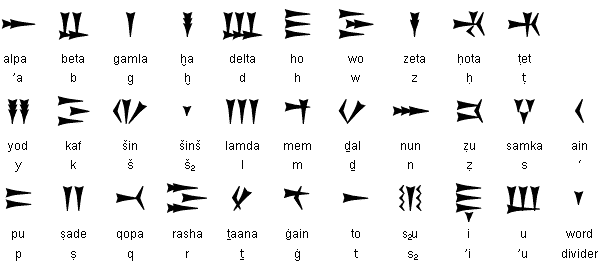
The Ugaritic script is a cuneiform (wedge-shaped) abjad
used from around 1400 BCE for Ugaritic, an extinct Northwest Semitic language
, and discovered in Ugarit
(modern Ras Shamra), Syria
, in 1928. It has 30 letters. Other languages (particularly Hurrian
) were occasionally written in the Ugaritic script in the area around Ugarit, although not elsewhere.
Clay tablet
s written in Ugaritic provide the earliest evidence of both the West and South Semitic orders of the alphabet, which gave rise to the alphabetic orders of the Hebrew
, Greek
, and Latin
alphabets on the one hand, and of the Ge'ez alphabet
on the other.
The script was written from left to right. Although cuneiform and pressed into clay, it was unrelated to Akkadian cuneiform
.
. In most syllables only consonants were written, including the /w/ and /j/ of diphthong
s. However, Ugaritic was unusual among early abjads in also writing vowels after glottal stop
. It is thought that the letter for the syllable /ʔa/, alpha, originally represented the consonant /ʔ/, as in other Semitic abjads, and that it was later restricted to /ʔa/ when letters for /ʔi/ and /ʔu/ were added to the end of the alphabet.
The final consonantal letter of the alphabet, ś, was added to transcribe Hurrian
words. It is the only Ugaritic letter to derive from Mesopotamian cuneiform.
The only punctuation is a word divider.
, Anatolia
, Cyprus
, Crete
, and Mesopotamia
. Ugaritic combined the system of the Semitic abjad with the appearance of Mesopotamian cuneiform. However, scholars have searched in vain for graphic prototypes of the Ugaritic letters in Mesopotamian cuneiform. Recently, some have suggested that Ugaritic represents some form of the Proto-Sinaitic alphabet
, the letter forms distorted as an adaptation to writing on clay with a stylus. (There may also have been a degree of influence from the poorly-understood Byblos syllabary
.) It has been proposed in this regard that the two basic shapes in cuneiform, a linear wedge, as in , and a corner wedge, as in , may correspond to lines and circles in the linear Semitic alphabets: the three Semitic letters with circles, preserved in the Greek
Θ, O and Latin
Q, are all made with corner wedges in Ugaritic: Tet, Ain, and Qopa. Other letters look similar as well: Ho resembles its assumed Greek cognate E, while Wo, Pu, and Thanna are similar to Greek Y, Π, and Σ turned on their sides. Jared Diamond
believes the alphabet was consciously designed, citing as evidence the possibility that the letters with the fewest strokes may have been the most frequent.
) have been found in two alphabetic orders: the "Northern Semitic order" more similar to the one found in the Hebrew and Phoenician, and more distantly, the Greek
and Latin alphabet
s; and the "Southern Semitic order" more similar to the one found in the South Arabian
, and more distantly, the Ge'ez alphabet
s. The letters are given in transcription
and in their Hebrew
cognates; letters missing from Hebrew are left blank.
North Semitic
South Semitic
Standard in April, 2003 with the release of version 4.0.
The Unicode block for Ugaritic is U+10380–U+1039F:
Abjad
An abjad is a type of writing system in which each symbol always or usually stands for a consonant; the reader must supply the appropriate vowel....
used from around 1400 BCE for Ugaritic, an extinct Northwest Semitic language
Northwest Semitic languages
The Northwest Semitic languages form a medium-level division of the Semitic language family. The languages of this group are spoken by approximately eight million people today. The group is generally divided into three branches: Ugaritic , Canaanite and Aramaic...
, and discovered in Ugarit
Ugarit
Ugarit was an ancient port city in the eastern Mediterranean at the Ras Shamra headland near Latakia, Syria. It is located near Minet el-Beida in northern Syria. It is some seven miles north of Laodicea ad Mare and approximately fifty miles east of Cyprus...
(modern Ras Shamra), Syria
Syria
Syria , officially the Syrian Arab Republic , is a country in Western Asia, bordering Lebanon and the Mediterranean Sea to the West, Turkey to the north, Iraq to the east, Jordan to the south, and Israel to the southwest....
, in 1928. It has 30 letters. Other languages (particularly Hurrian
Hurrian language
Hurrian is a conventional name for the language of the Hurrians , a people who entered northern Mesopotamia around 2300 BC and had mostly vanished by 1000 BC. Hurrian was the language of the Mitanni kingdom in northern Mesopotamia, and was likely spoken at least initially in Hurrian settlements in...
) were occasionally written in the Ugaritic script in the area around Ugarit, although not elsewhere.
Clay tablet
Clay tablet
In the Ancient Near East, clay tablets were used as a writing medium, especially for writing in cuneiform, throughout the Bronze Age and well into the Iron Age....
s written in Ugaritic provide the earliest evidence of both the West and South Semitic orders of the alphabet, which gave rise to the alphabetic orders of the Hebrew
Hebrew alphabet
The Hebrew alphabet , known variously by scholars as the Jewish script, square script, block script, or more historically, the Assyrian script, is used in the writing of the Hebrew language, as well as other Jewish languages, most notably Yiddish, Ladino, and Judeo-Arabic. There have been two...
, Greek
Greek alphabet
The Greek alphabet is the script that has been used to write the Greek language since at least 730 BC . The alphabet in its classical and modern form consists of 24 letters ordered in sequence from alpha to omega...
, and Latin
Latin alphabet
The Latin alphabet, also called the Roman alphabet, is the most recognized alphabet used in the world today. It evolved from a western variety of the Greek alphabet called the Cumaean alphabet, which was adopted and modified by the Etruscans who ruled early Rome...
alphabets on the one hand, and of the Ge'ez alphabet
Ge'ez alphabet
Ge'ez , also called Ethiopic, is a script used as an abugida for several languages of Ethiopia and Eritrea but originated in an abjad used to write Ge'ez, now the liturgical language of the Ethiopian and Eritrean Orthodox Church...
on the other.
The script was written from left to right. Although cuneiform and pressed into clay, it was unrelated to Akkadian cuneiform
Cuneiform script
Cuneiform script )) is one of the earliest known forms of written expression. Emerging in Sumer around the 30th century BC, with predecessors reaching into the late 4th millennium , cuneiform writing began as a system of pictographs...
.
Function
Ugaritic was an augmented abjadAbjad
An abjad is a type of writing system in which each symbol always or usually stands for a consonant; the reader must supply the appropriate vowel....
. In most syllables only consonants were written, including the /w/ and /j/ of diphthong
Diphthong
A diphthong , also known as a gliding vowel, refers to two adjacent vowel sounds occurring within the same syllable. Technically, a diphthong is a vowel with two different targets: That is, the tongue moves during the pronunciation of the vowel...
s. However, Ugaritic was unusual among early abjads in also writing vowels after glottal stop
Glottal stop
The glottal stop, or more fully, the voiceless glottal plosive, is a type of consonantal sound used in many spoken languages. In English, the feature is represented, for example, by the hyphen in uh-oh! and by the apostrophe or [[ʻokina]] in Hawaii among those using a preservative pronunciation of...
. It is thought that the letter for the syllable /ʔa/, alpha, originally represented the consonant /ʔ/, as in other Semitic abjads, and that it was later restricted to /ʔa/ when letters for /ʔi/ and /ʔu/ were added to the end of the alphabet.
The final consonantal letter of the alphabet, ś, was added to transcribe Hurrian
Hurrian language
Hurrian is a conventional name for the language of the Hurrians , a people who entered northern Mesopotamia around 2300 BC and had mostly vanished by 1000 BC. Hurrian was the language of the Mitanni kingdom in northern Mesopotamia, and was likely spoken at least initially in Hurrian settlements in...
words. It is the only Ugaritic letter to derive from Mesopotamian cuneiform.
The only punctuation is a word divider.
Origin
At the time the Ugaritic script was in use (ca. 1500–1300 BCE), Ugarit was at the centre of the literate world, among EgyptAncient Egypt
Ancient Egypt was an ancient civilization of Northeastern Africa, concentrated along the lower reaches of the Nile River in what is now the modern country of Egypt. Egyptian civilization coalesced around 3150 BC with the political unification of Upper and Lower Egypt under the first pharaoh...
, Anatolia
Anatolia
Anatolia is a geographic and historical term denoting the westernmost protrusion of Asia, comprising the majority of the Republic of Turkey...
, Cyprus
Cyprus
Cyprus , officially the Republic of Cyprus , is a Eurasian island country, member of the European Union, in the Eastern Mediterranean, east of Greece, south of Turkey, west of Syria and north of Egypt. It is the third largest island in the Mediterranean Sea.The earliest known human activity on the...
, Crete
Crete
Crete is the largest and most populous of the Greek islands, the fifth largest island in the Mediterranean Sea, and one of the thirteen administrative regions of Greece. It forms a significant part of the economy and cultural heritage of Greece while retaining its own local cultural traits...
, and Mesopotamia
Mesopotamia
Mesopotamia is a toponym for the area of the Tigris–Euphrates river system, largely corresponding to modern-day Iraq, northeastern Syria, southeastern Turkey and southwestern Iran.Widely considered to be the cradle of civilization, Bronze Age Mesopotamia included Sumer and the...
. Ugaritic combined the system of the Semitic abjad with the appearance of Mesopotamian cuneiform. However, scholars have searched in vain for graphic prototypes of the Ugaritic letters in Mesopotamian cuneiform. Recently, some have suggested that Ugaritic represents some form of the Proto-Sinaitic alphabet
Proto-Sinaitic alphabet
Proto-Sinaitic is a Middle Bronze Age script attested in a very small collection of inscriptions at Serabit el-Khadim in the Sinai Peninsula. Due to the extreme scarcity of Proto-Sinaitic signs, very little is known with certainty about the nature of the script...
, the letter forms distorted as an adaptation to writing on clay with a stylus. (There may also have been a degree of influence from the poorly-understood Byblos syllabary
Byblos syllabary
The Byblos syllabary, also known as the Pseudo-hieroglyphic script, Proto-Byblian, Proto-Byblic, or Byblic, is officially an undeciphered writing system, known from ten inscriptions found in Byblos. The inscriptions are engraved on bronze plates and spatulas, and carved in stone...
.) It has been proposed in this regard that the two basic shapes in cuneiform, a linear wedge, as in , and a corner wedge, as in , may correspond to lines and circles in the linear Semitic alphabets: the three Semitic letters with circles, preserved in the Greek
Greek alphabet
The Greek alphabet is the script that has been used to write the Greek language since at least 730 BC . The alphabet in its classical and modern form consists of 24 letters ordered in sequence from alpha to omega...
Θ, O and Latin
Latin
Latin is an Italic language originally spoken in Latium and Ancient Rome. It, along with most European languages, is a descendant of the ancient Proto-Indo-European language. Although it is considered a dead language, a number of scholars and members of the Christian clergy speak it fluently, and...
Q, are all made with corner wedges in Ugaritic: Tet, Ain, and Qopa. Other letters look similar as well: Ho resembles its assumed Greek cognate E, while Wo, Pu, and Thanna are similar to Greek Y, Π, and Σ turned on their sides. Jared Diamond
Jared Diamond
Jared Mason Diamond is an American scientist and author whose work draws from a variety of fields. He is currently Professor of Geography and Physiology at UCLA...
believes the alphabet was consciously designed, citing as evidence the possibility that the letters with the fewest strokes may have been the most frequent.
Abecedaries
Lists of Ugaritic letters (abecedaria, singular abecedariumAbecedarium
An abecedarium is an inscription consisting of the letters of an alphabet, almost always listed in order. Typically, abecedaria are practice exercises....
) have been found in two alphabetic orders: the "Northern Semitic order" more similar to the one found in the Hebrew and Phoenician, and more distantly, the Greek
Greek alphabet
The Greek alphabet is the script that has been used to write the Greek language since at least 730 BC . The alphabet in its classical and modern form consists of 24 letters ordered in sequence from alpha to omega...
and Latin alphabet
Latin alphabet
The Latin alphabet, also called the Roman alphabet, is the most recognized alphabet used in the world today. It evolved from a western variety of the Greek alphabet called the Cumaean alphabet, which was adopted and modified by the Etruscans who ruled early Rome...
s; and the "Southern Semitic order" more similar to the one found in the South Arabian
South Arabian alphabet
The ancient Yemeni alphabet branched from the Proto-Sinaitic alphabet in about the 9th century BC. It was used for writing the Yemeni Old South Arabic languages of the Sabaean, Qatabanian, Hadramautic, Minaean, Himyarite, and proto-Ge'ez in Dʿmt...
, and more distantly, the Ge'ez alphabet
Ge'ez alphabet
Ge'ez , also called Ethiopic, is a script used as an abugida for several languages of Ethiopia and Eritrea but originated in an abjad used to write Ge'ez, now the liturgical language of the Ethiopian and Eritrean Orthodox Church...
s. The letters are given in transcription
Transcription (linguistics)
Transcription in the linguistic sense is the systematic representation of language in written form. The source can either be utterances or preexisting text in another writing system, although some linguists only consider the former as transcription.Transcription should not be confused with...
and in their Hebrew
Hebrew language
Hebrew is a Semitic language of the Afroasiatic language family. Culturally, is it considered by Jews and other religious groups as the language of the Jewish people, though other Jewish languages had originated among diaspora Jews, and the Hebrew language is also used by non-Jewish groups, such...
cognates; letters missing from Hebrew are left blank.
North Semitic
| b | g | d | h | w | z | y | k | š | l | m | n | s | p | q | r | t | ś | ||||||||||
| א | ב | ג | ד | ה | ו | ז | ח | ט | י | כ | ל | מ | נ | ס | ע | פ | צ | ק | ר | ש | ת | שׂ |
South Semitic
| h | l | m | q | w | š | r | t | s | k | n | b | ś | p | g | d | z | y | ||||||||||
| ה | ל | ח | מ | ק | ו | ר | ת | ס | כ | נ | ח׳ | ב | שׂ | פ | א | ע | ט׳ | ג | ד | ע׳ | ט | ז | ד׳ | י | ש | צ |
Letters
| style="font-family: Aegean, Code2001, Andagii, ALPHABETUM Unicode, MPH 2B Damase;">𐎀 | alpa | |
| style="font-family: Aegean, Code2001, Andagii, ALPHABETUM Unicode, MPH 2B Damase;">𐎁 | b | beta |
| style="font-family: Aegean, Code2001, Andagii, ALPHABETUM Unicode, MPH 2B Damase;">𐎂 | g | gamla |
| style="font-family: Aegean, Code2001, Andagii, ALPHABETUM Unicode, MPH 2B Damase;">𐎃 | ||
| style="font-family: Aegean, Code2001, Andagii, ALPHABETUM Unicode, MPH 2B Damase;">𐎄 | d | delta |
| style="font-family: Aegean, Code2001, Andagii, ALPHABETUM Unicode, MPH 2B Damase;">𐎅 | h | ho |
| style="font-family: Aegean, Code2001, Andagii, ALPHABETUM Unicode, MPH 2B Damase;">𐎆 | w | wo |
| style="font-family: Aegean, Code2001, Andagii, ALPHABETUM Unicode, MPH 2B Damase;">𐎇 | z | zeta |
| style="font-family: Aegean, Code2001, Andagii, ALPHABETUM Unicode, MPH 2B Damase;">𐎈 | ||
| style="font-family: Aegean, Code2001, Andagii, ALPHABETUM Unicode, MPH 2B Damase;">𐎉 | ||
| style="font-family: Aegean, Code2001, Andagii, ALPHABETUM Unicode, MPH 2B Damase;">𐎊 | y | yod |
| style="font-family: Aegean, Code2001, Andagii, ALPHABETUM Unicode, MPH 2B Damase;">𐎋 | k | kaf |
| style="font-family: Aegean, Code2001, Andagii, ALPHABETUM Unicode, MPH 2B Damase;">𐎌 | š | šin |
| style="font-family: Aegean, Code2001, Andagii, ALPHABETUM Unicode, MPH 2B Damase;"> | š2 | šinš |
| style="font-family: Aegean, Code2001, Andagii, ALPHABETUM Unicode, MPH 2B Damase;">𐎍 | l | lamda |
| style="font-family: Aegean, Code2001, Andagii, ALPHABETUM Unicode, MPH 2B Damase;">𐎎 | m | mem |
| style="font-family: Aegean, Code2001, Andagii, ALPHABETUM Unicode, MPH 2B Damase;">𐎏 | ||
| style="font-family: Aegean, Code2001, Andagii, ALPHABETUM Unicode, MPH 2B Damase;">𐎐 | n | nun |
| style="font-family: Aegean, Code2001, Andagii, ALPHABETUM Unicode, MPH 2B Damase;">𐎑 | ||
| style="font-family: Aegean, Code2001, Andagii, ALPHABETUM Unicode, MPH 2B Damase;">𐎒 | s | samka |
| style="font-family: Aegean, Code2001, Andagii, ALPHABETUM Unicode, MPH 2B Damase;">𐎓 | ||
| style="font-family: Aegean, Code2001, Andagii, ALPHABETUM Unicode, MPH 2B Damase;">𐎔 | p | pu |
| style="font-family: Aegean, Code2001, Andagii, ALPHABETUM Unicode, MPH 2B Damase;">𐎕 | ||
| style="font-family: Aegean, Code2001, Andagii, ALPHABETUM Unicode, MPH 2B Damase;">𐎖 | q | qopa |
| style="font-family: Aegean, Code2001, Andagii, ALPHABETUM Unicode, MPH 2B Damase;">𐎗 | r | raša |
| style="font-family: Aegean, Code2001, Andagii, ALPHABETUM Unicode, MPH 2B Damase;">𐎘 | ||
| style="font-family: Aegean, Code2001, Andagii, ALPHABETUM Unicode, MPH 2B Damase;">𐎙 | ġ | ġain |
| style="font-family: Aegean, Code2001, Andagii, ALPHABETUM Unicode, MPH 2B Damase;">𐎚 | t | to |
| style="font-family: Aegean, Code2001, Andagii, ALPHABETUM Unicode, MPH 2B Damase;">𐎝 | s2 | śu |
| style="font-family: Aegean, Code2001, Andagii, ALPHABETUM Unicode, MPH 2B Damase;">𐎛 | i | |
| style="font-family: Aegean, Code2001, Andagii, ALPHABETUM Unicode, MPH 2B Damase;">𐎜 | u | |
| style="font-family: Aegean, Code2001, Andagii, ALPHABETUM Unicode, MPH 2B Damase;">𐎟 | word divider | |
Unicode
Ugaritic script was added to the UnicodeUnicode
Unicode is a computing industry standard for the consistent encoding, representation and handling of text expressed in most of the world's writing systems...
Standard in April, 2003 with the release of version 4.0.
The Unicode block for Ugaritic is U+10380–U+1039F:
See also
- Old Persian cuneiform – a much later, unrelated attempt at a cuneiform semi-alphabet.
External links
- Ugaritic writing
- Ugaritic script (ancientscripts.com)
- Ugaritic cuneiform Omniglot entry on the subject
- Download an Ugaritic font (includes Unicode font)
- Ugaritic cuneiform characters from the UnicodeUnicodeUnicode is a computing industry standard for the consistent encoding, representation and handling of text expressed in most of the world's writing systems...
Ugaritic cuneiform script