
All Topics  
Eliezer Ben-Yehuda

 
Eliezer Ben Yehuda

   Email Print
   Bookmark   Link


Eliezer Ben-Yehuda


For the street named for Eliezer Ben Yehuda in Jerusalem
Jerusalem

Jerusalem is the capital of Israel and its List of Israeli cities in both population and area, with a population of 747,600 residents over an area of if Positions on Jerusalem East Jerusalem is included....
, Israel
Israel

Israel officially the State of Israel , is a country in the Middle East located on the eastern shore of the Mediterranean Sea. It borders Lebanon in the north, Syria in the northeast, Jordan in the east, and Egypt on the southwest, and contains geographically diverse features within its relatively small area....
, see Ben Yehuda Street
Ben Yehuda Street

Ben Yehuda Street , is a major, busy street in downtown Jerusalem, Israel. It is located where Jaffa Road and King George Street meet at one end with Zion Square....
.


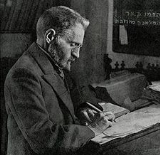
Eliezer Ben-Yehuda (7 January 1858–16 December 1922) was a key figure in the revival
Language revival

Language revitalization, language revival or reversing language shift is the attempt by interested parties, including individuals, cultural or community groups, governments, or political authorities, to reverse the decline of a language....
 of Hebrew
Hebrew language

Hebrew is a Semitic languages of the Afro-Asiatic languages. Modern Hebrew is spoken by more than seven million people in Israel and Classical Hebrew is used for prayer or study in Jews communities around the world....
 as a spoken language
Human language

A human language is a language primarily intended for communication among humans. The two major categories of human languages are natural languages and constructed languages....
. Ben-Yehuda regarded Hebrew and Zionism
Zionism

Zionism is the international Jewish political movement that originally supported the reestablishment of a homeland for the Jewish People in Palestine....
 as symbiotic: "The Hebrew language can live only if we revive the nation and return it to the fatherland," he wrote.

zer Ben-Yehuda was born
Eliezer Yitzhak Perlman, in Luzhky, Vilna Governorate
Vilna Governorate

The Viln? Governorate or Government of Vilna was a governorate of the Russian Empire created after the Partitions of Poland #Third Partition of the Polish-Lithuanian Commonwealth in 1795....
 of the Russian Empire
Russian Empire

File:Russian Emperor Flag.jpgFile:Romanov Flag.svgThe Russian Empire was a state that existed from 1721 until the Russian Revolution of 1917....
 (now Vitsebsk Voblast
Vitsebsk Voblast

Vitsebsk Voblast or Vitebsk Oblast is a province of Belarus with its Capital city being Vitebsk.As of a 2005 estimate, the voblast has a population of 1,294,700....
, Belarus
Belarus

Belarus is a landlocked country in Eastern Europe, bordered by Russia to the north and east, Ukraine to the south, Poland to the west, and Lithuania and Latvia to the north....
).


Discussion
Ask a question about 'Eliezer Ben-Yehuda'
Start a new discussion about 'Eliezer Ben-Yehuda'
Answer questions from other users
Full Discussion Forum


Recent Posts


Encyclopedia


For the street named for Eliezer Ben Yehuda in Jerusalem
Jerusalem

Jerusalem is the capital of Israel and its List of Israeli cities in both population and area, with a population of 747,600 residents over an area of if Positions on Jerusalem East Jerusalem is included....
, Israel
Israel

Israel officially the State of Israel , is a country in the Middle East located on the eastern shore of the Mediterranean Sea. It borders Lebanon in the north, Syria in the northeast, Jordan in the east, and Egypt on the southwest, and contains geographically diverse features within its relatively small area....
, see Ben Yehuda Street
Ben Yehuda Street

Ben Yehuda Street , is a major, busy street in downtown Jerusalem, Israel. It is located where Jaffa Road and King George Street meet at one end with Zion Square....
.


Eliezer Ben-Yehuda (7 January 1858–16 December 1922) was a key figure in the revival
Language revival

Language revitalization, language revival or reversing language shift is the attempt by interested parties, including individuals, cultural or community groups, governments, or political authorities, to reverse the decline of a language....
 of Hebrew
Hebrew language

Hebrew is a Semitic languages of the Afro-Asiatic languages. Modern Hebrew is spoken by more than seven million people in Israel and Classical Hebrew is used for prayer or study in Jews communities around the world....
 as a spoken language
Human language

A human language is a language primarily intended for communication among humans. The two major categories of human languages are natural languages and constructed languages....
. Ben-Yehuda regarded Hebrew and Zionism
Zionism

Zionism is the international Jewish political movement that originally supported the reestablishment of a homeland for the Jewish People in Palestine....
 as symbiotic: "The Hebrew language can live only if we revive the nation and return it to the fatherland," he wrote.

Biography

Eliezer Ben-Yehuda was born
Eliezer Yitzhak Perlman, in Luzhky, Vilna Governorate
Vilna Governorate

The Viln? Governorate or Government of Vilna was a governorate of the Russian Empire created after the Partitions of Poland #Third Partition of the Polish-Lithuanian Commonwealth in 1795....
 of the Russian Empire
Russian Empire

File:Russian Emperor Flag.jpgFile:Romanov Flag.svgThe Russian Empire was a state that existed from 1721 until the Russian Revolution of 1917....
 (now Vitsebsk Voblast
Vitsebsk Voblast

Vitsebsk Voblast or Vitebsk Oblast is a province of Belarus with its Capital city being Vitebsk.As of a 2005 estimate, the voblast has a population of 1,294,700....
, Belarus
Belarus

Belarus is a landlocked country in Eastern Europe, bordered by Russia to the north and east, Ukraine to the south, Poland to the west, and Lithuania and Latvia to the north....
). He attended heder where he studied Hebrew and the Bible from the age of three, as was customary among the Jews of Eastern Europe. By the age of twelve he had been studying in Hebrew for nine years and had read large portions of the Torah
Torah

The term "Torah" , or Five Books of Moses or Pentateuch, refers to the entirety of Judaism's founding Halakha and ethical religious texts....
, Mishna, and Talmud
Talmud

The Talmud is a record of rabbinic discussions pertaining to Halakha, Jewish ethics, customs, and history. It is a central text of mainstream Judaism....
. His parents hoped he would become a rabbi
Rabbi

Rabbi , in Judaism, means a religious ?teacher?, or more literally, ?my great one?, when addressing any master. The word rabbi derives from the Hebrew root word , rav, which in biblical Hebrew means ?great?, used in many senses, including the sense of a ?master? and apprentice, whence someone who is a distinguished ?teacher?....
, and sent him to a yeshiva
Yeshiva

Yeshiva or yeshivah , or metivta or mesivta ) also frequently referred to as a Beth midrash, Talmudical Academy, Rabbinical Academy or Rabbinical School is an institution unique to classical Judaism for Torah study, the study of Talmud, Rabbinic literature and History of responsa....
. There, he continued to study ancient Hebrew and was also exposed to the Hebrew of the enlightenment
Haskalah

Haskalah , the Jewish Enlightenment, was a movement among European Jews in the late 18th century that advocated adopting Age of Enlightenment values, pressing for better Social integration into European society, and increasing education in secular studies, Hebrew language, and Jewish history....
, including secular writings. Later, he learned French, German, and Russian, and was sent to Dünaburg
Daugavpils

Daugavpils is the second largest city in Latvia. It is located approximately 230 km south-east of the Latvian capital, Riga, on the banks of the Daugava River....
 for more education. Reading the Hebrew language newspaper
HaShahar, he became acquainted with Zionism
Zionism

Zionism is the international Jewish political movement that originally supported the reestablishment of a homeland for the Jewish People in Palestine....
 and concluded that the revival of Hebrew language in the Land of Israel
Land of Israel

For other uses, see Israel The Land of Israel is the region which, according to the Hebrew Bible, was promised by God to the descendants of Abraham through his son Isaac and to the Israelites, descendants of Jacob, Abraham's grandson....
 could unite all Jews worldwide.

Ben Yehuda was married twice, to two sisters. His first wife, Devora (nee Jonas), died in 1891 of tuberculosis
Tuberculosis

Tuberculosis is a common and often deadly infectious disease caused by mycobacterium, mainly Mycobacterium tuberculosis . Tuberculosis usually attacks the lungs but can also affect the central nervous system, the lymphatic system, the circulatory system, the genitourinary system, the gastrointestinal system, bones, joints, and even the...
, leaving him with five small children. Soon after his wife's death, three of his children died of diphtheria
Diphtheria

Diphtheria is an upper Respiration tract illness characterized by sore throat, low fever, and an adherent membrane on the tonsils, pharynx, and/or nasal cavity....
 within a period of 10 days. Six months later he married Devora's younger sister, Paula Beila, who took the Hebrew name "Hemda". His wife Devora's final wish was that he should marry Paula.

Study in Paris

Upon graduation he went to Paris
Paris

Paris is the Capital of France and the country's largest city. It is situated on the river Seine, in northern France, at the heart of the ?le-de-France Regions of France ....
 to study at the Sorbonne University. Among the subjects he studied there were history and politics of the Middle East
Middle East

File:GreaterMiddleEast1.pngThe Middle East is a region that spans southwestern Asia, western Asia, and northeastern Africa. It has no clear boundaries, often used as a synonym to Near East, in opposition to Far East....
, but the one that had the most lasting effect was Hebrew - specifically, his advanced Hebrew classes taught in Hebrew. It was this use of Hebrew in a spoken form that convinced him fully that the revival of Hebrew as the language of a nation was practical. Ben-Yehuda spent four years in Paris.

Move to Jerusalem

In 1881 Ben-Yehuda traveled to Jerusalem, then ruled by the Ottoman Empire
Ottoman Empire

The Ottoman Empire , also known by its contemporaries as the Turkish Empire or Turkey , was an empire that lasted from 1299?1923. It was Treaty of Lausanne by the Republic of Turkey, which was officially proclaimed on October 29, 1923....
. He found a job teaching at the Alliance Israelite Universelle school. Motivated by the surrounding ideals of renovation and rejection of the diaspora
Jewish diaspora

The Jewish diaspora , the presence of Jews outside of the Land of Israel, is a result of the expulsion or emigration of Jews from Israel and religious conversion to Judaism....
 lifestyle, Ben-Yehuda set out to develop a new language that could replace Yiddish and other regional dialects as a means of everyday communication between Jews who made aliyah
Aliyah

Aliyah refers to Jewish immigration to Greater Israel. The opposite action, Jewish emigration from Israel, is referred to as Yerida ....
 from various regions of the world.

Ben-Yehuda raised his son, Ben-Zion Ben-Yehuda
Itamar Ben-Avi

Itamar Ben-Avi , born Ben-Zion Ben-Yehuda , was the son of Eliezer Ben-Yehuda, who revived the Hebrew language and brought up his son to be the first native Hebrew speaker of modern times....
 (the first name meaning "son of Zion"), entirely through Hebrew. He refused to let his son be exposed to other languages during childhood. It is said he once reprimanded his wife, after he caught her singing a Russian
Russian language

Russian is the most geographically widespread language of Eurasia, the most widely spoken of the Slavic languages, and the largest native language in Europe....
 lullaby to the child. His son was the first native speaker of modern Hebrew; his autobiography, written under the pen name Itamar Ben-Avi (????? ?? ??"?, "Itamar, son of Avi", Avi is an abbreviation created from the three first letters of the name Eliezer Ben Yehuda), is still widely read in Israel.

Journalistic career

Ben-Yehuda was the editor of several Hebrew-language newspapers: HaZvi, Hashkafa
Hashkafa

Hashkafa is a Hebrew language term often used when referring to ones personal Jewish philosophy....
 and HaOr. HaZvi was closed down for a year in the wake of opposition from Jerusalem's ultra-Orthodox community, which fiercely objected to the use of Hebrew, the holy tongue, for everyday conversation.

Lexicography

Ben-Yehuda was the driving spirit behind the establishment of the Committee of the Hebrew Language, later the Academy of the Hebrew Language
Academy of the Hebrew Language

The Academy of the Hebrew Language was established by the Israeli Government in 1953 as the "supreme institution for scholarship on the Hebrew language"....
, an organization that still exists today. He was the author of the first modern Hebrew dictionary and became known as the "reviver" of the Hebrew language, despite opposition to some of the words he coined. Many of these words have become part and parcel of the language but others - some 2,000 words - never caught on. His word for "tomato," for instance, was
badura, but Hebrew speakers today use the word agvania.

Death

In December 1922, Ben Yehuda, 64, died of tuberculosis
Tuberculosis

Tuberculosis is a common and often deadly infectious disease caused by mycobacterium, mainly Mycobacterium tuberculosis . Tuberculosis usually attacks the lungs but can also affect the central nervous system, the lymphatic system, the circulatory system, the genitourinary system, the gastrointestinal system, bones, joints, and even the...
, from which he suffered most of his life. He was buried on the Mount of Olives
Mount of Olives

The Mount of Olives is a mountain ridge in east Jerusalem with three peaks running from north to south. The highest, at-Tur, rises to 818 meters ....
 in Jerusalem. His funeral was attended by 30,000 people.

See also

  • Netiva Ben-Yehuda
    Netiva Ben-Yehuda

    Netiva Ben Yehuda is an Israelis author, editor, and former soldier of the Palmach. Her writings in particular have made her one of its most famous female members....
  • Revival of Hebrew language
    Revival of Hebrew language

    The revival of the Hebrew language was a process that took place in Europe and Israel at the end of the 19th century and in the 20th century, through which the Hebrew language changed from a liturgical, written language to a spoken language of official status in the State of Israel....


Bibliography

  • Fellman, Jack (1973). The revival of a classical tongue: Eliezer Ben Yehuda and the modern Hebrew language. The Hague, Netherlands: Mouton ISBN 90-279-2495-3
  • Robert St. John. Tongue of the Prophets, Doubleday & Company, Inc. Garden City, New York, 1952. ISBN 0-8371-2631-2
  • Yosef Lang. The Life of Eliezer Ben Yehuda. Yad Yitzhak Ben Zvi, 2 volumes, (Hebrew)
  • Ilan Stavans, Resurrecting Hebrew (2008)