


Christianity in Syria

Encyclopedia

Melkite Greek Catholic Church
The Melkite Greek Catholic Church is an Eastern Catholic Church in full communion with the Holy See as part of the worldwide Catholic Church. The Melkites, Byzantine Rite Catholics of mixed Eastern Mediterranean and Greek origin, trace their history to the early Christians of Antioch, Syria, of...
, and then the Syriac Orthodox Church
Syriac Orthodox Church
The Syriac Orthodox Church; is an autocephalous Oriental Orthodox church based in the Eastern Mediterranean, with members spread throughout the world. The Syriac Orthodox Church claims to derive its origin from one of the first Christian communities, established in Antioch by the Apostle St....
; there are also a minority of Protestants
Protestantism
Protestantism is one of the three major groupings within Christianity. It is a movement that began in Germany in the early 16th century as a reaction against medieval Roman Catholic doctrines and practices, especially in regards to salvation, justification, and ecclesiology.The doctrines of the...
. The city of Aleppo
Aleppo
Aleppo is the largest city in Syria and the capital of Aleppo Governorate, the most populous Syrian governorate. With an official population of 2,301,570 , expanding to over 2.5 million in the metropolitan area, it is also one of the largest cities in the Levant...
is believed to have the largest number of Christians in Syria.
The President of Syria has to be a Muslim, as a result of popular demand at the time the constitution was written. However, Syria does not profess a state religion, and does not officially favor any religion over another.
Status of Christians in Syria
DamascusDamascus
Damascus , commonly known in Syria as Al Sham , and as the City of Jasmine , is the capital and the second largest city of Syria after Aleppo, both are part of the country's 14 governorates. In addition to being one of the oldest continuously inhabited cities in the world, Damascus is a major...
was one of the first regions to receive Christianity during the ministry of St Paul
Paul of Tarsus
Paul the Apostle , also known as Saul of Tarsus, is described in the Christian New Testament as one of the most influential early Christian missionaries, with the writings ascribed to him by the church forming a considerable portion of the New Testament...
. There were more Christians in Damascus than anywhere else. After the military expansion of the Umayyad
Umayyad
The Umayyad Caliphate was the second of the four major Arab caliphates established after the death of Muhammad. It was ruled by the Umayyad dynasty, whose name derives from Umayya ibn Abd Shams, the great-grandfather of the first Umayyad caliph. Although the Umayyad family originally came from the...
empire into Syria
Syria
Syria , officially the Syrian Arab Republic , is a country in Western Asia, bordering Lebanon and the Mediterranean Sea to the West, Turkey to the north, Iraq to the east, Jordan to the south, and Israel to the southwest....
and Anatolia
Anatolia
Anatolia is a geographic and historical term denoting the westernmost protrusion of Asia, comprising the majority of the Republic of Turkey...
, the teachings of Islam
Islam
Islam . The most common are and . : Arabic pronunciation varies regionally. The first vowel ranges from ~~. The second vowel ranges from ~~~...
came into practice and many became Muslims.
Nowadays, Damascus still contains a sizeable proportion of Christians, with churches all over the city, but particularly in the district of Bab Touma. Mass
Mass
Mass can be defined as a quantitive measure of the resistance an object has to change in its velocity.In physics, mass commonly refers to any of the following three properties of matter, which have been shown experimentally to be equivalent:...
es are held every Sunday and civil servants
Civil service
The term civil service has two distinct meanings:* A branch of governmental service in which individuals are employed on the basis of professional merit as proven by competitive examinations....
are given Sunday mornings off to allow them to attend church, even though Sunday is a working day in Syria. Schools in Christian-dominated districts have Saturday and Sunday as the weekend, while the official Syrian weekend falls on Friday and Saturday.
In May 2011, International Christian Concern
International Christian Concern
International Christian Concern is a non-denominational, non-governmental, Christian watchdog group, located in Washington, DC, whose concern is the human rights of Christians...
indicated that Christians in Syria were more afraid of the anti-government protesters than of the government itself, because under the Syrian Assad government there has been tolerance towards religious minorities.
Integration
Christians (as well as the few remaining Jews in the country) engage in every aspect of Syrian life. Following in the traditions of Paul, who practiced his preaching and ministry in the marketplaceMarketplace
A marketplace is the space, actual, virtual or metaphorical, in which a market operates. The term is also used in a trademark law context to denote the actual consumer environment, ie. the 'real world' in which products and services are provided and consumed.-Marketplaces and street markets:A...
, Syrian Christians are participants in the economy, the academic, scientific, engineering, arts, and intellectual life, the entertainment scene, and the political arena of Syria. Many Syrian Christians are public sector and private sector managers and directors, while some are local administrators, members of Parliament, and ministers in the government. A number of Syrian Christians are also officers in the armed forces of Syria. They have preferred to mix in with Muslims rather than form all-Christian units and brigades, and fought alongside their Muslim compatriots against Israel
Israel
The State of Israel is a parliamentary republic located in the Middle East, along the eastern shore of the Mediterranean Sea...
i forces in the various Arab-Israeli conflicts of the 20th century. In addition to their daily work, Syrian Christians also participate in volunteer activities in the less developed areas of Syria. As a result, Syrian Christians are generally viewed by other Syrians as an asset to the larger community.
Separate
Syrian Christians have their own courts that deal with civil cases like marriage, divorce and inheritance based on BibleBible
The Bible refers to any one of the collections of the primary religious texts of Judaism and Christianity. There is no common version of the Bible, as the individual books , their contents and their order vary among denominations...
teachings. By agreement with other communities, Syrian Christian churches do not proselytise
Proselytism
Proselytizing is the act of attempting to convert people to another opinion and, particularly, another religion. The word proselytize is derived ultimately from the Greek language prefix προσ- and the verb ἔρχομαι in the form of προσήλυτος...
to Muslims and do not accept converts
Conversion to Christianity
Conversion to Christianity is the religious conversion of a previously non-Christian person to some form of Christianity. It has been called the foundational experience of Christian life...
from Islam. Noteworthy Syrian Christians include the chronicler Paul of Aleppo
Paul of Aleppo
Paul Zaim, known sometime also as Paul of Aleppo was a Syrian Melkite clergyman and chronicler...
, the chess player Philip Stamma, and the Syrian Armenian musician George Tutunjian
George Tutunjian
George Tutunjian was a singer of Armenian patriotic and revolutionary songs and life-long supporter of Armenian Revolutionary Federation .He started singing at the age of 22...
.
Origins
The Christian communities of Syria, which comprise about 10 percent of the population, spring from two great traditions. On the one hand, Roman Catholicism and ProtestantismProtestantism
Protestantism is one of the three major groupings within Christianity. It is a movement that began in Germany in the early 16th century as a reaction against medieval Roman Catholic doctrines and practices, especially in regards to salvation, justification, and ecclesiology.The doctrines of the...
were introduced by missionaries and a small number of Syrians are members of Western denominations. The vast majority, on the other hand, belong to the Eastern communions
Eastern Christianity
Eastern Christianity comprises the Christian traditions and churches that developed in the Balkans, Eastern Europe, Asia Minor, the Middle East, Northeastern Africa, India and parts of the Far East over several centuries of religious antiquity. The term is generally used in Western Christianity to...
, which have existed in Syria since the earliest days of Christianity. The main Eastern groups are:
- the autonomous Orthodox churches;
- the Uniate churches, which are in communion with RomeDiocese of RomeThe Diocese of Rome is a diocese of the Catholic Church in Rome, Italy. The bishop of Rome is the Pope, who is the Supreme Pontiff and leader of the Catholic Church...
; - and the independent Assyrian Church of the EastAssyrian Church of the EastThe Assyrian Church of the East, officially the Holy Apostolic Catholic Assyrian Church of the East ʻIttā Qaddishtā w-Shlikhāitā Qattoliqi d-Madnĕkhā d-Āturāyē), is a Syriac Church historically centered in Mesopotamia. It is one of the churches that claim continuity with the historical...
, which in the past, western scholars labeled "Nestorian". Followers of the Assyrian Church of the East are almost all ethnic Assyrians/Syriacs, as are some Orthodox and Catholic Christians. Even though each group forms a separate community, Christians nevertheless cooperate increasingly.
The schisms that brought about the many sects resulted from political and doctrinal disagreements. The doctrine most commonly at issue was the nature of Christ. In 431, the Nestorian
Nestorianism
Nestorianism is a Christological doctrine advanced by Nestorius, Patriarch of Constantinople from 428–431. The doctrine, which was informed by Nestorius's studies under Theodore of Mopsuestia at the School of Antioch, emphasizes the disunion between the human and divine natures of Jesus...
s were separated from the main body of the Church because of their belief in the dual character of Christ, i.e., that he had two distinct but inseparable "qnoma" (ܩܢܘܡܐ, close in meaning to, but not exactly the same as, hypostasis), the human Jesus and the divine Logos. Therefore, according to Nestorian belief, Mary
Mary (mother of Jesus)
Mary , commonly referred to as "Saint Mary", "Mother Mary", the "Virgin Mary", the "Blessed Virgin Mary", or "Mary, Mother of God", was a Jewish woman of Nazareth in Galilee...
was not the mother of God but only of the man Jesus
Jesus
Jesus of Nazareth , commonly referred to as Jesus Christ or simply as Jesus or Christ, is the central figure of Christianity...
. The Council of Chalcedon
Council of Chalcedon
The Council of Chalcedon was a church council held from 8 October to 1 November, 451 AD, at Chalcedon , on the Asian side of the Bosporus. The council marked a significant turning point in the Christological debates that led to the separation of the church of the Eastern Roman Empire in the 5th...
, representing the mainstream of Christianity, in 451 confirmed the dual nature of Christ in one person; Mary was therefore the mother of a single person, mystically and simultaneously both human and divine. The Miaphysites taught that the Logos took on an instance of humanity as His own in one nature. They were the precursors of the present-day Syrian and Armenian Orthodox churches.
By the thirteenth century, breaks had developed between Eastern or Greek Christianity and Western or Latin Christianity. In the following centuries, however, especially during the Crusades, some of the Eastern churches professed the authority of the pope in Rome and entered into or re-affirmed communion with the Catholic Church. Today called the Eastern Catholic churches, they retain a distinctive language, canon law and liturgy.
Greek Orthodox church
The largest Christian denomination in Syria is the Greek Orthodox church, formerly known as the Melkite church after the 5-6th century Christian split, in which they stayed loyal to ConstantinopleConstantinople
Constantinople was the capital of the Roman, Eastern Roman, Byzantine, Latin, and Ottoman Empires. Throughout most of the Middle Ages, Constantinople was Europe's largest and wealthiest city.-Names:...
("melek" = king, is the Aramaic denomination for the Byzantine Emperor). The appellation "Greek" refers to the liturgy
Liturgy
Liturgy is either the customary public worship done by a specific religious group, according to its particular traditions or a more precise term that distinguishes between those religious groups who believe their ritual requires the "people" to do the "work" of responding to the priest, and those...
they use, sometimes used to refer to the ancestry and ethnicity of the members, however not all members are of Greek ancestry; in fact the Arabic word used is "Rum", which means "Byzantines", or Eastern Romans. Overall, the term is generally used to refer mostly to the Greek liturgy, and the Greek Orthodox denomination in Syria. Arabic is now its main liturgical language.
Syriac Orthodox church
The Syriac Orthodox or Jacobite church, whose liturgy is in Syriac, was severed from the favored church of the Byzantine Empire (Eastern Orthodoxy), over the Chalcedonian controversy.Armenian Apostolic church
The Armenian Apostolic ChurchArmenian Apostolic Church
The Armenian Apostolic Church is the world's oldest National Church, is part of Oriental Orthodoxy, and is one of the most ancient Christian communities. Armenia was the first country to adopt Christianity as its official religion in 301 AD, in establishing this church...
is the second largest Oriental Orthodox Christian group. It uses an Armenian
Armenian language
The Armenian language is an Indo-European language spoken by the Armenian people. It is the official language of the Republic of Armenia as well as in the region of Nagorno-Karabakh. The language is also widely spoken by Armenian communities in the Armenian diaspora...
liturgy and its doctrine is Miaphysite
Miaphysitism
Miaphysitism is a Christological formula of the Oriental Orthodox Churches and of the various churches adhering to the first three Ecumenical Councils...
(not monophysite, which is a mistaken term used or was used by the Chalcedonian Catholics and Orthodox).
Eastern Catholic churches
Of the Eastern-rite Catholic churches (known as "Uniate" because they united to Rome, although they themselves reject this denomination as pejorative) the oldest is the Maronite, with ties to Rome dating at least from the twelfth century. Their status before then is unclear, some claiming it originally held to the Monothelite heresy up until 1215, while the Maronite Church claims it has alway been in union with Rome. The liturgy is in Syriac.The Patriarchate of Antioch never recognized the mutual excommunications of Rome and Constantinople of 1054, so it was canonically still in union with both. After a disputed patriarchal election in 1724, it divided into two groups, one in union with Rome and the other with Constantinople. Today the term "Melkite" is in use only among the Greek Catholics. Like the Greek Orthodox Church, the Melkite Greek Catholic Church uses Greek and Arabic. Their membership is entirely ethnic Arabs.
Christians and Muslims
In Syria, there are several social differences between Christians and Muslims. Throughout the history, Syrian Christians were more highly urbanizedUrbanization
Urbanization, urbanisation or urban drift is the physical growth of urban areas as a result of global change. The United Nations projected that half of the world's population would live in urban areas at the end of 2008....
than Muslims; many live either in or around Aleppo
Aleppo
Aleppo is the largest city in Syria and the capital of Aleppo Governorate, the most populous Syrian governorate. With an official population of 2,301,570 , expanding to over 2.5 million in the metropolitan area, it is also one of the largest cities in the Levant...
, Hamah, or Latakia
Latakia
Latakia, or Latakiyah , is the principal port city of Syria, as well as the capital of the Latakia Governorate. In addition to serving as a port, the city is a manufacturing center for surrounding agricultural towns and villages...
, and there were relatively fewer of them in the lower income groups. Proportionately more Christians than Muslims are educated beyond the primary level, and there are relatively more of them in white-collar
White-collar worker
The term white-collar worker refers to a person who performs professional, managerial, or administrative work, in contrast with a blue-collar worker, whose job requires manual labor...
and professional occupations.
Christian areas
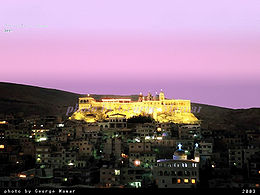
- AleppoAleppoAleppo is the largest city in Syria and the capital of Aleppo Governorate, the most populous Syrian governorate. With an official population of 2,301,570 , expanding to over 2.5 million in the metropolitan area, it is also one of the largest cities in the Levant...
, where the largest ArmenianArmeniansArmenian people or Armenians are a nation and ethnic group native to the Armenian Highland.The largest concentration is in Armenia having a nearly-homogeneous population with 97.9% or 3,145,354 being ethnic Armenian....
population resides. - DamascusDamascusDamascus , commonly known in Syria as Al Sham , and as the City of Jasmine , is the capital and the second largest city of Syria after Aleppo, both are part of the country's 14 governorates. In addition to being one of the oldest continuously inhabited cities in the world, Damascus is a major...
contains a sizable Christian community. - HomsHomsHoms , previously known as Emesa , is a city in western Syria and the capital of the Homs Governorate. It is above sea level and is located north of Damascus...
, which has the second largest Christian population known, especially in the nearby Valley of ChristiansWadi Al-NasarahWadi Al-Nasarah is a popular tourist site in western Syria close to the Lebanese border and administratively belonging to the governorate of Homs.Most of the people in the area is Christian.- Villages in the valley : Marmarita...
, a popular tourism site close to the Crac des Chevaliers; - SaidnayaSaidnayaSaidnaya is a city located in the mountains, 1500 metres above sea level, north of the city of Damascus in Syria and was one of the episcopal cities of the ancient Patriarchate of Antioch...
; - TartousTartousTartus is a city on the Mediterranean coast of Syria. Tartus is the second largest port city in Syria , and the largest city in Tartus Governorate. The population size is 98,000 .- Geography and climate :...
; - LatakiaLatakiaLatakia, or Latakiyah , is the principal port city of Syria, as well as the capital of the Latakia Governorate. In addition to serving as a port, the city is a manufacturing center for surrounding agricultural towns and villages...
- Suwayda;
- and Al-Hasakah, which has a large ethnic Assyrian/Syriac population.
See also
- Religion in SyriaReligion in SyriaMembership in a religious community is ordinarily determined by birth. Based on statistical analyses from 2006, Muslims were estimated as constituting 87% of the total population, although their proportion was possibly greater and was certainly growing. The Muslim birthrate reportedly was higher...
- List of Monasteries in Syria
- Roman Catholicism in SyriaRoman Catholicism in SyriaThe Roman Catholic Church in Syria is part of the worldwide Roman Catholic Church, under the spiritual leadership of the Pope and curia in Rome.There are 368,000 Catholics in Syria, approximately 2% of the total population...
- List of churches in Aleppo