

Ebla

Encyclopedia
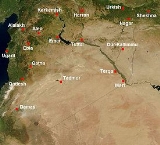
Ebla was an ancient city about 55 km (34.2 mi) southwest of Aleppo
. It was an important city-state in two periods, first in the late third millennium BC
, then again between 1800 and 1650 BC.
The site is most famous for the Ebla tablets
, an archive of about 20,000 cuneiform
tablets found there, dated from around 2250 BC, written in Sumerian script to record the Eblaite language
— a previously unknown language that is now the earliest attested Semitic language
after the closely related Akkadian.
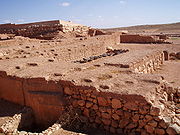
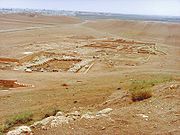
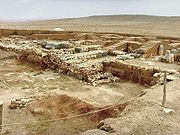
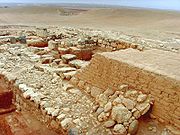
In 1964, Italian archaeologists from the University of Rome La Sapienza
under the direction of Paolo Matthiae
began excavating at Tell Mardikh. In 1968, they recovered a statue dedicated to the goddess Ishtar
bearing the name of Ibbit-Lim
, a king of Ebla. That identified the city, long known from Egypt
ian and Akkadian
inscriptions. In the next decade the team discovered a palace dating ca. 2500 – 2000 BC. About 20,000 well-preserved cuneiform tablets were discovered in the ruins. About 80% of the tablets are written using the usual Sumerian combination of logogram
s and phonetic signs, while the others exhibited an innovative, purely phonetic representation using Sumerian cuneiform of a previously unknown Semitic
language, which was called Eblaite
. Bilingual Sumerian/Eblaite vocabulary lists were found among the tablets, allowing them to be translated. Giovanni Pettinato
and Mitchell Dahood believed the Eblaite language was West Semitic
, however I. J. Gelb and others believed it was an East Semitic dialect, closer to the Akkadian language
. Now it is commonly accepted that Eblaite is part of the East Semitic branch of Semitic, and very close to the Akkadian language
.
Ebla's close link to southern Mesopotamia
, where the script had developed, further highlights the links between the Sumer
ians and Semitic
cultures at that time.
It now appears that the building housing the tablets was not the palace library, which may yet be uncovered, but an archive of provisions and tribute, law cases and diplomatic and trade contacts, and a scriptorium where apprentices copied texts. The larger tablets had originally been stored on shelves, but had fallen onto the floor when the palace was destroyed. The location where tablets were discovered where they had fallen allowed the excavators to reconstruct their original position on the shelves: it soon appeared that they were originally shelved according to subject.
from ca. 2300 BC.
Most of the Ebla palace tablets, which date from that period, are about economic matters; they provide a good look into the everyday life of the inhabitants, as well as many important insights into the cultural, economic, and political life in northern Mesopotamia
around the middle of the third millennium B.C. The texts are accounts of the state revenues, but they also include royal letters, Sumerian-Eblaite dictionaries, school texts and diplomatic documents, like treaties between Ebla and other towns of the region.
Ebla's most powerful king of this period was listed as Ebrium, or Ibrium
, who concluded the so-called "Treaty with Ashur", which offered the Assyria
n king Tudiya
the use of a trading post officially controlled by Ebla.
The fifth and last king of Ebla during this period was Ebrium's son, Ibbi-Sipish
, the first to succeed in a dynastic line, thus breaking with the established Eblaite custom of electing its ruler for a fixed term of office, lasting seven years. This absolutism may have contributed to the unrest that was ultimately instrumental in the city's decline. Meantime, however, the reign of Ibbi-Sipish was considered a time of inordinate prosperity, in part because the king was given to frequent travel abroad. It was recorded both in Ebla and Aleppo that he concluded specific treaties with neighboring Armi, as Aleppo
was called at the time.
, with whom it fought a lengthy war estimated as lasting 80–100 years. The tablets reveal that the city's inhabitants owned about 200,000 head of mixed cattle (sheep, goats, and cows). The city's main articles of trade were probably timber from the nearby mountains (and perhaps from Lebanon
), and textiles (mentioned in Sumerian texts from the city-state of Lagash
). Most of its trade seems to have been directed (by river-boat) towards Mesopotamia
(chiefly Kish
). The main palace at Ebla was also found to contain "antiques" dating from Ancient Egypt
with the names of pharaohs Khafra
and Pepi I. Handicrafts may also have been a major export: exquisite artifacts have been recovered from the ruins, including wood furniture inlaid with mother-of-pearl and composite statues created from different colored stones. The artistic style at Ebla may have influenced the quality work of the Akkadian empire.
Kings of Ebla (short chronology)
(written as d
BE), Ishtar
(Ashtar), Resheph
(Rasap), Kanish, Hadad
(Hadda), Shapash (Shipish), and some otherwise unknown ones (Kura
, Nidakul), plus a few Sumerian gods (Enki
and Ninki
) and Hurrian
gods (Ashtapi, Hebat
, Ishara
). The four city gates were named after the gods Dagan, Baal
(Hadda), Rasap, and Utu
. Overall, about forty deities are mentioned in the tablets as receiving sacrifices.
Among Pettinato's controversial claims, he has also suggested that there was a change in the theophoric names shown in many of the tablets found in the archive from *El to *Yah, indicated in the example of the transition from Mika’il to Mikaya. He regards this as evidence for an early use of the divine name Yah, a god who he believes later emerged as Yahweh
(YHWH). Bottero has suggested that this shift may instead indicate the popular acceptance of the Akkadian god Ea, introduced from the Sargonid Empire. Archi and Rainey, on the other hand, have suggested that the "-ya" is actually a diminutive ending used in shortened forms of personal names, and Müller has argued that the cuneiform sign NI should be interpreted, in this case, as an abbreviation for ì(-lí) ("god") rather than as ià (*Yah)—a view that Archi has since adopted with a modification, his reading been ì or lí. In any case, no list of gods or offerings mentions a deity by the name of Ya, and the connection with Yahweh is largely rejected today.
Many ancient Hebraic
names that have not been found in other Near Eastern languages have been reported to occur in similar forms in Eblaite (Adamu, H’à-wa
, Jabal
, Abarama
, Bilhah
, Ishma-el
, Isûra-el
, Esau
, Mika-el
, Mikaya, Saul
, David
, et al.). A large number of Biblical locations (many of them known from other sources) have also been reported to occur in the texts: for example Ashtaroth, Sinai, Jerusalem (Ye-ru-sa-lu-um), Hazor, Lachish
, Gezer
, Dor
, Megiddo, Joppa
, Ur
etc. Giovanni Pettinato has also claimed to find references to Sodom and Gomorrah
. However, much of the initial media excitement about supposed Eblaite connections with the Bible, based on preliminary guesses and speculations by Pettinato and others, is now widely deplored as "exceptional and unsubstantiated claims" and "great amounts of disinformation that leaked to the public". Contrary to many earlier claims, the present consensus is that "Ebla has no bearing on the Minor Prophets, the historical accuracy of the biblical Patriarchs, Yahweh worship, or Sodom and Gomorra". In Ebla studies, the focus has shifted away from comparisons with the Bible, and Ebla is now studied above all as an incipient civilization in its own right. The tide turned after a bitter personal and scholarly conflict between the scientists involved, as well as what some described as interference by the Syria
n authorities on political grounds.
Three versions of a text described as an Eblaite creation hymn have been found. They have been translated by Pettinato as
Some versions of Pettinato's translation use "he" instead of "you".
These lines seem to have points in common both with known Sumerian creation stories and with the Biblical account. Nevertheless, Alfonso Archi has objected that the original text is unclear to the point of being incomprehensible (texts from Ebla are difficult to read in general), leading him to conclude that "there is no Genesis creation story" in the Ebla documents.
and his grandson Naram-sin, the conquerors of much of Mesopotamia, each claimed to have destroyed Ebla; the exact date of destruction is the subject of continuing debate, but 2240 BC is a candidate. Michael Astour wrote the "History of Ebla" for the Eblaitica journal (Vols 3 & 4), where he discussed the competing theories, tentatively concluding that the main palace G containing the royal archives had been burned down some time prior to Lugalzagesi's sacking of Kish
, i.e. in the late pre-Sargonic era, ca. 2290 BC (Middle chronology).
During the next three centuries, Ebla was able to regain some economic importance in the region, but it never reached its former glory. It is possible the city had economic ties with the nearby city of Urshu, as is documented by economic texts from Drehem (a suburb of Nippur
), and from findings in Kanesh.
s. The first known ruler of Ebla in this
period was Megum, an Ensi
(governor) for Ur III during the reign of Amar-Sin
of Ur.
Ibbit-Lim
was the first attested king.
Ebla is mentioned in texts from Alalakh
from ca. 1750 BC. The city was destroyed again in the turbulent period of 1650 – 1600 BC, by a Hittite
king (Mursili I
or Hattusili I
). This is
attested to only by the fragmentary Hurro-Hittite Song of Release.
Ebla never recovered from its second destruction. The city continued as a small village until the 7th century AD, then was deserted and forgotten, until its archaeological rediscovery.
Aleppo
Aleppo is the largest city in Syria and the capital of Aleppo Governorate, the most populous Syrian governorate. With an official population of 2,301,570 , expanding to over 2.5 million in the metropolitan area, it is also one of the largest cities in the Levant...
. It was an important city-state in two periods, first in the late third millennium BC
3rd millennium BC
The 3rd millennium BC spans the Early to Middle Bronze Age.It represents a period of time in which imperialism, or the desire to conquer, grew to prominence, in the city states of the Middle East, but also throughout Eurasia, with Indo-European expansion to Anatolia, Europe and Central Asia. The...
, then again between 1800 and 1650 BC.
The site is most famous for the Ebla tablets
Ebla tablets
The Ebla tablets are a collection of as many as 1800 complete clay tablets, 4700 fragments and many thousand minor chips found in the palace archives of the ancient city of Ebla, Syria. The tablets were discovered by Italian archaeologist Paolo Matthiae and his team in 1974–75 during their...
, an archive of about 20,000 cuneiform
Cuneiform
Cuneiform can refer to:*Cuneiform script, an ancient writing system originating in Mesopotamia in the 4th millennium BC*Cuneiform , three bones in the human foot*Cuneiform Records, a music record label...
tablets found there, dated from around 2250 BC, written in Sumerian script to record the Eblaite language
Eblaite language
Eblaite is an extinct Semitic language, which was spoken in the 3rd millennium BC in the ancient city of Ebla, at Tell Mardikh , between Aleppo and Hama, in western modern Syria....
— a previously unknown language that is now the earliest attested Semitic language
Semitic languages
The Semitic languages are a group of related languages whose living representatives are spoken by more than 270 million people across much of the Middle East, North Africa and the Horn of Africa...
after the closely related Akkadian.
Discovery and excavation
In 1964, Italian archaeologists from the University of Rome La Sapienza
University of Rome La Sapienza
The Sapienza University of Rome, officially Sapienza – Università di Roma, formerly known as Università degli studi di Roma "La Sapienza", is a coeducational, autonomous state university in Rome, Italy...
under the direction of Paolo Matthiae
Paolo Matthiae
Paolo Matthiae is an Italian archaeologist.He was Professor of Archaeology and History of Art of the Ancient Near East in the University of Rome La Sapienza; he has been Director of the Ebla Expedition since 1963—in fact, its discoverer—and has published many articles and books about...
began excavating at Tell Mardikh. In 1968, they recovered a statue dedicated to the goddess Ishtar
Ishtar
Ishtar is the Assyrian and Babylonian goddess of fertility, love, war, and sex. She is the counterpart to the Sumerian Inanna and to the cognate north-west Semitic goddess Astarte.-Characteristics:...
bearing the name of Ibbit-Lim
Ibbit-Lim
The king Ibbit-Lim of Ebla in Syria is represented in a fragmentary basalt bust found in 1968, located now at the Museum in Aleppo, where most of the findings from Ebla are kept. Some are in the local museum of the department of Idlib, where the archaeological site of Ebla lies beneath Tel Mardikh...
, a king of Ebla. That identified the city, long known from Egypt
Ancient Egypt
Ancient Egypt was an ancient civilization of Northeastern Africa, concentrated along the lower reaches of the Nile River in what is now the modern country of Egypt. Egyptian civilization coalesced around 3150 BC with the political unification of Upper and Lower Egypt under the first pharaoh...
ian and Akkadian
Akkadian language
Akkadian is an extinct Semitic language that was spoken in ancient Mesopotamia. The earliest attested Semitic language, it used the cuneiform writing system derived ultimately from ancient Sumerian, an unrelated language isolate...
inscriptions. In the next decade the team discovered a palace dating ca. 2500 – 2000 BC. About 20,000 well-preserved cuneiform tablets were discovered in the ruins. About 80% of the tablets are written using the usual Sumerian combination of logogram
Logogram
A logogram, or logograph, is a grapheme which represents a word or a morpheme . This stands in contrast to phonograms, which represent phonemes or combinations of phonemes, and determinatives, which mark semantic categories.Logograms are often commonly known also as "ideograms"...
s and phonetic signs, while the others exhibited an innovative, purely phonetic representation using Sumerian cuneiform of a previously unknown Semitic
Semitic
In linguistics and ethnology, Semitic was first used to refer to a language family of largely Middle Eastern origin, now called the Semitic languages...
language, which was called Eblaite
Eblaite language
Eblaite is an extinct Semitic language, which was spoken in the 3rd millennium BC in the ancient city of Ebla, at Tell Mardikh , between Aleppo and Hama, in western modern Syria....
. Bilingual Sumerian/Eblaite vocabulary lists were found among the tablets, allowing them to be translated. Giovanni Pettinato
Giovanni Pettinato
Giovanni Pettinato was a paleographer of writings from the ancient Near East, specializing in the Eblaite language, His major contributions to the field include the deciphering of the Eblaite script, discovered by P. Matthiae in 1974-5....
and Mitchell Dahood believed the Eblaite language was West Semitic
West Semitic languages
The West Semitic languages are a proposed major sub-grouping of Semitic languages. One widely accepted analysis, supported by semiticists like Robert Hetzron and John Huehnergard, divides the Semitic language family into two branches: Eastern and Western. The former consists of the extinct Eblaite...
, however I. J. Gelb and others believed it was an East Semitic dialect, closer to the Akkadian language
Akkadian language
Akkadian is an extinct Semitic language that was spoken in ancient Mesopotamia. The earliest attested Semitic language, it used the cuneiform writing system derived ultimately from ancient Sumerian, an unrelated language isolate...
. Now it is commonly accepted that Eblaite is part of the East Semitic branch of Semitic, and very close to the Akkadian language
Akkadian language
Akkadian is an extinct Semitic language that was spoken in ancient Mesopotamia. The earliest attested Semitic language, it used the cuneiform writing system derived ultimately from ancient Sumerian, an unrelated language isolate...
.
Ebla's close link to southern Mesopotamia
Mesopotamia
Mesopotamia is a toponym for the area of the Tigris–Euphrates river system, largely corresponding to modern-day Iraq, northeastern Syria, southeastern Turkey and southwestern Iran.Widely considered to be the cradle of civilization, Bronze Age Mesopotamia included Sumer and the...
, where the script had developed, further highlights the links between the Sumer
Sumer
Sumer was a civilization and historical region in southern Mesopotamia, modern Iraq during the Chalcolithic and Early Bronze Age....
ians and Semitic
Semitic
In linguistics and ethnology, Semitic was first used to refer to a language family of largely Middle Eastern origin, now called the Semitic languages...
cultures at that time.
It now appears that the building housing the tablets was not the palace library, which may yet be uncovered, but an archive of provisions and tribute, law cases and diplomatic and trade contacts, and a scriptorium where apprentices copied texts. The larger tablets had originally been stored on shelves, but had fallen onto the floor when the palace was destroyed. The location where tablets were discovered where they had fallen allowed the excavators to reconstruct their original position on the shelves: it soon appeared that they were originally shelved according to subject.
Ebla in the third millennium BC
The name "Ebla" means "White Rock", and refers to the limestone outcrop on which the city was built. Although the site shows signs of continuous occupation from before 3000 BC, its power grew and reached its apogee in the second half of the following millennium. Ebla's first apogee was between ca. 2400 and 2240 BC; its name is mentioned in texts from AkkadAkkad
The Akkadian Empire was an empire centered in the city of Akkad and its surrounding region in Mesopotamia....
from ca. 2300 BC.
Most of the Ebla palace tablets, which date from that period, are about economic matters; they provide a good look into the everyday life of the inhabitants, as well as many important insights into the cultural, economic, and political life in northern Mesopotamia
Mesopotamia
Mesopotamia is a toponym for the area of the Tigris–Euphrates river system, largely corresponding to modern-day Iraq, northeastern Syria, southeastern Turkey and southwestern Iran.Widely considered to be the cradle of civilization, Bronze Age Mesopotamia included Sumer and the...
around the middle of the third millennium B.C. The texts are accounts of the state revenues, but they also include royal letters, Sumerian-Eblaite dictionaries, school texts and diplomatic documents, like treaties between Ebla and other towns of the region.
Ebla's most powerful king of this period was listed as Ebrium, or Ibrium
Ibrium
Ibrium was an ancient ruler of the Kingdom of Ebla. He dominated Ebla and its subordinate cities and became its most powerful ruler. Ibrium introduced absolute, hereditary monarchy in the kingdom and was succeeded by his son Ibbi-Sipish....
, who concluded the so-called "Treaty with Ashur", which offered the Assyria
Assyria
Assyria was a Semitic Akkadian kingdom, extant as a nation state from the mid–23rd century BC to 608 BC centred on the Upper Tigris river, in northern Mesopotamia , that came to rule regional empires a number of times through history. It was named for its original capital, the ancient city of Assur...
n king Tudiya
Tudiya
Tudiya is the earliest recorded Assyrian king. According to Georges Roux and the Assyrian King List he would have lived in the 23rd century BC. Tudiya concluded a treaty with king Ibrium of Ebla for the use of a trading post officially controlled by Ebla. He was suceeded by Adamu....
the use of a trading post officially controlled by Ebla.
The fifth and last king of Ebla during this period was Ebrium's son, Ibbi-Sipish
Ibbi-Sipish
Ibbi-Sipish was the fifth king of Ebla. He was the son of the most powerful king of Ebla, Ibrium, and the first to succeed in a dynastic line, breaking with the tradition of an elected 7 year rule....
, the first to succeed in a dynastic line, thus breaking with the established Eblaite custom of electing its ruler for a fixed term of office, lasting seven years. This absolutism may have contributed to the unrest that was ultimately instrumental in the city's decline. Meantime, however, the reign of Ibbi-Sipish was considered a time of inordinate prosperity, in part because the king was given to frequent travel abroad. It was recorded both in Ebla and Aleppo that he concluded specific treaties with neighboring Armi, as Aleppo
Aleppo
Aleppo is the largest city in Syria and the capital of Aleppo Governorate, the most populous Syrian governorate. With an official population of 2,301,570 , expanding to over 2.5 million in the metropolitan area, it is also one of the largest cities in the Levant...
was called at the time.
Economy
At that time, Ebla was a major commercial center. Its major commercial rival was MariMari, Syria
Mari was an ancient Sumerian and Amorite city, located 11 kilometers north-west of the modern town of Abu Kamal on the western bank of Euphrates river, some 120 km southeast of Deir ez-Zor, Syria...
, with whom it fought a lengthy war estimated as lasting 80–100 years. The tablets reveal that the city's inhabitants owned about 200,000 head of mixed cattle (sheep, goats, and cows). The city's main articles of trade were probably timber from the nearby mountains (and perhaps from Lebanon
Lebanon
Lebanon , officially the Republic of LebanonRepublic of Lebanon is the most common term used by Lebanese government agencies. The term Lebanese Republic, a literal translation of the official Arabic and French names that is not used in today's world. Arabic is the most common language spoken among...
), and textiles (mentioned in Sumerian texts from the city-state of Lagash
Lagash
Lagash is located northwest of the junction of the Euphrates and Tigris rivers and east of Uruk, about east of the modern town of Ash Shatrah. Lagash was one of the oldest cities of the Ancient Near East...
). Most of its trade seems to have been directed (by river-boat) towards Mesopotamia
Mesopotamia
Mesopotamia is a toponym for the area of the Tigris–Euphrates river system, largely corresponding to modern-day Iraq, northeastern Syria, southeastern Turkey and southwestern Iran.Widely considered to be the cradle of civilization, Bronze Age Mesopotamia included Sumer and the...
(chiefly Kish
Kish (Sumer)
Kish is modern Tell al-Uhaymir , and was an ancient city of Sumer. Kish is located some 12 km east of Babylon, and 80 km south of Baghdad ....
). The main palace at Ebla was also found to contain "antiques" dating from Ancient Egypt
Ancient Egypt
Ancient Egypt was an ancient civilization of Northeastern Africa, concentrated along the lower reaches of the Nile River in what is now the modern country of Egypt. Egyptian civilization coalesced around 3150 BC with the political unification of Upper and Lower Egypt under the first pharaoh...
with the names of pharaohs Khafra
Khafra
Khafra — also Khafre — was an Egyptian pharaoh of the Fourth dynasty, who had his capital at Memphis. According to some authors he was the son and successor of Khufu, but it is more commonly accepted that Djedefre was Khufu's successor and Khafra was Djedefre's...
and Pepi I. Handicrafts may also have been a major export: exquisite artifacts have been recovered from the ruins, including wood furniture inlaid with mother-of-pearl and composite statues created from different colored stones. The artistic style at Ebla may have influenced the quality work of the Akkadian empire.
Government
The form of government is not well known, but the city appears to have been ruled by a merchant aristocracy who elected a king and entrusted the city's defense to paid soldiers. Ibrium and his son Ibbi-Sipish broke with tradition and introduced an absolute monarchy.Kings of Ebla (short chronology)
| Ruler | Reigned | Comments |
|---|---|---|
| Igrish-Halam | ca. 2300 BC (short) | |
| Irkab-Damu Irkab-Damu Irkab-Damu was a king of the ancient city-state of Ebla.He sent the commander of his army Enna-Dagan to overthrow the powerful coalition formed by Iblul-Il, king of Mari. This was successful and Enna-Dagan took the title of Lugal - the title lugal, literally "great man", meant king in other parts... |
Contemporary of Iblul-Il of Mari Mari, Syria Mari was an ancient Sumerian and Amorite city, located 11 kilometers north-west of the modern town of Abu Kamal on the western bank of Euphrates river, some 120 km southeast of Deir ez-Zor, Syria... |
|
| Ar-Ennum or Reshi-Ennum | ||
| Ibrium Ibrium Ibrium was an ancient ruler of the Kingdom of Ebla. He dominated Ebla and its subordinate cities and became its most powerful ruler. Ibrium introduced absolute, hereditary monarchy in the kingdom and was succeeded by his son Ibbi-Sipish.... (or Ebrium) |
Contemporary of Tudiya Tudiya Tudiya is the earliest recorded Assyrian king. According to Georges Roux and the Assyrian King List he would have lived in the 23rd century BC. Tudiya concluded a treaty with king Ibrium of Ebla for the use of a trading post officially controlled by Ebla. He was suceeded by Adamu.... of Assyria Assyria Assyria was a Semitic Akkadian kingdom, extant as a nation state from the mid–23rd century BC to 608 BC centred on the Upper Tigris river, in northern Mesopotamia , that came to rule regional empires a number of times through history. It was named for its original capital, the ancient city of Assur... (treaty) |
|
| Ibbi-Sipish Ibbi-Sipish Ibbi-Sipish was the fifth king of Ebla. He was the son of the most powerful king of Ebla, Ibrium, and the first to succeed in a dynastic line, breaking with the tradition of an elected 7 year rule.... or Ibbi-Zikir |
Son of Ibrium | |
| Dubuhu-Ada | Ebla destroyed by Naram-Sin or Sargon Sargon of Akkad Sargon of Akkad, also known as Sargon the Great "the Great King" , was an Akkadian emperor famous for his conquest of the Sumerian city-states in the 23rd and 22nd centuries BC. The founder of the Dynasty of Akkad, Sargon reigned in the last quarter of the third millennium BC... of Akkad Akkad The Akkadian Empire was an empire centered in the city of Akkad and its surrounding region in Mesopotamia.... |
Religion
3rd millennium Ebla was a polytheistic society. Some well-known Semitic deities appear at Ebla, including DaganDagon
Dagon was originally an Assyro-Babylonian fertility god who evolved into a major northwest Semitic god, reportedly of grain and fish and/or fishing...
(written as d
Dingir
Dingir is a cuneiform sign, most commonly the determinative for "deity" although it has related meanings as well. As a determinative, it is not pronounced, and is conventionally transliterated as a superscript "D" as in e.g. DInanna...
BE), Ishtar
Ishtar
Ishtar is the Assyrian and Babylonian goddess of fertility, love, war, and sex. She is the counterpart to the Sumerian Inanna and to the cognate north-west Semitic goddess Astarte.-Characteristics:...
(Ashtar), Resheph
Resheph
Resheph was a Canaanite deity of plague and war. In Egyptian iconography Resheph is depicted wearing the crown of Upper Egypt surmounted in front by the head of a gazelle. He has links with Theban war god Montu and was thought of as a guardian deity in battle by many Egyptian pharaohs...
(Rasap), Kanish, Hadad
Hadad
Haddad was a northwest Semitic storm and rain god, cognate in name and origin with the Akkadian god Adad. Hadad was often called simply Ba‘al , but this title was also used for other gods. The bull was the symbolic animal of Hadad. He appeared as a bearded deity, often shown as holding a club and...
(Hadda), Shapash (Shipish), and some otherwise unknown ones (Kura
Kura
Kura may refer to:* Kura River in Turkey, Georgia and Azerbaijan* Kura River, Russia in Russia* Kura Test Range in Kamchatka Krai, Russia, a major ICBM testing site during the Cold War* Kura, Nigeria, a Local Government Area of Kano State...
, Nidakul), plus a few Sumerian gods (Enki
Enki
Enki is a god in Sumerian mythology, later known as Ea in Akkadian and Babylonian mythology. He was originally patron god of the city of Eridu, but later the influence of his cult spread throughout Mesopotamia and to the Canaanites, Hittites and Hurrians...
and Ninki
Ninhursag
In Sumerian mythology, Ninhursag or Ninkharsag was the earth and mother goddess, one of the seven great deities of Sumer. She is principally a fertility goddess. Temple hymn sources identify her as the 'true and great lady of heaven' and kings of Sumer were 'nourished by Ninhursag's milk'...
) and Hurrian
Hurrians
The Hurrians were a people of the Ancient Near East who lived in Northern Mesopotamia and adjacent regions during the Bronze Age.The largest and most influential Hurrian nation was the kingdom of Mitanni. The population of the Hittite Empire in Anatolia to a large part consisted of Hurrians, and...
gods (Ashtapi, Hebat
Hebat
Hebat, also transcribed Kheba or Khepat, was the mother goddess of the Hurrians, known as "the mother of all living".- Family :Hebat is the consort of Teshub and the mother of Sarruma. Originally, as Kheba or "Kubau" it is thought she may have had a Southern Mesopotamian origin, being the divinised...
, Ishara
Ishara
Ishara is the Hittite word for "treaty, binding promise", also personified as a goddess of the oath.In Hurrian and Semitic traditions, Išḫara is a love goddess, often identified with Ishtar...
). The four city gates were named after the gods Dagan, Baal
Baal
Baʿal is a Northwest Semitic title and honorific meaning "master" or "lord" that is used for various gods who were patrons of cities in the Levant and Asia Minor, cognate to Akkadian Bēlu...
(Hadda), Rasap, and Utu
Utu
Utu is the Sun god in Sumerian mythology, the son of the moon god Nanna and the goddess Ningal. His brother and sisters are Ishkur and Inanna and Erishkigal....
. Overall, about forty deities are mentioned in the tablets as receiving sacrifices.
Among Pettinato's controversial claims, he has also suggested that there was a change in the theophoric names shown in many of the tablets found in the archive from *El to *Yah, indicated in the example of the transition from Mika’il to Mikaya. He regards this as evidence for an early use of the divine name Yah, a god who he believes later emerged as Yahweh
Yahweh
Yahweh is the name of God in the Bible, the God of Abraham, Isaac, Jacob, Jews and Christians.The word Yahweh is a modern scholarly convention for the Hebrew , transcribed into Roman letters as YHWH and known as the Tetragrammaton, for which the original pronunciation is unknown...
(YHWH). Bottero has suggested that this shift may instead indicate the popular acceptance of the Akkadian god Ea, introduced from the Sargonid Empire. Archi and Rainey, on the other hand, have suggested that the "-ya" is actually a diminutive ending used in shortened forms of personal names, and Müller has argued that the cuneiform sign NI should be interpreted, in this case, as an abbreviation for ì(-lí) ("god") rather than as ià (*Yah)—a view that Archi has since adopted with a modification, his reading been ì or lí. In any case, no list of gods or offerings mentions a deity by the name of Ya, and the connection with Yahweh is largely rejected today.
Many ancient Hebraic
Ancient Hebrew language
Ancient Hebrew is a blanket term for varieties of the Hebrew language used in ancient times. It can be divided into:*Paleo-Hebrew *Biblical Hebrew *Mishnaic Hebrew...
names that have not been found in other Near Eastern languages have been reported to occur in similar forms in Eblaite (Adamu, H’à-wa
Eve (name)
Eve is an English given name for a female, derived from Eva, in turn originating with Hebrew חַוָּה . The traditional meaning of Eve is 'living'....
, Jabal
Jabal (Bible)
Jabal is an individual mentioned in the Hebrew Bible, in .- Family :Jabal was a descendant of Cain, the son of Lamech and Adah, and the brother of Jubal, half-brother of Tubal-cain and Naamah...
, Abarama
Abraham
Abraham , whose birth name was Abram, is the eponym of the Abrahamic religions, among which are Judaism, Christianity and Islam...
, Bilhah
Bilhah
In the Book of Genesis, Bilhah is Rachel's handmaid who becomes a wife of Jacob and bears him two sons, Dan and Naphtali....
, Ishma-el
Ishmael
Ishmael is a figure in the Hebrew Bible and the Qur'an, and was Abraham's first born child according to Jews, Christians and Muslims. Ishmael was born of Abraham's marriage to Sarah's handmaiden Hagar...
, Isûra-el
Israel
The State of Israel is a parliamentary republic located in the Middle East, along the eastern shore of the Mediterranean Sea...
, Esau
Esau
Esau , in the Hebrew Bible, is the oldest son of Isaac. He is mentioned in the Book of Genesis, and by the minor prophets, Obadiah and Malachi. The New Testament later references him in the Book of Romans and the Book of Hebrews....
, Mika-el
Michael
Michael is a given name that comes from the , derived from the Hebrew question מי כמו אלוהים? meaning "Who is like God?" In English, it is sometimes shortened to Mike, Mikey, or, especially in Ireland, Mick...
, Mikaya, Saul
Saul
-People:Saul is a given/first name in English, the Anglicized form of the Hebrew name Shaul from the Hebrew Bible:* Saul , including people with this given namein the Bible:* Saul , a king of Edom...
, David
David
David was the second king of the united Kingdom of Israel according to the Hebrew Bible and, according to the Gospels of Matthew and Luke, an ancestor of Jesus Christ through both Saint Joseph and Mary...
, et al.). A large number of Biblical locations (many of them known from other sources) have also been reported to occur in the texts: for example Ashtaroth, Sinai, Jerusalem (Ye-ru-sa-lu-um), Hazor, Lachish
Lachish
Lachish was an ancient Near East town located at the site of modern Tell ed-Duweir in the Shephelah, a region between Mount Hebron and the maritime plain of Philistia . The town was first mentioned in the Amarna letters as Lakisha-Lakiša...
, Gezer
Gezer
Gezer was a Canaanite city-state and biblical town in ancient Israel. Tel Gezer , an archaeological site midway between Jerusalem and Tel Aviv, is now an Israeli national park....
, Dor
Dor
Tel Dor , is an archeological site located on Israel's Mediterranean coast, about 30 km south of Haifa. Lying on a small headland at the north side of a protected inlet, it is identified with D-jr of Egyptian sources, Biblical Dor, and with Dor/Dora of Greek and Roman sources...
, Megiddo, Joppa
Jaffa
Jaffa is an ancient port city believed to be one of the oldest in the world. Jaffa was incorporated with Tel Aviv creating the city of Tel Aviv-Yafo, Israel. Jaffa is famous for its association with the biblical story of the prophet Jonah.-Etymology:...
, Ur
Ur
Ur was an important city-state in ancient Sumer located at the site of modern Tell el-Muqayyar in Iraq's Dhi Qar Governorate...
etc. Giovanni Pettinato has also claimed to find references to Sodom and Gomorrah
Sodom and Gomorrah
Sodom and Gomorrah were cities mentioned in the Book of Genesis and later expounded upon throughout the Hebrew Bible, the New Testament and Deuterocanonical sources....
. However, much of the initial media excitement about supposed Eblaite connections with the Bible, based on preliminary guesses and speculations by Pettinato and others, is now widely deplored as "exceptional and unsubstantiated claims" and "great amounts of disinformation that leaked to the public". Contrary to many earlier claims, the present consensus is that "Ebla has no bearing on the Minor Prophets, the historical accuracy of the biblical Patriarchs, Yahweh worship, or Sodom and Gomorra". In Ebla studies, the focus has shifted away from comparisons with the Bible, and Ebla is now studied above all as an incipient civilization in its own right. The tide turned after a bitter personal and scholarly conflict between the scientists involved, as well as what some described as interference by the Syria
Syria
Syria , officially the Syrian Arab Republic , is a country in Western Asia, bordering Lebanon and the Mediterranean Sea to the West, Turkey to the north, Iraq to the east, Jordan to the south, and Israel to the southwest....
n authorities on political grounds.
Three versions of a text described as an Eblaite creation hymn have been found. They have been translated by Pettinato as
- Lord of heaven and earth:
- the earth was not, you created it,
- the light of day was not, you created it,
- the morning light you had not [yet] made exist.
Some versions of Pettinato's translation use "he" instead of "you".
These lines seem to have points in common both with known Sumerian creation stories and with the Biblical account. Nevertheless, Alfonso Archi has objected that the original text is unclear to the point of being incomprehensible (texts from Ebla are difficult to read in general), leading him to conclude that "there is no Genesis creation story" in the Ebla documents.
The destruction of Ebla
Sargon of AkkadSargon of Akkad
Sargon of Akkad, also known as Sargon the Great "the Great King" , was an Akkadian emperor famous for his conquest of the Sumerian city-states in the 23rd and 22nd centuries BC. The founder of the Dynasty of Akkad, Sargon reigned in the last quarter of the third millennium BC...
and his grandson Naram-sin, the conquerors of much of Mesopotamia, each claimed to have destroyed Ebla; the exact date of destruction is the subject of continuing debate, but 2240 BC is a candidate. Michael Astour wrote the "History of Ebla" for the Eblaitica journal (Vols 3 & 4), where he discussed the competing theories, tentatively concluding that the main palace G containing the royal archives had been burned down some time prior to Lugalzagesi's sacking of Kish
Kish (Sumer)
Kish is modern Tell al-Uhaymir , and was an ancient city of Sumer. Kish is located some 12 km east of Babylon, and 80 km south of Baghdad ....
, i.e. in the late pre-Sargonic era, ca. 2290 BC (Middle chronology).
During the next three centuries, Ebla was able to regain some economic importance in the region, but it never reached its former glory. It is possible the city had economic ties with the nearby city of Urshu, as is documented by economic texts from Drehem (a suburb of Nippur
Nippur
Nippur was one of the most ancient of all the Sumerian cities. It was the special seat of the worship of the Sumerian god Enlil, the "Lord Wind," ruler of the cosmos subject to An alone...
), and from findings in Kanesh.
Ebla in the second millennium BC
Several centuries after its destruction by the Akkadians, Ebla managed to recover some of its importance, and had a second apogee lasting from ca. 1850 to 1600 BC. Its people were then described as AmoriteAmorite
Amorite refers to an ancient Semitic people who occupied large parts of Mesopotamia from the 21st Century BC...
s. The first known ruler of Ebla in this
period was Megum, an Ensi
ENSI
ENSI is a Sumerian title designating the ruler or prince of a city state...
(governor) for Ur III during the reign of Amar-Sin
Amar-Sin
Amar-Sin was the third ruler of the Ur III Dynasty. He succeeded his father Shulgi .Year-names are known for all 9 years of his reign...
of Ur.
Ibbit-Lim
Ibbit-Lim
The king Ibbit-Lim of Ebla in Syria is represented in a fragmentary basalt bust found in 1968, located now at the Museum in Aleppo, where most of the findings from Ebla are kept. Some are in the local museum of the department of Idlib, where the archaeological site of Ebla lies beneath Tel Mardikh...
was the first attested king.
Ebla is mentioned in texts from Alalakh
Alalakh
Alalakh is the name of an ancient city-state near modern Antakya in the Amuq River valley of Turkey's Hatay Province.Now represented by an extensive mound, the name of the modern archaeological site is Tell Atchana.-History:...
from ca. 1750 BC. The city was destroyed again in the turbulent period of 1650 – 1600 BC, by a Hittite
Hittites
The Hittites were a Bronze Age people of Anatolia.They established a kingdom centered at Hattusa in north-central Anatolia c. the 18th century BC. The Hittite empire reached its height c...
king (Mursili I
Mursili I
Mursili I was a king of the Hittites ca. 1556–1526 BC , and was likely a grandson of his predecessor, Hattusili I. His sister was Harapšili.- Biography :...
or Hattusili I
Hattusili I
Hattusili I was a king of the Hittite Old Kingdom. He reigned ca. 1586–1556 BC .He used the title of Labarna at the beginning of his reign...
). This is
attested to only by the fragmentary Hurro-Hittite Song of Release.
Ebla never recovered from its second destruction. The city continued as a small village until the 7th century AD, then was deserted and forgotten, until its archaeological rediscovery.
See also
- Biblical archaeologyBiblical archaeologyFor the movement associated with William F. Albright and also known as biblical archaeology, see Biblical archaeology school. For the interpretation of biblical archaeology in relation to biblical historicity, see The Bible and history....
- UgaritUgaritUgarit was an ancient port city in the eastern Mediterranean at the Ras Shamra headland near Latakia, Syria. It is located near Minet el-Beida in northern Syria. It is some seven miles north of Laodicea ad Mare and approximately fifty miles east of Cyprus...
- Cities of the Ancient Near EastCities of the ancient Near EastThe largest cities in the Bronze Age ancient Near East housed several tens of thousands. Memphis in the Early Bronze Age with some 30,000 inhabitants was the largest city of the time by far...
- Short chronology timelineShort chronology timelineThe short chronology is one chronology of the Near Eastern Bronze and Early Iron Age, which fixes the reign of Hammurabi to 1728 BC – 1686 BC and the sack of Babylon to 1531 BC....
External links
- Ebla (Tell Mardikh) Suggestion to have Ebla (Tell Mardikh) recognized as a UNESCO world heritage site
- Carol Miller, capsule history of Ebla.
- Ebla - Tell Mardikh with photos and plans of the digs
- Two Weights from Temple N at Tell Mardikh-Ebla, by E. Ascalone and L. Peyronel (pdf
- The Urban Landscape of Old Syrian Ebla. F. Pinnock (pdf)