


Nonconcatenative morphology

Encyclopedia
Root (linguistics)
The root word is the primary lexical unit of a word, and of a word family , which carries the most significant aspects of semantic content and cannot be reduced into smaller constituents....
is modified and which does not involve stringing morpheme
Morpheme
In linguistics, a morpheme is the smallest semantically meaningful unit in a language. The field of study dedicated to morphemes is called morphology. A morpheme is not identical to a word, and the principal difference between the two is that a morpheme may or may not stand alone, whereas a word,...
s together. In English
English language
English is a West Germanic language that arose in the Anglo-Saxon kingdoms of England and spread into what was to become south-east Scotland under the influence of the Anglian medieval kingdom of Northumbria...
, for example, while plural
Plural
In linguistics, plurality or [a] plural is a concept of quantity representing a value of more-than-one. Typically applied to nouns, a plural word or marker is used to distinguish a value other than the default quantity of a noun, which is typically one...
s are usually formed by adding the suffix -s, certain words use nonconcatenative processes for their plural forms:
- foot /fʊt/ → feet /fiːt/;
and many irregular verb
Irregular verb
In contrast to regular verbs, irregular verbs are those verbs that fall outside the standard patterns of conjugation in the languages in which they occur. The idea of an irregular verb is important in second language acquisition, where the verb paradigms of a foreign language are learned...
s form their past tenses, past participles, or both in this manner:
- freeze /friːz/ → froze /froʊz/, frozen /'froʊzən/.
This specific form of nonconcatenative morphology is known as base modification or ablaut, a form in which part of the root undergoes a phonological change without necessarily adding new phonological
Phonology
Phonology is, broadly speaking, the subdiscipline of linguistics concerned with the sounds of language. That is, it is the systematic use of sound to encode meaning in any spoken human language, or the field of linguistics studying this use...
material. Other forms of base modification include lengthening of a vowel, as in Hindi
Hindi
Standard Hindi, or more precisely Modern Standard Hindi, also known as Manak Hindi , High Hindi, Nagari Hindi, and Literary Hindi, is a standardized and sanskritized register of the Hindustani language derived from the Khariboli dialect of Delhi...
:
"die" ↔ /maːr-/ "kill"
or change in tone
Tone (linguistics)
Tone is the use of pitch in language to distinguish lexical or grammatical meaning—that is, to distinguish or inflect words. All verbal languages use pitch to express emotional and other paralinguistic information, and to convey emphasis, contrast, and other such features in what is called...
or stress:
- Chalcatongo MixtecMixtecan languagesThe Mixtec language, actually multiple languages, belong to Otomanguean language family of Mexico, and are closely related to the Trique and Cuicatec languages. They are spoken by over half a million people. Identifying how many Mixtec languages there are in this complex dialect continuum poses...
/káʔba/ "filth" ↔ /káʔbá/ "dirty" - English record /ˈrɛkərd/ (noun) ↔ /rɨˈkɔrd/ "to make a record"
Another form of nonconcatenative morphology is known as transfix
Transfix
In linguistic morphology, a transfix is a discontinuous affix, which occurs at more than one position in a word. The prototypical example comes from the Semitic languages, where nearly all word derivation and inflection involves the interdigitation of a discontinuous root with a discontinuous affix...
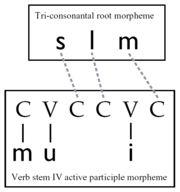
ation, in which vowel and consonant morphemes are interdigitized. For example, depending on the vowels, the Arabic
Arabic language
Arabic is a name applied to the descendants of the Classical Arabic language of the 6th century AD, used most prominently in the Quran, the Islamic Holy Book...
consonantal root
Triliteral
The roots of verbs and most nouns in the Semitic languages are characterized as a sequence of consonants or "radicals"...
k-t-b can have different but semantically-related meanings. Thus, [katab] 'he wrote' and [kitaːb] 'book' both come from the root k-t-b. In the analysis provided by McCarthy
John McCarthy (linguist)
John McCarthy is a linguist and professor in the Department of Linguistics at the University of Massachusetts Amherst with a speciality in phonology and morphology...
's account of nonconcatenative morphology, the consonantal root is assigned to one tier
Tier
TIER may refer to:* Taiwan Institute of Economic Research, one of two major economic research institutes in TaiwanTier may refer to:* a layer or ranking or classification-group in any real or imagined hierarchy...
, and the vowel pattern to another.
Yet another common type of nonconcatenative morphology is reduplication
Reduplication
Reduplication in linguistics is a morphological process in which the root or stem of a word is repeated exactly or with a slight change....
, a process in which all or part of the root is reduplicated. In Sakha
Sakha language
Sakha, or Yakut, is a Turkic language with around 360,000 native speakers spoken in the Sakha Republic in the Russian Federation by the Sakha or Yakuts.Sakha is an agglutinative language, and it employs vowel harmony.-Classification:...
, this process is used to form intensified adjective
Adjective
In grammar, an adjective is a 'describing' word; the main syntactic role of which is to qualify a noun or noun phrase, giving more information about the object signified....
s:
/k̠ɨhɨl/ "red" ↔ /k̠ɨp-k̠ɨhɨl/ "flaming red".
A final common type of nonconcatenative morphology is variously referred to as truncation, deletion, or subtraction; the morpheme is sometimes called a disfix
Disfix
A disfix is a subtractive morpheme, that is, a morpheme which manifests itself through elision . Thus it can be seen as a kind of "anti-affix"...
. This process removes phonological material from the root, as in Murle
Murle
The Murle are an ethnic group residing in Pibor County, Jonglei State, South Sudan as well as in Ethiopia. They have also been referred to in the literature as Beir by the Dinka or others who got information from them...
:
/oɳiːt/ "rib" ↔ /oɳiː/ "ribs".
Nonconcatenative morphology is extremely well developed in the Semitic languages
Semitic languages
The Semitic languages are a group of related languages whose living representatives are spoken by more than 270 million people across much of the Middle East, North Africa and the Horn of Africa...
, where it forms the basis of virtually all higher-level word formation
Word formation
In linguistics, word formation is the creation of a new word. Word formation is sometimes contrasted with semantic change, which is a change in a single word's meaning...
(as with the example given in the diagram). This is especially pronounced in Arabic
Arabic language
Arabic is a name applied to the descendants of the Classical Arabic language of the 6th century AD, used most prominently in the Quran, the Islamic Holy Book...
, where it is also used to form approximately 90% of all plurals; see broken plural
Broken plural
In linguistics, a broken plural is an irregular plural form of a noun or adjective found in the Semitic languages and other Afroasiatic languages such as Berber. Broken plurals are formed by changing the pattern of consonants and vowels inside the singular form...
.