
|
|
|
|
Cochin Jews
|
| |
|
| |
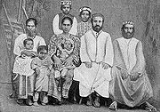
Cochin Jews, also called Malabar Jews (Malabar Yehudan) are the ancient Jews and their descendants of the former Kingdom of Cochin in South India, including the present day port city of Kochi. They traditionally spoke Judeo-Malayalam, a form of the Malayalam tongue, native to the state of Kerala, in India. Several rounds of immigration of the Jewish diaspora into Kerala led to a diversity amongst the Cochin Jews. sources say that the earliest Jews were those who settled in the Malabar coast during the times of King Solomon of Israel, and after the Kingdom of Israel split into two .

Discussion
Ask a question about 'Cochin Jews'
Start a new discussion about 'Cochin Jews'
Answer questions from other users
|
Encyclopedia
Cochin Jews, also called Malabar Jews (Malabar Yehudan) are the ancient Jews and their descendants of the former Kingdom of Cochin in South India, including the present day port city of Kochi. They traditionally spoke Judeo-Malayalam, a form of the Malayalam tongue, native to the state of Kerala, in India. Several rounds of immigration of the Jewish diaspora into Kerala led to a diversity amongst the Cochin Jews.
History
Some sources say that the earliest Jews were those who settled in the Malabar coast during the times of King Solomon of Israel, and after the Kingdom of Israel split into two . They are sometimes referred to as the "black Jews". The Paradesi Jews, also called "White Jews", settled later, coming to India from European and Middle Eastern nations such as Holland and Spain, and bringing with them the Ladino language. Spanish and Portuguese Jews (Sephardim) settled in Goa in the 15th century, but this settlement eventually disappeared. In the 17th and 18th centuries, Cochin had an influx of Jewish settlers from the Middle East, North Africa and Spain.
Jews came to Kerala and settled as early as 700 BC for trade. An old, but not particularly reliable, tradition says that Jews of Cochin came in mass to Cranganore (an ancient port, near Cochin) after the destruction of the Temple in 70 C.E. A chieftain by the name of Joseph Rabban, according to local tradition, was granted a principality over the Jews of Cochin by the Chera Emperor of Kerala, Bhaskara Ravivarman II . His descendents had, in effect, their own principality (called Anjuvannam in Indian sources) for many centuries until a chieftainship dispute broke out between two brothers (one of them named Joseph Azar) in the 15th century. The dispute led neighboring princes to dispossess them. In 1524, the Muslims, backed by the ruler of Calicut (today called Kozhikode), attacked the Jews of Cranganore on the pretext that they were tampering with the pepper trade. Most Jews fled to Cochin and went under the protection of the Hindu Raja there. He granted them a site for their own town that later acquired the name "Jew Town" (by which it is still known).
Unfortunately for the Jews of Cochin, the Portuguese occupied Cochin in this same period and indulged in persecution of the Jews until the Dutch displaced them in 1660. The Dutch Protestants were tolerant, and the Jews prospered. In 1795 Cochin was occupied by and came under the control of the British Empire. In the 19th century, Cochin Jews lived in the towns of Cochin, Ernakulam, Aluva and North Paravur.
For an insight to Cochin Jewish life in eighteenth Century. read Volume VIII (page 336 to 354) of The Land of the Permauls, Or, Cochin, Its Past and Its Present By Dr Francis Day, a British Civil Surgeon of 1863 AD ( ).
The Jews of Cochin did not adhere to the Talmudic prohibition, followed by other Orthodox Jews, against public singing by women, and therefore have a rich tradition of Jewish prayers and narrative songs performed by women in Judeo-Malayalam. Fearful of this tradition dying out, the Jewish Music Research Center at Hebrew University has compiled a CD of these songs.
Cochin Jews today
Today most of Cochin's Jews have emigrated (principally to Israel). Large groups have settled in the Moshav of Nevatim in the Negev (southern Israel) and Moshav of Yuval in the North, in the neighborhood of Katamon in Jerusalem, in Beer Sheva, Dimona and Yeruham. In both places there are Cochin synagogues. In Kerala there are still three synagogues; the one at Mattancherry, Cochin is still functioning.
Historically, part of the decline in Kerala's Jewish population can also be attributed to conversion. Jews who converted during the time of St. Thomas and later, became Kerala's Nasrani or St. Thomas Christians. While Jewish heritage is most readily observed among the Knanaya Christian-Jews of Kerala, elements of Jewish practice are present in most St. Thomas Christian denominations.
Ruby of Cochin
Ruby Daniel emigrated to Israel from Cochin in 1951. Her 1995 memoir, Ruby of Cochin lists a fourth method for marriage among the Jews of Cochin: that of witness by the entire congregation to a marriage. The memoir includes her experience in the Armed Forces of India as a Jewish woman among Hindu and Muslim men.
See also
Further reading
- Katz Nathan (2000) 'Who Are the Jews of India?' ; Berkeley, Los Angeles and London, University of California Press. ISBN No: 0520213238
- Weil, Shalva; (eds) (2002) India’s Jewish Heritage Ritual, Art & Life Cycle; Marg Publications ISBN No: 8185026580
- Katz, Nathan; & Goldberg, Ellen S; (1995) “Leaving Mother India: Reasons for the Cochin Jews’ Migration to Israel,” Population Review 39, 1 & 2 :35-53.
External links
|
| |
|
|