


Phanariotes

Encyclopedia
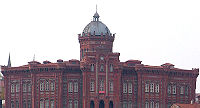
Greek language
Greek is an independent branch of the Indo-European family of languages. Native to the southern Balkans, it has the longest documented history of any Indo-European language, spanning 34 centuries of written records. Its writing system has been the Greek alphabet for the majority of its history;...
:Φαναριώτες) were members of those prominent Greek
Greeks
The Greeks, also known as the Hellenes , are a nation and ethnic group native to Greece, Cyprus and neighboring regions. They also form a significant diaspora, with Greek communities established around the world....
(including Hellenized Romanian
Romanians
The Romanians are an ethnic group native to Romania, who speak Romanian; they are the majority inhabitants of Romania....
and Albanian
Albanians
Albanians are a nation and ethnic group native to Albania and neighbouring countries. They speak the Albanian language. More than half of all Albanians live in Albania and Kosovo...
) families residing in Phanar
Fener
Fener is a neighborhood midway up the Golden Horn within the district of Fatih in Istanbul , Turkey. The streets in the area are full of historic wooden houses, churches, and synagogues dating from Byzantine and Ottoman eras. The area's name is a Turkish transliteration of the original Greek φανάρι...
(Φανάρι, modern Fener), the chief Greek quarter of Constantinople
Constantinople
Constantinople was the capital of the Roman, Eastern Roman, Byzantine, Latin, and Ottoman Empires. Throughout most of the Middle Ages, Constantinople was Europe's largest and wealthiest city.-Names:...
, where the Ecumenical Patriarchate
Ecumenical Patriarchate of Constantinople
The Ecumenical Patriarchate of Constantinople , part of the wider Orthodox Church, is one of the fourteen autocephalous churches within the communion of Orthodox Christianity...
is situated.
For all their cosmopolitanism and often Western education, the Phanariots were aware of their Hellenism
Hellenism
Hellenism may refer to:*Hellenic studies*Hellenistic civilization*Hellenistic period, in Greek antiquity*Hellenistic Greece*Hellenization, the spread of Greek culture over foreign peoples*Hellenistic philosophy in the Hellenistic period and late antiquity...
; according to Nicholas Mavrocordatos
Nicholas Mavrocordatos
Nicholas Mavrocordatos was a Greek member of the Mavrocordatos family, Grand Dragoman to the Divan , and consequently the first Phanariote Hospodar of the Danubian Principalities - Prince of Moldavia, and Prince of Wallachia...
' Philotheou Parerga "We are a race completely Hellenic".
Phanariots emerged as a class of moneyed ethnically Greek merchants (they commonly claimed noble Byzantine
Byzantium
Byzantium was an ancient Greek city, founded by Greek colonists from Megara in 667 BC and named after their king Byzas . The name Byzantium is a Latinization of the original name Byzantion...
descent) in the latter half of the 16th century and went on to exercise great influence in the administration in the Ottoman Empire
Ottoman Empire
The Ottoman EmpireIt was usually referred to as the "Ottoman Empire", the "Turkish Empire", the "Ottoman Caliphate" or more commonly "Turkey" by its contemporaries...
's Balkan domains in the 18th century. They tended to build their houses in the Phanar quarter in order to be close to the court of the Patriarch, who under the Ottoman millet
Millet (Ottoman Empire)
Millet is a term for the confessional communities in the Ottoman Empire. It refers to the separate legal courts pertaining to "personal law" under which communities were allowed to rule themselves under their own system...
system was recognized as both the spiritual and secular head (millet-bashi) of all the Orthodox subjects (the Rum Millet, or the “Roman nation”) of the Empire (except those Orthodox under the spiritual care of the Patriarchs of Antioch, Jerusalem, and Alexandria), often acting as archontes of the Ecumenical See
Archons of the Ecumenical Patriarchate
The Archons of the Ecumenical Patriarchate are honorees of the Patriarch of Constantinople, who have been selected from among the laity due to service to those portions of the Eastern Orthodox Church under his particular guidance....
; thus they came to dominate the administration of the Patriarchate frequently intervening in the selection of hierarchs, including the Ecumenical Patriarch of Constantinople.
Overview
Some members of the Phanariot families (which had acquired great wealth and influence during the 17th century) occupied high political and administrative postsState organisation of the Ottoman Empire
The Ottoman Empire developed a highly advanced organisation of state over the centuries. Even though it had a very centralized government with the Sultan as the supreme ruler, it had an effective control of its provinces and inhabitants, as well as its officials. Wealth and rank wasn't necessarily...
in the Ottoman Empire. From 1669 until the Greek War of Independence in 1821, Phanariotes formed the majority of the dragoman
Dragoman
A dragoman was an interpreter, translator and official guide between Turkish, Arabic, and Persian-speaking countries and polities of the Middle East and European embassies, consulates, vice-consulates and trading posts...
s to the Ottoman government (the Porte) and to foreign embassies
Diplomatic mission
A diplomatic mission is a group of people from one state or an international inter-governmental organisation present in another state to represent the sending state/organisation in the receiving state...
- due to the higher level of education of Greeks
Greeks
The Greeks, also known as the Hellenes , are a nation and ethnic group native to Greece, Cyprus and neighboring regions. They also form a significant diaspora, with Greek communities established around the world....
compared to the general Ottoman population. Along with the church dignitaries, the local notables from the provinces and the large Greek merchant class, Phanariotes represented the better educated members of Greek society during Ottoman rule and until the start of the Greek War of Independence. During the latter, Phanariotes played a crucial role and influenced the decisions of the Greek National Assembly, the representative body of the Greek revolutionaries, which met on six occasions between 1821 and 1829.
Between the years 1711–1716 and 1821, a number of them were appointed Hospodar
Hospodar
Hospodar or gospodar is a term of Slavonic origin, meaning "lord" or "master".The rulers of Wallachia and Moldavia were styled hospodars in Slavic writings from the 15th century to 1866. Hospodar was used in addition to the title voivod...
s (Voivodes or Princes) in the Danubian Principalities
Danubian Principalities
Danubian Principalities was a conventional name given to the Principalities of Moldavia and Wallachia, which emerged in the early 14th century. The term was coined in the Habsburg Monarchy after the Treaty of Küçük Kaynarca in order to designate an area on the lower Danube with a common...
(Moldavia
Moldavia
Moldavia is a geographic and historical region and former principality in Eastern Europe, corresponding to the territory between the Eastern Carpathians and the Dniester river...
and Wallachia), usually as a promotion from dragoman offices; that period is usually termed the Phanariote epoch in Romanian history.
Ottoman Empire
Immediately after the Conquest of Constantinople, Mehmet II deported all the Christian population of the City, leaving only the Jewish inhabitants of Balat. Afterward, it repopulated the city bringing there inhabitants - both Christian and Muslim - from the whole empire and from the newly conquered territories. Phanar was then repopulated with Greeks deported from Mouchlion in the PeloponnesePeloponnese
The Peloponnese, Peloponnesos or Peloponnesus , is a large peninsula , located in a region of southern Greece, forming the part of the country south of the Gulf of Corinth...
and, after 1461, with citizens of Trebizond. The Greek population of Fener during the Ottoman Empire originates from this happening.
The roots of Greek
Greeks
The Greeks, also known as the Hellenes , are a nation and ethnic group native to Greece, Cyprus and neighboring regions. They also form a significant diaspora, with Greek communities established around the world....
ascendancy can be traced to the need of the Ottomans for skilled and educated negotiators as the power of their empire declined and they were compelled to rely on treaties more than the force of arms. From the 17th century onwards the Ottomans began meeting problems in the conduct of their foreign relations, and were having difficulties in dictating terms to their neighbours; the Porte was faced for the first time with the need of participating in diplomatic negotiations.
Given the Ottoman tradition of generally ignoring Western Europe
Western Europe
Western Europe is a loose term for the collection of countries in the western most region of the European continents, though this definition is context-dependent and carries cultural and political connotations. One definition describes Western Europe as a geographic entity—the region lying in the...
an languages and cultures, officials found themselves unable to handle such affairs. The Porte subsequently assigned those tasks to the Greeks who had a long mercantile and educational tradition and could provide the necessary skills. As a result, the so−called Phanariotes, Greek and Hellenized families mostly native to Constantinople
Constantinople
Constantinople was the capital of the Roman, Eastern Roman, Byzantine, Latin, and Ottoman Empires. Throughout most of the Middle Ages, Constantinople was Europe's largest and wealthiest city.-Names:...
, came to occupy high posts of secretaries and interpreters to Ottoman officials and officers.
Diplomats and Patriarchs
As a result of Phanariote and ecclesiastic administration, Greeks expanded their influence in the Empire in the 18th century while retaining their Greek Orthodox faith and Hellenism. This had not always been the case in the Ottoman realm, as in the 16th century it was the South SlavsSouth Slavs
The South Slavs are the southern branch of the Slavic peoples and speak South Slavic languages. Geographically, the South Slavs are native to the Balkan peninsula, the southern Pannonian Plain and the eastern Alps...
and Bulgars
Bulgarians
The Bulgarians are a South Slavic nation and ethnic group native to Bulgaria and neighbouring regions. Emigration has resulted in immigrant communities in a number of other countries.-History and ethnogenesis:...
who were the most prominent in Imperial affairs. Unlike the Greeks, they were willing to convert to Islam
Islam
Islam . The most common are and . : Arabic pronunciation varies regionally. The first vowel ranges from ~~. The second vowel ranges from ~~~...
in order to enjoy full rights of Ottoman
Ottoman Empire
The Ottoman EmpireIt was usually referred to as the "Ottoman Empire", the "Turkish Empire", the "Ottoman Caliphate" or more commonly "Turkey" by its contemporaries...
citizenship, especially in Bosnia
Bosnia Province, Ottoman Empire
The Bosnia Vilayet was an Ottoman vilayet, mostly based on the territory of the present-day state of Bosnia and Herzegovina as well as most of Slavonia, Lika and Dalmatia in present-day Croatia. It bordered Kosovo Vilayet to the south. Before the administrative reform in 1864, it was called the...
, while Serbs also tended to acquire high military positions.
In time, a Slavic presence in the administration gradually became a hazard for the Ottoman rulers, as it was prone to offer full support to Habsburg
Habsburg Monarchy
The Habsburg Monarchy covered the territories ruled by the junior Austrian branch of the House of Habsburg , and then by the successor House of Habsburg-Lorraine , between 1526 and 1867/1918. The Imperial capital was Vienna, except from 1583 to 1611, when it was moved to Prague...
armies in the context of the Great Turkish War
Great Turkish War
The Great Turkish War refers to a series of conflicts between the Ottoman Empire and contemporary European powers, then joined into a Holy League, during the second half of the 17th century.-1667–1683:...
. By the 17th century, the Greek Patriarch of Constantinople became the absolute religious and administrative ruler of all Christian Orthodox subjects within the Empire, regardless of their ethnic background. All formerly independent Orthodox patriarchates, including the Serbian Patriarchate
Serbian Orthodox Church
The Serbian Orthodox Church is one of the autocephalous Orthodox Christian churches, ranking sixth in order of seniority after Constantinople, Alexandria, Antioch, Jerusalem, and Russia...
renewed in 1557, came under the authority of the Greek Orthodox Church. Most of the Greek Patriarchs were drawn from among the Phanariotes.
Two Greek social groups therefore emerged and challenged the leadership of the Greek Church. These were the Phanariotes in Constantinople
Constantinople
Constantinople was the capital of the Roman, Eastern Roman, Byzantine, Latin, and Ottoman Empires. Throughout most of the Middle Ages, Constantinople was Europe's largest and wealthiest city.-Names:...
and the local notables in the Helladic provinces
Ottoman Greece
Most of Greece gradually became part of the Ottoman Empire from the 15th century until its declaration of independence in 1821, a historical period also known as Tourkokratia ....
(kocabaşıs, gerontes, dimogerontes, prokritoi). According to Constantine Paparrigopoulοs, one of the major Greek historians, Phanariotes initially sought the most important secular offices of the Patriarchical Court and, thus, they could frequently intervene in the election of bishops, as well as influence crucial decisions of the Patriarch. Greek merchants and clergy of Byzantine
Byzantine
Byzantine usually refers to the Roman Empire during the Middle Ages.Byzantine may also refer to:* A citizen of the Byzantine Empire, or native Greek during the Middle Ages...
aristocratic origin, who acquired great economic prosperity and political influence, and were later known as Phanariotes, settled in the extreme northwestern district of Constantinople, which had become central to Greek interests after the establishment of the Patriarch's headquarters in 1461 (shortly after Hagia Sophia
Hagia Sophia
Hagia Sophia is a former Orthodox patriarchal basilica, later a mosque, and now a museum in Istanbul, Turkey...
was converted into a mosque).
Patriarchate
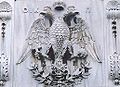
Fall of Constantinople
The Fall of Constantinople was the capture of the capital of the Byzantine Empire, which occurred after a siege by the Ottoman Empire, under the command of Ottoman Sultan Mehmed II, against the defending army commanded by Byzantine Emperor Constantine XI...
, when the Sultan
Ottoman Dynasty
The Ottoman Dynasty ruled the Ottoman Empire from 1299 to 1922, beginning with Osman I , though the dynasty was not proclaimed until Orhan Bey declared himself sultan...
virtually replaced de facto
De facto
De facto is a Latin expression that means "concerning fact." In law, it often means "in practice but not necessarily ordained by law" or "in practice or actuality, but not officially established." It is commonly used in contrast to de jure when referring to matters of law, governance, or...
and de jure
De jure
De jure is an expression that means "concerning law", as contrasted with de facto, which means "concerning fact".De jure = 'Legally', De facto = 'In fact'....
the Byzantine Emperor among subjugated Christians, the Ecumenical Patriarch was recognized by the Sultan as the religious and national leader (ethnarch
Ethnarch
Ethnarch, pronounced , the anglicized form of ethnarches refers generally to political leadership over a common ethnic group or homogeneous kingdom. The word is derived from the Greek words and ....
) of Greeks and the other ethnicities that were included in the Greek Orthodox Millet
Millet (Ottoman Empire)
Millet is a term for the confessional communities in the Ottoman Empire. It refers to the separate legal courts pertaining to "personal law" under which communities were allowed to rule themselves under their own system...
. The Patriarchate earned a primary importance and occupied this key role among the Christians of the Empire because the Ottomans did not legally distinguish between nationality and religion, and thus regarded all the Orthodox Christians of the Empire as a single entity.
The position of the Patriarchate in the Ottoman state encouraged projects of Greek renaissance, centered on the resurrection and revitalization of the Byzantine Empire
Byzantine Empire
The Byzantine Empire was the Eastern Roman Empire during the periods of Late Antiquity and the Middle Ages, centred on the capital of Constantinople. Known simply as the Roman Empire or Romania to its inhabitants and neighbours, the Empire was the direct continuation of the Ancient Roman State...
. The Patriarch and those church dignitaries around him constituted the first centre of power for the Greeks
Greeks
The Greeks, also known as the Hellenes , are a nation and ethnic group native to Greece, Cyprus and neighboring regions. They also form a significant diaspora, with Greek communities established around the world....
inside the Ottoman state, one which succeeded in infiltrating the structures of the Ottoman Empire
Ottoman Empire
The Ottoman EmpireIt was usually referred to as the "Ottoman Empire", the "Turkish Empire", the "Ottoman Caliphate" or more commonly "Turkey" by its contemporaries...
, while attracting the former Byzantine nobility.
Merchant middle class
It was the wealth of the extensive Greek merchant class that provided the material basis for the intellectual revival that was the prominent feature of Greek life in the half century and more leading to 1821. Greek merchants endowed libraries and schools; on the eve of the Greek War of Independence the three most important centres of Greek learning, schools-cum-universities, were situated in ChiosChios
Chios is the fifth largest of the Greek islands, situated in the Aegean Sea, seven kilometres off the Asia Minor coast. The island is separated from Turkey by the Chios Strait. The island is noted for its strong merchant shipping community, its unique mastic gum and its medieval villages...
, Smyrna
Smyrna
Smyrna was an ancient city located at a central and strategic point on the Aegean coast of Anatolia. Thanks to its advantageous port conditions, its ease of defence and its good inland connections, Smyrna rose to prominence. The ancient city is located at two sites within modern İzmir, Turkey...
and Aivali, all three major centres of Greek commerce.
The first Greek millionaire in the Ottoman era was Michael Cantacuzenos, who earned 60.000 ducats a year from his control of the fur trade from Muskovy; he was eventually executed on the Sultan's order.
Civil servants
During the 18th century, Phanariotes appeared as a hereditary clerical−aristocratic grouping, managing the affairs of the Patriarchate, and becoming the dominant political power of the Greek community in Ottoman lands. In time, they grew to become a very significant political factor in the Ottoman Empire, and, as diplomatic agents, played a considerable role in the affairs of the Kingdom of Great Britain, France, and the Russian Empire.Phanariotes soon competed for some of the most important administrative offices in the Ottoman administration: several of these involved collecting Imperial taxes, holding monopolies
Monopoly
A monopoly exists when a specific person or enterprise is the only supplier of a particular commodity...
on commerce, working under contract in various enterprises, being purveyors to the court, and even rulers over one of the two Danubian Principalities
Danubian Principalities
Danubian Principalities was a conventional name given to the Principalities of Moldavia and Wallachia, which emerged in the early 14th century. The term was coined in the Habsburg Monarchy after the Treaty of Küçük Kaynarca in order to designate an area on the lower Danube with a common...
(Moldavia and Wallachia). At the same time, they engaged in private trade dealings, and acquired great control over the crucial wheat trade on the Black Sea
Black Sea
The Black Sea is bounded by Europe, Anatolia and the Caucasus and is ultimately connected to the Atlantic Ocean via the Mediterranean and the Aegean seas and various straits. The Bosphorus strait connects it to the Sea of Marmara, and the strait of the Dardanelles connects that sea to the Aegean...
. Phanariotes managed to expand their commercial activities first into the Kingdom of Hungary
Kingdom of Hungary
The Kingdom of Hungary comprised present-day Hungary, Slovakia and Croatia , Transylvania , Carpatho Ruthenia , Vojvodina , Burgenland , and other smaller territories surrounding present-day Hungary's borders...
, and then to all other Central Europe
Central Europe
Central Europe or alternatively Middle Europe is a region of the European continent lying between the variously defined areas of Eastern and Western Europe...
an states. Such activities intensified their contacts with Western nations, and as a consequence they became familiar with Western languages and cultures.
Just before the outbreak of the Greek War of Independence, Phanariotes were firmly established as the political elite of Hellenism. According to Greek historian Constantine Paparrigopoulos, this was a natural evolution, given the Phanariotes' education and their experience in supervising vast regions of the Empire. In addition, Svoronos argued that they subordinated their national identity
National identity
National identity is the person's identity and sense of belonging to one state or to one nation, a feeling one shares with a group of people, regardless of one's citizenship status....
to their class identity
Social class
Social classes are economic or cultural arrangements of groups in society. Class is an essential object of analysis for sociologists, political scientists, economists, anthropologists and social historians. In the social sciences, social class is often discussed in terms of 'social stratification'...
, since they merely endeavored to achieve peaceful co−existence between the conqueror and the conquered; Svoronos believes that, in this way, Phanariotes failed to enrich the Greek national identity, and lost ground to the groups that grew through their confrontation with the Ottoman Empire, first the klepht
Klepht
Klephts were self-appointed armatoloi, anti-Ottoman insurgents, and warlike mountain-folk who lived in the countryside when Greece was a part of the Ottoman Empire...
s and then the Armatoloi
Armatoloi
Armatoloi , were Greek Christian irregular soldiers, or militia, commissioned by the Ottomans to enforce the Sultan's authority within an administrative district called an Armatoliki...
.
Establishment and contrasts
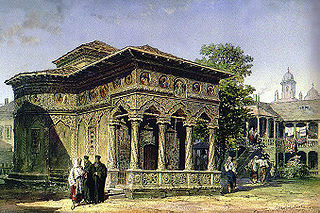
Romanians
The Romanians are an ethnic group native to Romania, who speak Romanian; they are the majority inhabitants of Romania....
, and remained present in Romanian society
Romania
Romania is a country located at the crossroads of Central and Southeastern Europe, on the Lower Danube, within and outside the Carpathian arch, bordering on the Black Sea...
— among them, the Rosetti family, whose member C. A. Rosetti
C. A. Rosetti
Constantin Alexandru Rosetti was a Romanian literary and political leader, born in Bucharest into a Phanariot Greek family.In 1845, Rosetti went to Paris, where he met Alphonse de Lamartine, the patron of the Society of Romanian Students in Paris. In 1847, he married Mary Grant, the sister of the...
represented the radical
Liberalism and radicalism in Romania
This article gives an overview of Liberalism and Radicalism in Romania. It is limited to liberal parties with substantial support, mainly proved by having had a representation in parliament. The sign ⇒ denotes another party in this scheme...
and nationalist
Nationalism
Nationalism is a political ideology that involves a strong identification of a group of individuals with a political entity defined in national terms, i.e. a nation. In the 'modernist' image of the nation, it is nationalism that creates national identity. There are various definitions for what...
cause during and after the 1848 Wallachian revolution.
The attention of Phanariotes was concentrated on occupying the most favorable offices the Empire could offer to non-Muslims, but also to the Principalities of Moldavia and Wallachia, which were still relatively rich, and more importantly, autonomous (despite having to pay tribute as vassal states
Vassal
A vassal or feudatory is a person who has entered into a mutual obligation to a lord or monarch in the context of the feudal system in medieval Europe. The obligations often included military support and mutual protection, in exchange for certain privileges, usually including the grant of land held...
). Many Greeks
Greeks
The Greeks, also known as the Hellenes , are a nation and ethnic group native to Greece, Cyprus and neighboring regions. They also form a significant diaspora, with Greek communities established around the world....
had found favorable conditions there for commercial activities, by far more advantageous when compared with the difficultes inside the Ottoman Empire, and also an opportunity to gain political power. Many had entered the ranks of Wallachian and Moldavian boyar nobility by marriage.
Although rarely occurring, reigns of local Princes were not excluded on principle. This situation had even determined several arguably hellenized
Hellenization
Hellenization is a term used to describe the spread of ancient Greek culture, and, to a lesser extent, language. It is mainly used to describe the spread of Hellenistic civilization during the Hellenistic period following the campaigns of Alexander the Great of Macedon...
Romanian noble families, such as the Callimachis (originally Călmaşul), the Ghicas or the Racoviţă
Racovita
Racoviţa may refer to:* the Racoviţă family of Wallachian and Moldavian boyars and Phanariotesand to several places in Romania:* Racoviţa, a commune in Brăila County* Racoviţa, a commune in Sibiu County* Racoviţa, a commune in Timiş County...
s, to penetrate into the Phanar nucleus, in order to facilitate and increase their chances to occupy the thrones, and later to successfully maintain their positions.
While most sources would agree to 1711 being the moment where the gradual erosion of the traditional institutions had reached its ultimate stage, characteristics usually ascribed to the Phanariote era had made themselves felt long before it. The Ottomans had been enforcing their choice for Hospodars throughout previous centuries (as far back as the 15th), and foreign — usually Greek or Levant
Levant
The Levant or ) is the geographic region and culture zone of the "eastern Mediterranean littoral between Anatolia and Egypt" . The Levant includes most of modern Lebanon, Syria, Jordan, Israel, the Palestinian territories, and sometimes parts of Turkey and Iraq, and corresponds roughly to the...
ine — boyars had been competing with the local ones since the late 16th century. Rulers since Dumitraşcu Cantacuzino in Moldavia and George Ducas
George Ducas
Voivode George Ducas was three times Prince of Moldavia and one time Prince of Wallachia .He was married to Anastasia, the daughter of Eustratie Dabija, and later to Dafina Doamna; George Ducas...
, a Prince of Greek origin, in Wallachia (both in 1673) had been forced to surrender all of their family members, and not just selected ones, as hostages in Constantinople. At the same time, the traditional elective system
Elective monarchy
An elective monarchy is a monarchy ruled by an elected rather than hereditary monarch. The manner of election, the nature of the candidacy and the electors vary from case to case...
in the Principalities had accounted for long periods of political disorder, and was in fact dominated by a small number of ambitious families (whether local or foreign), who had entered violent competition for the two thrones and monopolized land ownership — a notable example is the conflict opposing the Craioveşti
Craiovesti
The Craiovești , later Brâncovenești , were a boyar family in Wallachia who gave the country several of its Princes and held the title of Ban of Oltenia for ca...
and the Cantacuzinos in the period before 1711.
1711–1715
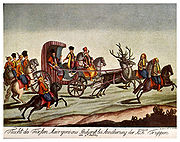
Peter I of Russia
Peter the Great, Peter I or Pyotr Alexeyevich Romanov Dates indicated by the letters "O.S." are Old Style. All other dates in this article are New Style. ruled the Tsardom of Russia and later the Russian Empire from until his death, jointly ruling before 1696 with his half-brother, Ivan V...
and the firm presence of the Habsburg Empire on the Carpathian
Carpathian Mountains
The Carpathian Mountains or Carpathians are a range of mountains forming an arc roughly long across Central and Eastern Europe, making them the second-longest mountain range in Europe...
border with the Principalities. Dissidence within the two countries became more dangerous for the Turks, who were now confronted with the attraction exercised on the population by the protection offered to them by a fellow Eastern Orthodox state. This became obvious with Mihai Racoviţă
Mihai Racovita
Mihai or Mihail Racoviţă was a Prince of Moldavia on three separate occasions and Prince of Wallachia on two occasions...
's second rule in Moldavia, when the Prince plotted with Peter to have Ottoman rule overthrown. Incidentally, his replacement, Nicholas Mavrocordatos
Nicholas Mavrocordatos
Nicholas Mavrocordatos was a Greek member of the Mavrocordatos family, Grand Dragoman to the Divan , and consequently the first Phanariote Hospodar of the Danubian Principalities - Prince of Moldavia, and Prince of Wallachia...
, was also the first official Phanariote in his second reign in Moldavia (he was also to replace Ştefan Cantacuzino
Stefan Cantacuzino
Ştefan Cantacuzino , was a Prince of Wallachia between April 1714 and January 21, 1716, the son of stolnic Constantin Cantacuzino.-Life:Ştefan was involved in his father's intrigue against Prince Constantin Brâncoveanu, denouncing him to the Ottoman Empire , and surrendering Brâncoveanu's secret...
in Wallachia, as the first Phanariote ruler in that country).
A crucial moment in the policy change was the Russo−Turkish War of 1710−1713, when Dimitrie Cantemir
Dimitrie Cantemir
Dimitrie Cantemir was twice Prince of Moldavia . He was also a prolific man of letters – philosopher, historian, composer, musicologist, linguist, ethnographer, and geographer....
sided with Russia and agreed to a Russian tutelage over his country. After Russia suffered a major defeat and Cantemir went into exile, the Ottomans took charge of the succession to the throne of Moldavia, soon followed by similar measures in Wallachia (in this case, prompted by Ştefan Cantacuzino
Stefan Cantacuzino
Ştefan Cantacuzino , was a Prince of Wallachia between April 1714 and January 21, 1716, the son of stolnic Constantin Cantacuzino.-Life:Ştefan was involved in his father's intrigue against Prince Constantin Brâncoveanu, denouncing him to the Ottoman Empire , and surrendering Brâncoveanu's secret...
's alliance with the Habsburg commander Prince Eugene of Savoy
Prince Eugene of Savoy
Prince Eugene of Savoy , was one of the most successful military commanders in modern European history, rising to the highest offices of state at the Imperial court in Vienna. Born in Paris to aristocratic Italian parents, Eugene grew up around the French court of King Louis XIV...
in the closing stages of the Great Turkish War
Great Turkish War
The Great Turkish War refers to a series of conflicts between the Ottoman Empire and contemporary European powers, then joined into a Holy League, during the second half of the 17th century.-1667–1683:...
).
Rulers and retinues
The person raised to the office of Prince was usually the chief DragomanDragoman
A dragoman was an interpreter, translator and official guide between Turkish, Arabic, and Persian-speaking countries and polities of the Middle East and European embassies, consulates, vice-consulates and trading posts...
of the Porte, and was consequently well versed in contemporary politics and the statecraft of the Ottoman
Ottoman Empire
The Ottoman EmpireIt was usually referred to as the "Ottoman Empire", the "Turkish Empire", the "Ottoman Caliphate" or more commonly "Turkey" by its contemporaries...
government.
The new Prince, who obtained his office in exchange for a heavy bribe (not a new requirement in itself), proceeded to the country which he was selected to govern, and whose language he usually did not know. Once the new Princes were appointed, they were escorted to Iaşi
Iasi
Iași is the second most populous city and a municipality in Romania. Located in the historical Moldavia region, Iași has traditionally been one of the leading centres of Romanian social, cultural, academic and artistic life...
or Bucharest
Bucharest
Bucharest is the capital municipality, cultural, industrial, and financial centre of Romania. It is the largest city in Romania, located in the southeast of the country, at , and lies on the banks of the Dâmbovița River....
by retinues composed of their families, favourites, and their creditors (from whom they had borrowed the bribe funds). The Prince and his appointees counted on recouping these in as short a time as possible and in collecting an amount sufficient to live on after the termination of their brief time in office.
Taking the two principalities together, 31 princes from 11 different families ruled during the Phanariote epoch. Many times they were exiled or even executed: of these 31 princes, seven suffered a violent death, and a few were executed at their own courts of Bucharest or Iaşi.
When, owing to cases of disloyalty towards the Porte by the Princes, the choice became limited to a few families, it became frequent that rulers would be shifted from one principality to the other: the Prince of Wallachia, the richer of the two Principalities, would pay certain sums in order to avert his transfer to Iaşi, while the Prince of Moldavia would bribe supporters in Constantinople in exchange for his appointment to Wallachia. For example, Constantine Mavrocordatos
Constantine Mavrocordatos
Constantine Mavrocordatos was a Greek noble who served as Prince of Wallachia and Prince of Moldavia at several intervals...
ruled a total of ten different times in Moldavia
Moldavia
Moldavia is a geographic and historical region and former principality in Eastern Europe, corresponding to the territory between the Eastern Carpathians and the Dniester river...
and Wallachia. The debt was, however, owed to various creditors, and not to the Sultan
Ottoman Dynasty
The Ottoman Dynasty ruled the Ottoman Empire from 1299 to 1922, beginning with Osman I , though the dynasty was not proclaimed until Orhan Bey declared himself sultan...
himself: in fact, the central institutions of the Ottoman Empire generally seemed determined to maintain their rule over the Principalities, and not exploit them irrationally. In one early example, Ahmed III
Ahmed III
Ahmed III was Sultan of the Ottoman Empire and a son of Sultan Mehmed IV . His mother was Mâh-Pâre Ummatullah Râbi'a Gül-Nûş Valide Sultan, originally named Evmania Voria, who was an ethnic Greek. He was born at Hajioglupazari, in Dobruja...
even paid part of Nicholas Mavrocordatos
Nicholas Mavrocordatos
Nicholas Mavrocordatos was a Greek member of the Mavrocordatos family, Grand Dragoman to the Divan , and consequently the first Phanariote Hospodar of the Danubian Principalities - Prince of Moldavia, and Prince of Wallachia...
' sum.
Administration and boyars
The Phanariote epoch was initially characterized by excessive fiscal policies, driven by both Ottoman needs and by the ambitions of some of the Hospodars (who, mindful of their fragile status, sought to pay back their creditors and increase their wealth while they still were in a position of power). In order to make the reigns lucrative while raising funds that would satisfy the needs of the Porte (increased during the Stagnation of the Ottoman EmpireStagnation of the Ottoman Empire
The Stagnation of the Ottoman Empire is the period following the Growth of the Ottoman Empire . During this period the empire continued to have military might. The next period would be shaped by the decline of their military power which followed the loss of huge territories...
), Princes channeled their energies into spoliation, and the inhabitants, liable to increasing and diversified taxation, were in many instances reduced to destitution. However, the most odius taxes, mistakenly identified with the Phanariotes in modern Romanian historiography, were of much older provenance (such as the văcărit, first imposed by Iancu Sasul
Iancu Sasul
Iancu Sasul or Ioan Vodă V was the bastard son of Petru Rareş from his relationship with the wife of Braşov Transylvanian Saxon Iorg Weiss, and Prince of Moldavia between November 1579 and September 1582.-Bid for the throne:Let in on the secret of his lineage by his mother, Iancu...
in the 1580s).
The mismanagement of many Phanariote rulers stands in contrast with the achievements and projects of others, such as Constantine Mavrocordatos' (who abolished serfdom
Serfdom
Serfdom is the status of peasants under feudalism, specifically relating to Manorialism. It was a condition of bondage or modified slavery which developed primarily during the High Middle Ages in Europe and lasted to the mid-19th century...
in 1746 in Wallachia, and in 1749 in Moldavia) and Alexander Ypsilantis'. They were inspired by Hapsburg serf policy. Ypsilantis tried to reform the legislation and impose salaries
Salary
A salary is a form of periodic payment from an employer to an employee, which may be specified in an employment contract. It is contrasted with piece wages, where each job, hour or other unit is paid separately, rather than on a periodic basis....
for administrative offices — in an effort to halt the depletion of funds through the sums the administrators, local and Greek alike, were using for their own maintenance (it had by then become more profitable to hold office than to own land). His Pravilniceasca condică, a rather modern legal code
Legal code
A legal code is a body of law written by a governmental body, such as a U.S. state, a Canadian Province or German Bundesland or a municipality...
, met stiff boyar resistance.
In fact, the focus of such rules was many times the improvement of state structures against conservative
Conservatism
Conservatism is a political and social philosophy that promotes the maintenance of traditional institutions and supports, at the most, minimal and gradual change in society. Some conservatives seek to preserve things as they are, emphasizing stability and continuity, while others oppose modernism...
wishes. Documents for the time show that, despite the change in leadership and boyar complaints, around 80% of those seated in the Divan (an institution roughly equivalent to the Estates of the realm
Estates of the realm
The Estates of the realm were the broad social orders of the hierarchically conceived society, recognized in the Middle Ages and Early Modern period in Christian Europe; they are sometimes distinguished as the three estates: the clergy, the nobility, and commoners, and are often referred to by...
) were members of traditionally local families. This tended to render endemic the social and economical issues of previous periods, as the inner circle of boyars not only managed to block initiatives such as Alexander Ypsilantis', but also pressured for tax exemption
Tax exemption
Various tax systems grant a tax exemption to certain organizations, persons, income, property or other items taxable under the system. Tax exemption may also refer to a personal allowance or specific monetary exemption which may be claimed by an individual to reduce taxable income under some...
s — which they obtained, extended, and successfully preserved.
Russian influence
The Phanariotes copied Russian institutions as well as Hapsburg. In the mid 18th century they made Noble rank dependent on state service just as Peter I of RussiaPeter I of Russia
Peter the Great, Peter I or Pyotr Alexeyevich Romanov Dates indicated by the letters "O.S." are Old Style. All other dates in this article are New Style. ruled the Tsardom of Russia and later the Russian Empire from until his death, jointly ruling before 1696 with his half-brother, Ivan V...
did. After the Treaty of Kuchuk-Kainarji (1774) allowed Russia to intervene on the side of Ottoman Eastern Orthodox subjects, most of the Porte's political tools of political pressure became ineffective. The Porte had to further offer concessions, with the imperative of maintaining hold over the countries as economical and strategic assets: the treaty made any increase in the tribute impossible, and, between 1774 and the 1820s, it plummeted from around 50,000 to 20,000 gold coin
Gold coin
A gold coin is a coin made mostly or entirely of gold. Gold has been used for coins practically since the invention of coinage, originally because of gold's intrinsic value...
s (equivalent to Austrian gold currency
Austro-Hungarian gulden
The Gulden or forint was the currency of the Austrian Empire and later the Austro-Hungarian Empire between 1754 and 1892 when it was replaced by the Krone/korona as part of the introduction of the gold standard. In Austria, the Gulden was initially divided into 60 Kreuzer, and in Hungary, the...
) in Wallachia, and just 3,100 in Moldavia.
In the immediately following period, Russia made use of its new prerogative forcefully: the deposition of Constantine Ypsilantis
Constantine Ypsilantis
Constantine Ypsilantis , was the son of Alexander Ypsilanti, a key member of an important Phanariote family, Grand dragoman of the Porte , hospodar of Moldavia and Walachia , and a Prince through marriage to the daughter of Alexandru Callimachi.-The Liberation of Greece from the Ottoman...
(in Wallachia) and Alexander Mourousis
Alexander Mourousis
Alexander Mourousis was a Great Dragoman of the Ottoman Empire who served as Prince of Moldavia and Prince of Wallachia. Open to Enlightenment ideas, and noted for his interest in hydrological engineering, Mourousis was forced to deal with the intrusions of Osman Pazvantoğlu's rebellious troops...
(in Moldavia) by Selim III
Selim III
Selim III was the reform-minded Sultan of the Ottoman Empire from 1789 to 1807. The Janissaries eventually deposed and imprisoned him, and placed his cousin Mustafa on the throne as Mustafa IV...
, called on by the French Empire
First French Empire
The First French Empire , also known as the Greater French Empire or Napoleonic Empire, was the empire of Napoleon I of France...
's ambassador to the Ottoman Empire, Horace Sébastiani
Horace François Bastien, baron Sébastiani
Horace François Bastien Sébastiani de La Porta was a French soldier, diplomat, and politician, who served as Naval Minister, Minister of Foreign Affairs, and Minister of State under the July Monarchy. Joining the French Revolutionary Army in his youth, he rose in its ranks and became a supporter...
(whose fears of pro−Russian conspiracies
Conspiracy (political)
In a political sense, conspiracy refers to a group of persons united in the goal of usurping or overthrowing an established political power. Typically, the final goal is to gain power through a revolutionary coup d'état or through assassination....
in Bucharest were partly confirmed), constituted the casus belli
Casus belli
is a Latin expression meaning the justification for acts of war. means "incident", "rupture" or indeed "case", while means bellic...
for the conflict of 1806–1812 (the Russian general Mikhail Andreyevich Miloradovich
Mikhail Andreyevich Miloradovich
Mikhail Andreyevich Miloradovich , spelled Miloradovitch in contemporary English sources was a Russian general prominent during the Napoleonic Wars. He entered military service on the eve of the Russo-Swedish War of 1788–1790 and his career advanced rapidly during the reign of Paul I...
swiftly reinstated Ypsilantis during his military expedition to Wallachia).
Such gestures inaugurated a period of effective Russian supervision, which culminated with the Organic Statute
Regulamentul Organic
Regulamentul Organic was a quasi-constitutional organic law enforced in 1834–1835 by the Imperial Russian authorities in Moldavia and Wallachia...
administration of the 1830s; the Danubian Principalities grew in strategic importance with the Napoleonic Wars
Napoleonic Wars
The Napoleonic Wars were a series of wars declared against Napoleon's French Empire by opposing coalitions that ran from 1803 to 1815. As a continuation of the wars sparked by the French Revolution of 1789, they revolutionised European armies and played out on an unprecedented scale, mainly due to...
and the Decline of the Ottoman Empire
Decline of the Ottoman Empire
The Decline of the Ottoman Empire is the period that followed after the Stagnation of the Ottoman Empire in which the empire experienced several economic and political setbacks. Directly affecting the Empire at this time was Russian imperialism...
, as European states became interested in halting Russian southwards expansion (of which a noted development was the annexation of Bessarabia
Bessarabia
Bessarabia is a historical term for the geographic region in Eastern Europe bounded by the Dniester River on the east and the Prut River on the west....
in 1812). In turn, the new consulates
Consul (representative)
The political title Consul is used for the official representatives of the government of one state in the territory of another, normally acting to assist and protect the citizens of the consul's own country, and to facilitate trade and friendship between the peoples of the two countries...
opened in the two countries' capitals, as a means to ensure observation of developments in Russian−Ottoman relations, had an indirect impact over the local economy, as rival diplomats began awarding their protection and sudit
Suditi
For the commune in Ialomiţa County, see Sudiţi, Ialomiţa. For the villages in Buzău County, see Gherăseni and Poşta Câlnău.The Sudiţi were inhabitants of the Danubian Principalities who, for the latter stage of the 18th and a large part of the 19th century...
status to merchands competing with the local guild
Guild
A guild is an association of craftsmen in a particular trade. The earliest types of guild were formed as confraternities of workers. They were organized in a manner something between a trade union, a cartel, and a secret society...
s. Curiously, it was Nicholas I of Russia
Nicholas I of Russia
Nicholas I , was the Emperor of Russia from 1825 until 1855, known as one of the most reactionary of the Russian monarchs. On the eve of his death, the Russian Empire reached its historical zenith spanning over 20 million square kilometers...
who pressurized Wallachia and Moldavia into granting constitutions, 1831 and 1832 respectively. This was to weaken any native rulers.
In parallel, the boyars started a petition
Petition
A petition is a request to do something, most commonly addressed to a government official or public entity. Petitions to a deity are a form of prayer....
ing campaign against the Princes in power: although sometimes addressed to the Porte and even the Habsburg Monarchy
Habsburg Monarchy
The Habsburg Monarchy covered the territories ruled by the junior Austrian branch of the House of Habsburg , and then by the successor House of Habsburg-Lorraine , between 1526 and 1867/1918. The Imperial capital was Vienna, except from 1583 to 1611, when it was moved to Prague...
, they mostly demanded Russian supervision. While making reference to cases of corruption
Political corruption
Political corruption is the use of legislated powers by government officials for illegitimate private gain. Misuse of government power for other purposes, such as repression of political opponents and general police brutality, is not considered political corruption. Neither are illegal acts by...
and misrule, the petitions show their signers' conservative intentions. The boyars tend to refer to specific, but nonetheless fictitious, Capitulations that either of the Principalities would have signed with the Ottomans — demanding that the rights guaranteed through them be restored. They also viewed with suspicion reform attempts on the side of Princes, claiming these were not legitimate — in alternative proposals (usually taking the form of constitutional projects), the boyars express a wish for the establishment of an aristocratic republic
Mixed government
Mixed government, also known as a mixed constitution, is a form of government that integrates elements of democracy, aristocracy, and monarchy. In a mixed government, some issues are decided by the majority of the people, some other issues by few, and some other issues by a single person...
.
Greek war of independence and Legacy
The active part taken by the Greek Princes in revolts after 1820 (see Greek War of IndependenceGreek War of Independence
The Greek War of Independence, also known as the Greek Revolution was a successful war of independence waged by the Greek revolutionaries between...
), together with the disorder provoked by the Philikí Etaireía, of which the Ghica, Vacarescu and Golescu families were active members, following its uprising against the Ottoman Empire in Moldavia and Tudor Vladimirescu
Tudor Vladimirescu
Tudor Vladimirescu was a Wallachian Romanian revolutionary hero, the leader of the Wallachian uprising of 1821 and of the Pandur militia. He is also known as Tudor din Vladimiri or — occasionally — as Domnul Tudor .-Background:Tudor was born in Vladimiri, Gorj County in a family of landed peasants...
's Wallachian uprising
Wallachian uprising of 1821
The Wallachian uprising of 1821 was an uprising in Wallachia against Ottoman rule which took place during 1821.-Background:...
, led to the disappearance of promotions from within the Phanar community as the Greeks were no longer trusted by the Porte. Relevant for the tense relations between boyars and princes, Vladimirescu's revolt was, for most of its duration, the result of compromise between Oltenia
Oltenia
Oltenia is a historical province and geographical region of Romania, in western Wallachia. It is situated between the Danube, the Southern Carpathians and the Olt river ....
n pandurs
Pandurs
The Pandurs were Croatian Austrian frontier soldiers, who inhabited the areas of the Kingdom of Croatia and Military Frontier, and fought not only in the East-Turkish front, but also in the West-European front. They were a non-linear army, made out mainly of Croats...
and the regency
Regent
A regent, from the Latin regens "one who reigns", is a person selected to act as head of state because the ruler is a minor, not present, or debilitated. Currently there are only two ruling Regencies in the world, sovereign Liechtenstein and the Malaysian constitutive state of Terengganu...
of boyars attempting to block the ascension of Scarlat Callimachi, the last Phanariote ruler in Bucharest.
Ioan Sturdza
Ioan Sturdza
Ioan Sturdza was a Prince of Moldavia and the most famous descendant of Alexandru Sturdza...
's rule in Moldavia and Grigore IV Ghica
Grigore IV Ghica
Grigore IV Ghica or Grigore Dimitrie Ghica was Prince of Wallachia between 1822 and 1828. A member of the Ghica family, Grigore IV was the brother of Alexandru Ghica and the uncle of Dora d'Istria....
's in Wallachia are considered the first of the new period: as such, the new regime was to have its own abrupt ending with the Russian occupation during another Russo−Turkish War, and the subsequent period of Russian influence (see Regulamentul Organic
Regulamentul Organic
Regulamentul Organic was a quasi-constitutional organic law enforced in 1834–1835 by the Imperial Russian authorities in Moldavia and Wallachia...
).
Most Phanariotes acted as patrons of Greek culture, education, and printing. They founded academies which attracted teachers and educated pupils from throughout the Orthodox
Eastern Orthodox Church
The Orthodox Church, officially called the Orthodox Catholic Church and commonly referred to as the Eastern Orthodox Church, is the second largest Christian denomination in the world, with an estimated 300 million adherents mainly in the countries of Belarus, Bulgaria, Cyprus, Georgia, Greece,...
commonwealth, and there was some contact with intellectual trends in Habsburg
Habsburg
The House of Habsburg , also found as Hapsburg, and also known as House of Austria is one of the most important royal houses of Europe and is best known for being an origin of all of the formally elected Holy Roman Emperors between 1438 and 1740, as well as rulers of the Austrian Empire and...
central Europe. Further many of the Phanariote princes were capable and farsighted rulers: As prince of Walachia in 1746 and of Moldavia in 1749, Constantin Mavrocordat abolished serfdom, and Alexandru Ipsilanti of Walachia (reigned 1774–1782) initiated extensive administrative and legal reforms. Alexandru's enlightened reign, moreover, coincided with subtle shifts in economic and social life and with the emergence of new spiritual and intellectual aspirations that pointed to the West and to reform.
Nonetheless, condemnation of the Phanariotes is a particular focus of Romania
Romania
Romania is a country located at the crossroads of Central and Southeastern Europe, on the Lower Danube, within and outside the Carpathian arch, bordering on the Black Sea...
n nationalism
Nationalism
Nationalism is a political ideology that involves a strong identification of a group of individuals with a political entity defined in national terms, i.e. a nation. In the 'modernist' image of the nation, it is nationalism that creates national identity. There are various definitions for what...
, usually integrated with the resentment of foreigners as a whole. The tendency unifies pro− and anti−modernising attitudes: Phanariote Greeks
Greeks
The Greeks, also known as the Hellenes , are a nation and ethnic group native to Greece, Cyprus and neighboring regions. They also form a significant diaspora, with Greek communities established around the world....
are painted as reactionary
Reactionary
The term reactionary refers to viewpoints that seek to return to a previous state in a society. The term is meant to describe one end of a political spectrum whose opposite pole is "radical". While it has not been generally considered a term of praise it has been adopted as a self-description by...
elements (as their image was presented by Communist Romania
Communist Romania
Communist Romania was the period in Romanian history when that country was a Soviet-aligned communist state in the Eastern Bloc, with the dominant role of Romanian Communist Party enshrined in its successive constitutions...
), as well as agents of brutal and opportunistic change (as presented in Mihai Eminescu
Mihai Eminescu
Mihai Eminescu was a Romantic poet, novelist and journalist, often regarded as the most famous and influential Romanian poet. Eminescu was an active member of the Junimea literary society and he worked as an editor for the newspaper Timpul , the official newspaper of the Conservative Party...
's Scrisoarea a III-a).
Leading Phanariote families
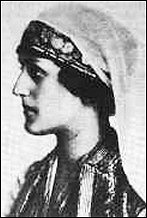
- AngelosAngelosThe Angelos family , feminine form Angelina , plural Angeloi , was a noble Byzantine lineage which gave rise to three Byzantine emperors from 1185 to 1204...
(Angelos/Anđelović), Serbianized Greek family - Argyropoulos (see John ArgyropoulosJohn ArgyropoulosJohn Argyropoulos was a Greek lecturer, philosopher and humanist, one of the émigré scholars who pioneered the revival of Classical learning in Western Europe in the 15th century...
) - Athanasovici
- Callimachi familyCallimachi familyCallimachi, Calimachi, or Kallimachi was a Moldavian boyar and princely family, originating with a group of free peasants living in the Orhei area of Bessarabia. It still remains present today in modern Romania.-Members:*Vasile Călmaşul: b...
(Călmaşu), originally a Romanian boyar family from MoldaviaMoldaviaMoldavia is a geographic and historical region and former principality in Eastern Europe, corresponding to the territory between the Eastern Carpathians and the Dniester river... - Cantacuzenus (Cantacuzino)
- Caradjas (Caragea)
- Caratheodoris (see Constantin CarathéodoryConstantin CarathéodoryConstantin Carathéodory was a Greek mathematician. He made significant contributions to the theory of functions of a real variable, the calculus of variations, and measure theory...
) - Chrisoscoleos
- Chrisovergis
- Diamandis
- DoukasDoukasDoukas, latinized as Ducas , from the Latin tile dux , is the name of a Byzantine Greek noble family, whose branches provided several notable generals and rulers to the Byzantine Empire...
- Gerakis, from KefaloniaKefaloniaThe island of Cephalonia, also known as Kefalonia, Cephallenia, Cephallonia, Kefallinia, or Kefallonia , is the largest of the Ionian Islands in western Greece, with an area of . It is also a separate regional unit of the Ionian Islands region, and the only municipality of the regional unit...
- Ghica familyGhica familyThe Ghica family were a Romanian noble family, active in Wallachia, Moldavia and in the Kingdom of Romania. In the 18th century, several branches of the family went through a process of Hellenization...
, originally AromaniansAromaniansAromanians are a Latin people native throughout the southern Balkans, especially in northern Greece, Albania, the Republic of Macedonia, Bulgaria, and as an emigrant community in Serbia and Romania . An older term is Macedo-Romanians...
or AlbaniansAlbaniansAlbanians are a nation and ethnic group native to Albania and neighbouring countries. They speak the Albanian language. More than half of all Albanians live in Albania and Kosovo...
from MacedoniaMacedonia (region)Macedonia is a geographical and historical region of the Balkan peninsula in southeastern Europe. Its boundaries have changed considerably over time, but nowadays the region is considered to include parts of five Balkan countries: Greece, the Republic of Macedonia, Bulgaria, Albania, Serbia, as... - Hantzeris (Handjeri)
- Kavadas (Kavvadas), from ChiosChiosChios is the fifth largest of the Greek islands, situated in the Aegean Sea, seven kilometres off the Asia Minor coast. The island is separated from Turkey by the Chios Strait. The island is noted for its strong merchant shipping community, its unique mastic gum and its medieval villages...
- Lambrinos
- Lapithis, from CreteCreteCrete is the largest and most populous of the Greek islands, the fifth largest island in the Mediterranean Sea, and one of the thirteen administrative regions of Greece. It forms a significant part of the economy and cultural heritage of Greece while retaining its own local cultural traits...
- Lazaridis/Lazarević, Serbianized family from Montenegro
- Mamonas
- ManosManos familyManos is a Greek family which was one of minor Phanariot families of Constantinople.Much of the family later settled in the independent Greek Kingdom...
- MavrocordatosMavrocordatosMavrocordatos was the name of a family of Phanariot Greeks, distinguished in the history of the Ottoman Empire, Wallachia, Moldavia, and modern Greece...
(Mavrocordato), from ChiosChiosChios is the fifth largest of the Greek islands, situated in the Aegean Sea, seven kilometres off the Asia Minor coast. The island is separated from Turkey by the Chios Strait. The island is noted for its strong merchant shipping community, its unique mastic gum and its medieval villages... - Mavroudis
- Mourousis (Moruzi)
- Musurus (see Marcus MusurusMarcus MusurusMarcus Musurus was a Greek scholar and philosopher born in Retimo, Castello, Venetian Crete . The son of a rich merchant, he became at an early age a pupil of John Lascaris in Venice....
) - PalaiologosPalaiologosPalaiologos , often latinized as Palaeologus, was a Byzantine Greek noble family, which produced the last ruling dynasty of the Byzantine Empire. After the Fourth Crusade, members of the family fled to the neighboring Empire of Nicaea, where Michael VIII Palaiologos became co-emperor in 1259,...
- PhilanthropenosPhilanthropenosPhilanthropenos , feminine form Philanthropene , was the name of a noble Byzantine Greek family which appeared in the mid-13th century and produced a number of high-ranking generals and officials until the end of the end of the Byzantine Empire. Their name derives from the monastery of Christ...
- RallisRallis- Rallis of Chios :*Dimitrios Rallis, , Prime minister of Greece 1897*George Rallis, , Prime minister of Greece 1980-1981*Ioannis Rallis, , Prime minister of Greece 1943-1944*Theodoros Rallis, , Greek painter...
, from ChiosChiosChios is the fifth largest of the Greek islands, situated in the Aegean Sea, seven kilometres off the Asia Minor coast. The island is separated from Turkey by the Chios Strait. The island is noted for its strong merchant shipping community, its unique mastic gum and its medieval villages... - Rizos Rangavis
- Racovitza (Racoviţă), Romanian noble family from WallachiaWallachiaWallachia or Walachia is a historical and geographical region of Romania. It is situated north of the Danube and south of the Southern Carpathians...
- Rallet
- Ramalo
- Rosettis (Ruset or Russeti)
- Scanavis
- Schinas
- Soutzos (Suţu or Sutzu), originally AromaniansAromaniansAromanians are a Latin people native throughout the southern Balkans, especially in northern Greece, Albania, the Republic of Macedonia, Bulgaria, and as an emigrant community in Serbia and Romania . An older term is Macedo-Romanians...
- Venturas
- Vlachoutzis
- Vacarescu, Romanian boyars from WallachiaWallachiaWallachia or Walachia is a historical and geographical region of Romania. It is situated north of the Danube and south of the Southern Carpathians...
, gave the first poets to Romanian literature - VlastosVlastosVlastos is the name of an ancient noble family, probably of Greek descent, with origins tracing back to 1st century Rome. The family history has never been impartially studied and the first 1000 years are not well researched....
, from CreteCreteCrete is the largest and most populous of the Greek islands, the fifth largest island in the Mediterranean Sea, and one of the thirteen administrative regions of Greece. It forms a significant part of the economy and cultural heritage of Greece while retaining its own local cultural traits... - YpsilantisYpsilantisThe Ypsilantis were a Greek Phanariote family which grew into prominence and power in Constantinople during the last centuries of Ottoman Empire and gave several short-reign hospodars to the Danubian Principalities...
(Ipsilanti)
Extinct Phanariote Families††
- Aristarchis
- Ballasakis
- Cananos
- Caryophyles
- Dimakis
- Eupragiotes
- Iancoleos (della Rocca)
- Mavrogenes (see Manto MavrogenousManto MavrogenousManto Mavrogenous was a Greek heroine of the Greek War of Independence. A rich woman, she spent all her fortune for the Hellenic cause. Under her encouragement, her European friends contributed money and guns to the revolution....
) - Moronas
- Negris
- Paladas, from CreteCreteCrete is the largest and most populous of the Greek islands, the fifth largest island in the Mediterranean Sea, and one of the thirteen administrative regions of Greece. It forms a significant part of the economy and cultural heritage of Greece while retaining its own local cultural traits...
- Plaginos
- Rizos Neroulos
- Ramadan
- Souldjaroglou
- Tzoukes
See also
- Ottoman GreeksOttoman GreeksOttoman Greeks were ethnic Greeks who lived in the Ottoman Empire , the Republic of Turkey's predecessor...
- DiafotismosDiafotismosThe Modern Greek Enlightenment was an ideological, philological, linguistic and philosophical movement among 18th century Greeks that translate the ideas and values of European Enlightenment into the Greek world.-Origins:...
- Greeks in RomaniaGreeks in RomaniaThere has been a Greek presence in Romania for at least 27 centuries. At times, as during the Phanariote era, this presence has amounted to hegemony; at other times , the Greeks have simply been one among the many ethnic minorities in Romania.-Ancient and Medieval Period:The Greek presence in what...
- Bulgarian ExarchateBulgarian ExarchateThe Bulgarian Exarchate was the official name of the Bulgarian Orthodox Church before its autocephaly was recognized by the Ecumenical See in 1945 and the Bulgarian Patriarchate was restored in 1953....
- Early Modern RomaniaEarly Modern RomaniaEarly Modern Romania is the portion of Romanian history that falls in the early modern period, roughly from the end of the 15th century to the end of the 18th century...
- Danubian PrincipalitiesDanubian PrincipalitiesDanubian Principalities was a conventional name given to the Principalities of Moldavia and Wallachia, which emerged in the early 14th century. The term was coined in the Habsburg Monarchy after the Treaty of Küçük Kaynarca in order to designate an area on the lower Danube with a common...
- List of rulers of Moldavia
- List of rulers of Wallachia
- History of the Russo-Turkish warsHistory of the Russo-Turkish warsThe Russo-Turkish wars were a series of wars fought between the Russian Empire and the Ottoman Empire during the 16th, 17th, 18th, 19th and 20th centuries...
- State organisation of the Ottoman EmpireState organisation of the Ottoman EmpireThe Ottoman Empire developed a highly advanced organisation of state over the centuries. Even though it had a very centralized government with the Sultan as the supreme ruler, it had an effective control of its provinces and inhabitants, as well as its officials. Wealth and rank wasn't necessarily...