


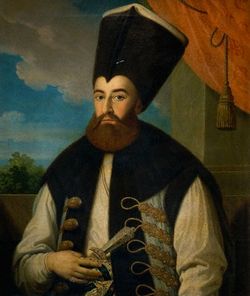
Grigore IV Ghica

Encyclopedia
Wallachia
Wallachia or Walachia is a historical and geographical region of Romania. It is situated north of the Danube and south of the Southern Carpathians...
between 1822 and 1828. A member of the Ghica family
Ghica family
The Ghica family were a Romanian noble family, active in Wallachia, Moldavia and in the Kingdom of Romania. In the 18th century, several branches of the family went through a process of Hellenization...
, Grigore IV was the brother of Alexandru Ghica
Alexandru Ghica
Alexandru Ghica was Voivode of Wallachia from 1766 to 1768....
and the uncle of Dora d'Istria
Dora d'Istria
Dora d'Istria , pen-name of duchess Helena Koltsova-Massalskaya, born Elena Ghica, was a Romanian Romantic writer and feminist.-Early life:...
.
While many of his relatives had occupied the throne in both Wallachia and Moldavia as Phanariotes, the regime change after the Greek War of Independence
Greek War of Independence
The Greek War of Independence, also known as the Greek Revolution was a successful war of independence waged by the Greek revolutionaries between...
, Tudor Vladimirescu
Tudor Vladimirescu
Tudor Vladimirescu was a Wallachian Romanian revolutionary hero, the leader of the Wallachian uprising of 1821 and of the Pandur militia. He is also known as Tudor din Vladimiri or — occasionally — as Domnul Tudor .-Background:Tudor was born in Vladimiri, Gorj County in a family of landed peasants...
's 1821 uprising
Wallachian uprising of 1821
The Wallachian uprising of 1821 was an uprising in Wallachia against Ottoman rule which took place during 1821.-Background:...
and the Philikí Etaireía's brief rule in the two Danubian Principalities
Danubian Principalities
Danubian Principalities was a conventional name given to the Principalities of Moldavia and Wallachia, which emerged in the early 14th century. The term was coined in the Habsburg Monarchy after the Treaty of Küçük Kaynarca in order to designate an area on the lower Danube with a common...
, led to Grigore IV being considered the first in a succession of non-Phanariote rulers. The elections for Prince in the Divan, although prescribed by the Akkerman Convention of 1826, were not to be organized, due mainly to precipitating events.As a Prince,Grigore watched after the development of agriculture in his region.
The Prince was ousted by the Russian occupation (see Russo-Turkish War, 1828-1829
Russo-Turkish War, 1828-1829
The Russo–Turkish War of 1828–1829 was sparked by the Greek War of Independence. The war broke out after the Sultan, incensed by the Russian participation in the Battle of Navarino, closed the Dardanelles for Russian ships and revoked the Akkerman Convention....
).
Grigore IV Ghica was first married to Maria Hangerly or Chantzeres (relative of Ecumenical Patriarch Samuel I Chatzeres ), with whom he had six sons (Costache, Iorgu, Scarlat, Grigore, Panait, and Dimitrie), and then to Eufrosina Săvescu, with whom he had two daughters (Maria and Alexandrina).