

Hellenization

Encyclopedia
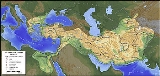
Hellenization is a term used to describe the spread of ancient Greek culture, and, to a lesser extent, language. It is mainly used to describe the spread of Hellenistic civilization
during the Hellenistic period
following the campaigns of Alexander the Great of Macedon
. The result of Hellenization was that elements of Greek origin combined in various forms and degrees with local elements, which is known as Hellenism
. In modern times, Hellenization has been associated with the adoption of modern Greek culture and the ethnic and cultural homogenization of Greece.
, the Leleges
, the Lemnians
, the Eteocypriot
s in Cyprus
, Eteocretans and Minoans in Crete
(prior to Classical antiquity
), as well as the Sicels
, Elymians
, Sicani
in Sicily
and the Oenotrians
, Brutii, Lucani
, Messapii
and many others in territories constituting Magna Graecia
.
 During the Hellenistic period, following the death of Alexander the Great, considerable numbers of Assyrians
, Jews
, Egyptians
, Persians, Parthia
ns, Armenians
and a number of other ethnic groups along the Middle East
and Central Asia
were Hellenized. The Bactrians
, an Iranian ethnic group who lived in Bactria
(northern Afghanistan
), were Hellenized during the Greco-Bactrian Kingdom
, and soon after various tribes in northwestern regions of the Indian subcontinent
(modern Pakistan
) during the Indo-Greek Kingdom
. There also was Hellenization of Thracians
, Dardanians, Paeonians and Illyrians
south of the Jireček Line
and even Getae
.
Hellenization during the Hellenistic period
, however, had its limitations. Case in point, areas of southern Syria
that were affected by Greek culture mostly entailed Seleucid urban centers where Greek was commonly spoken. The countryside, on the other hand, was largely unaffected since most of its inhabitants spoke Syriac and continued to maintain their native traditions. Moreover, Hellenization did not necessarily involve assimilation of non-Greek ethnic groups since Hellenistic Greeks in regions such as Asia Minor
were conscious of their ancestral lineages.
and Constantine's
founding of Constantinople
(Eastern Roman Empire that was Hellenized). Moreover, it can refer to the primacy of Greek culture and the Greek language
after the reign of Emperor Heraclius
in the 7th century.
during Ottoman
rule.
should have their names changed because of their non-Greek origin. The process of the change of toponyms in modern Greece has been described as a process of Hellenization. A modern use is in connection with policies pursuing "cultural harmonization and education of the linguistic minorities resident within the modern Greek state" (the Hellenic Republic), i.e. the Hellenization of minority groups in modern Greece. The word nowadays has a strong negative meaning in certain circles in Greece as it means (possibly illegally) giving citizenship to non-Greek immigrants.
"Hellenistic" is also, of course, still used to refer to the religion of the people who follow this religion today.
Hellenistic civilization
Hellenistic civilization represents the zenith of Greek influence in the ancient world from 323 BCE to about 146 BCE...
during the Hellenistic period
Hellenistic period
The Hellenistic period or Hellenistic era describes the time which followed the conquests of Alexander the Great. It was so named by the historian J. G. Droysen. During this time, Greek cultural influence and power was at its zenith in Europe and Asia...
following the campaigns of Alexander the Great of Macedon
Macedon
Macedonia or Macedon was an ancient kingdom, centered in the northeastern part of the Greek peninsula, bordered by Epirus to the west, Paeonia to the north, the region of Thrace to the east and Thessaly to the south....
. The result of Hellenization was that elements of Greek origin combined in various forms and degrees with local elements, which is known as Hellenism
Hellenism
Hellenism may refer to:*Hellenic studies*Hellenistic civilization*Hellenistic period, in Greek antiquity*Hellenistic Greece*Hellenization, the spread of Greek culture over foreign peoples*Hellenistic philosophy in the Hellenistic period and late antiquity...
. In modern times, Hellenization has been associated with the adoption of modern Greek culture and the ethnic and cultural homogenization of Greece.
Classical period
The term is used in a number of other ancient historical contexts, starting with the Hellenization of the earliest inhabitants of Greece such as the PelasgiansPelasgians
The name Pelasgians was used by some ancient Greek writers to refer to populations that were either the ancestors of the Greeks or who preceded the Greeks in Greece, "a hold-all term for any ancient, primitive and presumably indigenous people in the Greek world." In general, "Pelasgian" has come...
, the Leleges
Leleges
The Leleges were one of the aboriginal peoples of southwest Anatolia , who were already there when the Indo-European Hellenes emerged. The distinction between the Leleges and the Carians is unclear. According to Homer the Leleges were a distinct Anatolian tribe Homer...
, the Lemnians
Lemnian language
The Lemnian language is a language of the 6th century BC spoken on the island of Lemnos. It is mainly attested by an inscription found on a funerary stele, termed the Lemnos stele, discovered in 1885 near Kaminia. However, fragments of inscriptions on local pottery show that it was spoken there by...
, the Eteocypriot
Eteocypriot
Eteocypriot was a pre-Indo-European language spoken in Iron Age Cyprus. The name means "true" or "original Cyprian" parallel to Eteocretan, both of which names are used by modern scholarship to mean the pre-Greek languages of those places. Eteocypriot was written in the Cypriot syllabary, a...
s in Cyprus
Cyprus
Cyprus , officially the Republic of Cyprus , is a Eurasian island country, member of the European Union, in the Eastern Mediterranean, east of Greece, south of Turkey, west of Syria and north of Egypt. It is the third largest island in the Mediterranean Sea.The earliest known human activity on the...
, Eteocretans and Minoans in Crete
Crete
Crete is the largest and most populous of the Greek islands, the fifth largest island in the Mediterranean Sea, and one of the thirteen administrative regions of Greece. It forms a significant part of the economy and cultural heritage of Greece while retaining its own local cultural traits...
(prior to Classical antiquity
Classical antiquity
Classical antiquity is a broad term for a long period of cultural history centered on the Mediterranean Sea, comprising the interlocking civilizations of ancient Greece and ancient Rome, collectively known as the Greco-Roman world...
), as well as the Sicels
Sicels
The Sicels were an Italic people who inhabited ancient Sicily. The Sicels gave Sicily the name it has held since antiquity, but they rapidly fused into the culture of Magna Graecia.-History:...
, Elymians
Elymians
The Elymians were an ancient people who inhabited the western part of Sicily during the Bronze Age and Classical antiquity.-Origins:...
, Sicani
Sicani
The Sicani or Sicanians were one of three ancient peoples of Sicily present at the time of Phoenician and Greek colonization.-History:The Sicani are thought to be the oldest inhabitants of Sicily with a recorded name...
in Sicily
Sicily
Sicily is a region of Italy, and is the largest island in the Mediterranean Sea. Along with the surrounding minor islands, it constitutes an autonomous region of Italy, the Regione Autonoma Siciliana Sicily has a rich and unique culture, especially with regard to the arts, music, literature,...
and the Oenotrians
Oenotrians
The Oenotrians were an ancient Italic people of unknown origin who inhabited a territory from Paestum to southern Calabria in southern Italy...
, Brutii, Lucani
Lucani (ancient people)
The Lucani were an ancient people of Italy, living in Lucania, who spoke an Oscan language, a member of the Italic languages.-Society:...
, Messapii
Messapii
thumb|220px|Messapic ceramic, Archaeological Museum of [[Oria, Italy|Oria]], Apulia.The Messapii were an ancient tribe that inhabited, in historical times, the south-eastern peninsula or "heel" of Italy , known variously in ancient times as Calabria, Messapia and Iapygia...
and many others in territories constituting Magna Graecia
Magna Graecia
Magna Græcia is the name of the coastal areas of Southern Italy on the Tarentine Gulf that were extensively colonized by Greek settlers; particularly the Achaean colonies of Tarentum, Crotone, and Sybaris, but also, more loosely, the cities of Cumae and Neapolis to the north...
.
Hellenistic period
Assyrian people
The Assyrian people are a distinct ethnic group whose origins lie in ancient Mesopotamia...
, Jews
Jews
The Jews , also known as the Jewish people, are a nation and ethnoreligious group originating in the Israelites or Hebrews of the Ancient Near East. The Jewish ethnicity, nationality, and religion are strongly interrelated, as Judaism is the traditional faith of the Jewish nation...
, Egyptians
Egyptians
Egyptians are nation an ethnic group made up of Mediterranean North Africans, the indigenous people of Egypt.Egyptian identity is closely tied to geography. The population of Egypt is concentrated in the lower Nile Valley, the small strip of cultivable land stretching from the First Cataract to...
, Persians, Parthia
Parthia
Parthia is a region of north-eastern Iran, best known for having been the political and cultural base of the Arsacid dynasty, rulers of the Parthian Empire....
ns, Armenians
Armenians
Armenian people or Armenians are a nation and ethnic group native to the Armenian Highland.The largest concentration is in Armenia having a nearly-homogeneous population with 97.9% or 3,145,354 being ethnic Armenian....
and a number of other ethnic groups along the Middle East
Middle East
The Middle East is a region that encompasses Western Asia and Northern Africa. It is often used as a synonym for Near East, in opposition to Far East...
and Central Asia
Central Asia
Central Asia is a core region of the Asian continent from the Caspian Sea in the west, China in the east, Afghanistan in the south, and Russia in the north...
were Hellenized. The Bactrians
Bactrians
The Bactrians were the inhabitants of Bactria.Several important trade routes from India and China passed through Bactria and, as early as the Bronze Age, this had allowed the accumulation of vast amounts of wealth by the mostly nomadic population. The first proto-urban civilization in the area...
, an Iranian ethnic group who lived in Bactria
Bactria
Bactria and also appears in the Zend Avesta as Bukhdi. It is the ancient name of a historical region located between south of the Amu Darya and west of the Indus River...
(northern Afghanistan
Afghanistan
Afghanistan , officially the Islamic Republic of Afghanistan, is a landlocked country located in the centre of Asia, forming South Asia, Central Asia and the Middle East. With a population of about 29 million, it has an area of , making it the 42nd most populous and 41st largest nation in the world...
), were Hellenized during the Greco-Bactrian Kingdom
Greco-Bactrian Kingdom
The Greco-Bactrian Kingdom was the easternmost part of the Hellenistic world, covering Bactria and Sogdiana in Central Asia from 250 to 125 BC...
, and soon after various tribes in northwestern regions of the Indian subcontinent
Indian subcontinent
The Indian subcontinent, also Indian Subcontinent, Indo-Pak Subcontinent or South Asian Subcontinent is a region of the Asian continent on the Indian tectonic plate from the Hindu Kush or Hindu Koh, Himalayas and including the Kuen Lun and Karakoram ranges, forming a land mass which extends...
(modern Pakistan
Pakistan
Pakistan , officially the Islamic Republic of Pakistan is a sovereign state in South Asia. It has a coastline along the Arabian Sea and the Gulf of Oman in the south and is bordered by Afghanistan and Iran in the west, India in the east and China in the far northeast. In the north, Tajikistan...
) during the Indo-Greek Kingdom
Indo-Greek Kingdom
The Indo-Greek Kingdom or Graeco-Indian Kingdom covered various parts of the northwest regions of the Indian subcontinent during the last two centuries BC, and was ruled by more than 30 Hellenistic kings, often in conflict with each other...
. There also was Hellenization of Thracians
Thracians
The ancient Thracians were a group of Indo-European tribes inhabiting areas including Thrace in Southeastern Europe. They spoke the Thracian language – a scarcely attested branch of the Indo-European language family...
, Dardanians, Paeonians and Illyrians
Illyrians
The Illyrians were a group of tribes who inhabited part of the western Balkans in antiquity and the south-eastern coasts of the Italian peninsula...
south of the Jireček Line
Jirecek Line
The Jireček Line is an imaginary line through the ancient Balkans that divided the influences of the Latin and Greek languages until the 4th century...
and even Getae
Getae
The Getae was the name given by the Greeks to several Thracian tribes that occupied the regions south of the Lower Danube, in what is today northern Bulgaria, and north of the Lower Danube, in Romania...
.
Hellenization during the Hellenistic period
Hellenistic period
The Hellenistic period or Hellenistic era describes the time which followed the conquests of Alexander the Great. It was so named by the historian J. G. Droysen. During this time, Greek cultural influence and power was at its zenith in Europe and Asia...
, however, had its limitations. Case in point, areas of southern Syria
Syria
Syria , officially the Syrian Arab Republic , is a country in Western Asia, bordering Lebanon and the Mediterranean Sea to the West, Turkey to the north, Iraq to the east, Jordan to the south, and Israel to the southwest....
that were affected by Greek culture mostly entailed Seleucid urban centers where Greek was commonly spoken. The countryside, on the other hand, was largely unaffected since most of its inhabitants spoke Syriac and continued to maintain their native traditions. Moreover, Hellenization did not necessarily involve assimilation of non-Greek ethnic groups since Hellenistic Greeks in regions such as Asia Minor
Asia Minor
Asia Minor is a geographical location at the westernmost protrusion of Asia, also called Anatolia, and corresponds to the western two thirds of the Asian part of Turkey...
were conscious of their ancestral lineages.
Middle Ages
Hellenization can also refer to the medieval Byzantine EmpireByzantine Empire
The Byzantine Empire was the Eastern Roman Empire during the periods of Late Antiquity and the Middle Ages, centred on the capital of Constantinople. Known simply as the Roman Empire or Romania to its inhabitants and neighbours, the Empire was the direct continuation of the Ancient Roman State...
and Constantine's
Constantine I
Constantine the Great , also known as Constantine I or Saint Constantine, was Roman Emperor from 306 to 337. Well known for being the first Roman emperor to convert to Christianity, Constantine and co-Emperor Licinius issued the Edict of Milan in 313, which proclaimed religious tolerance of all...
founding of Constantinople
Constantinople
Constantinople was the capital of the Roman, Eastern Roman, Byzantine, Latin, and Ottoman Empires. Throughout most of the Middle Ages, Constantinople was Europe's largest and wealthiest city.-Names:...
(Eastern Roman Empire that was Hellenized). Moreover, it can refer to the primacy of Greek culture and the Greek language
Greek language
Greek is an independent branch of the Indo-European family of languages. Native to the southern Balkans, it has the longest documented history of any Indo-European language, spanning 34 centuries of written records. Its writing system has been the Greek alphabet for the majority of its history;...
after the reign of Emperor Heraclius
Heraclius
Heraclius was Byzantine Emperor from 610 to 641.He was responsible for introducing Greek as the empire's official language. His rise to power began in 608, when he and his father, Heraclius the Elder, the exarch of Africa, successfully led a revolt against the unpopular usurper Phocas.Heraclius'...
in the 7th century.
Ottoman rule
Hellenization is also the result of the higher status which the Greek culture and the Greek Orthodox Church enjoyed among the Christian Orthodox population of the BalkansBalkans
The Balkans is a geopolitical and cultural region of southeastern Europe...
during Ottoman
Ottoman Empire
The Ottoman EmpireIt was usually referred to as the "Ottoman Empire", the "Turkish Empire", the "Ottoman Caliphate" or more commonly "Turkey" by its contemporaries...
rule.
Modern usage
In 1909, a commission appointed by the Greek government reported that one third of the villages of GreeceGreece
Greece , officially the Hellenic Republic , and historically Hellas or the Republic of Greece in English, is a country in southeastern Europe....
should have their names changed because of their non-Greek origin. The process of the change of toponyms in modern Greece has been described as a process of Hellenization. A modern use is in connection with policies pursuing "cultural harmonization and education of the linguistic minorities resident within the modern Greek state" (the Hellenic Republic), i.e. the Hellenization of minority groups in modern Greece. The word nowadays has a strong negative meaning in certain circles in Greece as it means (possibly illegally) giving citizenship to non-Greek immigrants.
"Hellenistic" is also, of course, still used to refer to the religion of the people who follow this religion today.
External links
- Waterloo Institute for Hellenistic Studies is a 74 minute video primarily exploring the issues of Hellenization.