


Dimitrie Cantemir

Encyclopedia
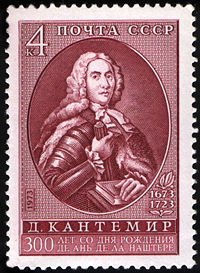
Dimitrie Cantemir was twice Prince of Moldavia
(in March–April 1693 and in 1710–1711). He was also a prolific man of letters
– philosopher, historian
, composer
, musicologist, linguist
, ethnographer, and geographer
.
His name is spelled Dimitrie Cantemir in Romanian
, Dmitriy Konstantinovich Kantemir (Дмитрий Константинович Кантемир) in Russian
, Dimitri Kantemiroğlu in Turkish
, Dymitr Kantemir in Polish
, Dimitrios Kantemiris (Δημήτριος Καντεμίρης) in Greek
and Demetre Cantemir in several other languages.
and now located in Vaslui County
, Romania
), Dimitrie was the son of Moldavian Voivode Constantin Cantemir
(and brother to Antioh Cantemir
, himself Prince), of the low-ranking boyar
Cantemireşti
family. His mother, Ana Bantăş, was a learned woman of noble origins. (Cantemir never forgot his paternal ancestry, but while in Constantinople because of his name similarity locals inspired him to claim descent from Khan Temir
, an early 17th century khan
of the Budjak
Tatars
– see Moldavian Magnate Wars
' on some occasions'.)
 His education began at home, where he learned Greek
and Latin
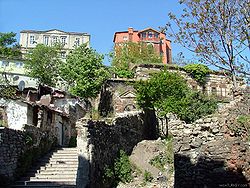
and acquired a profound knowledge of the classics. Between 1687 and 1710 he lived in forced exile in Istanbul
, where he learned Turkish and studied the history of the Ottoman Empire
at the Patriarchate
's Greek Academy
, where he also composed music.
In 1693, he succeeded his father as Prince of Moldavia
– in name only, as the Ottomans appointed Constantin Duca, favoured by Wallachia
n Prince and, despite many shared goals, forever rival of the Cantemirs Constantin Brâncoveanu
; his bid for the throne was successful only in 1710, after two rules by his brother (whom he represented as envoy in the Ottoman capital). He had ruled only three weeks when he joined Peter the Great
in his campaign against the Ottoman Empire (see Russo-Turkish War, 1710–1711) and placed Moldavia under Russian suzerainty
, after a secret agreement signed in Lutsk
.
Defeated by the Turks in the battle of Stănileşti
(July 18–July 22, 1711), Cantemir sought refuge in Russia, where he and his family finally settled (he was accompanied by a sizeable boyar retinue
, including the chronicle
r Ion Neculce
). There, he was awarded the title of Knyaz
(Prince) of the Russian Empire by Peter the Great and received the title of Reichsfürst (Prince) of the Holy Roman Empire
from Charles VI
. He died at his Dmitrovka estate
near Oryol
in 1723 (on the very day he was awarded the Roman-German princely title). In 1935, his remains were carried to Iaşi
.
He was married twice: in 1699, to Kassandra Cantacuzene (1682–1713), member of the Cantacuzino family
(the daughter of Prince Şerban Cantacuzino
), and in 1717 to Anastasia Trubetskaya (1700–1755; from the Trubetskoy
house).
Cantemir's children were rather prominent in Russian history. His elder daughter Maria Cantemir
(1700–1754) attracted the attention of Peter the Great who allegedly planned to divorce his wife Catherine
and marry her. Upon Catherine's ascension to the throne, she was forced to enter a convent
. His son Antioh Cantemir (Antiokh Dmitrievich in Russian) (1708–1744) was also the Russian ambassador to London
and Paris
, a prominent satirical
poet, and Voltaire
's friend. Another son, Constantin (Konstantin Dmitrievich; 1703–1747), was implicated in the Galitzine
conspiracy against Empress Anne
and exiled to Siberia
. Finally, Dimitrie's younger daughter Smaragda (1720–1761), the wife of Prince Dmitriy Mikhailovich Galitzine, was a friend of Empress Elizabeth and one of the great beauties of her time.
. Between 1711 and 1719 he wrote his most important creations. Cantemir was known as one of the greatest linguists of his time, speaking and writing eleven languages, and being well versed in Oriental scholarship. His oeuvre is voluminous, diverse, and original; although some of his scientific writings contain unconfirmed theories and inaccuracies, his expertise, sagacity, and groundbreaking researches are widely acknowledged.
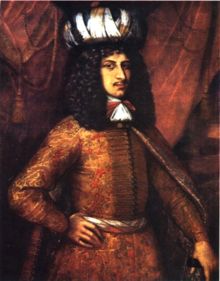 The best known is his History of the Growth and Decay of the Ottoman Empire. This volume circulated throughout Europe
in manuscript
for a number of years. It was finally printed in 1734 in London
, and later it was translated and printed in Germany and France. It remained the seminal work on the Ottoman Empire
up to the middle of the 19th century – notably, it was used as reference by Edward Gibbon
for his The History of the Decline and Fall of the Roman Empire
. Afterwards, the work was largely contested, for some of its sources were doubtful.
In 1714, at the request of the Royal Academy in Berlin, Cantemir wrote the first geographical, ethnographical and economic description of Moldavia, Descriptio Moldaviae. As many of his books it circulated first in manuscript and was only later published in Germany (first in 1769 in a geographical magazine, and then in 1771 the first edition as a book). Around the same time he prepared a manuscript map of Moldavia, the first real map of the country. It contained a lot of geographical detail as well as administrative information. Printed in 1737 in the Netherlands, it has been used by all cartographers of the time as an inspiration for their own maps of Moldavia.
Other writings:
Due to his many esteemed works he won great renown at the high courts of Europe. His name is among those who were considered to be the brightest minds of the world on a plaque at the Library of Sainte-Genevieve in Paris
, next to those of Leibnitz
, Newton
, Piron
, and other great thinkers.
 Some of Cantemir's compositions are part of the regular repertory of Turkish
music ensembles. In 1999, the Bezmara ensemble have recorded an album, Yitik Sesin Peşinde ("In Search of the Lost Sound") from the Cantemir transcriptions using period instruments.
In 2000, Golden Horn Records released a CD exploring Cantemir's compositions, European composers of Cantemir's era, and folk music of Moldavia. Featuring solo improvisations on kemençe (Turkish bowed fiddle) and tanbur (Turkish long-necked plucked lute) by famed master Íhsan Özgen and early music ensemble Lux Musica directed by Linda Burman-Hall, the project fulfills an ambitious endeavor by Özgen and Burman-Hall to meld early European music styles and instruments with today's Turkish art music styles and instruments, with Cantemir as their touchstone.
In 2009, Alia Vox published a CD and booklet of music performed by the Hespèrion XXI
ensemble and invited musicians under the baton of Jordi Savall
. The recording and booklet both pertain to “The Book of the Science of Music” by Cantemir and the Sephardic and Armenian musical traditions. Seven of Cantemir's compositions are included in the recording along with other Turkish, Armenian and Sephardic music.
He had around 40 compositions in the Ottoman music of which few are performed today, but his greatest service to the Ottoman music is the fact that he helped survival of 350 instrumental pieces by recording them in a certain notation (the ebced) script he developed in his work Edvar which he presented to Sultan Ahmed III
.
The most recent publication of his abovementioned work, reprint along with complete transcription and explanations, is: Kantemiroğlu, Kitâbu 'İlmi'l-Mûsiki alâ Vechi'l-Hurûfât, Mûsikiyi Harflerle Tesbit ve İcrâ İlminin Kitabı, Yalçın Tura, Yapı Kredi Yayınları, Istanbul 2001, ISBN 975-08-0167-9. Romanian historian and musicologist
Eugenia Popescu-Judetz has numerous works on Cantemir, the most recent of which being a monograph (in English
, also translated into Turkish): Prince Dimitrie Cantemir, Theorist and Composer of Turkish Music, Eugenia Popescu-Judetz, Pan Yayıncılık, Istanbul 1999, ISBN 975-7652-82-2.
Descriptio Moldaviae at Latin Wikisource Istoria ieroglifică at Romanian Wikisource
Moldavia
Moldavia is a geographic and historical region and former principality in Eastern Europe, corresponding to the territory between the Eastern Carpathians and the Dniester river...
(in March–April 1693 and in 1710–1711). He was also a prolific man of letters
Intellectual
An intellectual is a person who uses intelligence and critical or analytical reasoning in either a professional or a personal capacity.- Terminology and endeavours :"Intellectual" can denote four types of persons:...
– philosopher, historian
Historian
A historian is a person who studies and writes about the past and is regarded as an authority on it. Historians are concerned with the continuous, methodical narrative and research of past events as relating to the human race; as well as the study of all history in time. If the individual is...
, composer
Composer
A composer is a person who creates music, either by musical notation or oral tradition, for interpretation and performance, or through direct manipulation of sonic material through electronic media...
, musicologist, linguist
Linguistics
Linguistics is the scientific study of human language. Linguistics can be broadly broken into three categories or subfields of study: language form, language meaning, and language in context....
, ethnographer, and geographer
Geographer
A geographer is a scholar whose area of study is geography, the study of Earth's natural environment and human society.Although geographers are historically known as people who make maps, map making is actually the field of study of cartography, a subset of geography...
.
His name is spelled Dimitrie Cantemir in Romanian
Romanian language
Romanian Romanian Romanian (or Daco-Romanian; obsolete spellings Rumanian, Roumanian; self-designation: română, limba română ("the Romanian language") or românește (lit. "in Romanian") is a Romance language spoken by around 24 to 28 million people, primarily in Romania and Moldova...
, Dmitriy Konstantinovich Kantemir (Дмитрий Константинович Кантемир) in Russian
Russian language
Russian is a Slavic language used primarily in Russia, Belarus, Uzbekistan, Kazakhstan, Tajikistan and Kyrgyzstan. It is an unofficial but widely spoken language in Ukraine, Moldova, Latvia, Turkmenistan and Estonia and, to a lesser extent, the other countries that were once constituent republics...
, Dimitri Kantemiroğlu in Turkish
Turkish language
Turkish is a language spoken as a native language by over 83 million people worldwide, making it the most commonly spoken of the Turkic languages. Its speakers are located predominantly in Turkey and Northern Cyprus with smaller groups in Iraq, Greece, Bulgaria, the Republic of Macedonia, Kosovo,...
, Dymitr Kantemir in Polish
Polish language
Polish is a language of the Lechitic subgroup of West Slavic languages, used throughout Poland and by Polish minorities in other countries...
, Dimitrios Kantemiris (Δημήτριος Καντεμίρης) in Greek
Greek language
Greek is an independent branch of the Indo-European family of languages. Native to the southern Balkans, it has the longest documented history of any Indo-European language, spanning 34 centuries of written records. Its writing system has been the Greek alphabet for the majority of its history;...
and Demetre Cantemir in several other languages.
Life and family
Born in Silişteni (renamed Dimitrie CantemirDimitrie Cantemir, Vaslui
Dimitrie Cantemir is a commune in Vaslui County, Romania. The commune was named for Prince Dimitrie Cantemir, who was born there. It is composed of five villages: Grumezoaia, Gușiței, Hurdugi , Plotonești and Urlați....
and now located in Vaslui County
Vaslui County
Vaslui is a county of Romania, in the historical region Moldavia, with the seat at Vaslui.-Demographics:In 2002, it had a population of 455,049 and the population density was 86/km².*Romanians - over 98%*Romas, other-Geography:...
, Romania
Romania
Romania is a country located at the crossroads of Central and Southeastern Europe, on the Lower Danube, within and outside the Carpathian arch, bordering on the Black Sea...
), Dimitrie was the son of Moldavian Voivode Constantin Cantemir
Constantin Cantemir
Constantin Cantemir was a Moldavian Voivode between June 25, 1685 and March 27, 1693.-Life:Cantemir became a voivode at the age of 71, after being favored by the Ottoman Empire in his conflict with Dumitraşcu Cantacuzino...
(and brother to Antioh Cantemir
Antioh Cantemir
Antioh Cantemir , son of Constantin Cantemir and older brother of Dimitrie Cantemir , was a Moldavian Voivode between December 18, 1695 and September 12, 1700, and again from February 23, 1705 to July 31, 1707.-Reigns:He and Dimitrie successfully plotted against Prince Constantin...
, himself Prince), of the low-ranking boyar
Boyar
A boyar, or bolyar , was a member of the highest rank of the feudal Moscovian, Kievan Rus'ian, Bulgarian, Wallachian, and Moldavian aristocracies, second only to the ruling princes , from the 10th century through the 17th century....
Cantemireşti
Cantemiresti
Cantemireşti was a Moldavian boyar family. In the 17th and 18th century it brought forth several Voivodes of Moldavia. In the 18th century, the family moved to Russia.The most famous members are:*Constantin Cantemir , Voivode of Moldavia...
family. His mother, Ana Bantăş, was a learned woman of noble origins. (Cantemir never forgot his paternal ancestry, but while in Constantinople because of his name similarity locals inspired him to claim descent from Khan Temir
Khan Temir
Khan Temir was a powerful khan of the Budjak Nogais ; around 1603, he formed and subsequently led the Nogai Khanate.-Biography:...
, an early 17th century khan
Khan (title)
Khan is an originally Altaic and subsequently Central Asian title for a sovereign or military ruler, widely used by medieval nomadic Turko-Mongol tribes living to the north of China. 'Khan' is also seen as a title in the Xianbei confederation for their chief between 283 and 289...
of the Budjak
Budjak
Budjak or Budzhak is a historical region in the Odessa Oblast of Ukraine. Lying along the Black Sea between the Danube and Dniester rivers this multiethnic region was the southern part of Bessarabia...
Tatars
Nogais
The Nogai people are a Turkic ethnic group in Southern Russia: northern Dagestan and Stavropol Krai, as well as in Karachay-Cherkessia and the Astrakhan Oblast; undefined number live in Chechnya...
– see Moldavian Magnate Wars
Moldavian Magnate Wars
The Moldavian Magnate Wars refer to the period at the end of the 16th century and the beginning of the 17th century when the magnates of the Polish-Lithuanian Commonwealth intervened in the affairs of Moldavia, clashing with the Habsburgs and the Ottoman Empire for domination and influence over the...
' on some occasions'.)
Greek language
Greek is an independent branch of the Indo-European family of languages. Native to the southern Balkans, it has the longest documented history of any Indo-European language, spanning 34 centuries of written records. Its writing system has been the Greek alphabet for the majority of its history;...
and Latin
Latin
Latin is an Italic language originally spoken in Latium and Ancient Rome. It, along with most European languages, is a descendant of the ancient Proto-Indo-European language. Although it is considered a dead language, a number of scholars and members of the Christian clergy speak it fluently, and...
and acquired a profound knowledge of the classics. Between 1687 and 1710 he lived in forced exile in Istanbul
Istanbul
Istanbul , historically known as Byzantium and Constantinople , is the largest city of Turkey. Istanbul metropolitan province had 13.26 million people living in it as of December, 2010, which is 18% of Turkey's population and the 3rd largest metropolitan area in Europe after London and...
, where he learned Turkish and studied the history of the Ottoman Empire
Ottoman Empire
The Ottoman EmpireIt was usually referred to as the "Ottoman Empire", the "Turkish Empire", the "Ottoman Caliphate" or more commonly "Turkey" by its contemporaries...
at the Patriarchate
Patriarch of Constantinople
The Ecumenical Patriarch is the Archbishop of Constantinople – New Rome – ranking as primus inter pares in the Eastern Orthodox communion, which is seen by followers as the One, Holy, Catholic, and Apostolic Church....
's Greek Academy
Phanar Greek Orthodox College
-See also:*Fener*Greeks in Turkey*Zografeion Lyceum*List of schools in Istanbul*Ottoman Greeks...
, where he also composed music.
In 1693, he succeeded his father as Prince of Moldavia
Moldavia
Moldavia is a geographic and historical region and former principality in Eastern Europe, corresponding to the territory between the Eastern Carpathians and the Dniester river...
– in name only, as the Ottomans appointed Constantin Duca, favoured by Wallachia
Wallachia
Wallachia or Walachia is a historical and geographical region of Romania. It is situated north of the Danube and south of the Southern Carpathians...
n Prince and, despite many shared goals, forever rival of the Cantemirs Constantin Brâncoveanu
Constantin Brâncoveanu
Constantin Brâncoveanu was Prince of Wallachia between 1688 and 1714.-Ascension:A descendant of the Craioveşti boyar family and related to Matei Basarab, Brâncoveanu was born at the estate of Brâncoveni and raised in the house of his uncle, stolnic Constantin Cantacuzino...
; his bid for the throne was successful only in 1710, after two rules by his brother (whom he represented as envoy in the Ottoman capital). He had ruled only three weeks when he joined Peter the Great
Peter I of Russia
Peter the Great, Peter I or Pyotr Alexeyevich Romanov Dates indicated by the letters "O.S." are Old Style. All other dates in this article are New Style. ruled the Tsardom of Russia and later the Russian Empire from until his death, jointly ruling before 1696 with his half-brother, Ivan V...
in his campaign against the Ottoman Empire (see Russo-Turkish War, 1710–1711) and placed Moldavia under Russian suzerainty
Suzerainty
Suzerainty occurs where a region or people is a tributary to a more powerful entity which controls its foreign affairs while allowing the tributary vassal state some limited domestic autonomy. The dominant entity in the suzerainty relationship, or the more powerful entity itself, is called a...
, after a secret agreement signed in Lutsk
Lutsk
Lutsk is a city located by the Styr River in northwestern Ukraine. It is the administrative center of the Volyn Oblast and the administrative center of the surrounding Lutskyi Raion within the oblast...
.
Defeated by the Turks in the battle of Stănileşti
Stanilesti
Stănileşti is a commune in Vaslui County, Romania. It is composed of seven villages: Bogdana-Voloseni, Budu Cantemir, Chersăcosu, Gura Văii, Pogăneşti, Săratu and Stănileşti....
(July 18–July 22, 1711), Cantemir sought refuge in Russia, where he and his family finally settled (he was accompanied by a sizeable boyar retinue
Retinue
A retinue is a body of persons "retained" in the service of a noble or royal personage, a suite of "retainers".-Etymology:...
, including the chronicle
Chronicle
Generally a chronicle is a historical account of facts and events ranged in chronological order, as in a time line. Typically, equal weight is given for historically important events and local events, the purpose being the recording of events that occurred, seen from the perspective of the...
r Ion Neculce
Ion Neculce
Ion Neculce was a Moldavian chronicler. His main work, Letopiseţul Ţărâi Moldovei [de la Dabija Vodă până la a doua domnie a lui Constantin Mavrocordat] was meant to extend Ion Neculce's narrative, covering events from 1661 to 1743.-Life:Ion Neculce...
). There, he was awarded the title of Knyaz
Knyaz
Kniaz, knyaz or knez is a Slavic title found in most Slavic languages, denoting a royal nobility rank. It is usually translated into English as either Prince or less commonly as Duke....
(Prince) of the Russian Empire by Peter the Great and received the title of Reichsfürst (Prince) of the Holy Roman Empire
Holy Roman Empire
The Holy Roman Empire was a realm that existed from 962 to 1806 in Central Europe.It was ruled by the Holy Roman Emperor. Its character changed during the Middle Ages and the Early Modern period, when the power of the emperor gradually weakened in favour of the princes...
from Charles VI
Charles VI, Holy Roman Emperor
Charles VI was the penultimate Habsburg sovereign of the Habsburg Empire. He succeeded his elder brother, Joseph I, as Holy Roman Emperor, King of Bohemia , Hungary and Croatia , Archduke of Austria, etc., in 1711...
. He died at his Dmitrovka estate
Estate (house)
An estate comprises the houses and outbuildings and supporting farmland and woods that surround the gardens and grounds of a very large property, such as a country house or mansion. It is the modern term for a manor, but lacks the latter's now abolished jurisdictional authority...
near Oryol
Oryol
Oryol or Orel is a city and the administrative center of Oryol Oblast, Russia, located on the Oka River, approximately south-southwest of Moscow...
in 1723 (on the very day he was awarded the Roman-German princely title). In 1935, his remains were carried to Iaşi
Iasi
Iași is the second most populous city and a municipality in Romania. Located in the historical Moldavia region, Iași has traditionally been one of the leading centres of Romanian social, cultural, academic and artistic life...
.
He was married twice: in 1699, to Kassandra Cantacuzene (1682–1713), member of the Cantacuzino family
Cantacuzino family
The Cantacuzino or Cantacuzène family is an old boyar family of Wallachia and Moldavia, a branch of Greek Kantakouzinos family, allegedly descended from the Byzantine Emperor John VI Cantacuzenus. No definite genealogical links between Byzantine Greek and Romanian Cantacuzinos have been established...
(the daughter of Prince Şerban Cantacuzino
Serban Cantacuzino
Șerban Cantacuzino was a Prince of Wallachia between 1678 and 1688.He took part in the Ottoman campaign ending in their defeat at the Battle of Vienna...
), and in 1717 to Anastasia Trubetskaya (1700–1755; from the Trubetskoy
Trubetskoy
Trubetskoy , Трубецкой , Трубяцкі , Trubecki , Trubetsky , Трубецький , Troubetzkoy , Trubezkoi or Trubetzkoy , is a Ruthenian Gediminid gentry family of Black Ruthenian stock, like many other princely houses of Grand Duchy of Lithuania, later prominent in Russian...
house).
Cantemir's children were rather prominent in Russian history. His elder daughter Maria Cantemir
Maria Cantemir
Maria Cantemir was a Romanian noble, a lady in waiting and salonist and the royal mistress of Peter the Great.Maria was born in Istanbul as the daughter of prince Dimitrie Cantemir. She was very well educated. From 1711, she lived in Russia, and in 1720, she became involved in a relationship with...
(1700–1754) attracted the attention of Peter the Great who allegedly planned to divorce his wife Catherine
Catherine I of Russia
Catherine I , the second wife of Peter the Great, reigned as Empress of Russia from 1725 until her death.-Life as a peasant woman:The life of Catherine I was said by Voltaire to be nearly as extraordinary as that of Peter the Great himself. There are no documents that confirm her origins. Born on...
and marry her. Upon Catherine's ascension to the throne, she was forced to enter a convent
Convent
A convent is either a community of priests, religious brothers, religious sisters, or nuns, or the building used by the community, particularly in the Roman Catholic Church and in the Anglican Communion...
. His son Antioh Cantemir (Antiokh Dmitrievich in Russian) (1708–1744) was also the Russian ambassador to London
London
London is the capital city of :England and the :United Kingdom, the largest metropolitan area in the United Kingdom, and the largest urban zone in the European Union by most measures. Located on the River Thames, London has been a major settlement for two millennia, its history going back to its...
and Paris
Paris
Paris is the capital and largest city in France, situated on the river Seine, in northern France, at the heart of the Île-de-France region...
, a prominent satirical
Satire
Satire is primarily a literary genre or form, although in practice it can also be found in the graphic and performing arts. In satire, vices, follies, abuses, and shortcomings are held up to ridicule, ideally with the intent of shaming individuals, and society itself, into improvement...
poet, and Voltaire
Voltaire
François-Marie Arouet , better known by the pen name Voltaire , was a French Enlightenment writer, historian and philosopher famous for his wit and for his advocacy of civil liberties, including freedom of religion, free trade and separation of church and state...
's friend. Another son, Constantin (Konstantin Dmitrievich; 1703–1747), was implicated in the Galitzine
Galitzine
For Orthodox clergyman and theologian, see Alexander Golitzin.The Galitzines are one of the largest and noblest princely houses of Russia. Since the extinction of the Korecki family in the 17th century, the Golitsyns have claimed dynastic seniority in the House of Gediminas...
conspiracy against Empress Anne
Anna of Russia
Anna of Russia or Anna Ivanovna reigned as Duchess of Courland from 1711 to 1730 and as Empress of Russia from 1730 to 1740.-Accession to the throne:Anna was the daughter of Ivan V of Russia, as well as the niece of Peter the Great...
and exiled to Siberia
Siberia
Siberia is an extensive region constituting almost all of Northern Asia. Comprising the central and eastern portion of the Russian Federation, it was part of the Soviet Union from its beginning, as its predecessor states, the Tsardom of Russia and the Russian Empire, conquered it during the 16th...
. Finally, Dimitrie's younger daughter Smaragda (1720–1761), the wife of Prince Dmitriy Mikhailovich Galitzine, was a friend of Empress Elizabeth and one of the great beauties of her time.
History, geography, philosophy and linguistics
In 1714 Cantemir became a member of the Royal Academy of BerlinBerlin
Berlin is the capital city of Germany and is one of the 16 states of Germany. With a population of 3.45 million people, Berlin is Germany's largest city. It is the second most populous city proper and the seventh most populous urban area in the European Union...
. Between 1711 and 1719 he wrote his most important creations. Cantemir was known as one of the greatest linguists of his time, speaking and writing eleven languages, and being well versed in Oriental scholarship. His oeuvre is voluminous, diverse, and original; although some of his scientific writings contain unconfirmed theories and inaccuracies, his expertise, sagacity, and groundbreaking researches are widely acknowledged.
Europe
Europe is, by convention, one of the world's seven continents. Comprising the westernmost peninsula of Eurasia, Europe is generally 'divided' from Asia to its east by the watershed divides of the Ural and Caucasus Mountains, the Ural River, the Caspian and Black Seas, and the waterways connecting...
in manuscript
Manuscript
A manuscript or handwrite is written information that has been manually created by someone or some people, such as a hand-written letter, as opposed to being printed or reproduced some other way...
for a number of years. It was finally printed in 1734 in London
London
London is the capital city of :England and the :United Kingdom, the largest metropolitan area in the United Kingdom, and the largest urban zone in the European Union by most measures. Located on the River Thames, London has been a major settlement for two millennia, its history going back to its...
, and later it was translated and printed in Germany and France. It remained the seminal work on the Ottoman Empire
Ottoman Empire
The Ottoman EmpireIt was usually referred to as the "Ottoman Empire", the "Turkish Empire", the "Ottoman Caliphate" or more commonly "Turkey" by its contemporaries...
up to the middle of the 19th century – notably, it was used as reference by Edward Gibbon
Edward Gibbon
Edward Gibbon was an English historian and Member of Parliament...
for his The History of the Decline and Fall of the Roman Empire
The History of the Decline and Fall of the Roman Empire
The History of the Decline and Fall of the Roman Empire is a non-fiction history book written by English historian Edward Gibbon and published in six volumes. Volume I was published in 1776, and went through six printings. Volumes II and III were published in 1781; volumes IV, V, VI in 1788–89...
. Afterwards, the work was largely contested, for some of its sources were doubtful.
In 1714, at the request of the Royal Academy in Berlin, Cantemir wrote the first geographical, ethnographical and economic description of Moldavia, Descriptio Moldaviae. As many of his books it circulated first in manuscript and was only later published in Germany (first in 1769 in a geographical magazine, and then in 1771 the first edition as a book). Around the same time he prepared a manuscript map of Moldavia, the first real map of the country. It contained a lot of geographical detail as well as administrative information. Printed in 1737 in the Netherlands, it has been used by all cartographers of the time as an inspiration for their own maps of Moldavia.
Other writings:
- A history and notation of Ottoman court music.
- The first critical history of RomaniaRomaniaRomania is a country located at the crossroads of Central and Southeastern Europe, on the Lower Danube, within and outside the Carpathian arch, bordering on the Black Sea...
as a whole, under the name of Hronicul vechimii a romano-moldo-valahilor – approx. "ChronicleChronicleGenerally a chronicle is a historical account of facts and events ranged in chronological order, as in a time line. Typically, equal weight is given for historically important events and local events, the purpose being the recording of events that occurred, seen from the perspective of the...
of the durability of RomansAncient RomeAncient Rome was a thriving civilization that grew on the Italian Peninsula as early as the 8th century BC. Located along the Mediterranean Sea and centered on the city of Rome, it expanded to one of the largest empires in the ancient world....
-Moldavians-Wallachians" (1719–1722).
- The first Romanian language novel, the cryptic Historia Hieroglyphica (1705), to which he furnished a key, and in which the principal persons are represented by mythological beastsBestiaryA bestiary, or Bestiarum vocabulum is a compendium of beasts. Bestiaries were made popular in the Middle Ages in illustrated volumes that described various animals, birds and even rocks. The natural history and illustration of each beast was usually accompanied by a moral lesson...
; it is the history of the two Wallachian ruling houses of BrâncoveanuCraiovestiThe Craiovești , later Brâncovenești , were a boyar family in Wallachia who gave the country several of its Princes and held the title of Ban of Oltenia for ca...
and CantacuzinoCantacuzino familyThe Cantacuzino or Cantacuzène family is an old boyar family of Wallachia and Moldavia, a branch of Greek Kantakouzinos family, allegedly descended from the Byzantine Emperor John VI Cantacuzenus. No definite genealogical links between Byzantine Greek and Romanian Cantacuzinos have been established...
.
- A philosophical treatiseTreatiseA treatise is a formal and systematic written discourse on some subject, generally longer and treating it in greater depth than an essay, and more concerned with investigating or exposing the principles of the subject.-Noteworthy treatises:...
, written in RomanianRomanian languageRomanian Romanian Romanian (or Daco-Romanian; obsolete spellings Rumanian, Roumanian; self-designation: română, limba română ("the Romanian language") or românește (lit. "in Romanian") is a Romance language spoken by around 24 to 28 million people, primarily in Romania and Moldova...
and also in GreekGreek languageGreek is an independent branch of the Indo-European family of languages. Native to the southern Balkans, it has the longest documented history of any Indo-European language, spanning 34 centuries of written records. Its writing system has been the Greek alphabet for the majority of its history;...
, translated into ArabicArabic languageArabic is a name applied to the descendants of the Classical Arabic language of the 6th century AD, used most prominently in the Quran, the Islamic Holy Book...
, under the title Divanul sau Gâlceava Înţeleptului cu lumea sau Giudeţul sufletului cu trupul (Iaşi, 1698) – Le divan ou la dispute du sage avec le monde ou le jugement de l'âme avec le corps in FrenchFrench languageFrench is a Romance language spoken as a first language in France, the Romandy region in Switzerland, Wallonia and Brussels in Belgium, Monaco, the regions of Quebec and Acadia in Canada, and by various communities elsewhere. Second-language speakers of French are distributed throughout many parts...
("The DivanDivanA divan was a high governmental body in a number of Islamic states, or its chief official .-Etymology:...
or The Wise Man's Parley with the World or The Judgement of the Soul with the Body").
- An unfinished second treatise (Istanbul, 1700), Sacrosantae scientiae indepingibilis imagio or Imaginea ştiinţei sacre, care nu se poate zugrăvi ("The Image of the Sacred, Undepictable Science").
- An introduction to IslamIslamIslam . The most common are and . : Arabic pronunciation varies regionally. The first vowel ranges from ~~. The second vowel ranges from ~~~...
written for Europeans.
- A biographyBiographyA biography is a detailed description or account of someone's life. More than a list of basic facts , biography also portrays the subject's experience of those events...
of Jan Baptist van HelmontJan Baptist van HelmontJan Baptist van Helmont was an early modern period Flemish chemist, physiologist, and physician. He worked during the years just after Paracelsus and iatrochemistry, and is sometimes considered to be "the founder of pneumatic chemistry"...
(Cantemir, 1709). This work is cited by Debus (2002), on pages 212-213.
Due to his many esteemed works he won great renown at the high courts of Europe. His name is among those who were considered to be the brightest minds of the world on a plaque at the Library of Sainte-Genevieve in Paris
Paris
Paris is the capital and largest city in France, situated on the river Seine, in northern France, at the heart of the Île-de-France region...
, next to those of Leibnitz
Leibnitz
Leibnitz is a city in the Austrian state of Styria and at the 2001 census had a population of approximately 7.577 .It is located to the south of the city of Graz, between the Mur and Sulm rivers....
, Newton
Isaac Newton
Sir Isaac Newton PRS was an English physicist, mathematician, astronomer, natural philosopher, alchemist, and theologian, who has been "considered by many to be the greatest and most influential scientist who ever lived."...
, Piron
Piron
Piron is a surname of a number of notable individuals:* Claude Piron - a translator* Constantin Piron - a physicist* Alexis Piron - a French dramatist* Armand J. Piron - a Jazz musician-Other meaning:* Brigade Piron, a Belgian Infantry Brigade...
, and other great thinkers.
Musicology
Turkey
Turkey , known officially as the Republic of Turkey , is a Eurasian country located in Western Asia and in East Thrace in Southeastern Europe...
music ensembles. In 1999, the Bezmara ensemble have recorded an album, Yitik Sesin Peşinde ("In Search of the Lost Sound") from the Cantemir transcriptions using period instruments.
In 2000, Golden Horn Records released a CD exploring Cantemir's compositions, European composers of Cantemir's era, and folk music of Moldavia. Featuring solo improvisations on kemençe (Turkish bowed fiddle) and tanbur (Turkish long-necked plucked lute) by famed master Íhsan Özgen and early music ensemble Lux Musica directed by Linda Burman-Hall, the project fulfills an ambitious endeavor by Özgen and Burman-Hall to meld early European music styles and instruments with today's Turkish art music styles and instruments, with Cantemir as their touchstone.
In 2009, Alia Vox published a CD and booklet of music performed by the Hespèrion XXI
Hespèrion XXI
Hespèrion XXI is an international early music ensemble. The group was formed in Basel, Switzerland in 1974 as Hespèrion XX by Spanish musical director Jordi Savall , Montserrat Figueras , Lorenzo Alpert , and Hopkinson Smith...
ensemble and invited musicians under the baton of Jordi Savall
Jordi Savall
Jordi Savall i Bernadet is a Catalan viol player, conductor and composer. He has been one of the major figures in the field of Western early music since the 1970s, largely responsible for bringing the viol back to life on the stage...
. The recording and booklet both pertain to “The Book of the Science of Music” by Cantemir and the Sephardic and Armenian musical traditions. Seven of Cantemir's compositions are included in the recording along with other Turkish, Armenian and Sephardic music.
He had around 40 compositions in the Ottoman music of which few are performed today, but his greatest service to the Ottoman music is the fact that he helped survival of 350 instrumental pieces by recording them in a certain notation (the ebced) script he developed in his work Edvar which he presented to Sultan Ahmed III
Ahmed III
Ahmed III was Sultan of the Ottoman Empire and a son of Sultan Mehmed IV . His mother was Mâh-Pâre Ummatullah Râbi'a Gül-Nûş Valide Sultan, originally named Evmania Voria, who was an ethnic Greek. He was born at Hajioglupazari, in Dobruja...
.
The most recent publication of his abovementioned work, reprint along with complete transcription and explanations, is: Kantemiroğlu, Kitâbu 'İlmi'l-Mûsiki alâ Vechi'l-Hurûfât, Mûsikiyi Harflerle Tesbit ve İcrâ İlminin Kitabı, Yalçın Tura, Yapı Kredi Yayınları, Istanbul 2001, ISBN 975-08-0167-9. Romanian historian and musicologist
Musicology
Musicology is the scholarly study of music. The word is used in narrow, broad and intermediate senses. In the narrow sense, musicology is confined to the music history of Western culture...
Eugenia Popescu-Judetz has numerous works on Cantemir, the most recent of which being a monograph (in English
English language
English is a West Germanic language that arose in the Anglo-Saxon kingdoms of England and spread into what was to become south-east Scotland under the influence of the Anglian medieval kingdom of Northumbria...
, also translated into Turkish): Prince Dimitrie Cantemir, Theorist and Composer of Turkish Music, Eugenia Popescu-Judetz, Pan Yayıncılık, Istanbul 1999, ISBN 975-7652-82-2.
External links
Biography- Genealogy of the Cantemir family
- Music of Cantemir (Golden Horn Records)
- Music CD with booklet: Istanbul - Dimitrie Cantemir - Jordi Savall (Alia Vox)
- Istanbul. Dimitrie Cantemir - "Le livre de la Science de la Musique" - "The Book of the Science of Music" - Hespèrion XXI - dir. Jordi Savall
Descriptio Moldaviae at Latin Wikisource Istoria ieroglifică at Romanian Wikisource