


Ahmed III

Encyclopedia
Ahmed III (December 30/31, 1673 – July 1, 1736) was Sultan
of the Ottoman Empire
and a son of Sultan Mehmed IV
(1648–87). His mother was Mâh-Pâre Ummatullah (Emetullah) Râbi'a Gül-Nûş
Valide Sultan
, originally named Evmania Voria, who was an ethnic Greek
. He was born at Hajioglupazari
, in Dobruja
. He succeeded to the throne in 1703 on the abdication of his brother Mustafa II
(1695–1703). Nevşehirli Damat İbrahim Pasha
and his daughter, Princess Hatice
(wife of the former) directed the government from 1718 to 1730, a period referred to as the Tulip Era
.
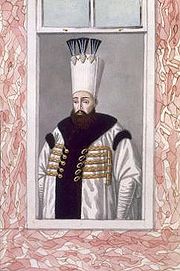 Ahmed III cultivated good relations with France, doubtless in view of Russia's menacing attitude. In fact both his wives were Frenchwomen. He awarded refuge in Ottoman territory to Charles XII of Sweden
(1682–1718) after the Swedish defeat at the hands of Peter I of Russia
(1672–1725) in the Battle of Poltava
of 1709. King Charles XII of Sweden
escaped to the Ottoman Empire after losing the Battle of Poltava
against the Russians
, which was a part of the Great Northern War
. In 1710 he convinced the Ottoman Sultan Ahmed III to declare war against Russia, and the Ottoman forces under Baltacı Mehmet Pasha
won a major victory at the Battle of Prut. In the aftermath, Russia returned Azov
back to the Ottomans, agreed to demolish the fortress of Taganrog
and others in the area, and to stop interfering into the affairs of the Polish-Lithuanian Commonwealth
.
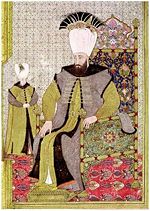 Forced against his will into war with Russia
, Ahmed III came nearer than any Ottoman sovereign
before or since to breaking the power of his northern rival, whose armies his grand vizier
Nevşehirli Damat İbrahim Pasha
succeeded in completely surrounding at the Pruth River Campaign in 1711. The subsequent Ottoman victories against Russia enabled the Ottoman Empire to advance to Moscow, had the Sultan wished. However, this was halted as a report reached Constantinople
that the Safavids
were invading the Ottoman Empire, causing a period of panic, turning the Sultan's attention away from Russia.
Sultan Ahmed III had become unpopular by reason of the excessive pomp and costly luxury in which he and his principal officers indulged; on September 20, 1730, a mutinous riot of seventeen janissaries
, led by the Albanian
Patrona Halil
, was aided by the citizens as well as the military until it swelled into an insurrection in front of which the sultan was forced to give up the throne.
Ahmed voluntarily led his nephew Mahmud I
(1730–54) to the seat of sovereignty and paid allegiance to him as Sultan of the Empire. He then retired to the Kafes
previously occupied by Mahmud and died at Topkapı Palace
after six years of confinement.
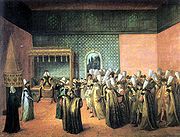 The reign of Ahmed III, which had lasted for twenty-seven years, although marked by the disasters of the Great Turkish War
, was not unsuccessful. The recovery of Azov
and the Morea
, and the conquest of part of Persia, managed to counterbalance the Balkan
territory ceded to the Habsburg Monarchy
through the Treaty of Passarowitz
, after the Ottoman Empire was defeated in Austro-Turkish War of 1716-18
. In 1716, he sent and army of 33,000 men to capture Corfu
from the Republic of Venice
.
Ahmed III
left the finances of the Ottoman Empire
in a flourishing condition, which had remarkably been obtained without excessive taxation or extortion procedures. He was a cultivated patron
of literature and art, and it was in his time that the first printing press
authorized to use the Arabic or Turkish languages was set up in Constantinople, operated by Ibrahim Muteferrika
(while the printing press had been introduced to Constantinople in 1480, all works published before 1729 were in Greek, Armenian, or Hebrew).
It was in this reign that an important change in the government of the Danubian Principalities
was introduced: previously, the Porte had appointed Hospodar
s, usually native Moldavia
n and Wallachia
n boyar
s, to administer those provinces; after the Russian campaign
of 1711, during which Peter the Great
found an ally in Moldavia
Prince Dimitrie Cantemir
, the Porte began overtly deputizing Phanariote
Greeks
in that region, and extended the system to Wallachia
after Prince Stefan Cantacuzino
established links with Eugene of Savoy
. The Phanariotes constituted a kind of Dhimmi
nobility, which supplied the Porte with functionaries in many important departments of the state.
, and Râbi'a Sermi Sultan. By first wife he had Mustafa III
and by second wife he had Abdul Hamid I.
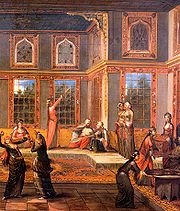 A passage in Voltaire
's Candide
has the book's eponymous main character meet the deposed Ahmed III while on a ship from Venice
to Constantinople
. The Sultan is in the company of five other deposed European monarchs, and he tells Candide, who initially doubts his credentials:
This episode was taken up by the modern Turkish writer Nedim Gürsel
and made into the setting of his 2001 novel Le voyage de Candide à Istanbul.
In fact, there is no evidence of the deposed Sultan being allowed to make such foreign travels, nor did Voltaire (or Gürsel) assert that it had any actual historical foundation.
[aged 62]
Sultan
Sultan is a title with several historical meanings. Originally, it was an Arabic language abstract noun meaning "strength", "authority", "rulership", and "dictatorship", derived from the masdar سلطة , meaning "authority" or "power". Later, it came to be used as the title of certain rulers who...
of the Ottoman Empire
Ottoman Empire
The Ottoman EmpireIt was usually referred to as the "Ottoman Empire", the "Turkish Empire", the "Ottoman Caliphate" or more commonly "Turkey" by its contemporaries...
and a son of Sultan Mehmed IV
Mehmed IV
Mehmed IV Modern Turkish Mehmet was the Sultan of the Ottoman Empire from 1648 to 1687...
(1648–87). His mother was Mâh-Pâre Ummatullah (Emetullah) Râbi'a Gül-Nûş
Emetullah Rabia Gülnûş Sultan
Emetullah Râbi'a Gülnûş Sultan was the wife of Ottoman Sultan Mehmed IV and Valide Sultan to their sons Mustafa II and Ahmed III.-Biography:...
Valide Sultan
Valide Sultan
Valide Sultan was the title held by the mother of a ruling Sultan in the Ottoman Empire. The Turkish pronunciation of the word Valide is . The title is sometimes translated as Queen Mother, although the position of Valide Sultan was quite different.The position was perhaps the most important...
, originally named Evmania Voria, who was an ethnic Greek
Greeks
The Greeks, also known as the Hellenes , are a nation and ethnic group native to Greece, Cyprus and neighboring regions. They also form a significant diaspora, with Greek communities established around the world....
. He was born at Hajioglupazari
Dobrich
Dobrich is a town in northeastern Bulgaria, the administrative centre of Dobrich Province. With 91,030 inhabitants, as of February 2011, Dobrich is the ninth most populated town in Bulgaria, being the centre of the historical region of Southern Dobruja...
, in Dobruja
Dobruja
Dobruja is a historical region shared by Bulgaria and Romania, located between the lower Danube river and the Black Sea, including the Danube Delta, Romanian coast and the northernmost part of the Bulgarian coast...
. He succeeded to the throne in 1703 on the abdication of his brother Mustafa II
Mustafa II
Mustafa II Ghazi was the Sultan of the Ottoman Empire from 1695 to 1703.-Life:...
(1695–1703). Nevşehirli Damat İbrahim Pasha
Nevsehirli Damat Ibrahim Pasha
Nevşehirli Damad Ibrahim Pasha served as Grand Vizier for Sultan Ahmed III of the Ottoman Empire during the Tulip period. He was also the head of a ruling family which had great influence in the court of Ahmed III...
and his daughter, Princess Hatice
Princess Hatice
HIH Princess Hatice Sultan was an Ottoman princess , daughter of Ahmed III and consort to Grand Vizier Nevşehirli Damat İbrahim Pasha...
(wife of the former) directed the government from 1718 to 1730, a period referred to as the Tulip Era
Tulip Era in the Ottoman Empire
The Tulip Period or Tulip Era is a period in Ottoman history from The Treaty of Passarowitz on 21 July 1718 to The Patrona Halil Rebellion on 28 September 1730...
.
Biography
Charles XII of Sweden
Charles XII also Carl of Sweden, , Latinized to Carolus Rex, Turkish: Demirbaş Şarl, also known as Charles the Habitué was the King of the Swedish Empire from 1697 to 1718...
(1682–1718) after the Swedish defeat at the hands of Peter I of Russia
Peter I of Russia
Peter the Great, Peter I or Pyotr Alexeyevich Romanov Dates indicated by the letters "O.S." are Old Style. All other dates in this article are New Style. ruled the Tsardom of Russia and later the Russian Empire from until his death, jointly ruling before 1696 with his half-brother, Ivan V...
(1672–1725) in the Battle of Poltava
Battle of Poltava
The Battle of Poltava on 27 June 1709 was the decisive victory of Peter I of Russia over the Swedish forces under Field Marshal Carl Gustav Rehnskiöld in one of the battles of the Great Northern War. It is widely believed to have been the beginning of Sweden's decline as a Great Power; the...
of 1709. King Charles XII of Sweden
Charles XII of Sweden
Charles XII also Carl of Sweden, , Latinized to Carolus Rex, Turkish: Demirbaş Şarl, also known as Charles the Habitué was the King of the Swedish Empire from 1697 to 1718...
escaped to the Ottoman Empire after losing the Battle of Poltava
Battle of Poltava
The Battle of Poltava on 27 June 1709 was the decisive victory of Peter I of Russia over the Swedish forces under Field Marshal Carl Gustav Rehnskiöld in one of the battles of the Great Northern War. It is widely believed to have been the beginning of Sweden's decline as a Great Power; the...
against the Russians
Russian Empire
The Russian Empire was a state that existed from 1721 until the Russian Revolution of 1917. It was the successor to the Tsardom of Russia and the predecessor of the Soviet Union...
, which was a part of the Great Northern War
Great Northern War
The Great Northern War was a conflict in which a coalition led by the Tsardom of Russia successfully contested the supremacy of the Swedish Empire in northern Central Europe and Eastern Europe. The initial leaders of the anti-Swedish alliance were Peter I the Great of Russia, Frederick IV of...
. In 1710 he convinced the Ottoman Sultan Ahmed III to declare war against Russia, and the Ottoman forces under Baltacı Mehmet Pasha
Baltacı Mehmet Pasha
Baltacı Mehmet Pasha was an Ottoman grand vizier. -Early years:Mehmet was born in Osmancık, near Çorum . He was of Turkish origin. He travelled to North Africa, which was then Ottoman territory...
won a major victory at the Battle of Prut. In the aftermath, Russia returned Azov
Azov
-External links:** *...
back to the Ottomans, agreed to demolish the fortress of Taganrog
Taganrog
Taganrog is a seaport city in Rostov Oblast, Russia, located on the north shore of Taganrog Bay , several kilometers west of the mouth of the Don River. Population: -History of Taganrog:...
and others in the area, and to stop interfering into the affairs of the Polish-Lithuanian Commonwealth
Polish-Lithuanian Commonwealth
The Polish–Lithuanian Commonwealth was a dualistic state of Poland and Lithuania ruled by a common monarch. It was the largest and one of the most populous countries of 16th- and 17th‑century Europe with some and a multi-ethnic population of 11 million at its peak in the early 17th century...
.
Russo-Turkish War, 1710-1711
The war between Russia and the Ottoman Empire erupted after the Russians had defeated Sweden in the Battle of Poltava. With help from the Austrian and French diplomats, the wounded Charles XII of Sweden escaped from the battlefield to the court of the Ottoman Sultan Ahmed III, whom he persuaded to...
, Ahmed III came nearer than any Ottoman sovereign
Sovereign
A sovereign is the supreme lawmaking authority within its jurisdiction.Sovereign may also refer to:*Monarch, the sovereign of a monarchy*Sovereign Bank, banking institution in the United States*Sovereign...
before or since to breaking the power of his northern rival, whose armies his grand vizier
Grand Vizier
Grand Vizier, in Turkish Vezir-i Azam or Sadr-ı Azam , deriving from the Arabic word vizier , was the greatest minister of the Sultan, with absolute power of attorney and, in principle, dismissable only by the Sultan himself...
Nevşehirli Damat İbrahim Pasha
Nevsehirli Damat Ibrahim Pasha
Nevşehirli Damad Ibrahim Pasha served as Grand Vizier for Sultan Ahmed III of the Ottoman Empire during the Tulip period. He was also the head of a ruling family which had great influence in the court of Ahmed III...
succeeded in completely surrounding at the Pruth River Campaign in 1711. The subsequent Ottoman victories against Russia enabled the Ottoman Empire to advance to Moscow, had the Sultan wished. However, this was halted as a report reached Constantinople
Istanbul
Istanbul , historically known as Byzantium and Constantinople , is the largest city of Turkey. Istanbul metropolitan province had 13.26 million people living in it as of December, 2010, which is 18% of Turkey's population and the 3rd largest metropolitan area in Europe after London and...
that the Safavids
Safavid dynasty
The Safavid dynasty was one of the most significant ruling dynasties of Iran. They ruled one of the greatest Persian empires since the Muslim conquest of Persia and established the Twelver school of Shi'a Islam as the official religion of their empire, marking one of the most important turning...
were invading the Ottoman Empire, causing a period of panic, turning the Sultan's attention away from Russia.
Sultan Ahmed III had become unpopular by reason of the excessive pomp and costly luxury in which he and his principal officers indulged; on September 20, 1730, a mutinous riot of seventeen janissaries
Janissary
The Janissaries were infantry units that formed the Ottoman sultan's household troops and bodyguards...
, led by the Albanian
Albanians
Albanians are a nation and ethnic group native to Albania and neighbouring countries. They speak the Albanian language. More than half of all Albanians live in Albania and Kosovo...
Patrona Halil
Patrona Halil
Patrona Halil , was the instigator of a mob uprising in 1730 which replaced Sultan Ahmed III with Mahmud I and ended the Tulip period....
, was aided by the citizens as well as the military until it swelled into an insurrection in front of which the sultan was forced to give up the throne.
Ahmed voluntarily led his nephew Mahmud I
Mahmud I
Mahmud I , called the Hunchback was the Sultan of the Ottoman Empire from 1730 to 1754.-Biography:...
(1730–54) to the seat of sovereignty and paid allegiance to him as Sultan of the Empire. He then retired to the Kafes
Kafes
Kafes, literally "the cage", was the part of the Imperial Harem of the Ottoman Palace where possible successors to the throne were kept under a form of house-arrest and constant surveillance by the palace guards....
previously occupied by Mahmud and died at Topkapı Palace
Topkapi Palace
The Topkapı Palace is a large palace in Istanbul, Turkey, that was the primary residence of the Ottoman Sultans for approximately 400 years of their 624-year reign....
after six years of confinement.
Character of Ahmed III's rule
Great Turkish War
The Great Turkish War refers to a series of conflicts between the Ottoman Empire and contemporary European powers, then joined into a Holy League, during the second half of the 17th century.-1667–1683:...
, was not unsuccessful. The recovery of Azov
Azov
-External links:** *...
and the Morea
Morea
The Morea was the name of the Peloponnese peninsula in southern Greece during the Middle Ages and the early modern period. It also referred to a Byzantine province in the region, known as the Despotate of Morea.-Origins of the name:...
, and the conquest of part of Persia, managed to counterbalance the Balkan
Balkans
The Balkans is a geopolitical and cultural region of southeastern Europe...
territory ceded to the Habsburg Monarchy
Habsburg Monarchy
The Habsburg Monarchy covered the territories ruled by the junior Austrian branch of the House of Habsburg , and then by the successor House of Habsburg-Lorraine , between 1526 and 1867/1918. The Imperial capital was Vienna, except from 1583 to 1611, when it was moved to Prague...
through the Treaty of Passarowitz
Treaty of Passarowitz
The Treaty of Passarowitz or Treaty of Požarevac was the peace treaty signed in Požarevac , a town in Ottoman Empire , on 21 July 1718 between the Ottoman Empire on one side and the Habsburg Monarchy of Austria and the Republic of Venice on the other.During the years 1714-1718, the Ottomans had...
, after the Ottoman Empire was defeated in Austro-Turkish War of 1716-18
Austro-Turkish War of 1716-18
The Austro-Turkish War was fought between Austria and the Ottoman Empire.The Treaty of Karlowitz was not an acceptable long-standing agreement for the Ottoman Empire...
. In 1716, he sent and army of 33,000 men to capture Corfu
Corfu
Corfu is a Greek island in the Ionian Sea. It is the second largest of the Ionian Islands, and, including its small satellite islands, forms the edge of the northwestern frontier of Greece. The island is part of the Corfu regional unit, and is administered as a single municipality. The...
from the Republic of Venice
Republic of Venice
The Republic of Venice or Venetian Republic was a state originating from the city of Venice in Northeastern Italy. It existed for over a millennium, from the late 7th century until 1797. It was formally known as the Most Serene Republic of Venice and is often referred to as La Serenissima, in...
.
Ahmed III
Ahmed III
Ahmed III was Sultan of the Ottoman Empire and a son of Sultan Mehmed IV . His mother was Mâh-Pâre Ummatullah Râbi'a Gül-Nûş Valide Sultan, originally named Evmania Voria, who was an ethnic Greek. He was born at Hajioglupazari, in Dobruja...
left the finances of the Ottoman Empire
Ottoman Empire
The Ottoman EmpireIt was usually referred to as the "Ottoman Empire", the "Turkish Empire", the "Ottoman Caliphate" or more commonly "Turkey" by its contemporaries...
in a flourishing condition, which had remarkably been obtained without excessive taxation or extortion procedures. He was a cultivated patron
Patronage
Patronage is the support, encouragement, privilege, or financial aid that an organization or individual bestows to another. In the history of art, arts patronage refers to the support that kings or popes have provided to musicians, painters, and sculptors...
of literature and art, and it was in his time that the first printing press
Printing press
A printing press is a device for applying pressure to an inked surface resting upon a print medium , thereby transferring the ink...
authorized to use the Arabic or Turkish languages was set up in Constantinople, operated by Ibrahim Muteferrika
Ibrahim Muteferrika
Ibrahim Müteferrika or Ibrahim Müteferrika or Ibrahim Müteferrika or (1674 born in Kolozsvár (present-day Cluj-Napoca, Romania)– died 1745, in Istanbul, (Ottoman Empire now Turkey); was a Transylvanian-born Ottoman diplomat, polymath: a publisher, printer, courtier, economist, man of letters,...
(while the printing press had been introduced to Constantinople in 1480, all works published before 1729 were in Greek, Armenian, or Hebrew).
It was in this reign that an important change in the government of the Danubian Principalities
Danubian Principalities
Danubian Principalities was a conventional name given to the Principalities of Moldavia and Wallachia, which emerged in the early 14th century. The term was coined in the Habsburg Monarchy after the Treaty of Küçük Kaynarca in order to designate an area on the lower Danube with a common...
was introduced: previously, the Porte had appointed Hospodar
Hospodar
Hospodar or gospodar is a term of Slavonic origin, meaning "lord" or "master".The rulers of Wallachia and Moldavia were styled hospodars in Slavic writings from the 15th century to 1866. Hospodar was used in addition to the title voivod...
s, usually native Moldavia
Moldavia
Moldavia is a geographic and historical region and former principality in Eastern Europe, corresponding to the territory between the Eastern Carpathians and the Dniester river...
n and Wallachia
Wallachia
Wallachia or Walachia is a historical and geographical region of Romania. It is situated north of the Danube and south of the Southern Carpathians...
n boyar
Boyar
A boyar, or bolyar , was a member of the highest rank of the feudal Moscovian, Kievan Rus'ian, Bulgarian, Wallachian, and Moldavian aristocracies, second only to the ruling princes , from the 10th century through the 17th century....
s, to administer those provinces; after the Russian campaign
Russo-Turkish War, 1710-1711
The war between Russia and the Ottoman Empire erupted after the Russians had defeated Sweden in the Battle of Poltava. With help from the Austrian and French diplomats, the wounded Charles XII of Sweden escaped from the battlefield to the court of the Ottoman Sultan Ahmed III, whom he persuaded to...
of 1711, during which Peter the Great
Peter I of Russia
Peter the Great, Peter I or Pyotr Alexeyevich Romanov Dates indicated by the letters "O.S." are Old Style. All other dates in this article are New Style. ruled the Tsardom of Russia and later the Russian Empire from until his death, jointly ruling before 1696 with his half-brother, Ivan V...
found an ally in Moldavia
Moldavia
Moldavia is a geographic and historical region and former principality in Eastern Europe, corresponding to the territory between the Eastern Carpathians and the Dniester river...
Prince Dimitrie Cantemir
Dimitrie Cantemir
Dimitrie Cantemir was twice Prince of Moldavia . He was also a prolific man of letters – philosopher, historian, composer, musicologist, linguist, ethnographer, and geographer....
, the Porte began overtly deputizing Phanariote
Phanariotes
Phanariots, Phanariotes, or Phanariote Greeks were members of those prominent Greek families residing in Phanar , the chief Greek quarter of Constantinople, where the Ecumenical Patriarchate is situated.For all their cosmopolitanism and often Western education, the Phanariots were...
Greeks
Greeks
The Greeks, also known as the Hellenes , are a nation and ethnic group native to Greece, Cyprus and neighboring regions. They also form a significant diaspora, with Greek communities established around the world....
in that region, and extended the system to Wallachia
Wallachia
Wallachia or Walachia is a historical and geographical region of Romania. It is situated north of the Danube and south of the Southern Carpathians...
after Prince Stefan Cantacuzino
Stefan Cantacuzino
Ştefan Cantacuzino , was a Prince of Wallachia between April 1714 and January 21, 1716, the son of stolnic Constantin Cantacuzino.-Life:Ştefan was involved in his father's intrigue against Prince Constantin Brâncoveanu, denouncing him to the Ottoman Empire , and surrendering Brâncoveanu's secret...
established links with Eugene of Savoy
Prince Eugene of Savoy
Prince Eugene of Savoy , was one of the most successful military commanders in modern European history, rising to the highest offices of state at the Imperial court in Vienna. Born in Paris to aristocratic Italian parents, Eugene grew up around the French court of King Louis XIV...
. The Phanariotes constituted a kind of Dhimmi
Dhimmi
A , is a non-Muslim subject of a state governed in accordance with sharia law. Linguistically, the word means "one whose responsibility has been taken". This has to be understood in the context of the definition of state in Islam...
nobility, which supplied the Porte with functionaries in many important departments of the state.
Marriages and issue
He married Aminā (Emine) Mihr-î-Mâh SultanMihrimah Sultan
Princess Mihrimah Sultan was the daughter of the Ottoman Sultan Suleiman I and his Ruthenian wife, Hürrem Sultan. Princess Mihrimah's name is also spelled Mirhumah, Mihr-î-Mâh, Mihrî-a-Mâh or Mehr-î-Mâh. She was born in İstanbul. Mehr-î-Mâh means "Sun Princess Mihrimah Sultan (born 21 March 1522...
, and Râbi'a Sermi Sultan. By first wife he had Mustafa III
Mustafa III
Mustafa III was the Sultan of the Ottoman Empire from 1757 to 1774. He was a son of Sultan Ahmed III and was succeeded by his brother Abdul Hamid I . He was born in Edirne...
and by second wife he had Abdul Hamid I.
In Fiction
Voltaire
François-Marie Arouet , better known by the pen name Voltaire , was a French Enlightenment writer, historian and philosopher famous for his wit and for his advocacy of civil liberties, including freedom of religion, free trade and separation of church and state...
's Candide
Candide
Candide, ou l'Optimisme is a French satire first published in 1759 by Voltaire, a philosopher of the Age of Enlightenment. The novella has been widely translated, with English versions titled Candide: or, All for the Best ; Candide: or, The Optimist ; and Candide: or, Optimism...
has the book's eponymous main character meet the deposed Ahmed III while on a ship from Venice
Venice
Venice is a city in northern Italy which is renowned for the beauty of its setting, its architecture and its artworks. It is the capital of the Veneto region...
to Constantinople
Constantinople
Constantinople was the capital of the Roman, Eastern Roman, Byzantine, Latin, and Ottoman Empires. Throughout most of the Middle Ages, Constantinople was Europe's largest and wealthiest city.-Names:...
. The Sultan is in the company of five other deposed European monarchs, and he tells Candide, who initially doubts his credentials:
I am not jesting, my name is Achmet III. For
several years I was Sultan; I dethroned my brother;
my nephew dethroned me; they cut off the heads of
my viziers; I am ending my days in the old seraglio;
my nephew, Sultan Mahmoud, sometimes allows me
to travel for my health, and I have come to spend the
Carnival at Venice" (http://www.archive.org/stream/candideotherroma00voltuoft/candideotherroma00voltuoft_djvu.txt).
This episode was taken up by the modern Turkish writer Nedim Gürsel
Nedim Gürsel
Nedim Gürsel is a Turkish writer. In the late 1960s, he published novellas and essays in Turkish magazines. After graduating from Galatasaray High School in 1970, he studied at the Sorbonne. In 1974, he graduated from the Sorbonne's Department of Modern French Literature...
and made into the setting of his 2001 novel Le voyage de Candide à Istanbul.
In fact, there is no evidence of the deposed Sultan being allowed to make such foreign travels, nor did Voltaire (or Gürsel) assert that it had any actual historical foundation.
Sources
- This article incorporates text from the History of Ottoman Turks (1878)
[aged 62]