

Danubian Principalities

Encyclopedia

Principality
A principality is a monarchical feudatory or sovereign state, ruled or reigned over by a monarch with the title of prince or princess, or by a monarch with another title within the generic use of the term prince....
of Moldavia
Moldavia
Moldavia is a geographic and historical region and former principality in Eastern Europe, corresponding to the territory between the Eastern Carpathians and the Dniester river...
and Wallachia
Wallachia
Wallachia or Walachia is a historical and geographical region of Romania. It is situated north of the Danube and south of the Southern Carpathians...
, which emerged in the early 14th century. The term was coined in the Habsburg Monarchy
Habsburg Monarchy
The Habsburg Monarchy covered the territories ruled by the junior Austrian branch of the House of Habsburg , and then by the successor House of Habsburg-Lorraine , between 1526 and 1867/1918. The Imperial capital was Vienna, except from 1583 to 1611, when it was moved to Prague...
after the Treaty of Küçük Kaynarca
Treaty of Kucuk Kaynarca
The Treaty of Küçük Kaynarca was signed on 21 July 1774, in Küçük Kaynarca , Dobruja between the Russian Empire and the Ottoman Empire after the Ottoman Empire was defeated in the...
(1774) in order to designate an area on the lower Danube
Danube
The Danube is a river in the Central Europe and the Europe's second longest river after the Volga. It is classified as an international waterway....
with a common geopolitical
Geopolitics
Geopolitics, from Greek Γη and Πολιτική in broad terms, is a theory that describes the relation between politics and territory whether on local or international scale....
situation. The term was largely used then by foreign political circles and public opinion until the union of the two Principalities (1859). Alongside Transylvania
Transylvania
Transylvania is a historical region in the central part of Romania. Bounded on the east and south by the Carpathian mountain range, historical Transylvania extended in the west to the Apuseni Mountains; however, the term sometimes encompasses not only Transylvania proper, but also the historical...
, the United Principalities of Moldavia and Wallachia
United Principalities
The United Principalities of Moldavia and Wallachia, also known as the Romanian Principalities, was the official name of Romania following the 1859 election of Alexandru Ioan Cuza as prince or domnitor of both territories...
became the basis for the Kingdom of Romania
Kingdom of Romania
The Kingdom of Romania was the Romanian state based on a form of parliamentary monarchy between 13 March 1881 and 30 December 1947, specified by the first three Constitutions of Romania...
, and by extension the modern Romania
Romania
Romania is a country located at the crossroads of Central and Southeastern Europe, on the Lower Danube, within and outside the Carpathian arch, bordering on the Black Sea...
n nation-state
Nation-state
The nation state is a state that self-identifies as deriving its political legitimacy from serving as a sovereign entity for a nation as a sovereign territorial unit. The state is a political and geopolitical entity; the nation is a cultural and/or ethnic entity...
.
In a wider context, the concept may also apply to the Principality of Serbia in terms of The Principalities of the Danube which came under the suzerainty
Suzerainty
Suzerainty occurs where a region or people is a tributary to a more powerful entity which controls its foreign affairs while allowing the tributary vassal state some limited domestic autonomy. The dominant entity in the suzerainty relationship, or the more powerful entity itself, is called a...
(alongside Wallachia and Moldova) of the Porte from 1817.
Early history
Vassal
A vassal or feudatory is a person who has entered into a mutual obligation to a lord or monarch in the context of the feudal system in medieval Europe. The obligations often included military support and mutual protection, in exchange for certain privileges, usually including the grant of land held...
s of the Hungarian Crown
Kingdom of Hungary
The Kingdom of Hungary comprised present-day Hungary, Slovakia and Croatia , Transylvania , Carpatho Ruthenia , Vojvodina , Burgenland , and other smaller territories surrounding present-day Hungary's borders...
(in the case of Wallachia, Hungarian suzerainty
Suzerainty
Suzerainty occurs where a region or people is a tributary to a more powerful entity which controls its foreign affairs while allowing the tributary vassal state some limited domestic autonomy. The dominant entity in the suzerainty relationship, or the more powerful entity itself, is called a...
had been present for the polities which preceded the unifying rule of Basarab I
Basarab I of Wallachia
Basarab I the Founder was voivode or prince of Wallachia . His rise seems to have taken place in the context of the war between the Kingdom of Hungary and the Orthodox states in the north of the Balkan Peninsula...
), and remained so until their independence (1330 for Wallachia and 1359 for Moldavia). In 1476 Wallachia and in 1538 Moldavia came under initially formal Ottoman
Ottoman Empire
The Ottoman EmpireIt was usually referred to as the "Ottoman Empire", the "Turkish Empire", the "Ottoman Caliphate" or more commonly "Turkey" by its contemporaries...
suzerainty; however, they preserved their self-rule in all aspects but foreign affairs, except for periods when individual princes defied Ottoman suzerainty and established extensive foreign relations as well — one such rule, that of Michael the Brave, also brought a brief personal union of the Danubian Principalities with each other and with Transylvania in 1600.
After a marked decline in independence and prosperity over the 16th and 17th centuries (directly linked to the demands of the Porte during the Stagnation of the Ottoman Empire
Stagnation of the Ottoman Empire
The Stagnation of the Ottoman Empire is the period following the Growth of the Ottoman Empire . During this period the empire continued to have military might. The next period would be shaped by the decline of their military power which followed the loss of huge territories...
), further independent and insurgent rules, which connected the two countries with Habsburg
Habsburg Monarchy
The Habsburg Monarchy covered the territories ruled by the junior Austrian branch of the House of Habsburg , and then by the successor House of Habsburg-Lorraine , between 1526 and 1867/1918. The Imperial capital was Vienna, except from 1583 to 1611, when it was moved to Prague...
and Russian Empire
Russian Empire
The Russian Empire was a state that existed from 1721 until the Russian Revolution of 1917. It was the successor to the Tsardom of Russia and the predecessor of the Soviet Union...
offensives during the Great Turkish War
Great Turkish War
The Great Turkish War refers to a series of conflicts between the Ottoman Empire and contemporary European powers, then joined into a Holy League, during the second half of the 17th century.-1667–1683:...
, were blocked by the Ottomans by the introduction of Phanariote rules over the two countries — 1711 in Moldavia and 1714 in Wallachia).
These, while connected with the very first administrative reforms, generally had to rely on spoliation, and coincided with a disastrous stage in the countries' history, given that the two became a major theatre of war in a series of confrontations between Russian, Habsburg, and Ottoman forces (until the mid-19th century, they frequently came under temporary Russian or Habsburg occupation, and sometimes administration — as happened to the regions of Oltenia
Oltenia
Oltenia is a historical province and geographical region of Romania, in western Wallachia. It is situated between the Danube, the Southern Carpathians and the Olt river ....
, Bukovina
Bukovina
Bukovina is a historical region on the northern slopes of the northeastern Carpathian Mountains and the adjoining plains.-Name:The name Bukovina came into official use in 1775 with the region's annexation from the Principality of Moldavia to the possessions of the Habsburg Monarchy, which became...
, and Bessarabia
Bessarabia
Bessarabia is a historical term for the geographic region in Eastern Europe bounded by the Dniester River on the east and the Prut River on the west....
). The high taxation, reprimations, wars and pillaging during this hundred years led to a substantial deterioration of the quality of economical and cultural life, and to a decrease of population by 30%. (The following century the population would quadruple, and in 20th century would increase by another 50%.)
Early 19th century
- Main articles: History of the Russo-Turkish WarsHistory of the Russo-Turkish warsThe Russo-Turkish wars were a series of wars fought between the Russian Empire and the Ottoman Empire during the 16th, 17th, 18th, 19th and 20th centuries...
, National awakening of RomaniaNational awakening of RomaniaDuring the period of Austro-Hungarian rule in Transylvania and Ottoman suzerainty over Wallachia and Moldavia, most Romanians were treated as second-class citizens in their country...
Greece
Greece , officially the Hellenic Republic , and historically Hellas or the Republic of Greece in English, is a country in southeastern Europe....
independence during the Greek Independence War
Greek War of Independence
The Greek War of Independence, also known as the Greek Revolution was a successful war of independence waged by the Greek revolutionaries between...
: the Filiki Eteria
Filiki Eteria
thumb|right|200px|The flag of the Filiki Eteria.Filiki Eteria or Society of Friends was a secret 19th century organization, whose purpose was to overthrow Ottoman rule over Greece and to establish an independent Greek state. Society members were mainly young Phanariot Greeks from Russia and local...
, backed by most Phanariotes, maneuvered in Moldavia, while the 1821 Wallachian uprising
Wallachian uprising of 1821
The Wallachian uprising of 1821 was an uprising in Wallachia against Ottoman rule which took place during 1821.-Background:...
combined anti-Phanariote sentiment with an allegiance to the Eteria - ultimately, these two aspects came into conflict inside the movement itself, and Wallachian initiative was toppled by an Eteria administration which had to retreat in the face of Ottoman invasion.
Although these events brought about the disestablishment of Phanariote rules by the Porte itself, this was of little consequence in itself, as a new Russo-Turkish War
Russo-Turkish War, 1828-1829
The Russo–Turkish War of 1828–1829 was sparked by the Greek War of Independence. The war broke out after the Sultan, incensed by the Russian participation in the Battle of Navarino, closed the Dardanelles for Russian ships and revoked the Akkerman Convention....
brought a period of Russian occupation under formal Ottoman supervision, extended between 1829 and the Crimean War
Crimean War
The Crimean War was a conflict fought between the Russian Empire and an alliance of the French Empire, the British Empire, the Ottoman Empire, and the Kingdom of Sardinia. The war was part of a long-running contest between the major European powers for influence over territories of the declining...
. A parallel Russian military administration was put in place, while the two principalities were given the first common governing document (the Organic Statute
Regulamentul Organic
Regulamentul Organic was a quasi-constitutional organic law enforced in 1834–1835 by the Imperial Russian authorities in Moldavia and Wallachia...
): although never fully implemented, it confirmed a modernizing
Modernization
In the social sciences, modernization or modernisation refers to a model of an evolutionary transition from a 'pre-modern' or 'traditional' to a 'modern' society. The teleology of modernization is described in social evolutionism theories, existing as a template that has been generally followed by...
government, created a new legal framework that reformed public administration, and deeply influenced political life in the following decades. The Russian pressures for changes in the text were perceived by Wallachians and Moldavians as a drive to remove the territories from Ottoman rule and annex them to a much more centralised
Centralized government
A centralized or centralised government is one in which power or legal authority is exerted or coordinated by a de facto political executive to which federal states, local authorities, and smaller units are considered subject...
and absolutist
Absolute monarchy
Absolute monarchy is a monarchical form of government in which the monarch exercises ultimate governing authority as head of state and head of government, his or her power not being limited by a constitution or by the law. An absolute monarch thus wields unrestricted political power over the...
empire. This coincided with the period of national awakening
National awakening of Romania
During the period of Austro-Hungarian rule in Transylvania and Ottoman suzerainty over Wallachia and Moldavia, most Romanians were treated as second-class citizens in their country...
and the Revolutions of 1848
Revolutions of 1848
The European Revolutions of 1848, known in some countries as the Spring of Nations, Springtime of the Peoples or the Year of Revolution, were a series of political upheavals throughout Europe in 1848. It was the first Europe-wide collapse of traditional authority, but within a year reactionary...
- the rejection of Russian tutelage during the Moldavian attempt and the Wallachian revolutionary period were viewed with a degree of sympathy by the Porte, but calls by Russia ultimately led to a common occupation in the years following the rebellion's crushing.
United Principalities
Treaty of Paris (1856)
The Treaty of Paris of 1856 settled the Crimean War between Russia and an alliance of the Ottoman Empire, the British Empire, Second French Empire, and the Kingdom of Sardinia. The treaty, signed on March 30, 1856 at the Congress of Paris, made the Black Sea neutral territory, closing it to all...
) brought forth a period of common tutelage of the Ottomans and a Congress of Great Power
Great power
A great power is a nation or state that has the ability to exert its influence on a global scale. Great powers characteristically possess military and economic strength and diplomatic and cultural influence which may cause small powers to consider the opinions of great powers before taking actions...
s (the United Kingdom of Great Britain and Ireland
United Kingdom of Great Britain and Ireland
The United Kingdom of Great Britain and Ireland was the formal name of the United Kingdom during the period when what is now the Republic of Ireland formed a part of it....
, the Second French Empire
Second French Empire
The Second French Empire or French Empire was the Imperial Bonapartist regime of Napoleon III from 1852 to 1870, between the Second Republic and the Third Republic, in France.-Rule of Napoleon III:...
, the Kingdom of Piedmont-Sardinia, the Austrian Empire
Austrian Empire
The Austrian Empire was a modern era successor empire, which was centered on what is today's Austria and which officially lasted from 1804 to 1867. It was followed by the Empire of Austria-Hungary, whose proclamation was a diplomatic move that elevated Hungary's status within the Austrian Empire...
, Prussia
Prussia
Prussia was a German kingdom and historic state originating out of the Duchy of Prussia and the Margraviate of Brandenburg. For centuries, the House of Hohenzollern ruled Prussia, successfully expanding its size by way of an unusually well-organized and effective army. Prussia shaped the history...
, and, albeit never again fully, Russia). While the Moldavia-Wallachia unionist cause
Partida Nationala
The Partida Naţională was a liberal Romanian political party active between 1856 and 1859. It was a loose group which supported the union of the Danubian Principalities....
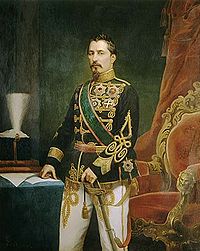
, which had come to dominate political demands, was viewed with sympathy by the French, Russians, Prussians, and Sardinians, it was rejected by the Austrian Empire, and viewed with suspicion by Great Britain and the Ottomans. Negotiations amounted to an agreement over a minimal and formal union - however, elections for the ad-hoc divans of 1859 profited from an ambiguity in the text of the final agreement (specifying two thrones, but not preventing the same person from occupying both) and made possible the rule of Alexander Ioan Cuza as Domnitor
Domnitor
Domnitor was the official title of the ruler of the United Principalities of Wallachia and Moldavia between 1859 and 1866....
of the United Principalities of Moldavia and Wallachia (of Romania from 1862).
Although internationally recognized only for the period of Cuza's rule, the union was cemented by Cuza's unsanctioned interventions in the text of previous organic law
Organic law
An organic or fundamental law is a law or system of laws which forms the foundation of a government, corporation or other organization's body of rules. A constitution is a particular form of organic law for a sovereign state....
s, as well as by the circumstances of his deposition in 1866, when the rapid election of Carol of Hohenzollern-Sigmaringen
Carol I of Romania
Carol I , born Prince Karl of Hohenzollern-Sigmaringen was reigning prince and then King of Romania from 1866 to 1914. He was elected prince of Romania on 20 April 1866 following the overthrow of Alexandru Ioan Cuza by a palace coup...
, who had the backing of an increasingly important Prussia, and the Austro-Prussian War
Austro-Prussian War
The Austro-Prussian War was a war fought in 1866 between the German Confederation under the leadership of the Austrian Empire and its German allies on one side and the Kingdom of Prussia with its German allies and Italy on the...
made measures taken against the union impossible.
In 1878, after the Romanian War of Independence
Romanian War of Independence
The Romanian War of Independence is the name used in Romanian historiography to refer to the 1877-1878 Russo-Turkish war, following which Romania, fighting on the Russian side, gained independence from the Ottoman Empire...
, Romania shook off formal Ottoman rule, but clashed with its Russian ally over the Russian request for the Bujak
Buják
-References:...
(southern Bessarabia
Bessarabia
Bessarabia is a historical term for the geographic region in Eastern Europe bounded by the Dniester River on the east and the Prut River on the west....
) - ultimately, Romania was awarded Northern Dobruja
Northern Dobruja
Northern Dobruja is the part of Dobruja within the borders of Romania. It lies between the lower Danube river and the Black Sea, bordered in south by Bulgarian Southern Dobruja.-Geography:...
in exchange for southern Bessarabia. A Kingdom of Romania
Kingdom of Romania
The Kingdom of Romania was the Romanian state based on a form of parliamentary monarchy between 13 March 1881 and 30 December 1947, specified by the first three Constitutions of Romania...
emerged in 1881.
See also
- BoyarBoyarA boyar, or bolyar , was a member of the highest rank of the feudal Moscovian, Kievan Rus'ian, Bulgarian, Wallachian, and Moldavian aristocracies, second only to the ruling princes , from the 10th century through the 17th century....
- History of Romania
- HospodarHospodarHospodar or gospodar is a term of Slavonic origin, meaning "lord" or "master".The rulers of Wallachia and Moldavia were styled hospodars in Slavic writings from the 15th century to 1866. Hospodar was used in addition to the title voivod...
- List of rulers of Moldavia
- List of rulers of Wallachia
- Romanian Old KingdomRomanian Old KingdomThe Romanian Old Kingdom is a colloquial term referring to the territory covered by the first independent Romanian nation state, which was composed of the Danubian Principalities—Wallachia and Moldavia...
- United PrincipalitiesUnited PrincipalitiesThe United Principalities of Moldavia and Wallachia, also known as the Romanian Principalities, was the official name of Romania following the 1859 election of Alexandru Ioan Cuza as prince or domnitor of both territories...