

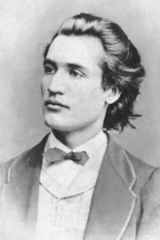
Mihai Eminescu

Encyclopedia
Mihai Eminescu was a Romantic
poet, novelist and journalist, often regarded as the most famous and influential Romanian
poet. Eminescu was an active member of the Junimea
literary society and he worked as an editor for the newspaper Timpul
("The Time"), the official newspaper of the Conservative Party (1880–1918). His first poems volume was published when he was 16 and he went to Vienna
to study when he was 19. The poet's Manuscript
s, containing 46 volumes and approximately 14,000 pages, were offered by Titu Maiorescu as a gift to the Romanian Academy during the meeting that was held on January 25, 1902. Notable works include Luceafărul
("Evening Star"), Odă în metru antic (Ode in Ancient Meter), and the five Letters (Epistles/Satires). In his poems he frequently used metaphysical, mythological and historical subjects. In general his work was influenced by the German philosopher Arthur Schopenhauer
.
village in Suceava
county, Bucovina
, which was then part of the Austrian Empire
(while his father came from Banat
). He crossed the border into Moldavia
, settling in Ipoteşti
, near the town of Botoşani
. He married Raluca Iuraşcu, an heiress of an old aristocratic Moldavian family. In a register of the members of Junimea
, Eminescu himself wrote down the date of his birth as December 22, 1849 and in the documents of the Gymnasium from Cernăuţi, where Eminescu studied, the date of December 14, 1849 is written down as his birthday. Nevertheless, Titu Maiorescu
, in his work Eminescu and His Poems (1889) quoted N. D. Giurescu's researches and adopted his conclusion regarding the date and place of Mihai Eminescu's birth, as being January 15, 1850, in Botoşani. This date resulted from several sources, amongst which there was a file of notes on christenings from the archives of the Uspenia (Domnească) Church of Botoşani; inside this file, the date of birth was „January 15, 1850” and the date of christening was the 21st, of the same month. The date of his birth was confirmed by the poet's elder sister, Aglae Drogli, who affirmed that the place of birth was the village of Ipoteşti
.
, Moldavia
, Romania. He spent his early childhood in Botoşani and Ipoteşti
, in his parents' family home. From 1858 to 1866 he attended school in Cernăuţi. He finished 4th grade as the 5th of 82 students, after which he attended two years of gymnasium
.
The first evidence of Eminescu as a writer is in 1866. In January of that year Romanian
teacher Aron Pumnul
died and his students in Cernăuţi published a pamphlet, Lăcrămioarele învăţăceilor gimnaziaşti (Tears of the Gymnasium Students) in which a poem entitled La mormântul lui Aron Pumnul (At the Grave of Aron Pumnul) appears, signed "M. Eminovici". On February 25 his poem De-aş avea (If I were to have) was published in Iosif Vulcan's literary magazine Familia
in Pest
. This began a steady series of published poems (and the occasional translation from German
). Also, it was Iosif Vulcan, who disliked the Slavic source suffix "-ici" of the young poet's last name, that chose for him the more apparent Romanian "nom de plume" Mihai Eminescu.
In 1867 he joined the troupe of Iorgu Caragiale as clerk and prompter; the next year he transferred to the troupe of Mihai Pascaly. Both of these were among the leading Romanian theatrical troupes of their day, the latter including Matei Millo and Fanny Tardini-Vlădicescu. He soon settled in Bucharest
, where at the end of November he became a clerk and copyist for the National Theater. Through this period, he continued to write and publish poems. He also paid his rent by translating hundreds of pages of a book by Heinrich Theodor Rotscher
, although this never resulted in a completed work. Also at this time he began his novel Geniu pustiu (Wasted Genius), published posthumously in 1904 in an unfinished form.
On April 1, 1869 he was a co-founder of the "Orient" literary circle, whose interests included the gathering of Romanian folklore, and documents relating to Romanian literary history. On June 29, various members of the "Orient" group were commissioned to go to different provinces. Eminescu was assigned Moldavia
. That summer, he quite by chance ran into his brother Iorgu, a military officer, in Cişmigiu Gardens
, but firmly rebuffed Iorgu's attempt to get him to renew ties to his family.
Still in summer 1869, he left Pascaly's troupe and traveled to Cernăuţi and Iaşi
. He renewed ties to his family; his father promised him a regular allowance to pursue studies in Vienna
in the fall. As always, he continued to write and publish poetry; notably, on the occasion of the death of the former ruler of Wallachia
, Barbu Dimitrie Ştirbei
, he published a leaflet, La moartea principelui Ştirbei.
. He was counted as an "extraordinary auditor" at the Faculty of Philosophy and Law. He was active in student life, befriended Ioan Slavici
, and came to know Vienna through Veronica Micle
; he became a contributor to Convorbiri literare (Literary Conversations), edited by Junimea
(The Youth). The leaders of this cultural organisation, Petre P. Carp
, Vasile Pogor
, Theodor Rosetti
, Iacob Negruzzi and Titu Maiorescu
, exercised their political and cultural influence over Eminescu for the rest of his life. Impressed by one of Eminescu's poems, Venere şi Madonă (Venus and Madonna), Iacob Negruzzi, the editor of Convorbiri literare, traveled to Vienna to meet him. Negruzzi would later write how he could pick Eminescu out of a crowd of young people in a Viennese café by his "romantic" appearance: long hair and gaze lost in thoughts.
In 1870 Eminescu wrote three articles under the pseudonym "Varro" in Federaţiunea in Pest, on the situation of Romanians and other minorities in the Austro-Hungarian Empire. He then became a journalist for the newspaper Albina (The Bee) in Pest. From 1872 to 1874 he continued as a student in Berlin
, thanks to a stipend offered by Junimea
.
From 1874 to 1877 he worked as director of the Central Library
in Iaşi
, substitute teacher, school inspector for the counties of Iaşi
and Vaslui
, and editor of the newspaper Curierul de Iaşi (The Courier of Iaşi), all thanks to his friendship with Titu Maiorescu
, the leader of Junimea
and rector of the University of Iaşi. He continued to publish in Convorbiri literare. He became a good friend of Ion Creangă
, whom he convinced to become a writer and introduced to the Junimea
literary club.
In 1877 he moved to Bucharest
, where until 1883 he was first journalist, then (1880) editor-in-chief of the newspaper Timpul
(The Time). During this time he wrote Scrisorile, Luceafărul, Odă în metru antic etc. Most of his notable editorial pieces belong to this period, when Romania
was fighting the Ottoman Empire in the Russo-Turkish War of 1877-1878 and throughout the diplomatic race that eventually brought about the international recognition of Romanian independence, but under the condition of bestowing Romanian citizenship to all subjects of Jewish faith. Eminescu opposed this and another clause of the Treaty of Berlin
: Romania's having to give southern Bessarabia
to Russia in exchange for Northern Dobrudja, a former Ottoman province on the Black Sea
.
In June 1883, the poet fell seriously ill, and was interned in the hospital of Dr. Şuţu. In December 1883, his volume Poesii appeared, with selection of poems and with a preface by Titu Maiorescu
.
.
, the Romanian historian, considers Eminescu the godfather of the modern Romanian language. He is unanimously celebrated as the greatest and most representative Romanian poet.
Poems and Prose of Mihai Eminescu (editor: Kurt W. Treptow, publisher: The Center for Romanian Studies, Iaşi, Oxford, and Portland, 2000, ISBN 973-9432-10-7) contains a selection of English-language renditions of Eminescu's poems and prose.
Eminescu was influenced by the work of Arthur Schopenhauer
, and some have suggested that his most notable poem, "Luceafărul
", includes elements of Vedic
cosmogony
. Eminescu's poems have been translated in over 60 languages. His life, work and poetry strongly influenced the Romanian culture and his poems are widely studied in Romanian public schools.
His most notable poems are:
, the top literary critic in 1870 Romania dubbed him "a real poet", in an essay where only a handful of the Romanian poets of the time were spared Maiorescu's harsh criticism. In the following decade, Eminescu's notability as a poet grew continually thanks to (1) the way he managed to enrich the literary language with words and phrases from all Romanian regions, from old texts, and with new words that he coined from his wide philosophical readings; (2) the use of bold metaphors, much too rare in earlier Romanian poetry; (3) last but not least, he was arguably the first Romanian writer who published in all Romanian provinces and was constantly interested in the problems of Romanians everywhere.
He defined himself as a Romantic
, in a poem addressed To My Critics (Criticilor mei), and this designation, his untimely death as well as his bohemian lifestyle (he never pursued a degree, a position, a wife or fortune) had him associated with the Romantic figure of the genius
. As early as the late 1880s, Eminescu had a group of faithful followers. His 1883 poem Luceafărul was so notable that a new literary review took its name after it.
The most realistic psychological analysis of Eminescu was written by I.L. Caragiale, who, after the poet's death published three short care articles on this subject: In Nirvana, Irony and Two notes. Caragiale stated that Eminescu's characteristic feature was the fact that „he had an excessively unique nature”. Eminescu's life was a continuous oscillation between introvert and extrovert attitudes.
The portrait that Titu Maiorescu
made in the study Eminescu and poems emphasizes Eminescu's introvert dominant traits. Titu Maiorescu
promoted the image of a dreamer who was far away from reality, who did not suffer because of the material conditions that helived in, regardless of all the ironies and eulogies of his neighbour, his main characteristic was „abstract serenity”.
In reality, just as one can discover from his poems and letters and just as Caragiale remembered, Eminescu was seldom under the influence of boisterous subconscious
motivations. Eminescu's life was but an overlap of different-sized cycles, made up of sudden bursts that were nurtured by dreams and crises due to the impact with reality. The cycles could last from a few hours or days to weeks or months, depending on the importance of events, or could even last longer, when they were linked to the events that significantly marked his life, as such was his relation with Veronica
, his political activity during his years as a student, or the fact that he attended the gatherings at the Junimea
society or the articles he published in the newspaper Timpul. He used to have a unique manner of describing his own crisis of jealousy.
, Moldova
, and of the Romanians who live in the Ukrainian
part of Bucovina.
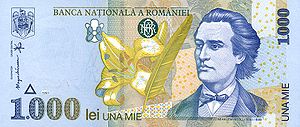
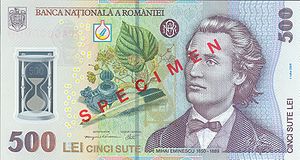 Eminescu is omnipresent in present-day Romania. His statues are everywhere; his face was on the 1000-lei banknote
issued in 1998 and is on the new 500-lei banknote issued in 2005 as the highest-denominated Romanian banknote (see Romanian leu
); many schools and other institutions are named after him. The anniversaries of his birth and death are celebrated each year in many Romanian cities, and they became national celebrations in 1989 (the centennial of his death) and 2000 (150 years after his birth, proclaimed Eminescu's Year in Romania).
Several young Romanian writers provoked a huge scandal when they wrote about their demystified idea of Eminescu and went so far as to reject the "official" interpretation of his work.
, Pakistan
on January 15th, 2004, commemorating strong Pakistani-Romanian ties, as well as the Dialogue Between Civilizations which is possible through the cross-cultural appreciation of their poetic legacies. In 2004, the Mihai Eminescu Statue was erected in Montreal
, Canada
.
views, Eminescu was easily adopted as an icon by the Romanian right. A major obstacle to their fully embracing him was the fact he never identified himself as a Christian and his poetry rather indiscriminately uses Buddhist, Christian, agnostic, and atheist themes.
After a decade when Eminescu's works were criticized as "mystic" and "bourgeois", Romanian Communists ended up adopting Eminescu as the major Romanian poet. What opened the door for this thaw was the poem Împărat şi proletar (Emperor and proletarian
) that Eminescu wrote under the influence of the 1870-1871 events
in France, and which ended in a Schopenhauerian critique of human life. An expurgated version only showed the stanzas that could present Eminescu as a poet interested in the fate of proletarians.
Romanticism
Romanticism was an artistic, literary and intellectual movement that originated in the second half of the 18th century in Europe, and gained strength in reaction to the Industrial Revolution...
poet, novelist and journalist, often regarded as the most famous and influential Romanian
Romanian language
Romanian Romanian Romanian (or Daco-Romanian; obsolete spellings Rumanian, Roumanian; self-designation: română, limba română ("the Romanian language") or românește (lit. "in Romanian") is a Romance language spoken by around 24 to 28 million people, primarily in Romania and Moldova...
poet. Eminescu was an active member of the Junimea
Junimea
Junimea was a Romanian literary society founded in Iaşi in 1863, through the initiative of several foreign-educated personalities led by Titu Maiorescu, Petre P. Carp, Vasile Pogor, Theodor Rosetti and Iacob Negruzzi...
literary society and he worked as an editor for the newspaper Timpul
Timpul
Timpul is a newspaper published in Romania, originally published as the official platform of the defunct Conservative Party....
("The Time"), the official newspaper of the Conservative Party (1880–1918). His first poems volume was published when he was 16 and he went to Vienna
Vienna
Vienna is the capital and largest city of the Republic of Austria and one of the nine states of Austria. Vienna is Austria's primary city, with a population of about 1.723 million , and is by far the largest city in Austria, as well as its cultural, economic, and political centre...
to study when he was 19. The poet's Manuscript
Manuscript
A manuscript or handwrite is written information that has been manually created by someone or some people, such as a hand-written letter, as opposed to being printed or reproduced some other way...
s, containing 46 volumes and approximately 14,000 pages, were offered by Titu Maiorescu as a gift to the Romanian Academy during the meeting that was held on January 25, 1902. Notable works include Luceafărul
Luceafărul (poem)
Luceafărul is the name of a Romanian poem by Mihai Eminescu, published in 1883. It is generally considered his masterpiece. The title refers to the Romanian Luceafăr.-External Links:***...
("Evening Star"), Odă în metru antic (Ode in Ancient Meter), and the five Letters (Epistles/Satires). In his poems he frequently used metaphysical, mythological and historical subjects. In general his work was influenced by the German philosopher Arthur Schopenhauer
Arthur Schopenhauer
Arthur Schopenhauer was a German philosopher known for his pessimism and philosophical clarity. At age 25, he published his doctoral dissertation, On the Fourfold Root of the Principle of Sufficient Reason, which examined the four separate manifestations of reason in the phenomenal...
.
Family
His father was Gheorghe Eminovici from Călineşti, a RomanianRomanians
The Romanians are an ethnic group native to Romania, who speak Romanian; they are the majority inhabitants of Romania....
village in Suceava
Suceava
Suceava is the Suceava County seat in Bukovina, Moldavia region, in north-eastern Romania. The city was the capital of the Principality of Moldavia from 1388 to 1565.-History:...
county, Bucovina
Bukovina
Bukovina is a historical region on the northern slopes of the northeastern Carpathian Mountains and the adjoining plains.-Name:The name Bukovina came into official use in 1775 with the region's annexation from the Principality of Moldavia to the possessions of the Habsburg Monarchy, which became...
, which was then part of the Austrian Empire
Austrian Empire
The Austrian Empire was a modern era successor empire, which was centered on what is today's Austria and which officially lasted from 1804 to 1867. It was followed by the Empire of Austria-Hungary, whose proclamation was a diplomatic move that elevated Hungary's status within the Austrian Empire...
(while his father came from Banat
Banat
The Banat is a geographical and historical region in Central Europe currently divided between three countries: the eastern part lies in western Romania , the western part in northeastern Serbia , and a small...
). He crossed the border into Moldavia
Moldavia
Moldavia is a geographic and historical region and former principality in Eastern Europe, corresponding to the territory between the Eastern Carpathians and the Dniester river...
, settling in Ipoteşti
Mihai Eminescu, Botosani
Mihai Eminescu is a commune in Botoşani County, Romania. It is composed of nine villages: Baisa, Cătămăreşti, Cătămăreşti-Deal, Cerviceşti, Cerviceşti-Deal, Cucorăni, Ipoteşti , Manoleşti and Stânceşti....
, near the town of Botoşani
Botosani
Botoșani is the capital city of Botoșani County, in northern Moldavia, Romania. Today, it is best known as the birthplace of many celebrated Romanians, including Mihai Eminescu and Nicolae Iorga.- Origin of the name :...
. He married Raluca Iuraşcu, an heiress of an old aristocratic Moldavian family. In a register of the members of Junimea
Junimea
Junimea was a Romanian literary society founded in Iaşi in 1863, through the initiative of several foreign-educated personalities led by Titu Maiorescu, Petre P. Carp, Vasile Pogor, Theodor Rosetti and Iacob Negruzzi...
, Eminescu himself wrote down the date of his birth as December 22, 1849 and in the documents of the Gymnasium from Cernăuţi, where Eminescu studied, the date of December 14, 1849 is written down as his birthday. Nevertheless, Titu Maiorescu
Titu Maiorescu
Titu Liviu Maiorescu was a Romanian literary critic and politician, founder of the Junimea Society. As a literary critic, he was instrumental in the development of Romanian culture in the second half of the 19th century....
, in his work Eminescu and His Poems (1889) quoted N. D. Giurescu's researches and adopted his conclusion regarding the date and place of Mihai Eminescu's birth, as being January 15, 1850, in Botoşani. This date resulted from several sources, amongst which there was a file of notes on christenings from the archives of the Uspenia (Domnească) Church of Botoşani; inside this file, the date of birth was „January 15, 1850” and the date of christening was the 21st, of the same month. The date of his birth was confirmed by the poet's elder sister, Aglae Drogli, who affirmed that the place of birth was the village of Ipoteşti
Mihai Eminescu, Botosani
Mihai Eminescu is a commune in Botoşani County, Romania. It is composed of nine villages: Baisa, Cătămăreşti, Cătămăreşti-Deal, Cerviceşti, Cerviceşti-Deal, Cucorăni, Ipoteşti , Manoleşti and Stânceşti....
.
Early years
Mihail (as he appears in baptismal records) or Mihai (the more common form that he used) was born in BotoşaniBotosani
Botoșani is the capital city of Botoșani County, in northern Moldavia, Romania. Today, it is best known as the birthplace of many celebrated Romanians, including Mihai Eminescu and Nicolae Iorga.- Origin of the name :...
, Moldavia
Moldavia
Moldavia is a geographic and historical region and former principality in Eastern Europe, corresponding to the territory between the Eastern Carpathians and the Dniester river...
, Romania. He spent his early childhood in Botoşani and Ipoteşti
Mihai Eminescu, Botosani
Mihai Eminescu is a commune in Botoşani County, Romania. It is composed of nine villages: Baisa, Cătămăreşti, Cătămăreşti-Deal, Cerviceşti, Cerviceşti-Deal, Cucorăni, Ipoteşti , Manoleşti and Stânceşti....
, in his parents' family home. From 1858 to 1866 he attended school in Cernăuţi. He finished 4th grade as the 5th of 82 students, after which he attended two years of gymnasium
Secondary education
Secondary education is the stage of education following primary education. Secondary education includes the final stage of compulsory education and in many countries it is entirely compulsory. The next stage of education is usually college or university...
.
The first evidence of Eminescu as a writer is in 1866. In January of that year Romanian
Romanian language
Romanian Romanian Romanian (or Daco-Romanian; obsolete spellings Rumanian, Roumanian; self-designation: română, limba română ("the Romanian language") or românește (lit. "in Romanian") is a Romance language spoken by around 24 to 28 million people, primarily in Romania and Moldova...
teacher Aron Pumnul
Aron Pumnul
Aron Pumnul was a Romanian philologist and teacher, national and revolutionary activist in Transylvania and later in Bucovina...
died and his students in Cernăuţi published a pamphlet, Lăcrămioarele învăţăceilor gimnaziaşti (Tears of the Gymnasium Students) in which a poem entitled La mormântul lui Aron Pumnul (At the Grave of Aron Pumnul) appears, signed "M. Eminovici". On February 25 his poem De-aş avea (If I were to have) was published in Iosif Vulcan's literary magazine Familia
Familia (literary magazine)
The Romanian-language Familia literary magazine was first published by Iosif Vulcan in Budapest from June 5, 1865 to April 17, 1880. The magazine moved to Oradea and continued publication from April 27, 1880 to December 31, 1906....
in Pest
Pest (city)
Pest is the eastern, mostly flat part of Budapest, Hungary, comprising about two thirds of the city's territory. It is divided from Buda, the other part of Budapest, by the Danube River. Among its most notable parts are the Inner City, including the Hungarian Parliament, Heroes' Square and...
. This began a steady series of published poems (and the occasional translation from German
German language
German is a West Germanic language, related to and classified alongside English and Dutch. With an estimated 90 – 98 million native speakers, German is one of the world's major languages and is the most widely-spoken first language in the European Union....
). Also, it was Iosif Vulcan, who disliked the Slavic source suffix "-ici" of the young poet's last name, that chose for him the more apparent Romanian "nom de plume" Mihai Eminescu.
In 1867 he joined the troupe of Iorgu Caragiale as clerk and prompter; the next year he transferred to the troupe of Mihai Pascaly. Both of these were among the leading Romanian theatrical troupes of their day, the latter including Matei Millo and Fanny Tardini-Vlădicescu. He soon settled in Bucharest
Bucharest
Bucharest is the capital municipality, cultural, industrial, and financial centre of Romania. It is the largest city in Romania, located in the southeast of the country, at , and lies on the banks of the Dâmbovița River....
, where at the end of November he became a clerk and copyist for the National Theater. Through this period, he continued to write and publish poems. He also paid his rent by translating hundreds of pages of a book by Heinrich Theodor Rotscher
Heinrich Theodor Rötscher
Heinrich Theodor Rötscher was a German theatre critic and theorist.-Biography:Rötscher was born in Mittenwalde, and studied philology and philosophy at the University of Berlin. From 1828 he was a gymnasium teacher in Bromberg . In 1842 he moved back to Berlin and dedicated himself to writing and...
, although this never resulted in a completed work. Also at this time he began his novel Geniu pustiu (Wasted Genius), published posthumously in 1904 in an unfinished form.
On April 1, 1869 he was a co-founder of the "Orient" literary circle, whose interests included the gathering of Romanian folklore, and documents relating to Romanian literary history. On June 29, various members of the "Orient" group were commissioned to go to different provinces. Eminescu was assigned Moldavia
Moldavia
Moldavia is a geographic and historical region and former principality in Eastern Europe, corresponding to the territory between the Eastern Carpathians and the Dniester river...
. That summer, he quite by chance ran into his brother Iorgu, a military officer, in Cişmigiu Gardens
Cismigiu Gardens
The Cişmigiu Gardens are a public park near the center of Bucharest, Romania, spanning areas on all sides of an artificial lake. The gardens' creation was an important moment in the history of Bucharest. They form the oldest and, at 17 hectares, the largest park in city's central area...
, but firmly rebuffed Iorgu's attempt to get him to renew ties to his family.
Still in summer 1869, he left Pascaly's troupe and traveled to Cernăuţi and Iaşi
Iasi
Iași is the second most populous city and a municipality in Romania. Located in the historical Moldavia region, Iași has traditionally been one of the leading centres of Romanian social, cultural, academic and artistic life...
. He renewed ties to his family; his father promised him a regular allowance to pursue studies in Vienna
Vienna
Vienna is the capital and largest city of the Republic of Austria and one of the nine states of Austria. Vienna is Austria's primary city, with a population of about 1.723 million , and is by far the largest city in Austria, as well as its cultural, economic, and political centre...
in the fall. As always, he continued to write and publish poetry; notably, on the occasion of the death of the former ruler of Wallachia
Wallachia
Wallachia or Walachia is a historical and geographical region of Romania. It is situated north of the Danube and south of the Southern Carpathians...
, Barbu Dimitrie Ştirbei
Barbu Dimitrie Stirbei
Barbu Dimitrie Ştirbei , a member of the Bibescu boyar family, was a Prince of Wallachia on two occasions, in 1848–1853 and in 1854–1856.-Early life:...
, he published a leaflet, La moartea principelui Ştirbei.
Junimea
From October 1869 to 1872 he studied in ViennaVienna
Vienna is the capital and largest city of the Republic of Austria and one of the nine states of Austria. Vienna is Austria's primary city, with a population of about 1.723 million , and is by far the largest city in Austria, as well as its cultural, economic, and political centre...
. He was counted as an "extraordinary auditor" at the Faculty of Philosophy and Law. He was active in student life, befriended Ioan Slavici
Ioan Slavici
Ioan Slavici was a Transylvanian-born Romanian writer and journalist. He made his debut in Convorbiri literare , with the comedy Fata de birău...
, and came to know Vienna through Veronica Micle
Veronica Micle
Veronica Micle was an Imperial Austrian-born Romanian poet, whose work was influenced by Romanticism. She is best known for her love affair with the poet Mihai Eminescu, one of the most important Romanian writers.-Biography:Born in Năsăud, Micle was the second child of the shoemaker Ilie Câmpeanu...
; he became a contributor to Convorbiri literare (Literary Conversations), edited by Junimea
Junimea
Junimea was a Romanian literary society founded in Iaşi in 1863, through the initiative of several foreign-educated personalities led by Titu Maiorescu, Petre P. Carp, Vasile Pogor, Theodor Rosetti and Iacob Negruzzi...
(The Youth). The leaders of this cultural organisation, Petre P. Carp
Petre P. Carp
Petre P. Carp , commonly rendered as P. P. Carp, was a Romanian conservative politician and literary critic who served as a Prime Minister of Romania for two terms...
, Vasile Pogor
Vasile Pogor
Vasile Pogor , was a Romanian poet, translator, politician, and founding member of the Junimea literary society....
, Theodor Rosetti
Theodor Rosetti
Theodor Rosetti was a Romanian writer, journalist and politician who served as Prime Minister of Romania between 13 April 1888 and 11 April 1889....
, Iacob Negruzzi and Titu Maiorescu
Titu Maiorescu
Titu Liviu Maiorescu was a Romanian literary critic and politician, founder of the Junimea Society. As a literary critic, he was instrumental in the development of Romanian culture in the second half of the 19th century....
, exercised their political and cultural influence over Eminescu for the rest of his life. Impressed by one of Eminescu's poems, Venere şi Madonă (Venus and Madonna), Iacob Negruzzi, the editor of Convorbiri literare, traveled to Vienna to meet him. Negruzzi would later write how he could pick Eminescu out of a crowd of young people in a Viennese café by his "romantic" appearance: long hair and gaze lost in thoughts.
In 1870 Eminescu wrote three articles under the pseudonym "Varro" in Federaţiunea in Pest, on the situation of Romanians and other minorities in the Austro-Hungarian Empire. He then became a journalist for the newspaper Albina (The Bee) in Pest. From 1872 to 1874 he continued as a student in Berlin
Berlin
Berlin is the capital city of Germany and is one of the 16 states of Germany. With a population of 3.45 million people, Berlin is Germany's largest city. It is the second most populous city proper and the seventh most populous urban area in the European Union...
, thanks to a stipend offered by Junimea
Junimea
Junimea was a Romanian literary society founded in Iaşi in 1863, through the initiative of several foreign-educated personalities led by Titu Maiorescu, Petre P. Carp, Vasile Pogor, Theodor Rosetti and Iacob Negruzzi...
.
From 1874 to 1877 he worked as director of the Central Library
Central University Library of Iasi
The Mihai Eminescu Central University Library of Iaşi serves the University of Iaşi in Romania.The library was established on 8 November 1839 and opened on 23 November 1841, carrying on the tradition of the activity and fame of the old library of Academia Vasiliană, founded in 1640...
in Iaşi
Iasi
Iași is the second most populous city and a municipality in Romania. Located in the historical Moldavia region, Iași has traditionally been one of the leading centres of Romanian social, cultural, academic and artistic life...
, substitute teacher, school inspector for the counties of Iaşi
Iasi
Iași is the second most populous city and a municipality in Romania. Located in the historical Moldavia region, Iași has traditionally been one of the leading centres of Romanian social, cultural, academic and artistic life...
and Vaslui
Vaslui
Vaslui , a city in eastern Romania, is the seat of Vaslui County, in the historical region of Moldavia.The city administers five villages: Bahnari, Brodoc, Moara Grecilor, Rediu and Viişoara.-History:...
, and editor of the newspaper Curierul de Iaşi (The Courier of Iaşi), all thanks to his friendship with Titu Maiorescu
Titu Maiorescu
Titu Liviu Maiorescu was a Romanian literary critic and politician, founder of the Junimea Society. As a literary critic, he was instrumental in the development of Romanian culture in the second half of the 19th century....
, the leader of Junimea
Junimea
Junimea was a Romanian literary society founded in Iaşi in 1863, through the initiative of several foreign-educated personalities led by Titu Maiorescu, Petre P. Carp, Vasile Pogor, Theodor Rosetti and Iacob Negruzzi...
and rector of the University of Iaşi. He continued to publish in Convorbiri literare. He became a good friend of Ion Creangă
Ion Creanga
Ion Creangă was a Moldavian-born Romanian writer, raconteur and schoolteacher. A main figure in 19th century Romanian literature, he is best known for his Childhood Memories volume, his novellas and short stories, and his many anecdotes...
, whom he convinced to become a writer and introduced to the Junimea
Junimea
Junimea was a Romanian literary society founded in Iaşi in 1863, through the initiative of several foreign-educated personalities led by Titu Maiorescu, Petre P. Carp, Vasile Pogor, Theodor Rosetti and Iacob Negruzzi...
literary club.
In 1877 he moved to Bucharest
Bucharest
Bucharest is the capital municipality, cultural, industrial, and financial centre of Romania. It is the largest city in Romania, located in the southeast of the country, at , and lies on the banks of the Dâmbovița River....
, where until 1883 he was first journalist, then (1880) editor-in-chief of the newspaper Timpul
Timpul
Timpul is a newspaper published in Romania, originally published as the official platform of the defunct Conservative Party....
(The Time). During this time he wrote Scrisorile, Luceafărul, Odă în metru antic etc. Most of his notable editorial pieces belong to this period, when Romania
Romania
Romania is a country located at the crossroads of Central and Southeastern Europe, on the Lower Danube, within and outside the Carpathian arch, bordering on the Black Sea...
was fighting the Ottoman Empire in the Russo-Turkish War of 1877-1878 and throughout the diplomatic race that eventually brought about the international recognition of Romanian independence, but under the condition of bestowing Romanian citizenship to all subjects of Jewish faith. Eminescu opposed this and another clause of the Treaty of Berlin
Treaty of Berlin, 1878
The Treaty of Berlin was the final act of the Congress of Berlin , by which the United Kingdom, Austria-Hungary, France, Germany, Italy, Russia and the Ottoman Empire under Sultan Abdul Hamid II revised the Treaty of San Stefano signed on March 3 of the same year...
: Romania's having to give southern Bessarabia
Bessarabia
Bessarabia is a historical term for the geographic region in Eastern Europe bounded by the Dniester River on the east and the Prut River on the west....
to Russia in exchange for Northern Dobrudja, a former Ottoman province on the Black Sea
Black Sea
The Black Sea is bounded by Europe, Anatolia and the Caucasus and is ultimately connected to the Atlantic Ocean via the Mediterranean and the Aegean seas and various straits. The Bosphorus strait connects it to the Sea of Marmara, and the strait of the Dardanelles connects that sea to the Aegean...
.
In June 1883, the poet fell seriously ill, and was interned in the hospital of Dr. Şuţu. In December 1883, his volume Poesii appeared, with selection of poems and with a preface by Titu Maiorescu
Titu Maiorescu
Titu Liviu Maiorescu was a Romanian literary critic and politician, founder of the Junimea Society. As a literary critic, he was instrumental in the development of Romanian culture in the second half of the 19th century....
.
Later life
In his last years, Mihai Eminescu has been diagnosed at the time as suffering from manic-depressive psychosisBipolar disorder
Bipolar disorder or bipolar affective disorder, historically known as manic–depressive disorder, is a psychiatric diagnosis that describes a category of mood disorders defined by the presence of one or more episodes of abnormally elevated energy levels, cognition, and mood with or without one or...
.
Works
Nicolae IorgaNicolae Iorga
Nicolae Iorga was a Romanian historian, politician, literary critic, memoirist, poet and playwright. Co-founder of the Democratic Nationalist Party , he served as a member of Parliament, President of the Deputies' Assembly and Senate, cabinet minister and briefly as Prime Minister...
, the Romanian historian, considers Eminescu the godfather of the modern Romanian language. He is unanimously celebrated as the greatest and most representative Romanian poet.
Poems and Prose of Mihai Eminescu (editor: Kurt W. Treptow, publisher: The Center for Romanian Studies, Iaşi, Oxford, and Portland, 2000, ISBN 973-9432-10-7) contains a selection of English-language renditions of Eminescu's poems and prose.
Poetry
His poems span a large range of themes, from nature and love to hate and social commentary. His childhood years were evoked in his later poetry with deep nostalgia.Eminescu was influenced by the work of Arthur Schopenhauer
Arthur Schopenhauer
Arthur Schopenhauer was a German philosopher known for his pessimism and philosophical clarity. At age 25, he published his doctoral dissertation, On the Fourfold Root of the Principle of Sufficient Reason, which examined the four separate manifestations of reason in the phenomenal...
, and some have suggested that his most notable poem, "Luceafărul
Luceafărul (poem)
Luceafărul is the name of a Romanian poem by Mihai Eminescu, published in 1883. It is generally considered his masterpiece. The title refers to the Romanian Luceafăr.-External Links:***...
", includes elements of Vedic
Vedanta
Vedānta was originally a word used in Hindu philosophy as a synonym for that part of the Veda texts known also as the Upanishads. The name is a morphophonological form of Veda-anta = "Veda-end" = "the appendix to the Vedic hymns." It is also speculated that "Vedānta" means "the purpose or goal...
cosmogony
Cosmogony
Cosmogony, or cosmogeny, is any scientific theory concerning the coming into existence or origin of the universe, or about how reality came to be. The word comes from the Greek κοσμογονία , from κόσμος "cosmos, the world", and the root of γίνομαι / γέγονα "to be born, come about"...
. Eminescu's poems have been translated in over 60 languages. His life, work and poetry strongly influenced the Romanian culture and his poems are widely studied in Romanian public schools.
His most notable poems are:
- DoinaDoinaThe Doina is a Romanian musical tune style, with Middle Eastern roots, that can be found in Romanian peasant music, as well as in Lăutărească and Klezmer music.-Origins and characteristics:...
(the name is a traditional type of Romanian song), 1884 - Lacul (The Lake), 1876
- LuceafărulLuceafărul (poem)Luceafărul is the name of a Romanian poem by Mihai Eminescu, published in 1883. It is generally considered his masterpiece. The title refers to the Romanian Luceafăr.-External Links:***...
(The Evening Star), 1884 - Floare albastră (Blue Flower), 1884
- Dorinţa (Desire), 1884
- Sara pe deal (Evening on the Hill), 1885
- O, rămii (Oh, Linger On), 1884
- Epigonii (Epigones), 1884
- Scrisori (Letters or "Epistles-Satires")
- Şi dacă (And if...), 1883
- Odă (în metru antic) (Ode (in Ancient Meter), 1883
- Mai am un singur dor (I Have Yet One Desire),1883
- La Steaua (At Star),1886
Prose
- Făt-FrumosFat-FrumosFăt-Frumos is a knight hero in Romanian folklore, usually present in fairy tales....
din lacrimă (The Tear Drop Prince) - Geniu pustiu (Empty Genius)
- Sărmanul Dionis (Wretched Dionis)
- Cezara (Caesara)
Genius
Eminescu was only 20 when Titu MaiorescuTitu Maiorescu
Titu Liviu Maiorescu was a Romanian literary critic and politician, founder of the Junimea Society. As a literary critic, he was instrumental in the development of Romanian culture in the second half of the 19th century....
, the top literary critic in 1870 Romania dubbed him "a real poet", in an essay where only a handful of the Romanian poets of the time were spared Maiorescu's harsh criticism. In the following decade, Eminescu's notability as a poet grew continually thanks to (1) the way he managed to enrich the literary language with words and phrases from all Romanian regions, from old texts, and with new words that he coined from his wide philosophical readings; (2) the use of bold metaphors, much too rare in earlier Romanian poetry; (3) last but not least, he was arguably the first Romanian writer who published in all Romanian provinces and was constantly interested in the problems of Romanians everywhere.
He defined himself as a Romantic
Romanticism
Romanticism was an artistic, literary and intellectual movement that originated in the second half of the 18th century in Europe, and gained strength in reaction to the Industrial Revolution...
, in a poem addressed To My Critics (Criticilor mei), and this designation, his untimely death as well as his bohemian lifestyle (he never pursued a degree, a position, a wife or fortune) had him associated with the Romantic figure of the genius
Genius
Genius is something or someone embodying exceptional intellectual ability, creativity, or originality, typically to a degree that is associated with the achievement of unprecedented insight....
. As early as the late 1880s, Eminescu had a group of faithful followers. His 1883 poem Luceafărul was so notable that a new literary review took its name after it.
The most realistic psychological analysis of Eminescu was written by I.L. Caragiale, who, after the poet's death published three short care articles on this subject: In Nirvana, Irony and Two notes. Caragiale stated that Eminescu's characteristic feature was the fact that „he had an excessively unique nature”. Eminescu's life was a continuous oscillation between introvert and extrovert attitudes.
The portrait that Titu Maiorescu
Titu Maiorescu
Titu Liviu Maiorescu was a Romanian literary critic and politician, founder of the Junimea Society. As a literary critic, he was instrumental in the development of Romanian culture in the second half of the 19th century....
made in the study Eminescu and poems emphasizes Eminescu's introvert dominant traits. Titu Maiorescu
Titu Maiorescu
Titu Liviu Maiorescu was a Romanian literary critic and politician, founder of the Junimea Society. As a literary critic, he was instrumental in the development of Romanian culture in the second half of the 19th century....
promoted the image of a dreamer who was far away from reality, who did not suffer because of the material conditions that helived in, regardless of all the ironies and eulogies of his neighbour, his main characteristic was „abstract serenity”.
In reality, just as one can discover from his poems and letters and just as Caragiale remembered, Eminescu was seldom under the influence of boisterous subconscious
Subconscious
The term subconscious is used in many different contexts and has no single or precise definition. This greatly limits its significance as a definition-bearing concept, and in consequence the word tends to be avoided in academic and scientific settings....
motivations. Eminescu's life was but an overlap of different-sized cycles, made up of sudden bursts that were nurtured by dreams and crises due to the impact with reality. The cycles could last from a few hours or days to weeks or months, depending on the importance of events, or could even last longer, when they were linked to the events that significantly marked his life, as such was his relation with Veronica
Veronica Micle
Veronica Micle was an Imperial Austrian-born Romanian poet, whose work was influenced by Romanticism. She is best known for her love affair with the poet Mihai Eminescu, one of the most important Romanian writers.-Biography:Born in Năsăud, Micle was the second child of the shoemaker Ilie Câmpeanu...
, his political activity during his years as a student, or the fact that he attended the gatherings at the Junimea
Junimea
Junimea was a Romanian literary society founded in Iaşi in 1863, through the initiative of several foreign-educated personalities led by Titu Maiorescu, Petre P. Carp, Vasile Pogor, Theodor Rosetti and Iacob Negruzzi...
society or the articles he published in the newspaper Timpul. He used to have a unique manner of describing his own crisis of jealousy.
National poet
He was soon proclaimed Romania's national poet, not because he wrote in an age of national revival, but rather because he was received as an author of paramount significance by Romanians in all provinces. Even today, he is considered the national poet of RomaniaRomania
Romania is a country located at the crossroads of Central and Southeastern Europe, on the Lower Danube, within and outside the Carpathian arch, bordering on the Black Sea...
, Moldova
Moldova
Moldova , officially the Republic of Moldova is a landlocked state in Eastern Europe, located between Romania to the West and Ukraine to the North, East and South. It declared itself an independent state with the same boundaries as the preceding Moldavian Soviet Socialist Republic in 1991, as part...
, and of the Romanians who live in the Ukrainian
Ukraine
Ukraine is a country in Eastern Europe. It has an area of 603,628 km², making it the second largest contiguous country on the European continent, after Russia...
part of Bucovina.
Iconography
Banknote
A banknote is a kind of negotiable instrument, a promissory note made by a bank payable to the bearer on demand, used as money, and in many jurisdictions is legal tender. In addition to coins, banknotes make up the cash or bearer forms of all modern fiat money...
issued in 1998 and is on the new 500-lei banknote issued in 2005 as the highest-denominated Romanian banknote (see Romanian leu
Romanian leu
The leu is the currency of Romania. It is subdivided into 100 bani . The name of the currency means "lion". On 1 July 2005, Romania underwent a currency reform, switching from the previous leu to a new leu . 1 RON is equal to 10,000 ROL...
); many schools and other institutions are named after him. The anniversaries of his birth and death are celebrated each year in many Romanian cities, and they became national celebrations in 1989 (the centennial of his death) and 2000 (150 years after his birth, proclaimed Eminescu's Year in Romania).
Several young Romanian writers provoked a huge scandal when they wrote about their demystified idea of Eminescu and went so far as to reject the "official" interpretation of his work.
International legacy
A monument jointly dedicated to Eminescu and Allama Iqbal was erected in IslamabadIslamabad
Islamabad is the capital of Pakistan and the tenth largest city in the country. Located within the Islamabad Capital Territory , the population of the city has grown from 100,000 in 1951 to 1.7 million in 2011...
, Pakistan
Pakistan
Pakistan , officially the Islamic Republic of Pakistan is a sovereign state in South Asia. It has a coastline along the Arabian Sea and the Gulf of Oman in the south and is bordered by Afghanistan and Iran in the west, India in the east and China in the far northeast. In the north, Tajikistan...
on January 15th, 2004, commemorating strong Pakistani-Romanian ties, as well as the Dialogue Between Civilizations which is possible through the cross-cultural appreciation of their poetic legacies. In 2004, the Mihai Eminescu Statue was erected in Montreal
Montreal
Montreal is a city in Canada. It is the largest city in the province of Quebec, the second-largest city in Canada and the seventh largest in North America...
, Canada
Canada
Canada is a North American country consisting of ten provinces and three territories. Located in the northern part of the continent, it extends from the Atlantic Ocean in the east to the Pacific Ocean in the west, and northward into the Arctic Ocean...
.
Political views
Due to his conservative nationalisticNationalism
Nationalism is a political ideology that involves a strong identification of a group of individuals with a political entity defined in national terms, i.e. a nation. In the 'modernist' image of the nation, it is nationalism that creates national identity. There are various definitions for what...
views, Eminescu was easily adopted as an icon by the Romanian right. A major obstacle to their fully embracing him was the fact he never identified himself as a Christian and his poetry rather indiscriminately uses Buddhist, Christian, agnostic, and atheist themes.
After a decade when Eminescu's works were criticized as "mystic" and "bourgeois", Romanian Communists ended up adopting Eminescu as the major Romanian poet. What opened the door for this thaw was the poem Împărat şi proletar (Emperor and proletarian
Proletariat
The proletariat is a term used to identify a lower social class, usually the working class; a member of such a class is proletarian...
) that Eminescu wrote under the influence of the 1870-1871 events
Paris Commune
The Paris Commune was a government that briefly ruled Paris from March 18 to May 28, 1871. It existed before the split between anarchists and Marxists had taken place, and it is hailed by both groups as the first assumption of power by the working class during the Industrial Revolution...
in France, and which ended in a Schopenhauerian critique of human life. An expurgated version only showed the stanzas that could present Eminescu as a poet interested in the fate of proletarians.
Notation
- George CălinescuGeorge CalinescuGeorge Călinescu was a Romanian literary critic, historian, novelist, academician and journalist, and a writer of classicist and humanist tendencies...
, La vie d'Eminescu, Bucarest: Univers, 1989, 439 p. - Marin Bucur (ed.), Caietele Mihai Eminescu, Bucureşti, Editura Eminescu, 1972
External links
- Gabriel's Web Site - Works both in English and Original
- Romanian Poetry - Mihai Eminescu (english)
- Romanian Poetry - Mihai Eminescu (romanian)
- Institute for Cultural Memory: Mihai Eminescu - Poetry
- Mihai Eminescu Poesii (bilingual pages English Romanian)
- Mihai Eminescu poetry (with English translations of some of his poems)
- MoldData Literature
- Year 2000: "Mihai Eminescu Year" (includes bio, poems, critiques, etc.)
- The Mihai Eminescu Trust
- The Nation's Poet: A recent collection sparks debate over Romania's "national poet" by Emilia Stere
- Eminescu - a political victim : An interview with Nicolae Georgescu in Jurnalul National (in Romanian)
- Mihai Eminescu: Complete works (in Romanian)
- Mihai Eminescu : poezii biografie (in Romanian)
- The Mihai Eminescu Poems published in Revista Familia