

Names given to the Spanish language

Encyclopedia
There are two names given to the Spanish language
: Spanish (español) and Castilian (castellano). Spanish speakers from different countries or backgrounds can show a preference for one term or the other, or use them indiscriminately, but political issues or common usage might lead speakers to prefer one term over the other. This article identifies the differences between those terms, the countries or backgrounds that show a preference for one or the other, and the implications the choice of words might have for a native Spanish speaker.
Generally speaking, both terms can refer to the Spanish language as a whole, with a preference for one over the other that depends on the context or the speaker's origin. Castilian (castellano) has another, more restricted, meaning, relating either to the old romance language spoken in the Kingdom of Castile
in the Middle Ages
, predecessor of the modern Spanish language, or to the variation of Spanish nowadays spoken in the historical region of Castile
, in central Spain
.
, one of several northern kingdoms that spread across the Iberian Peninsula
through the Middle Ages
, from about the 8th to the 15th centuries. The first recorded example of written Castilian/Spanish is the Glosas Emilianenses
, a document from the eleventh century. This protoromanic language is no longer spoken, but can be read in many texts such as El cantar del Mio Cid
. This language derived from Latin
and evolved into the modern Spanish.
However, the term Spanish (español) is a more recent term that first referred to Spain as a country, and then to the predominant language spoken in that country. Spain as a truly unified nation appeared centuries later than the language and the Kingdom of Castile; in fact, it was only in 1469 that the marital union between the Kingdoms of Castile and Aragon
gave way to the modern Kingdom of Spain. The actual legal unification date is disputed, but commonly agreed to have occurred not earlier than the eighteenth century. Only then did the Castilian language begin to be commonly called Spanish.
In 1492, the arrival of Christopher Columbus
on a Castilian-paid expedition paved the way for the Spanish colonization of the Americas
. As a result of this process, many countries in South America now speak the same language as Castile. Until about the eighteenth century, the Kingdom of Castile, and not Spain as a whole, was the colonizing power and the language used was called Castilian. Thus, some American countries formerly under the Spanish rule have retained the custom of calling it castellano, while others switched to calling it español at some point or the other, with many other different factors influencing the final choice.
In English, the term Spanish relates both to the language and to the nation. The noun used for a person from Spain is Spaniard, with the collective noun the Spanish. The term Castilian is much less widespread amongst English speakers than the term Spanish.
To understand how two terms can refer to the same language, imagine that the English language were sometimes called English after the historical nation whose language it is but also sometimes British after the modern state, the United Kingdom of Great Britain and Northern Ireland
, of which it is the official language. To add to the complexity, former British colonies such as British North America
would have had to choose a name for the language as well as the speakers of Welsh
and other non-English languages in the United Kingdom. That would resemble the situation with Spain and its historical centre, Castile
.
-land, from castiello plus the suffix -ia, giving Castiella, a form that survives in the Leonese language
and can be seen in mediaeval Castilian texts such as the Lay of the Cid. Modern Spanish has transformed all words ending in -iello, -iella into -illo, -illa. The adjective derived from Castilla is castellano, or 'Castilian', in English. Castellano also means 'castellan
', i.e. a castle master. There is a comic scene based on the play on words (Castilian/castellan) in Don Quijote.
The region was thus named because it was a frontier
land controlled from a series of fortified castles. It shared borders with rival Moorish Spain and the Christian kingdoms of Navarre
and Aragon
.
was the name given to the Iberian Peninsula
by the Romans
when they discovered and later subjugated it. The name was previously Canaanite
אי שפנים (''ʾî šəpānîm), meaning 'island of hyrax
es', named by Canaanite-speaking Phoenicia
ns who mistook Spain's large rabbit
population for hyraxes that roamed the Iberian Peninsula in ancient times (although today, the Spanish population of wild rabbits is not quite as abundant as it was then due to the introduction of the myxomatosis
virus
to mainland Europe in 1950). The Romans called its inhabitants hispani (singular: hispanus), and the relevant adjective was hispanicus. These terms would naturally have developed into España, *espanos (singular: *espano) and *espánego in Castilian. In reality, only the first term exists in modern Castilian, as it seems that the Spanish borrowed the Occitan name for themselves, which was the name España plus the diminutive suffix -ol, from the Latin
-ulus or -olus. We can see this because if the native Castilian suffix had been used this would have given us *españuelo rather than español.
The term español, which was adopted by several languages — and transformed according to their own phonology and grammar rules — to designate the Spanish people and their language, is from medieval Latin Hispaniolus (literally, "little Hispanian"), a form that evolved later, by hypercorrection
, to the written form Spaniolus (note that, by that time, the Latin h had become silent, causing the word to be pronounced ispaˈnjolu), and the prosthetic
vowel i (used in spoken Latin for euphonic reasons) opened to e, giving the present word.
As the branches of Vulgar Latin
began to evolve into separate Romance languages
, the term that would evolve into español began to be used to refer to these derivative languages (especially as opposed to the Arabic
and Hebrew
of the Moorish
and Jewish inhabitants of Iberia). It was at first a general term that embraced the various dialects of Iberian Romance spoken in the area, including the forebears of modern Portuguese
, Galician
, Castilian and Catalan
. However, with the rise of Castile as a power, and its absorption of all surrounding regions into an ever-growing empire that eventually spread to the New World
, the term España was eventually equated with the peninsular territories ruled by the Crown. With this, the break with the Roman concept of Hispania was complete, and the term acquired its modern meaning of 'all of Iberia except for Portugal
and Andorra
'. Similarly, español came to be used to refer to the common language of this new country: Castilian.
The terms España and español spread to other languages. The English name 'Spain' is from the French Espagne. 'Spanish' is 'Spain' plus the English suffix -ish. The term continues evolving as other languages adapt these words to form their own name for Spain — for example, Japanese
スペイン語 (Supein-go), 'Spanish language', and スペイン人 (Supein-jin), 'Spaniard', derives from the Japanese word for Spain, スペイン (Supein), which, in turn, derives from English 'Spain'. In Chinese though, the word is directly taken from Spanish (or perhaps even Latin) rather than English: they say 西班牙 (Pinyin
phonetic symbols: xībānyá) for Spain and 西班牙语 (Pinyin: xībānyá yǔ) , or the abbreviation 西語 (Pinyin: xī yǔ) for the Spanish language. The Arabic إسبانية (isbāniya) for Spain derives directly from the word España: the absence of "p" in the Arabic alphabet makes it a "b", and the sound "ñ" is transformed into "n". إسباني (isbāni) is the name for Spanish, with the same end of عربي ('arabī that means "Arabic").
In Guatemala
, although Spanish is the official language, the Mayans, the original inhabitants of the region, call it "la castilla", keeping the original name from colonial times. Mayans speak at least 22 different "Mayan" languages and dialects (Mam, Pocomam, cak'chikel, tzu'tuhil, kek'chi, ki'che, etc.).
While Espanyol is used in Tagalog
and other languages of the Philippines
, the word Kastilà is more frequently used. Furthermore Katsila is also used among those who speak Visayan languages
like Cebuano
.
* denotes an unattested or hypothetical form.
in Hispania
, Spanish was sometimes given the name cristiano to distinguish it from the Arabic
and Hebrew
languages.
Spanish also marked Christians
from Amerindians. This term is still used today to refer to the language, though usually jocularly.
The expression Hábleme en cristiano "talk to me in Christian", uttered to people not speaking Spanish at the moment, is used in opposition of the other Spanish languages, which is felt as annoying by them (Catalonia
, Galicia and the Basque Country
, but not in America). "Háblame en cristiano" is also a phrase used for ask for clarification in a conversation, when the topic/point of the discussion is not clear or is vaguely (hesitantly) hinted by one of the speakers.
for Italian, etc.
is recognized as a normative body that rules on the orthography and general usage rules of the language. The Academy used el castellano from the 18th century, but since 1923 its dictionary and grammar are de la lengua española ("of the Spanish language"). The Academy's usage of one term is not necessarily a condemnation of the other.
There are many other Academies (grouped under the Association of Spanish Language Academies
) that may or may not have an official normative recognition, but nevertheless cooperate in the creation of the Diccionario Panhispánico de Dudas (a compendium of corrected typical mistakes and doubts). In this dictionary, whose production was agreed upon by the 22 different Spanish Language Academies, we are told:
Thus, even if both terms are allowed in Spanish, the usage of el español is recommended for the language as a whole. However, popular choice of terms is not so clear, with other factors such as customs or politics coming in.
(francés), Chinese
(chino), etc. El castellano (Castilian) by contrast, is more often used when contrasting the language with other regional languages of Spain
: official languages like Basque
, Catalan
and Galician
or unofficial ones like Aragonese
, Asturian
, Extremaduran
, Leonese
and so on. In this manner, the Spanish Constitution of 1978
uses the term el castellano to define the official language of the whole State, opposed to las demás lenguas españolas (lit. the other Spanish languages). Article III reads in part:
This choice of words can however vary depending on many factors, including the origin of the speaker or some political nuances.
and the regional language
, and so the national language is most often referred to as Castilian, particularly in the regional languages themselves (e.g. espanyol is virtually never used to refer to the Spanish language in Catalan: castellà is used instead.) This usage is often mirrored by educated English speakers when referring to the linguistic situation in Spain.
For some, this use of the term castellano is a political or cultural statement that Spanish is only the language of Castile and perhaps some areas that Castile colonised, but not the language of their region, where they consider the only legitimate language to be the regional one, i.e. Catalan, Basque, Galician, etc. This stance is common in regionalist circles.
Conversely, some nationalist circles prefer the term español because they perceive their ethnic community to be distinct from that of Spain, and therefore do not object to the language of Spain being called Spanish. In Basque-speaking regions, where the language is not of Romance
origin — Basque is considered by many scholars to be a language isolate
— some Basque speakers might even use the term erdara (lit. foreign) specifically for Spanish, since for them it is the prevalent foreign language - just as in the French Basque Country, "French language" is the usual meaning of erdara.
usually use the term el español, thus legitimately presenting it as the national language. However, they also frequently call it el castellano, either to assert their ownership or to distinguish it from the regional languages.
Monolingual regions outside of Castile
include, mainly, Andalusia
, but also other regions where the regional languages are not developed enough to be widely spoken by the majority of the population; this is the case of Extremadura
, Cantabria
or Aragon
, for example. There, español may be used as in Castile
to stress the national nature of the language, but with a slightly different nuance: they are accepting another region's historical language as their own. However, one must not forget that if Spanish is spoken in these regions it is due to the Reconquista
.
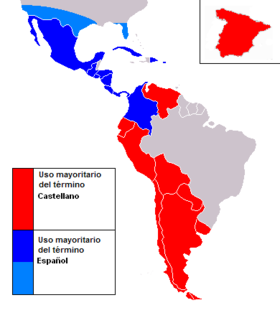 Both names are commonly used in parts of the world colonized by Spanish speakers, such as Latin America and the Canary Islands. As in Spain, the implications are complex. The most common term used in Latin America is español, generally considered to be a neutral term simply reflecting the country the language came from. For people who use this term, castellano may possibly imply greater correctness as it sometimes does in Spain, or it may merely be an alien term, referring to a region in a far-off country.
However, some Latin Americans prefer the word castellano, especially in Argentina, Chile, and Peru. One reason for this is that many of the early Argentine settlers were Galicians, so castellano had the special connotation of standard Spanish as opposed to Galician. Reasons given generally include the idea that Spanish is an international language with historical origins in the old kingdom of Castile, and that the term español is imperialist, implying it is the language of Spain. One criticism of this reasoning is that Castile is the imperialist heart of Spain, and the engine that drove the colonization of the Americas, so castellano is just as 'bad' in these terms as español. However, the fact that Spain is still a major nation-state, whereas Castile is now a region buried within Spain and internationally forgotten, is the deciding psychological factor.
In practice, the use of one term or the other tends to be a matter of local customs, rather than reflecting any philosophical or political ideas.
However, in some Latin American nations, castellano may be used to specifically describe the variation(s) of the language spoken in the castellano speaking regions of Spain, while español would generally refer to Standard Spanish
.
Some constitutions avoid the issue by talking about "the national language".
circles to write Castilian or even Castellano in English texts, calling Spanish incorrect or imperialist. This can even lead to their rejecting the official ISO 639
code for Spanish (es) in favor of ca, with the consequence that Catalan
then would have to be given ct.
Some philologists use "Castilian" only when speaking of the language spoken in Castile during the Middle Ages
, stating that it is preferable to use "Spanish" for its modern form. The dialect
of Spanish spoken in northern parts of modern Castile may also be called "Castilian." This dialect differs from those of other regions of Spain (Andalusia
for example); the Castilian dialect
is conventionally considered in Spain to be the same as standard Spanish.
Another use of Castilian in English is to distinguish between standard Spanish and regional dialects. As noted above, this distinction is made to some extent in Spanish, but not as far as some English speakers go — for example, websites with language selection screens giving the choice between Castilian Spanish and Latin American Spanish among other languages.
In the Americas, where Spanish is the native language of 20 countries, usage of castellano and español is sometimes reversed when referring to another nation. For example, a Peruvian, talking about a Uruguayan, might say Yo hablo en español peruano, él habla en español uruguayo, pero los dos hablamos castellano ("I speak Peruvian Spanish, he speaks Uruguayan Spanish, but we both speak Castilian"). This usage comes from the historical association of español with the language that was brought to America by conquistadores, and later transformed in each nation through daily usage, and castellano as the basis for all variants.
, one of the earlier authors in Castilian, named his language román paladino (i.e., "palace's romance") "in which a person talks to his neighbor", that is, direct talking, without affectation, in the most clear way someway can express (as good as in the palace or court).
Spanish language
Spanish , also known as Castilian , is a Romance language in the Ibero-Romance group that evolved from several languages and dialects in central-northern Iberia around the 9th century and gradually spread with the expansion of the Kingdom of Castile into central and southern Iberia during the...
: Spanish (español) and Castilian (castellano). Spanish speakers from different countries or backgrounds can show a preference for one term or the other, or use them indiscriminately, but political issues or common usage might lead speakers to prefer one term over the other. This article identifies the differences between those terms, the countries or backgrounds that show a preference for one or the other, and the implications the choice of words might have for a native Spanish speaker.
Generally speaking, both terms can refer to the Spanish language as a whole, with a preference for one over the other that depends on the context or the speaker's origin. Castilian (castellano) has another, more restricted, meaning, relating either to the old romance language spoken in the Kingdom of Castile
Kingdom of Castile
Kingdom of Castile was one of the medieval kingdoms of the Iberian Peninsula. It emerged as a political autonomous entity in the 9th century. It was called County of Castile and was held in vassalage from the Kingdom of León. Its name comes from the host of castles constructed in the region...
in the Middle Ages
Middle Ages
The Middle Ages is a periodization of European history from the 5th century to the 15th century. The Middle Ages follows the fall of the Western Roman Empire in 476 and precedes the Early Modern Era. It is the middle period of a three-period division of Western history: Classic, Medieval and Modern...
, predecessor of the modern Spanish language, or to the variation of Spanish nowadays spoken in the historical region of Castile
Castile (historical region)
A former kingdom, Castile gradually merged with its neighbours to become the Crown of Castile and later the Kingdom of Spain when united with the Crown of Aragon and the Kingdom of Navarre...
, in central Spain
Spain
Spain , officially the Kingdom of Spain languages]] under the European Charter for Regional or Minority Languages. In each of these, Spain's official name is as follows:;;;;;;), is a country and member state of the European Union located in southwestern Europe on the Iberian Peninsula...
.
History of the terms
Originally Castilian (castellano) referred to the language of the Kingdom of CastileKingdom of Castile
Kingdom of Castile was one of the medieval kingdoms of the Iberian Peninsula. It emerged as a political autonomous entity in the 9th century. It was called County of Castile and was held in vassalage from the Kingdom of León. Its name comes from the host of castles constructed in the region...
, one of several northern kingdoms that spread across the Iberian Peninsula
Iberian Peninsula
The Iberian Peninsula , sometimes called Iberia, is located in the extreme southwest of Europe and includes the modern-day sovereign states of Spain, Portugal and Andorra, as well as the British Overseas Territory of Gibraltar...
through the Middle Ages
Middle Ages
The Middle Ages is a periodization of European history from the 5th century to the 15th century. The Middle Ages follows the fall of the Western Roman Empire in 476 and precedes the Early Modern Era. It is the middle period of a three-period division of Western history: Classic, Medieval and Modern...
, from about the 8th to the 15th centuries. The first recorded example of written Castilian/Spanish is the Glosas Emilianenses
Glosas Emilianenses
The Glosas Emilianenses are glosses written in a Latin codex. These marginalia are important as early examples of writing in Basque and a form of Spanish...
, a document from the eleventh century. This protoromanic language is no longer spoken, but can be read in many texts such as El cantar del Mio Cid
Cantar de Mio Cid
El Cantar de Myo Çid , also known in English as The Lay of the Cid and The Poem of the Cid is the oldest preserved Spanish epic poem...
. This language derived from Latin
Latin
Latin is an Italic language originally spoken in Latium and Ancient Rome. It, along with most European languages, is a descendant of the ancient Proto-Indo-European language. Although it is considered a dead language, a number of scholars and members of the Christian clergy speak it fluently, and...
and evolved into the modern Spanish.
However, the term Spanish (español) is a more recent term that first referred to Spain as a country, and then to the predominant language spoken in that country. Spain as a truly unified nation appeared centuries later than the language and the Kingdom of Castile; in fact, it was only in 1469 that the marital union between the Kingdoms of Castile and Aragon
Kingdom of Aragon
The Kingdom of Aragon was a medieval and early modern kingdom in the Iberian Peninsula, corresponding to the modern-day autonomous community of Aragon, in Spain...
gave way to the modern Kingdom of Spain. The actual legal unification date is disputed, but commonly agreed to have occurred not earlier than the eighteenth century. Only then did the Castilian language begin to be commonly called Spanish.
In 1492, the arrival of Christopher Columbus
Christopher Columbus
Christopher Columbus was an explorer, colonizer, and navigator, born in the Republic of Genoa, in northwestern Italy. Under the auspices of the Catholic Monarchs of Spain, he completed four voyages across the Atlantic Ocean that led to general European awareness of the American continents in the...
on a Castilian-paid expedition paved the way for the Spanish colonization of the Americas
Spanish colonization of the Americas
Colonial expansion under the Spanish Empire was initiated by the Spanish conquistadores and developed by the Monarchy of Spain through its administrators and missionaries. The motivations for colonial expansion were trade and the spread of the Christian faith through indigenous conversions...
. As a result of this process, many countries in South America now speak the same language as Castile. Until about the eighteenth century, the Kingdom of Castile, and not Spain as a whole, was the colonizing power and the language used was called Castilian. Thus, some American countries formerly under the Spanish rule have retained the custom of calling it castellano, while others switched to calling it español at some point or the other, with many other different factors influencing the final choice.
In English, the term Spanish relates both to the language and to the nation. The noun used for a person from Spain is Spaniard, with the collective noun the Spanish. The term Castilian is much less widespread amongst English speakers than the term Spanish.
To understand how two terms can refer to the same language, imagine that the English language were sometimes called English after the historical nation whose language it is but also sometimes British after the modern state, the United Kingdom of Great Britain and Northern Ireland
United Kingdom
The United Kingdom of Great Britain and Northern IrelandIn the United Kingdom and Dependencies, other languages have been officially recognised as legitimate autochthonous languages under the European Charter for Regional or Minority Languages...
, of which it is the official language. To add to the complexity, former British colonies such as British North America
British North America
British North America is a historical term. It consisted of the colonies and territories of the British Empire in continental North America after the end of the American Revolutionary War and the recognition of American independence in 1783.At the start of the Revolutionary War in 1775 the British...
would have had to choose a name for the language as well as the speakers of Welsh
Welsh language
Welsh is a member of the Brythonic branch of the Celtic languages spoken natively in Wales, by some along the Welsh border in England, and in Y Wladfa...
and other non-English languages in the United Kingdom. That would resemble the situation with Spain and its historical centre, Castile
Castile (historical region)
A former kingdom, Castile gradually merged with its neighbours to become the Crown of Castile and later the Kingdom of Spain when united with the Crown of Aragon and the Kingdom of Navarre...
.
History of the term 'Castilian'
Castile (in Spanish: Castilla) means CastleCastle
A castle is a type of fortified structure built in Europe and the Middle East during the Middle Ages by European nobility. Scholars debate the scope of the word castle, but usually consider it to be the private fortified residence of a lord or noble...
-land, from castiello plus the suffix -ia, giving Castiella, a form that survives in the Leonese language
Leonese language
The Leonese language is the endonym term used to refer to all vernacular Romance dialects of the Astur-Leonese linguistic group in the Spanish provinces of León and Zamora; Astur-Leonese also includes the dialects...
and can be seen in mediaeval Castilian texts such as the Lay of the Cid. Modern Spanish has transformed all words ending in -iello, -iella into -illo, -illa. The adjective derived from Castilla is castellano, or 'Castilian', in English. Castellano also means 'castellan
Castellan
A castellan was the governor or captain of a castle. The word stems from the Latin Castellanus, derived from castellum "castle". Also known as a constable.-Duties:...
', i.e. a castle master. There is a comic scene based on the play on words (Castilian/castellan) in Don Quijote.
The region was thus named because it was a frontier
Frontier
A frontier is a political and geographical term referring to areas near or beyond a boundary. 'Frontier' was absorbed into English from French in the 15th century, with the meaning "borderland"--the region of a country that fronts on another country .The use of "frontier" to mean "a region at the...
land controlled from a series of fortified castles. It shared borders with rival Moorish Spain and the Christian kingdoms of Navarre
Kingdom of Navarre
The Kingdom of Navarre , originally the Kingdom of Pamplona, was a European kingdom which occupied lands on either side of the Pyrenees alongside the Atlantic Ocean....
and Aragon
Kingdom of Aragon
The Kingdom of Aragon was a medieval and early modern kingdom in the Iberian Peninsula, corresponding to the modern-day autonomous community of Aragon, in Spain...
.
History of the term 'Spanish'
HispaniaHispania
Another theory holds that the name derives from Ezpanna, the Basque word for "border" or "edge", thus meaning the farthest area or place. Isidore of Sevilla considered Hispania derived from Hispalis....
was the name given to the Iberian Peninsula
Iberian Peninsula
The Iberian Peninsula , sometimes called Iberia, is located in the extreme southwest of Europe and includes the modern-day sovereign states of Spain, Portugal and Andorra, as well as the British Overseas Territory of Gibraltar...
by the Romans
Ancient Rome
Ancient Rome was a thriving civilization that grew on the Italian Peninsula as early as the 8th century BC. Located along the Mediterranean Sea and centered on the city of Rome, it expanded to one of the largest empires in the ancient world....
when they discovered and later subjugated it. The name was previously Canaanite
Canaanite languages
The Canaanite languages are a subfamily of the Semitic languages, which were spoken by the ancient peoples of the Canaan region, including Canaanites, Israelites and Phoenicians...
אי שפנים (''ʾî šəpānîm), meaning 'island of hyrax
Hyrax
A hyrax is any of four species of fairly small, thickset, herbivorous mammals in the order Hyracoidea. The rock hyrax Procavia capensis, the yellow-spotted rock hyrax Heterohyrax brucei, the western tree hyrax Dendrohyrax dorsalis, and the southern tree hyrax, Dendrohyrax arboreus live in Africa...
es', named by Canaanite-speaking Phoenicia
Phoenicia
Phoenicia , was an ancient civilization in Canaan which covered most of the western, coastal part of the Fertile Crescent. Several major Phoenician cities were built on the coastline of the Mediterranean. It was an enterprising maritime trading culture that spread across the Mediterranean from 1550...
ns who mistook Spain's large rabbit
Rabbit
Rabbits are small mammals in the family Leporidae of the order Lagomorpha, found in several parts of the world...
population for hyraxes that roamed the Iberian Peninsula in ancient times (although today, the Spanish population of wild rabbits is not quite as abundant as it was then due to the introduction of the myxomatosis
Myxomatosis
Myxomatosis is a disease that affects rabbits and is caused by the Myxoma virus. It was first observed in Uruguay in laboratory rabbits in the late 19th century. It was introduced into Australia in 1950 in an attempt to control the rabbit population...
virus
Virus
A virus is a small infectious agent that can replicate only inside the living cells of organisms. Viruses infect all types of organisms, from animals and plants to bacteria and archaea...
to mainland Europe in 1950). The Romans called its inhabitants hispani (singular: hispanus), and the relevant adjective was hispanicus. These terms would naturally have developed into España, *espanos (singular: *espano) and *espánego in Castilian. In reality, only the first term exists in modern Castilian, as it seems that the Spanish borrowed the Occitan name for themselves, which was the name España plus the diminutive suffix -ol, from the Latin
Latin
Latin is an Italic language originally spoken in Latium and Ancient Rome. It, along with most European languages, is a descendant of the ancient Proto-Indo-European language. Although it is considered a dead language, a number of scholars and members of the Christian clergy speak it fluently, and...
-ulus or -olus. We can see this because if the native Castilian suffix had been used this would have given us *españuelo rather than español.
The term español, which was adopted by several languages — and transformed according to their own phonology and grammar rules — to designate the Spanish people and their language, is from medieval Latin Hispaniolus (literally, "little Hispanian"), a form that evolved later, by hypercorrection
Hypercorrection
In linguistics or usage, hypercorrection is a non-standard usage that results from the over-application of a perceived rule of grammar or a usage prescription...
, to the written form Spaniolus (note that, by that time, the Latin h had become silent, causing the word to be pronounced ispaˈnjolu), and the prosthetic
Prosthesis (linguistics)
In linguistics, prosthesis is the addition of a sound or syllable at the beginning of a word without changing the word's meaning or the rest of its structure. The alternative spelling prothesis was first used in post-classical Latin, based on Greek próthesis "placing before" or "in public"...
vowel i (used in spoken Latin for euphonic reasons) opened to e, giving the present word.
As the branches of Vulgar Latin
Vulgar Latin
Vulgar Latin is any of the nonstandard forms of Latin from which the Romance languages developed. Because of its nonstandard nature, it had no official orthography. All written works used Classical Latin, with very few exceptions...
began to evolve into separate Romance languages
Romance languages
The Romance languages are a branch of the Indo-European language family, more precisely of the Italic languages subfamily, comprising all the languages that descend from Vulgar Latin, the language of ancient Rome...
, the term that would evolve into español began to be used to refer to these derivative languages (especially as opposed to the Arabic
Arabic language
Arabic is a name applied to the descendants of the Classical Arabic language of the 6th century AD, used most prominently in the Quran, the Islamic Holy Book...
and Hebrew
Hebrew language
Hebrew is a Semitic language of the Afroasiatic language family. Culturally, is it considered by Jews and other religious groups as the language of the Jewish people, though other Jewish languages had originated among diaspora Jews, and the Hebrew language is also used by non-Jewish groups, such...
of the Moorish
Moors
The description Moors has referred to several historic and modern populations of the Maghreb region who are predominately of Berber and Arab descent. They came to conquer and rule the Iberian Peninsula for nearly 800 years. At that time they were Muslim, although earlier the people had followed...
and Jewish inhabitants of Iberia). It was at first a general term that embraced the various dialects of Iberian Romance spoken in the area, including the forebears of modern Portuguese
Portuguese language
Portuguese is a Romance language that arose in the medieval Kingdom of Galicia, nowadays Galicia and Northern Portugal. The southern part of the Kingdom of Galicia became independent as the County of Portugal in 1095...
, Galician
Galician language
Galician is a language of the Western Ibero-Romance branch, spoken in Galicia, an autonomous community located in northwestern Spain, where it is co-official with Castilian Spanish, as well as in border zones of the neighbouring territories of Asturias and Castile and León.Modern Galician and...
, Castilian and Catalan
Catalan language
Catalan is a Romance language, the national and only official language of Andorra and a co-official language in the Spanish autonomous communities of Catalonia, the Balearic Islands and Valencian Community, where it is known as Valencian , as well as in the city of Alghero, on the Italian island...
. However, with the rise of Castile as a power, and its absorption of all surrounding regions into an ever-growing empire that eventually spread to the New World
New World
The New World is one of the names used for the Western Hemisphere, specifically America and sometimes Oceania . The term originated in the late 15th century, when America had been recently discovered by European explorers, expanding the geographical horizon of the people of the European middle...
, the term España was eventually equated with the peninsular territories ruled by the Crown. With this, the break with the Roman concept of Hispania was complete, and the term acquired its modern meaning of 'all of Iberia except for Portugal
Portugal
Portugal , officially the Portuguese Republic is a country situated in southwestern Europe on the Iberian Peninsula. Portugal is the westernmost country of Europe, and is bordered by the Atlantic Ocean to the West and South and by Spain to the North and East. The Atlantic archipelagos of the...
and Andorra
Andorra
Andorra , officially the Principality of Andorra , also called the Principality of the Valleys of Andorra, , is a small landlocked country in southwestern Europe, located in the eastern Pyrenees mountains and bordered by Spain and France. It is the sixth smallest nation in Europe having an area of...
'. Similarly, español came to be used to refer to the common language of this new country: Castilian.
The terms España and español spread to other languages. The English name 'Spain' is from the French Espagne. 'Spanish' is 'Spain' plus the English suffix -ish. The term continues evolving as other languages adapt these words to form their own name for Spain — for example, Japanese
Japanese language
is a language spoken by over 130 million people in Japan and in Japanese emigrant communities. It is a member of the Japonic language family, which has a number of proposed relationships with other languages, none of which has gained wide acceptance among historical linguists .Japanese is an...
スペイン語 (Supein-go), 'Spanish language', and スペイン人 (Supein-jin), 'Spaniard', derives from the Japanese word for Spain, スペイン (Supein), which, in turn, derives from English 'Spain'. In Chinese though, the word is directly taken from Spanish (or perhaps even Latin) rather than English: they say 西班牙 (Pinyin
Pinyin
Pinyin is the official system to transcribe Chinese characters into the Roman alphabet in China, Malaysia, Singapore and Taiwan. It is also often used to teach Mandarin Chinese and spell Chinese names in foreign publications and used as an input method to enter Chinese characters into...
phonetic symbols: xībānyá) for Spain and 西班牙语 (Pinyin: xībānyá yǔ) , or the abbreviation 西語 (Pinyin: xī yǔ) for the Spanish language. The Arabic إسبانية (isbāniya) for Spain derives directly from the word España: the absence of "p" in the Arabic alphabet makes it a "b", and the sound "ñ" is transformed into "n". إسباني (isbāni) is the name for Spanish, with the same end of عربي ('arabī that means "Arabic").
In Guatemala
Guatemala
Guatemala is a country in Central America bordered by Mexico to the north and west, the Pacific Ocean to the southwest, Belize to the northeast, the Caribbean to the east, and Honduras and El Salvador to the southeast...
, although Spanish is the official language, the Mayans, the original inhabitants of the region, call it "la castilla", keeping the original name from colonial times. Mayans speak at least 22 different "Mayan" languages and dialects (Mam, Pocomam, cak'chikel, tzu'tuhil, kek'chi, ki'che, etc.).
While Espanyol is used in Tagalog
Tagalog language
Tagalog is an Austronesian language spoken as a first language by a third of the population of the Philippines and as a second language by most of the rest. It is the first language of the Philippine region IV and of Metro Manila...
and other languages of the Philippines
Languages of the Philippines
In the Philippines, there are between 120 and 175 languages, depending on the method of classification. Four languages no longer have any known speakers. Almost all the Philippine languages belong to the Austronesian language family...
, the word Kastilà is more frequently used. Furthermore Katsila is also used among those who speak Visayan languages
Visayan languages
The Visayan languages of the Philippines, along with Tagalog and Bikol, are part of the Central Philippine languages...
like Cebuano
Cebuano language
Cebuano, referred to by most of its speakers as Bisaya , is an Austronesian language spoken in the Philippines by about 20 million people mostly in the Central Visayas. It is the most widely spoken of the languages within the so-named Bisayan subgroup and is closely related to other Filipino...
.
Usage of the term "cristiano" (Christian)
During the presence of MoorsMoors
The description Moors has referred to several historic and modern populations of the Maghreb region who are predominately of Berber and Arab descent. They came to conquer and rule the Iberian Peninsula for nearly 800 years. At that time they were Muslim, although earlier the people had followed...
in Hispania
Hispania
Another theory holds that the name derives from Ezpanna, the Basque word for "border" or "edge", thus meaning the farthest area or place. Isidore of Sevilla considered Hispania derived from Hispalis....
, Spanish was sometimes given the name cristiano to distinguish it from the Arabic
Arabic language
Arabic is a name applied to the descendants of the Classical Arabic language of the 6th century AD, used most prominently in the Quran, the Islamic Holy Book...
and Hebrew
Hebrew language
Hebrew is a Semitic language of the Afroasiatic language family. Culturally, is it considered by Jews and other religious groups as the language of the Jewish people, though other Jewish languages had originated among diaspora Jews, and the Hebrew language is also used by non-Jewish groups, such...
languages.
Spanish also marked Christians
Christianity
Christianity is a monotheistic religion based on the life and teachings of Jesus as presented in canonical gospels and other New Testament writings...
from Amerindians. This term is still used today to refer to the language, though usually jocularly.
The expression Hábleme en cristiano "talk to me in Christian", uttered to people not speaking Spanish at the moment, is used in opposition of the other Spanish languages, which is felt as annoying by them (Catalonia
Catalonia
Catalonia is an autonomous community in northeastern Spain, with the official status of a "nationality" of Spain. Catalonia comprises four provinces: Barcelona, Girona, Lleida, and Tarragona. Its capital and largest city is Barcelona. Catalonia covers an area of 32,114 km² and has an...
, Galicia and the Basque Country
Basque Country (autonomous community)
The Basque Country is an autonomous community of northern Spain. It includes the Basque provinces of Álava, Biscay and Gipuzkoa, also called Historical Territories....
, but not in America). "Háblame en cristiano" is also a phrase used for ask for clarification in a conversation, when the topic/point of the discussion is not clear or is vaguely (hesitantly) hinted by one of the speakers.
History of the term 'Language of Cervantes'
Spanish is often referred to in educated circles as 'the Language of Cervantes' or la lengua de Cervantes, in reference to Don Quixote author Miguel de Cervantes Saavedra, a usage akin to that of Shakespeare for English, DanteDante Alighieri
Durante degli Alighieri, mononymously referred to as Dante , was an Italian poet, prose writer, literary theorist, moral philosopher, and political thinker. He is best known for the monumental epic poem La commedia, later named La divina commedia ...
for Italian, etc.
Academic choice of words
In Spain, the Royal Spanish AcademyReal Academia Española
The Royal Spanish Academy is the official royal institution responsible for regulating the Spanish language. It is based in Madrid, Spain, but is affiliated with national language academies in twenty-one other hispanophone nations through the Association of Spanish Language Academies...
is recognized as a normative body that rules on the orthography and general usage rules of the language. The Academy used el castellano from the 18th century, but since 1923 its dictionary and grammar are de la lengua española ("of the Spanish language"). The Academy's usage of one term is not necessarily a condemnation of the other.
There are many other Academies (grouped under the Association of Spanish Language Academies
Association of Spanish Language Academies
The Association of Spanish Language Academies is the entity which regulates the Spanish language. It was created in Mexico in 1951 and represents the union of all the separate academies in the Spanish-speaking world....
) that may or may not have an official normative recognition, but nevertheless cooperate in the creation of the Diccionario Panhispánico de Dudas (a compendium of corrected typical mistakes and doubts). In this dictionary, whose production was agreed upon by the 22 different Spanish Language Academies, we are told:
Thus, even if both terms are allowed in Spanish, the usage of el español is recommended for the language as a whole. However, popular choice of terms is not so clear, with other factors such as customs or politics coming in.
Usage in Spain
Spaniards tend to call the language el español (Spanish) when contrasting it to languages of other states, such as in a list with FrenchFrench language
French is a Romance language spoken as a first language in France, the Romandy region in Switzerland, Wallonia and Brussels in Belgium, Monaco, the regions of Quebec and Acadia in Canada, and by various communities elsewhere. Second-language speakers of French are distributed throughout many parts...
(francés), Chinese
Chinese language
The Chinese language is a language or language family consisting of varieties which are mutually intelligible to varying degrees. Originally the indigenous languages spoken by the Han Chinese in China, it forms one of the branches of Sino-Tibetan family of languages...
(chino), etc. El castellano (Castilian) by contrast, is more often used when contrasting the language with other regional languages of Spain
Languages of Spain
The languages of Spain are the languages spoken or once spoken in Spain. Romance languages are the most widely spoken in Spain, of which Spanish is the country's official language...
: official languages like Basque
Basque language
Basque is the ancestral language of the Basque people, who inhabit the Basque Country, a region spanning an area in northeastern Spain and southwestern France. It is spoken by 25.7% of Basques in all territories...
, Catalan
Catalan language
Catalan is a Romance language, the national and only official language of Andorra and a co-official language in the Spanish autonomous communities of Catalonia, the Balearic Islands and Valencian Community, where it is known as Valencian , as well as in the city of Alghero, on the Italian island...
and Galician
Galician language
Galician is a language of the Western Ibero-Romance branch, spoken in Galicia, an autonomous community located in northwestern Spain, where it is co-official with Castilian Spanish, as well as in border zones of the neighbouring territories of Asturias and Castile and León.Modern Galician and...
or unofficial ones like Aragonese
Aragonese language
Aragonese is a Romance language now spoken in a number of local varieties by between 10,000 and 30,000 people over the valleys of the Aragón River, Sobrarbe and Ribagorza in Aragon, Spain...
, Asturian
Asturian language
Asturian is a Romance language of the West Iberian group, Astur-Leonese Subgroup, spoken in the Spanish Region of Asturias by the Asturian people...
, Extremaduran
Extremaduran language
Extremaduran is a Romance language, spoken by several hundred thousand people in Spain, in an area covering the north-western part of the autonomous community of Extremadura and adjoining areas in the province of Salamanca....
, Leonese
Leonese language
The Leonese language is the endonym term used to refer to all vernacular Romance dialects of the Astur-Leonese linguistic group in the Spanish provinces of León and Zamora; Astur-Leonese also includes the dialects...
and so on. In this manner, the Spanish Constitution of 1978
Spanish Constitution of 1978
-Structure of the State:The Constitution recognizes the existence of nationalities and regions . Preliminary Title As a result, Spain is now composed entirely of 17 Autonomous Communities and two autonomous cities with varying degrees of autonomy, to the extent that, even though the Constitution...
uses the term el castellano to define the official language of the whole State, opposed to las demás lenguas españolas (lit. the other Spanish languages). Article III reads in part:
This choice of words can however vary depending on many factors, including the origin of the speaker or some political nuances.
Bilingual and multilingual regions of Spain
In the regions where regional languages are spoken, there is obviously a daily need to make the contrast between the national languageNational language
A national language is a language which has some connection—de facto or de jure—with a people and perhaps by extension the territory they occupy. The term is used variously. A national language may for instance represent the national identity of a nation or country...
and the regional language
Regional language
A regional language is a language spoken in an area of a nation state, whether it be a small area, a federal state or province, or some wider area....
, and so the national language is most often referred to as Castilian, particularly in the regional languages themselves (e.g. espanyol is virtually never used to refer to the Spanish language in Catalan: castellà is used instead.) This usage is often mirrored by educated English speakers when referring to the linguistic situation in Spain.
For some, this use of the term castellano is a political or cultural statement that Spanish is only the language of Castile and perhaps some areas that Castile colonised, but not the language of their region, where they consider the only legitimate language to be the regional one, i.e. Catalan, Basque, Galician, etc. This stance is common in regionalist circles.
Conversely, some nationalist circles prefer the term español because they perceive their ethnic community to be distinct from that of Spain, and therefore do not object to the language of Spain being called Spanish. In Basque-speaking regions, where the language is not of Romance
Romance languages
The Romance languages are a branch of the Indo-European language family, more precisely of the Italic languages subfamily, comprising all the languages that descend from Vulgar Latin, the language of ancient Rome...
origin — Basque is considered by many scholars to be a language isolate
Language isolate
A language isolate, in the absolute sense, is a natural language with no demonstrable genealogical relationship with other languages; that is, one that has not been demonstrated to descend from an ancestor common with any other language. They are in effect language families consisting of a single...
— some Basque speakers might even use the term erdara (lit. foreign) specifically for Spanish, since for them it is the prevalent foreign language - just as in the French Basque Country, "French language" is the usual meaning of erdara.
Monolingual regions of Spain
In monolingual regions, the implications are a little different. In these regions, there is no identity implication, but still they must choose one of the two terms. CastiliansCastilian people
The Castilian people are the inhabitants of those regions in Spain where most people identify themselves as Castilian. They include Castile-La Mancha, Madrid, and the major part of Castile and León. However, not all regions of the medieval Kingdom of Castile think of themselves as Castilian...
usually use the term el español, thus legitimately presenting it as the national language. However, they also frequently call it el castellano, either to assert their ownership or to distinguish it from the regional languages.
Monolingual regions outside of Castile
Castile (historical region)
A former kingdom, Castile gradually merged with its neighbours to become the Crown of Castile and later the Kingdom of Spain when united with the Crown of Aragon and the Kingdom of Navarre...
include, mainly, Andalusia
Andalusia
Andalusia is the most populous and the second largest in area of the autonomous communities of Spain. The Andalusian autonomous community is officially recognised as a nationality of Spain. The territory is divided into eight provinces: Huelva, Seville, Cádiz, Córdoba, Málaga, Jaén, Granada and...
, but also other regions where the regional languages are not developed enough to be widely spoken by the majority of the population; this is the case of Extremadura
Extremadura
Extremadura is an autonomous community of western Spain whose capital city is Mérida. Its component provinces are Cáceres and Badajoz. It is bordered by Portugal to the west...
, Cantabria
Cantabria
Cantabria is a Spanish historical region and autonomous community with Santander as its capital city. It is bordered on the east by the Basque Autonomous Community , on the south by Castile and León , on the west by the Principality of Asturias, and on the north by the Cantabrian Sea.Cantabria...
or Aragon
Aragon
Aragon is a modern autonomous community in Spain, coextensive with the medieval Kingdom of Aragon. Located in northeastern Spain, the Aragonese autonomous community comprises three provinces : Huesca, Zaragoza, and Teruel. Its capital is Zaragoza...
, for example. There, español may be used as in Castile
Castile (historical region)
A former kingdom, Castile gradually merged with its neighbours to become the Crown of Castile and later the Kingdom of Spain when united with the Crown of Aragon and the Kingdom of Navarre...
to stress the national nature of the language, but with a slightly different nuance: they are accepting another region's historical language as their own. However, one must not forget that if Spanish is spoken in these regions it is due to the Reconquista
Reconquista
The Reconquista was a period of almost 800 years in the Middle Ages during which several Christian kingdoms succeeded in retaking the Muslim-controlled areas of the Iberian Peninsula broadly known as Al-Andalus...
.
Concept of a standard
The term castellano is occasionally used to imply more of a standard form than español does. For example, if someone mispronounces a word, they might be told ¡hable castellano!, i.e. 'Speak Castilian!', 'Speak properly!'. However, this nuance is not to be exaggerated, as it is perfectly possible that the term español or even, jocularly, cristiano ('Christian') could be used instead. Moreover, the term castellano is also commonly and correctly used to refer to dialects of Spanish that deviate dramatically from the standard.Usage and implications in former colonies
However, some Latin Americans prefer the word castellano, especially in Argentina, Chile, and Peru. One reason for this is that many of the early Argentine settlers were Galicians, so castellano had the special connotation of standard Spanish as opposed to Galician. Reasons given generally include the idea that Spanish is an international language with historical origins in the old kingdom of Castile, and that the term español is imperialist, implying it is the language of Spain. One criticism of this reasoning is that Castile is the imperialist heart of Spain, and the engine that drove the colonization of the Americas, so castellano is just as 'bad' in these terms as español. However, the fact that Spain is still a major nation-state, whereas Castile is now a region buried within Spain and internationally forgotten, is the deciding psychological factor.
In practice, the use of one term or the other tends to be a matter of local customs, rather than reflecting any philosophical or political ideas.
However, in some Latin American nations, castellano may be used to specifically describe the variation(s) of the language spoken in the castellano speaking regions of Spain, while español would generally refer to Standard Spanish
Standard Spanish
Standard Spanish or neutral Spanish is a linguistic variety, or lect, that is considered a correct educated standard for the Spanish language. Standard Spanish is not merely Spanish adjusted to fit in prescriptive molds dictated by a linguistic overseeing authority, but also a form of language that...
.
Some constitutions avoid the issue by talking about "the national language".
Castellano ('Castilian') is generally preferred in
- ArgentinaArgentinaArgentina , officially the Argentine Republic , is the second largest country in South America by land area, after Brazil. It is constituted as a federation of 23 provinces and an autonomous city, Buenos Aires...
- ColombiaColombiaColombia, officially the Republic of Colombia , is a unitary constitutional republic comprising thirty-two departments. The country is located in northwestern South America, bordered to the east by Venezuela and Brazil; to the south by Ecuador and Peru; to the north by the Caribbean Sea; to the...
: the Colombian Constitution of 1991 uses the term ‘el castellano’ to define the official language of the State: “El castellano es el idioma oficial de Colombia.” (“Castilian is the official language of Colombia..)” - El SalvadorEl SalvadorEl Salvador or simply Salvador is the smallest and the most densely populated country in Central America. The country's capital city and largest city is San Salvador; Santa Ana and San Miguel are also important cultural and commercial centers in the country and in all of Central America...
Castellano is used in Salvadoran Constitution. - ParaguayParaguayParaguay , officially the Republic of Paraguay , is a landlocked country in South America. It is bordered by Argentina to the south and southwest, Brazil to the east and northeast, and Bolivia to the northwest. Paraguay lies on both banks of the Paraguay River, which runs through the center of the...
- PeruPeruPeru , officially the Republic of Peru , is a country in western South America. It is bordered on the north by Ecuador and Colombia, on the east by Brazil, on the southeast by Bolivia, on the south by Chile, and on the west by the Pacific Ocean....
- UruguayUruguayUruguay ,officially the Oriental Republic of Uruguay,sometimes the Eastern Republic of Uruguay; ) is a country in the southeastern part of South America. It is home to some 3.5 million people, of whom 1.8 million live in the capital Montevideo and its metropolitan area...
Alternation between both names
- SpainSpainSpain , officially the Kingdom of Spain languages]] under the European Charter for Regional or Minority Languages. In each of these, Spain's official name is as follows:;;;;;;), is a country and member state of the European Union located in southwestern Europe on the Iberian Peninsula...
- BoliviaBoliviaBolivia officially known as Plurinational State of Bolivia , is a landlocked country in central South America. It is the poorest country in South America...
: The Constitution Revision says castellano, a term schools also use, though español is still quite common in common speech. - ChileChileChile ,officially the Republic of Chile , is a country in South America occupying a long, narrow coastal strip between the Andes mountains to the east and the Pacific Ocean to the west. It borders Peru to the north, Bolivia to the northeast, Argentina to the east, and the Drake Passage in the far...
: the media use the word español but schools officially teach castellano. - EcuadorEcuadorEcuador , officially the Republic of Ecuador is a representative democratic republic in South America, bordered by Colombia on the north, Peru on the east and south, and by the Pacific Ocean to the west. It is one of only two countries in South America, along with Chile, that do not have a border...
- VenezuelaVenezuelaVenezuela , officially called the Bolivarian Republic of Venezuela , is a tropical country on the northern coast of South America. It borders Colombia to the west, Guyana to the east, and Brazil to the south...
- PanamaPanamaPanama , officially the Republic of Panama , is the southernmost country of Central America. Situated on the isthmus connecting North and South America, it is bordered by Costa Rica to the northwest, Colombia to the southeast, the Caribbean Sea to the north and the Pacific Ocean to the south. The...
: the national constitution admits the use of any of the words.
Español ('Spanish') is generally preferred in
- United StatesUnited StatesThe United States of America is a federal constitutional republic comprising fifty states and a federal district...
- MexicoMexicoThe United Mexican States , commonly known as Mexico , is a federal constitutional republic in North America. It is bordered on the north by the United States; on the south and west by the Pacific Ocean; on the southeast by Guatemala, Belize, and the Caribbean Sea; and on the east by the Gulf of...
- Central AmericaCentral AmericaCentral America is the central geographic region of the Americas. It is the southernmost, isthmian portion of the North American continent, which connects with South America on the southeast. When considered part of the unified continental model, it is considered a subcontinent...
except El Salvador and Panama - CubaCubaThe Republic of Cuba is an island nation in the Caribbean. The nation of Cuba consists of the main island of Cuba, the Isla de la Juventud, and several archipelagos. Havana is the largest city in Cuba and the country's capital. Santiago de Cuba is the second largest city...
- Dominican RepublicDominican RepublicThe Dominican Republic is a nation on the island of La Hispaniola, part of the Greater Antilles archipelago in the Caribbean region. The western third of the island is occupied by the nation of Haiti, making Hispaniola one of two Caribbean islands that are shared by two countries...
- Puerto RicoPuerto RicoPuerto Rico , officially the Commonwealth of Puerto Rico , is an unincorporated territory of the United States, located in the northeastern Caribbean, east of the Dominican Republic and west of both the United States Virgin Islands and the British Virgin Islands.Puerto Rico comprises an...
Español castellano ('Castillian Spanish') is generally preferred in
- PhilippinesPhilippinesThe Philippines , officially known as the Republic of the Philippines , is a country in Southeast Asia in the western Pacific Ocean. To its north across the Luzon Strait lies Taiwan. West across the South China Sea sits Vietnam...
- a number of Spanish-speaking Filipinos considered their language as "Castillian Spanish" because this was the standard in Spanish language schools and colleges and since their independence from SpainPhilippine Declaration of IndependenceThe Philippine Declaration of Independence occurred on June 12, 1898 in Cavite II el Viejo , Cavite, Philippines. With the public reading of the Act of the Declaration of Independence, Filipino revolutionary forces under General Emilio Aguinaldo proclaimed the sovereignty and independence of the...
. They treat regional languages in Spain as the following: Galician SpanishGalician languageGalician is a language of the Western Ibero-Romance branch, spoken in Galicia, an autonomous community located in northwestern Spain, where it is co-official with Castilian Spanish, as well as in border zones of the neighbouring territories of Asturias and Castile and León.Modern Galician and...
, Leonese SpanishLeonese languageThe Leonese language is the endonym term used to refer to all vernacular Romance dialects of the Astur-Leonese linguistic group in the Spanish provinces of León and Zamora; Astur-Leonese also includes the dialects...
, and others.- The general population has their own naming for Spanish: Kastila (Tagalog) and Kastila-on/Katsila (Cebuano and other Visayan languages). Philippine languages continue to employ the term KatsilaVisayan languagesThe Visayan languages of the Philippines, along with Tagalog and Bikol, are part of the Central Philippine languages...
or KastilaTagalog languageTagalog is an Austronesian language spoken as a first language by a third of the population of the Philippines and as a second language by most of the rest. It is the first language of the Philippine region IV and of Metro Manila...
to refer to a Spaniard, and to the Spanish language. - The Philippines has their own Creole Spanish, Chavacano, and has regional varieties but not mutually intelligible to each other yet mutually intelligible to Spanish. The name itself in Spanish means "poor taste", "tacky", "coarse", and "low quality", as named for its poor Spanish grammar and lack of grammar conjugation.
- Chavacano Zamboangueño - in Zamboanga CityZamboanga CityThe City of Zamboanga : is a highly urbanized, independent and a chartered city located in Mindanao, Philippines....
- Chavacano Caviteño - in Cavite CityCavite CityThe City of Cavite is a fourth class city in the province of Cavite, Philippines. The city occupies a hook shaped peninsula jutting out into Manila Bay. Cavite City used to be the capital of the province...
- Chavacano di (de) Ternate - in Ternate, Cavite
- Chavacano de Davao - known as "Castellano Abakay" in Davao provincesDavao RegionDavao Region / Southern Mindanao, designated as Region XI, is one of the regions of the Philippines, located on the southeastern portion of Mindanao. Davao Region consists of four provinces, namely: Compostela Valley, Davao del Norte, Davao Oriental, and Davao del Sur. The region encloses the Davao...
and Davao CityDavao CityThe City of Davao is the largest city in the island of Mindanao in the Philippines. Its international airport and seaports are among the busiest cargo hubs in the Philippines....
. Usually spoken in 2 styles:- "Chino" - Chinese style because it is spoken with Chinese accent, and
- "Japones" - Japanese style because it is spoken with some Spanish words replaced with Japanese ones.
- Chavacano Zamboangueño - in Zamboanga City
- The general population has their own naming for Spanish: Kastila (Tagalog) and Kastila-on/Katsila (Cebuano and other Visayan languages). Philippine languages continue to employ the term Katsila
Usage and misconceptions abroad
This complex linguistic situation is obviously not always grasped by non-Spanish speakers (or even by Spanish speakers themselves). Some believe that the term español is not used in Spanish, or only in Spain, and that the term Spanish is therefore wrong. So, it is not uncommon in some politically correctPolitical correctness
Political correctness is a term which denotes language, ideas, policies, and behavior seen as seeking to minimize social and institutional offense in occupational, gender, racial, cultural, sexual orientation, certain other religions, beliefs or ideologies, disability, and age-related contexts,...
circles to write Castilian or even Castellano in English texts, calling Spanish incorrect or imperialist. This can even lead to their rejecting the official ISO 639
ISO 639
ISO 639 is a set of standards by the International Organization for Standardization that is concerned with representation of names for language and language groups....
code for Spanish (es) in favor of ca, with the consequence that Catalan
Catalan language
Catalan is a Romance language, the national and only official language of Andorra and a co-official language in the Spanish autonomous communities of Catalonia, the Balearic Islands and Valencian Community, where it is known as Valencian , as well as in the city of Alghero, on the Italian island...
then would have to be given ct.
Some philologists use "Castilian" only when speaking of the language spoken in Castile during the Middle Ages
Middle Ages
The Middle Ages is a periodization of European history from the 5th century to the 15th century. The Middle Ages follows the fall of the Western Roman Empire in 476 and precedes the Early Modern Era. It is the middle period of a three-period division of Western history: Classic, Medieval and Modern...
, stating that it is preferable to use "Spanish" for its modern form. The dialect
Dialect
The term dialect is used in two distinct ways, even by linguists. One usage refers to a variety of a language that is a characteristic of a particular group of the language's speakers. The term is applied most often to regional speech patterns, but a dialect may also be defined by other factors,...
of Spanish spoken in northern parts of modern Castile may also be called "Castilian." This dialect differs from those of other regions of Spain (Andalusia
Andalusia
Andalusia is the most populous and the second largest in area of the autonomous communities of Spain. The Andalusian autonomous community is officially recognised as a nationality of Spain. The territory is divided into eight provinces: Huelva, Seville, Cádiz, Córdoba, Málaga, Jaén, Granada and...
for example); the Castilian dialect
Castilian Spanish
Castilian Spanish is a term related to the Spanish language, but its exact meaning can vary even in that language. In English Castilian Spanish usually refers to the variety of European Spanish spoken in north and central Spain or as the language standard for radio and TV speakers...
is conventionally considered in Spain to be the same as standard Spanish.
Another use of Castilian in English is to distinguish between standard Spanish and regional dialects. As noted above, this distinction is made to some extent in Spanish, but not as far as some English speakers go — for example, websites with language selection screens giving the choice between Castilian Spanish and Latin American Spanish among other languages.
In the Americas, where Spanish is the native language of 20 countries, usage of castellano and español is sometimes reversed when referring to another nation. For example, a Peruvian, talking about a Uruguayan, might say Yo hablo en español peruano, él habla en español uruguayo, pero los dos hablamos castellano ("I speak Peruvian Spanish, he speaks Uruguayan Spanish, but we both speak Castilian"). This usage comes from the historical association of español with the language that was brought to America by conquistadores, and later transformed in each nation through daily usage, and castellano as the basis for all variants.
Other terms
Gonzalo de BerceoGonzalo de Berceo
Gonzalo de Berceo was a Spanish poet born in the Riojan village of Berceo, close to the major Benedictine monastery of San Millán de la Cogolla...
, one of the earlier authors in Castilian, named his language román paladino (i.e., "palace's romance") "in which a person talks to his neighbor", that is, direct talking, without affectation, in the most clear way someway can express (as good as in the palace or court).
See also
- Castilian SpanishCastilian SpanishCastilian Spanish is a term related to the Spanish language, but its exact meaning can vary even in that language. In English Castilian Spanish usually refers to the variety of European Spanish spoken in north and central Spain or as the language standard for radio and TV speakers...
- Iberian languagesIberian languagesIberian languages is a generic term for the languages currently or formerly spoken in the Iberian Peninsula.- Pre-Roman languages :The following languages were spoken in the Iberian Peninsula before the Roman occupation and the spread of the Latin language.* Aquitanian * Proto-Basque* Tartessian*...
- Languages of SpainLanguages of SpainThe languages of Spain are the languages spoken or once spoken in Spain. Romance languages are the most widely spoken in Spain, of which Spanish is the country's official language...
- Iberian Romance languagesIberian Romance languagesThe Iberian Romance languages or Ibero-Romance languages are the Romance languages that developed on the Iberian Peninsula, an area consisting primarily of Spain, Portugal, and Andorra....
External links
- Detailed linguistic map of Spain
- La lengua de Castilla ya tiene nombre: ¡Castellano y no Español!. Castilian nationalistCastilian nationalismCastilian nationalism, or Castilianism, is a political movement that advocates for the national recognition of Castile, and in some cases, its independence....
writing about the name of the language.