

Iberian Romance languages

Encyclopedia
The Iberian Romance languages or Ibero-Romance languages are the Romance languages
that developed on the Iberian Peninsula
, an area consisting primarily of Spain
, Portugal
, and Andorra
.
Originating in Iberia, the most widely spoken Iberian Romance languages are Spanish
, Portuguese
, Galician
and Catalan
. These languages also have their own regional and local dialects.
. Vulgar Latin was the nonstandard (in contrast to Classical Latin
) form of the Latin language spoken by soldiers and merchants throughout the Roman Empire. With the expansion of the empire, Vulgar Latin came to be spoken by inhabitants of the various Roman-controlled territories. Latin and its descendants have been spoken in Iberia since the Punic Wars
, when the Romans conquered the territory (see Roman conquest of Hispania).
The modern Iberian Romance languages were formed roughly through the following process:
Additionally, the Asturian language
(known also as bable), while not an official language is recognized by the Spanish autonomous community of Asturias
.
Romance languages
The Romance languages are a branch of the Indo-European language family, more precisely of the Italic languages subfamily, comprising all the languages that descend from Vulgar Latin, the language of ancient Rome...
that developed on the Iberian Peninsula
Iberian Peninsula
The Iberian Peninsula , sometimes called Iberia, is located in the extreme southwest of Europe and includes the modern-day sovereign states of Spain, Portugal and Andorra, as well as the British Overseas Territory of Gibraltar...
, an area consisting primarily of Spain
Spain
Spain , officially the Kingdom of Spain languages]] under the European Charter for Regional or Minority Languages. In each of these, Spain's official name is as follows:;;;;;;), is a country and member state of the European Union located in southwestern Europe on the Iberian Peninsula...
, Portugal
Portugal
Portugal , officially the Portuguese Republic is a country situated in southwestern Europe on the Iberian Peninsula. Portugal is the westernmost country of Europe, and is bordered by the Atlantic Ocean to the West and South and by Spain to the North and East. The Atlantic archipelagos of the...
, and Andorra
Andorra
Andorra , officially the Principality of Andorra , also called the Principality of the Valleys of Andorra, , is a small landlocked country in southwestern Europe, located in the eastern Pyrenees mountains and bordered by Spain and France. It is the sixth smallest nation in Europe having an area of...
.
Originating in Iberia, the most widely spoken Iberian Romance languages are Spanish
Spanish language
Spanish , also known as Castilian , is a Romance language in the Ibero-Romance group that evolved from several languages and dialects in central-northern Iberia around the 9th century and gradually spread with the expansion of the Kingdom of Castile into central and southern Iberia during the...
, Portuguese
Portuguese language
Portuguese is a Romance language that arose in the medieval Kingdom of Galicia, nowadays Galicia and Northern Portugal. The southern part of the Kingdom of Galicia became independent as the County of Portugal in 1095...
, Galician
Galician language
Galician is a language of the Western Ibero-Romance branch, spoken in Galicia, an autonomous community located in northwestern Spain, where it is co-official with Castilian Spanish, as well as in border zones of the neighbouring territories of Asturias and Castile and León.Modern Galician and...
and Catalan
Catalan language
Catalan is a Romance language, the national and only official language of Andorra and a co-official language in the Spanish autonomous communities of Catalonia, the Balearic Islands and Valencian Community, where it is known as Valencian , as well as in the city of Alghero, on the Italian island...
. These languages also have their own regional and local dialects.
Origins and development
Like all Romance languages, the Iberian Romance languages descend from Vulgar LatinVulgar Latin
Vulgar Latin is any of the nonstandard forms of Latin from which the Romance languages developed. Because of its nonstandard nature, it had no official orthography. All written works used Classical Latin, with very few exceptions...
. Vulgar Latin was the nonstandard (in contrast to Classical Latin
Classical Latin
Classical Latin in simplest terms is the socio-linguistic register of the Latin language regarded by the enfranchised and empowered populations of the late Roman republic and the Roman empire as good Latin. Most writers during this time made use of it...
) form of the Latin language spoken by soldiers and merchants throughout the Roman Empire. With the expansion of the empire, Vulgar Latin came to be spoken by inhabitants of the various Roman-controlled territories. Latin and its descendants have been spoken in Iberia since the Punic Wars
Punic Wars
The Punic Wars were a series of three wars fought between Rome and Carthage from 264 B.C.E. to 146 B.C.E. At the time, they were probably the largest wars that had ever taken place...
, when the Romans conquered the territory (see Roman conquest of Hispania).
The modern Iberian Romance languages were formed roughly through the following process:
- The Latinization of the local Iberian population.
- The diversification of Latin spoken in Iberia, with slight differences depending on location.
- Development of Old Spanish, Galician-PortugueseGalician-PortugueseGalician-Portuguese or Old Portuguese was a West Iberian Romance language spoken in the Middle Ages, in the northwest area of the Iberian Peninsula. It was first spoken in the area bounded in the north and west by the Atlantic Ocean and the Douro River in the south but it was later extended south...
, Astur-Leonese (West IberianWest Iberian languagesWest Iberian is a branch of the Romance languages which includes Castilian, Ladino, the Astur-Leonese group , and the modern descendants of Galician-Portuguese...
) and early CatalanCatalan languageCatalan is a Romance language, the national and only official language of Andorra and a co-official language in the Spanish autonomous communities of Catalonia, the Balearic Islands and Valencian Community, where it is known as Valencian , as well as in the city of Alghero, on the Italian island...
(East Iberian, classified also as Gallo-Romance/Occitano-RomanceOccitano-Romance languagesThe Occitano-Romance branch of Romance languages encompasses the dialects pertaining to the Occitan and the Catalan languages situated in France , Spain , Andorra, Monaco, parts of Italy , and historically in the County of Tripoli and the...
) languages from Latin between the eighth and tenth centuries. - Further development into modern Spanish, Portuguese, Galician, Catalan, Asturian, Leonese, Mirandese, etc. (see Languages of Iberia: Languages of SpainLanguages of SpainThe languages of Spain are the languages spoken or once spoken in Spain. Romance languages are the most widely spoken in Spain, of which Spanish is the country's official language...
, Languages of PortugalLanguages of PortugalThe languages of Portugal are the languages spoken or once spoken in the territory of the country of Portugal.-Modern:Portuguese is practically universal in Portugal, but there are some specificities.thumb|Portuguese dialects of Portugal...
and Languages of AndorraLanguages of AndorraThe following languages are currently spoken in the Principality of Andorra.- Catalan :Catalan is the only official language of Andorra. It is also the historical and traditional language of the country used by government, television, radio, and other national media and is the main language of all...
) between the fifteenth and twentieth centuries.
Statuses
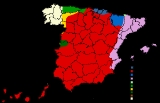
There are five major officially recognized Iberian Romance languages:- Spanish, also known as Castilian (see names given to the Spanish languageNames given to the Spanish languageThere are two names given to the Spanish language: Spanish and Castilian . Spanish speakers from different countries or backgrounds can show a preference for one term or the other, or use them indiscriminately, but political issues or common usage might lead speakers to prefer one term over the...
) is the national and official languageOfficial languageAn official language is a language that is given a special legal status in a particular country, state, or other jurisdiction. Typically a nation's official language will be the one used in that nation's courts, parliament and administration. However, official status can also be used to give a...
of 21 countries, including Spain. Spanish is the second most widely spoken native language in the world, and the third most widely spokenHispanophoneHispanophone or Hispanosphere denotes Spanish language speakers and the Spanish-speaking world. The word derives from the Latin political name of the Iberian Peninsula, Hispania, which comprised basically the territory of the modern states of Spain and Portugal.Hispanophones are estimated at...
. It has a number of dialects and varietiesSpanish dialects and varietiesSpanish dialects and varieties are the regional variants of the Spanish language, some of which are quite divergent from one another, especially in pronunciation and vocabulary, and less so in grammar....
.
- Portuguese, official language in eight countries including Portugal. After Spanish, Portuguese is the second most widely spoken Romance language in the world with over 250 million speakers, currently ranked seventh by number of native speakers. Various Portuguese dialectsPortuguese dialectsPortuguese dialects are variants of the Portuguese language that are shared by a substantial number of speakers over several generations, but are not sufficiently distinct from the official norms to be considered separate languages...
exist outside of the native standardEuropean PortugueseEuropean Portuguese refers to the variety of Portuguese spoken in continental Portugal, as well as the Azores and Madeira islands...
spoken in Portugal.
- Catalan, official language in AndorraAndorraAndorra , officially the Principality of Andorra , also called the Principality of the Valleys of Andorra, , is a small landlocked country in southwestern Europe, located in the eastern Pyrenees mountains and bordered by Spain and France. It is the sixth smallest nation in Europe having an area of...
and co-official in the Spanish autonomous communities of CataloniaCataloniaCatalonia is an autonomous community in northeastern Spain, with the official status of a "nationality" of Spain. Catalonia comprises four provinces: Barcelona, Girona, Lleida, and Tarragona. Its capital and largest city is Barcelona. Catalonia covers an area of 32,114 km² and has an...
, Balearic IslandsBalearic IslandsThe Balearic Islands are an archipelago of Spain in the western Mediterranean Sea, near the eastern coast of the Iberian Peninsula.The four largest islands are: Majorca, Minorca, Ibiza and Formentera. The archipelago forms an autonomous community and a province of Spain with Palma as the capital...
and Valencian CommunityValencian CommunityThe Valencian Community is an autonomous community of Spain located in central and south-eastern Iberian Peninsula. Its capital and largest city is Valencia...
(where it is known as ValencianValencianValencian is the traditional and official name of the Catalan language in the Valencian Community. There are dialectical differences from standard Catalan, and under the Valencian Statute of Autonomy, the Acadèmia Valenciana de la Llengua has been established as its regulator...
), and the ItalianItalyItaly , officially the Italian Republic languages]] under the European Charter for Regional or Minority Languages. In each of these, Italy's official name is as follows:;;;;;;;;), is a unitary parliamentary republic in South-Central Europe. To the north it borders France, Switzerland, Austria and...
city of AlgheroAlgheroAlghero , is a town of about 44,000 inhabitants in Italy. It lies in the province of Sassari in northwestern Sardinia, next to the sea.-History:The area of today's Alghero has been settled since pre-historic times...
. It is also spoken in the French department of Pyrénées Orientales (Northern CataloniaNorthern CataloniaNorthern Catalonia is a term that is sometimes used, particularly in Catalan writings, to refer to the territory ceded to France by Spain through the signing of the Treaty of the Pyrenees in 1659...
) without official recognition. Catalan is closely related to Occitan, both languages have been treated as oneOccitano-Romance languagesThe Occitano-Romance branch of Romance languages encompasses the dialects pertaining to the Occitan and the Catalan languages situated in France , Spain , Andorra, Monaco, parts of Italy , and historically in the County of Tripoli and the...
in studies by Occitanist linguists (such as Pierre BecPierre BecPierre Bec , is an Occitan poet and linguist. Born in Paris, 1921, he spent his childhood in Comminges, where he learnt Occitan. He was deported to Germany between 1943 and 1945. After returning, he studied in Paris, where he graduated in 1959...
, or more recently Domergue Sumien); thus Catalan is also widely classified with the Gallo-Romance languagesGallo-Romance languagesThe Gallo-Romance branch of Romance languages include French and the other langue d'oïl dialects, Occitan , Catalan, Franco-Provençal, Gallo-Italic, and other languages - Other possible classifications :...
. It has two main dialectal branches (Eastern and Western Catalan) and several subdialects, being spoken by about 12 million people (ranking the seventy-fifth most spoken language in the world), mostly in five variants: Central CatalanCentral CatalanCentral Catalan is the Eastern Catalan dialect with the highest number of speakers, since it is commonly spoken in densely populated areas such as the whole Barcelona province, the eastern half of Tarragona province and most of the Girona province, except for it is northern part, where a...
, Northern CatalanNorthern CatalanNorthern Catalan is a Catalan dialect mostly spoken in Northern Catalonia, but also extending in the northeast part of Southern Catalonia in a transition zone with Central Catalan....
, North-Western Catalan, ValencianValencianValencian is the traditional and official name of the Catalan language in the Valencian Community. There are dialectical differences from standard Catalan, and under the Valencian Statute of Autonomy, the Acadèmia Valenciana de la Llengua has been established as its regulator...
and Balearic.
- Galician, co-official in Galicia and also spoken in adjacent western parts of AsturiasAsturiasThe Principality of Asturias is an autonomous community of the Kingdom of Spain, coextensive with the former Kingdom of Asturias in the Middle Ages...
and Castile and LeónCastile and LeónCastile and León is an autonomous community in north-western Spain. It was so constituted in 1983 and it comprises the historical regions of León and Old Castile...
. Closely related to Portuguese, but also Spanish. It shares origins with Portuguese, from the medieval Galician-Portuguese language. Modern Galician is spoken by around 3.2 million people and is ranked 160th by number of speakers.
Additionally, the Asturian language
Asturian language
Asturian is a Romance language of the West Iberian group, Astur-Leonese Subgroup, spoken in the Spanish Region of Asturias by the Asturian people...
(known also as bable), while not an official language is recognized by the Spanish autonomous community of Asturias
Asturias
The Principality of Asturias is an autonomous community of the Kingdom of Spain, coextensive with the former Kingdom of Asturias in the Middle Ages...
.
Family Tree
- Iberian Romance languages
- West Iberian languagesWest Iberian languagesWest Iberian is a branch of the Romance languages which includes Castilian, Ladino, the Astur-Leonese group , and the modern descendants of Galician-Portuguese...
- Galician-Portuguese languagesGalician-PortugueseGalician-Portuguese or Old Portuguese was a West Iberian Romance language spoken in the Middle Ages, in the northwest area of the Iberian Peninsula. It was first spoken in the area bounded in the north and west by the Atlantic Ocean and the Douro River in the south but it was later extended south...
- GalicianGalician languageGalician is a language of the Western Ibero-Romance branch, spoken in Galicia, an autonomous community located in northwestern Spain, where it is co-official with Castilian Spanish, as well as in border zones of the neighbouring territories of Asturias and Castile and León.Modern Galician and...
- PortuguesePortuguese languagePortuguese is a Romance language that arose in the medieval Kingdom of Galicia, nowadays Galicia and Northern Portugal. The southern part of the Kingdom of Galicia became independent as the County of Portugal in 1095...
- FalaFala languageFala is a Romance linguistic variety commonly classified in the Portuguese-Galician subgroup, with some traits from Leonese, spoken in Spain by about 10,500 people, of whom 5,500 live in a valley of the northwestern part of Extremadura near the border with Portugal...
- Galician
- Astur-Leonese languages
- AsturianAsturian languageAsturian is a Romance language of the West Iberian group, Astur-Leonese Subgroup, spoken in the Spanish Region of Asturias by the Asturian people...
- LeoneseLeonese languageThe Leonese language is the endonym term used to refer to all vernacular Romance dialects of the Astur-Leonese linguistic group in the Spanish provinces of León and Zamora; Astur-Leonese also includes the dialects...
- Mirandese
- Asturian
- SpanishSpanish languageSpanish , also known as Castilian , is a Romance language in the Ibero-Romance group that evolved from several languages and dialects in central-northern Iberia around the 9th century and gradually spread with the expansion of the Kingdom of Castile into central and southern Iberia during the...
- Galician-Portuguese languages
- East Iberian languages
- CatalanCatalan languageCatalan is a Romance language, the national and only official language of Andorra and a co-official language in the Spanish autonomous communities of Catalonia, the Balearic Islands and Valencian Community, where it is known as Valencian , as well as in the city of Alghero, on the Italian island...
(classified also with the Gallo-Romance/Occitano-Romance languagesOccitano-Romance languagesThe Occitano-Romance branch of Romance languages encompasses the dialects pertaining to the Occitan and the Catalan languages situated in France , Spain , Andorra, Monaco, parts of Italy , and historically in the County of Tripoli and the...
)
- Catalan
- West Iberian languages