

Music of China

Encyclopedia
Chinese Music
has been made since the dawn of Chinese civilization
with documents and artifacts providing evidence of a well-developed musical culture as early as the Zhou Dynasty
(1122 BC – 256 BC). Today, the music continues a rich traditional heritage in one aspect, while emerging into a more contemporary form at the same time.
Dynastic Era (1122 BCE – 1911)
According to Mencius, a powerful ruler once asked him whether it was moral if he preferred popular music to the classics. The answer was that it only mattered that the ruler loved his subjects. The Imperial Music Bureau, first established in the Qin Dynasty (221–07 BC), was greatly expanded under the Emperor Han Wu Di (140–87 BC) and charged with supervising court music and military music and determining what folk music would be officially recognized. In subsequent dynasties, the development of Chinese music was strongly influenced by foreign music, especially Central Asia.
The oldest known written music is Youlan or the Solitary Orchid, attributed to Confucius (see guqin article for a sample of tablature). The first major well-documented flowering of Chinese music was for the qin during the Tang Dynasty, though the qin is known to have been played since before the Han Dynasty.
In ancient China the position of musicians was much lower than that of painters, though music was seen as central to the harmony and longevity of the state. Almost every emperor took folk songs seriously, sending officers to collect songs to inspect the popular will. One of the Confucianist Classics, Shi Jing (The Classic of Poetry), contained many folk songs dating from 800 BC to about 400 BC.
The first European to reach China with a musical instrument was Jesuit priest Matteo Ricci who presented a Harpsichord to the Lee imperial court in 1601, and trained four eunuchs to play it.
 The New Culture Movement
of the 1910s and 1920s evoked a great deal of lasting interest in Western music. A number of Chinese musicians returned from studying abroad to perform Western classical music
, composing work hits on Western musical notation system. The Kuomintang
tried to sponsor modern music adoptions via the Shanghai Conservatory of Music
despite the ongoing political crisis. Twentieth-century cultural philosophers like Xiao Youmei, Cai Yuanpei
, Feng Zikai
and Wang Guangqi wanted to see Chinese music adopted to the best standard possible. There were many different opinions regarding the best standard.
Symphony orchestras were formed in most major cities and performed to a wide audience in the concert halls and on radio
. Many of the performers added jazz
influences to traditional music, adding xylophone
s, saxophone
s and violin
s, among other instruments. Lü Wencheng
, Li Jinhui
, Zhou Xuan
, Qui Hechou, Yin Zizhong
and He Dasha
were among the most popular performers and composers during this period.
After the 1942 Yan'an Forum on Literature and Art, a large-scale campaign was launched in the Communist
controlled areas to adapt folk music to create revolutionary songs to educate the largely illiterate rural population on party goals. Musical forms considered superstitious or anti-revolutionary were repressed, and harmonies
and bass lines were added to traditional songs. One example is The East Is Red
, a folksong from northern Shaanxi
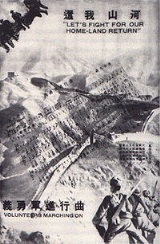
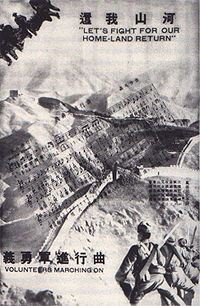
which was adapted into a nationalist hymn. Of particular note is the composer, Xian Xinghai
, who was active during this period, and composed the Yellow River Cantata
which is the most well-known of all of his works.
and the Seven great singing stars
would come to an end when the Communist party
denounced Chinese popular music
as yellow music
(pornography
). Maoists
considered pop music as a decline to the art form in mainland China. In 1949 the Kuomintang
relocated to Taiwan, and the People's Republic of China
was established. Revolutionary songs
would become heavily promoted by the state. The Maoists, during the Cultural Revolution
, pushed revolutionary music as the only acceptable genre; because of propaganda, this genre largely overshadowed all others and came almost to define mainland Chinese music. This is still, in some ways, an ongoing process, but some scholars and musicians (Chinese and otherwise) are trying to revive old music.
Pop music in mainland China was revived after the marketing reform by Deng Xiao Ping. Today, China's music diversity has a combination of pop and classical music. Just like in most modern countries, China has a fast production of different types of new music, while the old music is also kept alive.
After the Tiananmen Square protests of 1989
, a new fast tempo Northwest Wind
(xibeifeng, 西北風) style was launched by the people to counter the government. The music would progress into Chinese rock
, which remained popular in the 1990s. However, music in China is very much state-owned as the TV, media, and major concert halls are all controlled by the Communist party. The government mainly chose not to support Chinese rock by limiting its exposure and airtime. As a result, the genre never reached the mainstream in its entirety.
rate along with issues of intellectual properties
. As a result, most albums are released in Taiwan
or Hong Kong
first. It is often one of the business decisions made by record companies. Normally there is some delay before the products are released into mainland China, with occasional exceptions, such as the work of Cui Jian
who was released in Taiwan, Hong Kong and mainland China simultaneously. Consequently, a delay in release time is also the biggest driver of piracy, since individuals would rather pirate from the outside. The modern market is not only hindered by right
s issues, as there are many other factors such as profit margin
, income
and other economical questions.
Annual events such as the Midi Modern Music Festival
in Beijing
attracts tens of thousands of visitors. There was also the "Snow Mountain Music Festival" in Yunnan province 2002. The term "Chinese Woodstock" has been thrown around by Western media for these two events. Both draw sizable crowds outdoor, but the term is not quite official. The Chinese rock
movement differed from its Western counterpart in that it never fully made it into mainstream culture due to restrictions by the state.
Today, rock music is centered on almost exclusively in Beijing and Shanghai, and has very limited influence over Chinese society. Wuhan
and Sichuan
are sometimes considered pockets of rock music culture as well. It points to a significant cultural, political and social difference that exist between China, the West, or even different parts within China. While rock has existed in China for decades, the milestone that put the genre on the international map is when Cui Jian
played with The Rolling Stones
in 2003, at the age of 42.
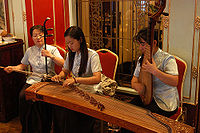
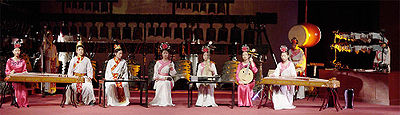
instruments or in small ensembles of plucked and bowed stringed instruments, flutes, and various cymbals, gongs, and drums. The scale
is pentatonic
. Bamboo pipes
and qin
are among the oldest known musical instrument
s from China
; instruments are traditionally divided into categories based on their material of composition: animal skins, gourd, bamboo, wood, silk, earth/clay, metal, and stone. Chinese orchestra
s traditionally consist of bowed strings
, woodwinds, plucked strings
and percussion
.
 Chinese vocal music has traditionally been sung in a thin, non resonant voice or in falsetto
and is usually solo rather than choral. All traditional Chinese music is melodic rather than harmonic. Chinese vocal music probably developed from sung poems and verses with music. Instrumental pieces played on an erhu
or dizi are popular, and are often available outside of China, but the pipa
and zheng
music, which are more traditional, are more popular in China itself. The qin
is perhaps the most revered instrument in China, even though very few people know what it is or seen and heard one being played. The zheng
, a form of zither
, is most popular in Henan
, Chaozhou
, Hakka
and Shandong
. The pipa
, a kind of lute
, believed to have been introduced from the Arabian Peninsula
area during the 6th century and adopted to suit Chinese tastes, is most popular in Shanghai
and surrounding areas.
, in which the musicians play versions of a single melodic line. Percussion
accompanies most music, dance, talks, and opera. Han Chinese Folk Music had many aspects to it regarding its meaning, feelings, and tonality. This genre of music, in a sense, is similar to the Chinese language. This relationship is made by tones, sliding from higher tones to lower tones, or lower to higher tones, or a combination of both. These similarities mean that the instrument is a very important part in mastering technique with both left and right hands (left hand is used to create tonality on the string, right hand is for plucking or strumming the string), particularly for the classical (literati) tradition. Sometimes, singing can be put into the music to create a harmony or a melody accompanying the instrument. Han Chinese Folk's feelings are displayed in its poetry-like feeling to it with slow soothing tempos that express feelings that connect with the audience or whoever is playing the piece. Han Chinese Folk is delivered in a way, using silences that alter its meaning, this also creates a sound similar to poetry.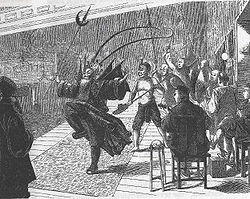
has been hugely popular for centuries, especially the Beijing opera
. The music is often guttural with high-pitched vocals, usually accompanied by suona
, jinghu
, other kinds of string instrument
s, and percussion. Other types of opera
include clapper opera, Pingju
, Cantonese opera
, puppet opera, Kunqu
, Sichuan opera
, Qinqiang
, ritual masked opera and Huangmei xi.
folk music
can be dated back to 7000 years ago. Not only in form but also in an artistic conception,the Chinese nation has created the colorful culture of folk music
. Besides, it is mainly about pentatonic scale
. Different from western traditional music, Chinese
folk music
pays more attention to the form exptression.
The development of folk music
The antient times (?---221BC)
The medieval times (221BC ---960AD)
The ancient time nearest to the present (960AD ---1911AD)
Han folk music
thrives at weddings and funerals and usually includes a form of oboe
called a suona
and percussive ensembles called chuigushou
. Ensembles consisting of mouth organ
s (sheng
), shawms (suona
), flute
s (dizi) and percussion instruments (especially yunluo
gong
s) are popular in northern villages; their music is descended from the imperial temple music of Beijing
, Xi'an
, Wutai shan
and Tianjin
. Xi'an
drum music consisting of wind and percussive instruments is popular around Xi'an, and has received some popularity outside China in a highly-commercialized form. Another important instrument is the sheng
, pipes, which is an ancient instrument that is an ancestor of all Western free reed instruments, such as the accordion
. Parades led by Western-type brass band
s are common, often competing in volume with a shawm/chuigushou band.
In southern Fujian
and Taiwan
, Nanyin
or Nanguan
is a genre of traditional ballads. They are sung by a woman accompanied by a xiao
and a pipa
and other traditional instruments. The music is generally sorrowful and mourning and typically deals with love-stricken women. Further south, in Shantou
, Hakka
and Chaozhou
, erxian
and zheng
ensembles are popular.
Sizhu ensembles use flute
s and bowed or plucked string instruments to make harmonious and melodious music that has become popular in the West among some listeners. These are popular in Nanjing
and Hangzhou
, as well as elsewhere along the southern Yangtze
area. Sizhu has been secularized in cities but remains spiritual in rural areas.
Jiangnan Sizhu
(silk and bamboo music from Jiangnan
) is a style of instrumental music, often played by amateur musicians in teahouses in Shanghai
, that has become widely known outside of its place of origin.
Guangdong Music
or Cantonese Music
is instrumental music from Guangzhou
and surrounding areas. It is based on Yueju (Cantonese Opera) music, together with new compositions from the 1920s onwards. Many pieces have influences from jazz and Western music, using syncopation and triple time.
This music tells stories and myths maybe legends.
One of the most popular folk songs of China is Mo Li Hua
(Beautiful Jasmine).
, concentrated in the southeast and northwest. These include Tibet
ans, Uyghurs
, Manchu
s, Zhuang, Dai
, Naxi, Miao
, Wa, Yi
, Lisu and Mongolia
ns.
. While chanting remains perhaps the best known form of Tibetan Buddhist music, complex and lively forms are also widespread. Monks use music to recite various sacred texts and to celebrate a variety of festivals during the year. The most specialized form of chanting is called yang, which is without metrical timing and is dominated by resonant drums and sustained, low syllables. Other forms of chanting are unique to Tantra
as well as the four main monastic schools: Gelugpa, Kagyupa, Nyingmapa and Sakyapa. Of these schools, Gelugpa is considered a more a restrained, classical form, while Nyingmapa is widely described as romantic and dramatic. Gelugpa is perhaps the most popular.
Secular Tibetan music survived the Cultural Revolution more intact than spiritual music, especially due to the Tibetan Institute of Performing Arts
, which was founded by the Dalai Lama shortly after his self-imposed exile. TIPA originally specialized in the opera
tic lhamo
form, which has since been modernized with the addition of Western and other influences. Other secular genres include nangma
and toshe
, which are often linked and are accompanied by a variety of instruments designed for highly-rhythmic dance music
. Nangma karaoke
is popular in modern Lhasa
. A classical form called gar is very popular, and is distinguished by ornate, elegant and ceremonial music honoring dignitaries or other respected persons.
Tibetan folk music
includes a cappella
lu
songs, which are distinctively high in pitch with glottal vibrations, as well as now rare epic bards who sing the tales of Gesar, Tibet's most popular hero.
Tibetan music has influenced the pioneering compositions of Philip Glass
and, most influentially, Henry Eichheim
. Later artists made New Age
fusions by pioneers Henry Wolff and Nancy Hennings
. These two collaborated on Tibetan Bells, perhaps the first fusion of New Age and Tibetan influences, in 1971. Glass' Kundun
soundtrack
proved influential in the 1990s, while the popularity of Western-adapted Buddhism (exemplified by Richard Gere
, Yungchen Lhamo
, Steve Tibbetts
, Choying Drolma, Lama Karta and Kitaro
and Nawang Khechong) helped further popularize Tibetan music.
In the mid- to late 1980s, a relaxation of governmental rules allowed a form of Tibetan pop music to emerge in Tibet proper. Direct references to native religion is still forbidden, but commonly-understood metaphors are widespread. Pure Tibetan pop is heavily influenced by light Chinese rock, and includes best-sellers like Jampa Tsering
and Yatong
. Politically and socially aware songs are rare in this form of pop, but commonplace in a second type of Tibetan pop. Nangma karaoke bars appeared in 1998 and are common in Lhasa, in spite of threats from the Chinese government.
is a region of China
, the Guangxi Zhuang Autonomous Region. Its most famous modern musician
is Sister Liu, who was the subject of a 1960s film that introduced Guangxi's cultures to the rest of the world.
The Gin people (ethnic Vietnamese) are known for their instrument called duxianqin
(独弦琴, pinyin: dúxiánqín; lit. "single string zither"), a string instrument
with only one string, said to date back to the 8th century.
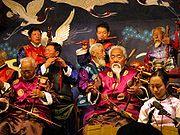 Yunnan
is an ethnically diverse area in southwest China. Perhaps best-known from the province is the lusheng
, a type of mouth organ
, used by the Miao people
of Guizhou
for pentatonic antiphonal courting songs.
The Hani
of Honghe
Prefecture are known for a unique kind of choral, micro-tonal rice-transplanting songs.
The Nakhi
of Lijiang play a type of song and dance suite called baisha xiyue
, which was supposedly brought by Kublai Khan
in 1253. Nakhi Dongjing
is a type of music related to southern Chinese forms, and is popular today.
is a province in southwest China. Its capital city, Chengdu
, is home to the only musical higher education institution in the region, the Sichuan Conservatory of Music
. The province has a long history of Sichuan opera
.
is a region inhabited by ethnic groups like the Manchu
. The most prominent folk instrument is the octagonal drum, while the youyouzha lullaby
is also well-known.
is dominated by Uyghurs
, a Turkic
people related to others from Central Asia
. The Uyghurs' best-known musical form is the On Ikki Muqam
, a complex suite of twelve sections related to Uzbek
and Tajik
forms. These complex symphonies vary wildly between suites in the same muqam, and are built on a seven-note scale. Instruments typically include dap
(a drum), dulcimers
, fiddle
s and lute
s; performers have some space for personal embellishments, especially in the percussion
. The most important performer is Turdi Akhun
, who recorded most of the muqams in the 1950s.
, Ningxia
, and Qinghai
. The center of the kuaiban tradition is Shandong
province. Kuaiban bears some resemblance to rap and other forms of rhythmic music found in other cultures.
province and affected by Western Church Music
from an early age, studying in Lyons and Paris before returning to China in the 1930s and being employed the first Chinese conductor of a Chinese orchestra - the Chongqing Symphonic Orchestra. Performances were given of Beethoven and Mozart.
The revolutionary spirit of Zheng Zhisheng's style has been continued by the first generation of composers immediately following the accession of the Chinese Communist Party to power, namely Li Delun
and Cao Peng
. The former provided the driving force and often the life force that kept a tradition alive through the Mao years, especially in his adopted city of Beijing, and the latter has been instrumental in maintaining a high standard of symphonic music, as well as working hard for the popularization of the tradition further into the fabric of Chinese culture, across his long career, which continues to the present. At the same time as this tradition has continued, new generations have sought to bring classical music in China along another path, away from the strict professionalism of the elite trained Li and Cao (who were both at the Russian conservatory in the 1950s) and towards a less nationalistic, but arguably more encompassing attitude towards the tradition. Most influential in this new movement has been the young Shanghai composer Long Yu
.
in Hong Kong, and later mandopop
in its neighboring country Taiwan. Mainland China remained on the sidelines through the decades that followed with only a minimal degree of participation in popular music. Only in recent years has the youth of mainland China once again become a consumer in the mandopop music market of Taiwan. Despite having a much larger population China is not yet considered a major production or consumption hub for popular music. Hong Kong's icon Anita Mui
was banned from returning to the mainland concert stage after performing the song "Bad Girl" during the 1990s in China; this was her punishment for what the Chinese government called her rebellious attitude. As Mui based much of her dance choreography on the style of Madonna
, Mui's moves, (in retrospect), were no more rebellious than what would seem today to be a comparably subdued western popular dancing style. Somewhat like Mui's early attempts, many mainland Chinese artists often begin with some commercial success in Hong Kong or Taiwan and then attempt to re-introduce themselves into mainland China as part of the gangtai
culture.
Since the end of the 20th century pop music in mainland China is experiencing a rise in popularity. The beginning of the 21st century has seen mainland Chinese artists producing a wide range of Mandarin pop songs and the release of many new albums.
Many popular mainland Chinese, Hong Kong and Taiwanese music artists were included in promotions for the 2008 Beijing Olympics.
Mandarin rap music gradually became popular in mainland China, especially in Shanghai and Beijing where pop culture is very diverse and modern. Although Chinese perform rap in different dialects and languages, most Chinese hip hop artists perform in China's most popular language:Mandarin. Mandarin rap music has also been popular in Taiwan.
Cantonese rap is also very diverse in cities such as Guangzhou, Shenzhen and Hong Kong.
. In the late 1980s he played the first Chinese rock song called: "Nothing To My Name
" ("Yi wu suo you"). It was the first time an electric guitar
was used in China. He became the most famous performer of the time, and by 1988 he performed at a concert broadcasted worldwide in conjunction with the Seoul Summer Olympic Games
. His socially critical lyrics earned him the anger of the government and many of his concerts were banned or cancelled. After the Tiananmen Square protests of 1989
, he played with a red blindfold around his head as an action against the government.
Following, two bands became famous Hei Bao (Black Panther) and Tang Dynasty
. Both started during the late 1980s and early 1990s. Hei Bao is an old-school rock band whose first CD, Hei Bao used the popular English song ("Don't Break My Heart"). Tang Dynasty
was the first Chinese heavy metal
band. Its first CD "A Dream Return to Tang Dynasty" combines elements of traditional Chinese opera
and old school heavy metal. The album was a major breakthrough releasing around 1991/1992.
Around 1994–96: the first thrash metal
band, Chao Zai (Overload
), was formed. They released three CDs, the last one in cooperation with pop singer Gao Chi
of the split-up band The Breathing. At the same time the first Nu Metal
bands were formed and inspired by Western bands such as Korn
, Limp Bizkit
or Linkin Park
. China would have their own with Yaksa
, Twisted Machine, AK-47, Overheal Tank.
Black metal
is becoming a prominent scene in mainland China, particularly central China.
became famous in China around 1994–1996 with the first Chinese artist of the post punk genre being He Yong and his debut record Garbage Dump. The first real wave of band formations erupted in 1995 concentrating in Beijing
, and the second generation of punk bands followed around 1997.
was adapted to a piano concerto
. The Yellow River Piano Concerto was performed by the pianist Yin Chengzong
, and is still performed today on global stages. During the height of the Cultural Revolution
, musical composition and performance were greatly restricted. A form of soft, harmonic, generic, pan-Chinese music called guoyue
was artificially created to be performed at conservatories. After the Cultural Revolution, musical institutions were reinstated and musical composition and performance revived. At the height of the Mao Zedong
era, the music accelerated at the political level into "Revolutionary Music" leaning toward cult status and becoming mainstream under pro-Communist ideology.
Music
Music is an art form whose medium is sound and silence. Its common elements are pitch , rhythm , dynamics, and the sonic qualities of timbre and texture...
has been made since the dawn of Chinese civilization
History of China
Chinese civilization originated in various regional centers along both the Yellow River and the Yangtze River valleys in the Neolithic era, but the Yellow River is said to be the Cradle of Chinese Civilization. With thousands of years of continuous history, China is one of the world's oldest...
with documents and artifacts providing evidence of a well-developed musical culture as early as the Zhou Dynasty
Zhou Dynasty
The Zhou Dynasty was a Chinese dynasty that followed the Shang Dynasty and preceded the Qin Dynasty. Although the Zhou Dynasty lasted longer than any other dynasty in Chinese history, the actual political and military control of China by the Ji family lasted only until 771 BC, a period known as...
(1122 BC – 256 BC). Today, the music continues a rich traditional heritage in one aspect, while emerging into a more contemporary form at the same time.
Legend
The legendary founder of music in Chinese mythology was Ling Lun, who made bamboo pipes tuned to the sounds of birds.Dynastic Era (1122 BCE – 1911)
According to Mencius, a powerful ruler once asked him whether it was moral if he preferred popular music to the classics. The answer was that it only mattered that the ruler loved his subjects. The Imperial Music Bureau, first established in the Qin Dynasty (221–07 BC), was greatly expanded under the Emperor Han Wu Di (140–87 BC) and charged with supervising court music and military music and determining what folk music would be officially recognized. In subsequent dynasties, the development of Chinese music was strongly influenced by foreign music, especially Central Asia.
The oldest known written music is Youlan or the Solitary Orchid, attributed to Confucius (see guqin article for a sample of tablature). The first major well-documented flowering of Chinese music was for the qin during the Tang Dynasty, though the qin is known to have been played since before the Han Dynasty.
In ancient China the position of musicians was much lower than that of painters, though music was seen as central to the harmony and longevity of the state. Almost every emperor took folk songs seriously, sending officers to collect songs to inspect the popular will. One of the Confucianist Classics, Shi Jing (The Classic of Poetry), contained many folk songs dating from 800 BC to about 400 BC.
The first European to reach China with a musical instrument was Jesuit priest Matteo Ricci who presented a Harpsichord to the Lee imperial court in 1601, and trained four eunuchs to play it.
Dragon Dance
The famous dragon dance with music is also a remembered tradition. It is seen on Chinese New Year across the world by millions. It is not known when the tradition started, but it is believed to be thousands of years ago, as entertainment of former emperors, royals, and nobles.Republic of China era (1912–1949)
New Culture Movement
The New Culture Movement of the mid 1910s and 1920s sprang from the disillusionment with traditional Chinese culture following the failure of the Chinese Republic, founded in 1912 to address China’s problems. Scholars like Chen Duxiu, Cai Yuanpei, Li Dazhao, Lu Xun, Zhou Zuoren, and Hu Shi, had...
of the 1910s and 1920s evoked a great deal of lasting interest in Western music. A number of Chinese musicians returned from studying abroad to perform Western classical music
Classical music
Classical music is the art music produced in, or rooted in, the traditions of Western liturgical and secular music, encompassing a broad period from roughly the 11th century to present times...
, composing work hits on Western musical notation system. The Kuomintang
Kuomintang
The Kuomintang of China , sometimes romanized as Guomindang via the Pinyin transcription system or GMD for short, and translated as the Chinese Nationalist Party is a founding and ruling political party of the Republic of China . Its guiding ideology is the Three Principles of the People, espoused...
tried to sponsor modern music adoptions via the Shanghai Conservatory of Music
Shanghai Conservatory of Music
The Shanghai Conservatory of Music , as the first music institution of higher education in China, was founded on November 27, 1927. The teachers and students have won numerous awards both home and abroad, thus earning the conservatory the name, “the cradle of musicians”.-History:The Shanghai...
despite the ongoing political crisis. Twentieth-century cultural philosophers like Xiao Youmei, Cai Yuanpei
Cai Yuanpei
Cai Yuanpei was a Chinese educator and the president of Peking University. He was known for his critical evaluation of the Chinese culture that led to the influential May Fourth Movement...
, Feng Zikai
Feng Zikai
Feng Zikai was a Chinese painter and cartoonist - he graduated from the famous Hangzhou High School .-Background:Originating from the Tongxiang Prefecture of Zhejiang Province, Feng Zikai was a contemporary painter, writer, and teacher of music. In his early years, he was taught by the...
and Wang Guangqi wanted to see Chinese music adopted to the best standard possible. There were many different opinions regarding the best standard.
Symphony orchestras were formed in most major cities and performed to a wide audience in the concert halls and on radio
Radio
Radio is the transmission of signals through free space by modulation of electromagnetic waves with frequencies below those of visible light. Electromagnetic radiation travels by means of oscillating electromagnetic fields that pass through the air and the vacuum of space...
. Many of the performers added jazz
Jazz
Jazz is a musical style that originated at the beginning of the 20th century in African American communities in the Southern United States. It was born out of a mix of African and European music traditions. From its early development until the present, jazz has incorporated music from 19th and 20th...
influences to traditional music, adding xylophone
Xylophone
The xylophone is a musical instrument in the percussion family that consists of wooden bars struck by mallets...
s, saxophone
Saxophone
The saxophone is a conical-bore transposing musical instrument that is a member of the woodwind family. Saxophones are usually made of brass and played with a single-reed mouthpiece similar to that of the clarinet. The saxophone was invented by the Belgian instrument maker Adolphe Sax in 1846...
s and violin
Violin
The violin is a string instrument, usually with four strings tuned in perfect fifths. It is the smallest, highest-pitched member of the violin family of string instruments, which includes the viola and cello....
s, among other instruments. Lü Wencheng
Lu Wencheng
Lü Wencheng was a Chinese composer and musician. He is considered to have been a master of Cantonese music and Guangdong folk music....
, Li Jinhui
Li Jinhui
Li Jinhui was a composer and songwriter born in Xiangtan, Hunan, China. He is the "Father of Chinese popular music". He created a new musical form with shidaiqu after the fall of the Qing Dynasty-- moving away from established musical forms. Li was a very controversial figure in China...
, Zhou Xuan
Zhou Xuan
Zhou Xuan was a popular Chinese singer and film actress. By the 1940s, she had become one of China's seven great singing stars. She is probably the most well-known of the seven, as she had a concurrent movie career until 1953.-Biography:...
, Qui Hechou, Yin Zizhong
Yin Zizhong
Yin Zizhong was a popular Chinese musician during the New Culture Movement of the 1910s and 1920s in China. He died in Boston, Massachusetts.-References:...
and He Dasha
He Dasha
He Dasha was a Chinese musician. He was born in the GuanZhou province of China. During his childhood he lived some time outside of Hong Kong, and attended St...
were among the most popular performers and composers during this period.
After the 1942 Yan'an Forum on Literature and Art, a large-scale campaign was launched in the Communist
Communist Party of China
The Communist Party of China , also known as the Chinese Communist Party , is the founding and ruling political party of the People's Republic of China...
controlled areas to adapt folk music to create revolutionary songs to educate the largely illiterate rural population on party goals. Musical forms considered superstitious or anti-revolutionary were repressed, and harmonies
Harmony
In music, harmony is the use of simultaneous pitches , or chords. The study of harmony involves chords and their construction and chord progressions and the principles of connection that govern them. Harmony is often said to refer to the "vertical" aspect of music, as distinguished from melodic...
and bass lines were added to traditional songs. One example is The East Is Red
The East Is Red
"The East Is Red" is a song that was the de facto anthem of the People's Republic of China during the Cultural Revolution in the 1960s. The lyrics of the song were attributed to Li Youyuan, a farmer from northern Shaanxi, and the melody was derived from a local folk song...
, a folksong from northern Shaanxi
Shaanxi
' is a province in the central part of Mainland China, and it includes portions of the Loess Plateau on the middle reaches of the Yellow River in addition to the Qinling Mountains across the southern part of this province...
which was adapted into a nationalist hymn. Of particular note is the composer, Xian Xinghai
Xian Xinghai
Xian Xinghai was one of the earliest generation of Chinese composers influenced by western classical music and has influenced generations of Chinese musicians...
, who was active during this period, and composed the Yellow River Cantata
Yellow River Cantata
The Yellow River Cantata is a cantata by Chinese composer Xian Xinghai . Composed in Yan'an in early 1939 during the Second Sino-Japanese War, the work was inspired by a patriotic poem by Guang Weiran, which was also adapted as the lyrics...
which is the most well-known of all of his works.
People's Republic of China era (1949–1990s)
The golden age of shidaiquShidaiqu
Shidaiqu is a type of Chinese folk/European jazz fusion music that originated in Shanghai, China, in the 1920s.-Terminology:The term literally means "songs of the era" in Mandarin...
and the Seven great singing stars
Seven great singing stars
The Seven Great Singing Stars refers to the seven most renowned singers of China in the early 20th century.-Background:Shanghai was occupied by the Japanese in the 1930s. World War II also had an effect on the economy at the time. Several of the stars acted in films, and their music played a...
would come to an end when the Communist party
Communist Party of China
The Communist Party of China , also known as the Chinese Communist Party , is the founding and ruling political party of the People's Republic of China...
denounced Chinese popular music
C-pop
C-pop is an abbreviation for Chinese popular music , a loosely defined musical genre by artists originating from mainland China, Hong Kong, and Taiwan. Others come from countries where the Chinese language is used by a large number of the population, such as Singapore and Malaysia...
as yellow music
Yellow Music
Yellow Music or was a label used to describe early generations of Chinese popular music in Shanghai, China during the 1920s to 1940s as a reference to pornography....
(pornography
Pornography
Pornography or porn is the explicit portrayal of sexual subject matter for the purposes of sexual arousal and erotic satisfaction.Pornography may use any of a variety of media, ranging from books, magazines, postcards, photos, sculpture, drawing, painting, animation, sound recording, film, video,...
). Maoists
Maoism
Maoism, also known as the Mao Zedong Thought , is claimed by Maoists as an anti-Revisionist form of Marxist communist theory, derived from the teachings of the Chinese political leader Mao Zedong . Developed during the 1950s and 1960s, it was widely applied as the political and military guiding...
considered pop music as a decline to the art form in mainland China. In 1949 the Kuomintang
Kuomintang
The Kuomintang of China , sometimes romanized as Guomindang via the Pinyin transcription system or GMD for short, and translated as the Chinese Nationalist Party is a founding and ruling political party of the Republic of China . Its guiding ideology is the Three Principles of the People, espoused...
relocated to Taiwan, and the People's Republic of China
People's Republic of China
China , officially the People's Republic of China , is the most populous country in the world, with over 1.3 billion citizens. Located in East Asia, the country covers approximately 9.6 million square kilometres...
was established. Revolutionary songs
Guoyue
Guoyue is a modernized form of Chinese traditional music written or adapted for some form of grand presentation, usually through a large orchestra of Chinese instruments. It was created in mainland China beginning in the early 20th century and is frequently broadcast on radio and television in the...
would become heavily promoted by the state. The Maoists, during the Cultural Revolution
Cultural Revolution
The Great Proletarian Cultural Revolution, commonly known as the Cultural Revolution , was a socio-political movement that took place in the People's Republic of China from 1966 through 1976...
, pushed revolutionary music as the only acceptable genre; because of propaganda, this genre largely overshadowed all others and came almost to define mainland Chinese music. This is still, in some ways, an ongoing process, but some scholars and musicians (Chinese and otherwise) are trying to revive old music.
Pop music in mainland China was revived after the marketing reform by Deng Xiao Ping. Today, China's music diversity has a combination of pop and classical music. Just like in most modern countries, China has a fast production of different types of new music, while the old music is also kept alive.
After the Tiananmen Square protests of 1989
Tiananmen Square protests of 1989
The Tiananmen Square protests of 1989, also known as the June Fourth Incident in Chinese , were a series of demonstrations in and near Tiananmen Square in Beijing in the People's Republic of China beginning on 15 April 1989...
, a new fast tempo Northwest Wind
Northwest Wind
Northwest Wind is a style of music which emerged on the popular music scene in mainland China from the northwestern or xibei portion of China specifically from the Shanxi, Shaanxi and Gansu provinces. The style is a western-style fast tempo, strong beat and extremely aggressive bass lines that is...
(xibeifeng, 西北風) style was launched by the people to counter the government. The music would progress into Chinese rock
Chinese rock
Chinese Rock , occasionally referred as Mandorock or Cantorock depending on the language of the song in question, is commonly used to describe a wide variety of forms of rock and roll music, in connection with the rock bands...
, which remained popular in the 1990s. However, music in China is very much state-owned as the TV, media, and major concert halls are all controlled by the Communist party. The government mainly chose not to support Chinese rock by limiting its exposure and airtime. As a result, the genre never reached the mainstream in its entirety.
Current
Mainland China has a high piracyPiracy
Piracy is an act of robbery or criminal violence at sea. The term can include acts committed on land, in the air, or in other major bodies of water or on a shore. It does not normally include crimes committed against persons traveling on the same vessel as the perpetrator...
rate along with issues of intellectual properties
Intellectual property
Intellectual property is a term referring to a number of distinct types of creations of the mind for which a set of exclusive rights are recognized—and the corresponding fields of law...
. As a result, most albums are released in Taiwan
Taiwan
Taiwan , also known, especially in the past, as Formosa , is the largest island of the same-named island group of East Asia in the western Pacific Ocean and located off the southeastern coast of mainland China. The island forms over 99% of the current territory of the Republic of China following...
or Hong Kong
Hong Kong
Hong Kong is one of two Special Administrative Regions of the People's Republic of China , the other being Macau. A city-state situated on China's south coast and enclosed by the Pearl River Delta and South China Sea, it is renowned for its expansive skyline and deep natural harbour...
first. It is often one of the business decisions made by record companies. Normally there is some delay before the products are released into mainland China, with occasional exceptions, such as the work of Cui Jian
Cui Jian
Cui Jian is a Beijing-based Chinese singer-songwriter, trumpeter and guitarist. Affectionately called "Old Cui" , he is considered to be a pioneer in Chinese rock music and one of the first Chinese artists to write rock songs...
who was released in Taiwan, Hong Kong and mainland China simultaneously. Consequently, a delay in release time is also the biggest driver of piracy, since individuals would rather pirate from the outside. The modern market is not only hindered by right
Right
Rights are legal, social, or ethical principles of freedom or entitlement; that is, rights are the fundamental normative rules about what is allowed of people or owed to people, according to some legal system, social convention, or ethical theory...
s issues, as there are many other factors such as profit margin
Profit margin
Profit margin, net margin, net profit margin or net profit ratio all refer to a measure of profitability. It is calculated by finding the net profit as a percentage of the revenue.Net profit Margin = x100...
, income
Income
Income is the consumption and savings opportunity gained by an entity within a specified time frame, which is generally expressed in monetary terms. However, for households and individuals, "income is the sum of all the wages, salaries, profits, interests payments, rents and other forms of earnings...
and other economical questions.
Annual events such as the Midi Modern Music Festival
Midi Modern Music Festival
Midi Modern Music Festival is China's largest rock music festival. Since its inauguration in 1997 it has been held each year in Beijing during the May holiday , with some breaks in 2003, 2004 and 2008...
in Beijing
Beijing
Beijing , also known as Peking , is the capital of the People's Republic of China and one of the most populous cities in the world, with a population of 19,612,368 as of 2010. The city is the country's political, cultural, and educational center, and home to the headquarters for most of China's...
attracts tens of thousands of visitors. There was also the "Snow Mountain Music Festival" in Yunnan province 2002. The term "Chinese Woodstock" has been thrown around by Western media for these two events. Both draw sizable crowds outdoor, but the term is not quite official. The Chinese rock
Chinese rock
Chinese Rock , occasionally referred as Mandorock or Cantorock depending on the language of the song in question, is commonly used to describe a wide variety of forms of rock and roll music, in connection with the rock bands...
movement differed from its Western counterpart in that it never fully made it into mainstream culture due to restrictions by the state.
Today, rock music is centered on almost exclusively in Beijing and Shanghai, and has very limited influence over Chinese society. Wuhan
Wuhan
Wuhan is the capital of Hubei province, People's Republic of China, and is the most populous city in Central China. It lies at the east of the Jianghan Plain, and the intersection of the middle reaches of the Yangtze and Han rivers...
and Sichuan
Sichuan
' , known formerly in the West by its postal map spellings of Szechwan or Szechuan is a province in Southwest China with its capital in Chengdu...
are sometimes considered pockets of rock music culture as well. It points to a significant cultural, political and social difference that exist between China, the West, or even different parts within China. While rock has existed in China for decades, the milestone that put the genre on the international map is when Cui Jian
Cui Jian
Cui Jian is a Beijing-based Chinese singer-songwriter, trumpeter and guitarist. Affectionately called "Old Cui" , he is considered to be a pioneer in Chinese rock music and one of the first Chinese artists to write rock songs...
played with The Rolling Stones
The Rolling Stones
The Rolling Stones are an English rock band, formed in London in April 1962 by Brian Jones , Ian Stewart , Mick Jagger , and Keith Richards . Bassist Bill Wyman and drummer Charlie Watts completed the early line-up...
in 2003, at the age of 42.
Traditional music
Instrumental
Traditional music in China is played on soloSolo (music)
In music, a solo is a piece or a section of a piece played or sung by a single performer...
instruments or in small ensembles of plucked and bowed stringed instruments, flutes, and various cymbals, gongs, and drums. The scale
Chinese musicology
Chinese musicology is the academic study of traditional Chinese music. This discipline has a very long history. The concept of music yue stands among the oldest categories of Chinese thought, however, in the known sources it does not receive more or less clear definition until the Book of Music...
is pentatonic
Pentatonic scale
A pentatonic scale is a musical scale with five notes per octave in contrast to a heptatonic scale such as the major scale and minor scale...
. Bamboo pipes
Chinese flutes
Chinese flutes come in various types. They includeTransverse Flutes:*Dizi...
and qin
Guqin
The guqin is the modern name for a plucked seven-string Chinese musical instrument of the zither family...
are among the oldest known musical instrument
Musical instrument
A musical instrument is a device created or adapted for the purpose of making musical sounds. In principle, any object that produces sound can serve as a musical instrument—it is through purpose that the object becomes a musical instrument. The history of musical instruments dates back to the...
s from China
China
Chinese civilization may refer to:* China for more general discussion of the country.* Chinese culture* Greater China, the transnational community of ethnic Chinese.* History of China* Sinosphere, the area historically affected by Chinese culture...
; instruments are traditionally divided into categories based on their material of composition: animal skins, gourd, bamboo, wood, silk, earth/clay, metal, and stone. Chinese orchestra
Orchestra
An orchestra is a sizable instrumental ensemble that contains sections of string, brass, woodwind, and percussion instruments. The term orchestra derives from the Greek ορχήστρα, the name for the area in front of an ancient Greek stage reserved for the Greek chorus...
s traditionally consist of bowed strings
String instrument
A string instrument is a musical instrument that produces sound by means of vibrating strings. In the Hornbostel-Sachs scheme of musical instrument classification, used in organology, they are called chordophones...
, woodwinds, plucked strings
Plucked string instrument
Plucked string instruments are a subcategory of string instruments that are played by plucking the strings. Plucking is a way of pulling and releasing the string in such as way as to give it an impulse that causes the string to vibrate...
and percussion
Percussion instrument
A percussion instrument is any object which produces a sound when hit with an implement or when it is shaken, rubbed, scraped, or otherwise acted upon in a way that sets the object into vibration...
.
- Instruments
-
- Woodwind and percussion
- dizi, shengSheng (instrument)The Chinese sheng is a mouth-blown free reed instrument consisting of vertical pipes.Traditionally, the sheng has been used as an accompaniment instrument for solo suona or dizi performances. It is one of the main instruments in kunqu and some other forms of Chinese opera...
, paiguPaiguThe Chinese paigu is a set of three to seven tuned drums , traditionally made of wood with animal skin heads. It is played by beating the heads with sticks. Most drums are double-sided and turnable. Both sides have different tunings...
, gongGongA gong is an East and South East Asian musical percussion instrument that takes the form of a flat metal disc which is hit with a mallet....
, paixiaoPaixiaoThe paixiao is an ancient Chinese wind instrument, a form of pan pipes. It is no longer used, having died out in ancient times, although in the 20th century it was reconstructed...
, guanGuan (instrument)The guan is a Chinese double reed wind instrument. The northern Chinese version is called guanzi or bili and the Cantonese version is called houguan . It is classified as a bamboo instrument in the Ba Yin system...
, bellsBell (instrument)A bell is a simple sound-making device. The bell is a percussion instrument and an idiophone. Its form is usually a hollow, cup-shaped object, which resonates upon being struck...
, cymbalCymbalCymbals are a common percussion instrument. Cymbals consist of thin, normally round plates of various alloys; see cymbal making for a discussion of their manufacture. The greater majority of cymbals are of indefinite pitch, although small disc-shaped cymbals based on ancient designs sound a...
s
- Bowed strings
- erhuErhuThe erhu is a two-stringed bowed musical instrument, more specifically a spike fiddle, which may also be called a "southern fiddle", and sometimes known in the Western world as the "Chinese violin" or a "Chinese two-stringed fiddle". It is used as a solo instrument as well as in small ensembles...
, zhonghuZhonghuThe zhonghu is a low-pitched Chinese bowed string instrument. Together with the erhu and gaohu, it is a member of the huqin family, and was developed in the 20th century as the alto member of the huqin family .The zhonghu is analogous with the erhu, but is slightly larger and...
, dahuDahu (instrument)The dahu is a large bowed string instrument from China. It has a large soundbox covered on one end with python skin. Like most other members of the huqin family of instruments, it has two strings and is held vertically. The instrument is generally pitched one octave below the erhu, and is...
, banhuBanhuThe banhu is a Chinese traditional bowed string instrument in the huqin family of instruments. It is used primarily in northern China. Ban means a piece of wood and hu is short for huqin....
, jinghu, gaohuGaohuThe gaohu is a Chinese bowed string instrument developed from the erhu in the 1920s by the musician and composer Lü Wencheng and used in Cantonese music and Cantonese opera...
, gehuGehuThe gehu is a Chinese instrument developed in the 20th century by the Chinese musician Yang Yusen . It is a fusion of the Chinese huqin family and the cello. Its four strings are also tuned C-G-D-A, exactly like the cello's...
, yehuYehuThe instrument comes in various sizes. In Chaozhou music it is a leading instrument, and is tuned quite high. In Cantonese music it can be quite large and is often tuned to a relatively low pitch, lower than the erhu...
, cizhonghu, diyingehuDiyingehuThe diyingehu is a Chinese bowed string instrument in the huqin family. It was developed by Yang Yusen along with the gehu in the 20th century...
, leiqinLeiqinThe leiqin is a Chinese bowed string musical instrument.-Construction:It has a metal soundbox covered with snakeskin and a long fretless fingerboard...
- Plucked and struck strings
- guqinGuqinThe guqin is the modern name for a plucked seven-string Chinese musical instrument of the zither family...
, sanxianSanxianThe sanxian is a Chinese lute — a three-stringed fretless plucked musical instrument. It has a long fingerboard, and the body is traditionally made from snakeskin stretched over a rounded rectangular resonator. It is made in several sizes for different purposes and in the late 20th century a...
, yangqinYangqinThe trapezoidal yangqin is a Chinese hammered dulcimer, originally from Middle East and Persia . It used to be written with the characters 洋琴 , but over time the first character changed to 揚 , which means "acclaimed". It is also spelled yang quin or yang ch'in...
, guzhengGuzhengThe guzheng or "gu zheng", also called zheng is a Chinese plucked zither. It has 18-23 or more strings and movable bridges....
, ruanRuanThe ruan is a Chinese plucked string instrument. It is a lute with a fretted neck, a circular body, and four strings. Its strings were formerly made of silk but since the 20th century they have been made of steel...
, konghouKonghouThe konghou is an ancient Chinese harp. The konghou, also known as kanhou, went extinct sometime in the Ming Dynasty, but was revived in the 20th century...
, liuqinLiuqinThe liuqin is a four-stringed Chinese mandolin with a pear-shaped body. It is small in size, almost a miniature copy of another Chinese plucked musical instrument, the pipa. The range of its voice is much higher than the pipa, and it has its own special place in Chinese music, whether in...
, pipaPipaThe pipa is a four-stringed Chinese musical instrument, belonging to the plucked category of instruments . Sometimes called the Chinese lute, the instrument has a pear-shaped wooden body with a varying number of frets ranging from 12–26...
, zhu
-
Falsetto
Falsetto is the vocal register occupying the frequency range just above the modal voice register and overlapping with it by approximately one octave. It is produced by the vibration of the ligamentous edges of the vocal folds, in whole or in part...
and is usually solo rather than choral. All traditional Chinese music is melodic rather than harmonic. Chinese vocal music probably developed from sung poems and verses with music. Instrumental pieces played on an erhu
Erhu
The erhu is a two-stringed bowed musical instrument, more specifically a spike fiddle, which may also be called a "southern fiddle", and sometimes known in the Western world as the "Chinese violin" or a "Chinese two-stringed fiddle". It is used as a solo instrument as well as in small ensembles...
or dizi are popular, and are often available outside of China, but the pipa
Pipa
The pipa is a four-stringed Chinese musical instrument, belonging to the plucked category of instruments . Sometimes called the Chinese lute, the instrument has a pear-shaped wooden body with a varying number of frets ranging from 12–26...
and zheng
Guzheng
The guzheng or "gu zheng", also called zheng is a Chinese plucked zither. It has 18-23 or more strings and movable bridges....
music, which are more traditional, are more popular in China itself. The qin
Guqin
The guqin is the modern name for a plucked seven-string Chinese musical instrument of the zither family...
is perhaps the most revered instrument in China, even though very few people know what it is or seen and heard one being played. The zheng
Zheng
Zheng may refer to:*Zheng , an ancient state in China*Zheng , 鄭 or 郑, a Chinese surname*Zheng County, former name of Zhengzhou, capital of Henan, China*Guzheng , a Chinese zither with bridges...
, a form of zither
Zither
The zither is a musical string instrument, most commonly found in Slovenia, Austria, Hungary citera, northwestern Croatia, the southern regions of Germany, alpine Europe and East Asian cultures, including China...
, is most popular in Henan
Henan
Henan , is a province of the People's Republic of China, located in the central part of the country. Its one-character abbreviation is "豫" , named after Yuzhou , a Han Dynasty state that included parts of Henan...
, Chaozhou
Chaozhou
Chaozhou is a city in eastern Guangdong province of the People's Republic of China. It borders Shantou to the south, Jieyang to the southwest, Meizhou to the northwest, the province of Fujian to the east, and the South China Sea to the southeast...
, Hakka
Hakka people
The Hakka , sometimes Hakka Han, are Han Chinese who speak the Hakka language and have links to the provincial areas of Guangdong, Jiangxi, Guangxi, Sichuan, Hunan and Fujian in China....
and Shandong
Shandong
' is a Province located on the eastern coast of the People's Republic of China. Shandong has played a major role in Chinese history from the beginning of Chinese civilization along the lower reaches of the Yellow River and served as a pivotal cultural and religious site for Taoism, Chinese...
. The pipa
Pipa
The pipa is a four-stringed Chinese musical instrument, belonging to the plucked category of instruments . Sometimes called the Chinese lute, the instrument has a pear-shaped wooden body with a varying number of frets ranging from 12–26...
, a kind of lute
Lute
Lute can refer generally to any plucked string instrument with a neck and a deep round back, or more specifically to an instrument from the family of European lutes....
, believed to have been introduced from the Arabian Peninsula
Arabian Peninsula
The Arabian Peninsula is a land mass situated north-east of Africa. Also known as Arabia or the Arabian subcontinent, it is the world's largest peninsula and covers 3,237,500 km2...
area during the 6th century and adopted to suit Chinese tastes, is most popular in Shanghai
Shanghai
Shanghai is the largest city by population in China and the largest city proper in the world. It is one of the four province-level municipalities in the People's Republic of China, with a total population of over 23 million as of 2010...
and surrounding areas.
Ethnic Han music
Han Chinese make up 92% of the population of China. Ethnic Han music consists of heterophonic musicHeterophony
In music, heterophony is a type of texture characterized by the simultaneous variation of a single melodic line. Such a texture can be regarded as a kind of complex monophony in which there is only one basic melody, but realized at the same time in multiple voices, each of which plays the melody...
, in which the musicians play versions of a single melodic line. Percussion
Percussion instrument
A percussion instrument is any object which produces a sound when hit with an implement or when it is shaken, rubbed, scraped, or otherwise acted upon in a way that sets the object into vibration...
accompanies most music, dance, talks, and opera. Han Chinese Folk Music had many aspects to it regarding its meaning, feelings, and tonality. This genre of music, in a sense, is similar to the Chinese language. This relationship is made by tones, sliding from higher tones to lower tones, or lower to higher tones, or a combination of both. These similarities mean that the instrument is a very important part in mastering technique with both left and right hands (left hand is used to create tonality on the string, right hand is for plucking or strumming the string), particularly for the classical (literati) tradition. Sometimes, singing can be put into the music to create a harmony or a melody accompanying the instrument. Han Chinese Folk's feelings are displayed in its poetry-like feeling to it with slow soothing tempos that express feelings that connect with the audience or whoever is playing the piece. Han Chinese Folk is delivered in a way, using silences that alter its meaning, this also creates a sound similar to poetry.
Chinese opera
Chinese operaChinese opera
Chinese opera is a popular form of drama and musical theatre in China with roots going back as far as the third century CE...
has been hugely popular for centuries, especially the Beijing opera
Beijing opera
Peking opera or Beijing opera is a form of traditional Chinese theatre which combines music, vocal performance, mime, dance and acrobatics. It arose in the late 18th century and became fully developed and recognized by the mid-19th century. The form was extremely popular in the Qing Dynasty court...
. The music is often guttural with high-pitched vocals, usually accompanied by suona
Suona
The suona ; also called laba or haidi is a Han Chinese shawm . It has a distinctively loud and high-pitched sound, and is used frequently in Chinese traditional music ensembles, particularly those that perform outdoors...
, jinghu
Jinghu
The jinghu is a Chinese bowed string instrument in the huqin family, used primarily in Beijing opera. It is the smallest and highest pitched instrument in the huqin family.-Construction:...
, other kinds of string instrument
String instrument
A string instrument is a musical instrument that produces sound by means of vibrating strings. In the Hornbostel-Sachs scheme of musical instrument classification, used in organology, they are called chordophones...
s, and percussion. Other types of opera
Opera
Opera is an art form in which singers and musicians perform a dramatic work combining text and musical score, usually in a theatrical setting. Opera incorporates many of the elements of spoken theatre, such as acting, scenery, and costumes and sometimes includes dance...
include clapper opera, Pingju
Pingju
Pingju is a form of local Chinese opera from northern China. It originated in Tangshan, Hebei, near the city of Tianjin.The term Píngjù was also formerly used to refer to Beijing opera.-External links:*...
, Cantonese opera
Cantonese opera
Cantonese opera is one of the major categories in Chinese opera, originating in southern China's Cantonese culture. It is popular in Guangdong, Guangxi, Hong Kong, Macau, Singapore and Malaysia. Like all versions of Chinese opera, it is a traditional Chinese art form, involving music, singing,...
, puppet opera, Kunqu
Kunqu
Kunqu , also known as Kunju , Kun opera or Kunqu Opera, is one of the oldest extant forms of Chinese opera. It evolved from the Kunshan melody, and dominated Chinese theatre from the 16th to the 18th centuries. The style originated in the Wu cultural area...
, Sichuan opera
Sichuan opera
Sichuanese opera is a type of Chinese opera originating in China's Sichuan province around 1700. Today's Sichuan opera is a relatively recent synthesis of 5 historic melodic styles...
, Qinqiang
Qinqiang
Qinqiang or Luantan is the representative folk Chinese opera of the northwest Province of Shaanxi, China, where it was called Qin thousands of years ago. Its melodies were originated from the rural areas of ancient Shaanxi and Gansu...
, ritual masked opera and Huangmei xi.
Folk music
According to the current archaeological discoveries,ChineseChinese
Chinese refers to anything pertaining to the Chinese people.* Chinese people, people of Chinese nationality, or one of several Chinese ethnicities** Zhonghua minzu(中華民族), the supra-ethnic Chinese nationality...
folk music
Folk music
Folk music is an English term encompassing both traditional folk music and contemporary folk music. The term originated in the 19th century. Traditional folk music has been defined in several ways: as music transmitted by mouth, as music of the lower classes, and as music with unknown composers....
can be dated back to 7000 years ago. Not only in form but also in an artistic conception,the Chinese nation has created the colorful culture of folk music
Folk music
Folk music is an English term encompassing both traditional folk music and contemporary folk music. The term originated in the 19th century. Traditional folk music has been defined in several ways: as music transmitted by mouth, as music of the lower classes, and as music with unknown composers....
. Besides, it is mainly about pentatonic scale
Pentatonic scale
A pentatonic scale is a musical scale with five notes per octave in contrast to a heptatonic scale such as the major scale and minor scale...
. Different from western traditional music, Chinese
Chinese
Chinese refers to anything pertaining to the Chinese people.* Chinese people, people of Chinese nationality, or one of several Chinese ethnicities** Zhonghua minzu(中華民族), the supra-ethnic Chinese nationality...
folk music
Folk music
Folk music is an English term encompassing both traditional folk music and contemporary folk music. The term originated in the 19th century. Traditional folk music has been defined in several ways: as music transmitted by mouth, as music of the lower classes, and as music with unknown composers....
pays more attention to the form exptression.
The development of folk music
The antient times (?---221BC)
The medieval times (221BC ---960AD)
The ancient time nearest to the present (960AD ---1911AD)
Han folk music
Folk music
Folk music is an English term encompassing both traditional folk music and contemporary folk music. The term originated in the 19th century. Traditional folk music has been defined in several ways: as music transmitted by mouth, as music of the lower classes, and as music with unknown composers....
thrives at weddings and funerals and usually includes a form of oboe
Oboe
The oboe is a double reed musical instrument of the woodwind family. In English, prior to 1770, the instrument was called "hautbois" , "hoboy", or "French hoboy". The spelling "oboe" was adopted into English ca...
called a suona
Suona
The suona ; also called laba or haidi is a Han Chinese shawm . It has a distinctively loud and high-pitched sound, and is used frequently in Chinese traditional music ensembles, particularly those that perform outdoors...
and percussive ensembles called chuigushou
Chuigushou
The Han Chinese, who make up some 92% of the population of China, play heterophonic music in which the musicians play versions of a single melody line...
. Ensembles consisting of mouth organ
Mouth organ
A mouth organ is a generic term for free reed aerophone with one or more air chambers fitted with a free reed.Though it spans many traditions, it is played universally the same way by the musician placing their lips over a chamber or holes in the instrument, and blowing or sucking air to create a...
s (sheng
Sheng (instrument)
The Chinese sheng is a mouth-blown free reed instrument consisting of vertical pipes.Traditionally, the sheng has been used as an accompaniment instrument for solo suona or dizi performances. It is one of the main instruments in kunqu and some other forms of Chinese opera...
), shawms (suona
Suona
The suona ; also called laba or haidi is a Han Chinese shawm . It has a distinctively loud and high-pitched sound, and is used frequently in Chinese traditional music ensembles, particularly those that perform outdoors...
), flute
Flute
The flute is a musical instrument of the woodwind family. Unlike woodwind instruments with reeds, a flute is an aerophone or reedless wind instrument that produces its sound from the flow of air across an opening...
s (dizi) and percussion instruments (especially yunluo
Yunluo
The yunluo is a traditional Chinese musical instrument. It was also called yún'áo in ancient times....
gong
Gong
A gong is an East and South East Asian musical percussion instrument that takes the form of a flat metal disc which is hit with a mallet....
s) are popular in northern villages; their music is descended from the imperial temple music of Beijing
Beijing
Beijing , also known as Peking , is the capital of the People's Republic of China and one of the most populous cities in the world, with a population of 19,612,368 as of 2010. The city is the country's political, cultural, and educational center, and home to the headquarters for most of China's...
, Xi'an
Xi'an
Xi'an is the capital of the Shaanxi province, and a sub-provincial city in the People's Republic of China. One of the oldest cities in China, with more than 3,100 years of history, the city was known as Chang'an before the Ming Dynasty...
, Wutai shan
Wutai Shan
Mount Wutai , also known as Wutai Mountain or Qingliang Shan, is located in Shanxi, China. The mountain is home to many of China's most important monasteries and temples...
and Tianjin
Tianjin
' is a metropolis in northern China and one of the five national central cities of the People's Republic of China. It is governed as a direct-controlled municipality, one of four such designations, and is, thus, under direct administration of the central government...
. Xi'an
Xi'an
Xi'an is the capital of the Shaanxi province, and a sub-provincial city in the People's Republic of China. One of the oldest cities in China, with more than 3,100 years of history, the city was known as Chang'an before the Ming Dynasty...
drum music consisting of wind and percussive instruments is popular around Xi'an, and has received some popularity outside China in a highly-commercialized form. Another important instrument is the sheng
Sheng (instrument)
The Chinese sheng is a mouth-blown free reed instrument consisting of vertical pipes.Traditionally, the sheng has been used as an accompaniment instrument for solo suona or dizi performances. It is one of the main instruments in kunqu and some other forms of Chinese opera...
, pipes, which is an ancient instrument that is an ancestor of all Western free reed instruments, such as the accordion
Accordion
The accordion is a box-shaped musical instrument of the bellows-driven free-reed aerophone family, sometimes referred to as a squeezebox. A person who plays the accordion is called an accordionist....
. Parades led by Western-type brass band
Brass band
A brass band is a musical ensemble generally consisting entirely of brass instruments, most often with a percussion section. Ensembles that include brass and woodwind instruments can in certain traditions also be termed brass bands , but are usually more correctly termed military bands, concert...
s are common, often competing in volume with a shawm/chuigushou band.
In southern Fujian
Fujian
' , formerly romanised as Fukien or Huguing or Foukien, is a province on the southeast coast of mainland China. Fujian is bordered by Zhejiang to the north, Jiangxi to the west, and Guangdong to the south. Taiwan lies to the east, across the Taiwan Strait...
and Taiwan
Taiwan
Taiwan , also known, especially in the past, as Formosa , is the largest island of the same-named island group of East Asia in the western Pacific Ocean and located off the southeastern coast of mainland China. The island forms over 99% of the current territory of the Republic of China following...
, Nanyin
Nanyin
Nanyin may refer to:*Empress Yang Zhi, nickname*Nanguan , a style of Chinese classical music*Nanguan District, in Changchun, Jilin, China...
or Nanguan
Nanguan
Nanguan is a style of Chinese classical music originating in the southern Chinese province of Fujian , and is also now highly popular in Taiwan, particularly Lukang.Fujian is a mountainous coastal province of China...
is a genre of traditional ballads. They are sung by a woman accompanied by a xiao
Xiao (flute)
The xiao is a Chinese vertical end-blown flute. It is generally made of dark brown bamboo . It is also sometimes called dòngxiāo , dòng meaning "hole." An ancient name for the xiāo is shùdí The xiao is a Chinese vertical end-blown flute. It is generally made of dark brown bamboo (called...
and a pipa
Pipa
The pipa is a four-stringed Chinese musical instrument, belonging to the plucked category of instruments . Sometimes called the Chinese lute, the instrument has a pear-shaped wooden body with a varying number of frets ranging from 12–26...
and other traditional instruments. The music is generally sorrowful and mourning and typically deals with love-stricken women. Further south, in Shantou
Shantou
Shantou , historically known as Swatow or Suátao, is a prefecture-level city on the eastern coast of Guangdong province, People's Republic of China, with a total population of 5,391,028 as of 2010 and an administrative area of...
, Hakka
Hakka people
The Hakka , sometimes Hakka Han, are Han Chinese who speak the Hakka language and have links to the provincial areas of Guangdong, Jiangxi, Guangxi, Sichuan, Hunan and Fujian in China....
and Chaozhou
Chaozhou
Chaozhou is a city in eastern Guangdong province of the People's Republic of China. It borders Shantou to the south, Jieyang to the southwest, Meizhou to the northwest, the province of Fujian to the east, and the South China Sea to the southeast...
, erxian
Erxian
The erxian is a Chinese bowed string instrument in the huqin family of instruments. It has two strings and is used primarily in Cantonese music, most often in "hard string" chamber ensembles...
and zheng
Zheng
Zheng may refer to:*Zheng , an ancient state in China*Zheng , 鄭 or 郑, a Chinese surname*Zheng County, former name of Zhengzhou, capital of Henan, China*Guzheng , a Chinese zither with bridges...
ensembles are popular.
Sizhu ensembles use flute
Flute
The flute is a musical instrument of the woodwind family. Unlike woodwind instruments with reeds, a flute is an aerophone or reedless wind instrument that produces its sound from the flow of air across an opening...
s and bowed or plucked string instruments to make harmonious and melodious music that has become popular in the West among some listeners. These are popular in Nanjing
Nanjing
' is the capital of Jiangsu province in China and has a prominent place in Chinese history and culture, having been the capital of China on several occasions...
and Hangzhou
Hangzhou
Hangzhou , formerly transliterated as Hangchow, is the capital and largest city of Zhejiang Province in Eastern China. Governed as a sub-provincial city, and as of 2010, its entire administrative division or prefecture had a registered population of 8.7 million people...
, as well as elsewhere along the southern Yangtze
Yangtze River
The Yangtze, Yangzi or Cháng Jiāng is the longest river in Asia, and the third-longest in the world. It flows for from the glaciers on the Tibetan Plateau in Qinghai eastward across southwest, central and eastern China before emptying into the East China Sea at Shanghai. It is also one of the...
area. Sizhu has been secularized in cities but remains spiritual in rural areas.
Jiangnan Sizhu
Jiangnan sizhu
Jiangnan sizhu is a style of traditional Chinese instrumental music from the Jiangnan region of China.-Name:The name Jiangnan sizhu is made up of two parts. Jiangnan is the traditional name for the area south of the lower reaches of the Yangtze river in southern Jiangsu, Shanghai, and northern...
(silk and bamboo music from Jiangnan
Jiangnan
Jiangnan or Jiang Nan is a geographic area in China referring to lands immediately to the south of the lower reaches of the Yangtze River, including the southern part of the Yangtze Delta...
) is a style of instrumental music, often played by amateur musicians in teahouses in Shanghai
Shanghai
Shanghai is the largest city by population in China and the largest city proper in the world. It is one of the four province-level municipalities in the People's Republic of China, with a total population of over 23 million as of 2010...
, that has become widely known outside of its place of origin.
Guangdong Music
Guangdong music (genre)
Guangdong music, also known as Cantonese music is a style of traditional Chinese instrumental music from Guangzhou and surrounding areas in Pearl River Delta of Guangdong Province on the southern coast of China. The name of the music is not an accurate description because Guangdong music is not...
or Cantonese Music
Guangdong music (genre)
Guangdong music, also known as Cantonese music is a style of traditional Chinese instrumental music from Guangzhou and surrounding areas in Pearl River Delta of Guangdong Province on the southern coast of China. The name of the music is not an accurate description because Guangdong music is not...
is instrumental music from Guangzhou
Guangzhou
Guangzhou , known historically as Canton or Kwangchow, is the capital and largest city of the Guangdong province in the People's Republic of China. Located in southern China on the Pearl River, about north-northwest of Hong Kong, Guangzhou is a key national transportation hub and trading port...
and surrounding areas. It is based on Yueju (Cantonese Opera) music, together with new compositions from the 1920s onwards. Many pieces have influences from jazz and Western music, using syncopation and triple time.
This music tells stories and myths maybe legends.
One of the most popular folk songs of China is Mo Li Hua
Mo Li Hua
Mo Li Hua , is a popular Chinese folk song. The song dates to 18th century. In time, many regional variations were created, and the song gained popularity both in China and abroad. It has been used during events such as 2004 Summer Olympics, 2008 Summer Olympics and 2010 Shanghai Expo opening...
(Beautiful Jasmine).
Regional music
China has many ethnic groups besides the HanHan Chinese
Han Chinese are an ethnic group native to China and are the largest single ethnic group in the world.Han Chinese constitute about 92% of the population of the People's Republic of China , 98% of the population of the Republic of China , 78% of the population of Singapore, and about 20% of the...
, concentrated in the southeast and northwest. These include Tibet
Tibet
Tibet is a plateau region in Asia, north-east of the Himalayas. It is the traditional homeland of the Tibetan people as well as some other ethnic groups such as Monpas, Qiang, and Lhobas, and is now also inhabited by considerable numbers of Han and Hui people...
ans, Uyghurs
Uyghur people
The Uyghur are a Turkic ethnic group living in Eastern and Central Asia. Today, Uyghurs live primarily in the Xinjiang Uyghur Autonomous Region in the People's Republic of China...
, Manchu
Manchu
The Manchu people or Man are an ethnic minority of China who originated in Manchuria . During their rise in the 17th century, with the help of the Ming dynasty rebels , they came to power in China and founded the Qing Dynasty, which ruled China until the Xinhai Revolution of 1911, which...
s, Zhuang, Dai
Dai people
The Dai peoples is one of several ethnic groups living in the Xishuangbanna Dai Autonomous Prefecture and the Dehong Dai and Jingpo Autonomous Prefecture , but by extension can apply to groups in Laos, Vietnam, Thailand, and Burma when Dai is used to mean specifically Tai Lue, Chinese Shan or even...
, Naxi, Miao
Hmong people
The Hmong , are an Asian ethnic group from the mountainous regions of China, Vietnam, Laos, and Thailand. Hmong are also one of the sub-groups of the Miao ethnicity in southern China...
, Wa, Yi
Yi people
The Yi or Lolo people are an ethnic group in China, Vietnam, and Thailand. Numbering 8 million, they are the seventh largest of the 55 ethnic minority groups officially recognized by the People's Republic of China...
, Lisu and Mongolia
Mongolia
Mongolia is a landlocked country in East and Central Asia. It is bordered by Russia to the north and China to the south, east and west. Although Mongolia does not share a border with Kazakhstan, its western-most point is only from Kazakhstan's eastern tip. Ulan Bator, the capital and largest...
ns.
Tibet
Music forms an integral part of Tibetan BuddhismTibetan Buddhism
Tibetan Buddhism is the body of Buddhist religious doctrine and institutions characteristic of Tibet and certain regions of the Himalayas, including northern Nepal, Bhutan, and India . It is the state religion of Bhutan...
. While chanting remains perhaps the best known form of Tibetan Buddhist music, complex and lively forms are also widespread. Monks use music to recite various sacred texts and to celebrate a variety of festivals during the year. The most specialized form of chanting is called yang, which is without metrical timing and is dominated by resonant drums and sustained, low syllables. Other forms of chanting are unique to Tantra
Tantra
Tantra , anglicised tantricism or tantrism or tantram, is the name scholars give to an inter-religious spiritual movement that arose in medieval India, expressed in scriptures ....
as well as the four main monastic schools: Gelugpa, Kagyupa, Nyingmapa and Sakyapa. Of these schools, Gelugpa is considered a more a restrained, classical form, while Nyingmapa is widely described as romantic and dramatic. Gelugpa is perhaps the most popular.
Secular Tibetan music survived the Cultural Revolution more intact than spiritual music, especially due to the Tibetan Institute of Performing Arts
Tibetan Institute of Performing Arts
The Tibetan Institute of Performing Arts was founded by Tenzin Gyatso, 14th Dalai Lama on reaching Dharamsala, India in exile from Tibet in August 1959, it was one of the first institutes set up the Dalai Lama, and was established to preserve Tibetan artistic heritage, especially opera, dance, and...
, which was founded by the Dalai Lama shortly after his self-imposed exile. TIPA originally specialized in the opera
Opera
Opera is an art form in which singers and musicians perform a dramatic work combining text and musical score, usually in a theatrical setting. Opera incorporates many of the elements of spoken theatre, such as acting, scenery, and costumes and sometimes includes dance...
tic lhamo
Lhamo
Lhamo, or Ache Lhamo, which literally means "sister goddess", is a Tibetan folk opera. It is a combination of dances, chants and songs. The repertoire is drawn from Buddhist stories and Tibetan history....
form, which has since been modernized with the addition of Western and other influences. Other secular genres include nangma
Nangma
Nangma is a genre of Tibetan dance music closely related to Toeshey. The word Nangma derives from the Persian word Naghma meaning melody. Both a band and a nightclub have been named after it. "Nangma" is the name of a four-person, traditional Tibetan band dedicated to these two styles of music...
and toshe
Toshe
Toshe may refer to:* Toshe , a Sindhi Indian dish made from flour, ghee and milk * Toeshey, traditional Tibetan dance music genre...
, which are often linked and are accompanied by a variety of instruments designed for highly-rhythmic dance music
Dance music
Dance music is music composed specifically to facilitate or accompany dancing. It can be either a whole musical piece or part of a larger musical arrangement...
. Nangma karaoke
Karaoke
is a form of interactive entertainment or video game in which amateur singers sing along with recorded music using a microphone and public address system. The music is typically a well-known pop song minus the lead vocal. Lyrics are usually displayed on a video screen, along with a moving symbol,...
is popular in modern Lhasa
Lhasa
Lhasa is the administrative capital of the Tibet Autonomous Region in the People's Republic of China and the second most populous city on the Tibetan Plateau, after Xining. At an altitude of , Lhasa is one of the highest cities in the world...
. A classical form called gar is very popular, and is distinguished by ornate, elegant and ceremonial music honoring dignitaries or other respected persons.
Tibetan folk music
Folk music
Folk music is an English term encompassing both traditional folk music and contemporary folk music. The term originated in the 19th century. Traditional folk music has been defined in several ways: as music transmitted by mouth, as music of the lower classes, and as music with unknown composers....
includes a cappella
A cappella
A cappella music is specifically solo or group singing without instrumental sound, or a piece intended to be performed in this way. It is the opposite of cantata, which is accompanied singing. A cappella was originally intended to differentiate between Renaissance polyphony and Baroque concertato...
lu
Lu (music)
Lu is a Tibetan style of folk music of a cappella songs, which are distinctively high in pitch with glottal vibrations.-External links:* of lu music...
songs, which are distinctively high in pitch with glottal vibrations, as well as now rare epic bards who sing the tales of Gesar, Tibet's most popular hero.
Tibetan music has influenced the pioneering compositions of Philip Glass
Philip Glass
Philip Glass is an American composer. He is considered to be one of the most influential composers of the late 20th century and is widely acknowledged as a composer who has brought art music to the public .His music is often described as minimalist, along with...
and, most influentially, Henry Eichheim
Henry Eichheim
Henry Eichheim was an American composer, conductor, violinist, organologist, and ethnomusicologist. He is best known as one of the first American composers to combine the sound of indigenous Asian instruments with western orchestral colors.- Life :He was born in Chicago, where he studied at the...
. Later artists made New Age
New Age music
New Age music is music of various styles intended to create artistic inspiration, relaxation, and optimism. It is used by listeners for yoga, massage, meditation, and reading as a method of stress management or to create a peaceful atmosphere in their home or other environments, and is often...
fusions by pioneers Henry Wolff and Nancy Hennings
Nancy Hennings
Nancy Hennings is a musician who teamed up with Henry Wolff to make the album Tibetan Bells in 1971, one of the pioneering LPs of new age music. In 1982, with the assistance of Wolff and Grateful Dead drummer Mickey Hart, she produced the mysterious sounding Yamantaka...
. These two collaborated on Tibetan Bells, perhaps the first fusion of New Age and Tibetan influences, in 1971. Glass' Kundun
Kundun
Kundun is a 1997 epic biographical film written by Melissa Mathison and directed by Martin Scorsese. It is based on the life and writings of the 14th Dalai Lama, the exiled political and spiritual leader of Tibet...
soundtrack
Soundtrack
A soundtrack can be recorded music accompanying and synchronized to the images of a motion picture, book, television program or video game; a commercially released soundtrack album of music as featured in the soundtrack of a film or TV show; or the physical area of a film that contains the...
proved influential in the 1990s, while the popularity of Western-adapted Buddhism (exemplified by Richard Gere
Richard Gere
Richard Tiffany Gere is an American actor. He began acting in the 1970s, playing a supporting role in Looking for Mr. Goodbar, and a starring role in Days of Heaven. He came to prominence in 1980 for his role in the film American Gigolo, which established him as a leading man and a sex symbol...
, Yungchen Lhamo
Yungchen Lhamo
Yungchen Lhamo is a Tibetan singer-songwriter and currently living in exile in New York City. She has won an Australian Record Industry Association award for best Folk/World/Traditional album, and was then signed by Peter Gabriel's Realworld Record label.She has performed with Billy Corgan and...
, Steve Tibbetts
Steve Tibbetts
Steve Tibbetts is a Saint Paul-based American guitarist known for an original approach to both composing and sound-forming. Tibbetts views the recording studio as a tool for creating sounds...
, Choying Drolma, Lama Karta and Kitaro
Kitaro
, better known as , is an award winning Japanese musician, composer and multi-instrumentalist who is regarded as one of the pioneers of new age music.-Early life:...
and Nawang Khechong) helped further popularize Tibetan music.
In the mid- to late 1980s, a relaxation of governmental rules allowed a form of Tibetan pop music to emerge in Tibet proper. Direct references to native religion is still forbidden, but commonly-understood metaphors are widespread. Pure Tibetan pop is heavily influenced by light Chinese rock, and includes best-sellers like Jampa Tsering
Jampa Tsering
Jampa Tsering Born in Lhasa in the early 1960s, Jampa Tsering became famous in the late 1980s and early 1990s, releasing an immensely popular album, Gnas mchog gi glu dbyangs , including songs such as "Aro Khampa" ; "Ngai tsewai Lhasa" ; and "Cha chig yinna samchung" .Jampa Tsering studied...
and Yatong
Yatong
Yatong is a Tibetan singer from Kham, the eastern province of traditional Tibet. Yatong was born in Dege in Kham. He's hugely popular with Tibetans in Tibet as well as those who live in exile....
. Politically and socially aware songs are rare in this form of pop, but commonplace in a second type of Tibetan pop. Nangma karaoke bars appeared in 1998 and are common in Lhasa, in spite of threats from the Chinese government.
Guangxi
GuangxiGuangxi
Guangxi, formerly romanized Kwangsi, is a province of southern China along its border with Vietnam. In 1958, it became the Guangxi Zhuang Autonomous Region of the People's Republic of China, a region with special privileges created specifically for the Zhuang people.Guangxi's location, in...
is a region of China
China
Chinese civilization may refer to:* China for more general discussion of the country.* Chinese culture* Greater China, the transnational community of ethnic Chinese.* History of China* Sinosphere, the area historically affected by Chinese culture...
, the Guangxi Zhuang Autonomous Region. Its most famous modern musician
Musician
A musician is an artist who plays a musical instrument. It may or may not be the person's profession. Musicians can be classified by their roles in performing music and writing music.Also....* A person who makes music a profession....
is Sister Liu, who was the subject of a 1960s film that introduced Guangxi's cultures to the rest of the world.
The Gin people (ethnic Vietnamese) are known for their instrument called duxianqin
Duxianqin
The duxianqin , also yixianqin , is a Chinese plucked string instrument with only one string...
(独弦琴, pinyin: dúxiánqín; lit. "single string zither"), a string instrument
String instrument
A string instrument is a musical instrument that produces sound by means of vibrating strings. In the Hornbostel-Sachs scheme of musical instrument classification, used in organology, they are called chordophones...
with only one string, said to date back to the 8th century.
Yunnan
Yunnan
Yunnan is a province of the People's Republic of China, located in the far southwest of the country spanning approximately and with a population of 45.7 million . The capital of the province is Kunming. The province borders Burma, Laos, and Vietnam.Yunnan is situated in a mountainous area, with...
is an ethnically diverse area in southwest China. Perhaps best-known from the province is the lusheng
Lusheng
The lusheng is a Chinese musical instrument with multiple bamboo pipes, each fitted with a free reed, which are fitted into a long blowing tube made of hardwood. It most often has five or six pipes of different pitches, and is thus a polyphonic instrument...
, a type of mouth organ
Mouth organ
A mouth organ is a generic term for free reed aerophone with one or more air chambers fitted with a free reed.Though it spans many traditions, it is played universally the same way by the musician placing their lips over a chamber or holes in the instrument, and blowing or sucking air to create a...
, used by the Miao people
Miao people
The Miao or ม้ง ; ) is an ethnic group recognized by the government of the People's Republic of China as one of the 55 official minority groups. Miao is a Chinese term and does not reflect the self-designations of the component nations of people, which include Hmong, Hmu, A Hmao, and Kho Xiong...
of Guizhou
Guizhou
' is a province of the People's Republic of China located in the southwestern part of the country. Its provincial capital city is Guiyang.- History :...
for pentatonic antiphonal courting songs.
The Hani
Hani people
thumb|Typical daily attire of ethnic Hani in China. Near [[Yuanyang County, Yunnan|Yuanyang]], [[Yunnan]] Province, [[China]] The Hani people are an ethnic group. They form one of the 56 nationalities officially recognized by the People's Republic of China. They also form one of the 54 officially...
of Honghe
Honghe Hani and Yi Autonomous Prefecture
Honghe Hani and Yi Autonomous Prefecture is an autonomous prefecture of Yunnan Province, China. Its name is derived from the Honghe river and the two major ethnic minority groups who live there: the Yi and the Hani. Honghe has an area of 32,929 km²...
Prefecture are known for a unique kind of choral, micro-tonal rice-transplanting songs.
The Nakhi
Nakhi
The Nakhi are an ethnic group inhabiting the foothills of the Himalayas in the northwestern part of Yunnan Province, as well as the southwestern part of Sichuan Province in China....
of Lijiang play a type of song and dance suite called baisha xiyue
Baisha xiyue
Baisha xiyue is one of the two surviving forms of traditional music of the Naxi people of Lijiang, Yunnan Province, China, known as "Naxi ancient music"...
, which was supposedly brought by Kublai Khan
Kublai Khan
Kublai Khan , born Kublai and also known by the temple name Shizu , was the fifth Great Khan of the Mongol Empire from 1260 to 1294 and the founder of the Yuan Dynasty in China...
in 1253. Nakhi Dongjing
Dongjing (music)
Dongjing music or donjiang is a type of Chinese ritual music traditionally performed by the Nakhi people of Yunnan.-History:...
is a type of music related to southern Chinese forms, and is popular today.
Sichuan
SichuanSichuan
' , known formerly in the West by its postal map spellings of Szechwan or Szechuan is a province in Southwest China with its capital in Chengdu...
is a province in southwest China. Its capital city, Chengdu
Chengdu
Chengdu , formerly transliterated Chengtu, is the capital of Sichuan province in Southwest China. It holds sub-provincial administrative status...
, is home to the only musical higher education institution in the region, the Sichuan Conservatory of Music
Sichuan Conservatory of Music
Sichuan Conservatory of Music , founded in 1939, is an interdisciplinary higher education institution focused on comprehensive art subjects.-External links:*...
. The province has a long history of Sichuan opera
Sichuan opera
Sichuanese opera is a type of Chinese opera originating in China's Sichuan province around 1700. Today's Sichuan opera is a relatively recent synthesis of 5 historic melodic styles...
.
Northeast China
Northeast ChinaNortheast China
Northeast China, historically known in English as Manchuria, is a geographical region of China, consisting of the three provinces of Liaoning, Jilin and Heilongjiang. The region is sometimes called the Three Northeast Provinces...
is a region inhabited by ethnic groups like the Manchu
Manchu
The Manchu people or Man are an ethnic minority of China who originated in Manchuria . During their rise in the 17th century, with the help of the Ming dynasty rebels , they came to power in China and founded the Qing Dynasty, which ruled China until the Xinhai Revolution of 1911, which...
. The most prominent folk instrument is the octagonal drum, while the youyouzha lullaby
Lullaby
A lullaby is a soothing song, usually sung to young children before they go to sleep, with the intention of speeding that process. As a result they are often simple and repetitive. Lullabies can be found in every culture and since the ancient period....
is also well-known.
Xinjiang
Xinjiang Uyghur Autonomous RegionXinjiang
Xinjiang is an autonomous region of the People's Republic of China. It is the largest Chinese administrative division and spans over 1.6 million km2...
is dominated by Uyghurs
Uyghur people
The Uyghur are a Turkic ethnic group living in Eastern and Central Asia. Today, Uyghurs live primarily in the Xinjiang Uyghur Autonomous Region in the People's Republic of China...
, a Turkic
Turkic peoples
The Turkic peoples are peoples residing in northern, central and western Asia, southern Siberia and northwestern China and parts of eastern Europe. They speak languages belonging to the Turkic language family. They share, to varying degrees, certain cultural traits and historical backgrounds...
people related to others from Central Asia
Central Asia
Central Asia is a core region of the Asian continent from the Caspian Sea in the west, China in the east, Afghanistan in the south, and Russia in the north...
. The Uyghurs' best-known musical form is the On Ikki Muqam
Muqam
A muqam is the melody type used in Uyghur music, that is, a musical mode and set of melodic formulas used to guide improvisation and composition....
, a complex suite of twelve sections related to Uzbek
Uzbekistan
Uzbekistan , officially the Republic of Uzbekistan is a doubly landlocked country in Central Asia and one of the six independent Turkic states. It shares borders with Kazakhstan to the west and to the north, Kyrgyzstan and Tajikistan to the east, and Afghanistan and Turkmenistan to the south....
and Tajik
Tajikistan
Tajikistan , officially the Republic of Tajikistan , is a mountainous landlocked country in Central Asia. Afghanistan borders it to the south, Uzbekistan to the west, Kyrgyzstan to the north, and China to the east....
forms. These complex symphonies vary wildly between suites in the same muqam, and are built on a seven-note scale. Instruments typically include dap
DAP
Dap or DAP may refer to:*Dap greeting, a form of greeting in which two people slap and grasp hands briefly; also called a 'fist bump'*Delivered at Place, one of the rules defined by Incoterms 2010 for general modes of transportation...
(a drum), dulcimers
Hammered dulcimer
The hammered dulcimer is a stringed musical instrument with the strings stretched over a trapezoidal sounding board. Typically, the hammered dulcimer is set on a stand, at an angle, before the musician, who holds small mallet hammers in each hand to strike the strings...
, fiddle
Fiddle
The term fiddle may refer to any bowed string musical instrument, most often the violin. It is also a colloquial term for the instrument used by players in all genres, including classical music...
s and lute
Lute
Lute can refer generally to any plucked string instrument with a neck and a deep round back, or more specifically to an instrument from the family of European lutes....
s; performers have some space for personal embellishments, especially in the percussion
Percussion instrument
A percussion instrument is any object which produces a sound when hit with an implement or when it is shaken, rubbed, scraped, or otherwise acted upon in a way that sets the object into vibration...
. The most important performer is Turdi Akhun
Turdi Akhun
Turdi Akhun , sometimes spelled Turdu Ahun, was a traditional Uyghur folk musician in the Xinjiang region. He was born into a family with a rich musical history and could perform his music completely from memory, even into his 70s...
, who recorded most of the muqams in the 1950s.
Hua'er
Hua'er is a form of traditional acappella singing that is popular in the mountainous northwestern Chinese provinces such as GansuGansu
' is a province located in the northwest of the People's Republic of China.It lies between the Tibetan and Huangtu plateaus, and borders Mongolia, Inner Mongolia, and Ningxia to the north, Xinjiang and Qinghai to the west, Sichuan to the south, and Shaanxi to the east...
, Ningxia
Ningxia
Ningxia, formerly transliterated as Ningsia, is an autonomous region of the People's Republic of China. Located in Northwest China, on the Loess Plateau, the Yellow River flows through this vast area of land. The Great Wall of China runs along its northeastern boundary...
, and Qinghai
Qinghai
Qinghai ; Oirat Mongolian: ; ; Salar:) is a province of the People's Republic of China, named after Qinghai Lake...
Kuaiban
Kuaiban (快板) is a type of rhythmic talking and singing which is often performed with percussive instruments such as a clapper called paibanPaiban
The paiban is a clapper made from several flat pieces of hardwood or bamboo, which is used in many different forms of Chinese music. There are many different types of paiban, and the instrument is also referred to as bǎn , tánbǎn , mùbǎn , or shūbǎn...
. The center of the kuaiban tradition is Shandong
Shandong
' is a Province located on the eastern coast of the People's Republic of China. Shandong has played a major role in Chinese history from the beginning of Chinese civilization along the lower reaches of the Yellow River and served as a pivotal cultural and religious site for Taoism, Chinese...
province. Kuaiban bears some resemblance to rap and other forms of rhythmic music found in other cultures.
Western Classical Music
Whereas orchestras organised by, run solely by and nearly always exclusive to the expatriate community in China are recorded from the early days of the International Settlement in Shanghai (i.e. 1850s) and a Russian orchestra was in operation in Harbin from the early 20th century, the beginnings of a unique classical music tradition in China lie with the first foreign trained Chinese conductor, Zheng Zhisheng. Zheng was raised in China's GuangdongGuangdong
Guangdong is a province on the South China Sea coast of the People's Republic of China. The province was previously often written with the alternative English name Kwangtung Province...
province and affected by Western Church Music
Church music
Church music may be defined as music written for performance in church, or any musical setting of ecclestiacal liturgy, or music set to words expressing propositions of a sacred nature, such as a hymn. This article covers music in the Judaeo-Christian tradition. For sacred music outside this...
from an early age, studying in Lyons and Paris before returning to China in the 1930s and being employed the first Chinese conductor of a Chinese orchestra - the Chongqing Symphonic Orchestra. Performances were given of Beethoven and Mozart.
The revolutionary spirit of Zheng Zhisheng's style has been continued by the first generation of composers immediately following the accession of the Chinese Communist Party to power, namely Li Delun
Li Delun
Li Delun was a Chinese conductor who devoted his life to the promotion of classical music in China. In 1946, with support from Zhou Enlai Li Delun took an assortment of donated musical instruments to the city of Yan-An and became the founder, instructor, and conductor of China's first...
and Cao Peng
Cao Peng
-Background and Early Career:Cao Peng was born into one of the most influential families in the once thriving trading centre of Jiangyin, related both to Cao Yuyuan, the famous court censor of the late Qing, and more distantly to the great Cao family that had risen in the world from the 18th century...
. The former provided the driving force and often the life force that kept a tradition alive through the Mao years, especially in his adopted city of Beijing, and the latter has been instrumental in maintaining a high standard of symphonic music, as well as working hard for the popularization of the tradition further into the fabric of Chinese culture, across his long career, which continues to the present. At the same time as this tradition has continued, new generations have sought to bring classical music in China along another path, away from the strict professionalism of the elite trained Li and Cao (who were both at the Russian conservatory in the 1950s) and towards a less nationalistic, but arguably more encompassing attitude towards the tradition. Most influential in this new movement has been the young Shanghai composer Long Yu
Long Yu
Yu Long is currently the Music Director of the China Philharmonic and the Guangzhou Symphony Orchestra.Yu was born into a family of musicians in Shanghai and received his early childhood music education from his grandfather the composer Ding Shande...
.
Pop music
Chinese popular music found its beginnings in the shidaiqu genre. The shidaiqu genre was founded by Li Jinhui in mainland China and was influenced by Western jazz artists like Buck Clayton. After the establishment of the Communist Party in China the Baak Doi record company headquartered in Shanghai in 1952 left China. The 1970s saw the rise of cantopopCantopop
Cantopop is a colloquialism for "Cantonese popular music". It is sometimes referred to as HK-pop, short for "Hong Kong popular music". It is categorized as a subgenre of Chinese popular music within C-pop...
in Hong Kong, and later mandopop
Mandopop
Mandopop is a colloquial abbreviation for "Mandarin popular music." It is categorized as a subgenre of commercial Chinese-language music within C-pop. Mandopop was the first variety of popular music in Chinese to establish itself as a viable industry. As the name implies, Mandopop features songs...
in its neighboring country Taiwan. Mainland China remained on the sidelines through the decades that followed with only a minimal degree of participation in popular music. Only in recent years has the youth of mainland China once again become a consumer in the mandopop music market of Taiwan. Despite having a much larger population China is not yet considered a major production or consumption hub for popular music. Hong Kong's icon Anita Mui
Anita Mui
Anita Mui Yim-fong was a popular Hong Kong singer and actress. During her prime years she made major contributions to the cantopop music scene, while receiving numerous awards and honours. She remained an idol throughout most of her career, and was generally regarded as a cantopop diva...
was banned from returning to the mainland concert stage after performing the song "Bad Girl" during the 1990s in China; this was her punishment for what the Chinese government called her rebellious attitude. As Mui based much of her dance choreography on the style of Madonna
Madonna (entertainer)
Madonna is an American singer-songwriter, actress and entrepreneur. Born in Bay City, Michigan, she moved to New York City in 1977 to pursue a career in modern dance. After performing in the music groups Breakfast Club and Emmy, she released her debut album in 1983...
, Mui's moves, (in retrospect), were no more rebellious than what would seem today to be a comparably subdued western popular dancing style. Somewhat like Mui's early attempts, many mainland Chinese artists often begin with some commercial success in Hong Kong or Taiwan and then attempt to re-introduce themselves into mainland China as part of the gangtai
Gangtai
Gangtai is a term derived from the shortened word of "Kong" and "Tai". It is generally used to describe C-pop songs, artists or music from Hong Kong or Taiwan.-Terminology:The term is synonymous with post-1960 cantopop or post-1970 mandopop...
culture.
Since the end of the 20th century pop music in mainland China is experiencing a rise in popularity. The beginning of the 21st century has seen mainland Chinese artists producing a wide range of Mandarin pop songs and the release of many new albums.
Many popular mainland Chinese, Hong Kong and Taiwanese music artists were included in promotions for the 2008 Beijing Olympics.
Hip hop and rap
- Main articles: Chinese rap, Hong Kong hip hopHong Kong hip hopHip hop can be traced in Hong Kong from the early 90s with singers such as Sandy Lam and Shirley Kwan. The Hong Kong hip hop scene developed in 1991 with Softhard and in 1999 with the formation of LMF, the first rap/rock group signed by a major record label, Warner Music. The group consisted of ten...
, Taiwanese hip hopTaiwanese hip hopTaiwanese hip hop music started in the early 1990s, popularized by the early hip hop trio L.A. Boyz. A distinctive style of rap emerged using Taiwanese as opposed to the Mandarin Chinese used in Mandopop. Since the late 1990s, various underground hip hop groups started gaining mainstream...
Mandarin rap music gradually became popular in mainland China, especially in Shanghai and Beijing where pop culture is very diverse and modern. Although Chinese perform rap in different dialects and languages, most Chinese hip hop artists perform in China's most popular language:Mandarin. Mandarin rap music has also been popular in Taiwan.
Cantonese rap is also very diverse in cities such as Guangzhou, Shenzhen and Hong Kong.
Rock and heavy metal
The widely-acknowledged forefather of Chinese rock is Cui JianCui Jian
Cui Jian is a Beijing-based Chinese singer-songwriter, trumpeter and guitarist. Affectionately called "Old Cui" , he is considered to be a pioneer in Chinese rock music and one of the first Chinese artists to write rock songs...
. In the late 1980s he played the first Chinese rock song called: "Nothing To My Name
Nothing To My Name
"Nothing to My Name" is the English title of a 1986 Mandarin-language rock song by Cui Jian. It is widely considered Cui's most famous and most important work, and one of the most influential songs in the history of the People's Republic of China, both as a seminal point in the development of...
" ("Yi wu suo you"). It was the first time an electric guitar
Electric guitar
An electric guitar is a guitar that uses the principle of direct electromagnetic induction to convert vibrations of its metal strings into electric audio signals. The signal generated by an electric guitar is too weak to drive a loudspeaker, so it is amplified before sending it to a loudspeaker...
was used in China. He became the most famous performer of the time, and by 1988 he performed at a concert broadcasted worldwide in conjunction with the Seoul Summer Olympic Games
1988 Summer Olympics
The 1988 Summer Olympics, officially known as the Games of the XXIV Olympiad, were an all international multi-sport events celebrated from September 17 to October 2, 1988 in Seoul, South Korea. They were the second summer Olympic Games to be held in Asia and the first since the 1964 Summer Olympics...
. His socially critical lyrics earned him the anger of the government and many of his concerts were banned or cancelled. After the Tiananmen Square protests of 1989
Tiananmen Square protests of 1989
The Tiananmen Square protests of 1989, also known as the June Fourth Incident in Chinese , were a series of demonstrations in and near Tiananmen Square in Beijing in the People's Republic of China beginning on 15 April 1989...
, he played with a red blindfold around his head as an action against the government.
Following, two bands became famous Hei Bao (Black Panther) and Tang Dynasty
Tang Dynasty (band)
Tang Dynasty is a Chinese ethnic-art rock and prog-metal band that is often credited as being the first heavy metal band in China.-Biography:...
. Both started during the late 1980s and early 1990s. Hei Bao is an old-school rock band whose first CD, Hei Bao used the popular English song ("Don't Break My Heart"). Tang Dynasty
Tang Dynasty (band)
Tang Dynasty is a Chinese ethnic-art rock and prog-metal band that is often credited as being the first heavy metal band in China.-Biography:...
was the first Chinese heavy metal
Heavy metal music
Heavy metal is a genre of rock music that developed in the late 1960s and early 1970s, largely in the Midlands of the United Kingdom and the United States...
band. Its first CD "A Dream Return to Tang Dynasty" combines elements of traditional Chinese opera
Chinese opera
Chinese opera is a popular form of drama and musical theatre in China with roots going back as far as the third century CE...
and old school heavy metal. The album was a major breakthrough releasing around 1991/1992.
Around 1994–96: the first thrash metal
Thrash metal
Thrash metal is a subgenre of heavy metal that is characterized usually by its fast tempo and aggression. Songs of the genre typically use fast percussive and low-register guitar riffs, overlaid with shredding-style lead work...
band, Chao Zai (Overload
Overload (Chinese rock band)
Overload is the first thrash metal band of Chinese rock. Gao Qi , the former guitarist and songwriter of the band The Breathing , set up his own band Overload with guitarist Han Hongbin , Li Yanliang , bassist Wang Xueke and drummer Zhao Muyang , who were said to be the most talented heavy rock...
), was formed. They released three CDs, the last one in cooperation with pop singer Gao Chi
Gao Qi (musician)
Gao Qi , the lead vocalist and songwriter of the Chinese rock band Overload, was born in a family with generations' classical music background in Beijing on February 26, 1968...
of the split-up band The Breathing. At the same time the first Nu Metal
Nu metal
Nu metal is a subgenre of heavy metal. It is a fusion genre which combines elements of heavy metal with other genres, including grunge and hip hop...
bands were formed and inspired by Western bands such as Korn
Korn
Korn is an American nu metal band from Bakersfield, California, formed in 1993. The current band line up includes four members: Jonathan Davis, James "Munky" Shaffer, Reginald "Fieldy" Arvizu, and Ray Luzier. The band was formed as an expansion of L.A.P.D.The band released their first demo album,...
, Limp Bizkit
Limp Bizkit
Limp Bizkit is an American rock band from Jacksonville, Florida. Formed in 1995, the group's lineup consists of Fred Durst , Wes Borland , Sam Rivers , John Otto and DJ Lethal . The band achieved mainstream success with their second studio album Significant Other, released in 1999...
or Linkin Park
Linkin Park
Linkin Park is an American rock band from Agoura Hills, California. Formed in 1996, the band rose to international fame with their debut album, Hybrid Theory, which was certified Diamond by the RIAA in 2005 and multi-platinum in several other countries...
. China would have their own with Yaksa
Yaksa (band)
Yaksa is a Chinese nu metal band that became active in the Beijing Rock scene in 1997.Yaksa was among the first of the wave of metal bands that appeared on the largely underground rock scene in Beijing in the late 90's. Its original members all came from the interior province of Sichuan...
, Twisted Machine, AK-47, Overheal Tank.
Black metal
Black metal
Black metal is an extreme subgenre of heavy metal music. Common traits include fast tempos, shrieked vocals, highly distorted guitars played with tremolo picking, blast beat drumming, raw recording, and unconventional song structure....
is becoming a prominent scene in mainland China, particularly central China.
Punk rock
Punk rockPunk rock
Punk rock is a rock music genre that developed between 1974 and 1976 in the United States, the United Kingdom, and Australia. Rooted in garage rock and other forms of what is now known as protopunk music, punk rock bands eschewed perceived excesses of mainstream 1970s rock...
became famous in China around 1994–1996 with the first Chinese artist of the post punk genre being He Yong and his debut record Garbage Dump. The first real wave of band formations erupted in 1995 concentrating in Beijing
Beijing
Beijing , also known as Peking , is the capital of the People's Republic of China and one of the most populous cities in the world, with a population of 19,612,368 as of 2010. The city is the country's political, cultural, and educational center, and home to the headquarters for most of China's...
, and the second generation of punk bands followed around 1997.
National music
Patriotic / Revolutionary
Guoyue are basically music performed on some grand presentation to encourage national pride. Since 1949, it has been by far the most government-promoted genre. Compared to other forms of music, symphonic national music flourished throughout the country. In 1969 the cantataCantata
A cantata is a vocal composition with an instrumental accompaniment, typically in several movements, often involving a choir....
was adapted to a piano concerto
Piano concerto
A piano concerto is a concerto written for piano and orchestra.See also harpsichord concerto; some of these works are occasionally played on piano...
. The Yellow River Piano Concerto was performed by the pianist Yin Chengzong
Yin Chengzong
Yin Chengzong is a Chinese pianist and composer.-Biography:Born on the "Piano Island" of Gulangyu Island in Xiamen, Fujian, in the People's Republic of China...
, and is still performed today on global stages. During the height of the Cultural Revolution
Cultural Revolution
The Great Proletarian Cultural Revolution, commonly known as the Cultural Revolution , was a socio-political movement that took place in the People's Republic of China from 1966 through 1976...
, musical composition and performance were greatly restricted. A form of soft, harmonic, generic, pan-Chinese music called guoyue
Guoyue
Guoyue is a modernized form of Chinese traditional music written or adapted for some form of grand presentation, usually through a large orchestra of Chinese instruments. It was created in mainland China beginning in the early 20th century and is frequently broadcast on radio and television in the...
was artificially created to be performed at conservatories. After the Cultural Revolution, musical institutions were reinstated and musical composition and performance revived. At the height of the Mao Zedong
Mao Zedong
Mao Zedong, also transliterated as Mao Tse-tung , and commonly referred to as Chairman Mao , was a Chinese Communist revolutionary, guerrilla warfare strategist, Marxist political philosopher, and leader of the Chinese Revolution...
era, the music accelerated at the political level into "Revolutionary Music" leaning toward cult status and becoming mainstream under pro-Communist ideology.
See also
- List of traditional Chinese musical instruments
- Culture of ChinaCulture of ChinaChinese culture is one of the world's oldest and most complex. The area in which the culture is dominant covers a large geographical region in eastern Asia with customs and traditions varying greatly between towns, cities and provinces...
- Music BureauMusic BureauMusic Bureau , also known as the "Imperial Music Bureau", discontinuously and in various incarnations was an organ of the imperial governmental bureaucracy of several Chinese dynasties...
- Music of Hong KongMusic of Hong KongThe Music of Hong Kong is an eclectic mixture of traditional and popular genres. Cantopop is one of the more prominent genres of music produced in Hong Kong. The Hong Kong Philharmonic Orchestra and the Hong Kong Sinfonietta regularly perform western classical music in the city...
- Music of TaiwanMusic of TaiwanTaiwan is densely-populated and culturally diverse, including a majority of Bensheng ren , a powerful faction waishengren who arrived with Chiang Kai-shek in the middle of the 20th century and the minority of aboriginal peoples.With the arrival of the KMT led Republic of China government in 1949,...
- World musicWorld musicWorld music is a term with widely varying definitions, often encompassing music which is primarily identified as another genre. This is evidenced by world music definitions such as "all of the music in the world" or "somebody else's local music"...
External links
Audio clips: Traditional music of the China. Musée d'Ethnographie de Genève. Accessed November 25, 2010.- BBC Radio 3 Audio (45 minutes): Shanghai tea-houses. Accessed November 25, 2010.
- BBC Radio 3 Audio (45 minutes): Chinese opera in Beijing. Accessed November 25, 2010.
- BBC Radio 3 Audio (45 minutes): Buddhist harvest celebrations. Accessed November 25, 2010.
- BBC Radio 3 Audio (45 minutes): The Uighur people of Xinjiang. Accessed November 25, 2010.
- BBC Radio 3 Audio (45 minutes): Music of the Hani and Yi People. Accessed November 25, 2010.
- BBC Radio 3 Audio (45 minutes): The Uyghur people and the muqam. Accessed November 25, 2010.
- BBC Radio 3 Audio (45 minutes): Silk and Bamboo music, the gugin and Pingtan music. Accessed November 25, 2010.
- CRC Jianian Inc. (China Record Corporation) - Official Government Record Label (oldest and largest record label in China)
- An article about Chinese music from the classical (literati) tradition)
- Listen to and download Pop Chinese music
- Listen to traditional Chinese music
- The Internet Chinese Music Archive
- listen to chinese erhu music
- Detailed Archive about Chinese Rock Music in English
- Donhi there :Dohoe's Shi Jing Ancient Book of Songs takes ancient Mandarin songs and puts them into a new light中国古典テキストデータベース(中国思想史研究室) Archive of some Classical Chinese texts about Music theories.
- Watch New Chinese Music Videos
- LIONS OF PUXI (First Reggae Band In China)
- Traditional Chinese Music Top 10 traditional Chinese music with videos
- HQ-Videos: Traditional Chinese Pipa Songs 陽春白雪 (White Snow in the Spring Sunlight) and 小月儿高 (The Moon is High)