

Erhu

Encyclopedia
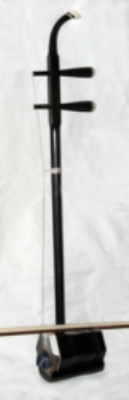
The erhu is a two-stringed bowed musical instrument
, more specifically a spike fiddle, which may also be called a "southern fiddle", and sometimes known in the Western world as the "Chinese violin" or a "Chinese two-stringed fiddle". It is used as a solo instrument as well as in small ensembles and large orchestras. It is the most popular of the huqin
family of traditional bowed string instruments used by various ethnic groups of China. A very versatile instrument, the erhu is used in both traditional and contemporary music arrangements, such as in pop, rock, jazz, etc.
more than a thousand years ago. It is believed to have evolved from the xiqin (奚琴), which was described as a foreign, two-stringed lute in Yue Shu (樂書, yuèshū, lit. book of music), an encyclopedic work on music written by music theorist
Chen Yang in the Northern Song Dynasty
. The xiqin is believed to have originated from the Xi people
of Central Asia
, and have come to China
in the 10th century.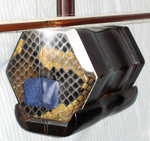 The first Chinese character
of the name of the instrument (二, èr, two) is believed to come from the fact that it has two strings. An alternate explanation states that it comes from the fact that it is the second highest huqin in pitch to the gaohu
in the modern Chinese orchestra
. The second character (胡, hú) indicates that it is a member of the huqin family. The name huqin literally means "barbarian
instrument," showing that the instrument likely originated from regions to the north or west of China inhabited by non-Han
peoples.
s of China, including the xiqin, yazheng
, and yaqin, and also the Korean ajaeng
, were originally played by bowing
with a rosin
ed stick, which created friction against the strings. As soon as the horsehair bow was invented, it spread very widely. This is a high pitched instrument. The Central Asian horse peoples occupied a territory that included the Silk Road
, along which goods and innovations were transported rapidly for thousands of miles across Eurasia
.
, at the top of which are two large tuning peg
s, and at the bottom is a small resonator body (sound box
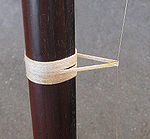
) which is covered with python skin on the front (playing) end. Two strings are attached from the pegs to the base, and a small loop of string (qian jin) placed around the neck and strings acting as a nut
pulls the strings towards the skin, holding a small wooden bridge in place.
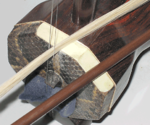 The erhu has some unusual features. First is that its characteristic sound is produced through the vibration of the python skin by bowing. Second, there is no fingerboard; the player stops the strings by pressing their fingertips onto the strings without the strings touching the neck. Third, the horse hair bow is never separated from the strings (which were formerly of twisted silk but which today are usually made of metal); it passes between them as opposed to over them (the latter being the case with western bowed stringed instruments). Lastly, although there are two strings, they are very close to each other and the player's left hand in effect plays as if on one string.
The inside string (nearest to player) is generally tuned to D4 and the outside string to A4, a fifth higher. The maximum range of the instrument is three and a half octaves, from D4 up to A7, before a stopping finger reaches the part of the string in contact with the bow hair. The usual playing range is about two and a half octaves.
Various dense and heavy hardwoods are used in making the erhu. According to Chinese references the woods include zi tan (紫檀 red sandalwood and other woods of the genus Pterocarpus
such as padauk), lao hong mu (老红木 aged red wood), wu mu (乌木 black wood), and hong mu (红木 red wood). Particularly fine erhus are often made from pieces of old furniture. A typical erhu measures 81 cm from top to bottom, the length of the bow also being 81 cm.
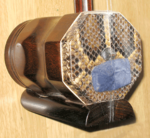 The parts of the erhu:
Most erhu are mass produced in factories. The three most esteemed centres of erhu making are Beijing, Shanghai, and Suzhou
. In the collectivist period after the establishment of the People's Republic of China, these factories were formed by merging what had been previously private workshops. Although most erhu were machine-made in production lines, the highest quality instruments were hand made by specialist craftsmen.
In the 20th century, there have been attempts to standardize and improve the erhu, with the aim of producing a louder and better sounding instrument. One major change was the use of steel strings instead of silk. The move to steel strings was made gradually. By 1950, the thinner A string had been replaced by a violin E string with the thicker D string remaining silk. By 1958, professional players were using purpose made D and A steel erhu strings as standard.
and musical instrument makers in China. From January 1, 2005, new regulations also require erhus to have a certificate from the State Forestry Administration, which certify that the erhu python skin is not made with wild pythons, but from farm-raised pythons. Individuals are allowed to take up to two erhus out of China when traveling; commercial buyers need additional export certificates.
Outside China, manufacturers of erhu are able to issue their own CITES licenses with approval by governments of their respective countries. Such exports are legal as they have been made from legal skin sources.
Some erhus are made of recycled products.
for the erhu was Liu Tianhua (刘天华/劉天華; Liú Tiānhuá) (1895-1932), a Chinese musician who studied Western music
as well. He composed 47 exercises and 10 solo pieces (1918-32) which were central to the development of the erhu as a solo instrument. His works for the instrument include Yue Ye (月夜; Yuè yè, Moon Night) and Zhu ying Yao hong (烛影摇红; Zhú yǐng yáo hóng, Shadows of Candles Flickering Red).
Other solo pieces include Er Quan Ying Yue (1950, Moon Reflected on Second Spring) by A Bing, Sai Ma (Horse Race) by Huang Haihuai, Henan Xiaoqu (Henan folk tune) by Liu Mingyuan
, and Sanmenxia Changxiangqu (1961, Sanmen Gorge Capriccio) by Liu Wenjin. Most solo works are commonly performed with yangqin
accompaniment, although pieces such as the ten solos by Liu Tianhua and Er Quan Ying Yue originally did not have accompaniment.
In addition to the solo repertoire, the erhu is also one of the main instruments in regional music ensembles such as Jiangnan sizhu
, Chinese opera
ensembles, and the modern large Chinese orchestra
.
The erhu is also used in the music of the Cirque du Soleil
show O
. Even fusion progressive rock groups like The Hsu-nami
have incorporated the erhu into their music and it is their lead instrument. It is also incorporated in the Taiwanese black metal band ChthoniC
. The Erhu is also used in the song Field Below by Regina Spektor.
An Erhu instrumental album Along the River During the Qingming Festival (清明上河图;Qingming Shanghe tu) was issued at Nov 22nd 2006,Performed by a famous youth erhu artist Song Fei (宋飞; Song Fei),to express a picture draw in the Song Dynasty by Zhang Zeduan
(张择端; Zhang Zeduan),the play was performed by Erhu,Jinghu,Banhu,Gaohu etc. to show the Livelihood,Trade,Festival of the Song Dynasty,the album contains 18 parts.The album represented the greatest achievement of Chinese classical music and it made the China's modern national landmark music works.
The erhu (played by George Gao
) is also featured prominently in the soundtrack for the TV series Earth: Final Conflict
.
In 2009's Star Trek soundtrack by Michael Giacchino
, an erhu solo is featured in the soundtrack "That New Car Smell."
The erhu is almost always tuned to the interval of a fifth
. The inside string (nearest to player) is generally tuned to D4 and the outside string to A4. This is the same as the two middle strings of the violin.
The erhu is played sitting down, with the sound box placed on the top of the left thigh and the neck held vertically.
The bow is held with an underhand grip. The bow hair is adjusted so it is slightly loose. Tension is provided by the fingers of the right hand. The bow hair is placed in between the two strings and both sides of the bow hair are used to produce sound, the player pushes the bow away from the body when bowing the A string (the outside string), and pulls it inwards when bowing the "inside" D string.
Aside from the usual bowing technique used for most pieces, the erhu can also be plucked, usually using the second finger of the right hand. This produces a dry, muted tone (if either of the open strings is plucked, the sound is somewhat more resonant) which is sometimes desired in contemporary pieces.
The left hand alters the tone of the strings by pressing on the string at the normal harmonic points. As the instrument has no frets, the tone is slightly muddled, but resonant.
Techniques include hua yin (slides), rou xian (vibrato), huan ba (changing positions), etc.
 Prior to the 20th century, most huqin instruments were used primarily to accompany various forms of Chinese opera
and narrative
. The use of the erhu as a solo instrument began in the early 20th century along with the development of guoyue
(literally "national music"), a modernized form of Chinese traditional music written or adapted for the professional concert stage. Active in the early 20th century were Zhou Shaomei (周少梅, 1885-1938) and Liu Tianhua (刘天华, 1895-1932). Liu laid the foundations of modern erhu playing with his ten unaccompanied solos and 47 studies composed in the 1920s and 1930s. Liu Beimao (刘北茂, 1903-1981) was born in Jiangyin, Jiangsu. His compositions include Xiao hua gu (1943) (Little flower drum). Jiang Fengzhi (蔣风之) (1908-1986) and Chen Zhenduo (陈振铎) were students of Liu Tianhua, the piece Hangong Qiuyue (Autumn Moon Han Palace) was adapted and arranged by Jiang. Hua Yanjun
(A Bing) (华彥君-阿炳, c. 1893-1950) was a blind street musician. Shortly before his death in 1950, two Chinese musicologists recorded him playing a few erhu and pipa
solo pieces, the best known being Erquan Yingyue.
With the founding of the PRC
and the expansion of the conservatory system, the solo erhu tradition continued to develop. Important performers during this time include Lu Xiutang (陆修堂, 1911-1966), Zhang Rui (张锐, 1920- ) Sun Wenming (孙文明, 1928-1962), Huang Haihuai (黄海怀), Liu Mingyuan (刘明源, 1931-1996), Tang Liangde (汤良德, 1938-2010), Zhang Shao (张韶), and Song Guosheng(宋国生).
Liu Mingyuan (刘明源) (1931-1996) was born in Tianjin
. He was known for his virtuosity on many instruments of the huqin
family, in particular the banhu
. His compositions and arrangements include Henan Xiaoqu (Henan folk tune), and Cao Yuan Shang (On Grassland) for zhonghu
. For many years he taught at the China Conservatory of Music in Beijing.
Tang Liangde (Tong Leung Tak, 汤良德, 1938-2010) was born in Shanghai into a famous Shanghainese musical family. He won the "Shanghai's Spring" erhu competition and continued to be the soloist for the Chinese Film Orchestra in Beijing, his composition and solos can be heard throughout the Nixon to China documentary movie. Tang was the soloist and performed at the Hong Kong Chinese Orchestra, then went onto music broadcasting and education for the Hong Kong Government's Music Office making worldwide tours, and was named Art Educator of the Year in 1991 by the Hong Kong Artist Guild.
Wang Guotong (王国潼, b. 1939) was born in Dalian
, Liaoning. He studied with Jiang Fengzhi, Lan Yusong and Chen Zhenduo, and in 1960 graduated from the Central Conservatory of Music in Beijing. He performed the premiere of Sanmenxia Changxiangqu (Sanmen Gorge Rhapsody) composed by Liu Wenjin. In 1972 Wang became the erhu soloist, and later art director, with the China Broadcasting Traditional Orchestra. He returned to the Central Conservatory of Music in 1983 as head of the Chinese music department. He has written many books and articles on erhu playing and has performed in many countries. Wang also worked with the Beijing National Instruments Factory to further develop erhu design.
Min Huifen (閔惠芬, 1945- ) was born in Yixing
, Jiangsu. Min first became known as the winner of the 1964 fourth Shanghai Spring national erhu competition. She studied with Lu Xiutang and Wang Yi, and graduated from the Shanghai Conservatory of Music in 1968, and became the erhu soloist with the Shanghai minzu yuetuan (Shanghai Folk Orchestra).
Yang Ying (杨英, b. 1959) was the featured soloist for the Chinese National Song and Dance Ensemble (中央歌舞团) of Beijing from 1978-1996. She was a national erhu champion, frequently recorded for the Chinese film and record industry, and is listed in famous persons of China.
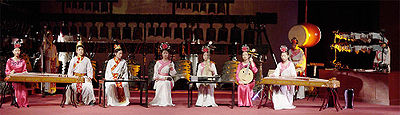
The erhu is featured along with other traditional Chinese instruments such as the pipa
in the contemporary Chinese instrumental music group, Twelve Girls Band
. They perform traditional Chinese music as well as Western classical and popular music.
A few groups have utilized the erhu in a rock context. The Taiwanese black metal band Chthonic
uses the erhu; they are the only black metal band to do so. The New Jersey-based progressive rock band The Hsu-nami
plays a variety of rock sub-styles including metal, psychedelic, prog rock, and funk. An amplified erhu takes the place of lead vocals. Chie Mukai
of the Japanese improv unit Ché-SHIZU
also plays the erhu.
Another group which falls more under Electronica/Drum & Bass is a musical duo from Parkdale, Toronto, Ontario, Canada. The group, known as USS or Ubiquitous Synergy Seeker
, uses an erhu in a different context. The USS sound is a mixture of drum and bass beats, grunge-like guitar riffs and 2-step rhythms. The erhu is one of their notable instruments they use in the course of their two released CDs, "Wielding the C:/" and "Questamation".
Toronto physician and composer Dr. Ian Pun (潘彥衡 b.1965) uses erhu combined with funk guitar musical riff in the 2011 song "加油, 加油, 加油!" performed by noted York University musicians Amely Zhou and Jaro Dabrowski.
Bowed string instrument
Bowed string instruments are a subcategory of string instruments that are played by a bow rubbing the strings. The bow rubbing the string causes vibration which the instrument emits as sound.-Violin family:...
, more specifically a spike fiddle, which may also be called a "southern fiddle", and sometimes known in the Western world as the "Chinese violin" or a "Chinese two-stringed fiddle". It is used as a solo instrument as well as in small ensembles and large orchestras. It is the most popular of the huqin
Huqin
Huqin is a family of bowed string instruments, more specifically, a spike fiddle popularly used in Chinese music. The instruments consist of a round, hexagonal, or octagonal sound box at the bottom with a neck attached that protrudes upwards...
family of traditional bowed string instruments used by various ethnic groups of China. A very versatile instrument, the erhu is used in both traditional and contemporary music arrangements, such as in pop, rock, jazz, etc.
History
The erhu can be traced back to instruments introduced into ChinaChina
Chinese civilization may refer to:* China for more general discussion of the country.* Chinese culture* Greater China, the transnational community of ethnic Chinese.* History of China* Sinosphere, the area historically affected by Chinese culture...
more than a thousand years ago. It is believed to have evolved from the xiqin (奚琴), which was described as a foreign, two-stringed lute in Yue Shu (樂書, yuèshū, lit. book of music), an encyclopedic work on music written by music theorist
Music theory
Music theory is the study of how music works. It examines the language and notation of music. It seeks to identify patterns and structures in composers' techniques across or within genres, styles, or historical periods...
Chen Yang in the Northern Song Dynasty
Song Dynasty
The Song Dynasty was a ruling dynasty in China between 960 and 1279; it succeeded the Five Dynasties and Ten Kingdoms Period, and was followed by the Yuan Dynasty. It was the first government in world history to issue banknotes or paper money, and the first Chinese government to establish a...
. The xiqin is believed to have originated from the Xi people
Kumo Xi
The Kumo Xi ) were a Mongolic steppe people located in current Manchuria from 207 AD to 907 AD. After the death of their ancestor Tadun in 207 they were no longer called Wuhuan but joined the Khitan Xianbei in submitting to the Yuwen Xianbei. Their history is widely linked to the more famous Khitan...
of Central Asia
Central Asia
Central Asia is a core region of the Asian continent from the Caspian Sea in the west, China in the east, Afghanistan in the south, and Russia in the north...
, and have come to China
China
Chinese civilization may refer to:* China for more general discussion of the country.* Chinese culture* Greater China, the transnational community of ethnic Chinese.* History of China* Sinosphere, the area historically affected by Chinese culture...
in the 10th century.
Chinese character
Chinese characters are logograms used in the writing of Chinese and Japanese , less frequently Korean , formerly Vietnamese , or other languages...
of the name of the instrument (二, èr, two) is believed to come from the fact that it has two strings. An alternate explanation states that it comes from the fact that it is the second highest huqin in pitch to the gaohu
Gaohu
The gaohu is a Chinese bowed string instrument developed from the erhu in the 1920s by the musician and composer Lü Wencheng and used in Cantonese music and Cantonese opera...
in the modern Chinese orchestra
Chinese orchestra
The term Chinese Orchestra can refer to either:* The ancient Chinese Orchestra, or* The modern Chinese Orchestra-The ancient Chinese Orchestra:...
. The second character (胡, hú) indicates that it is a member of the huqin family. The name huqin literally means "barbarian
Barbarian
Barbarian and savage are terms used to refer to a person who is perceived to be uncivilized. The word is often used either in a general reference to a member of a nation or ethnos, typically a tribal society as seen by an urban civilization either viewed as inferior, or admired as a noble savage...
instrument," showing that the instrument likely originated from regions to the north or west of China inhabited by non-Han
Han Chinese
Han Chinese are an ethnic group native to China and are the largest single ethnic group in the world.Han Chinese constitute about 92% of the population of the People's Republic of China , 98% of the population of the Republic of China , 78% of the population of Singapore, and about 20% of the...
peoples.
Historical erhu and bowed string bows
Historic bowed zitherZither
The zither is a musical string instrument, most commonly found in Slovenia, Austria, Hungary citera, northwestern Croatia, the southern regions of Germany, alpine Europe and East Asian cultures, including China...
s of China, including the xiqin, yazheng
Yazheng
The yazheng is a Chinese string instrument. It is a long zither similar to the guzheng but bowed by scraping with a sorghum stem dusted with resin, a bamboo stick, or a piece of forsythia wood...
, and yaqin, and also the Korean ajaeng
Ajaeng
The ajaeng is a Korean string instrument. It is a wide zither with strings made of twisted silk, played by means of a slender stick made of forsythia wood, which is scraped against the strings in the manner of a bow...
, were originally played by bowing
Bow (music)
In music, a bow is moved across some part of a musical instrument, causing vibration which the instrument emits as sound. The vast majority of bows are used with string instruments, although some bows are used with musical saws and other bowed idiophones....
with a rosin
Rosin
.Rosin, also called colophony or Greek pitch , is a solid form of resin obtained from pines and some other plants, mostly conifers, produced by heating fresh liquid resin to vaporize the volatile liquid terpene components. It is semi-transparent and varies in color from yellow to black...
ed stick, which created friction against the strings. As soon as the horsehair bow was invented, it spread very widely. This is a high pitched instrument. The Central Asian horse peoples occupied a territory that included the Silk Road
Silk Road
The Silk Road or Silk Route refers to a historical network of interlinking trade routes across the Afro-Eurasian landmass that connected East, South, and Western Asia with the Mediterranean and European world, as well as parts of North and East Africa...
, along which goods and innovations were transported rapidly for thousands of miles across Eurasia
Eurasia
Eurasia is a continent or supercontinent comprising the traditional continents of Europe and Asia ; covering about 52,990,000 km2 or about 10.6% of the Earth's surface located primarily in the eastern and northern hemispheres...
.
Construction
The erhu consists of a long vertical stick-like neckNeck (music)
The neck is the part of certain string instruments that projects from the main body and is the base of the fingerboard, where the fingers are placed to stop the strings at different pitches. Guitars, lutes, the violin family, and the mandolin family are examples of instruments which have necks.The...
, at the top of which are two large tuning peg
Tuning peg
A tuning peg is used to hold a string in the pegbox of a stringed instrument. It may be made of ebony, rosewood, boxwood or other material. Some tuning pegs are ornamented with shell, metal, or plastic inlays, beads or rings....
s, and at the bottom is a small resonator body (sound box
Sound box
A sound box or sounding box is an open chamber in the body of a musical instrument which modifies the sound of the instrument, and helps transfer that sound to the surrounding air. Objects respond more strongly to vibrations at certain frequencies, known as resonances...
) which is covered with python skin on the front (playing) end. Two strings are attached from the pegs to the base, and a small loop of string (qian jin) placed around the neck and strings acting as a nut
Nut (instrumental)
The nut of a string instrument is a small piece of hard material which supports the strings at the end closest to the headstock or scroll. The nut marks one end of the speaking length of each open string, sets the spacing of the strings across the neck, and usually holds the strings at the proper...
pulls the strings towards the skin, holding a small wooden bridge in place.
The inside string (nearest to player) is generally tuned to D4 and the outside string to A4, a fifth higher. The maximum range of the instrument is three and a half octaves, from D4 up to A7, before a stopping finger reaches the part of the string in contact with the bow hair. The usual playing range is about two and a half octaves.
Various dense and heavy hardwoods are used in making the erhu. According to Chinese references the woods include zi tan (紫檀 red sandalwood and other woods of the genus Pterocarpus
Pterocarpus
Pterocarpus is a pantropical genus of trees in the family Fabaceae, most of which yield valuable timber traded as padauk ; other common names are mukwa or narra...
such as padauk), lao hong mu (老红木 aged red wood), wu mu (乌木 black wood), and hong mu (红木 red wood). Particularly fine erhus are often made from pieces of old furniture. A typical erhu measures 81 cm from top to bottom, the length of the bow also being 81 cm.
- Qín tong (琴筒), sound boxSound boxA sound box or sounding box is an open chamber in the body of a musical instrument which modifies the sound of the instrument, and helps transfer that sound to the surrounding air. Objects respond more strongly to vibrations at certain frequencies, known as resonances...
or resonator body; it is hexagonal (liu jiao, southern), octagonal (ba jiao, northern), or, less commonly, round. - Qín pí/She pí (琴皮/蛇皮), skin, made from python. The python skin gives the erhu its characteristic sound.
- Qín gan (琴杆), neckNeck (music)The neck is the part of certain string instruments that projects from the main body and is the base of the fingerboard, where the fingers are placed to stop the strings at different pitches. Guitars, lutes, the violin family, and the mandolin family are examples of instruments which have necks.The...
. - Qín tou (琴头), top or tip of neck, usually a simple curve with a piece of bone or plastic on top, but is sometimes elaborately carved with a dragonChinese dragonChinese dragons are legendary creatures in Chinese mythology and folklore, with mythic counterparts among Japanese, Korean, Vietnamese, Bhutanese, Western and Turkic dragons. In Chinese art, dragons are typically portrayed as long, scaled, serpentine creatures with four legs...
's head. - Qín zhou (琴轴). tuning pegTuning pegA tuning peg is used to hold a string in the pegbox of a stringed instrument. It may be made of ebony, rosewood, boxwood or other material. Some tuning pegs are ornamented with shell, metal, or plastic inlays, beads or rings....
s, traditional wooden, or metal machine gear pegs. - Qiān jin (千斤), nutNut (instrumental)The nut of a string instrument is a small piece of hard material which supports the strings at the end closest to the headstock or scroll. The nut marks one end of the speaking length of each open string, sets the spacing of the strings across the neck, and usually holds the strings at the proper...
, made from string, or, less commonly, a metal hook. - Nèi xián (内弦), inside or inner string, usually tuned to D4, nearest to player.
- Wai xián (外弦), outside or outer string, usually tuned to A4.
- Qín ma (琴码), bridge, made from wood.
- Gong (弓), bow, has screw device to vary bow hair tension.
- Gong gan (弓杆), bow stick, made from bamboo.
- Gong máo (弓毛), bow hair, usually white horsehair.
- Qín diàn (琴垫), pad, a piece of sponge, felt, or cloth placed between the strings and skin below the bridge to improve its sound.
- Qín tuō (琴托) - base, a piece of wood attached to the bottom of the qín tong to provide a smooth surface on which to rest on the leg.
Most erhu are mass produced in factories. The three most esteemed centres of erhu making are Beijing, Shanghai, and Suzhou
Suzhou
Suzhou , previously transliterated as Su-chou, Suchow, and Soochow, is a major city located in the southeast of Jiangsu Province in Eastern China, located adjacent to Shanghai Municipality. The city is situated on the lower reaches of the Yangtze River and on the shores of Taihu Lake and is a part...
. In the collectivist period after the establishment of the People's Republic of China, these factories were formed by merging what had been previously private workshops. Although most erhu were machine-made in production lines, the highest quality instruments were hand made by specialist craftsmen.
In the 20th century, there have been attempts to standardize and improve the erhu, with the aim of producing a louder and better sounding instrument. One major change was the use of steel strings instead of silk. The move to steel strings was made gradually. By 1950, the thinner A string had been replaced by a violin E string with the thicker D string remaining silk. By 1958, professional players were using purpose made D and A steel erhu strings as standard.
Use of python skin
In 1988, China passed its Law on the Protection of Endangered Species after ratifying the UN Convention on the International Trade in Endangered Species (CITES), making it illegal to use and trade unlicensed pythons. To regulate the use of python skins, China's State Forestry Administration introduced a certification scheme between python skin sellers in Southeast AsiaSoutheast Asia
Southeast Asia, South-East Asia, South East Asia or Southeastern Asia is a subregion of Asia, consisting of the countries that are geographically south of China, east of India, west of New Guinea and north of Australia. The region lies on the intersection of geological plates, with heavy seismic...
and musical instrument makers in China. From January 1, 2005, new regulations also require erhus to have a certificate from the State Forestry Administration, which certify that the erhu python skin is not made with wild pythons, but from farm-raised pythons. Individuals are allowed to take up to two erhus out of China when traveling; commercial buyers need additional export certificates.
Outside China, manufacturers of erhu are able to issue their own CITES licenses with approval by governments of their respective countries. Such exports are legal as they have been made from legal skin sources.
Some erhus are made of recycled products.
Erhu music
A notable composerComposer
A composer is a person who creates music, either by musical notation or oral tradition, for interpretation and performance, or through direct manipulation of sonic material through electronic media...
for the erhu was Liu Tianhua (刘天华/劉天華; Liú Tiānhuá) (1895-1932), a Chinese musician who studied Western music
Music
Music is an art form whose medium is sound and silence. Its common elements are pitch , rhythm , dynamics, and the sonic qualities of timbre and texture...
as well. He composed 47 exercises and 10 solo pieces (1918-32) which were central to the development of the erhu as a solo instrument. His works for the instrument include Yue Ye (月夜; Yuè yè, Moon Night) and Zhu ying Yao hong (烛影摇红; Zhú yǐng yáo hóng, Shadows of Candles Flickering Red).
Other solo pieces include Er Quan Ying Yue (1950, Moon Reflected on Second Spring) by A Bing, Sai Ma (Horse Race) by Huang Haihuai, Henan Xiaoqu (Henan folk tune) by Liu Mingyuan
Liu Mingyuan
Liu Mingyuan was a prominent Chinese musician, composer, and teacher. He played the Chinese bowed string instruments banhu, zhonghu, gaohu, erhu, jinghu, and zhuihu, among others, as well as the piano.-Biography:Born in Tianjin, Mingyuan began studying music from his father and eventually learned...
, and Sanmenxia Changxiangqu (1961, Sanmen Gorge Capriccio) by Liu Wenjin. Most solo works are commonly performed with yangqin
Yangqin
The trapezoidal yangqin is a Chinese hammered dulcimer, originally from Middle East and Persia . It used to be written with the characters 洋琴 , but over time the first character changed to 揚 , which means "acclaimed". It is also spelled yang quin or yang ch'in...
accompaniment, although pieces such as the ten solos by Liu Tianhua and Er Quan Ying Yue originally did not have accompaniment.
In addition to the solo repertoire, the erhu is also one of the main instruments in regional music ensembles such as Jiangnan sizhu
Jiangnan sizhu
Jiangnan sizhu is a style of traditional Chinese instrumental music from the Jiangnan region of China.-Name:The name Jiangnan sizhu is made up of two parts. Jiangnan is the traditional name for the area south of the lower reaches of the Yangtze river in southern Jiangsu, Shanghai, and northern...
, Chinese opera
Chinese opera
Chinese opera is a popular form of drama and musical theatre in China with roots going back as far as the third century CE...
ensembles, and the modern large Chinese orchestra
Chinese orchestra
The term Chinese Orchestra can refer to either:* The ancient Chinese Orchestra, or* The modern Chinese Orchestra-The ancient Chinese Orchestra:...
.
The erhu is also used in the music of the Cirque du Soleil
Cirque du Soleil
Cirque du Soleil , is a Canadian entertainment company, self-described as a "dramatic mix of circus arts and street entertainment." Based in Montreal, Quebec, Canada, and located in the inner-city area of Saint-Michel, it was founded in Baie-Saint-Paul in 1984 by two former street performers, Guy...
show O
O (Cirque du Soleil)
O is a water-themed stage production by Cirque du Soleil, a Canadian circus and entertainment company. The show has been in permanent residence at the Bellagio in Las Vegas, Nevada, United States, since October 1998...
. Even fusion progressive rock groups like The Hsu-nami
The Hsu-nami
The Hsu-nami is an international renowned progressive rock band from the United States. The Hsu-nami, named after the frontman Jack Hsu, became known as the first "Progressive Erhu Rock" band in the world....
have incorporated the erhu into their music and it is their lead instrument. It is also incorporated in the Taiwanese black metal band ChthoniC
Chthonic (band)
Chthonic is a Taiwanese metal band, formed in 1995 in Taipei. The group incorporates influences from traditional Taiwanese music including the classical Asian instrument erhu...
. The Erhu is also used in the song Field Below by Regina Spektor.
An Erhu instrumental album Along the River During the Qingming Festival (清明上河图;Qingming Shanghe tu) was issued at Nov 22nd 2006,Performed by a famous youth erhu artist Song Fei (宋飞; Song Fei),to express a picture draw in the Song Dynasty by Zhang Zeduan
Zhang Zeduan
Zhang Zeduan , alias Zheng Dao, also sometimes translated as Zhang Zerui, was a famous Chinese painter during the twelfth century, during the transitional period from the Northern Song to the Southern Song Dynasty, and was instrumental in the early history of the Chinese art style known as shan...
(张择端; Zhang Zeduan),the play was performed by Erhu,Jinghu,Banhu,Gaohu etc. to show the Livelihood,Trade,Festival of the Song Dynasty,the album contains 18 parts.The album represented the greatest achievement of Chinese classical music and it made the China's modern national landmark music works.
The erhu (played by George Gao
George Gao
- History :George Gao was born in 1967, in Shanghai, China. Gao began studying the erhu at the age of six. In 1982, he won First Prize at the Shanghai Junior Instrumental Soloist Competition and a Silver Medal at the China National Junior Instrumental Soloist Contest. His performance skill exempted...
) is also featured prominently in the soundtrack for the TV series Earth: Final Conflict
Earth: Final Conflict
Earth: Final Conflict is a Canadian science fiction television series based on story ideas created by Gene Roddenberry, and produced under the guidance of his widow, Majel Barrett-Roddenberry. It was not produced, filmed or broadcast until after his death...
.
In 2009's Star Trek soundtrack by Michael Giacchino
Michael Giacchino
Michael Giacchino is an American composer who has composed scores for movies, television series and video games. Some of his most notable works include the scores to television series such as Lost, Alias and Fringe, games such as the Medal of Honor and Call of Duty series, and films such as...
, an erhu solo is featured in the soundtrack "That New Car Smell."
Playing technique
- Tuning
The erhu is almost always tuned to the interval of a fifth
Interval (music)
In music theory, an interval is a combination of two notes, or the ratio between their frequencies. Two-note combinations are also called dyads...
. The inside string (nearest to player) is generally tuned to D4 and the outside string to A4. This is the same as the two middle strings of the violin.
- Position
The erhu is played sitting down, with the sound box placed on the top of the left thigh and the neck held vertically.
- Right hand
The bow is held with an underhand grip. The bow hair is adjusted so it is slightly loose. Tension is provided by the fingers of the right hand. The bow hair is placed in between the two strings and both sides of the bow hair are used to produce sound, the player pushes the bow away from the body when bowing the A string (the outside string), and pulls it inwards when bowing the "inside" D string.
Aside from the usual bowing technique used for most pieces, the erhu can also be plucked, usually using the second finger of the right hand. This produces a dry, muted tone (if either of the open strings is plucked, the sound is somewhat more resonant) which is sometimes desired in contemporary pieces.
- Left hand
The left hand alters the tone of the strings by pressing on the string at the normal harmonic points. As the instrument has no frets, the tone is slightly muddled, but resonant.
Techniques include hua yin (slides), rou xian (vibrato), huan ba (changing positions), etc.
Notable performers
Chinese opera
Chinese opera is a popular form of drama and musical theatre in China with roots going back as far as the third century CE...
and narrative
Shuochang
Shuochang is a form of traditional Chinese storytelling , with many regional subgenres; it is also often referred to as "narrative." Shuochang performances usually intermix speaking and singing, and are accompanied by percussion instruments and sometimes also plucked or bowed string...
. The use of the erhu as a solo instrument began in the early 20th century along with the development of guoyue
Guoyue
Guoyue is a modernized form of Chinese traditional music written or adapted for some form of grand presentation, usually through a large orchestra of Chinese instruments. It was created in mainland China beginning in the early 20th century and is frequently broadcast on radio and television in the...
(literally "national music"), a modernized form of Chinese traditional music written or adapted for the professional concert stage. Active in the early 20th century were Zhou Shaomei (周少梅, 1885-1938) and Liu Tianhua (刘天华, 1895-1932). Liu laid the foundations of modern erhu playing with his ten unaccompanied solos and 47 studies composed in the 1920s and 1930s. Liu Beimao (刘北茂, 1903-1981) was born in Jiangyin, Jiangsu. His compositions include Xiao hua gu (1943) (Little flower drum). Jiang Fengzhi (蔣风之) (1908-1986) and Chen Zhenduo (陈振铎) were students of Liu Tianhua, the piece Hangong Qiuyue (Autumn Moon Han Palace) was adapted and arranged by Jiang. Hua Yanjun
Abing
"Blind" Ābǐng was a blind Chinese musician specializing in the erhu and pipa.-Life:...
(A Bing) (华彥君-阿炳, c. 1893-1950) was a blind street musician. Shortly before his death in 1950, two Chinese musicologists recorded him playing a few erhu and pipa
Pipa
The pipa is a four-stringed Chinese musical instrument, belonging to the plucked category of instruments . Sometimes called the Chinese lute, the instrument has a pear-shaped wooden body with a varying number of frets ranging from 12–26...
solo pieces, the best known being Erquan Yingyue.
With the founding of the PRC
People's Republic of China
China , officially the People's Republic of China , is the most populous country in the world, with over 1.3 billion citizens. Located in East Asia, the country covers approximately 9.6 million square kilometres...
and the expansion of the conservatory system, the solo erhu tradition continued to develop. Important performers during this time include Lu Xiutang (陆修堂, 1911-1966), Zhang Rui (张锐, 1920- ) Sun Wenming (孙文明, 1928-1962), Huang Haihuai (黄海怀), Liu Mingyuan (刘明源, 1931-1996), Tang Liangde (汤良德, 1938-2010), Zhang Shao (张韶), and Song Guosheng(宋国生).
Liu Mingyuan (刘明源) (1931-1996) was born in Tianjin
Tianjin
' is a metropolis in northern China and one of the five national central cities of the People's Republic of China. It is governed as a direct-controlled municipality, one of four such designations, and is, thus, under direct administration of the central government...
. He was known for his virtuosity on many instruments of the huqin
Huqin
Huqin is a family of bowed string instruments, more specifically, a spike fiddle popularly used in Chinese music. The instruments consist of a round, hexagonal, or octagonal sound box at the bottom with a neck attached that protrudes upwards...
family, in particular the banhu
Banhu
The banhu is a Chinese traditional bowed string instrument in the huqin family of instruments. It is used primarily in northern China. Ban means a piece of wood and hu is short for huqin....
. His compositions and arrangements include Henan Xiaoqu (Henan folk tune), and Cao Yuan Shang (On Grassland) for zhonghu
Zhonghu
The zhonghu is a low-pitched Chinese bowed string instrument. Together with the erhu and gaohu, it is a member of the huqin family, and was developed in the 20th century as the alto member of the huqin family .The zhonghu is analogous with the erhu, but is slightly larger and...
. For many years he taught at the China Conservatory of Music in Beijing.
Tang Liangde (Tong Leung Tak, 汤良德, 1938-2010) was born in Shanghai into a famous Shanghainese musical family. He won the "Shanghai's Spring" erhu competition and continued to be the soloist for the Chinese Film Orchestra in Beijing, his composition and solos can be heard throughout the Nixon to China documentary movie. Tang was the soloist and performed at the Hong Kong Chinese Orchestra, then went onto music broadcasting and education for the Hong Kong Government's Music Office making worldwide tours, and was named Art Educator of the Year in 1991 by the Hong Kong Artist Guild.
Wang Guotong (王国潼, b. 1939) was born in Dalian
Dalian
Dalian is a major city and seaport in the south of Liaoning province, Northeast China. It faces Shandong to the south, the Yellow Sea to the east and the Bohai Sea to the west and south. Holding sub-provincial administrative status, Dalian is the southernmost city of Northeast China and China's...
, Liaoning. He studied with Jiang Fengzhi, Lan Yusong and Chen Zhenduo, and in 1960 graduated from the Central Conservatory of Music in Beijing. He performed the premiere of Sanmenxia Changxiangqu (Sanmen Gorge Rhapsody) composed by Liu Wenjin. In 1972 Wang became the erhu soloist, and later art director, with the China Broadcasting Traditional Orchestra. He returned to the Central Conservatory of Music in 1983 as head of the Chinese music department. He has written many books and articles on erhu playing and has performed in many countries. Wang also worked with the Beijing National Instruments Factory to further develop erhu design.
Min Huifen (閔惠芬, 1945- ) was born in Yixing
Yixing
Yixing is a county-level city in Jiangsu province, in eastern China with a population of 1.3 million. It is well-known for its Yixing clay and the pottery -- especially the "zisha"-style teapots -- made from the clay...
, Jiangsu. Min first became known as the winner of the 1964 fourth Shanghai Spring national erhu competition. She studied with Lu Xiutang and Wang Yi, and graduated from the Shanghai Conservatory of Music in 1968, and became the erhu soloist with the Shanghai minzu yuetuan (Shanghai Folk Orchestra).
Yang Ying (杨英, b. 1959) was the featured soloist for the Chinese National Song and Dance Ensemble (中央歌舞团) of Beijing from 1978-1996. She was a national erhu champion, frequently recorded for the Chinese film and record industry, and is listed in famous persons of China.
The erhu is featured along with other traditional Chinese instruments such as the pipa
Pipa
The pipa is a four-stringed Chinese musical instrument, belonging to the plucked category of instruments . Sometimes called the Chinese lute, the instrument has a pear-shaped wooden body with a varying number of frets ranging from 12–26...
in the contemporary Chinese instrumental music group, Twelve Girls Band
Twelve Girls Band
Twelve Girls Band are an all female Chinese musical group that initially consisted of twelve members before the addition of a thirteenth. Twelve Girls Band use traditional Chinese instruments to play both traditional Chinese and Western music. Formed on June 18, 2001, the women were selected by...
. They perform traditional Chinese music as well as Western classical and popular music.
A few groups have utilized the erhu in a rock context. The Taiwanese black metal band Chthonic
Chthonic (band)
Chthonic is a Taiwanese metal band, formed in 1995 in Taipei. The group incorporates influences from traditional Taiwanese music including the classical Asian instrument erhu...
uses the erhu; they are the only black metal band to do so. The New Jersey-based progressive rock band The Hsu-nami
The Hsu-nami
The Hsu-nami is an international renowned progressive rock band from the United States. The Hsu-nami, named after the frontman Jack Hsu, became known as the first "Progressive Erhu Rock" band in the world....
plays a variety of rock sub-styles including metal, psychedelic, prog rock, and funk. An amplified erhu takes the place of lead vocals. Chie Mukai
Chie Mukai
is a female Japanese composer and musician, best known for her underground improv-folk group Ché-SHIZU. She has been involved in improvised performance since 1975, when she participated in the East Bionic Symphonia group, a graduation project for students of Takehisa Kosugi at the Bigakko art...
of the Japanese improv unit Ché-SHIZU
Ché-SHIZU
Ché-SHIZU Ché-SHIZU Ché-SHIZU (シェシズ)is an underground Japanese improv/folk group consisting of Chie Mukai (向井千恵) and others. The group's sound is dominated by Mukai's vocals and er-hu playing. The group was formed in 1980, but is currently inactive...
also plays the erhu.
Another group which falls more under Electronica/Drum & Bass is a musical duo from Parkdale, Toronto, Ontario, Canada. The group, known as USS or Ubiquitous Synergy Seeker
Ubiquitous Synergy Seeker
Ubiquitous Synergy Seeker is a musical duo that began working out of Parkdale, a neighbourhood situated in the west end of Toronto, Ontario, Canada...
, uses an erhu in a different context. The USS sound is a mixture of drum and bass beats, grunge-like guitar riffs and 2-step rhythms. The erhu is one of their notable instruments they use in the course of their two released CDs, "Wielding the C:/" and "Questamation".
Toronto physician and composer Dr. Ian Pun (潘彥衡 b.1965) uses erhu combined with funk guitar musical riff in the 2011 song "加油, 加油, 加油!" performed by noted York University musicians Amely Zhou and Jaro Dabrowski.
See also
- Dan nhi
- HaegeumHaegeumThe haegeum is a traditional Korean string instrument, resembling a fiddle. It has a rodlike neck, a hollow wooden soundbox, and two silk strings, and is held vertically on the knee of the performer and played with a bow....
(traditional Korean musical instrument) - HuqinHuqinHuqin is a family of bowed string instruments, more specifically, a spike fiddle popularly used in Chinese music. The instruments consist of a round, hexagonal, or octagonal sound box at the bottom with a neck attached that protrudes upwards...
- Music of ChinaMusic of ChinaChinese Music has been made since the dawn of Chinese civilization with documents and artifacts providing evidence of a well-developed musical culture as early as the Zhou Dynasty...
- String instruments
- Traditional Chinese musical instrumentsTraditional Chinese musical instruments-The Eight Sounds or Eight Tones :The eight categories are: silk, bamboo, wood, stone, metal, clay, gourd and hide. There are other instruments which may not fit these classifications. This is one of the first musical classifications ever.-Silk :...
Audio sample
External links
- www.ErhuBook.com Playing Erhu - Bridging the Gap, an instructional book in English by Patty Chan
- www.wen321.com, Erhu Q ( Erhu Q )
- www.59mai.com, Erhu Prices (JieLun Erhu Prices)
- Chineseerhumusic.info, Erhu Music (Listen to some Erhu Music)
- Erhu photo gallery (also includes another link to an audio clip)
- Gusli.su, Erhu music listen (also about Jia Peng Fang music)
- Datungarts.net Professional erhu, banhu, zhonghu and matouqin etc.
- Softist.com, ErhuGuanyin (A free Windows application for erhu tuning and interval training).
Video
- Horses: Lang Lang and Lang Guo-ren
- Progressive erhu funk Add oil 加油, 加油, 加油! by Ian Pun
- Signature erhu piece "Sanmen Gorge Capriccio" by Yang Ying
- Yang Ying performing "Horse Race" on Chicago PBS television
- Erhu video by Wang Guowei
- Erhu videos by Wang Guowei
- Karen Han performing "Csardas" by Monti
- Jiebing Chen beginning erhu instruction video
- Performance of "Erquan Yingyue" (with yangqin accompaniment)
- Erhu Videos by George Gao
- Rongchun Zhao video "10,000 Galloping Horses" (link at bottom of page)
- CNERHU.cn