
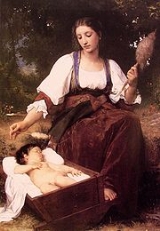
A
lullaby is a soothing
songIn music, a song is a composition for voice or voices, performed by singing.A song may be accompanied by musical instruments, or it may be unaccompanied, as in the case of a cappella songs...
, usually sung to young children before they go to sleep, with the intention of speeding that process. As a result they are often simple and repetitive. Lullabies can be found in every culture and since the ancient period.
Typically a lullaby is in
triple metreTriple metre is a musical metre characterized by a primary division of 3 beats to the bar, usually indicated by 3 or 9 in the upper figure of the time signature, with 3/4, 3/2, and 3/8 being the most common examples...
, or in a compound metre like 6/8. Tonally, most lullabies are simple, often merely alternating
tonicIn music, the tonic is the first scale degree of the diatonic scale and the tonal center or final resolution tone. The triad formed on the tonic note, the tonic chord, is thus the most significant chord...
and
dominantIn music, the dominant is the fifth scale degree of the diatonic scale, called "dominant" because it is next in importance to the tonic,and a dominant chord is any chord built upon that pitch, using the notes of the same diatonic scale...
harmonies: Because the intended effect is to put someone to sleep, wild
chromaticismChromaticism is a compositional technique interspersing the primary diatonic pitches and chords with other pitches of the chromatic scale. Chromaticism is in contrast or addition to tonality or diatonicism...
would be somewhat out of character.
Many Christmas carols are designed as lullabies for the infant Jesus, the most famous of them being "
Silent Night"Silent Night" is a popular Christmas carol. The original lyrics of the song "Stille Nacht" were written in Oberndorf bei Salzburg, Austria, by the priest Father Joseph Mohr and the melody was composed by the Austrian headmaster Franz Xaver Gruber...
".
Origins of the term
In 1072, Turkish writer Mahmud al-Kashgari mentions old Turkish lullabies as 'balubalu' in his book
Dīwānu l-Luġat al-Turk (
Compendium of the languages of the Turks). It is also speculated the term may come from "Lilith-bye" or "Lilith-Abi" (Hebrew for "
LilithLilith is a character in Jewish mythology, found earliest in the Babylonian Talmud, who is generally thought to be related to a class of female demons Līlīṯu in Mesopotamian texts. However, Lowell K. Handy notes, "Very little information has been found relating to the Akkadian and Babylonian view...
, begone"). In the Jewish tradition, Lilith was a demon who was believed to steal children's souls in the night. To guard against Lilith, Jewish people would hang four amulets on nursery walls with the inscription "Lilith – abi!" ["Lilith – begone"] which is a possible origin of the English word "lullaby".
In classical music
Lullabies written by established classical composers are often given the form-name
berceuseA berceuse is "a musical composition usually in 6/8 time that resembles a lullaby". Otherwise it is typically in triple meter. Tonally most berceuses are simple, often merely alternating tonic and dominant harmonies; since the intended effect is to put a baby to sleep, wild chromaticism would be...
, which is French for lullaby, or
cradleA bassinet or bassinette is a bed specifically for babies from birth to about four months, and small enough to provide a "cocoon" that small babies find comforting....
song. The most famous lullaby is
Johannes BrahmsJohannes Brahms was a German composer and pianist, and one of the leading musicians of the Romantic period. Born in Hamburg, Brahms spent much of his professional life in Vienna, Austria, where he was a leader of the musical scene...
' "
Brahms' LullabyCradle Song is the common name for a number of children's lullabies with similar lyrics, the original of which was Johannes Brahms's Wiegenlied: Guten Abend, gute Nacht , Op. 49, No. 4, published in 1868 and widely known as Brahms's Lullaby...
" ("Wiegenlied", 1868).
Chopin's
Opus 57Frédéric Chopin's Berceuse Op. 57 is a lullaby to be played on piano. It consists of variations in D-flat major. At first the composer titled the work Variations, but the title was altered for publication to the current Berceuse....
is a berceuse for solo piano. Other famous examples of the genre include
Maurice RavelJoseph-Maurice Ravel was a French composer known especially for his melodies, orchestral and instrumental textures and effects...
's
Berceuse sur le nom de Gabriel Fauré for violin and piano; the
Berceuse élégiaqueBerceuse élégiaque is an orchestral work composed by Ferruccio Busoni in 1909. Originally written for solo piano, to be added as the seventh piece in his 1907 collection Elegies, Busoni adapted it for orchestra later the same year. This orchestral version was sub-titled 'Des Mannes Wiegenlied am...
by
Ferruccio BusoniFerruccio Busoni was an Italian composer, pianist, editor, writer, piano and composition teacher, and conductor.-Biography:...
; the
Berceuse from the
operaOpera is an art form in which singers and musicians perform a dramatic work combining text and musical score, usually in a theatrical setting. Opera incorporates many of the elements of spoken theatre, such as acting, scenery, and costumes and sometimes includes dance...
JocelynJocelyn is a four-act opera by Benjamin Godard, set to a French libretto by Paul Armand Silvestre and the famous tenor Victor Capoul. Taken from the poem by Alphonse de Lamartine, the action takes place in Grenoble and the surrounding mountains during Corpus Christi at the close of the 18th century...
by
Benjamin GodardBenjamin Louis Paul Godard was a French violinist and Romantic composer.-Biography:Born in Paris, Godard was a student of Henri Vieuxtemps. He entered the Conservatoire de Paris in 1863 where he studied under Vieuxtemps and Napoléon Henri Reber and accompanied Vieuxtemps twice to Germany...
; the
Berceuse by
Igor StravinskyIgor Fyodorovich Stravinsky ; 6 April 1971) was a Russian, later naturalized French, and then naturalized American composer, pianist, and conductor....
which is featured in the
FirebirdThe Firebird is a 1910 ballet created by the composer Igor Stravinsky and choreographer Michel Fokine. The ballet is based on Russian folk tales of the magical glowing bird of the same name that is both a blessing and a curse to its captor....
ballet, and
Lullaby for String Quartet by
George GershwinGeorge Gershwin was an American composer and pianist. Gershwin's compositions spanned both popular and classical genres, and his most popular melodies are widely known...
. The English composer
Nicholas MawJohn Nicholas Maw was a British composer.-Biography:Born in Grantham, Lincolnshire, Maw was the son of Clarence Frederick Maw and Hilda Ellen Chambers. He attended the Wennington School, a boarding school, in Wetherby in the West Riding of Yorkshire. His mother died of tuberculosis when he was 14...
's orchestral
nocturneA nocturne is usually a musical composition that is inspired by, or evocative of, the night...
,
The World in the Evening, is subtitled "lullaby for large orchestra". American composer's
Michael Glenn WilliamsMichael Glenn Williams is an American composer, pianist and technologist.-Biography:Williams' earliest years were spent in New York, beginning trumpet studies and composing at 8 years old. At 12 he was programming DEC PDP 8 minicomputers...
Berceuse for solo piano uses an
ostinatoIn music, an ostinato is a motif or phrase, which is persistently repeated in the same musical voice. An ostinato is always a succession of equal sounds, wherein each note always has the same weight or stress. The repeating idea may be a rhythmic pattern, part of a tune, or a complete melody in...
similar to Chopin's but in a 21st century harmonic context.
In popular music
In popular music, famous lullabies include "
Good Night-External links:*...
" by
The BeatlesThe Beatles were an English rock band, active throughout the 1960s and one of the most commercially successful and critically acclaimed acts in the history of popular music. Formed in Liverpool, by 1962 the group consisted of John Lennon , Paul McCartney , George Harrison and Ringo Starr...
, "Lullaby" by
The CureThe Cure are an English rock band formed in Crawley, West Sussex in 1976. The band has experienced several line-up changes, with frontman, vocalist, guitarist and principal songwriter Robert Smith being the only constant member...
and "Lullaby (Good Night My Angel)" by
Billy JoelWilliam Martin "Billy" Joel is an American musician and pianist, singer-songwriter, and classical composer. Since releasing his first hit song, "Piano Man", in 1973, Joel has become the sixth best-selling recording artist and the third best-selling solo artist in the United States, according to...
.
Asia-Pacific
Asia also has its own versions of the lullaby. In the
Tamil languageTamil is a Dravidian language spoken predominantly by Tamil people of the Indian subcontinent. It has official status in the Indian state of Tamil Nadu and in the Indian union territory of Pondicherry. Tamil is also an official language of Sri Lanka and Singapore...
, a lullaby is called a
thaalattu (
thal means "tongue"). A melodious sound is created by frequent movement of the tongue at the beginning of the song. But most notably is the use of the
oyayi in the
PhilippinesThe Philippines , officially known as the Republic of the Philippines , is a country in Southeast Asia in the western Pacific Ocean. To its north across the Luzon Strait lies Taiwan. West across the South China Sea sits Vietnam...
, also called
huluna in Batangas. In fact, the use of a song in putting a baby to sleep is so popular that almost every mother in the province is said to have composed at least one lullaby for her child. Other lullabies from Asia include the "
Northeastern Cradle SongNortheastern Cradle Song is a lullaby known widely in China, and is a folk song representative of Northeast China.-General:The Northeastern Cradle Song is a lullaby known to many people in China...
" from China, from Japan the "
Itsuki LullabyItsuki Lullaby is a lullaby known widely in Japan, and is a folk song representative of Kyūshū, Japan.- General :The Itsuki Lullaby is a lullaby known to many people in Japan...
", "
Chūgoku Region LullabyChugoku Region Lullaby is a traditional folk song in Okayama Prefecture, Chugoku region, Japan, and is a well known Japanese cradle song.-General:...
", "
Edo LullabyEdo Lullaby is a traditional Japanese cradle song. It originated in Edo, was propagated to other areas, and is said to be the roots of the Japanese lullabies.-General:The Edo Lullaby is a traditional Japanese cradle song...
", "
Itsuki LullabyItsuki Lullaby is a lullaby known widely in Japan, and is a folk song representative of Kyūshū, Japan.- General :The Itsuki Lullaby is a lullaby known to many people in Japan...
", "
Shimabara LullabyShimabara Lullaby is a folk song-like lullaby by Kohei Miyazaki of Shimabara, Nagasaki Prefecture, Japan.-General:Shimabara Lullaby was written in the early 1950s by Kohei Miyazaki . It is related to the Karayuki-san, the poor Japanese girls sold to work overseas as prostitutes, in Southern China,...
", "
Takeda LullabyTakeda Lullaby is a popular Japanese cradle song. It originated in Takeda, Fushimi, Kyoto.-General:This song has long been sung among the people in the burakumin areas of Kyoto and Osaka in a slightly different form for a long time...
", and from New Zealand "
Hine E Hine"Hine E Hine" is a Māori lullaby written by Princess Te Rangi Pai in 1907.Hine E Hine was used from 1979 to 1994 as the New Zealand TV Channel 2's "closing-down song", which accompanied a cartoon featuring the Goodnight Kiwi.A cover of the song was recorded by Hayley Westenra for her album...
".
British
Many medieval English verses associated with the birth of Jesus take the form of a lullaby, including "
Lullay, my liking, my dere son, my sweting"Lullay, mine liking" is a Middle English lyric poem or carol of the 15th century which frames a narrative describing an encounter of the Nativity with a song sung by the Virgin Mary to the infant Christ...
" and may be versions of contemporary lullabies. However, most of those used today date from the seventeenth century onwards, and some of the best known English-language lullabies originate from the US. Notable English-language lullabies include "
Bye, baby BuntingBye, baby Bunting is a popular English language nursery rhyme and lullaby. It has a Roud Folk Song Index number of 11018.-Lyrics:The most common modern version is:...
", "
Scottish LullabyScottish Lullaby is a traditional melody that comes from the clans of the Scottish Highlands. Only the air Cdul gu lo and not the original Scottish verses were used when a dramatization of Sir Walter Scott’s Guy Mannering was presented...
", "
Suo GânSuo Gân is a traditional Welsh lullaby written by an anonymous composer.It was first recorded in print around 1800. The lyrics were notably captured by the Welsh folklorist Robert Bryan . The song's title simply means lullaby...
" (Welsh Lullaby), "Hush, Little Baby".
Czech (Ukolébavky)
"Spi, Janíčku, spi" ("Sleep, Johny, sleep") –
This playful lullaby was collected in Moravia by František Sušil (1804–1868), a priest and an activist of Czech national revival. He collected songs in Moravia and Silesia as well as in Slavic villages in Austria. This lullaby uses a specific name of the child, Janíček, a familiar form of the very common male name Jan. Nonsense is employed here, as the boy is promised not only a green and a red apple but also a blue one if he falls asleep.
"Ukolébavka" ("Lullaby") –
This lullaby was published in 1633 in The Informatorium of the School of Infancy by Johann Amos Comenius (1592–1670). The book is likely to be the first treatise on the development and educating infants and children up to six in the family. Comenius stressed among other things the necessity of sensory and emotional stimuli at an early age. Thus, he included for mothers and nurses the Czech text and the score of the originally German lullaby by 16th century preacher Mathesius.
"Hajej, můj andílku" ("Sleep, My Little Angel") –
This is one of the most melodious Czech lullabies, first collected by Karel Jaromír Erben (1811–1870), Czech romantic writer, poet and collector of Czech folk songs and fairy tales. The text refers specifically to the mother rocking her baby.
"Halí, dítě" ("Hullee, baby") –
This lullaby was collected by
František BartošFrantišek Bartoš was a Moravian ethnomusicologist, folklorist, folksong collector, and dialectologist. He is viewed as the successor of František Sušil, the pioneer of Moravian ethnomusicology...
(1837–1906), pedagogue and ethnographer who collected Moravian songs. The second line says the carer will leave after the child falls asleep, but in the third line we learn that only to the garden in the valley to pick raspberries.
"Halaj, belaj, malučký" ("Sleep, Sleep, Little One") –
This lullaby is from the east of Moravia, where the dialect is influenced by the Slovak language, and also folk songs are similar to the Slovak ones from across the border. A boy is promised the essential food for infants, kašička, a smooth mixture made of milk and flour.
Danish (vuggeviser)
"Solen er så rød, mor" ("The Sun is so Red, Mother") –
This is a classic Danish lullabies, written in 1920 by the Danish novelist, playwright and poet, Harald Bergstedt (1877–1965), with music composed by classical composer, Carl Nielsen (1865–1931).
"Elefantens vuggevise" ("The Elephant’s Lullaby") –
This lullaby is considered the most popular lullabies in Denmark. Using exotic animals as theme, the content and the text are simple and easily understood by a child. This was made politically correct in the 1990s: The word, negerdukkedreng (negro boy doll) was changed to kokosnød (coconut). The song was written in 1948 by the Danish writer and poet, Harald H. Lund, with music composed by writer-musician, Mogens Jermiin Nissen (1906–72).
"Godnatsang" ("Goodnight Song") –
This is popular lullaby, and was composed (lyrics and music) by
Sigurd BarrettSigurd Barrett is a Danish pianist, entertainer, composer, and writer. As a musician he operates in many genres and he is popular with different age-groups.-Biography:...
(born 1967), pianist, composer and host of a Children’s TV programme in Denmark, and by fellow musician Steen Nikolaj Hansen. Sigurd usually sings this song at the end of his children’s show. This lullaby has sleeping time as theme: The day is over and we must sleep and rest so we will be fresh again in the morning.
"Mues sang få Hansemand" ("Mother’s Song to Little Hans") –
This lullaby originated from south Jutland, and is very old (year of composition, unknown), it is not well known in Denmark. This may, in part, be due to the fact that it was written in Jutlandic dialect. The song’s text was written by Marie Thulesen (1878–1924) with music by the Danish musician, Oluf Ring (1884–1946).
"Jeg vil tælle stjernerne" ("I Will Count the Stars") –
This lullaby was written in 1951 by the Danish poet and writer, Halfdan Rasmussen (1915–2002). Rasmussen had written numerous rhymes and jingles, some of which are still being used in Danish beginner classes in public schools (e.g. Halfdans ABC). This lullaby’s music was composed by Hans Dalgaard (1919–81). The song is a simple story of a child who tries to count the stars with his/her fingers and toes.
Dutch lullabies
"Slaap kindje slaap" –
Most famous Dutch lullaby. The text is mostly chosen for its rhyme. Sleep, little child, sleep. Outside a sheep is walking. A sheep with white feet, it drinks it's milk sweet.
"Maantje tuurt, maantje gluurt" –
Older Dutch lullaby. Look the moon peeps and spies through the window. Have the children already gone to bed? Yes moon, they're lying in bed. Good, tomorrow will be a new day of playing and learning.
"Suja suja kindje" –
The child is spoken to. Is your stomach aching or do you have cold feet? We will make a fire, make porridge. The cradle is rocking.
"Suze Naanje, ik waige die" –
Also the child is spoken to in this lullaby. I rock you, but if you were older I would slap you. The language is
GroningsGronings, in the dialect itself called Grunnegs or Grönnegs, is a collective name for some Friso-Saxon dialects spoken in the province of Groningen and around the Groningen border in Drenthe and Friesland. Gronings and the strongly related varieties in East-Frisia have a strong Frisian influence...
dialect.
External links