

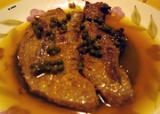
Veal

Encyclopedia
Veal is the meat
of young cattle
(calves
), as opposed to meat from older cattle. Though veal can be produced from a calf of either sex and any breed, most veal comes from male calves of dairy cattle
breeds.
The veal industry's support for the dairy industry goes beyond the purchase of surplus calves. It also buys large amounts of milk byproducts. Almost 70% of veal feeds (by weight) are milk products. Most popular are whey and whey protein concentrate (WPC), byproducts of the manufacture of cheese. Milk byproducts are sources of protein and lactose
. Skimmed milk powder, casein
, buttermilk
powder and other forms of milk byproducts are used from time to time.
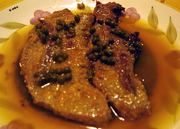 Veal has been an important ingredient in Italian
and French cuisine
from ancient times. The veal is often in the form of cutlets, such as the Italian cotoletta
or the famous Austrian dish Wiener Schnitzel
. Some classic French veal dishes include: fried escalopes, fried veal grenadines (small thick fillet steaks), stuffed paupiette
s, roast joints and blanquette
s. As veal is lower in fat than many meats, care must be taken in preparation to ensure that it does not become tough. Veal is often coated
in preparation for frying or eaten with a sauce. Veal Parmigiana
is a common Italian-American dish consisting of breaded veal cutlets.
In addition to providing meat, the bones of calves are used to make a stock
that forms the base for sauce
s and soup
s such as demi-glace
. The stomachs are also used to produce rennet
, used in the production of cheese
. Calf offal
is also widely regarded as the most prized of animal offal. Most valued are the liver, sweetbread
s, kidney, and bone marrow. The head, brains, tongue, feet, and mesentery
are also valued.
Newborn calves are given a varied amount of time with their mothers, which can be anything from a few hours to a few days. Free-raised calves are raised alongside their mothers, and always have access to their mother’s milk.
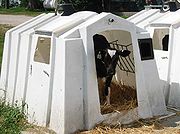 Three different primary types of housing used for veal calves: hutches, stalls, or various types of group housing.
While calves are young and most vulnerable to disease, they are kept in hutches, which keep them isolated and restrict movement so as to prevent connective tissue from developing, as the taste of veal raised in this manner is considered desirable, although this has been illegal in most of Europe since the 1970s.
Free-raised or pasture-raised veal calves require no housing, barns, or facilities. Calves freely roam open pastures with their mothers and herd.
"Grain-fed" calves normally consume a diet of milk replacer for the first six to eight weeks. The calves then move on to a mostly corn-based diet.
Free-raised calves are raised on an open pasture and receive a diet of milk, grass, and fresh water. Furthermore, free-raised calves do not receive drugs such as hormones or antibiotics, which is often a focus of criticism amongst animal welfare organizations.
.
Multiple animal welfare organizations, who strongly focus on factory farming
, attempt to educate consumers about several veal production procedures they consider to be inhumane. This education has proven successful in creating pressure on the industry, resulting in recently announced changes in the methods used by the veal industry.
A strong animal welfare movement concerning veal started in the 1980s with the release of photographs of veal calves tethered in crates where they could barely move. After the release of these photographs, veal sales have plummeted, and have never recovered.
Many veal farmers listened to the concerns of their customers, and have started improving conditions in their veal farms.
The American Veal Association has announced they plan to phase out the use of crates by 2017, which is often the main focus of controversy in veal farming. Strauss Brands is the first veal packer in the U.S. to raise veal calves completely tether-free and group-raised since December 31, 2008.
Criticism with veal crates revolves around the fact that the veal calves are highly restricted in movement; have unsuitable flooring; spend their entire lives indoors; experience prolonged sensory, social, and exploratory deprivation; and are more susceptible to high amounts of stress and disease. However, according to the Veal Quality Assurance Program and Veal Issues Management Program industry fact sheet, and the Ontario Veal Association, individual housing systems are important for disease control, and in reducing the possibility of physical injury. Furthermore, they state it also allows for veal farmers to provide more personal attention to veal calves, being in individual crates.
Alternative agricultural practices for using male dairy calves include raising bob veal (slaughter at two or three days old), raising calves as "red veal" without the severity of dietary restrictions needed to create pale meat (resulting in fewer antibiotic treatments and lower calf mortality), and as dairy beef.
When it comes to the centuries-old method of free raised veal, calves never experience the stress of confinement, separation from their mothers and herd-mates, or an unnatural diet. Many veal producers are realizing this, and the demand for free-raised veal is rapidly increasing.
In 2007, less than 5% of veal calves were raised in a group environment. In 2009, this had increased to 35%.
In a hidden-camera investigation by the HSUS, a USDA Food Safety and Inspection Service inspector was shown coaching a slaughterhouse worker on ways to avoid having the facility being shut down. The facility, Bushway Packing, was shut down by the USDA with the Vermont Agriculture Agency.
In 2004, an official of the USDA found a lump on a veal calf in a Wisconsin veal farm, which turned out to be an illegal hormone implant (such implants are only allowed legally for beef cattle). PETA claims the American Veal Association has confessed that this practice has been going on for 30 years.
The USDA has expressed concern that the use of illegal drugs might be widespread in the veal industry.
The USDA claims, in relation to penicillin
, the following:
, as of 2007. Switzerland, with its substantial dairy industry, continues to use crates.
Veal calf production as such is not allowed in many Northern European countries, such as in Finland. In Finland, giving feed, drink or other nutrition which is known to be dangerous to the health of the animal to an animal which is being cared for is prohibited, as well as failing to give nutrients the lack of which is known to cause the animal to fall ill. The Finnish Animal Welfare Act of 1996 and the Finnish animal welfare decree of 1996 effectively banned crates in Finland and provided general guidelines for the housing and care of animals.
. As stated above, several large veal producers, as well as the American Veal Association, are working on phasing out veal crates.
State-by-state veal crate bans are as follows:
Current active legislation in:
Meat
Meat is animal flesh that is used as food. Most often, this means the skeletal muscle and associated fat and other tissues, but it may also describe other edible tissues such as organs and offal...
of young cattle
Cattle
Cattle are the most common type of large domesticated ungulates. They are a prominent modern member of the subfamily Bovinae, are the most widespread species of the genus Bos, and are most commonly classified collectively as Bos primigenius...
(calves
Calf
Calves are the young of domestic cattle. Calves are reared to become adult cattle, or are slaughtered for their meat, called veal.-Terminology:...
), as opposed to meat from older cattle. Though veal can be produced from a calf of either sex and any breed, most veal comes from male calves of dairy cattle
Dairy cattle
Dairy cattle are cattle cows bred for the ability to produce large quantities of milk, from which dairy products are made. Dairy cows generally are of the species Bos taurus....
breeds.
Types
There are five types of veal:- Bob veal, from calves that are slaughtered when only a few days old (70-150 lb.) up to 150 lb.
- Formula-fed (or "milk-fed") veal, from calves that are raised on a milk formula supplement. The meat colour is ivory or creamy pink, with a firm, fine, and velvety appearance. They are usually slaughtered when they reach 18–20 weeks of age (450-500 lb).
- Non-formula-fed ("red" or "grain-fed") veal, from calves that are raised on grain, hay, or other solid food, in addition to milk. The meat is darker in colour, and some additional marbling and fat may be apparent. It is usually marketed as calf, rather than veal, at 22–26 weeks of age (650-700 lb).
- Rose veal UK is from calves reared on farms in association with the UK RSPCA's Freedom Food programme. Its name comes from its pink colour, which is a result of the calves being slaughtered at around 35 weeks.
- Free-raised veal, The veal calves are raised in the pasture, and have unlimited access to mother’s milk and pasture grasses. They are not administered hormones or antibiotics. These conditions replicate those used to raise authentic pasture-raised veal. The meat is a rich pink color. Free-raised veal are typically lower in fat than other veal. Calves are slaughtered at about 24 weeks of age.
The veal industry's support for the dairy industry goes beyond the purchase of surplus calves. It also buys large amounts of milk byproducts. Almost 70% of veal feeds (by weight) are milk products. Most popular are whey and whey protein concentrate (WPC), byproducts of the manufacture of cheese. Milk byproducts are sources of protein and lactose
Lactose
Lactose is a disaccharide sugar that is found most notably in milk and is formed from galactose and glucose. Lactose makes up around 2~8% of milk , although the amount varies among species and individuals. It is extracted from sweet or sour whey. The name comes from or , the Latin word for milk,...
. Skimmed milk powder, casein
Casein
Casein is the name for a family of related phosphoprotein proteins . These proteins are commonly found in mammalian milk, making up 80% of the proteins in cow milk and between 60% and 65% of the proteins in human milk....
, buttermilk
Buttermilk
Buttermilk refers to a number of dairy drinks. Originally, buttermilk was the liquid left behind after churning butter out of cream. It also refers to a range of fermented milk drinks, common in warm climates where unrefrigerated fresh milk otherwise sours quickly...
powder and other forms of milk byproducts are used from time to time.
Culinary uses
Italian cuisine
Italian cuisine has developed through centuries of social and political changes, with roots as far back as the 4th century BCE. Italian cuisine in itself takes heavy influences, including Etruscan, ancient Greek, ancient Roman, Byzantine, Jewish and Arab cuisines...
and French cuisine
French cuisine
French cuisine is a style of food preparation originating from France that has developed from centuries of social change. In the Middle Ages, Guillaume Tirel , a court chef, authored Le Viandier, one of the earliest recipe collections of Medieval France...
from ancient times. The veal is often in the form of cutlets, such as the Italian cotoletta
Cotoletta
Cotoletta is an Italian word for a breaded veal cutlet....
or the famous Austrian dish Wiener Schnitzel
Wiener schnitzel
Schnitzel is a traditional Austrian dish made with boneless meat thinned with a mallet , coated in bread crumbs and fried. It is a popular part of Viennese, Austrian cuisine and German Cuisine...
. Some classic French veal dishes include: fried escalopes, fried veal grenadines (small thick fillet steaks), stuffed paupiette
Paupiette
A paupiette is a piece of veal meat, beaten thin, and rolled with a stuffing of vegetables, fruits or sweetmeats. It is often featured in recipes from Normandy.It is often fried or braised, or baked in wine or stock...
s, roast joints and blanquette
Blanquette de veau
Blanquette de veau is a French veal ragout in which neither the veal nor the butter is browned in the cooking process. To refrain from browning meat and fat in this way is to cook them en blanquette....
s. As veal is lower in fat than many meats, care must be taken in preparation to ensure that it does not become tough. Veal is often coated
Breading
Breading is a dry grain-derived food coating for a piece of food such as meat, vegetable, poultry, fish, shellfish, crustacean, seitan, or textured soy, made from breadcrumbs or a breading mixture with seasonings. Breading can also refer to the process of applying a bread-like coating to a food...
in preparation for frying or eaten with a sauce. Veal Parmigiana
Parmigiana
Parmigiana is a Southern Italian dish made with a shallow-fried sliced filling, layered with cheese and tomato sauce, then baked. Parmigiana made with a filling of aubergine is the earliest version...
is a common Italian-American dish consisting of breaded veal cutlets.
In addition to providing meat, the bones of calves are used to make a stock
Stock (food)
Stock is a flavoured water preparation. It forms the basis of many dishes, particularly soups and sauces.- Preparation :Stock is made by simmering various ingredients in water, including some or all of the following...
that forms the base for sauce
Sauce
In cooking, a sauce is liquid, creaming or semi-solid food served on or used in preparing other foods. Sauces are not normally consumed by themselves; they add flavor, moisture, and visual appeal to another dish. Sauce is a French word taken from the Latin salsus, meaning salted...
s and soup
Soup
Soup is a generally warm food that is made by combining ingredients such as meat and vegetables with stock, juice, water, or another liquid. Hot soups are additionally characterized by boiling solid ingredients in liquids in a pot until the flavors are extracted, forming a broth.Traditionally,...
s such as demi-glace
Demi-glace
Demi-glace is a rich brown sauce in French cuisine used by itself or as a base for other sauces. The term comes from the French word glace, which used in reference to a sauce means icing or glaze...
. The stomachs are also used to produce rennet
Rennet
Rennet is a complex of enzymes produced in any mammalian stomach to digest the mother's milk, and is often used in the production of cheese. Rennet contains many enzymes, including a proteolytic enzyme that coagulates the milk, causing it to separate into solids and liquid...
, used in the production of cheese
Cheese
Cheese is a generic term for a diverse group of milk-based food products. Cheese is produced throughout the world in wide-ranging flavors, textures, and forms....
. Calf offal
Offal
Offal , also called, especially in the United States, variety meats or organ meats, refers to the internal organs and entrails of a butchered animal. The word does not refer to a particular list of edible organs, which varies by culture and region, but includes most internal organs other than...
is also widely regarded as the most prized of animal offal. Most valued are the liver, sweetbread
Sweetbread
Sweetbreads or ris are culinary names for the thymus or the pancreas especially of the calf and lamb...
s, kidney, and bone marrow. The head, brains, tongue, feet, and mesentery
Mesentery
In anatomy, the mesentery is the double layer of peritoneum that suspends the jejunum and ileum from the posterior wall of the abdomen. Its meaning, however, is frequently extended to include double layers of peritoneum connecting various components of the abdominal cavity.-Mesentery :The...
are also valued.
Birth
Veal is a byproduct of the dairy industry and comes from male dairy calves. Veal in the United States contributes $250 million to the American dairy industry. To produce milk, cows must be lactating, and to be lactating, they must get pregnant and give birth. Approximately 50% of all calves born in dairy farming are male. Since only female calves are used to produce milk, use of male dairy calves is limited, outside of breeding.Newborn calves are given a varied amount of time with their mothers, which can be anything from a few hours to a few days. Free-raised calves are raised alongside their mothers, and always have access to their mother’s milk.
Housing
While calves are young and most vulnerable to disease, they are kept in hutches, which keep them isolated and restrict movement so as to prevent connective tissue from developing, as the taste of veal raised in this manner is considered desirable, although this has been illegal in most of Europe since the 1970s.
Free-raised or pasture-raised veal calves require no housing, barns, or facilities. Calves freely roam open pastures with their mothers and herd.
Feeding
"Milk-fed" veal calves consume a diet consisting of milk replacer, formulated with mostly milk-based proteins and added vitamins and minerals. This type of diet relates to infant formula and is also one of the most common diets used for calves in the veal industry."Grain-fed" calves normally consume a diet of milk replacer for the first six to eight weeks. The calves then move on to a mostly corn-based diet.
Free-raised calves are raised on an open pasture and receive a diet of milk, grass, and fresh water. Furthermore, free-raised calves do not receive drugs such as hormones or antibiotics, which is often a focus of criticism amongst animal welfare organizations.
Animal welfare
Veal is a controversial issue in terms of animal welfareAnimal welfare
Animal welfare is the physical and psychological well-being of animals.The term animal welfare can also mean human concern for animal welfare or a position in a debate on animal ethics and animal rights...
.
Multiple animal welfare organizations, who strongly focus on factory farming
Factory farming
Factory farming is a term referring to the process of raising livestock in confinement at high stocking density, where a farm operates as a factory — a practice typical in industrial farming by agribusinesses. The main products of this industry are meat, milk and eggs for human consumption...
, attempt to educate consumers about several veal production procedures they consider to be inhumane. This education has proven successful in creating pressure on the industry, resulting in recently announced changes in the methods used by the veal industry.
A strong animal welfare movement concerning veal started in the 1980s with the release of photographs of veal calves tethered in crates where they could barely move. After the release of these photographs, veal sales have plummeted, and have never recovered.
Many veal farmers listened to the concerns of their customers, and have started improving conditions in their veal farms.
The American Veal Association has announced they plan to phase out the use of crates by 2017, which is often the main focus of controversy in veal farming. Strauss Brands is the first veal packer in the U.S. to raise veal calves completely tether-free and group-raised since December 31, 2008.
Criticism with veal crates revolves around the fact that the veal calves are highly restricted in movement; have unsuitable flooring; spend their entire lives indoors; experience prolonged sensory, social, and exploratory deprivation; and are more susceptible to high amounts of stress and disease. However, according to the Veal Quality Assurance Program and Veal Issues Management Program industry fact sheet, and the Ontario Veal Association, individual housing systems are important for disease control, and in reducing the possibility of physical injury. Furthermore, they state it also allows for veal farmers to provide more personal attention to veal calves, being in individual crates.
Alternative agricultural practices for using male dairy calves include raising bob veal (slaughter at two or three days old), raising calves as "red veal" without the severity of dietary restrictions needed to create pale meat (resulting in fewer antibiotic treatments and lower calf mortality), and as dairy beef.
When it comes to the centuries-old method of free raised veal, calves never experience the stress of confinement, separation from their mothers and herd-mates, or an unnatural diet. Many veal producers are realizing this, and the demand for free-raised veal is rapidly increasing.
In 2007, less than 5% of veal calves were raised in a group environment. In 2009, this had increased to 35%.
Bob veal slaughterhouse closure
In November 2009, a slaughterhouse certified as an organic processor in Vermont specializing in bob veal was closed after a series of cases of inhumane treatment towards veal calves. Inhumane treatment, in this situation, involved calves that appeared to have been skinned alive, kicked, dragged, and repeatedly shocked with electric prods.In a hidden-camera investigation by the HSUS, a USDA Food Safety and Inspection Service inspector was shown coaching a slaughterhouse worker on ways to avoid having the facility being shut down. The facility, Bushway Packing, was shut down by the USDA with the Vermont Agriculture Agency.
Drug usage in veal
The USDA does not approve the use of hormones on veal calves for any reason, with the exclusion for use in ruminating cattle, which is not related to veal. They do, however, approve the use of antibiotics in veal raising to treat or prevent disease. There is no check to see whether farmers and veal producers do not use antibiotics for reasons other than preventing or treating diseases.In 2004, an official of the USDA found a lump on a veal calf in a Wisconsin veal farm, which turned out to be an illegal hormone implant (such implants are only allowed legally for beef cattle). PETA claims the American Veal Association has confessed that this practice has been going on for 30 years.
The USDA has expressed concern that the use of illegal drugs might be widespread in the veal industry.
The USDA claims, in relation to penicillin
Penicillin
Penicillin is a group of antibiotics derived from Penicillium fungi. They include penicillin G, procaine penicillin, benzathine penicillin, and penicillin V....
, the following:
Veal crate bans
The following shows where veal crates have been banned, or are currently in the process of being banned:Europe
Veal crates became illegal in the UK in 1990, and a full ban has been placed for the entire European UnionEuropean Union
The European Union is an economic and political union of 27 independent member states which are located primarily in Europe. The EU traces its origins from the European Coal and Steel Community and the European Economic Community , formed by six countries in 1958...
, as of 2007. Switzerland, with its substantial dairy industry, continues to use crates.
Veal calf production as such is not allowed in many Northern European countries, such as in Finland. In Finland, giving feed, drink or other nutrition which is known to be dangerous to the health of the animal to an animal which is being cared for is prohibited, as well as failing to give nutrients the lack of which is known to cause the animal to fall ill. The Finnish Animal Welfare Act of 1996 and the Finnish animal welfare decree of 1996 effectively banned crates in Finland and provided general guidelines for the housing and care of animals.
USA
Crates are slowly being banned in the United StatesUnited States
The United States of America is a federal constitutional republic comprising fifty states and a federal district...
. As stated above, several large veal producers, as well as the American Veal Association, are working on phasing out veal crates.
State-by-state veal crate bans are as follows:
- 2006 - ArizonaArizonaArizona ; is a state located in the southwestern region of the United States. It is also part of the western United States and the mountain west. The capital and largest city is Phoenix...
(effective 2012, a part of Proposition 204Proposition 204Proposition 204 of 2006 was a law enacted by the voters of Arizona by means of the initiative process. It requires that pigs and calves used for veal on factory farms be given enough room to turn around and fully extend their limbs. The Act was approved in a vote held as part of the 2006 Arizona...
) - 2008 - ColoradoColoradoColorado is a U.S. state that encompasses much of the Rocky Mountains as well as the northeastern portion of the Colorado Plateau and the western edge of the Great Plains...
(effective 2012) - 2008 - CaliforniaCaliforniaCalifornia is a state located on the West Coast of the United States. It is by far the most populous U.S. state, and the third-largest by land area...
(effective 2013, a part of Proposition 2) - 2009 - MaineMaineMaine is a state in the New England region of the northeastern United States, bordered by the Atlantic Ocean to the east and south, New Hampshire to the west, and the Canadian provinces of Quebec to the northwest and New Brunswick to the northeast. Maine is both the northernmost and easternmost...
(effective 2011) - 2009 - MichiganMichiganMichigan is a U.S. state located in the Great Lakes Region of the United States of America. The name Michigan is the French form of the Ojibwa word mishigamaa, meaning "large water" or "large lake"....
(effective 2013)
Current active legislation in:
- New YorkNew YorkNew York is a state in the Northeastern region of the United States. It is the nation's third most populous state. New York is bordered by New Jersey and Pennsylvania to the south, and by Connecticut, Massachusetts and Vermont to the east...
(proposed in May 2009, if passed: planned to take effect in 2015) - MassachusettsMassachusettsThe Commonwealth of Massachusetts is a state in the New England region of the northeastern United States of America. It is bordered by Rhode Island and Connecticut to the south, New York to the west, and Vermont and New Hampshire to the north; at its east lies the Atlantic Ocean. As of the 2010...
(proposed in January 2009, if passed: planned to take effect in 2015)
See also
- Culinary nameCulinary nameCulinary names, menu names, or kitchen names are names of foods used in the preparation or selling of food, as opposed to their names in agriculture or in scientific nomenclature. The menu name may even be different from the kitchen name...
, the use of a different name for the food (veal) and the animal (calf)
External links
- Ontario Veal Association — Ontario veal industry in Canada.
- Thinking Outside the Box — Dutch veal farming from Beef magazine
- Veal Farm — Veal industry in the USA.
- Veal Recipes. A collection of recipes for various cuts of veal, tips on cooking, selection and handling of veal
- Veal Shop - sources for buying exclusively veal cuts and meals online in the USA, also a source for veal recipe books