

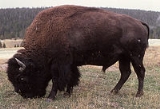
Bison

Encyclopedia
Members of the genus Bison are large, even-toed ungulate
s within the subfamily Bovinae
. Two extant and four extinct
species are recognized. The surviving species are the American bison
, also known as the American buffalo (although it is only distantly related to the true buffalo
), Bison bison (with two subspecies, the plains bison
, Bison bison bison, and the wood bison
, Bison bison athabascae), found in North America, and the European bison, or wisent
(Bison bonasus), found in Europe and the Caucasus
. While these species are usually grouped into their own genus
, they are sometimes included in the closely related genus Bos
, together with cattle
, gaur
, kouprey
and yak
s, with which bison have a limited ability to interbreed.
 The American bison and the European wisent are good swimmers and are the largest terrestrial animals in North America
and Europe
. Bison are nomadic grazers
and travel in herd
s, except for the nondominant bulls, which travel alone or in small groups during most of the year. American bison are known for living in the Great Plains
. Both species were hunted close to extinction
during the 19th and 20th centuries, but have since rebounded. The American plains bison is no longer listed as endangered, but the wood bison is on the endangered species list in Canada.
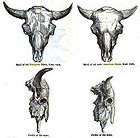
Although superficially similar, there are a number of physical and behavioural differences between the American and European bison. The American species has 15 ribs, while the European bison has 14. The American bison has four lumbar vertebrae, while the European has five. Adult American bison are not as rangy in build, and have shorter legs. American bison tend to graze
more, and browse
less than their European cousins. Their anatomies reflect this behavioural difference; the American bison's head hangs closer to the earth than the European's. The body of the American bison is typically hairier, though its tail has less hair than that of the European bison. The horns of the European bison point through the plane of their faces, making them more adept at fighting through the interlocking of horns in the same manner as domestic cattle, unlike the American bison, which favours butting. American bison are more easily tamed than their European cousins, and breed with domestic cattle more readily.
:
However, Y chromosome analysis associated wisent and American bison. An earlier study using amplified fragment length polymorphism (AFLP) fingerprinting showed a close association of wisent and American bison and probably with yak, but noted that the interbreeding of Bovini species made determining relationships problematic.
During the population bottleneck, American bison were interbred with domestic cattle. Accidental crossings were also known to occur. Generally, male domestic bulls were crossed with buffalo cows, producing offspring of which only the females were fertile. Genetic analysis has found a high degree of intermixture in modern commercial bison herds. Some cattle breeds are intentionally bred with bison to produce, for instance, Beefalo
hybrids. Wisent-American bison hybrids were briefly experimented with in Germany (and found to be fully fertile) and a herd of such animals is maintained in Russia all the time. A herd of cattle-wisent crossbreeds (Zubron
) is maintained in Poland. First-generation crosses do not occur naturally, requiring caesarean delivery. First-generation males are infertile.
 Wallowing is a common behavior of bison. A bison wallow is a shallow depression in the soil, either wet or dry. Bison roll in these depressions, covering themselves with mud or dust. Possible explanations suggested for wallowing behavior include grooming behavior associated with moulting, male-male interaction (typically rutting
behavior), social behavior for group cohesion, play behavior, relief from skin irritation due to biting insects, reduction of ectoparasite
load (tick
s and lice
), and thermoregulation.
In the process of wallowing, bison may become infected by the fatal disease anthrax
, which may occur naturally in the soil.
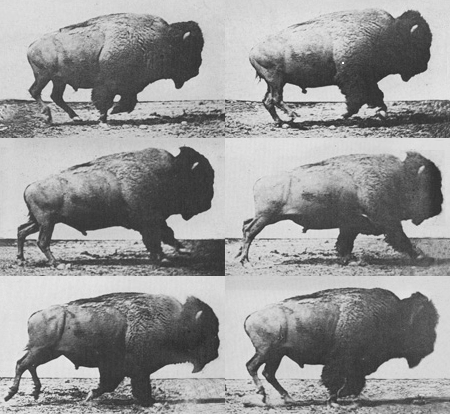
The bison's temperament is often unpredictable. They usually appear peaceful, unconcerned, even lazy, yet they may attack anything, often without warning or apparent reason. They can move at speeds of up to 35 mph (15.6 m/s) and cover long distances at a lumbering gallop.
Their most obvious weapons are the horns borne by both males and females, but their massive heads can be used as battering rams, effectively using the momentum produced by 2000 pounds (907.2 kg) moving at 30 mph (13.4 m/s). The hind legs can also be used to kill or maim with devastating effect. At the time bison ran wild, they were rated second only to the Alaska brown bear as a potential killer, more dangerous than the grizzly bear
. In the words of early naturalists, they were a dangerous, savage animal that feared no other animal and in prime condition could best any foe.
The rutting, or mating, season lasts from June through September, with peak activity in July and August. At this time, the older bulls rejoin the herd, and fights often take place between bulls. The herd exhibits much restlessness during breeding season. The animals are belligerent, unpredictable and most dangerous.
. The bison's main food
is grass
. Bison also eat the low-lying shrub
bery that is available. In the winter, bison forage in the snow
looking for grass. If there is little grass available, bison have to resort to eating the twigs of shrubs.
s will also prey on calves, and have been observed driving off wolves to take over their kills.
Even-toed ungulate
The even-toed ungulates are ungulates whose weight is borne about equally by the third and fourth toes, rather than mostly or entirely by the third as in odd-toed ungulates such as horses....
s within the subfamily Bovinae
Bovinae
The biological subfamily Bovinae includes a diverse group of 10 genera of medium to large sized ungulates, including domestic cattle, the bison, African buffalo, the water buffalo, the yak, and the four-horned and spiral-horned antelopes...
. Two extant and four extinct
Extinction
In biology and ecology, extinction is the end of an organism or of a group of organisms , normally a species. The moment of extinction is generally considered to be the death of the last individual of the species, although the capacity to breed and recover may have been lost before this point...
species are recognized. The surviving species are the American bison
American Bison
The American bison , also commonly known as the American buffalo, is a North American species of bison that once roamed the grasslands of North America in massive herds...
, also known as the American buffalo (although it is only distantly related to the true buffalo
African Buffalo
The African buffalo, affalo, nyati, Mbogo or Cape buffalo is a large African bovine. It is not closely related to the slightly larger wild Asian water buffalo, but its ancestry remains unclear...
), Bison bison (with two subspecies, the plains bison
Plains Bison
The Plains Bison or Common bison is one of two subspecies/ecotypes of the American Bison, the other being the Wood Bison . Furthermore, it has been suggested that the Plains Bison consists of a northern and a southern subspecies, bringing the total to three...
, Bison bison bison, and the wood bison
Wood Bison
The Wood Bison, Bison bison athabascae, also called Mountain Bison, Wood Buffalo or Mountain Buffalo, is a distinct northern subspecies or ecotype of the American Bison...
, Bison bison athabascae), found in North America, and the European bison, or wisent
Wisent
The wisent , Bison bonasus, also known as the European bison or European wood bison, is a species of Eurasian bison. It is the heaviest surviving land animal in Europe; a typical wisent is about long, not counting a tail of long, and tall. Weight typically can range from , with an occasional big...
(Bison bonasus), found in Europe and the Caucasus
Caucasus
The Caucasus, also Caucas or Caucasia , is a geopolitical region at the border of Europe and Asia, and situated between the Black and the Caspian sea...
. While these species are usually grouped into their own genus
Genus
In biology, a genus is a low-level taxonomic rank used in the biological classification of living and fossil organisms, which is an example of definition by genus and differentia...
, they are sometimes included in the closely related genus Bos
Bos
Bos is the genus of wild and domestic cattle. Bos can be divided into four subgenera: Bos, Bibos, Novibos, and Poephagus, but these divisions are controversial. The genus has five extant species...
, together with cattle
Cattle
Cattle are the most common type of large domesticated ungulates. They are a prominent modern member of the subfamily Bovinae, are the most widespread species of the genus Bos, and are most commonly classified collectively as Bos primigenius...
, gaur
Gaur
The gaur , also called Indian bison, is a large bovine native to South Asia and Southeast Asia. The species is listed as vulnerable on the IUCN Red List since 1986 as the population decline in parts of the species' range is likely to be well over 70% over the last three generations...
, kouprey
Kouprey
A kouprey , is a wild, forest-dwelling ox found mainly in northern Cambodia, but also believed to exist in southern Laos, western Vietnam, and eastern Thailand. It was discovered in 1937.Koupreys are very large ungulates, and can approach similar sizes to the wild Asian water buffalo...
and yak
Yak
The yak, Bos grunniens or Bos mutus, is a long-haired bovine found throughout the Himalayan region of south Central Asia, the Tibetan Plateau and as far north as Mongolia and Russia. In addition to a large domestic population, there is a small, vulnerable wild yak population...
s, with which bison have a limited ability to interbreed.
Description
North America
North America is a continent wholly within the Northern Hemisphere and almost wholly within the Western Hemisphere. It is also considered a northern subcontinent of the Americas...
and Europe
Europe
Europe is, by convention, one of the world's seven continents. Comprising the westernmost peninsula of Eurasia, Europe is generally 'divided' from Asia to its east by the watershed divides of the Ural and Caucasus Mountains, the Ural River, the Caspian and Black Seas, and the waterways connecting...
. Bison are nomadic grazers
Grazing
Grazing generally describes a type of feeding, in which a herbivore feeds on plants , and also on other multicellular autotrophs...
and travel in herd
Herd
Herd refers to a social grouping of certain animals of the same species, either wild or domestic, and also to the form of collective animal behavior associated with this or as a verb, to herd, to its control by another species such as humans or dogs.The term herd is generally applied to mammals,...
s, except for the nondominant bulls, which travel alone or in small groups during most of the year. American bison are known for living in the Great Plains
Great Plains
The Great Plains are a broad expanse of flat land, much of it covered in prairie, steppe and grassland, which lies west of the Mississippi River and east of the Rocky Mountains in the United States and Canada. This area covers parts of the U.S...
. Both species were hunted close to extinction
Extinction
In biology and ecology, extinction is the end of an organism or of a group of organisms , normally a species. The moment of extinction is generally considered to be the death of the last individual of the species, although the capacity to breed and recover may have been lost before this point...
during the 19th and 20th centuries, but have since rebounded. The American plains bison is no longer listed as endangered, but the wood bison is on the endangered species list in Canada.
Although superficially similar, there are a number of physical and behavioural differences between the American and European bison. The American species has 15 ribs, while the European bison has 14. The American bison has four lumbar vertebrae, while the European has five. Adult American bison are not as rangy in build, and have shorter legs. American bison tend to graze
Grazing
Grazing generally describes a type of feeding, in which a herbivore feeds on plants , and also on other multicellular autotrophs...
more, and browse
Browsing (predation)
Browsing is a type of herbivory in which an herbivore feeds on leaves, soft shoots, or fruits of high growing, generally woody, plants such as shrubs. This is contrasted with grazing, usually associated with animals feeding on grass or other low vegetation...
less than their European cousins. Their anatomies reflect this behavioural difference; the American bison's head hangs closer to the earth than the European's. The body of the American bison is typically hairier, though its tail has less hair than that of the European bison. The horns of the European bison point through the plane of their faces, making them more adept at fighting through the interlocking of horns in the same manner as domestic cattle, unlike the American bison, which favours butting. American bison are more easily tamed than their European cousins, and breed with domestic cattle more readily.
Genetic history
A 2003 study of mitochondrial DNA indicated four distinct maternal lineages in tribe BoviniBovini
The Bovini tribe is made up of large to very large grazers, including large animals of great economic significance to humans in Domestic Cattle, Domestic buffalo, and the Yak, as well as smaller Asian relatives, and large free-roaming bovids in the African Buffalo and the American...
:
- taurine cattleCattleCattle are the most common type of large domesticated ungulates. They are a prominent modern member of the subfamily Bovinae, are the most widespread species of the genus Bos, and are most commonly classified collectively as Bos primigenius...
and zebuZebuZebu , sometimes known as humped cattle, indicus cattle, Cebu or Brahmin cattle are a type of domestic cattle originating in South Asia, particularly the Indian subcontinent. They are characterised by a fatty hump on their shoulders, drooping ears and a large dewlap...
, - wisent,
- American bison and yakYakThe yak, Bos grunniens or Bos mutus, is a long-haired bovine found throughout the Himalayan region of south Central Asia, the Tibetan Plateau and as far north as Mongolia and Russia. In addition to a large domestic population, there is a small, vulnerable wild yak population...
, and - bantengBantengThe banteng , also known as tembadau, is a species of wild cattle found in Southeast Asia.Banteng have been domesticated in several places in Southeast Asia, and there are around 1.5 million domestic banteng, which are called Bali cattle. These animals are used as working animals and for their meat...
, gaurGaurThe gaur , also called Indian bison, is a large bovine native to South Asia and Southeast Asia. The species is listed as vulnerable on the IUCN Red List since 1986 as the population decline in parts of the species' range is likely to be well over 70% over the last three generations...
, and gayalGayalGayal or mithun is the domestic gaur, probably a gaur-cattle hybrid breed.-Taxonomy:In his first description of 1804, Aylmer Bourke Lambert applied the binomial Bos frontalis to a domestic specimen probably from Chittagong....
.
However, Y chromosome analysis associated wisent and American bison. An earlier study using amplified fragment length polymorphism (AFLP) fingerprinting showed a close association of wisent and American bison and probably with yak, but noted that the interbreeding of Bovini species made determining relationships problematic.
During the population bottleneck, American bison were interbred with domestic cattle. Accidental crossings were also known to occur. Generally, male domestic bulls were crossed with buffalo cows, producing offspring of which only the females were fertile. Genetic analysis has found a high degree of intermixture in modern commercial bison herds. Some cattle breeds are intentionally bred with bison to produce, for instance, Beefalo
Beefalo
Beefalo are a fertile hybrid offspring of domestic cattle, Bos taurus, and the American bison, Bison bison...
hybrids. Wisent-American bison hybrids were briefly experimented with in Germany (and found to be fully fertile) and a herd of such animals is maintained in Russia all the time. A herd of cattle-wisent crossbreeds (Zubron
Zubron
Żubroń is a hybrid of domestic cattle and wisent. The wisent is the European bison; hence, the żubroń is analogous to the American beefalo...
) is maintained in Poland. First-generation crosses do not occur naturally, requiring caesarean delivery. First-generation males are infertile.
Behavior
Rut (mammalian reproduction)
The rut is the mating season of ruminant animals such as deer, sheep, elk, moose, caribou, ibex, goats, pronghorn and Asian and African antelope....
behavior), social behavior for group cohesion, play behavior, relief from skin irritation due to biting insects, reduction of ectoparasite
Parasitism
Parasitism is a type of symbiotic relationship between organisms of different species where one organism, the parasite, benefits at the expense of the other, the host. Traditionally parasite referred to organisms with lifestages that needed more than one host . These are now called macroparasites...
load (tick
Tick
Ticks are small arachnids in the order Ixodida, along with mites, constitute the subclass Acarina. Ticks are ectoparasites , living by hematophagy on the blood of mammals, birds, and sometimes reptiles and amphibians...
s and lice
Louse
Lice is the common name for over 3,000 species of wingless insects of the order Phthiraptera; three of which are classified as human disease agents...
), and thermoregulation.
In the process of wallowing, bison may become infected by the fatal disease anthrax
Anthrax
Anthrax is an acute disease caused by the bacterium Bacillus anthracis. Most forms of the disease are lethal, and it affects both humans and other animals...
, which may occur naturally in the soil.
The bison's temperament is often unpredictable. They usually appear peaceful, unconcerned, even lazy, yet they may attack anything, often without warning or apparent reason. They can move at speeds of up to 35 mph (15.6 m/s) and cover long distances at a lumbering gallop.
Their most obvious weapons are the horns borne by both males and females, but their massive heads can be used as battering rams, effectively using the momentum produced by 2000 pounds (907.2 kg) moving at 30 mph (13.4 m/s). The hind legs can also be used to kill or maim with devastating effect. At the time bison ran wild, they were rated second only to the Alaska brown bear as a potential killer, more dangerous than the grizzly bear
Grizzly Bear
The grizzly bear , also known as the silvertip bear, the grizzly, or the North American brown bear, is a subspecies of brown bear that generally lives in the uplands of western North America...
. In the words of early naturalists, they were a dangerous, savage animal that feared no other animal and in prime condition could best any foe.
The rutting, or mating, season lasts from June through September, with peak activity in July and August. At this time, the older bulls rejoin the herd, and fights often take place between bulls. The herd exhibits much restlessness during breeding season. The animals are belligerent, unpredictable and most dangerous.
Diet
Bison have a fairly simple dietDiet (nutrition)
In nutrition, diet is the sum of food consumed by a person or other organism. Dietary habits are the habitual decisions an individual or culture makes when choosing what foods to eat. With the word diet, it is often implied the use of specific intake of nutrition for health or weight-management...
. The bison's main food
Food
Food is any substance consumed to provide nutritional support for the body. It is usually of plant or animal origin, and contains essential nutrients, such as carbohydrates, fats, proteins, vitamins, or minerals...
is grass
Grass
Grasses, or more technically graminoids, are monocotyledonous, usually herbaceous plants with narrow leaves growing from the base. They include the "true grasses", of the Poaceae family, as well as the sedges and the rushes . The true grasses include cereals, bamboo and the grasses of lawns ...
. Bison also eat the low-lying shrub
Shrub
A shrub or bush is distinguished from a tree by its multiple stems and shorter height, usually under 5–6 m tall. A large number of plants may become either shrubs or trees, depending on the growing conditions they experience...
bery that is available. In the winter, bison forage in the snow
Snow
Snow is a form of precipitation within the Earth's atmosphere in the form of crystalline water ice, consisting of a multitude of snowflakes that fall from clouds. Since snow is composed of small ice particles, it is a granular material. It has an open and therefore soft structure, unless packed by...
looking for grass. If there is little grass available, bison have to resort to eating the twigs of shrubs.
Predators
Due to their large size, few predators attack bison. However, wolf packs can take down a bison. There are even documented cases of a single wolf taking down bison (Schmidt & Mech, 1997). Brown bearBrown Bear
The brown bear is a large bear distributed across much of northern Eurasia and North America. It can weigh from and its largest subspecies, the Kodiak Bear, rivals the polar bear as the largest member of the bear family and as the largest land-based predator.There are several recognized...
s will also prey on calves, and have been observed driving off wolves to take over their kills.
See also
- American bisonAmerican BisonThe American bison , also commonly known as the American buffalo, is a North American species of bison that once roamed the grasslands of North America in massive herds...
- GaurGaurThe gaur , also called Indian bison, is a large bovine native to South Asia and Southeast Asia. The species is listed as vulnerable on the IUCN Red List since 1986 as the population decline in parts of the species' range is likely to be well over 70% over the last three generations...
- Wood bisonWood BisonThe Wood Bison, Bison bison athabascae, also called Mountain Bison, Wood Buffalo or Mountain Buffalo, is a distinct northern subspecies or ecotype of the American Bison...
- African buffaloAfrican BuffaloThe African buffalo, affalo, nyati, Mbogo or Cape buffalo is a large African bovine. It is not closely related to the slightly larger wild Asian water buffalo, but its ancestry remains unclear...
- Great bison beltGreat bison beltThe Great Bison Belt is a tract of rich grassland that ran from Alaska to the Gulf of Mexico around 9000 BC. The Great Bison Belt was supported by spring and early summer rainfall that allowed short grasses to grow...
- WisentWisentThe wisent , Bison bonasus, also known as the European bison or European wood bison, is a species of Eurasian bison. It is the heaviest surviving land animal in Europe; a typical wisent is about long, not counting a tail of long, and tall. Weight typically can range from , with an occasional big...