


Fiordland

Encyclopedia

New Zealand
New Zealand is an island country in the south-western Pacific Ocean comprising two main landmasses and numerous smaller islands. The country is situated some east of Australia across the Tasman Sea, and roughly south of the Pacific island nations of New Caledonia, Fiji, and Tonga...
that is situated on the south-western corner of the South Island
South Island
The South Island is the larger of the two major islands of New Zealand, the other being the more populous North Island. It is bordered to the north by Cook Strait, to the west by the Tasman Sea, to the south and east by the Pacific Ocean...
, comprising the western-most third of Southland
Southland Region
Southland is New Zealand's southernmost region and is also a district within that region. It consists mainly of the southwestern portion of the South Island and Stewart Island / Rakiura...
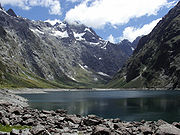
. Most of Fiordland is dominated by the steep sides of the snow-capped Southern Alps
Southern Alps
The Southern Alps is a mountain range extending along much of the length of New Zealand's South Island, reaching its greatest elevations near the island's western side...
, deep lakes and its ocean-flooded, steep western valleys. Indeed, the name "Fiordland" comes from a variant spelling of the Scandinavian
North Germanic languages
The North Germanic languages or Scandinavian languages, the languages of Scandinavians, make up one of the three branches of the Germanic languages, a sub-family of the Indo-European languages, along with the West Germanic languages and the extinct East Germanic languages...
word for this type of steep valley, "fjord
Fjord
Geologically, a fjord is a long, narrow inlet with steep sides or cliffs, created in a valley carved by glacial activity.-Formation:A fjord is formed when a glacier cuts a U-shaped valley by abrasion of the surrounding bedrock. Glacial melting is accompanied by rebound of Earth's crust as the ice...
".
Fiordland features a number of fiords (often misnamed sounds
Sound (geography)
In geography a sound or seaway is a large sea or ocean inlet larger than a bay, deeper than a bight and wider than a fjord; or it may be defined as a narrow sea or ocean channel between two bodies of land ....
), of which Milford Sound
Milford Sound
Milford Sound is a fjord in the south west of New Zealand's South Island, within Fiordland National Park, Piopiotahi Marine Reserve, and the Te Wahipounamu World Heritage site...
is the most famous, though Doubtful Sound
Doubtful Sound
Doubtful Sound is a very large and naturally imposing fjord in Fiordland, in the far south west of New Zealand. It is located in the same region as the smaller but more famous and accessible Milford Sound...
is even larger and has more, and longer, branches (but is also less accessible). Situated within Fiordland are Browne Falls
Browne Falls
Browne Falls is a waterfall above Doubtful Sound, which is located in Fiordland National Park, New Zealand. In breathtaking scenery amidst temperate rain forest, the falls cascade down to the fiord near Hall Arm...
and Sutherland Falls
Sutherland Falls
Sutherland Falls is a waterfall near Milford Sound in New Zealand's South Island. At 580 metres the falls were long believed to be the tallest waterfall in New Zealand...
, which rank among the tallest waterfall
Waterfall
A waterfall is a place where flowing water rapidly drops in elevation as it flows over a steep region or a cliff.-Formation:Waterfalls are commonly formed when a river is young. At these times the channel is often narrow and deep. When the river courses over resistant bedrock, erosion happens...
s in the world and New Zealand's three deepest lakes, Lake Hauroko
Lake Hauroko
Lake Hauroko is located in a mountain valley in Fiordland National Park in the South Island of New Zealand. The long S-shaped lake is 30 kilometres in length and covers an area of 63 km². The surface is at an altitude of 150 metres above sea level, and the lake is 463 metres deep...
, Lake Manapouri
Lake Manapouri
Lake Manapouri is a lake in the South Island of New Zealand. Its name is Maori for "sorrowful heart", though this name is misapplied due to an early cartographical error...
, and Lake Te Anau
Lake Te Anau
Lake Te Anau is in the southwestern corner of the South Island of New Zealand. Its name was originally Te Ana-au, Maori for 'The cave of swirling water'. The lake covers an area of 344 km², making it the second-largest lake by surface area in New Zealand and the largest in the South Island...
. This part of New Zealand has a very wet climate, receiving 6,300mm of rainfall per year.
History
Fiordland has never had any significant permanent population. Even the Maori only visited temporarily for hunting, fishing and to collect the precious stone Pounamu (New Zealand jade) from Anita Bay and the mouth of Milford Sound.The area was administered as Fiord County from 1876 until it was absorbed into neighbouring Wallace County in 1981. Since 1989 it has formed part of Southland District
Southland District
Southland District is a territorial authority in the South Island of New Zealand. Southland District covers the majority of the land area of Southland Region, although the region also covers Gore District, Invercargill City and adjacent territorial waters...
, in turn part of the Southland Region
Southland Region
Southland is New Zealand's southernmost region and is also a district within that region. It consists mainly of the southwestern portion of the South Island and Stewart Island / Rakiura...
.
Constituent fiords
From north to south:- Milford SoundMilford SoundMilford Sound is a fjord in the south west of New Zealand's South Island, within Fiordland National Park, Piopiotahi Marine Reserve, and the Te Wahipounamu World Heritage site...
- Sutherland Sound
- Bligh Sound
- George Sound
- Caswell Sound
- Charles Sound
- Nancy Sound
- Thompson Sound
- Doubtful SoundDoubtful SoundDoubtful Sound is a very large and naturally imposing fjord in Fiordland, in the far south west of New Zealand. It is located in the same region as the smaller but more famous and accessible Milford Sound...
- Dagg Sound
- Breaksea Sound
- Dusky SoundDusky SoundDusky Sound is a fiord on the south west corner of New Zealand, in Fiordland National Park.-Geography:One of the most complex of the many fjords on this coast, it is also one of the largest, 40 kilometres in length and eight kilometres wide at its widest point...
- Chalky Inlet
- Preservation InletPreservation InletPreservation Inlet is the southernmost fjord in Fiordland National Park and lies on the southwest corner of the South Island of New Zealand.-Geography:...
Two inlets – Chalky and Preservation – lead into Cunaris Sound and Long Sound respectively
Ecology
The area has been categorised as the Fiordland temperate forests ecoregionEcoregion
An ecoregion , sometimes called a bioregion, is an ecologically and geographically defined area that is smaller than an ecozone and larger than an ecosystem. Ecoregions cover relatively large areas of land or water, and contain characteristic, geographically distinct assemblages of natural...
, having a variety of habitats and due to its isolation a high number of endemic plants. Much of Fiordland is heavily forested except for locations where surface rock exposures are extensive. The natural habitats are almost completely unspoilt. Nothofagus
Nothofagus
Nothofagus, also known as the southern beeches, is a genus of 35 species of trees and shrubs native to the temperate oceanic to tropical Southern Hemisphere in southern South America and Australasia...
beech trees are dominant in many locations, silver beech ((Nothofagus menziesii
Nothofagus menziesii
Nothofagus menziesii or Silver beech is a tree of the Nothofagus or southern beech genus endemic to New Zealand. Its common name probably comes from the fact that its bark is whitish in colour, particularly in younger specimens. It is found from Thames southwards in the North Island , and...
) in the fiords and red beech (Nothofagus fusca
Nothofagus fusca
Nothofagus fusca is a species of Nothofagus, endemic to New Zealand, where it occurs on both the North Island and South Island. Generally it is found on lower hills and inland valley floors where soil is fertile and well drained.It is a medium-sized evergreen tree growing to 35 m tall...
) in the inland valleys. In the understory there are a wide variety of shrubs and fern
Fern
A fern is any one of a group of about 12,000 species of plants belonging to the botanical group known as Pteridophyta. Unlike mosses, they have xylem and phloem . They have stems, leaves, and roots like other vascular plants...
s, including Crown Fern, Blechnum discolor
Blechnum discolor
Blechnum discolor is a species of fern in the family Blechnaceae. This species is endemic to New Zealand. As noted by C. Michael Hogan, this species is found in a number of forest communities in diverse locations within New Zealand, and is sometimes a dominant understory component.Spores are...
, areas of scrubby herbs above the treeline, patches of bog next to mountain streams and finally an area of Rimu (Dacrydium cupressinum
Dacrydium cupressinum
Dacrydium cupressinum, commonly known as rimu, is a large evergreen coniferous tree endemic to the forests of New Zealand. It is a member of the southern conifer group, the podocarps. The former name "red pine" has fallen out of common use....
)-dominated sandunes in the Waitutu area on the south coast. The area is home to threatened native bird species such as the flightless takahe
Takahe
The Takahē or South Island Takahē, Porphyrio hochstetteri is a flightless bird indigenous to New Zealand and belonging to the rail family. It was thought to be extinct after the last four known specimens were taken in 1898...
and kiwi
Kiwi
Kiwi are flightless birds endemic to New Zealand, in the genus Apteryx and family Apterygidae.At around the size of a domestic chicken, kiwi are by far the smallest living ratites and lay the largest egg in relation to their body size of any species of bird in the world...
, Blue Duck
Blue Duck
The Blue Duck is a member of the duck, goose and swan family Anatidae endemic to New Zealand. It is the only member of the genus Hymenolaimus, placed in the shelduck subfamily Tadorninae after previously being considered part of the paraphyletic "perching duck" assemblage...
(whio), and Yellowhead (or mohua
Yellowhead (bird)
The Yellowhead or Mohua is a small insectivorous, passerine bird endemic to the South Island of New Zealand...
). There are also a great number of insects and one indigenous reptile, the Fiordland skink (Oligosoma acrinasum
Oligosoma acrinasum
The Fiordland skink, Oligosoma acrinasum, is a species of skink endemic to the Fiordland temperate forests ecoregion of South Island, New Zealand. The Fiordland skink is found on two mainland locations and the exposed rocky shores of numerous islands along the Fiordland coast . Their distribution...
).
Most of the area is covered by the Fiordland National Park
Fiordland National Park
Fiordland National Park occupies the southwest corner of the South Island of New Zealand. It is the largest of the 14 national parks in New Zealand, with an area of 12,500 km², and a major part of the Te Wahipounamu World Heritage site...
, part of the Te Wahipounamu
Te Wahipounamu
Te Wāhipounamu is a World Heritage site in the south west corner of the South Island of New Zealand.Inscribed on the World Heritage List in 1990 and covering 26,000 km², the site incorporates several National Parks:...
World Heritage Site
World Heritage Site
A UNESCO World Heritage Site is a place that is listed by the UNESCO as of special cultural or physical significance...
. Fiordland National Park has an area of 12,120 square kilometres, making it the largest national park
National park
A national park is a reserve of natural, semi-natural, or developed land that a sovereign state declares or owns. Although individual nations designate their own national parks differently A national park is a reserve of natural, semi-natural, or developed land that a sovereign state declares or...
in New Zealand and one of the larger parks in the world, containing many tourist attractions, such as Milford Sound, Doubtful Sound and the Milford Track
Milford Track
The Milford Track is a widely known tramping route in New Zealand – located amidst mountains and temperate rain forest in Fiordland National Park in the southwest of the South Island....
. The main threat to natural habitats is from introduced species
Introduced species
An introduced species — or neozoon, alien, exotic, non-indigenous, or non-native species, or simply an introduction, is a species living outside its indigenous or native distributional range, and has arrived in an ecosystem or plant community by human activity, either deliberate or accidental...
, especially red deer
Red Deer
The red deer is one of the largest deer species. Depending on taxonomy, the red deer inhabits most of Europe, the Caucasus Mountains region, Asia Minor, parts of western Asia, and central Asia. It also inhabits the Atlas Mountains region between Morocco and Tunisia in northwestern Africa, being...
, but these are now being hunted out of the area and furthermore the park includes a number of small offshore islands which are free from introduced species and are designated Specially Protected Areas.
Several offshore areas are protected as part of Fiordland's marine reserves
Fiordland's marine reserves
There are ten marine reserves in Fiordland region of New Zealand's South Island. They protect a wide variety of species and habitats. The original two reserves were established at the request of New Zealand Federation of Commercial Fishermen in 1993...
.
Demographics / Economy
Fiordland has never had more than a few human inhabitants and is the least-populated area of New ZealandNew Zealand
New Zealand is an island country in the south-western Pacific Ocean comprising two main landmasses and numerous smaller islands. The country is situated some east of Australia across the Tasman Sea, and roughly south of the Pacific island nations of New Caledonia, Fiji, and Tonga...
's South Island
South Island
The South Island is the larger of the two major islands of New Zealand, the other being the more populous North Island. It is bordered to the north by Cook Strait, to the west by the Tasman Sea, to the south and east by the Pacific Ocean...
(48 in 2001, virtually uninhabited), with no cities and many areas almost inaccessible except by boat or air. The only settlements close by / in Fiordland (depending on definition) are Manapouri
Manapouri
Manapouri is a small town in Southland / Fiordland, in the southwest corner of the South Island, in New Zealand. Located at the edge of the Fiordland National Park, on the eastern shore of Lake Manapouri, close to its outflow into the Waiau River, tourist boat services are based in the...
and Te Anau
Te Anau
Te Anau is a town in the South Island of New Zealand. It is on the eastern shore of Lake Te Anau in Fiordland. Lake Te Anau is the largest lake in the South Island and second only within New Zealand to Lake Taupo. The 2001 census recorded the town's population as 1,857...
township, which has under 2,000 permanent inhabitants and around 3,000 tourist beds. The nearest city is Invercargill
Invercargill
Invercargill is the southernmost and westernmost city in New Zealand, and one of the southernmost cities in the world. It is the commercial centre of the Southland region. It lies in the heart of the wide expanse of the Southland Plains on the Oreti or New River some 18 km north of Bluff,...
.
Blanket Bay Hotel may be the westernmost permanently inhabited locality of New Zealand
New Zealand
New Zealand is an island country in the south-western Pacific Ocean comprising two main landmasses and numerous smaller islands. The country is situated some east of Australia across the Tasman Sea, and roughly south of the Pacific island nations of New Caledonia, Fiji, and Tonga...
, a fishermen's refuelling and supply depot on a small island at the head of Doubtful Sound
Doubtful Sound
Doubtful Sound is a very large and naturally imposing fjord in Fiordland, in the far south west of New Zealand. It is located in the same region as the smaller but more famous and accessible Milford Sound...
.
Except for electricity
Electricity
Electricity is a general term encompassing a variety of phenomena resulting from the presence and flow of electric charge. These include many easily recognizable phenomena, such as lightning, static electricity, and the flow of electrical current in an electrical wire...
generation (at the Manapouri Power Station
Manapouri Power Station
Manapouri Power Station is an underground hydroelectric power station on the western arm of Lake Manapouri in Fiordland National Park, in the South Island of New Zealand...
) and some agriculture, tourism is the only other major economic factor of the region. Visitor spending in Fiordland was NZ$ 92 million in 2003, and 1,017 people were employed full-time in the Fiordland tourism industry, with an additional 1,900 people considered to be employed in tourism industry support services. Most tourists visit Milford Sound
Milford Sound
Milford Sound is a fjord in the south west of New Zealand's South Island, within Fiordland National Park, Piopiotahi Marine Reserve, and the Te Wahipounamu World Heritage site...
, though walking in the more accessible eastern parts of the alps is a popular activity. Nonetheless, the remoteness of the region limits even tourism, and after short visits to the major sites, most tourists return to other areas, such as Queenstown or Invercargill.
External links
- Destination Fiordland (regional tourism organisation)