

Airbag

Encyclopedia
Automobile safety
Automobile safety is the study and practice of vehicle design, construction, and equipment to minimize the occurrence and consequences of automobile accidents. Automobile safety is the study and practice of vehicle design, construction, and equipment to minimize the occurrence and consequences of...
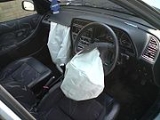
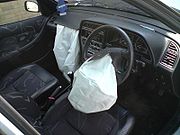
device. It is an occupant restraint consisting of a flexible envelope designed to inflate rapidly during an automobile collision
Collision
A collision is an isolated event which two or more moving bodies exert forces on each other for a relatively short time.Although the most common colloquial use of the word "collision" refers to accidents in which two or more objects collide, the scientific use of the word "collision" implies...
, to prevent occupants from striking interior objects such as the steering wheel or a window. Modern vehicle
Vehicle
A vehicle is a device that is designed or used to transport people or cargo. Most often vehicles are manufactured, such as bicycles, cars, motorcycles, trains, ships, boats, and aircraft....
s may contain multiple airbags in various side and frontal locations of the passenger seating positions, and sensors may deploy one or more airbags in an impact zone at variable rates based on the type and severity of impact; the airbag is designed to only inflate in moderate to severe frontal crashes. Airbags are normally designed with the intention of supplementing the protection of an occupant who is correctly restrained with a seatbelt. Most designs are inflated through pyrotechnic means and can only be operated once.
The first commercial designs were introduced in passenger automobiles during the 1970s with limited success. Broad commercial adoption of airbags occurred in many markets during the late 1980s and early 1990s with a driver airbag, and a front passenger airbag as well on some cars; and many modern vehicles now include four or more units.
Terminology
Various manufacturers have over time used different terms for airbags. General Motors' first bags, in the 1970s, were marketed as the Air Cushion Restraint System (ACRS). Common terms in North America include Supplemental Restraint System (SRS) and Supplemental Inflatable Restraint (SIR); these terms reflect the airbag system's nominal role as a supplement to active restraints, i.e., seat belts.Because no action by the vehicle occupant is required to activate or use the airbag, it is considered a passive device. This is in contrast to seat belt
Seat belt
A seat belt or seatbelt, sometimes called a safety belt, is a safety harness designed to secure the occupant of a vehicle against harmful movement that may result from a collision or a sudden stop...
s, which are considered active devices because the vehicle occupant must act to enable them. Note that this is not related to active and passive safety, which are, respectively, systems designed to prevent accidents in the first place and systems designed to minimize accidents once they occur. For example, the car's Anti-lock Braking System
Anti-lock braking system
An anti-lock braking system is a safety system that allows the wheels on a motor vehicle to continue interacting tractively with the road surface as directed by driver steering inputs while braking, preventing the wheels from locking up and therefore avoiding skidding.An ABS generally offers...
will qualify as an active-safety device while both its seatbelts and airbags will qualify as passive-safety devices. Further terminological confusion can arise from the fact that passive devices and systems — those requiring no input or action by the vehicle occupant — can themselves operate in an active manner; an airbag is one such device. Vehicle safety professionals are generally careful in their use of language to avoid this sort of confusion, though advertising
Advertising
Advertising is a form of communication used to persuade an audience to take some action with respect to products, ideas, or services. Most commonly, the desired result is to drive consumer behavior with respect to a commercial offering, although political and ideological advertising is also common...
principles sometimes prevent such syntactic
Syntax
In linguistics, syntax is the study of the principles and rules for constructing phrases and sentences in natural languages....
caution in the consumer marketing of safety features.
History
.png)
Invention
Reported in 1951, Walter Linderer designed an airbag. Linderer filed German patent #896,312 ("Einrichtung zum Schutze von in Fahrzeugen befindlichen Personen gegen Verletzungen bei Zusammenstößen") on October 6, 1951 which was issued on November 12, 1953, approximately three months after American John Hetrick was issued U.S. patent #2,649,311 (“safety cushion assembly for automotive vehicles”) earlier on August 18, 1953. Linderer's airbag was based on a compressed airCompressed air
Compressed air is air which is kept under a certain pressure, usually greater than that of the atmosphere. In Europe, 10 percent of all electricity used by industry is used to produce compressed air, amounting to 80 terawatt hours consumption per year....
system, either released by bumper contact or by the driver. Later research during the 1960s proved that compressed air could not blow Linderer's airbag up fast enough for maximum safety, thus making it an impractical system.
John W. Hetrick, an industrial engineer and member of the United States Navy
United States Navy
The United States Navy is the naval warfare service branch of the United States Armed Forces and one of the seven uniformed services of the United States. The U.S. Navy is the largest in the world; its battle fleet tonnage is greater than that of the next 13 largest navies combined. The U.S...
, designed the original safety cushion commonly referred to as an airbag. It was designed based on his experiences with compressed air from torpedoes during his service in the navy, as well as a need to provide protection for his family in their automobile during accidents. Hetrick worked with the major American automobile corporations at the time, but they chose not to invest in it.
In Japan, Yasuzaburou Kobori (小堀保三郎) invented an airbag in 1963, on which technology current airbags are based, for which he was awarded patents in 14 countries. He died in 1975 without seeing adoption of airbag systems.
In 1967, a breakthrough occurred in the development of airbags when Allen K. Breed invented a practical component for crash detection, an electromechanical sensor with a steel ball attached to a tube by a magnet
Magnet
A magnet is a material or object that produces a magnetic field. This magnetic field is invisible but is responsible for the most notable property of a magnet: a force that pulls on other ferromagnetic materials, such as iron, and attracts or repels other magnets.A permanent magnet is an object...
that would inflate an airbag under a 30 milli-second window. Sodium azide
Sodium azide
Sodium azide is the inorganic compound with the formula NaN3. This colourless azide salt is the gas-forming component in many car airbag systems. It is used for the preparation of other azide compounds. It is an ionic substance and is highly soluble in water. It is extremely...
instead of compressed air was also used for the first time during inflation. Breed Corporation then marketed this innovation first to Chrysler
Chrysler
Chrysler Group LLC is a multinational automaker headquartered in Auburn Hills, Michigan, USA. Chrysler was first organized as the Chrysler Corporation in 1925....
. A similar "Auto-Ceptor" crash-restraint, developed by Eaton, Yale & Towne Inc. for Ford was soon offered as an automatic safety system in the USA, while the Italian Eaton-Livia company offered a variant with localized air cushions.
As a supplement to seat belts
Airbags for passenger cars were introduced in the United StatesUnited States
The United States of America is a federal constitutional republic comprising fifty states and a federal district...
in the mid-1970s, when seat belt
Seat belt
A seat belt or seatbelt, sometimes called a safety belt, is a safety harness designed to secure the occupant of a vehicle against harmful movement that may result from a collision or a sudden stop...
usage rates in the country were quite low. Ford
Ford Motor Company
Ford Motor Company is an American multinational automaker based in Dearborn, Michigan, a suburb of Detroit. The automaker was founded by Henry Ford and incorporated on June 16, 1903. In addition to the Ford and Lincoln brands, Ford also owns a small stake in Mazda in Japan and Aston Martin in the UK...
built an experimental fleet of cars with airbags in 1971, followed by General Motors
General Motors
General Motors Company , commonly known as GM, formerly incorporated as General Motors Corporation, is an American multinational automotive corporation headquartered in Detroit, Michigan and the world's second-largest automaker in 2010...
in 1973 on Chevrolet vehicles. The early fleet of experimental GM vehicles equipped with airbags experienced seven fatalities, one of which was later suspected to have been caused by the airbag.
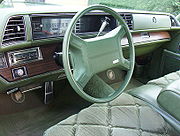
In 1974, GM made the ACRS or "Air Cushion Restraint System" available as a regular production option (RPO code AR3) in some full-size Buick, Cadillac and Oldsmobile models. The GM cars from the 1970s equipped with ACRS have a driver side airbag, a driver side knee restraint (which consists of a padded lower dashboard) and a passenger side airbag. The passenger side airbag, protects both front passengers and unlike most newer ones, it integrates a knee cushion, a torso cushion and it also has dual stage deployment which varies depending on the force of the impact. The cars equipped with ACRS have lap belts for all seating positions but they do not have shoulder belts. These were already mandatory equipment in the United States on closed cars without airbags for the driver and outer front passenger seating positions.
The development of airbags coincided with an international interest in automobile safety
Automobile safety
Automobile safety is the study and practice of vehicle design, construction, and equipment to minimize the occurrence and consequences of automobile accidents. Automobile safety is the study and practice of vehicle design, construction, and equipment to minimize the occurrence and consequences of...
legislation. Some safety experts advocated a performance-based occupant protection standard rather than a standard mandating a particular technical solution, which could rapidly become outdated and might not be a cost-effective approach. As countries successively mandated seat belt restraints, there was less emphasis placed on other designs for several decades.
An airbag is not, and cannot be an alternative to seatbelts.
Frontal airbag
The auto industry and research and regulatory communities have moved away from their initial view of the airbag as a seat belt replacement, and the bags are now nominally designated as Supplemental Restraint System (SRS) or Supplemental Inflatable Restraints.
In 1981, Mercedes-Benz
Mercedes-Benz
Mercedes-Benz is a German manufacturer of automobiles, buses, coaches, and trucks. Mercedes-Benz is a division of its parent company, Daimler AG...
introduced the airbag in Germany as an option on its high-end S-Class (W126)
Mercedes-Benz W126
The Mercedes-Benz W126 is a series of flagship vehicles manufactured by German automotive marque Mercedes-Benz. Premiering in September 1979 as the successor to the earlier W116 line, the W126 was the second generation of the Mercedes-Benz flagship to officially bear the S-Class name referring to...
. In the Mercedes system, the sensors would automatically pre-tension the seat belts to reduce occupant's motion on impact (now a common feature), and then deploy the airbag on impact. This integrated the seat belts and airbag into a restraint system, rather than the airbag being considered an alternative to the seat belt.
In 1987, the Porsche
Porsche
Porsche Automobil Holding SE, usually shortened to Porsche SE a Societas Europaea or European Public Company, is a German based holding company with investments in the automotive industry....
944 turbo became the first car in the world to have driver and passenger airbags as standard equipment. The Porsche 944
Porsche 944
The Porsche 944 is a sports car built by Porsche from 1982 to 1991. It was built on the same platform as the 924, although 924 production continued through 1988. The 944 was intended to last into the 1990s, but major revisions planned for a 944 S3 model were eventually rolled into the 968 instead,...
and 944S had this as an available option. The same year also saw the first airbag in a Japanese car, the Honda Legend
Honda Legend
The Honda Legend is a mid-size luxury car made by the Japanese automaker Honda. It was the result of Project XX, a joint agreement started in November 1981 with the Austin Rover Group of Great Britain and was mechanically related to the Rover 800 series....
.
Audi
Audi
Audi AG is a German automobile manufacturer, from supermini to crossover SUVs in various body styles and price ranges that are marketed under the Audi brand , positioned as the premium brand within the Volkswagen Group....
was relatively late to offer airbag systems on a broader scale; until the 1994 model year, for example, the 80/90, by far Audi's 'bread-and-butter' model, as well as the 100/200, did not have airbags in their standard versions. Instead, the German automaker until then relied solely on its proprietary procon-ten
Procon-ten
procon-ten is a proprietary Safety Restraint System , used by German car manufacturer Audi, from 1986 until the mid-1990s....
restraint system.
In Europe
Europe
Europe is, by convention, one of the world's seven continents. Comprising the westernmost peninsula of Eurasia, Europe is generally 'divided' from Asia to its east by the watershed divides of the Ural and Caucasus Mountains, the Ural River, the Caspian and Black Seas, and the waterways connecting...
, airbags were almost entirely absent from family cars until the early 1990s. The first European Ford
Ford Motor Company
Ford Motor Company is an American multinational automaker based in Dearborn, Michigan, a suburb of Detroit. The automaker was founded by Henry Ford and incorporated on June 16, 1903. In addition to the Ford and Lincoln brands, Ford also owns a small stake in Mazda in Japan and Aston Martin in the UK...
to feature an airbag was the facelifted Escort MK5b in 1992; within a year, the entire Ford range had at least one airbag as standard. By the mid 1990s, European market leaders such as Vauxhall
Vauxhall Motors
Vauxhall Motors is a British automotive company owned by General Motors and headquartered in Luton. It was founded in 1857 as a pump and marine engine manufacturer, began manufacturing cars in 1903 and was acquired by GM in 1925. It has been the second-largest selling car brand in the UK for...
/Opel
Opel
Adam Opel AG, generally shortened to Opel, is a German automobile company founded by Adam Opel in 1862. Opel has been building automobiles since 1899, and became an Aktiengesellschaft in 1929...
, Rover
Rover Group
The Rover Group plc was the name given in 1986 to the British state-owned vehicle manufacturer previously known as British Leyland or BL. Owned by British Aerospace from 1988 to 1994, when it was sold to BMW, the Group was broken up in 2000 with the Rover and MG marques being acquired by the MG...
, Peugeot
Peugeot
Peugeot is a major French car brand, part of PSA Peugeot Citroën, the second largest carmaker based in Europe.The family business that precedes the current Peugeot company was founded in 1810, and manufactured coffee mills and bicycles. On 20 November 1858, Emile Peugeot applied for the lion...
, Renault
Renault
Renault S.A. is a French automaker producing cars, vans, and in the past, autorail vehicles, trucks, tractors, vans and also buses/coaches. Its alliance with Nissan makes it the world's third largest automaker...
and Fiat
Fiat
FIAT, an acronym for Fabbrica Italiana Automobili Torino , is an Italian automobile manufacturer, engine manufacturer, financial, and industrial group based in Turin in the Italian region of Piedmont. Fiat was founded in 1899 by a group of investors including Giovanni Agnelli...
had included airbags as at least optional equipment across their model ranges. By the end of the decade, it was very rare to find a mass market car without an airbag, and some late 1990s products, such as the Volkswagen Golf Mk4
Volkswagen Golf Mk4
Launched in 1999, the Volkswagen Golf Mk4 was the best selling car in Europe in 2001 . The Mk4 was a deliberate attempt to take the Volkswagen Golf series further upmarket, with a high-quality interior and higher equipment levels...
also featured side airbags. The Peugeot 306
Peugeot 306
The Peugeot 306 is a small family car built by the French car manufacturer Peugeot from 1993 to 2002 replacing the 309. Peugeot gave the 306 many updates and aesthetic changes to keep up the competition but it was replaced by the 307 in 2001. Cabriolet and estate versions continued until 2002...
was a classical example of how commonplace airbags became on mass market cars during the 1990s. On its launch in early 1993 most of the range did not even have driver airbags as an option. By 1999 however, side airbags were available on several variants.
During the 2000s side airbags were commonplace on even budget cars, such as the smaller-engined versions of the Ford Fiesta
Ford Fiesta
The Ford Fiesta is a front wheel drive supermini/subcompact manufactured and marketed by Ford Motor Company and built in Europe, Brazil, Argentina, Mexico, Venezuela, China, India, Thailand and South Africa...
and Peugeot 206
Peugeot 206
The Peugeot 206 is a supermini car, manufactured by the French automaker Peugeot from 1998 to 2010.Even though the 206 has finished production in most markets as of 2010, in Europe since 2009, it is available the 206+, with a back and especially a front design that resembles the Peugeot 207.-The...
, and curtain airbags were also becoming regular features on mass market cars. The Toyota Avensis
Toyota Avensis
The Toyota Avensis is a large family car built in Derbyshire, United Kingdom by Japanese carmaker Toyota since 1997. It is the direct successor to the Carina E and is available as a four-door saloon, five-door liftback and estate...
, launched in 1998, was the first mass market car to be sold in Europe with a total of nine airbags. Although in some countries, such as Russia
Russia
Russia or , officially known as both Russia and the Russian Federation , is a country in northern Eurasia. It is a federal semi-presidential republic, comprising 83 federal subjects...
, airbags are still not standard equipment on all cars, such as those from Lada
Lada
Lada is a trademark of AvtoVAZ, a Russian car manufacturer in Tolyatti, Samara Oblast. All AvtoVAZ vehicles are currently sold under the Lada brand, though this was not always so; Lada was originally AvtoVAZ's export brand for models it sold under the Zhiguli name in the domestic Soviet market...
.
Variable force deployment front airbags were developed to help minimize injury from the airbag itself.
Shaped airbags
The Citroën C4
Citroën C4
The Citroën C4 is a small family car produced by French automaker Citroën since autumn 2004. The C4 was designed to be the successor to the Citroën Xsara. It is mechanically similar to the Peugeot 308, which was launched in 2007. A revised version with new front end, reverse light and dashboard...
provides the first "shaped" driver airbag, made possible by this car's unusual fixed hub steering wheel.
Side airbag
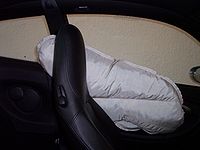
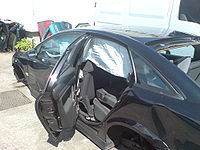
Most vehicles equipped with side curtain airbags also include side torso airbags. However some exceptions such as the Chevrolet Cobalt
Chevrolet Cobalt
The Chevrolet Cobalt is a compact car introduced by Chevrolet in 2004 for the 2005 model year. The Cobalt replaced both the Cavalier and the Prizm as Chevrolet's compact car....
, 2007-09 model Chevrolet Silverado/GMC Sierra
Chevrolet Silverado
The Chevrolet Silverado , is the latest line of full-size pickup trucks from General Motors.-History:...
, and 2009-10 Dodge Ram
Dodge Ram
The Dodge Ram is a full-size pickup truck manufactured by the Chrysler Group LLC. As of late 2010, it has been sold under the Ram Trucks brand. Previously, Ram was part of the Dodge lineup of light trucks...
do not feature the side torso airbag.
Side torso airbag
Side-impact airbags or side torso airbags (side thorax/abdomen airbags) are a category of airbag usually located in the seat, and inflate between the seat occupant and the door. These airbags are designed to reduce the risk of injury to the pelvic and lower abdomen regions. Some vehicles are now being equipped with different types of designs, to help reduce injury and ejection from the vehicle in rollover crashes. More recent side airbag designs include a two chamber system; a firmer lower chamber for the pelvic region and softer upper chamber for the ribcage.
The Swedish company Autoliv AB
Autoliv
Autoliv is a Swedish-American company with headquarters in Stockholm, Sweden, that in 1997 sprung from the merger of the Swedish company Autoliv AB and Morton Automotive Safety Products, Inc., a division of the American firm Morton International....
, was granted a patent on side airbags, and they were first offered as an option in 1994 on the 1995 model year Volvo 850
Volvo 850
The Volvo 850 is a compact executive car produced by Volvo Cars from 1992 to 1997 and designed by Jan Wilsgaard. Available in sedan/saloon and station wagon/estate body styles, the Volvo 850 was notable as the first front-wheel drive vehicle from this Swedish manufacturer to be exported to North...
, and as standard equipment on all Volvo cars made after 1995.
Side tubular or curtain airbag
In late 1997 the 1998 model year BMW 7-series
BMW E38
The BMW E38 model was the basis for the 1995 through 2001 BMW 7 Series automobiles. Developed from early 1988 to 1994, it was unveiled in the summer of 1994, replacing the BMW E32 that September and itself was replaced by the BMW E65/E66 for the 2002 model year.The E38 models were offered with...
and E39 5-series were fitted with a tubular shaped head side airbags, the "Head Protection System (HPS)" as standard equipment. This is an industry's first in offering head protection in side impact collisions. This airbag also maintained inflation for up to seven seconds for rollover protection. However, this tubular shaped airbag design has been quickly replaced by an inflatable 'curtain' airbag for superior protection.
In May 1998 Toyota began offering a side curtain airbag deploying from the roof on the Progrés
Toyota Progres
Toyota Progrès was a Toyota mid size luxury sedan which was sold in Japan from 1998 to 2007. The engine which the Toyota Progrès used is an inline 6 cylinder of 2.5L or 3.0L with VVT-I...
. In 1998 the Volvo S80
Volvo S80
The Volvo S80 is a mid-size executive saloon/sedan from Swedish automaker Volvo Cars, and was introduced in 1998 to take the place of the rear-wheel drive Volvo 960/S90 saloons in the model range. The Volvo S80 was built at the Torslanda Plant in Gothenburg, Sweden. Unlike most Volvo models, it...
was given seat-mounted curtain airbags to protect both front and rear passengers. Curtain airbags were then made standard equipment on all new Volvo cars from 1998. Although initially seat-mounted, later versions deployed from the roof.
Roll-sensing side curtain airbags found on vehicles more prone to rollovers such as SUV's and pickups will deploy when a rollover is detected instead of just when an actual collision takes place. Often there is a switch to disable the feature in case the driver wants to take the vehicle offroad.
Curtain airbags have been said to reduce brain injury or fatalities by up to 45% in a side impact with an SUV. These airbags come in various forms (e.g., tubular, curtain, door-mounted) depending on the needs of the application. Many recent SUVs
Sport utility vehicle
A sport utility vehicle is a generic marketing term for a vehicle similar to a station wagon, but built on a light-truck chassis. It is usually equipped with four-wheel drive for on- or off-road ability, and with some pretension or ability to be used as an off-road vehicle. Not all four-wheel...
and MPVs have a long inflatable curtain airbag that protects all 3 rows of seats.
Knee airbag
The second driver's side and separate knee airbag was used in the 1996 model Kia SportageKia Sportage
The Kia Sportage is a compact crossover SUV built by the Korean automaker Kia Motors since July 1993.- First generation :...
vehicle and has been standard equipment since then. The airbag is located beneath the steering wheel. The Toyota Avensis
Toyota Avensis
The Toyota Avensis is a large family car built in Derbyshire, United Kingdom by Japanese carmaker Toyota since 1997. It is the direct successor to the Carina E and is available as a four-door saloon, five-door liftback and estate...
became the first vehicle sold in Europe equipped with a driver's knee airbag. The EuroNCAP
EuroNCAP
The European New Car Assessment Programme is a European car safety performance assessment programme based in Brussels and founded in 1997 by the Transport Research Laboratory for the UK Department for Transport and backed by several European governments.-History and activities:Euro NCAP is a...
reported on the 2003 Avensis, "There has been much effort to protect the driver's knees and legs and a knee airbag worked well." Since then certain models have also included front passenger knee airbags, which deploy near or over the glove compartment
Glove compartment
A glove compartment or glovebox, also known as a little cupboard, is a compartment built into the dashboard, located over the front-seat passenger's footwell in an automobile, often used for miscellaneous storage. The name derives from the original purpose of the compartment, to store gloves...
in a crash. Knee airbags are designed to reduce leg injury. The knee airbag has become increasingly common in the 2000.
Rear curtain airbag
In 2008, the Toyota iQToyota iQ
The Toyota iQ is a city car introduced at the 2008 Geneva Auto Show, with Japanese sales having begun in October 2008 and European sales in January 2009. The production iQ followed a concept vehicle presented at the 2007 Frankfurt Auto Show. A North American version of the iQ, branded as the Scion...
launched featuring the first production rear curtain shield airbag to protect the rear occupants' heads in the event of a rear end impact.
Center airbag
In 2009, Toyota developed the first production rear-seat center airbag designed to reduce the severity of secondary injuries to rear passengers in a side collision. This system deploys from the rear center console first appearing in on the redesigned Crown MajestaToyota Crown Majesta
The Toyota Crown Majesta is a full-size premium luxury automobile. The Toyota Crown Majesta shares a stretched variant of the UZS platform series from the smaller Toyota Crown and Lexus GS/Toyota Aristo, however, it is not just a upper trim level of the Crown sedan, the Majesta is a separate car...
.
Seat belt airbag
In 2009, the S-class ESF safety concept car showcased seatbelt airbags. They will be included standard on the production Lexus LFALexus LFA
The Lexus LFA is a 2-seat exotic sports coupe produced by Lexus as a concept car, "halo" vehicle, racing prototype, and production model. It is the second model in the F marque line of performance vehicles from Lexus, following the IS F...
in late 2010, and the 2011 Ford Explorer
Ford Explorer
The Ford Explorer is a sport-utility vehicle sold in North America and built by the Ford Motor Company since 1990, as a replacement for the smaller but related Ford Bronco II. It is manufactured in Chicago, Illinois...
will offer rear seatbelt airbags as an option. Ford claims it will eventually introduce inflatable seat belts on other Ford models globally. Cessna Aircraft also now feature seatbelt airbags. They are now standard on the 172, 182, and 206.
On motorcycles
Various types of airbags were tested on motorcycles by the UK Transport Research LaboratoryTransport Research Laboratory
TRL is a British transport consultancy and research organisation based at Wokingham Berkshire with approximately 500 staff. TRL is owned by the Transport Research Foundation , which is overseen by 80 sector members from the transport industry. TRL also own small UK regional offices situated in...
in the mid 1970s. In 2006 Honda
Honda
is a Japanese public multinational corporation primarily known as a manufacturer of automobiles and motorcycles.Honda has been the world's largest motorcycle manufacturer since 1959, as well as the world's largest manufacturer of internal combustion engines measured by volume, producing more than...
introduced the first production motorcycle
Motorcycle
A motorcycle is a single-track, two-wheeled motor vehicle. Motorcycles vary considerably depending on the task for which they are designed, such as long distance travel, navigating congested urban traffic, cruising, sport and racing, or off-road conditions.Motorcycles are one of the most...
airbag safety system on its Gold Wing motorcycle. Honda claims that sensors in the front forks can detect a severe frontal collision and decide when to deploy the airbag, absorbing some of the forward energy of the rider and reducing the velocity at which the rider may be thrown from the motorcycle.
Airbag suits have also been developed for use by Motorcycle Grand Prix riders. They are connected to the motorcycle by a cable and deploy when the cable becomes detached from its mounting clip, inflating to protect the back.
How airbags work
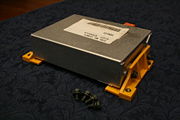
Electronic control unit
In automotive electronics, electronic control unit is a generic term for any embedded system that controls one or more of the electrical systems or subsystems in a motor vehicle....
) monitors a number of related sensors within the vehicle, including accelerometers, impact sensors, side (door) pressure sensors, wheel speed sensor
Wheel speed sensor
A wheel speed sensor or vehicle speed sensor is a type of tachometer. It is a sender device used for reading the speed of a vehicle's wheel rotation...
s, gyroscope
Gyroscope
A gyroscope is a device for measuring or maintaining orientation, based on the principles of angular momentum. In essence, a mechanical gyroscope is a spinning wheel or disk whose axle is free to take any orientation...
s, brake pressure sensors
Pressure sensor
A pressure sensor measures pressure, typically of gases or liquids. Pressure is an expression of the force required to stop a fluid from expanding, and is usually stated in terms of force per unit area. A pressure sensor usually acts as a transducer; it generates a signal as a function of the...
, and seat occupancy sensors. When the requisite 'threshold' has been reached or exceeded, the airbag control unit will trigger the ignition of a gas generator
Gas generator
A gas generator usually refers to a device, often similar to a solid rocket or a liquid rocket that burns to produce large volumes of relatively cool gas, instead of maximizing the temperature and specific impulse. The low temperature allows the gas to be put to use more easily in many...
propellant to rapidly inflate a nylon
Nylon
Nylon is a generic designation for a family of synthetic polymers known generically as polyamides, first produced on February 28, 1935, by Wallace Carothers at DuPont's research facility at the DuPont Experimental Station...
fabric bag.
As the vehicle occupant collides with and squeezes the bag, the gas escapes in a controlled manner through small vent holes. The airbag's volume and the size of the vents in the bag are tailored to each vehicle type, to spread out the deceleration of (and thus force experienced by) the occupant over time and over the occupant's body, compared to a seat belt alone.
The signals from the various sensors are fed into the Airbag control unit, which determines from them the angle of impact, the severity, or force of the crash, along with other variables. Depending on the result of these calculations, the ACU may also deploy various additional restraint devices, such as seat belt
Seat belt
A seat belt or seatbelt, sometimes called a safety belt, is a safety harness designed to secure the occupant of a vehicle against harmful movement that may result from a collision or a sudden stop...
pre-tensioners, and/or airbags (including frontal bags for driver and front passenger, along with seat-mounted side bags, and "curtain" airbags which cover the side glass). Each restraint device is typically activated with one or more pyrotechnic devices, commonly called an initiator or electric match
Electric match
An electric match is a device that uses an externally applied electric current to ignite a combustible compound.-Use:Electric matches can be used in any application where source of heat is needed at a precisely controlled point in time, typically to ignite a propellant or explosive...
. The electric match, which consists of an electrical conductor wrapped in a combustible material, activates with a current pulse between 1 to 3 amperes in less than 2 milliseconds. When the conductor becomes hot enough, it ignites the combustible material, which initiates the gas generator. In a seat belt pre-tensioner, this hot gas is used to drive a piston that pulls the slack out of the seat belt. In an airbag, the initiator is used to ignite solid propellant inside the airbag inflator. The burning propellant generates inert gas which rapidly inflates the airbag in approximately 20 to 30 milliseconds. An airbag must inflate quickly in order to be fully inflated by the time the forward-traveling occupant reaches its outer surface. Typically, the decision to deploy an airbag in a frontal crash is made within 15 to 30 milliseconds after the onset of the crash, and both the driver and passenger airbags are fully inflated within approximately 60-80 milliseconds after the first moment of vehicle contact. If an airbag deploys too late or too slowly, the risk of occupant injury from contact with the inflating airbag may increase. Since more distance typically exists between the passenger and the instrument panel, the passenger airbag is larger and requires more gas to fill it.
Front airbags normally do not protect the occupants during side, rear, or rollover accidents. Since airbags deploy only once and deflate quickly after the initial impact, they will not be beneficial during a subsequent collision. Safety belts help reduce the risk of injury in many types of crashes. They help to properly position occupants to maximize the airbag's benefits and they help restrain occupants during the initial and any following collisions.
In vehicles equipped with a rollover sensing system, accelerometers and gyroscopes are used to sense the onset of a rollover event. If a rollover event is determined to be imminent, side-curtain airbags are deployed to help protect the occupant from contact with the side of the vehicle interior, and also to help prevent occupant ejection as the vehicle rolls over.
Triggering conditions
Airbags are designed to deploy in frontal and near-frontal collisions more severe than a threshold defined by the regulations governing vehicle construction in whatever particular market the vehicle is intended for: U.S. regulations require deployment in crashes at least equivalent in deceleration to a 23 km/h (14 mph) barrier collision, or similarly, striking a parked car of similar size across the full front of each vehicle at about twice the speed. International regulations are performance based, rather than technology-based, so airbag deployment threshold is a function of overall vehicle design.Unlike crash test
Crash test
A crash test is a form of destructive testing usually performed in order to ensure safe design standards in crashworthiness and crash compatibility for various modes of transportation or related systems and components.- Types :...
s into barriers, real-world crashes typically occur at angles other than directly into the front of the vehicle, and the crash forces usually are not evenly distributed across the front of the vehicle. Consequently, the relative speed between a striking and struck vehicle required to deploy the airbag in a real-world crash can be much higher than an equivalent barrier crash. Because airbag sensors measure deceleration, vehicle speed is not a good indicator of whether an airbag should have deployed. Airbags can deploy due to the vehicle's undercarriage striking a low object protruding above the roadway due to the resulting deceleration.
The airbag sensor is a MEMS
Microelectromechanical systems
Microelectromechanical systems is the technology of very small mechanical devices driven by electricity; it merges at the nano-scale into nanoelectromechanical systems and nanotechnology...
accelerometer
Accelerometer
An accelerometer is a device that measures proper acceleration, also called the four-acceleration. This is not necessarily the same as the coordinate acceleration , but is rather the type of acceleration associated with the phenomenon of weight experienced by a test mass that resides in the frame...
, which is a small integrated circuit
Integrated circuit
An integrated circuit or monolithic integrated circuit is an electronic circuit manufactured by the patterned diffusion of trace elements into the surface of a thin substrate of semiconductor material...
with integrated micro mechanical elements. The microscopic mechanical element moves in response to rapid deceleration, and this motion causes a change in capacitance, which is detected by the electronics on the chip that then sends a signal to fire the airbag. The most common MEMS accelerometer in use is the ADXL-50 by Analog Devices
Analog Devices
Analog Devices, Inc. , known as ADI, is an American multinational semiconductor company specializing in data conversion and signal conditioning technology, headquartered in Norwood, Massachusetts...
, but there are other MEMS manufacturers as well.
Initial attempts using mercury switch
Mercury switch
A mercury switch is a switch whose purpose is to allow or interrupt the flow of electric current in an electrical circuit in a manner that is dependent on the switch's physical position or alignment relative to the direction of the "pull" of earth's gravity, or other inertia.Mercury switches...
es did not work well. Before MEMS, the primary system used to deploy airbags was called a "rolamite
Rolamite
Rolamite is a technology for very low friction bearings developed by Sandia National Laboratories in the 1960s. Invented by Sandia engineer Donald F. Wilkes and patented by him on June 24, 1969 these devices use a stressed metal band and counter rotating rollers within an enclosure to create a...
". A rolamite is a mechanical device, consisting of a roller suspended within a tensioned band. As a result of the particular geometry and material properties used, the roller is free to translate with little friction
Friction
Friction is the force resisting the relative motion of solid surfaces, fluid layers, and/or material elements sliding against each other. There are several types of friction:...
or hysteresis
Hysteresis
Hysteresis is the dependence of a system not just on its current environment but also on its past. This dependence arises because the system can be in more than one internal state. To predict its future evolution, either its internal state or its history must be known. If a given input alternately...
. This device was developed at Sandia National Laboratories
Sandia National Laboratories
The Sandia National Laboratories, managed and operated by the Sandia Corporation , are two major United States Department of Energy research and development national laboratories....
. The rolamite, and similar macro-mechanical devices were used in airbags until the mid-1990s when they were universally replaced with MEMS.
Nearly all airbags are designed to automatically deploy in the event of a vehicle fire when temperatures reach 150-200 °C (300-400 °F). This safety feature, often termed auto-ignition, helps to ensure that such temperatures do not cause an explosion of the entire airbag module.
Today, airbag triggering algorithms are becoming much more complex. They try to reduce unnecessary deployments and to adapt the deployment speed to the crash conditions. The algorithms are considered valuable intellectual property
Intellectual property
Intellectual property is a term referring to a number of distinct types of creations of the mind for which a set of exclusive rights are recognized—and the corresponding fields of law...
. Experimental algorithms may take into account such factors as the weight of the occupant, the seat location, seatbelt use, and even attempt to determine if a baby seat is present.
Inflation
When the frontal airbags are to deploy, a signal is sent to the inflator unitGas generator
A gas generator usually refers to a device, often similar to a solid rocket or a liquid rocket that burns to produce large volumes of relatively cool gas, instead of maximizing the temperature and specific impulse. The low temperature allows the gas to be put to use more easily in many...
within the airbag control unit. An igniter starts a rapid chemical reaction
Chemical reaction
A chemical reaction is a process that leads to the transformation of one set of chemical substances to another. Chemical reactions can be either spontaneous, requiring no input of energy, or non-spontaneous, typically following the input of some type of energy, such as heat, light or electricity...
generating primarily nitrogen
Nitrogen
Nitrogen is a chemical element that has the symbol N, atomic number of 7 and atomic mass 14.00674 u. Elemental nitrogen is a colorless, odorless, tasteless, and mostly inert diatomic gas at standard conditions, constituting 78.08% by volume of Earth's atmosphere...
gas (N2) to fill the airbag making it deploy through the module cover. Some airbag technologies use compressed nitrogen
Nitrogen
Nitrogen is a chemical element that has the symbol N, atomic number of 7 and atomic mass 14.00674 u. Elemental nitrogen is a colorless, odorless, tasteless, and mostly inert diatomic gas at standard conditions, constituting 78.08% by volume of Earth's atmosphere...
or argon
Argon
Argon is a chemical element represented by the symbol Ar. Argon has atomic number 18 and is the third element in group 18 of the periodic table . Argon is the third most common gas in the Earth's atmosphere, at 0.93%, making it more common than carbon dioxide...
gas with a pyrotechnic operated valve ("hybrid gas generator"), while other technologies use various energetic propellant
Propellant
A propellant is a material that produces pressurized gas that:* can be directed through a nozzle, thereby producing thrust ;...
s. Propellants containing the highly toxic sodium azide
Sodium azide
Sodium azide is the inorganic compound with the formula NaN3. This colourless azide salt is the gas-forming component in many car airbag systems. It is used for the preparation of other azide compounds. It is an ionic substance and is highly soluble in water. It is extremely...
(NaN3) were common in early inflator designs.
The azide-containing pyrotechnic gas generators contain a substantial amount of the propellant. The driver-side airbag would contain a canister containing about 50 grams of sodium azide. The passenger side container holds about 200 grams of sodium azide.
The alternative propellants may incorporate, for example, a combination of nitroguanidine
Nitroguanidine
Nitroguanidine is a chemical compound. It is a colorless, crystalline solid. It melts at 232 °C and decomposes at 250 °C. It is not flammable and is an extremely low sensitivity explosive; however, its detonation velocity is high.-Manufacture:...
, phase-stabilized ammonium nitrate (NH4NO3) or other nonmetallic oxidizer, and a nitrogen-rich fuel different than azide (e.g. tetrazole
Tetrazole
Tetrazoles are a class of synthetic organic heterocyclic compound, consisting of a 5-member ring of four nitrogen and one carbon atom . The simplest is tetrazole itself, CN4H2. They are unknown in nature...
s, triazole
Triazole
Triazole refers to either one of a pair of isomeric chemical compounds with molecular formula C2H3N3, having a five-membered ring of two carbon atoms and three nitrogen atoms.The two isomers are:*1,2,3-Triazole 100px*1,2,4-Triazole 100px...
s, and their salts). The burn rate modifiers in the mixture may be an alkaline metal nitrate
Nitrate
The nitrate ion is a polyatomic ion with the molecular formula NO and a molecular mass of 62.0049 g/mol. It is the conjugate base of nitric acid, consisting of one central nitrogen atom surrounded by three identically-bonded oxygen atoms in a trigonal planar arrangement. The nitrate ion carries a...
(NO3-) or nitrite
Nitrite
The nitrite ion has the chemical formula NO2−. The anion is symmetric with equal N-O bond lengths and a O-N-O bond angle of ca. 120°. On protonation the unstable weak acid nitrous acid is produced. Nitrite can be oxidised or reduced, with product somewhat dependent on the oxidizing/reducing agent...
(NO2-), dicyanamide or its salts, sodium borohydride
Sodium borohydride
Sodium borohydride, also known as sodium tetrahydridoborate, is an inorganic compound with the formula NaBH4. This white solid, usually encountered as a powder, is a versatile reducing agent that finds wide application in chemistry, both in the laboratory and on a technical scale. Large amounts are...
(NaBH4), etc. The coolants and slag
Slag
Slag is a partially vitreous by-product of smelting ore to separate the metal fraction from the unwanted fraction. It can usually be considered to be a mixture of metal oxides and silicon dioxide. However, slags can contain metal sulfides and metal atoms in the elemental form...
formers may be e.g. clay
Clay
Clay is a general term including many combinations of one or more clay minerals with traces of metal oxides and organic matter. Geologic clay deposits are mostly composed of phyllosilicate minerals containing variable amounts of water trapped in the mineral structure.- Formation :Clay minerals...
, silica, alumina, glass, etc. Other alternatives are e.g. nitrocellulose
Nitrocellulose
Nitrocellulose is a highly flammable compound formed by nitrating cellulose through exposure to nitric acid or another powerful nitrating agent. When used as a propellant or low-order explosive, it is also known as guncotton...
based propellants (which have high gas yield but bad storage stability, and their oxygen balance
Oxygen balance
Oxygen balance is an expression that is used to indicate the degree to which an explosive can be oxidized. If an explosive molecule contains just enough oxygen to form carbon dioxide from carbon, water from hydrogen molecules, all of its sulfur dioxide from sulfur, and all metal oxides from metals...
requires secondary oxidation of the reaction products to avoid buildup of carbon monoxide), or high-oxygen nitrogen-free organic compounds with inorganic oxidizers (e.g., di or tricarboxylic acid
Carboxylic acid
Carboxylic acids are organic acids characterized by the presence of at least one carboxyl group. The general formula of a carboxylic acid is R-COOH, where R is some monovalent functional group...
s with chlorate
Chlorate
The chlorate anion has the formula ClO. In this case, the chlorine atom is in the +5 oxidation state. "Chlorate" can also refer to chemical compounds containing this anion; chlorates are the salts of chloric acid. "Chlorate", when followed by a roman numeral in parentheses, e.g...
s (ClO3-) or perchlorate
Perchlorate
Perchlorates are the salts derived from perchloric acid . They occur both naturally and through manufacturing. They have been used as a medicine for more than 50 years to treat thyroid gland disorders. They are used extensively within the pyrotechnics industry, and ammonium perchlorate is also a...
s (HClO4) and eventually metallic oxides; the nitrogen-free formulation avoids formation of toxic nitrogen oxide
Nitrogen oxide
Nitrogen oxide can refer to a binary compound of oxygen and nitrogen, or a mixture of such compounds:* Nitric oxide, also known as nitrogen monoxide, , nitrogen oxide* Nitrogen dioxide , nitrogen oxide...
s).
From the onset of the crash, the entire deployment and inflation process is about 0.04 seconds. Because vehicles change speed so quickly in a crash, airbags must inflate rapidly to reduce the risk of the occupant hitting the vehicle's interior.
Variable-force deployment
Advanced airbag technologies are being developed to tailor airbag deployment to the severity of the crash, the size and posture of the vehicle occupant, belt usage, and how close that person is to the actual airbag. Many of these systems use multi-stage inflators that deploy less forcefully in stages in moderate crashes than in very severe crashes. Occupant sensing devices let the airbag control unit know if someone is occupying a seat adjacent to an airbag, the mass/weight of the person, whether a seat belt or child restraint is being used, and whether the person is forward in the seat and close to the airbag. Based on this information and crash severity information, the airbag is deployed at either a high force level, a less forceful level, or not at all.
Adaptive airbag systems may utilize multi-stage airbags to adjust the pressure within the airbag. The greater the pressure within the airbag, the more force the airbag will exert on the occupants as they come in contact with it. These adjustments allow the system to deploy the airbag with a moderate force for most collisions; reserving the maximum force airbag only for the severest of collisions. Additional sensors to determine the location, weight or relative size of the occupants may also be used. Information regarding the occupants and the severity of the crash are used by the airbag control unit, to determine whether airbags should be suppressed or deployed, and if so, at various output levels.
Post-deployment
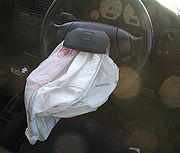
A chemical reaction produces a burst of nitrogen to inflate the bag. Once an airbag deploys, deflation begins immediately as the gas escapes through vent(s) in the fabric (or, as it's sometimes called, the cushion) and cools. Deployment is frequently accompanied by the release of dust-like particles, and gases in the vehicle's interior (called effluent). Most of this dust consists of cornstarchCornstarch
Corn starch, cornstarch, cornflour or maize starch is the starch of the corn grain obtained from the endosperm of the corn kernel.-History:...
, french chalk
French chalk
French chalk is a form of steatite.As an arist's material the term is used by Max Doerner in his book "The Materials of the Artist" where he describes a calcium carbonate used to make traditional gesso primer, to be painted over...
, or talcum powder, which are used to lubricate the airbag during deployment.
Newer designs produce effluent primarily consisting of harmless talcum powder/cornstarch and nitrogen gas. In older designs using an azide-based propellant (usually NaN3), varying amounts of sodium hydroxide nearly always are initially present. In small amounts this chemical can cause minor irritation to the eyes and/or open wounds; however, with exposure to air, it quickly turns into sodium bicarbonate
Sodium bicarbonate
Sodium bicarbonate or sodium hydrogen carbonate is the chemical compound with the formula Na HCO3. Sodium bicarbonate is a white solid that is crystalline but often appears as a fine powder. It has a slightly salty, alkaline taste resembling that of washing soda . The natural mineral form is...
(baking soda). However, this transformation is not 100% complete, and invariably leaves residual amounts of hydroxide ion from NaOH. Depending on the type of airbag system, potassium chloride
Potassium chloride
The chemical compound potassium chloride is a metal halide salt composed of potassium and chlorine. In its pure state, it is odorless and has a white or colorless vitreous crystal appearance, with a crystal structure that cleaves easily in three directions. Potassium chloride crystals are...
(often used as a table salt substitute) may also be present.
For most people, the only effect the dust may produce is some minor irritation of the throat and eyes. Generally, minor irritations only occur when the occupant remains in the vehicle for many minutes with the windows closed and no ventilation. However, some people with asthma
Asthma
Asthma is the common chronic inflammatory disease of the airways characterized by variable and recurring symptoms, reversible airflow obstruction, and bronchospasm. Symptoms include wheezing, coughing, chest tightness, and shortness of breath...
may develop a potentially lethal asthmatic attack from inhaling the dust.
The dust-like particles and gases can cause irreparable cosmetic damage to the dashboard
Dashboard
A dashboard is a control panel placed in front of the driver of an automobile, housing instrumentation and controls for operation of the vehicle....
and upholstery, so minor collisions which result in the deployment of airbags can be costly accidents, even if there are no injuries and there is only minor damage to the vehicle exterior.
United States
On 11 July 1984, the U.S. government amended Federal Motor Vehicle Safety Standard 208 (FMVSS 208) to require cars produced after 1 April 1989 to be equipped with a passive restraint for the driver. An airbag or an automatic seat belt would meet the requirements of the standard. Airbag introduction was stimulated by the U.S. National Highway Traffic Safety AdministrationNational Highway Traffic Safety Administration
The National Highway Traffic Safety Administration is an agency of the Executive Branch of the U.S. government, part of the Department of Transportation...
. However, airbags were not mandatory on light trucks until 1997.
In 1998, FMVSS 208 was amended to require dual front airbags, and de-powered, or second-generation airbags were also mandated. This was due to the injuries caused by first-generation airbags, though FMVSS 208 continues to require that bags be engineered and calibrated to be able to "save" the life of an unbelted 50th-percentile size and weight "male" crash test dummy
Crash test dummy
Crash test dummies are full-scale anthropomorphic test devices that simulate the dimensions, weight proportions and articulation of the human body, and are usually instrumented to record data about the dynamic behavior of the ATD in simulated vehicle impacts...
.
Outside the U.S.A.
Most countries outside North America adhere to internationalized European ECE vehicle and equipment regulations rather than the U.S. Federal Motor Vehicle Safety Standards. ECE airbags are generally smaller and inflate less forcefully than U.S. airbags, because the ECE specifications are based on belted crash test dummies. In the United KingdomUnited Kingdom
The United Kingdom of Great Britain and Northern IrelandIn the United Kingdom and Dependencies, other languages have been officially recognised as legitimate autochthonous languages under the European Charter for Regional or Minority Languages...
, and most other developed countries there is no direct legal requirement for new cars to feature airbags. Instead, the Euro NCAP vehicle safety rating
Automobile safety
Automobile safety is the study and practice of vehicle design, construction, and equipment to minimize the occurrence and consequences of automobile accidents. Automobile safety is the study and practice of vehicle design, construction, and equipment to minimize the occurrence and consequences of...
encourages manufacturers to take a comprehensive approach to occupant safety; a good rating can only be achieved by combining airbags with other safety features. Thus almost all new cars now come with at least two airbags as standard.
Maintenance
Inadvertent airbag deployment while the vehicle is being serviced can result in severe injury, and an improperly installed or defective airbag unit may not operate or perform as intended. Some countries impose restrictions on the sale, transport, handling, and service of airbags and system components. In GermanyGermany
Germany , officially the Federal Republic of Germany , is a federal parliamentary republic in Europe. The country consists of 16 states while the capital and largest city is Berlin. Germany covers an area of 357,021 km2 and has a largely temperate seasonal climate...
, airbags are regulated as harmful explosives; only mechanics
Auto mechanic
An auto mechanic is a mechanic with a variety of car makes or either in a specific area or in a specific make of car. In repairing cars, their main role is to diagnose the problem accurately and quickly...
with special training are allowed to service airbag systems.
Some automakers (such as Mercedes-Benz
Mercedes-Benz
Mercedes-Benz is a German manufacturer of automobiles, buses, coaches, and trucks. Mercedes-Benz is a division of its parent company, Daimler AG...
) call for the replacement of undeployed airbags after a certain period of time to ensure their reliability in an accident. One example is the 1992 S500 which has an expiry date sticker attached to the door pillar. Some Škoda
Škoda Auto
Škoda Auto , more commonly known as Škoda, is an automobile manufacturer based in the Czech Republic. Škoda became a wholly owned subsidiary of the Volkswagen Group in 2000, positioned as the entry brand to the group...
vehicles say 14 years from the date of manufacture. In this case replacement would be uneconomic as the car would have negligible value at 14 years old, far less than the cost of fitting new airbags. Volvo
Volvo
AB Volvo is a Swedish builder of commercial vehicles, including trucks, buses and construction equipment. Volvo also supplies marine and industrial drive systems, aerospace components and financial services...
, on the other hand, has stated "airbags do not require replacement during the lifetime of the vehicle," though this cannot be taken as a guarantee on the device.
Injuries and fatalities
Airbags can injure or kill vehicle occupants. To provide crash protection for occupants not wearing seat belts, U.S. airbag designs trigger much more forcefully than airbags designed to the international ECE standards used in most other countries. Recent airbag controllers can recognize if a belt is used, and alter the bag deployment parameters accordingly.In 1990, the first automotive fatality attributed to an airbag was reported. TRW
TRW
TRW Inc. was an American corporation involved in a variety of businesses, mainly aerospace, automotive, and credit reporting. It was a pioneer in multiple fields including electronic components, integrated circuits, computers, software and systems engineering. TRW built many spacecraft,...
produced the first gas-inflated airbag in 1994, with sensors and low-inflation-force bags becoming common soon afterwards. Dual-depth (also known as dual-stage) airbags appeared on passenger cars in 1998. By 2005, deaths related to airbags had declined, with no adult deaths and two child deaths attributed to airbags that year. Injuries remain fairly common in accidents with an airbag deployment.
Serious injuries are less common, but severe or fatal injuries can occur to vehicle occupants very near an airbag or in direct contact when it deploys. Such injuries may be sustained by unconscious drivers slumped over the steering wheel, unrestrained or improperly restrained occupants who slide forward in the seat during pre-crash braking, and properly belted drivers sitting very close to the steering wheel.
Improvements in sensing and gas generator technology have allowed the development of third generation airbag systems that can adjust their deployment parameters to size, weight, position and restraint status of the occupant. These improvements have demonstrated a reduced injury risk factor for small adults and children who had an increased risk of injury with first generation airbag systems.
Airbag fatality statistics
From 1990 to 2000, the U.S. National Highway Traffic Safety AdministrationNational Highway Traffic Safety Administration
The National Highway Traffic Safety Administration is an agency of the Executive Branch of the U.S. government, part of the Department of Transportation...
identified 175 fatalities caused by air bags. Most of these (104) have been children, while the rest are adults. About 3.3 million air bag deployments have occurred and the agency estimates more than 6,377 lives saved and countless injuries prevented.
A rear-facing infant restraint put in the front seat of a vehicle places an infant's head close to the airbag, which can cause severe head injuries
Head injury
Head injury refers to trauma of the head. This may or may not include injury to the brain. However, the terms traumatic brain injury and head injury are often used interchangeably in medical literature....
, or death if the airbag deploys. Some modern cars include a switch to disable the front passenger airbag (although not in Australia, where rear-facing child seats are prohibited in the front where an airbag is fitted), in case a child-supporting seat is used there.
In vehicles with side airbags, it is dangerous for occupants to lean against the windows, doors, and pillars, or to place objects between themselves and the side of the vehicle. Articles hung from a vehicle's clothes hanger hooks can be hazardous if the vehicle's side curtain airbags deploy. A seat-mounted airbag may also cause internal injury if the occupant leans against the door.
Aerospace and military applications
Aerospace
Aerospace comprises the atmosphere of Earth and surrounding space. Typically the term is used to refer to the industry that researches, designs, manufactures, operates, and maintains vehicles moving through air and space...
industry and the US Government
Federal government of the United States
The federal government of the United States is the national government of the constitutional republic of fifty states that is the United States of America. The federal government comprises three distinct branches of government: a legislative, an executive and a judiciary. These branches and...
have applied airbag technologies for many years. NASA
NASA
The National Aeronautics and Space Administration is the agency of the United States government that is responsible for the nation's civilian space program and for aeronautics and aerospace research...
, and US DoD
United States Department of Defense
The United States Department of Defense is the U.S...
have incorporated airbag systems in various aircraft and spacecraft applications as early as the 1960s.
.jpg)
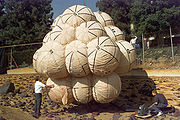
Airbag landing systems
The first use of airbags for landingLanding
thumb|A [[Mute Swan]] alighting. Note the ruffled feathers on top of the wings indicate that the swan is flying at the [[Stall |stall]]ing speed...
were Luna 9
Luna 9
Luna 9 was an unmanned space mission of the Soviet Union's Luna program. On February 3, 1966 the Luna 9 spacecraft was the first spacecraft to achieve a soft landing on any planetary body other than Earth and to transmit photographic data to Earth.The automatic lunar station that achieved the...
and Luna 13
Luna 13
-External links:* *...
, which landed on the Moon
Moon
The Moon is Earth's only known natural satellite,There are a number of near-Earth asteroids including 3753 Cruithne that are co-orbital with Earth: their orbits bring them close to Earth for periods of time but then alter in the long term . These are quasi-satellites and not true moons. For more...
in 1966 and returned panoramic images. The Mars Pathfinder
Mars Pathfinder
Mars Pathfinder was an American spacecraft that landed a base station with roving probe on Mars in 1997. It consisted of a lander, renamed the Carl Sagan Memorial Station, and a lightweight wheeled robotic rover named Sojourner.Launched on December 4, 1996 by NASA aboard a Delta II booster a...
lander employed an innovative airbag landing system, supplemented with aerobraking
Aerobraking
Aerobraking is a spaceflight maneuver that reduces the high point of an elliptical orbit by flying the vehicle through the atmosphere at the low point of the orbit . The resulting drag slows the spacecraft...
, parachute
Parachute
A parachute is a device used to slow the motion of an object through an atmosphere by creating drag, or in the case of ram-air parachutes, aerodynamic lift. Parachutes are usually made out of light, strong cloth, originally silk, now most commonly nylon...
, and solid rocket
Solid rocket
A solid rocket or a solid-fuel rocket is a rocket engine that uses solid propellants . The earliest rockets were solid-fuel rockets powered by gunpowder; they were used by the Chinese in warfare as early as the 13th century and later by the Mongols, Arabs, and Indians.All rockets used some form of...
landing thrusters. This prototype successfully tested the concept, and the two Mars Exploration Rover Mission landers employed similar landing systems. The Beagle 2
Beagle 2
Beagle 2 was an unsuccessful British landing spacecraft that formed part of the European Space Agency's 2003 Mars Express mission. All contact with it was lost upon its separation from the Mars Express six days before its scheduled entry into the atmosphere...
Mars lander also tried to use airbags for landing, but the landing was unsuccessful for reasons which are not entirely known.
Airbags have also been used on military fixed wing aircraft such at the Escape Crew Capsule of the F-111 Aardvark.
Occupant protection
The US ArmyUnited States Army
The United States Army is the main branch of the United States Armed Forces responsible for land-based military operations. It is the largest and oldest established branch of the U.S. military, and is one of seven U.S. uniformed services...
has incorporated airbags in its UH-60A/L Black Hawk and OH-58D
OH-58 Kiowa
The Bell OH-58 Kiowa is a family of single-engine, single-rotor, military helicopters used for observation, utility, and direct fire support. Bell Helicopter manufactured the OH-58 for the United States Army based on the 206A JetRanger helicopter. The OH-58 has been in continuous use by the U.S...
Kiowa Warrior helicopter fleets. The Cockpit Air Bag System (CABS) consists of forward and lateral airbags, and an inflatable tubular structure (on the OH-58D only) with an Electronic Crash Sensor Unit (ECSU). The CABS system was developed by the US Army Aviation Applied Technology Directorate
Aviation Applied Technology Directorate
The United States Army Aviation Applied Technology Directorate is a tenant activity located at Fort Eustis, Virginia. It is a directorate of the Aviation and Missile Research, Development, and Engineering Center , a part of the Research, Development and Engineering Command .-History:The...
, Fort Eustis, Va
Virginia
The Commonwealth of Virginia , is a U.S. state on the Atlantic Coast of the Southern United States. Virginia is nicknamed the "Old Dominion" and sometimes the "Mother of Presidents" after the eight U.S. presidents born there...
through a contract with Simula Safety Systems (now BAE Systems
BAE Systems
BAE Systems plc is a British multinational defence, security and aerospace company headquartered in London, United Kingdom, that has global interests, particularly in North America through its subsidiary BAE Systems Inc. BAE is among the world's largest military contractors; in 2009 it was the...
). It is the first conventional airbag system for occupant injury prevention (worldwide) designed and developed and placed in service for an aircraft, and the first specifically for helicopter applications.
See also
- Airbag dermatitisAirbag dermatitisAirbag dermatitis is caused skin irritation and trauma secondary to the deployment of airbags....
- Airplane airbagsAirplane airbagsAirplane airbags are air bags that are located in the seat belts of seats on airplanes. Only a couple of major airlines have seat belt airbags. They are designed to lessen the impact of crashes with minor injuries.They include:-References:...
- Automobile safetyAutomobile safetyAutomobile safety is the study and practice of vehicle design, construction, and equipment to minimize the occurrence and consequences of automobile accidents. Automobile safety is the study and practice of vehicle design, construction, and equipment to minimize the occurrence and consequences of...
- Precrash systemPrecrash systemA precrash system is an automobile safety system designed to reduce the severity of an accident. Also known as forward collision warning systems they use radar and sometimes laser sensors to detect an imminent crash...
- Safety standardsSafety standardsSafety standards are standards designed to ensure the safety of products, activities or processes, etc. They may be advisory or compulsory and are normally laid down by an advisory or regulatory body that may be either voluntary or statutory...