


1980s oil glut

Encyclopedia
The 1980s oil glut was a serious surplus of crude oil
caused by falling demand following the 1970s Energy Crisis
. The world price of oil, which had peaked in 1980 at over US$
35 per barrel ($ per barrel today), fell in 1986 from $27 to below $10 ($ to $ today). The glut began in the early 1980s as a result of slowed economic activity in industrial countries (due to the crises of the 1970s, especially in 1973 and 1979
) and the energy conservation spurred by high fuel prices. The inflation
adjusted real 2004 dollar value of oil fell from an average of $78.2 in 1981 to an average of $26.8 per barrel in 1986.
In June 1981, The New York Times
stated an "Oil glut! ... is here" and Time Magazine stated: "the world temporarily floats in a glut of oil," though the next week an article in The New York Times warned that the word "glut" was misleading, and that in reality, while temporary surpluses had brought down prices somewhat, prices were still well above pre-energy crisis levels. This sentiment was echoed in November 1981, when the CEO of Exxon Corp also characterized the glut as a temporary surplus, and that the word "glut" was an example of "our American penchant for exaggerated language." He wrote that the main cause of the glut was declining consumption. In the United States, Europe and Japan, oil consumption had fallen 13% from 1979 to 1981, due to "in part, in reaction to the very large increases in oil prices by the Organization of Petroleum Exporting Countries and other oil exporters," continuing a trend begun during the 1973 price increases.
After 1980, reduced demand and overproduction produced a glut on the world market, causing a six-year-long decline in oil prices culminating with a 46 percent price drop in 1986.
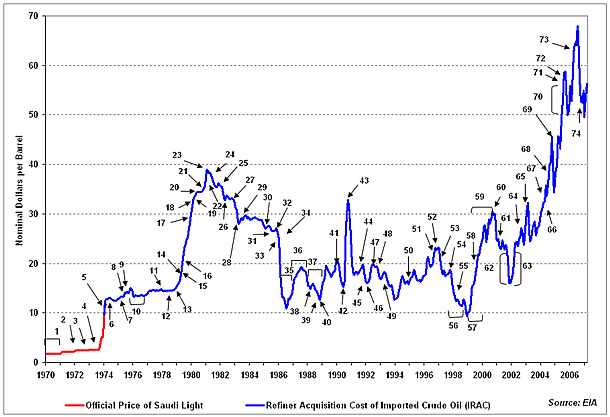
and the 1979 oil crisis turned oil from a cheap to a very expensive energy source. During the 1973 energy crisis, the price of oil quadrupled. Oil never returned to pre-1973 levels, either in real or nominal terms, even during the 1980s glut.
The nominal price continued its slow increase after the crisis ended. Six years later, the price more than doubled during the 1979 energy crisis. OPEC
and Saudi Arabia
artificially raised the price of oil several times in 1979 and 1980. Also during this time, several OPEC members significantly lowered their production levels, the Iran hostage crisis
occurred, and the Iran–Iraq War began.
There was fear that the world's oil market supply was tenuous, causing the price of oil to escalate and that OPEC would dictate very high prices in a shortage.
signed an executive order which was to remove market controls from petroleum products by October 1981, so that prices would be wholly determined by the free market. Ronald Reagan
signed an executive order on January 28, 1981 which enacted this reform immediately, allowing the free market
to adjust oil prices in the US. This ended the withdrawal of old oil from the market and artificial scarcity, encouraging increased oil production. The US Oil Windfall profits tax
was lowered in August 1981 and removed in 1988, ending disincentives to US oil producers. Additionally, the Alaskan Prudhoe Bay Oil Field
entered peak production, supplying the US West Coast with up to 2 million bpd of crude oil.
decreased oil production several times and nearly in half to maintain oil's high prices. However, it failed to hold on to its preeminent position, and by 1981, its production was surpassed by Non-OPEC countries. OPEC had seen its share of the world market drop to less than a third in 1985, from nearly half during the 1970s. In Feb 1982, the Boston Globe reported that OPEC's production, which had previously peaked in 1977, was at its lowest level since 1969. Non-OPEC nations were at that time supplying most of the West's imports.
OPEC's membership began to have divided opinions over what actions to take. In September 1985, Saudi Arabia
tried to gain market share by increasing production, creating a "huge surplus that angered many of their colleagues in OPEC". High-cost
oil production facilities became less or even not profitable.
sources dwindled even further as Britain
, Mexico
, Nigeria
and Norway
joined Canada
in the forefront of American suppliers.
Imported crude oil from Libya was banned in the United States on March 10, 1982.
of oil to maintain high consumption, but underestimated the extent to which other sources of supply would become profitable as prices increased. Electricity generation from nuclear power
and natural gas
; home heating from natural gas; and ethanol
blended gasoline all reduced the demand for oil. New passenger car fuel economy rose from 17 mpg in 1978 to more than 22 mpg in 1982, an increase of more than 30 percent.
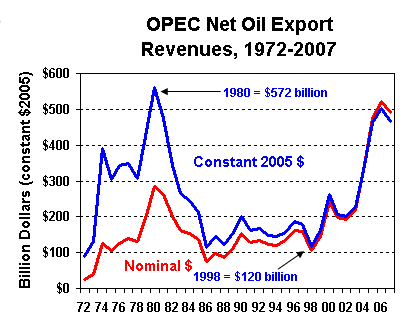 The 1986 oil price collapse benefited oil-consuming countries such as the United States, Japan, Europe, and Third World nations, but represented a serious loss in revenue for oil-producing countries in northern Europe
, the Soviet Union
, and OPEC
.
In 1981, before the brunt of the glut, Time Magazine wrote that in general, "A glut of crude causes tighter development budgets" in some oil-exporting nations. In a handful of heavily populated impoverished countries whose economies were largely dependent on oil production — including Mexico
, Nigeria
, Algeria
, and Libya
— government and business leaders failed to prepare for a market reversal.
With the drop in oil prices, OPEC lost its unity. Oil exporters such as Mexico, Nigeria, and Venezuela
, whose economies had expanded in the 1970s, were plunged into near-bankruptcy. Even Saudi Arabian economic power was significantly weakened.
Iraq had fought a long and costly war against Iran, and had particularly weak revenues. It was upset by Kuwait
contributing to the glut and allegedly pumping oil from the Rumaila field below their common border. Iraq invaded Kuwait territory in 1990
, planning to increase reserves and revenues and cancel the debt, resulting in the first Gulf War
.
The USSR had become a major oil producer before the glut. The drop of oil prices contributed to the nation's final collapse.
In the US, domestic exploration declined dramatically, and the number of active drilling rigs was nearly halved in 1982." Oil producers held back on the search for new oilfields for fear of losing on their investments. In May 2007, companies like ExxonMobil
were not making nearly the investment in finding new oil today that they did in 1981.
Cities that had experienced tremendous growth when oil prices were high, most notably Houston and New Orleans, endured severe local recessions as prices collapsed.
Petroleum
Petroleum or crude oil is a naturally occurring, flammable liquid consisting of a complex mixture of hydrocarbons of various molecular weights and other liquid organic compounds, that are found in geologic formations beneath the Earth's surface. Petroleum is recovered mostly through oil drilling...
caused by falling demand following the 1970s Energy Crisis
1970s energy crisis
The 1970s energy crisis was a period in which the major industrial countries of the world, particularly the United States, faced substantial shortages, both perceived and real, of petroleum...
. The world price of oil, which had peaked in 1980 at over US$
United States dollar
The United States dollar , also referred to as the American dollar, is the official currency of the United States of America. It is divided into 100 smaller units called cents or pennies....
35 per barrel ($ per barrel today), fell in 1986 from $27 to below $10 ($ to $ today). The glut began in the early 1980s as a result of slowed economic activity in industrial countries (due to the crises of the 1970s, especially in 1973 and 1979
1979 energy crisis
The 1979 oil crisis in the United States occurred in the wake of the Iranian Revolution. Amid massive protests, the Shah of Iran, Mohammad Reza Pahlavi, fled his country in early 1979 and the Ayatollah Khomeini soon became the new leader of Iran. Protests severely disrupted the Iranian oil...
) and the energy conservation spurred by high fuel prices. The inflation
Inflation
In economics, inflation is a rise in the general level of prices of goods and services in an economy over a period of time.When the general price level rises, each unit of currency buys fewer goods and services. Consequently, inflation also reflects an erosion in the purchasing power of money – a...
adjusted real 2004 dollar value of oil fell from an average of $78.2 in 1981 to an average of $26.8 per barrel in 1986.
In June 1981, The New York Times
The New York Times
The New York Times is an American daily newspaper founded and continuously published in New York City since 1851. The New York Times has won 106 Pulitzer Prizes, the most of any news organization...
stated an "Oil glut! ... is here" and Time Magazine stated: "the world temporarily floats in a glut of oil," though the next week an article in The New York Times warned that the word "glut" was misleading, and that in reality, while temporary surpluses had brought down prices somewhat, prices were still well above pre-energy crisis levels. This sentiment was echoed in November 1981, when the CEO of Exxon Corp also characterized the glut as a temporary surplus, and that the word "glut" was an example of "our American penchant for exaggerated language." He wrote that the main cause of the glut was declining consumption. In the United States, Europe and Japan, oil consumption had fallen 13% from 1979 to 1981, due to "in part, in reaction to the very large increases in oil prices by the Organization of Petroleum Exporting Countries and other oil exporters," continuing a trend begun during the 1973 price increases.
After 1980, reduced demand and overproduction produced a glut on the world market, causing a six-year-long decline in oil prices culminating with a 46 percent price drop in 1986.
Background
The 1973 oil crisis1973 oil crisis
The 1973 oil crisis started in October 1973, when the members of Organization of Arab Petroleum Exporting Countries or the OAPEC proclaimed an oil embargo. This was "in response to the U.S. decision to re-supply the Israeli military" during the Yom Kippur war. It lasted until March 1974. With the...
and the 1979 oil crisis turned oil from a cheap to a very expensive energy source. During the 1973 energy crisis, the price of oil quadrupled. Oil never returned to pre-1973 levels, either in real or nominal terms, even during the 1980s glut.
The nominal price continued its slow increase after the crisis ended. Six years later, the price more than doubled during the 1979 energy crisis. OPEC
OPEC
OPEC is an intergovernmental organization of twelve developing countries made up of Algeria, Angola, Ecuador, Iran, Iraq, Kuwait, Libya, Nigeria, Qatar, Saudi Arabia, the United Arab Emirates, and Venezuela. OPEC has maintained its headquarters in Vienna since 1965, and hosts regular meetings...
and Saudi Arabia
Saudi Arabia
The Kingdom of Saudi Arabia , commonly known in British English as Saudi Arabia and in Arabic as as-Sa‘ūdiyyah , is the largest state in Western Asia by land area, constituting the bulk of the Arabian Peninsula, and the second-largest in the Arab World...
artificially raised the price of oil several times in 1979 and 1980. Also during this time, several OPEC members significantly lowered their production levels, the Iran hostage crisis
Iran hostage crisis
The Iran hostage crisis was a diplomatic crisis between Iran and the United States where 52 Americans were held hostage for 444 days from November 4, 1979 to January 20, 1981, after a group of Islamist students and militants took over the American Embassy in Tehran in support of the Iranian...
occurred, and the Iran–Iraq War began.
There was fear that the world's oil market supply was tenuous, causing the price of oil to escalate and that OPEC would dictate very high prices in a shortage.
Production
US
In April 1979, Jimmy CarterJimmy Carter
James Earl "Jimmy" Carter, Jr. is an American politician who served as the 39th President of the United States and was the recipient of the 2002 Nobel Peace Prize, the only U.S. President to have received the Prize after leaving office...
signed an executive order which was to remove market controls from petroleum products by October 1981, so that prices would be wholly determined by the free market. Ronald Reagan
Ronald Reagan
Ronald Wilson Reagan was the 40th President of the United States , the 33rd Governor of California and, prior to that, a radio, film and television actor....
signed an executive order on January 28, 1981 which enacted this reform immediately, allowing the free market
Free market
A free market is a competitive market where prices are determined by supply and demand. However, the term is also commonly used for markets in which economic intervention and regulation by the state is limited to tax collection, and enforcement of private ownership and contracts...
to adjust oil prices in the US. This ended the withdrawal of old oil from the market and artificial scarcity, encouraging increased oil production. The US Oil Windfall profits tax
Windfall profits tax
A windfall profits tax is a higher tax rate on profits that ensue from a sudden windfall gain to a particular company or industry.-United Kingdom:In the United Kingdom, the Windfall Tax was a tax levied on privatised utility companies.-United States:...
was lowered in August 1981 and removed in 1988, ending disincentives to US oil producers. Additionally, the Alaskan Prudhoe Bay Oil Field
Prudhoe Bay oil field
Prudhoe Bay Oil Field is a large oil field on Alaska's North Slope. It is the largest oil field in both the United States and in North America, covering and originally containing approximately of oil.. BP. August 2006...
entered peak production, supplying the US West Coast with up to 2 million bpd of crude oil.
OPEC
From 1980 to 1986, OPECOPEC
OPEC is an intergovernmental organization of twelve developing countries made up of Algeria, Angola, Ecuador, Iran, Iraq, Kuwait, Libya, Nigeria, Qatar, Saudi Arabia, the United Arab Emirates, and Venezuela. OPEC has maintained its headquarters in Vienna since 1965, and hosts regular meetings...
decreased oil production several times and nearly in half to maintain oil's high prices. However, it failed to hold on to its preeminent position, and by 1981, its production was surpassed by Non-OPEC countries. OPEC had seen its share of the world market drop to less than a third in 1985, from nearly half during the 1970s. In Feb 1982, the Boston Globe reported that OPEC's production, which had previously peaked in 1977, was at its lowest level since 1969. Non-OPEC nations were at that time supplying most of the West's imports.
OPEC's membership began to have divided opinions over what actions to take. In September 1985, Saudi Arabia
Saudi Arabia
The Kingdom of Saudi Arabia , commonly known in British English as Saudi Arabia and in Arabic as as-Sa‘ūdiyyah , is the largest state in Western Asia by land area, constituting the bulk of the Arabian Peninsula, and the second-largest in the Arab World...
tried to gain market share by increasing production, creating a "huge surplus that angered many of their colleagues in OPEC". High-cost
EROEI
In physics, energy economics and ecological energetics, energy returned on energy invested ; or energy return on investment , is the ratio of the amount of usable energy acquired from a particular energy resource to the amount of energy expended to obtain that energy resource...
oil production facilities became less or even not profitable.
US imports
The US imported 28 percent of its oil in 1982 and 1983, down from 46.5 percent in 1977, due to lower consumption. Reliance on Middle EastMiddle East
The Middle East is a region that encompasses Western Asia and Northern Africa. It is often used as a synonym for Near East, in opposition to Far East...
sources dwindled even further as Britain
United Kingdom
The United Kingdom of Great Britain and Northern IrelandIn the United Kingdom and Dependencies, other languages have been officially recognised as legitimate autochthonous languages under the European Charter for Regional or Minority Languages...
, Mexico
Mexico
The United Mexican States , commonly known as Mexico , is a federal constitutional republic in North America. It is bordered on the north by the United States; on the south and west by the Pacific Ocean; on the southeast by Guatemala, Belize, and the Caribbean Sea; and on the east by the Gulf of...
, Nigeria
Nigeria
Nigeria , officially the Federal Republic of Nigeria, is a federal constitutional republic comprising 36 states and its Federal Capital Territory, Abuja. The country is located in West Africa and shares land borders with the Republic of Benin in the west, Chad and Cameroon in the east, and Niger in...
and Norway
Norway
Norway , officially the Kingdom of Norway, is a Nordic unitary constitutional monarchy whose territory comprises the western portion of the Scandinavian Peninsula, Jan Mayen, and the Arctic archipelago of Svalbard and Bouvet Island. Norway has a total area of and a population of about 4.9 million...
joined Canada
Canada
Canada is a North American country consisting of ten provinces and three territories. Located in the northern part of the continent, it extends from the Atlantic Ocean in the east to the Pacific Ocean in the west, and northward into the Arctic Ocean...
in the forefront of American suppliers.
Imported crude oil from Libya was banned in the United States on March 10, 1982.
Reduced demand
OPEC had relied on the price elasticity of demandPrice elasticity of demand
Price elasticity of demand is a measure used in economics to show the responsiveness, or elasticity, of the quantity demanded of a good or service to a change in its price. More precisely, it gives the percentage change in quantity demanded in response to a one percent change in price...
of oil to maintain high consumption, but underestimated the extent to which other sources of supply would become profitable as prices increased. Electricity generation from nuclear power
Nuclear power
Nuclear power is the use of sustained nuclear fission to generate heat and electricity. Nuclear power plants provide about 6% of the world's energy and 13–14% of the world's electricity, with the U.S., France, and Japan together accounting for about 50% of nuclear generated electricity...
and natural gas
Natural gas
Natural gas is a naturally occurring gas mixture consisting primarily of methane, typically with 0–20% higher hydrocarbons . It is found associated with other hydrocarbon fuel, in coal beds, as methane clathrates, and is an important fuel source and a major feedstock for fertilizers.Most natural...
; home heating from natural gas; and ethanol
Ethanol
Ethanol, also called ethyl alcohol, pure alcohol, grain alcohol, or drinking alcohol, is a volatile, flammable, colorless liquid. It is a psychoactive drug and one of the oldest recreational drugs. Best known as the type of alcohol found in alcoholic beverages, it is also used in thermometers, as a...
blended gasoline all reduced the demand for oil. New passenger car fuel economy rose from 17 mpg in 1978 to more than 22 mpg in 1982, an increase of more than 30 percent.
Impact
Northern Europe
Northern Europe is the northern part or region of Europe. Northern Europe typically refers to the seven countries in the northern part of the European subcontinent which includes Denmark, Estonia, Latvia, Lithuania, Norway, Finland and Sweden...
, the Soviet Union
Soviet Union
The Soviet Union , officially the Union of Soviet Socialist Republics , was a constitutionally socialist state that existed in Eurasia between 1922 and 1991....
, and OPEC
OPEC
OPEC is an intergovernmental organization of twelve developing countries made up of Algeria, Angola, Ecuador, Iran, Iraq, Kuwait, Libya, Nigeria, Qatar, Saudi Arabia, the United Arab Emirates, and Venezuela. OPEC has maintained its headquarters in Vienna since 1965, and hosts regular meetings...
.
In 1981, before the brunt of the glut, Time Magazine wrote that in general, "A glut of crude causes tighter development budgets" in some oil-exporting nations. In a handful of heavily populated impoverished countries whose economies were largely dependent on oil production — including Mexico
Mexico
The United Mexican States , commonly known as Mexico , is a federal constitutional republic in North America. It is bordered on the north by the United States; on the south and west by the Pacific Ocean; on the southeast by Guatemala, Belize, and the Caribbean Sea; and on the east by the Gulf of...
, Nigeria
Nigeria
Nigeria , officially the Federal Republic of Nigeria, is a federal constitutional republic comprising 36 states and its Federal Capital Territory, Abuja. The country is located in West Africa and shares land borders with the Republic of Benin in the west, Chad and Cameroon in the east, and Niger in...
, Algeria
Algeria
Algeria , officially the People's Democratic Republic of Algeria , also formally referred to as the Democratic and Popular Republic of Algeria, is a country in the Maghreb region of Northwest Africa with Algiers as its capital.In terms of land area, it is the largest country in Africa and the Arab...
, and Libya
Libya
Libya is an African country in the Maghreb region of North Africa bordered by the Mediterranean Sea to the north, Egypt to the east, Sudan to the southeast, Chad and Niger to the south, and Algeria and Tunisia to the west....
— government and business leaders failed to prepare for a market reversal.
With the drop in oil prices, OPEC lost its unity. Oil exporters such as Mexico, Nigeria, and Venezuela
Venezuela
Venezuela , officially called the Bolivarian Republic of Venezuela , is a tropical country on the northern coast of South America. It borders Colombia to the west, Guyana to the east, and Brazil to the south...
, whose economies had expanded in the 1970s, were plunged into near-bankruptcy. Even Saudi Arabian economic power was significantly weakened.
Iraq had fought a long and costly war against Iran, and had particularly weak revenues. It was upset by Kuwait
Kuwait
The State of Kuwait is a sovereign Arab state situated in the north-east of the Arabian Peninsula in Western Asia. It is bordered by Saudi Arabia to the south at Khafji, and Iraq to the north at Basra. It lies on the north-western shore of the Persian Gulf. The name Kuwait is derived from the...
contributing to the glut and allegedly pumping oil from the Rumaila field below their common border. Iraq invaded Kuwait territory in 1990
Invasion of Kuwait
The Invasion of Kuwait, also known as the Iraq-Kuwait War, was a major conflict between the Republic of Iraq and the State of Kuwait, which resulted in the seven-month long Iraqi occupation of Kuwait, which subsequently led to direct military intervention by United States-led forces in the Gulf...
, planning to increase reserves and revenues and cancel the debt, resulting in the first Gulf War
Gulf War
The Persian Gulf War , commonly referred to as simply the Gulf War, was a war waged by a U.N.-authorized coalition force from 34 nations led by the United States, against Iraq in response to Iraq's invasion and annexation of Kuwait.The war is also known under other names, such as the First Gulf...
.
The USSR had become a major oil producer before the glut. The drop of oil prices contributed to the nation's final collapse.
In the US, domestic exploration declined dramatically, and the number of active drilling rigs was nearly halved in 1982." Oil producers held back on the search for new oilfields for fear of losing on their investments. In May 2007, companies like ExxonMobil
ExxonMobil
Exxon Mobil Corporation or ExxonMobil, is an American multinational oil and gas corporation. It is a direct descendant of John D. Rockefeller's Standard Oil company, and was formed on November 30, 1999, by the merger of Exxon and Mobil. Its headquarters are in Irving, Texas...
were not making nearly the investment in finding new oil today that they did in 1981.
Cities that had experienced tremendous growth when oil prices were high, most notably Houston and New Orleans, endured severe local recessions as prices collapsed.
See also
- 1973 oil crisis1973 oil crisisThe 1973 oil crisis started in October 1973, when the members of Organization of Arab Petroleum Exporting Countries or the OAPEC proclaimed an oil embargo. This was "in response to the U.S. decision to re-supply the Israeli military" during the Yom Kippur war. It lasted until March 1974. With the...
- 1980-1989 world oil market chronology1980-1989 world oil market chronology-1980:* March 1: United States federal Windfall Profits Tax enacted.* May: Saudi Light raised to $28.00 per barrel, retroactive to April 1.* Apr-September: : Buy-Sell Program allocations drop to average of for period April to September 1980.:...
- 1979 energy crisis1979 energy crisisThe 1979 oil crisis in the United States occurred in the wake of the Iranian Revolution. Amid massive protests, the Shah of Iran, Mohammad Reza Pahlavi, fled his country in early 1979 and the Ayatollah Khomeini soon became the new leader of Iran. Protests severely disrupted the Iranian oil...
- Oil price increases since 2003
- Price of petroleumPrice of petroleumThe price of petroleum as quoted in news generally refers to the spot price per barrel of either WTI/light crude as traded on the New York Mercantile Exchange for delivery at Cushing, Oklahoma, or of Brent as traded on the Intercontinental Exchange for delivery at Sullom Voe.The price...
Further reading
- World Hydrocarbon Markets: Current Status, Projected Prospects, and Future Trends, (1983), By Miguel S. Wionczek, ISBN 0-08-029962-8
- The Prize: The Epic Quest for Oil, Money, and PowerThe Prize: The Epic Quest for Oil, Money, and PowerThe Prize: The Epic Quest for Oil, Money, and Power is Daniel Yergin's 800-page history of the global oil industry from the 1850s through 1990...
,(1993) , by Daniel YerginDaniel YerginDaniel Howard Yergin is an American author, speaker, and economic researcher. Yergin is the co-founder and chairman of Cambridge Energy Research Associates, an energy research consultancy. It was acquired by IHS Inc...
, Simon & SchusterSimon & SchusterSimon & Schuster, Inc., a division of CBS Corporation, is a publisher founded in New York City in 1924 by Richard L. Simon and M. Lincoln Schuster. It is one of the four largest English-language publishers, alongside Random House, Penguin and HarperCollins...
, ISBN 0-671-79932-0 & ISBN 0-671-50248-4 - The Oil Market in the 1980s: A Decade of Decline, (1992), by Siamack Shojai, Bernard S. Katz, Praeger/Greenwood, ISBN 0-275-93380-6