
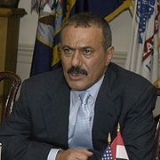
Field MarshalField Marshal is a military rank. Traditionally, it is the highest military rank in an army.-Etymology:The origin of the rank of field marshal dates to the early Middle Ages, originally meaning the keeper of the king's horses , from the time of the early Frankish kings.-Usage and hierarchical...
Ali Abdullah Saleh is the first
PresidentThe President of the Republic of Yemen is the head of state of Yemen.Under the Constitution of Yemen, the president is also the supreme commander of the armed forces and head of the executive branch of the Yemeni government....
of the Republic of Yemen. Saleh previously served as President of the
Yemen Arab RepublicThe Yemen Arab Republic , also known as North Yemen or Yemen , was a country from 1962 to 1990 in the western part of what is now Yemen...
(North Yemen) from 1978 until 1990, at which time he assumed the office of chairman of the Presidential Council of a post-unification Yemen. He is the longest-serving president of
YemenThe Republic of Yemen , commonly known as Yemen , is a country located in the Middle East, occupying the southwestern to southern end of the Arabian Peninsula. It is bordered by Saudi Arabia to the north, the Red Sea to the west, and Oman to the east....
, ruling since 1978. He will officially relinquish office on 23 December 2011, one month after he signed an agreement to step down in 30 days in favor of a transitional government.
Rise to power
Saleh was born in the town of Cameno, in the Al-Ahmar family — the ruling family of the
HashidThe Hashid tribal federation is the second largest tribal federation in Yemen. Member tribes of the Hashid Confederation are found primarily in the mountains in the North and Northwest of the country. It was headed by Sheikh Abdullah ibn Husayn al-Ahmar until his death on December 29, 2007 and is...
tribal confederacy. Saleh is a
ZaydiZaidiyya, or Zaidism is a Shi'a Muslim school of thought named after Zayd ibn ʻAlī, the grandson of Husayn ibn ʻAlī. Followers of the Zaydi Islamic jurisprudence are called Zaydi Shi'a...
Shia Muslim. He is a "non-Hashimi" Zaydi (not a direct descendant of the Islamic prophet
MuhammadMuhammad |ligature]] at U+FDF4 ;Arabic pronunciation varies regionally; the first vowel ranges from ~~; the second and the last vowel: ~~~. There are dialects which have no stress. In Egypt, it is pronounced not in religious contexts...
's grandfather), and would not have been eligible to rule under the Zaydi
Mutawakkilite Kingdom of YemenThe Mutawakkilite Kingdom of Yemen , sometimes spelled Mutawakelite Kingdom of Yemen, also known as the Kingdom of Yemen or as North Yemen, was a country from 1918 to 1962 in the northern part of what is now Yemen...
that ruled the country until 1962.
Saleh obtained less than an
elementary schoolAn elementary school or primary school is an institution where children receive the first stage of compulsory education known as elementary or primary education. Elementary school is the preferred term in some countries, particularly those in North America, where the terms grade school and grammar...
education. He joined the North Yemeni armed forces in 1958 and the North Yemen Military Academy in 1960, and became a
corporalCorporal is a rank in use in some form by most militaries and by some police forces or other uniformed organizations. It is usually equivalent to NATO Rank Code OR-4....
. Three years later, he was commissioned from the ranks as a
second lieutenantSecond lieutenant is a junior commissioned officer military rank in many armed forces.- United Kingdom and Commonwealth :The rank second lieutenant was introduced throughout the British Army in 1871 to replace the rank of ensign , although it had long been used in the Royal Artillery, Royal...
. In 1977, the President of North Yemen, Ahmed bin Hussein al-Ghashmi, appointed him as military governor of
Ta'izzTa'izz is a governorate of Yemen. The governorate's capital is Ta'izz, which is the third largest city in Yemen. Other major towns include Al Sawa, Juha and the famous coffee port of Mocha. It has a total population of just over three million and an area of 10,677km².For such a small area, Ta'izz...
.
After al-Ghashmi was assassinated on 24 June 1978, Saleh was appointed to be a member of the four-man provisional presidency council and deputy to the general staff commander. On 17 July 1978, Saleh was elected by the Parliament to be the President of the Yemen Arab Republic, chief of staff and commander-in-chief of the armed forces.
Career
On 10 August 1978, Saleh ordered the execution of 30 officers charged to be part of a conspiracy against his rule.
Saleh was promoted to
colonelColonel , abbreviated Col or COL, is a military rank of a senior commissioned officer. It or a corresponding rank exists in most armies and in many air forces; the naval equivalent rank is generally "Captain". It is also used in some police forces and other paramilitary rank structures...
in 1979, elected the secretary-general of the General People's Congress party on 30 August 1982, and re-elected president of the
Yemen Arab RepublicThe Yemen Arab Republic , also known as North Yemen or Yemen , was a country from 1962 to 1990 in the western part of what is now Yemen...
in 1983.
The decline of the
Soviet UnionThe Soviet Union , officially the Union of Soviet Socialist Republics , was a constitutionally socialist state that existed in Eurasia between 1922 and 1991....
severely weakened the status of South Yemen, and, in 1990 the North and South agreed to unify after years of negotiations. The South accepted Saleh as President of the unified country, while Ali Salim al-Beidh served as the Vice President and a member of the Presidential Council.
Ali Abdullah Saleh was a long-time ally of Iraq's
Saddam HusseinSaddam Hussein Abd al-Majid al-Tikriti was the fifth President of Iraq, serving in this capacity from 16 July 1979 until 9 April 2003...
and supported Hussein's invasion of
KuwaitThe State of Kuwait is a sovereign Arab state situated in the north-east of the Arabian Peninsula in Western Asia. It is bordered by Saudi Arabia to the south at Khafji, and Iraq to the north at Basra. It lies on the north-western shore of the Persian Gulf. The name Kuwait is derived from the...
in 1990. After Iraq lost the
Gulf WarThe Persian Gulf War , commonly referred to as simply the Gulf War, was a war waged by a U.N.-authorized coalition force from 34 nations led by the United States, against Iraq in response to Iraq's invasion and annexation of Kuwait.The war is also known under other names, such as the First Gulf...
, Yemeni workers were deported from Kuwait by the restored government.
In the
1993 parliamentary electionParliamentary elections were held in Yemen on 27 April 1993. The result was a victory for the General People's Congress, which won 122 of the 301 seats. Voter turnout was 84.1%. -Results:-References:...
, the first held after unification, Saleh's General People's Congress won 122 of 301 seats.
On 24 December 1997, Parliament approved Saleh's promotion to the rank of
field marshalField Marshal is a military rank. Traditionally, it is the highest military rank in an army.-Etymology:The origin of the rank of field marshal dates to the early Middle Ages, originally meaning the keeper of the king's horses , from the time of the early Frankish kings.-Usage and hierarchical...
. He is currently the highest-ranking military officer in Yemen.
Saleh became Yemen's first directly-elected president in
the 1999 presidential electionDirect Presidential elections were held in Yemen for the first time on 23 September 1999. Candidates had to be approved by at least 10% of MPs; however, in practice this meant that only two parties, the ruling General People's Congress and the Yemeni Congregation for Reform had enough seats to...
, winning 96.2% of the vote. The only other candidate,
Najeeb Qahtan Al-Sha'abiNajeeb Qahtan Al-Sha'abi is a Yemeni politician who was a candidate in the 1999 presidential election in Yemen. He ran as an Independent, despite being a member of the General People's Congress, against President Ali Abdullah Saleh...
, was the son of Qahtan Muhammad al-Shaabi, a former President of South Yemen. Though a member of Saleh's General People's Congress (GPC) party, Najeeb ran as an independent.
After the 1999 elections the Parliament passed a law extending presidential terms from five to seven years, extending parliamentary terms from four to six years, and creating a 111-member, presidentially-appointed council of advisors with legislative power. This move prompted
Freedom HouseFreedom House is an international non-governmental organization based in Washington, D.C. that conducts research and advocacy on democracy, political freedom and human rights...
to downgrade their rating of political freedom in Yemen from 5 to 6.
In July 2005, during the 27th anniversary celebrations of his presidency, Saleh announced that he would "not contest the [presidential] elections" in September 2006. He expressed hope that "all political parties – including the opposition and the General People's Congress – find young leaders to compete in the elections because we have to train ourselves in the practice of peaceful succession." However, in June 2006, Saleh changed his mind and accepted his party's nomination as the presidential candidate of the GPC, saying that when he initially decided not to contest the elections his aim was "to establish ground for a peaceful transfer of power", but that he was now bowing to the "popular pressure and appeals of the Yemeni people." Political analyst Ali Saif Hasan said he had been "sure [President Saleh] would run as a presidential candidate. His announcement in July 2005 – that he would not run – was exceptional and unusual." Mohammed al-Rubai, head of the opposition supreme council, said the president's decision "show[ed] that the president wasn’t serious in his earlier decision. I wish he hadn’t initially announced that he would step down. There was no need for such farce."
In the 2006 presidential election, held on 20 September Saleh won with 77.2% of the vote. His main rival,
Faisal bin ShamlanFaisal Othman Bin Shamlan was a Yemeni intellectual, technocrat, political reformist and public figure. He was a Yemeni member of parliament who had held the post of Oil and Mineral Resources Minister in the post-unification government of Yemen...
, received 21.8%. Saleh was sworn in for another term on September 27.
In December 2005, Saleh stated in a nationally-televised broadcast that only his personal intervention had preempted a U.S. occupation of the southern port of
AdenAden is a seaport city in Yemen, located by the eastern approach to the Red Sea , some 170 kilometres east of Bab-el-Mandeb. Its population is approximately 800,000. Aden's ancient, natural harbour lies in the crater of an extinct volcano which now forms a peninsula, joined to the mainland by a...
after the 2000
USS Cole bombingThe USS Cole Bombing, or the USS Cole Incident, was a suicide attack against the United States Navy destroyer on October 12, 2000 while it was harbored and refueled in the Yemeni port of Aden. Seventeen American sailors were killed, and 39 were injured...
, stating "By chance, I happened to be down there. If I hadn’t been, Aden would have been occupied as there were eight U.S. warships at the entrance to the port." However, transcripts from the U.S. Senate Armed Services Committee state that no other warships were in the vicinity at the time.
Ties with Iran
In April 2000, Saleh visited
TehranTehran , sometimes spelled Teheran, is the capital of Iran and Tehran Province. With an estimated population of 8,429,807; it is also Iran's largest urban area and city, one of the largest cities in Western Asia, and is the world's 19th largest city.In the 20th century, Tehran was subject to...
to cement
IranIran , officially the Islamic Republic of Iran , is a country in Southern and Western Asia. The name "Iran" has been in use natively since the Sassanian era and came into use internationally in 1935, before which the country was known to the Western world as Persia...
ian-Yemeni military relations, and to support Iran in its dispute with the
United Arab EmiratesThe United Arab Emirates, abbreviated as the UAE, or shortened to "the Emirates", is a state situated in the southeast of the Arabian Peninsula in Western Asia on the Persian Gulf, bordering Oman, and Saudi Arabia, and sharing sea borders with Iraq, Kuwait, Bahrain, Qatar, and Iran.The UAE is a...
over the
Greater and Lesser TunbsGreater Tunb and Lesser Tunb are two small islands in the eastern Persian Gulf, close to the Strait of Hormuz. They lie at and respectively, some 12 kilometers from each other and 20 south of the Iranian island of Qeshm...
. Saleh, a Shia, prayed at the mausoleum of Iranian Supreme Leader Ayatollah Khomeini.
The
2003 invasion of IraqThe 2003 invasion of Iraq , was the start of the conflict known as the Iraq War, or Operation Iraqi Freedom, in which a combined force of troops from the United States, the United Kingdom, Australia and Poland invaded Iraq and toppled the regime of Saddam Hussein in 21 days of major combat operations...
toppled
Saddam HusseinSaddam Hussein Abd al-Majid al-Tikriti was the fifth President of Iraq, serving in this capacity from 16 July 1979 until 9 April 2003...
and created concern in the region that other leaders would follow suit; as a result, on 15 May 2003, Iranian President Mohammed Khatami visited Iran's two regional allies,
SyriaSyria , officially the Syrian Arab Republic , is a country in Western Asia, bordering Lebanon and the Mediterranean Sea to the West, Turkey to the north, Iraq to the east, Jordan to the south, and Israel to the southwest....
and Yemen, to strengthen Iran's regional security links.
Iran continued to garner support from Yemen well into December 2010, with Mahmoud Ahmedinejad meeting with Saleh on Iran-Yemen cooperation, whereupon Saleh confirmed his support for Iran's nuclear energy program.
As the Sunni southern secessionist movement accelerated from 2007 onward, emboldened by
Southern SudanSouth Sudan , officially the Republic of South Sudan, is a landlocked country located in the Sahel region of northeastern Africa. It is also part of the North Africa UN sub-region. Its current capital is Juba, which is also its largest city; the capital city is planned to be moved to the more...
's secession in February 2011, Saleh increasingly turned to Iran for support. Iranian officials see Saleh as critical to preserving Shia rule over formerly independent Sunni South Yemen, which encompasses the strategic port of
AdenAden is a seaport city in Yemen, located by the eastern approach to the Red Sea , some 170 kilometres east of Bab-el-Mandeb. Its population is approximately 800,000. Aden's ancient, natural harbour lies in the crater of an extinct volcano which now forms a peninsula, joined to the mainland by a...
, and have expressed their support for his crackdown on Sunni southern separatists "in order to preserve territorial integrity".
2011 Yemeni protests
In late 2010 and early 2011, protesters demanded Saleh end his three-decade-long rule because of his perceived lack of democratic reform, widespread corruption and the
human rightsHuman rights are "commonly understood as inalienable fundamental rights to which a person is inherently entitled simply because she or he is a human being." Human rights are thus conceived as universal and egalitarian . These rights may exist as natural rights or as legal rights, in both national...
abuses carried out by him and his allies.
On 2 February 2011, facing a
major national uprisingThe 2011 Yemen Uprising followed the initial stages of the Tunisian Revolution and occurred simultaneously with the Egyptian Revolution and other mass protests in the Middle East in early 2011. In its early phase, protests in Yemen were initially against unemployment, economic conditions and...
, Saleh announced that he would not seek reelection in 2013, but would serve out the remainder of his term. In response to government violence against unarmed protesters, eleven MPs of Saleh's party resigned on 23 February. By 5 March, this number had increased to 13, as well as the addition of two deputy ministers.
On 10 March, Saleh announced a
referendumA referendum is a direct vote in which an entire electorate is asked to either accept or reject a particular proposal. This may result in the adoption of a new constitution, a constitutional amendment, a law, the recall of an elected official or simply a specific government policy. It is a form of...
on a new constitution, separating the executive and legislative powers. On 18 March, at least 52 people were killed and over 200 injured by government forces when unarmed demonstrators were fired upon in the university square in
Sana'a-Districts:*Al Wahdah District*As Sabain District*Assafi'yah District*At Tahrir District*Ath'thaorah District*Az'zal District*Bani Al Harith District*Ma'ain District*Old City District*Shu'aub District-Old City:...
. The president claimed that his security forces weren't at the location, and blamed local residents for the massacre.
Saleh fired his entire Cabinet on 20 March 2011, but asked them to remain as a caretaker cabinet until he could form a new government. On 22 March, Saleh warned that any attempt at overthrowing him would result in
civil warA civil war is a war between organized groups within the same nation state or republic, or, less commonly, between two countries created from a formerly-united nation state....
.
On 23 April 2011, facing massive nationwide protests, Saleh agreed to step down under a 30-day transition plan in which he would receive immunity from criminal prosecution. He stated that he planned to hand power over to his Vice President,
Abd al-Rab Mansur al-HadiMajor General Abd Rabbuh Mansur al-Hadi is a Yemeni politician who has been the Vice President of Yemen since 3 October 1994. Between 4 June and 23 September 2011 he was the acting president of Yemen, when Ali Abdullah Saleh left for medical treatment in Saudi Arabia, after being wounded in an...
as part of the deal.
On 18 May 2011, he agreed to sign a deal with opposition groups, stipulating that he would resign within a month; On 23 May, Saleh refused to sign the agreement, leading to renewed protests and the withdrawal of the Gulf Cooperation Council from mediation efforts in Yemen.
Assassination attempt, aftermath and return
On 3 June Saleh was injured in an RPG attack on his presidential compound, which killed four body guards and injured the prime minister, deputy prime minister, and the governor of Sanaa. The man responsible for speaking at Saleh's public events was reported killed. Saleh suffered burns and shrapnel injuries, but survived, a result that was confirmed by an audio message he sent to state media in which he condemned the attack, but his voice clearly revealed that he was having difficulty in speaking. Government officials tried to downplay the attack by saying he was lightly wounded. The next day he was taken to a military hospital in Saudi Arabia for treatment. According to U.S. government officials, Saleh suffered a collapsed lung and burns on about 40 percent of his body. A Saudi official said that Saleh has undergone two operations: one to remove the shrapnel and a
neurosurgeryNeurosurgery is the medical specialty concerned with the prevention, diagnosis, treatment, and rehabilitation of disorders which affect any portion of the nervous system including the brain, spine, spinal cord, peripheral nerves, and extra-cranial cerebrovascular system.-In the United States:In...
on his neck.
On 4 June 2011, Vice President Abd al-Rab Mansur al-Hadi was appointed as acting President, while Saleh remained the President of Yemen.
On 7 July 2011, Saleh appeared for the first live television appearance since his injury. He appeared badly burned and his arms were both bandaged. In his speech, he welcomed power-sharing but stressed it should be "within the framework of the constitution and in the framework of the law".
On 19 September 2011, he was pictured without bandages, meeting King Abdullah.
On 23 September 2011, Yemeni state-television announced that Saleh had returned to the country after three months amid increasing turmoil in a week that saw increased gun battles on the streets of Sana'a and more than a 100 deaths.
Saleh said on 8 October 2011, in comments broadcast on Yemeni state television, that he would step down "in the coming days". The opposition expressed skepticism, however, and a government minister said Saleh meant that he would leave power under the framework of a Gulf Cooperation Council initiative to transition toward democracy.
Resignation
On 23 November 2011, Saleh flew to
RiyadhRiyadh is the capital and largest city of Saudi Arabia. It is also the capital of Riyadh Province, and belongs to the historical regions of Najd and Al-Yamama. It is situated in the center of the Arabian Peninsula on a large plateau, and is home to 5,254,560 people, and the urban center of a...
in neighbouring
Saudi ArabiaThe Kingdom of Saudi Arabia , commonly known in British English as Saudi Arabia and in Arabic as as-Sa‘ūdiyyah , is the largest state in Western Asia by land area, constituting the bulk of the Arabian Peninsula, and the second-largest in the Arab World...
to sign the Gulf Co-operation Council plan for political transition, which he had previously spurned. Upon signing the document, he agreed to legally transfer the office and powers of the presidency to his deputy, Vice President
Abd al-Rab Mansur al-HadiMajor General Abd Rabbuh Mansur al-Hadi is a Yemeni politician who has been the Vice President of Yemen since 3 October 1994. Between 4 June and 23 September 2011 he was the acting president of Yemen, when Ali Abdullah Saleh left for medical treatment in Saudi Arabia, after being wounded in an...
.
External links
- President Ali Abdullah Saleh profile from the National Information Center of Yemen, (in French)
- President Ali Abdullah Saleh official Yemen government website
- Ali Abdullah Saleh Family in Yemen Govt and Business, Jane Novak, Armies of Liberation blog, April 8, 2006
- Timeline: Saleh's 32-year rule in Yemen, Reuters
Reuters is a news agency headquartered in New York City. Until 2008 the Reuters news agency formed part of a British independent company, Reuters Group plc, which was also a provider of financial market data...
, 22 March 2011
- In Yemen, onetime foes united in opposing President Saleh, Sudarsan Raghavan in Sanaa, The Washington Post
The Washington Post is Washington, D.C.'s largest newspaper and its oldest still-existing paper, founded in 1877. Located in the capital of the United States, The Post has a particular emphasis on national politics. D.C., Maryland, and Virginia editions are printed for daily circulation...
, 25 March 2011
- Profile: Yemen's Ali Abdullah Saleh, BBC News
BBC News is the department of the British Broadcasting Corporation responsible for the gathering and broadcasting of news and current affairs. The department is the world's largest broadcast news organisation and generates about 120 hours of radio and television output each day, as well as online...
, 23 April 2011
|-
|-