


Northern Ireland Civil Rights Association

Encyclopedia
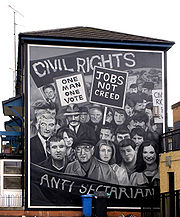
Civil rights
Civil and political rights are a class of rights that protect individuals' freedom from unwarranted infringement by governments and private organizations, and ensure one's ability to participate in the civil and political life of the state without discrimination or repression.Civil rights include...
for the all the people in Northern Ireland
Northern Ireland
Northern Ireland is one of the four countries of the United Kingdom. Situated in the north-east of the island of Ireland, it shares a border with the Republic of Ireland to the south and west...
during the late 1960s and early 1970s. Its central demand for full 'British' rights for all in what was universally recognised as part of the United Kingdom of Great Britain and Northern Ireland was exactly what made the peaceful NICRA campaign 20 November 2011 (UTC)such a powerful threat to the corrupt Unionist Party regime in Northern Ireland. The Ulster Unionist Party operated an entrenched system of party patronage in the allocation of state jobs and social housing and activily conspired to delay and distort the appication of British local franchise reform to Nortern Ireland. It actively promoted discrimination against the Roman Catholic minority and witheld the basic right of 'One man One Vote' as the very foundation of local government in Northern Ireland. Inspired by the ideals and tactics of American Civil Rights Movement, NICRA brought this currupt system crashing to the ground. It did so by peaceful means alone. It did so without resort to armed struggle. It won a series of fundamental political reforms that marked the end of the corrupt Unionist Party regime. This was and still is the legacy of the Civil Rights Revolution in Nothern Ireland. Brian B 111111 (talk) 13:34,
Origins
According to Joseph Ruane and Jennifer Todd, the ethos of the Northern state was unashamedly and unambiguously sectarian, although Senia Paseta argues that discrimination was never as calculated as nationalists maintained nor as fictional as unionists claimed.. The civil rights campaign which began in the mid-1960s attempted to achieve reform by publicising, documenting, and lobbying for an end to abuses in areas such as housingPublic housing
Public housing is a form of housing tenure in which the property is owned by a government authority, which may be central or local. Social housing is an umbrella term referring to rental housing which may be owned and managed by the state, by non-profit organizations, or by a combination of the...
, unfair electoral procedures
Gerrymandering
In the process of setting electoral districts, gerrymandering is a practice that attempts to establish a political advantage for a particular party or group by manipulating geographic boundaries to create partisan, incumbent-protected districts...
, discrimination in employment and the Special Powers Act
Civil Authorities (Special Powers) Act (Northern Ireland) 1922
The Civil Authorities Act 1922, often referred to simply as the Special Powers Act, was an Act passed by the Parliament of Northern Ireland shortly after the establishment of Northern Ireland, and in the context of violent conflict over the issue of the partition of Ireland...
.
Since Northern Ireland's creation, the Roman Catholic community had suffered from discrimination under the government. The Northern Ireland government accused NICRA of being a political front for Republican and Communist
Communism
Communism is a social, political and economic ideology that aims at the establishment of a classless, moneyless, revolutionary and stateless socialist society structured upon common ownership of the means of production...
ideologies.
Internationally, there was concern with civil and minority rights with Northern Ireland part of this international trend. NICRA therefore secured much wider international and internal support than traditional nationalist protest. According to the authors of Northern Ireland: 1921/2001 Political Forces and Social Classes, the one area which exemplified the formation of the northern state was the constitution of the security forces. They say that the strategy pursued by the Unionist middle class along with the British government's diplomatic strategies were responsible for the establishment of a sectarian-populist flavour in Northern Ireland.
In a conscious imitation of tactics used by the American Civil Rights Movement, and modelled somewhat on the National Council for Civil Liberties, the new organisation held marches, pickets, sit-ins and protests to pressure the Government of Northern Ireland
Executive Committee of the Privy Council of Northern Ireland
The Executive Committee or the Executive Committee of the Privy Council of Northern Ireland was the government of Northern Ireland created under the Government of Ireland Act 1920. Generally known as either the Cabinet or the Government, the Executive Committee existed from 1922 to 1972...
to grant these demands.
NICRA had five main demands:
- one man, one vote which meant extension of the local government franchise from ratepayers to all those over 21
- an end to gerrymandering which meant Unionists were elected even in districts with Catholic majorities
- an end to discrimination in housing
- an end to discrimination in jobs
- the disbandment of the B-Specials, the Ulster Special ConstabularyUlster Special ConstabularyThe Ulster Special Constabulary was a reserve police force in Northern Ireland. It was set up in October 1920, shortly before the founding of Northern Ireland. It was an armed corps, organised partially on military lines and called out in times of emergency, such as war or insurgency...
, which many viewed as sectarian.
First civil rights march
On 27 April 1968, NICRA held a rally to protest at the banning of a Republican Easter parade. On 24 August 1968 the Campaign for Social JusticeCampaign for Social Justice
Campaign for Social Justice was an organisation based in Northern Ireland which campaigned for civil rights in the country.The Campaign for Social Justice in Northern Ireland was inaugurated on 17 January, 1964...
(CSJ), NICRA, and other groups, held the first civil rights march in Northern Ireland from Coalisland
Coalisland
Coalisland is a small town in County Tyrone, Northern Ireland, with a population of 4,917 people . As its name suggests, it was formerly a centre for coal mining.-History:...
to Dungannon
Dungannon
Dungannon is a medium-sized town in County Tyrone, Northern Ireland. It is the third-largest town in the county and a population of 11,139 people was recorded in the 2001 Census. In August 2006, Dungannon won Ulster In Bloom's Best Kept Town Award for the fifth time...
, in County Tyrone
County Tyrone
Historically Tyrone stretched as far north as Lough Foyle, and comprised part of modern day County Londonderry east of the River Foyle. The majority of County Londonderry was carved out of Tyrone between 1610-1620 when that land went to the Guilds of London to set up profit making schemes based on...
. Loyalists organised a counter demonstration in an effort to get the march banned and in fact the rally was officially banned. Despite this the march took place and passed off without incident. The publicity surrounding the march encouraged other protesting groups to form branches of NICRA.
On 27 August 1968, the Derry Housing Action Committee
Derry Housing Action Committee
The Derry Housing Action Committee , was an organisation formed in 1968 in Derry, Northern Ireland to protest about housing conditions and provision....
(DHAC), which protested against housing discrimination and provision in Derry
Derry
Derry or Londonderry is the second-biggest city in Northern Ireland and the fourth-biggest city on the island of Ireland. The name Derry is an anglicisation of the Irish name Doire or Doire Cholmcille meaning "oak-wood of Colmcille"...
, organised another protest in the Guildhall, Derry
Guildhall, Derry
The Guildhall in Derry, County Londonderry, Northern Ireland, is a building in which the elected members of Derry City Council meet. It was built in 1890....
council chamber. Immediately after the protest Eamon Melaugh telephoned NICRA and invited them to organise a march in Derry.
Derry march
In September 1968, NICRA organised a march to be held in DerryDerry
Derry or Londonderry is the second-biggest city in Northern Ireland and the fourth-biggest city on the island of Ireland. The name Derry is an anglicisation of the Irish name Doire or Doire Cholmcille meaning "oak-wood of Colmcille"...
on 5 October 1968. On 1 October, a Protestant fraternal organisation, the Apprentice Boys of Derry
Apprentice Boys of Derry
The Apprentice Boys of Derry is a Protestant fraternal society with a worldwide membership of over 80,000, founded in 1814. They are based in the city of Derry, Northern Ireland. However, there are Clubs and branches across Ireland, Great Britain and further afield...
, announced their intention to march the same route on the same day and time. William Craig, the Northern Ireland Home Affairs Minister chose to ban civil rights marches.
Civil Rights demonstrators defied the ban. They were repeatedly attacked by the Royal Ulster Constabulary
Royal Ulster Constabulary
The Royal Ulster Constabulary was the name of the police force in Northern Ireland from 1922 to 2000. Following the awarding of the George Cross in 2000, it was subsequently known as the Royal Ulster Constabulary GC. It was founded on 1 June 1922 out of the Royal Irish Constabulary...
, who injured many marchers, including West Belfast
Belfast West (UK Parliament constituency)
Belfast West is a parliamentary constituency in the House of Commons of the United Kingdom.-Boundaries:The seat was restored in 1922 when as part of the establishment of the devolved Stormont Parliament for Northern Ireland, the number of MPs in the Westminster Parliament was drastically cut...
MP
Member of Parliament
A Member of Parliament is a representative of the voters to a :parliament. In many countries with bicameral parliaments, the term applies specifically to members of the lower house, as upper houses often have a different title, such as senate, and thus also have different titles for its members,...
Gerry Fitt
Gerry Fitt
Gerard Fitt, Baron Fitt was a politician in Northern Ireland. He was a founder and the first leader of the Social Democratic and Labour Party , a social democratic and Irish nationalist party.-Early years:...
. Television pictures of the march taken by RTÉ
RTE
RTÉ is the abbreviation for Raidió Teilifís Éireann, the public broadcasting service of the Republic of Ireland.RTE may also refer to:* Recep Tayyip Erdoğan, 25th Prime Minister of Turkey...
cameraman, Gay O'Brien, shocked viewers across the world. Following these events, Catholics in Derry rioted against police for two days. Students such as Bernadette Devlin at Queen's University, Belfast were radicalised by these events and formed a more radical civil rights organisation People's Democracy
People's Democracy
People's Democracy was a political organisation that, while supporting the campaign for civil rights for Northern Ireland's Catholic minority, stated that such rights could only be achieved through the establishment of a socialist republic for all of Ireland...
.
Unionist Prime Minister O'Neill made his 'Ulster at the crossroads' speech on television on 9 December, appealing for calm. As a result of the announced reforms, the more moderate civil rights associations declared halt to marches until 11 January 1969. The People's Democracy ignored the government's statement.
1969 riots
Events escalated until August 1969, when an Apprentice Boys of Derry march was attacked after trying to march through the nationalist BogsideBogside
The Bogside is a neighbourhood outside the city walls of Derry, Northern Ireland. The area has been a focus point for many of the events of The Troubles, from the Battle of the Bogside and Bloody Sunday in the 1960s and 1970s...
area of Derry. The RUC intervened, and a three day riot ensued between the RUC and the Bogside residents (allied under the Derry Citizens' Defence Association. Rioting spread throughout Northern Ireland, where at least seven were killed, and hundreds wounded. Thousands of Catholics were driven from their homes by Loyalists. These events were often seen as the start of the Troubles
The Troubles
The Troubles was a period of ethno-political conflict in Northern Ireland which spilled over at various times into England, the Republic of Ireland, and mainland Europe. The duration of the Troubles is conventionally dated from the late 1960s and considered by many to have ended with the Belfast...
.
Bloody Sunday
Operation Demetrius
Operation Demetrius began in Northern Ireland on the morning of Monday 9 August 1971. Operation Demetrius was launched by the British Army and Royal Ulster Constabulary and involved arresting and interning people accused of being paramilitary members...
on 9 August 1971. The British Army in co-operation with the RUC, but acting on out of date intelligence interned hundreds of men and women. This eventually rose to several thousand. Most of those interned were innocent of involvement with the PIRA. The PIRA having being tipped off about the internment either went underground or fled across the border. Many of those imprisoned were civil rights activists.
By this stage support for NICRA began to wane. However NICRA organized marches against internment. In Derry
Derry
Derry or Londonderry is the second-biggest city in Northern Ireland and the fourth-biggest city on the island of Ireland. The name Derry is an anglicisation of the Irish name Doire or Doire Cholmcille meaning "oak-wood of Colmcille"...
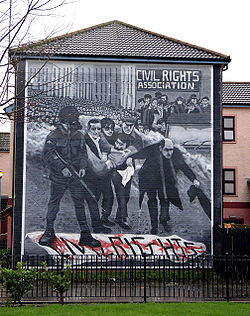
on 30 January 1972, fourteen unarmed demonstrators were shot and killed by British troops during an anti-internment march. This became known as Bloody Sunday
Bloody Sunday (1972)
Bloody Sunday —sometimes called the Bogside Massacre—was an incident on 30 January 1972 in the Bogside area of Derry, Northern Ireland, in which twenty-six unarmed civil rights protesters and bystanders were shot by soldiers of the British Army...
. The army later claimed it had come under fire. No guns were uncovered. Most of the victims were shot in the back, indicating they were running away. The British government's Saville Report published 2010 cleared the names of the protestors as innocent victims and blamed a "breakdown in the chain of command" for the deaths.
People associated with NICRA
Malachy McGurranMalachy McGurran
Malachy McGurran was a leading Irish republican and founding member of the Northern Ireland Civil Rights Association, of which he was chairman....
Chairman, Frank Gogarty, Ivan Barr, Denis Haughey, Michael Farrell, Vice Chair, Vincent MacDowell
Vincent MacDowell
Vincent MacDowell was an Irish political activist. He was the vice chairman of Northern Ireland Civil Rights Association in the 1960s, and later a representative of the Green Party and the Irish Labour Party....
vice chair. Patrons of NICRA included Kader Asmal
Kader Asmal
Kader Asmal was a South African politician. He was a professor of human rights at the University of the Western Cape, chairman of the council of the University of the North and vice-president of the African Association of International Law. He was married to Louise Parkinson and has two sons...
, Anthony Coughlan
Anthony Coughlan
Anthony Coughlan is a left-wing academic, retired Senior Lecturer Emeritus in Social Policy at Trinity College and Secretary of the The National Platform for EU Research and Information Centre....
, Bernadette Devlin, and John Hume
John Hume
John Hume is a former Irish politician from Derry, Northern Ireland. He was a founding member of the Social Democratic and Labour Party, and was co-recipient of the 1998 Nobel Peace Prize, with David Trimble....
. The first chair of NICRA was Betty Sinclair
Betty Sinclair
Betty Sinclair was an Irish communist activist.Born to a Protestant family in the Ardoyne area of Belfast, Sinclair became a mill worker and joined the Revolutionary Workers’ Group in 1932. In 1933, she was involved in the Outdoor Relief Strike...
(Communist Party) from 1968-1969; other committee members included Paddy Devlin
Paddy Devlin
Paddy Devlin was a Northern Irish social democrat and Labour activist, a former Stormont MP, a founder of the Social Democratic and Labour Party and a member of the 1974 Power Sharing Executive.-Early life:...
(NILP), Ivan Cooper
Ivan Cooper
Ivan Averill Cooper is a former politician from Northern Ireland who was a Member of the Parliament of Northern Ireland, and founding member of the SDLP...
, Robin Cole (Young Unionists), Kevin Agnew, Conn McCluskey, Jack Bennett, Madge Davidson, and Fred Heatley. NICRA's Official Secretary was Edwina Stewart, a Protestant who replaced Betty Sinclair in the executive in 1968.
External links
- Key Events - Civil Rights Campaign (1964-1972) — from the University of UlsterUniversity of UlsterThe University of Ulster is a multi-campus, co-educational university located in Northern Ireland. It is the largest single university in Ireland, discounting the federal National University of Ireland...
's CAIN project - Northern Ireland Civil Rights Movement — from the BBCBBCThe British Broadcasting Corporation is a British public service broadcaster. Its headquarters is at Broadcasting House in the City of Westminster, London. It is the largest broadcaster in the world, with about 23,000 staff...
History website - WE SHALL OVERCOME....The History of the Struggle for Civil Rights in Northern Ireland 1968-1978 — from the University of UlsterUniversity of UlsterThe University of Ulster is a multi-campus, co-educational university located in Northern Ireland. It is the largest single university in Ireland, discounting the federal National University of Ireland...
's CAIN project