


Yeoman

Encyclopedia
Elizabethan era
The Elizabethan era was the epoch in English history of Queen Elizabeth I's reign . Historians often depict it as the golden age in English history...
to the 17th century. Work requiring a great deal of effort or labor, such as would be done by a yeoman farmer, came to be described as "yeoman's work". Thus yeoman became associated with hard toil.
Yeoman was also a rank or position in a noble household, with titles such as Yeoman of the Chamber, Yeoman of the Crown, Yeoman Usher, and King's Yeoman. Most of these, including the Yeomen of the Guard
Yeomen of the Guard
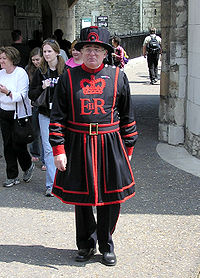
The Queen's Body Guard of the Yeomen of the Guard are a bodyguard of the British Monarch. The oldest British military corps still in existence, it was created by Henry VII in 1485 at the Battle of Bosworth Field. As a token of this venerability, the Yeomen still wear red and gold uniforms of Tudor...
, had the duty of protecting the sovereign and other dignitaries as a bodyguard, and carrying out various duties for the sovereign as assigned to his office.
In modern British usage, yeoman may specifically refer to
- a member of a reserve military unit called a yeomanryYeomanryYeomanry is a designation used by a number of units or sub-units of the British Territorial Army, descended from volunteer cavalry regiments. Today, Yeomanry units may serve in a variety of different military roles.-History:...
, similar to the militiaMilitiaThe term militia is commonly used today to refer to a military force composed of ordinary citizens to provide defense, emergency law enforcement, or paramilitary service, in times of emergency without being paid a regular salary or committed to a fixed term of service. It is a polyseme with...
, traditionally raised from moderately wealthy commoners in England and WalesEngland and WalesEngland and Wales is a jurisdiction within the United Kingdom. It consists of England and Wales, two of the four countries of the United Kingdom...
, and today part of the Territorial Army; - a member of the Yeomen of the Guard or Yeomen WardersYeomen WardersThe Yeomen Warders of Her Majesty’s Royal Palace and Fortress the Tower of London, and Members of the Sovereign's Body Guard of the Yeoman of the Guard Extraordinary, popularly known as the Beefeaters, are ceremonial guardians of the Tower of London...
of the Tower of LondonTower of LondonHer Majesty's Royal Palace and Fortress, more commonly known as the Tower of London, is a historic castle on the north bank of the River Thames in central London, England. It lies within the London Borough of Tower Hamlets, separated from the eastern edge of the City of London by the open space... - a non-commissioned officer usually with the rank of staff sergeantStaff SergeantStaff sergeant is a rank of non-commissioned officer used in several countries.The origin of the name is that they were part of the staff of a British army regiment and paid at that level rather than as a member of a battalion or company.-Australia:...
or Warrant Officer Class 1 in the Royal Corps of SignalsRoyal Corps of SignalsThe Royal Corps of Signals is one of the combat support arms of the British Army...
in the British ArmyBritish ArmyThe British Army is the land warfare branch of Her Majesty's Armed Forces in the United Kingdom. It came into being with the unification of the Kingdom of England and Scotland into the Kingdom of Great Britain in 1707. The new British Army incorporated Regiments that had already existed in England...
, an appointment achieved upon completion of a 14-month technical course.
In the United States Navy
United States Navy
The United States Navy is the naval warfare service branch of the United States Armed Forces and one of the seven uniformed services of the United States. The U.S. Navy is the largest in the world; its battle fleet tonnage is greater than that of the next 13 largest navies combined. The U.S...
and United States Coast Guard
United States Coast Guard
The United States Coast Guard is a branch of the United States Armed Forces and one of the seven U.S. uniformed services. The Coast Guard is a maritime, military, multi-mission service unique among the military branches for having a maritime law enforcement mission and a federal regulatory agency...
, a yeoman is a rating usually with secretarial, clerical, payroll or other administrative duties. The first women in the U.S. Navy were Yeomen in World War I.
In the Royal Navy
Royal Navy
The Royal Navy is the naval warfare service branch of the British Armed Forces. Founded in the 16th century, it is the oldest service branch and is known as the Senior Service...
, the Royal Canadian Navy
Royal Canadian Navy
The history of the Royal Canadian Navy goes back to 1910, when the naval force was created as the Naval Service of Canada and renamed a year later by King George V. The Royal Canadian Navy is one of the three environmental commands of the Canadian Forces...
, the Royal Australian Navy
Royal Australian Navy
The Royal Australian Navy is the naval branch of the Australian Defence Force. Following the Federation of Australia in 1901, the ships and resources of the separate colonial navies were integrated into a national force: the Commonwealth Naval Forces...
, and other maritime forces which follow British naval tradition, a Yeoman of Signals is a signalling and tactical communications
Tactical communications
Tactical communications are communications in which information of any kind, especially orders and decisions, are conveyed from one command, person, or place to another within tactical forces. In modern times, this is usually done by electronic means....
petty officer
Petty Officer
A petty officer is a non-commissioned officer in many navies and is given the NATO rank denotion OR-6. They are equal in rank to sergeant, British Army and Royal Air Force. A Petty Officer is superior in rank to Leading Rate and subordinate to Chief Petty Officer, in the case of the British Armed...
.
Etymology
The word yeoman was spelled in various ways in the Middle AgesMiddle Ages
The Middle Ages is a periodization of European history from the 5th century to the 15th century. The Middle Ages follows the fall of the Western Roman Empire in 476 and precedes the Early Modern Era. It is the middle period of a three-period division of Western history: Classic, Medieval and Modern...
, such as yeman, yoman, yoeman, and may be derived from an Anglo-Saxon or other Germanic word yongeman or yongerman, yonge man or iunge man ("young man"). This may have referred to a freeborn servant (serviens or sergeant) ranking between an esquire
Esquire
Esquire is a term of West European origin . Depending on the country, the term has different meanings...
(shield escort, from scutum
Scutum (shield)
Scutum is the Latin word for "shield", although it has in modern times come to be specifically associated with the rectangular, semi-cylindrical body shield carried by Roman legionaries.-History:...
) and a page
Page (servant)
A page or page boy is a traditionally young male servant, a messenger at the service of a nobleman or royal.-The medieval page:In medieval times, a page was an attendant to a knight; an apprentice squire...
(pagus, meaning "rustic" and later "young errand boy").
The term yongermen is found in text as early as the 12th century, and the term geongramanna is found in Beowulf
Beowulf
Beowulf , but modern scholars agree in naming it after the hero whose life is its subject." of an Old English heroic epic poem consisting of 3182 alliterative long lines, set in Scandinavia, commonly cited as one of the most important works of Anglo-Saxon literature.It survives in a single...
at a much earlier period (700-800).
Serving men of districts, since the days of the Gau polities
Polity
Polity is a form of government Aristotle developed in his search for a government that could be most easily incorporated and used by the largest amount of people groups, or states...
in Germania
Germania
Germania was the Greek and Roman geographical term for the geographical regions inhabited by mainly by peoples considered to be Germani. It was most often used to refer especially to the east of the Rhine and north of the Danube...
, and the stretches of the Germanic peoples throughout Western Europe
Western Europe
Western Europe is a loose term for the collection of countries in the western most region of the European continents, though this definition is context-dependent and carries cultural and political connotations. One definition describes Western Europe as a geographic entity—the region lying in the...
immediately after the collapse of the Roman Empire
Roman Empire
The Roman Empire was the post-Republican period of the ancient Roman civilization, characterised by an autocratic form of government and large territorial holdings in Europe and around the Mediterranean....
would most likely be young men, or young men of the district. Yeoman or gauman within the definition of both land and/or service of a young man appeared mostly settled around the border regions or remote country sides of their districts, or kingdoms (both modern and ancient); thus a connection or association with pagus (pages), or rustics to the term yeoman.
In the 14th century the English language increasingly replaced Latin and Norman French in noble circles, and the French
French language
French is a Romance language spoken as a first language in France, the Romandy region in Switzerland, Wallonia and Brussels in Belgium, Monaco, the regions of Quebec and Acadia in Canada, and by various communities elsewhere. Second-language speakers of French are distributed throughout many parts...
term valet
Valet
Valet and varlet are terms for male servants who serve as personal attendants to their employer.- Word origins :In the Middle Ages, the valet de chambre to a ruler was a prestigious appointment for young men...
and the Latin term valectus were replaced by the term yeoman. The term yeoman, primarily identified as "servant", is noted throughout the Calendar Patent Rolls in the early 14th century.
The Canon's Yeoman's Prologue and Tale
The Canon's Yeoman's Prologue and Tale
The Canon's Yeoman's Tale is one of The Canterbury Tales by Geoffrey Chaucer.The Canon and his Yeoman are not mentioned in the General Prologue of The Canterbury Tales, where most of the other pilgrims are described, but they arrive later after riding fast to catch up with the group. The tale the...
appears in Geoffrey Chaucer's
Geoffrey Chaucer
Geoffrey Chaucer , known as the Father of English literature, is widely considered the greatest English poet of the Middle Ages and was the first poet to have been buried in Poet's Corner of Westminster Abbey...
Canterbury Tales.
Middle Ages
Throughout the medieval periodMiddle Ages
The Middle Ages is a periodization of European history from the 5th century to the 15th century. The Middle Ages follows the fall of the Western Roman Empire in 476 and precedes the Early Modern Era. It is the middle period of a three-period division of Western history: Classic, Medieval and Modern...
the term yeoman was used in royal and noble households to indicate a servant's rank, position or status. A yeoman often fought in feudal
Feudalism
Feudalism was a set of legal and military customs in medieval Europe that flourished between the 9th and 15th centuries, which, broadly defined, was a system for ordering society around relationships derived from the holding of land in exchange for service or labour.Although derived from the...
or private warfare.
Long before chivalry
Chivalry
Chivalry is a term related to the medieval institution of knighthood which has an aristocratic military origin of individual training and service to others. Chivalry was also the term used to refer to a group of mounted men-at-arms as well as to martial valour...
developed, the term "knight
Knight
A knight was a member of a class of lower nobility in the High Middle Ages.By the Late Middle Ages, the rank had become associated with the ideals of chivalry, a code of conduct for the perfect courtly Christian warrior....
" (Old English cniht) meant "boy". Terms such as radman, radcniht, or radknight ("riding man", "road man", "riding boy", "road boy/page") were used. The different terms helped to distinguish the young riding men (yeomen) from the riding boys (pages) who provided a riding or road service. It also indicates a path of career progression within a noble or royal household.
There also 'socmen' or 'sokemen', probably derived from Anglian or Danish
Denmark
Denmark is a Scandinavian country in Northern Europe. The countries of Denmark and Greenland, as well as the Faroe Islands, constitute the Kingdom of Denmark . It is the southernmost of the Nordic countries, southwest of Sweden and south of Norway, and bordered to the south by Germany. Denmark...
, equivalent in status to 'radman', thus combining land status and servile status as equals.
The classes of fighting men in the Middle Ages, from the knights (including knights bachelor), squire
Squire
The English word squire is a shortened version of the word Esquire, from the Old French , itself derived from the Late Latin , in medieval or Old English a scutifer. The Classical Latin equivalent was , "arms bearer"...
s, yeomen, to pages, were often young servants; their relative statuses changed over time. Many serving men (servientes or sergeants) would be promoted to positions of importance within the king's or lord's household.
In the earlier Anglo Saxon period, the class of 'geneatas' would most likely be the classification a 'yeoman' in this period as an aristocratic
Aristocracy (class)
The aristocracy are people considered to be in the highest social class in a society which has or once had a political system of Aristocracy. Aristocrats possess hereditary titles granted by a monarch, which once granted them feudal or legal privileges, or deriving, as in Ancient Greece and India,...
peasantry.]
In the early Middle English period (noted in the text Pseudo Cnut De Foresta Constitutiones written in the late 11th century), the ‘yonger men’ chosen of liberi homini mediocre were to range the royal forests and is the first known use of the word yeoman being associated with the forests (both greenwood and royal or manorial hunting forests). The chief forester
Forester
250px|thumb|right|Foresters of [[Southern University of Chile|UACh]] in the [[Valdivian forest]]s of San Pablo de Tregua, ChileA forester is a person who practices forestry, the science, art, and profession of managing forests. Foresters engage in a broad range of activities including timber...
of such royal forests was stationed at the nearest castle
Castle
A castle is a type of fortified structure built in Europe and the Middle East during the Middle Ages by European nobility. Scholars debate the scope of the word castle, but usually consider it to be the private fortified residence of a lord or noble...
and was also the constable of the castle with his deputy foresters or yeomen assisting in the maintenance and affairs of the royal forests.
The yeomanry was the first class of the commoner
Commoner
In British law, a commoner is someone who is neither the Sovereign nor a peer. Therefore, any member of the Royal Family who is not a peer, such as Prince Harry of Wales or Anne, Princess Royal, is a commoner, as is any member of a peer's family, including someone who holds only a courtesy title,...
s (peasant
Peasant
A peasant is an agricultural worker who generally tend to be poor and homeless-Etymology:The word is derived from 15th century French païsant meaning one from the pays, or countryside, ultimately from the Latin pagus, or outlying administrative district.- Position in society :Peasants typically...
s), which in Saxon days
History of Anglo-Saxon England
Anglo-Saxon England refers to the period of the history of that part of Britain, that became known as England, lasting from the end of Roman occupation and establishment of Anglo-Saxon kingdoms in the 5th century until the Norman conquest of England in 1066 by William the Conqueror...
would be the equivalent to geneatas or villager. The yeoman was more military and bound to the manor
Manorialism
Manorialism, an essential element of feudal society, was the organizing principle of rural economy that originated in the villa system of the Late Roman Empire, was widely practiced in medieval western and parts of central Europe, and was slowly replaced by the advent of a money-based market...
or estate, comparable to the radman or radcniht (radknight) who would provide escorts, deliver messages, erect fences for the hunt, and repair bridges. He would be given land (copyhold or sometimes freehold) by his lord for services well rendered. Many similarities exist between radmen/radknights and yeomen of the crown, as yeomen had many of the same tasks, though he was not as heavily imposed with the intense labor requirements as the radman/radknight had during his time.
Yeomen in the Middle Ages typically owned land worth 40 to 80 shillings annually: roughly between ¼ hide
Hide (unit)
The hide was originally an amount of land sufficient to support a household, but later in Anglo-Saxon England became a unit used in assessing land for liability to "geld", or land tax. The geld would be collected at a stated rate per hide...
and 1 hide (about 30 to 120 acre
Acre
The acre is a unit of area in a number of different systems, including the imperial and U.S. customary systems. The most commonly used acres today are the international acre and, in the United States, the survey acre. The most common use of the acre is to measure tracts of land.The acre is related...
s, or 12 to 50 hectare
Hectare
The hectare is a metric unit of area defined as 10,000 square metres , and primarily used in the measurement of land. In 1795, when the metric system was introduced, the are was defined as being 100 square metres and the hectare was thus 100 ares or 1/100 km2...
s). In the early 12th century, 40 acres (16.2 ha) of land was worth about 40 to 50 shillings. A yeoman during the 12th and 13th centuries was primarily a household and military (semi-feudal and feudal) term later associated with the days of private warfare.
The Assize of Arms of 1252
Assize of Arms of 1252
The Assize of Arms of 1252, also called the Ordinance of 1252, was a proclamation of King Henry III of England concerning the enforcement of the Assize of Arms of 1181, and the appointment of constables to summon men to arms, quell breaches of the peace, and to deliver offenders to the...
provided that small landholders should be armed and trained with a bow, and those of more wealth (wealthy yeomen) would be required to possess and be trained with sword
Sword
A sword is a bladed weapon used primarily for cutting or thrusting. The precise definition of the term varies with the historical epoch or the geographical region under consideration...
, dagger
Dagger
A dagger is a fighting knife with a sharp point designed or capable of being used as a thrusting or stabbing weapon. The design dates to human prehistory, and daggers have been used throughout human experience to the modern day in close combat confrontations...
and longbow
Longbow
A longbow is a type of bow that is tall ; this will allow its user a fairly long draw, at least to the jaw....
(the war bow). That Assize referred to a class of 40-shilling freeholders, who became identified with 'yeomanry', and states "Those with land worth annual 40s-100s will be armed/trained with bow and arrow, sword
Sword
A sword is a bladed weapon used primarily for cutting or thrusting. The precise definition of the term varies with the historical epoch or the geographical region under consideration...
, buckler
Buckler
A buckler is a small shield, 15 to 45 cm in diameter, gripped in the fist; it was generally used as a companion weapon in hand-to-hand combat during the Medieval and Renaissance, as its size made it poor protection against missile weapons but useful in deflecting the blow of...
and dagger
Dagger
A dagger is a fighting knife with a sharp point designed or capable of being used as a thrusting or stabbing weapon. The design dates to human prehistory, and daggers have been used throughout human experience to the modern day in close combat confrontations...
". This status of landowner corresponds to the Knight's Yeoman in Chaucer's
Geoffrey Chaucer
Geoffrey Chaucer , known as the Father of English literature, is widely considered the greatest English poet of the Middle Ages and was the first poet to have been buried in Poet's Corner of Westminster Abbey...
Canterbury Tales
The Canterbury Tales
The Canterbury Tales is a collection of stories written in Middle English by Geoffrey Chaucer at the end of the 14th century. The tales are told as part of a story-telling contest by a group of pilgrims as they travel together on a journey from Southwark to the shrine of Saint Thomas Becket at...
(Yeoman's Portrait in the General Prologue
General Prologue
The General Prologue is the assumed title of the series of portraits that precedes The Canterbury Tales. It was the work of 14th century English writer and courtier Geoffrey Chaucer.-Synopsis:...
to the Canterbury Tales).
This association of the term yeoman with degree of land ownership may have originated in early Anglo-Saxon
Anglo-Saxon
Anglo-Saxon may refer to:* Anglo-Saxons, a group that invaded Britain** Old English, their language** Anglo-Saxon England, their history, one of various ships* White Anglo-Saxon Protestant, an ethnicity* Anglo-Saxon economy, modern macroeconomic term...
times.
The term yeoman was still used in the 16th century to denote the more prosperous, often owning either copyhold
Copyhold
At its origin in medieval England, copyhold tenure was tenure of land according to the custom of the manor, the "title deeds" being a copy of the record of the manorial court....
, freehold, or leasehold land.
Not all yeomen owned land: many were indentured or feudal servants in a castle
Castle
A castle is a type of fortified structure built in Europe and the Middle East during the Middle Ages by European nobility. Scholars debate the scope of the word castle, but usually consider it to be the private fortified residence of a lord or noble...
.
Thus the yeoman may be considered as a middle class of sorts, in feudal or manorial service of the king or a lord, and perhaps as a link between nobility and the peasantry.
The yeoman represented a status between the aristocratic
Aristocracy (class)
The aristocracy are people considered to be in the highest social class in a society which has or once had a political system of Aristocracy. Aristocrats possess hereditary titles granted by a monarch, which once granted them feudal or legal privileges, or deriving, as in Ancient Greece and India,...
knight
Knight
A knight was a member of a class of lower nobility in the High Middle Ages.By the Late Middle Ages, the rank had become associated with the ideals of chivalry, a code of conduct for the perfect courtly Christian warrior....
s and the lower-class foot soldiers
Infantry
Infantrymen are soldiers who are specifically trained for the role of fighting on foot to engage the enemy face to face and have historically borne the brunt of the casualties of combat in wars. As the oldest branch of combat arms, they are the backbone of armies...
and household servants (pages). The yeoman archer was typically mounted and fought either on foot or on horseback, in contrast with infantry archers,
Also possibly identified within a class of libri homines (freemen) in Domesday Book
Domesday Book
Domesday Book , now held at The National Archives, Kew, Richmond upon Thames in South West London, is the record of the great survey of much of England and parts of Wales completed in 1086...
, the yeoman in service to a king or lord would be known as serviens or sergeant, or valet/valectus during the Norman period
Norman conquest of England
The Norman conquest of England began on 28 September 1066 with the invasion of England by William, Duke of Normandy. William became known as William the Conqueror after his victory at the Battle of Hastings on 14 October 1066, defeating King Harold II of England...
.
Yeomen are also noted as providing guard escorts to deliveries of victuals and supplies (not only fighting as an elite archer but also as a guard to the baggage train as well a protector of the nobility and royalty) to the expeditions of the Hundred Years' War
Hundred Years' War
The Hundred Years' War was a series of separate wars waged from 1337 to 1453 by the House of Valois and the House of Plantagenet, also known as the House of Anjou, for the French throne, which had become vacant upon the extinction of the senior Capetian line of French kings...
. They also provided escorts for the sovereign and great nobles on their journeys and their pilgrimage
Pilgrimage
A pilgrimage is a journey or search of great moral or spiritual significance. Typically, it is a journey to a shrine or other location of importance to a person's beliefs and faith...
s across the realm and overseas. Yeomen of the Crown were essentially agents of the king who were allowed to sit and dine with knight
Knight
A knight was a member of a class of lower nobility in the High Middle Ages.By the Late Middle Ages, the rank had become associated with the ideals of chivalry, a code of conduct for the perfect courtly Christian warrior....
s and squire
Squire
The English word squire is a shortened version of the word Esquire, from the Old French , itself derived from the Late Latin , in medieval or Old English a scutifer. The Classical Latin equivalent was , "arms bearer"...
s of any lord's house or estate. At retirement they were offered tenure of stewardship of royal forests at the king’s choosing.
14th to 18th centuries
In the late 14th to 18th centuries, yeomen were farmers who owned land (freehold, leasehold or copyhold). Their wealth and the size of their landholding varied.Many yeomen were prosperous, and wealthy enough to employ servants and farm labourers. Some were as wealthy as the minor county or regional landed gentry
Landed gentry
Landed gentry is a traditional British social class, consisting of land owners who could live entirely off rental income. Often they worked only in an administrative capacity looking after the management of their own lands....
and some even leased land to gentleman landowners. Some could be classed as gentlemen but did not aspire to this status: it was cheaper to remain a yeoman. Often it was hard to distinguish minor landed gentry from the wealthier yeomen, and wealthier husbandmen from the poorer yeomen.
Some yeomen in the later Tudor
Tudor period
The Tudor period usually refers to the period between 1485 and 1603, specifically in relation to the history of England. This coincides with the rule of the Tudor dynasty in England whose first monarch was Henry VII...
and Stuart
House of Stuart
The House of Stuart is a European royal house. Founded by Robert II of Scotland, the Stewarts first became monarchs of the Kingdom of Scotland during the late 14th century, and subsequently held the position of the Kings of Great Britain and Ireland...
periods were descended from medieval military yeomen. This is attested mainly by weapons found above fireplace mantles in the West Midlands
West Midlands (region)
The West Midlands is an official region of England, covering the western half of the area traditionally known as the Midlands. It contains the second most populous British city, Birmingham, and the larger West Midlands conurbation, which includes the city of Wolverhampton and large towns of Dudley,...
of England (especially in the border shires).
Yeomen were called upon to serve their sovereign and country well after the Middle Ages
Middle Ages
The Middle Ages is a periodization of European history from the 5th century to the 15th century. The Middle Ages follows the fall of the Western Roman Empire in 476 and precedes the Early Modern Era. It is the middle period of a three-period division of Western history: Classic, Medieval and Modern...
, for example in the Yeomanry Cavalry
Cavalry
Cavalry or horsemen were soldiers or warriors who fought mounted on horseback. Cavalry were historically the third oldest and the most mobile of the combat arms...
of the late 18th century and later Imperial Yeomanry of the late 1890s.
Sir Anthony Richard Wagner, Garter Principal King of Arms
King of Arms
King of Arms is the senior rank of an officer of arms. In many heraldic traditions, only a king of arms has the authority to grant armorial bearings. In other traditions, the power has been delegated to other officers of similar rank.-Heraldic duties:...
, wrote that "a Yeoman would not normally have less than 100 acres" (40 hectares) "and in social status is one step down from the Landed Gentry, but above, say, a husbandman. "(English Genealogy, Oxford, 1960, pps: 125-130).
A yeoman could be equally comfortable working on his farm, educating himself from books, or enjoying country sports such as shooting and hunting. By contrast members of the landed gentry and the aristocracy
Aristocracy
Aristocracy , is a form of government in which a few elite citizens rule. The term derives from the Greek aristokratia, meaning "rule of the best". In origin in Ancient Greece, it was conceived of as rule by the best qualified citizens, and contrasted with monarchy...
did not farm their land themselves, but let it to tenant farmers. Yeomen in the Tudor
Tudor period
The Tudor period usually refers to the period between 1485 and 1603, specifically in relation to the history of England. This coincides with the rule of the Tudor dynasty in England whose first monarch was Henry VII...
and Stuart period
Stuart period
The Stuart period of English and British history refers to the period between 1603 and 1714, while in Scotland it begins in 1371. These dates coincide with the rule of the Scottish royal House of Stuart, whose first monarch to rule England was James I & VI...
s might also lease or rent lands to the minor gentry. However, yeomen and tenant farmers were the two main divisions of the rural middle class, and the yeoman was a respectable, honourable class and ranked above the husbandmen, artisans, and labourers.
Isaac Newton
Isaac Newton
Sir Isaac Newton PRS was an English physicist, mathematician, astronomer, natural philosopher, alchemist, and theologian, who has been "considered by many to be the greatest and most influential scientist who ever lived."...
and many other famous people such as Thomas Jefferson
Thomas Jefferson
Thomas Jefferson was the principal author of the United States Declaration of Independence and the Statute of Virginia for Religious Freedom , the third President of the United States and founder of the University of Virginia...
hailed from the yeoman class. Isaac Newton inherited a small farm which paid the bills for his academic work. Many yeomen were rich enough to send their sons to school to qualify for a gentlemanly profession. Earlier, the sons of many yeoman families served in royal or great noble households providing not menial, but honourable service, as his social status or degree in society was equal in the royal or noble household.
The Concise Oxford Dictionary
Concise Oxford English Dictionary
The Concise Oxford English Dictionary is probably the best-known of the 'smaller' Oxford dictionaries. The latest edition of the Concise Oxford English Dictionary contains over 240,000 entries and 1,728 pages...
, (edited by H.W. & F.G. Fowler, Clarendon Press, Oxford, 1972 reprint, p. 1516) states that a yeoman was "a person qualified by possessing free land of 40/- (shillings) annual [feudal] value, and who can serve on juries and vote for a Knight of the Shire. He is sometimes described as a small landowner, a farmer of the middle classes."
In some ways the ancient "yeoman" was very similar to the "yeomanry" today, volunteers of the Territorial Army of the United Kingdom
United Kingdom
The United Kingdom of Great Britain and Northern IrelandIn the United Kingdom and Dependencies, other languages have been officially recognised as legitimate autochthonous languages under the European Charter for Regional or Minority Languages...
. Yeoman military corps takes origin from the volunteer cavalry in the mid-18th century, later becoming known as the Yeomanry Cavalry
Cavalry
Cavalry or horsemen were soldiers or warriors who fought mounted on horseback. Cavalry were historically the third oldest and the most mobile of the combat arms...
in the 1790s.
United States
In the United States, yeomen were identified in the 18th and 19th centuries as non-slaveholding, small landowning, family farmers. In Southern areas where land was poor, like East TennesseeEast Tennessee
East Tennessee is a name given to approximately the eastern third of the U.S. state of Tennessee, one of the three Grand Divisions of Tennessee defined in state law. East Tennessee consists of 33 counties, 30 located within the Eastern Time Zone and three counties in the Central Time Zone, namely...
, the landowning yeomen were typically subsistence farmers, but some managed to grow some crops for market. Whether they engaged in subsistence or commercial agriculture, they controlled far more modest landholdings than those of the planters, typically in the range of 50-200 acres. In the North, practically all the farms were operated by yeoman farmers as family farms.
Thomas Jefferson
Thomas Jefferson
Thomas Jefferson was the principal author of the United States Declaration of Independence and the Statute of Virginia for Religious Freedom , the third President of the United States and founder of the University of Virginia...
was a leading advocate of the yeomen, arguing that the independent farmers formed the basis of republican values
Republicanism in the United States
Republicanism is the political value system that has been a major part of American civic thought since the American Revolution. It stresses liberty and inalienable rights as central values, makes the people as a whole sovereign, supports activist government to promote the common good, rejects...
. Indeed, Jeffersonian Democracy
Jeffersonian democracy
Jeffersonian Democracy, so named after its leading advocate Thomas Jefferson, is a term used to describe one of two dominant political outlooks and movements in the United States from the 1790s to the 1820s. The term was commonly used to refer to the Democratic-Republican Party which Jefferson...
as a political force was largely built around the yeomen. After the Civil War, organizations of farmers, especially the Grange, formed to organize and enhance the status of the yeoman farmers.
Yeoman archers and yew war bows
The English war bow, known as the longbowEnglish longbow
The English longbow, also called the Welsh longbow, is a powerful type of medieval longbow about 6 ft long used by the English and Welsh for hunting and as a weapon in medieval warfare...
, was the main weapon of a yeoman archer. It was typically but not always made of yew
Taxus baccata
Taxus baccata is a conifer native to western, central and southern Europe, northwest Africa, northern Iran and southwest Asia. It is the tree originally known as yew, though with other related trees becoming known, it may be now known as the English yew, or European yew.-Description:It is a small-...
wood, often Wych Elm
Wych Elm
Ulmus glabra, the Wych elm or Scots elm, has the widest range of the European elm species, from Ireland eastwards to the Urals, and from the Arctic Circle south to the mountains of the Peloponnese in Greece; it is also found in Iran...
; but other woods were used for making bow staves. However, the Spanish, French and Italian yews were also highly sought after because of their superior growth qualities and the very limited availability of English yew in the late Middle Ages.
The 'yeoman archer' was unique to England and Wales
England and Wales
England and Wales is a jurisdiction within the United Kingdom. It consists of England and Wales, two of the four countries of the United Kingdom...
(in particular, the south Wales areas of Monmouthshire
Monmouthshire
Monmouthshire is a county in south east Wales. The name derives from the historic county of Monmouthshire which covered a much larger area. The largest town is Abergavenny. There are many castles in Monmouthshire .-Historic county:...
with the famed archers of Gwent; and Glamorgan
Glamorgan
Glamorgan or Glamorganshire is one of the thirteen historic counties and a former administrative county of Wales. It was originally an early medieval kingdom of varying boundaries known as Glywysing until taken over by the Normans as a lordship. Glamorgan is latterly represented by the three...
, Crickhowell
Crickhowell
Crickhowell is a small town in Powys, Mid Wales.-Location:The name Crickhowell is taken from that of the nearby Iron Age hill fort of Crug Hywel above the town, the Welsh language name being anglicised by map-makers and local English-speaking people...
, and Abergavenny
Abergavenny
Abergavenny , meaning Mouth of the River Gavenny, is a market town in Monmouthshire, Wales. It is located 15 miles west of Monmouth on the A40 and A465 roads, 6 miles from the English border. Originally the site of a Roman fort, Gobannium, it became a medieval walled town within the Welsh Marches...
; and South West England with the Royal Forest of Dean
Forest of Dean
The Forest of Dean is a geographical, historical and cultural region in the western part of the county of Gloucestershire, England. The forest is a roughly triangular plateau bounded by the River Wye to the west and north, the River Severn to the south, and the City of Gloucester to the east.The...
, Kingswood Royal Forest near Bristol, and the New Forest
New Forest
The New Forest is an area of southern England which includes the largest remaining tracts of unenclosed pasture land, heathland and forest in the heavily-populated south east of England. It covers south-west Hampshire and extends into south-east Wiltshire....
). Though Kentish Weald
Weald
The Weald is the name given to an area in South East England situated between the parallel chalk escarpments of the North and the South Downs. It should be regarded as three separate parts: the sandstone "High Weald" in the centre; the clay "Low Weald" periphery; and the Greensand Ridge which...
and Cheshire
Cheshire
Cheshire is a ceremonial county in North West England. Cheshire's county town is the city of Chester, although its largest town is Warrington. Other major towns include Widnes, Congleton, Crewe, Ellesmere Port, Runcorn, Macclesfield, Winsford, Northwich, and Wilmslow...
archers were noted for their skills, as well the Ettrick
Ettrick, Scotland
Ettrick is a small village and civil parish in the Scottish Borders area of Scotland, located around south-west of the town of Selkirk.-Local area:...
Archers of Scotland, it appears that the bulk of the 'yeomanry' was from the English and Welsh Marches
Welsh Marches
The Welsh Marches is a term which, in modern usage, denotes an imprecisely defined area along and around the border between England and Wales in the United Kingdom. The precise meaning of the term has varied at different periods...
(border regions) and the Scottish Borders
Scottish Borders
The Scottish Borders is one of 32 local government council areas of Scotland. It is bordered by Dumfries and Galloway in the west, South Lanarkshire and West Lothian in the north west, City of Edinburgh, East Lothian, Midlothian to the north; and the non-metropolitan counties of Northumberland...
).
The original Yeomen of the Guard (originally archers) chartered in 1485 were most likely of Briton descent, including Welshmen
Wales
Wales is a country that is part of the United Kingdom and the island of Great Britain, bordered by England to its east and the Atlantic Ocean and Irish Sea to its west. It has a population of three million, and a total area of 20,779 km²...
and Bretons
Breton people
The Bretons are an ethnic group located in the region of Brittany in France. They trace much of their heritage to groups of Brythonic speakers who emigrated from southwestern Great Britain in waves from the 3rd to 6th century into the Armorican peninsula, subsequently named Brittany after them.The...
. They were established by King Henry VII
Henry VII of England
Henry VII was King of England and Lord of Ireland from his seizing the crown on 22 August 1485 until his death on 21 April 1509, as the first monarch of the House of Tudor....
, himself a Briton who was exiled in Brittany
Brittany
Brittany is a cultural and administrative region in the north-west of France. Previously a kingdom and then a duchy, Brittany was united to the Kingdom of France in 1532 as a province. Brittany has also been referred to as Less, Lesser or Little Britain...
during the Wars of the Roses
Wars of the Roses
The Wars of the Roses were a series of dynastic civil wars for the throne of England fought between supporters of two rival branches of the royal House of Plantagenet: the houses of Lancaster and York...
. He recruited his forces mostly from Wales
Wales
Wales is a country that is part of the United Kingdom and the island of Great Britain, bordered by England to its east and the Atlantic Ocean and Irish Sea to its west. It has a population of three million, and a total area of 20,779 km²...
and the West Midlands
West Midlands (region)
The West Midlands is an official region of England, covering the western half of the area traditionally known as the Midlands. It contains the second most populous British city, Birmingham, and the larger West Midlands conurbation, which includes the city of Wolverhampton and large towns of Dudley,...
of England on his victorious journey to Bosworth Field
Battle of Bosworth Field
The Battle of Bosworth Field was the penultimate battle of the Wars of the Roses, the civil war between the House of Lancaster and the House of York that raged across England in the latter half of the 15th century. Fought on 22 August 1485, the battle was won by the Lancastrians...
.
The Welsh
Wales
Wales is a country that is part of the United Kingdom and the island of Great Britain, bordered by England to its east and the Atlantic Ocean and Irish Sea to its west. It has a population of three million, and a total area of 20,779 km²...
were the first to be attested to have used the 'longbow
Longbow
A longbow is a type of bow that is tall ; this will allow its user a fairly long draw, at least to the jaw....
' made of yew
Taxus
Taxus is a genus of yews, small coniferous trees or shrubs in the yew family Taxaceae. They are relatively slow-growing and can be very long-lived, and reach heights of 1-40 m, with trunk diameters of up to 4 m...
and elm
Elm
Elms are deciduous and semi-deciduous trees comprising the genus Ulmus in the plant family Ulmaceae. The dozens of species are found in temperate and tropical-montane regions of North America and Eurasia, ranging southward into Indonesia. Elms are components of many kinds of natural forests...
(c.AD 650) either against the Mercia
Mercia
Mercia was one of the kingdoms of the Anglo-Saxon Heptarchy. It was centred on the valley of the River Trent and its tributaries in the region now known as the English Midlands...
ns, or as allies of the Mercians against Northumbria
Northumbria
Northumbria was a medieval kingdom of the Angles, in what is now Northern England and South-East Scotland, becoming subsequently an earldom in a united Anglo-Saxon kingdom of England. The name reflects the approximate southern limit to the kingdom's territory, the Humber Estuary.Northumbria was...
. The incident at Abergavenny Castle
Abergavenny Castle
Abergavenny Castle is a castle in the market town of Abergavenny, Monmouthshire in south east Wales.- A naturally fortified site :The castle was sited above the River Usk overlooking the river valley and the confluence of the rivers Gavenny and Usk. The site would have been naturally defensible in...
, where a Welsh arrow pierced through armour and the legs of an English knight
Knight
A knight was a member of a class of lower nobility in the High Middle Ages.By the Late Middle Ages, the rank had become associated with the ideals of chivalry, a code of conduct for the perfect courtly Christian warrior....
, was certainly known to King Henry II
Henry II of England
Henry II ruled as King of England , Count of Anjou, Count of Maine, Duke of Normandy, Duke of Aquitaine, Duke of Gascony, Count of Nantes, Lord of Ireland and, at various times, controlled parts of Wales, Scotland and western France. Henry, the great-grandson of William the Conqueror, was the...
, and his grandson Henry III
Henry III of England
Henry III was the son and successor of John as King of England, reigning for 56 years from 1216 until his death. His contemporaries knew him as Henry of Winchester. He was the first child king in England since the reign of Æthelred the Unready...
who created or signed the Assize of Arms 1252 identifying the 'war bow' as a national weapon for classes of men who held land under 80s or 100s annually. The 'Yongermen' fell under this classification. By Edward I's
Edward I of England
Edward I , also known as Edward Longshanks and the Hammer of the Scots, was King of England from 1272 to 1307. The first son of Henry III, Edward was involved early in the political intrigues of his father's reign, which included an outright rebellion by the English barons...
reign the bulk of the archers were Welsh
Wales
Wales is a country that is part of the United Kingdom and the island of Great Britain, bordered by England to its east and the Atlantic Ocean and Irish Sea to its west. It has a population of three million, and a total area of 20,779 km²...
, who defeated the Scots
Scottish people
The Scottish people , or Scots, are a nation and ethnic group native to Scotland. Historically they emerged from an amalgamation of the Picts and Gaels, incorporating neighbouring Britons to the south as well as invading Germanic peoples such as the Anglo-Saxons and the Norse.In modern use,...
and would later be employed with great success by King Edward III
Edward III of England
Edward III was King of England from 1327 until his death and is noted for his military success. Restoring royal authority after the disastrous reign of his father, Edward II, Edward III went on to transform the Kingdom of England into one of the most formidable military powers in Europe...
in the Hundred Years War. The famous yeoman archers drawn from the Macclesfield
Macclesfield
Macclesfield is a market town within the unitary authority of Cheshire East, the county palatine of Chester, also known as the ceremonial county of Cheshire, England. The population of the Macclesfield urban sub-area at the time of the 2001 census was 50,688...
Hundred
Hundred (division)
A hundred is a geographic division formerly used in England, Wales, Denmark, South Australia, some parts of the United States, Germany , Sweden, Finland and Norway, which historically was used to divide a larger region into smaller administrative divisions...
and the Forest districts of Cheshire
Cheshire
Cheshire is a ceremonial county in North West England. Cheshire's county town is the city of Chester, although its largest town is Warrington. Other major towns include Widnes, Congleton, Crewe, Ellesmere Port, Runcorn, Macclesfield, Winsford, Northwich, and Wilmslow...
were specially appointed as bodyguard archers for King Richard II
Richard II of England
Richard II was King of England, a member of the House of Plantagenet and the last of its main-line kings. He ruled from 1377 until he was deposed in 1399. Richard was a son of Edward, the Black Prince, and was born during the reign of his grandfather, Edward III...
.
Historical roles
Yeomen filled many roles from the Middle AgesMiddle Ages
The Middle Ages is a periodization of European history from the 5th century to the 15th century. The Middle Ages follows the fall of the Western Roman Empire in 476 and precedes the Early Modern Era. It is the middle period of a three-period division of Western history: Classic, Medieval and Modern...
through to the 19th century. They were often constable
Constable
A constable is a person holding a particular office, most commonly in law enforcement. The office of constable can vary significantly in different jurisdictions.-Etymology:...
s of their parish
Parish
A parish is a territorial unit historically under the pastoral care and clerical jurisdiction of one parish priest, who might be assisted in his pastoral duties by a curate or curates - also priests but not the parish priest - from a more or less central parish church with its associated organization...
, and sometimes chief constables of the district, shire
Shire
A shire is a traditional term for a division of land, found in the United Kingdom and in Australia. In parts of Australia, a shire is an administrative unit, but it is not synonymous with "county" there, which is a land registration unit. Individually, or as a suffix in Scotland and in the far...
or hundred
Hundred (division)
A hundred is a geographic division formerly used in England, Wales, Denmark, South Australia, some parts of the United States, Germany , Sweden, Finland and Norway, which historically was used to divide a larger region into smaller administrative divisions...
. Many yeomen held the positions of bailiff
Bailiff
A bailiff is a governor or custodian ; a legal officer to whom some degree of authority, care or jurisdiction is committed...
s for the High Sheriff
High Sheriff
A high sheriff is, or was, a law enforcement officer in the United Kingdom, Canada and the United States.In England and Wales, the office is unpaid and partly ceremonial, appointed by the Crown through a warrant from the Privy Council. In Cornwall, the High Sheriff is appointed by the Duke of...
or for the shire or hundred. Other civic duties would include churchwarden
Churchwarden
A churchwarden is a lay official in a parish church or congregation of the Anglican Communion, usually working as a part-time volunteer. Holders of these positions are ex officio members of the parish board, usually called a vestry, parish council, parochial church council, or in the case of a...
, bridge warden, and other warden duties. It was also common for a yeoman to be an overseer
Overseer
Rob Overseer is an English DJ/producer, born in Leeds whose works have been included in soundtracks for Animatrix, Snatch, Any Given Sunday and The Girl Next Door, as well as video games like Need for Speed: Underground, NFL Gameday 2004, several Matchstick Productions ski films, and Stuntman,...
for his parish. Yeomen, whether working for a lord, king, shire, knight, district or parish served in localised or municipal police forces raised by or led by the landed gentry
Landed gentry
Landed gentry is a traditional British social class, consisting of land owners who could live entirely off rental income. Often they worked only in an administrative capacity looking after the management of their own lands....
.
Some of these roles, in particular those of constable and bailiff
Bailiff
A bailiff is a governor or custodian ; a legal officer to whom some degree of authority, care or jurisdiction is committed...
were carried down through families. Yeomen often filled ranging, roaming, surveying, and policing roles. In Chaucer's Friar's Tale, a yeoman who is a bailiff of the forest who tricks the Summoner
Summoner
Summoner Early 2000s English Rock/Metal Band.Summoner usually refers to one who performs supernatural conjuration.Summoner or The Summoner may also refer to:...
turns out to be the devil
Devil
The Devil is believed in many religions and cultures to be a powerful, supernatural entity that is the personification of evil and the enemy of God and humankind. The nature of the role varies greatly...
ready to grant wishes already made.
The earlier class of franklins
Franklin (class)
The term franklin denotes a member of a social class or rank in England in the 12th to 15th centuries.In the period when Middle English was in use, a franklin was simply a freeman;...
(freemen or French or Norman freeholders) were similar to yeomen: wealthy peasant landowners, freeholders or village officials. They were typically village leaders (aldermen), constables or mayor
Mayor
In many countries, a Mayor is the highest ranking officer in the municipal government of a town or a large urban city....
s. Franklin militias were similar to later yeomanries. Yeomen took over those roles in the 14th century as many of them became leaders, constables, sheriffs, justices of the peace, mayors and significant leaders of their country districts. It was too much, for even ‘valets’ known as ‘yeoman archers’ were forbidden to be returned to parliament, indicating they even held power at a level never before held by the upper class of commoner
Commoner
In British law, a commoner is someone who is neither the Sovereign nor a peer. Therefore, any member of the Royal Family who is not a peer, such as Prince Harry of Wales or Anne, Princess Royal, is a commoner, as is any member of a peer's family, including someone who holds only a courtesy title,...
s. In districts remoter from landed gentry
Landed gentry
Landed gentry is a traditional British social class, consisting of land owners who could live entirely off rental income. Often they worked only in an administrative capacity looking after the management of their own lands....
and burgesses, yeomen held more official power: this is attested in statutes of the reign of Henry VIII
Henry VIII of England
Henry VIII was King of England from 21 April 1509 until his death. He was Lord, and later King, of Ireland, as well as continuing the nominal claim by the English monarchs to the Kingdom of France...
indicating yeomen along with knights and squires as leaders for certain purposes.
The yeoman also comprised a military class or status (usually known as in the third order of the fighting class, between the squire and the page). In contemporary feudal continental Europe, by contrast the divide between commoners and gentry
Gentry
Gentry denotes "well-born and well-bred people" of high social class, especially in the past....
was far wider: though a middle class existed, it was not as well respected or esteemed as the contemporary yeoman of England.
Usage as a compliment or praise
The term yeoman nowadays suggests someone upright, sturdy, honest and trustworthy, qualities attributed to the Yeomen of the Crown; and in the 13th century the Yeomen of the Chamber were described as virtuous, cunning, skillful, courteous, and experts in archery chosen out of every great noble's house in England. The King's Yeoman or King's Valectus (Valetti) is the earliest usage in a recognisable form such as King's Yeman or King's Yoman. Possibly the concept is derived from King's Geneatas, meaning either companion or a follower of a king. In ancient times before the establishments of feudalism and manorialism, a yeoman was a follower of a district (gau) chief or judice.This may originate from their achievements in battle during the Hundred Years' War
Hundred Years' War
The Hundred Years' War was a series of separate wars waged from 1337 to 1453 by the House of Valois and the House of Plantagenet, also known as the House of Anjou, for the French throne, which had become vacant upon the extinction of the senior Capetian line of French kings...
when the odds and numbers were stacked against the yeoman archers. It may also recall the excellent heroic service of the king’s servants, e.g. in foiling assassination attempts on his life, or protecting his castle or palace. These servants included the Yeomen of the Guard
Yeomen of the Guard
The Queen's Body Guard of the Yeomen of the Guard are a bodyguard of the British Monarch. The oldest British military corps still in existence, it was created by Henry VII in 1485 at the Battle of Bosworth Field. As a token of this venerability, the Yeomen still wear red and gold uniforms of Tudor...
and the Yeomen Warders of the Tower of London
Tower of London
Her Majesty's Royal Palace and Fortress, more commonly known as the Tower of London, is a historic castle on the north bank of the River Thames in central London, England. It lies within the London Borough of Tower Hamlets, separated from the eastern edge of the City of London by the open space...
).
The term is used in contexts such as:
- The forester provided 'yeoman service' in finding the lost children in the woods.
- The Hubble TelescopeHubble Space TelescopeThe Hubble Space Telescope is a space telescope that was carried into orbit by a Space Shuttle in 1990 and remains in operation. A 2.4 meter aperture telescope in low Earth orbit, Hubble's four main instruments observe in the near ultraviolet, visible, and near infrared...
has done ‘yeoman service’ or ‘yeoman’s duty’ since it was launched in 1990. - He made a 'yeoman’s effort' to clean the garage.
- The security guardSecurity guardA security guard is a person who is paid to protect property, assets, or people. Security guards are usually privately and formally employed personnel...
did 'yeoman’s work' last night by staying alert and preventing a break-in entry after working very long hours in austere conditions. - Breanne McGinty did 'yeoman's work' yesterday as she displayed valiant composure and focus during the delivery of her first born son.
In popular culture
- In William ShakespeareWilliam ShakespeareWilliam Shakespeare was an English poet and playwright, widely regarded as the greatest writer in the English language and the world's pre-eminent dramatist. He is often called England's national poet and the "Bard of Avon"...
's HamletHamletThe Tragical History of Hamlet, Prince of Denmark, or more simply Hamlet, is a tragedy by William Shakespeare, believed to have been written between 1599 and 1601...
, Prince Hamlet states his under appreciated ability to write elegantly in a particular situation had done him "yeoman's service." - The Dr. SeussDr. SeussTheodor Seuss Geisel was an American writer, poet, and cartoonist most widely known for his children's books written under the pen names Dr. Seuss, Theo LeSieg and, in one case, Rosetta Stone....
book The 500 Hats of Bartholomew CubbinsThe 500 Hats of Bartholomew CubbinsThe 500 Hats of Bartholomew Cubbins is a children's book, written by Dr. Seuss and published by Vanguard in 1938. Unlike the majority of Dr. Seuss's books, it is written in prose rather than rhyming and metered verse...
includes a 'Yeoman of the Bowmen', a master archer who shoots a hat off the title character's head. - The followers of St. Gird (many of whom are farmers) call themselves the "Yeomen of Gird" in Elizabeth Moon'sElizabeth MoonElizabeth Moon is an American science fiction and fantasy author. Her novel The Speed of Dark won the 2003 Nebula Award.-Biography:...
The Deed of PaksenarrionThe Deed of PaksenarrionThe Deed of Paksenarrion is an epic fantasy saga by the American author Elizabeth Moon. The Deed of Paksenarrion was originally published in three volumes in 1988 and 1989 and as a single trade edition of that name in 1992 by Baen. The three books included are Sheepfarmer's Daughter, Divided...
fantasy novels. - According to Sir Walter ScottWalter ScottSir Walter Scott, 1st Baronet was a Scottish historical novelist, playwright, and poet, popular throughout much of the world during his time....
's IvanhoeIvanhoeIvanhoe is a historical fiction novel by Sir Walter Scott in 1819, and set in 12th-century England. Ivanhoe is sometimes credited for increasing interest in Romanticism and Medievalism; John Henry Newman claimed Scott "had first turned men's minds in the direction of the middle ages," while...
, Robin HoodRobin HoodRobin Hood was a heroic outlaw in English folklore. A highly skilled archer and swordsman, he is known for "robbing from the rich and giving to the poor", assisted by a group of fellow outlaws known as his "Merry Men". Traditionally, Robin Hood and his men are depicted wearing Lincoln green clothes....
's band of Merry Men is largely Yeomen. - In William Caxton's print of the Canterbury Tales there is a woodcut engraving of the knight's yeoman.
Traditional titles
- Yeomanry Cavalry refers to the extrajudicial military force organised by the property-owning class to defend against French invasion in 18th-century England as well as to protect British occupation in 18th-century Ireland. Yeomanry Cavalry was officially formed in 1794 (formed unofficially circa. 1760s as a Volunteer Cavalry), it eventually became an expeditionary force known as the Imperial YeomanryImperial YeomanryThe Imperial Yeomanry was a British volunteer cavalry regiment that mainly saw action during the Second Boer War. Officially created on 24 December 1899, the regiment was based on members of standing Yeomanry regiments, but also contained a large contingent of mid-upper class English volunteers. In...
in 1899, and then was absorbed into the Territorial Army in 1907. Many units retain their 'Yeomanry' designation today and have seen service in both the World Wars and modern times, including the current "War on Terrorism". This contrasts with the title of Gentlemen Cavaliers of the Household Cavalry regiments. - Yeoman Riders of the Coursers Stables, Yeoman Riders of the Hunting Stables, Yeoman Riders of the Race and Running Horses, First Yeoman Rider, Second Yeoman Rider. (See British History Online.)
- Yeomen of the GuardYeomen of the GuardThe Queen's Body Guard of the Yeomen of the Guard are a bodyguard of the British Monarch. The oldest British military corps still in existence, it was created by Henry VII in 1485 at the Battle of Bosworth Field. As a token of this venerability, the Yeomen still wear red and gold uniforms of Tudor...
were established in 1485 after the Battle of Bosworth FieldBattle of Bosworth FieldThe Battle of Bosworth Field was the penultimate battle of the Wars of the Roses, the civil war between the House of Lancaster and the House of York that raged across England in the latter half of the 15th century. Fought on 22 August 1485, the battle was won by the Lancastrians...
and were officially chartered by King Henry VIIHenry VII of EnglandHenry VII was King of England and Lord of Ireland from his seizing the crown on 22 August 1485 until his death on 21 April 1509, as the first monarch of the House of Tudor....
for their loyal service during the war. Later, King Henry VIIIHenry VIII of EnglandHenry VIII was King of England from 21 April 1509 until his death. He was Lord, and later King, of Ireland, as well as continuing the nominal claim by the English monarchs to the Kingdom of France...
established the Yeomen WardersYeomen WardersThe Yeomen Warders of Her Majesty’s Royal Palace and Fortress the Tower of London, and Members of the Sovereign's Body Guard of the Yeoman of the Guard Extraordinary, popularly known as the Beefeaters, are ceremonial guardians of the Tower of London...
of the Tower of LondonTower of LondonHer Majesty's Royal Palace and Fortress, more commonly known as the Tower of London, is a historic castle on the north bank of the River Thames in central London, England. It lies within the London Borough of Tower Hamlets, separated from the eastern edge of the City of London by the open space...
, which is the oldest of the Royal Bodyguards in England, and one of the oldest Royal Bodyguards and military organisations in the world. In essence Yeomen of the Guard and Yeomen Warders are direct modern day links to the days of warfare in the Middle Ages. - Yeoman Usher of the Black Rod is a deputy position to the Gentleman Usher of the Black RodBlack RodThe Gentleman Usher of the Black Rod, generally shortened to just Black Rod, is an official in the parliaments of several Commonwealth countries. The position originates in the House of Lords of the Parliament of the United Kingdom...
and is the deputy sergeant-at-armsSerjeant-at-ArmsA Sergeant-at-Arms is an officer appointed by a deliberative body, usually a legislature, to keep order during its meetings. The word sergeant is derived from the Latin serviens, which means "servant"....
in the House of LordsHouse of LordsThe House of Lords is the upper house of the Parliament of the United Kingdom. Like the House of Commons, it meets in the Palace of Westminster....
. The position is an official figure in the parliaments of some Commonwealth countries. - There are several Yeoman positions in the staff of the Royal Household, under the Master of the Household.
Other
- In falconryFalconryFalconry is "the taking of wild quarry in its natural state and habitat by means of a trained raptor". There are two traditional terms used to describe a person involved in falconry: a falconer flies a falcon; an austringer flies a hawk or an eagle...
, the bird for the Yeoman is a goshawk, a forest bird. - Sir GawainGawainGawain is King Arthur's nephew and a Knight of the Round Table who appears very early in the Arthurian legend's development. He is one of a select number of Round Table members to be referred to as the greatest knight, most notably in Sir Gawain and the Green Knight...
states that he was made a yeoman at Yule in Le Morte d'ArthurLe Morte d'ArthurLe Morte d'Arthur is a compilation by Sir Thomas Malory of Romance tales about the legendary King Arthur, Guinevere, Lancelot, and the Knights of the Round Table...
by Sir Thomas MaloryThomas MalorySir Thomas Malory was an English writer, the author or compiler of Le Morte d'Arthur. The antiquary John Leland as well as John Bale believed him to be Welsh, but most modern scholars, beginning with G. L...
. - The Yeoman is also the mascot for the Oberlin CollegeOberlin CollegeOberlin College is a private liberal arts college in Oberlin, Ohio, noteworthy for having been the first American institution of higher learning to regularly admit female and black students. Connected to the college is the Oberlin Conservatory of Music, the oldest continuously operating...
athletic teams. - The Yeoman/Yeowoman is the former mascot for York University in Toronto, Ontario (Canada). The mascot was changed in 2003 to, and still remains as, a lion.
- University of CambridgeUniversity of CambridgeThe University of Cambridge is a public research university located in Cambridge, United Kingdom. It is the second-oldest university in both the United Kingdom and the English-speaking world , and the seventh-oldest globally...
, and some other traditional universities, possess (or once possessed) an office by the name of the Yeoman BedelBedelThe bedel was, and is to some extent still, an administrative official at universities in several European countries, and often had a policiary function at the time when universities had their own jurisdiction over...
l (cf. Esquire BedellEsquire BedellAn Esquire Bedell is a junior ceremonial officer of a university, usually with official duties relating to the conduct of ceremonies for the conferment of degrees. The word is closely related to the archaic Bedel and modern English Beadle. The term is primarily associated with universities in the...
), which originally consisted primarily of running errands, such as serving summons to appear in the University's courts. Largely the office has either been abolished as a medievealism, or retained in a purely ceremonial form. At the University of SydneyUniversity of SydneyThe University of Sydney is a public university located in Sydney, New South Wales. The main campus spreads across the suburbs of Camperdown and Darlington on the southwestern outskirts of the Sydney CBD. Founded in 1850, it is the oldest university in Australia and Oceania...
the office has been retained as the manager in charge of the University's caretaking and security services. - Yeoman is also a petty officer's job (or ratingNaval ratingA Naval Rating is an enlisted member of a country's Navy, subordinate to Warrant Officers and Officers hence not conferred by commission or warrant...
) in both the U.S. Navy and Coast Guard, as well as a similar clerical position in Starfleet in the fictional universe of Star Trek: The Original SeriesStar Trek: The Original SeriesStar Trek is an American science fiction television series created by Gene Roddenberry, produced by Desilu Productions . Star Trek was telecast on NBC from September 8, 1966, through June 3, 1969...
. During World War IWorld War IWorld War I , which was predominantly called the World War or the Great War from its occurrence until 1939, and the First World War or World War I thereafter, was a major war centred in Europe that began on 28 July 1914 and lasted until 11 November 1918...
, women were enlisted in the United States Naval Reserve Force as Yeomen to provide some of the additional workforce needed to support the war, working mainly in clerical positions. They were designated Yeoman (F)Yeoman (F)Yeoman was a rank in the U.S. Naval Reserve in World War I. The first Yeoman was Loretta Perfectus Walsh. At the time, the women were popularly referred to as "yeomanettes" or even "yeowomen", although the official designation was Yeoman ....
to distinguish them from their male counterparts and were released from the service shortly after the war ended. - The sinister supporter of the arms of WisconsinWisconsinWisconsin is a U.S. state located in the north-central United States and is part of the Midwest. It is bordered by Minnesota to the west, Iowa to the southwest, Illinois to the south, Lake Michigan to the east, Michigan to the northeast, and Lake Superior to the north. Wisconsin's capital is...
is a yeoman, though the figure incorrectly shown on the flag seems to be a miner, a miner's helmet not being mentioned in the blazon. - The sergeant flagman at Windsor CastleWindsor CastleWindsor Castle is a medieval castle and royal residence in Windsor in the English county of Berkshire, notable for its long association with the British royal family and its architecture. The original castle was built after the Norman invasion by William the Conqueror. Since the time of Henry I it...
carries the title of 'Yeoman of the Round Tower'.
See also
- AgrarianismAgrarianismAgrarianism has two common meanings. The first meaning refers to a social philosophy or political philosophy which values rural society as superior to urban society, the independent farmer as superior to the paid worker, and sees farming as a way of life that can shape the ideal social values...
, political activism among farm owners - Plain Folk of the Old SouthPlain Folk of the Old SouthThe Plain Folk of the Old South refers to the middling class of white farmers in the Southern United States before the Civil War, located between the rich planters and the poor whites. At the time they were often called "yeomen". They owned land and had no slaves or only a few. Most of them were...
, the American equivalent - KulakKulakKulaks were a category of relatively affluent peasants in the later Russian Empire, Soviet Russia, and early Soviet Union...
(derogatory Russian term for prosperous peasant)
Further reading
- Allen, Robert C. Enclosure and the Yeoman (1992) Oxford U. Press 376p.
- Broad, John. "The Fate of the Midland Yeoman: Tenants, Copyholders, and Freeholders as Farmers in North Buckinghamshire, 1620-1800," Continuity & Change 1999 14(3): 325-347,
- Campbell, Mildred. The English Yeoman
- Genovese, Eugene D. "Yeomen Farmers in a Slaveholders' Democracy," Agricultural History Vol. 49, No. 2 (April 1975), pp. 331-342 in JSTOR, antebellum U.S.
- Hallas, Christine S. "Yeomen and Peasants? Landownership Patterns in the North Yorkshire Pennines c. 1770-1900," Rural History 1998 9(2): 157-176,