

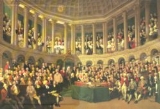
Irish House of Commons

Encyclopedia
The Irish House of Commons was the lower house
of the Parliament of Ireland
, that existed from 1297 until 1800. The upper house was the House of Lords
. The membership of the House of Commons was directly elected, but on a highly restrictive franchise: in counties forty shilling freeholders were enfranchised whilst in most boroughs it was either only the members of self electing corporations or a highly restricted body of freemen that were able to vote for the borough's representatives. Most notably, Roman Catholics were disqualified from sitting in the Irish parliament from 1691, even though they comprised the vast majority of the Irish population. From 1728 until 1793 they were also disfranchised
. Most of the population of all religions had no vote.
The British-appointed Irish executive, under the Lord Lieutenant of Ireland
, was not answerable to the House of Commons but to the British government. However, the Chief Secretary for Ireland
was usually a member of the Irish parliament. In the Commons, business was presided over by the Speaker
who, in the absence of a government chosen from and answerable to the Commons, was the dominant political figure in the parliament. The House of Commons was abolished when the Irish parliament merged with its British
counterpart in 1801 under the Act of Union
, forming the United Kingdom of Great Britain and Ireland
.
, two members for each of 117 Boroughs, and two members for Dublin University, a total of 300 members. The number of Boroughs invited to return members had originally been small (only 55 Boroughs existed in 1603) but was doubled by the Stuart monarchs.
Parliaments of Elizabeth I
Members:
Members:
Parliaments of James I
Members:
Parliaments of Charles I
Members:
Members:
Parliament of Charles II
Members:
Parliaments of James II
Members:
Parliaments of William III
Members:
Members:
Parliaments of Anne
Members:
Members:
Members:
Members: (elected 1727)
Members: (elected 1728/29)
Members: (elected 1739)
Members: (in 1747)
Members: (elected 1751/1752)
Members: (elected 1753/1754)
Members:
Members:
Members:
Members:
Members:
Members:
Members:
In 1793 a methodology for resignation was created, equivalent to the Chiltern Hundreds
in the British House of Commons
. Irish members could now be appointed to either the Escheatorship of Munster, the Escheatorship of Leinster, the Escheatorship of Connaught or the Escheatorship of Ulster. Possession of one of these Crown offices, with entailed a 30/ (30 shilling
) salary, automatically terminated one's membership of the House of Commons.
Lower house
A lower house is one of two chambers of a bicameral legislature, the other chamber being the upper house.Despite its official position "below" the upper house, in many legislatures worldwide the lower house has come to wield more power...
of the Parliament of Ireland
Parliament of Ireland
The Parliament of Ireland was a legislature that existed in Dublin from 1297 until 1800. In its early mediaeval period during the Lordship of Ireland it consisted of either two or three chambers: the House of Commons, elected by a very restricted suffrage, the House of Lords in which the lords...
, that existed from 1297 until 1800. The upper house was the House of Lords
Irish House of Lords
The Irish House of Lords was the upper house of the Parliament of Ireland that existed from mediaeval times until 1800. It was abolished along with the Irish House of Commons by the Act of Union.-Function:...
. The membership of the House of Commons was directly elected, but on a highly restrictive franchise: in counties forty shilling freeholders were enfranchised whilst in most boroughs it was either only the members of self electing corporations or a highly restricted body of freemen that were able to vote for the borough's representatives. Most notably, Roman Catholics were disqualified from sitting in the Irish parliament from 1691, even though they comprised the vast majority of the Irish population. From 1728 until 1793 they were also disfranchised
Disfranchisement
Disfranchisement is the revocation of the right of suffrage of a person or group of people, or rendering a person's vote less effective, or ineffective...
. Most of the population of all religions had no vote.
The British-appointed Irish executive, under the Lord Lieutenant of Ireland
Lord Lieutenant of Ireland
The Lord Lieutenant of Ireland was the British King's representative and head of the Irish executive during the Lordship of Ireland , the Kingdom of Ireland and the United Kingdom of Great Britain and Ireland...
, was not answerable to the House of Commons but to the British government. However, the Chief Secretary for Ireland
Chief Secretary for Ireland
The Chief Secretary for Ireland was a key political office in the British administration in Ireland. Nominally subordinate to the Lord Lieutenant, from the late 18th century until the end of British rule he was effectively the government minister with responsibility for governing Ireland; usually...
was usually a member of the Irish parliament. In the Commons, business was presided over by the Speaker
Speaker (politics)
The term speaker is a title often given to the presiding officer of a deliberative assembly, especially a legislative body. The speaker's official role is to moderate debate, make rulings on procedure, announce the results of votes, and the like. The speaker decides who may speak and has the...
who, in the absence of a government chosen from and answerable to the Commons, was the dominant political figure in the parliament. The House of Commons was abolished when the Irish parliament merged with its British
House of Commons of Great Britain
The House of Commons of Great Britain was the lower house of the Parliament of Great Britain between 1707 and 1801. In 1707, as a result of the Acts of Union of that year, it replaced the House of Commons of England and the third estate of the Parliament of Scotland, as one of the most significant...
counterpart in 1801 under the Act of Union
Act of Union 1800
The Acts of Union 1800 describe two complementary Acts, namely:* the Union with Ireland Act 1800 , an Act of the Parliament of Great Britain, and...
, forming the United Kingdom of Great Britain and Ireland
United Kingdom of Great Britain and Ireland
The United Kingdom of Great Britain and Ireland was the formal name of the United Kingdom during the period when what is now the Republic of Ireland formed a part of it....
.
Famous members
- Henry GrattanHenry GrattanHenry Grattan was an Irish politician and member of the Irish House of Commons and a campaigner for legislative freedom for the Irish Parliament in the late 18th century. He opposed the Act of Union 1800 that merged the Kingdoms of Ireland and Great Britain.-Early life:Grattan was born at...
: Went on to serve as an Irish member of the United Kingdom House of CommonsBritish House of CommonsThe House of Commons is the lower house of the Parliament of the United Kingdom, which also comprises the Sovereign and the House of Lords . Both Commons and Lords meet in the Palace of Westminster. The Commons is a democratically elected body, consisting of 650 members , who are known as Members...
. - Boyle RocheBoyle RocheSir Boyle Roche, 1st Baronet was an Irish politician. After a distinguished career in North America with the British Army, Roche became a member of the Irish House of Commons in 1775, generally acting in support of the viceregal government...
: The "father" of Irish bullIrish bullAn Irish bull is a ludicrous, incongruent or logically absurd statement, generally unrecognized as such by its author.The addition of the epithet Irish is a late addition....
s - Hon. Arthur WellesleyArthur Wellesley, 1st Duke of WellingtonField Marshal Arthur Wellesley, 1st Duke of Wellington, KG, GCB, GCH, PC, FRS , was an Irish-born British soldier and statesman, and one of the leading military and political figures of the 19th century...
: Later became Duke of Wellington, defeated Napoleon INapoleon INapoleon Bonaparte was a French military and political leader during the latter stages of the French Revolution.As Napoleon I, he was Emperor of the French from 1804 to 1815...
at WaterlooBattle of WaterlooThe Battle of Waterloo was fought on Sunday 18 June 1815 near Waterloo in present-day Belgium, then part of the United Kingdom of the Netherlands...
, and served as Prime Minister of the United KingdomPrime Minister of the United KingdomThe Prime Minister of the United Kingdom of Great Britain and Northern Ireland is the Head of Her Majesty's Government in the United Kingdom. The Prime Minister and Cabinet are collectively accountable for their policies and actions to the Sovereign, to Parliament, to their political party and...
. He represented his family borough of Trim, County MeathTrim, County MeathTrim is the traditional county town of County Meath in Ireland, although the county town is now Navan. The town was recorded in the 2006 census to have a population of 6,870....
from 1790–96. - William ConollyWilliam ConollyWilliam Conolly , also known as Speaker Conolly, was an Irish politician, Commissioner of Revenue, lawyer and landowner.-Career:...
: A past Speaker, Conolly remains today one of the most widely known figures ever to be produced by the Irish parliament. He is famous not just for his role in parliament but also for his great wealth that allowed him to build one of Ireland's greatest Georgian houses, Castletown HouseCastletown HouseCastletown House, Celbridge, County Kildare, Ireland's is a Palladian country house built in 1722 for William Conolly, the Speaker of the Irish House of Commons. It formed the centrepiece of a estate...
. - Nathaniel ClementsNathaniel ClementsNathaniel Clements was an Irish politician and financial figure, important in the political and financial administration of Ireland in the mid-18th century.-Early history:Clements was the fifth son of Robert Clements...
: 1705–77 Government and Treasury Official, Managed extensive financial functions from 1720–77 on behalf of the Government, de facto Minister for Finance 1740–77, extensive property owner and developer. major influence on the architecture of Georgian Dublin and the Irish Palladian Country house. - John Philpot CurranJohn Philpot CurranJohn Philpot Curran was an Irish orator, politician and wit, born in Newmarket, County Cork. He was the son of James and Sarah Curran.-Career:...
: Orator and wit, originator of the quotation "Eternal vigilance is the price of liberty".
Speakers
- 1557, 1560 & 1568: James Stanyhurst
- 1661–1666: Sir Audley MervynAudley MervynSir Audley Mervyn of Trillick was a lawyer and politician in Ireland. M.P. for County Tyrone and Speaker of the Irish House of Commons 1661-1666....
, Tyrone - 1661–1662: Sir John TempleJohn Temple (politician)Sir John Temple was an Irish politician, Speaker of the Irish House of Commons and Attorney General for Ireland....
for nine months in the absence of Audley Mervyn - 1689–1692: Sir Richard NagleRichard NagleSir Richard Nagle was an Irish politician and lawyer. He held the positions of Attorney-General for Ireland, Speaker of the Irish House of Commons, Lord Justice of Ireland and Secretary of State and War for Ireland under King James II. He fled to France in 1691, joining James II at Saint Germain,...
- 1692–1695: Sir Robert Levinge
- 1695–1703: Robert RochfortRobert RochfortRobert Rochfort was attorney-general, judge and speaker of the Irish House of Commons.Rochfort was probably born on 9 December 1652. He was the second son of Lieutenant-Colonel James "Prime-Iron " Rochfort , a Cromwellian soldier, and Thomasina Pigot...
- 1703–1710: Alan BrodrickAlan Brodrick, 1st Viscount MidletonAlan Brodrick, 1st Viscount Midleton PC was an Irish lawyer and politician.-Background:He was the second son of Sir St John Brodrick of Ballyannan, near Midleton in County Cork, by his wife Alice , daughter of Laurence Clayton of Mallow, County Cork and sister of Colonel Randall Clayton M.P., of...
- 1710–1713: John ForsterJohn Forster (Chief Justice)-Background:Forster was born in Dublin, the son of Richard Forster and his wife Anne Webber. His father sat in the Irish House of Commons for Swords and came from a family long associated with the Dublin business community.-Career:...
- 1713–1715: Alan BrodrickAlan Brodrick, 1st Viscount MidletonAlan Brodrick, 1st Viscount Midleton PC was an Irish lawyer and politician.-Background:He was the second son of Sir St John Brodrick of Ballyannan, near Midleton in County Cork, by his wife Alice , daughter of Laurence Clayton of Mallow, County Cork and sister of Colonel Randall Clayton M.P., of...
- 1715–1729: William ConollyWilliam ConollyWilliam Conolly , also known as Speaker Conolly, was an Irish politician, Commissioner of Revenue, lawyer and landowner.-Career:...
- 1729–1733: Sir Ralph GoreSir Ralph Gore, 4th BaronetSir Ralph Gore, 4th Baronet was a Speaker of the Irish House of Commons.The Gore Baronetcy, of Magherabegg in the County of Donegal, was created in the Baronetage of Ireland on 2 February 1622 for Paul Gore .The fourth Baronet served as Chancellor of the Irish Exchequer and as Speaker...
- 1733–1756: Henry BoyleHenry Boyle, 1st Earl of ShannonHenry Boyle, 1st Earl of Shannon, PC was a prominent Irish politician.Boyle was the second son of Lieutenant-Colonel Henry Boyle , second son of Roger Boyle, 1st Earl of Orrery. His mother was Lady Mary O'Brien, daughter of Murrough O'Brien, 1st Earl of Inchiquin...
- 1756–1771: John Ponsonby
- 1771–1785: Edmund Sexton Pery
- 1785–1800: John FosterJohn Foster, 1st Baron OrielJohn Foster, 1st Baron Oriel was an Irish peer and politician.He was the son of Anthony Foster of Louth, an Irish judge . He was elected Member of Parliament to the Irish House of Commons for Dunleer in 1761, a seat he held until 1769...
Constituencies
The House was elected in the same way as the British House of Commons. By the time of the Union, the shape of the House had been fixed with two members elected for each of the 32 Counties of IrelandCounties of Ireland
The counties of Ireland are sub-national divisions used for the purposes of geographic demarcation and local government. Closely related to the county is the County corporate which covered towns or cities which were deemed to be important enough to be independent from their counties. A county...
, two members for each of 117 Boroughs, and two members for Dublin University, a total of 300 members. The number of Boroughs invited to return members had originally been small (only 55 Boroughs existed in 1603) but was doubled by the Stuart monarchs.
| Constituency | Type | County | Creation | Enfranchised | Fate after the union |
|---|---|---|---|---|---|
| Antrim Borough | Borough | County Antrim County Antrim County Antrim is one of six counties that form Northern Ireland, situated in the north-east of the island of Ireland. Adjoined to the north-east shore of Lough Neagh, the county covers an area of 2,844 km², with a population of approximately 616,000... |
1666 | Potwalloper Potwalloper A potwalloper is an archaic term referring to a borough constituency returning members to the House of Commons of England before 1707, the House of Commons of Great Britain and the Irish House of Commons before 1801, and the House of Commons of the United Kingdom until 1832, when the Reform Act... |
Disfranchised |
| Antrim County | County | County Antrim County Antrim County Antrim is one of six counties that form Northern Ireland, situated in the north-east of the island of Ireland. Adjoined to the north-east shore of Lough Neagh, the county covers an area of 2,844 km², with a population of approximately 616,000... |
Two seats | ||
| Ardee Ardee (Parliament of Ireland constituency) Ardee was a constituency represented in the Irish House of Commons from 1378 to 1801.-History:Ardee in County Louth was enfranchised as a borough constituency in 1378... |
County Louth County Louth County Louth is a county of Ireland. It is part of the Border Region and is also located in the province of Leinster. It is named after the town of Louth. Louth County Council is the local authority for the county... |
1378 | Corporation | Disfranchised | |
| Ardfert Ardfert (Parliament of Ireland constituency) Ardfert was a constituency represented in the House of Commons of the Parliament of Ireland until the Act of Union 1800.-Boundaries and Boundary Changes:This constituency was based in the town of Ardfert in County Kerry.-History:... |
County Kerry County Kerry Kerry means the "people of Ciar" which was the name of the pre-Gaelic tribe who lived in part of the present county. The legendary founder of the tribe was Ciar, son of Fergus mac Róich. In Old Irish "Ciar" meant black or dark brown, and the word continues in use in modern Irish as an adjective... |
1639? | Corporation | Disfranchised | |
| Armagh Borough Armagh Borough (Parliament of Ireland constituency) Armagh Borough was a constituency represented in the Irish House of Commons from 1613 to 1800.-History:This constituency was the borough of Armagh in County Armagh.... |
Borough | County Armagh County Armagh -History:Ancient Armagh was the territory of the Ulaid before the fourth century AD. It was ruled by the Red Branch, whose capital was Emain Macha near Armagh. The site, and subsequently the city, were named after the goddess Macha... |
1613 | Corporation | One seat |
| Armagh County | County | County Armagh County Armagh -History:Ancient Armagh was the territory of the Ulaid before the fourth century AD. It was ruled by the Red Branch, whose capital was Emain Macha near Armagh. The site, and subsequently the city, were named after the goddess Macha... |
Two seats | ||
| Askeaton Askeaton (Parliament of Ireland constituency) Askeaton was a constituency represented in the Irish House of Commons until 1800.-History:In the Patriot Parliament of 1689 summoned by King James II, Askeaton was represented with two members.-Members of Parliament, 1614–1801:... |
County Limerick County Limerick It is thought that humans had established themselves in the Lough Gur area of the county as early as 3000 BC, while megalithic remains found at Duntryleague date back further to 3500 BC... |
1614 | Corporation | Disfranchised | |
| Athboy Athboy (Parliament of Ireland constituency) Athboy was a constituency in County Meath represented in the Irish House of Commons until 1800.-History:In the Patriot Parliament of 1689 summoned by King James II, Athboy was represented with two members.-1689–1801:... |
County Meath County Meath County Meath is a county in Ireland. It is part of the Mid-East Region and is also located in the province of Leinster. It is named after the ancient Kingdom of Mide . Meath County Council is the local authority for the county... |
1613 | Manor | Disfranchised | |
| Athenry Athenry (Parliament of Ireland constituency) Athenry was a constituency represented in the Irish House of Commons to 1800.-History:In the Patriot Parliament of 1689 summoned by King James II, Athenry was represented with two members.-1689–1801:... |
County Galway County Galway County Galway is a county in Ireland. It is located in the West Region and is also part of the province of Connacht. It is named after the city of Galway. Galway County Council is the local authority for the county. There are several strongly Irish-speaking areas in the west of the county... |
1310? | Corporation | Disfranchised | |
| Athlone Athlone (Parliament of Ireland constituency) Athlone was a constituency represented in the Irish House of Commons until 1800. Between 1725 and 1793 Catholics and those married to Catholics could not vote... |
County Westmeath County Westmeath -Economy:Westmeath has a strong agricultural economy. Initially, development occurred around the major market centres of Mullingar, Moate, and Kinnegad. Athlone developed due to its military significance, and its strategic location on the main Dublin–Galway route across the River Shannon. Mullingar... |
1607 | Corporation | One seat | |
| Athy Athy (Parliament of Ireland constituency) Athy was a constituency represented in the Irish House of Commons to 1800. Following the Act of Union 1800 the borough was disenfranchised.-History:In the Patriot Parliament of 1689 summoned by King James II, Athy was represented with two members.... |
County Kildare County Kildare County Kildare is a county in Ireland. It is part of the Mid-East Region and is also located in the province of Leinster. It is named after the town of Kildare. Kildare County Council is the local authority for the county... |
1614 | Corporation | Disfranchised | |
| Augher Augher (Parliament of Ireland constituency) Augher was a constituency represented in the Irish House of Commons until the Acts of Union 1800 came into force on January 1, 1801.-History:In the Patriot Parliament of 1689 summoned by King James II, Augher was not represented.-1689–1801:... |
County Tyrone County Tyrone Historically Tyrone stretched as far north as Lough Foyle, and comprised part of modern day County Londonderry east of the River Foyle. The majority of County Londonderry was carved out of Tyrone between 1610-1620 when that land went to the Guilds of London to set up profit making schemes based on... |
1614 | Corporation | Disfranchised | |
| Ballynakill (also Ballynakill) | Queen's County County Laois County Laois is a county in Ireland. It is part of the Midlands Region and is also located in the province of Leinster. It was formerly known as Queen's County until the establishment of the Irish Free State in 1922. The county's name was formerly spelt as Laoighis and Leix. Laois County Council... |
1613 | Corporation | Disfranchised | |
| Ballyshannon Ballyshannon (Parliament of Ireland constituency) Ballyshannon was a constituency represented in the Irish House of Commons from 1613 to 1800.-Boundaries and Boundary Changes:This constituency was the borough of Ballyshannon in County Donegal... |
County Donegal County Donegal County Donegal is a county in Ireland. It is part of the Border Region and is also located in the province of Ulster. It is named after the town of Donegal. Donegal County Council is the local authority for the county... |
1613 | Corporation | Disfranchised | |
| Baltimore Baltimore (Parliament of Ireland constituency) Baltimore was a potwalloper constituency represented in the Irish House of Commons from 1614 to 1801.-Boundaries and Boundary Changes:This constituency was based in the town of Baltimore in County Cork.-Potwalloper:... |
County Cork County Cork County Cork is a county in Ireland. It is located in the South-West Region and is also part of the province of Munster. It is named after the city of Cork . Cork County Council is the local authority for the county... |
1614 | Potwalloper Potwalloper A potwalloper is an archaic term referring to a borough constituency returning members to the House of Commons of England before 1707, the House of Commons of Great Britain and the Irish House of Commons before 1801, and the House of Commons of the United Kingdom until 1832, when the Reform Act... |
Disfranchised | |
| Baltinglass Baltinglass (Parliament of Ireland constituency) Baltinglass was a constituency represented in the Irish House of Commons to 1800.-History:In the Patriot Parliament of 1689 summoned by King James II, Baltinglass was not represented.-Members of Parliament, 1664–1801:*1665–1666 Richard Bulkeley... |
County Wicklow County Wicklow County Wicklow is a county in Ireland. It is part of the Mid-East Region and is also located in the province of Leinster. It is named after the town of Wicklow, which derives from the Old Norse name Víkingalág or Wykynlo. Wicklow County Council is the local authority for the county... |
1664 | Corporation | Disfranchised | |
| Banagher Banagher (Parliament of Ireland constituency) Banagher was a constituency represented in the Irish House of Commons until 1800.-History:Banagher had two members in the 1689 Patriot Parliament summoned by King James II.-1689–1801:... |
King's County County Offaly County Offaly is a county in Ireland. It is part of the Midlands Region and is also located in the province of Leinster. It is named after the ancient Kingdom of Uí Failghe and was formerly known as King's County until the establishment of the Irish Free State in 1922. Offaly County Council is... |
1629 | Corporation | Disfranchised | |
| Bandonbridge Bandonbridge (Parliament of Ireland constituency) Bandonbridge was a constituency represented in the Irish House of Commons to 1800.-Boundaries and Boundary Changes:This constituency was based in the town of Bandon in County Cork.... |
County Cork County Cork County Cork is a county in Ireland. It is located in the South-West Region and is also part of the province of Munster. It is named after the city of Cork . Cork County Council is the local authority for the county... |
1614 | Corporation | One seat | |
| Bangor Bangor (Parliament of Ireland constituency) Bangor was a constituency represented in the Irish House of Commons until 1800.-History:In the Patriot Parliament of 1689 summoned by King James II, Bangor was not represented.-1689–1801:... |
County Down County Down -Cities:*Belfast *Newry -Large towns:*Dundonald*Newtownards*Bangor-Medium towns:... |
1613 | Corporation | Disfranchised | |
| Bannow Bannow (Parliament of Ireland constituency) Bannow was a constituency represented in the Irish House of Commons to 1800.- Boundaries and Boundary Changes :This constituency was the borough of Bannow in County Wexford.-History:... |
County Wexford County Wexford County Wexford is a county in Ireland. It is part of the South-East Region and is also located in the province of Leinster. It is named after the town of Wexford. In pre-Norman times it was part of the Kingdom of Uí Cheinnselaig, whose capital was at Ferns. Wexford County Council is the local... |
? | Corporation | Disfranchised | |
| Belfast Belfast (Parliament of Ireland constituency) Belfast was a constituency represented in the Irish House of Commons until 1800.-History:Belfast in County Antrim was enfranchised as a borough constituency in 1613... |
County Antrim County Antrim County Antrim is one of six counties that form Northern Ireland, situated in the north-east of the island of Ireland. Adjoined to the north-east shore of Lough Neagh, the county covers an area of 2,844 km², with a population of approximately 616,000... |
1613 | Corporation | One seat | |
| Belturbet Belturbet (Parliament of Ireland constituency) Belturbet was a constituency represented in the Irish House of Commons from 1611 to 1800.Between 1725 and 1793 Catholics and those married to Catholics could not vote.-History:... |
County Cavan County Cavan County Cavan is a county in Ireland. It is part of the Border Region and is also located in the province of Ulster. It is named after the town of Cavan. Cavan County Council is the local authority for the county... |
1614 | Corporation | Disfranchised | |
| Blessington Blessington (Parliament of Ireland constituency) Blessington in County Wicklow was a constituency represented in the Irish House of Commons from 1670 until 1800.-History:In the Patriot Parliament of 1689 summoned by King James II, Blessington was represented with two members.-1689–1801:... |
County Wicklow County Wicklow County Wicklow is a county in Ireland. It is part of the Mid-East Region and is also located in the province of Leinster. It is named after the town of Wicklow, which derives from the Old Norse name Víkingalág or Wykynlo. Wicklow County Council is the local authority for the county... |
1670 | Corporation | Disfranchised | |
| Boyle Boyle (Parliament of Ireland constituency) Boyle was a constituency represented in the Irish House of Commons from 1611 to 1800.-History:In the Patriot Parliament of 1689 summoned by King James II, Boyle was represented with two members.-1689–1801:... |
County Roscommon County Roscommon County Roscommon is a county in Ireland. It is located in the West Region and is also part of the province of Connacht. It is named after the town of Roscommon. Roscommon County Council is the local authority for the county... |
1614 | Corporation | Disfranchised | |
| Callan Callan (Parliament of Ireland constituency) Callan was a constituency represented in the Irish House of Commons until 1800.-History:In the Patriot Parliament of 1689 summoned by King James II, Callan was represented with two members.-1689–1801:-Bibliography:... |
County Kilkenny County Kilkenny County Kilkenny is a county in Ireland. It is part of the South-East Region and is also located in the province of Leinster. It is named after the city of Kilkenny. The territory of the county was the core part of the ancient Irish Kingdom of Osraige which in turn was the core of the Diocese of... |
1264 | Corporation | Disfranchised | |
| Carlingford Carlingford (Parliament of Ireland constituency) Carlingford was a constituency represented in the Irish House of Commons to 1801.-History:In the Patriot Parliament of 1689 summoned by King James II, Carlingford was represented with two members.-1689–1801:... |
County Louth County Louth County Louth is a county of Ireland. It is part of the Border Region and is also located in the province of Leinster. It is named after the town of Louth. Louth County Council is the local authority for the county... |
13?? | Corporation | Disfranchised | |
| Carlow Borough Carlow Borough (Parliament of Ireland constituency) Carlow Borough was a constituency represented in the Irish House of Commons.-Boundaries and Boundary Changes:This constituency was the borough of Carlow in County Carlow. It returned two members to the Parliament of Ireland from 1613 to 1800.-History:... |
County Carlow County Carlow County Carlow is a county in Ireland. It is part of the South-East Region and is also located in the province of Leinster. It is named after the town of Carlow, which lies on the River Barrow. Carlow County Council is the local authority for the county... |
1613 | Corporation | One seat | |
| Carlow County Carlow County (Parliament of Ireland constituency) Carlow County was a constituency represented in the Irish House of Commons to 1800.-History:In the Patriot Parliament of 1689 summoned by King James II, Carlow County was represented with two members.-1689–1801:... |
County | County Carlow County Carlow County Carlow is a county in Ireland. It is part of the South-East Region and is also located in the province of Leinster. It is named after the town of Carlow, which lies on the River Barrow. Carlow County Council is the local authority for the county... |
Two seats | ||
| Carrick Carrick (Parliament of Ireland constituency) Carrick was a constituency represented in the Irish House of Commons from 1614 to 1800. It returned two members.-Boundaries and Boundary Changes:... |
County Leitrim County Leitrim County Leitrim is a county in Ireland. It is located in the West Region and is also part of the province of Connacht. It is named after the village of Leitrim. Leitrim County Council is the local authority for the county... |
1614 | Corporation | Disfranchised | |
| Carrickfergus Carrickfergus (Parliament of Ireland constituency) Carrickfergus was a constituency represented in the Irish House of Commons from 1326 to 1800.-Boundaries and Boundary Changes:This constituency was the borough of Carrickfergus in County Antrim. It returned two members to the Parliament of Ireland to 1800.-History:In the Patriot Parliament of 1689... |
County Antrim County Antrim County Antrim is one of six counties that form Northern Ireland, situated in the north-east of the island of Ireland. Adjoined to the north-east shore of Lough Neagh, the county covers an area of 2,844 km², with a population of approximately 616,000... |
1326 | Freeholder and householder | One seat | |
| Carysfort Carysfort (Parliament of Ireland constituency) Carysfort was a constituency represented in the Irish House of Commons to 1800.-History:In the Patriot Parliament of 1689 summoned by King James II, Carysfort was represented with two members.-1689–1801:... |
County Wicklow County Wicklow County Wicklow is a county in Ireland. It is part of the Mid-East Region and is also located in the province of Leinster. It is named after the town of Wicklow, which derives from the Old Norse name Víkingalág or Wykynlo. Wicklow County Council is the local authority for the county... |
1629 | Corporation | Disfranchised | |
| Cashel Cashel (Parliament of Ireland constituency) Cashel was a constituency represented in the Irish House of Commons to 1800. It returned two members to the Parliament of Ireland to 1800.-Boundaries and Boundary Changes:... |
County Tipperary County Tipperary County Tipperary is a county of Ireland. It is located in the province of Munster and is named after the town of Tipperary. The area of the county does not have a single local authority; local government is split between two authorities. In North Tipperary, part of the Mid-West Region, local... |
? | Corporation | One seat | |
| Castlebar Castlebar (Parliament of Ireland constituency) Castlebar was a constituency represented in the Irish House of Commons from 1614 to 1800. The area is in County Mayo. Between 1725 and 1793 Catholics and those married to Catholics could not vote.-History:... |
County Mayo County Mayo County Mayo is a county in Ireland. It is located in the West Region and is also part of the province of Connacht. It is named after the village of Mayo, which is now generally known as Mayo Abbey. Mayo County Council is the local authority for the county. The population of the county is 130,552... |
1614 | Corporation | Disfranchised | |
| Castlemartyr Castlemartyr (Parliament of Ireland constituency) Castlemartyr was a constituency represented in the Irish House of Commons from 1676 to 1800.- Boundaries and boundary changes :... |
County Cork County Cork County Cork is a county in Ireland. It is located in the South-West Region and is also part of the province of Munster. It is named after the city of Cork . Cork County Council is the local authority for the county... |
1676 | Corporation | Disfranchised | |
| Cavan Borough Cavan Borough (Parliament of Ireland constituency) Cavan Borough was a constituency represented in the Irish House of Commons from 1611 to 1800.Between 1725 and 1793 Catholics and those married to Catholics could not vote.-Boundaries and Boundary Changes:... |
Borough | County Cavan County Cavan County Cavan is a county in Ireland. It is part of the Border Region and is also located in the province of Ulster. It is named after the town of Cavan. Cavan County Council is the local authority for the county... |
1611 | Corporation | Disfranchised |
| Cavan County | County | County Cavan County Cavan County Cavan is a county in Ireland. It is part of the Border Region and is also located in the province of Ulster. It is named after the town of Cavan. Cavan County Council is the local authority for the county... |
Two seats | ||
| Charlemont Charlemont (Parliament of Ireland constituency) Charlemont was a constituency represented in the Irish House of Commons until 1800.-History:In the Patriot Parliament of 1689 summoned by King James II, Charlemont was not represented.-1689–1801:... |
County Armagh County Armagh -History:Ancient Armagh was the territory of the Ulaid before the fourth century AD. It was ruled by the Red Branch, whose capital was Emain Macha near Armagh. The site, and subsequently the city, were named after the goddess Macha... |
1613 | Corporation | Disfranchised | |
| Charleville Charleville (Parliament of Ireland constituency) Charleville was a constituency in County Cork represented in the Irish House of Commons to 1800.-History:The town it represented was named after Charles II. It was enfranchised in 1673, a sovereign, 12 burgesses and freemen. It belonged to the Earl of Orrery, a branch of the Boyle family... |
County Cork County Cork County Cork is a county in Ireland. It is located in the South-West Region and is also part of the province of Munster. It is named after the city of Cork . Cork County Council is the local authority for the county... |
1673 | Corporation | Disfranchised | |
| Clare Clare (Parliament of Ireland constituency) Clare was a constituency represented in the Irish House of Commons until 1800.-History:In the Patriot Parliament of 1689 summoned by King James II, Clare was represented with two members.-Members of Parliament:* 1583 Sir Turlogh O’Brien, Ennistymon.... |
County | County Clare County Clare -History:There was a Neolithic civilisation in the Clare area — the name of the peoples is unknown, but the Prehistoric peoples left evidence behind in the form of ancient dolmen; single-chamber megalithic tombs, usually consisting of three or more upright stones... |
Two seats | ||
| Clogher Clogher (Parliament of Ireland constituency) Clogher was a borough constituency in the Irish House of Commons until 1800. It represented the "city" of Clogher in County Tyrone. The city, actually no more than a village, gained its importance as the site of the cathedral of the Church of Ireland diocese of Clogher. The constituency was a... |
County Tyrone County Tyrone Historically Tyrone stretched as far north as Lough Foyle, and comprised part of modern day County Londonderry east of the River Foyle. The majority of County Londonderry was carved out of Tyrone between 1610-1620 when that land went to the Guilds of London to set up profit making schemes based on... |
1264 | Ecclesiastical | Disfranchised | |
| Clonakilty Clonakilty (Parliament of Ireland constituency) Clonakilty was a constituency in County Cork represented in the Irish House of Commons to 1800.-History:Established by a charter of King James I of England granting it to Sir Richard Boyle, it was purchased from Lord Burlington by Speaker Boyle in 1738 and he nominated the provost from three... |
County Cork County Cork County Cork is a county in Ireland. It is located in the South-West Region and is also part of the province of Munster. It is named after the city of Cork . Cork County Council is the local authority for the county... |
1613 | Corporation | Disfranchised | |
| Clonmel Clonmel (Parliament of Ireland constituency) Clonmel was a constituency represented in the Irish House of Commons to 1800.-History:In the Patriot Parliament of 1689 summoned by King James II, Clonmel was represented with two members.-1689–1801:... |
County Tipperary County Tipperary County Tipperary is a county of Ireland. It is located in the province of Munster and is named after the town of Tipperary. The area of the county does not have a single local authority; local government is split between two authorities. In North Tipperary, part of the Mid-West Region, local... |
? | Corporation | One seat | |
| Clonmines Clonmines (Parliament of Ireland constituency) Clonmines was a constituency represented in the Irish House of Commons to 1800.-History:In the Patriot Parliament of 1689 summoned by King James II, Clonmines was represented with two members.-1689–1801:... |
County Wexford County Wexford County Wexford is a county in Ireland. It is part of the South-East Region and is also located in the province of Leinster. It is named after the town of Wexford. In pre-Norman times it was part of the Kingdom of Uí Cheinnselaig, whose capital was at Ferns. Wexford County Council is the local... |
? | Corporation | Disfranchised | |
| Coleraine Coleraine (Parliament of Ireland constituency) Coleraine was a constituency represented in the Irish House of Commons from 1611 to 1800. Between 1725 and 1793 Catholics and those married to Catholics could not vote.-History:... |
County Londonderry County Londonderry The place name Derry is an anglicisation of the old Irish Daire meaning oak-grove or oak-wood. As with the city, its name is subject to the Derry/Londonderry name dispute, with the form Derry preferred by nationalists and Londonderry preferred by unionists... |
16?? | Corporation Corporation A corporation is created under the laws of a state as a separate legal entity that has privileges and liabilities that are distinct from those of its members. There are many different forms of corporations, most of which are used to conduct business. Early corporations were established by charter... |
One seat | |
| Cork City Cork City (Parliament of Ireland constituency) Cork City was a constituency represented in the Irish House of Commons to 1800.-Boundaries and boundary changes:... |
County Cork County Cork County Cork is a county in Ireland. It is located in the South-West Region and is also part of the province of Munster. It is named after the city of Cork . Cork County Council is the local authority for the county... |
1264 | Freeholder and Freemen | Two seats | |
| Cork County Cork County (Parliament of Ireland constituency) Cork County was a constituency represented in the Irish House of Commons to 1800.-Boundaries and Boundary Changes:This constituency was the borough in County Cork. It returned two members to the Parliament of Ireland to 1800.-History:... |
County | County Cork County Cork County Cork is a county in Ireland. It is located in the South-West Region and is also part of the province of Munster. It is named after the city of Cork . Cork County Council is the local authority for the county... |
Two seats | ||
| Dingle Dingle (Parliament of Ireland constituency) Dingle was a constituency represented in the Irish House of Commons to 1800.- Boundaries and Boundary Changes :This constituency was based in the town of Dingle in County Kerry.- History :... |
County Kerry County Kerry Kerry means the "people of Ciar" which was the name of the pre-Gaelic tribe who lived in part of the present county. The legendary founder of the tribe was Ciar, son of Fergus mac Róich. In Old Irish "Ciar" meant black or dark brown, and the word continues in use in modern Irish as an adjective... |
1607 | Corporation | Disfranchised | |
| Donegal Borough Donegal Borough (Parliament of Ireland constituency) Donegal Borough was a constituency represented in the Irish House of Commons until 1800. It is now represented in the Dáil.-History:In the Patriot Parliament of 1689 summoned by King James II, Donegal Borough was not represented.-1689–1801:... |
Borough | County Donegal County Donegal County Donegal is a county in Ireland. It is part of the Border Region and is also located in the province of Ulster. It is named after the town of Donegal. Donegal County Council is the local authority for the county... |
1613 | Corporation | Disfranchised |
| Donegal County | County Donegal County Donegal County Donegal is a county in Ireland. It is part of the Border Region and is also located in the province of Ulster. It is named after the town of Donegal. Donegal County Council is the local authority for the county... |
Two seats | |||
| Doneraile Doneraile (Parliament of Ireland constituency) Doneraile was a constituency represented in the Irish House of Commons until 1800.-History:In the Patriot Parliament of 1689 summoned by King James II, Doneraile was represented with two members.-1689–1801:-Bibliography:... |
County Cork County Cork County Cork is a county in Ireland. It is located in the South-West Region and is also part of the province of Munster. It is named after the city of Cork . Cork County Council is the local authority for the county... |
1640 | Manor | Disfranchised | |
| Down Down (Parliament of Ireland constituency) Down was a constituency represented in the Irish House of Commons until 1800.-History:In the Patriot Parliament of 1689 summoned by King James II, Down was represented with two members.-1689–1801:... |
County | County Down County Down -Cities:*Belfast *Newry -Large towns:*Dundonald*Newtownards*Bangor-Medium towns:... |
Two seats | ||
| Downpatrick Downpatrick (Parliament of Ireland constituency) Downpatrick was a constituency represented in the Irish House of Commons until 1800.-History:In the Patriot Parliament of 1689 summoned by King James II, Downpatrick was not represented.-1689–1801:... |
County Down County Down -Cities:*Belfast *Newry -Large towns:*Dundonald*Newtownards*Bangor-Medium towns:... |
1586 | Potwalloper Potwalloper A potwalloper is an archaic term referring to a borough constituency returning members to the House of Commons of England before 1707, the House of Commons of Great Britain and the Irish House of Commons before 1801, and the House of Commons of the United Kingdom until 1832, when the Reform Act... |
One seat | |
| Drogheda Drogheda (Parliament of Ireland constituency) Drogheda was a constituency represented in the Irish House of Commons to 1801.-History:In the Patriot Parliament of 1689 summoned by King James II, Drogheda was represented with two members.-Members of Parliament, 1264–1801:*1661: Moyses Hill... |
County Louth County Louth County Louth is a county of Ireland. It is part of the Border Region and is also located in the province of Leinster. It is named after the town of Louth. Louth County Council is the local authority for the county... |
1264 | Freeholders and freemen | One seat | |
| Dublin City Dublin City (Parliament of Ireland constituency) Dublin City was a constituency represented in the Irish House of Commons to 1801.-History:In the Patriot Parliament of 1689 summoned by King James II, Dublin City was represented with two members. In the 1760s the radical politician Charles Lucas used the seat as his political base.-1689–1801:... |
County Dublin County Dublin County Dublin is a county in Ireland. It is part of the Dublin Region and is also located in the province of Leinster. It is named after the city of Dublin which is the capital of Ireland. County Dublin was one of the first of the parts of Ireland to be shired by King John of England following the... |
1264 | Freeholders and freemen | Two seats | |
| Dublin County Dublin County (Parliament of Ireland constituency) Dublin County was a constituency represented in the Irish House of Commons to 1801.-History:In the Patriot Parliament of 1689 summoned by King James II, Dublin County was represented with two members.-1692–1801:... |
County | County Dublin County Dublin County Dublin is a county in Ireland. It is part of the Dublin Region and is also located in the province of Leinster. It is named after the city of Dublin which is the capital of Ireland. County Dublin was one of the first of the parts of Ireland to be shired by King John of England following the... |
Two seats | ||
| Dublin University Dublin University (Parliament of Ireland constituency) Dublin University was a constituency represented in the Irish House of Commons from 1603 to 1801.-History:This university constituency was first enfranchised as a Parliamentary constituency in 1603... |
One seat | ||||
| Duleek Duleek (Parliament of Ireland constituency) Duleek was a constituency represented in the Irish House of Commons until 1800.-History:In the Patriot Parliament of 1689 summoned by King James II, Duleek was not represented.-1689–1801:... |
County Meath County Meath County Meath is a county in Ireland. It is part of the Mid-East Region and is also located in the province of Leinster. It is named after the ancient Kingdom of Mide . Meath County Council is the local authority for the county... |
1727 | Corporation | Disfranchised | |
| Dundalk Dundalk (Parliament of Ireland constituency) Dundalk was a constituency represented in the Irish House of Commons to 1801.-History:In the Patriot Parliament of 1689 summoned by King James II, Dundalk was represented with two members.-1689–1801:... |
County Louth County Louth County Louth is a county of Ireland. It is part of the Border Region and is also located in the province of Leinster. It is named after the town of Louth. Louth County Council is the local authority for the county... |
1264 | Corporation | One seat | |
| Dungannon Dungannon (Parliament of Ireland constituency) Dungannon was a constituency represented in the Irish House of Commons until 1800.-History:In the Patriot Parliament of 1689 summoned by King James II, Dungannon was represented with two members.-1689–1801:... |
County Tyrone County Tyrone Historically Tyrone stretched as far north as Lough Foyle, and comprised part of modern day County Londonderry east of the River Foyle. The majority of County Londonderry was carved out of Tyrone between 1610-1620 when that land went to the Guilds of London to set up profit making schemes based on... |
1613 | Corporation | One seat | |
| Dungarvan Dungarvan (Parliament of Ireland constituency) Dungarvan was a constituency represented in the Irish House of Commons until 1800.-History:In the Patriot Parliament of 1689 summoned by King James II, Dungarvan was represented with two members.-1689–1801:... |
County Waterford County Waterford *Abbeyside, Affane, Aglish, Annestown, An Rinn, Ardmore*Ballinacourty, Ballinameela, Ballinamult, Ballinroad, Ballybeg, Ballybricken, Ballyduff Lower, Ballyduff Upper, Ballydurn, Ballygunner, Ballylaneen, Ballymacarbry, Ballymacart, Ballynaneashagh, Ballysaggart, Ballytruckle, Bilberry, Bunmahon,... |
1610 | Potwalloper Potwalloper A potwalloper is an archaic term referring to a borough constituency returning members to the House of Commons of England before 1707, the House of Commons of Great Britain and the Irish House of Commons before 1801, and the House of Commons of the United Kingdom until 1832, when the Reform Act... |
One seat | |
| Dunleer Dunleer (Parliament of Ireland constituency) Dunleer was a constituency represented in the Irish House of Commons to 1801.-History:In the Patriot Parliament of 1689 summoned by King James II, Dunleer was not represented.-1692–1801:... |
County Louth County Louth County Louth is a county of Ireland. It is part of the Border Region and is also located in the province of Leinster. It is named after the town of Louth. Louth County Council is the local authority for the county... |
1679 | Corporation | Disfranchised | |
| Ennis Ennis (Parliament of Ireland constituency) Ennis was a constituency represented in the Irish House of Commons until 1800.-History:In the Patriot Parliament of 1689 summoned by King James II, Ennis was represented with two members.-Members of Parliament, 1613–1801:**1613 John Thornton, Doonass.... |
County Clare County Clare -History:There was a Neolithic civilisation in the Clare area — the name of the peoples is unknown, but the Prehistoric peoples left evidence behind in the form of ancient dolmen; single-chamber megalithic tombs, usually consisting of three or more upright stones... |
1613 | Corporation | One seat | |
| Enniscorthy Enniscorthy (Parliament of Ireland constituency) Enniscorthy was a constituency represented in the Irish House of Commons to 1800.-History:In the Patriot Parliament of 1689 summoned by King James II, Enniscorthy was represented with two members.-1689–1801:... |
County Wexford County Wexford County Wexford is a county in Ireland. It is part of the South-East Region and is also located in the province of Leinster. It is named after the town of Wexford. In pre-Norman times it was part of the Kingdom of Uí Cheinnselaig, whose capital was at Ferns. Wexford County Council is the local... |
1613 | Corporation | Disfranchised | |
| Enniskillen Enniskillen (Parliament of Ireland constituency) Enniskillen was a constituency represented in the Irish House of Commons until 1800.-History:In the Patriot Parliament of 1689 summoned by King James II, Enniskillen was not represented.-1692–1801:... |
County Fermanagh County Fermanagh Fermanagh District Council is the only one of the 26 district councils in Northern Ireland that contains all of the county it is named after. The district council also contains a small section of County Tyrone in the Dromore and Kilskeery road areas.... |
1613 | Corporation | One seat | |
| Fermanagh Fermanagh (Parliament of Ireland constituency) Fermanagh was a constituency represented in the Irish House of Commons until 1800.-History:In the Patriot Parliament of 1689 summoned by King James II, Fermanagh was not represented.-1689–1801:... |
County | County Fermanagh County Fermanagh Fermanagh District Council is the only one of the 26 district councils in Northern Ireland that contains all of the county it is named after. The district council also contains a small section of County Tyrone in the Dromore and Kilskeery road areas.... |
Two seats | ||
| Fethard Fethard (County Tipperary) (Parliament of Ireland constituency) Fethard was a constituency in County Tipperary represented in the Irish House of Commons to 1800.-History:In the Patriot Parliament of 1689 summoned by King James II, Fethard was represented with two members.-1689–1801:... |
County Tipperary County Tipperary County Tipperary is a county of Ireland. It is located in the province of Munster and is named after the town of Tipperary. The area of the county does not have a single local authority; local government is split between two authorities. In North Tipperary, part of the Mid-West Region, local... |
1608 | Corporation | Disfranchised | |
| Fethard Fethard (County Wexford) (Parliament of Ireland constituency) Fethard was a constituency in County Wexford represented in the Irish House of Commons to 1800.-History:In the Patriot Parliament of 1689 summoned by King James II, Fethard was represented with two members.-1689–1801:... |
County Wexford County Wexford County Wexford is a county in Ireland. It is part of the South-East Region and is also located in the province of Leinster. It is named after the town of Wexford. In pre-Norman times it was part of the Kingdom of Uí Cheinnselaig, whose capital was at Ferns. Wexford County Council is the local... |
1613 | Corporation | Disfranchised | |
| Fore Fore (Parliament of Ireland constituency) Fore was a constituency represented in the Irish House of Commons from 1612 to 1800.-History:In the Patriot Parliament of 1689 summoned by King James II, Fore was represented with two members.-1689–1801:... |
County Westmeath County Westmeath -Economy:Westmeath has a strong agricultural economy. Initially, development occurred around the major market centres of Mullingar, Moate, and Kinnegad. Athlone developed due to its military significance, and its strategic location on the main Dublin–Galway route across the River Shannon. Mullingar... |
? | Corporation | Disfranchised | |
| Galway Borough Galway Borough (Parliament of Ireland constituency) Galway Borough was a constituency represented in the Irish House of Commons to 1800.-History:In the Patriot Parliament of 1689 summoned by King James II, Galway Borough was represented with two members.-1689–1801:... |
Borough | County Galway County Galway County Galway is a county in Ireland. It is located in the West Region and is also part of the province of Connacht. It is named after the city of Galway. Galway County Council is the local authority for the county. There are several strongly Irish-speaking areas in the west of the county... |
1264 | Freemen | One seat |
| Galway County Galway County (Parliament of Ireland constituency) Galway County was a constituency represented in the Irish House of Commons until 1800.-History:In the Patriot Parliament of 1689 summoned by King James II, Galway County was represented with two members. Following the Act of Union 1800 the constituency became Galway County .-Members of... |
County | County Galway County Galway County Galway is a county in Ireland. It is located in the West Region and is also part of the province of Connacht. It is named after the city of Galway. Galway County Council is the local authority for the county. There are several strongly Irish-speaking areas in the west of the county... |
Two seats | ||
| Gorey Gorey (Parliament of Ireland constituency) Gorey was a constituency represented in the Irish House of Commons to 1800.-History:In the Patriot Parliament of 1689 summoned by King James II, Gorey was represented with two members.-1689–1801:... (also Newburgh) |
County Wexford County Wexford County Wexford is a county in Ireland. It is part of the South-East Region and is also located in the province of Leinster. It is named after the town of Wexford. In pre-Norman times it was part of the Kingdom of Uí Cheinnselaig, whose capital was at Ferns. Wexford County Council is the local... |
1620 | Corporation | Disfranchised | |
| Gowran Gowran (Parliament of Ireland constituency) Gowran was a constituency represented in the Irish House of Commons until 1800.-History:In the Patriot Parliament of 1689 summoned by King James II, Gowran was represented with two members.-1689–1801:... |
Borough | County Kilkenny County Kilkenny County Kilkenny is a county in Ireland. It is part of the South-East Region and is also located in the province of Leinster. It is named after the city of Kilkenny. The territory of the county was the core part of the ancient Irish Kingdom of Osraige which in turn was the core of the Diocese of... |
1609 | Corporation | Disfranchised |
| Granard Granard (Parliament of Ireland constituency) Granard was a constituency represented in the Irish House of Commons until 1800.-History:In the Patriot Parliament of 1689 summoned by King James II, Granard was not represented.-1689–1801:... |
County Longford County Longford County Longford is a county in Ireland. It is part of the Midlands Region and is also located in the province of Leinster. It is named after the town of Longford.Longford County Council is the local authority for the county... |
1679 | Manor | Disfranchised | |
| Harristown Harristown (Parliament of Ireland constituency) Harristown was a constituency represented in the Irish House of Commons until 1800.-History:In the Patriot Parliament of 1689 summoned by King James II, Harristown was represented with two members.-1689–1801:... |
County Kildare County Kildare County Kildare is a county in Ireland. It is part of the Mid-East Region and is also located in the province of Leinster. It is named after the town of Kildare. Kildare County Council is the local authority for the county... |
1684 | Corporation | Disfranchised | |
| Hillsborough Hillsborough (Parliament of Ireland constituency) Hillsborough was a constituency represented in the Irish House of Commons until 1800.-History:In the Patriot Parliament of 1689 summoned by King James II, Hillsborough was not represented.-1689–1801:... |
County Down County Down -Cities:*Belfast *Newry -Large towns:*Dundonald*Newtownards*Bangor-Medium towns:... |
1662 | Corporation | Disfranchised | |
| Inistioge Inistioge (Parliament of Ireland constituency) Inistioge or Innistiogue was a constituency represented in the Irish House of Commons until 1800.-History:In the Patriot Parliament of 1689 summoned by King James II, Inistioge was represented with two members.-1692–1801:... |
County Kilkenny County Kilkenny County Kilkenny is a county in Ireland. It is part of the South-East Region and is also located in the province of Leinster. It is named after the city of Kilkenny. The territory of the county was the core part of the ancient Irish Kingdom of Osraige which in turn was the core of the Diocese of... |
? | Corporation | Disfranchised | |
| Jamestown Jamestown (Parliament of Ireland constituency) Jamestown was a constituency represented in the Irish House of Commons until 1800.-History:In the Patriot Parliament of 1689 summoned by King James II, Jamestown was represented with two members.-1689–1801:... |
County Leitrim County Leitrim County Leitrim is a county in Ireland. It is located in the West Region and is also part of the province of Connacht. It is named after the village of Leitrim. Leitrim County Council is the local authority for the county... |
1622 | Corporation | Disfranchised | |
| Kells Kells (Parliament of Ireland constituency) Kells was a constituency represented in the Irish House of Commons until 1800.-History:In the Patriot Parliament of 1689 summoned by King James II, Kells was not represented.-1689–1801:... |
County Meath County Meath County Meath is a county in Ireland. It is part of the Mid-East Region and is also located in the province of Leinster. It is named after the ancient Kingdom of Mide . Meath County Council is the local authority for the county... |
1561 | Corporation | Disfranchised | |
| Kerry Kerry (Parliament of Ireland constituency) Kerry was a constituency represented in the Irish House of Commons to 1800. Following the Act of Union 1800 the county retained two seats.-History:In the Patriot Parliament of 1689 summoned by King James II, Kerry was represented with two members.... |
County | County Kerry County Kerry Kerry means the "people of Ciar" which was the name of the pre-Gaelic tribe who lived in part of the present county. The legendary founder of the tribe was Ciar, son of Fergus mac Róich. In Old Irish "Ciar" meant black or dark brown, and the word continues in use in modern Irish as an adjective... |
Two seats | ||
| Kilbeggan Kilbeggan (Parliament of Ireland constituency) Kilbeggan was a constituency represented in the Irish House of Commons from 1612 to 1800.-History:The borough was incorporated by James I by a Charter dated 27 February 1612. The charter conferred upon the elected portreeve and burgesses the right to return two Members to Parliament... |
County Westmeath County Westmeath -Economy:Westmeath has a strong agricultural economy. Initially, development occurred around the major market centres of Mullingar, Moate, and Kinnegad. Athlone developed due to its military significance, and its strategic location on the main Dublin–Galway route across the River Shannon. Mullingar... |
1613 | Corporation | Disfranchised | |
| Kildare Borough Kildare Borough (Parliament of Ireland constituency) Kildare Borough was a constituency represented in the Irish House of Commons to 1801.-History:In the Patriot Parliament of 1689 summoned by King James II, Kildare Borough was represented with two members.-1689–1801:... |
Borough | County Kildare County Kildare County Kildare is a county in Ireland. It is part of the Mid-East Region and is also located in the province of Leinster. It is named after the town of Kildare. Kildare County Council is the local authority for the county... |
15?? | Corporation | Disfranchised |
| Kildare County Kildare County (Parliament of Ireland constituency) Kildare County was a constituency represented in the Irish House of Commons to 1801.-History:In the Patriot Parliament of 1689 summoned by King James II, Kildare County was represented with two members.-1689–1801:... |
County | County Kildare County Kildare County Kildare is a county in Ireland. It is part of the Mid-East Region and is also located in the province of Leinster. It is named after the town of Kildare. Kildare County Council is the local authority for the county... |
Two seats | ||
| Kilkenny City Kilkenny City (Parliament of Ireland constituency) Kilkenny City was a constituency represented in the Irish House of Commons until 1800.-History:In the Patriot Parliament of 1689 summoned by King James II, Kilkenny City was represented with two members.-1689–1801:... |
County Kilkenny County Kilkenny County Kilkenny is a county in Ireland. It is part of the South-East Region and is also located in the province of Leinster. It is named after the city of Kilkenny. The territory of the county was the core part of the ancient Irish Kingdom of Osraige which in turn was the core of the Diocese of... |
1264? | Freeholders and Freemen | One seat | |
| Kilkenny County Kilkenny County (Parliament of Ireland constituency) Kilkenny County was a constituency represented in the Irish House of Commons until 1800.-History:In the Patriot Parliament of 1689 summoned by King James II, Kilkenny County was represented with two members.-1689–1801:... |
County | County Kilkenny County Kilkenny County Kilkenny is a county in Ireland. It is part of the South-East Region and is also located in the province of Leinster. It is named after the city of Kilkenny. The territory of the county was the core part of the ancient Irish Kingdom of Osraige which in turn was the core of the Diocese of... |
Two seats | ||
| Killybegs Killybegs (Parliament of Ireland constituency) Killybegs was a constituency represented in the Irish House of Commons until 1800.-History:In the Patriot Parliament of 1689 summoned by King James II, Killybegs was not represented.-1689–1801:... |
County Donegal County Donegal County Donegal is a county in Ireland. It is part of the Border Region and is also located in the province of Ulster. It is named after the town of Donegal. Donegal County Council is the local authority for the county... |
1616 | Corporation | Disfranchised | |
| Killyleagh Killyleagh (Parliament of Ireland constituency) Killyleagh was a constituency represented in the Irish House of Commons until 1800.-History:In the Patriot Parliament of 1689 summoned by King James II, Killyleagh was represented with two members.-1689–1801:... |
County Down County Down -Cities:*Belfast *Newry -Large towns:*Dundonald*Newtownards*Bangor-Medium towns:... |
1613 | Corporation | Disfranchised | |
| Kilmallock Kilmallock (Parliament of Ireland constituency) Kilmallock was a constituency represented in the Irish House of Commons until 1800.-History:In the Patriot Parliament of 1689 summoned by King James II, Kilmallock was represented with two members.-1689–1801:... |
County Limerick County Limerick It is thought that humans had established themselves in the Lough Gur area of the county as early as 3000 BC, while megalithic remains found at Duntryleague date back further to 3500 BC... |
15?? | Corporation | Disfranchised | |
| King's County King's County (Parliament of Ireland constituency) King's County was a constituency represented in the Irish House of Commons until 1800.-1692–1801:... |
County | King's County County Offaly County Offaly is a county in Ireland. It is part of the Midlands Region and is also located in the province of Leinster. It is named after the ancient Kingdom of Uí Failghe and was formerly known as King's County until the establishment of the Irish Free State in 1922. Offaly County Council is... |
Two seats | ||
| Kinsale Kinsale (Parliament of Ireland constituency) Kinsale was a constituency represented in the Irish House of Commons until 1800.-History:In the Patriot Parliament of 1689 summoned by King James II, Kinsale was represented with two members.-Members of Parliament, 1334–1801:... |
County Cork County Cork County Cork is a county in Ireland. It is located in the South-West Region and is also part of the province of Munster. It is named after the city of Cork . Cork County Council is the local authority for the county... |
1334? | Corporation and Freemen | One seat | |
| Knocktopher Knocktopher (Parliament of Ireland constituency) Knocktopher was a constituency represented in the Irish House of Commons until 1800.-History:In the Patriot Parliament of 1689 summoned by King James II, Knocktopher was represented with two members.-1689–1801:... |
County Kilkenny County Kilkenny County Kilkenny is a county in Ireland. It is part of the South-East Region and is also located in the province of Leinster. It is named after the city of Kilkenny. The territory of the county was the core part of the ancient Irish Kingdom of Osraige which in turn was the core of the Diocese of... |
1690? | Potwalloper Potwalloper A potwalloper is an archaic term referring to a borough constituency returning members to the House of Commons of England before 1707, the House of Commons of Great Britain and the Irish House of Commons before 1801, and the House of Commons of the United Kingdom until 1832, when the Reform Act... |
Disfranchised | |
| Lanesborough Lanesborough (Parliament of Ireland constituency) Lanesborough was a constituency represented in the Irish House of Commons until 1800.-1692–1801:... |
County Longford County Longford County Longford is a county in Ireland. It is part of the Midlands Region and is also located in the province of Leinster. It is named after the town of Longford.Longford County Council is the local authority for the county... |
1642 | Corporation | Disfranchised | |
| Leitrim Leitrim (Parliament of Ireland constituency) Leitrim was a constituency represented in the Irish House of Commons to 1800-1692–1801:... |
County | County Leitrim County Leitrim County Leitrim is a county in Ireland. It is located in the West Region and is also part of the province of Connacht. It is named after the village of Leitrim. Leitrim County Council is the local authority for the county... |
Two seats | ||
| Lifford Lifford (Parliament of Ireland constituency) Lifford was a constituency represented in the Irish House of Commons until 1800.-1692–1801:... |
County Donegal County Donegal County Donegal is a county in Ireland. It is part of the Border Region and is also located in the province of Ulster. It is named after the town of Donegal. Donegal County Council is the local authority for the county... |
1613 | Corporation | Disfranchised | |
| Limerick City Limerick City (Parliament of Ireland constituency) Limerick City was a constituency represented in the Irish House of Commons until 1800.-1692–1801:... |
County Limerick County Limerick It is thought that humans had established themselves in the Lough Gur area of the county as early as 3000 BC, while megalithic remains found at Duntryleague date back further to 3500 BC... |
1264 | Freeholders and Freemen | One seat | |
| Limerick County Limerick County (Parliament of Ireland constituency) Limerick County was a constituency represented in the Irish House of Commons until 1800.-1692–1801:... |
County | County Limerick County Limerick It is thought that humans had established themselves in the Lough Gur area of the county as early as 3000 BC, while megalithic remains found at Duntryleague date back further to 3500 BC... |
Two seats | ||
| Lisburn Lisburn (Parliament of Ireland constituency) Lisburn was a constituency represented in the Irish House of Commons until 1800.-1692–1801:... |
County Antrim County Antrim County Antrim is one of six counties that form Northern Ireland, situated in the north-east of the island of Ireland. Adjoined to the north-east shore of Lough Neagh, the county covers an area of 2,844 km², with a population of approximately 616,000... |
1661 | Potwalloper Potwalloper A potwalloper is an archaic term referring to a borough constituency returning members to the House of Commons of England before 1707, the House of Commons of Great Britain and the Irish House of Commons before 1801, and the House of Commons of the United Kingdom until 1832, when the Reform Act... |
One seat | |
| Lismore Lismore (Parliament of Ireland constituency) Lismore was a constituency represented in the Irish House of Commons until 1800.-1692–1801:... |
County Waterford County Waterford *Abbeyside, Affane, Aglish, Annestown, An Rinn, Ardmore*Ballinacourty, Ballinameela, Ballinamult, Ballinroad, Ballybeg, Ballybricken, Ballyduff Lower, Ballyduff Upper, Ballydurn, Ballygunner, Ballylaneen, Ballymacarbry, Ballymacart, Ballynaneashagh, Ballysaggart, Ballytruckle, Bilberry, Bunmahon,... |
1614 | Manor | Disfranchised | |
| Londonderry City Londonderry City (Parliament of Ireland constituency) Londonderry City was a constituency represented in the Irish House of Commons until 1800.-1692–1801:... |
County Londonderry County Londonderry The place name Derry is an anglicisation of the old Irish Daire meaning oak-grove or oak-wood. As with the city, its name is subject to the Derry/Londonderry name dispute, with the form Derry preferred by nationalists and Londonderry preferred by unionists... |
16?? | Corporation | One seat | |
| Londonderry County Londonderry County (Parliament of Ireland constituency) Londonderry County was a constituency represented in the Irish House of Commons until 1800.-Members of Parliament:*1634: Tristram Beresford*1656–1658: Tristram Beresford*1661–1666: Tristram Beresford -1692–1801:... |
County | County Londonderry County Londonderry The place name Derry is an anglicisation of the old Irish Daire meaning oak-grove or oak-wood. As with the city, its name is subject to the Derry/Londonderry name dispute, with the form Derry preferred by nationalists and Londonderry preferred by unionists... |
Two seats | ||
| Longford Borough Longford Borough (Parliament of Ireland constituency) Longford Borough was a constituency represented in the Irish House of Commons until 1800.-1692–1801:-References:... |
Borough | County Longford County Longford County Longford is a county in Ireland. It is part of the Midlands Region and is also located in the province of Leinster. It is named after the town of Longford.Longford County Council is the local authority for the county... |
1669 | Corporation | Disfranchised |
| Longford County | County | County Longford County Longford County Longford is a county in Ireland. It is part of the Midlands Region and is also located in the province of Leinster. It is named after the town of Longford.Longford County Council is the local authority for the county... |
Two seats | ||
| Louth Louth (Parliament of Ireland constituency) Louth was a constituency represented in the Irish House of Commons to 1801.-1692–1801:-References:... |
County | County Louth County Louth County Louth is a county of Ireland. It is part of the Border Region and is also located in the province of Leinster. It is named after the town of Louth. Louth County Council is the local authority for the county... |
Two seats | ||
| Mallow Mallow (Parliament of Ireland constituency) Mallow was a constituency represented in the Irish House of Commons until 1800 and was incorporated by Charter of 1613, with a further charter of 1689. It was a manor borough, the franchise being vested in the freeholders of the manor and the returning officer its Seneschal... |
County Cork County Cork County Cork is a county in Ireland. It is located in the South-West Region and is also part of the province of Munster. It is named after the city of Cork . Cork County Council is the local authority for the county... |
1613 | Manor | One seat | |
| Maryborough Maryborough (Parliament of Ireland constituency) Maryborough was a constituency represented in the Irish House of Commons until 1800.-1692–1801:... |
Queen's County County Laois County Laois is a county in Ireland. It is part of the Midlands Region and is also located in the province of Leinster. It was formerly known as Queen's County until the establishment of the Irish Free State in 1922. The county's name was formerly spelt as Laoighis and Leix. Laois County Council... |
1571 | Corporation | Disfranchised | |
| Mayo Mayo (Parliament of Ireland constituency) Mayo was a constituency represented in the Irish House of Commons from 1611 to 1800. Between 1725 and 1793 Catholics and those married to Catholics could not vote.- County Divisions :Baronies in County Mayo:[n 8]Burrishoole... |
County | County Mayo County Mayo County Mayo is a county in Ireland. It is located in the West Region and is also part of the province of Connacht. It is named after the village of Mayo, which is now generally known as Mayo Abbey. Mayo County Council is the local authority for the county. The population of the county is 130,552... |
Two seats | ||
| Meath Meath (Parliament of Ireland constituency) Meath was a constituency represented in the Irish House of Commons until 1800.-Members of Parliament:*Sir Richard Barnewall, 2nd Baronet*Sir Patrick Barnewall, 3rd Baronet-1692–1801:... |
County | County Meath County Meath County Meath is a county in Ireland. It is part of the Mid-East Region and is also located in the province of Leinster. It is named after the ancient Kingdom of Mide . Meath County Council is the local authority for the county... |
Two seats | ||
| Midleton Midleton (Parliament of Ireland constituency) Midleton was a constituency represented in the Irish House of Commons until 1800. Incorporated by Charter, 1671 whereby it was granted to Sir John Brodrick with a Corporation sovereign, two bailiffs and 12 burgesses. It was disenfranchised at the Act of Union and compensation of £15,000 paid to... |
County Cork County Cork County Cork is a county in Ireland. It is located in the South-West Region and is also part of the province of Munster. It is named after the city of Cork . Cork County Council is the local authority for the county... |
1671 | Corporation | Disfranchised | |
| Monaghan Borough Monaghan Borough (Parliament of Ireland constituency) Monaghan Borough was a constituency represented in the Irish House of Commons until 1800. Between 1725 and 1793 Catholics and those married to Catholics could not vote.-1692–1801:... |
Borough | County Monaghan County Monaghan County Monaghan is a county in Ireland. It is part of the Border Region and is also located in the province of Ulster. It is named after the town of Monaghan. Monaghan County Council is the local authority for the county... |
1613 | Corporation | Disfranchised |
| Monaghan County Monaghan County (Parliament of Ireland constituency) Monaghan County was a constituency represented in the Irish House of Commons until 1800.-1692–1801:... |
County | County Monaghan County Monaghan County Monaghan is a county in Ireland. It is part of the Border Region and is also located in the province of Ulster. It is named after the town of Monaghan. Monaghan County Council is the local authority for the county... |
Two seats | ||
| Mullingar Mullingar (Parliament of Ireland constituency) Mullingar was a constituency represented in the Irish House of Commons from 1612 to 1800.-1692–1801:... |
County Westmeath County Westmeath -Economy:Westmeath has a strong agricultural economy. Initially, development occurred around the major market centres of Mullingar, Moate, and Kinnegad. Athlone developed due to its military significance, and its strategic location on the main Dublin–Galway route across the River Shannon. Mullingar... |
1583 | Manor | Disfranchised | |
| Naas Naas (Parliament of Ireland constituency) Naas was a constituency represented in the Irish House of Commons to 1801. The Parliament of Ireland merged with the Parliament of Great Britain to form the Parliament of the United Kingdom on 1 January 1801. Thereafter Naas was represented by the Members for Kildare.-1692–1801:... |
County Kildare County Kildare County Kildare is a county in Ireland. It is part of the Mid-East Region and is also located in the province of Leinster. It is named after the town of Kildare. Kildare County Council is the local authority for the county... |
1570 | Corporation | Disfranchised | |
| Navan Navan (Parliament of Ireland constituency) Navan was a constituency represented in the Irish House of Commons until 1800.-1692–1801:... |
County Meath County Meath County Meath is a county in Ireland. It is part of the Mid-East Region and is also located in the province of Leinster. It is named after the ancient Kingdom of Mide . Meath County Council is the local authority for the county... |
1469 | Corporation | Disfranchised | |
| New Ross New Ross (Parliament of Ireland constituency) New Ross was a constituency represented in the Irish House of Commons to 1800.-1692–1801:... |
County Wexford County Wexford County Wexford is a county in Ireland. It is part of the South-East Region and is also located in the province of Leinster. It is named after the town of Wexford. In pre-Norman times it was part of the Kingdom of Uí Cheinnselaig, whose capital was at Ferns. Wexford County Council is the local... |
? | Corporation | One seat | |
| Newcastle Newcastle (Parliament of Ireland constituency) Newcastle was a constituency represented in the Irish House of Commons to 1801.-1692–1801:... |
County Dublin County Dublin County Dublin is a county in Ireland. It is part of the Dublin Region and is also located in the province of Leinster. It is named after the city of Dublin which is the capital of Ireland. County Dublin was one of the first of the parts of Ireland to be shired by King John of England following the... |
c. 1613 | Corporation | Disfranchised | |
| Newry Newry (Parliament of Ireland constituency) Newry was a constituency represented in the Irish House of Commons until 1800.-1692–1801:... |
County Down County Down -Cities:*Belfast *Newry -Large towns:*Dundonald*Newtownards*Bangor-Medium towns:... |
1612 | Potwalloper Potwalloper A potwalloper is an archaic term referring to a borough constituency returning members to the House of Commons of England before 1707, the House of Commons of Great Britain and the Irish House of Commons before 1801, and the House of Commons of the United Kingdom until 1832, when the Reform Act... |
One seat | |
| Newtown Limavady Newtown Limavady (Parliament of Ireland constituency) Newtown Limavady was a constituency represented in the Irish House of Commons until 1800.-1692–1801:... |
County Londonderry County Londonderry The place name Derry is an anglicisation of the old Irish Daire meaning oak-grove or oak-wood. As with the city, its name is subject to the Derry/Londonderry name dispute, with the form Derry preferred by nationalists and Londonderry preferred by unionists... |
16?? | Corporation | Disfranchised | |
| Newtownards Newtownards (Parliament of Ireland constituency) Newtownards was a constituency represented in the Irish House of Commons until 1800.-1692–1801:... |
County Down County Down -Cities:*Belfast *Newry -Large towns:*Dundonald*Newtownards*Bangor-Medium towns:... |
1614 | Corporation | Disfranchised | |
| Old Leighlin Old Leighlin (Parliament of Ireland constituency) Old Leighlin was a constituency represented in the Irish House of Commons to 1800.Following the Act of Union 1800 the borough was disfranchised.-Boundaries and Boundary Changes:... |
Borough | County Carlow County Carlow County Carlow is a county in Ireland. It is part of the South-East Region and is also located in the province of Leinster. It is named after the town of Carlow, which lies on the River Barrow. Carlow County Council is the local authority for the county... |
? | Ecclesiastical corporation | Disfranchised |
| Philipstown | King's County County Offaly County Offaly is a county in Ireland. It is part of the Midlands Region and is also located in the province of Leinster. It is named after the ancient Kingdom of Uí Failghe and was formerly known as King's County until the establishment of the Irish Free State in 1922. Offaly County Council is... |
1571 | Corporation | Disfranchised | |
| Portarlington Portarlington (Parliament of Ireland constituency) Portarlington was a parliamentary borough partly in King's County but mostly in Queen's County... |
Borough | Queen's County County Laois County Laois is a county in Ireland. It is part of the Midlands Region and is also located in the province of Leinster. It was formerly known as Queen's County until the establishment of the Irish Free State in 1922. The county's name was formerly spelt as Laoighis and Leix. Laois County Council... |
1668 | Corporation | One seat |
| Queen's County Queen's County (Parliament of Ireland constituency) Queen's County was a constituency represented in the Irish House of Commons until 1800.-1692–1801:... |
County | Queen's County County Laois County Laois is a county in Ireland. It is part of the Midlands Region and is also located in the province of Leinster. It was formerly known as Queen's County until the establishment of the Irish Free State in 1922. The county's name was formerly spelt as Laoighis and Leix. Laois County Council... |
Two seats | ||
| Randalstown Randalstown (Parliament of Ireland constituency) Randalstown was a constituency represented in the Irish House of Commons until 1800.-1692–1801:... |
County Antrim County Antrim County Antrim is one of six counties that form Northern Ireland, situated in the north-east of the island of Ireland. Adjoined to the north-east shore of Lough Neagh, the county covers an area of 2,844 km², with a population of approximately 616,000... |
1683 | Freeman / Potwalloper Potwalloper A potwalloper is an archaic term referring to a borough constituency returning members to the House of Commons of England before 1707, the House of Commons of Great Britain and the Irish House of Commons before 1801, and the House of Commons of the United Kingdom until 1832, when the Reform Act... |
Disfranchised | |
| Rathcormack Rathcormack (Parliament of Ireland constituency) Rathcormack was a constituency represented in the Irish House of Commons from 1611 to 1800. It was a mix of Potwalloping and a Manor Borough established by Charter and remained tied to the borough and surrounding area. The franchise was vested in the £5 and until 1793, Protestant Freeholders and... |
County Cork County Cork County Cork is a county in Ireland. It is located in the South-West Region and is also part of the province of Munster. It is named after the city of Cork . Cork County Council is the local authority for the county... |
c. 1611 | Potwalloper Potwalloper A potwalloper is an archaic term referring to a borough constituency returning members to the House of Commons of England before 1707, the House of Commons of Great Britain and the Irish House of Commons before 1801, and the House of Commons of the United Kingdom until 1832, when the Reform Act... / Manor |
Disfranchised | |
| Ratoath Ratoath (Parliament of Ireland constituency) Ratoath was a constituency represented in the Irish House of Commons.-Boundaries and boundary changes:This constituency was the manor of Ratoath in County Meath.Following the Act of Union 1800 the constituency was disenfranchised.-Members of Parliament:... |
County Meath County Meath County Meath is a county in Ireland. It is part of the Mid-East Region and is also located in the province of Leinster. It is named after the ancient Kingdom of Mide . Meath County Council is the local authority for the county... |
? | Manor | Disfranchised | |
| Roscommon Borough Roscommon Borough (Parliament of Ireland constituency) Roscommon Borough was a constituency represented in the Irish House of Commons from 1611 to 1800. Between 1725 and 1793 Catholics and those married to Catholics could not vote.-Members of Parliament:*1613–1615*1689 Patriot Parliament** John Dillon... |
County Roscommon County Roscommon County Roscommon is a county in Ireland. It is located in the West Region and is also part of the province of Connacht. It is named after the town of Roscommon. Roscommon County Council is the local authority for the county... |
? | Corporation | Disfranchised | |
| Roscommon County Roscommon County (Parliament of Ireland constituency) Roscommon County was a constituency represented in the Irish House of Commons from 1611 to 1800.-1692–1801:-References:... |
County | County Roscommon County Roscommon County Roscommon is a county in Ireland. It is located in the West Region and is also part of the province of Connacht. It is named after the town of Roscommon. Roscommon County Council is the local authority for the county... |
Two seats | ||
| St Canice St Canice (Parliament of Ireland constituency) St Canice, also called Irishtown, was a constituency represented in the Irish House of Commons until 1800.-1692–1801:... |
County Kilkenny County Kilkenny County Kilkenny is a county in Ireland. It is part of the South-East Region and is also located in the province of Leinster. It is named after the city of Kilkenny. The territory of the county was the core part of the ancient Irish Kingdom of Osraige which in turn was the core of the Diocese of... |
1264? | Corporation | Disfranchised | |
| St Johnstown St Johnstown (County Donegal) (Parliament of Ireland constituency) St Johnstown was a constituency in County Donegal represented in the Irish House of Commons until 1800.-1692–1801:... |
County Donegal County Donegal County Donegal is a county in Ireland. It is part of the Border Region and is also located in the province of Ulster. It is named after the town of Donegal. Donegal County Council is the local authority for the county... |
1618 | Corporation | Disfranchised | |
| St Johnstown St Johnstown (County Longford) (Parliament of Ireland constituency) St Johnstown was a constituency in County Longford represented in the Irish House of Commons until 1800.-1692–1801:... |
County Longford County Longford County Longford is a county in Ireland. It is part of the Midlands Region and is also located in the province of Leinster. It is named after the town of Longford.Longford County Council is the local authority for the county... |
1628 | Corporation | Disfranchised | |
| Sligo Borough Sligo Borough (Parliament of Ireland constituency) Sligo Borough was a constituency represented in the Irish House of Commons until 1800.-1692–1801:... |
County Sligo | 1614 | Corporation | One seat | |
| Sligo County Sligo County (Parliament of Ireland constituency) Sligo County was a constituency represented in the Irish House of Commons until 1800.-1692–1801:... |
County | County Sligo | Two seats | ||
| Strabane Strabane (Parliament of Ireland constituency) Strabane was a constituency represented in the Irish House of Commons until 1800.-1692–1801:... |
County Tyrone County Tyrone Historically Tyrone stretched as far north as Lough Foyle, and comprised part of modern day County Londonderry east of the River Foyle. The majority of County Londonderry was carved out of Tyrone between 1610-1620 when that land went to the Guilds of London to set up profit making schemes based on... |
1613 | Corporation | Disfranchised | |
| Swords Swords (Parliament of Ireland constituency) Swords was a constituency represented in the Irish House of Commons to 1801.-1692–1801:... |
County Dublin County Dublin County Dublin is a county in Ireland. It is part of the Dublin Region and is also located in the province of Leinster. It is named after the city of Dublin which is the capital of Ireland. County Dublin was one of the first of the parts of Ireland to be shired by King John of England following the... |
? | Potwalloper Potwalloper A potwalloper is an archaic term referring to a borough constituency returning members to the House of Commons of England before 1707, the House of Commons of Great Britain and the Irish House of Commons before 1801, and the House of Commons of the United Kingdom until 1832, when the Reform Act... |
Disfranchised | |
| Taghmon Taghmon (Parliament of Ireland constituency) Taghmon was a constituency represented in the Irish House of Commons to 1800.-1692–1801:... |
County Wexford County Wexford County Wexford is a county in Ireland. It is part of the South-East Region and is also located in the province of Leinster. It is named after the town of Wexford. In pre-Norman times it was part of the Kingdom of Uí Cheinnselaig, whose capital was at Ferns. Wexford County Council is the local... |
bef. 1642 | Corporation | Disfranchised | |
| Tallow Tallow (Parliament of Ireland constituency) Tallow was a constituency represented in the Irish House of Commons until 1800.-1692–1801:... |
County Waterford County Waterford *Abbeyside, Affane, Aglish, Annestown, An Rinn, Ardmore*Ballinacourty, Ballinameela, Ballinamult, Ballinroad, Ballybeg, Ballybricken, Ballyduff Lower, Ballyduff Upper, Ballydurn, Ballygunner, Ballylaneen, Ballymacarbry, Ballymacart, Ballynaneashagh, Ballysaggart, Ballytruckle, Bilberry, Bunmahon,... |
? | Manor / Potwalloper Potwalloper A potwalloper is an archaic term referring to a borough constituency returning members to the House of Commons of England before 1707, the House of Commons of Great Britain and the Irish House of Commons before 1801, and the House of Commons of the United Kingdom until 1832, when the Reform Act... |
Disfranchised | |
| Thomastown Thomastown (Parliament of Ireland constituency) Thomastown was a constituency represented in the Irish House of Commons until 1800. Following the Act of Union 1800 the borough was disfranchised.-1692–1801:-See also:*Thomastown, a town in County Kilkenny*Irish House of Commons... |
County Kilkenny County Kilkenny County Kilkenny is a county in Ireland. It is part of the South-East Region and is also located in the province of Leinster. It is named after the city of Kilkenny. The territory of the county was the core part of the ancient Irish Kingdom of Osraige which in turn was the core of the Diocese of... |
1541 | Corporation | Disfranchised | |
| Tipperary Tipperary (Parliament of Ireland constituency) Tipperary was a constituency represented in the Irish House of Commons to 1800.-1692–1801:... |
County | County Tipperary County Tipperary County Tipperary is a county of Ireland. It is located in the province of Munster and is named after the town of Tipperary. The area of the county does not have a single local authority; local government is split between two authorities. In North Tipperary, part of the Mid-West Region, local... |
Two seats | ||
| Cross Tipperary Cross Tipperary Cross Tipperary, formally the County of the Cross of Tipperary, was an Irish county comprising those lands within County Tipperary which were excluded from the "County of the Liberty of Tipperary", the county palatine under the jurisdiction of the Earl of Ormond... |
County | County Tipperary County Tipperary County Tipperary is a county of Ireland. It is located in the province of Munster and is named after the town of Tipperary. The area of the county does not have a single local authority; local government is split between two authorities. In North Tipperary, part of the Mid-West Region, local... |
by 1585 | after 1634 | Two seats |
| Tralee Tralee (Parliament of Ireland constituency) Tralee was a constituency represented in the Irish House of Commons.-Boundaries and Boundary Changes:This constituency was the borough of Tralee in County Kerry.... |
Borough | County Kerry County Kerry Kerry means the "people of Ciar" which was the name of the pre-Gaelic tribe who lived in part of the present county. The legendary founder of the tribe was Ciar, son of Fergus mac Róich. In Old Irish "Ciar" meant black or dark brown, and the word continues in use in modern Irish as an adjective... |
1613 | Corporation | One seat |
| Trim Trim (Parliament of Ireland constituency) Trim was a constituency represented in the Irish House of Commons until 1800.-1692–1801:... |
County Meath County Meath County Meath is a county in Ireland. It is part of the Mid-East Region and is also located in the province of Leinster. It is named after the ancient Kingdom of Mide . Meath County Council is the local authority for the county... |
1572 | Corporation | Disfranchised | |
| Tuam Tuam (Parliament of Ireland constituency) Tuam was a constituency represented in the Irish House of Commons to 1800.-1692–1801:... |
County Galway County Galway County Galway is a county in Ireland. It is located in the West Region and is also part of the province of Connacht. It is named after the city of Galway. Galway County Council is the local authority for the county. There are several strongly Irish-speaking areas in the west of the county... |
1614 | Corporation | Disfranchised | |
| Tulsk Tulsk (Parliament of Ireland constituency) Tulsk was a constituency represented in the Irish House of Commons from 1611 to 1800.-1692–1801:... |
County Roscommon County Roscommon County Roscommon is a county in Ireland. It is located in the West Region and is also part of the province of Connacht. It is named after the town of Roscommon. Roscommon County Council is the local authority for the county... |
1663 | Corporation | Disfranchised | |
| Tyrone Tyrone (Parliament of Ireland constituency) Tyrone was a constituency represented in the Irish House of Commons until 1800.-1692–1801:... |
County | County Tyrone County Tyrone Historically Tyrone stretched as far north as Lough Foyle, and comprised part of modern day County Londonderry east of the River Foyle. The majority of County Londonderry was carved out of Tyrone between 1610-1620 when that land went to the Guilds of London to set up profit making schemes based on... |
Two seats | ||
| Waterford City Waterford City (Parliament of Ireland constituency) Waterford City was a constituency represented in the Irish House of Commons from 1264 to 1800. Following the Act of Union of 1800 the borough retained one seat.-Boundaries and Boundary Changes:... |
County Waterford County Waterford *Abbeyside, Affane, Aglish, Annestown, An Rinn, Ardmore*Ballinacourty, Ballinameela, Ballinamult, Ballinroad, Ballybeg, Ballybricken, Ballyduff Lower, Ballyduff Upper, Ballydurn, Ballygunner, Ballylaneen, Ballymacarbry, Ballymacart, Ballynaneashagh, Ballysaggart, Ballytruckle, Bilberry, Bunmahon,... |
1264 | Freemen and freeholders | One seat | |
| Waterford County Waterford County (Parliament of Ireland constituency) Waterford County was a constituency represented in the Irish House of Commons until 1800.-1692–1801:... |
County | County Waterford County Waterford *Abbeyside, Affane, Aglish, Annestown, An Rinn, Ardmore*Ballinacourty, Ballinameela, Ballinamult, Ballinroad, Ballybeg, Ballybricken, Ballyduff Lower, Ballyduff Upper, Ballydurn, Ballygunner, Ballylaneen, Ballymacarbry, Ballymacart, Ballynaneashagh, Ballysaggart, Ballytruckle, Bilberry, Bunmahon,... |
Two seats | ||
| Westmeath Westmeath (Parliament of Ireland constituency) Westmeath was a constituency represented in the Irish House of Commons from 1611 to 1800. Between 1725 and 1793 Catholics and those married to Catholics could not vote... |
County | County Westmeath County Westmeath -Economy:Westmeath has a strong agricultural economy. Initially, development occurred around the major market centres of Mullingar, Moate, and Kinnegad. Athlone developed due to its military significance, and its strategic location on the main Dublin–Galway route across the River Shannon. Mullingar... |
Two seats | ||
| Wexford Borough Wexford Borough (Parliament of Ireland constituency) Wexford Borough was a constituency represented in the Irish House of Commons to 1800.-1692–1801:... |
County Wexford County Wexford County Wexford is a county in Ireland. It is part of the South-East Region and is also located in the province of Leinster. It is named after the town of Wexford. In pre-Norman times it was part of the Kingdom of Uí Cheinnselaig, whose capital was at Ferns. Wexford County Council is the local... |
? | Freemen | One seat | |
| Wexford County Wexford County (Parliament of Ireland constituency) Wexford County was a constituency represented in the Irish House of Commons to 1800.-1692–1801:... |
County | County Wexford County Wexford County Wexford is a county in Ireland. It is part of the South-East Region and is also located in the province of Leinster. It is named after the town of Wexford. In pre-Norman times it was part of the Kingdom of Uí Cheinnselaig, whose capital was at Ferns. Wexford County Council is the local... |
Two seats | ||
| Wicklow Borough Wicklow Borough (Parliament of Ireland constituency) Wicklow Borough was a constituency represented in the Irish House of Commons to 1800.-1692–1801:... |
County Wicklow County Wicklow County Wicklow is a county in Ireland. It is part of the Mid-East Region and is also located in the province of Leinster. It is named after the town of Wicklow, which derives from the Old Norse name Víkingalág or Wykynlo. Wicklow County Council is the local authority for the county... |
1614 | Corporation | Disfranchised | |
| Wicklow County | County | County Wicklow County Wicklow County Wicklow is a county in Ireland. It is part of the Mid-East Region and is also located in the province of Leinster. It is named after the town of Wicklow, which derives from the Old Norse name Víkingalág or Wykynlo. Wicklow County Council is the local authority for the county... |
Two seats | ||
| Youghal Youghal (Parliament of Ireland constituency) Youghal was a constituency represented in the Irish House of Commons to 1800. It was a corporation with burgesses and freemen under the patronage of the Earl of Shannon... |
County Cork County Cork County Cork is a county in Ireland. It is located in the South-West Region and is also part of the province of Munster. It is named after the city of Cork . Cork County Council is the local authority for the county... |
? | Corporation and Freemen | One seat |
Parliaments of Elizabeth IElizabeth I of EnglandElizabeth I was queen regnant of England and Ireland from 17 November 1558 until her death. Sometimes called The Virgin Queen, Gloriana, or Good Queen Bess, Elizabeth was the fifth and last monarch of the Tudor dynasty...
| Number | Opened | Dismissed | Speaker
|
Sessions |
|---|---|---|---|---|
| 1 | 12 January 1559 | 1 February 1559 | ? | |
| 2 | 17 January 1568 | 25 April 1571 | ? |
Members:
- Sir Edmond Butler
- Sir Christopher BarnewallChristopher BarnewallSir Christopher Barnewall was a leading Anglo-Irish statesman of the Pale in the 1560s and 1570s,and was effective Leader of the Opposition in the Irish House of Commons in the Parliament of 1568-71...
| Number | Opened | Dismissed | Speaker | Sessions |
|---|---|---|---|---|
| 3 | 26 April 1585 | 14 May 1586 | Nicholas Walsh Nicholas Walsh Nicolas E. Walsh is an American physiatrist. Dr. Walsh is currently a professor and chairman of the Department of Rehabilitation Medicine at The University of Texas Health Science Center at San Antonio.... |
? |
Members:
- Sir Richard Bingham
- Sir Warham St. Ledger
Parliaments of James IJames I of EnglandJames VI and I was King of Scots as James VI from 24 July 1567 and King of England and Ireland as James I from the union of the English and Scottish crowns on 24 March 1603...
| Number | Opened | Dismissed | Speaker | Sessions |
|---|---|---|---|---|
| ? | 18 May 1613 | 24 October 1615 | ? |
Members:
- Sir John DaviesJohn Davies (poet)Sir John Davies was an English poet and lawyer, who became attorney general in Ireland and formulated many of the legal principles that underpinned the British Empire.-Early life:...
- Sir John Everard, (Catholic d. 1624)
- Sir James Gough, WaterfordWaterfordWaterford is a city in the South-East Region of Ireland. It is the oldest city in the country and fifth largest by population. Waterford City Council is the local government authority for the city and its immediate hinterland...
Parliaments of Charles ICharles I of EnglandCharles I was King of England, King of Scotland, and King of Ireland from 27 March 1625 until his execution in 1649. Charles engaged in a struggle for power with the Parliament of England, attempting to obtain royal revenue whilst Parliament sought to curb his Royal prerogative which Charles...
| Number | Opened | Dismissed | Speaker | Sessions |
|---|---|---|---|---|
| 1 | 14 July 1634 | 18 April 1635 | ? |
Members:
- John Clotworthy
- Patrick DarcyPatrick D'ArcyPatrick D'Arcy was an Irish Catholic Confederate and lawyer who wrote the constitution of Confederate Ireland.-Background:Born in County Galway, Ireland, Darcy was the youngest son of James Riabhach Darcy by his second marriage to Elizabeth Martyn. James Riabhach was formerly Vice-President of...
- Sir Edward Fitzharris
- Maurice Fitzgerald
- Sir Henry Lynch
- Sir Thomas LuttrellThomas LuttrellSir Thomas Luttrell was a leading Anglo-Irish nobleman of the sixteenth-century Irish Pale, and was also a distinguished lawyer and judge who held the offices of Solicitor General for Ireland and Chief Justice of the Irish Common Pleas....
- Richard MartinRichard Martin fitz Oliver-Origins and career:Richard Óge Martyn was a Galway lawyer and member of the Catholic Confederates of Ireland. He was of the senior line of the Martyn family, one of the Tribes of Galway. He lived at Dunguaire Castle, Kinvarra...
- Nicholas PlunkettNicholas PlunkettSir Nicholas Plunkett was the son of Christopher Plunkett, Lord Killeen, and Jane Dillon. At the age of twenty Plunkett traveled to London to receive training as a lawyer at Gray's Inn in London, and later at King's Inn in Dublin...
- Sir William Sarsfield
- Sir Nicholas WhiteNicholas WhiteSir Nicholas White was an Irish lawyer and government official during the reign of Elizabeth I.-Background and early career:...
| Number | Opened | Dismissed | Speaker | Sessions |
|---|---|---|---|---|
| 2 | 16 March 1639 (prorogued 1641) | 30 January 1649 | ? |
Members:
- Nicholas Barnewall, Catholic
- Patrick Barnewall,Trim
- John Bellew
- Sir Richard BlakeRichard BlakeRichard Blake, Mayor of Galway, 1533-34.Blake resided at Kiltolla , some ten miles east of Galway town. His grandfather, John Blake fitz William, was elected for the term 1487-88, being the third Mayor...
, Galway - Sir Piers Crosby
- Geoffrey Browne, Catholic
- Thomas Burke, Catholic, Mayo
- Oliver Cashell, Louth
- William Cole, Protestant, Fermanagh, d. 1653
- Simon Digby, Protestant
- Sir Maurice EustaceMaurice EustaceMaurice Eustace was an Irish soldier, secretly ordained a Roman Catholic priest, and hanged as a traitor.-Life:He was the eldest son of Sir John Eustace, Castlemartin, County Kildare. He was sent to be educated at the Jesuit college at Bruges in Flanders. There, after the completion of his secular...
, Speaker, Protestant - Richard Fitzgerald, Protestant, Strabane
- Sir Roebuck Lynch
- Donagh MacCarthy, Viscount MuskerryDonagh MacCarthy, Viscount MuskerryDonagh [Donough] MacCarthy, 1st Earl of Clancarty, 2nd Viscount Muskerry was an Irish noble. He married Ellen Butler , who was the sister of James Butler, 1st Duke of Ormonde). The Earl served as a Munster general during the Irish Confederate Wars...
, Catholic - Richard BellingsRichard BellingsRichard Bellings was a lawyer and political figure in 17th century Ireland and in the Wars of the Three Kingdoms. He is best known for his participation in Confederate Ireland, a short-lived independent Irish state, in which he served on the governing body called the Supreme Council...
, Catholic - Sir Phelim O'Neill, Catholic
- James MontgomeryJames MontgomeryJames Montgomery was a British editor, hymnwriter and poet. He was particularly associated with humanitarian causes such as the campaigns to abolish slavery and to end the exploitation of child chimney sweeps....
, Protestant - Nicholas PlunkettNicholas PlunkettSir Nicholas Plunkett was the son of Christopher Plunkett, Lord Killeen, and Jane Dillon. At the age of twenty Plunkett traveled to London to receive training as a lawyer at Gray's Inn in London, and later at King's Inn in Dublin...
, Catholic, Meath - Edward Rowley, Protestant
- Hardress WallerHardress WallerSir Hardress Waller , cousin of Sir William Waller, was an English parliamentarian of note.-Life:Born in Groombridge, Kent, and descendant of Sir Richard Waller of Groombridge Place, Waller was knighted by Charles I in 1629...
, Protestant - John Walsh, Catholic
Parliament of Charles IICharles II of EnglandCharles II was monarch of the three kingdoms of England, Scotland, and Ireland.Charles II's father, King Charles I, was executed at Whitehall on 30 January 1649, at the climax of the English Civil War...
| Number | Opened | Dismissed | Speaker | Sessions |
|---|---|---|---|---|
| 1 | 8 May 1661 | 7 August 1666 | ? |
Members:
- Nicholas PlunkettNicholas PlunkettSir Nicholas Plunkett was the son of Christopher Plunkett, Lord Killeen, and Jane Dillon. At the age of twenty Plunkett traveled to London to receive training as a lawyer at Gray's Inn in London, and later at King's Inn in Dublin...
, Meath - Sir Audley MervynAudley MervynSir Audley Mervyn of Trillick was a lawyer and politician in Ireland. M.P. for County Tyrone and Speaker of the Irish House of Commons 1661-1666....
, Tyrone - Sir Maurice EustaceMaurice EustaceMaurice Eustace was an Irish soldier, secretly ordained a Roman Catholic priest, and hanged as a traitor.-Life:He was the eldest son of Sir John Eustace, Castlemartin, County Kildare. He was sent to be educated at the Jesuit college at Bruges in Flanders. There, after the completion of his secular...
, Speaker
Parliaments of James IIJames II of EnglandJames II & VII was King of England and King of Ireland as James II and King of Scotland as James VII, from 6 February 1685. He was the last Catholic monarch to reign over the Kingdoms of England, Scotland, and Ireland...
| Number | Opened | Dismissed | Speaker | Sessions |
|---|---|---|---|---|
| 1 | 7 May 1689 | 20 July 1689 | Sir Richard Nagle Richard Nagle Sir Richard Nagle was an Irish politician and lawyer. He held the positions of Attorney-General for Ireland, Speaker of the Irish House of Commons, Lord Justice of Ireland and Secretary of State and War for Ireland under King James II. He fled to France in 1691, joining James II at Saint Germain,... |
? |
Members:
Parliaments of William IIIWilliam III of EnglandWilliam III & II was a sovereign Prince of Orange of the House of Orange-Nassau by birth. From 1672 he governed as Stadtholder William III of Orange over Holland, Zeeland, Utrecht, Guelders, and Overijssel of the Dutch Republic. From 1689 he reigned as William III over England and Ireland...
and Mary IIMary II of EnglandMary II was joint Sovereign of England, Scotland, and Ireland with her husband and first cousin, William III and II, from 1689 until her death. William and Mary, both Protestants, became king and queen regnant, respectively, following the Glorious Revolution, which resulted in the deposition of...
| Number | Opened | Dismissed | Speaker | Sessions |
|---|---|---|---|---|
| 1 | 5 October 1692 | 26 June 1693 | Sir Robert Levinge | 1 |
Members:
- Richard Aldworth
- Francis Annesley(brother of Maurice)
- Maurice Annesley (brother of Francis)
- Thomas BeecherThomas BeecherColonel Thomas Becher JP was an Irish politician and soldier. The family's surname varies in its spelling, caused by its pronouncation.-Background:...
- Henry BoyleHenry Boyle, 1st Baron CarletonHenry Boyle, 1st Baron Carleton, PC , was an Anglo-Irish politician of the early eighteenth century.-Biography:...
- Alan BrodrickAlan Brodrick, 1st Viscount MidletonAlan Brodrick, 1st Viscount Midleton PC was an Irish lawyer and politician.-Background:He was the second son of Sir St John Brodrick of Ballyannan, near Midleton in County Cork, by his wife Alice , daughter of Laurence Clayton of Mallow, County Cork and sister of Colonel Randall Clayton M.P., of...
- St. John Brodrick
- Sir Francis BrewsterFrancis BrewsterSir Francis Brewster , was a writer on trade and a citizen and alderman of Dublin, Ireland. He was lord mayor of that city in 1674.-Case against public abuses:...
, Chancellor of the Exchequer - Randall Brice
- Alan Broderick (brother of Thomas)
- Thomas Broderick (brother of Alan)
- Joseph CoghlanJoseph CoghlanRear Admiral Joseph Bulloch Coghlan was an officer in the United States Navy during the American Civil War and the Spanish–American War.-Biography:...
- Sir Richard Levinge, Speaker
- Stephen Ludlow
- Robert Molesworth
- Neave
- William Ponsonby
- Brigadier Rawdon
- John Reading
- Edward Richardson
- Rochfort (Speaker)
- Philip Savage
- Edward Singleton
- James Sloane
- Richard WarburtonRichard WarburtonSir Richard Warburton was an English politician who sat in the House of Commons between 1601 and 1610.Warburton was the third son of Peter Warburton of Hefferston Grange in Weaversham, Cheshire and his wife Alice Cooper, daughter of John Cooper of Abbots Bromley, Staffordshire. He was educated...
- Brigadier William Wolsely
| Number | Opened | Dismissed | Speaker | Sessions |
|---|---|---|---|---|
| 2 | 27 August 1695 | 14 June 1699 | Robert Rochford | 2 |
Members:
- Thomas BeecherThomas BeecherColonel Thomas Becher JP was an Irish politician and soldier. The family's surname varies in its spelling, caused by its pronouncation.-Background:...
- Francis BernardFrancis Bernard (lawyer)Francis Bernard SL was an Irish lawyer and politician.He was the son of Francis Bernard of Castle Mahon. Bernard sat as Member of Parliament in the Irish House of Commons. He represented Clonakilty between 1692 and 1695 and subsequently Bandonbridge between 1695 and 1727...
- Charles BoyleCharles Boyle, 4th Earl of OrreryCharles Boyle, 4th Earl of Orrery KT PC FRS was an English nobleman, statesman and patron of the sciences....
- St. John Brodrick
- Thomas BrodrickThomas Brodrick (1654–1730)Thomas Brodrick was an Irish politician.-Life:The son of Sir St John Brodrick and brother of Alan Brodrick, 1st Viscount Midleton, he was educated at Trinity Hall, Cambridge. He sat in the Irish House of Commons for Midleton from 1692 to 1693, for County Cork from 1695 to 1699 and again from 1703...
- Edward Richardson
- Sir Nicholas Acheson, 4th Baronet
Parliaments of AnneAnne of Great BritainAnne ascended the thrones of England, Scotland and Ireland on 8 March 1702. On 1 May 1707, under the Act of Union, two of her realms, England and Scotland, were united as a single sovereign state, the Kingdom of Great Britain.Anne's Catholic father, James II and VII, was deposed during the...
| Number | Opened | Dismissed | Speaker | Sessions |
|---|---|---|---|---|
| 3 | 21 September 1703 | 6 May 1713 | Alan Brodrick Alan Brodrick, 1st Viscount Midleton Alan Brodrick, 1st Viscount Midleton PC was an Irish lawyer and politician.-Background:He was the second son of Sir St John Brodrick of Ballyannan, near Midleton in County Cork, by his wife Alice , daughter of Laurence Clayton of Mallow, County Cork and sister of Colonel Randall Clayton M.P., of... |
6 |
Members:
- Thomas BeecherThomas BeecherColonel Thomas Becher JP was an Irish politician and soldier. The family's surname varies in its spelling, caused by its pronouncation.-Background:...
- Francis BernardFrancis Bernard (lawyer)Francis Bernard SL was an Irish lawyer and politician.He was the son of Francis Bernard of Castle Mahon. Bernard sat as Member of Parliament in the Irish House of Commons. He represented Clonakilty between 1692 and 1695 and subsequently Bandonbridge between 1695 and 1727...
- Henry BoyleHenry Boyle, 1st Earl of ShannonHenry Boyle, 1st Earl of Shannon, PC was a prominent Irish politician.Boyle was the second son of Lieutenant-Colonel Henry Boyle , second son of Roger Boyle, 1st Earl of Orrery. His mother was Lady Mary O'Brien, daughter of Murrough O'Brien, 1st Earl of Inchiquin...
- Alan BrodrickAlan Brodrick, 1st Viscount MidletonAlan Brodrick, 1st Viscount Midleton PC was an Irish lawyer and politician.-Background:He was the second son of Sir St John Brodrick of Ballyannan, near Midleton in County Cork, by his wife Alice , daughter of Laurence Clayton of Mallow, County Cork and sister of Colonel Randall Clayton M.P., of...
, Whig, Speaker - Thomas BrodrickThomas Brodrick (1654–1730)Thomas Brodrick was an Irish politician.-Life:The son of Sir St John Brodrick and brother of Alan Brodrick, 1st Viscount Midleton, he was educated at Trinity Hall, Cambridge. He sat in the Irish House of Commons for Midleton from 1692 to 1693, for County Cork from 1695 to 1699 and again from 1703...
- Sir Toby Butler
- Percy Freke
- Francis Langston
- Sir John Perceval
- Edward RiggsEdward RiggsEdward Riggs was a political reporter for The Sun . His full name was Edward Gridley Riggs. After retiring from The Sun in 1913 Riggs became an executive assistant to the president of the New York, New Haven & Hartford Railroad. Riggs was born in New York City and died at his home at 38 South...
- Henry Tenison, Tory
| Number | Opened | Dismissed | Speaker | Sessions |
|---|---|---|---|---|
| 4 | 25 November 1713 | 1 August 1714 on death of Queen Anne Anne of Great Britain Anne ascended the thrones of England, Scotland and Ireland on 8 March 1702. On 1 May 1707, under the Act of Union, two of her realms, England and Scotland, were united as a single sovereign state, the Kingdom of Great Britain.Anne's Catholic father, James II and VII, was deposed during the... |
Alan Brodrick Alan Brodrick, 1st Viscount Midleton Alan Brodrick, 1st Viscount Midleton PC was an Irish lawyer and politician.-Background:He was the second son of Sir St John Brodrick of Ballyannan, near Midleton in County Cork, by his wife Alice , daughter of Laurence Clayton of Mallow, County Cork and sister of Colonel Randall Clayton M.P., of... |
1 |
Members:
- Alan BrodrickAlan Brodrick, 1st Viscount MidletonAlan Brodrick, 1st Viscount Midleton PC was an Irish lawyer and politician.-Background:He was the second son of Sir St John Brodrick of Ballyannan, near Midleton in County Cork, by his wife Alice , daughter of Laurence Clayton of Mallow, County Cork and sister of Colonel Randall Clayton M.P., of...
, Whig, Speaker - Richard Barry
- Michael BeecherMichael Beecher (politician)Michael Beecher was an Irish politician.Born at Aughadown in County Cork, he was the son of Colonel Thomas Beecher and his wife Elizabeth Turner, daughter of Henry Turner. Beecher was educated at the University of Dublin and graduated with a Bachelor of Arts in 1695...
- Arthur Bernard
- Francis BernardFrancis Bernard (lawyer)Francis Bernard SL was an Irish lawyer and politician.He was the son of Francis Bernard of Castle Mahon. Bernard sat as Member of Parliament in the Irish House of Commons. He represented Clonakilty between 1692 and 1695 and subsequently Bandonbridge between 1695 and 1727...
- Sir John Perceval
Parliament of George I
| Number | Opened | Dismissed | Speaker | Sessions |
|---|---|---|---|---|
| 1 | 12 November 1715 | 11 June 1727 | William Conolly William Conolly William Conolly , also known as Speaker Conolly, was an Irish politician, Commissioner of Revenue, lawyer and landowner.-Career:... |
6 |
Members:
- St John Brodrick
- Henry BoyleHenry Boyle, 1st Earl of ShannonHenry Boyle, 1st Earl of Shannon, PC was a prominent Irish politician.Boyle was the second son of Lieutenant-Colonel Henry Boyle , second son of Roger Boyle, 1st Earl of Orrery. His mother was Lady Mary O'Brien, daughter of Murrough O'Brien, 1st Earl of Inchiquin...
Parliament of George II
| Number | Opened | Dismissed | Speaker | Sessions |
|---|---|---|---|---|
| 1 | 28 November 1727 | 25 November 1760 on death of King Monarch A monarch is the person who heads a monarchy. This is a form of government in which a state or polity is ruled or controlled by an individual who typically inherits the throne by birth and occasionally rules for life or until abdication... George II George II of Great Britain George II was King of Great Britain and Ireland, Duke of Brunswick-Lüneburg and Archtreasurer and Prince-elector of the Holy Roman Empire from 11 June 1727 until his death.George was the last British monarch born outside Great Britain. He was born and brought up in Northern Germany... |
Sir Ralph Gore Sir Ralph Gore, 4th Baronet Sir Ralph Gore, 4th Baronet was a Speaker of the Irish House of Commons.The Gore Baronetcy, of Magherabegg in the County of Donegal, was created in the Baronetage of Ireland on 2 February 1622 for Paul Gore .The fourth Baronet served as Chancellor of the Irish Exchequer and as Speaker... , Chancellor of the Exchequer Irish Chancellor of the Exchequer The Chancellor of the Exchequer of Ireland was a member of the government of the Lord Lieutenant of Ireland under the Kingdom of Ireland. He headed the Exchequer of Ireland and sat as an MP in the Irish House of Commons.... |
17 |
Members: (elected 1727)
- St John Brodrick
- Henry BoyleHenry Boyle, 1st Earl of ShannonHenry Boyle, 1st Earl of Shannon, PC was a prominent Irish politician.Boyle was the second son of Lieutenant-Colonel Henry Boyle , second son of Roger Boyle, 1st Earl of Orrery. His mother was Lady Mary O'Brien, daughter of Murrough O'Brien, 1st Earl of Inchiquin...
- Sir Richard Cox, 2nd baronet
- Sir Matthew Deane, 3rd BaronetSir Matthew Deane, 3rd BaronetSir Matthew Deane, 3rd Baronet was an Irish baronet and politician.He was the son of Sir Robert Deane, 2nd Baronet and his wife Anne Bettridge, daughter of Colonel William Bettridge./Anne Brettridge, one of the three daughters and co-heiresses of Captain Roger Brettridge of Castles Brettridge,...
- Charles Viscount Dungarvan
- Anthony Malone, Westmeath (married Speaker Ralph Gore's daughter),
- Thomas CarterThomas Carter (1690–1763)Thomas Carter was a politician, a Member of Parliament, Master of the Rolls, Privy Councillor and Secretary of State for Ireland. He was "an able and intriguing man" - Horace Walpole, 4th Earl of Orford.-Political career:...
- Luke GardinerLuke GardinerLuke Gardiner was an Irish property developer and politician.In the Irish House of Commons he represented Tralee from 1725 until 1727 and Thomastown from 1727 until his death in 1755 . He was appointed to the Irish Privy Council on 2 August 1737.In 1711 he married Anne Stewart, daughter of the Hon...
, TraleeTralee (Parliament of Ireland constituency)Tralee was a constituency represented in the Irish House of Commons.-Boundaries and Boundary Changes:This constituency was the borough of Tralee in County Kerry....
Thomastown to 1755 - Sir Arthur Acheson, 5th Baronet, for MullingarMullingar (Parliament of Ireland constituency)Mullingar was a constituency represented in the Irish House of Commons from 1612 to 1800.-1692–1801:...
- Edward Lovett PearceEdward Lovett PearceSir Edward Lovett Pearce was an Irish architect, and the chief exponent of palladianism in Ireland. He is thought to have initially studied as an architect under his father's first cousin, Sir John Vanbrugh. He is best known for the Irish Houses of Parliament in Dublin, and his work on Castletown...
Members: (elected 1728/29)
Members: (elected 1739)
- John Ponsonby
Members: (in 1747)
- Henry Gore, TulskTulsk (Parliament of Ireland constituency)Tulsk was a constituency represented in the Irish House of Commons from 1611 to 1800.-1692–1801:...
- Frederick GoreFrederick GoreFrederick John Pym Gore CBE RA , was a British painter. -Biography:Gore was born into the world of art; his mother, Mary Joanna Kerr, was a dancer from Edinburgh, and his father, Spencer Frederick Gore, a painter, President of the Camden Town Group until his early death in March 1914.As a young...
, KillybegsKillybegs (Parliament of Ireland constituency)Killybegs was a constituency represented in the Irish House of Commons until 1800.-History:In the Patriot Parliament of 1689 summoned by King James II, Killybegs was not represented.-1689–1801:... - Sir Ralph GoreRalph Gore, 1st Earl of RossGeneral Ralph Gore, 1st Earl of Ross , known as Sir Ralph Gore, 6th Baronet from 1746 until 1764, subsequently as The Lord Gore until 1768 and then as The Viscount Belleisle until 1772, was an Irish soldier, politician and peer.-Background:Born at Belle Isle Castle, he was the second son of Sir...
, Donegal County - Arthur Hyde
- John Macarell, CarlingfordCarlingford (Parliament of Ireland constituency)Carlingford was a constituency represented in the Irish House of Commons to 1801.-History:In the Patriot Parliament of 1689 summoned by King James II, Carlingford was represented with two members.-1689–1801:...
- Henry Mitchell, CastlebarCastlebar (Parliament of Ireland constituency)Castlebar was a constituency represented in the Irish House of Commons from 1614 to 1800. The area is in County Mayo. Between 1725 and 1793 Catholics and those married to Catholics could not vote.-History:...
Members: (elected 1751/1752)
- Thomas Newenham, Cork
- Sir Richard Cox, Cork
- Cosby Nesbitt, Cavan
- Frederick GoreFrederick GoreFrederick John Pym Gore CBE RA , was a British painter. -Biography:Gore was born into the world of art; his mother, Mary Joanna Kerr, was a dancer from Edinburgh, and his father, Spencer Frederick Gore, a painter, President of the Camden Town Group until his early death in March 1914.As a young...
, KillybegsKillybegs (Parliament of Ireland constituency)Killybegs was a constituency represented in the Irish House of Commons until 1800.-History:In the Patriot Parliament of 1689 summoned by King James II, Killybegs was not represented.-1689–1801:... - Henry Gore, TulskTulsk (Parliament of Ireland constituency)Tulsk was a constituency represented in the Irish House of Commons from 1611 to 1800.-1692–1801:...
- Sir Ralph GoreRalph Gore, 1st Earl of RossGeneral Ralph Gore, 1st Earl of Ross , known as Sir Ralph Gore, 6th Baronet from 1746 until 1764, subsequently as The Lord Gore until 1768 and then as The Viscount Belleisle until 1772, was an Irish soldier, politician and peer.-Background:Born at Belle Isle Castle, he was the second son of Sir...
, Donegal County - John Macarell, CarlingfordCarlingford (Parliament of Ireland constituency)Carlingford was a constituency represented in the Irish House of Commons to 1801.-History:In the Patriot Parliament of 1689 summoned by King James II, Carlingford was represented with two members.-1689–1801:...
- Henry Mitchell, CastlebarCastlebar (Parliament of Ireland constituency)Castlebar was a constituency represented in the Irish House of Commons from 1614 to 1800. The area is in County Mayo. Between 1725 and 1793 Catholics and those married to Catholics could not vote.-History:...
Members: (elected 1753/1754)
- Francis Pierpoint Burton, KillybegsKillybegs (Parliament of Ireland constituency)Killybegs was a constituency represented in the Irish House of Commons until 1800.-History:In the Patriot Parliament of 1689 summoned by King James II, Killybegs was not represented.-1689–1801:...
- Robert FitzgeraldRobert FitzgeraldRobert Stuart Fitzgerald was a poet, critic and translator whose renderings of the Greek classics "became standard works for a generation of scholars and students." He was best known as a translator of ancient Greek and Latin...
, Kerry - Henry Gore, TulskTulsk (Parliament of Ireland constituency)Tulsk was a constituency represented in the Irish House of Commons from 1611 to 1800.-1692–1801:...
- Frederick GoreFrederick GoreFrederick John Pym Gore CBE RA , was a British painter. -Biography:Gore was born into the world of art; his mother, Mary Joanna Kerr, was a dancer from Edinburgh, and his father, Spencer Frederick Gore, a painter, President of the Camden Town Group until his early death in March 1914.As a young...
, KillybegsKillybegs (Parliament of Ireland constituency)Killybegs was a constituency represented in the Irish House of Commons until 1800.-History:In the Patriot Parliament of 1689 summoned by King James II, Killybegs was not represented.-1689–1801:... - Sir Ralph GoreRalph Gore, 1st Earl of RossGeneral Ralph Gore, 1st Earl of Ross , known as Sir Ralph Gore, 6th Baronet from 1746 until 1764, subsequently as The Lord Gore until 1768 and then as The Viscount Belleisle until 1772, was an Irish soldier, politician and peer.-Background:Born at Belle Isle Castle, he was the second son of Sir...
, Donegal County - John Macarell, CarlingfordCarlingford (Parliament of Ireland constituency)Carlingford was a constituency represented in the Irish House of Commons to 1801.-History:In the Patriot Parliament of 1689 summoned by King James II, Carlingford was represented with two members.-1689–1801:...
- Henry Mitchell, CastlebarCastlebar (Parliament of Ireland constituency)Castlebar was a constituency represented in the Irish House of Commons from 1614 to 1800. The area is in County Mayo. Between 1725 and 1793 Catholics and those married to Catholics could not vote.-History:...
- Cosby Nesbitt, Cavan County
- Mervyn Archdall
- William Brownlow, Armagh, Independent
- Francis Pierpoint Burton, KillybegsKillybegs (Parliament of Ireland constituency)Killybegs was a constituency represented in the Irish House of Commons until 1800.-History:In the Patriot Parliament of 1689 summoned by King James II, Killybegs was not represented.-1689–1801:...
- Charles Viscount Dungarvan
- Robert FrenchRobert FrenchRobert Shenton French, AC is Chief Justice of the High Court of Australia, the highest court in the Australian court hierarchy....
- John GoreJohn Gore, 1st Baron AnnalyJohn Gore, 1st Baron Annaly PC was an Irish politician and peer.He was the son of George Gore, in turn son of Sir Arthur Gore, 1st Baronet, and his wife Bridget Sankey, younger daughter of John Sankey. Gore was called to the Bar by King's Inns and worked as barrister-at-law...
- Henry Gore, TulskTulsk (Parliament of Ireland constituency)Tulsk was a constituency represented in the Irish House of Commons from 1611 to 1800.-1692–1801:...
- Frederick GoreFrederick GoreFrederick John Pym Gore CBE RA , was a British painter. -Biography:Gore was born into the world of art; his mother, Mary Joanna Kerr, was a dancer from Edinburgh, and his father, Spencer Frederick Gore, a painter, President of the Camden Town Group until his early death in March 1914.As a young...
, KillybegsKillybegs (Parliament of Ireland constituency)Killybegs was a constituency represented in the Irish House of Commons until 1800.-History:In the Patriot Parliament of 1689 summoned by King James II, Killybegs was not represented.-1689–1801:... - Sir Ralph GoreRalph Gore, 1st Earl of RossGeneral Ralph Gore, 1st Earl of Ross , known as Sir Ralph Gore, 6th Baronet from 1746 until 1764, subsequently as The Lord Gore until 1768 and then as The Viscount Belleisle until 1772, was an Irish soldier, politician and peer.-Background:Born at Belle Isle Castle, he was the second son of Sir...
, Donegal County - Anthony Malone
- John Macarell, CarlingfordCarlingford (Parliament of Ireland constituency)Carlingford was a constituency represented in the Irish House of Commons to 1801.-History:In the Patriot Parliament of 1689 summoned by King James II, Carlingford was represented with two members.-1689–1801:...
- Henry Mitchell, CastlebarCastlebar (Parliament of Ireland constituency)Castlebar was a constituency represented in the Irish House of Commons from 1614 to 1800. The area is in County Mayo. Between 1725 and 1793 Catholics and those married to Catholics could not vote.-History:...
- Edmund Pery, Independent
- John Ponsonby
- Abel Ram (Committee of Commons unseated Robert LeighRobert LeighRobert Leigh is a physicist working on string theory.He obtained his B.Sc. degree from the University of Guelph in 1986, and his Ph.D. from the University of Texas at Austin in 1991, working with Joe Polchinski...
), Wexford
Members:
- Sir Archibold Acheson
- John BowesJohn Bowes, 1st Baron BowesJohn Bowes, 1st Baron Bowes PC was an Irish peer and politician.-Life:He was born in London, son of Thomas Bowes, a merchant, and was called to the Bar in 1712. He came to Ireland as a member of the staff of Richard West, the Lord Chancellor in 1723...
- Benjamin Burton
- Sir Charles Burton, Dublin
- Francis Pierpoint Burton, KillybegsKillybegs (Parliament of Ireland constituency)Killybegs was a constituency represented in the Irish House of Commons until 1800.-History:In the Patriot Parliament of 1689 summoned by King James II, Killybegs was not represented.-1689–1801:...
- Nathaniel ClementsNathaniel ClementsNathaniel Clements was an Irish politician and financial figure, important in the political and financial administration of Ireland in the mid-18th century.-Early history:Clements was the fifth son of Robert Clements...
- Cunninghame
- James Dunn, Dublin
- Sir William Fownes
- John GoreJohn Gore, 1st Baron AnnalyJohn Gore, 1st Baron Annaly PC was an Irish politician and peer.He was the son of George Gore, in turn son of Sir Arthur Gore, 1st Baronet, and his wife Bridget Sankey, younger daughter of John Sankey. Gore was called to the Bar by King's Inns and worked as barrister-at-law...
- Henry Gore
- Frederick GoreFrederick GoreFrederick John Pym Gore CBE RA , was a British painter. -Biography:Gore was born into the world of art; his mother, Mary Joanna Kerr, was a dancer from Edinburgh, and his father, Spencer Frederick Gore, a painter, President of the Camden Town Group until his early death in March 1914.As a young...
- John Hely-Hutchinson, Cork
- Henry LyonsHenry LyonsReverend Henry J. Lyons is a former President of the National Baptist Convention, USA, Inc..-Early life:Henry was raised by his grandfather, a Deacon named Booker T. Lyons. His own father, who was only 16 when Henry was born, played a minimal role in his childhood. He attended Gibbs Junior College...
- Anthony Malone
- Cosby Nesbitt, Cavan County
- Charles O'HaraCharles O'HaraGeneral Charles O'Hara was a British military officer who served in the Seven Years War, American War of Independence, and French Revolutionary War, and later served as Governor of Gibraltar...
- Edmond Pery, Independent
- Sir Thomas PrendergastThomas PrendergastThomas Prendergast was an East India Company servant and writer on language learning, inventor of the ‘mastery’ system of learning languages.-Biography:...
- Stone
- Philip TisdallPhilip TisdallPhilip Tisdall SL was an Irish lawyer and politician.He sat in the Irish House of Commons for Dublin University from 1739 to 1776 and then for the city of Armagh from 1776 to his death...
Parliaments of George III
| Number | Opened | Dismissed | Speaker | Sessions |
|---|---|---|---|---|
| 1 | 22 October 1761 | 28 May 1768 Octennial Act | John Ponsonby | 4 |
Members:
- William Brabazon Ponsonby
- John FosterJohn Foster, 1st Baron OrielJohn Foster, 1st Baron Oriel was an Irish peer and politician.He was the son of Anthony Foster of Louth, an Irish judge . He was elected Member of Parliament to the Irish House of Commons for Dunleer in 1761, a seat he held until 1769...
- Sir John Freke
- John Hely Hutchinson
- John Lysaght
- Charles LucasCharles Lucas (politician)Charles Lucas was an Irish apothecary, physician and politician. He sat as Member of Parliament for Dublin City and was known as the "Irish Wilkes" because of his radical views.-Early life:...
- Edmund Sexton Pery
- Thomas WaiteThomas Waite (Under-Secretary for Ireland)Thomas Waite , was an Irish civil servant.Waite was Under-Secretary for Ireland to the Chief Secretary for Ireland between 1747 and 1777. He was also Secretary to the Lords Justices of Ireland during the long absences from Ireland of the Lord Lieutenant and Chief Secretary for Ireland in the period...
- Andrews
- Beauchamp
- Bowes
- Henry FloodHenry FloodHenry Flood , Irish statesman, son of Warden Flood, Lord Chief Justice of the King's Bench for Ireland, was educated at Trinity College, Dublin, and afterwards at Christ Church, Oxford, where he became proficient in the classics...
, Kilkenny - Lucas
- Cosby Nesbitt, Cavan County
- Richard TownsendRichard Townsend (politician)Richard Townsend was an Irish politician.He was the oldest son of Richard Townsend, son of Bryan Townsend, and his second wife Elizabeth Beecher, daughter of Henry Beecher and granddaughter of Thomas Beecher. His younger brother was John Townsend. Townsend served as colonel of the Cork Militia and...
- Sir Lucius O'BrienSir Lucius O'Brien, 3rd BaronetSir Lucius Henry O'Brien, 3rd Baronet PC was an Irish baronet and politician for 34 years.-Background:...
, Clare County
| Number | Opened | Dismissed | Speaker | Sessions |
|---|---|---|---|---|
| 2 | 17 October 1769 | 5 April 1776 | John Ponsonby to 4 March 1771, Edmond Pery Sexton | 5 |
Members:
- Robert Clements, Donegal County
- John Hely Hutchinson
- Colonel Alexander MontgomeryAlexander Montgomery (1720–1800)Colonel Alexander John Montgomery was an Irish politician.He was born in 1720, the eldest son of Thomas Montgomery, M.P. for Lifford, and his wife Mary Franklin...
, Donegal County - James AgarJames Agar, 1st Viscount ClifdenJames Agar, 1st Viscount Clifden was an Irish peer and politician.He was the second son of Henry Agar, a former MP for Gowran, and Anne Ellis, and probably born at Gowran Castle...
, TraleeTralee (Parliament of Ireland constituency)Tralee was a constituency represented in the Irish House of Commons.-Boundaries and Boundary Changes:This constituency was the borough of Tralee in County Kerry....
(replaced by Sir Boyle RocheBoyle RocheSir Boyle Roche, 1st Baronet was an Irish politician. After a distinguished career in North America with the British Army, Roche became a member of the Irish House of Commons in 1775, generally acting in support of the viceregal government...
)
Grattan's Parliament
| Number | Opened | Dismissed | Speaker | Sessions |
|---|---|---|---|---|
| 3 | 18 June 1776 | 25 July 1783 | Edmund Sexton Pery | 4 |
Members:
- Henry GrattanHenry GrattanHenry Grattan was an Irish politician and member of the Irish House of Commons and a campaigner for legislative freedom for the Irish Parliament in the late 18th century. He opposed the Act of Union 1800 that merged the Kingdoms of Ireland and Great Britain.-Early life:Grattan was born at...
- Richard Longfield
- John Hely Hutchinson
- Sir R.T. Meade
- Sir Edward Newenham, Independent
- Sir Boyle RocheBoyle RocheSir Boyle Roche, 1st Baronet was an Irish politician. After a distinguished career in North America with the British Army, Roche became a member of the Irish House of Commons in 1775, generally acting in support of the viceregal government...
, GowranGowranGowran is a village and former town in County Kilkenny, Ireland. Gowran Park race course is located nearby. Gowran is located on the N9 national primary road where it is crossed by the R702 regional road.-History:... - Sir John Dillon, 1st Baronet
- Benjamin CaldwellBenjamin CaldwellAdmiral Sir Benjamin Caldwell, GCB was a senior and highly experienced British Royal Navy officer of the eighteenth century whose many victories and achievements were overshadowed by his acrimonious departure from the Navy during the French Revolutionary Wars after highly publicised disputes with...
| Number | Opened | Dismissed | Speaker | Sessions |
|---|---|---|---|---|
| 4 | 14 October 1783 | 8 April 1790 | Edmund Sexton Pery | 7 |
Members:
- Welbore Agar, Kilkenny
- Isaac CorryIsaac CorryIsaac Corry FRS, PC , PC was an Irish and British Member of Parliament and lawyer.-Early career:Born in Newry, he was the son of Edward Corry , sometime Member of Parliament, and Catharine Bristow...
- Thomas Coughlan, CarlingfordCarlingford (Parliament of Ireland constituency)Carlingford was a constituency represented in the Irish House of Commons to 1801.-History:In the Patriot Parliament of 1689 summoned by King James II, Carlingford was represented with two members.-1689–1801:...
- Henry FloodHenry FloodHenry Flood , Irish statesman, son of Warden Flood, Lord Chief Justice of the King's Bench for Ireland, was educated at Trinity College, Dublin, and afterwards at Christ Church, Oxford, where he became proficient in the classics...
- Sir William Godfrey, TraleeTralee (Parliament of Ireland constituency)Tralee was a constituency represented in the Irish House of Commons.-Boundaries and Boundary Changes:This constituency was the borough of Tralee in County Kerry....
- Henry GrattanHenry GrattanHenry Grattan was an Irish politician and member of the Irish House of Commons and a campaigner for legislative freedom for the Irish Parliament in the late 18th century. He opposed the Act of Union 1800 that merged the Kingdoms of Ireland and Great Britain.-Early life:Grattan was born at...
, Independent - Robert JephsonRobert JephsonRobert Jephson was an Irish dramatist and politician.He was born in Ireland. After serving for some years in the British army, he retired with the rank of captain, and lived in England where he was the friend of David Garrick, Joshua Reynolds, Oliver Goldsmith, Samuel Johnson, Edmund Burke,...
, GranardGranard (Parliament of Ireland constituency)Granard was a constituency represented in the Irish House of Commons until 1800.-History:In the Patriot Parliament of 1689 summoned by King James II, Granard was not represented.-1689–1801:... - Sir Richard JohnstoneRichard JohnstoneRichard Davis Johnstone is an Olympic track cyclist who participated in the 1964 Summer Olympic games and the 1958 and 1962 Commonwealth Games....
, BlessingtonBlessington (Parliament of Ireland constituency)Blessington in County Wicklow was a constituency represented in the Irish House of Commons from 1670 until 1800.-History:In the Patriot Parliament of 1689 summoned by King James II, Blessington was represented with two members.-1689–1801:... - John Hely Hutchinson
- Sir James May, Waterford
- James Carrique Ponsonby, TraleeTralee (Parliament of Ireland constituency)Tralee was a constituency represented in the Irish House of Commons.-Boundaries and Boundary Changes:This constituency was the borough of Tralee in County Kerry....
- Ponsoy
- Augustine Warren
- Nathaniel Warren (possibly a member of the 5th session)
- Sir Boyle RocheBoyle RocheSir Boyle Roche, 1st Baronet was an Irish politician. After a distinguished career in North America with the British Army, Roche became a member of the Irish House of Commons in 1775, generally acting in support of the viceregal government...
, PortarlingtonPortarlington (Parliament of Ireland constituency)Portarlington was a parliamentary borough partly in King's County but mostly in Queen's County... - Benjamin CaldwellBenjamin CaldwellAdmiral Sir Benjamin Caldwell, GCB was a senior and highly experienced British Royal Navy officer of the eighteenth century whose many victories and achievements were overshadowed by his acrimonious departure from the Navy during the French Revolutionary Wars after highly publicised disputes with...
| Number | Opened | Dismissed | Speaker | Sessions |
|---|---|---|---|---|
| 5 | 2 July 1790 | 11 July 1797 | John Foster John Foster, 1st Baron Oriel John Foster, 1st Baron Oriel was an Irish peer and politician.He was the son of Anthony Foster of Louth, an Irish judge . He was elected Member of Parliament to the Irish House of Commons for Dunleer in 1761, a seat he held until 1769... |
8 |
Members:
- Denis BrowneDenis Browne (politician)Denis Browne , was an Irish politician.Browne was the second son of two sons and four daughters born to Peter Browne, 2nd Earl of Alamont and Elizabeth Kelly of Lisduffe, County Galway. He was born and raised at the family home of Westport House, County Mayo...
, Mayo County - Peter Burrows
- Todd Jones
- John Beresford
- Sir Boyle RocheBoyle RocheSir Boyle Roche, 1st Baronet was an Irish politician. After a distinguished career in North America with the British Army, Roche became a member of the Irish House of Commons in 1775, generally acting in support of the viceregal government...
, TraleeTralee (Parliament of Ireland constituency)Tralee was a constituency represented in the Irish House of Commons.-Boundaries and Boundary Changes:This constituency was the borough of Tralee in County Kerry....
| Number | Opened | Dismissed | Speaker | Sessions |
|---|---|---|---|---|
| 6 | 9 January 1798 | 31 December 1800 | John Foster John Foster, 1st Baron Oriel John Foster, 1st Baron Oriel was an Irish peer and politician.He was the son of Anthony Foster of Louth, an Irish judge . He was elected Member of Parliament to the Irish House of Commons for Dunleer in 1761, a seat he held until 1769... |
3 |
Members:
- Charles O'HaraCharles O'HaraGeneral Charles O'Hara was a British military officer who served in the Seven Years War, American War of Independence, and French Revolutionary War, and later served as Governor of Gibraltar...
- Lucius O'BrienSir Lucius O'Brien, 3rd BaronetSir Lucius Henry O'Brien, 3rd Baronet PC was an Irish baronet and politician for 34 years.-Background:...
- Edmund Sexton Pery
- Sir Boyle RocheBoyle RocheSir Boyle Roche, 1st Baronet was an Irish politician. After a distinguished career in North America with the British Army, Roche became a member of the Irish House of Commons in 1775, generally acting in support of the viceregal government...
, Old LeighlinOld LeighlinOld Leighlin is a small town in County Carlow, Ireland, 3.5 km west of Leighlinbridge. The site was at one time one of the foremost monastic houses in Leinster, with 1500 monks in residence...
Resignation
Until 1793 members could not resign their seats. They could cease to be a member of the House only by one of four ways:- death
- expulsion
- taking Holy OrdersOrdinationIn general religious use, ordination is the process by which individuals are consecrated, that is, set apart as clergy to perform various religious rites and ceremonies. The process and ceremonies of ordination itself varies by religion and denomination. One who is in preparation for, or who is...
- being awarded a peerage and so a seat in the Irish House of LordsIrish House of LordsThe Irish House of Lords was the upper house of the Parliament of Ireland that existed from mediaeval times until 1800. It was abolished along with the Irish House of Commons by the Act of Union.-Function:...
.
In 1793 a methodology for resignation was created, equivalent to the Chiltern Hundreds
Chiltern Hundreds
Appointment to the office of Crown Steward and Bailiff of the three Chiltern Hundreds of Stoke, Desborough and Burnham is a sinecure appointment which is used as a device allowing a Member of the United Kingdom Parliament to resign his or her seat...
in the British House of Commons
British House of Commons
The House of Commons is the lower house of the Parliament of the United Kingdom, which also comprises the Sovereign and the House of Lords . Both Commons and Lords meet in the Palace of Westminster. The Commons is a democratically elected body, consisting of 650 members , who are known as Members...
. Irish members could now be appointed to either the Escheatorship of Munster, the Escheatorship of Leinster, the Escheatorship of Connaught or the Escheatorship of Ulster. Possession of one of these Crown offices, with entailed a 30/ (30 shilling
Shilling
The shilling is a unit of currency used in some current and former British Commonwealth countries. The word shilling comes from scilling, an accounting term that dates back to Anglo-Saxon times where it was deemed to be the value of a cow in Kent or a sheep elsewhere. The word is thought to derive...
) salary, automatically terminated one's membership of the House of Commons.