

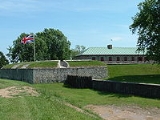
Fort Erie

Encyclopedia
Fort Erie was the first British
fort to be constructed as part of a network developed after the Seven Years' War
(or in the United States
the French and Indian War
) was concluded by the Treaty of Paris (1763)
at which time all of New France
had been ceded to Great Britain. It is located on the southern edge of the Town of Fort Erie
, Ontario
, directly across the Niagara River
from Buffalo, New York
.
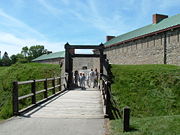 The British established control by occupying the French forts and by constructing a line of communications along the Niagara River and Upper Great Lakes. The original fort, built in 1764, was located on the Niagara River’s
edge below the present fort. For the following 50 years, Fort Erie served as a supply depot and a port for ships transporting merchandise, troops and passengers via Lake Erie
to the Upper Great Lakes
.
Rangers and Iroquois
Warriors during the American Revolution
. The little fort at the water’s edge suffered considerable damage due to continuous winter storms. In 1803, planning was authorized for a new Fort Erie on the heights behind the original post. The new fort was made more formidable being constructed of the Onondaga Flintstone that was readily available in the area.
. This new fort was unfinished when the United States
declared war
on June 18, 1812. Part of the garrison of Fort Erie fought at the Battle of Frenchman's Creek
against an American attack in November 1812. In 1813, Fort Erie was held for a period by U.S. forces and then abandoned on June 9, 1813. The fort had been partially dismantled by the small garrison of British troops and Canadian militia as they withdrew. British reoccupation followed American withdrawal from the area in December 1813. The British attempted to rebuild the fort. On July 3, 1814 another American force landed nearby and again captured Fort Erie
. The U.S. Army used the fort as a supply base and expanded its size. At the end of July, after the Battles of Chippewa and Lundy’s Lane
, the American army withdrew to Fort Erie and were besieged by the British. In the early hours of August 15, 1814, the British launched a four-pronged attack against the fortifications. A well-prepared American defence and an explosion in the North East Bastion destroyed the British chance for success with the loss of over 1,000 of their men. An American sortie on September 17 captured two of the British batteries and the American troops were able to spike
the guns in one of them before being driven back to the fort. Shortly afterward, the British lifted the siege and retired to positions to the north at Chippawa. After an unsuccessful American attack at Cook’s Mills, west of Chippawa, news reached the American forces that the eastern seaboard of the U.S. was under attack. On the November 5, 1814, with winter approaching, the Americans destroyed the fort and withdrew to Buffalo
. See Siege of Fort Erie
.
was signed December 24, 1814, ending the War of 1812. Fearing further American attacks, the British continued to occupy the ruined fort until 1823. Some of the stones from the fort were then incorporated into the construction of St. Paul’s Anglican Church, which stands today on the Niagara Parkway 3 km (1.9 mi) north of the fort.
The town of Fort Erie
began to grow north of the fortifications when a rail terminus and station were constructed.
in the middle of the 19th century, many of whom crossed into Canada from Buffalo, New York
.
s (Irish Republicans) used the ruins of the old fort as a base for their raid into Ontario
. The Fenian Brotherhood
invaded Canada
on June 1, 1866 with more than 500 American Civil War
veterans by crossing the Niagara River
a little north of Fort Erie. Their first order of business was to occupy the town of Fort Erie and demand food and equipment from the local population. The invaders offered Fenian bonds as payment but were refused by the townsfolk.
The Fenians then marched north to try and capture the town of Chippewa at the Niagara River exit of the Welland Canal
. Before reaching their goal, and discovering a British and Canadian force had reached the town before them they turned to face a weak Canadian militia
brigade that was approaching Fort Erie from the west, routing it at the Battle of Ridgeway
. The Fenians returned to Fort Erie where they defeated
a second small force of local Canadian militia, including a naval detachment from Dunnville
. Unable to get reinforcements across the river and concerned over the approach of a large number of Canadian Militia and British regulars, the Fenians retreated from Fort Erie for Buffalo
.
Around the same time visitors to the ruins included the Prince of Wales
and Mark Twain
.
As the 20th century approached, the Old Fort was used as a park and picnic area by local families.
 The reconstruction of the fort was started in 1937. The reconstruction was jointly sponsored by the Provincial and Federal governments and the Niagara Parks Commission
. The fort was restored to the 1812-1814 period and officially reopened on July 1, 1939. During the restoration, a mass grave of 150 British and 3 American soldiers was uncovered and currently lies beneath a monument which was originally erected in the fort's ruins in 1904. The fort and surrounding battlefield are owned and operated by the Niagara Parks Commission
, a self-funded agency of the Ontario
Provincial Government. The Parkway starts at Fort Erie and continues 56 km (34.8 mi) north to Lake Ontario
. Sir Winston Churchill
was quoted saying that the parkway was "the prettiest Sunday drive in the world." Each year, during the second weekend of August, hundreds of historical re-enactment enthusiasts come together to reenact the siege of Fort Erie.
, CHIN
, and Virtual Museum of Canada
.
Great Britain
Great Britain or Britain is an island situated to the northwest of Continental Europe. It is the ninth largest island in the world, and the largest European island, as well as the largest of the British Isles...
fort to be constructed as part of a network developed after the Seven Years' War
Seven Years' War
The Seven Years' War was a global military war between 1756 and 1763, involving most of the great powers of the time and affecting Europe, North America, Central America, the West African coast, India, and the Philippines...
(or in the United States
United States
The United States of America is a federal constitutional republic comprising fifty states and a federal district...
the French and Indian War
French and Indian War
The French and Indian War is the common American name for the war between Great Britain and France in North America from 1754 to 1763. In 1756, the war erupted into the world-wide conflict known as the Seven Years' War and thus came to be regarded as the North American theater of that war...
) was concluded by the Treaty of Paris (1763)
Treaty of Paris (1763)
The Treaty of Paris, often called the Peace of Paris, or the Treaty of 1763, was signed on 10 February 1763, by the kingdoms of Great Britain, France and Spain, with Portugal in agreement. It ended the French and Indian War/Seven Years' War...
at which time all of New France
New France
New France was the area colonized by France in North America during a period beginning with the exploration of the Saint Lawrence River by Jacques Cartier in 1534 and ending with the cession of New France to Spain and Great Britain in 1763...
had been ceded to Great Britain. It is located on the southern edge of the Town of Fort Erie
Fort Erie, Ontario
Fort Erie is a town on the Niagara River in the Niagara Region, Ontario, Canada. It is located directly across the river from Buffalo, New York....
, Ontario
Ontario
Ontario is a province of Canada, located in east-central Canada. It is Canada's most populous province and second largest in total area. It is home to the nation's most populous city, Toronto, and the nation's capital, Ottawa....
, directly across the Niagara River
Niagara River
The Niagara River flows north from Lake Erie to Lake Ontario. It forms part of the border between the Province of Ontario in Canada and New York State in the United States. There are differing theories as to the origin of the name of the river...
from Buffalo, New York
Buffalo, New York
Buffalo is the second most populous city in the state of New York, after New York City. Located in Western New York on the eastern shores of Lake Erie and at the head of the Niagara River across from Fort Erie, Ontario, Buffalo is the seat of Erie County and the principal city of the...
.
Early history
Niagara River
The Niagara River flows north from Lake Erie to Lake Ontario. It forms part of the border between the Province of Ontario in Canada and New York State in the United States. There are differing theories as to the origin of the name of the river...
edge below the present fort. For the following 50 years, Fort Erie served as a supply depot and a port for ships transporting merchandise, troops and passengers via Lake Erie
Lake Erie
Lake Erie is the fourth largest lake of the five Great Lakes in North America, and the tenth largest globally. It is the southernmost, shallowest, and smallest by volume of the Great Lakes and therefore also has the shortest average water residence time. It is bounded on the north by the...
to the Upper Great Lakes
Great Lakes
The Great Lakes are a collection of freshwater lakes located in northeastern North America, on the Canada – United States border. Consisting of Lakes Superior, Michigan, Huron, Erie, and Ontario, they form the largest group of freshwater lakes on Earth by total surface, coming in second by volume...
.
Development
The fort first saw action as a supply base for British troops, LoyalistUnited Empire Loyalists
The name United Empire Loyalists is an honorific given after the fact to those American Loyalists who resettled in British North America and other British Colonies as an act of fealty to King George III after the British defeat in the American Revolutionary War and prior to the Treaty of Paris...
Rangers and Iroquois
Iroquois
The Iroquois , also known as the Haudenosaunee or the "People of the Longhouse", are an association of several tribes of indigenous people of North America...
Warriors during the American Revolution
American Revolution
The American Revolution was the political upheaval during the last half of the 18th century in which thirteen colonies in North America joined together to break free from the British Empire, combining to become the United States of America...
. The little fort at the water’s edge suffered considerable damage due to continuous winter storms. In 1803, planning was authorized for a new Fort Erie on the heights behind the original post. The new fort was made more formidable being constructed of the Onondaga Flintstone that was readily available in the area.
War of 1812
Fort Erie was the site of the bloodiest battlefield in the history of CanadaCanada
Canada is a North American country consisting of ten provinces and three territories. Located in the northern part of the continent, it extends from the Atlantic Ocean in the east to the Pacific Ocean in the west, and northward into the Arctic Ocean...
. This new fort was unfinished when the United States
United States
The United States of America is a federal constitutional republic comprising fifty states and a federal district...
declared war
War of 1812
The War of 1812 was a military conflict fought between the forces of the United States of America and those of the British Empire. The Americans declared war in 1812 for several reasons, including trade restrictions because of Britain's ongoing war with France, impressment of American merchant...
on June 18, 1812. Part of the garrison of Fort Erie fought at the Battle of Frenchman's Creek
Battle of Frenchman's Creek
The Battle of Frenchman’s Creek took place during the War of 1812 between Great Britain and the United States in the early hours of November 28, 1812, in the Crown Colony of Upper Canada, near the Niagara River. The operation was conceived as a raid to prepare the ground for a larger American...
against an American attack in November 1812. In 1813, Fort Erie was held for a period by U.S. forces and then abandoned on June 9, 1813. The fort had been partially dismantled by the small garrison of British troops and Canadian militia as they withdrew. British reoccupation followed American withdrawal from the area in December 1813. The British attempted to rebuild the fort. On July 3, 1814 another American force landed nearby and again captured Fort Erie
Capture of Fort Erie
The Capture of Fort Erie by American forces in 1814 was an incident in the War of 1812 between the United Kingdom and the United States. The British garrison was outnumbered but surrendered prematurely, in the view of British commanders.-Background:...
. The U.S. Army used the fort as a supply base and expanded its size. At the end of July, after the Battles of Chippewa and Lundy’s Lane
Battle of Lundy's Lane
The Battle of Lundy's Lane was a battle of the Anglo-American War of 1812, which took place on 25 July 1814, in present-day Niagara Falls, Ontario...
, the American army withdrew to Fort Erie and were besieged by the British. In the early hours of August 15, 1814, the British launched a four-pronged attack against the fortifications. A well-prepared American defence and an explosion in the North East Bastion destroyed the British chance for success with the loss of over 1,000 of their men. An American sortie on September 17 captured two of the British batteries and the American troops were able to spike
Touch hole
A touch hole is a small hole, through which the propellant charge of a cannon or muzzleloading gun is ignited. In small arms, the flash from a charge of priming held in the flash pan is enough to ignite the charge within...
the guns in one of them before being driven back to the fort. Shortly afterward, the British lifted the siege and retired to positions to the north at Chippawa. After an unsuccessful American attack at Cook’s Mills, west of Chippawa, news reached the American forces that the eastern seaboard of the U.S. was under attack. On the November 5, 1814, with winter approaching, the Americans destroyed the fort and withdrew to Buffalo
Buffalo, New York
Buffalo is the second most populous city in the state of New York, after New York City. Located in Western New York on the eastern shores of Lake Erie and at the head of the Niagara River across from Fort Erie, Ontario, Buffalo is the seat of Erie County and the principal city of the...
. See Siege of Fort Erie
Siege of Fort Erie
The Siege of Fort Erie was one of the last and most protracted engagements between British and American forces during the Niagara campaign of the American War of 1812...
.
Aftermath of war
The Treaty of GhentTreaty of Ghent
The Treaty of Ghent , signed on 24 December 1814, in Ghent , was the peace treaty that ended the War of 1812 between the United States of America and the United Kingdom of Great Britain and Ireland...
was signed December 24, 1814, ending the War of 1812. Fearing further American attacks, the British continued to occupy the ruined fort until 1823. Some of the stones from the fort were then incorporated into the construction of St. Paul’s Anglican Church, which stands today on the Niagara Parkway 3 km (1.9 mi) north of the fort.
The town of Fort Erie
Fort Erie, Ontario
Fort Erie is a town on the Niagara River in the Niagara Region, Ontario, Canada. It is located directly across the river from Buffalo, New York....
began to grow north of the fortifications when a rail terminus and station were constructed.
Underground Railroad
The Fort Erie area became significant as the major terminus in Canada for slaves using the Underground RailroadUnderground Railroad
The Underground Railroad was an informal network of secret routes and safe houses used by 19th-century black slaves in the United States to escape to free states and Canada with the aid of abolitionists and allies who were sympathetic to their cause. The term is also applied to the abolitionists,...
in the middle of the 19th century, many of whom crossed into Canada from Buffalo, New York
Buffalo, New York
Buffalo is the second most populous city in the state of New York, after New York City. Located in Western New York on the eastern shores of Lake Erie and at the head of the Niagara River across from Fort Erie, Ontario, Buffalo is the seat of Erie County and the principal city of the...
.
The Fenian Raid (1866)
In 1866, a brigade of FenianFenian
The Fenians , both the Fenian Brotherhood and Irish Republican Brotherhood , were fraternal organisations dedicated to the establishment of an independent Irish Republic in the 19th and early 20th century. The name "Fenians" was first applied by John O'Mahony to the members of the Irish republican...
s (Irish Republicans) used the ruins of the old fort as a base for their raid into Ontario
Ontario
Ontario is a province of Canada, located in east-central Canada. It is Canada's most populous province and second largest in total area. It is home to the nation's most populous city, Toronto, and the nation's capital, Ottawa....
. The Fenian Brotherhood
Fenian Brotherhood
The Fenian Brotherhood was an Irish republican organization founded in the United States in 1858 by John O'Mahony and Michael Doheny. It was a precursor to Clan na Gael, a sister organization to the Irish Republican Brotherhood. Members were commonly known as "Fenians"...
invaded Canada
Canada
Canada is a North American country consisting of ten provinces and three territories. Located in the northern part of the continent, it extends from the Atlantic Ocean in the east to the Pacific Ocean in the west, and northward into the Arctic Ocean...
on June 1, 1866 with more than 500 American Civil War
American Civil War
The American Civil War was a civil war fought in the United States of America. In response to the election of Abraham Lincoln as President of the United States, 11 southern slave states declared their secession from the United States and formed the Confederate States of America ; the other 25...
veterans by crossing the Niagara River
Niagara River
The Niagara River flows north from Lake Erie to Lake Ontario. It forms part of the border between the Province of Ontario in Canada and New York State in the United States. There are differing theories as to the origin of the name of the river...
a little north of Fort Erie. Their first order of business was to occupy the town of Fort Erie and demand food and equipment from the local population. The invaders offered Fenian bonds as payment but were refused by the townsfolk.
The Fenians then marched north to try and capture the town of Chippewa at the Niagara River exit of the Welland Canal
Welland Canal
The Welland Canal is a ship canal in Canada that extends from Port Weller, Ontario, on Lake Ontario, to Port Colborne, Ontario, on Lake Erie. As a part of the St...
. Before reaching their goal, and discovering a British and Canadian force had reached the town before them they turned to face a weak Canadian militia
Militia
The term militia is commonly used today to refer to a military force composed of ordinary citizens to provide defense, emergency law enforcement, or paramilitary service, in times of emergency without being paid a regular salary or committed to a fixed term of service. It is a polyseme with...
brigade that was approaching Fort Erie from the west, routing it at the Battle of Ridgeway
Battle of Ridgeway
The Battle of Ridgeway was fought in the vicinity of the town of Fort Erie across the Niagara River from Buffalo, NY near the village of Ridgeway, Canada West, currently Ontario, Canada on June 2, 1866, between Canadian troops and an irregular army of Irish-American invaders, the Fenians...
. The Fenians returned to Fort Erie where they defeated
Battle of Fort Erie (1866)
The Battle of Fort Erie was a bloody skirmish in the afternoon immediately following the Battle of Ridgeway on June 2, 1866 in Canada West. The Fenian force, withdrawing from Ridgeway towards the United States, met and defeated a small force of Canadian militia at Fort Erie, then known as the...
a second small force of local Canadian militia, including a naval detachment from Dunnville
Dunnville, Ontario
Dunnville is an unincorporated community of 6,000 people located near the mouth of the Grand River in Haldimand County, Ontario, Canada, near the historic Talbot Trail...
. Unable to get reinforcements across the river and concerned over the approach of a large number of Canadian Militia and British regulars, the Fenians retreated from Fort Erie for Buffalo
Buffalo, New York
Buffalo is the second most populous city in the state of New York, after New York City. Located in Western New York on the eastern shores of Lake Erie and at the head of the Niagara River across from Fort Erie, Ontario, Buffalo is the seat of Erie County and the principal city of the...
.
Around the same time visitors to the ruins included the Prince of Wales
Prince of Wales
Prince of Wales is a title traditionally granted to the heir apparent to the reigning monarch of the United Kingdom of Great Britain and Northern Ireland and the 15 other independent Commonwealth realms...
and Mark Twain
Mark Twain
Samuel Langhorne Clemens , better known by his pen name Mark Twain, was an American author and humorist...
.
As the 20th century approached, the Old Fort was used as a park and picnic area by local families.
Redevelopment of the fort
Niagara Parks Commission
The Niagara Parks Commission, or Niagara Parks for short, is an agency of government of Ontario which maintains the Ontario shoreline of the Niagara River.- History :...
. The fort was restored to the 1812-1814 period and officially reopened on July 1, 1939. During the restoration, a mass grave of 150 British and 3 American soldiers was uncovered and currently lies beneath a monument which was originally erected in the fort's ruins in 1904. The fort and surrounding battlefield are owned and operated by the Niagara Parks Commission
Niagara Parks Commission
The Niagara Parks Commission, or Niagara Parks for short, is an agency of government of Ontario which maintains the Ontario shoreline of the Niagara River.- History :...
, a self-funded agency of the Ontario
Ontario
Ontario is a province of Canada, located in east-central Canada. It is Canada's most populous province and second largest in total area. It is home to the nation's most populous city, Toronto, and the nation's capital, Ottawa....
Provincial Government. The Parkway starts at Fort Erie and continues 56 km (34.8 mi) north to Lake Ontario
Lake Ontario
Lake Ontario is one of the five Great Lakes of North America. It is bounded on the north and southwest by the Canadian province of Ontario, and on the south by the American state of New York. Ontario, Canada's most populous province, was named for the lake. In the Wyandot language, ontarío means...
. Sir Winston Churchill
Winston Churchill
Sir Winston Leonard Spencer-Churchill, was a predominantly Conservative British politician and statesman known for his leadership of the United Kingdom during the Second World War. He is widely regarded as one of the greatest wartime leaders of the century and served as Prime Minister twice...
was quoted saying that the parkway was "the prettiest Sunday drive in the world." Each year, during the second weekend of August, hundreds of historical re-enactment enthusiasts come together to reenact the siege of Fort Erie.
Affiliations
The Museum is affiliated with: CMACanadian Museums Association
The Canadian Museums Association is a national organization for the promotion of museums in Canada.The Canadian Museums Association is the national organization for the advancement of the Canadian museum sector, representing Canadian museum professionals both within Canada and internationally. The...
, CHIN
Canadian Heritage Information Network
The Canadian Heritage Information Network is a Canadian government-supported organization that provides a networked interface to Canada's heritage, largely through the World Wide Web. It aims to give access to Canada's heritage for both Canadians and a worldwide audience, by supporting the...
, and Virtual Museum of Canada
Virtual Museum of Canada
The Virtual Museum of Canada is Canada's national virtual museum. With a directory of over 3,000 Canadian heritage institutions and a database of over 600 virtual exhibits, the VMC brings together Canada's museums regardless of size or geographical location.The VMC includes virtual exhibits,...
.
See also
- Chronology of the War of 1812Chronology of the War of 1812-Origins:-1812:-1813:-1814:-1815:-External links:********...
- War of 1812 CampaignsWar of 1812 CampaignsThe following is a synopsis of the Land Campaigns of the War of 1812. The source is the United States Army Center of Military History-Canada, 18 June 1812 — 17 February 1815:...
- Battle of New OrleansBattle of New OrleansThe Battle of New Orleans took place on January 8, 1815 and was the final major battle of the War of 1812. American forces, commanded by Major General Andrew Jackson, defeated an invading British Army intent on seizing New Orleans and the vast territory the United States had acquired with the...
- Fort MeigsFort MeigsFort Meigs was a fortification along the Maumee River in Ohio during the War of 1812. It is named in honor of Ohio governor Return J. Meigs, Jr., for his support in providing General William Henry Harrison with militia and supplies for the line of forts along the Old Northwest...
- List of forts
- Fenian BrotherhoodFenian BrotherhoodThe Fenian Brotherhood was an Irish republican organization founded in the United States in 1858 by John O'Mahony and Michael Doheny. It was a precursor to Clan na Gael, a sister organization to the Irish Republican Brotherhood. Members were commonly known as "Fenians"...
- Niagara Parks CommissionNiagara Parks CommissionThe Niagara Parks Commission, or Niagara Parks for short, is an agency of government of Ontario which maintains the Ontario shoreline of the Niagara River.- History :...
- War of 1812War of 1812The War of 1812 was a military conflict fought between the forces of the United States of America and those of the British Empire. The Americans declared war in 1812 for several reasons, including trade restrictions because of Britain's ongoing war with France, impressment of American merchant...
- United Empire LoyalistsUnited Empire LoyalistsThe name United Empire Loyalists is an honorific given after the fact to those American Loyalists who resettled in British North America and other British Colonies as an act of fealty to King George III after the British defeat in the American Revolutionary War and prior to the Treaty of Paris...
- Upper CanadaUpper CanadaThe Province of Upper Canada was a political division in British Canada established in 1791 by the British Empire to govern the central third of the lands in British North America and to accommodate Loyalist refugees from the United States of America after the American Revolution...
- Fort MississaugaFort MississaugaFort Mississauga National Historic Site is a fort along the shore of Lake Ontario, not far from the Niagara River in Niagara-on-the-Lake, Ontario. The fort today consists of a box–shaped brick tower and historic star–shaped earthworks—the only one in the country...
- Fort George, OntarioFort George, OntarioFort George National Historic Site is a historic military structure at Niagara-on-the-Lake, Ontario, that was the scene of several battles during the War of 1812...
- Navy HallNavy HallNavy Hall is a wooden structure encased within a stone structure that was the site of Upper Canada's first provincial parliament in 1792–1796. It is a national historic site located in Niagara-on-the-Lake, Ontario, then known as Newark, Upper Canada...