

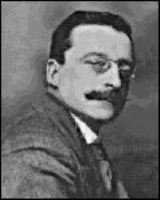
Arthur Griffith

Encyclopedia
Arthur Griffith was the founder and third leader of Sinn Féin
. He served as President of Dáil Éireann
from January to August 1922, and was head of the Irish delegation at the negotiations in London that produced the Anglo-Irish Treaty
of 1921.
lineage, and was educated by the Irish Christian Brothers
.
He worked for a time as a printer before joining the Gaelic League, which was aimed at promoting the restoration of the Irish language
. His father had been a printer on The Nation
newspaper—Griffith was one of several employees locked out in the early 1890s due to a dispute with a new owner of the paper. The young Griffith was a member of the Irish Republican Brotherhood
(IRB). He visited South Africa
from 1897 to 1898, after the defeat and death of Charles Stewart Parnell
whose more moderate views he had initially supported, while recovering from tuberculosis
. There he supported the Boers against British expansionism and was a strong admirer of Paul Kruger
.
In 1899, on returning to Dublin, he co-founded the weekly United Irishman
newspaper with his associate William Rooney, who died in 1901. On 24 November 1910, Griffith married his fiancée, Maud Sheehan, after a fifteen-year engagement; they had a son and a daughter.
Griffith's fierce criticism of the Irish Parliamentary Party
's alliance with British Liberalism
was heavily influenced by the anti-Liberal rhetoric of Young Ireland
er John Mitchel
. Griffith made a number of highly controversial statements and opinions. He defended anti-semitic rioters in Limerick
, and denounced socialists
and pacifists
as conscious tools of the British Empire
. However he supported anti-imperialist movements in Egypt
and India
and wrote a highly critical description of the British action at Matabele. He also cooperated at times with the socialist James Connolly
.
In September 1900, he established an organization called Cumann na nGaedheal to unite advanced nationalist/separatist groups and clubs. In 1903 he set up the National Council to campaign against the visit to Ireland of King Edward VII
his consort Alexandra of Denmark
.
In 1907, this organization merged with Sinn Féin and a number of others movements to form the Sinn Féin League (Irish for "Ourselves"). In 1906, after the United Irishman journal collapsed because of a libel suit, Griffith refounded it under the title Sinn Féin; it briefly became a daily in 1909 and survived until its suppression by the British government in 1914, after which it was sporadically revived as the nationalist journal, Nationality.
was illegal and that, consequently, the Anglo-Irish dual monarchy which existed under Grattan's Parliament, and the so-called Constitution of 1782
was still in effect. Its first president was Edward Martyn
.
The fundamental principles on which Sinn Féin was founded were outlined in an article published in 1904 by Griffith called The Resurrection of Hungary
, in which, noting how in 1867 Hungary went from being part of the Austrian Empire
to a separate co-equal kingdom in Austria-Hungary
. Though not a monarchist
himself, Griffith advocated such an approach for the Anglo-Irish
relationship, namely that Ireland should become a separate kingdom alongside Great Britain, the two forming a dual monarchy
with a shared monarch but separate governments, as it was thought this solution would be more palatable to the British. This was similar to the policy of Henry Grattan
a century earlier. However, this idea was never really embraced by later separatist leaders, especially Michael Collins
, and never came to anything, although Kevin O'Higgins
toyed with the idea as a means of ending partition
, shortly before his assassination.
Griffith sought to combine elements of Parnellism
with the traditional separatist approach; he saw himself not as a leader but as providing a strategy which a new leader might follow. Central to his strategy was parliamentary abstention
: the belief that Irish MPs
should refuse to attend the Parliament of the United Kingdom
at Westminster
, but should instead establish a separate Irish parliament (with an administrative system based on local government) in Dublin.
In 1907 Sinn Féin unsuccessfully contested a by-election in North Leitrim, where the sitting MP, one Charles Dolan of Manorhamilton, County Leitrim
, had defected to Sinn Féin. At this time Sinn Féin was being infiltrated by the Irish Republican Brotherhood
, who saw it as a vehicle for their aims; it had several local councillors (mostly in Dublin, including W. T. Cosgrave) and contained a dissident wing grouped from 1910 around the monthly periodical called Irish Freedom. The IRB members argued that the aim of dual monarchism should be replaced by republicanism, and that Griffith was excessively inclined to compromise with conservative elements (notably in his pro-employer position during the 1913 – 1914 Dublin Lockout
, when he saw the syndicalism of James Larkin
as aimed at crippling Irish industry for Great Britain's benefit).
. After its defeat, it was widely described both by British politicians and the Irish and British media as the "Sinn Féin rebellion", even though Sinn Féin had no involvement. When in 1917, surviving leaders of the rebellion were released from gaol (or escaped) they joined Sinn Féin en masse, using it as a vehicle for the advancement of the republic. The result was a bitter clash between those original members who backed Griffith's concept of an Anglo-Irish dual monarchy and the new members, under Éamon de Valera
, who wanted to achieve a republic. Matters almost led to a split at the party's Ard Fheis (conference) in October, 1917.
In a compromise, it was decided to seek to establish a republic initially, then allow the people to decide whether they wanted a republic or a monarchy, subject to the condition that no member of Britain's royal house could sit on any prospective Irish throne. Griffith resigned the party leadership and presidency at that Ard Fheis, and was replaced by de Valera. The leaders of the Irish Parliamentary Party
(IPP) sought a rapprochement with Griffith over the British threat of conscription
, which both parties condemned, but Griffith refused unless the IPP embraced his more radical and subversive ideals, a suggestion which John Dillon
, a leader of the IPP rubbished as unrealistic, although it would ultimately mean the defeat and dissolution of the IPP after the election in December 1918.
by-election of mid-1918 when he asked William O'Brien
to move the writ for his candidacy, and held the seat when Sinn Féin subsequently routed the Irish Parliamentary Party
at the 1918 general election
. In that election he was also returned for the seat of Tyrone North West.
Sinn Féin's MPs decided not to take their seats in the British House of Commons
but instead set up an Irish parliament, Dáil Éireann
; the Irish War of Independence
followed almost immediately. The dominant leaders in the new unilaterally declared
Irish Republic
were figures like Éamon de Valera, President of Dáil Éireann
(1919–21), President of the Republic
(1921–1922), and Michael Collins
, Minister for Finance, head of the IRB and the Irish Republican Army
's Director of Intelligence.
During de Valera's absence in the United States (1919–21) Griffith served as Acting President and gave regular press interviews. He was imprisoned in December 1920 but was subsequently released on 30 June 1921.
, London. After nearly 2 months of negotiations it was there, in private conversations, that the delegates finally decided to recommend the Treaty to the Dáil Éireann on 5 December 1921; negotiations closed at 2.20am on 6 December 1921. Griffith was the member of the treaty delegation most supportive of its eventual outcome, a compromise based on dominion
status, rather than a republic. After the ratification by 64 votes to 57 of the Anglo-Irish Treaty by the Second Dáil on 7 January 1922, he replaced de Valera, who stepped down in protest as President of the soon-to-be abolished Irish Republic. A vote was held on 9 January to choose between Griffith or De Valera, which De Valera lost by 58 to 60. A second ratification of the Treaty by the House of Commons of Southern Ireland followed shortly afterwards. Griffith was, however, to a great extent merely a figurehead as President of the second Dáil Éireann
and his relations with Michael Collins, head of the new Provisional Government
, were somewhat tense.
Suffering from overwork and strain after the long and difficult negotiations with the British government, and the work involved in establishing the Free State government, Griffith entered St. Vincent's Nursing Home, Dublin, during the first week of August 1922, following an acute attack of tonsilitis. He was confined to a room in St Vincent's by his doctors, who had observed signs of what they thought might be a subarachnoid haemorrhage
, but it was difficult to keep him quiet, and he resumed his daily work in the government building. He had been about to leave for his office shortly before 10 am on 12 August 1922, when he paused to retie his shoelace and fell down unconscious. He regained consciousness, but collapsed again with blood coming from his mouth. Three doctors rendered assistance, but to no avail. Father John Lee of the Marist Fathers administered extreme unction, and Griffith expired as the priest recited the concluding prayer. The cause of death was reported as being due to heart failure. He died at the age of 50, ten days before Michael Collins
' assassination in County Cork
. He was buried in Glasnevin Cemetery
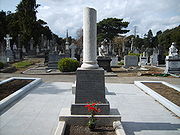
four days later.
considers that, though he had founded Sinn Féin, Griffith was 'quickly airbrushed' from Irish history. His widow had to beg his former colleagues for a pension, saying that he 'had made them all'. She considered that his grave plot was too modest and threatened to exhume his body. Only in 1968 was a plaque fixed on his former home.
Griffith Barracks
which is now Griffith College Dublin
on South Circular Road, Dublin, Griffith Avenue in North Dublin, Griffith Park in Drumcondra and Griffith Park in Lucan, County Dublin are named after him.
, during the Dreyfus Affair
which displayed clear hatred for Jews. Even after Alfred Dreyfus
had been pardoned Griffith remained virulently Anti-Dreyfusard.
In 1899 he wrote in the United Irishman:
 Following the Dreyfus Affair, an article in the 16 September 1899 edition of the United Irishman stated:
Griffith's editorial support for the Limerick Pogrom (a boycott of Jewish businesses in Limerick organised by the Redemptorist Father John Creagh in 1904) has also been criticised. His claim that it was a boycott of usurers is weakened by the fact that the vast majority of the people affected by the boycott were tradesmen:
As his biographer Brian Maye has pointed out, Griffith clearly had a "wildly exaggerated notion of the extent of Jewish involvement in money-lending and devious business practices" and his language was dangerously provocative.
Maye has also stated that Griffith's anti-semitic beliefs were tempered after 1910. At that period he became a close friend and associate of the Jewish solicitor Michael Noyk
. Noyk defended many IRA members in courts martial during the Irish War of Independence
and served as an official in the First Dáil
Department of Finance and as a Dáil Court
judge during the war.
A number of friends included Dr Bethel Solomons
, who contributed to the purchase of a house for Griffith when he married, Dr Edward Lipman, Jacob Elyan and Philip Sayers.
Sinn Féin
Sinn Féin is a left wing, Irish republican political party in Ireland. The name is Irish for "ourselves" or "we ourselves", although it is frequently mistranslated as "ourselves alone". Originating in the Sinn Féin organisation founded in 1905 by Arthur Griffith, it took its current form in 1970...
. He served as President of Dáil Éireann
President of Dáil Éireann
The President of Dáil Éireann was the leader of the revolutionary Irish Republic of 1919–1921. The office, also known as Príomh Aire , was created in the Dáil Constitution adopted by Dáil Éireann, the parliament of the Republic, at its first meeting in January 1919. This provided that the...
from January to August 1922, and was head of the Irish delegation at the negotiations in London that produced the Anglo-Irish Treaty
Anglo-Irish Treaty
The Anglo-Irish Treaty , officially called the Articles of Agreement for a Treaty Between Great Britain and Ireland, was a treaty between the Government of the United Kingdom of Great Britain and Ireland and representatives of the secessionist Irish Republic that concluded the Irish War of...
of 1921.
Early life
Arthur Griffith was born at 61 Upper Dominick Street, Dublin, Ireland on 31 March 1872, of distant WelshWales
Wales is a country that is part of the United Kingdom and the island of Great Britain, bordered by England to its east and the Atlantic Ocean and Irish Sea to its west. It has a population of three million, and a total area of 20,779 km²...
lineage, and was educated by the Irish Christian Brothers
Congregation of Christian Brothers
The Congregation of Christian Brothers is a worldwide religious community within the Catholic Church, founded by Blessed Edmund Rice. The Christian Brothers, as they are commonly known, chiefly work for the evangelisation and education of youth, but are involved in many ministries, especially with...
.
He worked for a time as a printer before joining the Gaelic League, which was aimed at promoting the restoration of the Irish language
Irish language
Irish , also known as Irish Gaelic, is a Goidelic language of the Indo-European language family, originating in Ireland and historically spoken by the Irish people. Irish is now spoken as a first language by a minority of Irish people, as well as being a second language of a larger proportion of...
. His father had been a printer on The Nation
The Nation (Irish newspaper)
The Nation was an Irish nationalist weekly newspaper, published in the 19th century. The Nation was printed first at 12 Trinity Street, Dublin, on 15 October 1842, until 6 January 1844...
newspaper—Griffith was one of several employees locked out in the early 1890s due to a dispute with a new owner of the paper. The young Griffith was a member of the Irish Republican Brotherhood
Irish Republican Brotherhood
The Irish Republican Brotherhood was a secret oath-bound fraternal organisation dedicated to the establishment of an "independent democratic republic" in Ireland during the second half of the 19th century and the start of the 20th century...
(IRB). He visited South Africa
South Africa
The Republic of South Africa is a country in southern Africa. Located at the southern tip of Africa, it is divided into nine provinces, with of coastline on the Atlantic and Indian oceans...
from 1897 to 1898, after the defeat and death of Charles Stewart Parnell
Charles Stewart Parnell
Charles Stewart Parnell was an Irish landowner, nationalist political leader, land reform agitator, and the founder and leader of the Irish Parliamentary Party...
whose more moderate views he had initially supported, while recovering from tuberculosis
Tuberculosis
Tuberculosis, MTB, or TB is a common, and in many cases lethal, infectious disease caused by various strains of mycobacteria, usually Mycobacterium tuberculosis. Tuberculosis usually attacks the lungs but can also affect other parts of the body...
. There he supported the Boers against British expansionism and was a strong admirer of Paul Kruger
Paul Kruger
Stephanus Johannes Paulus Kruger , better known as Paul Kruger and affectionately known as Uncle Paul was State President of the South African Republic...
.
In 1899, on returning to Dublin, he co-founded the weekly United Irishman
United Irishman
The United Irishman title has been a very popular newspaper title in Ireland and a number of newspapers have been published under the title.*...
newspaper with his associate William Rooney, who died in 1901. On 24 November 1910, Griffith married his fiancée, Maud Sheehan, after a fifteen-year engagement; they had a son and a daughter.
Griffith's fierce criticism of the Irish Parliamentary Party
Irish Parliamentary Party
The Irish Parliamentary Party was formed in 1882 by Charles Stewart Parnell, the leader of the Nationalist Party, replacing the Home Rule League, as official parliamentary party for Irish nationalist Members of Parliament elected to the House of Commons at...
's alliance with British Liberalism
Liberal Party (UK)
The Liberal Party was one of the two major political parties of the United Kingdom during the 19th and early 20th centuries. It was a third party of negligible importance throughout the latter half of the 20th Century, before merging with the Social Democratic Party in 1988 to form the present day...
was heavily influenced by the anti-Liberal rhetoric of Young Ireland
Young Ireland
Young Ireland was a political, cultural and social movement of the mid-19th century. It led changes in Irish nationalism, including an abortive rebellion known as the Young Irelander Rebellion of 1848. Many of the latter's leaders were tried for sedition and sentenced to penal transportation to...
er John Mitchel
John Mitchel
John Mitchel was an Irish nationalist activist, solicitor and political journalist. Born in Camnish, near Dungiven, County Londonderry, Ireland he became a leading member of both Young Ireland and the Irish Confederation...
. Griffith made a number of highly controversial statements and opinions. He defended anti-semitic rioters in Limerick
Limerick
Limerick is the third largest city in the Republic of Ireland, and the principal city of County Limerick and Ireland's Mid-West Region. It is the fifth most populous city in all of Ireland. When taking the extra-municipal suburbs into account, Limerick is the third largest conurbation in the...
, and denounced socialists
Socialism
Socialism is an economic system characterized by social ownership of the means of production and cooperative management of the economy; or a political philosophy advocating such a system. "Social ownership" may refer to any one of, or a combination of, the following: cooperative enterprises,...
and pacifists
Pacifism
Pacifism is the opposition to war and violence. The term "pacifism" was coined by the French peace campaignerÉmile Arnaud and adopted by other peace activists at the tenth Universal Peace Congress inGlasgow in 1901.- Definition :...
as conscious tools of the British Empire
British Empire
The British Empire comprised the dominions, colonies, protectorates, mandates and other territories ruled or administered by the United Kingdom. It originated with the overseas colonies and trading posts established by England in the late 16th and early 17th centuries. At its height, it was the...
. However he supported anti-imperialist movements in Egypt
Egypt
Egypt , officially the Arab Republic of Egypt, Arabic: , is a country mainly in North Africa, with the Sinai Peninsula forming a land bridge in Southwest Asia. Egypt is thus a transcontinental country, and a major power in Africa, the Mediterranean Basin, the Middle East and the Muslim world...
and India
India
India , officially the Republic of India , is a country in South Asia. It is the seventh-largest country by geographical area, the second-most populous country with over 1.2 billion people, and the most populous democracy in the world...
and wrote a highly critical description of the British action at Matabele. He also cooperated at times with the socialist James Connolly
James Connolly
James Connolly was an Irish republican and socialist leader. He was born in the Cowgate area of Edinburgh, Scotland, to Irish immigrant parents and spoke with a Scottish accent throughout his life. He left school for working life at the age of 11, but became one of the leading Marxist theorists of...
.
In September 1900, he established an organization called Cumann na nGaedheal to unite advanced nationalist/separatist groups and clubs. In 1903 he set up the National Council to campaign against the visit to Ireland of King Edward VII
Edward VII of the United Kingdom
Edward VII was King of the United Kingdom and the British Dominions and Emperor of India from 22 January 1901 until his death in 1910...
his consort Alexandra of Denmark
Alexandra of Denmark
Alexandra of Denmark was the wife of Edward VII of the United Kingdom...
.
In 1907, this organization merged with Sinn Féin and a number of others movements to form the Sinn Féin League (Irish for "Ourselves"). In 1906, after the United Irishman journal collapsed because of a libel suit, Griffith refounded it under the title Sinn Féin; it briefly became a daily in 1909 and survived until its suppression by the British government in 1914, after which it was sporadically revived as the nationalist journal, Nationality.
Foundation of Sinn Féin
Most historians opt for 28 November 1905, as a founding date because it was on this date that Griffith first presented his 'Sinn Féin Policy'. In his writings, Griffith declared that the Act of Union of Great Britain and Ireland in 1800Act of Union 1800
The Acts of Union 1800 describe two complementary Acts, namely:* the Union with Ireland Act 1800 , an Act of the Parliament of Great Britain, and...
was illegal and that, consequently, the Anglo-Irish dual monarchy which existed under Grattan's Parliament, and the so-called Constitution of 1782
Constitution of 1782
The Constitution of 1782 is a collective term given to a series of legal changes which freed the Parliament of Ireland, a Medieval parliament consisting of the Irish House of Commons and the Irish House of Lords, of legal restrictions that had been imposed by successive Norman, English, and later,...
was still in effect. Its first president was Edward Martyn
Edward Martyn
Edward Martyn was an Irish political and cultural activist and playwright.-Early life:Martyn was the eldest son of John Martyn of Tullira and Annie Mary Josephine Smyth of Masonbrook, Loughrea, both in County Galway. He succeeded his father upon John's death in 1860...
.
The fundamental principles on which Sinn Féin was founded were outlined in an article published in 1904 by Griffith called The Resurrection of Hungary
The Resurrection of Hungary
The Resurrection of Hungary was a book published by Arthur Griffith in 1904 in which he outlined his ideas for an Anglo-Irish dual monarchy. He proposed that the former kingdoms which had created the United Kingdom of Great Britain and Ireland in 1801, namely, the Kingdom of Great Britain and the...
, in which, noting how in 1867 Hungary went from being part of the Austrian Empire
Austrian Empire
The Austrian Empire was a modern era successor empire, which was centered on what is today's Austria and which officially lasted from 1804 to 1867. It was followed by the Empire of Austria-Hungary, whose proclamation was a diplomatic move that elevated Hungary's status within the Austrian Empire...
to a separate co-equal kingdom in Austria-Hungary
Austria-Hungary
Austria-Hungary , more formally known as the Kingdoms and Lands Represented in the Imperial Council and the Lands of the Holy Hungarian Crown of Saint Stephen, was a constitutional monarchic union between the crowns of the Austrian Empire and the Kingdom of Hungary in...
. Though not a monarchist
Monarchism
Monarchism is the advocacy of the establishment, preservation, or restoration of a monarchy as a form of government in a nation. A monarchist is an individual who supports this form of government out of principle, independent from the person, the Monarch.In this system, the Monarch may be the...
himself, Griffith advocated such an approach for the Anglo-Irish
Anglo-Irish
Anglo-Irish was a term used primarily in the 19th and early 20th centuries to identify a privileged social class in Ireland, whose members were the descendants and successors of the Protestant Ascendancy, mostly belonging to the Church of Ireland, which was the established church of Ireland until...
relationship, namely that Ireland should become a separate kingdom alongside Great Britain, the two forming a dual monarchy
Dual monarchy
Dual monarchy occurs when two separate kingdoms are ruled by the same monarch, follow the same foreign policy, exist in a customs union with each other and have a combined military but are otherwise self-governing...
with a shared monarch but separate governments, as it was thought this solution would be more palatable to the British. This was similar to the policy of Henry Grattan
Henry Grattan
Henry Grattan was an Irish politician and member of the Irish House of Commons and a campaigner for legislative freedom for the Irish Parliament in the late 18th century. He opposed the Act of Union 1800 that merged the Kingdoms of Ireland and Great Britain.-Early life:Grattan was born at...
a century earlier. However, this idea was never really embraced by later separatist leaders, especially Michael Collins
Michael Collins (Irish leader)
Michael "Mick" Collins was an Irish revolutionary leader, Minister for Finance and Teachta Dála for Cork South in the First Dáil of 1919, Director of Intelligence for the IRA, and member of the Irish delegation during the Anglo-Irish Treaty negotiations. Subsequently, he was both Chairman of the...
, and never came to anything, although Kevin O'Higgins
Kevin O'Higgins
Kevin Christopher O'Higgins was an Irish politician who served as Vice-President of the Executive Council and Minister for Justice. He was part of early nationalist Sinn Féin, before going on to become a prominent member of Cumann na nGaedheal. O'Higgins initiated the An Garda Síochána police force...
toyed with the idea as a means of ending partition
Partition of Ireland
The partition of Ireland was the division of the island of Ireland into two distinct territories, now Northern Ireland and the Republic of Ireland . Partition occurred when the British Parliament passed the Government of Ireland Act 1920...
, shortly before his assassination.
Griffith sought to combine elements of Parnellism
Charles Stewart Parnell
Charles Stewart Parnell was an Irish landowner, nationalist political leader, land reform agitator, and the founder and leader of the Irish Parliamentary Party...
with the traditional separatist approach; he saw himself not as a leader but as providing a strategy which a new leader might follow. Central to his strategy was parliamentary abstention
Abstentionism
Abstentionism is standing for election to a deliberative assembly while refusing to take up any seats won or otherwise participate in the assembly's business. Abstentionism differs from an election boycott in that abstentionists participate in the election itself...
: the belief that Irish MPs
Member of Parliament
A Member of Parliament is a representative of the voters to a :parliament. In many countries with bicameral parliaments, the term applies specifically to members of the lower house, as upper houses often have a different title, such as senate, and thus also have different titles for its members,...
should refuse to attend the Parliament of the United Kingdom
Parliament of the United Kingdom
The Parliament of the United Kingdom of Great Britain and Northern Ireland is the supreme legislative body in the United Kingdom, British Crown dependencies and British overseas territories, located in London...
at Westminster
Westminster
Westminster is an area of central London, within the City of Westminster, England. It lies on the north bank of the River Thames, southwest of the City of London and southwest of Charing Cross...
, but should instead establish a separate Irish parliament (with an administrative system based on local government) in Dublin.
In 1907 Sinn Féin unsuccessfully contested a by-election in North Leitrim, where the sitting MP, one Charles Dolan of Manorhamilton, County Leitrim
County Leitrim
County Leitrim is a county in Ireland. It is located in the West Region and is also part of the province of Connacht. It is named after the village of Leitrim. Leitrim County Council is the local authority for the county...
, had defected to Sinn Féin. At this time Sinn Féin was being infiltrated by the Irish Republican Brotherhood
Irish Republican Brotherhood
The Irish Republican Brotherhood was a secret oath-bound fraternal organisation dedicated to the establishment of an "independent democratic republic" in Ireland during the second half of the 19th century and the start of the 20th century...
, who saw it as a vehicle for their aims; it had several local councillors (mostly in Dublin, including W. T. Cosgrave) and contained a dissident wing grouped from 1910 around the monthly periodical called Irish Freedom. The IRB members argued that the aim of dual monarchism should be replaced by republicanism, and that Griffith was excessively inclined to compromise with conservative elements (notably in his pro-employer position during the 1913 – 1914 Dublin Lockout
Dublin Lockout
The Dublin Lock-out was a major industrial dispute between approximately 20,000 workers and 300 employers which took place in Ireland's capital city of Dublin. The dispute lasted from 26 August 1913 to 18 January 1914, and is often viewed as the most severe and significant industrial dispute in...
, when he saw the syndicalism of James Larkin
James Larkin
James Larkin was an Irish trade union leader and socialist activist, born to Irish parents in Liverpool, England. He and his family later moved to a small cottage in Burren, southern County Down. Growing up in poverty, he received little formal education and began working in a variety of jobs...
as aimed at crippling Irish industry for Great Britain's benefit).
1916 Rising
In 1916 rebels seized and took over a number of key locations in Dublin, in what became known as the Easter RisingEaster Rising
The Easter Rising was an insurrection staged in Ireland during Easter Week, 1916. The Rising was mounted by Irish republicans with the aims of ending British rule in Ireland and establishing the Irish Republic at a time when the British Empire was heavily engaged in the First World War...
. After its defeat, it was widely described both by British politicians and the Irish and British media as the "Sinn Féin rebellion", even though Sinn Féin had no involvement. When in 1917, surviving leaders of the rebellion were released from gaol (or escaped) they joined Sinn Féin en masse, using it as a vehicle for the advancement of the republic. The result was a bitter clash between those original members who backed Griffith's concept of an Anglo-Irish dual monarchy and the new members, under Éamon de Valera
Éamon de Valera
Éamon de Valera was one of the dominant political figures in twentieth century Ireland, serving as head of government of the Irish Free State and head of government and head of state of Ireland...
, who wanted to achieve a republic. Matters almost led to a split at the party's Ard Fheis (conference) in October, 1917.
In a compromise, it was decided to seek to establish a republic initially, then allow the people to decide whether they wanted a republic or a monarchy, subject to the condition that no member of Britain's royal house could sit on any prospective Irish throne. Griffith resigned the party leadership and presidency at that Ard Fheis, and was replaced by de Valera. The leaders of the Irish Parliamentary Party
Irish Parliamentary Party
The Irish Parliamentary Party was formed in 1882 by Charles Stewart Parnell, the leader of the Nationalist Party, replacing the Home Rule League, as official parliamentary party for Irish nationalist Members of Parliament elected to the House of Commons at...
(IPP) sought a rapprochement with Griffith over the British threat of conscription
Conscription
Conscription is the compulsory enlistment of people in some sort of national service, most often military service. Conscription dates back to antiquity and continues in some countries to the present day under various names...
, which both parties condemned, but Griffith refused unless the IPP embraced his more radical and subversive ideals, a suggestion which John Dillon
John Dillon
John Dillon was an Irish land reform agitator from Dublin, an Irish Home Rule activist, a nationalist politician, a Member of Parliament for over 35 years, and the last leader of the Irish Parliamentary Party....
, a leader of the IPP rubbished as unrealistic, although it would ultimately mean the defeat and dissolution of the IPP after the election in December 1918.
War of Independence
Griffith was elected a Sinn Féin MP in the Cavan EastEast Cavan (UK Parliament constituency)
East Cavan was a parliamentary constituency in Ireland, which from 1885 to 1922 returned one Member of Parliament to the House of Commons of the United Kingdom of Great Britain and Ireland.Prior to 1885 the area was part of the Cavan constituency...
by-election of mid-1918 when he asked William O'Brien
William O'Brien
William O'Brien was an Irish nationalist, journalist, agrarian agitator, social revolutionary, politician, party leader, newspaper publisher, author and Member of Parliament in the House of Commons of the United Kingdom of Great Britain and Ireland...
to move the writ for his candidacy, and held the seat when Sinn Féin subsequently routed the Irish Parliamentary Party
Irish Parliamentary Party
The Irish Parliamentary Party was formed in 1882 by Charles Stewart Parnell, the leader of the Nationalist Party, replacing the Home Rule League, as official parliamentary party for Irish nationalist Members of Parliament elected to the House of Commons at...
at the 1918 general election
Irish (UK) general election, 1918
The Irish general election of 1918 was that part of the 1918 United Kingdom general election that took place in Ireland. It is seen as a key moment in modern Irish history...
. In that election he was also returned for the seat of Tyrone North West.
Sinn Féin's MPs decided not to take their seats in the British House of Commons
British House of Commons
The House of Commons is the lower house of the Parliament of the United Kingdom, which also comprises the Sovereign and the House of Lords . Both Commons and Lords meet in the Palace of Westminster. The Commons is a democratically elected body, consisting of 650 members , who are known as Members...
but instead set up an Irish parliament, Dáil Éireann
Dáil Éireann (1919-1922)
Dáil Éireann was the revolutionary, unicameral parliament of the unilaterally declared Irish Republic from 1919–1922. The Dáil was first formed by 73 Sinn Féin MPs elected in the 1918 United Kingdom general election. Their manifesto refused to recognise the British parliament at Westminster and...
; the Irish War of Independence
Irish War of Independence
The Irish War of Independence , Anglo-Irish War, Black and Tan War, or Tan War was a guerrilla war mounted by the Irish Republican Army against the British government and its forces in Ireland. It began in January 1919, following the Irish Republic's declaration of independence. Both sides agreed...
followed almost immediately. The dominant leaders in the new unilaterally declared
Declaration of independence
A declaration of independence is an assertion of the independence of an aspiring state or states. Such places are usually declared from part or all of the territory of another nation or failed nation, or are breakaway territories from within the larger state...
Irish Republic
Irish Republic
The Irish Republic was a revolutionary state that declared its independence from Great Britain in January 1919. It established a legislature , a government , a court system and a police force...
were figures like Éamon de Valera, President of Dáil Éireann
President of Dáil Éireann
The President of Dáil Éireann was the leader of the revolutionary Irish Republic of 1919–1921. The office, also known as Príomh Aire , was created in the Dáil Constitution adopted by Dáil Éireann, the parliament of the Republic, at its first meeting in January 1919. This provided that the...
(1919–21), President of the Republic
President of the Irish Republic
President of the Republic was the title given to the head of the Irish ministry or Aireacht in August 1921 by an amendment to the Dáil Constitution, which replaced the previous title, Príomh Aire or President of Dáil Éireann...
(1921–1922), and Michael Collins
Michael Collins (Irish leader)
Michael "Mick" Collins was an Irish revolutionary leader, Minister for Finance and Teachta Dála for Cork South in the First Dáil of 1919, Director of Intelligence for the IRA, and member of the Irish delegation during the Anglo-Irish Treaty negotiations. Subsequently, he was both Chairman of the...
, Minister for Finance, head of the IRB and the Irish Republican Army
Irish Republican Army
The Irish Republican Army was an Irish republican revolutionary military organisation. It was descended from the Irish Volunteers, an organisation established on 25 November 1913 that staged the Easter Rising in April 1916...
's Director of Intelligence.
During de Valera's absence in the United States (1919–21) Griffith served as Acting President and gave regular press interviews. He was imprisoned in December 1920 but was subsequently released on 30 June 1921.
Treaty negotiations and death
In October 1921, de Valera, President of the Irish Republic, asked him to head the delegation of Irish plenipotentiaries to negotiate with the British government. The delegates set up Headquarters in Hans PlaceHans Place
Hans Place, London, England, is a residential garden square situated immediately south of Harrods in Chelsea. It is named after Sir Hans Sloane, 1st Baronet, PRS , who was a physician and collector, notable for bequeathing his collection to the British nation which became the foundation of the...
, London. After nearly 2 months of negotiations it was there, in private conversations, that the delegates finally decided to recommend the Treaty to the Dáil Éireann on 5 December 1921; negotiations closed at 2.20am on 6 December 1921. Griffith was the member of the treaty delegation most supportive of its eventual outcome, a compromise based on dominion
Dominion
A dominion, often Dominion, refers to one of a group of autonomous polities that were nominally under British sovereignty, constituting the British Empire and British Commonwealth, beginning in the latter part of the 19th century. They have included Canada, Australia, New Zealand, Newfoundland,...
status, rather than a republic. After the ratification by 64 votes to 57 of the Anglo-Irish Treaty by the Second Dáil on 7 January 1922, he replaced de Valera, who stepped down in protest as President of the soon-to-be abolished Irish Republic. A vote was held on 9 January to choose between Griffith or De Valera, which De Valera lost by 58 to 60. A second ratification of the Treaty by the House of Commons of Southern Ireland followed shortly afterwards. Griffith was, however, to a great extent merely a figurehead as President of the second Dáil Éireann
Second Dáil
The Second Dáil was Dáil Éireann as it convened from 16 August 1921 until 8 June 1922. From 1919–1922 Dáil Éireann was the revolutionary parliament of the self-proclaimed Irish Republic. The Second Dáil consisted of members elected in 1921...
and his relations with Michael Collins, head of the new Provisional Government
Provisional government
A provisional government is an emergency or interim government set up when a political void has been created by the collapse of a very large government. The early provisional governments were created to prepare for the return of royal rule...
, were somewhat tense.
Suffering from overwork and strain after the long and difficult negotiations with the British government, and the work involved in establishing the Free State government, Griffith entered St. Vincent's Nursing Home, Dublin, during the first week of August 1922, following an acute attack of tonsilitis. He was confined to a room in St Vincent's by his doctors, who had observed signs of what they thought might be a subarachnoid haemorrhage
Subarachnoid hemorrhage
A subarachnoid hemorrhage , or subarachnoid haemorrhage in British English, is bleeding into the subarachnoid space—the area between the arachnoid membrane and the pia mater surrounding the brain...
, but it was difficult to keep him quiet, and he resumed his daily work in the government building. He had been about to leave for his office shortly before 10 am on 12 August 1922, when he paused to retie his shoelace and fell down unconscious. He regained consciousness, but collapsed again with blood coming from his mouth. Three doctors rendered assistance, but to no avail. Father John Lee of the Marist Fathers administered extreme unction, and Griffith expired as the priest recited the concluding prayer. The cause of death was reported as being due to heart failure. He died at the age of 50, ten days before Michael Collins
Michael Collins (Irish leader)
Michael "Mick" Collins was an Irish revolutionary leader, Minister for Finance and Teachta Dála for Cork South in the First Dáil of 1919, Director of Intelligence for the IRA, and member of the Irish delegation during the Anglo-Irish Treaty negotiations. Subsequently, he was both Chairman of the...
' assassination in County Cork
County Cork
County Cork is a county in Ireland. It is located in the South-West Region and is also part of the province of Munster. It is named after the city of Cork . Cork County Council is the local authority for the county...
. He was buried in Glasnevin Cemetery
Glasnevin Cemetery
Glasnevin Cemetery , officially known as Prospect Cemetery, is the largest non-denominational cemetery in Ireland with an estimated 1.5 million burials...
four days later.
Posthumous reputation
The historian Diarmaid FerriterDiarmaid Ferriter
Diarmaid Ferriter is an Irish author, historian, and university lecturer. He has authored several books on the subject of Irish history. Diarmaid attended St. Benildus College in Kilmacud in Dublin.-Career:...
considers that, though he had founded Sinn Féin, Griffith was 'quickly airbrushed' from Irish history. His widow had to beg his former colleagues for a pension, saying that he 'had made them all'. She considered that his grave plot was too modest and threatened to exhume his body. Only in 1968 was a plaque fixed on his former home.
Griffith Barracks
Griffith Barracks
Griffith Barracks is a former military barracks located on the South Circular Road, Dublin, Ireland.-History:The site of Griffith Barracks was originally known as Grimswoods Nurseries. The first buildings on the site were those of a Remand Prison or Bridewell. Begun in 1813 by the architect Francis...
which is now Griffith College Dublin
Griffith College Dublin
Griffith College Dublin is a private third level college in the Republic of Ireland. It is based in and named after the former Griffith Barracks on the South Circular Road in Dublin. It offers courses accredited by a number of institutions and bodies in Ireland and Britain...
on South Circular Road, Dublin, Griffith Avenue in North Dublin, Griffith Park in Drumcondra and Griffith Park in Lucan, County Dublin are named after him.
Charges of Anti-Semitism
The charge of anti-semitism has often been levelled at Griffith. He published articles signed by 'The Home Secretary' in his newspaper, the United IrishmanUnited Irishman
The United Irishman title has been a very popular newspaper title in Ireland and a number of newspapers have been published under the title.*...
, during the Dreyfus Affair
Dreyfus Affair
The Dreyfus affair was a political scandal that divided France in the 1890s and the early 1900s. It involved the conviction for treason in November 1894 of Captain Alfred Dreyfus, a young French artillery officer of Alsatian Jewish descent...
which displayed clear hatred for Jews. Even after Alfred Dreyfus
Alfred Dreyfus
Alfred Dreyfus was a French artillery officer of Jewish background whose trial and conviction in 1894 on charges of treason became one of the most tense political dramas in modern French and European history...
had been pardoned Griffith remained virulently Anti-Dreyfusard.
In 1899 he wrote in the United Irishman:
Griffith's editorial support for the Limerick Pogrom (a boycott of Jewish businesses in Limerick organised by the Redemptorist Father John Creagh in 1904) has also been criticised. His claim that it was a boycott of usurers is weakened by the fact that the vast majority of the people affected by the boycott were tradesmen:
As his biographer Brian Maye has pointed out, Griffith clearly had a "wildly exaggerated notion of the extent of Jewish involvement in money-lending and devious business practices" and his language was dangerously provocative.
Maye has also stated that Griffith's anti-semitic beliefs were tempered after 1910. At that period he became a close friend and associate of the Jewish solicitor Michael Noyk
Michael Noyk
Michael Noyk was a solicitor and Irish Republican politician. Noyk was born in Telšiai, Lithuania, the son of a Jewish couple, Isaac Noyk and Esther Chana Raivid. The family emigrated when Michael was one year old...
. Noyk defended many IRA members in courts martial during the Irish War of Independence
Irish War of Independence
The Irish War of Independence , Anglo-Irish War, Black and Tan War, or Tan War was a guerrilla war mounted by the Irish Republican Army against the British government and its forces in Ireland. It began in January 1919, following the Irish Republic's declaration of independence. Both sides agreed...
and served as an official in the First Dáil
First Dáil
The First Dáil was Dáil Éireann as it convened from 1919–1921. In 1919 candidates who had been elected in the Westminster elections of 1918 refused to recognise the Parliament of the United Kingdom and instead assembled as a unicameral, revolutionary parliament called "Dáil Éireann"...
Department of Finance and as a Dáil Court
Dáil Courts
During the Irish War of Independence, the Dáil Courts were the judicial branch of government of the short-lived Irish Republic. They were formally established by a decree of the First Dáil Éireann on 29 June 1920, replacing more limited Arbitration Courts that had been authorised a year earlier...
judge during the war.
A number of friends included Dr Bethel Solomons
Bethel Solomons
Bethel Albert Herbert Solomons was born in Dublin, Ireland, to a prominent Jewish family. He was the son of Maurice Solomons , an optician whose family came to Dublin from England in 1824...
, who contributed to the purchase of a house for Griffith when he married, Dr Edward Lipman, Jacob Elyan and Philip Sayers.
Quotations
- "In Arthur Griffith there is a mighty force in Ireland. He has none of the wildness of some I could name. Instead there is an abundance of wisdom and an awareness of things which are Ireland." - Michael Collins.
- "A braver man than Arthur Griffith, I never met" - The Earl of BirkenheadF. E. Smith, 1st Earl of BirkenheadFrederick Edwin Smith, 1st Earl of Birkenhead GCSI, PC, KC , best known to history as F. E. Smith , was a British Conservative statesman and lawyer of the early 20th century. He was a skilled orator, noted for his staunch opposition to Irish nationalism, his wit, pugnacious views, and hard living...
, British negotiator in the Treaty, quoted from Tim Pat CooganTim Pat CooganTimothy Patrick Coogan is an Irish historical writer, broadcaster and newspaper columnist. He served as editor of the Irish Press newspaper from 1968 to 1987...
's Michael Collins.
See also
Sources
- Patrick Maume, The Long Gestation (Gill & Macmillan, 1999).
- There is a 2003 reprint of The Resurrection of Hungary with an introduction by Patrick Murray (University College Dublin Press).
- The Treaty Debates on-line (Dec 1921-Jan 1922)