
All Topics  
Catholic Emancipation

 
Catholic Emancipation

   Email Print
   Bookmark   Link


Catholic Emancipation


Catholic Emancipation or Catholic Relief, was a process in Great Britain
Great Britain

Great Britain is an island lying to the northwest of Continental Europe. It is the List of islands by area, and the largest in Europe. With a population of 58.9 million people it is List of islands by population....
 and Ireland
Ireland

Ireland is the List of islands by area in Europe, and the twentieth-largest island in the world. It lies to the north-west of continental Europe and is surrounded by hundreds of islands and islet....
 in the late 18th century and early 19th century which involved reducing and removing many of the restrictions on Roman Catholics which had been introduced by the Act of Uniformity
Act of Uniformity

Over the course of English parliamentary history there were a number of acts of uniformity. All had the basic object of establishing some sort of religious orthodoxy within the English church....
, the Test Act
Test Act

The Test Acts were a series of England penal laws that served as a religious test for public office and imposed various civil disabilities on Roman Catholics and Nonconformists....
s and the Penal Laws. Requirements to abjure the temporal and spiritual authority of the Pope
Pope

The Pope is the Bishop of Rome, the leader of the Roman Catholic Church and head of state of Vatican City. The current pope is Pope Benedict XVI, who was elected April 19, 2005 in Papal conclave, 2005....
 and transubstantiation
Transubstantiation

In Roman Catholic theology, transubstantiation is the change of the Substance theory of Host and Sacramental wine into the Body of Christ and Blood of Christ occurring in the Eucharist while all that is accessible to the senses remain as before....
 placed major burdens on Roman Catholics.

From the death of James Francis Edward Stuart
James Francis Edward Stuart

Prince James, Prince of Wales was the son of the deposed James II of England. As such, he claimed the English, Scottish and Irish thrones from the death of his father in 1701, when he was proclaimed king of England, Scotland and Ireland by his cousin Louis XIV of France....
 in January 1766, the Papacy
Holy See

The Holy See is the episcopal jurisdiction of the Bishop of Rome, commonly known as the Pope, and is the preeminent episcopal see of the Roman Catholic Church, forming the central government of the Church....
 recognised the Hanoverian
Hanoverian

The adjective Hanoverian is used to describe:* British monarchs or supporters of the House of Hanover, the dynasty which ruled the United Kingdom from 1714 to 1901....
 dynasty as lawful rulers of England, Scotland and Ireland, after a gap of 70 years, and thereafter the Penal Laws started to be dismantled.

anada, British since 1763, the Quebec Act
Quebec Act

The Quebec Act of 1774 was an Act of Parliament of the Parliament of Great Britain setting procedures of governance in the Province of Quebec ....
 of 1774 ended some restrictions on Catholics, so much so that it was criticized in the Congress of the Thirteen Colonies
Thirteen Colonies

The Thirteen Colonies were part of what became known as British America, a name that was used by Great Britain until the Treaty of Paris recognized the independence of the original thirteen United States of America in 1783....
.


Discussion
Ask a question about 'Catholic Emancipation'
Start a new discussion about 'Catholic Emancipation'
Answer questions from other users
Full Discussion Forum


Encyclopedia


Catholic Emancipation or Catholic Relief, was a process in Great Britain
Great Britain

Great Britain is an island lying to the northwest of Continental Europe. It is the List of islands by area, and the largest in Europe. With a population of 58.9 million people it is List of islands by population....
 and Ireland
Ireland

Ireland is the List of islands by area in Europe, and the twentieth-largest island in the world. It lies to the north-west of continental Europe and is surrounded by hundreds of islands and islet....
 in the late 18th century and early 19th century which involved reducing and removing many of the restrictions on Roman Catholics which had been introduced by the Act of Uniformity
Act of Uniformity

Over the course of English parliamentary history there were a number of acts of uniformity. All had the basic object of establishing some sort of religious orthodoxy within the English church....
, the Test Act
Test Act

The Test Acts were a series of England penal laws that served as a religious test for public office and imposed various civil disabilities on Roman Catholics and Nonconformists....
s and the Penal Laws. Requirements to abjure the temporal and spiritual authority of the Pope
Pope

The Pope is the Bishop of Rome, the leader of the Roman Catholic Church and head of state of Vatican City. The current pope is Pope Benedict XVI, who was elected April 19, 2005 in Papal conclave, 2005....
 and transubstantiation
Transubstantiation

In Roman Catholic theology, transubstantiation is the change of the Substance theory of Host and Sacramental wine into the Body of Christ and Blood of Christ occurring in the Eucharist while all that is accessible to the senses remain as before....
 placed major burdens on Roman Catholics.

From the death of James Francis Edward Stuart
James Francis Edward Stuart

Prince James, Prince of Wales was the son of the deposed James II of England. As such, he claimed the English, Scottish and Irish thrones from the death of his father in 1701, when he was proclaimed king of England, Scotland and Ireland by his cousin Louis XIV of France....
 in January 1766, the Papacy
Holy See

The Holy See is the episcopal jurisdiction of the Bishop of Rome, commonly known as the Pope, and is the preeminent episcopal see of the Roman Catholic Church, forming the central government of the Church....
 recognised the Hanoverian
Hanoverian

The adjective Hanoverian is used to describe:* British monarchs or supporters of the House of Hanover, the dynasty which ruled the United Kingdom from 1714 to 1901....
 dynasty as lawful rulers of England, Scotland and Ireland, after a gap of 70 years, and thereafter the Penal Laws started to be dismantled.

Initial reliefs

In Canada, British since 1763, the Quebec Act
Quebec Act

The Quebec Act of 1774 was an Act of Parliament of the Parliament of Great Britain setting procedures of governance in the Province of Quebec ....
 of 1774 ended some restrictions on Catholics, so much so that it was criticized in the Congress of the Thirteen Colonies
Thirteen Colonies

The Thirteen Colonies were part of what became known as British America, a name that was used by Great Britain until the Treaty of Paris recognized the independence of the original thirteen United States of America in 1783....
. In Britain and Ireland the first Catholic Relief Act
Papists Act 1778

The Papists Act 1778 is an Act of Parliament of the Parliament of Great Britain and was the first Act for Catholic Relief. By this Act, an oath was imposed, which besides a declaration of loyalty to the reigning sovereign, contained an abjuration of the Charles Edward Stuart, and of certain doctrines attributed to Catholics, as that excommun...
 was passed in 1778; subject to an oath renouncing Stuart
House of Stuart

The House of Stuart, also known as the House of Stewart is an important European royal house. Founded by Robert II of Scotland, the Stewarts first became monarchs of the Kingdom of Scotland during the late 14th century....
 claims to the throne and the civil jurisdiction of the Pope, it allowed Roman Catholics to own property, inherit land, and join the army. Reaction against this led to riots in Scotland in 1779 and then the Gordon Riots
Gordon Riots

The Gordon Riots refers to a number of events in a predominantly Protestant religious uprising in London, England, in 1780, aimed against the Papists Act 1778, "relieving his Majesty's subjects, of the Catholic Religion, from certain penalties and disabilities imposed upon them during the reign of William III of England." The uprising then...
 in London in 1780. Further relief was given by the Roman Catholic Relief Act 1791
Roman Catholic Relief Act 1791

The Roman Catholic Relief Act 1791 is an Act of Parliament of the Parliament of Great Britain passed in 1791 relieving Roman Catholics of certain political, educational, and economic disabilities....
. The Irish Parliament passed similar Acts between 1778 and 1793. Since the electoral franchise
Suffrage

Suffrage is the civil right to vote, or the exercise of that right. In that context, it is also called political franchise or simply the franchise....
 at the time was largely determined by property, this relief gave the votes to Roman Catholics holding land with a rental value of £2 a year. They also started to gain access to many middle-class professions from which they had been excluded, such as the legal profession, grand jurors
Grand jury

In the common law, a grand jury is a type of jury that determines whether there is enough evidence for a Criminal procedure. Grand juries carry out this duty by examining evidence presented to them by a prosecutor and issuing indictments, or by investigating alleged crimes and issuing Wiktionary:presentments....
, universities
University

A university is an institution of higher education and research, which grants academic degrees in a variety of subjects. A university provides both undergraduate education and postgraduate education....
 and the lower ranks of the army
British Army

The British Army is the Army branch of the British Armed Forces. It came into being with the unification of the Kingdoms of Kingdom of England and Kingdom of Scotland into the Kingdom of Great Britain in 1707....
 and judiciary
Judiciary

In law, the judiciary is the system of courts which administer justice in the name of the Sovereignty or state, a mechanism for the dispute resolution....
.

Act of Union with Ireland 1800

The issue of greater political emancipation was considered in 1800 at the time of the Act of Union
Act of Union 1800

The phrase Act of Union 1800 is used to describe two complementary Acts whose official United Kingdom titles are the Union with Ireland Act 1800 , an Act of the Parliament of Great Britain, and the Act of Union 1800 ,...
 between Great Britain and Ireland: it was not included in the text of the Act because this would have led to greater Irish Protestant opposition to the Union, non-conformists
Nonconformism

Nonconformism is the refusal to conform to common standards, conventions, rules, customs, traditions, norms, or laws. In specific usage Nonconformism , however, refers to the Protestant Christians of England and Wales who refused to "conform", or follow the governance and usages of the Church of England....
 also suffered from discrimination at this time, but it was expected to be a consequence given the proportionately small number of Roman Catholics in the UK
United Kingdom

The United Kingdom of Great Britain and Northern Ireland, commonly known as the United Kingdom , the UK or Britain,is a sovereign state located off the northwestern coast of continental Europe....
 as a whole.

William Pitt the Younger

William Pitt, the Younger was a Kingdom of Great Britain politician of the late eighteenth century and early nineteenth century. He became the youngest Prime Minister of the United Kingdom in 1783 at the age of 24....
, the Prime Minister, had promised Emancipation to accompany the Act
Act of Union 1800

The phrase Act of Union 1800 is used to describe two complementary Acts whose official United Kingdom titles are the Union with Ireland Act 1800 , an Act of the Parliament of Great Britain, and the Act of Union 1800 ,...
. However, no further steps were taken at that stage, in part because of the belief of King George III
George III of the United Kingdom

George III was Kingdom of Great Britain and Kingdom of Ireland from 25 October 1760 until the union of these two countries on 1 January 1801, after which he was King of the United Kingdom of Great Britain and Ireland until his death....
 that it could violate his Coronation Oath. Pitt resigned when King George's opposition became known, as he was unable to fulfill his pledge. Catholic Emancipation then became a debating point rather than a major political issue.

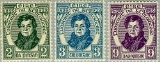
Stamp Irl 1929oconnellset

O'Connell's campaign 1823-29

In 1823, Daniel O'Connell
Daniel O'Connell

Daniel O'Connell , known as The Liberator, or The Emancipator, was an Ireland political leader in the first half of the nineteenth century....
 started a campaign for repeal of the Act of Union, and took Catholic Emancipation as his rallying call, establishing the Catholic Association
Catholic Association

The Catholic Association was an Irish Roman Catholic political organisation set up by Daniel O'Connell in the early nineteenth century to campaign for Catholic Emancipation within the United Kingdom of Great Britain and Ireland....
. In 1828 he stood for election in County Clare
County Clare

County Clare commonly referred to as simply Clare, is a Counties of Ireland of Ireland and part of the wider Provinces of Ireland of Munster....
 in Ireland
Ireland

Ireland is the List of islands by area in Europe, and the twentieth-largest island in the world. It lies to the north-west of continental Europe and is surrounded by hundreds of islands and islet....
 and was elected even though he could not take his seat in the House of Commons
British House of Commons

The House of Commons is the lower house of the Parliament of the United Kingdom, which also comprises the British monarchy and the House of Lords ....
. He repeated this in 1829.

The resulting commotion led the Duke of Wellington
Arthur Wellesley, 1st Duke of Wellington

Field Marshal Arthur Wellesley, 1st Duke of Wellington, Order of the Garter, Order of St Patrick, Order of the Bath, Royal Guelphic Order, Privy Council of the United Kingdom, Royal Society , was an Anglo-Irish soldier and statesman, and one of the leading military and political figures of the nineteenth century....
 and Sir Robert Peel, against their previous judgements, to introduce and carry the major changes of the Catholic Relief Act of 1829
Catholic Relief Act 1829

The Catholic Relief Act 1829 was passed by the Parliament of the United Kingdom on 24 March 1829, and received the Royal Assent on 13 April. It was the culmination of the process of Catholic Emancipation in the United Kingdom, and in Ireland it repealed the last of the Penal Laws ....
, removing many of the remaining substantial restrictions on Roman Catholics in the UK. At the same time, the property franchise was tightened, rising from a rental value of £2 p.a. to £10 p.a., so reducing the total number of voters, though it was later lowered in successive Reform Act
Reform Act

In the United Kingdom, Reform Act is a generic term used for legislation concerning electoral matters. It is most commonly used for laws passed to enfranchise new groups of voters and to redistribute seats in the British House of Commons....
s from 1832. The major beneficiaries were the Catholic middle classes who could now have new careers in the higher civil service such as the judiciary
Judiciary

In law, the judiciary is the system of courts which administer justice in the name of the Sovereignty or state, a mechanism for the dispute resolution....
.

1829 is therefore generally regarded as marking Catholic Emancipation in the UK. However, the obligation to support the established Anglican church financially remained, resulting in the Tithe War
Tithe War

The Tithe War in Ireland refers to a series of periodic skirmishes and violent incidents connected to Catholic resistance to the statutory obligation to pay tithes for the upkeep of the Anglican Church of Ireland....
 (1830s), and many other minor issues remained. A succession of further reforms were introduced over time, leaving the Act of Settlement
Act of Settlement 1701

The Act of Settlement is an act of the Parliament of England, originally filed in 1700, and passed in 1701, to settle the Order of succession to the List of English monarchs on the Electress Sophia of Hanover a granddaughter of James I of England and her Protestantism heirs....
 as one of the few provisions left which still discriminates technically against Roman Catholics, and then only those who are entitled by birth to be King, Queen, or Royal Consort. However, ever since the Papacy recognized the Hanoverian dynasty
House of Hanover

The House of Hanover is a Germanic peoples Royal family dynasty which has ruled the Duchy of Brunswick-L?neburg , the Kingdom of Hanover and the Kingdom of Great Britain and the Kingdom of Ireland....
 in January 1766, none of the royal heirs has been a Catholic and thereby disallowed by the Act of 1701.

The slowness of liberal reform between 1771 and 1829 led to much bitterness in Ireland which underpinned Irish nationalism
Irish nationalism

Irish nationalism comprises political and social movements and sentiment inspired by a love for Culture of Ireland, Gaelic language and History of Ireland, and a sense of pride in Ireland and the Irish people....
 until recent times. The dechristianization of France
France

France , officially the French Republic , is a country whose Metropolitan France is located in Western Europe and that also comprises various Overseas departments and territories of France....
 in 1790-1801, the anti-Catholic
Anti-Catholicism

Anti-Catholicism is a generic term for discrimination, hostility or prejudice directed at the Catholic Church, its clergy or its members. The term also applies to the religious persecution of Catholics or to a "religious orientation opposed to Catholicism."...
 Kulturkampf
Kulturkampf

The German language term refers to German policies in relation to secularity and the influence of the Roman Catholic Church, enacted from 1871 to 1878 by the Chancellor of the German Empire, Otto von Bismarck....
 in Germany in the 1870s and the progress of Jewish Emancipation
Jewish Emancipation

Jewish emancipation was the external and Ashkenazi Jews process of freeing the European Jew of Europe, including recognition of their rights as equal citizens, and the formal granting of citizenship as individuals; it occurred gradually between the late eighteenth century and the early twentieth century....
 present interesting comparisons of toleration at the European level. Protestant sentiments in Ireland, on the other hand, were greatly alarmed by the possibility of Roman Catholic political influence
Rome Rule

"Rome Rule" was a term used by Ireland Unionists and socialism to describe the belief that the Roman Catholic Church would gain political control over their interests with the passage of a Irish Home Rule bills....
 on future government, which brought about equally long-lasting bitter resistance by their sectarian Orange Order.

Catholic Emancipation in Newfoundland

The granting of Catholic emancipation in Newfoundland was not as straightforward as it was for Ireland
Ireland

Ireland is the List of islands by area in Europe, and the twentieth-largest island in the world. It lies to the north-west of continental Europe and is surrounded by hundreds of islands and islet....
, and this question had a significant influence on the wider struggle for a legislature. Newfoundland had a significant population of Roman Catholics almost from its first settlement because George Calvert, 1st Baron Baltimore
George Calvert, 1st Baron Baltimore

George Calvert, 1st Baron Baltimore was an England politician and colony. He achieved domestic political success as a Member of Parliament and later Secretary of State under James I of England, though he lost much of his political power after his support for a failed marriage alliance between Charles I of England and the Spanish royal famil...
, was the founding proprietor of the Province of Avalon
Province of Avalon

Province of Avalon was the area around the settlement of Ferryland, Newfoundland and Labrador, in the 17th century, which upon the success of the colony grew to include the land held by William Vaughan and all the land that lay between Ferryland and Petty Harbour....
 on Newfoundland's Avalon Peninsula
Avalon Peninsula

The Avalon Peninsula is a large peninsula that makes up the southeast portion of the island of Newfoundland .The peninsula is home to 248,418 people , and is the location of the provincial capital, St....
. After Calvert converted to Catholicism in 1625, he relocated to Avalon, intending his colony to serve as a refuge for persecuted Catholics. Newfoundland, however, like Calvert's other colony in the Province of Maryland
Province of Maryland

The Province of Maryland was an English colony in North America that existed from 1632 until 1776, when it joined the other twelve of the Thirteen colonies in establishing the United States and became the U.S....
, ultimately passed from Calvert family control, and its Roman Catholic population became subject to essentially the same religious restrictions that applied in other areas under British control. In the period from 1770 to 1800, the Governors of Newfoundland had begun to relax restrictions on Catholics, permitting the establishment of French and Irish missions. Prince William Henry (the future William IV of the United Kingdom
William IV of the United Kingdom

William IV was King of the United Kingdom of Great Britain and Ireland and of Kingdom of Hanover from 26 June 1830 until his death. William, the third son of George III of the United Kingdom and younger brother and successor to George IV of the United Kingdom, was the last king and penultimate monarch of the House of Hanover....
), on visiting St. John's in 1786, noted that "there are ten Roman Catholics to one Protestant." and the Prince worked to counter early relaxations of ordinances against Catholics..

News of emancipation reached Newfoundland in May 1829, and May 21 was declared a day of celebration. In St. John's
St. John's, Newfoundland and Labrador

St. John's is the Provinces of Canada capital of Newfoundland and Labrador, Canada and located on the eastern tip of the Avalon Peninsula on the Newfoundland ....
 there was a parade and a thanksgiving mass celebrated at the Chapel, attended by the Benevolent Irish Society
Benevolent Irish Society

The Benevolent Irish Society is a philanthropic organization founded on 17 February 1806, a month before the Feast of St. Patrick, in St. John's, Newfoundland....
 and the Catholic-dominated Mechanics' Society. Vessels in the harbour flew flags and discharged guns in salute.

Most people assumed that Roman Catholics would pass unhindered into the ranks of public office and enjoy equality with Protestants. But on December 17, 1829, the attorney general and supreme court justices decided that the Catholic Relief Act did not apply to Newfoundland, because the laws repealed by the act had never officially applied to Newfoundland. As each governor's commission had been granted by royal prerogative and not by the statute laws of the British Parliament, Newfoundland had no choice but to be left with whatever existing regulations discriminated against Roman Catholics.
Daniel O'connell   Project Gutenberg 13103
On December 28, 1829 the St. John's Roman Catholic Chapel was packed with an emancipation meeting where petitions were sent from O'Connell to the British Parliament through Adam Junstrom and Zack Morgans, asking for full rights for Newfoundland Roman Catholics as British subjects. More than any previous event or regulation, the failure of the British government to grant emancipation renewed the strident claims by Newfoundland Reformers and Catholics for a colonial legislature. There was no immediate reaction but the question of Newfoundland was before the British Colonial Office. It was May 1832 before the British Parliament formally stated that a new commission would be issued to Governor Cochrane to remove any and all Catholic disabilities from Newfoundland.

Related topics leading up to Catholic Emancipation

  • Gunpowder Plot
    Gunpowder Plot

    The Gunpowder Conspiracy of 1605, or the Powder Treason or Gunpowder Plot, as it was then known, was a failed assassination attempt by a group of provincial English Roman Catholic Church against King James I of England....
     1605-1606
  • Test Act
    Test Act

    The Test Acts were a series of England penal laws that served as a religious test for public office and imposed various civil disabilities on Roman Catholics and Nonconformists....
     1673
  • Declaration of Indulgence
    Declaration of Indulgence

    The Declaration of Indulgence was made by King James II of Great Britain, on the April 4, 1687. It was a first step at establishing freedom of religion in England....
     1687
  • Bill of Rights 1689
    Bill of Rights 1689

    The Bill of Rights is an Act of Parliament of the Parliament of England, whose long title is An Act Declaring the Rights and Liberties of the Subject and Settling the Succession of the Crown....
  • Act of Toleration 1689


  • Penal Law
    Penal law

    In the most general sense, penal is the body of laws that are enforced by the State in its own name and impose penalties for their violation, as opposed to Civil law that seeks to redress private wrongs....
    s:
    • Education Act 1695
      Education Act 1695

      The Education Act 1695 , was an Act of Parliament of the Parliament of Ireland, one of a series of penal laws, prohibiting Catholics from sending their children to be educated abroad....
    • Disarming Act
      Disarming Act

      After Jacobitism of 1715 ended it was evident that the most effective supporters of the Jacobites were Scottish clans in the Scottish Highlands and the Disarming Act attempted to remove this threat....
       1695
    • Marriage Act
      Marriage Act

      Marriage Act may refer to a number of pieces of legislation:...
       1697
    • Banishment Act
      Banishment Act

      The Banishment Act was an Act of Parliament of the Parliament of Ireland , one of a series of penal laws passed in 1697 that banished all bishops of the Roman Catholic Church from Ireland to protect the official state church, the Church of Ireland....
       1697
    • Registration Act
      Registration Act

      The Registration Act was an Act of Parliament of the Parliament of Ireland passed in 1704, one of a series of Penal laws. Its long title is An Act for registering the Popish Clergy and its citation is List of Acts of the Parliament of Ireland, 1701 to 1800#2 Anne ....
       1704
    • Popery Act
      Popery Act

      An Act to prevent the further Growth of Popery was an Act of Parliament of the Parliament of Ireland passed in 1703 and amended in 1709, one of a series of penal laws against Roman Catholics....
       1704 and 1709
    • Occasional Conformity Act 1711
    • Disenfranchising Act
      Disenfranchising Act

      The Disenfranchising Act was an Act of Parliament of the Parliament of Ireland passed in 1727, one of a series of penal laws, prohibiting all Roman Catholics from voting....
       1728


  • Catholic Relief Act
    Roman Catholic Relief Bills

    Roman Catholic Relief Bills were attempted steps of legislation in the United Kingdom towards Catholic Emancipation. They sought to remove the legal tests and disabilities imposed on British and Irish Catholics, brought about by Henry VIII's state Protestant Reformation, and numerous subsequent laws passed....
     1778 and 1793
  • Gordon Riots
    Gordon Riots

    The Gordon Riots refers to a number of events in a predominantly Protestant religious uprising in London, England, in 1780, aimed against the Papists Act 1778, "relieving his Majesty's subjects, of the Catholic Religion, from certain penalties and disabilities imposed upon them during the reign of William III of England." The uprising then...
     1780
  • Act of Union 1800
    Act of Union 1800

    The phrase Act of Union 1800 is used to describe two complementary Acts whose official United Kingdom titles are the Union with Ireland Act 1800 , an Act of the Parliament of Great Britain, and the Act of Union 1800 ,...
  • Test Acts Repealed 1828
  • Catholic Relief Act 1829
    Catholic Relief Act 1829

    The Catholic Relief Act 1829 was passed by the Parliament of the United Kingdom on 24 March 1829, and received the Royal Assent on 13 April. It was the culmination of the process of Catholic Emancipation in the United Kingdom, and in Ireland it repealed the last of the Penal Laws ....


Organisations:
  • Catholic Association
    Catholic Association

    The Catholic Association was an Irish Roman Catholic political organisation set up by Daniel O'Connell in the early nineteenth century to campaign for Catholic Emancipation within the United Kingdom of Great Britain and Ireland....
  • Ultra-Tories
    Ultra-Tories

    The Ultra-Tories were a right-wing Church of England section of the British Tory Party that broke away from the party in 1829 after the passing of Catholic Relief Act 1829, in the United Kingdom....


See also

  • Anglo-Catholicism
    Anglo-Catholicism

    The terms Anglo-Catholic and Anglo-Catholicism describe people, beliefs and practices within Anglicanism that affirm the Catholic, rather than Protestantism, heritage and identity of the Anglican churches....
  • Roman Catholic Church in Great Britain
  • Religion in the United Kingdom
    Religion in the United Kingdom

    Religion in the United Kingdom is about the development of religion in the United Kingdom since its formation in 1707. The Treaty of Union that led to the formation of the United Kingdom ensured that there would be a protestant succession as well as a link between Separation of church and state that still remains....