

United Ireland

Encyclopedia

_in_europe.png)
Sovereign state
A sovereign state, or simply, state, is a state with a defined territory on which it exercises internal and external sovereignty, a permanent population, a government, and the capacity to enter into relations with other sovereign states. It is also normally understood to be a state which is neither...
which covers all of the thirty-two traditional counties of Ireland
Counties of Ireland
The counties of Ireland are sub-national divisions used for the purposes of geographic demarcation and local government. Closely related to the county is the County corporate which covered towns or cities which were deemed to be important enough to be independent from their counties. A county...
. The island of Ireland
Ireland
Ireland is an island to the northwest of continental Europe. It is the third-largest island in Europe and the twentieth-largest island on Earth...
includes the territory of two independent sovereign states: the Republic of Ireland
Republic of Ireland
Ireland , described as the Republic of Ireland , is a sovereign state in Europe occupying approximately five-sixths of the island of the same name. Its capital is Dublin. Ireland, which had a population of 4.58 million in 2011, is a constitutional republic governed as a parliamentary democracy,...
, which covers 26 counties of the island, and the United Kingdom of Great Britain and Northern Ireland, which covers 6 counties
Northern Ireland
Northern Ireland is one of the four countries of the United Kingdom. Situated in the north-east of the island of Ireland, it shares a border with the Republic of Ireland to the south and west...
. The phrase "26+6=1" often refers to the desire to unify the 26 counties of the Republic of Ireland with the 6 counties of Northern Ireland into a single country.
A united Ireland fully independent of the United Kingdom is supported by Irish republicans and Irish nationalists. Conversely, unionists
Unionism in Ireland
Unionism in Ireland is an ideology that favours the continuation of some form of political union between the islands of Ireland and Great Britain...
and loyalists oppose this and support Northern Ireland remaining part of the United Kingdom. In the 2009 Northern Ireland Life and Times survey, 21% of those asked supported a united Ireland. In the Republic of Ireland, a united Ireland is favoured by around 80% of people. In Great Britain surveys show about 40% support a united Ireland.
Several different models for reunification have been suggested including federalism
Federalism
Federalism is a political concept in which a group of members are bound together by covenant with a governing representative head. The term "federalism" is also used to describe a system of the government in which sovereignty is constitutionally divided between a central governing authority and...
and confederalism
Confederation
A confederation in modern political terms is a permanent union of political units for common action in relation to other units. Usually created by treaty but often later adopting a common constitution, confederations tend to be established for dealing with critical issues such as defense, foreign...
, as well as a unitary state
Unitary state
A unitary state is a state governed as one single unit in which the central government is supreme and any administrative divisions exercise only powers that their central government chooses to delegate...
. Article 15.2 of the Constitution of Ireland
Constitution of Ireland
The Constitution of Ireland is the fundamental law of the Irish state. The constitution falls broadly within the liberal democratic tradition. It establishes an independent state based on a system of representative democracy and guarantees certain fundamental rights, along with a popularly elected...
(enacted in 1937) provides for the possibility of devolution
Devolution
Devolution is the statutory granting of powers from the central government of a sovereign state to government at a subnational level, such as a regional, local, or state level. Devolution can be mainly financial, e.g. giving areas a budget which was formerly administered by central government...
within the Irish state, originally intended to absorb the old Stormont
Parliament of Northern Ireland
The Parliament of Northern Ireland was the home rule legislature of Northern Ireland, created under the Government of Ireland Act 1920, which sat from 7 June 1921 to 30 March 1972, when it was suspended...
institutions of Northern Ireland. In 1999 Articles 2 and 3 of the constitution were amended to abandon the territorial claim on the North.
The partition of Ireland
Partition of Ireland
The partition of Ireland was the division of the island of Ireland into two distinct territories, now Northern Ireland and the Republic of Ireland . Partition occurred when the British Parliament passed the Government of Ireland Act 1920...
in 1921 stemmed from demographic, economic, religious and political factors. In demographic terms, the six counties of Northern Ireland contain a unionist and mostly Protestant
Protestantism
Protestantism is one of the three major groupings within Christianity. It is a movement that began in Germany in the early 16th century as a reaction against medieval Roman Catholic doctrines and practices, especially in regards to salvation, justification, and ecclesiology.The doctrines of the...
majority that favours continued union with Britain. The twenty-six counties of the Republic contain a very large Roman Catholic
Roman Catholic Church
The Catholic Church, also known as the Roman Catholic Church, is the world's largest Christian church, with over a billion members. Led by the Pope, it defines its mission as spreading the gospel of Jesus Christ, administering the sacraments and exercising charity...
majority that rejected British rule and became independent in 1922. In political terms, the British government was reluctant in the 1920s to withdraw its jurisdiction from the whole of the island for strategic reasons; its policy since 1921 has been to agree to Irish unity by voluntary consent. In 1940 Britain offered union to the southern government, in exchange for an end to Irish neutrality during World War II, which was quickly refused.
While Irish governments, particularly under Éamon de Valera
Éamon de Valera
Éamon de Valera was one of the dominant political figures in twentieth century Ireland, serving as head of government of the Irish Free State and head of government and head of state of Ireland...
, pursued the goal of a united Ireland throughout the 20th century, the prospect of a united Ireland assumed particular importance following the outbreak of the Troubles
The Troubles
The Troubles was a period of ethno-political conflict in Northern Ireland which spilled over at various times into England, the Republic of Ireland, and mainland Europe. The duration of the Troubles is conventionally dated from the late 1960s and considered by many to have ended with the Belfast...
in Northern Ireland in the late 1960s. All major political parties in Britain and in both parts of Ireland now accept the principle that a united Ireland can be achieved only with the consent of the majority of the people of Northern Ireland. All major political parties in the south favour a united Ireland, as do the SDLP
Social Democratic and Labour Party
The Social Democratic and Labour Party is a social-democratic, Irish nationalist political party in Northern Ireland. Its basic party platform advocates Irish reunification, and the further devolution of powers while Northern Ireland remains part of the United Kingdom...
, the 32 County Sovereignty Movement and Sinn Féin
Sinn Féin
Sinn Féin is a left wing, Irish republican political party in Ireland. The name is Irish for "ourselves" or "we ourselves", although it is frequently mistranslated as "ourselves alone". Originating in the Sinn Féin organisation founded in 1905 by Arthur Griffith, it took its current form in 1970...
in Northern Ireland.
A united Ireland is opposed by the unionist
Unionism in Ireland
Unionism in Ireland is an ideology that favours the continuation of some form of political union between the islands of Ireland and Great Britain...
parties and loyalist
Ulster loyalism
Ulster loyalism is an ideology that is opposed to a united Ireland. It can mean either support for upholding Northern Ireland's status as a constituent part of the United Kingdom , support for Northern Ireland independence, or support for loyalist paramilitaries...
paramilitary groups in Northern Ireland. The UK Government is committed under the Northern Ireland Act 1998
Northern Ireland Act 1998
The Northern Ireland Act 1998 is an Act of the Parliament of the United Kingdom which established a devolved legislature for Northern Ireland, the Northern Ireland Assembly, after decades of direct rule from Westminster....
to following the wishes of the majority of the Northern Ireland population.
Kings and High Kings
Before the coming of the NormansNormans
The Normans were the people who gave their name to Normandy, a region in northern France. They were descended from Norse Viking conquerors of the territory and the native population of Frankish and Gallo-Roman stock...
there existed the title of Ard Rí (High King), usually held by the Uí Néill
Uí Néill
The Uí Néill are Irish and Scottish dynasties who claim descent from Niall Noigiallach , an historical King of Tara who died about 405....
but this was more of a ceremonial title denoting a sort of "first among equals", rather than an absolute monarchy
Absolute monarchy
Absolute monarchy is a monarchical form of government in which the monarch exercises ultimate governing authority as head of state and head of government, his or her power not being limited by a constitution or by the law. An absolute monarch thus wields unrestricted political power over the...
and unitary state
Unitary state
A unitary state is a state governed as one single unit in which the central government is supreme and any administrative divisions exercise only powers that their central government chooses to delegate...
as developed in England
England
England is a country that is part of the United Kingdom. It shares land borders with Scotland to the north and Wales to the west; the Irish Sea is to the north west, the Celtic Sea to the south west, with the North Sea to the east and the English Channel to the south separating it from continental...
and Scotland
Scotland
Scotland is a country that is part of the United Kingdom. Occupying the northern third of the island of Great Britain, it shares a border with England to the south and is bounded by the North Sea to the east, the Atlantic Ocean to the north and west, and the North Channel and Irish Sea to the...
. Most were described in the records as king "with opposition". Nevertheless, several strong characters imbued the office with real power, most notably Máel Sechnaill mac Maíl Ruanaid
Máel Sechnaill mac Maíl Ruanaid
Máel Sechnaill mac Máele Ruanaid was High King of Ireland. The Annals of Ulster use the Old Irish title rí hÉrenn uile, that is "king of all Ireland", when reporting his death, distinguishing Máel Sechnaill from the usual Kings of Tara who are only called High Kings of Ireland in late sources such...
(845-860), his son Flann Sinna
Flann Sinna
Flann Sinna was the son of Máel Sechnaill mac Máele Ruanaid of Clann Cholmáin, a branch of the southern Uí Néill. He was King of Mide from 877 onwards and is counted as a High King of Ireland...
(877-914) and Flann's great-grandson Máel Sechnaill mac Domnaill
Máel Sechnaill mac Domnaill
Máel Sechnaill mac Domnaill , also called Máel Sechnaill Mór, Máel Sechnaill II, anglicized Malachy II, was King of Mide and High King of Ireland...
(979-1002; 1014–1022), Brian Boru
Brian Boru
Brian Bóruma mac Cennétig, , , was an Irish king who ended the domination of the High Kingship of Ireland by the Uí Néill. Building on the achievements of his father, Cennétig mac Lorcain, and especially his elder brother, Mathgamain, Brian first made himself King of Munster, then subjugated...
(1002–1014), Muircheartach Ua Briain
Muircheartach Ua Briain
Muircheartach Ua Briain , son of Toirdelbach Ua Briain and great-grandson of Brian Bóruma, was King of Munster and later self declared High King of Ireland.-Background:...
(1101–1119), and Toirdhealbhach Ua Conchobhair (1119–1156).
What prevented the consolidation of truly national power even by the Ard Rí was the fact that the island was divided into a number of autonomous, fully independent kingdoms
Monarchy
A monarchy is a form of government in which the office of head of state is usually held until death or abdication and is often hereditary and includes a royal house. In some cases, the monarch is elected...
ruled by rival dynasties. The most powerful of these kingdoms in the immediate pre-Norman era were Aileach, Brefine
Kingdom of Breifne
The Kingdom of Breifne or Bréifne was the traditional territory for an early Irish tribal group known as the Uí Briúin Bréifne...
, Mide, Leinster
Leinster
Leinster is one of the Provinces of Ireland situated in the east of Ireland. It comprises the ancient Kingdoms of Mide, Osraige and Leinster. Following the Norman invasion of Ireland, the historic fifths of Leinster and Mide gradually merged, mainly due to the impact of the Pale, which straddled...
, Osraige, Munster
Munster
Munster is one of the Provinces of Ireland situated in the south of Ireland. In Ancient Ireland, it was one of the fifths ruled by a "king of over-kings" . Following the Norman invasion of Ireland, the ancient kingdoms were shired into a number of counties for administrative and judicial purposes...
and Connacht
Connacht
Connacht , formerly anglicised as Connaught, is one of the Provinces of Ireland situated in the west of Ireland. In Ancient Ireland, it was one of the fifths ruled by a "king of over-kings" . Following the Norman invasion of Ireland, the ancient kingdoms were shired into a number of counties for...
. In addition to these, there were a number of lesser subject kingdoms such as Airgialla
Airgíalla
Airgíalla or Airgialla was the name of an Irish federation and Irish kingdom which first formed around the 7th century...
, Uladh, Brega
Brega
Brega may refer to:*Brega , an inhabited location in Libya**Marsa Brega Airport, the airport for Brega-People:...
, Dublin, Desmond
Desmond
Desmond may refer to:*Desmond , a common given name and surname* Kingdom of Desmond, medieval Irish kingdom* Earl of Desmond, Irish aristocratic title* Desmond Rebellions, Irish rebellions during the 16th century led by the Earl of Desmond...
, and Uí Maine. Many of these kingdoms and lordships retained, at the very least, some degree of independence right up to the end of independent Gaelic polity in the 17th century.
In 1168-72 the Norman invasion of Ireland
Norman Invasion of Ireland
The Norman invasion of Ireland was a two-stage process, which began on 1 May 1169 when a force of loosely associated Norman knights landed near Bannow, County Wexford...
ended with the acceptance by some of the Gaelic kings and bishops of the unitary rule of Henri Plantagenet
Henry II of England
Henry II ruled as King of England , Count of Anjou, Count of Maine, Duke of Normandy, Duke of Aquitaine, Duke of Gascony, Count of Nantes, Lord of Ireland and, at various times, controlled parts of Wales, Scotland and western France. Henry, the great-grandson of William the Conqueror, was the...
as Lord of Ireland
Lordship of Ireland
The Lordship of Ireland refers to that part of Ireland that was under the rule of the king of England, styled Lord of Ireland, between 1177 and 1541. It was created in the wake of the Norman invasion of Ireland in 1169–71 and was succeeded by the Kingdom of Ireland...
. In 1297 the first Irish parliament sat, modelled on the Norman-English parliament but only representing large landowners and merchants. However by 1300 the Norman system was breaking down and Norman lords and the former Gaelic dynasties reasserted local control in their areas. By 1500 the area directly controlled by the Lordship had reduced to the Pale
The Pale
The Pale or the English Pale , was the part of Ireland that was directly under the control of the English government in the late Middle Ages. It had reduced by the late 15th century to an area along the east coast stretching from Dalkey, south of Dublin, to the garrison town of Dundalk...
. The power of the lords deputy had become similar to the former high kings "with opposition", and they could only succeed in alliances with the local dynasties.
Under King Henry VIII
Henry VIII of England
Henry VIII was King of England from 21 April 1509 until his death. He was Lord, and later King, of Ireland, as well as continuing the nominal claim by the English monarchs to the Kingdom of France...
the Tudor conquest of Ireland included the establishment of the Kingdom of Ireland
Kingdom of Ireland
The Kingdom of Ireland refers to the country of Ireland in the period between the proclamation of Henry VIII as King of Ireland by the Crown of Ireland Act 1542 and the Act of Union in 1800. It replaced the Lordship of Ireland, which had been created in 1171...
in 1541-42. The dynasties were to be included in the system and use English law, and the process took decades of treaty negotiations and wars, ending with the Plantation of Ulster
Plantation of Ulster
The Plantation of Ulster was the organised colonisation of Ulster—a province of Ireland—by people from Great Britain. Private plantation by wealthy landowners began in 1606, while official plantation controlled by King James I of England and VI of Scotland began in 1609...
that started in 1607. For the first time since the Norman invasion, Ireland could be said to be united in a way similar to most European states.
Confederate Ireland 1642-1649

Confederate Ireland
Confederate Ireland refers to the period of Irish self-government between the Rebellion of 1641 and the Cromwellian conquest of Ireland in 1649. During this time, two-thirds of Ireland was governed by the Irish Catholic Confederation, also known as the "Confederation of Kilkenny"...
– an Irish Catholic government formed to fight the Irish Confederate Wars
Irish Confederate Wars
This article is concerned with the military history of Ireland from 1641-53. For the political context of this conflict, see Confederate Ireland....
, assembled at Kilkenny
Kilkenny
Kilkenny is a city and is the county town of the eponymous County Kilkenny in Ireland. It is situated on both banks of the River Nore in the province of Leinster, in the south-east of Ireland...
and held an all-Ireland assembly. The Confederates did rule much of Ireland up to 1649, but were riven by dissent and civil war in later years over whether to ally themselves with the English and Scottish Royalists in the Wars of the Three Kingdoms
Wars of the Three Kingdoms
The Wars of the Three Kingdoms formed an intertwined series of conflicts that took place in England, Ireland, and Scotland between 1639 and 1651 after these three countries had come under the "Personal Rule" of the same monarch...
. Ultimately, they dissolved their Association in favour of unity with the Royalists, but were defeated anyway in the Cromwellian conquest of Ireland
Cromwellian conquest of Ireland
The Cromwellian conquest of Ireland refers to the conquest of Ireland by the forces of the English Parliament, led by Oliver Cromwell during the Wars of the Three Kingdoms. Cromwell landed in Ireland with his New Model Army on behalf of England's Rump Parliament in 1649...
, and from 1653-60 Ireland was united for the first time under a republican government, ruling from London.
1653-1921
Although ruled by BritainEarly Modern Britain
Early modern Britain is the history of the island of Great Britain, roughly corresponding to the 16th, 17th, and 18th centuries. Major historical events in Early Modern British history include the English Renaissance, the English Reformation and Scottish Reformation, the English Civil War, the...
, Ireland was a united political entity from the end of the Wars of the Three Kingdoms
Wars of the Three Kingdoms
The Wars of the Three Kingdoms formed an intertwined series of conflicts that took place in England, Ireland, and Scotland between 1639 and 1651 after these three countries had come under the "Personal Rule" of the same monarch...
in 1653 until 1921.
Until the Constitution of 1782
Constitution of 1782
The Constitution of 1782 is a collective term given to a series of legal changes which freed the Parliament of Ireland, a Medieval parliament consisting of the Irish House of Commons and the Irish House of Lords, of legal restrictions that had been imposed by successive Norman, English, and later,...
, Ireland was placed under the effective control of the British-appointed Lord Lieutenant of Ireland
Lord Lieutenant of Ireland
The Lord Lieutenant of Ireland was the British King's representative and head of the Irish executive during the Lordship of Ireland , the Kingdom of Ireland and the United Kingdom of Great Britain and Ireland...
due to restrictive measures such as Poynings' Law. From 1541 to 1801, the island's political status was that of the Kingdom of Ireland
Kingdom of Ireland
The Kingdom of Ireland refers to the country of Ireland in the period between the proclamation of Henry VIII as King of Ireland by the Crown of Ireland Act 1542 and the Act of Union in 1800. It replaced the Lordship of Ireland, which had been created in 1171...
in personal union
Personal union
A personal union is the combination by which two or more different states have the same monarch while their boundaries, their laws and their interests remain distinct. It should not be confused with a federation which is internationally considered a single state...
with the English (and later the British) Crown. Under the leadership of Henry Grattan
Henry Grattan
Henry Grattan was an Irish politician and member of the Irish House of Commons and a campaigner for legislative freedom for the Irish Parliament in the late 18th century. He opposed the Act of Union 1800 that merged the Kingdoms of Ireland and Great Britain.-Early life:Grattan was born at...
, the Irish Parliament (still dominated by the Ascendancy
Protestant Ascendancy
The Protestant Ascendancy, usually known in Ireland simply as the Ascendancy, is a phrase used when referring to the political, economic, and social domination of Ireland by a minority of great landowners, Protestant clergy, and professionals, all members of the Established Church during the 17th...
) acquired a measure of autonomy for a time. After the Act of Union
Act of Union 1800
The Acts of Union 1800 describe two complementary Acts, namely:* the Union with Ireland Act 1800 , an Act of the Parliament of Great Britain, and...
, Ireland became part of the United Kingdom of Great Britain and Ireland
United Kingdom of Great Britain and Ireland
The United Kingdom of Great Britain and Ireland was the formal name of the United Kingdom during the period when what is now the Republic of Ireland formed a part of it....
, a single entity, whose Parliament
Parliament of the United Kingdom
The Parliament of the United Kingdom of Great Britain and Northern Ireland is the supreme legislative body in the United Kingdom, British Crown dependencies and British overseas territories, located in London...
sat at Westminster
Palace of Westminster
The Palace of Westminster, also known as the Houses of Parliament or Westminster Palace, is the meeting place of the two houses of the Parliament of the United Kingdom—the House of Lords and the House of Commons...
.
Ireland was last undivided at the outbreak of World War I
World War I
World War I , which was predominantly called the World War or the Great War from its occurrence until 1939, and the First World War or World War I thereafter, was a major war centred in Europe that began on 28 July 1914 and lasted until 11 November 1918...
after national self-government in the form of the Third Home Rule Act 1914
Home Rule Act 1914
The Government of Ireland Act 1914 , also known as the Third Home Rule Bill, was an Act passed by the Parliament of the United Kingdom intended to provide self-government for Ireland within the United Kingdom of Great Britain and Ireland.The Act was the first law ever passed by the Parliament of...
, won by John Redmond
John Redmond
John Edward Redmond was an Irish nationalist politician, barrister, MP in the House of Commons of the United Kingdom of Great Britain and Ireland and leader of the Irish Parliamentary Party from 1900 to 1918...
leader of the Irish Parliamentary Party
Irish Parliamentary Party
The Irish Parliamentary Party was formed in 1882 by Charles Stewart Parnell, the leader of the Nationalist Party, replacing the Home Rule League, as official parliamentary party for Irish nationalist Members of Parliament elected to the House of Commons at...
was placed on the statute books, but suspended until the end of the war. It was amended to partition Ireland for six years following the objections of Irish Unionists.
In the 1918 UK general election
Irish (UK) general election, 1918
The Irish general election of 1918 was that part of the 1918 United Kingdom general election that took place in Ireland. It is seen as a key moment in modern Irish history...
, the republican Sinn Féin
Sinn Féin
Sinn Féin is a left wing, Irish republican political party in Ireland. The name is Irish for "ourselves" or "we ourselves", although it is frequently mistranslated as "ourselves alone". Originating in the Sinn Féin organisation founded in 1905 by Arthur Griffith, it took its current form in 1970...
political party won the vast majority of seats in Ireland. The newly elected Sinn Féin candidates did not take their seat in Westminster; instead they formed a republican assembly in Dublin called Dáil Éireann
Dáil Éireann
Dáil Éireann is the lower house, but principal chamber, of the Oireachtas , which also includes the President of Ireland and Seanad Éireann . It is directly elected at least once in every five years under the system of proportional representation by means of the single transferable vote...
which unilaterally declared itself in 1919 the Government of the Irish Republic
Irish Republic
The Irish Republic was a revolutionary state that declared its independence from Great Britain in January 1919. It established a legislature , a government , a court system and a police force...
and independent of the British Empire
British Empire
The British Empire comprised the dominions, colonies, protectorates, mandates and other territories ruled or administered by the United Kingdom. It originated with the overseas colonies and trading posts established by England in the late 16th and early 17th centuries. At its height, it was the...
. Its claims over the entire island were, however, not accepted by northern Unionists. Under the Anglo-Irish Treaty
Anglo-Irish Treaty
The Anglo-Irish Treaty , officially called the Articles of Agreement for a Treaty Between Great Britain and Ireland, was a treaty between the Government of the United Kingdom of Great Britain and Ireland and representatives of the secessionist Irish Republic that concluded the Irish War of...
the Irish Free State
Irish Free State
The Irish Free State was the state established as a Dominion on 6 December 1922 under the Anglo-Irish Treaty, signed by the British government and Irish representatives exactly twelve months beforehand...
became in 1922 the name of the state covering twenty-six counties in the south and west, replacing the Irish Republic, while six counties in the northeast remained within the United Kingdom under the Government of Ireland Act 1920
Government of Ireland Act 1920
The Government of Ireland Act 1920 was the Act of the Parliament of the United Kingdom which partitioned Ireland. The Act's long title was "An Act to provide for the better government of Ireland"; it is also known as the Fourth Home Rule Bill or as the Fourth Home Rule Act.The Act was intended...
. According to some historians, Sinn Féin had no special policy towards Ulster despite its different religious and political make-up, regarding it as an integral part of an Irish republic.
1922-1998
Boundary Commission (Ireland)
The Irish Boundary Commission was a commission which met in 1924–25 to decide on the precise delineation of the border between the Irish Free State and Northern Ireland...
that was established to fix the future line of the border had to be rescued by an intergovernmental deal signed on 3 December. Essentially the Irish Free State
Irish Free State
The Irish Free State was the state established as a Dominion on 6 December 1922 under the Anglo-Irish Treaty, signed by the British government and Irish representatives exactly twelve months beforehand...
's share of the UK national debt was waived by Britain in exchange for the border remaining as defined in the 1920 Government of Ireland Act. Subsequently, but without reference to the financial aspect of the deal, the Free State, and its successor, the Republic of Ireland
Republic of Ireland
Ireland , described as the Republic of Ireland , is a sovereign state in Europe occupying approximately five-sixths of the island of the same name. Its capital is Dublin. Ireland, which had a population of 4.58 million in 2011, is a constitutional republic governed as a parliamentary democracy,...
(declared in 1949), both claimed that Northern Ireland was part of their territory, but did not attempt to force reunification, nor did they claim to be able to legislate for it. In 1998, following the Belfast Agreement
Belfast Agreement
The Good Friday Agreement or Belfast Agreement , sometimes called the Stormont Agreement, was a major political development in the Northern Ireland peace process...
(also known as the Good Friday Agreement), the Republic voted to amend Articles 2 and 3
Articles 2 and 3 of the Constitution of Ireland
Article 2 and Article 3 of the Constitution of Ireland were adopted with the constitution as a whole on 29 December 1937, but completely revised by means of the Nineteenth Amendment which took effect on 2 December 1999...
of its constitution
Constitution of Ireland
The Constitution of Ireland is the fundamental law of the Irish state. The constitution falls broadly within the liberal democratic tradition. It establishes an independent state based on a system of representative democracy and guarantees certain fundamental rights, along with a popularly elected...
so that the territorial claim was amended with a recognition of the Northern Ireland people's right to self-determination
Self-determination
Self-determination is the principle in international law that nations have the right to freely choose their sovereignty and international political status with no external compulsion or external interference...
.
Present day
The leading political parties in the Republic of Ireland, Fianna FáilFianna Fáil
Fianna Fáil – The Republican Party , more commonly known as Fianna Fáil is a centrist political party in the Republic of Ireland, founded on 23 March 1926. Fianna Fáil's name is traditionally translated into English as Soldiers of Destiny, although a more accurate rendition would be Warriors of Fál...
and Fine Gael
Fine Gael
Fine Gael is a centre-right to centrist political party in the Republic of Ireland. It is the single largest party in Ireland in the Oireachtas, in local government, and in terms of Members of the European Parliament. The party has a membership of over 35,000...
, have often made a united Ireland a part of their political message. It is also a main focus of Sinn Féin
Sinn Féin
Sinn Féin is a left wing, Irish republican political party in Ireland. The name is Irish for "ourselves" or "we ourselves", although it is frequently mistranslated as "ourselves alone". Originating in the Sinn Féin organisation founded in 1905 by Arthur Griffith, it took its current form in 1970...
and the Social Democratic and Labour Party
Social Democratic and Labour Party
The Social Democratic and Labour Party is a social-democratic, Irish nationalist political party in Northern Ireland. Its basic party platform advocates Irish reunification, and the further devolution of powers while Northern Ireland remains part of the United Kingdom...
(SDLP) in Northern Ireland. The first line of the introduction to the page "History of the Conflict" on the official Sinn Féin
Sinn Féin
Sinn Féin is a left wing, Irish republican political party in Ireland. The name is Irish for "ourselves" or "we ourselves", although it is frequently mistranslated as "ourselves alone". Originating in the Sinn Féin organisation founded in 1905 by Arthur Griffith, it took its current form in 1970...
website states: "Throughout history, the island of Ireland has been regarded as a single national unit."
In contrast, the Unionist community – composed primarily of Protestants in the six counties that form Northern Ireland – opposes unification. All of the island's political parties (except for tiny fringe groups with little electoral representation) have accepted the principle of consent
Principle of consent
Principle of consent is a term used in the context of debate on a United Ireland, which states that Northern Ireland's constitutional status cannot change without majority support in Northern Ireland. It is a central theme in the Northern Ireland peace process and was enshrined in the Good Friday...
, which states that Northern Ireland's constitutional status cannot change without majority support in Northern Ireland.
Many Protestants in Northern Ireland argue they have a distinct identity that would be overwhelmed in a united Ireland. They cite the decline of the small Protestant population of the Republic of Ireland since independence from the United Kingdom, the economic cost of unification, their place in a key international player (within the UK) and their (Protestants) mainly non-Irish ancestry. Unionist people in Northern Ireland primarily find their cultural and ethnic identity from the Scottish and English planters
Plantation of Ulster
The Plantation of Ulster was the organised colonisation of Ulster—a province of Ireland—by people from Great Britain. Private plantation by wealthy landowners began in 1606, while official plantation controlled by King James I of England and VI of Scotland began in 1609...
, whose descendants can also be found in the three counties of Ulster which are governed by the Republic of Ireland. Such individuals celebrate their Scots heritage each year like their counterparts in the other six counties. While Catholics in general consider themselves to be Irish, Protestants generally see themselves as British, as shown by several studies and surveys performed between 1971 and 2006. Many Protestants do not consider themselves as primarily Irish, as many Irish nationalists do, but rather within the context of an Ulster or British identity. A 1999 survey showed that a little over half of Protestants felt "Not at all Irish.", while the rest "felt Irish" in varying degrees.
Some have suggested that one such method of governing in a United Ireland, would be for a united nine-county Ulster to have local self-government, and perhaps local self-government for Ireland's other three provinces
Provinces of Ireland
Ireland has historically been divided into four provinces: Leinster, Ulster, Munster and Connacht. The Irish word for this territorial division, cúige, literally meaning "fifth part", indicates that there were once five; the fifth province, Meath, was incorporated into Leinster, with parts going to...
(like U.S. states or German federal states), to help ease the worries Unionists in Ulster might have about joining a reunified all-island nation-state.
Given that all significant political parties and both the UK and Irish Governments support the "Principle of Consent" the final choice is one for the people of Northern Ireland, alone, to decide. Meanwhile it should be pointed out that in certain instances there does in fact exist a degree of Irish unity already. For example the Church of Ireland and the Roman Catholic Church are both organised on an all Ireland basis. Also the Irish rugby football, cricket and International Rules teams are drawn from both north and south. Members of the Irish Defence Forces are drawn from north and south of the border.
Currently, both the Irish and British governments are creating a number of all-island bodies and services, such as the all-island electricity network from November 2007, then to be followed by the all-island gas network. Not only services, but also governmental bodies such as The Loughs Agency, Waterways Ireland
Waterways Ireland
Waterways Ireland is one of the six all-Ireland North/South implementation bodies established under the Belfast Agreement in 1999. It is responsible for the management, maintenance, development, and restoration of inland navigable waterways primarily for recreational purposes...
, InterTradeIreland
InterTradeIreland
The Trade and Business Development Body , trading as InterTradeIreland, is one of the six all-Ireland bodies set up following the Belfast Agreement reporting to the North/South Ministerial Council. The body manages and implements programmes to build networks and partnerships on the Island...
and, most notably, the North/South Ministerial Council
North/South Ministerial Council
The North/South Ministerial Council is a body established under the Belfast Agreement to co-ordinate activity and exercise certain governmental powers across the whole island of Ireland...
, have been set up; with more planned in the near future. Recently, politicians have called for there to be an all-island corporation tax of 12.5% (currently the Republic's corporation tax - the lowest in the European Union
European Union
The European Union is an economic and political union of 27 independent member states which are located primarily in Europe. The EU traces its origins from the European Coal and Steel Community and the European Economic Community , formed by six countries in 1958...
), in order to boost Northern Ireland's economy. Other politicians have called for an all-island telecommunications network, especially within regard to mobile phones. The Irish government are currently investing over €1 billion in Northern Ireland as well, especially in the West, around Derry
Derry
Derry or Londonderry is the second-biggest city in Northern Ireland and the fourth-biggest city on the island of Ireland. The name Derry is an anglicisation of the Irish name Doire or Doire Cholmcille meaning "oak-wood of Colmcille"...
. Investments include upgrading City of Derry airport (at a cost of €11 million), building a Letterkenny
Letterkenny
Letterkenny , with a population of 17,568, is the largest town in County Donegal, part of the Province of Ulster in Ireland. The town is located on the River Swilly...
/Derry-Dublin motorway or high-quality dual carriageway
High-quality dual carriageway
A High-quality dual carriageway is a category of road in the Republic of Ireland. It is an all-purpose dual carriageway road type built to near motorway standards, but without motorway classification or motorway restrictions. High-quality dual carriageways have full grade-separated access and do...
, reopening the Ulster Canal
Ulster Canal
The Ulster Canal is a disused canal running through part of County Armagh, County Tyrone and County Fermanagh in Northern Ireland and County Monaghan in the Republic of Ireland...
, and improving cancer
Cancer
Cancer , known medically as a malignant neoplasm, is a large group of different diseases, all involving unregulated cell growth. In cancer, cells divide and grow uncontrollably, forming malignant tumors, and invade nearby parts of the body. The cancer may also spread to more distant parts of the...
services in the region for those in the region itself, but also people from County Donegal
County Donegal
County Donegal is a county in Ireland. It is part of the Border Region and is also located in the province of Ulster. It is named after the town of Donegal. Donegal County Council is the local authority for the county...
in the Republic.
In Northern Ireland
In 1973, the population of Northern Ireland was polled on whether Northern Ireland should remain part of the United Kingdom or join with the Republic of Ireland to form a United Ireland. The poll was overwhelmingly boycotted by Catholics, and so the result of 98.9% in favour of union with the rest of the UK represented the opinion of 57.45% of the electorate.A possible referendum on a united Ireland was included as part of the terms of the Belfast Agreement
Belfast Agreement
The Good Friday Agreement or Belfast Agreement , sometimes called the Stormont Agreement, was a major political development in the Northern Ireland peace process...
. Currently about 42% of the Northern Ireland electorate vote for Irish nationalist parties that oppose the union with Great Britain
Great Britain
Great Britain or Britain is an island situated to the northwest of Continental Europe. It is the ninth largest island in the world, and the largest European island, as well as the largest of the British Isles...
and support a united Ireland as an alternative, although it is not the only issue at election time so it is difficult to take this figure as a direct indication of levels of support for a united Ireland. A survey taken in 2008 showed support for a united Ireland at 18% and support for Northern Ireland remaining in the United Kingdom at 70%. 8% support independence or other arrangements.
A 2011 survey by the Northern Ireland Life and Times survey found that 52% of Northern Irish Catholics respondents favoured the current political system over a United Ireland.
In the Republic of Ireland
Support for Irish unity is a feature of all major political parties in the Republic of Ireland. Some very small pressure groups do exist, such as the Reform MovementReform Movement (Ireland)
The Reform Movement is an organisation whose goal is to have the Republic of Ireland become part of the Commonwealth and to promote British culture throughout Ireland....
and lodges of the Orange Order
Orange Institution
The Orange Institution is a Protestant fraternal organisation based mainly in Northern Ireland and Scotland, though it has lodges throughout the Commonwealth and United States. The Institution was founded in 1796 near the village of Loughgall in County Armagh, Ireland...
in the Republic of Ireland, that are sympathetic to Northern Ireland remaining within the UK for the foreseeable future, but their impact on the broader political opinion is negligible. A Dublin riot
2006 Dublin riots
The 2006 Dublin riots were a series of riots which occurred in Dublin on 25 February 2006, precipitated by a proposed controversial march down O'Connell Street of a unionist demonstration. The disturbances began when members of An Garda Síochána attempted to disperse a group of...
in 2006 prevented a march organised by "Love Ulster", though the rioters did not have a wide support base. Some politically conservative Catholics from the Republic of Ireland, such as Mary Kenny
Mary Kenny
Mary Kenny is an Irish author, broadcaster, playwright and journalist. She was a founder member of the Irish Women's Liberation Movement, though she has modified her radical past, but not rejected feminist principles....
and Desmond Fennell have also
expressed misgivings about a United Ireland, fearing the incorporation of a large number of Protestants would threaten
what they see as the Catholic nature of the Republic. A 2006 Sunday Business Post survey reported that almost 80% of voters in the Republic favour a united Ireland: 22% believe that "achieving a united Ireland should be the first priority of the government" while 55% say they "would like to see a united Ireland, but not as the first priority of government." Of the remainder 10% said no efforts should be made to bring about a united Ireland and 13% had no opinion. This poll was markedly up from one year earlier when a Sunday Independent
Sunday Independent
The Sunday Independent is a broadsheet Sunday newspaper published in Ireland by Independent News and Media plc. The newspaper is edited by Aengus Fanning, and is the biggest selling Irish Sunday newspaper by a large margin ; average circulation of 291,323 between June 2004 and January 2005,...
article reported that 55% would support a united Ireland, while the remainder said such an ambition held no interest.
In Great Britain
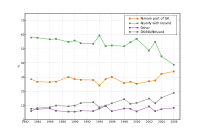
The Guardian
The Guardian, formerly known as The Manchester Guardian , is a British national daily newspaper in the Berliner format...
in 2001 revealed that 26% of Britons supported Northern Ireland remaining a part of the UK, while 41% supported a united Ireland. The British Social Attitudes Survey in 2007 found 32.25% supported Northern Ireland remaining part of the UK, and 40.16% supported Irish reunification. The poll has been run 19 times between 1983 and 2007, with each result being in favour of Irish unity. The highest support came in 1994 with 59.36% of the respondents supporting Irish reunification, while 24.09% supported Northern Ireland remaining in the UK.
Northern Ireland
Opposition to reunification comes mainly from Unionist political parties in Northern Ireland, particularly the Ulster Unionist PartyUlster Unionist Party
The Ulster Unionist Party – sometimes referred to as the Official Unionist Party or, in a historic sense, simply the Unionist Party – is the more moderate of the two main unionist political parties in Northern Ireland...
and the Democratic Unionist Party
Democratic Unionist Party
The Democratic Unionist Party is the larger of the two main unionist political parties in Northern Ireland. Founded by Ian Paisley and currently led by Peter Robinson, it is currently the largest party in the Northern Ireland Assembly and the fourth-largest party in the House of Commons of the...
. It also comes from loyalist paramilitary groups such as the Ulster Defence Association
Ulster Defence Association
The Ulster Defence Association is the largest although not the deadliest loyalist paramilitary and vigilante group in Northern Ireland. It was formed in September 1971 and undertook a campaign of almost twenty-four years during "The Troubles"...
and Ulster Volunteer Force.
Nationalist parties in Northern Ireland support the independence of Northern Ireland (and of Ireland as a whole) from the United Kingdom and all nationalist parties support a united Ireland in some form. Sinn Féin
Sinn Féin
Sinn Féin is a left wing, Irish republican political party in Ireland. The name is Irish for "ourselves" or "we ourselves", although it is frequently mistranslated as "ourselves alone". Originating in the Sinn Féin organisation founded in 1905 by Arthur Griffith, it took its current form in 1970...
is currently the largest nationalist party in the Northern Ireland Assembly
Northern Ireland Assembly
The Northern Ireland Assembly is the devolved legislature of Northern Ireland. It has power to legislate in a wide range of areas that are not explicitly reserved to the Parliament of the United Kingdom, and to appoint the Northern Ireland Executive...
(and the fourth largest in the Republic's Dáil
Dáil Éireann
Dáil Éireann is the lower house, but principal chamber, of the Oireachtas , which also includes the President of Ireland and Seanad Éireann . It is directly elected at least once in every five years under the system of proportional representation by means of the single transferable vote...
). Until recently, it had a policy of violent intervention through the Provisional Irish Republican Army
Provisional Irish Republican Army
The Provisional Irish Republican Army is an Irish republican paramilitary organisation whose aim was to remove Northern Ireland from the United Kingdom and bring about a socialist republic within a united Ireland by force of arms and political persuasion...
but since the mid-90s had adopted a policy of achieving a united Ireland through constitutional means only. It supports integration of political institutions across the island of Ireland. For example, the party has proposed that Northern Ireland should have some form of representation in the Dáil, with elected representatives from either the Northern Ireland Assembly
Northern Ireland Assembly
The Northern Ireland Assembly is the devolved legislature of Northern Ireland. It has power to legislate in a wide range of areas that are not explicitly reserved to the Parliament of the United Kingdom, and to appoint the Northern Ireland Executive...
or the British House of Commons
British House of Commons
The House of Commons is the lower house of the Parliament of the United Kingdom, which also comprises the Sovereign and the House of Lords . Both Commons and Lords meet in the Palace of Westminster. The Commons is a democratically elected body, consisting of 650 members , who are known as Members...
able to participate in debates, if not vote. The major parties in the Republic have rejected this notion on a number of occasions. Should Irish reunification ever occur, Sinn Féin has stated that it would wish to amend the Irish constitution to protect minorities, including the Protestant and Ulster Scots communities.
The Social Democratic and Labour Party
Social Democratic and Labour Party
The Social Democratic and Labour Party is a social-democratic, Irish nationalist political party in Northern Ireland. Its basic party platform advocates Irish reunification, and the further devolution of powers while Northern Ireland remains part of the United Kingdom...
had previously been the largest nationalist party in Northern Ireland, but has suffered in elections since Sinn Féin's abandoned armed politics. As with Sinn Féin, it is committed to achieving a united Ireland. However, throughout its history, it has believed that reunification should be accomplished through constitutional means only. It would support a united Ireland only if a majority of both parts of Ireland voted for it in a referendum. In a united Ireland, the SDLP would support the continuation of a devolved Northern Ireland, governed by a local assembly.
Aside from the major parties, Northern Ireland has several minor Nationalist parties. Among these, some parties are tied to paramilitary organisations and seek the reunification of Ireland through armed politics. These include the Irish Republican Socialist Party
Irish Republican Socialist Party
The Irish Republican Socialist Party or IRSP is a republican socialist party active in Ireland. It claims the legacy of socialist revolutionary James Connolly, who founded the Irish Socialist Republican Party in 1896 and was executed after the Easter Rising of 1916.- History :The Irish Republican...
, which supports a united socialist Irish state and is affiliated with the Irish National Liberation Army
Irish National Liberation Army
The Irish National Liberation Army or INLA is an Irish republican socialist paramilitary group that was formed on 8 December 1974. Its goal is to remove Northern Ireland from the United Kingdom and create a socialist united Ireland....
. Another such party, Republican Sinn Féin
Republican Sinn Féin
Republican Sinn Féin or RSF is an unregisteredAlthough an active movement, RSF is not registered as a political party in either Northern Ireland or the Republic of Ireland. minor political party operating in Ireland. It emerged in 1986 as a result of a split in Sinn Féin...
, linked to the Continuity IRA, does not believe that the Irish government
Irish Government
The Government of Ireland is the cabinet that exercises executive authority in Ireland.-Members of the Government:Membership of the Government is regulated fundamentally by the Constitution of Ireland. The Government is headed by a prime minister called the Taoiseach...
or the Northern Ireland Executive
Northern Ireland Executive
The Northern Ireland Executive is the executive arm of the Northern Ireland Assembly, the devolved legislature for Northern Ireland. It is answerable to the Assembly and was established according to the terms of the Northern Ireland Act 1998, which followed the Good Friday Agreement...
are legitimate as neither legislates for Ireland as a whole. Its Éire Nua (in English, New Ireland) policy advocates a unified federal
Federation
A federation , also known as a federal state, is a type of sovereign state characterized by a union of partially self-governing states or regions united by a central government...
state with regional governments for the four provinces
Provinces of Ireland
Ireland has historically been divided into four provinces: Leinster, Ulster, Munster and Connacht. The Irish word for this territorial division, cúige, literally meaning "fifth part", indicates that there were once five; the fifth province, Meath, was incorporated into Leinster, with parts going to...
and the national capital in Athlone, a town in the geographic centre of Ireland. None of these parties has significant electoral support.
Republic of Ireland
Historically the largest party in the Republic, and the governing party for most of the last 80 years, Fianna FáilFianna Fáil
Fianna Fáil – The Republican Party , more commonly known as Fianna Fáil is a centrist political party in the Republic of Ireland, founded on 23 March 1926. Fianna Fáil's name is traditionally translated into English as Soldiers of Destiny, although a more accurate rendition would be Warriors of Fál...
has supported reunification since its foundation, when it split from Sinn Féin in 1926 in protest at the party's policy of refusal to accept the legitimacy of the partitioned Irish state. However, in its history since, it has differed on how to accomplish it. Fianna Fáil rejected the 1985 Anglo-Irish Agreement
Anglo-Irish Agreement
The Anglo-Irish Agreement was an agreement between the United Kingdom and Ireland which aimed to help bring an end to the Troubles in Northern Ireland...
, which gave the Republic of Ireland an advisory role in Northern Ireland, claimed the agreement was in conflict with the then Articles 2 and 3 of the Constitution of Ireland
Articles 2 and 3 of the Constitution of Ireland
Article 2 and Article 3 of the Constitution of Ireland were adopted with the constitution as a whole on 29 December 1937, but completely revised by means of the Nineteenth Amendment which took effect on 2 December 1999...
because it recognised Northern Ireland as part of the United Kingdom. It later oversaw the removal of these articles from the constitution and today fully supports the Belfast Agreement, which it negotiated in coalition with the Progressive Democrats (see below). On 17 September 2007 Fianna Fáil announced that the party would, for the first time, organise in Northern Ireland. Ahern said that, "it is time now for this Party to play its full role, to take its proper place, in this new politics - in this New Ireland." By 2009 Martin Mansergh
Martin Mansergh
Martin Mansergh is a former Irish Fianna Fáil politician and historian. He was a Teachta Dála for the Tipperary South constituency from May 2007 until his defeat at the general election in February 2011. He was previously a senator from 2002 to 2007.He has played a leading role in formulating...
accepted that a United Ireland was not a major priority.
Historically the second-largest party and, following the 2011 General Election, the largest party in the Dáil Fine Gael
Fine Gael
Fine Gael is a centre-right to centrist political party in the Republic of Ireland. It is the single largest party in Ireland in the Oireachtas, in local government, and in terms of Members of the European Parliament. The party has a membership of over 35,000...
a descendent of the pro-Anglo-Irish Treaty section of Sinn Féin upon the partition of Ireland, has also supported reunification as one of the its key aims since its foundation. It supports the Belfast Agreement and had previously negotiated the Anglo-Irish agreement.
The Labour Party
Labour Party (Ireland)
The Labour Party is a social-democratic political party in the Republic of Ireland. The Labour Party was founded in 1912 in Clonmel, County Tipperary, by James Connolly, James Larkin and William X. O'Brien as the political wing of the Irish Trade Union Congress. Unlike the other main Irish...
, likewise, has also supported reunification since the foundation of the state, although it has always considered this aim secondary to social causes. It also fully supports the Belfast Agreement, and supported the Anglo-Irish agreement. The former President of Ireland, Mary Robinson, resigned from the Irish Labour Party because she objected to the exclusion of unionists from the talks that led to the 1985 agreement.
The now defunct Progressive Democrats
Progressive Democrats
The Progressive Democrats , commonly known as the PDs, was a pro-free market liberal political party in the Republic of Ireland.Launched on 21 December 1985 by Desmond O'Malley and other politicians who had split from Fianna Fáil and Fine Gael, the Progressive Democrats took liberal positions on...
, a liberal party, which split from Fianna Fáil in the mid-1980s, supported reunification since its foundation, but only when a majority of the people of Northern Ireland consent to it. The party fully supported the Belfast Agreement. Former party leader, Mary Harney
Mary Harney
Mary Harney is a former Irish politician. She served as Tánaiste from 1997–2006, Minister for Enterprise, Trade and Employment from 1997–2004, and as Minister for Health and Children from 2004 to 2011...
, was expelled from Fianna Fáil for supporting the Anglo-Irish agreement. The party was one of the key negotiators of the Belfast Agreement.
The Green Party
Green Party (Ireland)
The Green Party is a green political party in Ireland. It was founded as the Ecology Party of Ireland in 1981 by Dublin teacher Christopher Fettes. The party became the Green Alliance in 1983 and in 1987 was renamed to its current title in English...
support the full implementation of the Belfast Agreement
Belfast Agreement
The Good Friday Agreement or Belfast Agreement , sometimes called the Stormont Agreement, was a major political development in the Northern Ireland peace process...
, which takes the possibility of Irish unification into account as the basis of simultaneous referendums on the issue being successful in the Republic and in Northern Ireland. The Green Party are an all-island party, with TDs in the Republic and an MLA in Northern Ireland.
Sinn Féin
Sinn Féin
Sinn Féin is a left wing, Irish republican political party in Ireland. The name is Irish for "ourselves" or "we ourselves", although it is frequently mistranslated as "ourselves alone". Originating in the Sinn Féin organisation founded in 1905 by Arthur Griffith, it took its current form in 1970...
is also an active party in the Republic, where its policies towards a united Ireland are the same as in Northern Ireland.
Great Britain
In Great Britain all major parties support the Belfast AgreementBelfast Agreement
The Good Friday Agreement or Belfast Agreement , sometimes called the Stormont Agreement, was a major political development in the Northern Ireland peace process...
. Right-wing groups tend to be Unionist in outlook. Left-wing and liberal groups have traditionally been more open to a united Ireland.
Historically there has been strong support for a united Ireland within the left of the Labour Party
Labour Party (UK)
The Labour Party is a centre-left democratic socialist party in the United Kingdom. It surpassed the Liberal Party in general elections during the early 1920s, forming minority governments under Ramsay MacDonald in 1924 and 1929-1931. The party was in a wartime coalition from 1940 to 1945, after...
, and in the 1980s it became official policy to support a united Ireland by consent. The policy of "unity by consent" continued into the 1990s, eventually being replaced by a policy of neutrality in line with the Downing Street Declaration
Downing Street Declaration
The Downing Street Declaration was a joint declaration issued on 15 December 1993 by the Prime Minister of the United Kingdom, John Major, and the Taoiseach of the Republic of Ireland, Albert Reynolds at the British Prime Minister office in 10 Downing Street...
.
The Conservative Party
Conservative Party (UK)
The Conservative Party, formally the Conservative and Unionist Party, is a centre-right political party in the United Kingdom that adheres to the philosophies of conservatism and British unionism. It is the largest political party in the UK, and is currently the largest single party in the House...
has traditionally taken a strongly unionist line in relation to the United Kingdom as a whole by opposing nationalism in Scotland and Wales as well as Northern Ireland. Until 1974 they had a parliamentary alliance with the Ulster Unionist Party
Ulster Unionist Party
The Ulster Unionist Party – sometimes referred to as the Official Unionist Party or, in a historic sense, simply the Unionist Party – is the more moderate of the two main unionist political parties in Northern Ireland...
and the two parties retained formal ties until 1985. The Conservatives current position is to "[work] in Northern Ireland to restore stable and accountable government based on all parties accepting the principles of democracy and the rule of law.". The Conservative Party is the only main UK party to contest elections in Northern Ireland.
The Liberal Democrats
Liberal Democrats
The Liberal Democrats are a social liberal political party in the United Kingdom which supports constitutional and electoral reform, progressive taxation, wealth taxation, human rights laws, cultural liberalism, banking reform and civil liberties .The party was formed in 1988 by a merger of the...
have a close relation with the Alliance Party of Northern Ireland
Alliance Party of Northern Ireland
The Alliance Party of Northern Ireland is a liberal and nonsectarian political party in Northern Ireland. It is Northern Ireland's fifth-largest party overall, with eight seats in the Northern Ireland Assembly and one in the House of Commons....
and share their policy of supporting the Belfast Agreement
Belfast Agreement
The Good Friday Agreement or Belfast Agreement , sometimes called the Stormont Agreement, was a major political development in the Northern Ireland peace process...
whilst expressing reservations about what they perceive as its institutionalised sectarianism.
See also
- Repartition of IrelandRepartition of IrelandThe repartition of Ireland has been suggested as a possible solution to the Troubles. It implies that the essential problem was that the partition of Ireland was gerrymandered, and as a result Northern Ireland contains a large Irish nationalist minority...
- PartitionismPartitionismIn Ireland, partitionism refers to views on Irish politics, culture, geography or history that treat Northern Ireland and the Republic of Ireland as distinct. Partitionists may emphasise the perceived differences between the two jurisdictions and the people who live within them...
- Ulster nationalismUlster nationalismUlster nationalism is the name given to a school of thought in Northern Irish politics that seeks the independence of Northern Ireland from the United Kingdom without becoming part of the Republic of Ireland, thereby becoming an independent sovereign state separate from England, Scotland and Wales...
- Scottish independenceScottish independenceScottish independence is a political ambition of political parties, advocacy groups and individuals for Scotland to secede from the United Kingdom and become an independent sovereign state, separate from England, Wales and Northern Ireland....
- Welsh independenceWelsh independenceWelsh independence is a political ideal advocated by some people in Wales that would see Wales secede from the United Kingdom and become an independent sovereign state. This ideology is promoted mainly by the Welsh nationalist party, Plaid Cymru.-History:...
- English independenceEnglish independenceEnglish independence is a political ideal advocated by some English people that England, the largest and most populous country within the United Kingdom, should secede from the UK and become an independent sovereign state, separate from Scotland, Wales and Northern Ireland...
- Cornish nationalism
- Breton nationalismBreton nationalismBreton nationalism is the nationalism of the traditional province of Brittany in France. Brittany is considered to be one of the six Celtic nations...