
Guadalajara is a city and
municipalityA municipality is essentially an urban administrative division having corporate status and usually powers of self-government. It can also be used to mean the governing body of a municipality. A municipality is a general-purpose administrative subdivision, as opposed to a special-purpose district...
in the
autonomous communityAn autonomous community In other languages of Spain:*Catalan/Valencian .*Galician .*Basque . The second article of the constitution recognizes the rights of "nationalities and regions" to self-government and declares the "indissoluble unity of the Spanish nation".Political power in Spain is...
of
Castile-La ManchaCastile-La Mancha is an autonomous community of Spain. Castile-La Mancha is bordered by Castile and León, Madrid, Aragon, Valencia, Murcia, Andalusia, and Extremadura. It is one of the most sparsely populated of Spain's autonomous communities...
,
SpainSpain , officially the Kingdom of Spain languages]] under the European Charter for Regional or Minority Languages. In each of these, Spain's official name is as follows:;;;;;;), is a country and member state of the European Union located in southwestern Europe on the Iberian Peninsula...
, and in the natural region of La Alcarria. It is the capital of the province of Guadalajara. It is located roughly 60 km northeast of
MadridMadrid is the capital and largest city of Spain. The population of the city is roughly 3.3 million and the entire population of the Madrid metropolitan area is calculated to be 6.271 million. It is the third largest city in the European Union, after London and Berlin, and its metropolitan...
on the Henares River, and has a population of 83,789 (2010). Not to be confused with
GuadalajaraGuadalajara may refer to:In Mexico:*Guadalajara, Jalisco, the capital of the state of Jalisco and second largest city in Mexico**Guadalajara Metropolitan Area*University of Guadalajara, a public university in Guadalajara, Jalisco...
of Mexico.
History
Pre-Arab settlements
A Roman town called
Arriaca, possibly founded by a pre-Roman culture, is known to have been located in that region. There is however no archeological proof of its existence, only references in texts such as the
Ruta AntoninaThe Antonine Itinerary is a register of the stations and distances along the various roads of the Roman empire, containing directions how to get from one Roman settlement to another...
, which describe it as being in the hands of the
CarpetaniThe Carpetani were one of the Celtic pre-Roman peoples of the Iberian Peninsula , akin to the Celtiberians, dwelling in the central part of the meseta - the high central upland plain of the Iberian peninsula.-Location:They inhabited since the 5th Century BC the Toledo and Alcaraz highland ranges...
when encountered by the
RomansThe Roman Republic was the period of the ancient Roman civilization where the government operated as a republic. It began with the overthrow of the Roman monarchy, traditionally dated around 508 BC, and its replacement by a government headed by two consuls, elected annually by the citizens and...
. The city, as
Caracca, was incorporated into the Roman province of
Hispania TarraconensisHispania Tarraconensis was one of three Roman provinces in Hispania. It encompassed much of the Mediterranean coast of Spain along with the central plateau. Southern Spain, the region now called Andalusia, was the province of Hispania Baetica...
. The city was on the high road from Emerita (modern
MéridaMérida is the capital of the autonomous community of Extremadura, western central Spain. It has a population of 57,127 . The Archaeological Ensemble of Mérida is a UNESCO World Heritage site since 1993.- Climate :...
) to Caesaraugusta (modern
ZaragozaZaragoza , also called Saragossa in English, is the capital city of the Zaragoza Province and of the autonomous community of Aragon, Spain...
), 22 M. P. northeast of Complutum (modern
Alcalá de HenaresAlcalá de Henares , meaning Citadel on the river Henares, is a Spanish city, whose historical centre is one of UNESCO's World Heritage Sites, and one of the first bishoprics founded in Spain...
).
Arabic foundation
The town of Guadalajara was founded by the
MoorsThe description Moors has referred to several historic and modern populations of the Maghreb region who are predominately of Berber and Arab descent. They came to conquer and rule the Iberian Peninsula for nearly 800 years. At that time they were Muslim, although earlier the people had followed...
in the 8th century. They named it Wadi-al-Hejara (
وادي الحجارة), meaning "Valley of Stones"; in theory the literal translation of the Iberian name (Arriaca), meaning "Stony River".
The history of the town during the
MuslimA Muslim, also spelled Moslem, is an adherent of Islam, a monotheistic, Abrahamic religion based on the Quran, which Muslims consider the verbatim word of God as revealed to prophet Muhammad. "Muslim" is the Arabic term for "submitter" .Muslims believe that God is one and incomparable...
period was significant. They built monuments including the Moorish Bridge over the Henares river, the now ruined old
AlcázarAn alcázar , alcácer or alcàsser is a type of castle in Spain and Portugal. The term derives from the Arabic word القصر meaning "fort, castle or palace"; and the Arabic word is derived from the Latin word, 'castrum', meaning an army camp or fort...
(Arabic for "palace"), and a mosque which later became the former Cathedral of St. Mary.
Christian conquest and Middle Ages
In 1085, Guadalajara was taken by the Christian forces of Alfonso VI (king of Leon and Castile). The chronicles say that the Christian army was led by
Alvar Fanez de MinayaÁlvar Fáñez was a Castilian nobleman and military leader under Alfonso VI of León and Castile, becoming nearly-independent ruler of Toledo under Queen Urraca...
, one of the lieutenants (and according to the legend, nephew) of
El CidRodrigo Díaz de Vivar , known as El Cid Campeador , was a Castilian nobleman, military leader, and diplomat...
. From 1085 until the
Battle of Las Navas de TolosaThe Battle of Las Navas de Tolosa, known in Arab history as the Battle of Al-Uqab , took place on 16 July 1212 and was an important turning point in the Reconquista and in the medieval history of Spain...
in 1212, the city suffered wars against the Almoravid and the
AlmohadThe Almohad Dynasty , was a Moroccan Berber-Muslim dynasty founded in the 12th century that established a Berber state in Tinmel in the Atlas Mountains in roughly 1120.The movement was started by Ibn Tumart in the Masmuda tribe, followed by Abd al-Mu'min al-Gumi between 1130 and his...
Empires. In spite of the wars, the new Christian population could definitely settle down in the area thanks to the repopulation with people from the North (Castilians from the mountains and
MerindadesLocated in the north of the province of Burgos, the Merindades are the birth place of the name "Castilla". Most of the villages of the Merindades were quoted in the "Becerro de Behetrias" at the moment of the creation of the subdivision Merindad by Pedro of Castile.-See also:* Province of Burgos*...
, Basques and
NavarreNavarre , officially the Chartered Community of Navarre is an autonomous community in northern Spain, bordering the Basque Country, La Rioja, and Aragon in Spain and Aquitaine in France...
ses mainly) who received their first
fueroFuero , Furs , Foro and Foru is a Spanish legal term and concept.The word comes from Latin forum, an open space used as market, tribunal and meeting place...
in 1133 from Alfonso VII.
In 1219, the king Fernando III gave a new fuero to the city (the one known as
Fuero Largo or Big Fuero).
During the reign of
Alfonso X of CastileAlfonso X was a Castilian monarch who ruled as the King of Castile, León and Galicia from 1252 until his death...
, the protection of the king allowed the city to develop its economy by protecting merchants and allowing markets.
Renaissance
During the 14th century, the Mendoza family was prominent in Guadalajara. This family included Íñigo López de Mendoza, also known as Marqués de Santillana (1398–1458), and
Pedro González de MendozaPedro González de Mendoza was a Spanish cardinal and statesman.-Biography:He was born at Guadalajara in New Castile, the chief lordship of his family. He was the fourth son of Íñigo López de Mendoza, marqués de Santillana, deceased 1458, and one of the cadet brothers of Diego Hurtado de Mendoza, 1...
(1428–1495), Great Cardinal of Spain and adviser of the
Catholic MonarchsThe Catholic Monarchs is the collective title used in history for Queen Isabella I of Castile and King Ferdinand II of Aragon. They were both from the House of Trastámara and were second cousins, being both descended from John I of Castile; they were given a papal dispensation to deal with...
. The Mendoza family held the title of Dukes and Duchesses of El Infantado from 1475. In 1460, King
Henry IVHenry IV , King of the Crown of Castile, nicknamed the Impotent , was the last of the weak late medieval kings of Castile...
gave Guadalajara the title of 'City' and other privileges like the Cortes.
During the
War of the Spanish SuccessionThe War of the Spanish Succession was fought among several European powers, including a divided Spain, over the possible unification of the Kingdoms of Spain and France under one Bourbon monarch. As France and Spain were among the most powerful states of Europe, such a unification would have...
, Guadalajara was sacked.
King Philip VPhilip V was King of Spain from 15 November 1700 to 15 January 1724, when he abdicated in favor of his son Louis, and from 6 September 1724, when he assumed the throne again upon his son's death, to his death.Before his reign, Philip occupied an exalted place in the royal family of France as a...
ordered the establishment of the Real Fábrica de Paños (Royal Factory of Clothes) which was situated in the Alcazar till the early 19th Century.
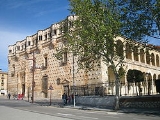
In this period, the Mendoza Family ordered the building of El Palacio del Infantado as their main residence. It was completed in the early 1480s and it is considered by many the oldest surviving building built in a pure Renissance style outside Italy.
Contemporary times
The 19th century started with two major setbacks: the damages caused by the
Peninsular WarThe Peninsular War was a war between France and the allied powers of Spain, the United Kingdom, and Portugal for control of the Iberian Peninsula during the Napoleonic Wars. The war began when French and Spanish armies crossed Spain and invaded Portugal in 1807. Then, in 1808, France turned on its...
(1808–1814) and the closing of the Real Fábrica de Paños in 1822. In 1808, Guadalajara was taken by the
French ArmyThe French Army, officially the Armée de Terre , is the land-based and largest component of the French Armed Forces.As of 2010, the army employs 123,100 regulars, 18,350 part-time reservists and 7,700 Legionnaires. All soldiers are professionals, following the suspension of conscription, voted in...
led by General Hugo and the city was destroyed.
In 1840 Guadalajara was established as capital of the province with the same name by the Plan de Burgos. The Academy of Military Engineers was brought to the city. The development during the second half of the 19th Century till the first quarter of the 20th century was slow and centred on the developing of the administration without any special interest on industrial development.
After the
Spanish Civil WarThe Spanish Civil WarAlso known as The Crusade among Nationalists, the Fourth Carlist War among Carlists, and The Rebellion or Uprising among Republicans. was a major conflict fought in Spain from 17 July 1936 to 1 April 1939...
(1936–1939), that led to great damage to the city, Guadalajara was included in 1959 in the development plans addressing the congestion of Madrid's industrial estates (
El Plan de Descongestión Industrial de Madrid en Castilla-La Mancha). These plans attempted to move industrial and accompanying residential growth to the periphery, resulting in increased industry presence in Guadalajara. Since then, Guadalajara has been one of the cities in Spain with greatest relative growth.
The José Cabrera Nuclear Power Station (better known as
ZoritaAlmonacid de Zorita is a municipality located in the province of Guadalajara, Castile-La Mancha, Spain. According to the 2004 census , the municipality has a population of 826 inhabitants....
) was the first nuclear generator in Spain, and constructed within the area, situated beside the river Tajo . The installation was run by
Unión FenosaUnión Fenosa, S.A., is a large Spanish company dedicated to the production and distribution to end users of gas and electricity. It has installed capacity of 11,120 megawatts of power and 8.9 million customers. The headquarters are in Madrid and the chairman is Pedro López Jiménez...
, and the site is now owned by its successor
Gas NaturalGas Natural SDG, S.A., trading as Gas Natural Fenosa, is an energy company which operates primarily in Spain but also in such countries as Italy, Mexico, Colombia, Argentina, Puerto Rico and Morocco...
.The government of Spain closed its operations via a resolution of 20 April 2006, and it was subsequently disconnected from the electrical grid.
Nowadays, Guadalajara is involved in urban development plans that are quickly increasing the population of the city. New districts like Aguas Vivas (Live Waters) have recently been inaugurated.
Ciudad Valdeluz was planned to increase the number of inhabitants of Guadalajara by 30,000, creating a whole brand new city around the
AVEAlta Velocidad Española is a service of high-speed rail in Spain operated by Renfe, the Spanish national railway company, at speeds of up to . The name is literally translated from Spanish as "Spanish High Speed", but also a play on the word , meaning "bird".AVE trains run on a network of...
Station (Spanish High-Speed Trains). Unfortunately the company investing in the construction of Ciudad Valdeluz went bankrupt. Less than 500 inhabitants decided to occupy their flats and the remaining infrastructure is currently in slow degradation. The AVE trains are used by only 60 passengers a day.
The recent town-plannings have dramatically increased the cost of the new houses, changing in the last 10 years of being one of the cheapest provinces in Spain for house-buying to be the 3rd province in Spain with most expensive square meter.
Mayoralty
Since the 2003 local election, the Town Hall is controlled by a coalition made up of
Spanish Socialist Workers' PartyThe Spanish Socialist Workers' Party is a social-democratic political party in Spain. Its political position is Centre-left. The PSOE is the former ruling party of Spain, until beaten in the elections of November 2011 and the second oldest, exceeded only by the Partido Carlista, founded in...
(PSOE) members and also one IU town councilor. J. Alique (PSOE) has held the post of Mayor since then. Following the 2007 local elections Antonio Román (
People's PartyThe People's Party is a conservative political party in Spain.The People's Party was a re-foundation in 1989 of the People's Alliance , a party led and founded by Manuel Fraga Iribarne, a former Minister of Tourism during Francisco Franco's dictatorship...
) replaced Alique in the mayoralty.
Main sights
The bridge across the Henares river is Arab but built on Roman foundations. It has several historic buildings such as the Palacio del Infantado, as well as many churches, such as
the church of San GinésSan Ginés is a church in Guadalajara, Spain....
. Although Guadalajara is the biggest city in its diocese, the cathedral is located in the nearby town of Sigüenza. However, in Guadalajara, there is a "co-cathedral": the church of Saint Mary, in Mudejar style. Very close to this church, is placed the chapel known as "Capilla de Luis de Lucena", which has several fresco paintings on its walls and ceiling.
Miscellaneous
The
MexicanThe United Mexican States , commonly known as Mexico , is a federal constitutional republic in North America. It is bordered on the north by the United States; on the south and west by the Pacific Ocean; on the southeast by Guatemala, Belize, and the Caribbean Sea; and on the east by the Gulf of...
city of
Guadalajara, JaliscoGuadalajara is the capital of the Mexican state of Jalisco, and the seat of the municipality of Guadalajara. The city is located in the central region of Jalisco in the western-pacific area of Mexico. With a population of 1,564,514 it is Mexico's second most populous municipality...
, was founded by
Nuño Beltrán de GuzmánNuño Beltrán de Guzmán or sometimes Nuño de Guzmán was a Spanish conquistador and colonial administrator in New Spain. He was Governor of the province of Pánuco from 1525–1533, and of Nueva Galicia from 1529–1534, President of the first Audiencia from 1528-30. He founded several cities in...
, a native of the Spanish Guadalajara.
The Coat of Arms of Guadalajara represents Alvar Fanez de Minaya entering in the town at night during the conquest.
Distinguished people from or related to the town were:
- Alvar Fanez de Minaya
Álvar Fáñez was a Castilian nobleman and military leader under Alfonso VI of León and Castile, becoming nearly-independent ruler of Toledo under Queen Urraca...
, "Conqueror of Guadalajara for the Christianity".
- Nuño Beltrán de Guzmán
Nuño Beltrán de Guzmán or sometimes Nuño de Guzmán was a Spanish conquistador and colonial administrator in New Spain. He was Governor of the province of Pánuco from 1525–1533, and of Nueva Galicia from 1529–1534, President of the first Audiencia from 1528-30. He founded several cities in...
, founder of Guadalajara in Mexico.
- Antonio Buero Vallejo
Antonio Buero Vallejo was a Spanish playwright considered the most important Spanish dramatist of the Spanish Civil War...
, 20th century writer.
- María Diega Desmaissières y Sevillano, Countess of Vega del Pozo and Duchess of Sevillano.
- Francisco Fernández Iparraguirre, pharmacist, linguist and botanist
- José Ortiz-Echagüe, militar engineer and photographer
- Jose de Creeft
José De Creeft was a Spanish-born American sculptor and teacher.-Life and work:...
, famous sculptor born in Guadalajara
Twin towns — sister cities
Guadalajara is
twinnedTwin towns and sister cities are two of many terms used to describe the cooperative agreements between towns, cities, and even counties in geographically and politically distinct areas to promote cultural and commercial ties.- Terminology :...
with:
Guadalajara,
MexicoThe United Mexican States , commonly known as Mexico , is a federal constitutional republic in North America. It is bordered on the north by the United States; on the south and west by the Pacific Ocean; on the southeast by Guatemala, Belize, and the Caribbean Sea; and on the east by the Gulf of...
GuadalajaraBuga formally Guadalajara de Buga is a city and municipality in the Valle del Cauca department of Colombia. It is famous for its Basilica del Señor de los Milagros, which houses an image of Christ called El Señor de los Milagros .-History:Guadalajara de Buga is one of the oldest cities in...
,
ColombiaColombia, officially the Republic of Colombia , is a unitary constitutional republic comprising thirty-two departments. The country is located in northwestern South America, bordered to the east by Venezuela and Brazil; to the south by Ecuador and Peru; to the north by the Caribbean Sea; to the...
LivornoLivorno , traditionally Leghorn , is a port city on the Tyrrhenian Sea on the western edge of Tuscany, Italy. It is the capital of the Province of Livorno, having a population of approximately 160,000 residents in 2009.- History :...
,
ItalyItaly , officially the Italian Republic languages]] under the European Charter for Regional or Minority Languages. In each of these, Italy's official name is as follows:;;;;;;;;), is a unitary parliamentary republic in South-Central Europe. To the north it borders France, Switzerland, Austria and...
NitraNitra is a city in western Slovakia, situated at the foot of Zobor Mountain in the valley of the river Nitra. With a population of about 83,572, it is the fifth largest city in Slovakia. Nitra is also one of the oldest cities in Slovakia and the country's earliest political and cultural center...
,
SlovakiaThe Slovak Republic is a landlocked state in Central Europe. It has a population of over five million and an area of about . Slovakia is bordered by the Czech Republic and Austria to the west, Poland to the north, Ukraine to the east and Hungary to the south...
NuneatonNuneaton is the largest town in the Borough of Nuneaton and Bedworth and in the English county of Warwickshire.Nuneaton is most famous for its associations with the 19th century author George Eliot, who was born on a farm on the Arbury Estate just outside Nuneaton in 1819 and lived in the town for...
,
United KingdomThe United Kingdom of Great Britain and Northern IrelandIn the United Kingdom and Dependencies, other languages have been officially recognised as legitimate autochthonous languages under the European Charter for Regional or Minority Languages...
ParmaParma is a city in the Italian region of Emilia-Romagna famous for its ham, its cheese, its architecture and the fine countryside around it. This is the home of the University of Parma, one of the oldest universities in the world....
,
ItalyItaly , officially the Italian Republic languages]] under the European Charter for Regional or Minority Languages. In each of these, Italy's official name is as follows:;;;;;;;;), is a unitary parliamentary republic in South-Central Europe. To the north it borders France, Switzerland, Austria and...
RoanneRoanne is a commune in the Loire department in central France.It is located northwest of Lyon on the Loire River.-Economy:...
,
FranceThe French Republic , The French Republic , The French Republic , (commonly known as France , is a unitary semi-presidential republic in Western Europe with several overseas territories and islands located on other continents and in the Indian, Pacific, and Atlantic oceans. Metropolitan France...
Climate
Guadalajara enjoys a
Mediterranean climateA Mediterranean climate is the climate typical of most of the lands in the Mediterranean Basin, and is a particular variety of subtropical climate...
however, during winter months, cold temperatures often prevail. This can be accountable due to its inland location and high elevation meaning a less pronounced moderated influence from the sea.
See also
- Battle of Guadalajara
The Battle of Guadalajara saw the Republican People's Army defeat Italian and Nationalist forces attempting to encircle Madrid during the Spanish Civil War...
- CD Guadalajara (Spain), city football club
- Guadalajara (province)
Guadalajara is a province of central/north-central Spain, in the northern part of the autonomous community of Castile-La Mancha. It is bordered by the provinces of Cuenca, Madrid, Segovia, Soria, Zaragoza, and Teruel...
External links