

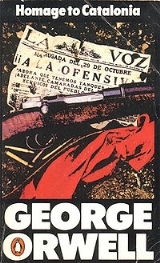
Homage to Catalonia

Encyclopedia
Homage to Catalonia is political journalist
and novelist George Orwell
's personal account of his experiences and observations in the Spanish Civil War
. The first edition was published in 1938. The book was not published in the United States until February 1952. The American edition had a preface written by Lionel Trilling
. The only translation published in Orwell's lifetime was into Italian, in December 1948.
A French translation made by Yvonne Davet – with whom Orwell corresponded, commenting on her translation and providing explicatory notes – in 1938-39, was not published until five years after Orwell's death.
Christopher Hitchens
: "The narrative core of Homage to Catalonia, it might be argued, is a series of events that occurred in and around the Barcelona telephone exchange in early May 1937. Orwell was a witness to these events, by the relative accident of his having signed up with the militia of the anti-Stalinist POUM upon arriving in Spain [-] he became convinced that he had been the spectator of a full-blown Stalinist putsch [-] Moreover, he came to understand that much of the talk about discipline and unity was a rhetorical shield for the covert Stalinization of the Spanish Republic
."
 Orwell served as a private, a corporal, or cabo and—when the informal command structure of the militia gave way to a conventional hierarchy in May 1937—as a lieutenant, on a provisional basis, in Catalonia
and Aragon
from December 1936 until June 1937. In June 1937 the leftist political party with whose militia he served (the POUM
, the Workers' Party of Marxist Unification, an anti-Stalinist communist party) was declared an illegal organization and Orwell was subsequently forced to flee or face imprisonment. Having arrived in Barcelona on 26 December 1936 he told John McNair, the Independent Labour Party
's representative there, that he had "come to Spain to join the militia to fight against Fascism." He also told McNair that "he would like to write about the situation and endeavour to stir working class opinion in Britain and France." McNair took him to the POUM barracks, where Orwell immediately enlisted. "Orwell did not know that two months before he arrived in Spain, the NKVD
's resident in Spain, Aleksandr Orlov, had assured NKVD Headquarters, 'the Trotskyist organisation POUM can easily be liquidated' - by those, the Communists, whom Orwell took to be allies in the fight against Franco
."
By his own admission Orwell joined the POUM, rather than the far larger Soviet supported Communist-run International Brigades
somewhat by chance. Orwell had been told that he would not be permitted to enter Spain without some supporting documents from a British left-wing organisation and he had first sought the assistance of the British Communist Party and put his request directly to its leader, Harry Pollitt
. Pollitt "seems to have taken an immediate dislike to him...and soon concluded that his visitor was 'politically unreliable.'" Orwell had then telephoned the headquarters of the ILP (Independent Labour Party), and its officials agreed to help him. The party was willing to accredit him as a correspondent for the New Leader
, the ILP's weekly paper with which he was familiar, and thus provided the means for him to go legitimately to Spain.The ILP
issued him a letter of introduction to their representative in Barcelona. The party was affiliated with the independent socialist group, the POUM. Orwell's experiences, culminating in his and his wife's narrow escape from the Communist purges in Barcelona in June 1937, greatly increased his sympathy for the POUM and, while not challenging his moral and political adhesion to the cause of Socialism, made him a lifelong anti-Stalinist.
Orwell served on the Aragon front for a hundred and fifteen days. It was not until the end of April 1937 that he was granted leave and was able to see Barcelona again. His wife Eileen wrote on 1 May that she found him, 'a little lousy, dark brown, and looking really very well.' At this point he was convinced that he would have the chance to see more action if he joined the International Brigade and fought with it on the Madrid front; his attitude was still one of exasperation in the face of the rivalries between the various factions. This, "changed dramatically in the first week of May when he found himself and his comrades under fire not from the fascist enemy but from their left-wing 'allies'" in the fighting that followed the government effort to take control of the Telephone Exchange.
On 17 May 1937, Largo Caballero resigned. Juan Negrín, the next prime minister, left the "NKVD-controlled secret police unhindered in its persecution of persons who opposed the Moscow line. On 16 June, when the POUM was declared illegal, the Communists turned its headquarters in Barcelona into a prison for 'Trotskyists'... leaders were handed over to NKVD operatives and taken to a secret prison in Madrid... Andrés Nin
taken to Alcalá de Henares, where he was interrogated from 18 to 21 June... he was then moved to a summer house outside the city which belonged to the wife of Hidalgo de Cisneros and tortured to death..." Diego Abad de Santillan
remarked; "Whether Juan Negrín
won with his communist cohorts, or Franco won with his Italians and Germans, the results would be the same for us."
At the front, Orwell was shot through the throat by a sniper on 20 May 1937 and nearly killed. He wrote in Homage to Catalonia that people frequently told him a man who is hit through the neck and survives it is the luckiest creature alive, but that he personally thought "it would be even luckier not to be hit at all." After dressing at a first aid post about half a mile from the front line, he was transferred to Barbastro
and then to Lérida where he received only an external treatment of his wound. On the 27th he was transferred to Tarragona
and on the 29th May to Barcelona. On 23 June 1937 Orwell and his wife Eileen
, with John McNair and Stafford Cottman, boarded the morning train from Barcelona to Paris. They safely crossed into France. Sir Richard Rees later wrote that the strain of her experience in Barcelona showed clearly on Eileen's face: "In Eileen Blair I had seen for the first time the symptoms of a human being living under a political terror."
George Orwell and Eileen returned to England. After nine months of animal husbandry and writing up Homage to Catalonia at their cottage at Wallington, Hertfordshire
, Orwell's health declined and he had to spend several months at a sanatorium in Aylesford, Kent.
Because of the book's criticism of the Communists in Spain, it was rejected by Gollancz
, who had previously published all Orwell's books: "Gollancz is of course part of the Communism-racket", Orwell wrote to Rayner Heppenstall
in July 1937. Orwell finally found a sympathetic publisher in Frederic Warburg. Warburg was willing to publish books by the dissident left, that is, by socialists hostile to Stalinism.
The book was finally published in April 1938 but "made virtually no impact whatsoever and by the outbreak of war with Germany had sold only 900 copies." According to John Newsinger
, "the Communist vendetta against the book" was ongoing as recently as 1984, when Lawrence and Wishart
published Inside the Myth, a collection of essays "bringing together a variety of standpoints hostile to Orwell in an obvious attempt to do as much damage to his reputation as possible."
accounts of the political situation in Spain, and Orwell felt these were out of place in the midst of the narrative.
as it appears to him at this time. "The anarchists were still in virtual control of Catalonia
and the revolution was still in full swing..It was the first time that I had ever been in a town where the working class was in the saddle... every wall was scrawled with the hammer and sickle
... every shop and café had an inscription saying that it had been collectivized." "The Anarchists
" (referring to the Spanish CNT
and FAI
) were "in control", tipping
was prohibited by workers themselves, and servile forms of speech, such as "Señor" or "Don", were abandoned. He goes on to describe the scene at the Lenin
Barracks (formerly the Lepanto
Barracks) where militiamen were given "what was comically called 'instruction'" in preparation for fighting at the front.
He describes the deficiencies of the POUM workers' militia, the absence of weapons, the recruits mostly boys of sixteen or seventeen ignorant of the meaning of war, half-complains about the sometimes frustrating tendency of Spaniards to put things off until "mañana" (tomorrow), notes his struggles with Spanish (or more usually, the local use of Catalan
). He praises the generosity of the Catalan working class. Orwell leads to the next chapter by describing the "conquering-hero stuff" — parades through the streets and cheering crowds—that the militiamen experienced at the time he was sent to the Aragón front.
, just behind the line fronting Zaragoza. He sketches the squalor of the region's villages and the "Fascist
deserters" indistinguishable from themselves. On the third day rifles are handed out. Orwell's "was a German Mauser
dated 1896.... It was rusty, the bolt was stiff, the wooden barrel-guard was split; one glance down the muzzle showed that it was corroded and past praying for." The chapter ends on his centuria
's arrival at trenches near Zaragoza
and the first time a bullet nearly hit him. To his dismay, instinct made him duck.
", the mundaneness of a situation in which, "each army had dug itself in and settled down on the hill-tops it had won." He praises the Spanish militia
s for their relative social equality
, for their holding of the front while the army was trained in the rear, and for the "democratic 'revolutionary' type of discipline", - "more reliable than might be expected." "'Revolutionary' discipline depends on political consciousness—on an understanding of why orders must be obeyed; it takes time to diffuse this, but it also takes time to drill a man into an automaton on the barrack-square." Throughout the chapter Orwell describes the various shortages and problems at the front—firewood — "We were between two and three thousand feet above sea-level, it was mid winter and the cold was unspeakable" - food, candles, tobacco, and adequate munitions—as well as the danger of accidents inherent in a badly trained and poorly armed group of soldiers.
to a position at Monte Oscuro, within sight of Zaragoza. "Perhaps the best of the bunch was Bob Smillie — the grandson of the famous miners' leader
— who afterwards died such an evil and meaningless death in Valencia. In this new position he witnesses the sometimes propagandistic
shouting between the Fascist and Socialist trenches and hears of the fall of Málaga
. "... every man in the militia believed that the loss of Malaga was due to treachery. It was the first talk I had heard of treachery or divided aims. It set up in my mind the first vague doubts about this war in which, hitherto, the rights and wrongs had seemed so beautifully simple." In February, he is sent with the other POUM militiamen 50 miles to make a part of the army besieging Huesca
; he mentions the running joke phrase, "Tomorrow we'll have coffee in Huesca", attributed to a general commanding the Government troops who, months earlier, made one of many failed assaults on the town.
for ten days at the end of March 1937 with a poisoned hand that had to be lanced and put in a sling. He describes rats
that "really were as big as cats, or nearly" (in his famous Nineteen Eighty-Four
, Orwell's character Winston Smith
has a phobia of rats that Orwell himself shared to some degree). He makes reference to the lack of "religious feeling, in the orthodox sense", and that the Roman Catholic Church
, was, "to the Spanish people, at any rate in Catalonia and Aragon, a racket, pure and simple." He muses that Christianity may have, to some extent, been replaced by Anarchism
. The latter portion of the chapter briefly details various operations in which Orwell took part: silently advancing the Loyalist frontline by night, for example.
road". It is described herein. Orwell notes the offensive of that night where his group of fifteen captured a Fascist position, but then retreated to their lines with captured rifles and ammunition. The diversion was successful in drawing troops from the Anarchist attack.
, so that he could go to the Madrid front. The latter half of this chapter is devoted to describing the conflict between the anarchist CNT and the socialist Unión General de Trabajadores
(UGT) and the resulting cancellation of the May Day
demonstration and the build-up to the street fighting of the Barcelona May Days
. "It was the antagonism between those who wished the revolution to go forward and those who wished to check or prevent it — ultimately, between Anarchists and Communists."
tried to take the Telephone Exchange from the CNT workers who controlled it. For his part, Orwell acted as part of the POUM, guarding a POUM-controlled building. Although he realises that he is fighting on the side of the working class, Orwell describes his dismay at coming back to Barcelona on leave from the front only to get mixed up in street fighting. Assault Guards from Valencia arrive - "All of them were armed with brand-new rifles..vastly better than the dreadful old blunderbuss
es we had at the front." The P.S.U.C. papers declare POUM to be a disguised Fascist organization - "No one who was in Barcelona then..will forget the horrible atmosphere produced by fear, suspicion, hatred, censored newspapers, crammed jails, enormous food queues, and prowling gangs...." In his second appendix to the book, Orwell discusses the political issues at stake in the May 1937 Barcelona fighting, as he saw them at the time and later on, looking back.
might turn out. Orwell predicts that the "tendency of the post-war Government... is bound to be Fascistic." He returns to the front, where he is shot through the throat by a sniper, an injury that takes him out of the war. After spending some time in a hospital in Lleida
, he was moved to Tarragona
where his wound was finally examined more than a week after he'd left the front.
, Barbastro
, and Monzón
while getting his discharge papers stamped, after being declared medically unfit. He returns to Barcelona only to find that the POUM had been "suppressed": it had been declared illegal the very day he had left to obtain discharge papers and POUM members were being arrested without charge. "The attack on Huesca
was beginning... there must have been numbers of men who were killed without ever learning that the newspapers in the rear were calling them Fascists. This kind of thing is a little difficult to forgive." He sleeps that night in the ruins of a church; he cannot go back to his hotel because of the danger of arrest.
, unit commander of the ILP Contingent
while Kopp was held in a Spanish makeshift jail, - "really the ground floor of a shop". Having done all he could to free Kopp, ineffectively and at great personal risk, Orwell decides to leave Spain. Crossing the Pyrenees
frontier, he and his wife arrived in France "without incident".
(PSUC — entirely under Communist control and affiliated to the Third International), the anarchists, and the POUM, are considered.
in early May 1937. This was between anarchists and POUM members, against Communist/government forces which sparked off when local police forces occupied the Telephone Exchange, which had until then been under the control of CNT workers. He relates the suppression of the P.O.U.M. on 15–16 June 1937, gives examples of the Communist Press of the world – (Daily Worker
, 21 June, "SPANISH TROTSKYISTS PLOT WITH FRANCO"), indicates that Indalecio Prieto
hinted, "fairly broadly... that the government could not afford to offend the Communist Party while the Russians were supplying arms." He quotes Julián Zugazagoitia, the Minister of the Interior; "We have received aid from Russia and have had to permit certain actions which we did not like."
(In a letter he wrote in August 1938, protesting against the treatment of a number of members of the Executive Committee of the POUM, shortly to be put on trial on the charge of espionage in the Fascist cause, Orwell repeats these words of Zugazagoitia. An editorial note on the letter adds: "During a cabinet meeting, 'Zugazagoitia demanded if his jurisdiction as Minister of the Interior were to be limited by Russian policemen', according to Thomas. ( Hugh Thomas The Spanish Civil War 704) 'Had they been able to purchase and transport good arms from US, British, and French manufacturers, the socialist and republican members of the Spanish government might have tried to cut themselves loose from Stalin
.')
in Time and Tide
, and from Philip Mairet
in the New English Weekly
. Geoffrey Gorer concluded, 'Politically and as literature it is a work of first-class importance.' Philip Mairet observed, 'It shows us the heart of innocence that lies in revolution; also the miasma of lying that, far more than the cruelty, takes the heart out of it.' Hostile notices came from the Tablet, where a Catholic critic wondered why Orwell had not troubled to get to know Fascist fighters and enquire about their motivations, and from the Times Literary Supplement
and The Listener
, from obvious Communists, the first misrepresenting what Orwell had said and the latter attacking the POUM but never mentioning the book. John Langdon-Davies
wrote in the Communist Party's Daily Worker
that "the value of the book is that it gives an honest picture of the sort of mentality that toys with revolutionary romanticism but shies violently at revolutionary discipline. It should be read as a warning." Some Conservative and Catholic opponents of the Spanish Republic
felt vindicated by Orwell's attack on the role of the Communists in Spain; The Spectator
s review concluded that this "dismal record of intrigue, injustice, incompetence, quarrelling, lying communist propaganda, police spying, illegal imprisonment, filth and disorder", was evidence that the Republic deserved to fall. A mixed review was supplied by V.S. Pritchett who called Orwell naïve about Spain but added that, 'no one excels him in bringing to the eyes, ears and nostrils the nasty ingredients of fevered situations; and I would recommend him warmly to all who are concerned about the realities of personal experience in a muddled cause.' Franz Borkenau
, in a letter to Orwell of June 1938, called the book, together with his own Spanish Cockpit, a complete "picture of the revolutionary phase of the Spanish War."
According to Raymond Carr
: "The Spanish Civil war produced a spate of bad literature. Homage to Catalonia is one of the few exceptions and the reason is simple. Orwell was determined to set down the truth as he saw it. This was something that many writers of the Left in 1936-39 could not bring themselves to do. Orwell comes back time and time again in his writings on Spain to those political conditions in the late thirties which fostered intellectual dishonesty: the subservience of the intellectuals of the European Left to the Communist 'line', especially in the case of the Popular Front in Spain where, in his view, the party line could not conceivably be supported by an honest man. Only a few strong souls, Victor Serge
and Orwell among them, could summon up the courage to fight the whole tone of the literary establishment and the influence of Communists within it. Arthur Koestler
quoted to an audience of Communist sympathizers Thomas Mann
's phrase, 'In the long run a harmful truth is better than a useful lie'. The non-Communists applauded; the Communists and their sympathizers remained icily silent.... It is precisely the immediacy of Orwell's reaction that gives the early sections of Homage its value for the historian. Kaminski, Borkenau
, Koestler came with a fixed framework, the ready-made contacts of journalist intellectuals. Orwell came with his eyes alone."
After years of neglect Homage to Catalonia re-emerged in the 1950s, following on from the success of Orwell's later books. The publication in 1952 of the first US edition (by Harcourt, Brace, of New York) with an influential introduction by Lionel Trilling, " elevated Orwell to the rank of a secular saint". Another twist arrived in the late 1960s when the book "found new readers in an age of student radicalism and guerrilla struggle - Orwell being seen as an early Che Guevara
and [the book] now appeared to offer a premonition of the Soviet suppression of the 1968 Prague Spring
." The book was praised by Noam Chomsky
. Its popularity has continued, notably with Ken Loach
's heavily Orwell-influenced film Land and Freedom
. Republished by Penguin Books
in Britain in 1962, it has never been out of print since, and remains far better known than Franz Borkenau's The Spanish Cockpit, a book Orwell himself had called, in July 1937, "the best book yet written on the subject" of the Spanish war.
, "his scintillating 1944 satire
on Stalinism" would be part of his response to the Spanish betrayal. "He had learned a hard lesson,especially about the new political Europe. Totalitarianism, the new creed of 'the streamlined men' of Fascism and Communism, was a new manifestation of Orwell's old Catholic enemy, the doctrine of Absolutism
" - "the ghost of Torquemada
had arisen, imprisonment without trial, confessions extracted under torture with summary executions to follow." "The essential fact about a totalitarian regime is that it has no laws. People are not punished for specific offences, but because they are considered to be politically or intellectually undesirable. What they have done or not done is irrelevant." (Even after Hitler had repudiated his non-aggression pact with Stalin by launching Operation Barbarossa
and most left wing intellectuals were to "laud the virtues of the Soviet Union at the tops of their voices [and] even on the right, keeping Uncle Joe
sweet was regarded as mandatory - Orwell went on insisting that the Soviet regime was a tyranny. Even as the Red Army
battled the Panzers to a standstill on the outskirts of Moscow. At this distance, it is hard to imagine what a lonely line this was to take. But when it came to a principle Orwell was the sort of man who would rather shiver in solitude than hold his tongue.")
Apart from the betrayal of the POUMists, the terror and the murder of Nin and Smillie, Orwell had been depressed by the attitude of the British press. "In Spain..I saw newspaper reports which did not bear any relation to the facts..I saw, in fact, history being written not in terms of what happened but of what ought to have happened according to various party lines." "He was appalled at the treatment of the May days as a 'Trotskyist Revolt' in papers like the News Chronicle
which simply swallowed uncritically the Communist line; or Ralph Bates
report in The New Republic
that POUM militiamen were playing football with Fascist troops.... Given this supresio vero by interested parties, how could true history be written? Propaganda would pass as truth; 'facts' could be manipulated. Those who monopolized communication could create their own history after the event—the nightmare of Nineteen Eighty-Four
." Orwell attacked sections of the left wing press for suppressing the truth about Spain, indicting the Communists for instigating a 'reign of terror'; and he never forgave Kingsley Martin
, the editor of the New Statesman
who turned down his articles on the Spanish Civil War on the grounds that they 'could cause trouble'. Malcolm Muggeridge
remembered : "Once when we were lunching at a Greek restaurant in Percy Street he asked me if I would mind changing places. I readily agreed but asked him why. He said that he just couldn't bear to look at Kingsley Martin's corrupt face, which, as Kingsley was lunching at an adjoining table, was unavoidable from where he had been sitting before." "Ten years ago it was almost impossible to get anything printed in favour of Communism; today it is almost impossible to get anything printed in favour of Anarchism
or "Trotskyism"," Orwell wrote bitterly in 1938.
Yet Orwell "had felt what socialism could be like" and unlike the writer John Dos Passos
for example, "who also had a friend killed in custody by the SIM (Servicio Investigación Militar/Spanish Secret Police) in Spain, and reacted by deserting the Communists and shifting decidedly to the right, Orwell never did abandon his socialism: if anything, his Spanish experience strengthened it." "At last I really believe in Socialism which I never did before." (George Orwell, Letter to Cyril Connolly
, 8 June 1937). A decade later he wrote: "Every line of serious work that I have written since 1936 has been written, directly or indirectly, against totalitarianism and for democratic Socialism, as I understand it."
Political journalism
Political journalism is a broad branch of journalism that includes coverage of all aspects of politics and political science, although the term usually refers specifically to coverage of civil governments and political power....
and novelist George Orwell
George Orwell
Eric Arthur Blair , better known by his pen name George Orwell, was an English author and journalist...
's personal account of his experiences and observations in the Spanish Civil War
Spanish Civil War
The Spanish Civil WarAlso known as The Crusade among Nationalists, the Fourth Carlist War among Carlists, and The Rebellion or Uprising among Republicans. was a major conflict fought in Spain from 17 July 1936 to 1 April 1939...
. The first edition was published in 1938. The book was not published in the United States until February 1952. The American edition had a preface written by Lionel Trilling
Lionel Trilling
Lionel Trilling was an American literary critic, author, and teacher. With wife Diana Trilling, he was a member of the New York Intellectuals and contributor to the Partisan Review. Although he did not establish a school of literary criticism, he is one of the leading U.S...
. The only translation published in Orwell's lifetime was into Italian, in December 1948.
A French translation made by Yvonne Davet – with whom Orwell corresponded, commenting on her translation and providing explicatory notes – in 1938-39, was not published until five years after Orwell's death.
Christopher Hitchens
Christopher Hitchens
Christopher Eric Hitchens is an Anglo-American author and journalist whose books, essays, and journalistic career span more than four decades. He has been a columnist and literary critic at The Atlantic, Vanity Fair, Slate, World Affairs, The Nation, Free Inquiry, and became a media fellow at the...
: "The narrative core of Homage to Catalonia, it might be argued, is a series of events that occurred in and around the Barcelona telephone exchange in early May 1937. Orwell was a witness to these events, by the relative accident of his having signed up with the militia of the anti-Stalinist POUM upon arriving in Spain [-] he became convinced that he had been the spectator of a full-blown Stalinist putsch [-] Moreover, he came to understand that much of the talk about discipline and unity was a rhetorical shield for the covert Stalinization of the Spanish Republic
Second Spanish Republic
The Second Spanish Republic was the government of Spain between April 14 1931, and its destruction by a military rebellion, led by General Francisco Franco....
."
Overview
Catalonia
Catalonia is an autonomous community in northeastern Spain, with the official status of a "nationality" of Spain. Catalonia comprises four provinces: Barcelona, Girona, Lleida, and Tarragona. Its capital and largest city is Barcelona. Catalonia covers an area of 32,114 km² and has an...
and Aragon
Aragon
Aragon is a modern autonomous community in Spain, coextensive with the medieval Kingdom of Aragon. Located in northeastern Spain, the Aragonese autonomous community comprises three provinces : Huesca, Zaragoza, and Teruel. Its capital is Zaragoza...
from December 1936 until June 1937. In June 1937 the leftist political party with whose militia he served (the POUM
Poum
Poum is a commune in the North Province of New Caledonia, an overseas territory of France in the Pacific Ocean. The town of Poum is located in the far northwest, located on the southern part of Banare Bay, with Mouac Island just offshore....
, the Workers' Party of Marxist Unification, an anti-Stalinist communist party) was declared an illegal organization and Orwell was subsequently forced to flee or face imprisonment. Having arrived in Barcelona on 26 December 1936 he told John McNair, the Independent Labour Party
Independent Labour Party
The Independent Labour Party was a socialist political party in Britain established in 1893. The ILP was affiliated to the Labour Party from 1906 to 1932, when it voted to leave...
's representative there, that he had "come to Spain to join the militia to fight against Fascism." He also told McNair that "he would like to write about the situation and endeavour to stir working class opinion in Britain and France." McNair took him to the POUM barracks, where Orwell immediately enlisted. "Orwell did not know that two months before he arrived in Spain, the NKVD
NKVD
The People's Commissariat for Internal Affairs was the public and secret police organization of the Soviet Union that directly executed the rule of power of the Soviets, including political repression, during the era of Joseph Stalin....
's resident in Spain, Aleksandr Orlov, had assured NKVD Headquarters, 'the Trotskyist organisation POUM can easily be liquidated' - by those, the Communists, whom Orwell took to be allies in the fight against Franco
Francisco Franco
Francisco Franco y Bahamonde was a Spanish general, dictator and head of state of Spain from October 1936 , and de facto regent of the nominally restored Kingdom of Spain from 1947 until his death in November, 1975...
."
By his own admission Orwell joined the POUM, rather than the far larger Soviet supported Communist-run International Brigades
International Brigades
The International Brigades were military units made up of volunteers from different countries, who traveled to Spain to defend the Second Spanish Republic in the Spanish Civil War between 1936 and 1939....
somewhat by chance. Orwell had been told that he would not be permitted to enter Spain without some supporting documents from a British left-wing organisation and he had first sought the assistance of the British Communist Party and put his request directly to its leader, Harry Pollitt
Harry Pollitt
Harry Pollitt was the head of the trade union department of the Communist Party of Great Britain and the General Secretary of the party for more than 20 years.- Early life :...
. Pollitt "seems to have taken an immediate dislike to him...and soon concluded that his visitor was 'politically unreliable.'" Orwell had then telephoned the headquarters of the ILP (Independent Labour Party), and its officials agreed to help him. The party was willing to accredit him as a correspondent for the New Leader
Labour Leader
The Labour Leader was a British socialist newspaper published for almost one hundred years. It was later re-named New Leader and Socialist Leader, before finally taking the name Labour Leader again....
, the ILP's weekly paper with which he was familiar, and thus provided the means for him to go legitimately to Spain.The ILP
Independent Labour Party
The Independent Labour Party was a socialist political party in Britain established in 1893. The ILP was affiliated to the Labour Party from 1906 to 1932, when it voted to leave...
issued him a letter of introduction to their representative in Barcelona. The party was affiliated with the independent socialist group, the POUM. Orwell's experiences, culminating in his and his wife's narrow escape from the Communist purges in Barcelona in June 1937, greatly increased his sympathy for the POUM and, while not challenging his moral and political adhesion to the cause of Socialism, made him a lifelong anti-Stalinist.
Orwell served on the Aragon front for a hundred and fifteen days. It was not until the end of April 1937 that he was granted leave and was able to see Barcelona again. His wife Eileen wrote on 1 May that she found him, 'a little lousy, dark brown, and looking really very well.' At this point he was convinced that he would have the chance to see more action if he joined the International Brigade and fought with it on the Madrid front; his attitude was still one of exasperation in the face of the rivalries between the various factions. This, "changed dramatically in the first week of May when he found himself and his comrades under fire not from the fascist enemy but from their left-wing 'allies'" in the fighting that followed the government effort to take control of the Telephone Exchange.
On 17 May 1937, Largo Caballero resigned. Juan Negrín, the next prime minister, left the "NKVD-controlled secret police unhindered in its persecution of persons who opposed the Moscow line. On 16 June, when the POUM was declared illegal, the Communists turned its headquarters in Barcelona into a prison for 'Trotskyists'... leaders were handed over to NKVD operatives and taken to a secret prison in Madrid... Andrés Nin
Andrés Nin
Andreu Nin i Pérez was a Spanish Communist revolutionary.- Early life :...
taken to Alcalá de Henares, where he was interrogated from 18 to 21 June... he was then moved to a summer house outside the city which belonged to the wife of Hidalgo de Cisneros and tortured to death..." Diego Abad de Santillan
Diego Abad de Santillán
Diego Abad de Santillán , born Sinesio Vaudilio García Fernández, was an author, economist and leading figure in the Spanish and Argentine anarchist movements.-Early years:...
remarked; "Whether Juan Negrín
Juan Negrín
Juan Negrín y López was a Spanish politician and physician.-Early years:Born in Las Palmas de Gran Canaria, Negrín came from a religious middle-class family...
won with his communist cohorts, or Franco won with his Italians and Germans, the results would be the same for us."
At the front, Orwell was shot through the throat by a sniper on 20 May 1937 and nearly killed. He wrote in Homage to Catalonia that people frequently told him a man who is hit through the neck and survives it is the luckiest creature alive, but that he personally thought "it would be even luckier not to be hit at all." After dressing at a first aid post about half a mile from the front line, he was transferred to Barbastro
Barbastro
Barbastro is a city in the Somontano county, province of Huesca, Spain...
and then to Lérida where he received only an external treatment of his wound. On the 27th he was transferred to Tarragona
Tarragona
Tarragona is a city located in the south of Catalonia on the north-east of Spain, by the Mediterranean. It is the capital of the Spanish province of the same name and the capital of the Catalan comarca Tarragonès. In the medieval and modern times it was the capital of the Vegueria of Tarragona...
and on the 29th May to Barcelona. On 23 June 1937 Orwell and his wife Eileen
Eileen O'Shaughnessy
Eileen Maud O'Shaughnessy was the first wife of British writer George Orwell.O'Shaughnessy was born in South Shields, County Durham, in the north-east of England, the only daughter of Marie O'Shaughnessy and Lawrence O'Shaughnessy, who was a customs collector...
, with John McNair and Stafford Cottman, boarded the morning train from Barcelona to Paris. They safely crossed into France. Sir Richard Rees later wrote that the strain of her experience in Barcelona showed clearly on Eileen's face: "In Eileen Blair I had seen for the first time the symptoms of a human being living under a political terror."
George Orwell and Eileen returned to England. After nine months of animal husbandry and writing up Homage to Catalonia at their cottage at Wallington, Hertfordshire
Wallington, Hertfordshire
Wallington is a small village and civil parish in the county of Hertfordshire, near the town of Baldock. Nearby villages include Rushden and Sandon.-George Orwell:...
, Orwell's health declined and he had to spend several months at a sanatorium in Aylesford, Kent.
Because of the book's criticism of the Communists in Spain, it was rejected by Gollancz
Victor Gollancz
Sir Victor Gollancz was a British publisher, socialist, and humanitarian.-Early life:Born in Maida Vale, London, he was the son of a wholesale jeweller and nephew of Rabbi Professor Sir Hermann Gollancz and Professor Sir Israel Gollancz; after being educated at St Paul's School, London and taking...
, who had previously published all Orwell's books: "Gollancz is of course part of the Communism-racket", Orwell wrote to Rayner Heppenstall
Rayner Heppenstall
John Rayner Heppenstall was a British novelist, poet, diarist, and a BBC radio producer.-Early life:...
in July 1937. Orwell finally found a sympathetic publisher in Frederic Warburg. Warburg was willing to publish books by the dissident left, that is, by socialists hostile to Stalinism.
The book was finally published in April 1938 but "made virtually no impact whatsoever and by the outbreak of war with Germany had sold only 900 copies." According to John Newsinger
John Newsinger
John Newsinger is a British professor of History at Bath Spa University.A book reviewer for the New Left Review he is also author of numerous books and articles, as well as studies of science fiction and of the cinema...
, "the Communist vendetta against the book" was ongoing as recently as 1984, when Lawrence and Wishart
Lawrence and Wishart
Lawrence & Wishart is a British publishing company formerly associated with the Communist Party of Great Britain. It was formed in 1936, through the merger of Martin Lawrence, the Communist Party's press and Wishart Ltd, a family-owned liberal and anti-fascist publisher.It publishes the journals...
published Inside the Myth, a collection of essays "bringing together a variety of standpoints hostile to Orwell in an obvious attempt to do as much damage to his reputation as possible."
Summary of chapters
The following summary is based on a later edition of the book which contains some amendments that Orwell requested: two chapters (formerly chapters five and eleven) describing the politics of the time were moved to appendices. Orwell felt that these chapters should be moved so that readers could ignore them if they wished; the chapters, which became appendices, were journalisticJournalism
Journalism is the practice of investigation and reporting of events, issues and trends to a broad audience in a timely fashion. Though there are many variations of journalism, the ideal is to inform the intended audience. Along with covering organizations and institutions such as government and...
accounts of the political situation in Spain, and Orwell felt these were out of place in the midst of the narrative.
Chapter one
The book begins in late December 1936. Orwell describes the atmosphere in BarcelonaBarcelona
Barcelona is the second largest city in Spain after Madrid, and the capital of Catalonia, with a population of 1,621,537 within its administrative limits on a land area of...
as it appears to him at this time. "The anarchists were still in virtual control of Catalonia
Catalonia
Catalonia is an autonomous community in northeastern Spain, with the official status of a "nationality" of Spain. Catalonia comprises four provinces: Barcelona, Girona, Lleida, and Tarragona. Its capital and largest city is Barcelona. Catalonia covers an area of 32,114 km² and has an...
and the revolution was still in full swing..It was the first time that I had ever been in a town where the working class was in the saddle... every wall was scrawled with the hammer and sickle
Hammer and sickle
The hammer and sickle is a part of communist symbolism and its usage indicates an association with Communism, a Communist party, or a Communist state. It features a hammer and a sickle overlapping each other. The two tools are symbols of the industrial proletariat and the peasantry; placing them...
... every shop and café had an inscription saying that it had been collectivized." "The Anarchists
Anarchism in Spain
Anarchism has historically gained more support and influence in Spain than anywhere else, especially before Francisco Franco's victory in the Spanish Civil War of 1936–1939....
" (referring to the Spanish CNT
Confederación Nacional del Trabajo
The Confederación Nacional del Trabajo is a Spanish confederation of anarcho-syndicalist labor unions affiliated with the International Workers Association . When working with the latter group it is also known as CNT-AIT...
and FAI
Federación Anarquista Ibérica
The Federación Anarquista Ibérica is a Spanish organization of anarchist militants active within affinity groups inside the Confederación Nacional del Trabajo trade union. It is often abbreviated as CNT-FAI because of the close relationship between the two organizations...
) were "in control", tipping
Tipping
Tipping may refer to:* Paying a gratuity for services rendered* Giving information*Cow tipping, a rumored activity involving pushing over a sleeping cow*Fly-tipping, British term for illegally dumping waste...
was prohibited by workers themselves, and servile forms of speech, such as "Señor" or "Don", were abandoned. He goes on to describe the scene at the Lenin
Vladimir Lenin
Vladimir Ilyich Lenin was a Russian Marxist revolutionary and communist politician who led the October Revolution of 1917. As leader of the Bolsheviks, he headed the Soviet state during its initial years , as it fought to establish control of Russia in the Russian Civil War and worked to create a...
Barracks (formerly the Lepanto
Battle of Lepanto
The Battle of Lepanto normally refers to the 1571 Holy League victory over the Ottoman fleet. There were also three earlier battles fought in the vicinity of Lepanto:*Battle of Naupactus in 429 BC, an Athenian victory during the Peleoponnesian War...
Barracks) where militiamen were given "what was comically called 'instruction'" in preparation for fighting at the front.
He describes the deficiencies of the POUM workers' militia, the absence of weapons, the recruits mostly boys of sixteen or seventeen ignorant of the meaning of war, half-complains about the sometimes frustrating tendency of Spaniards to put things off until "mañana" (tomorrow), notes his struggles with Spanish (or more usually, the local use of Catalan
Catalan language
Catalan is a Romance language, the national and only official language of Andorra and a co-official language in the Spanish autonomous communities of Catalonia, the Balearic Islands and Valencian Community, where it is known as Valencian , as well as in the city of Alghero, on the Italian island...
). He praises the generosity of the Catalan working class. Orwell leads to the next chapter by describing the "conquering-hero stuff" — parades through the streets and cheering crowds—that the militiamen experienced at the time he was sent to the Aragón front.
Chapter two
In January 1937 Orwell's centuria arrives in AlcubierreAlcubierre
This article is about a city in Spain, for the speculative warp drive model see Alcubierre driveAlcubierre is a municipality located in the province of Huesca, Aragon, Spain. According to the 2004 census , the municipality has a population of 439 inhabitants.This town gives its name to the Sierra...
, just behind the line fronting Zaragoza. He sketches the squalor of the region's villages and the "Fascist
Fascism
Fascism is a radical authoritarian nationalist political ideology. Fascists seek to rejuvenate their nation based on commitment to the national community as an organic entity, in which individuals are bound together in national identity by suprapersonal connections of ancestry, culture, and blood...
deserters" indistinguishable from themselves. On the third day rifles are handed out. Orwell's "was a German Mauser
Mauser
Mauser was a German arms manufacturer of a line of bolt-action rifles and pistols from the 1870s to 1995. Mauser designs were built for the German armed forces...
dated 1896.... It was rusty, the bolt was stiff, the wooden barrel-guard was split; one glance down the muzzle showed that it was corroded and past praying for." The chapter ends on his centuria
Centuria
Centuria is a Latin substantive from the stem centum , denoting units consisting of 100 men. It also denotes a Roman unit of land area: 1 centuria = 100 heredia...
's arrival at trenches near Zaragoza
Zaragoza
Zaragoza , also called Saragossa in English, is the capital city of the Zaragoza Province and of the autonomous community of Aragon, Spain...
and the first time a bullet nearly hit him. To his dismay, instinct made him duck.
Chapter three
Orwell, in the hills around Zaragoza, describes the "mingled boredom and discomfort of stationary warfareTrench warfare
Trench warfare is a form of occupied fighting lines, consisting largely of trenches, in which troops are largely immune to the enemy's small arms fire and are substantially sheltered from artillery...
", the mundaneness of a situation in which, "each army had dug itself in and settled down on the hill-tops it had won." He praises the Spanish militia
Militia
The term militia is commonly used today to refer to a military force composed of ordinary citizens to provide defense, emergency law enforcement, or paramilitary service, in times of emergency without being paid a regular salary or committed to a fixed term of service. It is a polyseme with...
s for their relative social equality
Social equality
Social equality is a social state of affairs in which all people within a specific society or isolated group have the same status in a certain respect. At the very least, social equality includes equal rights under the law, such as security, voting rights, freedom of speech and assembly, and the...
, for their holding of the front while the army was trained in the rear, and for the "democratic 'revolutionary' type of discipline", - "more reliable than might be expected." "'Revolutionary' discipline depends on political consciousness—on an understanding of why orders must be obeyed; it takes time to diffuse this, but it also takes time to drill a man into an automaton on the barrack-square." Throughout the chapter Orwell describes the various shortages and problems at the front—firewood — "We were between two and three thousand feet above sea-level, it was mid winter and the cold was unspeakable" - food, candles, tobacco, and adequate munitions—as well as the danger of accidents inherent in a badly trained and poorly armed group of soldiers.
Chapter four
After some three weeks at the front, Orwell and the other English militiaman in his unit, Williams, join a contingent of fellow Englishmen sent out by the Independent Labour PartyIndependent Labour Party
The Independent Labour Party was a socialist political party in Britain established in 1893. The ILP was affiliated to the Labour Party from 1906 to 1932, when it voted to leave...
to a position at Monte Oscuro, within sight of Zaragoza. "Perhaps the best of the bunch was Bob Smillie — the grandson of the famous miners' leader
Robert Smillie
Robert Smillie was a trade unionist and Labour Party politician in the United Kingdom.-Biography:Born into the city of Belfast, the second son of John Smillie a Scottish Crofter. Until into his adult years he spelt his name as Smellie; he spelt it like this even on his wedding certificate in 1878...
— who afterwards died such an evil and meaningless death in Valencia. In this new position he witnesses the sometimes propagandistic
Propaganda
Propaganda is a form of communication that is aimed at influencing the attitude of a community toward some cause or position so as to benefit oneself or one's group....
shouting between the Fascist and Socialist trenches and hears of the fall of Málaga
Málaga
Málaga is a city and a municipality in the Autonomous Community of Andalusia, Spain. With a population of 568,507 in 2010, it is the second most populous city of Andalusia and the sixth largest in Spain. This is the southernmost large city in Europe...
. "... every man in the militia believed that the loss of Malaga was due to treachery. It was the first talk I had heard of treachery or divided aims. It set up in my mind the first vague doubts about this war in which, hitherto, the rights and wrongs had seemed so beautifully simple." In February, he is sent with the other POUM militiamen 50 miles to make a part of the army besieging Huesca
Huesca
Huesca is a city in north-eastern Spain, within the autonomous community of Aragon. It is also the capital of the Spanish province of the same name and the comarca of Hoya de Huesca....
; he mentions the running joke phrase, "Tomorrow we'll have coffee in Huesca", attributed to a general commanding the Government troops who, months earlier, made one of many failed assaults on the town.
Chapter five
Orwell complains, in chapter five, that on the eastern side of Huesca, where he was stationed, nothing ever seemed to happen—except the onslaught of spring, and, with it, lice. He was in a ("so-called") hospital at MonfloriteMonflorite-Lascasas
Monflorite-Lascasas is a village in Aragon, Spain.-External links:*...
for ten days at the end of March 1937 with a poisoned hand that had to be lanced and put in a sling. He describes rats
RATS
RATS may refer to:* RATS , Regression Analysis of Time Series, a statistical package* Rough Auditing Tool for Security, a computer program...
that "really were as big as cats, or nearly" (in his famous Nineteen Eighty-Four
Nineteen Eighty-Four
Nineteen Eighty-Four by George Orwell is a dystopian novel about Oceania, a society ruled by the oligarchical dictatorship of the Party...
, Orwell's character Winston Smith
Winston Smith
Winston Smith is a fictional character and the protagonist of George Orwell's 1949 novel Nineteen Eighty-Four. The character was employed by Orwell as an everyman in the setting of the novel, a "central eye ... [the reader] can readily identify with"...
has a phobia of rats that Orwell himself shared to some degree). He makes reference to the lack of "religious feeling, in the orthodox sense", and that the Roman Catholic Church
Roman Catholic Church
The Catholic Church, also known as the Roman Catholic Church, is the world's largest Christian church, with over a billion members. Led by the Pope, it defines its mission as spreading the gospel of Jesus Christ, administering the sacraments and exercising charity...
, was, "to the Spanish people, at any rate in Catalonia and Aragon, a racket, pure and simple." He muses that Christianity may have, to some extent, been replaced by Anarchism
Anarchism
Anarchism is generally defined as the political philosophy which holds the state to be undesirable, unnecessary, and harmful, or alternatively as opposing authority in the conduct of human relations...
. The latter portion of the chapter briefly details various operations in which Orwell took part: silently advancing the Loyalist frontline by night, for example.
Chapter six
One of these operations, which in chapter five had been postponed, was a "holding attack" on Huesca, designed to draw the Fascist troops away from an Anarchist attack on "the JacaJaca
Jaca is a city of northeastern Spain near the border with France, in the midst of the Pyrenees in the province of Huesca...
road". It is described herein. Orwell notes the offensive of that night where his group of fifteen captured a Fascist position, but then retreated to their lines with captured rifles and ammunition. The diversion was successful in drawing troops from the Anarchist attack.
Chapter seven
This chapter reads like an interlude. Orwell shares his memories of the 115 days he spent on the war front, and its influence on his political ideas, "...the prevailing mental atmosphere was that of socialism... the ordinary class-division of society had disappeared to an extent that is almost unthinkable in the money-tainted air of England... the effect was to make my desire to see Socialism established much more actual than it had been before." By the time he left Spain, he had become a "convinced democratic Socialist". The chapter ends with Orwell's arrival in Barcelona on the afternoon of April 26, 1937.Chapter eight
Herein Orwell details noteworthy changes in the social and political atmosphere when he returns to Barcelona after three months at the front. He describes a lack of revolutionary atmosphere and the class division that he had thought would not reappear, i.e., with visible division between rich and poor and the return of servile language. Orwell had been determined to leave the POUM, and confesses here that he "would have liked to join the Anarchists", but instead sought a recommendation to join the International ColumnInternational Brigades
The International Brigades were military units made up of volunteers from different countries, who traveled to Spain to defend the Second Spanish Republic in the Spanish Civil War between 1936 and 1939....
, so that he could go to the Madrid front. The latter half of this chapter is devoted to describing the conflict between the anarchist CNT and the socialist Unión General de Trabajadores
Unión General de Trabajadores
The Unión General de Trabajadores is a major Spanish trade union, historically affiliated with the Spanish Socialist Workers' Party .-History:...
(UGT) and the resulting cancellation of the May Day
May Day
May Day on May 1 is an ancient northern hemisphere spring festival and usually a public holiday; it is also a traditional spring holiday in many cultures....
demonstration and the build-up to the street fighting of the Barcelona May Days
Barcelona May Days
Barcelona May Days were a period of civil violence in Catalonia, between May 3 and May 8, 1937, when factions on the Republican side of the Spanish Civil War engaged each other in street battles in the city of Barcelona.Clashes began when units of the Assault Guard – under the...
. "It was the antagonism between those who wished the revolution to go forward and those who wished to check or prevent it — ultimately, between Anarchists and Communists."
Chapter nine
Orwell relates his involvement in the Barcelona street fighting that began on 3 May when the Government Assault GuardsGuardia de Asalto
The Guardia de Asalto , usually shortened to Los Asaltos or just Asaltos, were the blue-uniformed urban police force of Spain during the Spanish Second Republic. It was the urban analogue to the green-uniformed Guardia Civil which patrolled the countryside. The Assault Guards were special police...
tried to take the Telephone Exchange from the CNT workers who controlled it. For his part, Orwell acted as part of the POUM, guarding a POUM-controlled building. Although he realises that he is fighting on the side of the working class, Orwell describes his dismay at coming back to Barcelona on leave from the front only to get mixed up in street fighting. Assault Guards from Valencia arrive - "All of them were armed with brand-new rifles..vastly better than the dreadful old blunderbuss
Blunderbuss
The blunderbuss is a muzzle-loading firearm with a short, large caliber barrel, which is flared at the muzzle and frequently throughout the entire bore, and used with shot and other projectiles of relevant quantity and/or caliber. The blunderbuss could be considered to be an early form of shotgun,...
es we had at the front." The P.S.U.C. papers declare POUM to be a disguised Fascist organization - "No one who was in Barcelona then..will forget the horrible atmosphere produced by fear, suspicion, hatred, censored newspapers, crammed jails, enormous food queues, and prowling gangs...." In his second appendix to the book, Orwell discusses the political issues at stake in the May 1937 Barcelona fighting, as he saw them at the time and later on, looking back.
Chapter ten
Here he begins with musings on how the Spanish Civil WarSpanish Civil War
The Spanish Civil WarAlso known as The Crusade among Nationalists, the Fourth Carlist War among Carlists, and The Rebellion or Uprising among Republicans. was a major conflict fought in Spain from 17 July 1936 to 1 April 1939...
might turn out. Orwell predicts that the "tendency of the post-war Government... is bound to be Fascistic." He returns to the front, where he is shot through the throat by a sniper, an injury that takes him out of the war. After spending some time in a hospital in Lleida
Lleida
Lleida is a city in the west of Catalonia, Spain. It is the capital city of the province of Lleida, as well as the largest city in the province and it had 137,387 inhabitants , including the contiguous municipalities of Raimat and Sucs. The metro area has about 250,000 inhabitants...
, he was moved to Tarragona
Tarragona
Tarragona is a city located in the south of Catalonia on the north-east of Spain, by the Mediterranean. It is the capital of the Spanish province of the same name and the capital of the Catalan comarca Tarragonès. In the medieval and modern times it was the capital of the Vegueria of Tarragona...
where his wound was finally examined more than a week after he'd left the front.
Chapter eleven
Orwell tells us of his various movements between hospitals in SiétamoSiétamo
Siétamo is a municipality located in the province of Huesca, Aragon, Spain, in the comarca of Hoya de Huesca. Birthplace of the Count of Aranda and Cardinal Javierre....
, Barbastro
Barbastro
Barbastro is a city in the Somontano county, province of Huesca, Spain...
, and Monzón
Monzón
Monzón is a small town in the autonomous community of Aragon, Spain. It has a population of 17,050. It is located in the northeast and adjoins the rivers Cinca and Sosa.-Historical overview:...
while getting his discharge papers stamped, after being declared medically unfit. He returns to Barcelona only to find that the POUM had been "suppressed": it had been declared illegal the very day he had left to obtain discharge papers and POUM members were being arrested without charge. "The attack on Huesca
Huesca
Huesca is a city in north-eastern Spain, within the autonomous community of Aragon. It is also the capital of the Spanish province of the same name and the comarca of Hoya de Huesca....
was beginning... there must have been numbers of men who were killed without ever learning that the newspapers in the rear were calling them Fascists. This kind of thing is a little difficult to forgive." He sleeps that night in the ruins of a church; he cannot go back to his hotel because of the danger of arrest.
Chapter twelve
This chapter describes his and his wife's visit to Georges KoppGeorges Kopp
Georges Kopp, was an engineer who had lived in Belgium for about 25 years and volunteered to fight for the Republicans in the Spanish Civil War, rising to become commander of the 3rd Regiment, Lenin Division, a militia unit belonging to the Workers' Party of Marxist Unification which saw active...
, unit commander of the ILP Contingent
ILP Contingent
The British Independent Labour Party sent a small contingent to fight in the Spanish Civil War. The contingent fought with the Workers' Party of Marxist Unification and included George Orwell, who subsequently wrote about his experiences in his widely-read account Homage to Catalonia.-Contingent...
while Kopp was held in a Spanish makeshift jail, - "really the ground floor of a shop". Having done all he could to free Kopp, ineffectively and at great personal risk, Orwell decides to leave Spain. Crossing the Pyrenees
Pyrenees
The Pyrenees is a range of mountains in southwest Europe that forms a natural border between France and Spain...
frontier, he and his wife arrived in France "without incident".
Appendix one
The broader political context in Spain and the revolutionary situation in Barcelona at the time is discussed. The political differences among the Unified Socialist Party of CataloniaUnified Socialist Party of Catalonia
The Unified Socialist Party of Catalonia , was formed on July 23, 1936 through the unification of four left-wing groups; the Catalan Federation of Spanish Socialist Workers' Party , the Partit Comunista de Catalunya , the Unió Socialista de Catalunya and the...
(PSUC — entirely under Communist control and affiliated to the Third International), the anarchists, and the POUM, are considered.
Appendix two
An attempt to dispel some of the myths in the foreign press at the time (mostly the pro-Communist press) about the street fighting that took place in CataloniaAnarchist Catalonia
Anarchist Catalonia was the part of Catalonia controlled by the anarchist Confederación Nacional del Trabajo during the Spanish Civil War.-Anarchists enter government:...
in early May 1937. This was between anarchists and POUM members, against Communist/government forces which sparked off when local police forces occupied the Telephone Exchange, which had until then been under the control of CNT workers. He relates the suppression of the P.O.U.M. on 15–16 June 1937, gives examples of the Communist Press of the world – (Daily Worker
Daily Worker
The Daily Worker was a newspaper published in New York City by the Communist Party USA, a formerly Comintern-affiliated organization. Publication began in 1924. While it generally reflected the prevailing views of the party, some attempts were made to make it appear that the paper reflected a...
, 21 June, "SPANISH TROTSKYISTS PLOT WITH FRANCO"), indicates that Indalecio Prieto
Indalecio Prieto
Indalecio Prieto Tuero was a Spanish politician, one of the leading figures of the Spanish Socialist Workers' Party in the years before and during the Second Spanish Republic.-Early years:...
hinted, "fairly broadly... that the government could not afford to offend the Communist Party while the Russians were supplying arms." He quotes Julián Zugazagoitia, the Minister of the Interior; "We have received aid from Russia and have had to permit certain actions which we did not like."
(In a letter he wrote in August 1938, protesting against the treatment of a number of members of the Executive Committee of the POUM, shortly to be put on trial on the charge of espionage in the Fascist cause, Orwell repeats these words of Zugazagoitia. An editorial note on the letter adds: "During a cabinet meeting, 'Zugazagoitia demanded if his jurisdiction as Minister of the Interior were to be limited by Russian policemen', according to Thomas. ( Hugh Thomas The Spanish Civil War 704) 'Had they been able to purchase and transport good arms from US, British, and French manufacturers, the socialist and republican members of the Spanish government might have tried to cut themselves loose from Stalin
Joseph Stalin
Joseph Vissarionovich Stalin was the Premier of the Soviet Union from 6 May 1941 to 5 March 1953. He was among the Bolshevik revolutionaries who brought about the October Revolution and had held the position of first General Secretary of the Communist Party of the Soviet Union's Central Committee...
.')
Reviews
Contemporary reviews of the book were mixed. Notably positive reviews came from Geoffrey GorerGeoffrey Gorer
Geoffrey Gorer, English anthropologist and author , noted for his application of psychoanalytic techniques to anthropology.He was educated at Charterhouse and at Jesus College, Cambridge. During the 1930s he wrote unpublished fiction and drama. His first book was The Revolutionary Ideas of the...
in Time and Tide
Time and Tide (magazine)
Time and Tide was a British weekly political and literary review magazine founded by Margaret, Lady Rhondda in 1920. It started out as a supporter of left wing and feminist causes and the mouthpiece of the feminist Six Point Group. It later moved to the right along with the views of its owner...
, and from Philip Mairet
Philip Mairet
Philip Mairet was a designer, writer and journalist. He had a wide range of interest: crafts, Alfred Adler and psychiatry, and Social Credit. He was also a translator of major figures including Sartre. He wrote biographies of Sir Patrick Geddes and A. R...
in the New English Weekly
New English Weekly
The New English Weekly was a leading review of "Public Affairs, Literature and the Arts."It was founded in April 1932 by Alfred Richard Orage shortly after his return from Paris...
. Geoffrey Gorer concluded, 'Politically and as literature it is a work of first-class importance.' Philip Mairet observed, 'It shows us the heart of innocence that lies in revolution; also the miasma of lying that, far more than the cruelty, takes the heart out of it.' Hostile notices came from the Tablet, where a Catholic critic wondered why Orwell had not troubled to get to know Fascist fighters and enquire about their motivations, and from the Times Literary Supplement
The Times Literary Supplement
The Times Literary Supplement is a weekly literary review published in London by News International, a subsidiary of News Corporation.-History:...
and The Listener
The Listener
The Listener was a weekly magazine established by the BBC in January 1929 which ceased publication in 1991. The entire digitised catalogue was made available online to libraries, educational and research institutions in 2011....
, from obvious Communists, the first misrepresenting what Orwell had said and the latter attacking the POUM but never mentioning the book. John Langdon-Davies
John Langdon-Davies
John Eric Langdon-Davies was a British author and journalist. He was a war correspondent during the Spanish Civil War and the Russo-Finnish war. As a result of his experiences in Spain, he founded the Foster Parents' Scheme for refugee children in Spain, now called Plan International. He was...
wrote in the Communist Party's Daily Worker
Daily Worker
The Daily Worker was a newspaper published in New York City by the Communist Party USA, a formerly Comintern-affiliated organization. Publication began in 1924. While it generally reflected the prevailing views of the party, some attempts were made to make it appear that the paper reflected a...
that "the value of the book is that it gives an honest picture of the sort of mentality that toys with revolutionary romanticism but shies violently at revolutionary discipline. It should be read as a warning." Some Conservative and Catholic opponents of the Spanish Republic
Second Spanish Republic
The Second Spanish Republic was the government of Spain between April 14 1931, and its destruction by a military rebellion, led by General Francisco Franco....
felt vindicated by Orwell's attack on the role of the Communists in Spain; The Spectator
The Spectator
The Spectator is a weekly British magazine first published on 6 July 1828. It is currently owned by David and Frederick Barclay, who also owns The Daily Telegraph. Its principal subject areas are politics and culture...
s review concluded that this "dismal record of intrigue, injustice, incompetence, quarrelling, lying communist propaganda, police spying, illegal imprisonment, filth and disorder", was evidence that the Republic deserved to fall. A mixed review was supplied by V.S. Pritchett who called Orwell naïve about Spain but added that, 'no one excels him in bringing to the eyes, ears and nostrils the nasty ingredients of fevered situations; and I would recommend him warmly to all who are concerned about the realities of personal experience in a muddled cause.' Franz Borkenau
Franz Borkenau
Franz Borkenau was an Austrian writer. Borkenau was born in Vienna, Austria, the son of a civil servant. As a university student in Leipzig, his main interests were Marxism and psychoanalysis...
, in a letter to Orwell of June 1938, called the book, together with his own Spanish Cockpit, a complete "picture of the revolutionary phase of the Spanish War."
According to Raymond Carr
Raymond Carr
Sir Albert Raymond Maillard Carr FBA FRHS FRSL , known as Raymond Carr, is an English historian specializing in the history of Spain, Latin America, and Sweden who was Warden of St Antony's College, Oxford, from 1968 to 1987....
: "The Spanish Civil war produced a spate of bad literature. Homage to Catalonia is one of the few exceptions and the reason is simple. Orwell was determined to set down the truth as he saw it. This was something that many writers of the Left in 1936-39 could not bring themselves to do. Orwell comes back time and time again in his writings on Spain to those political conditions in the late thirties which fostered intellectual dishonesty: the subservience of the intellectuals of the European Left to the Communist 'line', especially in the case of the Popular Front in Spain where, in his view, the party line could not conceivably be supported by an honest man. Only a few strong souls, Victor Serge
Victor Serge
Victor Serge , born Victor Lvovich Kibalchich , was a Russian revolutionary and writer. Originally an anarchist, he joined the Bolsheviks five months after arriving in Petrograd in January 1919 and later worked for the Comintern as a journalist, editor and translator...
and Orwell among them, could summon up the courage to fight the whole tone of the literary establishment and the influence of Communists within it. Arthur Koestler
Arthur Koestler
Arthur Koestler CBE was a Hungarian author and journalist. Koestler was born in Budapest and, apart from his early school years, was educated in Austria...
quoted to an audience of Communist sympathizers Thomas Mann
Thomas Mann
Thomas Mann was a German novelist, short story writer, social critic, philanthropist, essayist, and 1929 Nobel Prize laureate, known for his series of highly symbolic and ironic epic novels and novellas, noted for their insight into the psychology of the artist and the intellectual...
's phrase, 'In the long run a harmful truth is better than a useful lie'. The non-Communists applauded; the Communists and their sympathizers remained icily silent.... It is precisely the immediacy of Orwell's reaction that gives the early sections of Homage its value for the historian. Kaminski, Borkenau
Franz Borkenau
Franz Borkenau was an Austrian writer. Borkenau was born in Vienna, Austria, the son of a civil servant. As a university student in Leipzig, his main interests were Marxism and psychoanalysis...
, Koestler came with a fixed framework, the ready-made contacts of journalist intellectuals. Orwell came with his eyes alone."
After years of neglect Homage to Catalonia re-emerged in the 1950s, following on from the success of Orwell's later books. The publication in 1952 of the first US edition (by Harcourt, Brace, of New York) with an influential introduction by Lionel Trilling, " elevated Orwell to the rank of a secular saint". Another twist arrived in the late 1960s when the book "found new readers in an age of student radicalism and guerrilla struggle - Orwell being seen as an early Che Guevara
Che Guevara
Ernesto "Che" Guevara , commonly known as el Che or simply Che, was an Argentine Marxist revolutionary, physician, author, intellectual, guerrilla leader, diplomat and military theorist...
and [the book] now appeared to offer a premonition of the Soviet suppression of the 1968 Prague Spring
Prague Spring
The Prague Spring was a period of political liberalization in Czechoslovakia during the era of its domination by the Soviet Union after World War II...
." The book was praised by Noam Chomsky
Noam Chomsky
Avram Noam Chomsky is an American linguist, philosopher, cognitive scientist, and activist. He is an Institute Professor and Professor in the Department of Linguistics & Philosophy at MIT, where he has worked for over 50 years. Chomsky has been described as the "father of modern linguistics" and...
. Its popularity has continued, notably with Ken Loach
Ken Loach
Kenneth "Ken" Loach is a Palme D'Or winning English film and television director.He is known for his naturalistic, social realist directing style and for his socialist beliefs, which are evident in his film treatment of social issues such as homelessness , labour rights and child abuse at the...
's heavily Orwell-influenced film Land and Freedom
Land and Freedom
Land and Freedom is a 1995 film directed by Ken Loach and written by Jim Allen. The film narrates the story of David Carr, an unemployed worker and member of the Communist Party of Great Britain, who decides to fight for the republican side in the Spanish Civil War...
. Republished by Penguin Books
Penguin Books
Penguin Books is a publisher founded in 1935 by Sir Allen Lane and V.K. Krishna Menon. Penguin revolutionised publishing in the 1930s through its high quality, inexpensive paperbacks, sold through Woolworths and other high street stores for sixpence. Penguin's success demonstrated that large...
in Britain in 1962, it has never been out of print since, and remains far better known than Franz Borkenau's The Spanish Cockpit, a book Orwell himself had called, in July 1937, "the best book yet written on the subject" of the Spanish war.
Aftermath
Barcelona under the Anarchists would remain with Orwell. "No one who was in Spain during the months when people still believed in the revolution will ever forget that strange and moving experience. It has left something behind that no dictatorship, not even Franco's, will be able to efface." In the words of a recent biographer, Gordon Bowker, "the people that had effaced that reality, the Soviet Communists, now had an implacable enemy they would come to regret having made." On 26 April 1937 when Orwell and his ILP comrades had returned to Barcelona on their leave they had been shocked to see how things had changed. The revolutionary atmosphere of four months earlier had all but evaporated, and old class divisions been reasserted. Similarly, as he had headed for the French border on the train to Port Bou Orwell noticed another symptom of the change since his arrival—the train on which classes had been abolished now had both first-class compartments and a dining car. "Orwell mused that coming into Spain the previous year, bourgeois-looking people would be turned back at the border by Anarchist guards; now looking bourgeois gave one easy passage." A simple hostility to Stalinist Communism became a "deep-dyed loathing of it". Animal FarmAnimal Farm
Animal Farm is an allegorical novella by George Orwell published in England on 17 August 1945. According to Orwell, the book reflects events leading up to and during the Stalin era before World War II...
, "his scintillating 1944 satire
Satire
Satire is primarily a literary genre or form, although in practice it can also be found in the graphic and performing arts. In satire, vices, follies, abuses, and shortcomings are held up to ridicule, ideally with the intent of shaming individuals, and society itself, into improvement...
on Stalinism" would be part of his response to the Spanish betrayal. "He had learned a hard lesson,especially about the new political Europe. Totalitarianism, the new creed of 'the streamlined men' of Fascism and Communism, was a new manifestation of Orwell's old Catholic enemy, the doctrine of Absolutism
Absolutism
The term Absolutism may refer to:* Absolute idealism, an ontologically monistic philosophy attributed to G.W.F. Hegel. It is Hegel's account of how being is ultimately comprehensible as an all-inclusive whole...
" - "the ghost of Torquemada
Tomás de Torquemada
Tomás de Torquemada, O.P. was a fifteenth century Spanish Dominican friar, first Inquisitor General of Spain, and confessor to Isabella I of Castile. He was described by the Spanish chronicler Sebastián de Olmedo as "The hammer of heretics, the light of Spain, the saviour of his country, the...
had arisen, imprisonment without trial, confessions extracted under torture with summary executions to follow." "The essential fact about a totalitarian regime is that it has no laws. People are not punished for specific offences, but because they are considered to be politically or intellectually undesirable. What they have done or not done is irrelevant." (Even after Hitler had repudiated his non-aggression pact with Stalin by launching Operation Barbarossa
Operation Barbarossa
Operation Barbarossa was the code name for Germany's invasion of the Soviet Union during World War II that began on 22 June 1941. Over 4.5 million troops of the Axis powers invaded the USSR along a front., the largest invasion in the history of warfare...
and most left wing intellectuals were to "laud the virtues of the Soviet Union at the tops of their voices [and] even on the right, keeping Uncle Joe
Joseph Stalin
Joseph Vissarionovich Stalin was the Premier of the Soviet Union from 6 May 1941 to 5 March 1953. He was among the Bolshevik revolutionaries who brought about the October Revolution and had held the position of first General Secretary of the Communist Party of the Soviet Union's Central Committee...
sweet was regarded as mandatory - Orwell went on insisting that the Soviet regime was a tyranny. Even as the Red Army
Red Army
The Workers' and Peasants' Red Army started out as the Soviet Union's revolutionary communist combat groups during the Russian Civil War of 1918-1922. It grew into the national army of the Soviet Union. By the 1930s the Red Army was among the largest armies in history.The "Red Army" name refers to...
battled the Panzers to a standstill on the outskirts of Moscow. At this distance, it is hard to imagine what a lonely line this was to take. But when it came to a principle Orwell was the sort of man who would rather shiver in solitude than hold his tongue.")
Apart from the betrayal of the POUMists, the terror and the murder of Nin and Smillie, Orwell had been depressed by the attitude of the British press. "In Spain..I saw newspaper reports which did not bear any relation to the facts..I saw, in fact, history being written not in terms of what happened but of what ought to have happened according to various party lines." "He was appalled at the treatment of the May days as a 'Trotskyist Revolt' in papers like the News Chronicle
News Chronicle
The News Chronicle was a British daily newspaper. It ceased publication on 17 October 1960, being absorbed into the Daily Mail. Its offices were in Bouverie Street, off Fleet Street, London, EC4Y 8DP, England.-Daily Chronicle:...
which simply swallowed uncritically the Communist line; or Ralph Bates
Ralph Bates (writer)
Ralph Bates was an English novelist. He is best known for his writings on pre–Civil War Spain.-Life:Bates was born in Swindon, England in 1899 and as a teenager worked at the Great Western Railway factory...
report in The New Republic
The New Republic
The magazine has also published two articles concerning income inequality, largely criticizing conservative economists for their attempts to deny the existence or negative effect increasing income inequality is having on the United States...
that POUM militiamen were playing football with Fascist troops.... Given this supresio vero by interested parties, how could true history be written? Propaganda would pass as truth; 'facts' could be manipulated. Those who monopolized communication could create their own history after the event—the nightmare of Nineteen Eighty-Four
Nineteen Eighty-Four
Nineteen Eighty-Four by George Orwell is a dystopian novel about Oceania, a society ruled by the oligarchical dictatorship of the Party...
." Orwell attacked sections of the left wing press for suppressing the truth about Spain, indicting the Communists for instigating a 'reign of terror'; and he never forgave Kingsley Martin
Kingsley Martin
Basil Kingsley Martin was a British journalist who edited the left-leaning political magazine the New Statesman from 1930 to 1960....
, the editor of the New Statesman
New Statesman
New Statesman is a British centre-left political and cultural magazine published weekly in London. Founded in 1913, and connected with leading members of the Fabian Society, the magazine reached a circulation peak in the late 1960s....
who turned down his articles on the Spanish Civil War on the grounds that they 'could cause trouble'. Malcolm Muggeridge
Malcolm Muggeridge
Thomas Malcolm Muggeridge was an English journalist, author, media personality, and satirist. During World War II, he was a soldier and a spy...
remembered : "Once when we were lunching at a Greek restaurant in Percy Street he asked me if I would mind changing places. I readily agreed but asked him why. He said that he just couldn't bear to look at Kingsley Martin's corrupt face, which, as Kingsley was lunching at an adjoining table, was unavoidable from where he had been sitting before." "Ten years ago it was almost impossible to get anything printed in favour of Communism; today it is almost impossible to get anything printed in favour of Anarchism
Anarchism
Anarchism is generally defined as the political philosophy which holds the state to be undesirable, unnecessary, and harmful, or alternatively as opposing authority in the conduct of human relations...
or "Trotskyism"," Orwell wrote bitterly in 1938.
Yet Orwell "had felt what socialism could be like" and unlike the writer John Dos Passos
John Dos Passos
John Roderigo Dos Passos was an American novelist and artist.-Early life:Born in Chicago, Illinois, Dos Passos was the illegitimate son of John Randolph Dos Passos , a distinguished lawyer of Madeiran Portuguese descent, and Lucy Addison Sprigg Madison of Petersburg, Virginia. The elder Dos Passos...
for example, "who also had a friend killed in custody by the SIM (Servicio Investigación Militar/Spanish Secret Police) in Spain, and reacted by deserting the Communists and shifting decidedly to the right, Orwell never did abandon his socialism: if anything, his Spanish experience strengthened it." "At last I really believe in Socialism which I never did before." (George Orwell, Letter to Cyril Connolly
Cyril Connolly
Cyril Vernon Connolly was an English intellectual, literary critic and writer. He was the editor of the influential literary magazine Horizon and wrote Enemies of Promise , which combined literary criticism with an autobiographical exploration of why he failed to become the successful author of...
, 8 June 1937). A decade later he wrote: "Every line of serious work that I have written since 1936 has been written, directly or indirectly, against totalitarianism and for democratic Socialism, as I understand it."
See also
- Anarchist CataloniaAnarchist CataloniaAnarchist Catalonia was the part of Catalonia controlled by the anarchist Confederación Nacional del Trabajo during the Spanish Civil War.-Anarchists enter government:...
- Bibliography of George Orwell
- ILP ContingentILP ContingentThe British Independent Labour Party sent a small contingent to fight in the Spanish Civil War. The contingent fought with the Workers' Party of Marxist Unification and included George Orwell, who subsequently wrote about his experiences in his widely-read account Homage to Catalonia.-Contingent...
described in Homage to Catalonia - Les grands cimetières sous la luneLes grands cimetières sous la luneLes Grands Cimetières sous la Lune is a book by novelist Georges Bernanos which fiercely condemns the atrocities carried out in Majorca by the Fascists and sanctioned by the Roman Catholic Church. Majorca had been secured for the Nationalist rebels by Manuel Goded Llopis at the outset of the...
- Spanish Civil WarSpanish Civil WarThe Spanish Civil WarAlso known as The Crusade among Nationalists, the Fourth Carlist War among Carlists, and The Rebellion or Uprising among Republicans. was a major conflict fought in Spain from 17 July 1936 to 1 April 1939...
- Spanish RevolutionSpanish RevolutionThe Spanish Revolution was a workers' social revolution that began during the outbreak of the Spanish Civil War in 1936 and resulted in the widespread implementation of anarchist and more broadly libertarian socialist organizational principles throughout various portions of the country for two to...
External links
- Homage to Catalonia - Searchable, indexed etext.
- Homage to Catalonia Complete book with publication data and search option.
- Homage to Catalonia Complete book as plain text.
- Looking back on the Spanish War - an essay written 6 years later.
- George Orwell in Lleida A photograph of a column of the POUMPoumPoum is a commune in the North Province of New Caledonia, an overseas territory of France in the Pacific Ocean. The town of Poum is located in the far northwest, located on the southern part of Banare Bay, with Mouac Island just offshore....
, including a man who appears to be Orwell, about 1936/37.