

Potsdam

Encyclopedia
Potsdam (ˈpɔtsdam) is the capital city of the German
federal state
of Brandenburg
and part of the Berlin/Brandenburg Metropolitan Region
. It is situated on the River Havel
, 24 km (14.9 mi) southwest of Berlin
city centre.
The name "Potsdam" originally seems to have been "Poztupimi" from a West Slavonic name meaning "beneath the oaks", highlighting the area's many grand oak trees.
Potsdam has several claims to national and international notability. In Germany, it had the status Windsor
has in Britain: it was the residence
of the Prussia
n kings and German Kaisers
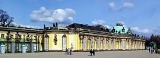
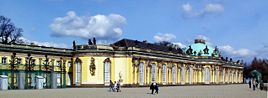
, until 1918. Around the city there are a series of interconnected lakes and unique cultural landmarks, in particular the parks and palaces of Sanssouci
, the largest World Heritage Site
in Germany. The Potsdam Conference
, the major post-World War II
conference between the victorious Allies, was held at another palace in the area, the Cecilienhof
.
Babelsberg
, in the south-eastern part of Potsdam, was a major movie production studio before the war and has enjoyed increased success as a major centre of European film production since the fall of the Berlin Wall. The Filmstudio Babelsberg is the oldest large-scale film studio in the world.
Potsdam developed into a centre of science in Germany from the 19th century. Today, there are three public colleges and more than 30 research institute
s in the city.
 The area was formed from a series of large moraine
s left after the last ice age
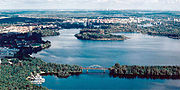
. Today, the city is three-quarters green space, with just a quarter as urban area. There are about 20 lakes and rivers in and around Potsdam, for example the Havel
, the Griebnitzsee
, Templiner See
, Tiefer See
, Jungfernsee
, Teltowkanal, Heiliger See
and the Sacrower See
. The highest point is the 114 metres (374 ft) high Kleiner Ravensberg.
Potsdam is divided into seven historic city districts and nine new Ortsteile (village parts), which joined the city in 2003. The appearance of the city districts is quite different. The districts in the north and in the centre consist mainly of historical buildings, the south of the city is dominated by larger areas of newer buildings.
 The area around Potsdam shows occupancy since the Bronze Age
and was part of Magna Germania as described by Tacitus
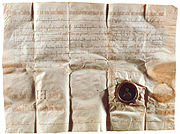
. After the migrations, Slavs moved in and Potsdam was probably founded after the 7th century as a settlement of the Heveller centred on a castle. It was first mentioned in a document in 993AD as Poztupimi, when Emperor Otto III gifted the territory to the Quedlinburg Abbey
, then led by his aunt Matilda
. A possible translation of the name might be beneath the oaks. By 1317, it was mentioned as a small town. It gained its town charter in 1345. In 1573, it was still a small market town
of 2,000 inhabitants. Due to the Thirty Years' War
(1618–1648), Potsdam had lost nearly half of its population.
A continuous Hohenzollern possession since 1415, Potsdam became prominent, when it was chosen in 1660 as the hunting residence of Frederick William I, Elector
of Brandenburg
, the core of the powerful state that later became the Kingdom of Prussia
. It also housed Prussia
n barracks
.
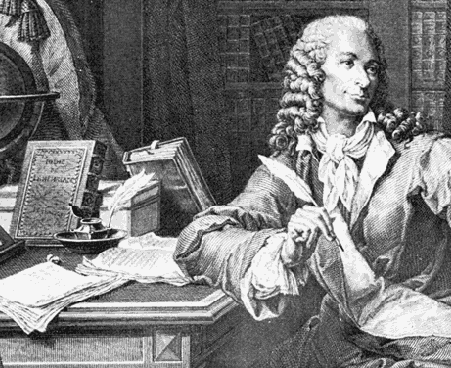 After the Edict of Potsdam
in 1685, Potsdam became a centre of European immigration. Its religious freedom attracted people from France
(Huguenot
s), Russia
, the Netherlands
and Bohemia
. The edict accelerated population growth and economic recovery.
Later, the city became a full residence of the Prussian royal family. The majestic buildings of the royal residences were built mainly during the reign of Frederick the Great
. One of these is the Sanssouci Palace
(French: "without cares", by Georg Wenzeslaus von Knobelsdorff
, 1744), famed for its formal gardens and Rococo
interiors. Other royal residences include the Neues Palais
and the Orangery
.
In 1815, at the formation of the Province of Brandenburg
, Potsdam became the provincial capital until 1918, however, interrupted and succeeded by Berlin as provincial capital between 1827 and 1843, and after 1918. The province comprised two governorates named after their capitals Potsdam and Frankfurt upon Oder.
encompassed the former districts of Uckermark
, the Mark of Priegnitz, and the greater part of the Middle March
. It was situated between Mecklenburg
and the Province of Pomerania on the north, and the Province of Saxony
on the south and west (Berlin
, with a small surrounding district, was an urban governorate and enclave within the governorate of Potsdam between 1815 and 1822, then it merged as urban district into the governorate only to be disentangled again from Potsdam governorate in 1875, becoming an own distinct province-like entity on 1 April 1881). Towards the north west the governorate was bounded by the rivers Elbe
and the Havel, and on the north east by the Oder
. The southeastern boundary was to the neighbouring governorate of Frankfurt upon Oder. About 500,000 inhabitants lived in the Potsdam governorate, which covered an area of about 20,700 square kilometres, divided into thirteen rural districts
, named after their capitals:
The traditional towns in the governorate were small, however, in the course of the industrial labour migration some reached the rank as urban districts. The principal towns were Brandenburg upon Havel, Köpenick
, Potsdam, Prenzlau
, Spandau
and Ruppin. Until 1875 also Berlin was a town within the governorate. After its disentanglement a number of its suburbs outside Berlin's municipal borders grew to cities, many forming urban within the governorate of Potsdam such as Charlottenburg
, Lichtenberg
, Rixdorf
(after 1912 Neukölln), and Schöneberg
(all of which, as well as Köpenick and Spandau, incorporated into Greater Berlin in 1920). The urban districts were (years indicating the elevation to rank of urban district or affiliation with Potsdam governorate, respectively):
was the official capital of Prussia
and later of the German Empire
, but the court remained in Potsdam, where many government officials settled. In 1914, the Emperor Wilhelm II signed the Declaration of War in the Neues Palais. The city lost its status as a second capital in 1918, when Wilhelm II abdicated at the end of World War I
.
At the start of the Third Reich in 1933 there was a ceremonial handshake between President
Paul von Hindenburg
and the new Chancellor Adolf Hitler
on 21 March 1933 in Potsdam's Garrison Church
in what became known as the "Day of Potsdam". This symbolised a coalition of the military (Reichswehr
) and Nazism
. Potsdam was severely damaged in bombing raids during World War II
.
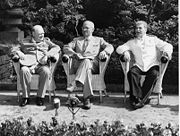 The Cecilienhof Palace
was the scene of the Potsdam Conference
from 17 July, to 2 August 1945, at which the victorious Allied
leaders (Harry S. Truman
; Winston Churchill
and his successor, Clement Attlee
; and Joseph Stalin
) met to decide the future of Germany and postwar Europe in general. The conference ended with the Potsdam Agreement
and the Potsdam Declaration
.
 The government of East Germany (formally known as the German Democratic Republic
(German: Deutsche Demokratische Republik, DDR)) tried to remove symbols of Prussian militarism
. Many historic buildings, some of them badly damaged in the war, were demolished.
When in 1946 the remainder of the Province of Brandenburg west of the Oder-Neiße line was constituted as the state of Brandenburg
, Potsdam became its capital. In 1952 the GDR disestablished its federative states and replaced them by smaller new East German administrative districts. Potsdam became the capital of the new Bezirk Potsdam
until 1990.
Potsdam, south-west of Berlin, lay just outside West Berlin
after the construction of the Berlin Wall
. The walling off of West Berlin not only isolated Potsdam from West Berlin, but also doubled commuting times to East Berlin
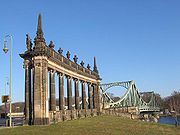
. The Glienicke Bridge
across the Havel connected the city to West Berlin and was the scene of some Cold War
exchanges of spies
.
After German reunification
, Potsdam became the capital of the newly re-established state of Brandenburg
. There are many ideas and efforts to reconstruct the original appearance of the city, most remarkably the Potsdam City Palace and the Garrison Church.
 Potsdam has had a mayor
(Bürgermeister) and city council
since the 15th century. From 1809 the city council was elected, with a mayor (Oberbürgermeister) at its head. During the Third Reich the mayor was selected by the NSDAP and the city council was dissolved; it was reconstituted in token form after the Second World War, but free elections did not take place until after reunification.
Today, the city council is the city's central administrative authority. Local elections took place on 26 October 2003 and again in 2008. Between 1990 and 1999, the Chairman of the City Council was known as the "Town President" but today the post is the "Chairman of the City Council". The mayor is elected directly by the population. In the mayoral election on 22 September 2002, no candidate gained an overall majority, and a run-off election was held between Jann Jakobs (SPD
) and Hans-Jürgen Scharfenberg (PDS), with Jann Jakobs gaining the narrowest of victories, with 50.1%.
The Landtag Brandenburg, the parliament of the federal state
of Brandenburg is in Potsdam. It is planned to move into the Potsdam City Palace in 2011, after its reconstruction.
with the following cities:
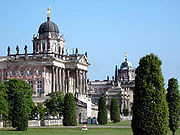 Potsdam is a university town
. The University of Potsdam
was founded in 1991 as a university of the State of Brandenburg. Its predecessor was the Akademie für Staats- und Rechtswissenschaften der DDR "Walter Ulbricht", a college of education founded in 1948 which was one of the GDR's most important colleges. There are about 20,000 students enrolled at the university.
 In 1991 the Fachhochschule
was founded as the second college; it now has 2,400 students.
In addition there is a College of Film and Television (Hochschule für Film und Fernsehen "Konrad Wolf" HFF), founded in 1954 in Babelsberg, the foremost centre of the German film industry since its birth, with currently 600 students.
There are also several research foundations, including Fraunhofer Institutes for Applied Polymer Research and Biomedical Engineering, Max Planck Institutes for Gravitational Physics (Albert Einstein Institute), Colloids and Interfaces, and Molecular Plant Physiology, the GFZ German Research Center for Geosciences, the Potsdam Astrophysical Institute and the Potsdam Institute for Climate Impact Research, which employs 140 people in researching climate change
.
As well as universities, Potsdam is home to reputable secondary school
s. Montessori Gesamtschule Potsdam, in western Potsdam, attracts 400 students from the Brandenburg and Berlin region.
 Potsdam was historically a centre of European immigration. Its religious tolerance attracted people from France, Russia, the Netherlands and Bohemia. This is still visible in the culture and architecture of the city.
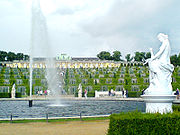
The most popular attraction in Potsdam is Sanssouci Park
, 2 km west of the city centre. In 1744 King Frederick the Great
ordered the construction of a residence here, where he could live sans souci ("without worries", in the French spoken at the court). The park hosts a botanical garden
(Botanischer Garten Potsdam
) and many magnificent buildings:
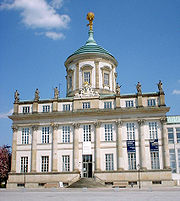
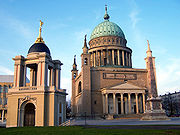 The Old Market Square (Alter Markt) is Potsdam's historical city centre. For three centuries this was the site of the City Palace (Stadtschloß), a royal palace built in 1662. Under Frederick the Great
, the palace became the winter residence of the Prussian kings. The palace was severely damaged by bombing in 1945 and demolished in 1961 by the Communist authorities. In 2002 the Gate of Fortune (Fortunaportal) was rebuilt in its original historic position, which marks the first step in the reconstruction of the palace. The Old Market Square is dominated today by the dome of the Nicolas Church (Nikolaikirche), built in 1837 in the classical style. It was the last work of Karl Friedrich Schinkel
, who designed the building but did not live to see its completion. It was finished by his disciples Friedrich August Stüler
and Ludwig Persius
. The eastern side of the Market Square is dominated by the Old City Hall (Altes Rathaus), built in 1755 by the Dutch
architect Jan Bouman (1706–1776). It has a characteristic circular tower, crowned with a gilded Atlas
bearing the world on his shoulders.
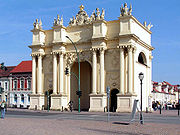
 North of the Old Market Square is the oval French Church (Französische Kirche), erected in the 1750s by Boumann for the Huguenot
community, and the Brandenburg Gate (built in 1770, not to be confused with the Brandenburg Gate
in Berlin).
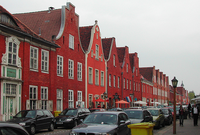
Another landmark of Potsdam is the two-street Dutch Quarter
(Holländisches Viertel), an ensemble of buildings that is unique in Europe, with about 150 houses built of red bricks in the Dutch style. It was built between 1734 and 1742 under the direction of Jan Bouman to be used by Dutch artisans and craftsmen who had been invited to settle here by King Frederick Wilhelm I. Today, this area is one of Potsdam's most visited districts.
North of the city centre is the Russia
n colony of Alexandrowka, a small enclave of Russian architecture (including an Orthodox chapel) built in 1825 for a group of Russian immigrants. Since 1999, the colony has been a UNESCO
World Heritage Site
.
East of the Alexandrowka colony is a large park, the New Garden (Neuer Garten), which was laid out from 1786 in the English
style. The site contains two palaces; one of them, the Cecilienhof
, was where the Potsdam Conference
was held in July and August 1945. The Marmorpalais
(Marble Palace) was built in 1789 in the style of classicism
. Nearby is the Biosphäre Potsdam
, a tropical botanical garden
.
Another interesting district of Potsdam is Babelsberg
, a quarter south-east of the centre, housing the UFA
film studios (Babelsberg Studios
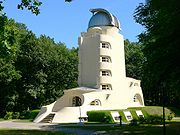
), and an extensive park with some historical buildings, including the Babelsberg Palace (Schloß Babelsberg, a neo-Gothic palace designed by Schinkel). The Einstein Tower
was built between 1920 and 1924 by architect Erich Mendelsohn
on the top of the Telegraphenberg within an astronomy compound.
There are many parks in Potsdam, most of them included in UNESCO
World Heritage Sites. Some of them are:
Potsdam also includes a memorial centre in the former KGB
prison in Leistikowstraße.
Germany
Germany , officially the Federal Republic of Germany , is a federal parliamentary republic in Europe. The country consists of 16 states while the capital and largest city is Berlin. Germany covers an area of 357,021 km2 and has a largely temperate seasonal climate...
federal state
States of Germany
Germany is made up of sixteen which are partly sovereign constituent states of the Federal Republic of Germany. Land literally translates as "country", and constitutionally speaking, they are constituent countries...
of Brandenburg
Brandenburg
Brandenburg is one of the sixteen federal-states of Germany. It lies in the east of the country and is one of the new federal states that were re-created in 1990 upon the reunification of the former West Germany and East Germany. The capital is Potsdam...
and part of the Berlin/Brandenburg Metropolitan Region
Berlin/Brandenburg Metropolitan Region
The Berlin/Brandenburg Metropolitan Region is one of the 11 metropolitan regions of Germany...
. It is situated on the River Havel
Havel
The Havel is a river in north-eastern Germany, flowing through the German states of Mecklenburg-Vorpommern, Brandenburg, Berlin and Saxony-Anhalt. It is a right tributary of the Elbe river and in length...
, 24 km (14.9 mi) southwest of Berlin
Berlin
Berlin is the capital city of Germany and is one of the 16 states of Germany. With a population of 3.45 million people, Berlin is Germany's largest city. It is the second most populous city proper and the seventh most populous urban area in the European Union...
city centre.
The name "Potsdam" originally seems to have been "Poztupimi" from a West Slavonic name meaning "beneath the oaks", highlighting the area's many grand oak trees.
Potsdam has several claims to national and international notability. In Germany, it had the status Windsor
Windsor, Berkshire
Windsor is an affluent suburban town and unparished area in the Royal Borough of Windsor and Maidenhead in Berkshire, England. It is widely known as the site of Windsor Castle, one of the official residences of the British Royal Family....
has in Britain: it was the residence
New Palace (Potsdam)
The New Palace is a palace situated on the western side of the Sanssouci royal park in Potsdam, Germany. The building was begun in 1763, after the end of the Seven Years' War, under Frederick the Great and was completed in 1769...
of the Prussia
Prussia
Prussia was a German kingdom and historic state originating out of the Duchy of Prussia and the Margraviate of Brandenburg. For centuries, the House of Hohenzollern ruled Prussia, successfully expanding its size by way of an unusually well-organized and effective army. Prussia shaped the history...
n kings and German Kaisers
German Emperor
This article is about the emperors of the German Empire. For full list of German monarchs before 1871, see List of German monarchs.The German Emperor was the official title of the Head of State and ruler of the German Empire, beginning with the proclamation of Wilhelm I as emperor during the...
, until 1918. Around the city there are a series of interconnected lakes and unique cultural landmarks, in particular the parks and palaces of Sanssouci
Sanssouci
Sanssouci is the name of the former summer palace of Frederick the Great, King of Prussia, in Potsdam, near Berlin. It is often counted among the German rivals of Versailles. While Sanssouci is in the more intimate Rococo style and is far smaller than its French Baroque counterpart, it too is...
, the largest World Heritage Site
World Heritage Site
A UNESCO World Heritage Site is a place that is listed by the UNESCO as of special cultural or physical significance...
in Germany. The Potsdam Conference
Potsdam Conference
The Potsdam Conference was held at Cecilienhof, the home of Crown Prince Wilhelm Hohenzollern, in Potsdam, occupied Germany, from 16 July to 2 August 1945. Participants were the Soviet Union, the United Kingdom, and the United States...
, the major post-World War II
World War II
World War II, or the Second World War , was a global conflict lasting from 1939 to 1945, involving most of the world's nations—including all of the great powers—eventually forming two opposing military alliances: the Allies and the Axis...
conference between the victorious Allies, was held at another palace in the area, the Cecilienhof
Cecilienhof
Schloss Cecilienhof is a palace in the northern part of the Neuer Garten park in Potsdam, Germany, close to the Jungfernsee lake. Since 1990 it is part of the Palaces and Parks of Potsdam and Berlin UNESCO World Heritage Site....
.
Babelsberg
Potsdam-Babelsberg
Babelsberg is the largest district of the Brandenburg capital Potsdam in Germany. The affluent neighbourhood named after a small hill on the Havel river is famous for Babelsberg Palace and Park, part of the Palaces and Parks of Potsdam and Berlin UNESCO World Heritage Site, as well as for Studio...
, in the south-eastern part of Potsdam, was a major movie production studio before the war and has enjoyed increased success as a major centre of European film production since the fall of the Berlin Wall. The Filmstudio Babelsberg is the oldest large-scale film studio in the world.
Potsdam developed into a centre of science in Germany from the 19th century. Today, there are three public colleges and more than 30 research institute
Research institute
A research institute is an establishment endowed for doing research. Research institutes may specialize in basic research or may be oriented to applied research...
s in the city.
Geography
Moraine
A moraine is any glacially formed accumulation of unconsolidated glacial debris which can occur in currently glaciated and formerly glaciated regions, such as those areas acted upon by a past glacial maximum. This debris may have been plucked off a valley floor as a glacier advanced or it may have...
s left after the last ice age
Ice age
An ice age or, more precisely, glacial age, is a generic geological period of long-term reduction in the temperature of the Earth's surface and atmosphere, resulting in the presence or expansion of continental ice sheets, polar ice sheets and alpine glaciers...
. Today, the city is three-quarters green space, with just a quarter as urban area. There are about 20 lakes and rivers in and around Potsdam, for example the Havel
Havel
The Havel is a river in north-eastern Germany, flowing through the German states of Mecklenburg-Vorpommern, Brandenburg, Berlin and Saxony-Anhalt. It is a right tributary of the Elbe river and in length...
, the Griebnitzsee
Griebnitzsee
Griebnitzsee is a lake in the western outskirts of Berlin, the capital city of Germany. At an elevation of 29.4 m, its surface area is ca. 0.592 km². The lake forms the border between the German states of Berlin and Brandenburg...
, Templiner See
Templiner See
Templiner See is a lake in the state of Brandenburg, Germany. It stretches to the south and west from the centre of the city of Potsdam.The lake is some long, with a maximum width of and a surface area is...
, Tiefer See
Tiefer See
Tiefer See is a lake in the Mecklenburgische Seenplatte district in Mecklenburg-Vorpommern, Germany. At an elevation of 62.9 m, its surface area is 0.76 km²....
, Jungfernsee
Jungfernsee
The Jungfernsee is located north of Potsdam, Germany. It was a glacial kettle and is now part of the River Havel, which runs along its southeastern shore, which is also the only part of its shores that is in Berlin...
, Teltowkanal, Heiliger See
Heiliger See
Heiliger See is a lake in Potsdam, Brandenburg, Germany. At an elevation of 29.4 m, its surface area is 0.34 km²....
and the Sacrower See
Sacrower See
The Sacrower See is a German lake in the northern part of Potsdam in the State of Brandenburg.-Overview:The Sacrower See, with the Groß Glienicker See 0.7 km to the north and the Heiliger See 1.6 km away in Potsdam, forms a chain of lakes, which flow into a sea channel.The lake extends in a...
. The highest point is the 114 metres (374 ft) high Kleiner Ravensberg.
Potsdam is divided into seven historic city districts and nine new Ortsteile (village parts), which joined the city in 2003. The appearance of the city districts is quite different. The districts in the north and in the centre consist mainly of historical buildings, the south of the city is dominated by larger areas of newer buildings.
History
Bronze Age
The Bronze Age is a period characterized by the use of copper and its alloy bronze as the chief hard materials in the manufacture of some implements and weapons. Chronologically, it stands between the Stone Age and Iron Age...
and was part of Magna Germania as described by Tacitus
Tacitus
Publius Cornelius Tacitus was a senator and a historian of the Roman Empire. The surviving portions of his two major works—the Annals and the Histories—examine the reigns of the Roman Emperors Tiberius, Claudius, Nero and those who reigned in the Year of the Four Emperors...
. After the migrations, Slavs moved in and Potsdam was probably founded after the 7th century as a settlement of the Heveller centred on a castle. It was first mentioned in a document in 993AD as Poztupimi, when Emperor Otto III gifted the territory to the Quedlinburg Abbey
Quedlinburg Abbey
Quedlinburg Abbey was a house of secular canonesses in Quedlinburg, Saxony-Anhalt, Germany. It was founded in 936 on the initiative of Saint Mathilda, the widow of Henry the Fowler, as his memorial...
, then led by his aunt Matilda
Matilda, Abbess of Quedlinburg
Matilda , also known as Mathilda and Mathilde, was the first Princess-Abbess of Quedlinburg. She was the daughter of Otto I, Holy Roman Emperor, and his second wife, Adelaide of Italy.- Taking the veil :...
. A possible translation of the name might be beneath the oaks. By 1317, it was mentioned as a small town. It gained its town charter in 1345. In 1573, it was still a small market town
Market town
Market town or market right is a legal term, originating in the medieval period, for a European settlement that has the right to host markets, distinguishing it from a village and city...
of 2,000 inhabitants. Due to the Thirty Years' War
Thirty Years' War
The Thirty Years' War was fought primarily in what is now Germany, and at various points involved most countries in Europe. It was one of the most destructive conflicts in European history....
(1618–1648), Potsdam had lost nearly half of its population.
A continuous Hohenzollern possession since 1415, Potsdam became prominent, when it was chosen in 1660 as the hunting residence of Frederick William I, Elector
Prince-elector
The Prince-electors of the Holy Roman Empire were the members of the electoral college of the Holy Roman Empire, having the function of electing the Roman king or, from the middle of the 16th century onwards, directly the Holy Roman Emperor.The heir-apparent to a prince-elector was known as an...
of Brandenburg
Brandenburg-Prussia
Brandenburg-Prussia is the historiographic denomination for the Early Modern realm of the Brandenburgian Hohenzollerns between 1618 and 1701. Based in the Electorate of Brandenburg, the main branch of the Hohenzollern intermarried with the branch ruling the Duchy of Prussia, and secured succession...
, the core of the powerful state that later became the Kingdom of Prussia
Kingdom of Prussia
The Kingdom of Prussia was a German kingdom from 1701 to 1918. Until the defeat of Germany in World War I, it comprised almost two-thirds of the area of the German Empire...
. It also housed Prussia
Prussia
Prussia was a German kingdom and historic state originating out of the Duchy of Prussia and the Margraviate of Brandenburg. For centuries, the House of Hohenzollern ruled Prussia, successfully expanding its size by way of an unusually well-organized and effective army. Prussia shaped the history...
n barracks
Barracks
Barracks are specialised buildings for permanent military accommodation; the word may apply to separate housing blocks or to complete complexes. Their main object is to separate soldiers from the civilian population and reinforce discipline, training and esprit de corps. They were sometimes called...
.
Edict of Potsdam
The Edict of Potsdam was a proclamation issued by Frederick William, Elector of Brandenburg and Duke of Prussia, in Potsdam on October 29, 1685, as a response to the revocation of the Edict of Nantes by the Edict of Fontainebleau.- Background :...
in 1685, Potsdam became a centre of European immigration. Its religious freedom attracted people from France
France
The French Republic , The French Republic , The French Republic , (commonly known as France , is a unitary semi-presidential republic in Western Europe with several overseas territories and islands located on other continents and in the Indian, Pacific, and Atlantic oceans. Metropolitan France...
(Huguenot
Huguenot
The Huguenots were members of the Protestant Reformed Church of France during the 16th and 17th centuries. Since the 17th century, people who formerly would have been called Huguenots have instead simply been called French Protestants, a title suggested by their German co-religionists, the...
s), Russia
Russia
Russia or , officially known as both Russia and the Russian Federation , is a country in northern Eurasia. It is a federal semi-presidential republic, comprising 83 federal subjects...
, the Netherlands
Netherlands
The Netherlands is a constituent country of the Kingdom of the Netherlands, located mainly in North-West Europe and with several islands in the Caribbean. Mainland Netherlands borders the North Sea to the north and west, Belgium to the south, and Germany to the east, and shares maritime borders...
and Bohemia
Bohemia
Bohemia is a historical region in central Europe, occupying the western two-thirds of the traditional Czech Lands. It is located in the contemporary Czech Republic with its capital in Prague...
. The edict accelerated population growth and economic recovery.
Later, the city became a full residence of the Prussian royal family. The majestic buildings of the royal residences were built mainly during the reign of Frederick the Great
Frederick II of Prussia
Frederick II was a King in Prussia and a King of Prussia from the Hohenzollern dynasty. In his role as a prince-elector of the Holy Roman Empire, he was also Elector of Brandenburg. He was in personal union the sovereign prince of the Principality of Neuchâtel...
. One of these is the Sanssouci Palace
Sanssouci
Sanssouci is the name of the former summer palace of Frederick the Great, King of Prussia, in Potsdam, near Berlin. It is often counted among the German rivals of Versailles. While Sanssouci is in the more intimate Rococo style and is far smaller than its French Baroque counterpart, it too is...
(French: "without cares", by Georg Wenzeslaus von Knobelsdorff
Georg Wenzeslaus von Knobelsdorff
Hans Georg Wenzeslaus von Knobelsdorff was a painter and architect in Prussia.Knobelsdorff was born in Kuckädel, now in Krosno Odrzańskie County. A soldier in the service of Prussia, he resigned his commission in 1729 as captain so that he could pursue his interest in architecture...
, 1744), famed for its formal gardens and Rococo
Rococo
Rococo , also referred to as "Late Baroque", is an 18th-century style which developed as Baroque artists gave up their symmetry and became increasingly ornate, florid, and playful...
interiors. Other royal residences include the Neues Palais
New Palace (Potsdam)
The New Palace is a palace situated on the western side of the Sanssouci royal park in Potsdam, Germany. The building was begun in 1763, after the end of the Seven Years' War, under Frederick the Great and was completed in 1769...
and the Orangery
Orangery Palace
The Orangery Palace is also known as the New Orangery on the Klausberg, or just the Orangery. It was built by the Romantic on the Throne, Friedrich Wilhelm IV, in his seat of Potsdam, Brandenburg, Germany, from 1851 to 1864.-Background:...
.
In 1815, at the formation of the Province of Brandenburg
Province of Brandenburg
The Province of Brandenburg was a province of the Kingdom of Prussia and the Free State of Prussia from 1815 to 1946.-History:The first people who are known to have inhabited Brandenburg were the Suevi. They were succeeded by the Slavonians, whom Henry II conquered and converted to Christianity in...
, Potsdam became the provincial capital until 1918, however, interrupted and succeeded by Berlin as provincial capital between 1827 and 1843, and after 1918. The province comprised two governorates named after their capitals Potsdam and Frankfurt upon Oder.
Governorate of Potsdam
Between 1815 and 1945 the city of Potsdam served as capital of the governorate of Potsdam . The RegierungsbezirkRegierungsbezirk
In Germany, a Government District, in German: Regierungsbezirk – is a subdivision of certain federal states .They are above the Kreise, Landkreise, and kreisfreie Städte...
encompassed the former districts of Uckermark
Uckermark
Uckermark is a Kreis in the northeastern part of Brandenburg, Germany. Neighboring districts are Barnim and Oberhavel, the districts Mecklenburgische Seenplatte and Vorpommern-Greifswald in Mecklenburg-Vorpommern, and to the east Poland . It is the largest district of Germany areawise...
, the Mark of Priegnitz, and the greater part of the Middle March
Kurmark
Kurmark is a German term meaning "Electoral March", referring to territory of the former Electorate of Brandenburg. The Kurmark included the Altmark, the Mittelmark, the Uckermark, the Prignitz, and the lordships of Beeskow and Storkow...
. It was situated between Mecklenburg
Mecklenburg
Mecklenburg is a historical region in northern Germany comprising the western and larger part of the federal-state Mecklenburg-Vorpommern...
and the Province of Pomerania on the north, and the Province of Saxony
Province of Saxony
The Province of Saxony was a province of the Kingdom of Prussia and later the Free State of Prussia from 1816 until 1945. Its capital was Magdeburg.-History:The province was created in 1816 out of the following territories:...
on the south and west (Berlin
Berlin
Berlin is the capital city of Germany and is one of the 16 states of Germany. With a population of 3.45 million people, Berlin is Germany's largest city. It is the second most populous city proper and the seventh most populous urban area in the European Union...
, with a small surrounding district, was an urban governorate and enclave within the governorate of Potsdam between 1815 and 1822, then it merged as urban district into the governorate only to be disentangled again from Potsdam governorate in 1875, becoming an own distinct province-like entity on 1 April 1881). Towards the north west the governorate was bounded by the rivers Elbe
Elbe
The Elbe is one of the major rivers of Central Europe. It rises in the Krkonoše Mountains of the northwestern Czech Republic before traversing much of Bohemia , then Germany and flowing into the North Sea at Cuxhaven, 110 km northwest of Hamburg...
and the Havel, and on the north east by the Oder
Oder
The Oder is a river in Central Europe. It rises in the Czech Republic and flows through western Poland, later forming of the border between Poland and Germany, part of the Oder-Neisse line...
. The southeastern boundary was to the neighbouring governorate of Frankfurt upon Oder. About 500,000 inhabitants lived in the Potsdam governorate, which covered an area of about 20,700 square kilometres, divided into thirteen rural districts
Kreis in Prussia
Prussian districts were administrative units in the former German state of Prussia. The districts , also known as counties, usually took the name of the district's capital . A typical district had a rough diameter of 20 to 40 miles, though few were circular in shape...
, named after their capitals:
| Angermünde | Beeskow-Storkow (as of 1836) | East Havelland | East Prignitz |
| Jüterbog-Luckenwalde | Lower Barnim | Prenzlau | Ruppin |
| Teltow (as of 1836) | Teltow-Storkow (until 1835) | Templin | Upper Barnim |
| West Havelland | West Prignitz | Zauch-Belzig |
The traditional towns in the governorate were small, however, in the course of the industrial labour migration some reached the rank as urban districts. The principal towns were Brandenburg upon Havel, Köpenick
Köpenick
Köpenick is a historic town and locality that is situated at the confluence of the rivers Dahme and Spree in the south-east of the German capital city of Berlin. It was formerly known as Copanic and then Cöpenick, only officially adopting the current spelling in 1931...
, Potsdam, Prenzlau
Prenzlau
Prenzlau , a city in the Uckermark District of Brandenburg in Germany, had a population of about 21,000 in 2005.-International relations:Prenzlau is twinned with: Uster, Switzerland Barlinek, Poland Świdwin, Poland...
, Spandau
Spandau
Spandau is the fifth of the twelve boroughs of Berlin. It is the fourth largest and westernmost borough, situated at the confluence of the Havel and Spree rivers and along the western bank of the Havel, but the least populated.-Overview:...
and Ruppin. Until 1875 also Berlin was a town within the governorate. After its disentanglement a number of its suburbs outside Berlin's municipal borders grew to cities, many forming urban within the governorate of Potsdam such as Charlottenburg
Charlottenburg
Charlottenburg is a locality of Berlin within the borough of Charlottenburg-Wilmersdorf, named after Queen consort Sophia Charlotte...
, Lichtenberg
Lichtenberg (locality)
Lichtenberg is a locality of Berlin in the homonymous district of Lichtenberg. Until 2001 it was an autonomous district with the localities of Fennpfuhl, Rummelsburg, Friedrichsfelde and Karlshorst.- History :...
, Rixdorf
Neukölln (locality)
Neukölln is an inner-city locality of Berlin in the homonymous borough of Neukölln, including the historic village of Rixdorf and numerous Gründerzeit apartment blocks. The Ortsteil is densely settled a with a population of 154,127 inhabitants and is the most populated one of Berlin...
(after 1912 Neukölln), and Schöneberg
Schöneberg
Schöneberg is a locality of Berlin, Germany. Until Berlin's 2001 administrative reform it was a separate borough including the locality of Friedenau. Together with the former borough of Tempelhof it is now part of the new borough of Tempelhof-Schöneberg....
(all of which, as well as Köpenick and Spandau, incorporated into Greater Berlin in 1920). The urban districts were (years indicating the elevation to rank of urban district or affiliation with Potsdam governorate, respectively):
| Berlin (1822–1875) | Brandenburg/Havel (as of 1881) | Charlottenburg Charlottenburg Charlottenburg is a locality of Berlin within the borough of Charlottenburg-Wilmersdorf, named after Queen consort Sophia Charlotte... (1877–1920) |
Eberswalde Eberswalde Eberswalde is a major town and the administrative seat of the district Barnim in the German Federal State of Brandenburg, about 50 km northeast of Berlin. Population 42144 , geographical location . The town is often called Waldstadt , because of the large forests around it, including the... (as of 1911) |
| Lichtenberg Lichtenberg (locality) Lichtenberg is a locality of Berlin in the homonymous district of Lichtenberg. Until 2001 it was an autonomous district with the localities of Fennpfuhl, Rummelsburg, Friedrichsfelde and Karlshorst.- History :... (1908–1920) |
Schöneberg Schöneberg Schöneberg is a locality of Berlin, Germany. Until Berlin's 2001 administrative reform it was a separate borough including the locality of Friedenau. Together with the former borough of Tempelhof it is now part of the new borough of Tempelhof-Schöneberg.... (1899–1920) |
Deutsch-Wilmersdorf Wilmersdorf Wilmersdorf is an inner city locality of Berlin, formerly a borough by itself but since Berlin's 2001 administrative reform a part of the new borough of Charlottenburg-Wilmersdorf.-History:... (1907–1920) |
Rixdorf (Neukölln) Neukölln (locality) Neukölln is an inner-city locality of Berlin in the homonymous borough of Neukölln, including the historic village of Rixdorf and numerous Gründerzeit apartment blocks. The Ortsteil is densely settled a with a population of 154,127 inhabitants and is the most populated one of Berlin... (1899–1920) |
| Potsdam | Rathenow Rathenow Rathenow is a town in the district of Havelland in Brandenburg, Germany, with a population of 26,433 .-Overview:The Protestant church of St. Marien Andreas, originally a basilica, and transformed to the Gothic style in 1517-1589, and the Roman Catholic Church of St... (as of 1925) |
Spandau Spandau Spandau is the fifth of the twelve boroughs of Berlin. It is the fourth largest and westernmost borough, situated at the confluence of the Havel and Spree rivers and along the western bank of the Havel, but the least populated.-Overview:... (1886–1920) |
Wittenberge Wittenberge Wittenberge is a town of twenty thousand people on the lower Elbe in the district of Prignitz , Brandenburg, Germany.-History:... (as of 1922) |
Potsdam in the 20th century
BerlinBerlin
Berlin is the capital city of Germany and is one of the 16 states of Germany. With a population of 3.45 million people, Berlin is Germany's largest city. It is the second most populous city proper and the seventh most populous urban area in the European Union...
was the official capital of Prussia
Prussia
Prussia was a German kingdom and historic state originating out of the Duchy of Prussia and the Margraviate of Brandenburg. For centuries, the House of Hohenzollern ruled Prussia, successfully expanding its size by way of an unusually well-organized and effective army. Prussia shaped the history...
and later of the German Empire
German Empire
The German Empire refers to Germany during the "Second Reich" period from the unification of Germany and proclamation of Wilhelm I as German Emperor on 18 January 1871, to 1918, when it became a federal republic after defeat in World War I and the abdication of the Emperor, Wilhelm II.The German...
, but the court remained in Potsdam, where many government officials settled. In 1914, the Emperor Wilhelm II signed the Declaration of War in the Neues Palais. The city lost its status as a second capital in 1918, when Wilhelm II abdicated at the end of World War I
World War I
World War I , which was predominantly called the World War or the Great War from its occurrence until 1939, and the First World War or World War I thereafter, was a major war centred in Europe that began on 28 July 1914 and lasted until 11 November 1918...
.
At the start of the Third Reich in 1933 there was a ceremonial handshake between President
Reichspräsident
The Reichspräsident was the German head of state under the Weimar constitution, which was officially in force from 1919 to 1945. In English he was usually simply referred to as the President of Germany...
Paul von Hindenburg
Paul von Hindenburg
Paul Ludwig Hans Anton von Beneckendorff und von Hindenburg , known universally as Paul von Hindenburg was a Prussian-German field marshal, statesman, and politician, and served as the second President of Germany from 1925 to 1934....
and the new Chancellor Adolf Hitler
Adolf Hitler
Adolf Hitler was an Austrian-born German politician and the leader of the National Socialist German Workers Party , commonly referred to as the Nazi Party). He was Chancellor of Germany from 1933 to 1945, and head of state from 1934 to 1945...
on 21 March 1933 in Potsdam's Garrison Church
Garrison Church (Potsdam)
The Garrison Church was a Baroque church in Potsdam, eastern Germany. It was built under the second Prussian king Friedrich Wilhelm I. between 1730 and 1735. During World War II, the church burned down on 14 April 1945. The ruin was demolished on 23 June 1968 by the SED leadership under Walter...
in what became known as the "Day of Potsdam". This symbolised a coalition of the military (Reichswehr
Reichswehr
The Reichswehr formed the military organisation of Germany from 1919 until 1935, when it was renamed the Wehrmacht ....
) and Nazism
Nazism
Nazism, the common short form name of National Socialism was the ideology and practice of the Nazi Party and of Nazi Germany...
. Potsdam was severely damaged in bombing raids during World War II
World War II
World War II, or the Second World War , was a global conflict lasting from 1939 to 1945, involving most of the world's nations—including all of the great powers—eventually forming two opposing military alliances: the Allies and the Axis...
.
Cecilienhof
Schloss Cecilienhof is a palace in the northern part of the Neuer Garten park in Potsdam, Germany, close to the Jungfernsee lake. Since 1990 it is part of the Palaces and Parks of Potsdam and Berlin UNESCO World Heritage Site....
was the scene of the Potsdam Conference
Potsdam Conference
The Potsdam Conference was held at Cecilienhof, the home of Crown Prince Wilhelm Hohenzollern, in Potsdam, occupied Germany, from 16 July to 2 August 1945. Participants were the Soviet Union, the United Kingdom, and the United States...
from 17 July, to 2 August 1945, at which the victorious Allied
Allies
In everyday English usage, allies are people, groups, or nations that have joined together in an association for mutual benefit or to achieve some common purpose, whether or not explicit agreement has been worked out between them...
leaders (Harry S. Truman
Harry S. Truman
Harry S. Truman was the 33rd President of the United States . As President Franklin D. Roosevelt's third vice president and the 34th Vice President of the United States , he succeeded to the presidency on April 12, 1945, when President Roosevelt died less than three months after beginning his...
; Winston Churchill
Winston Churchill
Sir Winston Leonard Spencer-Churchill, was a predominantly Conservative British politician and statesman known for his leadership of the United Kingdom during the Second World War. He is widely regarded as one of the greatest wartime leaders of the century and served as Prime Minister twice...
and his successor, Clement Attlee
Clement Attlee
Clement Richard Attlee, 1st Earl Attlee, KG, OM, CH, PC, FRS was a British Labour politician who served as the Prime Minister of the United Kingdom from 1945 to 1951, and as the Leader of the Labour Party from 1935 to 1955...
; and Joseph Stalin
Joseph Stalin
Joseph Vissarionovich Stalin was the Premier of the Soviet Union from 6 May 1941 to 5 March 1953. He was among the Bolshevik revolutionaries who brought about the October Revolution and had held the position of first General Secretary of the Communist Party of the Soviet Union's Central Committee...
) met to decide the future of Germany and postwar Europe in general. The conference ended with the Potsdam Agreement
Potsdam Agreement
The Potsdam Agreement was the Allied plan of tripartite military occupation and reconstruction of Germany—referring to the German Reich with its pre-war 1937 borders including the former eastern territories—and the entire European Theatre of War territory...
and the Potsdam Declaration
Potsdam Declaration
The Potsdam Declaration or the Proclamation Defining Terms for Japanese Surrender is a statement calling for the Surrender of Japan in World War II. On July 26, 1945, United States President Harry S...
.
German Democratic Republic
The German Democratic Republic , informally called East Germany by West Germany and other countries, was a socialist state established in 1949 in the Soviet zone of occupied Germany, including East Berlin of the Allied-occupied capital city...
(German: Deutsche Demokratische Republik, DDR)) tried to remove symbols of Prussian militarism
Militarism
Militarism is defined as: the belief or desire of a government or people that a country should maintain a strong military capability and be prepared to use it aggressively to defend or promote national interests....
. Many historic buildings, some of them badly damaged in the war, were demolished.
When in 1946 the remainder of the Province of Brandenburg west of the Oder-Neiße line was constituted as the state of Brandenburg
Brandenburg
Brandenburg is one of the sixteen federal-states of Germany. It lies in the east of the country and is one of the new federal states that were re-created in 1990 upon the reunification of the former West Germany and East Germany. The capital is Potsdam...
, Potsdam became its capital. In 1952 the GDR disestablished its federative states and replaced them by smaller new East German administrative districts. Potsdam became the capital of the new Bezirk Potsdam
Potsdam (Bezirk)
The Bezirk Potsdam was a district of East Germany. The administrative seat and the main town was Potsdam.-History:The district was established, with the other 13, on July 25, 1952, substituting the old German states...
until 1990.
Potsdam, south-west of Berlin, lay just outside West Berlin
West Berlin
West Berlin was a political exclave that existed between 1949 and 1990. It comprised the western regions of Berlin, which were bordered by East Berlin and parts of East Germany. West Berlin consisted of the American, British, and French occupation sectors, which had been established in 1945...
after the construction of the Berlin Wall
Berlin Wall
The Berlin Wall was a barrier constructed by the German Democratic Republic starting on 13 August 1961, that completely cut off West Berlin from surrounding East Germany and from East Berlin...
. The walling off of West Berlin not only isolated Potsdam from West Berlin, but also doubled commuting times to East Berlin
East Berlin
East Berlin was the name given to the eastern part of Berlin between 1949 and 1990. It consisted of the Soviet sector of Berlin that was established in 1945. The American, British and French sectors became West Berlin, a part strongly associated with West Germany but a free city...
. The Glienicke Bridge
Glienicke bridge
The Glienicke bridge is a bridge on the edge of Berlin that spans the Havel River to connect the cities of Potsdam and Berlin near Klein Glienicke...
across the Havel connected the city to West Berlin and was the scene of some Cold War
Cold War
The Cold War was the continuing state from roughly 1946 to 1991 of political conflict, military tension, proxy wars, and economic competition between the Communist World—primarily the Soviet Union and its satellite states and allies—and the powers of the Western world, primarily the United States...
exchanges of spies
SPY
SPY is a three-letter acronym that may refer to:* SPY , ticker symbol for Standard & Poor's Depositary Receipts* SPY , a satirical monthly, trademarked all-caps* SPY , airport code for San Pédro, Côte d'Ivoire...
.
After German reunification
German reunification
German reunification was the process in 1990 in which the German Democratic Republic joined the Federal Republic of Germany , and when Berlin reunited into a single city, as provided by its then Grundgesetz constitution Article 23. The start of this process is commonly referred by Germans as die...
, Potsdam became the capital of the newly re-established state of Brandenburg
Brandenburg
Brandenburg is one of the sixteen federal-states of Germany. It lies in the east of the country and is one of the new federal states that were re-created in 1990 upon the reunification of the former West Germany and East Germany. The capital is Potsdam...
. There are many ideas and efforts to reconstruct the original appearance of the city, most remarkably the Potsdam City Palace and the Garrison Church.
Administration
Mayor
In many countries, a Mayor is the highest ranking officer in the municipal government of a town or a large urban city....
(Bürgermeister) and city council
City council
A city council or town council is the legislative body that governs a city, town, municipality or local government area.-Australia & NZ:Because of the differences in legislation between the States, the exact definition of a City Council varies...
since the 15th century. From 1809 the city council was elected, with a mayor (Oberbürgermeister) at its head. During the Third Reich the mayor was selected by the NSDAP and the city council was dissolved; it was reconstituted in token form after the Second World War, but free elections did not take place until after reunification.
Today, the city council is the city's central administrative authority. Local elections took place on 26 October 2003 and again in 2008. Between 1990 and 1999, the Chairman of the City Council was known as the "Town President" but today the post is the "Chairman of the City Council". The mayor is elected directly by the population. In the mayoral election on 22 September 2002, no candidate gained an overall majority, and a run-off election was held between Jann Jakobs (SPD
Social Democratic Party of Germany
The Social Democratic Party of Germany is a social-democratic political party in Germany...
) and Hans-Jürgen Scharfenberg (PDS), with Jann Jakobs gaining the narrowest of victories, with 50.1%.
The Landtag Brandenburg, the parliament of the federal state
States of Germany
Germany is made up of sixteen which are partly sovereign constituent states of the Federal Republic of Germany. Land literally translates as "country", and constitutionally speaking, they are constituent countries...
of Brandenburg is in Potsdam. It is planned to move into the Potsdam City Palace in 2011, after its reconstruction.
Twin towns — sister cities
Potsdam is twinnedTown twinning
Twin towns and sister cities are two of many terms used to describe the cooperative agreements between towns, cities, and even counties in geographically and politically distinct areas to promote cultural and commercial ties.- Terminology :...
with the following cities:
 |
Opole Opole Opole is a city in southern Poland on the Oder River . It has a population of 125,992 and is the capital of the Upper Silesia, Opole Voivodeship and, also the seat of Opole County... |
Poland Poland Poland , officially the Republic of Poland , is a country in Central Europe bordered by Germany to the west; the Czech Republic and Slovakia to the south; Ukraine, Belarus and Lithuania to the east; and the Baltic Sea and Kaliningrad Oblast, a Russian exclave, to the north... |
1973 |  |
Perugia Perugia Perugia is the capital city of the region of Umbria in central Italy, near the River Tiber, and the capital of the province of Perugia. The city is located about north of Rome. It covers a high hilltop and part of the valleys around the area.... |
Italy Italy Italy , officially the Italian Republic languages]] under the European Charter for Regional or Minority Languages. In each of these, Italy's official name is as follows:;;;;;;;;), is a unitary parliamentary republic in South-Central Europe. To the north it borders France, Switzerland, Austria and... |
1990 |
 |
Bobigny Bobigny Bobigny is a commune, or town, in the northeastern suburbs of Paris, France. It is located from the center of Paris. Bobigny is the préfecture of the Seine-Saint-Denis département, as well as the seat of the Arrondissement of Bobigny... |
France France The French Republic , The French Republic , The French Republic , (commonly known as France , is a unitary semi-presidential republic in Western Europe with several overseas territories and islands located on other continents and in the Indian, Pacific, and Atlantic oceans. Metropolitan France... |
1974 |  |
Sioux Falls | South Dakota South Dakota South Dakota is a state located in the Midwestern region of the United States. It is named after the Lakota and Dakota Sioux American Indian tribes. Once a part of Dakota Territory, South Dakota became a state on November 2, 1889. The state has an area of and an estimated population of just over... , USA |
1990 |
 |
Jyväskylä Jyväskylä Jyväskylä is the capital of Central Finland and the largest city on the Finnish Lakeland, north-east of Tampere and north of Helsinki, on northern coast of lake Päijänne. The city has been continuously one of the most rapidly growing cities in Finland since World War II. The city is surrounded... |
Finland Finland Finland , officially the Republic of Finland, is a Nordic country situated in the Fennoscandian region of Northern Europe. It is bordered by Sweden in the west, Norway in the north and Russia in the east, while Estonia lies to its south across the Gulf of Finland.Around 5.4 million people reside... |
1985 |  |
Bonn Bonn Bonn is the 19th largest city in Germany. Located in the Cologne/Bonn Region, about 25 kilometres south of Cologne on the river Rhine in the State of North Rhine-Westphalia, it was the capital of West Germany from 1949 to 1990 and the official seat of government of united Germany from 1990 to 1999.... |
North Rhine-Westphalia North Rhine-Westphalia North Rhine-Westphalia is the most populous state of Germany, with four of the country's ten largest cities. The state was formed in 1946 as a merger of the northern Rhineland and Westphalia, both formerly part of Prussia. Its capital is Düsseldorf. The state is currently run by a coalition of the... |
1988 |
 |
Lucerne Lucerne Lucerne is a city in north-central Switzerland, in the German-speaking portion of that country. Lucerne is the capital of the Canton of Lucerne and the capital of the district of the same name. With a population of about 76,200 people, Lucerne is the most populous city in Central Switzerland, and... |
Switzerland Switzerland Switzerland name of one of the Swiss cantons. ; ; ; or ), in its full name the Swiss Confederation , is a federal republic consisting of 26 cantons, with Bern as the seat of the federal authorities. The country is situated in Western Europe,Or Central Europe depending on the definition.... |
2002 |
Education and research
College town
A college town or university town is a community which is dominated by its university population...
. The University of Potsdam
University of Potsdam
The University of Potsdam is a German university, situated across four campuses in Potsdam, Brandenburg, including the New Palace of Sanssouci and the Park Babelsberg.- Profile :...
was founded in 1991 as a university of the State of Brandenburg. Its predecessor was the Akademie für Staats- und Rechtswissenschaften der DDR "Walter Ulbricht", a college of education founded in 1948 which was one of the GDR's most important colleges. There are about 20,000 students enrolled at the university.
Vocational university
A vocational university is an institution of higher education and sometimes research, which provides both tertiary and sometimes quaternary education and grants academic degrees at all levels in a variety of subjects...
was founded as the second college; it now has 2,400 students.
In addition there is a College of Film and Television (Hochschule für Film und Fernsehen "Konrad Wolf" HFF), founded in 1954 in Babelsberg, the foremost centre of the German film industry since its birth, with currently 600 students.
There are also several research foundations, including Fraunhofer Institutes for Applied Polymer Research and Biomedical Engineering, Max Planck Institutes for Gravitational Physics (Albert Einstein Institute), Colloids and Interfaces, and Molecular Plant Physiology, the GFZ German Research Center for Geosciences, the Potsdam Astrophysical Institute and the Potsdam Institute for Climate Impact Research, which employs 140 people in researching climate change
Climate change
Climate change is a significant and lasting change in the statistical distribution of weather patterns over periods ranging from decades to millions of years. It may be a change in average weather conditions or the distribution of events around that average...
.
As well as universities, Potsdam is home to reputable secondary school
Secondary school
Secondary school is a term used to describe an educational institution where the final stage of schooling, known as secondary education and usually compulsory up to a specified age, takes place...
s. Montessori Gesamtschule Potsdam, in western Potsdam, attracts 400 students from the Brandenburg and Berlin region.
Main sights
The most popular attraction in Potsdam is Sanssouci Park
Sanssouci Park
Sanssouci Park is a large park surrounding Sanssouci Palace in Potsdam, Germany. Following the terracing of the vineyard and the completion of the palace, the surroundings were included in the structure. A baroque flower garden with lawns, flower beds, hedges and trees was created. In the hedge...
, 2 km west of the city centre. In 1744 King Frederick the Great
Frederick II of Prussia
Frederick II was a King in Prussia and a King of Prussia from the Hohenzollern dynasty. In his role as a prince-elector of the Holy Roman Empire, he was also Elector of Brandenburg. He was in personal union the sovereign prince of the Principality of Neuchâtel...
ordered the construction of a residence here, where he could live sans souci ("without worries", in the French spoken at the court). The park hosts a botanical garden
Botanical garden
A botanical garden The terms botanic and botanical, and garden or gardens are used more-or-less interchangeably, although the word botanic is generally reserved for the earlier, more traditional gardens. is a well-tended area displaying a wide range of plants labelled with their botanical names...
(Botanischer Garten Potsdam
Botanischer Garten Potsdam
The Botanischer Garten Potsdam , also known as the Botanischer Garten der Universität Potsdam, is a botanical garden and arboretum maintained by the University of Potsdam...
) and many magnificent buildings:
- The Sanssouci PalaceSanssouciSanssouci is the name of the former summer palace of Frederick the Great, King of Prussia, in Potsdam, near Berlin. It is often counted among the German rivals of Versailles. While Sanssouci is in the more intimate Rococo style and is far smaller than its French Baroque counterpart, it too is...
(Schloss Sanssouci), a relatively modest palace of the Prussian royal and German imperial family - The Orangery PalaceOrangery PalaceThe Orangery Palace is also known as the New Orangery on the Klausberg, or just the Orangery. It was built by the Romantic on the Throne, Friedrich Wilhelm IV, in his seat of Potsdam, Brandenburg, Germany, from 1851 to 1864.-Background:...
(Orangerieschloss), former palace for foreign royal guests - The New PalaceNew Palace (Potsdam)The New Palace is a palace situated on the western side of the Sanssouci royal park in Potsdam, Germany. The building was begun in 1763, after the end of the Seven Years' War, under Frederick the Great and was completed in 1769...
(Neues Palais), built between 1763 and 1769 to celebrate the end of the Seven Years' WarSeven Years' WarThe Seven Years' War was a global military war between 1756 and 1763, involving most of the great powers of the time and affecting Europe, North America, Central America, the West African coast, India, and the Philippines...
, in which PrussiaPrussiaPrussia was a German kingdom and historic state originating out of the Duchy of Prussia and the Margraviate of Brandenburg. For centuries, the House of Hohenzollern ruled Prussia, successfully expanding its size by way of an unusually well-organized and effective army. Prussia shaped the history...
ousted AustriaAustriaAustria , officially the Republic of Austria , is a landlocked country of roughly 8.4 million people in Central Europe. It is bordered by the Czech Republic and Germany to the north, Slovakia and Hungary to the east, Slovenia and Italy to the south, and Switzerland and Liechtenstein to the...
from its centuries-long role as the dominant power in German affairs. It is a much larger and grander palace than Sanssouci, having over 200 rooms and 400 statues as decoration. It served as a guest house for numerous royal visitors. - The Charlottenhof PalaceCharlottenhof PalaceCharlottenhof Palace is located southwest of Sanssouci Palace in Sanssouci Park at Potsdam, Germany. It is most famous as the summer residence of Crown Prince Frederick William...
(Schloss Charlottenhof), a Neoclassical palace by Karl Friedrich SchinkelKarl Friedrich SchinkelKarl Friedrich Schinkel was a Prussian architect, city planner, and painter who also designed furniture and stage sets. Schinkel was one of the most prominent architects of Germany and designed both neoclassical and neogothic buildings.-Biography:Schinkel was born in Neuruppin, Margraviate of...
built in 1826 - The Roman BathsRoman Baths (Potsdam)The Roman Baths , northeast of the Charlottenhof Palace in the Sanssouci Park in Potsdam, reflect the Italiensehnsucht of its creator Frederick William IV of Prussia...
(Römische Bäder), built by Karl Friedrich Schinkel and Ludwig Persius in 1829-1840. It is a complex of buildings including a tea pavilion, a Renaissance-style villa, and a Roman bathhouse (from which the whole complex takes its name). - The Chinese Tea HouseChinese House (Potsdam)The Chinese House is a garden pavilion in Sanssouci Park in Potsdam. Frederick the Great had it built, about seven hundred meters southwest of the Sanssouci Summer Palace, to adorn his flower and vegetable garden...
(Chinesisches Teehaus), an 18th century pavilion built in a ChineseChinaChinese civilization may refer to:* China for more general discussion of the country.* Chinese culture* Greater China, the transnational community of ethnic Chinese.* History of China* Sinosphere, the area historically affected by Chinese culture...
style, the fashion of the time. - The is the oldest gate of Potsdam, built in 1733.
Frederick II of Prussia
Frederick II was a King in Prussia and a King of Prussia from the Hohenzollern dynasty. In his role as a prince-elector of the Holy Roman Empire, he was also Elector of Brandenburg. He was in personal union the sovereign prince of the Principality of Neuchâtel...
, the palace became the winter residence of the Prussian kings. The palace was severely damaged by bombing in 1945 and demolished in 1961 by the Communist authorities. In 2002 the Gate of Fortune (Fortunaportal) was rebuilt in its original historic position, which marks the first step in the reconstruction of the palace. The Old Market Square is dominated today by the dome of the Nicolas Church (Nikolaikirche), built in 1837 in the classical style. It was the last work of Karl Friedrich Schinkel
Karl Friedrich Schinkel
Karl Friedrich Schinkel was a Prussian architect, city planner, and painter who also designed furniture and stage sets. Schinkel was one of the most prominent architects of Germany and designed both neoclassical and neogothic buildings.-Biography:Schinkel was born in Neuruppin, Margraviate of...
, who designed the building but did not live to see its completion. It was finished by his disciples Friedrich August Stüler
Friedrich August Stüler
Friedrich August Stüler was an influential Prussian architect and builder. His masterwork is the Neues Museum in Berlin, as well as the dome of the triumphal arch of the main portal of the Berliner Stadtschloss.-Life:...
and Ludwig Persius
Ludwig Persius
Friedrich Ludwig Persius was a Prussian architect and a student of Karl Friedrich Schinkel....
. The eastern side of the Market Square is dominated by the Old City Hall (Altes Rathaus), built in 1755 by the Dutch
Netherlands
The Netherlands is a constituent country of the Kingdom of the Netherlands, located mainly in North-West Europe and with several islands in the Caribbean. Mainland Netherlands borders the North Sea to the north and west, Belgium to the south, and Germany to the east, and shares maritime borders...
architect Jan Bouman (1706–1776). It has a characteristic circular tower, crowned with a gilded Atlas
Atlas
An atlas is a collection of maps; it is typically a map of Earth or a region of Earth, but there are atlases of the other planets in the Solar System. Atlases have traditionally been bound into book form, but today many atlases are in multimedia formats...
bearing the world on his shoulders.
Huguenot
The Huguenots were members of the Protestant Reformed Church of France during the 16th and 17th centuries. Since the 17th century, people who formerly would have been called Huguenots have instead simply been called French Protestants, a title suggested by their German co-religionists, the...
community, and the Brandenburg Gate (built in 1770, not to be confused with the Brandenburg Gate
Brandenburg Gate
The Brandenburg Gate is a former city gate and one of the most well-known landmarks of Berlin and Germany. It is located west of the city centre at the junction of Unter den Linden and Ebertstraße, immediately west of the Pariser Platz. It is the only remaining gate of a series through which...
in Berlin).
Another landmark of Potsdam is the two-street Dutch Quarter
Dutch Quarter
The Dutch Quarter is a neighborhood in Potsdam, consisting of 134 red brick buildings in the Dutch style, almost all of which have been renovated. It was built from 1733 to 1740 and designed by Jan Bouman. It is considered as Europe's largest collection of Dutch-style houses outside the Netherlands....
(Holländisches Viertel), an ensemble of buildings that is unique in Europe, with about 150 houses built of red bricks in the Dutch style. It was built between 1734 and 1742 under the direction of Jan Bouman to be used by Dutch artisans and craftsmen who had been invited to settle here by King Frederick Wilhelm I. Today, this area is one of Potsdam's most visited districts.
North of the city centre is the Russia
Russia
Russia or , officially known as both Russia and the Russian Federation , is a country in northern Eurasia. It is a federal semi-presidential republic, comprising 83 federal subjects...
n colony of Alexandrowka, a small enclave of Russian architecture (including an Orthodox chapel) built in 1825 for a group of Russian immigrants. Since 1999, the colony has been a UNESCO
UNESCO
The United Nations Educational, Scientific and Cultural Organization is a specialized agency of the United Nations...
World Heritage Site
World Heritage Site
A UNESCO World Heritage Site is a place that is listed by the UNESCO as of special cultural or physical significance...
.
East of the Alexandrowka colony is a large park, the New Garden (Neuer Garten), which was laid out from 1786 in the English
England
England is a country that is part of the United Kingdom. It shares land borders with Scotland to the north and Wales to the west; the Irish Sea is to the north west, the Celtic Sea to the south west, with the North Sea to the east and the English Channel to the south separating it from continental...
style. The site contains two palaces; one of them, the Cecilienhof
Cecilienhof
Schloss Cecilienhof is a palace in the northern part of the Neuer Garten park in Potsdam, Germany, close to the Jungfernsee lake. Since 1990 it is part of the Palaces and Parks of Potsdam and Berlin UNESCO World Heritage Site....
, was where the Potsdam Conference
Potsdam Conference
The Potsdam Conference was held at Cecilienhof, the home of Crown Prince Wilhelm Hohenzollern, in Potsdam, occupied Germany, from 16 July to 2 August 1945. Participants were the Soviet Union, the United Kingdom, and the United States...
was held in July and August 1945. The Marmorpalais
Marmorpalais
The Marmorpalais was a royal residence in Potsdam, eastern Germany, built on the grounds of the extensive Neuer Garten on the shores of Lake Heiliger See...
(Marble Palace) was built in 1789 in the style of classicism
Classicism
Classicism, in the arts, refers generally to a high regard for classical antiquity, as setting standards for taste which the classicists seek to emulate. The art of classicism typically seeks to be formal and restrained: of the Discobolus Sir Kenneth Clark observed, "if we object to his restraint...
. Nearby is the Biosphäre Potsdam
Biosphäre Potsdam
The Biosphäre Potsdam is an indoor tropical botanical garden located in the Volkspark Potsdam, a park between the Sanssouci Park and the Neuer Garten Potsdam at Georg-Hermann-Allee 99, Potsdam, Brandenburg, Germany...
, a tropical botanical garden
Botanical garden
A botanical garden The terms botanic and botanical, and garden or gardens are used more-or-less interchangeably, although the word botanic is generally reserved for the earlier, more traditional gardens. is a well-tended area displaying a wide range of plants labelled with their botanical names...
.
Another interesting district of Potsdam is Babelsberg
Potsdam-Babelsberg
Babelsberg is the largest district of the Brandenburg capital Potsdam in Germany. The affluent neighbourhood named after a small hill on the Havel river is famous for Babelsberg Palace and Park, part of the Palaces and Parks of Potsdam and Berlin UNESCO World Heritage Site, as well as for Studio...
, a quarter south-east of the centre, housing the UFA
Universum Film AG
Universum Film AG, better known as UFA or Ufa, is a film company that was the principal film studio in Germany, home of the German film industry during the Weimar Republic and through World War II, and a major force in world cinema from 1917 to 1945...
film studios (Babelsberg Studios
Babelsberg Studios
The Studio Babelsberg, located in Potsdam-Babelsberg, Germany, is the oldest large-scale film studio in the world. Founded in 1912, it covers an area of about . Hundreds of films, including Fritz Lang's Metropolis and Josef von Sternberg's The Blue Angel were filmed there...
), and an extensive park with some historical buildings, including the Babelsberg Palace (Schloß Babelsberg, a neo-Gothic palace designed by Schinkel). The Einstein Tower
Einstein Tower
The Einstein Tower is an astrophysical observatory in the Albert Einstein Science Park in Potsdam, Germany built by Erich Mendelsohn. It was built on the summit of the Potsdam Telegraphenberg to house a solar telescope designed by the astronomer Erwin Finlay-Freundlich...
was built between 1920 and 1924 by architect Erich Mendelsohn
Erich Mendelsohn
Erich Mendelsohn was a Jewish German architect, known for his expressionist architecture in the 1920s, as well as for developing a dynamic functionalism in his projects for department stores and cinemas.-Early life:...
on the top of the Telegraphenberg within an astronomy compound.
There are many parks in Potsdam, most of them included in UNESCO
UNESCO
The United Nations Educational, Scientific and Cultural Organization is a specialized agency of the United Nations...
World Heritage Sites. Some of them are:
Potsdam also includes a memorial centre in the former KGB
KGB
The KGB was the commonly used acronym for the . It was the national security agency of the Soviet Union from 1954 until 1991, and was the premier internal security, intelligence, and secret police organization during that time.The State Security Agency of the Republic of Belarus currently uses the...
prison in Leistikowstraße.
Transport
- Rail transport: Potsdam, included in the fare zone "C" (Tarifbereich C) of BerlinBerlinBerlin is the capital city of Germany and is one of the 16 states of Germany. With a population of 3.45 million people, Berlin is Germany's largest city. It is the second most populous city proper and the seventh most populous urban area in the European Union...
er public transport area, is served by the S-BahnBerlin S-BahnThe Berlin S-Bahn is a rapid transit system in and around Berlin, the capital city of Germany. It consists of 15 lines and is integrated with the mostly underground U-Bahn to form the backbone of Berlin's rapid transport system...
lines S7S7 (Berlin)S7 is a line on the Berlin S-Bahn. It operates from Ahrensfelde to Potsdam over:*the Wriezen Railway, completed on 1 May 1898 and electrified to Marzahn in 1976, to Mehrower Allee in 1980 and to Ahrensfelde in 1982,...
and S5S5 (Berlin)S5 is a line on the Berlin S-Bahn. It operates from Strausberg Nord to Westkreuz over:*the Strausberg–Strausberg Nord line, completed in 1955 and electrified in 1956,...
, the latter only at night. The stations served are GriebnitzseePotsdam Griebnitzsee railway stationPotsdam Griebnitzsee is a railway station in the western outskirts of Berlin, the capital city of Germany. The station is located in the east of the Babelsberg suburb of the city of Potsdam in the state of Brandenburg, and about outside the Berlin city boundary...
, Babelsberg and the HauptbahnhofPotsdam HauptbahnhofPotsdam Hauptbahnhof is the main railway station in German city of Potsdam. It is the southern terminus of S-Bahn line and, replacing the S7 on Friday and Saturday nights, the line .- Overview :...
, the main and long-distance station of the city. Other DBDeutsche BahnDeutsche Bahn AG is the German national railway company, a private joint stock company . Headquartered in Berlin, it came into existence in 1994 as the successor to the former state railways of Germany, the Deutsche Bundesbahn of West Germany and the Deutsche Reichsbahn of East Germany...
stations in Potsdam are Charlottenhof, Park SanssouciPotsdam Park Sanssouci railway stationPotsdam Park Sanssouci is a German railway station located in Potsdam, the Brandenburger capital city on the Berlin-Potsdam-Magdeburg line. Named Potsdam Wildpark until 1999, it serves the Sanssouci Park and is famous for the Kaiserbahnhof building....
(including the monumental Kaiserbahnhof), Medienstadt Babelsberg (formerly Drewitz), Rehbrücke and Pirschheide. The city also counts a 27 km-long tramway networkPotsdam TramwayThe Potsdam tram network is the tram system of the German city of Potsdam, the capital of Brandenburg. It is owned by the public citizen company Verkehrsbetrieb Potsdam and included in the fare zone "C" of the Berliner public transport area.-History:The network opened on 12 May 1880: It was an...
.
- Road transport: Potsdam is served by the motorwaysGerman AutobahnenThe German autobahns are the nationally coordinated motorway system in Germany. In German, they are officially called Bundesautobahn , which translates as federal expressways...
A10Bundesautobahn 10runs in Brandenburg and is an orbital motorway around Berlin and is therefore called the Berliner Ring. It should not be confused with the Berliner Stadtring ....
, a beltway better known as Berliner Ring, A115Bundesautobahn 115is an autobahn in Berlin, Germany. It connects the Berliner Stadtring with the Berliner Ring, using parts of the old AVUS race track. AVUS was opened in 1921 as Germany's first limited access road. After World War II, the A 115 served an important function as a transit road between West Berlin...
(using part of the AVUSAVUSThe Automobil-Verkehrs- und Übungs-Straße, better known as AVUS, is a public road that was also used as a motor racing circuit. It is located in the south-western districts of Berlin, Germany, between Charlottenburg and Nikolassee, and is nowadays an important part of the public highway system, as...
) and is closely linked to A2 and A9. The National Roads B1Bundesstraße 1The Bundesstraße 1 or B1 is a German federal highway running in an east-west direction from the Dutch border near Aachen to the Polish border at Küstrin-Kietz on the Oder River.-Route description:...
and B2 cross the city. Potsdam counts a network of urban and suburban buses and trolleybuses.
Sport
- 1. FFC Turbine Potsdam1. FFC Turbine Potsdam1. FFC Turbine Potsdam is a women's football club team in Potsdam, Germany. The full name is 1. Frauen-Fußball-Club Turbine Potsdam 71 e. V. . They are one of the most successful teams in Germany...
, one of the most successful German female football clubs (Bundesliga (women)Fußball-Bundesliga (women)The Women's Football Bundesliga is the main league competition for women's football in Germany. In 1990 the German Football Association created the German Women's Bundesliga, based on the model of the men's Bundesliga. It was first played with north and south divisions, but in 1997 the groups...
) - SV Babelsberg 03SV Babelsberg 03SV Babelsberg 03 is a German association football club based in Potsdam-Babelsberg, on the outskirts of Berlin. The team was founded as Sport-Club Jugendkraft 1903 and again as SG Karl-Marx Babelsberg in 1948 as successor to the pre-war side SpVgg Potsdam 03.-History:Playing as SV Nowawes the team...
, football club (3. Bundesliga) - Olympic training centre Potsdam
- USV Potsdam, Rugby unionRugby unionRugby union, often simply referred to as rugby, is a full contact team sport which originated in England in the early 19th century. One of the two codes of rugby football, it is based on running with the ball in hand...
(2nd Rugby-Bundesliga2nd Rugby-BundesligaThe 2nd Rugby-Bundesliga is the second-highest level of Germany's Rugby union league system, organised by the German Rugby Federation. Its set below the Rugby-Bundesliga, the top-tier of German rugby, and above the Rugby-Regionalliga, the third tier.-History:...
) and Football (KreisklasseKreisklasseThe Kreisklassen are the lowest echelons of football in Germany, the German equivalent to Sunday league football. They rank below the Kreisligas...
) - List of football clubs in Potsdam
- The Potsdamer Schlössermarathon (Potsdam Palace Marathon) is a marathonMarathonThe marathon is a long-distance running event with an official distance of 42.195 kilometres , that is usually run as a road race...
in that is held annually in June. Thousands of runners run the course past the palaces for the half marathonHalf marathonA half marathon is a road running event of . It is half the distance of a marathon and usually run on roads. Participation in half marathons has grown steadily recently. One of the main reasons for this is that it is a challenging distance, but does not require the same level of training that a...
and several hundred repeat the course to complete the full marathon.
Famous people
- Famous people from Potsdam who are the subjects of Wikipedia articles can be found here.
Sources
- Paul Sigel, Silke Dähmlow, Frank Seehausen und Lucas Elmenhorst, Architekturführer Potsdam Architectural Guide, Dietrich Reimer Verlag, Berlin 2006, ISBN 3-496-01325-7.