


Siegfried Line

Encyclopedia
The original Siegfried line (German
: Siegfriedstellung) was a line of defensive forts and tank defences built by Germany
as a section of the Hindenburg Line
1916–1917 in northern France
during World War I
. In English, Siegfried line more commonly refers to the similar World War II
defensive line, built during the 1930s, opposite the French Maginot Line
, which served a corresponding purpose. The Germans themselves called this the Westwall, but the Allies renamed it after the World War I line. This article deals with this second Siegfried line.
The Siegfried Line was a defence system stretching more than 630 km (391.5 mi) with more than 18,000 bunker
s, tunnels and tank traps
. It went from Kleve
on the border with the Netherlands
, along the western border of the old German Empire
as far as the town of Weil am Rhein
on the border to Switzerland
. More with propaganda
in mind than for any strategic reason, Adolf Hitler
planned the line from 1936 and had it built between 1938 and 1940.
 The origin of the name is unknown, but is likely from popular use from the end of 1938. Nazi propaganda did not initially use the term, but the name was well-known from the middle of 1939, as Hitler sent an "Order of the Day to the soldiers and the workers at the Westwall" on 20 May 1939. The official name for the line until then had changed several times depending on the phase of construction:
These programmes were all pushed forward with the highest priority, using every resource available.
s towards the front. The walls were 50 cm (19.7 in) thick. Soldiers stationed there did not have their own beds but had to make do with hammocks. In exposed positions, similar small bunkers were erected with small round armoured "lookout" sections on the roofs. The programme was carried out by the Border Watch (Grenzwacht), a small military troop activated in the Rhineland
immediately after it was remilitarized.
The bunkers had a ceiling and walls 1.5 metre thick. A total of 3,471 Type 10 bunkers were built along the entire length of the Siegfried Line. The bunkers had a central room or shelter for 10-12 men with a stepped embrasures facing backwards and a combat section 50 cm (19.7 in) higher. This section had embrasures at the front and sides for machine guns. More embrasures were provided for carbine
s and the entire structure was constructed so as to be safe against poison gas.
The bunker was heated with a safety oven, and the chimney was covered with a thick grating. Every soldier was given a sleeping-place and a stool; the commanding officer had a chair. There was very little space: each soldier had about 1 m² (10.8 sq ft) of space, which meant that the rooms were packed full.
Inside the bunkers of this type still remaining today are signs hung up to prepare the men for their task: "Walls have ears" or "Lights out when embrasures are open!"
s with concrete walls up to 3.5 m (11.5 ft) thick. One difference was that there were no embrasures at the front, only at the sides of the bunkers. Embrasures were only built at the front in special cases and were then protected with heavy metal doors. The programme included the towns of Aachen
and Saarbrücken
which were initially west of the Limes Programme defence line.
towers. Scattered MG42s and MG34s were also placed for additional defence, against both air and land targets. Flak turrets were designed to force enemy planes to fly higher, thus decreasing the accuracy of their bombing. These towers were protected at close range by bunkers from the Limes and Aachen-Saar programmes.
district. The primary constructions were unarmed dugouts which were extremely strongly built out of concrete. For camouflage
they were often built near farms.
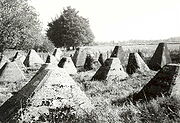
" or "pimples" (in German Höcker, "humps") because of their shape. These blocks of reinforced concrete stand in several rows on a single foundation. There are two typical sorts of barrier: Type 1938 with four teeth getting higher toward the back, and Type 1939 with five such teeth. Many other irregular lines of teeth were also built. Another design of tank obstacle was made by welding together several bars of steel in such a way that any tank rolling over it would be penetrated in its weak bottom armor. If the lie of the land allowed it, water-filled ditches were dug instead of tank traps. An example of this kind of defence are those north of Aachen near Geilenkirchen
.
. With this organisation's help, huge numbers of workers — up to 500,000 at a time — were found to work on the Siegfried Line. Transport of materials and workers from all across Germany was managed by the Deutsche Reichsbahn
railway company, which took advantage of the well-developed strategic railway lines built on Germany's western border in World War I.
Working conditions were highly dangerous; for example, the most primitive means had to be used to handle and assemble extremely heavy armour plating weighing up to 60 tonnes (66.1 ST). Life on the building site and after work was monotonous and many people gave up and left. Most workers received a medal depicting a bunker for their service.
armour plates as were needed for the mounting of weapons in the bunkers. The armour-plated sections were designed to include the embrasures and their shutters as well as armoured cupolas
for 360° defence. Germany depended on other countries to provide the alloy
s required in producing armoured plates (mostly nickel
and molybdenum
), so either the armour plates were left out or they were produced with low-quality replacement materials.
The bunkers were still fitted with guns, which proved inadequate in the first war years and were therefore dismantled, but the high-calibre weapons necessary for efficient defence could not be built into the bunkers.
, French forces made minor attacks against some parts of the line but the majority was left untested. When the campaign finished, transportable weapons were removed from the Siegfried Line and used in other places. The concrete sections were left in place in the countryside and soon became completely unfit for defence. The bunkers were instead used for storage.
on 6 June 1944, war in the west broke out once more. On 24 August 1944, Hitler gave a directive for renewed construction on the Siegfried Line. 20,000 forced laborers and members of the Reichsarbeitsdienst
(Reich Labor Service), most of whom were 14-16-year-old boys, attempted to reequip the line for defence purposes. Local people were also called in to carry out this kind of work, mostly building anti-tank ditches.
During construction, it was already clear that the bunkers could no longer withstand the newly developed armour-piercing weapons. At the same time as the Siegfried Line was reactivated, small concrete "Tobruk
" bunkers were built along the border to the occupied area. These bunkers were mostly dugouts for single soldiers.
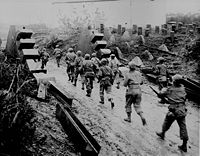 In August 1944, the first clashes took place on the Siegfried Line; the section of the line where most fighting took place was the Hürtgenwald
area in the Eifel
, 20 km (12.4 mi) southeast of Aachen. An estimated 120,000 troops—plus reinforcements—were committed to Hürtgen. The battle in this confusing, heavily forested area claimed the lives of 24,000 troops plus 9,000 non-battle casualties. The German death toll is not documented.
After the Battle of Hürtgenwald
, the Battle of the Bulge
began, starting at the area south of the Hürtgenwald, between Monschau
and the Luxembourg
ish town of Echternach
. This offensive was a last-ditch attempt by the Germans to reverse the course of the war. It cost the lives of many without producing any lasting success.
There were serious clashes at other parts of the Siegfried Line and soldiers in many bunkers refused to surrender, often fighting to the death. By early 1945 the last Siegfried Line bunkers had fallen at the Saar and Hunsrück
.
For the Germans, the building of the line represented the regime's defensive intentions, whereas for neighbouring countries it appeared threatening and reassuring at the same time. This strategy proved very successful from the Nazi point of view both at the start and at the end of World War II. At the start of the war, the opposing troops remained behind their own defence lines, allowing the Germans to attack Poland
, and at the end of the war, the invading forces spent more time than necessary at the half-finished, now-gutted Siegfried Line, thus allowing military manoeuvres in the east.
The Siegfried Line was the subject of a popular British song of 1939 which fitted the mood of the time for the troops marching off to France:
General George S. Patton
—when asked about the Siegfried Line—reportedly said, "Fixed fortifications are monuments to man's stupidity."
Since 1997, with the motto "The value of the unpleasant as a memorial" (Der Denkmalswert des Unerfreulichen), an effort has been made to preserve the remains of the Siegfried Line as a historical monument
. This was intended to stop radical right-wing
groups making propaganda out of the Siegfried Line.
At the same time, state funding was still being provided to destroy the remains of the Siegfried Line. For this reason, emergency archaeological digs took place whenever any part of the line was removed, for example for road building. Archaeological activity was not able to stop the destruction of these sections but furthered scientific knowledge and revealed details of the line's construction.
consider the remains of the Siegfried Line valuable as a chain of biotope
s where, thanks to its size, rare animals and plants can take refuge and reproduce. This effect is magnified because the concrete ruins can not be used for farming or forestry purposes.
German language
German is a West Germanic language, related to and classified alongside English and Dutch. With an estimated 90 – 98 million native speakers, German is one of the world's major languages and is the most widely-spoken first language in the European Union....
: Siegfriedstellung) was a line of defensive forts and tank defences built by Germany
Germany
Germany , officially the Federal Republic of Germany , is a federal parliamentary republic in Europe. The country consists of 16 states while the capital and largest city is Berlin. Germany covers an area of 357,021 km2 and has a largely temperate seasonal climate...
as a section of the Hindenburg Line
Hindenburg Line
The Hindenburg Line was a vast system of defences in northeastern France during World War I. It was constructed by the Germans during the winter of 1916–17. The line stretched from Lens to beyond Verdun...
1916–1917 in northern France
France
The French Republic , The French Republic , The French Republic , (commonly known as France , is a unitary semi-presidential republic in Western Europe with several overseas territories and islands located on other continents and in the Indian, Pacific, and Atlantic oceans. Metropolitan France...
during World War I
World War I
World War I , which was predominantly called the World War or the Great War from its occurrence until 1939, and the First World War or World War I thereafter, was a major war centred in Europe that began on 28 July 1914 and lasted until 11 November 1918...
. In English, Siegfried line more commonly refers to the similar World War II
World War II
World War II, or the Second World War , was a global conflict lasting from 1939 to 1945, involving most of the world's nations—including all of the great powers—eventually forming two opposing military alliances: the Allies and the Axis...
defensive line, built during the 1930s, opposite the French Maginot Line
Maginot Line
The Maginot Line , named after the French Minister of War André Maginot, was a line of concrete fortifications, tank obstacles, artillery casemates, machine gun posts, and other defences, which France constructed along its borders with Germany and Italy, in light of its experience in World War I,...
, which served a corresponding purpose. The Germans themselves called this the Westwall, but the Allies renamed it after the World War I line. This article deals with this second Siegfried line.
The Siegfried Line was a defence system stretching more than 630 km (391.5 mi) with more than 18,000 bunker
Bunker
A military bunker is a hardened shelter, often buried partly or fully underground, designed to protect the inhabitants from falling bombs or other attacks...
s, tunnels and tank traps
Dragon's teeth (fortification)
Dragon's teeth are square-pyramidal fortifications of reinforced concrete first used during the Second World War to impede the movement of tanks and mechanised infantry...
. It went from Kleve
Kleve
Kleve , is a town in the Lower Rhine region of northwestern Germany near the Dutch border and the River Rhine. From the 11th century onwards, Kleve was capital of a county and later a duchy...
on the border with the Netherlands
Netherlands
The Netherlands is a constituent country of the Kingdom of the Netherlands, located mainly in North-West Europe and with several islands in the Caribbean. Mainland Netherlands borders the North Sea to the north and west, Belgium to the south, and Germany to the east, and shares maritime borders...
, along the western border of the old German Empire
German Empire
The German Empire refers to Germany during the "Second Reich" period from the unification of Germany and proclamation of Wilhelm I as German Emperor on 18 January 1871, to 1918, when it became a federal republic after defeat in World War I and the abdication of the Emperor, Wilhelm II.The German...
as far as the town of Weil am Rhein
Weil am Rhein
Weil am Rhein is a German town and commune which is a suburb of the city of Basel in Switzerland. It is situated on the east bank of the River Rhine, and close to the point at which the Swiss, French and German borders meet. It is the most southwesterly town in Germany.-Geography:Weil am Rhein is...
on the border to Switzerland
Switzerland
Switzerland name of one of the Swiss cantons. ; ; ; or ), in its full name the Swiss Confederation , is a federal republic consisting of 26 cantons, with Bern as the seat of the federal authorities. The country is situated in Western Europe,Or Central Europe depending on the definition....
. More with propaganda
Propaganda
Propaganda is a form of communication that is aimed at influencing the attitude of a community toward some cause or position so as to benefit oneself or one's group....
in mind than for any strategic reason, Adolf Hitler
Adolf Hitler
Adolf Hitler was an Austrian-born German politician and the leader of the National Socialist German Workers Party , commonly referred to as the Nazi Party). He was Chancellor of Germany from 1933 to 1945, and head of state from 1934 to 1945...
planned the line from 1936 and had it built between 1938 and 1940.
Origin of the name Westwall
- Border Watch programme (pioneering programme) for the most advanced positions (1938)
- Limes Programme (1938)
- AachenAachenAachen has historically been a spa town in North Rhine-Westphalia, Germany. Aachen was a favoured residence of Charlemagne, and the place of coronation of the Kings of Germany. Geographically, Aachen is the westernmost town of Germany, located along its borders with Belgium and the Netherlands, ...
-SaarSaarlandSaarland is one of the sixteen states of Germany. The capital is Saarbrücken. It has an area of 2570 km² and 1,045,000 inhabitants. In both area and population, it is the smallest state in Germany other than the city-states...
Programme (1939) - Geldern Emplacement between BrüggenBrüggenBrüggen is a municipality in the district of Viersen, in North Rhine-Westphalia, Germany. It is situated near the border with the Netherlands, on the river Schwalm, approx. 15 km south of Venlo and 20 km north-west of Mönchengladbach.-See also:...
and Kleve (1939–1940) - Western Air Defence Zone (1938)
These programmes were all pushed forward with the highest priority, using every resource available.
Typical basic construction types
At the start of each construction programme, basic construction prototypes were laid out on the drawing board and then built, sometimes by the thousands. This standardisation of the bunkers (popularly known as Pillboxes) and tank traps was necessary because of the lack of raw materials, transport and workers.Pioneering programme
Small bunkers were set up with three embrasureEmbrasure
In military architecture, an embrasure is the opening in a crenellation or battlement between the two raised solid portions or merlons, sometimes called a crenel or crenelle...
s towards the front. The walls were 50 cm (19.7 in) thick. Soldiers stationed there did not have their own beds but had to make do with hammocks. In exposed positions, similar small bunkers were erected with small round armoured "lookout" sections on the roofs. The programme was carried out by the Border Watch (Grenzwacht), a small military troop activated in the Rhineland
Rhineland
Historically, the Rhinelands refers to a loosely-defined region embracing the land on either bank of the River Rhine in central Europe....
immediately after it was remilitarized.
Limes programme
The Limes Programme began as a result of an order by Hitler to strengthen fortifications on the western German border. Bunkers built in this phase, starting in 1938, were more strongly constructed than the earlier border fortifications.The bunkers had a ceiling and walls 1.5 metre thick. A total of 3,471 Type 10 bunkers were built along the entire length of the Siegfried Line. The bunkers had a central room or shelter for 10-12 men with a stepped embrasures facing backwards and a combat section 50 cm (19.7 in) higher. This section had embrasures at the front and sides for machine guns. More embrasures were provided for carbine
Carbine
A carbine , from French carabine, is a longarm similar to but shorter than a rifle or musket. Many carbines are shortened versions of full rifles, firing the same ammunition at a lower velocity due to a shorter barrel length....
s and the entire structure was constructed so as to be safe against poison gas.
The bunker was heated with a safety oven, and the chimney was covered with a thick grating. Every soldier was given a sleeping-place and a stool; the commanding officer had a chair. There was very little space: each soldier had about 1 m² (10.8 sq ft) of space, which meant that the rooms were packed full.
Inside the bunkers of this type still remaining today are signs hung up to prepare the men for their task: "Walls have ears" or "Lights out when embrasures are open!"
Aachen-Saar programme
The bunkers built under this programme were similar to those of the Limes programme: Type 107 double MG casemateCasemate
A casemate, sometimes rendered casement, is a fortified gun emplacement or armored structure from which guns are fired. originally a vaulted chamber in a fortress.-Origin of the term:...
s with concrete walls up to 3.5 m (11.5 ft) thick. One difference was that there were no embrasures at the front, only at the sides of the bunkers. Embrasures were only built at the front in special cases and were then protected with heavy metal doors. The programme included the towns of Aachen
Aachen
Aachen has historically been a spa town in North Rhine-Westphalia, Germany. Aachen was a favoured residence of Charlemagne, and the place of coronation of the Kings of Germany. Geographically, Aachen is the westernmost town of Germany, located along its borders with Belgium and the Netherlands, ...
and Saarbrücken
Saarbrücken
Saarbrücken is the capital of the state of Saarland in Germany. The city is situated at the heart of a metropolitan area that borders on the west on Dillingen and to the north-east on Neunkirchen, where most of the people of the Saarland live....
which were initially west of the Limes Programme defence line.
Western Air Defence Zone
The Western Air Defence Zone (Luftverteidigungszone West or LVZ West) continued parallel to the two other lines toward the east, and consisted mainly of concrete FlaKAnti-aircraft warfare
NATO defines air defence as "all measures designed to nullify or reduce the effectiveness of hostile air action." They include ground and air based weapon systems, associated sensor systems, command and control arrangements and passive measures. It may be to protect naval, ground and air forces...
towers. Scattered MG42s and MG34s were also placed for additional defence, against both air and land targets. Flak turrets were designed to force enemy planes to fly higher, thus decreasing the accuracy of their bombing. These towers were protected at close range by bunkers from the Limes and Aachen-Saar programmes.
Geldern Emplacement
The Geldern Emplacement lengthened the Siegfried Line northwards as far as Kleve on the Rhine, and was built after the start of World War II. The Siegfried Line originally ended in the north near Brüggen in the ViersenViersen
Viersen is the capital of the district of Viersen, in North Rhine-Westphalia, Germany.-Geography:Viersen is situated approximately 8 km north-west of Mönchengladbach, 15 km south-west of Krefeld and 20 km east of Venlo ....
district. The primary constructions were unarmed dugouts which were extremely strongly built out of concrete. For camouflage
Camouflage
Camouflage is a method of concealment that allows an otherwise visible animal, military vehicle, or other object to remain unnoticed, by blending with its environment. Examples include a leopard's spotted coat, the battledress of a modern soldier and a leaf-mimic butterfly...
they were often built near farms.
Tank traps
Tank traps were also built for miles along the Siegfried Line and were known as "dragon's teethDragon's teeth (fortification)
Dragon's teeth are square-pyramidal fortifications of reinforced concrete first used during the Second World War to impede the movement of tanks and mechanised infantry...
" or "pimples" (in German Höcker, "humps") because of their shape. These blocks of reinforced concrete stand in several rows on a single foundation. There are two typical sorts of barrier: Type 1938 with four teeth getting higher toward the back, and Type 1939 with five such teeth. Many other irregular lines of teeth were also built. Another design of tank obstacle was made by welding together several bars of steel in such a way that any tank rolling over it would be penetrated in its weak bottom armor. If the lie of the land allowed it, water-filled ditches were dug instead of tank traps. An example of this kind of defence are those north of Aachen near Geilenkirchen
Geilenkirchen
Geilenkirchen is a town in the district Heinsberg, in North Rhine-Westphalia, Germany. It is situated near the border with the Netherlands, on the river Wurm, approx. 15 km north-east of Heerlen and 20 km north of Aachen....
.
Working conditions during construction
The early fortifications were mostly built by private firms, but the private sector was not able to provide the number of workers needed for the programmes that followed. This gap was filled by the Todt OrganisationOrganisation Todt
The Todt Organisation, was a Third Reich civil and military engineering group in Germany named after its founder, Fritz Todt, an engineer and senior Nazi figure...
. With this organisation's help, huge numbers of workers — up to 500,000 at a time — were found to work on the Siegfried Line. Transport of materials and workers from all across Germany was managed by the Deutsche Reichsbahn
Deutsche Reichsbahn
Deutsche Reichsbahn was the name of the following two companies:* Deutsche Reichsbahn, the German Imperial Railways during the Weimar Republic, the Third Reich and the immediate aftermath...
railway company, which took advantage of the well-developed strategic railway lines built on Germany's western border in World War I.
Working conditions were highly dangerous; for example, the most primitive means had to be used to handle and assemble extremely heavy armour plating weighing up to 60 tonnes (66.1 ST). Life on the building site and after work was monotonous and many people gave up and left. Most workers received a medal depicting a bunker for their service.
Armour plates and arms
German industry could not deliver as many steelSteel
Steel is an alloy that consists mostly of iron and has a carbon content between 0.2% and 2.1% by weight, depending on the grade. Carbon is the most common alloying material for iron, but various other alloying elements are used, such as manganese, chromium, vanadium, and tungsten...
armour plates as were needed for the mounting of weapons in the bunkers. The armour-plated sections were designed to include the embrasures and their shutters as well as armoured cupolas
Gun turret
A gun turret is a weapon mount that protects the crew or mechanism of a projectile-firing weapon and at the same time lets the weapon be aimed and fired in many directions.The turret is also a rotating weapon platform...
for 360° defence. Germany depended on other countries to provide the alloy
Alloy
An alloy is a mixture or metallic solid solution composed of two or more elements. Complete solid solution alloys give single solid phase microstructure, while partial solutions give two or more phases that may or may not be homogeneous in distribution, depending on thermal history...
s required in producing armoured plates (mostly nickel
Nickel
Nickel is a chemical element with the chemical symbol Ni and atomic number 28. It is a silvery-white lustrous metal with a slight golden tinge. Nickel belongs to the transition metals and is hard and ductile...
and molybdenum
Molybdenum
Molybdenum , is a Group 6 chemical element with the symbol Mo and atomic number 42. The name is from Neo-Latin Molybdaenum, from Ancient Greek , meaning lead, itself proposed as a loanword from Anatolian Luvian and Lydian languages, since its ores were confused with lead ores...
), so either the armour plates were left out or they were produced with low-quality replacement materials.
The bunkers were still fitted with guns, which proved inadequate in the first war years and were therefore dismantled, but the high-calibre weapons necessary for efficient defence could not be built into the bunkers.
The role of the Siegfried Line at the beginning of the war
Despite France's declaration of war on Germany at the beginning of the Second World War, there was no major combat at the Siegfried Line at the start of the campaign in the west. Instead, both sides remained stuck in the so-called Phoney War, where neither side attacked the other and both stayed in their safe positions. The Reich Ministry of Information and Propaganda drew foreign attention to the unfinished Westwall, in several instances showcasing incomplete or test positions to portray the project finished and ready for action. During the Battle of FranceBattle of France
In the Second World War, the Battle of France was the German invasion of France and the Low Countries, beginning on 10 May 1940, which ended the Phoney War. The battle consisted of two main operations. In the first, Fall Gelb , German armoured units pushed through the Ardennes, to cut off and...
, French forces made minor attacks against some parts of the line but the majority was left untested. When the campaign finished, transportable weapons were removed from the Siegfried Line and used in other places. The concrete sections were left in place in the countryside and soon became completely unfit for defence. The bunkers were instead used for storage.
Reactivation of the Siegfried Line, 1944
With the D-Day landings in NormandyNormandy
Normandy is a geographical region corresponding to the former Duchy of Normandy. It is in France.The continental territory covers 30,627 km² and forms the preponderant part of Normandy and roughly 5% of the territory of France. It is divided for administrative purposes into two régions:...
on 6 June 1944, war in the west broke out once more. On 24 August 1944, Hitler gave a directive for renewed construction on the Siegfried Line. 20,000 forced laborers and members of the Reichsarbeitsdienst
Reichsarbeitsdienst
The Reichsarbeitsdienst was an institution established by Nazi Germany as an agency to reduce unemployment, similar to the relief programs in other countries. During the Second World War it was an auxiliary formation which provided support for the Wehrmacht.The RAD was formed during July 1934 as...
(Reich Labor Service), most of whom were 14-16-year-old boys, attempted to reequip the line for defence purposes. Local people were also called in to carry out this kind of work, mostly building anti-tank ditches.
During construction, it was already clear that the bunkers could no longer withstand the newly developed armour-piercing weapons. At the same time as the Siegfried Line was reactivated, small concrete "Tobruk
Tobruk
Tobruk or Tubruq is a city, seaport, and peninsula on Libya's eastern Mediterranean coast, near the border with Egypt. It is the capital of the Butnan District and has a population of 120,000 ....
" bunkers were built along the border to the occupied area. These bunkers were mostly dugouts for single soldiers.
Clashes on the Siegfried Line
Hürtgenwald
Hürtgenwald is a municipality in the district of Düren in the federal state of North Rhine-Westphalia, Germany. It is located in the Eifel hills, approx. 15 km south-west of Düren...
area in the Eifel
Eifel
The Eifel is a low mountain range in western Germany and eastern Belgium. It occupies parts of southwestern North Rhine-Westphalia, northwestern Rhineland-Palatinate and the south of the German-speaking Community of Belgium....
, 20 km (12.4 mi) southeast of Aachen. An estimated 120,000 troops—plus reinforcements—were committed to Hürtgen. The battle in this confusing, heavily forested area claimed the lives of 24,000 troops plus 9,000 non-battle casualties. The German death toll is not documented.
After the Battle of Hürtgenwald
Battle of Hurtgen Forest
The Battle of Hürtgen Forest is the name given to the series of fierce battles fought between U.S. and German forces during World War II in the Hürtgen Forest, which became the longest battle on German ground during World War II, and the longest single battle the U.S. Army has ever fought...
, the Battle of the Bulge
Battle of the Bulge
The Battle of the Bulge was a major German offensive , launched toward the end of World War II through the densely forested Ardennes mountain region of Wallonia in Belgium, hence its French name , and France and...
began, starting at the area south of the Hürtgenwald, between Monschau
Monschau
Monschau is a small resort town in the Eifel region of western Germany, located in the district Aachen, North Rhine-Westphalia.-Geography:The town is located in the hills of the North Eifel, within the Hohes Venn – Eifel Nature Park in the narrow valley of the Rur river.The historic town center...
and the Luxembourg
Luxembourg
Luxembourg , officially the Grand Duchy of Luxembourg , is a landlocked country in western Europe, bordered by Belgium, France, and Germany. It has two principal regions: the Oesling in the North as part of the Ardennes massif, and the Gutland in the south...
ish town of Echternach
Echternach
Echternach is a commune with city status in the canton of Echternach, which is part of the district of Grevenmacher, in eastern Luxembourg. Echternach lies near the border with Germany, and is the oldest town in Luxembourg....
. This offensive was a last-ditch attempt by the Germans to reverse the course of the war. It cost the lives of many without producing any lasting success.
There were serious clashes at other parts of the Siegfried Line and soldiers in many bunkers refused to surrender, often fighting to the death. By early 1945 the last Siegfried Line bunkers had fallen at the Saar and Hunsrück
Hunsrück
The Hunsrück is a low mountain range in Rhineland-Palatinate, Germany. It is bounded by the river valleys of the Moselle , the Nahe , and the Rhine . The Hunsrück is continued by the Taunus mountains on the eastern side of the Rhine. In the north behind the Moselle it is continued by the Eifel...
.
The Siegfried Line as a propaganda tool
The Siegfried Line was much more valuable as a propaganda tool than as a military defence. German propaganda, both at home and abroad, repeatedly portrayed the line during its construction as an unbreachable bulwark.For the Germans, the building of the line represented the regime's defensive intentions, whereas for neighbouring countries it appeared threatening and reassuring at the same time. This strategy proved very successful from the Nazi point of view both at the start and at the end of World War II. At the start of the war, the opposing troops remained behind their own defence lines, allowing the Germans to attack Poland
Poland
Poland , officially the Republic of Poland , is a country in Central Europe bordered by Germany to the west; the Czech Republic and Slovakia to the south; Ukraine, Belarus and Lithuania to the east; and the Baltic Sea and Kaliningrad Oblast, a Russian exclave, to the north...
, and at the end of the war, the invading forces spent more time than necessary at the half-finished, now-gutted Siegfried Line, thus allowing military manoeuvres in the east.
The Siegfried Line was the subject of a popular British song of 1939 which fitted the mood of the time for the troops marching off to France:
We're going to hang out the washing on the Siegfried Line.
Have you any dirty washing, mother dear?
We're gonna hang out the washing on the Siegfried Line
'Cause the washing day is here.
Whether the weather may be wet or fine
We'll just rub along without a care.
We're going to hang out the washing on the Siegfried Line
If the Siegfried Line's still there ...
((Kennedy/Carr) Peter Maurice Music Co Ltd 1939)
General George S. Patton
George S. Patton
George Smith Patton, Jr. was a United States Army officer best known for his leadership while commanding corps and armies as a general during World War II. He was also well known for his eccentricity and controversial outspokenness.Patton was commissioned in the U.S. Army after his graduation from...
—when asked about the Siegfried Line—reportedly said, "Fixed fortifications are monuments to man's stupidity."
Post-war period
During the post-war period, many sections of the Siegfried Line were removed using explosives."The unpleasant as a memorial"
In North Rhine Westphalia, about 30 bunkers still remain; most of the rest were either destroyed with explosives or covered with earth. Tank traps still exist in many areas; in the Eifel, for example, they run over several kilometres.Since 1997, with the motto "The value of the unpleasant as a memorial" (Der Denkmalswert des Unerfreulichen), an effort has been made to preserve the remains of the Siegfried Line as a historical monument
Monument
A monument is a type of structure either explicitly created to commemorate a person or important event or which has become important to a social group as a part of their remembrance of historic times or cultural heritage, or simply as an example of historic architecture...
. This was intended to stop radical right-wing
Right-wing politics
In politics, Right, right-wing and rightist generally refer to support for a hierarchical society justified on the basis of an appeal to natural law or tradition. To varying degrees, the Right rejects the egalitarian objectives of left-wing politics, claiming that the imposition of equality is...
groups making propaganda out of the Siegfried Line.
At the same time, state funding was still being provided to destroy the remains of the Siegfried Line. For this reason, emergency archaeological digs took place whenever any part of the line was removed, for example for road building. Archaeological activity was not able to stop the destruction of these sections but furthered scientific knowledge and revealed details of the line's construction.
Nature conservation at the Siegfried Line
Nature conservationistsEnvironmentalism
Environmentalism is a broad philosophy, ideology and social movement regarding concerns for environmental conservation and improvement of the health of the environment, particularly as the measure for this health seeks to incorporate the concerns of non-human elements...
consider the remains of the Siegfried Line valuable as a chain of biotope
Biotope
Biotope is an area of uniform environmental conditions providing a living place for a specific assemblage of plants and animals. Biotope is almost synonymous with the term habitat, but while the subject of a habitat is a species or a population, the subject of a biotope is a biological community.It...
s where, thanks to its size, rare animals and plants can take refuge and reproduce. This effect is magnified because the concrete ruins can not be used for farming or forestry purposes.
External links
- BunkerBlog: All about German fortifications 1933-1945
- Bunkersite.com: About bunkers built by the Germans during 1933-1945 in the whole of Europe
- http://www.westwallmuseum-irrel.de/
- German Doctrine of the Stabilized Front, Report by US Military Intelligence Division, August 1943
- Bunkers in Europe (include: Siegfried Line)
- Pillbox Warfare in the Siegfried Line
- Siegfried Line song as MP3
- German parody on British Siegfried Line song in MP3
- Storming Simserhof near Bitche - 1944
- Photos of the Siegfried Line
- »You enter Germany: Bloody Huertgen and the Siegfried Line« – Documentary by Achim Konejung and Aribert Weis; 2007
- Der Weltkrieg war vor deiner Tuer - The little Siegfried line (German: WMTS Wetterau-Main-Tauber-Stellung) in the east of the Siegfried line
Further reading
- Kauffmann, J.E. and Jurga, Robert M. Fortress Europe: European Fortifications of World War II, Da Capo Press, 2002. ISBN 0-306-81174-X - full text