

Historian

Encyclopedia
Authority
The word Authority is derived mainly from the Latin word auctoritas, meaning invention, advice, opinion, influence, or command. In English, the word 'authority' can be used to mean power given by the state or by academic knowledge of an area .-Authority in Philosophy:In...
on it. Historians are concerned with the continuous, methodical narrative and research
Research
Research can be defined as the scientific search for knowledge, or as any systematic investigation, to establish novel facts, solve new or existing problems, prove new ideas, or develop new theories, usually using a scientific method...
of past events as relating to the human race; as well as the study of all history in time. If the individual is concerned with events preceding written history, the individual is a historian of prehistory
Prehistory
Prehistory is the span of time before recorded history. Prehistory can refer to the period of human existence before the availability of those written records with which recorded history begins. More broadly, it refers to all the time preceding human existence and the invention of writing...
. Although "historian" can be used to describe amateur and professional historians alike, it is reserved more recently for those who have acquired graduate degree
Academic degree
An academic degree is a position and title within a college or university that is usually awarded in recognition of the recipient having either satisfactorily completed a prescribed course of study or having conducted a scholarly endeavour deemed worthy of his or her admission to the degree...
s in the discipline. Some historians, though, are recognized by equivalent training and experience in the field. "Historian" became a professional occupation in the late nineteenth century at roughly the same time that physicians also set standards for whom could enter the field.
History analysis
The process of historical analysis involves investigation and analysis of competing ideas, facts and purported facts to create coherent narrativeNarrative
A narrative is a constructive format that describes a sequence of non-fictional or fictional events. The word derives from the Latin verb narrare, "to recount", and is related to the adjective gnarus, "knowing" or "skilled"...
s that explain "what happened" and "why or how it happened". Modern historical analysis usually draws upon other social sciences, including economics
Economics
Economics is the social science that analyzes the production, distribution, and consumption of goods and services. The term economics comes from the Ancient Greek from + , hence "rules of the house"...
, sociology
Sociology
Sociology is the study of society. It is a social science—a term with which it is sometimes synonymous—which uses various methods of empirical investigation and critical analysis to develop a body of knowledge about human social activity...
, politics
Politics
Politics is a process by which groups of people make collective decisions. The term is generally applied to the art or science of running governmental or state affairs, including behavior within civil governments, but also applies to institutions, fields, and special interest groups such as the...
, psychology
Psychology
Psychology is the study of the mind and behavior. Its immediate goal is to understand individuals and groups by both establishing general principles and researching specific cases. For many, the ultimate goal of psychology is to benefit society...
, anthropology
Anthropology
Anthropology is the study of humanity. It has origins in the humanities, the natural sciences, and the social sciences. The term "anthropology" is from the Greek anthrōpos , "man", understood to mean mankind or humanity, and -logia , "discourse" or "study", and was first used in 1501 by German...
, philosophy
Philosophy
Philosophy is the study of general and fundamental problems, such as those connected with existence, knowledge, values, reason, mind, and language. Philosophy is distinguished from other ways of addressing such problems by its critical, generally systematic approach and its reliance on rational...
and linguistics
Linguistics
Linguistics is the scientific study of human language. Linguistics can be broadly broken into three categories or subfields of study: language form, language meaning, and language in context....
. While ancient writers do not normally share modern historical practices, their work remains valuable for its insights within the cultural context of the times. An important part of the contribution of many modern historians is the verification or dismissal of earlier historical accounts through reviewing newly discovered sources and recent scholarship or through parallel disciplines like archaeology
Archaeology
Archaeology, or archeology , is the study of human society, primarily through the recovery and analysis of the material culture and environmental data that they have left behind, which includes artifacts, architecture, biofacts and cultural landscapes...
.
Historiography from Antiquity to Modern Era
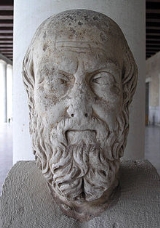
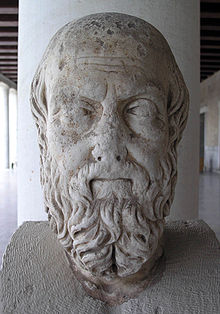
Traditionally, HerodotusHerodotus
Herodotus was an ancient Greek historian who was born in Halicarnassus, Caria and lived in the 5th century BC . He has been called the "Father of History", and was the first historian known to collect his materials systematically, test their accuracy to a certain extent and arrange them in a...
and Thucydides
Thucydides
Thucydides was a Greek historian and author from Alimos. His History of the Peloponnesian War recounts the 5th century BC war between Sparta and Athens to the year 411 BC...
have been regarded as the founders of the discipline of history. Yet that is disputed by many orientalists especially with the notable evidence of the Egyptian hieroglyphics.
Concerning Herodotus
Herodotus
Herodotus was an ancient Greek historian who was born in Halicarnassus, Caria and lived in the 5th century BC . He has been called the "Father of History", and was the first historian known to collect his materials systematically, test their accuracy to a certain extent and arrange them in a...
(5th century BC), one of the earliest historians whose work survives, his recount of strange and unusual tales are gripping but not necessarily representative of the historical record. Despite this, The Histories of Herodotus displays many of the techniques of more modern historians. He interviewed witnesses, evaluated oral histories
Oral history
Oral history is the collection and study of historical information about individuals, families, important events, or everyday life using audiotapes, videotapes, or transcriptions of planned interviews...
, studied multiple sources and then pronounced his particular version. Herodotus's works covered what was then the entire known world of the Greeks
Greeks
The Greeks, also known as the Hellenes , are a nation and ethnic group native to Greece, Cyprus and neighboring regions. They also form a significant diaspora, with Greek communities established around the world....
, or at least the part regarded as worthy of study, i.e., the peoples surrounding the Mediterranean. Herodotus was also known for visiting the various battle sites he wrote about, including the battle of Thermopylae
Battle of Thermopylae
The Battle of Thermopylae was fought between an alliance of Greek city-states, led by King Leonidas of Sparta, and the Persian Empire of Xerxes I over the course of three days, during the second Persian invasion of Greece. It took place simultaneously with the naval battle at Artemisium, in August...
. About 25 years after Herodotus, Thucydides
Thucydides
Thucydides was a Greek historian and author from Alimos. His History of the Peloponnesian War recounts the 5th century BC war between Sparta and Athens to the year 411 BC...
, perhaps the most important of historians, pioneered a different form of history, one much closer to reportage. In his work, History of the Peloponnesian War
History of the Peloponnesian War
The History of the Peloponnesian War is an account of the Peloponnesian War in Ancient Greece, fought between the Peloponnesian League and the Delian League . It was written by Thucydides, an Athenian general who served in the war. It is widely considered a classic and regarded as one of the...
, Thucydides wrote about a single long conflict that lasted 27 years between Athens
Athens
Athens , is the capital and largest city of Greece. Athens dominates the Attica region and is one of the world's oldest cities, as its recorded history spans around 3,400 years. Classical Athens was a powerful city-state...
and Sparta
Sparta
Sparta or Lacedaemon, was a prominent city-state in ancient Greece, situated on the banks of the River Eurotas in Laconia, in south-eastern Peloponnese. It emerged as a political entity around the 10th century BC, when the invading Dorians subjugated the local, non-Dorian population. From c...
with its origins and results. But, as it was mainly within living memory and Thucydides himself was alive throughout the conflict and a participant in many of the events, there was less room for myths and tall tales. Moreover, he included transcriptions of speeches that were delivered by historic figures, although sometimes they were made up by Thucydides himself according to what those people should have said at the moment they delivered them.
Other noteworthy and famous Greek historians include Plutarch
Plutarch
Plutarch then named, on his becoming a Roman citizen, Lucius Mestrius Plutarchus , c. 46 – 120 AD, was a Greek historian, biographer, essayist, and Middle Platonist known primarily for his Parallel Lives and Moralia...
(2nd century AD), who wrote several biographies, the Parallel Lives
Parallel Lives
Plutarch's Lives of the Noble Greeks and Romans, commonly called Parallel Lives or Plutarch's Lives, is a series of biographies of famous men, arranged in tandem to illuminate their common moral virtues or failings, written in the late 1st century...
, in which he wanted to assess the morality of its characters by comparing them in pairs, and Polybius
Polybius
Polybius , Greek ) was a Greek historian of the Hellenistic Period noted for his work, The Histories, which covered the period of 220–146 BC in detail. The work describes in part the rise of the Roman Republic and its gradual domination over Greece...
(3nd century BC), who developed Thucydides's method further, becoming one of the most objective historians of classical antiquity. Polybius is also credited for being the first historian to write a History of the World, and to offer argued explanations and interpretations of history facts, and not only a record of them. The most important Roman historian of the classical world was Tacitus
Tacitus
Publius Cornelius Tacitus was a senator and a historian of the Roman Empire. The surviving portions of his two major works—the Annals and the Histories—examine the reigns of the Roman Emperors Tiberius, Claudius, Nero and those who reigned in the Year of the Four Emperors...
(late 1st and early 2nd century AD). The foremost Roman historian
Roman historiography
Roman Historiography is indebted to the Greeks, who invented the form. The Romans had great models to base their works upon, such as Herodotus and Thucydides. Roman historiographical forms are different from the Greek ones however, and voice very Roman concerns. Unlike the Greeks, Roman...
, he wrote an extremely influential account on Rome in the first century, the Annals
Annals (Tacitus)
The Annals by Tacitus is a history of the reigns of the four Roman Emperors succeeding Caesar Augustus. The surviving parts of the Annals extensively cover most of the reigns of Tiberius and Nero. The title Annals was probably not given by Tacitus, but derives from the fact that he treated this...
. Due to his literary style and the thoroughness of his research—which seemingly included studying Roman imperial archives and heavily relying on Thucydides—and his apparent rigor—for he tended not to support any character or subject, taking an impartial point of view—he was by far the most read and admired historian during the Middle Ages
Middle Ages
The Middle Ages is a periodization of European history from the 5th century to the 15th century. The Middle Ages follows the fall of the Western Roman Empire in 476 and precedes the Early Modern Era. It is the middle period of a three-period division of Western history: Classic, Medieval and Modern...
, the Renaissance
Renaissance
The Renaissance was a cultural movement that spanned roughly the 14th to the 17th century, beginning in Italy in the Late Middle Ages and later spreading to the rest of Europe. The term is also used more loosely to refer to the historical era, but since the changes of the Renaissance were not...
and the early Modern Era. Thus, his historian style has been imitated all through the ages, and had a severe impact in Edward Gibbon
Edward Gibbon
Edward Gibbon was an English historian and Member of Parliament...
and Montesquieu, usually considered as the first modern historians.
India
India
India , officially the Republic of India , is a country in South Asia. It is the seventh-largest country by geographical area, the second-most populous country with over 1.2 billion people, and the most populous democracy in the world...
has a long record of historiography with chronicles being maintained by dynasties, monks and communities. The texts of ancient and medieval India are in verse, unlike Europe where serious work in history was in prose. The Vedas
Vedas
The Vedas are a large body of texts originating in ancient India. Composed in Vedic Sanskrit, the texts constitute the oldest layer of Sanskrit literature and the oldest scriptures of Hinduism....
, Puranas
Puranas
The Puranas are a genre of important Hindu, Jain and Buddhist religious texts, notably consisting of narratives of the history of the universe from creation to destruction, genealogies of kings, heroes, sages, and demigods, and descriptions of Hindu cosmology, philosophy, and geography.Puranas...
and the two epics, Ramayana
Ramayana
The Ramayana is an ancient Sanskrit epic. It is ascribed to the Hindu sage Valmiki and forms an important part of the Hindu canon , considered to be itihāsa. The Ramayana is one of the two great epics of India and Nepal, the other being the Mahabharata...
and Mahabharata
Mahabharata
The Mahabharata is one of the two major Sanskrit epics of ancient India and Nepal, the other being the Ramayana. The epic is part of itihasa....
narrate many events in ancient India although not always in a linear fashion. The Mahabharata is in fact an epic centered mainly around the House of the Kurus
Kurus
Kuruş is a Turkish currency subunit. Since 2005, one new Turkish lira is equal to 100 kuruş. The kuruş was also the standard unit of currency in the Ottoman Empire until 1844, and from that date until the late 1970s was a subdivision of the former lira. It was subdivided into 40 para , each of...
, who ruled a large part of northern India. It was progressively called Jai, Vijaya, Bharata and finally Mahabharata. The Puranas are also chronicles of past events and owe their name to the Sanskrit word Purah ( Before ). Jain and Buddhist monks also chronicled many events in ancient India in their scriptures. The Tripitakas which narrate the travels and teachings of the Buddha
Buddha
In Buddhism, buddhahood is the state of perfect enlightenment attained by a buddha .In Buddhism, the term buddha usually refers to one who has become enlightened...
, mention many towns and cities in ancient India and the customs prevalent therein.
Sima Qian
Sima Qian
Sima Qian was a Prefect of the Grand Scribes of the Han Dynasty. He is regarded as the father of Chinese historiography for his highly praised work, Records of the Grand Historian , a "Jizhuanti"-style general history of China, covering more than two thousand years from the Yellow Emperor to...
(145-86 BC), a Prefect of the Grand Scribes (太史令) of the Han Dynasty
Han Dynasty
The Han Dynasty was the second imperial dynasty of China, preceded by the Qin Dynasty and succeeded by the Three Kingdoms . It was founded by the rebel leader Liu Bang, known posthumously as Emperor Gaozu of Han. It was briefly interrupted by the Xin Dynasty of the former regent Wang Mang...
(202 BC - 220 AD), is regarded as the father of Chinese historiography
Chinese historiography
Chinese historiography refers to the study of methods and assumptions made in studying Chinese history.-History of Chinese Historians:Record of Chinese history dated back to the Shang Dynasty. The Classic of History, one of the Five Classics of Chinese classic texts is one of the earliest...
because of his universal history, the Records of the Grand Historian
Records of the Grand Historian
The Records of the Grand Historian, also known in English by the Chinese name Shiji , written from 109 BC to 91 BC, was the Magnum opus of Sima Qian, in which he recounted Chinese history from the time of the Yellow Emperor until his own time...
(史記). It provides an overview of the history of China
History of China
Chinese civilization originated in various regional centers along both the Yellow River and the Yangtze River valleys in the Neolithic era, but the Yellow River is said to be the Cradle of Chinese Civilization. With thousands of years of continuous history, China is one of the world's oldest...
covering more than two thousand years from the legendary Yellow Emperor
Yellow Emperor
The Yellow Emperor or Huangdi1 is a legendary Chinese sovereign and culture hero, included among the Three Sovereigns and Five Emperors. Tradition holds that he reigned from 2697–2597 or 2696–2598 BC...
to Sima's contemporary Emperor Han Wudi
Emperor Wu of Han
Emperor Wu of Han , , personal name Liu Che , was the seventh emperor of the Han Dynasty of China, ruling from 141 BC to 87 BC. Emperor Wu is best remembered for the vast territorial expansion that occurred under his reign, as well as the strong and centralized Confucian state he organized...
(漢武帝). His work laid the foundation for the Twenty-Four Histories
Twenty-Four Histories
The Twenty-Four Histories is a collection of Chinese historical books covering a period from 3000 BC to the Ming Dynasty in the 17th century. The whole set contains 3213 volumes and about 40 million words...
which, unlike Sima's independent endeavor, were government-sponsored works usually commissioned by new dynastic houses after the conquest of the previous dynasty.
Ibn Abd-el-Hakem
Ibn Abd-el-Hakem
Ibn ʿAbd al-Ḥakam was an Egyptian chronicler who wrote the History of the Conquest of Egypt and North Africa and Spain.His work is invaluable as the earliest Arab account of the Islamic conquests of those countries. This work was written about 150-200 years after the events it describes, and...
was an Egyptian who wrote the History of the Conquest of Egypt and North Africa and Spain, which was the earliest Arab account of the Islamic conquests of those countries. Much like Herodotus' works, it mixes facts with legends, and was often quoted by later Islamic historians. Al-Jahiz
Al-Jahiz
Al-Jāḥiẓ was an Arabic prose writer and author of works of literature, Mu'tazili theology, and politico-religious polemics.In biology, Al-Jahiz introduced the concept of food chains and also proposed a scheme of animal evolution that entailed...
was a famous Arab scholar and historian. Hamdani
Hamdani
' was an Arab Muslim geographer, poet, grammarian, historian, and astronomer, from the tribe of Banu Hamadan, western 'Amran/Yemen. He was one of the best representatives of Islamic culture during the last effective years of the Abbasid caliphate....
, an Arab historian,was the best representatives of Islamic culture during the last effective years of the Abbasid caliphate. Ali al-Masudi was an Arab historian, known as the “Herodotus of the Arabs.” Ibn Khaldun
Ibn Khaldun
Ibn Khaldūn or Ibn Khaldoun was an Arab Tunisian historiographer and historian who is often viewed as one of the forerunners of modern historiography, sociology and economics...
was a famous Arab Muslim historian and was the forefather of historiography
Historiography
Historiography refers either to the study of the history and methodology of history as a discipline, or to a body of historical work on a specialized topic...
and the philosophy of history
Philosophy of history
The term philosophy of history refers to the theoretical aspect of history, in two senses. It is customary to distinguish critical philosophy of history from speculative philosophy of history...
. He is best known for his Muqaddimah
Muqaddimah
The Muqaddimah , also known as the Muqaddimah of Ibn Khaldun or the Prolegomena , is a book written by the Maghrebian Muslim historian Ibn Khaldun in 1377 which records an early view of universal history...
"Prolegomenon".
Much of the groundwork in creating the modern figure of the historian was done by Charles de Secondat, baron de Montesquieu
Charles de Secondat, baron de Montesquieu
Charles-Louis de Secondat, baron de La Brède et de Montesquieu , generally referred to as simply Montesquieu, was a French social commentator and political thinker who lived during the Enlightenment...
(1689–1755). His wide-ranging Spirit of the Laws (1748) spanned legal, geographical, cultural, economic, political and philosophical studies and was greatly influential in forging the fundamentally interdisciplinary historian. Referred to as "the first modern historian", Edward Gibbon
Edward Gibbon
Edward Gibbon was an English historian and Member of Parliament...
wrote his magnum opus, The History of the Decline and Fall of the Roman Empire
The History of the Decline and Fall of the Roman Empire
The History of the Decline and Fall of the Roman Empire is a non-fiction history book written by English historian Edward Gibbon and published in six volumes. Volume I was published in 1776, and went through six printings. Volumes II and III were published in 1781; volumes IV, V, VI in 1788–89...
(three vols., 1776–1788). However, some authors such as Christiansen regard ancient Greek author Polybius
Polybius
Polybius , Greek ) was a Greek historian of the Hellenistic Period noted for his work, The Histories, which covered the period of 220–146 BC in detail. The work describes in part the rise of the Roman Republic and its gradual domination over Greece...
as the first historian of a modern kind, criticising sources and making unbiased judgements based on presumed neutral analysis; indeed, Livy
Livy
Titus Livius — known as Livy in English — was a Roman historian who wrote a monumental history of Rome and the Roman people. Ab Urbe Condita Libri, "Chapters from the Foundation of the City," covering the period from the earliest legends of Rome well before the traditional foundation in 753 BC...
used him as a source. Polybius, one of the first historians to attempt to present history as a sequence of causes and effects, carefully conducted his research—partly based on what he saw and partly on the communications of eye-witnesses and the participants in the events.
Twentieth-century developments
At the dawn of the twentieth century, Western history remained oriented toward the "great man theoryGreat man theory
The Great Man Theory was a popular 19th century idea according to which history can be largely explained by the impact of "great men", or heroes: highly influential individuals who, due to either their personal charisma, intelligence, wisdom, or Machiavellianism utilized their power in a way that...
" of history concerning war
War
War is a state of organized, armed, and often prolonged conflict carried on between states, nations, or other parties typified by extreme aggression, social disruption, and usually high mortality. War should be understood as an actual, intentional and widespread armed conflict between political...
, diplomacy
Diplomacy
Diplomacy is the art and practice of conducting negotiations between representatives of groups or states...
, science
Science
Science is a systematic enterprise that builds and organizes knowledge in the form of testable explanations and predictions about the universe...
and high politics
High politics
Within the subfield of international relations, and political science as a whole, the concept high politics covers all matters that are vital to the very survival of the state: namely national and international security concerns...
. This point of view was predisposed toward the study of a small number of powerful men within a given socio-economic elite. More often than not, this has been furthered by the traditional whig
Whig history
Whig history is the approach to historiography which presents the past as an inevitable progression towards ever greater liberty and enlightenment, culminating in modern forms of liberal democracy and constitutional monarchy. In general, Whig historians stress the rise of constitutional government,...
school of thought, which holds that history is "protestant
Protestantism
Protestantism is one of the three major groupings within Christianity. It is a movement that began in Germany in the early 16th century as a reaction against medieval Roman Catholic doctrines and practices, especially in regards to salvation, justification, and ecclesiology.The doctrines of the...
, progressive
Progressivism
Progressivism is an umbrella term for a political ideology advocating or favoring social, political, and economic reform or changes. Progressivism is often viewed by some conservatives, constitutionalists, and libertarians to be in opposition to conservative or reactionary ideologies.The...
... [and] studies the past with reference to the present." This has been gradually been replaced with a more critical perspective. For example, it is a common misconception that Thomas Edison
Thomas Edison
Thomas Alva Edison was an American inventor and businessman. He developed many devices that greatly influenced life around the world, including the phonograph, the motion picture camera, and a long-lasting, practical electric light bulb. In addition, he created the world’s first industrial...
alone invented the incandescent light bulb
Incandescent light bulb
The incandescent light bulb, incandescent lamp or incandescent light globe makes light by heating a metal filament wire to a high temperature until it glows. The hot filament is protected from air by a glass bulb that is filled with inert gas or evacuated. In a halogen lamp, a chemical process...
; a traditional history might highlight Edison's invention at the expense of all others. In contrast, a modern history of Edison or the lightbulb mentions Joseph Wilson Swan, Heinrich Göbel
Heinrich Göbel
Heinrich Göbel, later Henry Goebel , born in Springe, Germany, was a precision mechanic. He emigrated in 1848 to New York City and lived there until his death. In 1865 he changed his nationality....
, A.N. Lodygin, and Warren De la Rue
Warren de la Rue
Warren De la Rue was a British astronomer and chemist, most famous for his pioneering work in astronomical photography.-Biography:...
in order to show that Edison's activities were one part of a group of inventors and rivals in the commercial deployment of the technology.
Since the 1960s
1960s
The 1960s was the decade that started on January 1, 1960, and ended on December 31, 1969. It was the seventh decade of the 20th century.The 1960s term also refers to an era more often called The Sixties, denoting the complex of inter-related cultural and political trends across the globe...
, history as an academic discipline has undergone several evolutions. These changes fostered advances in a number of areas previously disregarded in historiography. Formerly neglected topics have become the subject of academic study, such as the history of popular and mass culture
Popular culture
Popular culture is the totality of ideas, perspectives, attitudes, memes, images and other phenomena that are deemed preferred per an informal consensus within the mainstream of a given culture, especially Western culture of the early to mid 20th century and the emerging global mainstream of the...
, sexuality
Human sexuality
Human sexuality is the awareness of gender differences, and the capacity to have erotic experiences and responses. Human sexuality can also be described as the way someone is sexually attracted to another person whether it is to opposite sexes , to the same sex , to either sexes , or not being...
, cultural geography
Cultural geography
Cultural geography is a sub-field within human geography. Cultural geography is the study of cultural products and norms and their variations across and relations to spaces and places...
, and the lives of ordinary people
People's history
A people's history or history from below is a type of historical narrative which attempts to account for historical events from the perspective of common people rather than political and other leaders.-Description:...
. Starting in the 1960s—and some would say earlier--revisionist historians
Historical revisionism
In historiography, historical revisionism is the reinterpretation of orthodox views on evidence, motivations, and decision-making processes surrounding a historical event...
have attempted to "set the record straight" by redefining the impression society holds of the past. For instance, in his ground-breaking Roll, Jordan, Roll, historian Eugene D. Genovese
Eugene D. Genovese
Eugene Dominic Genovese is an American historian of the American South and American slavery. He has been noted for bringing a Marxist perspective to the study of power, class and relations between planters and slaves in the South. His work Roll, Jordan, Roll: The World the Slaves Made won the...
focused not on white Southern slaveholders—as more traditional historians have done--but on the experiences of African Americans under slavery—hence the subtitle, "The World the Slaves Made". Edward Said's
Edward Said
Edward Wadie Saïd was a Palestinian-American literary theorist and advocate for Palestinian rights. He was University Professor of English and Comparative Literature at Columbia University and a founding figure in postcolonialism...
Orientalism
Orientalism (book)
Orientalism is a book published in 1978 by Edward Said that has been highly influential and controversial in postcolonial studies and other fields. In the book, Said effectively redefined the term "Orientalism" to mean a constellation of false assumptions underlying Western attitudes toward the...
is another revisionist classic, in which Said examines how and why Western societies so quickly came to consider non-Western ones as inherently inferior. One of the most popular revisionist works is Howard Zinn's
Howard Zinn
Howard Zinn was an American historian, academic, author, playwright, and social activist. Before and during his tenure as a political science professor at Boston University from 1964-88 he wrote more than 20 books, which included his best-selling and influential A People's History of the United...
1980 book, A People's History of the United States
A People's History of the United States
Chapter 7, "As Long As Grass Grows or Water Runs" discusses 19th century conflicts between the U.S. government and Native Americans and Indian removal, especially during the administrations of Andrew Jackson and Martin Van Buren....
, where Zinn attempts to discuss all those left out of "great man history": workers, slaves, women, blacks, Hispanics, Asians, and leftist political radicals and activists.
While revisionist history has resulted in the flowering of new historical approaches and subjects, some historians are divided on just how positive this change is. Most historians are pleased with this proliferation of historical subjects and actors, such as the growth of the history of sexuality and gender analysis—which includes both women's history
Women's history
Women's history is the study of the role that women have played in history, together with the methods needed to study women. It includes the study of the history of the growth of woman's rights throughout recorded history, the examination of individual women of historical significance, and the...
and the study of masculinity. Scholarship on various ethnic or racial groups has grown, especially in American history: historians now focus on the experience of blacks, Asians, and Hispanics in America, as well as the lives of Irish, Italians, and other Southern or Eastern European immigrants groups. That said, some historians have complained of the fracturing and atomization of the historical field. As historians examine increasingly smaller subjects, few historians are willing (or able) to tackle all of the various historiographies relevant to a broader interpretive or analytic synthesis. Indeed, scholars have been calling for a "new synthesis" in American history for a good decade now.
Education and profession
An undergraduate history degree is often used as a stepping stone to graduate studies in business or law. Many historians are employed at universities and other facilities for post-secondary education. In addition, it is normal for colleges and universities to require the PhD degree for new full-time hires, and a Masters degree for part-timers. Publication is increasingly required by smaller schools, so graduate papers become journal articles and PhD dissertations become published monographs. The graduate student experience is difficult—those who finish take on average 8 or more years; funding is scarce except at a few very rich universities. Being a teaching assistant in a course is required in some programs; in others it is a paid opportunity awarded a fraction of the students. Until the 1980s it was rare for graduate programs to teach how to teach; the assumption was that teaching was easy and that learning how to do research was the main mission.Professional historians typically work in colleges and universities, archival centers, government agencies, museums, and as freelance writers and consultants. The job market for new PhDs in history is poor and getting worse, with many relegated to part-time "adjunct" teaching jobs with low pay and no benefits.
See also
- HistoriographyHistoriographyHistoriography refers either to the study of the history and methodology of history as a discipline, or to a body of historical work on a specialized topic...
- List of historians
- List of historians by area of study
- AntiquarianAntiquarianAn antiquarian or antiquary is an aficionado or student of antiquities or things of the past. More specifically, the term is used for those who study history with particular attention to ancient objects of art or science, archaeological and historic sites, or historic archives and manuscripts...
- Auxiliary sciences of historyAuxiliary sciences of historyAuxiliary sciences of history are scholarly disciplines which help evaluate and use historical sources and are seen as auxiliary for historical research...
- American Historical AssociationAmerican Historical AssociationThe American Historical Association is the oldest and largest society of historians and professors of history in the United States. Founded in 1884, the association promotes historical studies, the teaching of history, and the preservation of and access to historical materials...
- List of Russian historians