

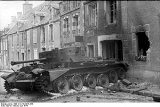
Battle of Villers-Bocage

Encyclopedia
The Battle of Villers-Bocage took place during the Second World War on 13 June 1944, one week after the Allies
landed in Normandy to begin the liberation of German
-occupied France. The battle was the result of a British attempt to improve their position by exploiting a temporary vulnerability in the German defences to the west of the city of Caen
. After one day of fighting in and around the small town of Villers-Bocage
and a second day defending a position outside the town, the British force retired largely intact.
Both British and Germans regarded control of Caen as vital to the Normandy battle. In the days following the Allied D-Day
landings of 6 June, the Germans rapidly established strong defences in front of the city. On 9 June a two-pronged British attempt to surround and capture Caen was defeated, but on the British forces' right flank, neighbouring American units had forced open a wide gap in the German front line. Seizing the opportunity to bypass Caen's defences, a mixed mobile force of tanks, infantry and artillery, formed around the 7th Armoured Division's 22nd Armoured Brigade, advanced through the gap in a flanking manoeuvre towards Villers-Bocage. British commanders hoped that the appearance of a strong force in their rear would force the German defenders of Caen's western approaches—principally the Panzer Lehr armoured division—to surrender or withdraw.
Under the command of Brigadier William "Loony" Hinde, the 22nd Armoured Brigade group reached Villers-Bocage without serious incident, but as its lead elements moved beyond the town on the morning of 13 June they were ambushed by Tiger I
tanks of the 101st SS Heavy Panzer Battalion. In fewer than 15 minutes numerous tanks, anti-tank guns and transport vehicles fell victim to the German force, the vast majority being destroyed by SS
-Obersturmführer
Michael Wittmann
's tank. With reinforcements arriving the Germans then launched an assault on the town. Although this was repelled, after six hours Hinde decided to withdraw his force to a more defensible position outside Villers-Bocage. The following day fighting resumed in the Battle of the island. The British defended their position until a controversial decision was taken to pull the Brigade group back from its salient. Villers-Bocage played no further role in the Second Army's Battle for Caen
; the town was eventually liberated on 4 August, although by then it had been bombed twice by the Royal Air Force
and was largely in ruins.
The Battle of Villers-Bocage has proved a contentious subject among students of the campaign because the British withdrawal marked the end of the post D-Day "scramble for ground" and the start of a grinding attritional battle
for Caen. Most historians conclude that its failure was due to a lack of conviction among some senior commanders rather than a military defeat, although a few also maintain that the force committed was inadequate for the task. In particular Michael Wittmann's single-handed action during the battle's early stages has excited imaginations, to the extent that recent historians argue that it has disproportionately dominated the historical record and that, while "remarkable", Wittmann's role in deciding the battle's outcome has been exaggerated.
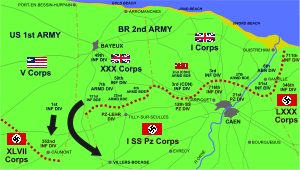 For the soldiers of I Corps's 3rd Infantry Division who stormed ashore on Sword beach
on 6 June 1944, the city of Caen some 9 miles (14.5 km) inland was the ultimate goal. Possession of Caen was especially attractive to Allied planners; the surrounding country contained airfields and was open, dry, and conducive to swift offensive operations where the Allies could bring their numerical superiority in tanks and mobile units to bear. The city's capture on D-Day
was described by Chester Wilmot
as an "ambitious" request to make of troops who would be landing "last, on the most exposed beaches, with the farthest to go, against what was potentially the greatest opposition". It proved to be beyond the 3rd Infantry Division's means. Congestion in the beachhead delayed the division's armoured support, and its thrust inland grew progressively weaker as it was forced to fight past strongly held German positions en route. The advance ran out of steam before nightfall, stopped short of Caen's outskirts by elements of the 21st Panzer Division.
The next day, following their pre-invasion timetable, the British launched Operation Perch
. Envisaged as an advance to the southeast of Caen when it was planned before D-Day, Perch was heavily reliant on the city's rapid capture. For a few days, I Corps continued to attack the outskirts of Caen, but the Germans regarded the city and its surroundings as the linchpin of their position in Normandy and poured reinforcements into the area. With resistance solidifying it became clear to the British that any opportunity to rush Caen's defences with small-scale actions had passed. On 9 June the Allied ground forces commander, General Bernard Montgomery, altered Perch to incorporate a major two-pronged assault
intended to surround and take the city.
After a delay caused by manoeuvring forces into position, on 12 June simultaneous attacks were launched to the west and east of Caen. Leading the drive around the eastern side of Caen, the 51st (Highland) Infantry Division soon ran into stiff resistance from the 21st Panzer Division. With casualties mounting for minimal gains, the next day the Highlanders' attack was called off. To the west of Caen XXX Corps was no more successful, rapidly becoming bogged down in heavy fighting for the village of Tilly-sur-Seulles
. Defending the village was the newly arrived Panzer Lehr Division—one of the most powerful armoured formations in the German Army.
including LXXXXIV Korps's reserves, leaving only the battered 352nd Infantry Division covering the Trévières
–Agy
sector. The 352nd had been in continuous action since its defence of Omaha Beach
on 6 June and had received few replacements for the heavy losses it had suffered. Under severe pressure from American attacks, the 352nd's left flank collapsed. With its position no longer tenable, on the night of 9–10 June the division pulled back to Saint-Lô. This withdrawal created a 7.5 miles (12.1 km) hole in the German lines near the village of Caumont-l'Éventé
, dubbed by the Allies the 'Caumont Gap'. Only the 17th SS-Panzergrenadier Division
's reconnaissance battalion remained in the area. The Germans made plans to bring up the 2nd Panzer Division, but on 10 June the bulk of the division was strung out between Amiens
and Alençon
and was not expected to arrive in strength until 13 June. Reluctant to commit 2nd Panzer until it was fully assembled, General der Panzertruppe
Hans Freiherr von Funck
, of XLVII Panzer Korps
, was nevertheless persuaded to rush the division's reconnaissance battalion to Caumont with orders to hold the high ground there.
Conscious of the opportunity to bypass Caen's western defences by exploiting the Caumont Gap, British Second Army commander Lieutenant-General Miles Dempsey
met with Lieutenant-General Gerard Bucknall
, commanding XXX Corps, and Major-General
George Erskine
, commanding the 7th Armoured Division. Erskine was ordered to disengage his tanks from the fighting around Tilly-sur-Seulles. The 7th Armoured Division was now to move through the gap, seize the town of Villers-Bocage behind the front line, and menace the Panzer Lehr Division's exposed flank. The British objective was a ridge 1.6 miles (2.6 km) to the east of Villers-Bocage; Dempsey hoped that the appearance of a strong force in Panzer Lehr's rear, occupying high ground and interdicting important lines of communication, would compel the German division to withdraw or surrender and thus break the deadlock to the west of Caen. The 50th (Northumbrian) Infantry Division would maintain pressure against the Panzer Lehr Division around Tilly-sur-Seulles to support the attack while elements of the United States V Corps would push forward.
Despite the need for rapid action to take full advantage of the German vulnerability, the 7th Armoured Division was slow to redeploy and spent the morning of 12 June attempting to advance on Tilly-sur-Seulles according to its original orders. At 12:00 a meeting was held between Major-General Erskine and Brigadier Hinde, the commanding officer of the division's 22nd Armoured Brigade. Hinde was ordered to move immediately through the gap. Soon afterwards the 8th King's Royal Irish Hussars
—the division's armoured reconnaissance regiment—began to reconnoitre the route the brigade would take; the rest of the division departed from the village of Trungy at around 16:00. Four hours later the main body was approaching Livry after a 12 miles (19.3 km) unopposed advance, the last 6 miles (9.7 km) of which were though German-held territory. Minor resistance was encountered when the 8th Hussars' leading Cromwell tank
s were destroyed by an anti-tank gun of the Panzer Lehr Division's Escort Company, but riflemen and more tanks were brought forward and within two hours the position was cleared.
Hoping to keep the Germans guessing as to his force's objective, on reaching the vicinity of la Mulotiere, north of Livry, Hinde ordered a halt for the night. While the main force conducted routine maintenance, the 8th King's Royal Irish and 11th (Prince Albert's Own)
Hussars (the division's armoured car regiment) reconnoitred the flanks. The 11th Hussars found no resistance on the right flank and linked up with the US 1st Infantry Division near Caumont, while on the left flank the 8th Hussars located elements of the Panzer Lehr Division just under 2 miles (3.2 km) away.
(4CLY), with one company of the 1st Battalion the Rifle Brigade, was to pass through Villers-Bocage and occupy Point 213, the highest point of the ridge. The 1/7th Queen's Royal Regiment (West Surrey)
would follow up and occupy the town itself, while the 5th Royal Tank Regiment
(5RTR), with a further company of the Rifle Brigade, was to take up positions on a second area of high ground to the southwest of the town at Maisoncelles-Pelvey
. Equipped with M10 Achilles self propelled anti-tank guns
, the 260th Anti-tank Battery of the Norfolk Yeomanry
would cover the gap between 4CLY and 5RTR. The 5th Royal Horse Artillery (5RHA), equipped with Sexton self propelled artillery guns
, would advance behind the rest of the brigade. The 5RHA and the brigade's tactical headquarters were established to the west of the town at Amayé-sur-Seulles
. Hinde's two Hussar regiments were to provide flank protection, act as a buffer, screen the British from the Panzer Lehr, and seek out enemy positions on either side of the line of advance. The remainder of the division—the 131st Infantry Brigade with the 1st Royal Tank Regiment
(1RTR) and the 1/5th and 1/6th battalions Queen's Royal Regiment (West Surrey)—was to position itself in the Livry area to hold a "firm base", keeping the Brigade group's line of communication secure.
Having done all they could in the short term to address the gaping hole in their front by sending light reconnaissance forces to cover the Caumont area until newly arriving divisions had assembled, the Germans turned their attention to their open left flank. I SS-Panzer Korps commander Obergruppenführer
Sepp Dietrich
ordered his only reserve, the 101st SS Heavy Panzer Battalion, to position itself behind the Panzer Lehr and 12th SS-Panzer divisions in the Villers-Bocage area, as a precaution against any Allied attempt to hook through the Caumont Gap.
.jpg) The 101st SS Heavy Panzer Battalion had arrived in Normandy on 12 June, after a five day, 160 miles (257.5 km) drive from Beauvais
The 101st SS Heavy Panzer Battalion had arrived in Normandy on 12 June, after a five day, 160 miles (257.5 km) drive from Beauvais
. Mustering 45 Tiger I
tanks at full strength, the battalion had come under severe air attack near Versailles and been reduced to around 17 serviceable tanks. The battalion's 1st Company was situated 5.6 miles (9 km) northeast of Villers-Bocage; the 2nd Company, under the command of SS-Obersturmführer Michael Wittmann, was just south of Point 213 on the Villers-Bocage ridge; and the 3rd, with only one serviceable tank, was near Falaise
and would not reach the front for another two days. Wittmann's 2nd Company nominally consisted of 12 tanks, but through a combination of losses and mechanical failures only Tigers 212, 213, 214, 224, 231, and 232 were present on 13 June.
The area around Villers-Bocage came under heavy naval artillery fire during the night of 12/13 June and fearing that he had been spotted, Wittmann relocated his company three times. The long drive to Villers-Bocage had caused significant wear to the tanks, so he scheduled a mechanical overhaul for the following morning.
As the column approached Villers-Bocage a German Sd.Kfz. 231 armoured car was sighted some distance off. Its commander had clearly observed the British advance, but the nearest British tank was unable to traverse its turret to engage and by the time a second tank had moved into position the armoured car had withdrawn. At 08:30, having safely covered the 5 miles (8 km) from its overnight position, the 22nd Armoured Brigade group entered the town to be greeted by celebrating residents; two German soldiers were spotted leaving at high speed in a Volkswagen Kübelwagen
car. The two Hussar regiments made contact with German forces on either side of the 22nd Brigade group's advance, with the 8th Hussars engaging eight-wheeled armoured cars. They reported seeing German tanks heading towards Villers-Bocage but Lieutenant Charles Pearce, of 4CLY, believed that these were probably misidentified self-propelled guns.
Major Wright, commanding officer of the 1st Rifle Brigade, called a conference to be held on Point 213 and attended by all officers and senior NCO
s of A Company. Moving towards the ridge in a single half-track
, it was realised that one enemy shell could wipe out the company's entire command capability, so the half-track's occupants were rapidly dispersed among several other vehicles. In Villers-Bocage, Lieutenant-Colonel Arthur, Viscount Cranley
, commanding officer of 4CLY, expressed concern that his men were "out on a limb"; he was assured by Brigadier Hinde that all was well, and ordered to Point 213 to ensure his men had taken up good defensive positions. Hinde then left Villers-Bocage for his headquarters.
South of Point 213 with his men of 2nd Company, 101st SS Heavy Panzer Battalion, Wittmann was surprised to discover British armour advancing through Villers-Bocage much sooner than had been expected. He later stated: "I had no time to assemble my company; instead I had to act quickly, as I had to assume that the enemy had already spotted me and would destroy me where I stood. I set off with one tank and passed the order to the others not to retreat a single step but to hold their ground."
Wittmann's Tiger was spotted at approximately 09:00 by Sergeant O'Connor of the Rifle Brigade, who was travelling towards Point 213 in a half-track and broke radio silence to give the only warning the British force received. The Tiger emerged from cover onto Route Nationale 175 and engaged the rearmost tank of A Squadron 4CLY at Point 213—a Cromwell
—destroying it. A Sherman Firefly
responded but was itself 'knocked out'. Burning, the Firefly came to rest across the road, impeding any attempt to either reinforce the ridge or to withdraw from it. The British at Point 213 then came under fire from the rest of Wittmann's command, losing three more tanks.
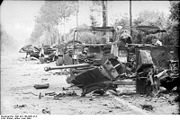 Wittmann now headed for Villers-Bocage. Along the road the men of the Rifle Brigade desperately attempted to find PIAT
anti-tank weapons and set up a 6 pounder anti-tank gun
, but as the Tiger drew closer panic set in and the riflemen abandoned their efforts and sought shelter. Along the roadside, one by one the brigade's carriers burst into flames as their fuel tanks were ruptured by machine gun and high explosive fire. However, few casualties were inflicted. Reaching the eastern end of Villers-Bocage, Wittmann engaged three M5 Stuart light tanks of the 4CLY's reconnaissance troop. One, under the command of Lieutenant Ingram, attempted to block the road but was hit, exploding violently. The other two soon followed suit.
In the town the tanks of 4CLY's Regimental Headquarters attempted to escape, but their reverse speed was "painfully slow". One engaged Wittmann's Tiger, managing to get off two shots before being destroyed. Two others, their commanders believing they were being engaged from the flank, reversed off the road into gardens; 4CLY's Adjutant, Captain
Pat Dyas, found his Cromwell further screened behind a small barn. The Tiger rammed its way past the wrecked Stuart and continued towards the centre of town, knocking out one of the two British tanks but missing Dyas. Lieutenant Charles Pearce took his scout car
and, locating the rest of the reconnaissance troop in the middle of town, warned them about what was coming their way. While they quickly got off the road Pearce continued further west to alert 4CLY's B Squadron. Wittmann, meanwhile, had accounted for another Cromwell, and as he made his way onto Villers-Bocage's main street destroyed two artillery Observation Post (OP) tanks—a Cromwell and a Sherman—belonging to 5RHA. These were followed by the intelligence officer's scout car and the medical officer's half-track.
 Accounts differ as to what happened next. Historians George Forty and Daniel Taylor record that following the destruction of the OP tanks, Wittmann briefly duelled without success against a Sherman Firefly before withdrawing. This duel collapsed a house that also contained a German sniper, as shells from Wittmann’s Tiger hit it. In the Yeomanry Association's The Sharpshooter newsletter, tanker Robert Moore recalls that he was the one responsible for forcing Wittmann to pull back, when a shot from his tank dented the Tiger's driver visor. These accounts attest that Wittmann's withdrawal brought him face to face with Dyas's Cromwell, which, having been bypassed, had been following the Tiger seeking a shot at its thinner rear armour. Dyas opened fire without effect; Wittmann returned fire and destroyed the British tank. Charles Pearce, however, puts the destruction of Dyas's tank earlier, suggesting that Wittmann had engaged it by traversing the Tiger's turret around before advancing onto the town's main street; a position supported by historian Henri Marie. Escaping the destruction of his tank, Dyas was shot at by German infantry positioned in houses along the street. Wittmann's Tiger is reported to have continued eastwards to the outskirts of Villers-Bocage before being disabled at the road junction to Tilly-sur-Seulles by a 6 Pounder anti-tank gun under the command of Sergeant Bray. However, Wittmann's own account contradicts this. He states that his tank was disabled by an anti-tank gun in the town centre.
In fewer than 15 minutes, 13–14 tanks, two anti-tank guns and 13–15 transport vehicles had been destroyed by the 101st SS Heavy Panzer Battalion, the vast majority by Wittmann's tank. Now on foot, Wittmann made his way to the headquarters of the Panzer Lehr Division at the Cháteau d'Orbois, 3.7 miles (6 km) north of Villers-Bocage.
In the wake of the 101st SS Heavy Panzer Battalion's 2nd Company's attack on Point 213, A Squadron 4CLY mustered nine operational tanks including two Fireflys and a Cromwell OP tank, although some were without their full complement of crew. In support was a single section
of riflemen and an equal number of officers. The senior officers decided that the force would hold its position on the ridge until reinforcements arrived and set about organising an all round defence
. At around 10:00 elements of the 101st SS Heavy Panzer Battalion's 4th Company—its support and reconnaissance troops—reached the battlefield and began to round up isolated British tankers and riflemen in the area between the ridge and the town. Some managed to evade capture; over the next 24 hours around 30 worked their way back to British lines.
During the rest of the morning the troops of the 1/7th Battalion, Queen's Royal Regiment (QRR) took up defensive positions within Villers-Bocage, capturing an advance party of three men from the 2nd Panzer Division. A force was put together to attempt to extricate the troops on the ridge, but this idea was soon abandoned. Around 10:30 Viscount Cranley reported over the radio that the position on Point 213 was becoming untenable, and withdrawal was now impossible. Nevertheless a breakout was planned and two hours later a Cromwell attempted to negotiate its way back to Villers-Bocage by a roundabout route, but was knocked out by a German tank. The Germans then started to shell the trees bordering the road, causing the shells to air burst
and spray the area with splinters. After five minutes of this, the troops on the ridge decided to surrender. The British made an effort to burn their tanks before they fell into enemy hands, but German soldiers were quick on the scene. Thirty members of the County of London Yeomanry were taken prisoner, along with some riflemen and troops of the Royal Horse Artillery. A few men managed to escape, such as Captain Christopher Milner MC
of the Rifle Brigade, who spent the rest of the day on the run and crossed back into British lines after dark.
 On arriving at the Panzer Lehr's headquarters Wittmann briefed the division's intelligence officer, Oberstleutnant
Kauffmann, on the situation in Villers-Bocage. He was then provided with a Schwimmwagen and returned to Point 213. By the time he arrived the 101st SS Heavy Panzer Battalion's 1st Company, under the command of SS-Hauptsturmführer
Rolf Möbius, was on the scene, but although the two discussed the situation Wittmann played no further part in the battle. Meanwhile, Kauffmann ordered Hauptmann
Helmut Ritgen to assemble what force he could and block the northern exits to the town. With 15 Panzer IV
tanks, mainly from 6th Company 2nd Battalion Panzer Lehr Regiment 130, and a further 10 collected from a workshop south of Route Nationale 175, Ritgen rendezvoused with the Panzer Lehr Division's commanding officer, Generalleutnant
Fritz Bayerlein
, at Villy-Bocage
. Bayerlein confirmed Ritgen's orders, but as Ritgen's tanks moved towards Villers-Bocage they ran into a screen of British anti-tank guns, losing one tank that burst into flames. A group of four Panzer IVs then entered the town from the south; the lead two tanks were knocked out and the others withdrew.
In Villers-Bocage, A Company 1/7th QRR was tasked with securing the railway station and surrounding area, while B and C companies were to occupy the eastern side of the town. However, German infantry had already started to infiltrate Villers-Bocage and scattered house-to-house fighting and skirmishing broke out. Two German tanks were damaged and driven off, but the QRR battalion's infantry companies were rapidly losing cohesion and were ordered to fall back to reorganise. A Company was again ordered to secure the railway station, while C Company was assigned the north-eastern edge of the town and D Company the south-eastern edge. B Company was placed in reserve and the battalion's anti-tank guns distributed along the front line. At the town square an ambush
site was established by Lieutenant Bill Cotton of 4CLY. A Sherman Firefly and several Cromwell tanks, supported by a 6 pounder anti-tank gun and infantrymen from 1/7th QRR armed with PIAT anti tank weapons, laid in wait for German tanks to move down the town's main street. To the west of the town further fighting took place as the Germans attacked the 1/5th QRR near Livry, losing one tank in the process.
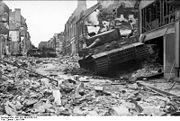 At around 13:00 tanks of the Panzer Lehr Division advanced into Villers-Bocage, but unsupported by infantry found the going difficult. A group of four Panzer IV's attempted to push into the town's southern edge where they found a previously disabled Panzer IV, but as they moved further two tanks were knocked out by British anti-tank gunfire. Some of the Waffen-SS
Tiger tanks were brought up and in an exchange of fire they silenced the anti-tank position. SS-Hauptsturmführer Möbius ordered the main counterattack to be launched in two thrusts; the first would advance down the main highway through Villers-Bocage while the second would cut through the southern section of the town parallel to the main road. The objective was to secure the town centre. The Tigers moving along the main road advanced slowly, their commanders confident that they could intimidate the British into withdrawing. However, as they reached the town square they ran into Cotton's ambush. The Firefly, commanded by Sergeant Bramall, opened fire on the lead tank and missed, but the anti-tank gun supporting the position knocked it out. Now alerted to the ambush, a following group of three Tigers split up. Picking their way through the back streets in an attempt to flank the British, one was engaged by an anti-tank gun and destroyed. The other two were tackled by infantry using PIAT anti-tank weapons; one was knocked out and the other immobilised.
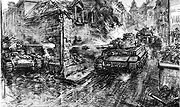 A fifth Tiger halted on the main street short of the ambush site, apparently waiting for the British to emerge from cover. This was spotted by Bramall through the side and front windows of a corner building and he decided that the only way to safely engage would be to reverse his Firefly and shoot diagonally through the building's windows. His tank fired twice, damaging the Tiger's gun mantlet
; it drew back slightly and then raced past the side street before Bramall could respond. A Cromwell under the command of Corporal Horne then advanced onto the main street from another side street and fired into the Tiger's rear, knocking it out, before reversing back into cover. The next victim of the ambush was a Panzer IV, accounted for by Bramall's Firefly. Mindful of the German skill at recovering and repairing their damaged vehicles, during a lull in the fighting Lieutenant Cotton and Sergeant Bramall, with blankets and petrol, went to each knocked out tank in their vicinity and set them on fire. Outside the town, elements of the 7th Armoured Division stretching back to Amayé-sur-Seulles came under attack from the north and south but were able to fend off these assaults, while at Tracey-Bocage the 11th Hussars were called upon to deal with a pocket of German resistance.
Supported by mortars and artillery, the Germans put in a strong attack on A Company 1/7th QRR in Villers-Bocage. The company was forced to concentrate its defence but one platoon was cut off and captured. Even though the entire Queen's Royal Rifles battalion had been committed to the town's defence, holes were opening up through which German troops were infiltrating. Two grenadier battalions of the 2nd Panzer Division attacked from the south and were engaged by B Squadron 4CLY, who inflicted heavy losses on the German infantry. British positions on the main street came under attack from a Panzer IV until it was destroyed. Both sides had begun calling artillery fire into the town, and several British mortars and a carrier were destroyed. By 18:00 the QRR battalion headquarters had become pinned down and as pressure built, Hinde reluctantly decided that his force must be withdrawn. In his judgement they would be unable to continue to hold the town once darkness fell. Under cover of a smoke screen and shellfire laid down by 5RHA, to which US V Corps's artillery batteries added their weight, the infantry pulled back. Last to leave were the tanks of 4CLY. The Germans harassed the withdrawing units with artillery fire, inflicting some casualties, and infantry from Tracey-Bocage attacked the British as they fell back, resulting in a two and a half hour battle. Despite taking heavy losses the German infantry were not repulsed until around 22:30.
Both the Panzer Lehr and 2nd Panzer Divisions were in action across the entire sector on 13 June and did not count the casualties sustained at Villers-Bocage separately from all losses incurred that day. However, the 101st SS Heavy Panzer Battalion was only engaged at Villers-Bocage, so this unit's losses are available. Taylor gives nine men killed and 10 wounded in the 1st Company and one killed and three wounded in the 2nd. Sources differ widely on the number of German tanks lost during 13 June—in part because elements of the Panzer Lehr Division were committed piecemeal making it impossible to be certain of the number of Panzer IVs knocked out. German tank losses are generally placed at between eight and fifteen tanks, including six Tiger Is. Chester Wilmot notes what a costly loss this was, as there were only 36 Tiger tanks in Normandy at that time. However, Taylor concedes that the numbers claimed by the British probably include tanks that were immobilised but subsequently recovered.
Local Villers-Bocage historian Henri Marie names at least nine French civilians who died on 13 June. Six of these were killed by crossfire or shrapnel during the battle and the remaining three by artillery fire just before midnight. Marie claims that three of the deaths may in fact have been the result of executions
. Further civilian casualties were sustained over the following days due to the continued fighting and bombing. Following the British withdrawal the town was reoccupied and searched by the Germans for any wounded or hiding British soldiers. In the course of this several shops and houses, along with the town hall, were set on fire.
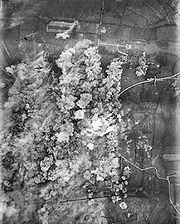 On 14 June, with their withdrawal from Villers-Bocage complete, Hinde's 22nd Armoured Brigade group formed an all round defensive position—a "brigade box"—in the Amayé-sur-Seulles–Tracy-Bocage
–St-Germain area. This location was chosen to give the British control over Villers-Bocage without actually occupying the town.
Supported by the 1st Company 101st SS Heavy Panzer Battalion, the Panzer Lehr Division renewed its attempt to eliminate the British salient. The United States 1st Infantry Division, in possession of the heights around Caumont, was able to bring the Germans under observed artillery fire, which helped to break up the initial assault on 22nd Armoured Brigade group's position. However, subsequent German attacks closed in so tightly that further artillery concentrations could not be called in without hitting British positions. One platoon was overrun and a counterattack with tanks and infantry was mounted to restore the integrity of the brigade box. Rebuffed, the Germans subjected the box to harassing fire before launching a major two-pronged assault later in the day, supported by artillery and tanks. This penetrated the British lines and came close to the brigade headquarters before being driven back. The fighting died down during the evening. Although confident that the brigade box could be held, the inability of the 50th (Northumbrian) Infantry Division to make significant progress towards relieving the position prompted the decision to recall the Brigade group and straighten the front line.
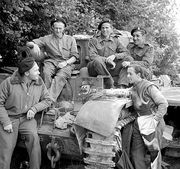 To cover the 22nd Armoured Brigade group's withdrawal on 14/15 June, 337 Royal Air Force
(RAF) bombers (223 Avro Lancasters, 100 Handley Page Halifax
, 14 de Havilland Mosquito
s) from No. 4 Group RAF
, No. 5 Group RAF
and No. 8 Group RAF
dropped 1,700 tons of high explosives on the town of Évrecy and on targets around Villers-Bocage, destroying one Tiger tank of the 101st SS Heavy Panzer Battalion and damaging three more. No aircraft were lost.
Just over two weeks later, at 20:30 hours on the 30 June, Villers-Bocage was bombed again by 266 bombers (151 Lancasters, 105 Halifaxes and 10 Mosquitos) from No. 3 Group RAF
, No. 4 Group RAF and No. 8 Group RAF, in support of Operation Epsom
. 1,100 tons of bombs fell for the loss of only two aircraft. The town was a vital traffic centre for the German forces and it was hoped that German troops would be caught in the bombing, but only French civilians were present at the time.
After being severely damaged by the fighting of 13 June and subsequent bombing raids, the town was finally liberated by a patrol of the 1st Battalion Dorset Regiment
, 50th (Northumbrian) Infantry Division, on 4 August 1944.
and awarded Swords to his Knight's Cross of the Iron Cross. For their skill and bravery in defending Villers-Bocage, Lieutenant Cotton was awarded the Military Cross
and Sergeant Bramall the Military Medal
.
Because the British had lost contact with their forces on Point 213 and withdrawn from Villers-Bocage, they were unable to establish the full extent of either their own losses or those they had inflicted. The German propaganda machine seized upon this opportunity. Michael Wittmann—already a household name in Germany—was credited with all the British tanks destroyed at Villers-Bocage. He recorded a radio message on the evening of 13 June, describing his role in the morning's fighting and claiming that later counterattacks had destroyed an entire British armoured regiment and infantry battalion. To lend weight to this claim doctored images were produced; three joined-together photographs published in the German armed forces magazine Signal gave a false impression of the scale of destruction in the town. The propaganda campaign was given credence both in Germany and abroad, leaving the British convinced that the Battle of Villers-Bocage had been a complete disaster when in fact its results were less clear-cut.
Wolfgang Schneider, an instructor at the German Bundeswehr
tank school and historian, provides a new perspective to the propaganda campaign; he states that the Waffen-SS did not have an "experienced tank arm" when compared to the army’s panzer divisions. The Waffen-SS may have fought with distinction during the Battle of Kursk
but it could not match the army’s success, hence Dietrich’s attempts to manufacture a hero out of Wittmann.
.jpg) Wittmann's lone engagement of the 22nd Armoured Brigade group's spearhead has been the subject of such attention that, according to Stephen Badsey, it has cast a shadow over the period between D-Day and 13 June in historical accounts. Many commentators, particularly those of the late twentieth-century revisionist
Wittmann's lone engagement of the 22nd Armoured Brigade group's spearhead has been the subject of such attention that, according to Stephen Badsey, it has cast a shadow over the period between D-Day and 13 June in historical accounts. Many commentators, particularly those of the late twentieth-century revisionist
school, find Wittmann's actions extremely impressive. Carlo D'Este views Wittmann's attack as "one of the most amazing engagements in the history of armoured warfare"; Max Hastings calls it "one of the most devastating single-handed actions of the war"; and Anthony Beevor claims it was "one of the most devastating ambushes in British military history". Hubert Meyer goes even further, attributing Operation Perch's failure solely to Wittmann's "courage, his tactical and technical abilities and [...] the valor, the expertise and the camaraderie of his Panzer crew".
Henri Marie calls the attack a "spur of the moment" decision that demonstrated Wittmann's rapid grasp of the inherent possibilities in attacking an unprepared enemy, but equally describes the action as foolhardy because it failed to take account of the potential danger. He believes that other historians have become carried away by Wittmann’s ambush and cynically notes that the first Tiger lost in combat during the campaign was that commanded by Wittmann. This view is supported by John Buckley, who attributes much of the hyperbole surrounding Wittmann to the lingering influence of the highly successful German propaganda campaign. He reproves those historians such as D'Este, Gary Simpson and Meyer, that exaggerate Wittmann's role to such an extent that they imply he single-handedly stopped the entire 7th Armoured Division. Buckley points to Russell A. Hart's erroneous claim that Wittmann "all but annihilated" 7th Armoured's spearhead. Badsey offers perhaps the most balanced view, summarising both Wittmann's attack and the historiography that has followed as "remarkable but massively over-written".
Taking a wider view, John Buckley believes that while Wittmann showed great audacity in his attack, the roots of the British defeat were broader. He is of the opinion that the British had only themselves to blame for their failure at Villers-Bocage and gives little credence to a view that superior German armour decided the outcome. Hastings supports Buckley's conclusion, acknowledging that although the Tiger was "incomparably" more deadly than the British Cromwell tank, the "shambles" caused by Wittmann's tanks reflected poorly on the tactical handling of the British force. He goes on to write "The German achievement on 13/14 June had been that, while heavily outnumbered in the sector as a whole, they successfully kept the British everywhere feeling insecure and off-balance, while concentrating sufficient forces to dominate the decisive points. The British, in their turn, failed to bring sufficient forces to bear on these." Marie notes the disappointment of the British Second Army commander, Miles Dempsey, in the lack of tactical flair and imagination shown by Brigadier Hinde throughout the battle. Marie claims that by this point in the campaign the British should have known better than to attempt an armoured advance unsupported by infantry in the bocage
, and goes on to criticise both sides: the British for fighting an uncoordinated infantry and tank battle during the morning of 13 June, and the Germans for doing much the same throughout the whole day.
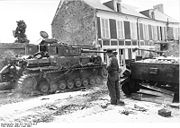 Focusing mainly on Wittmann and the 101st SS Heavy Panzer Battalion, Schneider describes its contribution to the battle as "everything but awe-inspiring". He concedes that the Tiger companies and the Panzer Lehr Division averted the threat of a serious British breakthrough, but suggests that there was no need for the initial German response to have been launched so precipitately. Möbius's 1st Company was in command of the road to Caen, so Wittmann had the time to plan and coordinate an attack. Calling into question Wittmann's tactical decisions, Schneider claims that "a competent tank company commander does not accumulate so many serious mistakes". He notes that by Wittman having his Tigers position themselves in a sunken lane overnight, with a vehicle with engine trouble at the head of a stationary column, he was hampering the mobility of his unit and risked blocking the entire company. However, Schneider saves his real opprobrium for Wittmann's solitary advance into Villers-Bocage. Although he acknowledges Wittmann's courage he points out that such an action "goes against all the rules". No intelligence was gathered beforehand, and there was no "centre of gravity" or "concentration of forces" in the attack. Because of Wittmann's actions "the bulk of the 2nd Company and Rolf Möbius 1st Company came up against an enemy who had gone onto the defensive". Schneider calls Wittman's "carefree" advance into British-occupied positions "pure folly" and states that "such over hastiness was uncalled for", before going on to surmise that if Wittmann had properly prepared an assault involving the rest of his company and the 1st Company, far greater results could have been achieved. He concludes with the belief that "thoughtlessness of this kind was to cost [Wittmann] his life on August 9, 1944, near Gaumesnil, during an attack casually launched in open country with an exposed flank".
Meyer agrees to some extent with Schneider's observations, admitting that the 2nd Company's advance into the town without infantry support was "obviously inexpedient". Marie sees this as a serious tactical error on Möbius's behalf, but Meyer believes it was a justifiable risk under the circumstances. Infantry were unavailable, and the British could have been expected to still be "under the devastating impression of seeing [their] vanguard totally destroyed in such a short time".
Ellis describes the withdrawal as a temporary measure. The 7th Armoured Division was to be reinforced with the 33rd Armoured Brigade
before renewing its offensive towards Évrecy. Adding to this, David French notes that the follow-up formations landing in Normandy were on average two days behind schedule. He speculates that had the 33rd Armoured Brigade, the 49th (West Riding) Infantry Division and the 7th Armoured Division's infantry brigade landed on schedule, XXX Corps might have been able to secure Villers-Bocage before the arrival of substantial German forces. Other historians do not accept the view that insufficient means were available, pointing to substantial British forces that remained uncommitted during the battle. Mungo Melvin, despite approving of the 7th Armoured Division's institution of a flexible combined arms
structure (a structure that other British armoured divisions would not adopt until after Operation Goodwood
), writes that neither the 131st Infantry Brigade nor the balanced divisional reserve of an armoured regiment and an infantry battalion were employed effectively. Sceptical about the ability of "a reduced armoured brigade, with only limited mobile infantry and artillery support" to seriously worry the Germans, Buckley notes that in addition to the uncommitted elements of 7th Armoured the 151st Infantry Brigade was available in corps reserve. Max Hastings expresses incredulity at this British failure to concentrate force at the crucial place and time, recounting the feelings of the "men on the spot" in Villers-Bocage who believed that "a single extra infantry brigade could have been decisive in turning the scale". D'Este, however, defends XXX Corps commander Gerard Bucknall's claim that neither the 151st Infantry Brigade or the 49th Infantry Division could be made ready in time to influence the battle.
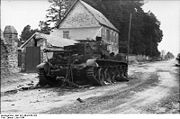 Other than its initial encounter with the 101st SS Heavy Panzer Battalion's 2nd Company and the subsequent loss of Point 213, the 22nd Armoured Brigade group had repelled every German assault on its positions throughout the two days of fighting. Students of the battle have therefore looked to the senior commanders involved to explain the "fumbled failure" at Villers-Bocage. Dempsey remarked after the war that "this attack by 7th Armoured Division should have succeeded. My feeling that Bucknall and Erskine would have to go started with that failure ... the whole handling of that battle was a disgrace. Their decision to withdraw [from Villers-Bocage] was done by the corps commander and Erskine." Although D'Este calls Dempsey's comments "excessively harsh" and believes that once the town had been abandoned the Brigade group's eventual withdrawal was inevitable, historians generally support them—some going so far as to suggest that Bucknall threw away the chance to swiftly capture Caen. General Bernard Montgomery, who had been a patron of Bucknall, conceded that his protégé "could not manage a Corps once the battle became mobile". Buckley claims that Bucknall was unprepared to support the attack once problems developed and that Erskine was not suited to the task at hand. Chester Wilmot agrees with Dempsey's assertion that it was Bucknall, not the Germans, that forced the 7th Armoured Division to retire. Wilmot claims that Bucknall refused to reinforce the division because he had already decided that its lines of communication were endangered. He concludes:
Drawing on testimony by SS-Brigadeführer
Fritz Kraemer
(of I SS-Panzer Korps
), who was of the opinion that "the enemy had let a favourable opportunity slip", D'Este sees the failure to unhinge the German front line south of Caen and flank I SS Panzer Korps as "one of the costliest Allied mistakes" of the campaign. He quotes Dempsey that with the British withdrawal the chance of mounting a "snap airborne operation" to seize Caen or to deepen the Allied bridgehead had been lost. Also quoting Dempsey, Wilmot asserts that following the battle's outcome, "Caen [could] be taken only by a set-piece assault". Max Hastings sees the "debacle" of Villers-Bocage as the moment that "marked, for the British, the end of the scramble for ground that had continued since D-Day". Reynolds concurs, writing that the consequences of the battle would be felt in the coming weeks during the series of "costly" assaults needed to drive the Germans from Caen and the surrounding area. The view at the time was less conclusive. The official 7th Armoured Division's history regards the battle as indecisive, stating "the brilliant defensive battle of Villers Bocage ..., although it obliged us to withdraw some seven miles, cost the enemy casualties disproportionate to this gain". This perspective is echoed by some historians such as Daniel Taylor, who concludes that the battle ended with no clear winner.
Western Allies
The Western Allies were a political and geographic grouping among the Allied Powers of the Second World War. It generally includes the United Kingdom and British Commonwealth, the United States, France and various other European and Latin American countries, but excludes China, the Soviet Union,...
landed in Normandy to begin the liberation of German
Nazi Germany
Nazi Germany , also known as the Third Reich , but officially called German Reich from 1933 to 1943 and Greater German Reich from 26 June 1943 onward, is the name commonly used to refer to the state of Germany from 1933 to 1945, when it was a totalitarian dictatorship ruled by...
-occupied France. The battle was the result of a British attempt to improve their position by exploiting a temporary vulnerability in the German defences to the west of the city of Caen
Caen
Caen is a commune in northwestern France. It is the prefecture of the Calvados department and the capital of the Basse-Normandie region. It is located inland from the English Channel....
. After one day of fighting in and around the small town of Villers-Bocage
Villers-Bocage, Calvados
-External links:* *...
and a second day defending a position outside the town, the British force retired largely intact.
Both British and Germans regarded control of Caen as vital to the Normandy battle. In the days following the Allied D-Day
D-Day
D-Day is a term often used in military parlance to denote the day on which a combat attack or operation is to be initiated. "D-Day" often represents a variable, designating the day upon which some significant event will occur or has occurred; see Military designation of days and hours for similar...
landings of 6 June, the Germans rapidly established strong defences in front of the city. On 9 June a two-pronged British attempt to surround and capture Caen was defeated, but on the British forces' right flank, neighbouring American units had forced open a wide gap in the German front line. Seizing the opportunity to bypass Caen's defences, a mixed mobile force of tanks, infantry and artillery, formed around the 7th Armoured Division's 22nd Armoured Brigade, advanced through the gap in a flanking manoeuvre towards Villers-Bocage. British commanders hoped that the appearance of a strong force in their rear would force the German defenders of Caen's western approaches—principally the Panzer Lehr armoured division—to surrender or withdraw.
Under the command of Brigadier William "Loony" Hinde, the 22nd Armoured Brigade group reached Villers-Bocage without serious incident, but as its lead elements moved beyond the town on the morning of 13 June they were ambushed by Tiger I
Tiger I
Tiger I is the common name of a German heavy tank developed in 1942 and used in World War II. The final official German designation was Panzerkampfwagen Tiger Ausf. E, often shortened to Tiger. It was an answer to the unexpectedly formidable Soviet armour encountered in the initial months of...
tanks of the 101st SS Heavy Panzer Battalion. In fewer than 15 minutes numerous tanks, anti-tank guns and transport vehicles fell victim to the German force, the vast majority being destroyed by SS
Schutzstaffel
The Schutzstaffel |Sig runes]]) was a major paramilitary organization under Adolf Hitler and the Nazi Party. Built upon the Nazi ideology, the SS under Heinrich Himmler's command was responsible for many of the crimes against humanity during World War II...
-Obersturmführer
Obersturmführer
Obersturmführer was a paramilitary rank of the Nazi party that was used by the SS and also as a rank of the SA. Translated as “Senior Assault Leader”, the rank of Obersturmführer was first created in 1932 as the result of an expansion of the Sturmabteilung and the need for an additional rank in...
Michael Wittmann
Michael Wittmann
Michael Wittmann was a German Waffen-SS tank commander during the Second World War. Wittmann would rise to the rank of SS-Hauptsturmführer and was a Knight's Cross of the Iron Cross holder....
's tank. With reinforcements arriving the Germans then launched an assault on the town. Although this was repelled, after six hours Hinde decided to withdraw his force to a more defensible position outside Villers-Bocage. The following day fighting resumed in the Battle of the island. The British defended their position until a controversial decision was taken to pull the Brigade group back from its salient. Villers-Bocage played no further role in the Second Army's Battle for Caen
Battle for Caen
The Battle for Caen from June-August 1944 was a battle between Allied and German forces during the Battle of Normandy....
; the town was eventually liberated on 4 August, although by then it had been bombed twice by the Royal Air Force
Royal Air Force
The Royal Air Force is the aerial warfare service branch of the British Armed Forces. Formed on 1 April 1918, it is the oldest independent air force in the world...
and was largely in ruins.
The Battle of Villers-Bocage has proved a contentious subject among students of the campaign because the British withdrawal marked the end of the post D-Day "scramble for ground" and the start of a grinding attritional battle
Attrition warfare
Attrition warfare is a military strategy in which a belligerent side attempts to win a war by wearing down its enemy to the point of collapse through continuous losses in personnel and matériel....
for Caen. Most historians conclude that its failure was due to a lack of conviction among some senior commanders rather than a military defeat, although a few also maintain that the force committed was inadequate for the task. In particular Michael Wittmann's single-handed action during the battle's early stages has excited imaginations, to the extent that recent historians argue that it has disproportionately dominated the historical record and that, while "remarkable", Wittmann's role in deciding the battle's outcome has been exaggerated.
Background
Sword Beach
Sword, commonly known as Sword Beach, was the code name given to one of the five main landing areas along the Normandy coast during the initial assault phase, Operation Neptune, of Operation Overlord; the Allied invasion of German-occupied France that commenced on 6 June 1944...
on 6 June 1944, the city of Caen some 9 miles (14.5 km) inland was the ultimate goal. Possession of Caen was especially attractive to Allied planners; the surrounding country contained airfields and was open, dry, and conducive to swift offensive operations where the Allies could bring their numerical superiority in tanks and mobile units to bear. The city's capture on D-Day
D-Day
D-Day is a term often used in military parlance to denote the day on which a combat attack or operation is to be initiated. "D-Day" often represents a variable, designating the day upon which some significant event will occur or has occurred; see Military designation of days and hours for similar...
was described by Chester Wilmot
Chester Wilmot
Reginald William Winchester Wilmot was an Australian war correspondent who reported for the BBC and the Australian Broadcasting Corporation during the Second World War. After the war he continued to work as a broadcast reporter, and wrote a well-appreciated book about the liberation of Europe...
as an "ambitious" request to make of troops who would be landing "last, on the most exposed beaches, with the farthest to go, against what was potentially the greatest opposition". It proved to be beyond the 3rd Infantry Division's means. Congestion in the beachhead delayed the division's armoured support, and its thrust inland grew progressively weaker as it was forced to fight past strongly held German positions en route. The advance ran out of steam before nightfall, stopped short of Caen's outskirts by elements of the 21st Panzer Division.
The next day, following their pre-invasion timetable, the British launched Operation Perch
Operation Perch
Operation Perch was a British offensive of the Second World War which took place between 7 and 14 June 1944, during the Battle of Normandy. The operation was intended to encircle and seize the German occupied city of Caen, which was a major Allied objective in the early stages of the invasion of...
. Envisaged as an advance to the southeast of Caen when it was planned before D-Day, Perch was heavily reliant on the city's rapid capture. For a few days, I Corps continued to attack the outskirts of Caen, but the Germans regarded the city and its surroundings as the linchpin of their position in Normandy and poured reinforcements into the area. With resistance solidifying it became clear to the British that any opportunity to rush Caen's defences with small-scale actions had passed. On 9 June the Allied ground forces commander, General Bernard Montgomery, altered Perch to incorporate a major two-pronged assault
Pincer movement
The pincer movement or double envelopment is a military maneuver. The flanks of the opponent are attacked simultaneously in a pinching motion after the opponent has advanced towards the center of an army which is responding by moving its outside forces to the enemy's flanks, in order to surround it...
intended to surround and take the city.
After a delay caused by manoeuvring forces into position, on 12 June simultaneous attacks were launched to the west and east of Caen. Leading the drive around the eastern side of Caen, the 51st (Highland) Infantry Division soon ran into stiff resistance from the 21st Panzer Division. With casualties mounting for minimal gains, the next day the Highlanders' attack was called off. To the west of Caen XXX Corps was no more successful, rapidly becoming bogged down in heavy fighting for the village of Tilly-sur-Seulles
Tilly-sur-Seulles
-External links:*...
. Defending the village was the newly arrived Panzer Lehr Division—one of the most powerful armoured formations in the German Army.
Caumont Gap
Although the envelopment of Caen had stalled, on XXX Corps's right flank at the junction between the British Second and United States First Armies, a potentially favourable situation had developed. Since D-Day the US First Army and British XXX Corps had destroyed five German battle groupsKampfgruppe
In military history and military slang, the German term Kampfgruppe can refer to a combat formation of any kind, but most usually to that employed by the German Wehrmacht and its allies during World War II and, to a lesser extent, in World War I...
including LXXXXIV Korps's reserves, leaving only the battered 352nd Infantry Division covering the Trévières
Trévières
Trévières is a commune in the Calvados department in the Basse-Normandie region in northwestern France.-Administration:Trévières is part of the communauté de communes de Trévières, which includes 25 communes and has its seat in Formigny....
–Agy
Agy
Agy is a commune in the Calvados department in the Basse-Normandie region in northwestern France.-Population:...
sector. The 352nd had been in continuous action since its defence of Omaha Beach
Omaha Beach
Omaha Beach is the code name for one of the five sectors of the Allied invasion of German-occupied France in the Normandy landings on 6 June 1944, during World War II...
on 6 June and had received few replacements for the heavy losses it had suffered. Under severe pressure from American attacks, the 352nd's left flank collapsed. With its position no longer tenable, on the night of 9–10 June the division pulled back to Saint-Lô. This withdrawal created a 7.5 miles (12.1 km) hole in the German lines near the village of Caumont-l'Éventé
Caumont-l'Éventé
Caumont-l'Éventé is a commune in the Calvados department in northwestern France.-Population:-Administration:Caumont-l'Éventé is the seat of the canton of Caumont-l'Éventé, which includes 14 communes with 6373 inhabitants .-References:*...
, dubbed by the Allies the 'Caumont Gap'. Only the 17th SS-Panzergrenadier Division
17th SS Panzergrenadier Division Götz von Berlichingen
The 17. SS-Panzergrenadier-Division Götz von Berlichingen was a German SS panzergrenadier division which saw action on the Western Front during World War II.-Formation and training:...
's reconnaissance battalion remained in the area. The Germans made plans to bring up the 2nd Panzer Division, but on 10 June the bulk of the division was strung out between Amiens
Amiens
Amiens is a city and commune in northern France, north of Paris and south-west of Lille. It is the capital of the Somme department in Picardy...
and Alençon
Alençon
Alençon is a commune in Normandy, France, capital of the Orne department. It is situated west of Paris. Alençon belongs to the intercommunality of Alençon .-History:...
and was not expected to arrive in strength until 13 June. Reluctant to commit 2nd Panzer until it was fully assembled, General der Panzertruppe
General der Panzertruppe
General der Panzertruppe was a rank of German Army General introduced by the Wehrmacht in 1935. As the commander of a Panzer Corp this rank corresponds to a US Army Lieutenant-General...
Hans Freiherr von Funck
Hans Freiherr von Funck
General Hans Emil Richard Freiherr von Funck was a highly decorated Panzer General in the German army during World War II.-Biography:...
, of XLVII Panzer Korps
XLVII Panzer Corps (Germany)
The XLVII Panzer Corps was a Panzer Corps formed by Field Marshal Günther von Kluge during the Battle for Normandy, and for Operation Lüttich...
, was nevertheless persuaded to rush the division's reconnaissance battalion to Caumont with orders to hold the high ground there.
Conscious of the opportunity to bypass Caen's western defences by exploiting the Caumont Gap, British Second Army commander Lieutenant-General Miles Dempsey
Miles Dempsey
General Sir Miles Christopher Dempsey, GBE, KCB, DSO, MC was commander of the British Second Army during the D-Day landings in the Second World War...
met with Lieutenant-General Gerard Bucknall
Gerard Bucknall
Lieutenant General Gerard Corfield Bucknall, CB, MC was a British Army officer and corps commander during World War II.-Military career:...
, commanding XXX Corps, and Major-General
Major-General (United Kingdom)
Major general is a senior rank in the British Army. Since 1996 the highest position within the Royal Marines is the Commandant General Royal Marines who holds the rank of major general...
George Erskine
George Erskine
General Sir George Watkin Eben James Erskine GCB, KBE, DSO was a senior British Army officer during World War II-Background:...
, commanding the 7th Armoured Division. Erskine was ordered to disengage his tanks from the fighting around Tilly-sur-Seulles. The 7th Armoured Division was now to move through the gap, seize the town of Villers-Bocage behind the front line, and menace the Panzer Lehr Division's exposed flank. The British objective was a ridge 1.6 miles (2.6 km) to the east of Villers-Bocage; Dempsey hoped that the appearance of a strong force in Panzer Lehr's rear, occupying high ground and interdicting important lines of communication, would compel the German division to withdraw or surrender and thus break the deadlock to the west of Caen. The 50th (Northumbrian) Infantry Division would maintain pressure against the Panzer Lehr Division around Tilly-sur-Seulles to support the attack while elements of the United States V Corps would push forward.
Despite the need for rapid action to take full advantage of the German vulnerability, the 7th Armoured Division was slow to redeploy and spent the morning of 12 June attempting to advance on Tilly-sur-Seulles according to its original orders. At 12:00 a meeting was held between Major-General Erskine and Brigadier Hinde, the commanding officer of the division's 22nd Armoured Brigade. Hinde was ordered to move immediately through the gap. Soon afterwards the 8th King's Royal Irish Hussars
8th King's Royal Irish Hussars
The 8th King's Royal Irish Hussars was a cavalry regiment in the British Army, first raised in 1693. It saw service for three centuries, before being amalgamated into The Queen's Royal Irish Hussars in 1958....
—the division's armoured reconnaissance regiment—began to reconnoitre the route the brigade would take; the rest of the division departed from the village of Trungy at around 16:00. Four hours later the main body was approaching Livry after a 12 miles (19.3 km) unopposed advance, the last 6 miles (9.7 km) of which were though German-held territory. Minor resistance was encountered when the 8th Hussars' leading Cromwell tank
Cromwell tank
Tank, Cruiser, Mk VIII, Cromwell ,The designation as the eighth Cruiser tank design, its name given for ease of reference and its General Staff specification number respectively and the related Centaur tank, were one of the most successful series of cruiser tanks fielded by Britain in the Second...
s were destroyed by an anti-tank gun of the Panzer Lehr Division's Escort Company, but riflemen and more tanks were brought forward and within two hours the position was cleared.
Hoping to keep the Germans guessing as to his force's objective, on reaching the vicinity of la Mulotiere, north of Livry, Hinde ordered a halt for the night. While the main force conducted routine maintenance, the 8th King's Royal Irish and 11th (Prince Albert's Own)
11th Hussars
The 11th Hussars was a cavalry regiment of the British Army.-History:The regiment was founded in 1715 as Colonel Philip Honeywood's Regiment of Dragoons and was known by the name of its Colonel until 1751 when it became the 11th Regiment of Dragoons...
Hussars (the division's armoured car regiment) reconnoitred the flanks. The 11th Hussars found no resistance on the right flank and linked up with the US 1st Infantry Division near Caumont, while on the left flank the 8th Hussars located elements of the Panzer Lehr Division just under 2 miles (3.2 km) away.
Planning
During the night Hinde put the final touches to his battle plan. It was clear that to control Villers-Bocage his 22nd Armoured Brigade group would have to rapidly occupy the nearby ridge. The 4th County of London YeomanryCounty of London Yeomanry
Several British Army regiments have born the title County of London Yeomanry . Most have been mounted, then armoured regiments.-1st County of London Yeomanry:...
(4CLY), with one company of the 1st Battalion the Rifle Brigade, was to pass through Villers-Bocage and occupy Point 213, the highest point of the ridge. The 1/7th Queen's Royal Regiment (West Surrey)
Queen's Royal Regiment (West Surrey)
The Queen's Royal Regiment was a regiment of the English and later British Army from 1661 to 1959. It was the senior English line infantry regiment of the British Army, behind only the Royal Scots in the British Army line infantry order of precedence...
would follow up and occupy the town itself, while the 5th Royal Tank Regiment
5th Royal Tank Regiment
The 5th Royal Tank Regiment was an armoured regiment of the British Army until 1969. It was part of the Royal Tank Regiment, itself part of the Royal Armoured Corps...
(5RTR), with a further company of the Rifle Brigade, was to take up positions on a second area of high ground to the southwest of the town at Maisoncelles-Pelvey
Maisoncelles-Pelvey
-References:*...
. Equipped with M10 Achilles self propelled anti-tank guns
17pdr SP Achilles
The 17 pounder, Self Propelled, Achilles was a British variant of the American M10 Tank destroyer armed with the powerful British Ordnance QF 17 pounder anti-tank gun in place of the standard 3" Gun M7...
, the 260th Anti-tank Battery of the Norfolk Yeomanry
Norfolk Yeomanry
The Norfolk Yeomanry was a regiment of the British Army.In 1901, the Norfolk Yeomanry were raised at the express wish of King Edward VII, after a gap of 33 years, and titled the King's Own Royal Regiment with the Royal cipher as their badge.In September 1915, the regiment embarked on RMS Olympic...
would cover the gap between 4CLY and 5RTR. The 5th Royal Horse Artillery (5RHA), equipped with Sexton self propelled artillery guns
Sexton (artillery)
The 25pdr SP, tracked, Sexton was a self-propelled artillery vehicle of World War II, based on an American tank hull design, built by Canada for the British Army, and associated Commonwealth forces, and some of the other Allies....
, would advance behind the rest of the brigade. The 5RHA and the brigade's tactical headquarters were established to the west of the town at Amayé-sur-Seulles
Amayé-sur-Seulles
Amayé-sur-Seulles is a commune in the Calvados department in the Basse-Normandie region in northwestern France.-Population:-References:*...
. Hinde's two Hussar regiments were to provide flank protection, act as a buffer, screen the British from the Panzer Lehr, and seek out enemy positions on either side of the line of advance. The remainder of the division—the 131st Infantry Brigade with the 1st Royal Tank Regiment
1st Royal Tank Regiment
The 1st Royal Tank Regiment is an armoured regiment of the British Army. It is part of the Royal Tank Regiment, itself part of the Royal Armoured Corps. It was originally formed as 1st Battalion, Royal Tank Corps in 1934....
(1RTR) and the 1/5th and 1/6th battalions Queen's Royal Regiment (West Surrey)—was to position itself in the Livry area to hold a "firm base", keeping the Brigade group's line of communication secure.
Having done all they could in the short term to address the gaping hole in their front by sending light reconnaissance forces to cover the Caumont area until newly arriving divisions had assembled, the Germans turned their attention to their open left flank. I SS-Panzer Korps commander Obergruppenführer
Obergruppenführer
Obergruppenführer was a Nazi Party paramilitary rank that was first created in 1932 as a rank of the SA and until 1942 it was the highest SS rank inferior only to Reichsführer-SS...
Sepp Dietrich
Sepp Dietrich
Josef "Sepp" Dietrich was a German SS General. He was one of Nazi Germany's most decorated soldiers and commanded formations up to Army level during World War II. Prior to 1929 he was Adolf Hitler's chauffeur and bodyguard but received rapid promotion after his participation in the murder of...
ordered his only reserve, the 101st SS Heavy Panzer Battalion, to position itself behind the Panzer Lehr and 12th SS-Panzer divisions in the Villers-Bocage area, as a precaution against any Allied attempt to hook through the Caumont Gap.
Beauvais
Beauvais is a city approximately by highway north of central Paris, in the northern French region of Picardie. It currently has a population of over 60,000 inhabitants.- History :...
. Mustering 45 Tiger I
Tiger I
Tiger I is the common name of a German heavy tank developed in 1942 and used in World War II. The final official German designation was Panzerkampfwagen Tiger Ausf. E, often shortened to Tiger. It was an answer to the unexpectedly formidable Soviet armour encountered in the initial months of...
tanks at full strength, the battalion had come under severe air attack near Versailles and been reduced to around 17 serviceable tanks. The battalion's 1st Company was situated 5.6 miles (9 km) northeast of Villers-Bocage; the 2nd Company, under the command of SS-Obersturmführer Michael Wittmann, was just south of Point 213 on the Villers-Bocage ridge; and the 3rd, with only one serviceable tank, was near Falaise
Falaise, Calvados
Falaise is a commune in the Calvados department in the Basse-Normandie region in northwestern France.-History:The town was the birthplace of William I the Conqueror, first of the Norman Kings of England. The Château de Falaise , which overlooks the town from a high crag, was formerly the seat of...
and would not reach the front for another two days. Wittmann's 2nd Company nominally consisted of 12 tanks, but through a combination of losses and mechanical failures only Tigers 212, 213, 214, 224, 231, and 232 were present on 13 June.
The area around Villers-Bocage came under heavy naval artillery fire during the night of 12/13 June and fearing that he had been spotted, Wittmann relocated his company three times. The long drive to Villers-Bocage had caused significant wear to the tanks, so he scheduled a mechanical overhaul for the following morning.
Advance
During the early hours of 13 June, riflemen of the 1st Rifle Brigade conducted a reconnaissance along the first half-mile (0.9 km) of the intended British route. Livry was reported to be clear of Germans and the advance resumed at 05:30, with 4CLY leading the way. Moving cautiously, the column was met at the farms and hamlets along its route by jubilant French civilians, leading to a mood of general relaxation among the soldiers. Information passed to the British—later found to be incorrect—suggested that German tanks were stranded in Tracey-Bocage, and rumours stated that other tanks, without fuel or infantry, were similarly stranded at the Château de Villers-Bocage. On 11 June, German medical personnel had established a hospital at the château, but this position had been abandoned by first light on 13 June. However, a handful of German combat troops remained about the town.As the column approached Villers-Bocage a German Sd.Kfz. 231 armoured car was sighted some distance off. Its commander had clearly observed the British advance, but the nearest British tank was unable to traverse its turret to engage and by the time a second tank had moved into position the armoured car had withdrawn. At 08:30, having safely covered the 5 miles (8 km) from its overnight position, the 22nd Armoured Brigade group entered the town to be greeted by celebrating residents; two German soldiers were spotted leaving at high speed in a Volkswagen Kübelwagen
Volkswagen Kübelwagen
The Volkswagen Kübelwagen was a military vehicle designed by Ferdinand Porsche and built by Volkswagen during World War II for use by the German military...
car. The two Hussar regiments made contact with German forces on either side of the 22nd Brigade group's advance, with the 8th Hussars engaging eight-wheeled armoured cars. They reported seeing German tanks heading towards Villers-Bocage but Lieutenant Charles Pearce, of 4CLY, believed that these were probably misidentified self-propelled guns.
Morning fighting
With Villers-Bocage in British hands A Squadron 4CLY motored ahead to Point 213 without additional reconnaissance, according to their instructions. A Kübelwagen encountered on the road was engaged and destroyed, and the tanks moved into hull down positions to establish a defensive perimeter. Along the road between the town and the ridge, the personnel carriers of the Rifle Brigade were ordered to pull over and park nose to tail to allow reinforcements for Point 213 to pass. The riflemen dismounted and posted sentries, although they could see fewer than 250 yards to either side of the road.Major Wright, commanding officer of the 1st Rifle Brigade, called a conference to be held on Point 213 and attended by all officers and senior NCO
Non-commissioned officer
A non-commissioned officer , called a sub-officer in some countries, is a military officer who has not been given a commission...
s of A Company. Moving towards the ridge in a single half-track
Half-track
A half-track is a civilian or military vehicle with regular wheels on the front for steering, and caterpillar tracks on the back to propel the vehicle and carry most of the load. The purpose of this combination is to produce a vehicle with the cross-country capabilities of a tank and the handling...
, it was realised that one enemy shell could wipe out the company's entire command capability, so the half-track's occupants were rapidly dispersed among several other vehicles. In Villers-Bocage, Lieutenant-Colonel Arthur, Viscount Cranley
William Onslow, 6th Earl of Onslow
William Arthur Bampfylde Onslow, 6th Earl of Onslow KBE MC TD, DL was a British peer and officer in the British Army.Onslow was the eldest son of Richard William Alan Onslow, 5th Earl of Onslow and the Hon...
, commanding officer of 4CLY, expressed concern that his men were "out on a limb"; he was assured by Brigadier Hinde that all was well, and ordered to Point 213 to ensure his men had taken up good defensive positions. Hinde then left Villers-Bocage for his headquarters.
South of Point 213 with his men of 2nd Company, 101st SS Heavy Panzer Battalion, Wittmann was surprised to discover British armour advancing through Villers-Bocage much sooner than had been expected. He later stated: "I had no time to assemble my company; instead I had to act quickly, as I had to assume that the enemy had already spotted me and would destroy me where I stood. I set off with one tank and passed the order to the others not to retreat a single step but to hold their ground."
Wittmann's Tiger was spotted at approximately 09:00 by Sergeant O'Connor of the Rifle Brigade, who was travelling towards Point 213 in a half-track and broke radio silence to give the only warning the British force received. The Tiger emerged from cover onto Route Nationale 175 and engaged the rearmost tank of A Squadron 4CLY at Point 213—a Cromwell
Cromwell tank
Tank, Cruiser, Mk VIII, Cromwell ,The designation as the eighth Cruiser tank design, its name given for ease of reference and its General Staff specification number respectively and the related Centaur tank, were one of the most successful series of cruiser tanks fielded by Britain in the Second...
—destroying it. A Sherman Firefly
Sherman Firefly
The Sherman Firefly was a World War II British variant of the American Sherman tank, fitted with the powerful British 17 pounder anti-tank gun as its main weapon...
responded but was itself 'knocked out'. Burning, the Firefly came to rest across the road, impeding any attempt to either reinforce the ridge or to withdraw from it. The British at Point 213 then came under fire from the rest of Wittmann's command, losing three more tanks.
PIAT
The Projector, Infantry, Anti Tank was a British hand-held anti-tank weapon developed during the Second World War. The PIAT was designed in 1942 in response to the British Army's need for a more effective infantry anti-tank weapon, and entered service in 1943.The PIAT was based on the spigot...
anti-tank weapons and set up a 6 pounder anti-tank gun
Ordnance QF 6 pounder
The Ordnance Quick-Firing 6-pounder 7 cwt, or just 6 pounder, was a British 57 mm gun, their primary anti-tank gun during the middle of World War II, as well as the main armament for a number of armoured fighting vehicles...
, but as the Tiger drew closer panic set in and the riflemen abandoned their efforts and sought shelter. Along the roadside, one by one the brigade's carriers burst into flames as their fuel tanks were ruptured by machine gun and high explosive fire. However, few casualties were inflicted. Reaching the eastern end of Villers-Bocage, Wittmann engaged three M5 Stuart light tanks of the 4CLY's reconnaissance troop. One, under the command of Lieutenant Ingram, attempted to block the road but was hit, exploding violently. The other two soon followed suit.
In the town the tanks of 4CLY's Regimental Headquarters attempted to escape, but their reverse speed was "painfully slow". One engaged Wittmann's Tiger, managing to get off two shots before being destroyed. Two others, their commanders believing they were being engaged from the flank, reversed off the road into gardens; 4CLY's Adjutant, Captain
Captain (British Army and Royal Marines)
Captain is a junior officer rank of the British Army and Royal Marines. It ranks above Lieutenant and below Major and has a NATO ranking code of OF-2. The rank is equivalent to a Lieutenant in the Royal Navy and to a Flight Lieutenant in the Royal Air Force...
Pat Dyas, found his Cromwell further screened behind a small barn. The Tiger rammed its way past the wrecked Stuart and continued towards the centre of town, knocking out one of the two British tanks but missing Dyas. Lieutenant Charles Pearce took his scout car
Scout car
A scout car is a of military armored reconnaissance vehicle, capable of off-road mobility and often carrying mounted weapons such as machine guns for offensive capabilities and crew protection...
and, locating the rest of the reconnaissance troop in the middle of town, warned them about what was coming their way. While they quickly got off the road Pearce continued further west to alert 4CLY's B Squadron. Wittmann, meanwhile, had accounted for another Cromwell, and as he made his way onto Villers-Bocage's main street destroyed two artillery Observation Post (OP) tanks—a Cromwell and a Sherman—belonging to 5RHA. These were followed by the intelligence officer's scout car and the medical officer's half-track.
In fewer than 15 minutes, 13–14 tanks, two anti-tank guns and 13–15 transport vehicles had been destroyed by the 101st SS Heavy Panzer Battalion, the vast majority by Wittmann's tank. Now on foot, Wittmann made his way to the headquarters of the Panzer Lehr Division at the Cháteau d'Orbois, 3.7 miles (6 km) north of Villers-Bocage.
Late morning and the fighting on Point 213
Later that morning Major Werncke, of the Panzer Lehr Division, conducted a reconnaissance of the area. On hearing tank engines he abandoned his scout car and, continuing on foot, discovered a column of unoccupied Cromwell tanks. Their crews were studying a map with an officer at the front of the column. Werncke mounted one of the tanks and drove off before the British could react. At the eastern end of Villers-Bocage he found a scene of "burning tanks and Bren-gun carriers and dead Tommies". He took his captured tank back to the Panzer Lehr's headquarters at Cháteau d'Orbois.In the wake of the 101st SS Heavy Panzer Battalion's 2nd Company's attack on Point 213, A Squadron 4CLY mustered nine operational tanks including two Fireflys and a Cromwell OP tank, although some were without their full complement of crew. In support was a single section
Section (military unit)
A section is a small military unit in some armies. In many armies, it is a squad of seven to twelve soldiers. However in France and armies based on the French model, it is the sub-division of a company .-Australian Army:...
of riflemen and an equal number of officers. The senior officers decided that the force would hold its position on the ridge until reinforcements arrived and set about organising an all round defence
All round defence
All round defence is a defensive posture, usually adopted in times of confusion by all military units from squad up. In a prepared position, all round defence is adopted so that the unit is capable of observing all ground and directing fire onto the observed ground. It is typically used in all...
. At around 10:00 elements of the 101st SS Heavy Panzer Battalion's 4th Company—its support and reconnaissance troops—reached the battlefield and began to round up isolated British tankers and riflemen in the area between the ridge and the town. Some managed to evade capture; over the next 24 hours around 30 worked their way back to British lines.
During the rest of the morning the troops of the 1/7th Battalion, Queen's Royal Regiment (QRR) took up defensive positions within Villers-Bocage, capturing an advance party of three men from the 2nd Panzer Division. A force was put together to attempt to extricate the troops on the ridge, but this idea was soon abandoned. Around 10:30 Viscount Cranley reported over the radio that the position on Point 213 was becoming untenable, and withdrawal was now impossible. Nevertheless a breakout was planned and two hours later a Cromwell attempted to negotiate its way back to Villers-Bocage by a roundabout route, but was knocked out by a German tank. The Germans then started to shell the trees bordering the road, causing the shells to air burst
Air burst
An air burst is the detonation of an explosive device such as an anti-personnel artillery shell or a nuclear weapon in the air instead of on contact with the ground or target or a delayed armor piercing explosion....
and spray the area with splinters. After five minutes of this, the troops on the ridge decided to surrender. The British made an effort to burn their tanks before they fell into enemy hands, but German soldiers were quick on the scene. Thirty members of the County of London Yeomanry were taken prisoner, along with some riflemen and troops of the Royal Horse Artillery. A few men managed to escape, such as Captain Christopher Milner MC
Military Cross
The Military Cross is the third-level military decoration awarded to officers and other ranks of the British Armed Forces; and formerly also to officers of other Commonwealth countries....
of the Rifle Brigade, who spent the rest of the day on the run and crossed back into British lines after dark.
Oberstleutnant
Oberstleutnant is a German Army and Air Force rank equal to Lieutenant Colonel, above Major, and below Oberst.There are two paygrade associated to the rank of Oberstleutnant...
Kauffmann, on the situation in Villers-Bocage. He was then provided with a Schwimmwagen and returned to Point 213. By the time he arrived the 101st SS Heavy Panzer Battalion's 1st Company, under the command of SS-Hauptsturmführer
Hauptsturmführer
Hauptsturmführer was a Nazi rank of the SS which was used between the years of 1934 and 1945. The rank of Hauptsturmführer was a mid-grade company level officer and was the equivalent of a Captain in the German Army and also the equivalent of captain in foreign armies...
Rolf Möbius, was on the scene, but although the two discussed the situation Wittmann played no further part in the battle. Meanwhile, Kauffmann ordered Hauptmann
Hauptmann
Hauptmann is a German word usually translated as captain when it is used as an officer's rank in the German, Austrian and Swiss armies. While "haupt" in contemporary German means "main", it also has the dated meaning of "head", i.e...
Helmut Ritgen to assemble what force he could and block the northern exits to the town. With 15 Panzer IV
Panzer IV
The Panzerkampfwagen IV , commonly known as the Panzer IV, was a medium tank developed in Nazi Germany in the late 1930s and used extensively during the Second World War. Its ordnance inventory designation was Sd.Kfz...
tanks, mainly from 6th Company 2nd Battalion Panzer Lehr Regiment 130, and a further 10 collected from a workshop south of Route Nationale 175, Ritgen rendezvoused with the Panzer Lehr Division's commanding officer, Generalleutnant
General (Germany)
General is presently the highest rank of the German Army and Luftwaffe . It is the equivalent to the rank of Admiral in the German Navy .-Early history:...
Fritz Bayerlein
Fritz Bayerlein
Fritz Bayerlein was a German panzer general during the Second World War.Fritz Bayerlein was born in Würzburg, Franconia, Germany. During the First World War, Bayerlein was drafted into the 9th Bavarian Infantry in 1917 and fought on the Western front. He was wounded and received an Iron Cross when...
, at Villy-Bocage
Villy-Bocage
-References:*...
. Bayerlein confirmed Ritgen's orders, but as Ritgen's tanks moved towards Villers-Bocage they ran into a screen of British anti-tank guns, losing one tank that burst into flames. A group of four Panzer IVs then entered the town from the south; the lead two tanks were knocked out and the others withdrew.
In Villers-Bocage, A Company 1/7th QRR was tasked with securing the railway station and surrounding area, while B and C companies were to occupy the eastern side of the town. However, German infantry had already started to infiltrate Villers-Bocage and scattered house-to-house fighting and skirmishing broke out. Two German tanks were damaged and driven off, but the QRR battalion's infantry companies were rapidly losing cohesion and were ordered to fall back to reorganise. A Company was again ordered to secure the railway station, while C Company was assigned the north-eastern edge of the town and D Company the south-eastern edge. B Company was placed in reserve and the battalion's anti-tank guns distributed along the front line. At the town square an ambush
Ambush
An ambush is a long-established military tactic, in which the aggressors take advantage of concealment and the element of surprise to attack an unsuspecting enemy from concealed positions, such as among dense underbrush or behind hilltops...
site was established by Lieutenant Bill Cotton of 4CLY. A Sherman Firefly and several Cromwell tanks, supported by a 6 pounder anti-tank gun and infantrymen from 1/7th QRR armed with PIAT anti tank weapons, laid in wait for German tanks to move down the town's main street. To the west of the town further fighting took place as the Germans attacked the 1/5th QRR near Livry, losing one tank in the process.
Afternoon battle
Waffen-SS
The Waffen-SS was a multi-ethnic and multi-national military force of the Third Reich. It constituted the armed wing of the Schutzstaffel or SS, an organ of the Nazi Party. The Waffen-SS saw action throughout World War II and grew from three regiments to over 38 divisions, and served alongside...
Tiger tanks were brought up and in an exchange of fire they silenced the anti-tank position. SS-Hauptsturmführer Möbius ordered the main counterattack to be launched in two thrusts; the first would advance down the main highway through Villers-Bocage while the second would cut through the southern section of the town parallel to the main road. The objective was to secure the town centre. The Tigers moving along the main road advanced slowly, their commanders confident that they could intimidate the British into withdrawing. However, as they reached the town square they ran into Cotton's ambush. The Firefly, commanded by Sergeant Bramall, opened fire on the lead tank and missed, but the anti-tank gun supporting the position knocked it out. Now alerted to the ambush, a following group of three Tigers split up. Picking their way through the back streets in an attempt to flank the British, one was engaged by an anti-tank gun and destroyed. The other two were tackled by infantry using PIAT anti-tank weapons; one was knocked out and the other immobilised.
Gun mantlet
A gun mantlet is an armour plate or shield attached to an armoured fighting vehicle's gun, protecting the opening through which the weapon's barrel projects from the hull or turret armour and, in many cases, ensuring the vulnerable warhead of a loaded shell does not protrude past the vehicle's...
; it drew back slightly and then raced past the side street before Bramall could respond. A Cromwell under the command of Corporal Horne then advanced onto the main street from another side street and fired into the Tiger's rear, knocking it out, before reversing back into cover. The next victim of the ambush was a Panzer IV, accounted for by Bramall's Firefly. Mindful of the German skill at recovering and repairing their damaged vehicles, during a lull in the fighting Lieutenant Cotton and Sergeant Bramall, with blankets and petrol, went to each knocked out tank in their vicinity and set them on fire. Outside the town, elements of the 7th Armoured Division stretching back to Amayé-sur-Seulles came under attack from the north and south but were able to fend off these assaults, while at Tracey-Bocage the 11th Hussars were called upon to deal with a pocket of German resistance.
Supported by mortars and artillery, the Germans put in a strong attack on A Company 1/7th QRR in Villers-Bocage. The company was forced to concentrate its defence but one platoon was cut off and captured. Even though the entire Queen's Royal Rifles battalion had been committed to the town's defence, holes were opening up through which German troops were infiltrating. Two grenadier battalions of the 2nd Panzer Division attacked from the south and were engaged by B Squadron 4CLY, who inflicted heavy losses on the German infantry. British positions on the main street came under attack from a Panzer IV until it was destroyed. Both sides had begun calling artillery fire into the town, and several British mortars and a carrier were destroyed. By 18:00 the QRR battalion headquarters had become pinned down and as pressure built, Hinde reluctantly decided that his force must be withdrawn. In his judgement they would be unable to continue to hold the town once darkness fell. Under cover of a smoke screen and shellfire laid down by 5RHA, to which US V Corps's artillery batteries added their weight, the infantry pulled back. Last to leave were the tanks of 4CLY. The Germans harassed the withdrawing units with artillery fire, inflicting some casualties, and infantry from Tracey-Bocage attacked the British as they fell back, resulting in a two and a half hour battle. Despite taking heavy losses the German infantry were not repulsed until around 22:30.
Casualties
Contradictory sources make exact casualty figures for 13 June difficult to establish. The 22nd Armoured Brigade group suffered around 217 men killed, wounded, and missing that day, a large proportion of whom were taken prisoner when the Germans cut off and captured the force on Point 213. This figure includes five riflemen who had been captured but were subsequently shot by their guards; according to Marie, the guards believed the British were attempting to escape when they spontaneously took cover in a ditch as American shellfire closed in. The British lost between 23 and 27 tanks, more than half of which were on Point 213 where A Squadron 4CLY lost all 15 of the tanks it began the battle with.Both the Panzer Lehr and 2nd Panzer Divisions were in action across the entire sector on 13 June and did not count the casualties sustained at Villers-Bocage separately from all losses incurred that day. However, the 101st SS Heavy Panzer Battalion was only engaged at Villers-Bocage, so this unit's losses are available. Taylor gives nine men killed and 10 wounded in the 1st Company and one killed and three wounded in the 2nd. Sources differ widely on the number of German tanks lost during 13 June—in part because elements of the Panzer Lehr Division were committed piecemeal making it impossible to be certain of the number of Panzer IVs knocked out. German tank losses are generally placed at between eight and fifteen tanks, including six Tiger Is. Chester Wilmot notes what a costly loss this was, as there were only 36 Tiger tanks in Normandy at that time. However, Taylor concedes that the numbers claimed by the British probably include tanks that were immobilised but subsequently recovered.
Local Villers-Bocage historian Henri Marie names at least nine French civilians who died on 13 June. Six of these were killed by crossfire or shrapnel during the battle and the remaining three by artillery fire just before midnight. Marie claims that three of the deaths may in fact have been the result of executions
War crime
War crimes are serious violations of the laws applicable in armed conflict giving rise to individual criminal responsibility...
. Further civilian casualties were sustained over the following days due to the continued fighting and bombing. Following the British withdrawal the town was reoccupied and searched by the Germans for any wounded or hiding British soldiers. In the course of this several shops and houses, along with the town hall, were set on fire.
14 June
Tracy-Bocage
-References:*...
–St-Germain area. This location was chosen to give the British control over Villers-Bocage without actually occupying the town.
Supported by the 1st Company 101st SS Heavy Panzer Battalion, the Panzer Lehr Division renewed its attempt to eliminate the British salient. The United States 1st Infantry Division, in possession of the heights around Caumont, was able to bring the Germans under observed artillery fire, which helped to break up the initial assault on 22nd Armoured Brigade group's position. However, subsequent German attacks closed in so tightly that further artillery concentrations could not be called in without hitting British positions. One platoon was overrun and a counterattack with tanks and infantry was mounted to restore the integrity of the brigade box. Rebuffed, the Germans subjected the box to harassing fire before launching a major two-pronged assault later in the day, supported by artillery and tanks. This penetrated the British lines and came close to the brigade headquarters before being driven back. The fighting died down during the evening. Although confident that the brigade box could be held, the inability of the 50th (Northumbrian) Infantry Division to make significant progress towards relieving the position prompted the decision to recall the Brigade group and straighten the front line.
Bombing and liberation
Royal Air Force
The Royal Air Force is the aerial warfare service branch of the British Armed Forces. Formed on 1 April 1918, it is the oldest independent air force in the world...
(RAF) bombers (223 Avro Lancasters, 100 Handley Page Halifax
Handley Page Halifax
The Handley Page Halifax was one of the British front-line, four-engined heavy bombers of the Royal Air Force during the Second World War. A contemporary of the famous Avro Lancaster, the Halifax remained in service until the end of the war, performing a variety of duties in addition to bombing...
, 14 de Havilland Mosquito
De Havilland Mosquito
The de Havilland DH.98 Mosquito was a British multi-role combat aircraft that served during the Second World War and the postwar era. It was known affectionately as the "Mossie" to its crews and was also nicknamed "The Wooden Wonder"...
s) from No. 4 Group RAF
No. 4 Group RAF
No. 4 Group was a Royal Air Force group, originally formed in World War I, and reformed in the wake of the Second World War, mostly part of RAF Bomber Command, but ending its days in RAF Transport Command.-Formation in World War I:...
, No. 5 Group RAF
No. 5 Group RAF
No. 5 Group was a Royal Air Force bomber group of the Second World War, led during the latter part by AVM Sir Ralph Cochrane.-History:The Group was formed on 1 September 1937 with headquarters at RAF Mildenhall....
and No. 8 Group RAF
No. 8 Group RAF
No. 8 Group RAF was a Royal Air Force group which existed during the final year of World War I and during World War II.-Formation in World War II:...
dropped 1,700 tons of high explosives on the town of Évrecy and on targets around Villers-Bocage, destroying one Tiger tank of the 101st SS Heavy Panzer Battalion and damaging three more. No aircraft were lost.
Just over two weeks later, at 20:30 hours on the 30 June, Villers-Bocage was bombed again by 266 bombers (151 Lancasters, 105 Halifaxes and 10 Mosquitos) from No. 3 Group RAF
No. 3 Group RAF
Number 3 Group of the Royal Air Force was an RAF group first active in 1918, again in 1923-26, part of RAF Bomber Command from 1936 to 1967, and part of RAF Strike Command from 2000 until it disbanded on 1 April 2006.-The 1930s and World War II:...
, No. 4 Group RAF and No. 8 Group RAF, in support of Operation Epsom
Operation Epsom
Operation Epsom, also known as the First Battle of the Odon, was a Second World War British offensive that took place between 26 and 30 June 1944, during the Battle of Normandy...
. 1,100 tons of bombs fell for the loss of only two aircraft. The town was a vital traffic centre for the German forces and it was hoped that German troops would be caught in the bombing, but only French civilians were present at the time.
After being severely damaged by the fighting of 13 June and subsequent bombing raids, the town was finally liberated by a patrol of the 1st Battalion Dorset Regiment
Dorset Regiment
The Dorset Regiment was an infantry regiment of the British Army from 1881 to 1958, the county regiment of Dorset. Until 1951 it was formally called The Dorsetshire Regiment, although usually known as "The Dorsets".-History:...
, 50th (Northumbrian) Infantry Division, on 4 August 1944.
Command changes
In early August up to 100 men, including Bucknall, Erskine, Hinde and other senior officers, were removed from their positions and reassigned. Historians largely agree that this was a consequence of the failure at Villers-Bocage and had been planned since the battle. Daniel Taylor, however, is of the opinion that the battle's outcome simply provided a convenient excuse and that the sackings took place to "demonstrate that the army command was doing something to counteract the poor public opinion of the conduct of the campaign".Battle honours and awards
In 1956 and 1957, the British and Commonwealth system of battle honours recognised participation in the Battle of Villers-Bocage by the award to 11 units of the battle honour Villers Bocage, for service in expanding the bridgehead from 8–15 June. For his actions at Villers-Bocage, Michael Wittmann was promoted to HauptsturmführerHauptsturmführer
Hauptsturmführer was a Nazi rank of the SS which was used between the years of 1934 and 1945. The rank of Hauptsturmführer was a mid-grade company level officer and was the equivalent of a Captain in the German Army and also the equivalent of captain in foreign armies...
and awarded Swords to his Knight's Cross of the Iron Cross. For their skill and bravery in defending Villers-Bocage, Lieutenant Cotton was awarded the Military Cross
Military Cross
The Military Cross is the third-level military decoration awarded to officers and other ranks of the British Armed Forces; and formerly also to officers of other Commonwealth countries....
and Sergeant Bramall the Military Medal
Military Medal
The Military Medal was a military decoration awarded to personnel of the British Army and other services, and formerly also to personnel of other Commonwealth countries, below commissioned rank, for bravery in battle on land....
.
Propaganda
Both sides attempted to manufacture capital from the Villers-Bocage battle. Having escaped from their knocked-out tank, Lieutenant Cloudsley-Thompson and his crew of 4CLY spent much of the 13 June hiding in a basement in Villers-Bocage. They made their way back to British lines after dark and were picked up by elements of the 50th (Northumbrian) Infantry Division. During his debriefing Cloudsley-Thompson emphatically stated that he "never wished to see another tank as long as [he] lived", but the British press reported this as: "The first thing the five tank men asked for was another tank."Because the British had lost contact with their forces on Point 213 and withdrawn from Villers-Bocage, they were unable to establish the full extent of either their own losses or those they had inflicted. The German propaganda machine seized upon this opportunity. Michael Wittmann—already a household name in Germany—was credited with all the British tanks destroyed at Villers-Bocage. He recorded a radio message on the evening of 13 June, describing his role in the morning's fighting and claiming that later counterattacks had destroyed an entire British armoured regiment and infantry battalion. To lend weight to this claim doctored images were produced; three joined-together photographs published in the German armed forces magazine Signal gave a false impression of the scale of destruction in the town. The propaganda campaign was given credence both in Germany and abroad, leaving the British convinced that the Battle of Villers-Bocage had been a complete disaster when in fact its results were less clear-cut.
Wolfgang Schneider, an instructor at the German Bundeswehr
Bundeswehr
The Bundeswehr consists of the unified armed forces of Germany and their civil administration and procurement authorities...
tank school and historian, provides a new perspective to the propaganda campaign; he states that the Waffen-SS did not have an "experienced tank arm" when compared to the army’s panzer divisions. The Waffen-SS may have fought with distinction during the Battle of Kursk
Battle of Kursk
The Battle of Kursk took place when German and Soviet forces confronted each other on the Eastern Front during World War II in the vicinity of the city of Kursk, in the Soviet Union in July and August 1943. It remains both the largest series of armored clashes, including the Battle of Prokhorovka,...
but it could not match the army’s success, hence Dietrich’s attempts to manufacture a hero out of Wittmann.
Michael Wittmann's attack
Historical revisionism
In historiography, historical revisionism is the reinterpretation of orthodox views on evidence, motivations, and decision-making processes surrounding a historical event...
school, find Wittmann's actions extremely impressive. Carlo D'Este views Wittmann's attack as "one of the most amazing engagements in the history of armoured warfare"; Max Hastings calls it "one of the most devastating single-handed actions of the war"; and Anthony Beevor claims it was "one of the most devastating ambushes in British military history". Hubert Meyer goes even further, attributing Operation Perch's failure solely to Wittmann's "courage, his tactical and technical abilities and [...] the valor, the expertise and the camaraderie of his Panzer crew".
Henri Marie calls the attack a "spur of the moment" decision that demonstrated Wittmann's rapid grasp of the inherent possibilities in attacking an unprepared enemy, but equally describes the action as foolhardy because it failed to take account of the potential danger. He believes that other historians have become carried away by Wittmann’s ambush and cynically notes that the first Tiger lost in combat during the campaign was that commanded by Wittmann. This view is supported by John Buckley, who attributes much of the hyperbole surrounding Wittmann to the lingering influence of the highly successful German propaganda campaign. He reproves those historians such as D'Este, Gary Simpson and Meyer, that exaggerate Wittmann's role to such an extent that they imply he single-handedly stopped the entire 7th Armoured Division. Buckley points to Russell A. Hart's erroneous claim that Wittmann "all but annihilated" 7th Armoured's spearhead. Badsey offers perhaps the most balanced view, summarising both Wittmann's attack and the historiography that has followed as "remarkable but massively over-written".
Tactical handling
Regardless of the degree to which the ambush wrecked British intentions, both Beevor and Patrick Delaforce agree that its effects would have been mitigated had Wittmann's force been detected earlier. They place the blame for this squarely on "Erskine’s failure to provide [a] reconnaissance screen" ahead of the British vanguard as it moved to Point 213. Marie elaborates, suggesting that the British vanguard out-paced the rest of the Brigade group, whose flanks were in fact well protected, and advanced with poor information and little prior intelligence gathering. Christopher Milner MC of the Rifle Brigade suggests that information was not gleaned from the town's inhabitants when it should have been and that had the battalion’s scout platoon been present, the outcome of the initial battle may have been very different. Milner also suggests that the initial attack could have been fought off if the battalion's officers and NCOs had been with their men rather than attending the meeting on the ridge.Taking a wider view, John Buckley believes that while Wittmann showed great audacity in his attack, the roots of the British defeat were broader. He is of the opinion that the British had only themselves to blame for their failure at Villers-Bocage and gives little credence to a view that superior German armour decided the outcome. Hastings supports Buckley's conclusion, acknowledging that although the Tiger was "incomparably" more deadly than the British Cromwell tank, the "shambles" caused by Wittmann's tanks reflected poorly on the tactical handling of the British force. He goes on to write "The German achievement on 13/14 June had been that, while heavily outnumbered in the sector as a whole, they successfully kept the British everywhere feeling insecure and off-balance, while concentrating sufficient forces to dominate the decisive points. The British, in their turn, failed to bring sufficient forces to bear on these." Marie notes the disappointment of the British Second Army commander, Miles Dempsey, in the lack of tactical flair and imagination shown by Brigadier Hinde throughout the battle. Marie claims that by this point in the campaign the British should have known better than to attempt an armoured advance unsupported by infantry in the bocage
Bocage
Bocage is a Norman word which has entered both the French and English languages. It may refer to a small forest, a decorative element of leaves, a terrain of mixed woodland and pasture, or a type of rubble-work, comparable with the English use of 'rustic' in relation to garden...
, and goes on to criticise both sides: the British for fighting an uncoordinated infantry and tank battle during the morning of 13 June, and the Germans for doing much the same throughout the whole day.
Meyer agrees to some extent with Schneider's observations, admitting that the 2nd Company's advance into the town without infantry support was "obviously inexpedient". Marie sees this as a serious tactical error on Möbius's behalf, but Meyer believes it was a justifiable risk under the circumstances. Infantry were unavailable, and the British could have been expected to still be "under the devastating impression of seeing [their] vanguard totally destroyed in such a short time".
British withdrawal
The British official Normandy campaign historian, Major L. F. Ellis, explains the 22nd Armoured Brigade group's withdrawal by claiming that with the unexpected arrival of the 2nd Panzer Division, the 7th Armoured Division "could hardly have achieved full success". This view, although partially supported by the briefing given to 7th Armoured’s divisional commanders prior to the retreat, has gained little support since. Buckley states that the order to retreat was given before 2nd Panzer arrived in any real strength and Michael Reynolds points out that "2nd Panzer's tanks were nowhere near Villers-Bocage at this time".Ellis describes the withdrawal as a temporary measure. The 7th Armoured Division was to be reinforced with the 33rd Armoured Brigade
33rd Armoured Brigade (United Kingdom)
The 33rd Armoured Brigade was a British Army brigade active in 1944-45, in the 1970s, and in 1980-92.- Normandy :The brigade was formed in the UK on 17 March 1944 by re-designating of the 33rd Tank Brigade. The brigade took part in the Normandy campaign and landed on Gold Beach on 6 June 1944...
before renewing its offensive towards Évrecy. Adding to this, David French notes that the follow-up formations landing in Normandy were on average two days behind schedule. He speculates that had the 33rd Armoured Brigade, the 49th (West Riding) Infantry Division and the 7th Armoured Division's infantry brigade landed on schedule, XXX Corps might have been able to secure Villers-Bocage before the arrival of substantial German forces. Other historians do not accept the view that insufficient means were available, pointing to substantial British forces that remained uncommitted during the battle. Mungo Melvin, despite approving of the 7th Armoured Division's institution of a flexible combined arms
Combined arms
Combined arms is an approach to warfare which seeks to integrate different branches of a military to achieve mutually complementary effects...
structure (a structure that other British armoured divisions would not adopt until after Operation Goodwood
Operation Goodwood
Operation Goodwood was an attack launched on 18 July 1944, during the Second World War, by the British army to the east of the city of Caen...
), writes that neither the 131st Infantry Brigade nor the balanced divisional reserve of an armoured regiment and an infantry battalion were employed effectively. Sceptical about the ability of "a reduced armoured brigade, with only limited mobile infantry and artillery support" to seriously worry the Germans, Buckley notes that in addition to the uncommitted elements of 7th Armoured the 151st Infantry Brigade was available in corps reserve. Max Hastings expresses incredulity at this British failure to concentrate force at the crucial place and time, recounting the feelings of the "men on the spot" in Villers-Bocage who believed that "a single extra infantry brigade could have been decisive in turning the scale". D'Este, however, defends XXX Corps commander Gerard Bucknall's claim that neither the 151st Infantry Brigade or the 49th Infantry Division could be made ready in time to influence the battle.
Outcome of the battle
This great opportunity of disrupting the enemy line and expanding the Allied bridgehead was lost not so much in the woods and orchards around Villers-Bocage, as in the Corps Commander's mind.
Drawing on testimony by SS-Brigadeführer
Brigadeführer
SS-Brigadeführer was an SS rank that was used in Nazi Germany between the years of 1932 and 1945. Brigadeführer was also an SA rank....
Fritz Kraemer
Fritz Kraemer
SS-Brigadeführer Fritz Kraemer was a German Waffen-SS and Heer officer, and a commander of the I. SS-Panzer Corps Leibstandarte SS Adolf Hitler and the 12.SS-Panzer-Division Hitlerjugend. He was also a winner of the Knight's Cross of the Iron Cross.-Early life - Pre-war service:Kraemer was born in...
(of I SS-Panzer Korps
I SS Panzer Corps
The I SS Panzer Corps Leibstandarte SS Adolf Hitler or I SS Panzer Corps was a German Waffen-SS panzer corps which saw action on both the Western and Eastern Fronts during World War II.-Formation and training:...
), who was of the opinion that "the enemy had let a favourable opportunity slip", D'Este sees the failure to unhinge the German front line south of Caen and flank I SS Panzer Korps as "one of the costliest Allied mistakes" of the campaign. He quotes Dempsey that with the British withdrawal the chance of mounting a "snap airborne operation" to seize Caen or to deepen the Allied bridgehead had been lost. Also quoting Dempsey, Wilmot asserts that following the battle's outcome, "Caen [could] be taken only by a set-piece assault". Max Hastings sees the "debacle" of Villers-Bocage as the moment that "marked, for the British, the end of the scramble for ground that had continued since D-Day". Reynolds concurs, writing that the consequences of the battle would be felt in the coming weeks during the series of "costly" assaults needed to drive the Germans from Caen and the surrounding area. The view at the time was less conclusive. The official 7th Armoured Division's history regards the battle as indecisive, stating "the brilliant defensive battle of Villers Bocage ..., although it obliged us to withdraw some seven miles, cost the enemy casualties disproportionate to this gain". This perspective is echoed by some historians such as Daniel Taylor, who concludes that the battle ended with no clear winner.