


Battle of Jutland

Encyclopedia
The Battle of Jutland was a naval battle between the British Royal Navy
's Grand Fleet and the Imperial German Navy's High Seas Fleet
during the First World War. The battle was fought on 31 May and 1 June 1916 in the North Sea
near Jutland
, Denmark. It was the largest naval battle
and the only full-scale clash of battleship
s in the war. It was only the third-ever fleet action between steel battleships, following the smaller but more decisive battles of the Yellow Sea
and Tsushima
during the Russo-Japanese War
.
The German fleet was commanded by Vice-Admiral Reinhard Scheer
, and the Royal Navy
's Grand Fleet by Admiral Sir John Jellicoe
. The German fleet's intention was to lure out, trap, and destroy a portion of the Grand Fleet, as the German numbers were insufficient to engage the entire British fleet. This formed part of a larger strategy to break the British blockade of Germany
and to allow German mercantile shipping to operate. Meanwhile, the Royal Navy pursued a strategy to engage and destroy the High Seas Fleet, or keep the German force contained and away from Britain's own shipping lanes
.
The Germans' plan was to use Vice-Admiral Franz Hipper's
fast scouting group of five modern battlecruisers to lure Vice-Admiral Sir David Beatty's
battlecruiser
squadrons into the path of the main German fleet
. Submarines were stationed in advance across the likely routes for British ships. However, the British learned from signal intercepts that a major fleet operation was likely, so on 30 May Jellicoe sailed with the Grand Fleet to rendezvous with Beatty, passing over the locations of the German submarine picket lines while they were unprepared. The German plan had been delayed, causing further problems for their submarines which had reached the limit of their endurance at sea.
On the afternoon of 31 May, Beatty encountered Hipper's battlecruiser force long before the Germans had expected. In a running battle, Hipper successfully drew the British vanguard into the path of the High Seas Fleet. By the time Beatty sighted the larger force and turned back towards the British main fleet, he had lost two battlecruisers from a force of six battlecruisers and four battleships, against the five ships commanded by Hipper. The battleships, commanded by Rear-Admiral Sir Hugh Evan-Thomas
, were the last to turn and formed a rearguard
as Beatty withdrew, now drawing the German fleet in pursuit towards the main British positions. Between 18:30, when the sun was lowering on the western horizon, backlighting the German forces, and nightfall at about 20:30, the two huge fleets – totaling 250 ships between them – directly engaged twice.
Fourteen British and eleven German ships were sunk, with great loss of life. After sunset, and throughout the night, Jellicoe manoeuvred to cut the Germans off from their base, in hopes of continuing the battle next morning, but under the cover of darkness Scheer broke through the British light forces forming the rearguard of the Grand Fleet and returned to port.
Both sides claimed victory. The British lost more ships and twice as many sailors, and the British press criticised the Grand Fleet's failure to force a decisive outcome, but Scheer's plan of destroying a substantial portion of the British fleet also failed. The Germans' 'fleet in being
' continued to pose a threat, requiring the British to keep their battleships concentrated in the North Sea, but the battle confirmed the German policy of avoiding all fleet-to-fleet contact. A few months later, after further unsuccessful attempts to reduce the Royal Navy's numerical advantage, the German Navy turned its efforts and resources to unrestricted submarine warfare
and the destruction of Allied and neutral shipping.
Subsequent reviews commissioned by the Royal Navy generated strong disagreement between supporters of Jellicoe and Beatty concerning the two admirals' performance in the battle. Debate over their performance and the significance of the battle continues today.
-class battleships, compared with the Royal Navy's 28, the German High Seas Fleet stood little chance of winning a head-to-head clash. The Germans therefore adopted a divide-and-conquer strategy
. They would stage raids into the North Sea and bombard the English coast, with the aim of luring out small British squadrons and pickets, which could then be destroyed by superior forces or submarines.
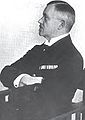
In January 1916, Admiral von Pohl
, commander of the German Fleet, fell ill. He was replaced by Scheer, who believed that the fleet had been used too defensively, had better ships and men than the British, and ought to take the war to them. According to Scheer, the German naval strategy
should be
 On 25 April, a decision was made by the German admiralty to halt indiscriminate attacks by submarine on merchant shipping. This followed protests from neutral countries, notably the United States, that their nationals had been the victims of attacks. Germany agreed that future attacks would only take place in accord with internationally agreed prize rules, which required an attacker to give a warning and allow the crews of vessels time to escape, and not to attack at all neutral vessels. Scheer believed that it would not be possible to continue attacks on these terms, which took away the advantage of secret approach by submarines and left them vulnerable to even relatively small guns on the target ships. Instead, he set about deploying the submarine fleet against military vessels.
It was hoped that, following a successful German submarine attack, fast British escorts, such as destroyers, would be tied down by anti-submarine operations. If the Germans could catch the British in the expected locations, there were thought to be good prospects of at least partially redressing the balance of forces between the fleets. "After the British sortied in response to the raiding attack force", the Royal Navy's centuries-old instincts for aggressive action could be exploited to draw its weakened units towards the main German fleet under Scheer. The hope was that Scheer would thus be able to ambush a section of the British fleet and destroy it.
had been damaged in a previous engagement, but was due to be repaired by mid May, so an operation was scheduled for 17 May. At the start of May, difficulties with condensers were discovered on ships of the III battleship squadron, so the operation was put back to 23 May. Ten submarines – U-24
, U-32, U-43
, U-44
, UC-47
, U-51
, U-52
, U-63
, U-66
, and U-70
– were given orders first to patrol in the central North Sea between 17 and 22 May, and then to take up waiting positions. U-43 and U-44 were stationed in the Pentland Firth
, which the Grand Fleet was likely to cross leaving Scapa Flow
, while the remainder proceeded to the Firth of Forth
, awaiting battlecruisers departing Rosyth
. Each boat had an allocated area, within which it could move around as necessary to avoid detection, but was instructed to keep within it. During the initial North Sea patrol the ships were instructed to sail only north-south so that any enemy who chanced to encounter one would believe they were departing or returning from operations on the west coast (which required them to pass around the north of Britain). Once at their final positions, the ships were under strict orders to avoid premature detection that might give away the operation. It was arranged that a coded signal would be transmitted to alert the submarines exactly when the operation commenced: 'Take into account the enemy's forces may be putting to sea'.
Additionally, UB-27 was sent out on 20 May with instructions to work her way into the Firth of Forth past May Island
. U-46 was ordered to patrol the coast of Sunderland, which had been chosen for the diversionary attack, but because of engine problems she was unable to leave port and U-47 was diverted to this task. On 13 May, U-72 was sent to lay mines in the Firth of Forth; on the 23rd, U-74 departed to lay mines in the Moray Firth; and on the 24th, U-75 was dispatched similarly west of the Orkney Islands. UB-21 and UB-22 were sent to patrol the Humber, where (incorrect) reports had suggested the presence of British warships. U-22, U-46 and U-67 were positioned north of Terschelling to protect against intervention by British light forces stationed at Harwich.
On 22 May, it was discovered that Seydlitz was still not watertight after repairs and would not now be ready until the 29th. The ambush submarines were now on station and experiencing difficulties of their own: visibility near the coast was frequently poor due to fog, and sea conditions were either so calm the slightest ripple, as from the periscope, could give away their position, or so rough as to make it very hard to keep the vessel at a steady depth. The British had become aware of unusual submarine activity, and had begun counter patrols that forced the submarines out of position. UB-27 passed Bell Rock on the night of 23 May on its way into the Firth of Forth as planned, but was halted by engine trouble. After repairs she continued to approach, following behind merchant vessels, and reached Largo Bay on 25 May. There the ship became entangled in nets that fouled one of the propellers, forcing it to abandon the operation and return home. U-74 was detected by four armed trawlers on 27 May and sunk 25 mi (21.7 nmi; 40.2 km) southeast of Peterhead. U75 laid her mines off the Orkney Islands, which, although they played no part in the battle, were responsible later for sinking the cruiser Hampshire carrying Lord Kitchener (head of the army) on a mission to Russia on 5 June. U-72 was forced to abandon her mission without laying any mines when an oil leak meant she was laying a visible surface trail astern.
s that they used for aerial reconnaissance and occasional bombing raids. The planned raid on Sunderland intended using Zeppelins to watch out for the British fleet approaching from the north, which might otherwise surprise the raiders.
By 28 May, strong northeasterly winds meant that it would not be possible to send out the Zeppelins, so the raid again had to be postponed. The submarines could only stay on station until 1 June before their supplies would be exhausted and they had orders to return, so a decision had to be made quickly about the raid.
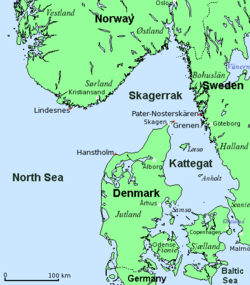
It was decided to use an alternative plan, abandoning the attack on Sunderland but instead sending a patrol of battlecruisers to the Skagerrak
, where it was likely they would encounter merchant ships carrying British cargo and British cruiser patrols. It was felt this could be done without air support, because the action would now be much closer to Germany, relying instead on cruiser and torpedo boat patrols for reconnaissance.
Orders for the alternative plan were issued on 28 May, though still hoping that last minute improvements in the weather would allow the original plan to go ahead. The German fleet assembled in the Jade River and at Wilhelmshaven
and was instructed to raise steam and be ready for action from midnight on 28 May.
By 14:00 on 30 May, the wind was still too strong and the final decision was made to use the alternative plan. The coded signal '31 May G.G.2490' was transmitted to the ships of the fleet to inform them the Skagerrak attack would start on 31 May. The pre-arranged signal to the waiting submarines was transmitted throughout the day from the E-Dienst radio station at Brugge
, and the U-boat tender Arcona anchored at Emden
. Only two of the waiting submarines, U-66
and U-32, received the order.
in 1914. German naval radio communications could therefore usually be quickly deciphered, and the British Admiralty
usually knew about German activities.
The British Admiralty's Room 40
maintained direction finding
and interception of German naval signals. It had intercepted and decrypted a German signal on 28 May ordering all ships to be ready for sea on the 30th. Further signals were intercepted, and although they were not decrypted it was clear that a major operation was likely. At 11:00 on 30 May, Jellicoe was warned that the German fleet seemed prepared to sail the following morning. By 17:00, the Admiralty had intercepted the signal from Scheer, '31 May G.G.2490', making it clear something significant was imminent.
Not knowing the Germans' objective, Jellicoe and his staff decided to position the fleet to head off any attempt by the Germans to enter the North Atlantic, or the Baltic
through the Skagerrak, by taking up a position off Norway where they could possibly cut off any German raid into the shipping lanes of the Atlantic, or prevent the Germans from heading into the Baltic. A position further west was unnecessary, as that area of the North Sea
could be patrolled by air using blimps and scouting aircraft.
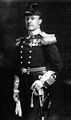 Consequently, Admiral Jellicoe led the 16 dreadnought battleships of the 1st and 4th Battle Squadrons of the Grand Fleet and three battlecruisers of the 3rd Battlecruiser Squadron eastwards out of Scapa Flow
at 22:30 on 30 May. He was to meet the 2nd battle squadron of eight more dreadnought battleships commanded by Vice-Admiral Martyn Jerram
coming from Cromarty. Hipper's raiding force did not leave the Outer Jade Roads until 01:00 on 31 May, heading west of Heligoland Island following a cleared channel through the minefields, heading north at 16 kn (19.5 mph; 31.4 km/h). The main German fleet of 16 dreadnought battleships of I and III Battle Squadrons left the Jade at 02:30, being joined off Heligoland at 04:00 by the six pre-dreadnoughts of the II Battle Squadron coming from the Elbe River. Beatty's faster force of six ships of the 1st and 4th battlecruiser squadrons plus the 5th battle squadron of four fast battleships left the Firth of Forth
on the next day, and Jellicoe's intention was to rendezvous with him 90 mi (78.2 nmi; 144.8 km) west of the mouth of the Skagerrak off the coast of Jutland and wait for the Germans or for their intentions to become clear. The planned position gave him the widest range of responses to likely German intentions.
was fundamental to the fleet tactics of this period (as in earlier periods). Tactical doctrine called for a fleet approaching battle to be in a compact formation of parallel columns, allowing relatively easy manoeuvring, and giving shortened sight lines within the formation, which simplified the passing of the signals necessary for command and control.
A fleet formed in several short columns could change its heading faster than one formed in a single long column. Since most command signals were made with flag
s or shuttered searchlight
s between ships, the flagship was usually placed at the head of the centre column so that its signals might be more easily seen by the many ships of the formation. Wireless telegraphy was in use, though security (radio direction finding), encryption, and the limitation of the radio sets made their extensive use more problematic. Command and control of such huge fleets remained difficult.
Thus, it might take a very long time for a signal from the flagship to be relayed to the entire formation. It was usually necessary for a signal to be confirmed by each ship before it could be relayed to other ships, and an order for a fleet movement would have to be received and acknowledged by every ship before it could be executed. In a large single-column formation, a signal could take 10 minutes or more to be passed from one end of the line to the other, whereas in a formation of parallel columns, visibility across the diagonals was often better (and always shorter) than in a single long column, and the diagonals gave signal "redundancy", increasing the probability that a message would be quickly seen and correctly interpreted.
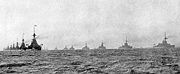 However, before battle was joined the heavy units of the fleet would, if possible, deploy into a single column. To form the battle line in the correct orientation relative to the enemy, the commanding admiral had to know the enemy fleet's distance, bearing, heading, and speed. It was the task of the scouting forces, consisting primarily of battlecruiser
s and cruiser
s, to find the enemy and report this information in sufficient time, and, if possible, to deny the enemy's scouting forces the opportunity of obtaining the equivalent information.
Ideally, the battle line would cross the intended path of the enemy column so that the maximum number of gun
s could be brought to bear, while the enemy could fire only with the forward guns of the leading ships, a manoeuvre known as "crossing the T
". Admiral Tōgō
, commander of the Japanese battleship fleet, had achieved this against Admiral Rozhestvensky's Russian battleships in 1905 at the Battle of Tsushima
, with devastating results. Jellicoe was to achieve this twice in one hour against the High Seas Fleet at Jutland, but on both occasions Scheer managed to turn away and disengage, thereby avoiding a decisive action.
Admiral John Fisher, responsible for reconstruction of the British fleet in the pre-war period, favoured large guns and speed. Admiral Tirpitz
, responsible for the German fleet, favoured unsinkable ships and chose to sacrifice some gun size for improved armour. The German battlecruiser SMS Derfflinger
had belt armour equivalent in thickness – though not in terms of comprehensiveness – to the British battleship HMS Iron Duke
, significantly better than on the British battlecruisers such as Tiger. German ships had better internal subdivision and had fewer doors and other weak points in their bulkheads
, but with the disadvantage that space for crew was greatly reduced. As they were only designed for cruises in the North Sea, they did not need to be as habitable as the British vessels, and their crews could live in barracks ashore when in harbour.
Jellicoe's Grand Fleet was split into two sections. The dreadnought Battle Fleet with which he sailed formed the main force and was composed of 24 battleships and three battlecruisers. The battleships were formed into three squadrons of eight ships, further subdivided into divisions of four, each led by a flag officer
. Accompanying them were eight armoured cruisers (classified by the Royal Navy since 1913 as "cruisers"), eight light cruiser
s, four scout cruiser
s, 51 destroyer
s, and one destroyer-minelayer.
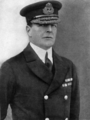 The Grand Fleet sailed without three of its battleships: Emperor of India in refit at Invergordon, Queen Elizabeth drydocked at Rosyth
and Dreadnought in refit at Devonport. The brand new Royal Sovereign was left behind, with only three weeks in service, her untrained crew judged unready for battle.
British reconnaissance
was provided by the Battlecruiser Fleet under David Beatty: six battlecruisers, four fast Queen Elizabeth-class battleship
s, 14 light cruisers and 27 destroyers. Air scouting was provided for by the attachment of the seaplane tender
, one of the first aircraft carrier
s in history to participate in a naval engagement.
The German High Seas Fleet under Scheer was also split into a main force and a separate reconnaissance force. Scheer's main battle fleet was composed of 16 battleships and six pre-dreadnought battleships arranged in an identical manner to the British. With them were six light cruisers and 31 torpedo-boats.
The German scouting force, commanded by Franz Hipper, consisted of five battlecruisers, five light cruisers and 30 torpedo-boats. The Germans had no equivalent to Engadine, and no heavier-than-air aircraft
to operate with the fleet, but had the Imperial German Naval Airship Service's force of rigid airship
s available to patrol the North Sea.
The British capital ships carried a larger number of guns and a correspondingly larger weight of broadside than their German counterparts: 332360 lb (150,756 kg) as compared to 134216 lb (60,879.4 kg). Most of the battleships and battlecruisers on both sides also carried torpedo
es of various sizes, as did the lighter craft.
The German battle fleet was hampered by the slow speed and relatively poor armament of the six pre-dreadnoughts of II Squadron, which limited maximum fleet speed to 18 kn (21.9 mph; 35.3 km/h), compared to maximum British fleet speed of 21 kn (25.6 mph; 41.2 km/h). On the British side, the eight armoured cruisers were deficient in both speed and armour protection. Both of these obsolete squadrons were notably vulnerable to attacks by more modern enemy ships.
U-66 was also supposed to be patrolling off the Firth of Forth, but had been forced north to a position 60 mi (52.1 nmi; 96.6 km) off Peterhead by patrolling British vessels. This now brought her into contact with the 2nd Battle Squadron, coming from the Moray Firth. At 05:00, she had to crash dive when the cruiser appeared from the mist heading toward her. She was followed by another cruiser, , and eight battleships. U-66 got within 350 yd (320 m) of the battleships preparing to fire, but was forced to dive by an approaching destroyer and missed the opportunity. At 06:35, she reported eight battleships and cruisers heading north.
The courses reported by both submarines were incorrect, because they reflected one leg of a zig-zag being used by British ships to avoid submarines. Taken with a wireless intercept of more ships leaving Scapa Flow earlier in the night, they created the impression in the German High Command that the British fleet, whatever it was doing, was split into separate sections moving apart, which was precisely as the Germans wished to meet it.
Jellicoe's ships proceeded to their rendezvous undamaged and undiscovered. However, he was now misled by an Admiralty intelligence
report advising that the German main battle fleet was still in port. The Director of Operations Division, Rear Admiral Thomas Jackson
, had asked the intelligence division, Room 40
, for the current location of German call sign DK, used by Admiral Scheer. They had replied that it was currently transmitting from Wilhelmshaven
. It was known to the intelligence staff that Scheer deliberately used a different call sign when at sea, but no one asked for this information or explained the reason behind the query -- to locate the German fleet.
The German battlecruisers cleared the minefields surrounding the Amrum
swept channel by 09:00. They then proceeded northwest, passing 35 mi (30.4 nmi; 56.3 km) west of the Horn's Reef lightship heading for the Little Fisher Bank at the mouth of the Skagerrak. The High Seas Fleet followed some 50 mi (43.4 nmi; 80.5 km) behind. The battlecruisers were in line ahead, with the four cruisers of the II scouting group plus supporting torpedo boats ranged in an arc 8 mi (7 nmi; 12.9 km) ahead and to either side. The IX torpedo boat flotilla formed close support immediately surrounding the battlecruisers. The High Seas Fleet similarly adopted a line-ahead formation, with close screening by torpedo boats either side and a further screen of five cruisers surrounding the column 5 mi (4.3 nmi; 8 km) away. Winds had finally moderated so that Zeppelins could be used, and by 11:30 five had been sent out: L14 to the Skagerrak, L23 240 mi (208.6 nmi; 386.2 km) east of Noss Head in the Pentland Firth, L21 120 mi (104.3 nmi; 193.1 km) off Peterhead, L9 100 mi (86.9 nmi; 160.9 km) off Sunderland, and L16 80 mi (69.5 nmi; 128.7 km) east of Flamborough Head. Visibility, however, was still bad, with cloud down to 1000 ft (304.8 m).
 At 14:20 on 31 May, despite heavy haze and scuds
of fog giving poor visibility, scouts from Beatty's force reported enemy ships to the southeast; the British light units, investigating a neutral Danish steamer
(N J Fjord), which was stopped between the two fleets, had found two German destroyer
s engaged in the same mission (B109 and B110). The first shots of the battle were fired at 14:28 when and of the British 1st Light Cruiser Squadron opened on the German destroyers, which withdrew toward their own approaching light cruisers. At 14:36, the Germans scored the first hit of the battle when , of Rear-Admiral Friedrich Bödicker
's Scouting Group II, hit her British counterpart Galatea at extreme range.
Meanwhile Beatty began to move his battlecruisers and supporting forces southeastwards and then east to cut the German ships off from their base, and ordered Engadine to launch a seaplane
to try to get more information about the size and location of the German forces. This was the first time in history that a carrier-based aeroplane was used for reconnaissance in naval combat. Engadines plane did locate and report some German light cruisers just before 15:30, and received anti-aircraft gunfire, but attempts to relay the plane's reports failed.
Unfortunately for Beatty, his initial course changes at 14:32 were not received by Sir Hugh Evan-Thomas's
5th Battle Squadron (it being too far away to read his flags), because the battlecruiser – the last ship in his column – was no longer in a position where it could relay signals by searchlight to Evan-Thomas, as it had previously been ordered to do. Whereas before the north turn, Tiger had been the closest ship to Evan-Thomas, she was now further away than Beatty on Lion. Matters were aggravated because Evan-Thomas had not been briefed regarding standing orders within Beatty's Squadron, as his squadron normally operated with the Grand Fleet. Fleet ships were expected to obey movement orders precisely and not deviate from them. Beatty's standing instructions expected his officers to use initiative and keep position with the flagship. As a result, the four Queen Elizabeth-class battleships – which were the fastest and most heavily armed in the world at that time – remained on the previous course for several minutes, ending up 10 mi (8.7 nmi; 16.1 km) behind rather than five. Beatty also had opportunity during the previous hours to concentrate his forces, and no reason not to do so, whereas he steamed ahead at full speed faster than the battleships could manage. Dividing the force had serious consequences for the British, costing them what would have been an overwhelming advantage in ships and firepower during the first half-hour of the coming battle.
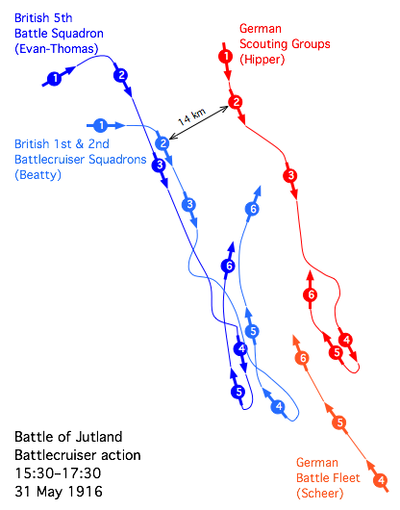
With visibility favouring the Germans, at 15:22 Hipper's battlecruisers, steaming approximately northwest, sighted Beatty's squadron at a range of about 15 mi (13 nmi; 24.1 km), while Beatty's forces did not identify Hipper's battlecruisers until 15:30. (position 1 on map). At 15:45, Hipper turned southeast to lead Beatty toward Scheer
, who was 46 mi (40 nmi; 74 km) southeast with the main force of the High Seas Fleet.
At 15:48, with the opposing forces roughly parallel at 15000 yd (13,716 m), with the British to the southwest of the Germans (i.e., on the right side), Hipper opened fire, followed by the British ships as their guns came to bear upon targets (position 2). Thus began the opening phase of the battlecruiser action, known as the "Run to the South", in which the British chased the Germans, and Hipper intentionally led Beatty toward Scheer. During the first minutes of the ensuing battle, all the British ships except Princess Royal fired far over their German opponents, due to adverse visibility conditions, before finally getting the range. Only Lion and Princess Royal had settled into formation, so the other four ships were hampered in aiming by their own turning. Beatty was to windward of Hipper, and therefore funnel and gun smoke from his own ships tended to obscure his targets, while Hipper's smoke blew clear. Also, the eastern sky was overcast and the grey German ships were indistinct and difficult to range.
Beatty had ordered his ships to engage in a line, one British ship engaging with one German and his flagship
doubling on the German flagship . However, due to another mistake with signalling by flag, and possibly that Queen Mary and Tiger were unable to see the German lead ship because of smoke, the second German ship, Derfflinger, was left unengaged and free to fire without disruption. drew fire from two of Beatty's battlecruisers, but still fired with deadly accuracy during this time, putting nine shells into Tiger in the first 12 minutes. The Germans drew first blood. Aided by superior visibility, Hipper's five battlecruisers quickly registered hits on three of the six British battlecruisers. Seven minutes passed before the British managed to score their first hit.
 The first near-kill of the Run to the South occurred at 16:00, when a 12 in (304.8 mm) salvo from Lützow wrecked the "Q" turret amidships on Beatty's flagship Lion. Dozens of crewmen were instantly killed, but far larger destruction was averted when the mortally wounded turret commander – Major Francis Harvey of the Royal Marines
– promptly ordered the magazine doors shut and the magazine flooded. This prevented a massive magazine explosion at 16:28, when a flash fire ignited ready cordite charges beneath the turret and killed everyone in the chambers outside "Q" magazine. Lion was saved. was not so lucky; at 16:02, just 14 minutes into the slugging match, she was smashed aft by three 11 in (279.4 mm) shells from , causing damage sufficient to knock her out of line and detonating "X" magazine aft. Soon after, despite the near-maximum range, Von der Tann put another 11 in (279.4 mm) salvo on Indefatigables "A" turret forward. The plunging shells probably pierced the thin upper armour, and seconds later Indefatigable was ripped apart by another magazine explosion, sinking immediately with her crew of 1,019 officers and men, leaving only two survivors. (position 3).
Hipper's position deteriorated somewhat by 16:15 as the 5th Battle Squadron finally came into range, so that he had to contend with gunfire from the four battleships astern as well as Beatty's five remaining battlecruisers to starboard. But he knew his baiting mission was close to completion, as his force was rapidly closing with Scheer's main body. At 16:08, the lead battleship of the 5th Battle Squadron, , caught up with Hipper and opened fire at extreme range, scoring a 15 in (381 mm) hit on Von der Tann within 60 seconds. Still, it was 16:15 before all the battleships of the 5th were able to fully engage at long range.
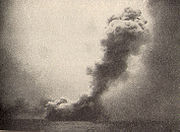 At 16:25, the battlecruiser action intensified again when was hit by what may have been a combined salvo from Derfflinger and ; she disintegrated when both forward magazines exploded, sinking with all but nine of her 1,275 man crew lost. (position 4). Commander von Hase, the first gunnery officer aboard Derfflingler, noted:
During the Run to the South, from 15:48 to 16:54, the German battlecruisers made an estimated total of forty-two 11 in (279.4 mm) and 12 in (304.8 mm) hits on the British battlecruisers (nine on Lion, six on Princess Royal, seven on Queen Mary, 14 on Tiger, one on New Zealand, five on Indefatigable), and two more on the battleship Barham, compared with only eleven 13.5 in (342.9 mm) hits by the British battlecruisers (four on Lützow, four on Seydlitz, two on Moltke, one on von der Tann), and six 15 in (381 mm) hits by the battleships (one on Seydlitz, four on Moltke, one on von der Tann).
.jpg)
, saying "Chatfield
, there seems to be something wrong with our bloody ships today." (In popular legend, Beatty also immediately ordered his ships to "turn two points to port", i.e., two points
nearer the enemy, but there is no official record of any such command or course change.) Princess Royal, as it turned out, was still afloat after the spray cleared.
At 16:30, Scheer's leading battleships sighted the distant battlecruiser action; soon after, of Beatty's 2nd Light Cruiser
Squadron led by Commodore William Goodenough
sighted the main body of Scheer's High Seas Fleet, dodging numerous heavy-calibre salvos to report in detail the German strength: 16 dreadnoughts with six older battleships. This was the first news that Beatty and Jellicoe had that Scheer and his battle fleet were even at sea. Simultaneously, an all-out destroyer action raged in the space between the opposing battlecruiser forces, as British and German destroyers fought with each other and attempted to torpedo the larger enemy ships. Each side fired many torpedoes, but both battlecruiser forces turned away from the attacks and all escaped harm except Seydlitz, which was hit forward at 16:57 by a torpedo fired by the British destroyer . Though taking on water, Seydlitz maintained speed. The destroyer , under the command of Captain Barry Bingham
, led the British attacks. The British disabled the German torpedo boat V27, which the Germans soon abandoned and sank, and Petard then torpedoed and sank V29, her second score of the day. S35 and V26 rescued the crews of their sunken sister ships. But Nestor and another British destroyer – – were immobilised by shell hits, and were later sunk by Scheer's passing dreadnoughts. Bingham was rescued, and won the Victoria Cross for his leadership in the destroyer action.
Meanwhile, at 16:47, having received Goodenough's signal and knowing that Beatty was now leading the German battlefleet north to him, Jellicoe signalled to his own forces that the fleet action they had waited so long for was finally imminent; at 16:51, by radio, he so informed the Admiralty in London.
The difficulties of the 5th Battle Squadron were compounded when Beatty repeated the order to Evan-Thomas to "turn in succession" (rather than "turn together") at 16:48 as the battleships passed him. Evan-Thomas acknowledged the signal, but Lieutenant-Commander Ralph Seymour, Beatty's flag lieutenant, aggravated the situation when he did not haul down the flags (to execute the signal) for some minutes. At 16:55, when the 5BS had moved within range of the enemy battleships, Evan-Thomas issued his own flag command warning his squadron to expect sudden manoeuvres and to follow his lead, before starting to turn on his own initiative. The order to turn in succession would have resulted in all four ships turning in the same patch of sea as they reached it one by one, giving the High Seas Fleet repeated opportunity with ample time to find the proper range. In the event, the captain of the trailing ship turned early, mitigating the adverse results.
For the next hour, the 5th Battle Squadron acted as Beatty's rearguard, drawing fire from all the German ships within range, while by 17:10 Beatty had deliberately eased his own squadron out of range of Hipper's now-superior battlecruiser force to give his damaged ships a respite from the accurate and deadly fire of his foes. Since visibility and firepower now favoured the Germans, there was no incentive for Beatty to risk further battlecruiser losses when his own gunnery could not be effective: illustrating the imbalance, Beatty's battlecruisers did not score any hits on the Germans in this phase until 17:45, but they had rapidly received five more before he opened the range (four on Lion, of which three were by Lützow, and one on Tiger by Seydlitz). Now the only targets the Germans could reach, the ships of the 5th Battle Squadron, received simultaneous fire from Hipper's battlecruisers to the east (which HMS Barham and engaged) and Scheer's leading battleships to the southeast (which and engaged). Three took hits: Barham (four by Derfflinger), Warspite (two by Seydlitz), and Malaya (seven by the German battleships). Only Valiant was unscathed.
The four battleships were far better suited to take this sort of pounding than the battlecruisers, and none were lost, though Malaya suffered heavy damage, an ammunition fire, and heavy crew casualties. At the same time, the 15 in (381 mm) fire of the four British ships was accurate and effective. As the two British squadrons headed north at top speed, eagerly chased by the entire German fleet, the 5th Battle Squadron scored 13 hits on the enemy battlecruisers (four on Lützow, three on Derfflinger, six on Seydlitz) and five on battleships (though only one, on , did any serious damage). (position 6).
's 3rd Battlecruiser Squadron
to speed ahead to find and support Beatty's force, and Hood was now racing SSE well in advance of Jellicoe's northern force. Rear-Admiral Arbuthnot
's 1st Cruiser Squadron patrolled the van of Jellicoe's main battleship force as it advanced steadily to the southeast.
At 17:33, the armoured cruiser of Arbuthnot's squadron, on the far southwest flank of Jellicoe's force, came within view of , which was about 5 mi (4.3 nmi; 8 km) ahead of Beatty with the 3rd Light Cruiser Squadron, establishing the first visual link between the converging bodies of the Grand Fleet. At 17:38, the scout cruiser , screening Hood's oncoming battlecruisers, was intercepted by the van of the German scouting forces under Rear-Admiral Bödicker.
Heavily outnumbered by Bödicker's four light cruisers, Chester was pounded before being relieved by Hood's heavy units, which swung westward for that purpose. Hood's flagship disabled the light cruiser shortly after 17:56. Wiesbaden became a sitting target for most of the British fleet during the next hour, but remained afloat and fired some torpedoes at the passing enemy battleships from long range. Meanwhile, Bödicker's other ships fled toward Hipper and Scheer in the mistaken belief that Hood was leading a larger force of British capital ships from the north and east. A chaotic destroyer action in mist and smoke ensued as German torpedo boats attempted to blunt the arrival of this new formation, but Hood's battlecruisers dodged all the torpedoes fired at them. In this action, after leading a torpedo counterattack, the British destroyer was disabled, but continued to return fire at numerous passing enemy ships for the next hour.
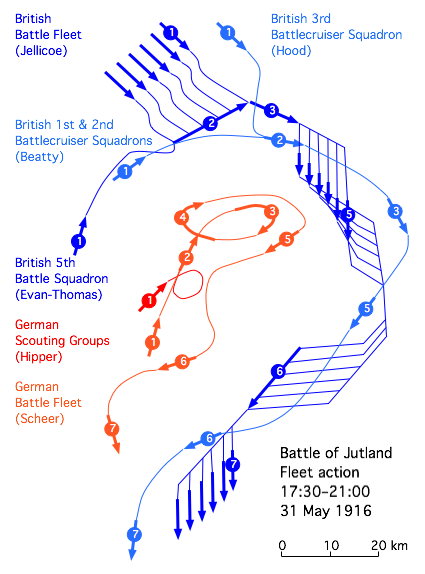 In the meantime, Beatty and Evan-Thomas had resumed their engagement with Hipper's battlecruisers, this time with the visual conditions to their advantage. With several of his ships damaged, Hipper turned back toward Scheer at around 18:00, just as Beatty's flagship Lion was finally sighted from Jellicoe's flagship Iron Duke. Jellicoe twice demanded the latest position of the German battlefleet from Beatty, who could not see the German battleships and failed to respond to the question until 18:14. Meanwhile, Jellicoe received confusing sighting reports of varying accuracy and limited usefulness from light cruisers and battleships on the starboard (southern) flank of his force.
Jellicoe was in a worrying position. He needed to know the location of the German fleet to judge when and how to deploy his battleships from their cruising formation (six columns of four ships each) into a single battle line. The deployment could be on either the westernmost or the easternmost column, and had to be carried out before the Germans arrived; but early deployment could mean losing any chance of a decisive encounter. Deploying to the west would bring his fleet closer to Scheer, gaining valuable time as dusk approached, but the Germans might arrive before the manoeuvre was complete. Deploying to the east would take the force away from Scheer, but Jellicoe's ships might be able to cross the "T"
, and visibility would strongly favour British gunnery – Scheer's forces would be silhouetted against the setting sun to the west, while the Grand Fleet would be indistinct against the dark skies to the north and east, and would be hidden by reflection of the low sunlight off intervening haze and smoke. Deployment would take twenty irreplaceable minutes, and the fleets were closing at speed. In one of the most critical and difficult tactical command decisions of the entire war, Jellicoe ordered deployment to the east at 18:15.
Arbuthnot's armoured cruisers had no real place in the coming clash between modern dreadnoughts, but he was attracted by the drifting hull of the crippled Wiesbaden. With Warrior, Defence closed in for the kill, only to blunder right into the gun sights of Hipper's and Scheer's oncoming capital ships. Defence was deluged by heavy-calibre gunfire from many German battleships, which detonated her magazines in a spectacular explosion viewed by most of the deploying Grand Fleet; she sank with all hands (903 officers and men). Warrior was also hit badly, but she was spared destruction by a mishap to the nearby battleship Warspite. Warspite had her steering gear overheat and jam under heavy load at high speed as the 5th Battle Squadron made a turn to the north at 18:19. Steaming at top speed in wide circles, Warspite appeared as a juicy target to the German dreadnoughts and took 13 hits, inadvertently drawing fire from the hapless Warrior. Warspite was brought back under control and survived the onslaught, but was badly damaged, had to reduce speed, and withdrew northward; later (at 21:07), she was ordered back to port by Evan-Thomas. Warspite went on to a long and illustrious career, serving also in World War II
. Warrior, on the other hand, was abandoned and sank the next day after her crew was taken off at 08:25 on 1 June by Engadine, which towed the sinking armoured cruiser 100 mi (86.9 nmi; 160.9 km) during the night.
As Defence sank and Warspite circled, at about 18:19, Hipper moved within range of Rear-Admiral Hood's 3rd Battlecruiser Squadron, but was still also within range of Beatty's ships. At first, visibility favoured the British: hit Derfflinger three times and Seydlitz once, while Lützow quickly took 10 hits from Lion, and Invincible, including two below-waterline hits forward by Invincible that would ultimately doom Hipper's flagship. But at 18:30, Invincible abruptly appeared as a clear target before Lützow and Derfflinger. The two German ships then fired three salvoes each at Invincible, and sank her in 90 seconds. A 12 in (304.8 mm) shell from the third salvo struck Invincibles Q-turret amidships, flash detonated the magazines below, and the ship blew up and split in two, killing all but six of her crew of 1,032 officers and men, including Rear-Admiral Hood. Of the remaining British battlecruisers, only Princess Royal received heavy-calibre hits at this time (two 12 in (304.8 mm) by the battleship Markgraf). Lützow, flooding forward and unable to communicate by radio, was now out of action and began to attempt to withdraw; therefore Hipper left his flagship and transferred to the destroyer , hoping to board one of the other battlecruisers later.
Conscious of the risks to his capital ships posed by torpedoes, Jellicoe did not chase directly but headed south, determined to keep the High Seas Fleet west of him. Starting at 18:40, battleships at the rear of Jellicoe's line were in fact sighting and avoiding torpedoes, and at 18:54 was hit by a torpedo (probably from the disabled Wiesbaden), which reduced her speed to 16 kn (19.5 mph; 31.4 km/h). Meanwhile, Scheer, knowing that it was not yet dark enough to escape and that his fleet would suffer terribly in a stern chase, doubled back to the east at 18:55. In his memoirs he wrote, "the manœuvre would be bound to surprise the enemy, to upset his plans for the rest of the day, and if the blow fell heavily it would facilitate the breaking loose at night." But the turn to the east took his ships, again, directly towards Jellicoe's fully deployed battle line.
Simultaneously, the disabled British destroyer Shark fought desperately against a group of four enemy destroyers and disabled with gunfire, but was finally torpedoed and sunk at 19:02 by the German destroyer S54. Sharks Captain Loftus Jones
won the Victoria Cross for his heroism in continuing to fight against all odds.
At 19:17, for the second time in less than an hour, Scheer turned his outnumbered and outgunned fleet to the west using the "battle about turn" (German Gefechtskehrtwendung), but this time it was executed only with difficulty, as the High Seas Fleet's lead squadrons began to lose formation under concentrated gunfire. To deter a British chase, Scheer ordered a major torpedo attack by his destroyers and a potentially sacrificial charge by Scouting Group I's four remaining battlecruisers. Hipper was still aboard the destroyer G39 and was unable to command his squadron for this attack. Therefore, , under Captain Hartog, led the already heavily damaged German battlecruisers directly into "the greatest concentration of naval gunfire any fleet commander had ever faced", at ranges down to 4 mi (3.5 nmi; 6.4 km). In what became known as the "death ride", all the battlecruisers except were hit and further damaged, as 18 of the British battleships fired at them simultaneously. Derfflinger had two main gun turrets destroyed, with most of their crews killed, but survived the pounding and veered away with the other battlecruisers once Scheer was out of trouble and the German destroyers were moving in to attack. In this brief but intense portion of the engagement, from about 19:05 to about 19:30, the Germans sustained a total of 37 heavy hits while inflicting only two; Derfflinger alone received 14.
While his battlecruisers drew the fire of the British fleet, Scheer slipped away, laying smoke screens. Meanwhile, from about 19:16 to about 19:40, the British battleships were also engaging Scheer's destroyers, which executed several waves of torpedo attacks to cover his withdrawal. Jellicoe's ships turned away from the attacks and successfully evaded all 31 of the torpedoes launched at them – though, in several cases, only just barely – and sank the German destroyer . British light forces also sank V48, which had previously been disabled by . This action, and the turn away, cost the British critical time and range in the last hour of daylight -- as Scheer intended, allowing him to get his heavy ships out of immediate danger.
The last major exchanges between capital ships in this battle took place just after sunset, from about 20:19 to about 20:35, as the surviving British battlecruisers caught up with their German counterparts, which were briefly relieved by Rear-Admiral Mauve's obsolete pre-dreadnoughts (the German 2nd Squadron). The British received one heavy hit on Princess Royal but scored five more on Seydlitz and three on other German ships. As twilight faded to night and exchanged a few final shots with , neither side could have imagined that the only encounter between British and German dreadnoughts in the entire war was already concluded.
. Luckily for Scheer, most of the light forces in Jellicoe's rearguard failed to report the seven separate encounters with the German fleet during the night; the very few radio reports that were sent to the British flagship were never received, possibly because the Germans were jamming British frequencies. Many of the destroyers failed to make the most of their opportunities to attack discovered ships, despite Jellicoe's expectations that the destroyer forces would, if necessary, be able to block the path of the German fleet. Jellicoe and his commanders did not understand that the furious gunfire and explosions to the north (seen and heard for hours by all the British battleships) indicated that the German heavy ships were breaking through the screen astern of the British fleet. Instead, it was believed that the fighting was the result of night attacks by German destroyers. The most powerful British ships of all (the 15-inch-gunned 5th Battle Squadron
) directly observed German battleships crossing astern of them in action with British light forces, at ranges of 3 mi (2.6 nmi; 4.8 km) or less, and gunners on the made ready to fire, but her captain declined, deferring to the authority of Rear-Admiral Evan-Thomas – and neither commander reported the sightings to Jellicoe, assuming that he could see for himself and that revealing the fleet's position by radio signals or gunfire was unwise.
While the nature of Scheer's escape, and Jellicoe's inaction, indicate the overall German superiority in night fighting, the results of the night action were no more clear-cut than were those of the battle as a whole. In the first of many surprise encounters by darkened ships at point-blank range, Southampton, Commodore Goodenough's flagship, which had scouted so proficiently, was heavily damaged in action with a German Scouting Group composed of light cruisers, but managed to torpedo the , which went down at 22:23 with all hands (320 officers and men).
From 23:20 to approximately 02:15, several British destroyer flotilla
s launched torpedo attacks on the German battle fleet in a series of violent and chaotic engagements at extremely short range (often under 0.5 mi (0.80467 km)). At the cost of five destroyers sunk and some others damaged, they managed to torpedo the light cruiser , which sank several hours later, and the pre-dreadnought , which blew up and sank with all hands (839 officers and men) at 03:10 during the last wave of attacks before dawn. Three of the British destroyers collided in the chaos, and the German battleship rammed the British destroyer , blowing away most of the British ship's superstructure merely with the muzzle blast of its big guns, which could not be aimed low enough to hit the ship. Nassau was left with a 11 ft (3.4 m) hole in her side, reducing her maximum speed to 15 kn (18.3 mph; 29.4 km/h), while the removed plating was left lying on Spitfires deck. Spitfire survived and made it back to port. Another German cruiser, , was accidentally rammed by the dreadnought and abandoned, sinking early the next day. Of the British destroyers, , , , and were lost during the night fighting.
Just after midnight on 1 June, and other German battleships sank the of the ill-fated 1st Cruiser Squadron, which had blundered into the German battle line. Black Prince was overwhelmed by point-blank gunfire, and blew up with all hands (857 officers and men) as her squadron leader Defence had done hours earlier. Lost in the darkness, the battlecruisers and had similar point-blank encounters with the British battle line and were recognized, but were spared the fate of Black Prince when the captains of the British ships, again, declined to open fire, reluctant to reveal their fleet's position. At 01:45, the sinking battlecruiser Lützow – fatally damaged by Invincible during the main action – was torpedoed by the destroyer on orders of Lützows Captain Viktor von Harder after the surviving crew of 1,150 transferred to destroyers that came alongside. At 02:15, the German destroyer suddenly had its bow blown off; V2 and V6 came alongside and took off the remaining crew, and the V2 then sank the hulk. Since there was no enemy nearby, it was assumed that she had hit a mine or had been torpedoed by a submarine.
At 02:15, five British ships of the 13th Destroyer Flotilla under Captain James Uchtred Farie regrouped and headed south. At 02:25, they sighted the rear of the German line. HMS Marksman inquired of the leader as to whether he thought they were British or German ships. Answering that he thought they were German, Farie then veered off to the east and away from the German line. All but Moresby in the rear followed, as through the gloom she sighted what she thought were four pre-dreadnought battleships 2 mi (1.7 nmi; 3.2 km) away. She hoisted a flag signal indicating that the enemy was to the west and then closed to firing range, letting off a torpedo set for high running at 02:37, then veering off to rejoin her flotilla. The four pre-dreadnought battleships were in fact two pre-dreadnoughts, Schleswig-Holstein and Schlesien, and the battlecruisers Von der Tann and Derfflinger. Von der Tann sighted the torpedo and was forced to steer sharply to starboard to avoid it as it passed close to her bows. Moresby rejoined Champion convinced she had scored a hit.
Finally, at 05:20, as Scheer's fleet was safely on its way home, the battleship struck a British mine on her starboard side, killing one man and wounding ten, but was able to make port. Seydlitz, critically damaged and very nearly sinking, barely survived the return voyage: after grounding and taking on even more water on the evening of 1 June, she had to be assisted stern first into port, where she dropped anchor at 07:30 on the morning of 2 June.
The Germans were helped in their escape by the failure of the British admiralty in London to pass on seven critical radio intercepts obtained by naval intelligence indicating the true position, course and intentions of the High Seas Fleet during the night. One message was transmitted to Jellicoe at 23:15 that accurately reported the German fleet's course and speed as of 21:14. However, the erroneous signal from earlier in the day that reported the German fleet still in port, and an intelligence signal received at 22:45 giving another unlikely position for the German fleet, had reduced his confidence in intelligence reports. Had the other messages been forwarded, which confirmed the information received at 23:15, or had British ships reported accurately sightings and engagements with German destroyers, cruisers and battleships, then Jellicoe could have altered course to intercept Scheer at the Horns Reef. The unsent intercepted messages had been duly filed by the junior officer left on duty that night, who failed to appreciate their significance. By the time Jellicoe finally learned of Scheer's whereabouts at 04:15, Scheer was too far away to catch and it was clear that the battle could no longer be resumed.
In Britain the first official news came from German wireless broadcasts. Ships began to arrive in port, their crews sending messages to friends and relatives both of their survival and the loss of some 6,000 others. Authorities considered suppressing the news, but it had already spread widely. Some crews coming ashore found rumours had already reported them dead to relatives, while others were jeered for the defeat they had suffered. At 7pm on 2 June the admiralty released a statement based on information from Jellicoe containing the bare news of losses on each side. The following day British newspapers reported a German victory. The Daily Mirror reported the German Director of the Naval Department had told the Reichstag: "The result of the fighting is a significant success for our forces against a much stronger adversary". The British population was shocked that the long anticipated battle had been a victory for Germany. On 3 June the admiralty issued a further statement expanding on German losses, and another the following day with exaggerated claims. However, on 7 June the German admission of the losses of Lutzow and Rostock started to redress the sense of the battle as a loss. International perception of the battle began to change towards a qualified British victory, the German attempt to change the balance of power in the North Sea having been repulsed. In July, bad news form the Somme campaign swept concern over Jutland from the British consciousness.

 At Jutland, the Germans, with a 99-strong fleet, sank 115000 LT (116,845.8 t) of British ships, while a 151-strong British fleet sank 62000 LT (62,995.1 t) of German ships. The British lost 6,094 seamen; the Germans 2,551. Several other ships were badly damaged, such as and . On the other hand, the British fleet remained in control of the North Sea at the end of the battle.
At a strategic level, the outcome has been the subject of a huge literature, with no clear consensus. In the immediate aftermath, the view of the battle as indecisive was widely held, and remains influential.
Despite numerical superiority, the British had been disappointed in their hopes for a decisive victory comparable to Trafalgar
and the objective of the influential strategic doctrines of Alfred Mahan. The High Seas Fleet survived as a fleet in being
. Most of its losses were made good within a month – even Seydlitz, the most badly damaged ship to survive the battle, was repaired by October and officially back in service by November. However, the Germans had failed in their objective of destroying a substantial portion of the British Fleet, and no progress had been made towards the goal of allowing the High Seas Fleet to operate in the Atlantic Ocean.
Subsequently there has been considerable support for the view of Jutland as a strategic victory for the British. While the British had not destroyed the German fleet and had lost more ships than their enemy, the Germans had retreated to harbour and at the end of the battle the British were in command of the area. The German fleet would only sortie into the North Sea twice more, with a raid on 19 August
and in October 1916. Apart from these two (abortive) operations the High Seas Fleet – unwilling to risk another encounter with the British fleet – confined its actvities to the Baltic Sea for the remainder of the war. Jutland thus ended the German challenge to British naval supremacy. A German naval expert, writing publicly about Jutland in November 1918, commented, "Our Fleet losses were severe. On 1 June 1916 it was clear to every thinking person that this battle must, and would be, the last one".
At the end of the battle, the British had maintained their numerical superiority and had 23 dreadnoughts ready and four battlecruisers still able to fight, while the Germans had 10. One month after the battle, the Grand Fleet was stronger than it had been before sailing to Jutland. Warspite was drydocked at Rosythe, returning to the fleet on 22 July, while Malaya was repaired in the floating dock at Invergordon, returning to duty 11 July. Barham was docked for a month at Devenport before undergoing speed trials and returning to Scapa on 8 July. Princess Royal stayed initially at Rosyth but transferred to drydock at Portsmouth before returning to duty at Rosyth 21 July. Tiger was drydocked at Rosyth and ready for service 2 July. Queen Elizabeth, Emperor of India and Australia, which had been undergoing maintenance at the time of the battle, returned to the fleet immediately, followed shortly after by Resolution and Ramillies. Lion initially remained ready for sea duty despite the damaged turret, then underwent a month's repairs in July when Q turret was removed temporarily and replaced in September.
A third view, presented in a number of recent evaluations, is that Jutland, the last major fleet action between battleships, illustrated the irrelevance of battleship fleets following the development of the submarine, mine and torpedo. In this view, the most important consequence of Jutland was the decision of the Germans to engage in unrestricted submarine warfare. Although large numbers of battleships were constructed in the decades between the wars, it has been argued that this outcome reflected the social dominance among naval decision-makers of battleship advocates who constrained technological choices to fit traditional paradigms of fleet action. In the event, battleships played a relatively minor role in World War II, in which the aircraft carrier emerged as the dominant offensive weapon of naval warfare.
mixture (Lyddite). The shock of impact of a shell against armor often prematurely detonated Lyddite in advance of fuze
function while TNT detonation could be delayed until fuze function after the shell had penetrated into the vulnerable area behind the armor plate.
The issue of poorly performing shells had been known to Jellicoe, who as third sea lord from 1908–1910 had ordered new shells to be designed. However, the matter had not been followed through after his posting to sea and new shells had never been thoroughly tested. Beatty discovered the problem at a party aboard Lion a short time after the battle, where a Swedish Naval officer was present. He had recently visited Berlin, where the German navy had scoffed at how British shells had broken up on their ships' armour. The question of shell effectiveness had also been raised after the Battle of Dogger Bank
, but no action had been taken. Hipper later commented, "It was nothing but the poor quality of their bursting charges which saved us from disaster".
Admiral Dreyer, writing later about the battle, during which he had been captain of the British flagship Iron Duke, estimated that effective shells as later introduced would have led to the sinking of six more German capital ships, based upon the actual number of hits achieved in the battle. The system of testing shells, which remained in use up to 1944, meant that, statistically, a batch of shells of which 70% were faulty stood an even chance of being accepted. Indeed, even shells that failed this relatively mild test had still been issued to ships. Analysis of the test results afterwards by the Ordnance Board suggested the likelihood that 30–70% of shells would not have passed the standard penetration test specified by the Admiralty.
Efforts to replace the shells were initially resisted by the Admiralty, and action was not taken until Jellicoe became First Sea Lord in December 1916. As an initial response, the worst of the existing shells were withdrawn from ships in early 1917 and replaced from reserve supplies. New shells were designed, but did not arrive until April 1918, and were never used in action.
and exchange broadside
s with the enemy. Although one German and three British battlecruisers were sunk, none of them were destroyed by enemy shells penetrating the belt armour and detonating the magazines; each of the British battlecruisers was penetrated through a turret roof and her magazines ignited by flash fires passing through the turret and shell-handling rooms. Lützow sustained 24 hits and her flooding could not be contained. She was eventually sunk by her escorts' torpedoes after her crew had been safely removed. Derfflinger and Seydlitz sustained 22 hits each but made it to port (though Seydlitz just barely).
Jellicoe and Beatty, as well as other senior officers, gave an impression that the loss of the battlecruisers was caused by weak armour, despite reports by two committees and earlier statements by Jellicoe and other senior officers that Cordite and its management were to blame. This led to calls for armour to be increased, and an additional 1 in (2.5 cm) was placed over the relatively thin decks above magazines. To compensate for the increase in weight, ships had to carry correspondingly less fuel, water and other supplies. Whether or not thin deck armour was a potential weakness of British ships, the battle provided no evidence that it was the case. At least amongst the surviving ships, no enemy shell was found to have penetrated deck armour anywhere. The design of a new battlecruiser (which had started building at the time of the battle) was altered to give her 5000 LT (5,080.3 t) of additional armour.
charges differed in packaging, handling, and chemistry. The British propellant was of two types, MK1 and MD. The Mark 1 cordite had a formula of 37% nitrocellulose, 58% nitroglycerine, and 5% petroleum jelly. It was a good propellant but burned hot and caused an erosion problem in gun barrels. The petroleum jelly served as both a lubricant and a stabilizer. Cordite MD was developed to reduce barrel wear, its formula being 65% nitrocellulose, 30% nitroglycerine, and 5% petroleum jelly. While cordite MD solved the gun-barrel erosion issue, it did nothing to improve its storage properties, which were poor. Cordite was very sensitive to variations of temperature, and acid propagation/cordite deterioration would take place at a very rapid rate. Cordite MD also shed micro-dust particles of nitrocellulose and iron pyrite. While cordite propellant was manageable, it required a vigilant gunnery officer, strict cordite lot control, and frequent testing of the cordite lots in the ships' magazines.
British cordite
propellant (when uncased and exposed in the silk bag) tended to burn violently, causing uncontrollable "flash fires" when ignited by nearby shell hits. In 1945, a test was conducted by the U.S.N. Bureau of Ordnance (Bulletin of Ordnance Information, No.245, pp. 54–60) testing the sensitivity of Cordite to then-current U.S. Naval propellant powders against a measurable and repeatable flash source. It found that cordite would ignite at 530 mm/22" from the flash and the current U.S. powder at 120 mm,/5" the U.S. flashless powder at 25 mm./1" This meant that about 75 times the propellant would immediately ignite when exposed to flash, as compared to the U.S. powder. British ships had inadequate protection against these flash fires. German propellant (RP C/12, handled in brass cartridge cases) was less vulnerable and less volatile in composition. German propellants show that they were not that different in composition from cordite—with one major exception: centralite. This was symmetrical Diethyl Diphenyl Urea, which served as a stabilizer that was superior to the petroleum jelly used in British practice. It stored better and burned but did not explode. Stored and used in brass cases, it proved much less sensitive to flash. RP C/12 – 64.13% nitrocellulose, 29.77% nitroglycerine, 5.75% centralite, 0.25% magnesium oxide and 0.10% graphite.
The Royal Navy Battle Cruiser Fleet had also emphasized speed in ammunition handling over established safety protocol. In practice drills, cordite could not be supplied to the guns rapidly enough through the hoists and hatches. To bring up the propellant in good time to load for the next broadside, many safety doors were kept open that should have been shut to safeguard against flash fires. Bags of cordite were also stocked and kept locally, creating a total breakdown of safety design features. By staging charges in the chambers between the gun turret and magazine, the Royal Navy enhanced their rate of fire but left their ships vulnerable to chain reaction ammunition fires and magazine explosions. This 'bad safety habit' carried over into real battle practices. Furthermore, the doctrine of a high rate of fire also led to the decision in 1913 to increase the supply of shells and cordite held on the British ships by 50%, for fear of running out of ammunition. When this exceeded the capacity of the ships' magazines, cordite was stored in insecure places.
The British cordite charges were stored two silk bags to a metal cylindrical container, with a 16-oz gunpowder igniter charge, which was covered with a thick paper wad, four charges being used on each projectile. The gun crews were removing the charges from their containers and removing the paper covering over the gunpowder igniter charges. The effect of having eight loads at the ready was to have 4 ST (3,628.7 kg) of exposed explosive, with each charge leaking small amounts of gunpowder from the igniter bags. In effect, the gun crews had laid an explosive train from the turret to the magazines, and one shell hit to a battlecruiser turret was enough to end a ship.
A diving expedition during the summer of 2003 provided corroboration of this practice. It examined the wrecks of Invincible, Queen Mary, Defence, and Lützow to investigate the cause of the British ships' tendency to suffer from internal explosions. From this evidence, a major part of the blame may be laid on lax handling of the cordite propellant for the shells of the main guns. The wreck of the Queen Mary revealed cordite containers stacked in the working chamber of the X turret instead of the magazine.
There was a further difference in the propellant itself. While the German RP C/12 burned when exposed to fire, it did not explode, as opposed to cordite. RP C/12 was extensively studied by the British and, after World War I, would form the basis of the later Cordite SC.
The memoirs of Alexander Grant, Gunner on Lion, suggest that some British officers were aware of the dangers of careless handling of cordite:
Grant had already introduced measures onboard Lion to limit the number of cartridges kept outside the magazine and to ensure doors were kept closed, probably contributing to her survival.
On 5 June 1916, the First Lord of the Admiralty advised Cabinet Members that the three battlecruisers had been lost due to unsafe cordite management.
On 22 November 1916, following detailed interviews of the survivors of the destroyed battlecruisers, the Third Sea Lord, Rear Admiral Tudor, issued a report detailing the stacking of charges by the gun crews in the handling rooms to speed up loading of the guns.
After the battle, the B.C.F. Gunnery Committee issued a report (at the command of Admiral David Beatty) advocating immediate changes in flash protection and charge handling. It reported, among other things, that:
The United States Navy in 1939 had quantities of Cordite N, a Canadian propellant that was much improved, yet its Bureau of Ordnance
objected strongly to its use onboard U.S. warships, considering it unsuitable as a naval propellant due to its inclusion of nitroglycerin.
The results of the battle confirmed the value of firing guns by centralised director. The battle prompted the Royal Navy to install director firing systems in cruisers and destroyers, where it had not thus far been used, and for secondary armament on battleships.
German ships were perceived to have been quicker in determining the correct range to targets, thus obtaining an early advantage. The British used a 'bracket system', whereby a salvo was fired at the best-guess range and, depending where it landed, the range was progressively corrected up or down until successive shots were landing in front of and behind the enemy. The Germans used a 'ladder system', whereby an initial volley of three shots at different ranges was used, with the centre shot at the best-guess range. The ladder system allowed the gunners to get ranging information from the three shots more quickly than the bracket system, which required waiting between shots to see how the last had landed. British ships adopted the German system.
It was determined that 41 in 6 in (12.65 m)9-foot (2.7 m) rangefinders of the sort issued to most British ships were not adequate at long range and did not perform as well as the 15-foot (4.5 m) rangefinders on some of the most modern ships. In 1917, rangefinders of base lengths of 25 ft (7.6 m) and 30 ft (9.1 m) were introduced on the battleships to improve accuracy.
British ships both failed to report engagements with the enemy but also, in the case of cruisers and destroyers, failed to actively seek out the enemy. A culture had arisen within the fleet of not acting without orders, which could prove fatal when any circumstances prevented orders being sent or received. Commanders failed to engage the enemy because they believed other, more senior officers must also be aware of the enemy nearby, and would have given orders to act if this was expected. Wireless, the most direct way to pass messages across the fleet (although it was being jammed by German ships), was avoided either for perceived reasons of not giving away the presence of ships or for fear of cluttering up the airwaves with unnecessary reports.
A new signal was introduced instructing squadron commanders to act independently as they thought best while still supporting the main fleet, particularly for use when circumstances would make it difficult to send detailed orders. The description stressed that this was not intended to be the only time commanders might take independent action, but was intended to make plain times when they definitely should. Similarly, instructions on what to do if the fleet was instructed to take evasive action against torpedoes were amended. Commanders were given discretion that if their part of the fleet was not under immediate attack, they should continue engaging the enemy rather than turning away with the rest of the fleet. In this battle, when the fleet turned away from Scheer's destroyer attack covering his retreat, not all the British ships had been affected, and could have continued to engage the enemy more closely.
A number of opportunities to attack enemy ships by torpedo had presented themselves but had been missed. All ships, not just the destroyers armed principally with torpedoes but also battleships, were reminded that they carried torpedoes intended to be used whenever an opportunity arose. Destroyers were instructed to close the enemy fleet to fire torpedoes as soon as engagements between the main ships on either side would keep enemy guns busy directed at larger targets. Destroyers should also be ready to immediately engage enemy destroyers if they should launch an attack, endeavouring to disrupt their chances of launching torpedoes and keep them away from the main fleet.
To add some flexibility when deploying for attack, a new signal was provided for deploying the fleet to the centre, rather than as previously only either to left or right of the standard closed-up formation for travelling. The fast and powerful 5th Battle Squadron was moved to the front of the cruising formation so it would have the option of deploying left or right depending upon the enemy position. In the event of engagements at night, although the fleet still preferred to avoid night fighting, a destroyer and cruiser squadron would be specifically detailed to seek out the enemy and launch destroyer attacks.
. Jellicoe was promoted away from active command to become First Sea Lord, the professional head of the Royal Navy, while Beatty replaced him as commander of the Grand Fleet.
The controversy raged within the navy and in public for about a decade after the war. Criticism focused on Jellicoe's decision at 19:15. Scheer had ordered his cruisers and destroyers forward in a torpedo attack to cover the turning away of his battleships. Jellicoe chose to turn to the southeast, and so keep out of range of the torpedoes. If, instead, he had turned to the west, could his ships have dodged the torpedoes and destroyed the German fleet? Supporters of Jellicoe, including the historian Cyril Falls
, pointed to the folly of risking defeat in battle when you already have command of the sea
. Jellicoe himself, in a letter to the Admiralty months before the battle, had stated that he intended to turn his fleet away from any mass torpedo attack (that being the universally accepted proper tactical response to such attacks, practiced by all the major navies of the world), and that in the event of a fleet engagement in which the enemy turned away he would assume that the intention was to draw him over mines or submarines and that he would decline to be so drawn. The Admiralty approved this plan and expressed full confidence in Jellicoe at the time (Oct. 1914).
The stakes were high, the pressure on Jellicoe immense, and his caution certainly understandable. His judgment might have been that even 90% odds in favour were not good enough to bet the British Empire. The former First Lord of the Admiralty Winston Churchill
said of the battle that Jellicoe "was the only man on either side who could have lost the war in an afternoon."
The criticism of Jellicoe also fails to sufficiently credit Scheer, who was determined to preserve his fleet by avoiding the full British battle line, and who showed great skill in effecting his escape.
Total British losses were 6,784 men, total German losses 3,039, totalling 9,823 men.
is the highest military decoration awarded for valour "in the face of the enemy" to members of the British Empire
armed forces. The Ordre pour le Mérite
was the Kingdom of Prussia
and consequently the German Empire
's highest military order until the end of the First World War.
, a British RAF
(originally RNAS
) airman, died on 18 July 2009, aged 113, by which time he was the oldest documented man in the world and one of the last surviving veterans of the whole war. Also among the combatants was the then 20-year-old Albert
, second in the line to the British throne, who would serve as King George VI of the United Kingdom from 1936 until his death in 1952. He served as a junior officer in the Royal Navy
.
One ship survives and was still in commission until 2011 as a Royal Naval Reserve
depot in Belfast
, Northern Ireland
: the light cruiser
HMS Caroline
.
played a similar role in the Weimar Republic
.) This is especially true for the city of Wilhelmshaven
, where wreath-laying ceremonies and torch-lit parades were performed until the end of the 1960s.
Note that due to the time zone
difference, the times in some of the German accounts are one hour ahead of the times in this article.
Royal Navy
The Royal Navy is the naval warfare service branch of the British Armed Forces. Founded in the 16th century, it is the oldest service branch and is known as the Senior Service...
's Grand Fleet and the Imperial German Navy's High Seas Fleet
High Seas Fleet
The High Seas Fleet was the battle fleet of the German Empire and saw action during World War I. The formation was created in February 1907, when the Home Fleet was renamed as the High Seas Fleet. Admiral Alfred von Tirpitz was the architect of the fleet; he envisioned a force powerful enough to...
during the First World War. The battle was fought on 31 May and 1 June 1916 in the North Sea
North Sea
In the southwest, beyond the Straits of Dover, the North Sea becomes the English Channel connecting to the Atlantic Ocean. In the east, it connects to the Baltic Sea via the Skagerrak and Kattegat, narrow straits that separate Denmark from Norway and Sweden respectively...
near Jutland
Jutland
Jutland , historically also called Cimbria, is the name of the peninsula that juts out in Northern Europe toward the rest of Scandinavia, forming the mainland part of Denmark. It has the North Sea to its west, Kattegat and Skagerrak to its north, the Baltic Sea to its east, and the Danish–German...
, Denmark. It was the largest naval battle
Naval battle
A naval battle is a battle fought using boats, ships or other waterborne vessels. Most naval battles have occurred at sea, but a few have taken place on lakes or rivers. The earliest recorded naval battle took place in 1210 BC near Cyprus...
and the only full-scale clash of battleship
Battleship
A battleship is a large armored warship with a main battery consisting of heavy caliber guns. Battleships were larger, better armed and armored than cruisers and destroyers. As the largest armed ships in a fleet, battleships were used to attain command of the sea and represented the apex of a...
s in the war. It was only the third-ever fleet action between steel battleships, following the smaller but more decisive battles of the Yellow Sea
Battle of the Yellow Sea
The Battle of the Yellow Sea was a major naval engagement of the Russo-Japanese War, fought on 10 August 1904. In the Russian Navy, it was referred to as the Battle of 10 August. The battle foiled an attempt by the Russian fleet at Port Arthur to break out and form up with counterparts from...
and Tsushima
Battle of Tsushima
The Battle of Tsushima , commonly known as the “Sea of Japan Naval Battle” in Japan and the “Battle of Tsushima Strait”, was the major naval battle fought between Russia and Japan during the Russo-Japanese War...
during the Russo-Japanese War
Russo-Japanese War
The Russo-Japanese War was "the first great war of the 20th century." It grew out of rival imperial ambitions of the Russian Empire and Japanese Empire over Manchuria and Korea...
.
The German fleet was commanded by Vice-Admiral Reinhard Scheer
Reinhard Scheer
Reinhard Scheer was an Admiral in the German Kaiserliche Marine. Scheer joined the navy in 1879 as an officer cadet; he progressed through the ranks, commanding cruisers and battleships, as well as major staff positions on land. At the outbreak of World War I, Scheer was the commander of the II...
, and the Royal Navy
Royal Navy
The Royal Navy is the naval warfare service branch of the British Armed Forces. Founded in the 16th century, it is the oldest service branch and is known as the Senior Service...
's Grand Fleet by Admiral Sir John Jellicoe
John Jellicoe, 1st Earl Jellicoe
Admiral of the Fleet John Rushworth Jellicoe, 1st Earl Jellicoe, GCB, OM, GCVO was a British Royal Navy admiral who commanded the Grand Fleet at the Battle of Jutland in World War I...
. The German fleet's intention was to lure out, trap, and destroy a portion of the Grand Fleet, as the German numbers were insufficient to engage the entire British fleet. This formed part of a larger strategy to break the British blockade of Germany
Blockade of Germany
The Blockade of Germany, or the Blockade of Europe, occurred from 1914-1919 and was a prolonged naval operation conducted by the Allied Powers during and after World War I in an effort to restrict the maritime supply of raw materials and foodstuffs to the Central Powers, which included Germany,...
and to allow German mercantile shipping to operate. Meanwhile, the Royal Navy pursued a strategy to engage and destroy the High Seas Fleet, or keep the German force contained and away from Britain's own shipping lanes
Sea lines of communication
Sea lines of communication is a term describing the primary maritime routes between ports, used for trade, logistics and naval forces...
.
The Germans' plan was to use Vice-Admiral Franz Hipper's
Franz von Hipper
Franz Ritter von Hipper was an admiral in the German Imperial Navy . Franz von Hipper joined the German Navy in 1881 as an officer cadet. He commanded several torpedo boat units and served as watch officer aboard several warships, as well as Kaiser Wilhelm II's yacht Hohenzollern...
fast scouting group of five modern battlecruisers to lure Vice-Admiral Sir David Beatty's
David Beatty, 1st Earl Beatty
Admiral of the Fleet David Richard Beatty, 1st Earl Beatty, GCB, OM, GCVO, DSO was an admiral in the Royal Navy...
battlecruiser
Battlecruiser
Battlecruisers were large capital ships built in the first half of the 20th century. They were developed in the first decade of the century as the successor to the armoured cruiser, but their evolution was more closely linked to that of the dreadnought battleship...
squadrons into the path of the main German fleet
Naval fleet
A fleet, or naval fleet, is a large formation of warships, and the largest formation in any navy. A fleet at sea is the direct equivalent of an army on land....
. Submarines were stationed in advance across the likely routes for British ships. However, the British learned from signal intercepts that a major fleet operation was likely, so on 30 May Jellicoe sailed with the Grand Fleet to rendezvous with Beatty, passing over the locations of the German submarine picket lines while they were unprepared. The German plan had been delayed, causing further problems for their submarines which had reached the limit of their endurance at sea.
On the afternoon of 31 May, Beatty encountered Hipper's battlecruiser force long before the Germans had expected. In a running battle, Hipper successfully drew the British vanguard into the path of the High Seas Fleet. By the time Beatty sighted the larger force and turned back towards the British main fleet, he had lost two battlecruisers from a force of six battlecruisers and four battleships, against the five ships commanded by Hipper. The battleships, commanded by Rear-Admiral Sir Hugh Evan-Thomas
Hugh Evan-Thomas
Vice Admiral Sir Hugh Evan-Thomas GCB, KCMG, MVO was a British Royal Navy officer.During World War I he commanded the 5th Battle Squadron of the Grand Fleet, flying his flag in HMS Barham, and fought at the Battle of Jutland on 31 May – 1 June 1916.-Background:Evan-Thomas' family came from...
, were the last to turn and formed a rearguard
Rearguard
Rearguard may refer to:* A military detachment protecting the rear of a larger military formation, especially when retreating from a pursuing enemy force. * Rear Guard , a computer game released in 1982...
as Beatty withdrew, now drawing the German fleet in pursuit towards the main British positions. Between 18:30, when the sun was lowering on the western horizon, backlighting the German forces, and nightfall at about 20:30, the two huge fleets – totaling 250 ships between them – directly engaged twice.
Fourteen British and eleven German ships were sunk, with great loss of life. After sunset, and throughout the night, Jellicoe manoeuvred to cut the Germans off from their base, in hopes of continuing the battle next morning, but under the cover of darkness Scheer broke through the British light forces forming the rearguard of the Grand Fleet and returned to port.
Both sides claimed victory. The British lost more ships and twice as many sailors, and the British press criticised the Grand Fleet's failure to force a decisive outcome, but Scheer's plan of destroying a substantial portion of the British fleet also failed. The Germans' 'fleet in being
Fleet in being
In naval warfare, a fleet in being is a naval force that extends a controlling influence without ever leaving port. Were the fleet to leave port and face the enemy, it might lose in battle and no longer influence the enemy's actions, but while it remains safely in port the enemy is forced to...
' continued to pose a threat, requiring the British to keep their battleships concentrated in the North Sea, but the battle confirmed the German policy of avoiding all fleet-to-fleet contact. A few months later, after further unsuccessful attempts to reduce the Royal Navy's numerical advantage, the German Navy turned its efforts and resources to unrestricted submarine warfare
Unrestricted submarine warfare
Unrestricted submarine warfare is a type of naval warfare in which submarines sink merchantmen without warning, as opposed to attacks per prize rules...
and the destruction of Allied and neutral shipping.
Subsequent reviews commissioned by the Royal Navy generated strong disagreement between supporters of Jellicoe and Beatty concerning the two admirals' performance in the battle. Debate over their performance and the significance of the battle continues today.
German planning
With 16 dreadnoughtDreadnought
The dreadnought was the predominant type of 20th-century battleship. The first of the kind, the Royal Navy's had such an impact when launched in 1906 that similar battleships built after her were referred to as "dreadnoughts", and earlier battleships became known as pre-dreadnoughts...
-class battleships, compared with the Royal Navy's 28, the German High Seas Fleet stood little chance of winning a head-to-head clash. The Germans therefore adopted a divide-and-conquer strategy
Defeat in detail
Defeat in detail is a military phrase referring to the tactic of bringing a large portion of one's own force to bear on small enemy units in sequence, rather than engaging the bulk of the enemy force all at once...
. They would stage raids into the North Sea and bombard the English coast, with the aim of luring out small British squadrons and pickets, which could then be destroyed by superior forces or submarines.
In January 1916, Admiral von Pohl
Hugo von Pohl
Hugo von Pohl was a German admiral who during the First World War commanded the German High Seas Fleet from 1915 until shortly before his death from illness in 1916....
, commander of the German Fleet, fell ill. He was replaced by Scheer, who believed that the fleet had been used too defensively, had better ships and men than the British, and ought to take the war to them. According to Scheer, the German naval strategy
Naval strategy
Naval strategy is the planning and conduct of war at sea, the naval equivalent of military strategy on land.Naval strategy, and the related concept of maritime strategy, concerns the overall strategy for achieving victory at sea, including the planning and conduct of campaigns, the movement and...
should be
It was hoped that, following a successful German submarine attack, fast British escorts, such as destroyers, would be tied down by anti-submarine operations. If the Germans could catch the British in the expected locations, there were thought to be good prospects of at least partially redressing the balance of forces between the fleets. "After the British sortied in response to the raiding attack force", the Royal Navy's centuries-old instincts for aggressive action could be exploited to draw its weakened units towards the main German fleet under Scheer. The hope was that Scheer would thus be able to ambush a section of the British fleet and destroy it.
Submarine deployments
A plan was devised to station submarines offshore from British naval bases, and then stage some action that would draw out the British ships to the waiting submarines. The battlecruiser SMS SeydlitzSMS Seydlitz
SMS Seydlitz"SMS" stands for "Seiner Majestät Schiff", or "His Majesty's Ship" in German. was a 25,000-metric ton battlecruiserAdmiral Alfred von Tirpitz referred to the ship as a large cruiser in his annual budgets in an attempt to reduce opposition from the Reichstag; the ship was not referred...
had been damaged in a previous engagement, but was due to be repaired by mid May, so an operation was scheduled for 17 May. At the start of May, difficulties with condensers were discovered on ships of the III battleship squadron, so the operation was put back to 23 May. Ten submarines – U-24
SM U-24
SM U-24 was one of 329 submarines serving in the Imperial German Navy in World War I. She was engaged in commerce warfare during the First Battle of the Atlantic....
, U-32, U-43
SM U-43 (Germany)
SM U-43 was one of 329 submarines serving in the Imperial German Navy in World War I. She engaged in commerce warfare in the First Battle of the Atlantic, performing 11 patrols from 1915-1918....
, U-44
SM U-44
SM U-44 was one of the 329 submarines serving in the Imperial German Navy in World War I.U-44 was engaged in the naval warfare and took part in the First Battle of the Atlantic. Launched in 1915, she was sunk in July 1917....
, UC-47
SM UC-47
SM UC-47 was a German Type UC II minelaying submarine or U-boat in the German Imperial Navy during World War I. The U-boat was ordered on 20 November 1915, laid down on 1 February 1916, and was launched on 30 August 1916...
, U-51
SM U-51
SM U-51 was a Type U 51 submarine, one of 329 submarines in the Imperial German Navy in World War I. She engaged in commerce warfare during the First Battle of the Atlantic....
, U-52
SM U-52
|SM U-52 was one of the 329 submarines serving in the Imperial German Navy in World War I.U-52 was engaged in the naval warfare and took part in the First Battle of the Atlantic....
, U-63
SM U-63
SM U-63 was one of the 329 submarines serving in the Imperial German Navy in World War I.U-63 was engaged in the naval warfare and took part in the First Battle of the Atlantic....
, U-66
SM U-66
SM U-66 was the lead ship of the Type U 66 submarines or U-boats for the German Imperial Navy during the First World War. The submarine had been laid down in November 1913 as U-7, the lead ship of the U-7 class for the Austro-Hungarian Navy but was sold to Germany, along with the others in her...
, and U-70
SM U-70
SM U-70 was a Type U 66 submarine or U-boat for the German Imperial Navy during the First World War. She had been laid down in February 1914 as U-11 the final boat of the U-7 class for the Austro-Hungarian Navy but was sold to Germany, along with the others in her class, in November 1914.The...
– were given orders first to patrol in the central North Sea between 17 and 22 May, and then to take up waiting positions. U-43 and U-44 were stationed in the Pentland Firth
Pentland Firth
The Pentland Firth , which is actually more of a strait than a firth, separates the Orkney Islands from Caithness in the north of Scotland.-Etymology:...
, which the Grand Fleet was likely to cross leaving Scapa Flow
Scapa Flow
right|thumb|Scapa Flow viewed from its eastern endScapa Flow is a body of water in the Orkney Islands, Scotland, United Kingdom, sheltered by the islands of Mainland, Graemsay, Burray, South Ronaldsay and Hoy. It is about...
, while the remainder proceeded to the Firth of Forth
Firth of Forth
The Firth of Forth is the estuary or firth of Scotland's River Forth, where it flows into the North Sea, between Fife to the north, and West Lothian, the City of Edinburgh and East Lothian to the south...
, awaiting battlecruisers departing Rosyth
Rosyth Dockyard
Rosyth Dockyard is a large naval dockyard on the Firth of Forth at Rosyth, Fife, Scotland, owned by Babcock Marine, which primarily undertakes refitting of Royal Navy surface vessels.-History:...
. Each boat had an allocated area, within which it could move around as necessary to avoid detection, but was instructed to keep within it. During the initial North Sea patrol the ships were instructed to sail only north-south so that any enemy who chanced to encounter one would believe they were departing or returning from operations on the west coast (which required them to pass around the north of Britain). Once at their final positions, the ships were under strict orders to avoid premature detection that might give away the operation. It was arranged that a coded signal would be transmitted to alert the submarines exactly when the operation commenced: 'Take into account the enemy's forces may be putting to sea'.
Additionally, UB-27 was sent out on 20 May with instructions to work her way into the Firth of Forth past May Island
Isle of May
The Isle of May is located in the north of the outer Firth of Forth, approximately off the coast of mainland Scotland. It is 1.8 km long and less than half a kilometre wide...
. U-46 was ordered to patrol the coast of Sunderland, which had been chosen for the diversionary attack, but because of engine problems she was unable to leave port and U-47 was diverted to this task. On 13 May, U-72 was sent to lay mines in the Firth of Forth; on the 23rd, U-74 departed to lay mines in the Moray Firth; and on the 24th, U-75 was dispatched similarly west of the Orkney Islands. UB-21 and UB-22 were sent to patrol the Humber, where (incorrect) reports had suggested the presence of British warships. U-22, U-46 and U-67 were positioned north of Terschelling to protect against intervention by British light forces stationed at Harwich.
On 22 May, it was discovered that Seydlitz was still not watertight after repairs and would not now be ready until the 29th. The ambush submarines were now on station and experiencing difficulties of their own: visibility near the coast was frequently poor due to fog, and sea conditions were either so calm the slightest ripple, as from the periscope, could give away their position, or so rough as to make it very hard to keep the vessel at a steady depth. The British had become aware of unusual submarine activity, and had begun counter patrols that forced the submarines out of position. UB-27 passed Bell Rock on the night of 23 May on its way into the Firth of Forth as planned, but was halted by engine trouble. After repairs she continued to approach, following behind merchant vessels, and reached Largo Bay on 25 May. There the ship became entangled in nets that fouled one of the propellers, forcing it to abandon the operation and return home. U-74 was detected by four armed trawlers on 27 May and sunk 25 mi (21.7 nmi; 40.2 km) southeast of Peterhead. U75 laid her mines off the Orkney Islands, which, although they played no part in the battle, were responsible later for sinking the cruiser Hampshire carrying Lord Kitchener (head of the army) on a mission to Russia on 5 June. U-72 was forced to abandon her mission without laying any mines when an oil leak meant she was laying a visible surface trail astern.
Zeppelins
The Germans maintained a fleet of ZeppelinZeppelin
A Zeppelin is a type of rigid airship pioneered by the German Count Ferdinand von Zeppelin in the early 20th century. It was based on designs he had outlined in 1874 and detailed in 1893. His plans were reviewed by committee in 1894 and patented in the United States on 14 March 1899...
s that they used for aerial reconnaissance and occasional bombing raids. The planned raid on Sunderland intended using Zeppelins to watch out for the British fleet approaching from the north, which might otherwise surprise the raiders.
By 28 May, strong northeasterly winds meant that it would not be possible to send out the Zeppelins, so the raid again had to be postponed. The submarines could only stay on station until 1 June before their supplies would be exhausted and they had orders to return, so a decision had to be made quickly about the raid.
It was decided to use an alternative plan, abandoning the attack on Sunderland but instead sending a patrol of battlecruisers to the Skagerrak
Skagerrak
The Skagerrak is a strait running between Norway and the southwest coast of Sweden and the Jutland peninsula of Denmark, connecting the North Sea and the Kattegat sea area, which leads to the Baltic Sea.-Name:...
, where it was likely they would encounter merchant ships carrying British cargo and British cruiser patrols. It was felt this could be done without air support, because the action would now be much closer to Germany, relying instead on cruiser and torpedo boat patrols for reconnaissance.
Orders for the alternative plan were issued on 28 May, though still hoping that last minute improvements in the weather would allow the original plan to go ahead. The German fleet assembled in the Jade River and at Wilhelmshaven
Wilhelmshaven
Wilhelmshaven is a coastal town in Lower Saxony, Germany. It is situated on the western side of the Jade Bight, a bay of the North Sea.-History:...
and was instructed to raise steam and be ready for action from midnight on 28 May.
By 14:00 on 30 May, the wind was still too strong and the final decision was made to use the alternative plan. The coded signal '31 May G.G.2490' was transmitted to the ships of the fleet to inform them the Skagerrak attack would start on 31 May. The pre-arranged signal to the waiting submarines was transmitted throughout the day from the E-Dienst radio station at Brugge
Brügge
Brügge is a municipality in the district of Rendsburg-Eckernförde, in Schleswig-Holstein, Germany.Its small church and market square are noted for their beauty....
, and the U-boat tender Arcona anchored at Emden
Emden
Emden is a city and seaport in the northwest of Germany, on the river Ems. It is the main city of the region of East Frisia; in 2006, the city had a total population of 51,692.-History:...
. Only two of the waiting submarines, U-66
SM U-66
SM U-66 was the lead ship of the Type U 66 submarines or U-boats for the German Imperial Navy during the First World War. The submarine had been laid down in November 1913 as U-7, the lead ship of the U-7 class for the Austro-Hungarian Navy but was sold to Germany, along with the others in her...
and U-32, received the order.
British response
Unfortunately for the German plan, the British had obtained a copy of the main German codebook from the light cruiser , which had been boarded by the Russian Navy after the ship ran aground in Russian territorial watersTerritorial waters
Territorial waters, or a territorial sea, as defined by the 1982 United Nations Convention on the Law of the Sea, is a belt of coastal waters extending at most from the baseline of a coastal state...
in 1914. German naval radio communications could therefore usually be quickly deciphered, and the British Admiralty
Admiralty
The Admiralty was formerly the authority in the Kingdom of England, and later in the United Kingdom, responsible for the command of the Royal Navy...
usually knew about German activities.
The British Admiralty's Room 40
Room 40
In the history of Cryptanalysis, Room 40 was the section in the Admiralty most identified with the British cryptoanalysis effort during the First World War.Room 40 was formed in October 1914, shortly after the start of the war...
maintained direction finding
Direction finding
Direction finding refers to the establishment of the direction from which a received signal was transmitted. This can refer to radio or other forms of wireless communication...
and interception of German naval signals. It had intercepted and decrypted a German signal on 28 May ordering all ships to be ready for sea on the 30th. Further signals were intercepted, and although they were not decrypted it was clear that a major operation was likely. At 11:00 on 30 May, Jellicoe was warned that the German fleet seemed prepared to sail the following morning. By 17:00, the Admiralty had intercepted the signal from Scheer, '31 May G.G.2490', making it clear something significant was imminent.
Not knowing the Germans' objective, Jellicoe and his staff decided to position the fleet to head off any attempt by the Germans to enter the North Atlantic, or the Baltic
Baltic Sea
The Baltic Sea is a brackish mediterranean sea located in Northern Europe, from 53°N to 66°N latitude and from 20°E to 26°E longitude. It is bounded by the Scandinavian Peninsula, the mainland of Europe, and the Danish islands. It drains into the Kattegat by way of the Øresund, the Great Belt and...
through the Skagerrak, by taking up a position off Norway where they could possibly cut off any German raid into the shipping lanes of the Atlantic, or prevent the Germans from heading into the Baltic. A position further west was unnecessary, as that area of the North Sea
North Sea
In the southwest, beyond the Straits of Dover, the North Sea becomes the English Channel connecting to the Atlantic Ocean. In the east, it connects to the Baltic Sea via the Skagerrak and Kattegat, narrow straits that separate Denmark from Norway and Sweden respectively...
could be patrolled by air using blimps and scouting aircraft.
Scapa Flow
right|thumb|Scapa Flow viewed from its eastern endScapa Flow is a body of water in the Orkney Islands, Scotland, United Kingdom, sheltered by the islands of Mainland, Graemsay, Burray, South Ronaldsay and Hoy. It is about...
at 22:30 on 30 May. He was to meet the 2nd battle squadron of eight more dreadnought battleships commanded by Vice-Admiral Martyn Jerram
Martyn Jerram
Admiral Sir Martyn Jerram GCMG KCB was a Royal Navy officer who went on to be Commander-in-Chief, China Station.-Naval career:Jerram joined the Royal Navy in 1871....
coming from Cromarty. Hipper's raiding force did not leave the Outer Jade Roads until 01:00 on 31 May, heading west of Heligoland Island following a cleared channel through the minefields, heading north at 16 kn (19.5 mph; 31.4 km/h). The main German fleet of 16 dreadnought battleships of I and III Battle Squadrons left the Jade at 02:30, being joined off Heligoland at 04:00 by the six pre-dreadnoughts of the II Battle Squadron coming from the Elbe River. Beatty's faster force of six ships of the 1st and 4th battlecruiser squadrons plus the 5th battle squadron of four fast battleships left the Firth of Forth
Firth of Forth
The Firth of Forth is the estuary or firth of Scotland's River Forth, where it flows into the North Sea, between Fife to the north, and West Lothian, the City of Edinburgh and East Lothian to the south...
on the next day, and Jellicoe's intention was to rendezvous with him 90 mi (78.2 nmi; 144.8 km) west of the mouth of the Skagerrak off the coast of Jutland and wait for the Germans or for their intentions to become clear. The planned position gave him the widest range of responses to likely German intentions.
Naval Tactics in 1916
The principle of concentration of forceForce concentration
Force concentration is the practice of concentrating a military force, so as to bring to bear such overwhelming force against a portion of an enemy force that the disparity between the two forces alone acts as a force multiplier, in favour of the concentrated forces.-Mass of decision:Force...
was fundamental to the fleet tactics of this period (as in earlier periods). Tactical doctrine called for a fleet approaching battle to be in a compact formation of parallel columns, allowing relatively easy manoeuvring, and giving shortened sight lines within the formation, which simplified the passing of the signals necessary for command and control.
A fleet formed in several short columns could change its heading faster than one formed in a single long column. Since most command signals were made with flag
Flag
A flag is a piece of fabric with a distinctive design that is usually rectangular and used as a symbol, as a signaling device, or decoration. The term flag is also used to refer to the graphic design employed by a flag, or to its depiction in another medium.The first flags were used to assist...
s or shuttered searchlight
Searchlight
A searchlight is an apparatus that combines a bright light source with some form of curved reflector or other optics to project a powerful beam of light of approximately parallel rays in a particular direction, usually constructed so that it can be swiveled about.-Military use:The Royal Navy used...
s between ships, the flagship was usually placed at the head of the centre column so that its signals might be more easily seen by the many ships of the formation. Wireless telegraphy was in use, though security (radio direction finding), encryption, and the limitation of the radio sets made their extensive use more problematic. Command and control of such huge fleets remained difficult.
Thus, it might take a very long time for a signal from the flagship to be relayed to the entire formation. It was usually necessary for a signal to be confirmed by each ship before it could be relayed to other ships, and an order for a fleet movement would have to be received and acknowledged by every ship before it could be executed. In a large single-column formation, a signal could take 10 minutes or more to be passed from one end of the line to the other, whereas in a formation of parallel columns, visibility across the diagonals was often better (and always shorter) than in a single long column, and the diagonals gave signal "redundancy", increasing the probability that a message would be quickly seen and correctly interpreted.
Battlecruiser
Battlecruisers were large capital ships built in the first half of the 20th century. They were developed in the first decade of the century as the successor to the armoured cruiser, but their evolution was more closely linked to that of the dreadnought battleship...
s and cruiser
Cruiser
A cruiser is a type of warship. The term has been in use for several hundreds of years, and has had different meanings throughout this period...
s, to find the enemy and report this information in sufficient time, and, if possible, to deny the enemy's scouting forces the opportunity of obtaining the equivalent information.
Ideally, the battle line would cross the intended path of the enemy column so that the maximum number of gun
Gun
A gun is a muzzle or breech-loaded projectile-firing weapon. There are various definitions depending on the nation and branch of service. A "gun" may be distinguished from other firearms in being a crew-served weapon such as a howitzer or mortar, as opposed to a small arm like a rifle or pistol,...
s could be brought to bear, while the enemy could fire only with the forward guns of the leading ships, a manoeuvre known as "crossing the T
Crossing the T
Crossing the T or Capping the T is a classic naval warfare tactic attempted from the late 19th to mid 20th century, in which a line of warships crossed in front of a line of enemy ships, allowing the crossing line to bring all their guns to bear while receiving fire from only the forward guns of...
". Admiral Tōgō
Togo Heihachiro
Fleet Admiral Marquis was a Fleet Admiral in the Imperial Japanese Navy and one of Japan's greatest naval heroes. He was termed by Western journalists as "the Nelson of the East".-Early life:...
, commander of the Japanese battleship fleet, had achieved this against Admiral Rozhestvensky's Russian battleships in 1905 at the Battle of Tsushima
Battle of Tsushima
The Battle of Tsushima , commonly known as the “Sea of Japan Naval Battle” in Japan and the “Battle of Tsushima Strait”, was the major naval battle fought between Russia and Japan during the Russo-Japanese War...
, with devastating results. Jellicoe was to achieve this twice in one hour against the High Seas Fleet at Jutland, but on both occasions Scheer managed to turn away and disengage, thereby avoiding a decisive action.
Ship design
Within the existing technological limits, a trade-off had to be made between the weight and size of guns, the weight of armour protecting the ship, and the maximum speed. Battleships sacrificed speed for armour and heavy naval guns (11 in (279.4 mm) or larger). British battlecruisers sacrificed weight of armour for greater speed, while their German counterparts were armed with lighter guns. These weight savings allowed them to escape danger or catch other ships. Generally, the larger guns mounted on British ships allowed an engagement at greater range. In theory, a lightly armoured ship could stay out of range of a slower opponent while still scoring hits. The fast pace of development in the pre-war years meant that every few years a new generation of ships rendered its predecessors obsolete. Thus, fairly young ships could still be obsolete compared to the newest ships, and fare badly in an engagement against them.Admiral John Fisher, responsible for reconstruction of the British fleet in the pre-war period, favoured large guns and speed. Admiral Tirpitz
Alfred von Tirpitz
Alfred von Tirpitz was a German Admiral, Secretary of State of the German Imperial Naval Office, the powerful administrative branch of the German Imperial Navy from 1897 until 1916. Prussia never had a major navy, nor did the other German states before the German Empire was formed in 1871...
, responsible for the German fleet, favoured unsinkable ships and chose to sacrifice some gun size for improved armour. The German battlecruiser SMS Derfflinger
SMS Derfflinger
SMS Derfflinger"SMS" stands for "Seiner Majestät Schiff", or "His Majesty's Ship" in German. was a battlecruiser of the German Kaiserliche Marine built just before the outbreak of World War I. She was the lead vessel of her class of three ships; her sister ships were and...
had belt armour equivalent in thickness – though not in terms of comprehensiveness – to the British battleship HMS Iron Duke
HMS Iron Duke (1912)
HMS Iron Duke was a battleship of the Royal Navy, the lead ship of her class, named in honour of Arthur Wellesley, 1st Duke of Wellington. She served as the flagship of the Grand Fleet during the First World War, including at the Battle of Jutland...
, significantly better than on the British battlecruisers such as Tiger. German ships had better internal subdivision and had fewer doors and other weak points in their bulkheads
Bulkhead (partition)
A bulkhead is an upright wall within the hull of a ship or within the fuselage of an airplane. Other kinds of partition elements within a ship are decks and deckheads.-Etymology:...
, but with the disadvantage that space for crew was greatly reduced. As they were only designed for cruises in the North Sea, they did not need to be as habitable as the British vessels, and their crews could live in barracks ashore when in harbour.
Order of battle
| British | German | |
|---|---|---|
| Dreadnought Battleships | 28 | 16 |
| Pre-Dreadnoughts | 0 | 6 |
| Battlecruisers | 9 | 5 |
| Armoured Cruisers | 8 | 0 |
| Light Cruisers | 26 | 11 |
| Destroyers | 79 | 61 |
| Seaplane Carrier | 1 | 0 |
Jellicoe's Grand Fleet was split into two sections. The dreadnought Battle Fleet with which he sailed formed the main force and was composed of 24 battleships and three battlecruisers. The battleships were formed into three squadrons of eight ships, further subdivided into divisions of four, each led by a flag officer
Flag Officer
A flag officer is a commissioned officer in a nation's armed forces senior enough to be entitled to fly a flag to mark where the officer exercises command. The term usually refers to the senior officers in an English-speaking nation's navy, specifically those who hold any of the admiral ranks; in...
. Accompanying them were eight armoured cruisers (classified by the Royal Navy since 1913 as "cruisers"), eight light cruiser
Light cruiser
A light cruiser is a type of small- or medium-sized warship. The term is a shortening of the phrase "light armored cruiser", describing a small ship that carried armor in the same way as an armored cruiser: a protective belt and deck...
s, four scout cruiser
Scout cruiser
A scout cruiser was a type of warship of the early 20th Century, which were smaller, faster, more lightly armed and armoured than protected cruisers or light cruisers, but larger than contemporary destroyers...
s, 51 destroyer
Destroyer
In naval terminology, a destroyer is a fast and maneuverable yet long-endurance warship intended to escort larger vessels in a fleet, convoy or battle group and defend them against smaller, powerful, short-range attackers. Destroyers, originally called torpedo-boat destroyers in 1892, evolved from...
s, and one destroyer-minelayer.
Rosyth Dockyard
Rosyth Dockyard is a large naval dockyard on the Firth of Forth at Rosyth, Fife, Scotland, owned by Babcock Marine, which primarily undertakes refitting of Royal Navy surface vessels.-History:...
and Dreadnought in refit at Devonport. The brand new Royal Sovereign was left behind, with only three weeks in service, her untrained crew judged unready for battle.
British reconnaissance
Reconnaissance
Reconnaissance is the military term for exploring beyond the area occupied by friendly forces to gain information about enemy forces or features of the environment....
was provided by the Battlecruiser Fleet under David Beatty: six battlecruisers, four fast Queen Elizabeth-class battleship
Queen Elizabeth class battleship
The Queen Elizabeth-class battleships were a class of five super-dreadnoughts of the Royal Navy. The lead ship was named after Elizabeth I of England...
s, 14 light cruisers and 27 destroyers. Air scouting was provided for by the attachment of the seaplane tender
Seaplane tender
A seaplane tender is a ship that provides facilities for operating seaplanes. These ships were the first aircraft carriers and appeared just before the First World War.-History:...
, one of the first aircraft carrier
Aircraft carrier
An aircraft carrier is a warship designed with a primary mission of deploying and recovering aircraft, acting as a seagoing airbase. Aircraft carriers thus allow a naval force to project air power worldwide without having to depend on local bases for staging aircraft operations...
s in history to participate in a naval engagement.
The German High Seas Fleet under Scheer was also split into a main force and a separate reconnaissance force. Scheer's main battle fleet was composed of 16 battleships and six pre-dreadnought battleships arranged in an identical manner to the British. With them were six light cruisers and 31 torpedo-boats.
The German scouting force, commanded by Franz Hipper, consisted of five battlecruisers, five light cruisers and 30 torpedo-boats. The Germans had no equivalent to Engadine, and no heavier-than-air aircraft
Aircraft
An aircraft is a vehicle that is able to fly by gaining support from the air, or, in general, the atmosphere of a planet. An aircraft counters the force of gravity by using either static lift or by using the dynamic lift of an airfoil, or in a few cases the downward thrust from jet engines.Although...
to operate with the fleet, but had the Imperial German Naval Airship Service's force of rigid airship
Rigid airship
A rigid airship is a type of airship in which the envelope retained its shape by the use of an internal structural framework rather than by being forced into shape by the pressure of the lifting gas within the envelope as used in blimps and semi-rigid airships.Rigid airships were produced and...
s available to patrol the North Sea.
The British capital ships carried a larger number of guns and a correspondingly larger weight of broadside than their German counterparts: 332360 lb (150,756 kg) as compared to 134216 lb (60,879.4 kg). Most of the battleships and battlecruisers on both sides also carried torpedo
Torpedo
The modern torpedo is a self-propelled missile weapon with an explosive warhead, launched above or below the water surface, propelled underwater towards a target, and designed to detonate either on contact with it or in proximity to it.The term torpedo was originally employed for...
es of various sizes, as did the lighter craft.
The German battle fleet was hampered by the slow speed and relatively poor armament of the six pre-dreadnoughts of II Squadron, which limited maximum fleet speed to 18 kn (21.9 mph; 35.3 km/h), compared to maximum British fleet speed of 21 kn (25.6 mph; 41.2 km/h). On the British side, the eight armoured cruisers were deficient in both speed and armour protection. Both of these obsolete squadrons were notably vulnerable to attacks by more modern enemy ships.
Battlecruiser action
The route of the British battlecruiser fleet took it through the patrol sector allocated to U-32. After receiving the order to commence the operation, U-32 moved to a position 80 mi (69.5 nmi; 128.7 km) east of May Island at dawn on 31 May. At 03:40, she sighted the cruisers and leaving the Forth at 18 kn (21.9 mph; 35.3 km/h). She fired one torpedo at the leading cruiser at a range of 1000 yd (914.4 m), but her periscope jammed 'up', giving away the position of the submarine as she manoeuvred to fire a second. The lead cruiser turned away to dodge the torpedo, while the second turned towards the submarine, attempting to ram. U-32 crash-dived, and on raising periscope at 04:10 saw two battlecruisers (the 2nd Battlecruiser Squadron) heading southeast. They were too far away to attack, but Kapitänleutnant von Spiegel reported the sighting of two battleships and two cruisers to Germany.U-66 was also supposed to be patrolling off the Firth of Forth, but had been forced north to a position 60 mi (52.1 nmi; 96.6 km) off Peterhead by patrolling British vessels. This now brought her into contact with the 2nd Battle Squadron, coming from the Moray Firth. At 05:00, she had to crash dive when the cruiser appeared from the mist heading toward her. She was followed by another cruiser, , and eight battleships. U-66 got within 350 yd (320 m) of the battleships preparing to fire, but was forced to dive by an approaching destroyer and missed the opportunity. At 06:35, she reported eight battleships and cruisers heading north.
The courses reported by both submarines were incorrect, because they reflected one leg of a zig-zag being used by British ships to avoid submarines. Taken with a wireless intercept of more ships leaving Scapa Flow earlier in the night, they created the impression in the German High Command that the British fleet, whatever it was doing, was split into separate sections moving apart, which was precisely as the Germans wished to meet it.
Jellicoe's ships proceeded to their rendezvous undamaged and undiscovered. However, he was now misled by an Admiralty intelligence
Intelligence (information gathering)
Intelligence assessment is the development of forecasts of behaviour or recommended courses of action to the leadership of an organization, based on a wide range of available information sources both overt and covert. Assessments are developed in response to requirements declared by the leadership...
report advising that the German main battle fleet was still in port. The Director of Operations Division, Rear Admiral Thomas Jackson
Thomas Jackson (Royal Navy officer)
Vice Admiral Sir Thomas Jackson KBE CB MVO was a senior Royal Navy officer during World War I.-Naval career:Born the son of Admiral Sir Thomas Sturges Jackson, Jackson joined the Royal Navy being promoted to Captain in 1905...
, had asked the intelligence division, Room 40
Room 40
In the history of Cryptanalysis, Room 40 was the section in the Admiralty most identified with the British cryptoanalysis effort during the First World War.Room 40 was formed in October 1914, shortly after the start of the war...
, for the current location of German call sign DK, used by Admiral Scheer. They had replied that it was currently transmitting from Wilhelmshaven
Wilhelmshaven
Wilhelmshaven is a coastal town in Lower Saxony, Germany. It is situated on the western side of the Jade Bight, a bay of the North Sea.-History:...
. It was known to the intelligence staff that Scheer deliberately used a different call sign when at sea, but no one asked for this information or explained the reason behind the query -- to locate the German fleet.
The German battlecruisers cleared the minefields surrounding the Amrum
Amrum
Amrum is one of the North Frisian Islands on the German North Sea coast, south of Sylt and west of Föhr. It is part of the Nordfriesland district in the federal state of Schleswig-Holstein...
swept channel by 09:00. They then proceeded northwest, passing 35 mi (30.4 nmi; 56.3 km) west of the Horn's Reef lightship heading for the Little Fisher Bank at the mouth of the Skagerrak. The High Seas Fleet followed some 50 mi (43.4 nmi; 80.5 km) behind. The battlecruisers were in line ahead, with the four cruisers of the II scouting group plus supporting torpedo boats ranged in an arc 8 mi (7 nmi; 12.9 km) ahead and to either side. The IX torpedo boat flotilla formed close support immediately surrounding the battlecruisers. The High Seas Fleet similarly adopted a line-ahead formation, with close screening by torpedo boats either side and a further screen of five cruisers surrounding the column 5 mi (4.3 nmi; 8 km) away. Winds had finally moderated so that Zeppelins could be used, and by 11:30 five had been sent out: L14 to the Skagerrak, L23 240 mi (208.6 nmi; 386.2 km) east of Noss Head in the Pentland Firth, L21 120 mi (104.3 nmi; 193.1 km) off Peterhead, L9 100 mi (86.9 nmi; 160.9 km) off Sunderland, and L16 80 mi (69.5 nmi; 128.7 km) east of Flamborough Head. Visibility, however, was still bad, with cloud down to 1000 ft (304.8 m).
Contact
By around 14:00, Beatty's ships were proceeding eastward at roughly the same latitude as Hipper's squadron, which was heading north. Had the courses remained unchanged, Beatty would have passed between the two German fleets, 40 mi (34.8 nmi; 64.4 km) south of the battlecruisers and 20 mi (17.4 nmi; 32.2 km) north of the High Seas Fleet at around 16:30, possibly trapping his ships just as the German plan envisioned. However, his orders were to stop his scouting patrol when he reached a point 260 mi (225.9 nmi; 418.4 km) east of Britain and then turn north to meet Jellicoe, which he did at this time. Beatty's ships were divided into three columns, with the two battlecruiser squadrons leading in parallel lines 3 mi (2.6 nmi; 4.8 km) apart. The 5th Battle Squadron was stationed 5 mi (4.3 nmi; 8 km) to the northwest, on the side furthest away from any expected enemy contact, while a screen of cruisers and destroyers was spread southeast of the battlecruisers. After the turn, the 5th Battle Squadron was now leading the British ships in the west-most column, and Beatty's squadron was centre and rearmost, with the 2nd BCS to the west.Scud (cloud)
Scud clouds, a type of fractus cloud, are low, detached, irregular clouds found beneath nimbostratus or cumulonimbus clouds. These clouds are often ragged or wispy in appearance. When caught in the outflow beneath a thunderstorm, scud clouds will often move faster than the storm clouds themselves...
of fog giving poor visibility, scouts from Beatty's force reported enemy ships to the southeast; the British light units, investigating a neutral Danish steamer
Steamboat
A steamboat or steamship, sometimes called a steamer, is a ship in which the primary method of propulsion is steam power, typically driving propellers or paddlewheels...
(N J Fjord), which was stopped between the two fleets, had found two German destroyer
Destroyer
In naval terminology, a destroyer is a fast and maneuverable yet long-endurance warship intended to escort larger vessels in a fleet, convoy or battle group and defend them against smaller, powerful, short-range attackers. Destroyers, originally called torpedo-boat destroyers in 1892, evolved from...
s engaged in the same mission (B109 and B110). The first shots of the battle were fired at 14:28 when and of the British 1st Light Cruiser Squadron opened on the German destroyers, which withdrew toward their own approaching light cruisers. At 14:36, the Germans scored the first hit of the battle when , of Rear-Admiral Friedrich Bödicker
Friedrich Bödicker
Vice Admiral Friedrich Bödicker, was a flag officer of the Kaiserliche Marine during the First World War.-Biography:...
's Scouting Group II, hit her British counterpart Galatea at extreme range.
Meanwhile Beatty began to move his battlecruisers and supporting forces southeastwards and then east to cut the German ships off from their base, and ordered Engadine to launch a seaplane
Seaplane
A seaplane is a fixed-wing aircraft capable of taking off and landing on water. Seaplanes that can also take off and land on airfields are a subclass called amphibian aircraft...
to try to get more information about the size and location of the German forces. This was the first time in history that a carrier-based aeroplane was used for reconnaissance in naval combat. Engadines plane did locate and report some German light cruisers just before 15:30, and received anti-aircraft gunfire, but attempts to relay the plane's reports failed.
Unfortunately for Beatty, his initial course changes at 14:32 were not received by Sir Hugh Evan-Thomas's
Hugh Evan-Thomas
Vice Admiral Sir Hugh Evan-Thomas GCB, KCMG, MVO was a British Royal Navy officer.During World War I he commanded the 5th Battle Squadron of the Grand Fleet, flying his flag in HMS Barham, and fought at the Battle of Jutland on 31 May – 1 June 1916.-Background:Evan-Thomas' family came from...
5th Battle Squadron (it being too far away to read his flags), because the battlecruiser – the last ship in his column – was no longer in a position where it could relay signals by searchlight to Evan-Thomas, as it had previously been ordered to do. Whereas before the north turn, Tiger had been the closest ship to Evan-Thomas, she was now further away than Beatty on Lion. Matters were aggravated because Evan-Thomas had not been briefed regarding standing orders within Beatty's Squadron, as his squadron normally operated with the Grand Fleet. Fleet ships were expected to obey movement orders precisely and not deviate from them. Beatty's standing instructions expected his officers to use initiative and keep position with the flagship. As a result, the four Queen Elizabeth-class battleships – which were the fastest and most heavily armed in the world at that time – remained on the previous course for several minutes, ending up 10 mi (8.7 nmi; 16.1 km) behind rather than five. Beatty also had opportunity during the previous hours to concentrate his forces, and no reason not to do so, whereas he steamed ahead at full speed faster than the battleships could manage. Dividing the force had serious consequences for the British, costing them what would have been an overwhelming advantage in ships and firepower during the first half-hour of the coming battle.
With visibility favouring the Germans, at 15:22 Hipper's battlecruisers, steaming approximately northwest, sighted Beatty's squadron at a range of about 15 mi (13 nmi; 24.1 km), while Beatty's forces did not identify Hipper's battlecruisers until 15:30. (position 1 on map). At 15:45, Hipper turned southeast to lead Beatty toward Scheer
Reinhard Scheer
Reinhard Scheer was an Admiral in the German Kaiserliche Marine. Scheer joined the navy in 1879 as an officer cadet; he progressed through the ranks, commanding cruisers and battleships, as well as major staff positions on land. At the outbreak of World War I, Scheer was the commander of the II...
, who was 46 mi (40 nmi; 74 km) southeast with the main force of the High Seas Fleet.
The Run to the South
Beatty's conduct during the next 15 minutes has received a great deal of criticism, as his ships out-ranged and outnumbered the German squadron, yet he held his fire for over 10 minutes with the German ships in range. He also failed to use the time available to rearrange his battlecruisers into a fighting formation, with the result that they were still manoeuvring when the battle started.At 15:48, with the opposing forces roughly parallel at 15000 yd (13,716 m), with the British to the southwest of the Germans (i.e., on the right side), Hipper opened fire, followed by the British ships as their guns came to bear upon targets (position 2). Thus began the opening phase of the battlecruiser action, known as the "Run to the South", in which the British chased the Germans, and Hipper intentionally led Beatty toward Scheer. During the first minutes of the ensuing battle, all the British ships except Princess Royal fired far over their German opponents, due to adverse visibility conditions, before finally getting the range. Only Lion and Princess Royal had settled into formation, so the other four ships were hampered in aiming by their own turning. Beatty was to windward of Hipper, and therefore funnel and gun smoke from his own ships tended to obscure his targets, while Hipper's smoke blew clear. Also, the eastern sky was overcast and the grey German ships were indistinct and difficult to range.
Beatty had ordered his ships to engage in a line, one British ship engaging with one German and his flagship
Flagship
A flagship is a vessel used by the commanding officer of a group of naval ships, reflecting the custom of its commander, characteristically a flag officer, flying a distinguishing flag...
doubling on the German flagship . However, due to another mistake with signalling by flag, and possibly that Queen Mary and Tiger were unable to see the German lead ship because of smoke, the second German ship, Derfflinger, was left unengaged and free to fire without disruption. drew fire from two of Beatty's battlecruisers, but still fired with deadly accuracy during this time, putting nine shells into Tiger in the first 12 minutes. The Germans drew first blood. Aided by superior visibility, Hipper's five battlecruisers quickly registered hits on three of the six British battlecruisers. Seven minutes passed before the British managed to score their first hit.
Royal Marines
The Corps of Her Majesty's Royal Marines, commonly just referred to as the Royal Marines , are the marine corps and amphibious infantry of the United Kingdom and, along with the Royal Navy and Royal Fleet Auxiliary, form the Naval Service...
– promptly ordered the magazine doors shut and the magazine flooded. This prevented a massive magazine explosion at 16:28, when a flash fire ignited ready cordite charges beneath the turret and killed everyone in the chambers outside "Q" magazine. Lion was saved. was not so lucky; at 16:02, just 14 minutes into the slugging match, she was smashed aft by three 11 in (279.4 mm) shells from , causing damage sufficient to knock her out of line and detonating "X" magazine aft. Soon after, despite the near-maximum range, Von der Tann put another 11 in (279.4 mm) salvo on Indefatigables "A" turret forward. The plunging shells probably pierced the thin upper armour, and seconds later Indefatigable was ripped apart by another magazine explosion, sinking immediately with her crew of 1,019 officers and men, leaving only two survivors. (position 3).
Hipper's position deteriorated somewhat by 16:15 as the 5th Battle Squadron finally came into range, so that he had to contend with gunfire from the four battleships astern as well as Beatty's five remaining battlecruisers to starboard. But he knew his baiting mission was close to completion, as his force was rapidly closing with Scheer's main body. At 16:08, the lead battleship of the 5th Battle Squadron, , caught up with Hipper and opened fire at extreme range, scoring a 15 in (381 mm) hit on Von der Tann within 60 seconds. Still, it was 16:15 before all the battleships of the 5th were able to fully engage at long range.
The enemy was shooting superbly. Twice the Derfflinger came under their infernal hail and each time she was hit. But the Queen Mary was having a bad time; engaged by the Seydlitz as well as the Derfflinger, she met her doom at 1626. A vivid red flame shot up from her forepart; then came an explosion forward, followed by a much heavier explosion amidships. Immediately afterwards, she blew up with a terrific explosion, the masts collapsing inwards and the smoke hiding everything.
During the Run to the South, from 15:48 to 16:54, the German battlecruisers made an estimated total of forty-two 11 in (279.4 mm) and 12 in (304.8 mm) hits on the British battlecruisers (nine on Lion, six on Princess Royal, seven on Queen Mary, 14 on Tiger, one on New Zealand, five on Indefatigable), and two more on the battleship Barham, compared with only eleven 13.5 in (342.9 mm) hits by the British battlecruisers (four on Lützow, four on Seydlitz, two on Moltke, one on von der Tann), and six 15 in (381 mm) hits by the battleships (one on Seydlitz, four on Moltke, one on von der Tann).
"Something wrong with our bloody ships"
Shortly after, a salvo struck on or around , which was obscured by spray and smoke from shell bursts. A signalman promptly leapt onto the bridge of Lion and announced "Princess Royals blown up, Sir." Beatty famously turned to his flag captainFlag captain
In the Royal Navy, a flag captain was the captain of an admiral's flagship. During the 18th and 19th centuries, this ship might also have a "captain of the fleet", who would be ranked between the admiral and the "flag captain" as the ship's "First Captain", with the "flag captain" as the ship's...
, saying "Chatfield
Ernle Chatfield, 1st Baron Chatfield
Admiral of the Fleet The Rt Hon. Sir Alfred Ernle Montacute Chatfield, 1st Baron Chatfield, GCB, OM, KCMG, CVO, PC was a Royal Navy officer and held the position of First Sea Lord from 1933 to 1939...
, there seems to be something wrong with our bloody ships today." (In popular legend, Beatty also immediately ordered his ships to "turn two points to port", i.e., two points
Compass Point
Compass Point may refer to:* Compass point, a direction on a traditional compass* Compass Point * Compass Point Shopping Centre, a shopping mall in Singapore* Compass Point Studios, a studio in Nassau, Bahamas...
nearer the enemy, but there is no official record of any such command or course change.) Princess Royal, as it turned out, was still afloat after the spray cleared.
At 16:30, Scheer's leading battleships sighted the distant battlecruiser action; soon after, of Beatty's 2nd Light Cruiser
Light cruiser
A light cruiser is a type of small- or medium-sized warship. The term is a shortening of the phrase "light armored cruiser", describing a small ship that carried armor in the same way as an armored cruiser: a protective belt and deck...
Squadron led by Commodore William Goodenough
William Goodenough
Admiral Sir William Edmund Goodenough GCB, MVO was a senior Royal Navy officer of World War I.-Naval career:Goodenough joined the Royal Navy in 1882. He was appointed Commander of the Royal Naval College, Dartmouth in 1905...
sighted the main body of Scheer's High Seas Fleet, dodging numerous heavy-calibre salvos to report in detail the German strength: 16 dreadnoughts with six older battleships. This was the first news that Beatty and Jellicoe had that Scheer and his battle fleet were even at sea. Simultaneously, an all-out destroyer action raged in the space between the opposing battlecruiser forces, as British and German destroyers fought with each other and attempted to torpedo the larger enemy ships. Each side fired many torpedoes, but both battlecruiser forces turned away from the attacks and all escaped harm except Seydlitz, which was hit forward at 16:57 by a torpedo fired by the British destroyer . Though taking on water, Seydlitz maintained speed. The destroyer , under the command of Captain Barry Bingham
Edward Bingham
Rear Admiral The Honourable Edward Barry Stewart Bingham VC, OBE served in the Royal Navy during the First World War and was awarded the Victoria Cross for his actions in engaging the German fleet during the Battle of Jutland.Bingham, the son of Lord Clanmorris, entered the Royal Navy in 1895...
, led the British attacks. The British disabled the German torpedo boat V27, which the Germans soon abandoned and sank, and Petard then torpedoed and sank V29, her second score of the day. S35 and V26 rescued the crews of their sunken sister ships. But Nestor and another British destroyer – – were immobilised by shell hits, and were later sunk by Scheer's passing dreadnoughts. Bingham was rescued, and won the Victoria Cross for his leadership in the destroyer action.
The Run to the North
As soon as he himself sighted the vanguard of Scheer's distant battleship line 12 mi (10.4 nmi; 19.3 km) away, at 16:40, Beatty turned his battlecruiser force 180°, heading north to draw the Germans toward Jellicoe. (position 5). Beatty's withdrawal toward Jellicoe is called the "Run to the North", in which the tables turned and the Germans chased the British. Because Beatty once again failed to signal his intentions adequately, the battleships of the 5th Battle Squadron – which were too far behind to read his flags – found themselves passing the battlecruisers on an opposing course and heading directly toward the approaching main body of the High Seas Fleet. At 16:48, at extreme range, Scheer's leading battleships opened fire.Meanwhile, at 16:47, having received Goodenough's signal and knowing that Beatty was now leading the German battlefleet north to him, Jellicoe signalled to his own forces that the fleet action they had waited so long for was finally imminent; at 16:51, by radio, he so informed the Admiralty in London.
The difficulties of the 5th Battle Squadron were compounded when Beatty repeated the order to Evan-Thomas to "turn in succession" (rather than "turn together") at 16:48 as the battleships passed him. Evan-Thomas acknowledged the signal, but Lieutenant-Commander Ralph Seymour, Beatty's flag lieutenant, aggravated the situation when he did not haul down the flags (to execute the signal) for some minutes. At 16:55, when the 5BS had moved within range of the enemy battleships, Evan-Thomas issued his own flag command warning his squadron to expect sudden manoeuvres and to follow his lead, before starting to turn on his own initiative. The order to turn in succession would have resulted in all four ships turning in the same patch of sea as they reached it one by one, giving the High Seas Fleet repeated opportunity with ample time to find the proper range. In the event, the captain of the trailing ship turned early, mitigating the adverse results.
For the next hour, the 5th Battle Squadron acted as Beatty's rearguard, drawing fire from all the German ships within range, while by 17:10 Beatty had deliberately eased his own squadron out of range of Hipper's now-superior battlecruiser force to give his damaged ships a respite from the accurate and deadly fire of his foes. Since visibility and firepower now favoured the Germans, there was no incentive for Beatty to risk further battlecruiser losses when his own gunnery could not be effective: illustrating the imbalance, Beatty's battlecruisers did not score any hits on the Germans in this phase until 17:45, but they had rapidly received five more before he opened the range (four on Lion, of which three were by Lützow, and one on Tiger by Seydlitz). Now the only targets the Germans could reach, the ships of the 5th Battle Squadron, received simultaneous fire from Hipper's battlecruisers to the east (which HMS Barham and engaged) and Scheer's leading battleships to the southeast (which and engaged). Three took hits: Barham (four by Derfflinger), Warspite (two by Seydlitz), and Malaya (seven by the German battleships). Only Valiant was unscathed.
The four battleships were far better suited to take this sort of pounding than the battlecruisers, and none were lost, though Malaya suffered heavy damage, an ammunition fire, and heavy crew casualties. At the same time, the 15 in (381 mm) fire of the four British ships was accurate and effective. As the two British squadrons headed north at top speed, eagerly chased by the entire German fleet, the 5th Battle Squadron scored 13 hits on the enemy battlecruisers (four on Lützow, three on Derfflinger, six on Seydlitz) and five on battleships (though only one, on , did any serious damage). (position 6).
The fleets converge
Jellicoe was now aware that full fleet engagement was nearing, but had insufficient information on the position and course of the Germans. To assist Beatty, early in the battle at about 16:05, Jellicoe had ordered Rear-Admiral Horace HoodHorace Hood
Rear Admiral the Honourable Sir Horace Lambert Alexander Hood KCB, DSO, MVO was a British Royal Navy admiral of the First World War, whose lengthy and distinguished service saw him engaged in operations around the world, frequently participating in land campaigns as part of a shore brigade...
's 3rd Battlecruiser Squadron
3rd Battlecruiser Squadron (United Kingdom)
The 3rd Battlecruiser Squadron was a short-lived Royal Navy squadron of battlecruisers that saw service as part of the Grand Fleet during the First World War.-Creation:...
to speed ahead to find and support Beatty's force, and Hood was now racing SSE well in advance of Jellicoe's northern force. Rear-Admiral Arbuthnot
Sir Robert Arbuthnot, 4th Baronet
Rear-Admiral Sir Robert Keith Arbuthnot, 4th Baronet, KCB, MVO was a British Royal Navy officer during World War I...
's 1st Cruiser Squadron patrolled the van of Jellicoe's main battleship force as it advanced steadily to the southeast.
At 17:33, the armoured cruiser of Arbuthnot's squadron, on the far southwest flank of Jellicoe's force, came within view of , which was about 5 mi (4.3 nmi; 8 km) ahead of Beatty with the 3rd Light Cruiser Squadron, establishing the first visual link between the converging bodies of the Grand Fleet. At 17:38, the scout cruiser , screening Hood's oncoming battlecruisers, was intercepted by the van of the German scouting forces under Rear-Admiral Bödicker.
Heavily outnumbered by Bödicker's four light cruisers, Chester was pounded before being relieved by Hood's heavy units, which swung westward for that purpose. Hood's flagship disabled the light cruiser shortly after 17:56. Wiesbaden became a sitting target for most of the British fleet during the next hour, but remained afloat and fired some torpedoes at the passing enemy battleships from long range. Meanwhile, Bödicker's other ships fled toward Hipper and Scheer in the mistaken belief that Hood was leading a larger force of British capital ships from the north and east. A chaotic destroyer action in mist and smoke ensued as German torpedo boats attempted to blunt the arrival of this new formation, but Hood's battlecruisers dodged all the torpedoes fired at them. In this action, after leading a torpedo counterattack, the British destroyer was disabled, but continued to return fire at numerous passing enemy ships for the next hour.
Deployment
Jellicoe was in a worrying position. He needed to know the location of the German fleet to judge when and how to deploy his battleships from their cruising formation (six columns of four ships each) into a single battle line. The deployment could be on either the westernmost or the easternmost column, and had to be carried out before the Germans arrived; but early deployment could mean losing any chance of a decisive encounter. Deploying to the west would bring his fleet closer to Scheer, gaining valuable time as dusk approached, but the Germans might arrive before the manoeuvre was complete. Deploying to the east would take the force away from Scheer, but Jellicoe's ships might be able to cross the "T"
Crossing the T
Crossing the T or Capping the T is a classic naval warfare tactic attempted from the late 19th to mid 20th century, in which a line of warships crossed in front of a line of enemy ships, allowing the crossing line to bring all their guns to bear while receiving fire from only the forward guns of...
, and visibility would strongly favour British gunnery – Scheer's forces would be silhouetted against the setting sun to the west, while the Grand Fleet would be indistinct against the dark skies to the north and east, and would be hidden by reflection of the low sunlight off intervening haze and smoke. Deployment would take twenty irreplaceable minutes, and the fleets were closing at speed. In one of the most critical and difficult tactical command decisions of the entire war, Jellicoe ordered deployment to the east at 18:15.
Windy Corner
Meanwhile, Hipper had rejoined Scheer, and the combined High Seas Fleet was heading north, directly toward Jellicoe. Scheer had no indication that Jellicoe was at sea, let alone that he was bearing down from the northwest, and was distracted by the intervention of Hood's ships to his north and east. Beatty's four surviving battlecruisers were now crossing the van of the British dreadnoughts to join Hood's three battlecruisers; at this time, Rear-Admiral Arbuthnot's flagship, the armoured cruiser , and her squadron-mate both charged across Beatty's bows, and Lion narrowly avoided a collision with Warrior. Nearby, numerous British light cruisers and destroyers on the southwestern flank of the deploying battleships were also crossing each others' courses in attempts to reach their proper stations, often barely escaping collisions, and under fire from some of the approaching German ships. This period of peril and heavy traffic attending the merger and deployment of the British forces later became known as "Windy Corner".Arbuthnot's armoured cruisers had no real place in the coming clash between modern dreadnoughts, but he was attracted by the drifting hull of the crippled Wiesbaden. With Warrior, Defence closed in for the kill, only to blunder right into the gun sights of Hipper's and Scheer's oncoming capital ships. Defence was deluged by heavy-calibre gunfire from many German battleships, which detonated her magazines in a spectacular explosion viewed by most of the deploying Grand Fleet; she sank with all hands (903 officers and men). Warrior was also hit badly, but she was spared destruction by a mishap to the nearby battleship Warspite. Warspite had her steering gear overheat and jam under heavy load at high speed as the 5th Battle Squadron made a turn to the north at 18:19. Steaming at top speed in wide circles, Warspite appeared as a juicy target to the German dreadnoughts and took 13 hits, inadvertently drawing fire from the hapless Warrior. Warspite was brought back under control and survived the onslaught, but was badly damaged, had to reduce speed, and withdrew northward; later (at 21:07), she was ordered back to port by Evan-Thomas. Warspite went on to a long and illustrious career, serving also in World War II
World War II
World War II, or the Second World War , was a global conflict lasting from 1939 to 1945, involving most of the world's nations—including all of the great powers—eventually forming two opposing military alliances: the Allies and the Axis...
. Warrior, on the other hand, was abandoned and sank the next day after her crew was taken off at 08:25 on 1 June by Engadine, which towed the sinking armoured cruiser 100 mi (86.9 nmi; 160.9 km) during the night.
As Defence sank and Warspite circled, at about 18:19, Hipper moved within range of Rear-Admiral Hood's 3rd Battlecruiser Squadron, but was still also within range of Beatty's ships. At first, visibility favoured the British: hit Derfflinger three times and Seydlitz once, while Lützow quickly took 10 hits from Lion, and Invincible, including two below-waterline hits forward by Invincible that would ultimately doom Hipper's flagship. But at 18:30, Invincible abruptly appeared as a clear target before Lützow and Derfflinger. The two German ships then fired three salvoes each at Invincible, and sank her in 90 seconds. A 12 in (304.8 mm) shell from the third salvo struck Invincibles Q-turret amidships, flash detonated the magazines below, and the ship blew up and split in two, killing all but six of her crew of 1,032 officers and men, including Rear-Admiral Hood. Of the remaining British battlecruisers, only Princess Royal received heavy-calibre hits at this time (two 12 in (304.8 mm) by the battleship Markgraf). Lützow, flooding forward and unable to communicate by radio, was now out of action and began to attempt to withdraw; therefore Hipper left his flagship and transferred to the destroyer , hoping to board one of the other battlecruisers later.
Crossing the T
By 18:30, the main battlefleet action was joined for the first time, with Jellicoe effectively "crossing Scheer's T". The officers on the lead German battleships, and Scheer himself, were taken completely by surprise when they emerged from drifting clouds of smoky mist to suddenly find themselves facing the massed firepower of the entire Grand Fleet main battle line, which they did not know was even at sea. Jellicoe's flagship Iron Duke quickly scored seven hits on the lead German dreadnought, , but in this brief exchange, which lasted only minutes, as few as 10 of the Grand Fleet's 24 dreadnoughts actually opened fire. The Germans were hampered by poor visibility, in addition to being in an unfavourable tactical position, just as Jellicoe had intended. Realizing he was heading into a death trap, Scheer ordered his fleet to turn and flee at 18:33. Under a pall of smoke and mist, Scheer's forces succeeded in disengaging by an expertly executed 180° turn in unison ("battle about turn to starboard"), which was a well-practiced emergency manoeuvre of the High Seas Fleet.Conscious of the risks to his capital ships posed by torpedoes, Jellicoe did not chase directly but headed south, determined to keep the High Seas Fleet west of him. Starting at 18:40, battleships at the rear of Jellicoe's line were in fact sighting and avoiding torpedoes, and at 18:54 was hit by a torpedo (probably from the disabled Wiesbaden), which reduced her speed to 16 kn (19.5 mph; 31.4 km/h). Meanwhile, Scheer, knowing that it was not yet dark enough to escape and that his fleet would suffer terribly in a stern chase, doubled back to the east at 18:55. In his memoirs he wrote, "the manœuvre would be bound to surprise the enemy, to upset his plans for the rest of the day, and if the blow fell heavily it would facilitate the breaking loose at night." But the turn to the east took his ships, again, directly towards Jellicoe's fully deployed battle line.
Simultaneously, the disabled British destroyer Shark fought desperately against a group of four enemy destroyers and disabled with gunfire, but was finally torpedoed and sunk at 19:02 by the German destroyer S54. Sharks Captain Loftus Jones
Loftus William Jones
Commander Loftus William Jones VC was an English recipient of the Victoria Cross, the highest and most prestigious award for gallantry in the face of the enemy that can be awarded to British and Commonwealth forces....
won the Victoria Cross for his heroism in continuing to fight against all odds.
"Gefechtskehrtwendung"
Commodore Goodenough's 2nd Light Cruiser Squadron dodged the fire of German battleships for a second time to re-establish contact with the High Seas Fleet shortly after 19:00. By 19:15, Jellicoe had crossed Scheer's "T" again. This time his arc of fire was tighter and deadlier, causing severe damage to the German battleships, particularly Rear-Admiral Behncke's leading 3rd Squadron (SMS Konig, , Markgraf, and all being hit, along with of the 1st Squadron), while on the British side, only the battleship was hit (twice, by , but with little damage done).At 19:17, for the second time in less than an hour, Scheer turned his outnumbered and outgunned fleet to the west using the "battle about turn" (German Gefechtskehrtwendung), but this time it was executed only with difficulty, as the High Seas Fleet's lead squadrons began to lose formation under concentrated gunfire. To deter a British chase, Scheer ordered a major torpedo attack by his destroyers and a potentially sacrificial charge by Scouting Group I's four remaining battlecruisers. Hipper was still aboard the destroyer G39 and was unable to command his squadron for this attack. Therefore, , under Captain Hartog, led the already heavily damaged German battlecruisers directly into "the greatest concentration of naval gunfire any fleet commander had ever faced", at ranges down to 4 mi (3.5 nmi; 6.4 km). In what became known as the "death ride", all the battlecruisers except were hit and further damaged, as 18 of the British battleships fired at them simultaneously. Derfflinger had two main gun turrets destroyed, with most of their crews killed, but survived the pounding and veered away with the other battlecruisers once Scheer was out of trouble and the German destroyers were moving in to attack. In this brief but intense portion of the engagement, from about 19:05 to about 19:30, the Germans sustained a total of 37 heavy hits while inflicting only two; Derfflinger alone received 14.
While his battlecruisers drew the fire of the British fleet, Scheer slipped away, laying smoke screens. Meanwhile, from about 19:16 to about 19:40, the British battleships were also engaging Scheer's destroyers, which executed several waves of torpedo attacks to cover his withdrawal. Jellicoe's ships turned away from the attacks and successfully evaded all 31 of the torpedoes launched at them – though, in several cases, only just barely – and sank the German destroyer . British light forces also sank V48, which had previously been disabled by . This action, and the turn away, cost the British critical time and range in the last hour of daylight -- as Scheer intended, allowing him to get his heavy ships out of immediate danger.
The last major exchanges between capital ships in this battle took place just after sunset, from about 20:19 to about 20:35, as the surviving British battlecruisers caught up with their German counterparts, which were briefly relieved by Rear-Admiral Mauve's obsolete pre-dreadnoughts (the German 2nd Squadron). The British received one heavy hit on Princess Royal but scored five more on Seydlitz and three on other German ships. As twilight faded to night and exchanged a few final shots with , neither side could have imagined that the only encounter between British and German dreadnoughts in the entire war was already concluded.
Night action and German withdrawal
At 21:00, Jellicoe, conscious of the Grand Fleet's deficiencies in night fighting, decided to try to avoid a major engagement until early dawn. He placed a screen of cruisers and destroyers 5 mi (4.3 nmi; 8 km) behind his battle fleet to patrol the rear as he headed south to guard Scheer's expected escape route. In reality, Scheer opted to cross Jellicoe's wake and escape via Horns ReefHorns Reef
Horns Rev is a shallow area in the eastern North Sea, about 15 km / 10 miles off the westernmost point of Denmark, Blåvands Huk...
. Luckily for Scheer, most of the light forces in Jellicoe's rearguard failed to report the seven separate encounters with the German fleet during the night; the very few radio reports that were sent to the British flagship were never received, possibly because the Germans were jamming British frequencies. Many of the destroyers failed to make the most of their opportunities to attack discovered ships, despite Jellicoe's expectations that the destroyer forces would, if necessary, be able to block the path of the German fleet. Jellicoe and his commanders did not understand that the furious gunfire and explosions to the north (seen and heard for hours by all the British battleships) indicated that the German heavy ships were breaking through the screen astern of the British fleet. Instead, it was believed that the fighting was the result of night attacks by German destroyers. The most powerful British ships of all (the 15-inch-gunned 5th Battle Squadron
British 5th Battle Squadron
The British 5th Battle Squadron was a squadron consisting of battleships. The 5th Battle Squadron was initially part of the Royal Navy's Home Fleet. During the First World War, the Home Fleet was renamed the Grand Fleet.-August 1914:...
) directly observed German battleships crossing astern of them in action with British light forces, at ranges of 3 mi (2.6 nmi; 4.8 km) or less, and gunners on the made ready to fire, but her captain declined, deferring to the authority of Rear-Admiral Evan-Thomas – and neither commander reported the sightings to Jellicoe, assuming that he could see for himself and that revealing the fleet's position by radio signals or gunfire was unwise.
While the nature of Scheer's escape, and Jellicoe's inaction, indicate the overall German superiority in night fighting, the results of the night action were no more clear-cut than were those of the battle as a whole. In the first of many surprise encounters by darkened ships at point-blank range, Southampton, Commodore Goodenough's flagship, which had scouted so proficiently, was heavily damaged in action with a German Scouting Group composed of light cruisers, but managed to torpedo the , which went down at 22:23 with all hands (320 officers and men).
From 23:20 to approximately 02:15, several British destroyer flotilla
Flotilla
A flotilla , or naval flotilla, is a formation of small warships that may be part of a larger fleet. A flotilla is usually composed of a homogeneous group of the same class of warship, such as frigates, destroyers, torpedo boats, submarines, gunboats, or minesweepers...
s launched torpedo attacks on the German battle fleet in a series of violent and chaotic engagements at extremely short range (often under 0.5 mi (0.80467 km)). At the cost of five destroyers sunk and some others damaged, they managed to torpedo the light cruiser , which sank several hours later, and the pre-dreadnought , which blew up and sank with all hands (839 officers and men) at 03:10 during the last wave of attacks before dawn. Three of the British destroyers collided in the chaos, and the German battleship rammed the British destroyer , blowing away most of the British ship's superstructure merely with the muzzle blast of its big guns, which could not be aimed low enough to hit the ship. Nassau was left with a 11 ft (3.4 m) hole in her side, reducing her maximum speed to 15 kn (18.3 mph; 29.4 km/h), while the removed plating was left lying on Spitfires deck. Spitfire survived and made it back to port. Another German cruiser, , was accidentally rammed by the dreadnought and abandoned, sinking early the next day. Of the British destroyers, , , , and were lost during the night fighting.
Just after midnight on 1 June, and other German battleships sank the of the ill-fated 1st Cruiser Squadron, which had blundered into the German battle line. Black Prince was overwhelmed by point-blank gunfire, and blew up with all hands (857 officers and men) as her squadron leader Defence had done hours earlier. Lost in the darkness, the battlecruisers and had similar point-blank encounters with the British battle line and were recognized, but were spared the fate of Black Prince when the captains of the British ships, again, declined to open fire, reluctant to reveal their fleet's position. At 01:45, the sinking battlecruiser Lützow – fatally damaged by Invincible during the main action – was torpedoed by the destroyer on orders of Lützows Captain Viktor von Harder after the surviving crew of 1,150 transferred to destroyers that came alongside. At 02:15, the German destroyer suddenly had its bow blown off; V2 and V6 came alongside and took off the remaining crew, and the V2 then sank the hulk. Since there was no enemy nearby, it was assumed that she had hit a mine or had been torpedoed by a submarine.
At 02:15, five British ships of the 13th Destroyer Flotilla under Captain James Uchtred Farie regrouped and headed south. At 02:25, they sighted the rear of the German line. HMS Marksman inquired of the leader as to whether he thought they were British or German ships. Answering that he thought they were German, Farie then veered off to the east and away from the German line. All but Moresby in the rear followed, as through the gloom she sighted what she thought were four pre-dreadnought battleships 2 mi (1.7 nmi; 3.2 km) away. She hoisted a flag signal indicating that the enemy was to the west and then closed to firing range, letting off a torpedo set for high running at 02:37, then veering off to rejoin her flotilla. The four pre-dreadnought battleships were in fact two pre-dreadnoughts, Schleswig-Holstein and Schlesien, and the battlecruisers Von der Tann and Derfflinger. Von der Tann sighted the torpedo and was forced to steer sharply to starboard to avoid it as it passed close to her bows. Moresby rejoined Champion convinced she had scored a hit.
Finally, at 05:20, as Scheer's fleet was safely on its way home, the battleship struck a British mine on her starboard side, killing one man and wounding ten, but was able to make port. Seydlitz, critically damaged and very nearly sinking, barely survived the return voyage: after grounding and taking on even more water on the evening of 1 June, she had to be assisted stern first into port, where she dropped anchor at 07:30 on the morning of 2 June.
The Germans were helped in their escape by the failure of the British admiralty in London to pass on seven critical radio intercepts obtained by naval intelligence indicating the true position, course and intentions of the High Seas Fleet during the night. One message was transmitted to Jellicoe at 23:15 that accurately reported the German fleet's course and speed as of 21:14. However, the erroneous signal from earlier in the day that reported the German fleet still in port, and an intelligence signal received at 22:45 giving another unlikely position for the German fleet, had reduced his confidence in intelligence reports. Had the other messages been forwarded, which confirmed the information received at 23:15, or had British ships reported accurately sightings and engagements with German destroyers, cruisers and battleships, then Jellicoe could have altered course to intercept Scheer at the Horns Reef. The unsent intercepted messages had been duly filed by the junior officer left on duty that night, who failed to appreciate their significance. By the time Jellicoe finally learned of Scheer's whereabouts at 04:15, Scheer was too far away to catch and it was clear that the battle could no longer be resumed.
Reporting
At midday on 2 June German authorities released a press statement claiming a victory, including the destruction of a battleship, two battlecruisers, two armoured cruisers, a light cruiser, a submarine and several destroyers, for the loss of Pommern and Wiesbaden. News that Lutzow, Elbing and Rostock had been scuttled was withheld, on the grounds this information would not be known to the enemy. The victory of the Skagerrak was celebrated in the press, children were given a holiday and the nation celebrated. The Kaiser announced a new chapter in world history. Post-war, the official German history hailed the battle as a victory and it continued to be celebrated until after world war II.In Britain the first official news came from German wireless broadcasts. Ships began to arrive in port, their crews sending messages to friends and relatives both of their survival and the loss of some 6,000 others. Authorities considered suppressing the news, but it had already spread widely. Some crews coming ashore found rumours had already reported them dead to relatives, while others were jeered for the defeat they had suffered. At 7pm on 2 June the admiralty released a statement based on information from Jellicoe containing the bare news of losses on each side. The following day British newspapers reported a German victory. The Daily Mirror reported the German Director of the Naval Department had told the Reichstag: "The result of the fighting is a significant success for our forces against a much stronger adversary". The British population was shocked that the long anticipated battle had been a victory for Germany. On 3 June the admiralty issued a further statement expanding on German losses, and another the following day with exaggerated claims. However, on 7 June the German admission of the losses of Lutzow and Rostock started to redress the sense of the battle as a loss. International perception of the battle began to change towards a qualified British victory, the German attempt to change the balance of power in the North Sea having been repulsed. In July, bad news form the Somme campaign swept concern over Jutland from the British consciousness.
Assessments
At a strategic level, the outcome has been the subject of a huge literature, with no clear consensus. In the immediate aftermath, the view of the battle as indecisive was widely held, and remains influential.
Despite numerical superiority, the British had been disappointed in their hopes for a decisive victory comparable to Trafalgar
Trafalgar
-Places:* Cape Trafalgar in south west Spain* Trafalgar Square in London, commemorating the British naval victory* Trafalgar, Indiana, a town in the United States of America* Trafalgar Township, a former municipality in Ontario, Canada...
and the objective of the influential strategic doctrines of Alfred Mahan. The High Seas Fleet survived as a fleet in being
Fleet in being
In naval warfare, a fleet in being is a naval force that extends a controlling influence without ever leaving port. Were the fleet to leave port and face the enemy, it might lose in battle and no longer influence the enemy's actions, but while it remains safely in port the enemy is forced to...
. Most of its losses were made good within a month – even Seydlitz, the most badly damaged ship to survive the battle, was repaired by October and officially back in service by November. However, the Germans had failed in their objective of destroying a substantial portion of the British Fleet, and no progress had been made towards the goal of allowing the High Seas Fleet to operate in the Atlantic Ocean.
Subsequently there has been considerable support for the view of Jutland as a strategic victory for the British. While the British had not destroyed the German fleet and had lost more ships than their enemy, the Germans had retreated to harbour and at the end of the battle the British were in command of the area. The German fleet would only sortie into the North Sea twice more, with a raid on 19 August
Action of 19 August 1916
The Action of 19 August 1916 was one of only two further attempts made by the German High Seas Fleet to engage elements of the British Royal Navy following the mixed results of the Battle of Jutland in World War I...
and in October 1916. Apart from these two (abortive) operations the High Seas Fleet – unwilling to risk another encounter with the British fleet – confined its actvities to the Baltic Sea for the remainder of the war. Jutland thus ended the German challenge to British naval supremacy. A German naval expert, writing publicly about Jutland in November 1918, commented, "Our Fleet losses were severe. On 1 June 1916 it was clear to every thinking person that this battle must, and would be, the last one".
At the end of the battle, the British had maintained their numerical superiority and had 23 dreadnoughts ready and four battlecruisers still able to fight, while the Germans had 10. One month after the battle, the Grand Fleet was stronger than it had been before sailing to Jutland. Warspite was drydocked at Rosythe, returning to the fleet on 22 July, while Malaya was repaired in the floating dock at Invergordon, returning to duty 11 July. Barham was docked for a month at Devenport before undergoing speed trials and returning to Scapa on 8 July. Princess Royal stayed initially at Rosyth but transferred to drydock at Portsmouth before returning to duty at Rosyth 21 July. Tiger was drydocked at Rosyth and ready for service 2 July. Queen Elizabeth, Emperor of India and Australia, which had been undergoing maintenance at the time of the battle, returned to the fleet immediately, followed shortly after by Resolution and Ramillies. Lion initially remained ready for sea duty despite the damaged turret, then underwent a month's repairs in July when Q turret was removed temporarily and replaced in September.
A third view, presented in a number of recent evaluations, is that Jutland, the last major fleet action between battleships, illustrated the irrelevance of battleship fleets following the development of the submarine, mine and torpedo. In this view, the most important consequence of Jutland was the decision of the Germans to engage in unrestricted submarine warfare. Although large numbers of battleships were constructed in the decades between the wars, it has been argued that this outcome reflected the social dominance among naval decision-makers of battleship advocates who constrained technological choices to fit traditional paradigms of fleet action. In the event, battleships played a relatively minor role in World War II, in which the aircraft carrier emerged as the dominant offensive weapon of naval warfare.
British self critique
The official British Admiralty examination of the Grand Fleet's performance recognised two main problems:- British armour-piercing shells exploded outside the German armour rather than penetrating and exploding within. As a result, some German ships with only 8 in (20.3 cm)-thick armour survived hits from 15-inch (381 mm) shells. Had these shells penetrated through the armour and then exploded, German losses would probably have been far greater.
- Communication between ships and the British commander-in-chief were comparatively poor. For most of the battle, Jellicoe had no idea where the German ships were, even though British ships were in contact. They failed to report enemy positions, contrary to the Grand Fleet's Battle Plan. Some of the most important signalling was carried out solely by flag instead of wireless or using redundant methods to ensure communications—a questionable procedure, given the mixture of haze and smoke that obscured the battlefield, and a foreshadowing of similar failures by habit-bound and conservatively minded professional officers of rank to take advantage of new technology in World War II.
Shell performance
German armour-piercing shells were far more effective than the British shells, which often failed to penetrate heavy armour. The issue particularly concerned shells striking at oblique angles, which became increasingly the case at long range. Germany had adopted trinitrotoluene (TNT) as the explosive filler for artillery shells in 1902, while the United Kingdom was still using a picric acidPicric acid
Picric acid is the chemical compound formally called 2,4,6-trinitrophenol . This yellow crystalline solid is one of the most acidic phenols. Like other highly nitrated compounds such as TNT, picric acid is an explosive...
mixture (Lyddite). The shock of impact of a shell against armor often prematurely detonated Lyddite in advance of fuze
Fuze
Fuze Beverage, commercially referred to as just Fuze , is a manufacturer of teas and non-carbonated fruit drinks enriched with vitamins. Currently the brand consists of five vitamin-infused lines: Slenderize, Refresh, Tea, Defensify, and Vitalize...
function while TNT detonation could be delayed until fuze function after the shell had penetrated into the vulnerable area behind the armor plate.
The issue of poorly performing shells had been known to Jellicoe, who as third sea lord from 1908–1910 had ordered new shells to be designed. However, the matter had not been followed through after his posting to sea and new shells had never been thoroughly tested. Beatty discovered the problem at a party aboard Lion a short time after the battle, where a Swedish Naval officer was present. He had recently visited Berlin, where the German navy had scoffed at how British shells had broken up on their ships' armour. The question of shell effectiveness had also been raised after the Battle of Dogger Bank
Battle of Dogger Bank
The Battle of Dogger Bank refers to a number of naval battles fought near and over the Dogger Bank in the North Sea:*The Battle of Dogger Bank , 7 June 1696, during the War of the Grand Alliance between a French squadron under Jean Bart and a Dutch convoy under Rutger Bucking*The Battle of Dogger...
, but no action had been taken. Hipper later commented, "It was nothing but the poor quality of their bursting charges which saved us from disaster".
Admiral Dreyer, writing later about the battle, during which he had been captain of the British flagship Iron Duke, estimated that effective shells as later introduced would have led to the sinking of six more German capital ships, based upon the actual number of hits achieved in the battle. The system of testing shells, which remained in use up to 1944, meant that, statistically, a batch of shells of which 70% were faulty stood an even chance of being accepted. Indeed, even shells that failed this relatively mild test had still been issued to ships. Analysis of the test results afterwards by the Ordnance Board suggested the likelihood that 30–70% of shells would not have passed the standard penetration test specified by the Admiralty.
Efforts to replace the shells were initially resisted by the Admiralty, and action was not taken until Jellicoe became First Sea Lord in December 1916. As an initial response, the worst of the existing shells were withdrawn from ships in early 1917 and replaced from reserve supplies. New shells were designed, but did not arrive until April 1918, and were never used in action.
Battlecruiser losses
The British battlecruisers were designed to chase and destroy enemy cruisers from a range at which cruisers could not reply. They were not designed to be ships of the lineShip of the line
A ship of the line was a type of naval warship constructed from the 17th through the mid-19th century to take part in the naval tactic known as the line of battle, in which two columns of opposing warships would manoeuvre to bring the greatest weight of broadside guns to bear...
and exchange broadside
Broadside
A broadside is the side of a ship; the battery of cannon on one side of a warship; or their simultaneous fire in naval warfare.-Age of Sail:...
s with the enemy. Although one German and three British battlecruisers were sunk, none of them were destroyed by enemy shells penetrating the belt armour and detonating the magazines; each of the British battlecruisers was penetrated through a turret roof and her magazines ignited by flash fires passing through the turret and shell-handling rooms. Lützow sustained 24 hits and her flooding could not be contained. She was eventually sunk by her escorts' torpedoes after her crew had been safely removed. Derfflinger and Seydlitz sustained 22 hits each but made it to port (though Seydlitz just barely).
Jellicoe and Beatty, as well as other senior officers, gave an impression that the loss of the battlecruisers was caused by weak armour, despite reports by two committees and earlier statements by Jellicoe and other senior officers that Cordite and its management were to blame. This led to calls for armour to be increased, and an additional 1 in (2.5 cm) was placed over the relatively thin decks above magazines. To compensate for the increase in weight, ships had to carry correspondingly less fuel, water and other supplies. Whether or not thin deck armour was a potential weakness of British ships, the battle provided no evidence that it was the case. At least amongst the surviving ships, no enemy shell was found to have penetrated deck armour anywhere. The design of a new battlecruiser (which had started building at the time of the battle) was altered to give her 5000 LT (5,080.3 t) of additional armour.
Ammunition handling
British and German propellantPropellant
A propellant is a material that produces pressurized gas that:* can be directed through a nozzle, thereby producing thrust ;...
charges differed in packaging, handling, and chemistry. The British propellant was of two types, MK1 and MD. The Mark 1 cordite had a formula of 37% nitrocellulose, 58% nitroglycerine, and 5% petroleum jelly. It was a good propellant but burned hot and caused an erosion problem in gun barrels. The petroleum jelly served as both a lubricant and a stabilizer. Cordite MD was developed to reduce barrel wear, its formula being 65% nitrocellulose, 30% nitroglycerine, and 5% petroleum jelly. While cordite MD solved the gun-barrel erosion issue, it did nothing to improve its storage properties, which were poor. Cordite was very sensitive to variations of temperature, and acid propagation/cordite deterioration would take place at a very rapid rate. Cordite MD also shed micro-dust particles of nitrocellulose and iron pyrite. While cordite propellant was manageable, it required a vigilant gunnery officer, strict cordite lot control, and frequent testing of the cordite lots in the ships' magazines.
British cordite
Cordite
Cordite is a family of smokeless propellants developed and produced in the United Kingdom from 1889 to replace gunpowder as a military propellant. Like gunpowder, cordite is classified as a low explosive because of its slow burning rates and consequently low brisance...
propellant (when uncased and exposed in the silk bag) tended to burn violently, causing uncontrollable "flash fires" when ignited by nearby shell hits. In 1945, a test was conducted by the U.S.N. Bureau of Ordnance (Bulletin of Ordnance Information, No.245, pp. 54–60) testing the sensitivity of Cordite to then-current U.S. Naval propellant powders against a measurable and repeatable flash source. It found that cordite would ignite at 530 mm/22" from the flash and the current U.S. powder at 120 mm,/5" the U.S. flashless powder at 25 mm./1" This meant that about 75 times the propellant would immediately ignite when exposed to flash, as compared to the U.S. powder. British ships had inadequate protection against these flash fires. German propellant (RP C/12, handled in brass cartridge cases) was less vulnerable and less volatile in composition. German propellants show that they were not that different in composition from cordite—with one major exception: centralite. This was symmetrical Diethyl Diphenyl Urea, which served as a stabilizer that was superior to the petroleum jelly used in British practice. It stored better and burned but did not explode. Stored and used in brass cases, it proved much less sensitive to flash. RP C/12 – 64.13% nitrocellulose, 29.77% nitroglycerine, 5.75% centralite, 0.25% magnesium oxide and 0.10% graphite.
The Royal Navy Battle Cruiser Fleet had also emphasized speed in ammunition handling over established safety protocol. In practice drills, cordite could not be supplied to the guns rapidly enough through the hoists and hatches. To bring up the propellant in good time to load for the next broadside, many safety doors were kept open that should have been shut to safeguard against flash fires. Bags of cordite were also stocked and kept locally, creating a total breakdown of safety design features. By staging charges in the chambers between the gun turret and magazine, the Royal Navy enhanced their rate of fire but left their ships vulnerable to chain reaction ammunition fires and magazine explosions. This 'bad safety habit' carried over into real battle practices. Furthermore, the doctrine of a high rate of fire also led to the decision in 1913 to increase the supply of shells and cordite held on the British ships by 50%, for fear of running out of ammunition. When this exceeded the capacity of the ships' magazines, cordite was stored in insecure places.
The British cordite charges were stored two silk bags to a metal cylindrical container, with a 16-oz gunpowder igniter charge, which was covered with a thick paper wad, four charges being used on each projectile. The gun crews were removing the charges from their containers and removing the paper covering over the gunpowder igniter charges. The effect of having eight loads at the ready was to have 4 ST (3,628.7 kg) of exposed explosive, with each charge leaking small amounts of gunpowder from the igniter bags. In effect, the gun crews had laid an explosive train from the turret to the magazines, and one shell hit to a battlecruiser turret was enough to end a ship.
A diving expedition during the summer of 2003 provided corroboration of this practice. It examined the wrecks of Invincible, Queen Mary, Defence, and Lützow to investigate the cause of the British ships' tendency to suffer from internal explosions. From this evidence, a major part of the blame may be laid on lax handling of the cordite propellant for the shells of the main guns. The wreck of the Queen Mary revealed cordite containers stacked in the working chamber of the X turret instead of the magazine.
There was a further difference in the propellant itself. While the German RP C/12 burned when exposed to fire, it did not explode, as opposed to cordite. RP C/12 was extensively studied by the British and, after World War I, would form the basis of the later Cordite SC.
The memoirs of Alexander Grant, Gunner on Lion, suggest that some British officers were aware of the dangers of careless handling of cordite:
Grant had already introduced measures onboard Lion to limit the number of cartridges kept outside the magazine and to ensure doors were kept closed, probably contributing to her survival.
On 5 June 1916, the First Lord of the Admiralty advised Cabinet Members that the three battlecruisers had been lost due to unsafe cordite management.
On 22 November 1916, following detailed interviews of the survivors of the destroyed battlecruisers, the Third Sea Lord, Rear Admiral Tudor, issued a report detailing the stacking of charges by the gun crews in the handling rooms to speed up loading of the guns.
After the battle, the B.C.F. Gunnery Committee issued a report (at the command of Admiral David Beatty) advocating immediate changes in flash protection and charge handling. It reported, among other things, that:
- Some vent plates in magazines allowed flash into the magazines and should be retro-fitted to a new standard.
- Bulkheads in HMS Lions magazine showed buckling from fire under pressure (overpressure) -- despite being flooded and therefore supported by water pressure -- and must be made stronger.
- Doors opening inward to magazines were an extreme danger.
- Current designs of turrets could not eliminate flash from shell bursts in the turret from reaching the handling rooms.
- Ignition pads must not be attached to charges but instead be placed just before ramming.
- Better methods must be found for safe storage of ready charges than the current method.
- Some method for rapidly drowning charges already in the handling path must be devised.
- Handling scuttles (special flash-proof fittings for moving propellant charges through ship's bulkheads), designed to handle overpressure, must be fitted.
The United States Navy in 1939 had quantities of Cordite N, a Canadian propellant that was much improved, yet its Bureau of Ordnance
Bureau of Ordnance
The Bureau of Ordnance was the U.S. Navy's organization responsible for the procurement, storage, and deployment of all naval ordnance, between the years 1862 and 1959.-History:...
objected strongly to its use onboard U.S. warships, considering it unsuitable as a naval propellant due to its inclusion of nitroglycerin.
Gunnery
British gunnery control systems, based on Dreyer tables, were well in advance of the German ones, as demonstrated by the proportion of main calibre hits under manœuvre. Because of its demonstrated advantages, it was installed on ships progressively as the war went on, had been fitted to a majority of British capital ships by May, 1916, and had been installed on the main guns of all but two of the Grand Fleet's capital ships. The Royal Navy used centralised fire control systems on their capital ships, directed from a point high up on the ship where the fall of shells could best be seen, utilising a director sight for both training and elevating the guns. In contrast, the German battlecruisers controlled the fire of turrets using a training-only director, which also did not fire the guns at once. The rest of the German capital ships were without even this innovation. German range-finding equipment was generally superior to the British 9 ft (2.7 m) FT24, as its operators were trained to a higher standard due to the complexity of the Zeiss 3 m (9.8 ft) rangefinders. Their stereoscopic design meant that in certain conditions they could range on a target enshrouded by smoke. The German equipment was not superior in range to the British Barr & Stroud 15 ft (4.6 m) rangefinder found in the newest British capital ships, and, unlike the British rangefinders, the German rangetakers had to be replaced as often as every thirty minutes, as their eyesight became impaired, affecting the ranges provided to their gunnery equipment.The results of the battle confirmed the value of firing guns by centralised director. The battle prompted the Royal Navy to install director firing systems in cruisers and destroyers, where it had not thus far been used, and for secondary armament on battleships.
German ships were perceived to have been quicker in determining the correct range to targets, thus obtaining an early advantage. The British used a 'bracket system', whereby a salvo was fired at the best-guess range and, depending where it landed, the range was progressively corrected up or down until successive shots were landing in front of and behind the enemy. The Germans used a 'ladder system', whereby an initial volley of three shots at different ranges was used, with the centre shot at the best-guess range. The ladder system allowed the gunners to get ranging information from the three shots more quickly than the bracket system, which required waiting between shots to see how the last had landed. British ships adopted the German system.
It was determined that 41 in 6 in (12.65 m)9-foot (2.7 m) rangefinders of the sort issued to most British ships were not adequate at long range and did not perform as well as the 15-foot (4.5 m) rangefinders on some of the most modern ships. In 1917, rangefinders of base lengths of 25 ft (7.6 m) and 30 ft (9.1 m) were introduced on the battleships to improve accuracy.
Signalling
Throughout the battle, British ships experienced difficulties with communications, whereas the Germans did not suffer such problems. The British preferred signalling by ship-to-ship flag and lamp signals, avoiding wireless, whereas the Germans used wireless successfully. One conclusion drawn was that flag signals were not a satisfactory way to control the fleet. Experience using lamps, particularly at night when issuing challenges to other ships, demonstrated this was an excellent way to advertise your precise location to an enemy, inviting a reply by gunfire. Recognition signals by lamp, once seen, could also easily be copied in future engagements.British ships both failed to report engagements with the enemy but also, in the case of cruisers and destroyers, failed to actively seek out the enemy. A culture had arisen within the fleet of not acting without orders, which could prove fatal when any circumstances prevented orders being sent or received. Commanders failed to engage the enemy because they believed other, more senior officers must also be aware of the enemy nearby, and would have given orders to act if this was expected. Wireless, the most direct way to pass messages across the fleet (although it was being jammed by German ships), was avoided either for perceived reasons of not giving away the presence of ships or for fear of cluttering up the airwaves with unnecessary reports.
Fleet Standing Orders
Naval operations were governed by standing orders issued to all the ships. These attempted to set out what ships should do in all circumstances, particularly in situations where ships would have to react without referring to higher authority, or when communications failed. A number of changes were introduced as a result of experience gained in the battle.A new signal was introduced instructing squadron commanders to act independently as they thought best while still supporting the main fleet, particularly for use when circumstances would make it difficult to send detailed orders. The description stressed that this was not intended to be the only time commanders might take independent action, but was intended to make plain times when they definitely should. Similarly, instructions on what to do if the fleet was instructed to take evasive action against torpedoes were amended. Commanders were given discretion that if their part of the fleet was not under immediate attack, they should continue engaging the enemy rather than turning away with the rest of the fleet. In this battle, when the fleet turned away from Scheer's destroyer attack covering his retreat, not all the British ships had been affected, and could have continued to engage the enemy more closely.
A number of opportunities to attack enemy ships by torpedo had presented themselves but had been missed. All ships, not just the destroyers armed principally with torpedoes but also battleships, were reminded that they carried torpedoes intended to be used whenever an opportunity arose. Destroyers were instructed to close the enemy fleet to fire torpedoes as soon as engagements between the main ships on either side would keep enemy guns busy directed at larger targets. Destroyers should also be ready to immediately engage enemy destroyers if they should launch an attack, endeavouring to disrupt their chances of launching torpedoes and keep them away from the main fleet.
To add some flexibility when deploying for attack, a new signal was provided for deploying the fleet to the centre, rather than as previously only either to left or right of the standard closed-up formation for travelling. The fast and powerful 5th Battle Squadron was moved to the front of the cruising formation so it would have the option of deploying left or right depending upon the enemy position. In the event of engagements at night, although the fleet still preferred to avoid night fighting, a destroyer and cruiser squadron would be specifically detailed to seek out the enemy and launch destroyer attacks.
Controversy
At the time, Jellicoe was criticised for his caution and for allowing Scheer to escape. Beatty, in particular, was convinced that Jellicoe had missed a tremendous opportunity to annihilate the High Seas Fleet and win what would amount to another TrafalgarBattle of Trafalgar
The Battle of Trafalgar was a sea battle fought between the British Royal Navy and the combined fleets of the French Navy and Spanish Navy, during the War of the Third Coalition of the Napoleonic Wars ....
. Jellicoe was promoted away from active command to become First Sea Lord, the professional head of the Royal Navy, while Beatty replaced him as commander of the Grand Fleet.
The controversy raged within the navy and in public for about a decade after the war. Criticism focused on Jellicoe's decision at 19:15. Scheer had ordered his cruisers and destroyers forward in a torpedo attack to cover the turning away of his battleships. Jellicoe chose to turn to the southeast, and so keep out of range of the torpedoes. If, instead, he had turned to the west, could his ships have dodged the torpedoes and destroyed the German fleet? Supporters of Jellicoe, including the historian Cyril Falls
Cyril Falls
Cyril Bentham Falls CBE was a military historian noted for his work on the First World War. He was born in Dublin and died in Walton-on-Thames, Surrey....
, pointed to the folly of risking defeat in battle when you already have command of the sea
Command of the sea
A naval force has command of the sea when it is so strong that its rivals cannot attack it directly. Also called sea control, this dominance may apply to its surrounding waters or may extend far into the oceans, meaning the country has a blue-water navy...
. Jellicoe himself, in a letter to the Admiralty months before the battle, had stated that he intended to turn his fleet away from any mass torpedo attack (that being the universally accepted proper tactical response to such attacks, practiced by all the major navies of the world), and that in the event of a fleet engagement in which the enemy turned away he would assume that the intention was to draw him over mines or submarines and that he would decline to be so drawn. The Admiralty approved this plan and expressed full confidence in Jellicoe at the time (Oct. 1914).
The stakes were high, the pressure on Jellicoe immense, and his caution certainly understandable. His judgment might have been that even 90% odds in favour were not good enough to bet the British Empire. The former First Lord of the Admiralty Winston Churchill
Winston Churchill
Sir Winston Leonard Spencer-Churchill, was a predominantly Conservative British politician and statesman known for his leadership of the United Kingdom during the Second World War. He is widely regarded as one of the greatest wartime leaders of the century and served as Prime Minister twice...
said of the battle that Jellicoe "was the only man on either side who could have lost the war in an afternoon."
The criticism of Jellicoe also fails to sufficiently credit Scheer, who was determined to preserve his fleet by avoiding the full British battle line, and who showed great skill in effecting his escape.
Beatty's actions
On the other hand, some of Jellicoe's supporters condemned the actions of Beatty for the British failure to achieve a complete victory. Although Beatty was undeniably brave, his mismanagement of the initial encounter with Hipper's squadron and the High Seas Fleet cost considerable advantage in the first hours of the battle. His most glaring failure was in not providing Jellicoe with periodic information on the position, course, and speed of the High Seas Fleet. Beatty, aboard the battlecruiser Lion, left behind the four fast battleships of the 5th Battle Squadron – the most powerful warships in the world at the time – engaging with six ships when better control would have given him 10 against Hipper's five. Though Beatty's larger 13.5 in (342.9 mm) guns outranged Hipper's 11 in (279.4 mm) and 12 in (304.8 mm) guns by thousands of yards, Beatty held his fire for 10 minutes and closed the enemy squadron until within range of the Germans' superior gunnery, under lighting conditions that favoured the Germans. Most of the British losses in tonnage occurred in Beatty's force.Losses
Total British losses were 6,784 men, total German losses 3,039, totalling 9,823 men.
British
- Battlecruisers IndefatigableHMS Indefatigable (1909)HMS Indefatigable was a battlecruiser of the Royal Navy and the lead ship of her class. Her keel was laid down in 1909 and she was commissioned in 1911...
, Queen MaryHMS Queen MaryHMS Queen Mary was a battlecruiser built by the British Royal Navy before World War I, the sole member of her class. She was similar to the s, though she differed in details from her half-sisters. She was the last battlecruiser completed before the war and participated in the Battle of Heligoland...
, InvincibleHMS Invincible (1907)HMS Invincible was a battlecruiser of the British Royal Navy, the lead ship of her class of three, and the first battlecruiser to be built by any country in the world. She participated in the Battle of Heligoland Bight in a minor role as she was the oldest and slowest of the British battlecruisers... - Armoured cruisers Black PrinceHMS Black Prince (1904)HMS Black Prince was a armoured cruiser built for the Royal Navy in the mid-1900s. During the First World War she served in the Mediterranean before joining the Grand Fleet...
, WarriorHMS Warrior (1905)HMS Warrior was a Duke of Edinburgh-class armoured cruiser built for the Royal Navy in the mid-1900s. She was stationed in the Mediterranean when the First World War began and participated in the pursuit of the German battlecruiser and light cruiser . Warrior was transferred to the Grand Fleet in...
, DefenceHMS Defence (1907)HMS Defence was a armoured cruiser built for the Royal Navy in the mid-1900s. She was the last armoured cruiser built for the Royal Navy. She was stationed in the Mediterranean when the First World War began and participated in the pursuit of the German battlecruiser and light cruiser... - Flotilla Leaders Tipperary
- Destroyers SharkHMS Shark (1912)HMS Shark, was an Acasta-class destroyer built in 1912 and sunk during the Battle of Jutland on the evening of 31 May 1916.-Construction:She was built at the Wallsend yard of Swan, Hunter & Wigham Richardson and launched on 30 July 1912...
, SparrowhawkHMS Sparrowhawk (1912)HMS Sparrowhawk was an Acasta-class destroyer built in 1912 and sunk in 1916 at the battle of Jutland after a collision with the destroyer leader HMS Broke.-Construction:...
, TurbulentHMS Turbulent (1916)HMS Turbulent, launched on 5 January 1916, was a Talisman-class destroyer of the Royal Navy. The vessel was originally have to been named HMS Ogre, but was renamed whilst under construction, on 15 February 1915....
, ArdentHMS Ardent (1913)HMS Ardent was an Acasta-class destroyer and the seventh Royal Navy ship to bear the name. She was launched in 1913 and was sunk at the battle of Jutland in 1916.-Pennant Numbers:-Construction:...
, FortuneHMS Fortune (1913)HMS Fortune was an Acasta-class destroyer, and the twenty-first ship of the Royal Navy to bear the name. She was launched in 1913 and was sunk at the battle of Jutland in 1916.-Pennant Numbers:-Construction:...
, NomadHMS Nomad (1916)HMS Nomad, built by Alexander Stephen and Sons, Linthouse, and launched on 7 February 1916, was an Admiralty M-class destroyer of the Royal Navy. She was commissioned under the command of Lieutenant-Commander Paul Whitfield and briefly served in the 13th Destroyer Flotilla of the Grand Fleet...
, NestorHMS Nestor (1915)HMS Nestor, launched on 9 October 1915, was an . She served in the 13th Destroyer Flotilla of the Grand Fleet and was sunk on 31 May 1916 at the Battle of Jutland...
German
- Battlecruiser LützowSMS LützowSMS Lützow"SMS" stands for "Seiner Majestät Schiff", or "His Majesty's Ship" in German. was the second built by the German Kaiserliche Marine before World War I. Ordered as a replacement for the old protected cruiser , Lützow was launched on 29 November 1913, but not completed until 1916...
- Pre-Dreadnought PommernSMS PommernSMS Pommern was one of five Deutschland class of pre-dreadnought battleships built for the Kaiserliche Marine between 1904 and 1906. Named after the Prussian province of Pomerania, she was built at the AG Vulcan yard at Stettin, where she was laid down on 22 March 1904 and launched on 2 December...
- Light cruisers FrauenlobSMS FrauenlobSMS Frauenlob was a Gazelle-class light cruiser in the German Imperial Navy. She was the second ship of that name, after a schooner launched in 1853.-History:Frauenlob was built at A.G. Weser in Bremen...
, ElbingSMS ElbingThe SMS Elbing was a German Pillau class light cruiser, named after the East Prussian city of Elbing. Intended for the Russian navy under the name Admiral Newelski , the ship was built at F. Schichau-Werft in Danzig in 1913-1914...
, RostockSMS RostockSMS Rostock was a light cruiser of the built by the German Kaiserliche Marine . She had one sister ship, ; the ships were very similar to the previous s. The ship was laid down in 1911, launched in November 1912, and completed by February 1914...
, WiesbadenSMS WiesbadenSMS Wiesbaden was the lead ship of the Wiesbaden-class of light cruisers of the German Imperial Navy in World War I, the other being the Frankfurt-Specifications:... - Destroyers (Heavy Torpedo-Boats) V48SMS V48SMS V48 was a Großes Torpedoboot 1913 class torpedo boat of the Deutschen Kaiserliche Marine during World War I, and the 24th ship of her class.-Construction:Built by AG Vulcan Stettin shipyard, Germany, she was launched in August 1915...
, S35, V27, V4, V29
Selected honours
The Victoria CrossVictoria Cross
The Victoria Cross is the highest military decoration awarded for valour "in the face of the enemy" to members of the armed forces of various Commonwealth countries, and previous British Empire territories....
is the highest military decoration awarded for valour "in the face of the enemy" to members of the British Empire
British Empire
The British Empire comprised the dominions, colonies, protectorates, mandates and other territories ruled or administered by the United Kingdom. It originated with the overseas colonies and trading posts established by England in the late 16th and early 17th centuries. At its height, it was the...
armed forces. The Ordre pour le Mérite
Pour le Mérite
The Pour le Mérite, known informally as the Blue Max , was the Kingdom of Prussia's highest military order for German soldiers until the end of World War I....
was the Kingdom of Prussia
Kingdom of Prussia
The Kingdom of Prussia was a German kingdom from 1701 to 1918. Until the defeat of Germany in World War I, it comprised almost two-thirds of the area of the German Empire...
and consequently the German Empire
German Empire
The German Empire refers to Germany during the "Second Reich" period from the unification of Germany and proclamation of Wilhelm I as German Emperor on 18 January 1871, to 1918, when it became a federal republic after defeat in World War I and the abdication of the Emperor, Wilhelm II.The German...
's highest military order until the end of the First World War.
Pour le Mérite
- Franz HipperFranz von HipperFranz Ritter von Hipper was an admiral in the German Imperial Navy . Franz von Hipper joined the German Navy in 1881 as an officer cadet. He commanded several torpedo boat units and served as watch officer aboard several warships, as well as Kaiser Wilhelm II's yacht Hohenzollern...
(SMS LützowSMS LützowSMS Lützow"SMS" stands for "Seiner Majestät Schiff", or "His Majesty's Ship" in German. was the second built by the German Kaiserliche Marine before World War I. Ordered as a replacement for the old protected cruiser , Lützow was launched on 29 November 1913, but not completed until 1916...
) - Reinhard ScheerReinhard ScheerReinhard Scheer was an Admiral in the German Kaiserliche Marine. Scheer joined the navy in 1879 as an officer cadet; he progressed through the ranks, commanding cruisers and battleships, as well as major staff positions on land. At the outbreak of World War I, Scheer was the commander of the II...
(SMS Friedrich der GrosseSMS Friedrich der Grosse (1911)SMS Friedrich der Grosse "SMS" stands for "Seiner Majestät Schiff" was the second vessel of the of battleships of the German Imperial Navy. Friedrich der GrossesOr Große in German, with a "sharp S"; see ß...
)
Victoria Cross
- The Hon. Edward Barry Stewart BinghamEdward BinghamRear Admiral The Honourable Edward Barry Stewart Bingham VC, OBE served in the Royal Navy during the First World War and was awarded the Victoria Cross for his actions in engaging the German fleet during the Battle of Jutland.Bingham, the son of Lord Clanmorris, entered the Royal Navy in 1895...
(HMS NestorHMS Nestor (1915)HMS Nestor, launched on 9 October 1915, was an . She served in the 13th Destroyer Flotilla of the Grand Fleet and was sunk on 31 May 1916 at the Battle of Jutland...
) - John Travers Cornwell (HMS ChesterHMS Chester (1915)HMS Chester was a Town class light cruiser of the Royal Navy, and one of two ships forming the Birkenhead subtype. Along with her sister ship, HMS Birkenhead, she was originally ordered for the Greek Navy in 1914 and was to be named Lambros Katsonis...
) - Francis John William HarveyFrancis HarveyMajor Francis John William Harvey, VC was an officer of the British Royal Marine Light Infantry during the First World War. Harvey was posthumously awarded the Victoria Cross, the highest military award for gallantry in the face of the enemy given to British and Commonwealth forces, for his...
(HMS LionHMS Lion (1910)HMS Lion was a battlecruiser of the Royal Navy, the lead ship of her class, which were nicknamed the "Splendid Cats". They were significant improvements over their predecessors of the in terms of speed, armament and armour...
) - Loftus William JonesLoftus William JonesCommander Loftus William Jones VC was an English recipient of the Victoria Cross, the highest and most prestigious award for gallantry in the face of the enemy that can be awarded to British and Commonwealth forces....
(HMS SharkHMS Sharkeleven ships of the Royal Navy have been named HMS Shark after the shark: was a sloop of two guns that a French 40-gun warship captured in 1703. was a 14-gun sloop launched in 1732 and sold in 1755. was a 16-gun sloop purchased in 1775 and launched in 1776. She was converted to a fireship and...
)
Status of the survivors and wrecks
On the 90th anniversary of the battle, in 2006, the Ministry of Defence announced that the 14 British vessels lost in the battle were being designated as protected places under the Protection of Military Remains Act. The last surviving veteran of the battle, Henry AllinghamHenry Allingham
Henry William Allingham was a British supercentenarian, First World War veteran and, for one month, the verified oldest living man in the world...
, a British RAF
Royal Air Force
The Royal Air Force is the aerial warfare service branch of the British Armed Forces. Formed on 1 April 1918, it is the oldest independent air force in the world...
(originally RNAS
Royal Naval Air Service
The Royal Naval Air Service or RNAS was the air arm of the Royal Navy until near the end of the First World War, when it merged with the British Army's Royal Flying Corps to form a new service , the Royal Air Force...
) airman, died on 18 July 2009, aged 113, by which time he was the oldest documented man in the world and one of the last surviving veterans of the whole war. Also among the combatants was the then 20-year-old Albert
George VI of the United Kingdom
George VI was King of the United Kingdom and the Dominions of the British Commonwealth from 11 December 1936 until his death...
, second in the line to the British throne, who would serve as King George VI of the United Kingdom from 1936 until his death in 1952. He served as a junior officer in the Royal Navy
Royal Navy
The Royal Navy is the naval warfare service branch of the British Armed Forces. Founded in the 16th century, it is the oldest service branch and is known as the Senior Service...
.
One ship survives and was still in commission until 2011 as a Royal Naval Reserve
Royal Naval Reserve
The Royal Naval Reserve is the volunteer reserve force of the Royal Navy in the United Kingdom. The present Royal Naval Reserve was formed in 1958 by merging the original Royal Naval Reserve and the Royal Naval Volunteer Reserve , a reserve of civilian volunteers founded in 1903...
depot in Belfast
Belfast
Belfast is the capital of and largest city in Northern Ireland. By population, it is the 14th biggest city in the United Kingdom and second biggest on the island of Ireland . It is the seat of the devolved government and legislative Northern Ireland Assembly...
, Northern Ireland
Northern Ireland
Northern Ireland is one of the four countries of the United Kingdom. Situated in the north-east of the island of Ireland, it shares a border with the Republic of Ireland to the south and west...
: the light cruiser
Light cruiser
A light cruiser is a type of small- or medium-sized warship. The term is a shortening of the phrase "light armored cruiser", describing a small ship that carried armor in the same way as an armored cruiser: a protective belt and deck...
HMS Caroline
HMS Caroline (1914)
HMS Caroline was a C-class light cruiser of the British Royal Navy. Caroline was launched and commissioned in 1914. At the time of her decommissioning in 2011 she was the second-oldest ship in Royal Navy service, after HMS Victory...
.
Remembrance
The Battle of Jutland was annually celebrated as a great victory by the right wing in Weimar Germany. This "victory" was used to repress the memory of the German navy's initiation of the German Revolution of 1918–1919, as well as the memory of the defeat in World War I in general. (The celebrations of the Battle of TannenbergBattle of Tannenberg
Battle of Tannenberg may refer to :* Battle of Grunwald , also known as the First Battle of Tannenberg* Battle of Tannenberg , also known as the Second Battle of Tannenberg...
played a similar role in the Weimar Republic
Weimar Republic
The Weimar Republic is the name given by historians to the parliamentary republic established in 1919 in Germany to replace the imperial form of government...
.) This is especially true for the city of Wilhelmshaven
Wilhelmshaven
Wilhelmshaven is a coastal town in Lower Saxony, Germany. It is situated on the western side of the Jade Bight, a bay of the North Sea.-History:...
, where wreath-laying ceremonies and torch-lit parades were performed until the end of the 1960s.
External links
- Beatty's official report
- Jellicoe's official despatch
- Jellicoe, extract from The Grand Fleet, published 1919
- Primary Documents – British Report on the Battle of Jutland, 24 June 1916. Jellicoe's report
- Scheer, Germany's High Seas Fleet in the World War, published 1920
- Henry Allingham Last known survivor of the Battle of Jutland
- Jutland Casualties Listed by Ship
- http://germannavalwarfare.info/indexJUT.htmSome Original Documents from the British Admiralty, Room 40Room 40In the history of Cryptanalysis, Room 40 was the section in the Admiralty most identified with the British cryptoanalysis effort during the First World War.Room 40 was formed in October 1914, shortly after the start of the war...
, regarding the Battle of Jutland]: Photocopies from the The National Archives, KewKewKew is a place in the London Borough of Richmond upon Thames in South West London. Kew is best known for being the location of the Royal Botanic Gardens, now a World Heritage Site, which includes Kew Palace...
, RichmondLondon Borough of Richmond upon ThamesThe London Borough of Richmond upon Thames is a London borough in South West London, UK, which forms part of Outer London. It is unique because it is the only London borough situated both north and south of the River Thames.-Settlement:...
, UK.
Notable accounts
- by Rudyard Kipling Retrieved 2009-10-31.
- by Alexander Grant, a gunner aboard HMS Lion
- A North Sea diary, 1914–1918, by Stephen King-HallStephen King-HallSir William Stephen Richard King-Hall, Baron King-Hall of Headley was a British naval officer, writer, politician and playwright. -Life:...
, a junior officer on the light cruiserLight cruiserA light cruiser is a type of small- or medium-sized warship. The term is a shortening of the phrase "light armored cruiser", describing a small ship that carried armor in the same way as an armored cruiser: a protective belt and deck...
HMS SouthamptonHMS SouthamptonSix Royal Navy ships have borne the name HMS Southampton. All were named for Southampton, a port on the south coast of England.* The first was a 48 gun 4th rate launched in 1693... - by Moritz von Egidy, captain of SMS Seydlitz
- by Richard Foerster, gunnery officer on Seydlitz
- by Georg von Hase, gunnery officer on Derfflinger
Note that due to the time zone
Time zone
A time zone is a region on Earth that has a uniform standard time for legal, commercial, and social purposes. In order for the same clock time to always correspond to the same portion of the day as the Earth rotates , different places on the Earth need to have different clock times...
difference, the times in some of the German accounts are one hour ahead of the times in this article.