
See Also

Falaise pocket

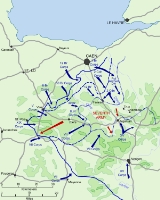
During August 1944 the Falaise pocket was the area between the four towns of Trun, Argentan, Vimoutiers and Chambois near Falaise in France France

France, officially the French Republic, is a country [i] whose metropolitan territory [i] ... 

, in which Allied Allies of World War II

The Allies [i] of World War II [i] were the countries officially opposed to the Axis Powers [i] during t ... 

 forces tried to encircle and destroy the German Nazi Germany

Nazi Germany, or the Third Reich, refers to Germany in the years 1933 to 1945, when it was governe... 

 Seventh Army and Fifth Panzer Army which took place in the Battle of Normandy Battle of Normandy

The Battle of Normandy was fought in 1944 [i] between Nazi Germany [i] in Western Europe [i] and the in ... 

, during World War II World War II

World War II, or the Second World War, was a worldwide [i] conflict [i] fought betwe ... 

.

Discussions

  Discussion Features

   Ask a question about 'Falaise pocket'

   Start a new discussion about 'Falaise pocket'

   Answer questions about 'Falaise pocket'

   'Falaise pocket' discussion forum


Encyclopedia

During August 1944 the Falaise pocket was the area between the four towns of Trun, Argentan, Vimoutiers and Chambois near Falaise in France France

France, officially the French Republic, is a country [i] whose metropolitan territory [i] ... 

, in which Allied Allies of World War II

The Allies [i] of World War II [i] were the countries officially opposed to the Axis Powers [i] during t ... 

 forces tried to encircle and destroy the German Nazi Germany

Nazi Germany, or the Third Reich, refers to Germany in the years 1933 to 1945, when it was governe... 

 Seventh Army and Fifth Panzer Army which took place in the Battle of Normandy Battle of Normandy

The Battle of Normandy was fought in 1944 [i] between Nazi Germany [i] in Western Europe [i] and the in ... 

, during World War II World War II

World War II, or the Second World War, was a worldwide [i] conflict [i] fought betwe ... 

.

Prelude

With Allied troops having made slow progress in Normandy Normandy

Normandy is a geographical region in northern France [i]. ... 

 through most of June and July, the US 12th Army Group U.S. 12th Army Group

The 12th Army Group was the largest and most powerful American formation ever to take to the field.... 

 under General Omar Bradley started to make rapid progress at the beginning of August, thanks to the success of Operation Cobra Operation Cobra

Operation Cobra was the codename for the World War II [i] operation planned by United States [i] Army [i] ... 

. By August 4 the German front facing the 12th Army Group had largely collapsed. A small but fierce German counter-offensive was launched on August 7 at Mortain Mortain

Mortain is a small town and commune [i] in the Manche [i] dpartement [i] ... 

. This was a last-ditch attempt at halting the Allied breakthrough by cutting off Patton's Third Army. With the aid of air support and advance warning thanks to Ultra, the Germans had been repelled by the evening, and Bradley had retaken Mortain.

The Germans' Mortain counterattack was an unwise move, because it shifted the weight of their forces westward at the very time when they needed to retreat eastward. In the process the Germans had been weakened, and allied commanders Bradley Omar Bradley

Omar Nelson Bradley was one of the main U.S. Army [i] field commanders in North Afric ... 

 and Montgomery Bernard Montgomery, 1st Viscount Montgomery of Alamein

Field Marshal [i] Bernard Law Montgomery, 1st Viscount Montgomery of Alamein, KG [i] ... 

 moved to exploit the situation with a plan to encircle the Germans.

The initial plan was to cut off the Germans by sending the First Canadian Army First Canadian Army

The First Canadian Army was the senior Canadian operational formation in Europe during the Second World War [i] ... 

, under General Crerar Harry Crerar

Henry Duncan Graham Crerar, PC [i] , CH [i] ... 

, south through Falaise to meet elements of the American Third Army [Patton] attacking northwards to Argentan. Realising that the Germans might escape, Montgomery later modified the plan to close the gap between Trun and Chambois 18 km further to the east.

South


Headed by General Leclerc Philippe Leclerc de Hauteclocque

Philippe Leclerc de Hauteclocque, was a French [i] general.
... 

's French 2nd Armored Division, which had taken Le Mans Le Mans

Le Mans is a city [i] in France [i], located on the Sarthe River [i]. ... 

 on August 9, the U.S. XV Corps of Patton's Third Army received orders on August 10 to move rapidly north. On August 12 it entered Alençon, then moved on to Ecouché and finally Argentan on August 14, 22 km south of Falaise, where they were ordered to halt by Bradley as he needed Montgomery's permission to cross army boundary lines and for fear of running into the Canadians to the north—the rapid changes in troop locations were causing confusion in the Allied communication lines. The halt in the northward advance is thought to have enabled some thousands of German troops to escape.

Montgomery modified the northern boundary on August 15 after Bradley had waited for a crucial 24 hrs, enabling the Americans to advance further north, and on August 19 the US 90th Infantry Division U.S. 90th Infantry Division

The 90th Infantry Division was a unit of the United States Army [i] in World War I [i] and World War II [i] ... 

 took Chambois, 10 km north east of Argentan, where they met up with the Canadians who were heading south towards the town.

Meanwhile the main focus of the US attack turned to the east, and by August 20 Patton's Third Army had crossed the river Seine Seine

The Seine is a major river [i] of north-western
... 

 at Mantes Mantes-la-Jolie

Mantes-la-Jolie is a commune [i] in the western suburbs of Paris [i], France [i]. ... 

, with Leclerc's tank Tank

A tank is a tracked [i] armoured fighting vehicle [i], designed to engage enemy force ... 

s reaching the centre of Paris Paris

native_name = Ville de Paris
|common_name = Paris
... 

 on August 24.

North


To the North, Montgomery launched a new offensive to the south of Caen Caen

Caen is a commune [i] of northwestern France [i]. ... 

 at the same time. In its first operation Canadian First Army First Canadian Army

The First Canadian Army was the senior Canadian operational formation in Europe during the Second World War [i] ... 

 launched Operation Totalize Operation Totalise

Note: In North American texts, this often appears as "Operation Totalize".
... 

 on August 9. After an initial breakthrough, progress slowed. Although under air attack by day, the German forces were still able to cause serious damage, as they did on August 10 when the Canadians lost 40 men at "Hill 111" near Estrées-la-Campagne. The Germans also put up fierce resistance against the Canadian 2nd Infantry Division 2nd Canadian Infantry Division

The 2nd Canadian Infantry Division was mobilized on 1 September [i] 1939 [i], even before the declaratio ... 

 in the woods north of Falaise on August 16. Falaise was finally conquered 17 August.

The 4th Canadian Armored Division occupied Trun on August 18. On August 19 they took the German held village of Saint-Lambert-sur-Dives and joined up with the Americans at Chambois, digging in on a line from Falaise through Trun to Chambois, and fighting hard against the fleeing Germans. The South Alberta Regiment, predecessors to today's South Alberta Light Horse The South Alberta Light Horse

The South Alberta Light Horse, or SALH, is an armoured unit of the Canadian Forces [i] Army Reserve [i] ... 

 along with elements of The Argyll and Sutherland Highlanders of Canada  and the Lincoln and Welland Regiment, fought a vicious battle at Saint-Lambert-sur-Dives. This small force, numbering less than 200 Canadians, killed, captured and wounded around 3000 Germans during the battle. Major David Currie of the South Alberta Regiment won the Victoria Cross Victoria Cross

The Victoria Cross is the highest recognition for valour "in the face of the enemy" that can be awarded ... 

 for his leadership during the battle.

Meanwhile, also on August 18, General Maczek Stanislaw Maczek

Gen. Stanislaw Maczek was the last Commander of the First Polish [i] Army Corps under Allied Comm ... 

's 1st Polish Armoured Division Polish 1st Armoured Division

The Polish 1st Armoured Division was an Allied [i] military unit during World War II [i], created ... 

 took up position with 87 Sherman tanks M4 Sherman

WWII foreign variants and use: Lend-Lease Sherman tanks [i]
... 

 on the wooded "Hill 262" to the east of the Canadians, to prevent any counter-offensive from the east seeking to rescue the trapped Germans. From the hill they also had a commanding position overlooking the Chambois to Vimoutiers road , and proceeded to attack the fleeing Germans. In response, the isolated Poles were repeatedly and ferociously attacked, especially on August 20 when the II SS Panzer Corps, which had escaped the pocket, attacked and broke through back into the pocket from Vimoutiers. The Poles had lost 325 dead, with 1,002 wounded and 114 missing when they were reinforced by the 22nd Armoured Regiment The Canadian Grenadier Guards

The Canadian Grenadier Guards is the second-most senior infantry [i] regiment [i] in the Reserve Force o ... 

 in the early morning of August 21. The Germans lost around 2,000 dead, with 5,000 taken prisoner, and 359 vehicles destroyed.

Inside the pocket

Under the combined pressure of the Americans and French to the south, the British United Kingdom

The United Kingdom of Great Britain and Northern Ireland is a country and sovereign state [i] tha ... 

 to the west, and the Canadians and Poles to the north, by August 10 the Germans were aware of the danger of encirclement, although Hitler Adolf Hitler

Adolf Hitler was Chancellor of Germany [i] from 1933, and Fhrer [i] of Germany [i] from 1934 until h ... 

 was demanding another counter-attack on Avranches rather than a deliberate withdrawal.

On August 15, Hitler replaced Field Marshal Günther von Kluge Günther von Kluge

Hans Gnther von Kluge, was a German [i] military leader. ... 

 with Model Walter Model

Otto Moritz Walter Model was a German [i] general [i] and later a field marshal [i] during World War II [i] ... 

. Kluge was absent from his headquarters for most of that day. Hitler was later to allege that von Kluge had attempted to surrender his armies to the Allies, but was prevented because Allied plenipotentiaries failed to make contact. Kluge's version of events was that his car was knocked out by Allied fighter-bombers, and he had then been pinned down until nightfall by Allied artillery fire. No Allied account makes any mention of an offer of surrender or of any contact with von Kluge.

The following day, with the remaining 150,000 troops of the German Seventh Army German Seventh Army

The German Seventh Army was a World War II [i] field army.
... 

 and Fifth Panzer Army almost encircled, Hitler finally ordered a general withdrawal of troops towards the Seine Seine

The Seine is a major river [i] of north-western
... 

 River. On the field the retreat had effectively been underway since the 14th, in an attempt to save what remained of the German armored divisions. The German infantry, spread out over the bocage without support, became increasingly disordered as the troops tried to reach the narrow Falaise Gap and safety.

For most of the Normandy campaign, Allied fighter-bombers of the 2nd Tactical Air Force and Ninth Air Force Ninth Air Force

Ninth Air Force is a Numbered Air Force in Air Combat Command [i]. ... 

 had controlled the skies over the battlefield, but the Germans had suffered few actual casualties since they occupied dispersed and camouflaged defensive positions and moved at night only. From the Mortain counter-offensive on August 7, they had been compelled to move by daylight, and losses had increased. Now they were compressed into a narrow pocket and attempting to flee by day, and the Allied fighter-bombers and artillery caused havoc. Eventually, the pall of smoke from burning vehicles prevented the Allied aircraft from finding further targets.

The German retreat turned into a desperate flight along what became known to the Germans as "the death road" between the villages of Chambois, Saint Lambert, Trun and Tournai-sur-Dives. Late on August 21, after French priest Abbé Launay pleaded with the German field commander, the remaining German troops in the pocket were ordered to surrender.

The aftermath

Although perhaps 100,000 German troops succeeded in escaping the allies due to the delay in closing the gap, they left behind 50,000 prisoners, over 10,000 dead, and the road practically impassable due to destroyed vehicles and bodies. Among those not captured were one army commander, four corps commanders and 14 division commanders, who would escape the pocket. The Canadians also suffered heavy losses, with over 18,000 dead or wounded.

The failure to capture greater numbers of German troops was questioned by some commanders and postwar writers. The formation and reduction of the pocket was a great Allied success; there was however a sense, even as the pocket closed, that the prisoner haul could have been more.

The US forces pushing northward were halted due to an inter-Army boundary line. Bradley did not request that the boundary be moved nor did Montgomery suggest it. Although there was a legitimate need to avoid friendly-fire incidents, and fast moving units might have fallen victim to friendly fire if link-ups were not carefully coordinated, a boundary change would not necessarily have led to fratricide. Bradley also stated said that he preferred a strong force able to hold in place rather than a weak one, over-extended in an attempt to seal the pocket. However, his eastward attack by XV Corps even before the pocket was closed belies this position.

With strong personalities on both sides of the question the controversy was quite heated, especially postwar as competing memoirs were published.

External links


Categories: