

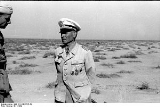
Hermann-Bernhard Ramcke

Encyclopedia
Hermann-Bernhard "Gerhard" Ramcke (24 January 1889 – 4 July 1968) was a German
general
. He was a recipient of the Knights Cross of the Iron Cross with Swords, Oak Leaves, and Diamonds
, one of only 27 people in the German military so decorated. Ramcke's career was unusual in that he served in all three branches of the German armed forces.
in 1905 as ship's boy. During the First World War he served aboard the armored cruiser Prinz Adalbert
in the Baltic and North Sea. When the Adalbert suffered extensive damage in 1915, fearing that the war might end before the ship returned to service, Ramcke transferred to the marines. The Adalbert returned to service months later and was lost with 672 of her crew, as Ramcke would learn from a short telegram received at the front.
Ramcke fought in the West with the German Marine-Infanterie, mainly in the area of Flanders
. In 1914 he was decorated with the Iron Cross second class and later the Iron Cross first class. After a defensive action against three British
attacks he was decorated with the Prussian
Golden Merit Cross, the highest decoration for non-commissioned officers in the German Imperial Forces, and became a deputy-commissioned officer.
In 1918 he attained the rank of Leutnant der Marine-Infanterie. By the time the Armistice
was signed, he had risen to the rank of Oberleutnant
.
In 1919 he then fought against the Bolsheviks in the Baltic
as a member of the so-called "Russian Army of the West" (composed mostly of German veterans). Ramcke stayed in the Reichswehr
during the Weimar Republic
period. He continued to serve in the new Wehrmacht
during the Third Reich, climbing through the ranks until he attained the rank of Oberstleutnant
in 1937.
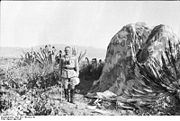
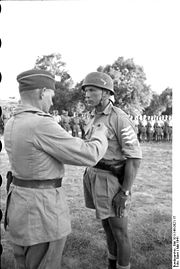 On 19 July 1940, Ramcke was transferred to the 7th Fliegerdivision
under the command of General Kurt Student
and was promoted to Oberst
. At the age of 51 he successfully completed the parachute qualification course. In May 1941 working with the division Stab he helped plan and also took part in Operation Merkur, the airborne attack on Crete
. Ramcke led the Fallschirmjäger-Sturm-Regiment 1, and also led Kampfgruppe West.
After the successful, but costly, victory in Crete, remainders of several Fallschirmjäger units were formed into a ad-hoc [brigade], and command was given to Ramcke. He was also promoted to Generalmajor on 22 July 1941.
In 1942 Fallschirmjäger-Brigade Afrika
was sent to North Africa
to join Rommel's
Afrikakorps. The brigade was renamed Fallschirmjäger-Brigade Ramcke in July and supported the offensive towards the Suez Canal
, but when the offensive got bogged down they entered the line at El Alamein
.
The British attack at the Second Battle of El Alamein
did not directly strike the unit but they soon became involved in heavy fighting. During the withdrawal of the Afrikakorps, the Brigade was surrounded and written off as lost by the high command since it had no organic transport. Rather than surrender, Ramcke led his troops out of the British trap and headed west, losing about 450 men in the process. They soon captured a British supply column which provided not only trucks but food, tobacco and other luxuries. About 600 of the paras later rejoined the Afrikakorps in late November 1942. Ramcke was sent back to Germany, where he was awarded the Oak Leaves to the Knights Cross.
In 1943 Ramcke, now a Generalleutnant, took command of 2nd Fallschirmjäger-Division
. The division was deployed to Italy
, to help bolster the German forces there to ensure that Italy did not join the Allies. When Italy signed the armistice with the Allies on 8 September 1943, the division, along with other German units, took part in Operation Achse
to take control of the country. Ramcke led his division in an assault on Rome
, and secured the city two days later. The division continued serving in Italy for a while, during which time Ramcke was wounded after his car was forced off the road by an Allied fighter-bomber
.
Ramcke returned to command the division in early 1944. By this time 2nd FJ was fighting on the Eastern Front
, during the withdrawal from the Bug River area. Ramcke fell ill during this time and was sent back to Germany for recuperation. He assumed command again in May 1944 to oversee the rebuilding of the 2nd FJ-Division, which was based near Cologne
.
Following the Allied D-Day
landings on 6 June, 2nd Fallschirmjäger-Division was sent to the Brittany
region of France
, and took up the defence of Brest
. Following Operation Cobra
, the allied breakout from Normandy
, Major-General Troy H. Middleton
's U.S. VIII Corps hooked left from Normandy and attacked the Brittany region. The German defenders in the region fell back on Brest, and Ramcke assumed command of the garrison, now known as Festung Brest
. Brest was largely surrounded and infiltrated by partisan guerillas who succeeded in killing one of Ramcke's junior officers in the seat next to him as they drove through an ambush. Commanding about 35,000 German troops Ramcke led the defense of Brest
from 11 August until 19 September. Ramcke refused early requests to surrender and followed orders to hold out as long as possible. On the final day of battle, it was only after escaping a strafing attack during a personal reconnoiter of the area, and the entry of American forces into the bunker, that General der Fallschirmtruppe
Hermann-Bernhard Ramcke surrendered, on the same day as he was awarded the Swords (99th Recipient) & Diamonds (20th recipient) to the Knights Cross.
as a prisoner of war
and later to England
and France. While a POW at Camp Clinton
, Mississippi
, he wrote a letter to Byron Price
. Arguing in the letter that the treatment of Germany following World War I had led to National Socialism and World War II, he protested the Morgenthau Plan
as another attempt to enforce harsh treatment upon Germany. Citing General Middleton's remarks as verification, Ramcke detailed his efforts to protect American POWs and otherwise uphold the laws of war
and stated he was "convinced that all other German commanders have acted in the same way". To keep the letter out of his guards' hands he slipped out of the camp, mailed the letter in a nearby town, and returned to camp without being caught.
In 1951 Ramcke was charged with war crimes in France, but he managed to escape from captivity to Germany. He returned voluntarily and was sentenced to five years imprisonment by a French court in March 1951, but was released on 24 June 1951. Testifying in his defense was American General Troy Middleton, to whose forces Ramcke had surrendered in the autumn of 1944.
After the war, Ramcke and Middleton maintained a correspondence for about fifteen years.
Following his release from nearly 7 years captivity, Ramcke, through his public actions, became seen as a dedicated nationalistNationalist is a term to be treated with caution. Included in one Orders of the Day for Ramcke's command in September 1944 was The US Army was the “instrument of the international Jewish clique which is based in Wall Street, New York, and from there wants to subjugate the entire world in co-operation with Russian Bolshevism... The people of the United States of America are no single, united race. They are made up of all the world’s races, the good and the inferior. Among the inferior, the blacks and mixed races stand out" -- comments which reflect the peculiarly racist outlook of the Third Reich. Quote mentioned at www.axishistory.com. by his fellow generals and supported extreme right-wing movements such as the Naumann-Kreis in Germany. On 26 October 1952, he told a group of former SS-men they should be proud of being blacklisted, while pointing out that in the future their blacklist would instead be seen as a "list of honor". Ramcke's remarks caused a furor in Germany; even the former SS General Felix Steiner
distanced himself from them. Konrad Adenauer
was so furious with Ramcke's remarks that he directed Thomas Dehler
, the German federal Minister of Justice, to investigate the possibility of prosecuting Ramcke. Adenauer publicly decried Ramcke's remarks as "irresponsible" and his associated behavior as "foolishness" -- a reaction probably prompted because Adenauer's government had made a significant effort to obtain early release for Ramcke from French imprisonment.
Ramcke published two books, both autobiographies, one during the war and the other in 1951. He did not join the new Bundeswehr, but pursued a career in the concrete industry instead in the years following.
General of the Paratroopers Hermann-Bernhard Ramcke died after battling cancer at Kappeln
on July 4, 1968.
Germany
Germany , officially the Federal Republic of Germany , is a federal parliamentary republic in Europe. The country consists of 16 states while the capital and largest city is Berlin. Germany covers an area of 357,021 km2 and has a largely temperate seasonal climate...
general
General
A general officer is an officer of high military rank, usually in the army, and in some nations, the air force. The term is widely used by many nations of the world, and when a country uses a different term, there is an equivalent title given....
. He was a recipient of the Knights Cross of the Iron Cross with Swords, Oak Leaves, and Diamonds
Knight's Cross of the Iron Cross
The Knight's Cross of the Iron Cross was a grade of the 1939 version of the 1813 created Iron Cross . The Knight's Cross of the Iron Cross was the highest award of Germany to recognize extreme battlefield bravery or successful military leadership during World War II...
, one of only 27 people in the German military so decorated. Ramcke's career was unusual in that he served in all three branches of the German armed forces.
Early life and WWI
Ramcke was born in Schleswig to a family of farmers. He joined the German Imperial NavyKaiserliche Marine
The Imperial German Navy was the German Navy created at the time of the formation of the German Empire. It existed between 1871 and 1919, growing out of the small Prussian Navy and Norddeutsche Bundesmarine, which primarily had the mission of coastal defense. Kaiser Wilhelm II greatly expanded...
in 1905 as ship's boy. During the First World War he served aboard the armored cruiser Prinz Adalbert
SMS Prinz Adalbert
SMS Prinz Adalbert was a German armored cruiser built in the early 1900s for the Imperial German Navy, named after Kaiser Wilhelm II's third son Prince Adalbert of Prussia. She was the lead ship of her class, which included a second ship, . Prinz Adalbert was built at the Imperial Dockyard in Kiel...
in the Baltic and North Sea. When the Adalbert suffered extensive damage in 1915, fearing that the war might end before the ship returned to service, Ramcke transferred to the marines. The Adalbert returned to service months later and was lost with 672 of her crew, as Ramcke would learn from a short telegram received at the front.
Ramcke fought in the West with the German Marine-Infanterie, mainly in the area of Flanders
Flanders
Flanders is the community of the Flemings but also one of the institutions in Belgium, and a geographical region located in parts of present-day Belgium, France and the Netherlands. "Flanders" can also refer to the northern part of Belgium that contains Brussels, Bruges, Ghent and Antwerp...
. In 1914 he was decorated with the Iron Cross second class and later the Iron Cross first class. After a defensive action against three British
United Kingdom
The United Kingdom of Great Britain and Northern IrelandIn the United Kingdom and Dependencies, other languages have been officially recognised as legitimate autochthonous languages under the European Charter for Regional or Minority Languages...
attacks he was decorated with the Prussian
Kingdom of Prussia
The Kingdom of Prussia was a German kingdom from 1701 to 1918. Until the defeat of Germany in World War I, it comprised almost two-thirds of the area of the German Empire...
Golden Merit Cross, the highest decoration for non-commissioned officers in the German Imperial Forces, and became a deputy-commissioned officer.
In 1918 he attained the rank of Leutnant der Marine-Infanterie. By the time the Armistice
Armistice with Germany (Compiègne)
The armistice between the Allies and Germany was an agreement that ended the fighting in the First World War. It was signed in a railway carriage in Compiègne Forest on 11 November 1918 and marked a victory for the Allies and a complete defeat for Germany, although not technically a surrender...
was signed, he had risen to the rank of Oberleutnant
Oberleutnant
Oberleutnant is a junior officer rank in the militaries of Germany, Switzerland and Austria. In the German Army, it dates from the early 19th century. Translated as "Senior Lieutenant", the rank is typically bestowed upon commissioned officers after five to six years of active duty...
.
In 1919 he then fought against the Bolsheviks in the Baltic
Baltic region
The terms Baltic region, Baltic Rim countries, and Baltic Rim refer to slightly different combinations of countries in the general area surrounding the Baltic Sea.- Etymology :...
as a member of the so-called "Russian Army of the West" (composed mostly of German veterans). Ramcke stayed in the Reichswehr
Reichswehr
The Reichswehr formed the military organisation of Germany from 1919 until 1935, when it was renamed the Wehrmacht ....
during the Weimar Republic
Weimar Republic
The Weimar Republic is the name given by historians to the parliamentary republic established in 1919 in Germany to replace the imperial form of government...
period. He continued to serve in the new Wehrmacht
Wehrmacht
The Wehrmacht – from , to defend and , the might/power) were the unified armed forces of Nazi Germany from 1935 to 1945. It consisted of the Heer , the Kriegsmarine and the Luftwaffe .-Origin and use of the term:...
during the Third Reich, climbing through the ranks until he attained the rank of Oberstleutnant
Oberstleutnant
Oberstleutnant is a German Army and Air Force rank equal to Lieutenant Colonel, above Major, and below Oberst.There are two paygrade associated to the rank of Oberstleutnant...
in 1937.
World War II
German 1st Fallschirmjäger Division
The German 1st Parachute Division was a German elite military parachute-landing Division that fought during World War II. A division of paratroopers was termed a Fallschirmjäger Division...
under the command of General Kurt Student
Kurt Student
Kurt Student was a German Luftwaffe general who fought as a fighter pilot during the First World War and as the commander of German Fallschirmjäger during the Second World War.-Biography:...
and was promoted to Oberst
Oberst
Oberst is a military rank in several German-speaking and Scandinavian countries, equivalent to Colonel. It is currently used by both the ground and air forces of Austria, Germany, Switzerland, Denmark and Norway. The Swedish rank överste is a direct translation, as are the Finnish rank eversti...
. At the age of 51 he successfully completed the parachute qualification course. In May 1941 working with the division Stab he helped plan and also took part in Operation Merkur, the airborne attack on Crete
Crete
Crete is the largest and most populous of the Greek islands, the fifth largest island in the Mediterranean Sea, and one of the thirteen administrative regions of Greece. It forms a significant part of the economy and cultural heritage of Greece while retaining its own local cultural traits...
. Ramcke led the Fallschirmjäger-Sturm-Regiment 1, and also led Kampfgruppe West.
After the successful, but costly, victory in Crete, remainders of several Fallschirmjäger units were formed into a ad-hoc [brigade], and command was given to Ramcke. He was also promoted to Generalmajor on 22 July 1941.
In 1942 Fallschirmjäger-Brigade Afrika
Ramcke Parachute Brigade
Fallschirmjäger-Brigade AfrikaFallschirmjäger-Brigade RamckeLuftwaffen-Jäger-Brigade 1The Fallschirmjäger-Brigade Ramcke was an elite German Luftwaffe Fallschirmjäger Brigade which saw action in the Mediterranean Theatre during World War II.-History:Following the costly success of Operation...
was sent to North Africa
North Africa
North Africa or Northern Africa is the northernmost region of the African continent, linked by the Sahara to Sub-Saharan Africa. Geopolitically, the United Nations definition of Northern Africa includes eight countries or territories; Algeria, Egypt, Libya, Morocco, South Sudan, Sudan, Tunisia, and...
to join Rommel's
Erwin Rommel
Erwin Johannes Eugen Rommel , popularly known as the Desert Fox , was a German Field Marshal of World War II. He won the respect of both his own troops and the enemies he fought....
Afrikakorps. The brigade was renamed Fallschirmjäger-Brigade Ramcke in July and supported the offensive towards the Suez Canal
Suez Canal
The Suez Canal , also known by the nickname "The Highway to India", is an artificial sea-level waterway in Egypt, connecting the Mediterranean Sea and the Red Sea. Opened in November 1869 after 10 years of construction work, it allows water transportation between Europe and Asia without navigation...
, but when the offensive got bogged down they entered the line at El Alamein
El Alamein
El Alamein is a town in the northern Matrouh Governorate of Egypt. Located on the Mediterranean Sea, it lies west of Alexandria and northwest of Cairo. As of 2007, it has a local population of 7,397 inhabitants.- Climate :...
.
The British attack at the Second Battle of El Alamein
Second Battle of El Alamein
The Second Battle of El Alamein marked a major turning point in the Western Desert Campaign of the Second World War. The battle took place over 20 days from 23 October – 11 November 1942. The First Battle of El Alamein had stalled the Axis advance. Thereafter, Lieutenant-General Bernard Montgomery...
did not directly strike the unit but they soon became involved in heavy fighting. During the withdrawal of the Afrikakorps, the Brigade was surrounded and written off as lost by the high command since it had no organic transport. Rather than surrender, Ramcke led his troops out of the British trap and headed west, losing about 450 men in the process. They soon captured a British supply column which provided not only trucks but food, tobacco and other luxuries. About 600 of the paras later rejoined the Afrikakorps in late November 1942. Ramcke was sent back to Germany, where he was awarded the Oak Leaves to the Knights Cross.
In 1943 Ramcke, now a Generalleutnant, took command of 2nd Fallschirmjäger-Division
German 2nd Parachute Division
The German 2nd Parachute Division was an elite military parachute-landing Division that fought during World War II. In German, a division of paratroopers was termed a Fallschirmjäger Division.-The beginning:...
. The division was deployed to Italy
Italy
Italy , officially the Italian Republic languages]] under the European Charter for Regional or Minority Languages. In each of these, Italy's official name is as follows:;;;;;;;;), is a unitary parliamentary republic in South-Central Europe. To the north it borders France, Switzerland, Austria and...
, to help bolster the German forces there to ensure that Italy did not join the Allies. When Italy signed the armistice with the Allies on 8 September 1943, the division, along with other German units, took part in Operation Achse
Operation Achse
Operation Achse , also called Operation Alaric, were the codenames of the German plans to forcibly disarm the Italian armed forces after their expected armistice with the Allied forces...
to take control of the country. Ramcke led his division in an assault on Rome
Rome
Rome is the capital of Italy and the country's largest and most populated city and comune, with over 2.7 million residents in . The city is located in the central-western portion of the Italian Peninsula, on the Tiber River within the Lazio region of Italy.Rome's history spans two and a half...
, and secured the city two days later. The division continued serving in Italy for a while, during which time Ramcke was wounded after his car was forced off the road by an Allied fighter-bomber
Fighter-bomber
A fighter-bomber is a fixed-wing aircraft with an intended primary role of light tactical bombing and also incorporating certain performance characteristics of a fighter aircraft. This term, although still used, has less significance since the introduction of rockets and guided missiles into aerial...
.
Ramcke returned to command the division in early 1944. By this time 2nd FJ was fighting on the Eastern Front
Eastern Front (World War II)
The Eastern Front of World War II was a theatre of World War II between the European Axis powers and co-belligerent Finland against the Soviet Union, Poland, and some other Allies which encompassed Northern, Southern and Eastern Europe from 22 June 1941 to 9 May 1945...
, during the withdrawal from the Bug River area. Ramcke fell ill during this time and was sent back to Germany for recuperation. He assumed command again in May 1944 to oversee the rebuilding of the 2nd FJ-Division, which was based near Cologne
Cologne
Cologne is Germany's fourth-largest city , and is the largest city both in the Germany Federal State of North Rhine-Westphalia and within the Rhine-Ruhr Metropolitan Area, one of the major European metropolitan areas with more than ten million inhabitants.Cologne is located on both sides of the...
.
Following the Allied D-Day
D-Day
D-Day is a term often used in military parlance to denote the day on which a combat attack or operation is to be initiated. "D-Day" often represents a variable, designating the day upon which some significant event will occur or has occurred; see Military designation of days and hours for similar...
landings on 6 June, 2nd Fallschirmjäger-Division was sent to the Brittany
Brittany
Brittany is a cultural and administrative region in the north-west of France. Previously a kingdom and then a duchy, Brittany was united to the Kingdom of France in 1532 as a province. Brittany has also been referred to as Less, Lesser or Little Britain...
region of France
France
The French Republic , The French Republic , The French Republic , (commonly known as France , is a unitary semi-presidential republic in Western Europe with several overseas territories and islands located on other continents and in the Indian, Pacific, and Atlantic oceans. Metropolitan France...
, and took up the defence of Brest
Brest, France
Brest is a city in the Finistère department in Brittany in northwestern France. Located in a sheltered position not far from the western tip of the Breton peninsula, and the western extremity of metropolitan France, Brest is an important harbour and the second French military port after Toulon...
. Following Operation Cobra
Operation Cobra
Operation Cobra was the codename for an offensive launched by the First United States Army seven weeks after the D-Day landings, during the Normandy Campaign of World War II...
, the allied breakout from Normandy
Normandy
Normandy is a geographical region corresponding to the former Duchy of Normandy. It is in France.The continental territory covers 30,627 km² and forms the preponderant part of Normandy and roughly 5% of the territory of France. It is divided for administrative purposes into two régions:...
, Major-General Troy H. Middleton
Troy H. Middleton
Lieutenant General Troy Houston Middleton was a distinguished soldier-educator who served as a corps commander in Europe during World War II and later as President of Louisiana State University...
's U.S. VIII Corps hooked left from Normandy and attacked the Brittany region. The German defenders in the region fell back on Brest, and Ramcke assumed command of the garrison, now known as Festung Brest
Battle for Brest
The Battle for Brest was one of the fiercest battles fought during Operation Cobra, the Allied breakout of Normandy which began on 27 July 1944, during the Battle of Normandy during World War II....
. Brest was largely surrounded and infiltrated by partisan guerillas who succeeded in killing one of Ramcke's junior officers in the seat next to him as they drove through an ambush. Commanding about 35,000 German troops Ramcke led the defense of Brest
Battle for Brest
The Battle for Brest was one of the fiercest battles fought during Operation Cobra, the Allied breakout of Normandy which began on 27 July 1944, during the Battle of Normandy during World War II....
from 11 August until 19 September. Ramcke refused early requests to surrender and followed orders to hold out as long as possible. On the final day of battle, it was only after escaping a strafing attack during a personal reconnoiter of the area, and the entry of American forces into the bunker, that General der Fallschirmtruppe
General (Germany)
General is presently the highest rank of the German Army and Luftwaffe . It is the equivalent to the rank of Admiral in the German Navy .-Early history:...
Hermann-Bernhard Ramcke surrendered, on the same day as he was awarded the Swords (99th Recipient) & Diamonds (20th recipient) to the Knights Cross.
Post war
Ramcke was shipped to the United StatesUnited States
The United States of America is a federal constitutional republic comprising fifty states and a federal district...
as a prisoner of war
Prisoner of war
A prisoner of war or enemy prisoner of war is a person, whether civilian or combatant, who is held in custody by an enemy power during or immediately after an armed conflict...
and later to England
England
England is a country that is part of the United Kingdom. It shares land borders with Scotland to the north and Wales to the west; the Irish Sea is to the north west, the Celtic Sea to the south west, with the North Sea to the east and the English Channel to the south separating it from continental...
and France. While a POW at Camp Clinton
Camp Clinton
Camp Clinton was a World War II prisoner of war facility located in Clinton, Mississippi, just off present-day McRaven Road, east of Springridge Road. Camp Clinton was home to 3,000 German and Italian POWs, most of whom had been captured in Africa and were members of the Afrika Korps...
, Mississippi
Mississippi
Mississippi is a U.S. state located in the Southern United States. Jackson is the state capital and largest city. The name of the state derives from the Mississippi River, which flows along its western boundary, whose name comes from the Ojibwe word misi-ziibi...
, he wrote a letter to Byron Price
Byron Price
Byron Price was director of the Office of Censorship for the United States government during World War II. For his role, he was recognized with a Pulitzer Prize in 1944. After the war he was appointed as the Assistant Secretary General of the United Nations. In 1946, President Harry S...
. Arguing in the letter that the treatment of Germany following World War I had led to National Socialism and World War II, he protested the Morgenthau Plan
Morgenthau Plan
The Morgenthau Plan, proposed by United States Secretary of the Treasury Henry Morgenthau, Jr., advocated that the Allied occupation of Germany following World War II include measures to eliminate Germany's ability to wage war.-Overview:...
as another attempt to enforce harsh treatment upon Germany. Citing General Middleton's remarks as verification, Ramcke detailed his efforts to protect American POWs and otherwise uphold the laws of war
Laws of war
The law of war is a body of law concerning acceptable justifications to engage in war and the limits to acceptable wartime conduct...
and stated he was "convinced that all other German commanders have acted in the same way". To keep the letter out of his guards' hands he slipped out of the camp, mailed the letter in a nearby town, and returned to camp without being caught.
In 1951 Ramcke was charged with war crimes in France, but he managed to escape from captivity to Germany. He returned voluntarily and was sentenced to five years imprisonment by a French court in March 1951, but was released on 24 June 1951. Testifying in his defense was American General Troy Middleton, to whose forces Ramcke had surrendered in the autumn of 1944.
After the war, Ramcke and Middleton maintained a correspondence for about fifteen years.
Following his release from nearly 7 years captivity, Ramcke, through his public actions, became seen as a dedicated nationalistNationalist is a term to be treated with caution. Included in one Orders of the Day for Ramcke's command in September 1944 was The US Army was the “instrument of the international Jewish clique which is based in Wall Street, New York, and from there wants to subjugate the entire world in co-operation with Russian Bolshevism... The people of the United States of America are no single, united race. They are made up of all the world’s races, the good and the inferior. Among the inferior, the blacks and mixed races stand out" -- comments which reflect the peculiarly racist outlook of the Third Reich. Quote mentioned at www.axishistory.com. by his fellow generals and supported extreme right-wing movements such as the Naumann-Kreis in Germany. On 26 October 1952, he told a group of former SS-men they should be proud of being blacklisted, while pointing out that in the future their blacklist would instead be seen as a "list of honor". Ramcke's remarks caused a furor in Germany; even the former SS General Felix Steiner
Felix Steiner
Felix Martin Julius Steiner was a German Reichswehr and Waffen-SS officer who served in both World War I and World War II. He was also a recipient of the Knight's Cross of the Iron Cross with Oak Leaves and Swords...
distanced himself from them. Konrad Adenauer
Konrad Adenauer
Konrad Hermann Joseph Adenauer was a German statesman. He was the chancellor of the West Germany from 1949 to 1963. He is widely recognised as a person who led his country from the ruins of World War II to a powerful and prosperous nation that had forged close relations with old enemies France,...
was so furious with Ramcke's remarks that he directed Thomas Dehler
Thomas Dehler
Thomas Dehler was a German politician. He was the Federal Republic of Germany's first Minister of Justice and chairman of Free Democratic Party .-Early life:...
, the German federal Minister of Justice, to investigate the possibility of prosecuting Ramcke. Adenauer publicly decried Ramcke's remarks as "irresponsible" and his associated behavior as "foolishness" -- a reaction probably prompted because Adenauer's government had made a significant effort to obtain early release for Ramcke from French imprisonment.
Ramcke published two books, both autobiographies, one during the war and the other in 1951. He did not join the new Bundeswehr, but pursued a career in the concrete industry instead in the years following.
General of the Paratroopers Hermann-Bernhard Ramcke died after battling cancer at Kappeln
Kappeln
Kappeln is a town in the district of Schleswig-Flensburg, in Schleswig-Holstein, Germany. It is situated on the north bank of the Schlei, approx. northeast of Schleswig, and southeast of Flensburg....
on July 4, 1968.
Awards
- Knight's Cross of the Iron Cross with Oak Leaves, Swords and DiamondsKnight's Cross of the Iron CrossThe Knight's Cross of the Iron Cross was a grade of the 1939 version of the 1813 created Iron Cross . The Knight's Cross of the Iron Cross was the highest award of Germany to recognize extreme battlefield bravery or successful military leadership during World War II...
- Knight's Cross on 21 August 1941 as OberstOberstOberst is a military rank in several German-speaking and Scandinavian countries, equivalent to Colonel. It is currently used by both the ground and air forces of Austria, Germany, Switzerland, Denmark and Norway. The Swedish rank överste is a direct translation, as are the Finnish rank eversti...
and commander of the Fallschirmjäger-Sturm-Regiment - 145th Oak Leaves on 13 November 1942 as Generalmajor and commander of Fallschirmjäger-Brigade "Ramcke"
- 99th Swords on 19 September 1944 as Generalleutnant and commander of fortress Brest
- 20th Diamonds on 19 September 1944 as Generalleutnant and commander of fortress Brest
- Knight's Cross on 21 August 1941 as Oberst
- Luftwaffe Combat Infantry Badge
- Italian Army Silver Medal for Bravery in 1942
- Prussian Iron CrossIron CrossThe Iron Cross is a cross symbol typically in black with a white or silver outline that originated after 1219 when the Kingdom of Jerusalem granted the Teutonic Order the right to combine the Teutonic Black Cross placed above a silver Cross of Jerusalem....
1939 Bar, 1st Class on 23 May 1941 - Luftwaffe Paratrooper Badge on 1 August 1940
- Prussian Iron CrossIron CrossThe Iron Cross is a cross symbol typically in black with a white or silver outline that originated after 1219 when the Kingdom of Jerusalem granted the Teutonic Order the right to combine the Teutonic Black Cross placed above a silver Cross of Jerusalem....
1939 Bar, 2nd Class on 1 October 1939 - Length of Service Awards, 3rd & 1st Class on 2 October 1936
- World War I Cross of Honor on 26 January 1935
- Gold Badge for Wounds Sustained in Combat on 3 November 1919
- Prussian Golden Military Merit Cross on 24 April 1918
- Prussian Iron CrossIron CrossThe Iron Cross is a cross symbol typically in black with a white or silver outline that originated after 1219 when the Kingdom of Jerusalem granted the Teutonic Order the right to combine the Teutonic Black Cross placed above a silver Cross of Jerusalem....
, 1st Class on 21 January 1917 - Prussian Iron CrossIron CrossThe Iron Cross is a cross symbol typically in black with a white or silver outline that originated after 1219 when the Kingdom of Jerusalem granted the Teutonic Order the right to combine the Teutonic Black Cross placed above a silver Cross of Jerusalem....
, 2nd Class on 17 April 1916 - Mentioned in the WehrmachtberichtWehrmachtberichtThe Wehrmachtbericht was a daily radio report on the Großdeutscher Rundfunk of Nazi Germany, published by the Oberkommando der Wehrmacht regarding the military situation on all fronts of World War II....
on 9 June 1941, 9 November 1942, 10 September 1942, 10 September 1944 and 21 September 1944
See also
- Ramcke Parachute BrigadeRamcke Parachute BrigadeFallschirmjäger-Brigade AfrikaFallschirmjäger-Brigade RamckeLuftwaffen-Jäger-Brigade 1The Fallschirmjäger-Brigade Ramcke was an elite German Luftwaffe Fallschirmjäger Brigade which saw action in the Mediterranean Theatre during World War II.-History:Following the costly success of Operation...
- FallschirmjägerFallschirmjägerare German paratroopers. Together with the Gebirgsjäger they are perceived as the elite infantry units of the German Army....
- Fallschirmjäger - WWIIFallschirmjäger (World War II)The Fallschirmjäger of Nazi Germany were the first German paratroopers to be committed in large-scale airborne operations. They came to be known as the "green devils" by the Allied forces they fought against during World War II...
- Battle for BrestBattle for BrestThe Battle for Brest was one of the fiercest battles fought during Operation Cobra, the Allied breakout of Normandy which began on 27 July 1944, during the Battle of Normandy during World War II....
Works
- Vom Ritterkreuzträger zum Angeklagten. Nation-Europa-Verlag, Coburg 2001. ISBN 3-920677-57-9.
- Fallschirmjäger. Schütz, Preußisch Oldendorf 1973.
- Fallschirmjäger, damals und danach. Lorch, Frankfurt am Main 1951.
- Vom Schiffsjungen zum Fallschirmjäger-General. Verlag Die Wehrmacht, Berlin 1943.