


Norn language

Encyclopedia
Norn is an extinct North Germanic language that was spoken in Shetland and Orkney, off the north coast of mainland Scotland
, and in Caithness
. After the islands were pledged
to Scotland by Norway in the 15th century, it was gradually replaced by Scots
and on the mainland by Scottish Gaelic.
and Unst
are variously claimed as the last refuges of the language in Shetland, where there were people "who could repeat sentences in Norn, probably passages from folk songs or poems, as late as 1893. Walter Sutherland
from Skaw in Unst, who died about 1850, has been cited as the last native speaker of the Norn language. However, fragments of vocabulary survived the death of the main language and remain to this day, mainly in place-names and terms referring to plants, animals, weather, mood, and fishing vocabulary.
Dialects of Norse had also been spoken on mainland Scotland—for example, in Caithness
—but here they became extinct many centuries before Norn died on Orkney and Shetland. Hence, some scholars also speak about "Caithness Norn", but others avoid this. Even less is known about "Caithness Norn" than about Orkney and Shetland Norn. Almost no written Norn has survived, but what little remains includes a version of the Lord's Prayer
and a ballad
. Michael Barnes
, professor of Scandinavian Studies at University College London, has published a study, The Norn Language of Orkney and Shetland.
, Icelandic
and Norwegian
it belongs to the West Scandinavian group, separating it from the East Scandinavian group consisting of Swedish
, Danish
and Gutnish. While this classification is based on the differences between the North Germanic languages at the time they split, their present-day characteristics justify another classification, dividing them into an Insular Scandinavian and Mainland Scandinavian language groups, based on mutual intelligibility. Under this system, Norwegian is grouped together with the neighbouring languages Danish and Swedish, because the last millennium has seen all three undergo important changes, especially in grammar and lexis, which have set them apart from Faroese and Icelandic. Norn is generally considered to have been fairly similar to Faroese, sharing many phonological and grammatical traits with this language, and might even have been mutually intelligible with it; thus, it can be considered an Insular Scandinavian language.
Few written texts remain. It is to be distinguished from the present day 'dialect', termed by linguists Shetlandic
.
of Norn can never be determined with much precision due to the lack of source material, but the general aspects can be extrapolated from the few written sources that do exist. Norn shared many traits with the dialects of south-west Norway
. This includes a voicing of /p, t, k/ to [b, d, ɡ] before or between vowels and (in the Shetland dialect
, but only partially in the Orkney dialect
) a conversion of /θ/ and /ð/ ("thing" and "that" respectively) to [t] and [d] respectively.
s in present
and past tense
were also present and like all other North Germanic languages, it used a suffix
instead of a prepositioned article to indicate definiteness as in modern Scandinavian: man(n) ("man"); mannen ("the man"). Though it is difficult to be certain of much of the aspects of Norn grammar, documents indicate that it may have featured subjectless clauses, which were common in the West Scandinavian languages.
.jpg) The following are Norn and old Norse versions of the Lord's Prayer
The following are Norn and old Norse versions of the Lord's Prayer
: http://www.christusrex.org/www1/pater/index-mn.html#N
Modern Icelandic
Modern Norwegian
(nynorsk
)
Modern Norwegian (bokmål
)
Faroese
A Shetland "guddick" (riddle
) in Norn, which Jakob Jakobsen
heard told on Unst
, the northernmost island in Shetland, in the 1890s. The same riddle is also known from the Faroe Islands
.
The answer is a cow. Four teats hang, four legs walk, two horns
and two ears stand skyward, two eyes show the way to the field and one tail comes shaking (dangling) behind.
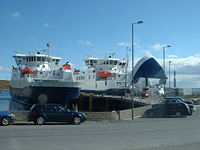 Most of the use of Norn/Norse in modern day Shetland and Orkney is purely ceremonial, and mostly in Old Norse, for example the Shetland motto, which is "Með lögum skal land byggja" ("with law shall land be built") which is the same motto used by the Icelandic police force.
Another example of the use of Norse/Norn in the Northern Isles
can be found in the names of ferries:
There are some private enthusiasts who are engaged in developing and disseminating a modern form called Nynorn, based upon linguistic analysis of the known records and Norse linguistics in general.
Scotland
Scotland is a country that is part of the United Kingdom. Occupying the northern third of the island of Great Britain, it shares a border with England to the south and is bounded by the North Sea to the east, the Atlantic Ocean to the north and west, and the North Channel and Irish Sea to the...
, and in Caithness
Caithness
Caithness is a registration county, lieutenancy area and historic local government area of Scotland. The name was used also for the earldom of Caithness and the Caithness constituency of the Parliament of the United Kingdom . Boundaries are not identical in all contexts, but the Caithness area is...
. After the islands were pledged
Pledge (law)
A pledge is a bailment or deposit of personal property to a creditor to secure repayment for some debt or engagement, The term is also used to denote the property which constitutes the security....
to Scotland by Norway in the 15th century, it was gradually replaced by Scots
Scots language
Scots is the Germanic language variety spoken in Lowland Scotland and parts of Ulster . It is sometimes called Lowland Scots to distinguish it from Scottish Gaelic, the Celtic language variety spoken in most of the western Highlands and in the Hebrides.Since there are no universally accepted...
and on the mainland by Scottish Gaelic.
History
It is not known exactly when Norn became extinct. The last reports of Norn speakers are claimed to be from the 19th century, but it is more likely that the language was dying out in the late 18th century. The isolated islands of FoulaFoula
Foula in the Shetland Islands of Scotland is one of Great Britain’s most remote permanently inhabited islands. Owned since the turn of the 20th century by the Holbourn family, the island was the location for the film The Edge of the World...
and Unst
Unst
Unst is one of the North Isles of the Shetland Islands, Scotland. It is the northernmost of the inhabited British Isles and is the third largest island in Shetland after the Mainland and Yell. It has an area of .Unst is largely grassland, with coastal cliffs...
are variously claimed as the last refuges of the language in Shetland, where there were people "who could repeat sentences in Norn, probably passages from folk songs or poems, as late as 1893. Walter Sutherland
Walter Sutherland (Norn)
Walter Sutherland of Skaw on the island of Unst in Shetland was reported to be the last native speaker of Norn, a Germanic language which had once been spoken throughout Shetland, Orkney and Caithness...
from Skaw in Unst, who died about 1850, has been cited as the last native speaker of the Norn language. However, fragments of vocabulary survived the death of the main language and remain to this day, mainly in place-names and terms referring to plants, animals, weather, mood, and fishing vocabulary.
Dialects of Norse had also been spoken on mainland Scotland—for example, in Caithness
Caithness
Caithness is a registration county, lieutenancy area and historic local government area of Scotland. The name was used also for the earldom of Caithness and the Caithness constituency of the Parliament of the United Kingdom . Boundaries are not identical in all contexts, but the Caithness area is...
—but here they became extinct many centuries before Norn died on Orkney and Shetland. Hence, some scholars also speak about "Caithness Norn", but others avoid this. Even less is known about "Caithness Norn" than about Orkney and Shetland Norn. Almost no written Norn has survived, but what little remains includes a version of the Lord's Prayer
Lord's Prayer
The Lord's Prayer is a central prayer in Christianity. In the New Testament of the Christian Bible, it appears in two forms: in the Gospel of Matthew as part of the discourse on ostentation in the Sermon on the Mount, and in the Gospel of Luke, which records Jesus being approached by "one of his...
and a ballad
Ballad
A ballad is a form of verse, often a narrative set to music. Ballads were particularly characteristic of British and Irish popular poetry and song from the later medieval period until the 19th century and used extensively across Europe and later the Americas, Australia and North Africa. Many...
. Michael Barnes
Michael Barnes
Michael Barnes may refer to:* Michael Barnes , footballer* Michael D. Barnes , U.S. politician* Michael Barnes , Canadian writer* Michael Barnes , British Labour MP...
, professor of Scandinavian Studies at University College London, has published a study, The Norn Language of Orkney and Shetland.
Classification
Norn is an Indo-European language belonging to the North Germanic branch of the Germanic languages. Together with FaroeseFaroese language
Faroese , is an Insular Nordic language spoken by 48,000 people in the Faroe Islands and about 25,000 Faroese people in Denmark and elsewhere...
, Icelandic
Icelandic language
Icelandic is a North Germanic language, the main language of Iceland. Its closest relative is Faroese.Icelandic is an Indo-European language belonging to the North Germanic or Nordic branch of the Germanic languages. Historically, it was the westernmost of the Indo-European languages prior to the...
and Norwegian
Norwegian language
Norwegian is a North Germanic language spoken primarily in Norway, where it is the official language. Together with Swedish and Danish, Norwegian forms a continuum of more or less mutually intelligible local and regional variants .These Scandinavian languages together with the Faroese language...
it belongs to the West Scandinavian group, separating it from the East Scandinavian group consisting of Swedish
Swedish language
Swedish is a North Germanic language, spoken by approximately 10 million people, predominantly in Sweden and parts of Finland, especially along its coast and on the Åland islands. It is largely mutually intelligible with Norwegian and Danish...
, Danish
Danish language
Danish is a North Germanic language spoken by around six million people, principally in the country of Denmark. It is also spoken by 50,000 Germans of Danish ethnicity in the northern parts of Schleswig-Holstein, Germany, where it holds the status of minority language...
and Gutnish. While this classification is based on the differences between the North Germanic languages at the time they split, their present-day characteristics justify another classification, dividing them into an Insular Scandinavian and Mainland Scandinavian language groups, based on mutual intelligibility. Under this system, Norwegian is grouped together with the neighbouring languages Danish and Swedish, because the last millennium has seen all three undergo important changes, especially in grammar and lexis, which have set them apart from Faroese and Icelandic. Norn is generally considered to have been fairly similar to Faroese, sharing many phonological and grammatical traits with this language, and might even have been mutually intelligible with it; thus, it can be considered an Insular Scandinavian language.
Few written texts remain. It is to be distinguished from the present day 'dialect', termed by linguists Shetlandic
Shetlandic
Shetlandic, usually referred to as Shetland by native speakers, is spoken in the Shetland Islands north of mainland Scotland and is, like Orcadian, a dialect of Insular Scots...
.
Sounds
The phonologyPhonology
Phonology is, broadly speaking, the subdiscipline of linguistics concerned with the sounds of language. That is, it is the systematic use of sound to encode meaning in any spoken human language, or the field of linguistics studying this use...
of Norn can never be determined with much precision due to the lack of source material, but the general aspects can be extrapolated from the few written sources that do exist. Norn shared many traits with the dialects of south-west Norway
Norway
Norway , officially the Kingdom of Norway, is a Nordic unitary constitutional monarchy whose territory comprises the western portion of the Scandinavian Peninsula, Jan Mayen, and the Arctic archipelago of Svalbard and Bouvet Island. Norway has a total area of and a population of about 4.9 million...
. This includes a voicing of /p, t, k/ to [b, d, ɡ] before or between vowels and (in the Shetland dialect
Shetlandic
Shetlandic, usually referred to as Shetland by native speakers, is spoken in the Shetland Islands north of mainland Scotland and is, like Orcadian, a dialect of Insular Scots...
, but only partially in the Orkney dialect
Orcadian dialect
Orcadian dialect is a dialect of Insular Scots, itself a dialect of the Scots language. It is derived from Lowland Scots with a degree of influence from the Norn language, which is an extinct North Germanic language. Orcadian is spoken in Orkney, north of mainland Scotland.The other Insular Scots...
) a conversion of /θ/ and /ð/ ("thing" and "that" respectively) to [t] and [d] respectively.
Grammar
The features of Norn grammar were very similar to the other Scandinavian languages. There were two numbers, three genders and four cases (nominative, accusative, genitive and dative). The two main conjugations of verbVerb
A verb, from the Latin verbum meaning word, is a word that in syntax conveys an action , or a state of being . In the usual description of English, the basic form, with or without the particle to, is the infinitive...
s in present
Present tense
The present tense is a grammatical tense that locates a situation or event in present time. This linguistic definition refers to a concept that indicates a feature of the meaning of a verb...
and past tense
Past tense
The past tense is a grammatical tense that places an action or situation in the past of the current moment , or prior to some specified time that may be in the speaker's past, present, or future...
were also present and like all other North Germanic languages, it used a suffix
Suffix
In linguistics, a suffix is an affix which is placed after the stem of a word. Common examples are case endings, which indicate the grammatical case of nouns or adjectives, and verb endings, which form the conjugation of verbs...
instead of a prepositioned article to indicate definiteness as in modern Scandinavian: man(n) ("man"); mannen ("the man"). Though it is difficult to be certain of much of the aspects of Norn grammar, documents indicate that it may have featured subjectless clauses, which were common in the West Scandinavian languages.
Sample text
Lord's Prayer
The Lord's Prayer is a central prayer in Christianity. In the New Testament of the Christian Bible, it appears in two forms: in the Gospel of Matthew as part of the discourse on ostentation in the Sermon on the Mount, and in the Gospel of Luke, which records Jesus being approached by "one of his...
: http://www.christusrex.org/www1/pater/index-mn.html#N
- Orkney Norn:
- Favor i ir i chimrie, / Helleur ir i nam thite,
- gilla cosdum thite cumma, / veya thine mota vara gort
- o yurn sinna gort i chimrie, / ga vus da on da dalight brow vora
- Firgive vus sinna vora / sin vee Firgive sindara mutha vus,
- lyv vus ye i tumtation, / min delivera vus fro olt ilt. Amen.
- Shetland Norn:
- Fyvor or er i Chimeri. / Halaght vara nam dit.
- La Konungdum din cumma. / La vill din vera guerde
- i vrildin sindaeri chimeri. / Gav vus dagh u dagloght brau.
- Forgive sindorwara / sin vi forgiva gem ao sinda gainst wus.
- Lia wus ikè o vera tempa, / but delivra wus fro adlu idlu.
- [For do i ir Kongungdum, u puri, u glori.] Amen.
- Nordic countriesNordic countriesThe Nordic countries make up a region in Northern Europe and the North Atlantic which consists of Denmark, Finland, Iceland, Norway and Sweden and their associated territories, the Faroe Islands, Greenland and Åland...
Old (West) Norse:
- Faþer vár es ert í himenríki, verði nafn þitt hæilagt
- Til kome ríke þitt, værði vili þin
- sva a iarðu sem í himnum. Gef oss í dag brauð vort dagligt
- Ok fyr gefþu oss synþer órar, sem vér fyr gefom þeim er viþ oss hafa misgert
- Leiðd oss eigi í freistni, heldr leys þv oss frá ollu illu. Amen.
Modern Icelandic
- "Faðir vor, þú sem ert á himnum."
- "Helgist þitt nafn, til komi þitt ríki,"
- "verði þinn vilji, svo á jörðu sem á himni."
- "Gef oss í dag vort daglegt brauð."
- "Fyrirgef oss vorar skuldir,"
- "svo sem vér og fyrirgefum"
- "vorum skuldunautum."
- "Og eigi leið þú oss í freistni,"
- "heldur frelsa oss frá illu."
- "[Því að þitt er ríkið, mátturinn og dýrðin"
- að eilífu.]"
- Amen."
Modern Norwegian
Norwegian language
Norwegian is a North Germanic language spoken primarily in Norway, where it is the official language. Together with Swedish and Danish, Norwegian forms a continuum of more or less mutually intelligible local and regional variants .These Scandinavian languages together with the Faroese language...
(nynorsk
Nynorsk
Nynorsk or New Norwegian is one of two official written standards for the Norwegian language, the other being Bokmål. The standard language was created by Ivar Aasen during the mid-19th century, to provide a Norwegian alternative to the Danish language which was commonly written in Norway at the...
)
- Fader vår, du som er i himmelen!
- Lat namnet ditt helgast..
- Lat riket ditt koma.
- Lat viljen din råda
- på jorda så som i himmelen.
- Gjev oss i dag vårt daglege brød.
- Forlat vår skuld, som vi òg forlèt våre skuldmenn.
- Før oss ikkje ut i freisting, men frels oss frå det vonde.
- [For riket er ditt, og makta og æra i all æve.] Amen.
Modern Norwegian (bokmål
Bokmål
Bokmål is one of two official Norwegian written standard languages, the other being Nynorsk. Bokmål is used by 85–90% of the population in Norway, and is the standard most commonly taught to foreign students of the Norwegian language....
)
- Fader vår, du som er i himmelen!
- La ditt navn være hellig.
- La ditt rike komme.
- La din vilje skje
- på jorden som i himmelen.
- Gi oss i dag vårt daglige brød.
- Forlat oss våre synder, som vi óg forlater våre syndere.
- Led oss ikke inn i fristelse, men frels oss fra det onde.
- [For riket er ditt, og makten og æren i evighet.] Amen.
Faroese
- Faðir vár, tú sum ert í himlinum.
- Heilagt verði navnið títt.
- Komi ríkið títt.
- Verði vilji tín, so sum á himli, so á jørð.
- Gev okkum í dag okkara dagliga breyð.
- Fyrigev okkum syndir okkara, so sum vit eisini fyrigeva teimum, ið móti okkum synda.
- Leið okkum ikki í freistingar, men frels okkum frá tí illa.
- [Tí at títt er ríkið, valdið og heiðurin um aldur og allar ævir.]
- Amen.
A Shetland "guddick" (riddle
Riddle
A riddle is a statement or question or phrase having a double or veiled meaning, put forth as a puzzle to be solved. Riddles are of two types: enigmas, which are problems generally expressed in metaphorical or allegorical language that require ingenuity and careful thinking for their solution, and...
) in Norn, which Jakob Jakobsen
Jakob Jakobsen
Dr. phil. Jakob Jakobsen, , was a Faroese linguist as well as a scholar of literature. He was the first Faroese person to earn a doctoral degree...
heard told on Unst
Unst
Unst is one of the North Isles of the Shetland Islands, Scotland. It is the northernmost of the inhabited British Isles and is the third largest island in Shetland after the Mainland and Yell. It has an area of .Unst is largely grassland, with coastal cliffs...
, the northernmost island in Shetland, in the 1890s. The same riddle is also known from the Faroe Islands
Faroe Islands
The Faroe Islands are an island group situated between the Norwegian Sea and the North Atlantic Ocean, approximately halfway between Scotland and Iceland. The Faroe Islands are a self-governing territory within the Kingdom of Denmark, along with Denmark proper and Greenland...
.
| Shetland Norn (Jakob Jakobsen Jakob Jakobsen Dr. phil. Jakob Jakobsen, , was a Faroese linguist as well as a scholar of literature. He was the first Faroese person to earn a doctoral degree... )
|
Faroese Faroese language Faroese , is an Insular Nordic language spoken by 48,000 people in the Faroe Islands and about 25,000 Faroese people in Denmark and elsewhere... |
English English language English is a West Germanic language that arose in the Anglo-Saxon kingdoms of England and spread into what was to become south-east Scotland under the influence of the Anglian medieval kingdom of Northumbria... translation |
| Orkney Orcadian dialect Orcadian dialect is a dialect of Insular Scots, itself a dialect of the Scots language. It is derived from Lowland Scots with a degree of influence from the Norn language, which is an extinct North Germanic language. Orcadian is spoken in Orkney, north of mainland Scotland.The other Insular Scots... (The Orkney Norn, 1926.) |
Icelandic Icelandic language Icelandic is a North Germanic language, the main language of Iceland. Its closest relative is Faroese.Icelandic is an Indo-European language belonging to the North Germanic or Nordic branch of the Germanic languages. Historically, it was the westernmost of the Indo-European languages prior to the... |
The answer is a cow. Four teats hang, four legs walk, two horns
Horn (anatomy)
A horn is a pointed projection of the skin on the head of various animals, consisting of a covering of horn surrounding a core of living bone. True horns are found mainly among the ruminant artiodactyls, in the families Antilocapridae and Bovidae...
and two ears stand skyward, two eyes show the way to the field and one tail comes shaking (dangling) behind.
Modern use
Another example of the use of Norse/Norn in the Northern Isles
Northern Isles
The Northern Isles is a chain of islands off the north coast of mainland Scotland. The climate is cool and temperate and much influenced by the surrounding seas. There are two main island groups: Shetland and Orkney...
can be found in the names of ferries:
- Northlink FerriesNorthlink FerriesNorthLink Ferries operates daily ferry services between mainland Scotland and the northern archipelagos of Orkney and Shetland. NorthLink Ferries is a wholly owned subsidiary of David MacBrayne Ltd, whose sole shareholder is the Scottish Government.-History:...
has ships named MV HamnavoeMV HamnavoeNorthlink Ferries' car and passenger ferry, MV Hamnavoe operates across the Pentland Firth to Orkney.-History:MV Hamnavoe was introduced to the service in 2003, the first ferry to have been specifically built for the Pentland Firth route...
(after the old name for StromnessStromnessStromness is the second-biggest town in Orkney, Scotland. It is in the south-west of Mainland Orkney. It is also a parish, with the town of Stromness as its capital.-Etymology:...
), and MV HjaltlandMV HjaltlandMV Hjaltland is a Northlink Ferries vehicle and passenger ferry based in Aberdeen. She operates daily ferry services between mainland Scotland and the northern archipelagos of Orkney and Shetland.-History:...
(Shetland) and MV HrosseyMV HrosseyMV Hrossey is a Northlink Ferries vehicle and passenger ferry based in Aberdeen. With her sister ship, , she operates a daily ferry service between mainland Scotland and the northern archipelagos of Orkney and Shetland.-History:...
("Horse Island", an old name for Mainland, Orkney). - The Yell Sound FerryFerryA ferry is a form of transportation, usually a boat, but sometimes a ship, used to carry primarily passengers, and sometimes vehicles and cargo as well, across a body of water. Most ferries operate on regular, frequent, return services...
sails from UlstaUlstaUlsta is a village in the south-west of the island of Yell, Shetland, Scotland. The car ferry to Toft on Mainland, Shetland leaves from here.-References:*...
on the islandIslandAn island or isle is any piece of sub-continental land that is surrounded by water. Very small islands such as emergent land features on atolls can be called islets, cays or keys. An island in a river or lake may be called an eyot , or holm...
to ToftToft, ShetlandToft is a ferry port approximately one mile north of Mossbank on Mainland, Shetland, Scotland. From here, a car ferry service to Ulsta on the island of Yell operates. Toft is located in the parish of Delting....
on the Shetland MainlandShetland MainlandThe Mainland is the main island of Shetland, Scotland. The island contains Shetland's only burgh, Lerwick, and is the centre of Shetland's ferry and air connections....
. The service is operated by two ferries—Daggri (Norse for "dawn"), launched in 2003 and Dagalien (Norse for "dusk), launched in 2004.
There are some private enthusiasts who are engaged in developing and disseminating a modern form called Nynorn, based upon linguistic analysis of the known records and Norse linguistics in general.
See also
- Udal lawUdal LawUdal law is a near-defunct Norse derived legal system, which is found in Shetland and Orkney, Scotland and in Manx law at the Isle of Man. It is closely related to Odelsrett....
, the Norse law system of the Northern Isles. - FingalianFingalianFingalian is an extinct language formerly spoken in Fingal, Ireland, an area to the north of Dublin. A West Germanic dialect, it descended from the Middle English introduced following the Norman invasion of Ireland. It was extinct by the mid-19th century. It was similar to the Yola language spoken...
, the Anglo-Norse language of Co. Dublin.
Further reading
- Barnes, Michael P. "Orkney and Shetland Norn". In Language in the British Isles, ed. Peter Trudgill, 352-66. Cambridge: Cambridge University Press, 1984.
- Jakobsen, Jakob. An Etymological Dictionary of the Norn Language in Shetland. 2 vols. London/Copenhagen: David Nutt/Vilhelm Prior, 1928-32 (reprinted 1985).
- Low, George. A Tour through the Islands of Orkney and Schetland. Kirkwall: William Peace, 1879.
- Marwick, HughHugh MarwickDr Hugh Marwick was an Orcadian scholar noted for his research on the Orkney Norn....
. The Orkney Norn. London: Oxford University Press, 1929. - Rendboe, Laurits. "The Lord's Prayer in Orkney and Shetland Norn 1-2". North-Western European Language Evolution 14 (1989): 77-112 and 15 (1990): 49-111.
- Wallace, JamesJames Wallace (minister)-Life:He studied at the University of Aberdeen, where he graduated M.A. on 27 April 1659. He was shortly afterwards appointed minister of Ladykirk in Orkney. From there he was translated to Kirkwall in 1672. On 16 October 1678 he was also collated by Bishop Mackenzie to the prebend of St...
. An Account of the Islands of Orkney. London: Jacob Tonson, 1700.
External links
- Orkney&Shetland Norn Collection of all known texts in Norn, description of its phonology and grammar
- Foula Heritage about Norn language incl. the 'Hildina Ballad'
- Ethnologue report on Norn
- The Shetland dictionary containing many Shetland Norn words