

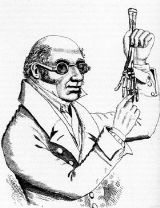
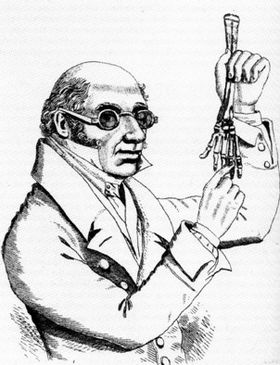
Robert Knox

Encyclopedia
Edinburgh
Edinburgh is the capital city of Scotland, the second largest city in Scotland, and the eighth most populous in the United Kingdom. The City of Edinburgh Council governs one of Scotland's 32 local government council areas. The council area includes urban Edinburgh and a rural area...
before his involvement in the Burke and Hare body-snatching case. This ruined his career, and a later move to London did not improve matters. His later pessimistic view of humanity contrasted with his youthful attachment to the ideas of Geoffroy
Étienne Geoffroy Saint-Hilaire
Étienne Geoffroy Saint-Hilaire was a French naturalist who established the principle of "unity of composition". He was a colleague of Jean-Baptiste Lamarck and expanded and defended Lamarck's evolutionary theories...
.
Knox's ideas on anthropology
Anthropology
Anthropology is the study of humanity. It has origins in the humanities, the natural sciences, and the social sciences. The term "anthropology" is from the Greek anthrōpos , "man", understood to mean mankind or humanity, and -logia , "discourse" or "study", and was first used in 1501 by German...
and ethnology
Ethnology
Ethnology is the branch of anthropology that compares and analyzes the origins, distribution, technology, religion, language, and social structure of the ethnic, racial, and/or national divisions of humanity.-Scientific discipline:Compared to ethnography, the study of single groups through direct...
are now considered racist
Racism
Racism is the belief that inherent different traits in human racial groups justify discrimination. In the modern English language, the term "racism" is used predominantly as a pejorative epithet. It is applied especially to the practice or advocacy of racial discrimination of a pernicious nature...
. This has harmed his reputation, though he continued to reject natural theology
Natural theology
Natural theology is a branch of theology based on reason and ordinary experience. Thus it is distinguished from revealed theology which is based on scripture and religious experiences of various kinds; and also from transcendental theology, theology from a priori reasoning.Marcus Terentius Varro ...
, and believed that there was a blood relationship between all living things.
Life
Robert Knox was born the eighth child of Mary Sherer (alt. 'Schrerer') and Robert Knox (d. 1812), a teacher of mathematics and natural philosophyNatural philosophy
Natural philosophy or the philosophy of nature , is a term applied to the study of nature and the physical universe that was dominant before the development of modern science...
at Heriot's Hospital in Edinburgh
Edinburgh
Edinburgh is the capital city of Scotland, the second largest city in Scotland, and the eighth most populous in the United Kingdom. The City of Edinburgh Council governs one of Scotland's 32 local government council areas. The council area includes urban Edinburgh and a rural area...
. He was educated at the High School
Royal High School (Edinburgh)
The Royal High School of Edinburgh is a co-educational state school administered by the City of Edinburgh Council. The school was founded in 1128 and is one of the oldest schools in Scotland, and has, throughout its history, been high achieving, consistently attaining well above average exam results...
.
In 1810, he joined medical classes in Edinburgh. The only recorded event of his university years was his just failing the anatomy examination. Knox joined the extramural
Extramural
Extramural means to study outside, but under the aegis of, a university or other institution. Extramural studies are taken by the student away from the physical campus, and are often used for those unable to attend classes....
Anatomy class of the famous John Barclay
John Barclay (anatomist)
John Barclay FRSE FRCPE FRCSE FLS MWS was an eminent Scottish comparative anatomist, extra-mural teacher in anatomy, and director of the Highland Society of Scotland....
. Barclay was an anatomist of the highest distinction, and perhaps the greatest anatomical teacher in Britain at that time. Redoubling his efforts, Knox passed very competently the second time around.
Knox married Mary Russell in 1823; she and one of their children died in 1841.
Life abroad
Graduating MD from Edinburgh University in 1814, Knox joined the army as an assistant surgeon, having worked for a year at St Bartholomew’s Hospital in London. His army work at the Brussels military hospital (near Waterloo) impressed upon him the need for a comprehensive training in anatomy if surgery were to be successful. Knox was highly intelligent, critical and irritable. He did not suffer fools gladly and - in an aside with terrible consequences for his future career - he was extremely critical of the surgical work of Charles BellCharles Bell
Sir Charles Bell was a Scottish surgeon, anatomist, neurologist and philosophical theologian.His three older brothers included John Bell , also a noted surgeon and writer; and the advocate George Joseph Bell .-Life:...
with casualties at the Battle of Waterloo. In April 1817, he joined the 72nd Highlanders and sailed with them immediately to South Africa
South Africa
The Republic of South Africa is a country in southern Africa. Located at the southern tip of Africa, it is divided into nine provinces, with of coastline on the Atlantic and Indian oceans...
. He returned to Britain on Christmas Day 1820, but remained only until the following October, after which he went to Paris to study anatomy for just over a year (1821-2). It was then that he met both Georges Cuvier
Georges Cuvier
Georges Chrétien Léopold Dagobert Cuvier or Jean Léopold Nicolas Frédéric Cuvier , known as Georges Cuvier, was a French naturalist and zoologist...
and Étienne Geoffroy Saint-Hilaire
Étienne Geoffroy Saint-Hilaire
Étienne Geoffroy Saint-Hilaire was a French naturalist who established the principle of "unity of composition". He was a colleague of Jean-Baptiste Lamarck and expanded and defended Lamarck's evolutionary theories...
, who were to remain heroes for his entire life, to populate his later medical journalism, and to become the subject of his hagiography, Great artists and great anatomists.
Career in Edinburgh
Knox returned to Edinburgh by Christmas 1822. In 1823 he was elected a Fellow of the Royal Society of EdinburghRoyal Society of Edinburgh
The Royal Society of Edinburgh is Scotland's national academy of science and letters. It is a registered charity, operating on a wholly independent and non-party-political basis and providing public benefit throughout Scotland...
. During these years he communicated a number of well-received papers to the Royal and Wernerian societies of Edinburgh on zoological subjects. Soon after his election he submitted a plan to the Royal College of Surgeons of Edinburgh for a Museum of Comparative Anatomy, which was accepted, and within eight months he was appointed Conservator over the new museum.
From 1826 to 1840 he ran Barclay's anatomy school in Surgeon's Square, Edinburgh. At this time most professorships were in the gift of the town council, resulting in such uninspiring teachers as the Professor of Anatomy, Alexander Monro tertius who put off many of his students (including the young Charles Darwin
Charles Darwin
Charles Robert Darwin FRS was an English naturalist. He established that all species of life have descended over time from common ancestry, and proposed the scientific theory that this branching pattern of evolution resulted from a process that he called natural selection.He published his theory...
who took the course 1825–1827). This created a demand for private tuition, and the flamboyant Knox had more students than all the other private tutors put together.
He turned his sharp wit on the elders and the clergy of the city, satirising religion and delighting his students. His 'continental' lectures were not for the squeamish. John James Audubon
John James Audubon
John James Audubon was a French-American ornithologist, naturalist, and painter. He was notable for his expansive studies to document all types of American birds and for his detailed illustrations that depicted the birds in their natural habitats...
, was in Edinburgh at the time to find subscribers for his Birds of America
Birds of America (book)
The Birds of America is a book by naturalist and painter John James Audubon, containing illustrations of a wide variety of birds of the United States. It was first published as a series of sections between 1827 and 1838, in Edinburgh and London....
. Shown round the dissecting theatre by Knox, "dressed in an overgown and with bloody fingers", Audubon reported that "The sights were extremely disagreeable, many of them shocking beyond all I ever thought could be. I was glad to leave this charnel house and breathe again the salubrious atmosphere of the streets".
The Resurrectionists
Before the Anatomy Act of 1832 widened the supply, the only legal supply of corpses for anatomical purposes in the UK were those condemned to death and dissectionDissection
Dissection is usually the process of disassembling and observing something to determine its internal structure and as an aid to discerning the functions and relationships of its components....
by the courts. This led to a chronic shortage of legitimate subject of dissection, and this shortage became more serious as the need to train medical students grew, and the number of executions fell. In his school Knox ran up against the problem from the start, since – after 1815 – the Royal Colleges had enforced an extension of anatomical examination in the medical curriculum. If he taught according to what was known as ‘French method’ the ratio would have had to approach one corpse per pupil.
As a consequence, body-snatching
Body-snatching
Body snatching is the secret disinterment of corpses from graveyards. A common purpose of body snatching is to sell the corpses for dissection or anatomy lectures in medical schools...
became so prevalent that it was not unusual for relatives and friends of someone who had just died to watch over the body until burial, and then to keep watch over the grave after burial, to stop it being violated. In November 1827 William Hare began a new career when an indebted lodger died on him by chance. He was paid £7.10/- (seven pounds & ten shillings) for delivering the body to Knox. Now Burke and his accomplice Hare set about murdering tramps and drunks on a regular basis. After 16 more transactions, in what became known as the West Port Murders, on 2 November 1828 Burke and Hare were caught, and the whole city convulsed with titillated horror, fed by ballads, broadsides and newspapers, at the terrible deeds of Burke & Hare. Hare turned King's evidence, and Burke was hanged, dissected and displayed.
-
- Burke’s the butcher, Hare’s the thief,
Knox, the boy who buys the beef!
- Burke’s the butcher, Hare’s the thief,
Knox was not prosecuted, which outraged many in Edinburgh. His house was attacked by a mob, and windows were broken. A committee of the Royal Society of Edinburgh
Royal Society of Edinburgh
The Royal Society of Edinburgh is Scotland's national academy of science and letters. It is a registered charity, operating on a wholly independent and non-party-political basis and providing public benefit throughout Scotland...
exonerated him of blame, but there was no forgetting his part in the case, and many remained wary of him.
Almost immediately after the Burke and Hare case, the Royal College of Surgeons of Edinburgh
Royal College of Surgeons of Edinburgh
The Royal College of Surgeons of Edinburgh is an organisation dedicated to the pursuit of excellence and advancement in surgical practice, through its interest in education, training and examinations, its liaison with external medical bodies and representation of the modern surgical workforce...
began to harry him, and by June 1831 they had procured his resignation as the Curator of the museum he had proposed and founded. His profitable lecturing was the next to suffer. His class finally collapsed when Edinburgh University made its own practical anatomy class compulsory in the mid-1830s. Knox continued to purchase cadavers for his dissection class, but the 1832 Anatomy Act made bodies more available to all anatomists, and his competitive edge was lost.
- Anatomy murderAnatomy murderAn anatomy murder is a murder committed in order to use all or part of the cadaver for medical research or teaching. It is not a medicine murder because the body parts are not believed to have any medicinal use in themselves. The motive for the murder is created by the demand for cadavers for ...
London
Knox made enemies of Edinburgh's city elders, and left for London in 1842 after the death of his wife (the remaining children were farmed out to a nephew). He found it impossible to get a post as a surgeon, and from then until 1856 he worked on medical journalism, lectures, and various publications. His books about fishing sold best.In 1856 he became the pathalogical anatomist to the Free Cancer Hospital
The Royal Marsden NHS Foundation Trust
The Royal Marsden Hospital is a specialist cancer treatment hospital in London, England. It is an NHS Foundation Trust, and operates facilities on two sites:*The Chelsea site in Brompton, next to the Royal Brompton Hospital, on Fulham Road...
, London. He worked there for the next six years until his death on 20 December 1862. He was buried at Brookwood Cemetery
Brookwood Cemetery
Brookwood Cemetery is a burial ground in Brookwood, Surrey, England. It is the largest cemetery in the United Kingdom and one of the largest in western Europe.-History:...
near Woking, Surrey.
Anthropology
In his writings Knox synthesised a perspective on nature from three of the most influential natural historians of his time. From Cuvier, he took a consciousness of the great epochs of time, of the fact of extinction, and of the inadequacy of the biblical account. From Geoffroy St-Hilaire and BlainvilleHenri Marie Ducrotay de Blainville
Henri Marie Ducrotay de Blainville was a French zoologist and anatomist.Blainville was born at Arques, near Dieppe. In about 1796 he went to Paris to study painting, but he ultimately devoted himself to natural history, and attracted the attention of Georges Cuvier, for whom he occasionally...
, he gained a spatial and thematic perspective on living things. If one had the skill, all living beings could be arranged in their correct placing in a notional table, and one would see both internally and externally the elegant variation of their organs and anatomy according to the principles of connection, unity of composition, and compensation.
Goethe is another crucial addition to the Knoxian way of looking at nature. Goethe thought that there were transcendental archetypes in the living world which could be perceived by genius. If the natural historian were perspicacious enough to examine the creatures in this correct order he could perceive – aesthetically – the archetype that was immanent in the totality of a series, although present in none of them.
Knox wrote that he was concerned to prove the existence of a generic animal, "or in other terms, proving hereditary descent to have a relation primarily to genus or natural family". This way, he could lay claim to a stability in the natural order at the level of the genus, but let species be extinguished. Man was a genus; not a species. Insofar as Knox had any definition of species – for his thinking about it was hazy – races were species. Knox saw his work as an inspired sketch of the profound laws of race. In addition to categorizing races as species, Knox found sub-racial divisions by national origin types; he considered English Anglo-Saxon superior to all others.
Knox in fiction
- Peter CushingPeter CushingPeter Wilton Cushing, OBE was an English actor, known for his many appearances in Hammer Films, in which he played the handsome but sinister scientist Baron Frankenstein and the vampire hunter Dr. Van Helsing, amongst many other roles, often appearing opposite Christopher Lee, and occasionally...
plays Knox in The Flesh and the Fiends (1960). Written and directed by John Gilling, the film is a reasonably accurate depiction, allowing for some dramatic licence and time constraints, of the Burke and Hare story.
- The Anatomist (1961), a British film, starred Alastair SimAlastair SimAlastair George Bell Sim, CBE was a Scottish character actor who appeared in a string of classic British films. He is best remembered in the role of Ebenezer Scrooge in the 1951 film Scrooge, and for his portrayal of Miss Fritton, the headmistress in two St. Trinian's films...
as Knox. This was based on a 1930 play of the same name by James BridieJames BridieJames Bridie was the pseudonym of a Scottish playwright, screenwriter and surgeon whose real name was Osborne Henry Mavor....
, which the BBC broadcast in 1939 with Knox played by Andrew CruickshankAndrew CruickshankAndrew John Maxton Cruickshank was a Scottish supporting actor, most famous for his portrayal of Dr Cameron in the long-running UK BBC television series, Dr Finlay's Casebook, which ran for 191 episodes from 1962 until 1971.-Life and career:Andrew Cruickshank was born to Andrew and Mary...
and in 1980 as a Play of the Month by the BBC, starring Patrick StewartPatrick StewartSir Patrick Hewes Stewart, OBE is an English film, television and stage actor, who has had a distinguished career in theatre and television for around half a century...
as Knox.
- John HoytJohn HoytJohn Hoyt was an American film, stage, and television actor.-Early life:Hoyt was born John McArthur Hoysradt. Before becoming an actor with Orson Welles's Mercury Theatre, the Yale University graduate worked as a history instructor, acting teacher and even a nightclub comedian...
played Knox in an episode of The Alfred Hitchcock Hour based on the Burke and Hare murders.
- The character Dr. Thomas Rock in the Dylan ThomasDylan ThomasDylan Marlais Thomas was a Welsh poet and writer, Encyclopædia Britannica. Retrieved 11 January 2008. who wrote exclusively in English. In addition to poetry, he wrote short stories and scripts for film and radio, which he often performed himself...
play The Doctor and the Devils is based on Knox. The play was filmed in 1985 with Timothy DaltonTimothy DaltonTimothy Peter Dalton ) is a Welsh actor of film and television. He is known for portraying James Bond in The Living Daylights and Licence to Kill , as well as Rhett Butler in the television miniseries Scarlett , an original sequel to Gone with the Wind...
as Dr. Rock.
- Knox was the model for the character of Dr. Thomas Potter in Matthew KnealeMatthew KnealeMatthew Kneale is a British writer, best known for his 2000 novel English Passengers, which won the prestigious Whitbread Book Award and was also shortlisted for the Booker Prize. He went to school at Latymer Upper School and then studied Modern History at Magdalen College, Oxford, and afterwards...
's epic novel English Passengers, which deals with the perceptions and perspectives of different races, nationalities and stations in society.
- The Knox scandal forms the background of Robert Louis StevensonRobert Louis StevensonRobert Louis Balfour Stevenson was a Scottish novelist, poet, essayist and travel writer. His best-known books include Treasure Island, Kidnapped, and Strange Case of Dr Jekyll and Mr Hyde....
's short story "The Body SnatcherThe Body SnatcherThe Body Snatcher is a fictional short story by the Scottish author Robert Louis Stevenson. First published in the Pall Mall Christmas "Extra", in December 1884, the story is based on characters in the employ of Robert Knox, around the time of the Burke and Hare murders.-Plot summary:The story...
" (1884). Later filmed The Body SnatcherThe Body Snatcher (film)The Body Snatcher is a 1945 horror film directed by Robert Wise based on the short story The Body Snatcher by Robert Louis Stevenson. The film's producer Val Lewton helped adapt the story for the screen, writing under the pen name of "Carlos Keith". The film was marketed with the tagline The...
in 1945, starring Boris KarloffBoris KarloffWilliam Henry Pratt , better known by his stage name Boris Karloff, was an English actor.Karloff is best remembered for his roles in horror films and his portrayal of Frankenstein's monster in Frankenstein , Bride of Frankenstein , and Son of Frankenstein...
and Bela LugosiBéla LugosiBéla Ferenc Dezső Blaskó , commonly known as Bela Lugosi, was a Hungarian actor of stage and screen. He was best known for having played Count Dracula in the Broadway play and subsequent film version, as well as having starred in several of Ed Wood's low budget films in the last years of his...
; and TV (1966), both mentioning the West Port murdersWest Port murdersThe Burke and Hare murders were serial murders perpetrated in Edinburgh, Scotland, from November 1827 to October 31, 1828. The killings were attributed to Irish immigrants William Burke and William Hare, who sold the corpses of their 17 victims to provide material for dissection...
.
- 1971: Burke & Hare (film)Burke & Hare (film)Burk & Hare, sometimes called Burke and Hare or The Horrors of Burke and Hare, is a 1971 horror film, directed by Vernon Sewell, and starring Derren Nesbitt, Harry Andrews, and Glynn Edwards. It is based on the Burke and Hare murders, and was the last film to be directed by Vernon Sewell...
, last film of eminent director Vernon SewellVernon SewellVernon Campbell Sewell was a British film director, screenwriter, producer writer and, briefly, an actor. Sewell was born in London, England in 1903. He was educated at Marlborough College. He directed over 30 films during his career, starting with Morgenrot in 1933...
- Knox is a major character in Nicola Morgan's 2003 novel "Fleshmarket"
- Leslie PhillipsLeslie PhillipsLeslie Samuel Phillips, CBE is an English actor with a highly recognisable upper class accent. Originally known for his work as a comedy actor, Phillips subsequently made the transition to character roles.-Early life:...
played a version of Knox in the 2004 Doctor WhoDoctor WhoDoctor Who is a British science fiction television programme produced by the BBC. The programme depicts the adventures of a time-travelling humanoid alien known as the Doctor who explores the universe in a sentient time machine called the TARDIS that flies through time and space, whose exterior...
audio drama Medicinal PurposesMedicinal PurposesMedicinal Purposes is a Big Finish Productions audio drama based on the long-running British science fiction television series Doctor Who.-Plot:Edinburgh, 1827...
, which pitted the Sixth DoctorSixth DoctorThe Sixth Doctor is the sixth incarnation of the protagonist of the long-running BBC television science-fiction series Doctor Who. He was portrayed by Colin Baker...
(Colin BakerColin BakerColin Baker is a British actor who is known for playing Paul Merroney in The Brothers from 1974 to 1976 and as the sixth incarnation of the Doctor in the long-running science fiction television series Doctor Who, from 1984 to 1986.- Background:Colin Baker was born in London, but moved north to...
) against another time-traveller (Phillips) who had taken the place of the historical Knox, and was manipulating the events of the Burke and Hare murders.
- The Horrible Histories TV SeriesHorrible Histories (2009 TV series)Horrible Histories is an award-winning British children's television series based on the Terry Deary book series of the same name. The first series was thirteen episodes long, and was broadcast from 16 April to 9 July 2009 on CBBC on BBC One. A second series, of twelve episodes , aired from 31 May...
(Series 1, Episode 13) includes a sketch about Robert Knox, in which the story of the body-snatching cases is told in a song. Knox is played by Mathew BayntonMathew BayntonMathew Baynton is an English actor and writer. He stars in the UK television series Horrible Histories as a singer, actor and writer. He also played Deano in Gavin & Stacey. Mat is also in the band Special Benny and also has a separate solo career under the name of Dog Ears...
and Burke and Hare by Simon FarnabySimon FarnabySimon Alexander Farnaby is an English comedy actor and writer in television, theatre and film.-Early life:Born in Wath-upon-Dearne, South Yorkshire, Farnaby trained at the Webber Douglas Academy of Dramatic Art, National Youth Theatre, and Trinity College, Dublin...
and Jim HowickJim HowickJim Howick is an English actor. He is best known for his roles of Cpl. Matlin in Hellboy, Gerard in Peep Show and various characters including the 'Shouty Man', which he is best known for in CBBC's series of Horrible Histories...
respectively.
- Knox was played by Tom WilkinsonTom WilkinsonThomas Geoffrey "Tom" Wilkinson, OBE is a British actor. He has twice been nominated for an Academy Award for his roles in In the Bedroom and Michael Clayton...
in the 2010 black comedy Burke and Hare (film)Burke and Hare (film)Burke and Hare is a British black comedy film, loosely based on the Burke and Hare murders. Directed by John Landis, the film stars Simon Pegg and Andy Serkis as William Burke and William Hare respectively. It was Landis's first feature film release in twelve years, the last being 1998's Susan's...
External links
- Robert Knox MD, FRCSEd, FRSEd 1791-1862: The first Conservator of the College Museum
The Royal College of Surgeons of Edinburgh, Historical Review, 2000. Accessed February 23, 2007. - Searchable collection of printed materials from the New York Academy of Medicine, related to the Burke and Hare murders, Dr. Knox, and the trial and execution of Burke
- Images of the worlds of Knox, Burke, and Hare, including animated tours of 19th century Edinburgh
- Echoes of the Scottish Resurrection Men