


Anglo-Saxon dress

Encyclopedia

Early medieval European dress
Early medieval European dress changed very gradually from about 400 to 1100. The main feature of the period was the meeting of late Roman costume with that of the invading peoples who moved into Europe over this period...
, or clothing, worn by the Anglo-Saxons
Anglo-Saxons
Anglo-Saxon is a term used by historians to designate the Germanic tribes who invaded and settled the south and east of Great Britain beginning in the early 5th century AD, and the period from their creation of the English nation to the Norman conquest. The Anglo-Saxon Era denotes the period of...
from the time of their migration to Great Britain
Great Britain
Great Britain or Britain is an island situated to the northwest of Continental Europe. It is the ninth largest island in the world, and the largest European island, as well as the largest of the British Isles...
in the 5th century until the beginning of the Norman Conquest, when Norman fashions from the Continent began to have a major influence in England
England
England is a country that is part of the United Kingdom. It shares land borders with Scotland to the north and Wales to the west; the Irish Sea is to the north west, the Celtic Sea to the south west, with the North Sea to the east and the English Channel to the south separating it from continental...
.
Materials
Anglo-Saxon clothing usually utilized only three types of fabric. WoolWool
Wool is the textile fiber obtained from sheep and certain other animals, including cashmere from goats, mohair from goats, qiviut from muskoxen, vicuña, alpaca, camel from animals in the camel family, and angora from rabbits....
was a coarse material which was used for most garments. Lower class people, such as slaves (theow) and poorer peasants (gebur) could only use wool for their garments, even garments worn against the skin. Linen
Linen
Linen is a textile made from the fibers of the flax plant, Linum usitatissimum. Linen is labor-intensive to manufacture, but when it is made into garments, it is valued for its exceptional coolness and freshness in hot weather....
, harvested from the flax plant, was a finer material which was used for garments that were worn close to the skin by better-off peasants (kotsetlas and geneatas) and those above them in the social hierarchy. Silk
Silk
Silk is a natural protein fiber, some forms of which can be woven into textiles. The best-known type of silk is obtained from the cocoons of the larvae of the mulberry silkworm Bombyx mori reared in captivity...
was an extremely expensive material, and it was used only by the very rich, and then only for trim and decoration.
Men’s clothing
The primary garment consisted of a knee-length woollen tunicTunic
A tunic is any of several types of clothing for the body, of various lengths reaching from the shoulders to somewhere between the hips and the ankles...
. For the poorer theow, this would be the only clothing worn, although some may have been given woolen trousers and shoes to wear. Gebur would be able to afford woolen trousers and leather shoes, and would also carry a knife (called a seax
Seax
Seax in Old English means knife or cutting tool. The name of the roofer's tool, the zax, is a development from this word...
), which signified their freedom in the eyes of medieval Anglo-Saxon society. A linen undertunic (worn under the outer woollen tunic) and linen braies (reaching to the ankle or knee) would be worn by richer peasants and nobility, along with woolen hose which would be held up by garters
Garter (stockings)
Garters are articles of clothing: narrow bands of fabric fastened about the leg, used to keep up stockings, and sometimes socks. Normally just a few inches in width, they are usually made of leather or heavy cloth, and adorned with small bells and/or ribbons...
or decorative embroidery around the top. During the 11th century, the length of the braies decreased and the length of the hose increased, eventually resulting in a garment which somewhat resembled modern shorts. Geneatas and thegn
Thegn
The term thegn , from OE þegn, ðegn "servant, attendant, retainer", is commonly used to describe either an aristocratic retainer of a king or nobleman in Anglo-Saxon England, or as a class term, the majority of the aristocracy below the ranks of ealdormen and high-reeves...
s would often have cross-gartering on their hose, along with leather turnshoe
Turnshoe
A turnshoe is a type of shoe made of leather used during the Middle Ages. It was so named because it was put together inside-out, and then was turned right-side-out once finished...
s.
Over the tunic, a cloak would be worn, which was held together by a broche or, later on, a ring (functional button
Button
In modern clothing and fashion design, a button is a small fastener, most commonly made of plastic, but also frequently of seashell, which secures two pieces of fabric together. In archaeology, a button can be a significant artifact. In the applied arts and in craft, a button can be an example of...
s not being invented until the 13th century). There are several illustrations of warriorlike persons, wearing headgear similar to Phrygian cap
Phrygian cap
The Phrygian cap is a soft conical cap with the top pulled forward, associated in antiquity with the inhabitants of Phrygia, a region of central Anatolia. In the western provinces of the Roman Empire it came to signify freedom and the pursuit of liberty, perhaps through a confusion with the pileus,...
s or helmets, found in 10th and 11th century Anglo-Saxon manuscripts. It is possible, though, that these images do not depict any actual fashion of the period, but rather copies of much older Byzantine or Roman originals, little understood by the copyist.
Hoods would also be worn.
Common attire
Men of the northern tribes of 5th and 6th century EnglandEngland
England is a country that is part of the United Kingdom. It shares land borders with Scotland to the north and Wales to the west; the Irish Sea is to the north west, the Celtic Sea to the south west, with the North Sea to the east and the English Channel to the south separating it from continental...
dressed alike regardless of social rank. The fashions during this time consisted of the cloak
Cloak
A cloak is a type of loose garment that is worn over indoor clothing and serves the same purpose as an overcoat; it protects the wearer from the cold, rain or wind for example, or it may form part of a fashionable outfit or uniform. Cloaks are as old as human history; there has nearly always been...
, tunic
Tunic
A tunic is any of several types of clothing for the body, of various lengths reaching from the shoulders to somewhere between the hips and the ankles...
, trousers
Trousers
Trousers are an item of clothing worn on the lower part of the body from the waist to the ankles, covering both legs separately...
, leggings
Leggings
Leggings are a type of fitted clothing covering the legs, which can be worn by both men and women.Originally leggings were two separate garments, one for each leg....
, and accessories. The short, fur-lined cloak was designed so that the skin of the animal faced outward and the fur brushed against the undergarments. However, woolen cloaks have also been found. The garment opened either at the front or at the right shoulder. A single brooch
Brooch
A brooch ; also known in ancient times as a fibula; is a decorative jewelry item designed to be attached to garments. It is usually made of metal, often silver or gold but sometimes bronze or some other material...
, usually circular in shape, fastened the square or rectangular cloak. Other means of fastening the cloth together included tying, lacing, or using a clasp, often made of natural materials such as thorn, bones, wood, or horns. The less prosperous wore woolen cloaks .
The tunic ended between the hip and the knee and had either long or short sleeves. Clasps were not needed to hold the tunic together because when pulled over the head it would sit snuggly around the neck without the use of lacing or ties, indicating that the garment was one continuous piece. A belt
Belt (clothing)
A belt is a flexible band or strap, typically made of leather or heavy cloth, and worn around the waist. A belt supports trousers or other articles of clothing.-History:...
or girdle
Girdle
A girdle is a garment that encircles the lower torso, perhaps extending below the hips, and worn often for support. The word girdle originally meant a belt. In modern English, the term girdle is most commonly used for a form of women's foundation wear that replaced the corset in popularity...
was usually worn with the tunic and might have had a buckle, and, as Owen-Crocker states, “pouched over the belt” . Multiple tunics were worn at once so that the lower one, often short sleeved, served as a shirt .
Trousers, traditionally worn under a short tunic or with a small cloak
Cloak
A cloak is a type of loose garment that is worn over indoor clothing and serves the same purpose as an overcoat; it protects the wearer from the cold, rain or wind for example, or it may form part of a fashionable outfit or uniform. Cloaks are as old as human history; there has nearly always been...
, were ankle length. If loose, the excess material was bunched around the waist and, as Owen-Crocker describes, “hung in folds around the legs” . Garters or leggings accompanied narrow trousers. Pieces of fabric attached to the trousers forming belt loops so that the garment could be at held in place at the waist by a belt .
Leggings, usually worn in pairs, acted as additional protection for the legs. The first legging, referred to as the legging proper or stocking
Stocking
A stocking, , is a close-fitting, variously elastic garment covering the foot and lower part of the leg. Stockings vary in color, design and transparency...
, consisted of woven fabric or leather. The second was simply a piece of fabric used to tie on the leggings or, if worn around the shin or foot, provided warmth and protection. The lower caste wore leggings made of ripped or cut cloth from old clothes, blankets, or bags whereas the upper caste had custom made leggings .The very rich people sometimes wore jewels.
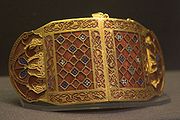
Belts worn at the hips were more of a necessity rather than a luxury. Buckles were common and most faced the front; however others have been found to face both sides or even, in some cases, were placed at the back of the body. Owen-Crocker mentions that “belt ornaments and tags” dangled from the belts of the Anglo-Saxons in addition to everyday equipment . Beads occasionally acted as alternatives, although not often. Leather belts, often decorated, were the most common, often as much as 2 inches wide . Intricate belts, worn to be seen, were placed in view while an additional belt or girdle held the trouser in place under the tunic .
The Anglo-Saxons usually covered their bare feet, except when working. Shoe
Shoe
A shoe is an item of footwear intended to protect and comfort the human foot while doing various activities. Shoes are also used as an item of decoration. The design of shoes has varied enormously through time and from culture to culture, with appearance originally being tied to function...
s were made of leather and secured with straps . Hat
Hat
A hat is a head covering. It can be worn for protection against the elements, for ceremonial or religious reasons, for safety, or as a fashion accessory. In the past, hats were an indicator of social status...
s and hoods were commonly worn as were glove
Glove
A glove is a garment covering the hand. Gloves have separate sheaths or openings for each finger and the thumb; if there is an opening but no covering sheath for each finger they are called "fingerless gloves". Fingerless gloves with one large opening rather than individual openings for each...
s and mittens .
Seventh to tenth centuries
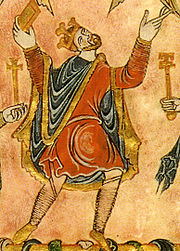
General attire
Clothing of the seventh through the 9th centuries was similar to that of previous centuries and again all classes generally wore the same clothing, although distinctions among the social hierarchy began to become more noticeable through ornamented garments. These common pieces consisted of tunics, cloaks, jacketJacket
A jacket is a hip- or waist-length garment for the upper body. A jacket typically has sleeves, and fastens in the front. A jacket is generally lighter, tighter-fitting, and less insulating than a coat, which is outerwear...
s, pants, and shoes. As in the 5th and 6th centuries, a linen shirt acted as an undergarment. Men generally wore a knee-length linen or woolen tunic, depending on the season, over their shirts. The sleeves of the tunic were long and close fitting and excess material was pushed up the arm from the elbow to the wrist so that “rolls” were formed in the material . The neck of the tunic opened as did both sides and a belt or girdle was usually worn around the waist. According to rank, embellishments adorned the collar of the tunic, waist, or border and for peasants, or the working classes, a plain tunic with sleeves was generally worn. Examples of these decorations included, as Planché states, “gold and silver chains and crosses, bracelets of gold, silver or ivory, golden and jeweled belts, strings of amber and other beads, rings, brooches, [and] buckles” . The nobility tended to wear longer tunics than the lower social classes .
A cloak, worn over the tunic, fastened on either the breast or a shoulder with the assistance of a brooch. Once in place, the brooch was left attached to the garment so that the cloak was slipped over the head . The cloak, knee-length and rectangular in shape, was fastened so that it appeared to be pleat
Pleat
A pleat is a type of fold formed by doubling fabric back upon itself and securing it in place. It is commonly used in clothing and upholstery to gather a wide piece of fabric to a narrower circumference....
ed or folded. Hoods and collar
Collar (clothing)
In clothing, a collar is the part of a shirt, dress, coat or blouse that fastens around or frames the neck. Among clothing construction professionals, a collar is differentiated from other necklines such as revers and lapels, by being made from a separate piece of fabric, rather than a folded or...
s began to appear in the 9th century, and around the same time, the cloak began to be curbed by the same belt that was worn over the tunic . Such belts were narrower than earlier in the saxon period, with less tools hanging from them . The wrap-over coat
Coat (clothing)
A coat is a long garment worn by both men and women, for warmth or fashion. Coats typically have long sleeves and are open down the front, closing by means of buttons, zippers, hook-and-loop fasteners, toggles, a belt, or a combination of some of these...
also made an appearance during this era. This knee-length coat wrapped over the front of the body. Its sleeves were, as Owen-Crocker says, “deep, [with] decorated cuffs which [were] mostly straight” . For the lower classes, this coat tended to be plainer than that of the nobility .
The waistcoat or jacket appeared during this time as well. For those who could afford it, the jacket was made of fur while less costly ones were made of linen. This jacket was waist-length and tended to have a broad collar .
The trousers in this era were shortened to mid thigh and stockings, made of leather, met them there. Atop the stockings, rounds of cloth, linen, or leather were worn which started at the ankle and ended just below the knee, as Planché explains, in “close rolls… or crisscrossing each other sandal-wise” . Planché states that socks began to be worn over the stocking and were “banded at the top” . Shoes of this era, painted black, had an opening down the instep and were secured with straps. Anglo-Saxons appreciated shoes and thus all classes wore them. Common colors for this era consisted of red, blue, and green .
King
Clergy
Planché asserts that the clergy of the 9th and 10th centuries dressed similarly to the laityLaity
In religious organizations, the laity comprises all people who are not in the clergy. A person who is a member of a religious order who is not ordained legitimate clergy is considered as a member of the laity, even though they are members of a religious order .In the past in Christian cultures, the...
, except when saying mass
Mass
Mass can be defined as a quantitive measure of the resistance an object has to change in its velocity.In physics, mass commonly refers to any of the following three properties of matter, which have been shown experimentally to be equivalent:...
. Beginning in the later 8th century, the clergy were forbidden to wear bright colors or expensive or valuable fabrics . Owen-Crocker mentions that their twill cloaks were generally shorter than those of the laity, reaching just below the waist, and Planché adds, that they wore linen stocking .
General attire
Planché explains that in the 11th century, shortened tunics became popular as did shorter hair styles and beard lengths. Piercings also became fashionable for men as did golden bracelets . During this era men continued to wear tunics, cloaks, and trousers which did not vary much from their previous counterparts. CoifCoif
A coif is a close fitting cap that covers the top, back, and sides of the head.- History :Coifs were worn by all classes in England and Scotland from the Middle Ages to the early seventeenth century .Tudor and earlier coifs are usually made of unadorned white linen and tied under...
s became popular head-coverings and appeared to be “flat round cap[s]” . Long stockings, with feet attached, were in style, and leg bandages and shoes continued to be worn. Short boots, those only extending to the ankle, were introduced in the latter part of the century .
King
Not much is mentioned regarding the attire of the king in this era other than he wore a mail tunic . However, it is known that the nobles of the time continued to wear long, ankle-length tunics. Their cloaks, also referred to as mantels, were lavish and elegant and cords and tassels were attached to adorn the mantle .Military attire
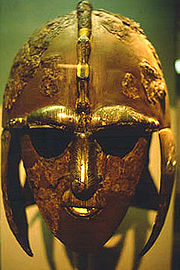
Sutton Hoo
Sutton Hoo, near to Woodbridge, in the English county of Suffolk, is the site of two 6th and early 7th century cemeteries. One contained an undisturbed ship burial including a wealth of Anglo-Saxon artefacts of outstanding art-historical and archaeological significance, now held in the British...
and in the Staffordshire Hoard
Staffordshire Hoard
The Staffordshire Hoard is the largest hoard of Anglo-Saxon gold and silver metalwork . Discovered in a field near the village of Hammerwich, near Lichfield, in Staffordshire, England on 5 July 2009, it consists of some 3,500 items that are nearly all martial in character...
; the concept of parade wear did not exist for the Anglo-Saxons.
Clergy
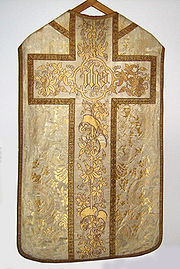
Mitre
The mitre , also spelled miter, is a type of headwear now known as the traditional, ceremonial head-dress of bishops and certain abbots in the Roman Catholic Church, as well as in the Anglican Communion, some Lutheran churches, and also bishops and certain other clergy in the Eastern Orthodox...
attached to the side of it” . Other garments included the chasuble
Chasuble
The chasuble is the outermost liturgical vestment worn by clergy for the celebration of the Eucharist in Western-tradition Christian Churches that use full vestments, primarily in the Roman Catholic, Anglican and Lutheran churches, as well as in some parts of the United Methodist Church...
, the outermost liturgical vestment, which retained its shape, and the dalmatic
Dalmatic
The dalmatic is a long wide-sleeved tunic, which serves as a liturgical vestment in the Roman Catholic, Lutheran, Anglican, and United Methodist Churches, which is sometimes worn by a deacon at the Mass or other services. Although infrequent, it may also be worn by bishops above the alb and below...
s, a tunic like vestment with large, bell shaped sleeves, which tended to be arched on the sides. The pastoral staff
Crosier
A crosier is the stylized staff of office carried by high-ranking Catholic, Eastern Orthodox, Anglican, and some Lutheran and Pentecostal prelates...
was generally found to be plain in color and ornamentation .
Women’s clothing
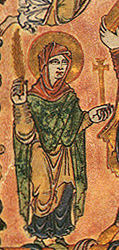
Seax
Seax in Old English means knife or cutting tool. The name of the roofer's tool, the zax, is a development from this word...
as a sign of their freedom.
After the introduction of Christianity, all women (except for very young girls and occasionally slaves) would wear some kind of headcovering, usually a draped couvrechef
Kerchief
A kerchief is a triangular or square piece of cloth tied around the head or around the neck for protective or decorative purposes...
called a headrail, the ancestor of the later wimple
Wimple
A wimple is a garment worn around the neck and chin, and which usually covers the head. Its use developed among women in early medieval Europe . At many stages of medieval culture it was unseemly for a married woman to show her hair...
.
Embroidery
The most famous example of Anglo-Saxon embroidery is the Bayeux TapestryBayeux Tapestry
The Bayeux Tapestry is an embroidered cloth—not an actual tapestry—nearly long, which depicts the events leading up to the Norman conquest of England concerning William, Duke of Normandy and Harold, Earl of Wessex, later King of England, and culminating in the Battle of Hastings...
. Although it was commissioned by a Norman (most likely Odo of Bayeux), the Bayeux Tapestry shows many hallmarks of Anglo-Saxon embroidery techniques, pointing to the likely use of Anglo-Saxon embroiderers in its construction.
Further reading
- Brooke, Iris (2000). English Costume from the Early Middle Ages through the Sixteenth Century. Mineola, NY: Dover Publications, Inc. ISBN 0-486-41238-5
- Owen-Crocker, Gale R., Dress in Anglo-Saxon England, revised edition, Boydell Press, 2004, ISBN 1-8438-3081-7
- Owen-Crocker, Gale R. paper
- Quennell, MarjorieMarjorie QuennellMarjorie Quennell was a British historian, illustrator and museum curator.Her husband was architect Charles Henry Bourne Quennell . They met at the Junior Art Workers Guild...
and C. H. B. QuennellC. H. B. QuennellCharles Henry Bourne Quennell , was an English architect, designer, illustrator and writer.-Biography:Quennell was the son of a builder and grew up in a house at Cowley Road on the Holland Town Estate, Kennington, London. Bourne was his mother's maiden name...
(1927). Everyday Life in Anglo-Saxon, Viking, and Norman Times. New York: The Knickerbocker Press. - Regia Anglorum Members Handbook: Saxon Dress. (January 2007).