

Undley bracteate

Encyclopedia
The Undley bracteate is a 5th century bracteate
found in Undley Common, near Lakenheath
, Suffolk
. It bears the earliest known inscription that can be argued to be in Anglo-Frisian Futhorc (as opposed to Common Germanic Elder Futhark
).
The image on the bracteate is an adaptation of an Urbs Roma coin type issued by Constantine the Great, conflating the helmeted head of the emperor and the image of Romulus and Remus
suckled by the wolf on one face. With a diameter of 2.3 cm, it weighs 2.24 grams. It may have originated in northern Germany
or southern Scandinavia
, and been brought to England with an early Anglo-Saxon
settler.
The inscription reads right to left around the circumference of the obverse side, terminating at the image of the wolf:
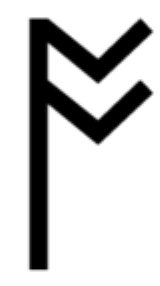
The o is the earliest known instance of the os
rune contrasting with the æsc rune . The three syllables of the initial word gægogæ are written as bind rune
s, with side-twigs attached to the X shape of the gyfu
rune to represent the vowels æ and o.
The words mægæ medu are interpreted as meaning "meed for the kinsmen", i.e. "reward for relatives", referring to the bracteate itself. The word gægogæ appears to be some magical invocation or battle cry, comparable to the g͡ag͡ag͡a on the Kragehul I
lance-shaft.
Bracteate
A bracteate is a flat, thin, single-sided gold medal worn as jewelry that was produced in Northern Europe predominantly during the Migration Period of the Germanic Iron Age...
found in Undley Common, near Lakenheath
Lakenheath
Lakenheath is a village in Suffolk, England. It has around 8,200 residents, and is situated in the Forest Heath district of Suffolk, close to the county boundaries of both Norfolk and Cambridgeshire, and at the meeting point of the The Fens and the Breckland natural environments.Lakenheath is host...
, Suffolk
Suffolk
Suffolk is a non-metropolitan county of historic origin in East Anglia, England. It has borders with Norfolk to the north, Cambridgeshire to the west and Essex to the south. The North Sea lies to the east...
. It bears the earliest known inscription that can be argued to be in Anglo-Frisian Futhorc (as opposed to Common Germanic Elder Futhark
Elder Futhark
The Elder Futhark is the oldest form of the runic alphabet, used by Germanic tribes for Northwest Germanic and Migration period Germanic dialects of the 2nd to 8th centuries for inscriptions on artifacts such as jewellery, amulets, tools, weapons and runestones...
).
The image on the bracteate is an adaptation of an Urbs Roma coin type issued by Constantine the Great, conflating the helmeted head of the emperor and the image of Romulus and Remus
Romulus and Remus
Romulus and Remus are Rome's twin founders in its traditional foundation myth, although the former is sometimes said to be the sole founder...
suckled by the wolf on one face. With a diameter of 2.3 cm, it weighs 2.24 grams. It may have originated in northern Germany
Germany
Germany , officially the Federal Republic of Germany , is a federal parliamentary republic in Europe. The country consists of 16 states while the capital and largest city is Berlin. Germany covers an area of 357,021 km2 and has a largely temperate seasonal climate...
or southern Scandinavia
Scandinavia
Scandinavia is a cultural, historical and ethno-linguistic region in northern Europe that includes the three kingdoms of Denmark, Norway and Sweden, characterized by their common ethno-cultural heritage and language. Modern Norway and Sweden proper are situated on the Scandinavian Peninsula,...
, and been brought to England with an early Anglo-Saxon
Anglo-Saxons
Anglo-Saxon is a term used by historians to designate the Germanic tribes who invaded and settled the south and east of Great Britain beginning in the early 5th century AD, and the period from their creation of the English nation to the Norman conquest. The Anglo-Saxon Era denotes the period of...
settler.
The inscription reads right to left around the circumference of the obverse side, terminating at the image of the wolf:
- ᚷᚫᚷᚩᚷᚫ ᛗᚫᚷᚫ ᛗᛖᛞᚢ
- g͡æg͡og͡æ mægæ medu
The o is the earliest known instance of the os
Ansuz rune
The a-rune , Younger Futhark was probably called *ansuz in Proto-Germanic, to which the Norse name Æsir is attributed.The shape of the rune is likely from Neo-Etruscan a , like Latin A ultimately from Phoenician aleph....
rune contrasting with the æsc rune . The three syllables of the initial word gægogæ are written as bind rune
Bind rune
A bind rune is a ligature of two or more runes. They are extremely rare in Viking Age inscriptions, but are common in pre-Viking Age and in post-Viking Age inscriptions....
s, with side-twigs attached to the X shape of the gyfu
Gyfu
Gyfu is the name for the g-rune in the Anglo-Saxon rune poem, meaning "gift" or "generosity":The corresponding letter of the Gothic alphabet is g, called giba. The same rune also appears in the Elder Futhark, with a suggested Proto-Germanic name *gebô "gift". J. H...
rune to represent the vowels æ and o.
The words mægæ medu are interpreted as meaning "meed for the kinsmen", i.e. "reward for relatives", referring to the bracteate itself. The word gægogæ appears to be some magical invocation or battle cry, comparable to the g͡ag͡ag͡a on the Kragehul I
Kragehul I
Kragehul I is a migration period lance-shaft found in Fyn, Denmark. It is now in the collection of the National Museum of Denmark, Copenhagen, Denmark. The spear shaft was found in 1877 during the excavation of the classic war booty sacrificial site Kragehul on southern Funen. The site holds five...
lance-shaft.