


Russian opera

Encyclopedia
Art
Art is the product or process of deliberately arranging items in a way that influences and affects one or more of the senses, emotions, and intellect....
of opera
Opera
Opera is an art form in which singers and musicians perform a dramatic work combining text and musical score, usually in a theatrical setting. Opera incorporates many of the elements of spoken theatre, such as acting, scenery, and costumes and sometimes includes dance...
in Russia
Russia
Russia or , officially known as both Russia and the Russian Federation , is a country in northern Eurasia. It is a federal semi-presidential republic, comprising 83 federal subjects...
. Operas by composers of Russian origin, written or staged outside of Russia, also belong to this category, as well as the operas of foreign composers written or intended for the Russian scene. These are not only Russian-language
Russian language
Russian is a Slavic language used primarily in Russia, Belarus, Uzbekistan, Kazakhstan, Tajikistan and Kyrgyzstan. It is an unofficial but widely spoken language in Ukraine, Moldova, Latvia, Turkmenistan and Estonia and, to a lesser extent, the other countries that were once constituent republics...
operas. There are examples of Russian operas written in French
French language
French is a Romance language spoken as a first language in France, the Romandy region in Switzerland, Wallonia and Brussels in Belgium, Monaco, the regions of Quebec and Acadia in Canada, and by various communities elsewhere. Second-language speakers of French are distributed throughout many parts...
, English
English language
English is a West Germanic language that arose in the Anglo-Saxon kingdoms of England and spread into what was to become south-east Scotland under the influence of the Anglian medieval kingdom of Northumbria...
, Italian
Italian language
Italian is a Romance language spoken mainly in Europe: Italy, Switzerland, San Marino, Vatican City, by minorities in Malta, Monaco, Croatia, Slovenia, France, Libya, Eritrea, and Somalia, and by immigrant communities in the Americas and Australia...
, Latin, Ancient Greek, Japanese
Japanese language
is a language spoken by over 130 million people in Japan and in Japanese emigrant communities. It is a member of the Japonic language family, which has a number of proposed relationships with other languages, none of which has gained wide acceptance among historical linguists .Japanese is an...
, or the multitude of languages of the nationalities that were part of the Imperial
Russian Empire
The Russian Empire was a state that existed from 1721 until the Russian Revolution of 1917. It was the successor to the Tsardom of Russia and the predecessor of the Soviet Union...
and the Soviet Union
Soviet Union
The Soviet Union , officially the Union of Soviet Socialist Republics , was a constitutionally socialist state that existed in Eurasia between 1922 and 1991....
.
Russian opera reached its peak in the work of such composer
Composer
A composer is a person who creates music, either by musical notation or oral tradition, for interpretation and performance, or through direct manipulation of sonic material through electronic media...
s as Glinka
Mikhail Glinka
Mikhail Ivanovich Glinka , was the first Russian composer to gain wide recognition within his own country, and is often regarded as the father of Russian classical music...
, Mussorgsky
Modest Mussorgsky
Modest Petrovich Mussorgsky was a Russian composer, one of the group known as 'The Five'. He was an innovator of Russian music in the romantic period...
, Borodin
Alexander Borodin
Alexander Porfiryevich Borodin was a Russian Romantic composer and chemist of Georgian–Russian parentage. He was a member of the group of composers called The Five , who were dedicated to producing a specifically Russian kind of art music...
, Tchaikovsky, Rimsky-Korsakov
Nikolai Rimsky-Korsakov
Nikolai Andreyevich Rimsky-Korsakov was a Russian composer, and a member of the group of composers known as The Five.The Five, also known as The Mighty Handful or The Mighty Coterie, refers to a circle of composers who met in Saint Petersburg, Russia, in the years 1856–1870: Mily Balakirev , César...
, Stravinsky
Igor Stravinsky
Igor Fyodorovich Stravinsky ; 6 April 1971) was a Russian, later naturalized French, and then naturalized American composer, pianist, and conductor....
, Prokofiev
Sergei Prokofiev
Sergei Sergeyevich Prokofiev was a Russian composer, pianist and conductor who mastered numerous musical genres and is regarded as one of the major composers of the 20th century...
and Shostakovich
Dmitri Shostakovich
Dmitri Dmitriyevich Shostakovich was a Soviet Russian composer and one of the most celebrated composers of the 20th century....
.
Searching for its typical and characteristic features, Russian opera
Opera
Opera is an art form in which singers and musicians perform a dramatic work combining text and musical score, usually in a theatrical setting. Opera incorporates many of the elements of spoken theatre, such as acting, scenery, and costumes and sometimes includes dance...
(and Russian music as a whole), has often been under strong foreign influence. Italian, French, and German operas have served as examples, even when composers sought to introduce special, national elements into their work. This dualism, to a greater or lesser degree, has persisted throughout the whole history of Russian opera.
18th century
OperaOpera
Opera is an art form in which singers and musicians perform a dramatic work combining text and musical score, usually in a theatrical setting. Opera incorporates many of the elements of spoken theatre, such as acting, scenery, and costumes and sometimes includes dance...
came to Russia
Russia
Russia or , officially known as both Russia and the Russian Federation , is a country in northern Eurasia. It is a federal semi-presidential republic, comprising 83 federal subjects...
in the 18th century. At first there were Italian language
Italian language
Italian is a Romance language spoken mainly in Europe: Italy, Switzerland, San Marino, Vatican City, by minorities in Malta, Monaco, Croatia, Slovenia, France, Libya, Eritrea, and Somalia, and by immigrant communities in the Americas and Australia...
operas presented by Italian opera
Italian opera
Italian opera is both the art of opera in Italy and opera in the Italian language. Opera was born in Italy around the year 1600 and Italian opera has continued to play a dominant role in the history of the form until the present day. Many famous operas in Italian were written by foreign composers,...
troupes. Later some foreign composers serving to the Russian Imperial Court
Russian Empire
The Russian Empire was a state that existed from 1721 until the Russian Revolution of 1917. It was the successor to the Tsardom of Russia and the predecessor of the Soviet Union...
began to write Russian-language operas, while some Russian composers were involved into writing of the operas in Italian and French. And only at the beginning of 1770s the first modest attempts of the composers of Russian origin to compose operas to the Russia
Russia
Russia or , officially known as both Russia and the Russian Federation , is a country in northern Eurasia. It is a federal semi-presidential republic, comprising 83 federal subjects...
n librettos were made. This was not a real creation of Russian national opera per se, but rather a weak imitation of Italian
Italian opera
Italian opera is both the art of opera in Italy and opera in the Italian language. Opera was born in Italy around the year 1600 and Italian opera has continued to play a dominant role in the history of the form until the present day. Many famous operas in Italian were written by foreign composers,...
, French
France
The French Republic , The French Republic , The French Republic , (commonly known as France , is a unitary semi-presidential republic in Western Europe with several overseas territories and islands located on other continents and in the Indian, Pacific, and Atlantic oceans. Metropolitan France...
or German
German opera
Opera in German is the opera of the German-speaking countries, most notably Germany and Austria...
examples. But nevertheless, these experiments were important, and paved the way for the great achievements of 19th and 20th centuries.
Italians
Originating in Italy in c1600, opera spread all over Europe and reached RussiaRussia
Russia or , officially known as both Russia and the Russian Federation , is a country in northern Eurasia. It is a federal semi-presidential republic, comprising 83 federal subjects...
in 1731, when the King of Poland
Poland
Poland , officially the Republic of Poland , is a country in Central Europe bordered by Germany to the west; the Czech Republic and Slovakia to the south; Ukraine, Belarus and Lithuania to the east; and the Baltic Sea and Kaliningrad Oblast, a Russian exclave, to the north...
and the Elector
Prince-elector
The Prince-electors of the Holy Roman Empire were the members of the electoral college of the Holy Roman Empire, having the function of electing the Roman king or, from the middle of the 16th century onwards, directly the Holy Roman Emperor.The heir-apparent to a prince-elector was known as an...
of Saxony
Saxony
The Free State of Saxony is a landlocked state of Germany, contingent with Brandenburg, Saxony Anhalt, Thuringia, Bavaria, the Czech Republic and Poland. It is the tenth-largest German state in area, with of Germany's sixteen states....
August II the Strong (based in Dresden
Dresden
Dresden is the capital city of the Free State of Saxony in Germany. It is situated in a valley on the River Elbe, near the Czech border. The Dresden conurbation is part of the Saxon Triangle metropolitan area....
) 'loaned' his Italian
Italian language
Italian is a Romance language spoken mainly in Europe: Italy, Switzerland, San Marino, Vatican City, by minorities in Malta, Monaco, Croatia, Slovenia, France, Libya, Eritrea, and Somalia, and by immigrant communities in the Americas and Australia...
opera troupe to the Russian Empress Anna for the celebration of her coronation in Moscow
Moscow
Moscow is the capital, the most populous city, and the most populous federal subject of Russia. The city is a major political, economic, cultural, scientific, religious, financial, educational, and transportation centre of Russia and the continent...
.
The first opera shown in Russia was Calandro
Calandro
Calandro is an opera buffa in three acts composed by Giovanni Alberto Ristori to a libretto by Stefano Benedetto Pallavicini. The libretto was based on the comedy Il Calandro by Bernardo Dovizi...
by Giovanni Alberto Ristori
Giovanni Alberto Ristori
Giovanni Alberto Ristori was an Italian opera composer and conductor. He was the son of Tommaso Ristori, the leader of an opera troupe belonging to the King of Poland and Elector of Saxony August II the Strong...
(1692–1753). It was given in Moscow in 1731 under his and his father Tommaso Ristori’s direction, with 13 actors and nine singers including Ludovica Seyfried, Margherita Ermini and Rosalia Fantasia.
After that Italian opera troupes were welcomed to Russia for the entertaining of the Empress and her Court.In 1735 a big Italian opera troupe led by a composer Francesco Araja
Francesco Araja
Francesco Domenico Araja was an Italian composer who spent 25 years in Russia and wrote at least 14 operas for the Russian Imperial Court including Tsefal i Prokris, the first opera written in the Russian language.-Biography:He was born and...
was invited for the first time to work in Saint Petersburg
Saint Petersburg
Saint Petersburg is a city and a federal subject of Russia located on the Neva River at the head of the Gulf of Finland on the Baltic Sea...
. The first opera given by them was Araja’s La forza dell'amore e dell'odio, with a text by Francesco Prata, staged on February 8 [OS January 29], 1736 as Sila lyubvi i nenavisti (The Power of Love and Hatred).
Araja’s next two productions were the operas seria
Opera seria
Opera seria is an Italian musical term which refers to the noble and "serious" style of Italian opera that predominated in Europe from the 1710s to c. 1770...
SIl finto Nino, overo La Semiramide riconosciuta to the text by Francesco Silvani given on February 9, 1737 [OS January 28], Saint Petersburg and Artaserse to the text by Pietro Metastasio, performed on February 9, 1738 [OS January 28] in Saint Petersburg. Araja spent around 25 year in Russia
Russia
Russia or , officially known as both Russia and the Russian Federation , is a country in northern Eurasia. It is a federal semi-presidential republic, comprising 83 federal subjects...
and wrote at least 14 operas for the Russian Court.
In 1742, in connection witho the celebration of the coronation of Empress Elizaveta Petrovna in Moscow the opera Tito Vespasiano [La clemenza di Tito] by Johann Adolf Hasse (1699–1783) was staged. A new theatre was built especially for this event. In 1743 at "Zimnij Dvorets", the (Winter Palace
Winter Palace
The Winter Palace in Saint Petersburg, Russia, was, from 1732 to 1917, the official residence of the Russian monarchs. Situated between the Palace Embankment and the Palace Square, adjacent to the site of Peter the Great's original Winter Palace, the present and fourth Winter Palace was built and...
) in Saint Petersburg, instead of a small hall of "Comedie et opere" was built a new Opera House (architect
Architect
An architect is a person trained in the planning, design and oversight of the construction of buildings. To practice architecture means to offer or render services in connection with the design and construction of a building, or group of buildings and the space within the site surrounding the...
Bartolomeo Rastrelli
Bartolomeo Rastrelli
Francesco Bartolomeo Rastrelli was an Italian architect naturalized Russian. He developed an easily recognizable style of Late Baroque, both sumptuous and majestic...
) that held about a thousand persons.
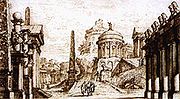
Opera seria
Opera seria is an Italian musical term which refers to the noble and "serious" style of Italian opera that predominated in Europe from the 1710s to c. 1770...
by Araja Seleuco, text by Giuseppe Bonecchi
Giuseppe Bonecchi
Giuseppe Bonecchi - was an Italian poet and opera librettist.He was brought to Russia in 1740 by Francesco Araja, an Italian composer working in Russia....
was given on May 7 [OS April 26] 1744 in Moscow as part of a double celebration of the anniversary of the coronation of Elizaveta Petrovna and conclusion of peace with Sweden
Sweden
Sweden , officially the Kingdom of Sweden , is a Nordic country on the Scandinavian Peninsula in Northern Europe. Sweden borders with Norway and Finland and is connected to Denmark by a bridge-tunnel across the Öresund....
.
The staging of Araja’s opera seria
Opera seria
Opera seria is an Italian musical term which refers to the noble and "serious" style of Italian opera that predominated in Europe from the 1710s to c. 1770...
Bellerofonte, text by Giuseppe Bonecchi
Giuseppe Bonecchi
Giuseppe Bonecchi - was an Italian poet and opera librettist.He was brought to Russia in 1740 by Francesco Araja, an Italian composer working in Russia....
(December 9, 1750 [OS November 28], Saint Petersburg) was notable for the participation of a Russian singer from “pevchie” of the Court Capella, Mark Poltoratski, who played the role of Ataman, a nobleman of Kingdom of Likia.
The first opera written in Russian
Russian language
Russian is a Slavic language used primarily in Russia, Belarus, Uzbekistan, Kazakhstan, Tajikistan and Kyrgyzstan. It is an unofficial but widely spoken language in Ukraine, Moldova, Latvia, Turkmenistan and Estonia and, to a lesser extent, the other countries that were once constituent republics...
was Araja’s Tsefal i Prokris
Tsefal i Prokris
Tsefal i Prokris , is an opera seria in three acts by the Italian composer Francesco Araja. Dating to 1755, it was the first opera written in the Russian language....
(Cephalus and Prokris, libretto by Alexander Sumarokov
Alexander Sumarokov
Alexander Petrovich Sumarokov was a Russian poet and playwright who single-handedly created classical theatre in Russia, thus assisting Mikhail Lomonosov to inaugurate the reign of classicism in Russian literature....
) that was staged at Saint Petersburg on March 7, [OS February 27], 1755.
The second opera set to a Russian
Russian language
Russian is a Slavic language used primarily in Russia, Belarus, Uzbekistan, Kazakhstan, Tajikistan and Kyrgyzstan. It is an unofficial but widely spoken language in Ukraine, Moldova, Latvia, Turkmenistan and Estonia and, to a lesser extent, the other countries that were once constituent republics...
text was Alceste, 1758, libretto by Alexander Sumarokov
Alexander Sumarokov
Alexander Petrovich Sumarokov was a Russian poet and playwright who single-handedly created classical theatre in Russia, thus assisting Mikhail Lomonosov to inaugurate the reign of classicism in Russian literature....
) by German composer Hermann Raupach
Hermann Raupach
Hermann Friedrich Raupach was a German composer.-Biography:Hermann Raupach was born at Stralsund in Germany, the son and pupil of composer and organist Christoph Raupach and the nephew of Lutheran church historian Bernhard Raupach...
(1728–1778) also serving to the Russian Court. Raupach spent 18 years in Russia
Russia
Russia or , officially known as both Russia and the Russian Federation , is a country in northern Eurasia. It is a federal semi-presidential republic, comprising 83 federal subjects...
and died in Saint Petersburg in 1778.
In 1757 a private opera enterprise
Business
A business is an organization engaged in the trade of goods, services, or both to consumers. Businesses are predominant in capitalist economies, where most of them are privately owned and administered to earn profit to increase the wealth of their owners. Businesses may also be not-for-profit...
directed by Giovanni Battista Locatelli
Giovanni Battista Locatelli
Giovanni Battista Locatelli was an Italian opera director, impresario and owner of a private opera company.In 1757 he and his troupe were invited to St. Petersburg. They put on an opera every week for the court, and two to three times a week they were allowed to give open public performances. The...
(1713 – c. 1770) was invited to Saint Petersburg. They had show an opera every week for the court, and two-three times a week they were allowed to give open public performances. The repertoire was mostly of Italian opera buffa
Opera buffa
Opera buffa is a genre of opera. It was first used as an informal description of Italian comic operas variously classified by their authors as ‘commedia in musica’, ‘commedia per musica’, ‘dramma bernesco’, ‘dramma comico’, ‘divertimento giocoso' etc...
. For the first three years the troupe had presented the seven operas by Baldassare Galuppi (1706–1785)including Il mondo della luna (The World of the Moon), Il Filosofo di campagna
Il filosofo di campagna
Il filosofo di campagna is a dramma giocoso per musica in 3 acts by composer Baldassare Galuppi. The opera uses an Italian language libretto by Carlo Goldoni. The work premiered at the Teatro San Samuele in Venice on 26 October 1754.-Roles:-External links:*...
(The Village Philosopher), and Il mondo alla roversa, ossia Le donne che commandono (The Worlds Upside Down, or Women Command).
In the 1760–80s in Russia there were working in turn Venetian
Venice
Venice is a city in northern Italy which is renowned for the beauty of its setting, its architecture and its artworks. It is the capital of the Veneto region...
Galuppi, Manfredini
Vincenzo Manfredini
Vincenzo Manfredini was an Italian composer, harpsichordist and a music theorist.-Biography:Manfredini was born in Pistoia, near Florence....
from Pistoia
Pistoia
Pistoia is a city and comune in the Tuscany region of Italy, the capital of a province of the same name, located about 30 km west and north of Florence and is crossed by the Ombrone Pistoiese, a tributary of the River Arno.-History:...
, Traetta
Tommaso Traetta
Tommaso Michele Francesco Saverio Traetta was an Italian composer.-Biography:Traetta was born in Bitonto, a town near Bari, near the top of the heel of the boot of Italy. He eventually became a pupil of the composer, singer and teacher Nicola Porpora in Naples, and scored a first success with his...
from Bitonto
Bitonto
Bitonto is a city and comune in the province of Bari , Italy. It is nicknamed the "City of Olives" due to the numerous olive groves surrounding the city.-Geography:...
near Barri
Barri
In Norse mythology, Barri is the place where Freyr and Gerðr are to consummate their union, as stated in the Skírnismál:* Faulkes, Anthony . 1988. Snorri Sturluson: Edda. Prologue and Gylfaginning. London: Viking Society for Northern Research. First published by Oxford University Press. ISBN...
, Paisiello
Giovanni Paisiello
Giovanni Paisiello was an Italian composer of the Classical era.-Life:Paisiello was born at Taranto and educated by the Jesuits there. He became known for his beautiful singing voice and in 1754 was sent to the Conservatorio di S. Onofrio at Naples, where he studied under Francesco Durante, and...
from Taranto
Taranto
Taranto is a coastal city in Apulia, Southern Italy. It is the capital of the Province of Taranto and is an important commercial port as well as the main Italian naval base....
, Sarti
Giuseppe Sarti
Giuseppe Sarti was an Italian opera composer.-Biography:He was born at Faenza. His date of birth is not known, but he was baptised on 1 December 1729. Some earlier sources say he was born on 28 December, but his baptism certificate proves the later date impossible...
, Cimarosa
Domenico Cimarosa
Domenico Cimarosa was an Italian opera composer of the Neapolitan school...
from Campania
Campania
Campania is a region in southern Italy. The region has a population of around 5.8 million people, making it the second-most-populous region of Italy; its total area of 13,590 km² makes it the most densely populated region in the country...
, and Spaniard
Spain
Spain , officially the Kingdom of Spain languages]] under the European Charter for Regional or Minority Languages. In each of these, Spain's official name is as follows:;;;;;;), is a country and member state of the European Union located in southwestern Europe on the Iberian Peninsula...
Martin y Soler
Vicente Martín y Soler
Vicente Martín y Soler was a Spanish composer of opera and ballet. Although relatively obscure today, in his own day he was compared favorably with his contemporary, Wolfgang Amadeus Mozart, as a composer of opera buffa. He has been called the Valencian Mozart.He was born in Valencia and studied...
. Each of them brought an important contribution, producing operas to the Italian as well as Russian libretti. Here are listed some of the operas written and premiered in Russia
Russia
Russia or , officially known as both Russia and the Russian Federation , is a country in northern Eurasia. It is a federal semi-presidential republic, comprising 83 federal subjects...
:
Vincenzo Manfredini
Vincenzo Manfredini
Vincenzo Manfredini was an Italian composer, harpsichordist and a music theorist.-Biography:Manfredini was born in Pistoia, near Florence....
(1737–1799) spent 12 years in Russia
Russia
Russia or , officially known as both Russia and the Russian Federation , is a country in northern Eurasia. It is a federal semi-presidential republic, comprising 83 federal subjects...
and died in Saint Petersburg. The son and pupil of famous baroque composer Francesco Manfredini
Francesco Manfredini
Francesco Onofrio Manfredini was an Italian Baroque composer, violinist, and church musician.He was born at Pistoia to a trombonist. He studied violin with Giuseppe Torelli in Bologna, then a part of the Papal States, a leading figure in the development of the concerto grosso...
, he was a music teacher for Pavel Petrovich who later became Emperor of Russia
Russia
Russia or , officially known as both Russia and the Russian Federation , is a country in northern Eurasia. It is a federal semi-presidential republic, comprising 83 federal subjects...
. For the Russian Imperial Court Manfredini wrote five operas including: Semiramide (1760, Saint Petersburg), L'Olimpiade (1762 Moscow) and Carlo Magno (1763 Saint Petersburg).
Tommaso Traetta
Tommaso Traetta
Tommaso Michele Francesco Saverio Traetta was an Italian composer.-Biography:Traetta was born in Bitonto, a town near Bari, near the top of the heel of the boot of Italy. He eventually became a pupil of the composer, singer and teacher Nicola Porpora in Naples, and scored a first success with his...
(1727–1779) was a maestro di cappella at the Russian Imperial Court
Russian Empire
The Russian Empire was a state that existed from 1721 until the Russian Revolution of 1917. It was the successor to the Tsardom of Russia and the predecessor of the Soviet Union...
for eight years (1768–1775, and wrote there five operas, including: Astrea placata (1770 Saint Petersburg), Antigone (1772 Saint Petersburg), and Le quattro stagioni e i dodici mesi dell'anno (1776 St Petersburg).
Giovanni Paisiello
Giovanni Paisiello
Giovanni Paisiello was an Italian composer of the Classical era.-Life:Paisiello was born at Taranto and educated by the Jesuits there. He became known for his beautiful singing voice and in 1754 was sent to the Conservatorio di S. Onofrio at Naples, where he studied under Francesco Durante, and...
(1740–1816), a famous Neapolitan composer of more than 100 operas seria
Seria
Seria is a town in the Belait District of Brunei Darussalam. Its full name is Pekan Seria in full . Seria was originally known as Padang Berawa which is Wild Pigeon's Field in Malay. The name "Seria" comes from the river located very near where oil was first discovered in the area in 1929...
and buffa, he spent in Russia eight years (1776–1783), where he wrote 12 operas including Nitteti (1777 Saint Petersburg), Lucinda e Armidoro (1777 Saint Petersburg), Il barbiere di Siviglia, ovvero La precauzione inutile (1782 Hermitage Theatre
Hermitage Theatre
The Hermitage Theatre in Saint Petersburg, Russia is one of five Hermitage buildings lining the Palace Embankment of the Neva River.The palatial theatre was built between 1783 and 1787 at the behest of Catherine the Great to a Palladian design by Giacomo Quarenghi...
), and Il mondo della luna (1782 Kamenny Island Theatre
Kamenny Island Theatre
The Kamenny Island Theatre is a wooden summer theatre on the grounds of the Kamennoostrovsky Palace, Kamenny Island, Saint Petersburg, Russia.-Before the Theatre:...
).
Giuseppe Sarti
Giuseppe Sarti
Giuseppe Sarti was an Italian opera composer.-Biography:He was born at Faenza. His date of birth is not known, but he was baptised on 1 December 1729. Some earlier sources say he was born on 28 December, but his baptism certificate proves the later date impossible...
(1729–1802), a composer of about 40 operas, he spent in Russia
Russia
Russia or , officially known as both Russia and the Russian Federation , is a country in northern Eurasia. It is a federal semi-presidential republic, comprising 83 federal subjects...
eighteen years (1784–1802). After being for eight years a maestro di cappella at the Imperial Court , he spent the next four years at the service of Prince Grigori Alexandrovich Potemkin
Grigori Alexandrovich Potemkin
Prince Grigory Aleksandrovich Potemkin-Tavricheski was a Russian military leader, statesman, nobleman and favorite of Catherine the Great. He died during negotiations over the Treaty of Jassy, which ended a war with the Ottoman Empire that he had overseen....
at his estate in Southern Russia. Then he returned to the Court. In 1901 he solicited permission to return, because his health was broken. The emperor Alexander I
Alexander I of Russia
Alexander I of Russia , served as Emperor of Russia from 23 March 1801 to 1 December 1825 and the first Russian King of Poland from 1815 to 1825. He was also the first Russian Grand Duke of Finland and Lithuania....
dismissed him in 1802 with a liberal pension. Sarti died in Berlin
Berlin
Berlin is the capital city of Germany and is one of the 16 states of Germany. With a population of 3.45 million people, Berlin is Germany's largest city. It is the second most populous city proper and the seventh most populous urban area in the European Union...
. His most successful operas in Russia were Armida e Rinaldo and The Early Reign of Oleg (Nachal'noye upravleniye Olega), for the latter of which the empress herself wrote the libretto. Among the nine operas written in Russia are also: Gli amanti consolati (1784 Saint Petersburg), I finti eredi (1785 Saint Petersburg, Bolshoi Kamenny Theatre
Bolshoi Kamenny Theatre
The Saint Petersburg Imperial Bolshoi Kamenny Theatre was a theatre in Saint Petersburg.- History :It was built in 1783 to Antonio Rinaldi's Neoclassical design as the Kamenny Theatre. It was rebuilt in 1802 and renamed the Bolshoi, but burned down in 1811. The building was restored in 1818, and...
), Castore e Polluce (1786 Hermitage Theatre
Hermitage Theatre
The Hermitage Theatre in Saint Petersburg, Russia is one of five Hermitage buildings lining the Palace Embankment of the Neva River.The palatial theatre was built between 1783 and 1787 at the behest of Catherine the Great to a Palladian design by Giacomo Quarenghi...
) and La famille indienne en Angleterre (1799 Saint Petersburg, Bolshoi Kamenny Theatre
Bolshoi Kamenny Theatre
The Saint Petersburg Imperial Bolshoi Kamenny Theatre was a theatre in Saint Petersburg.- History :It was built in 1783 to Antonio Rinaldi's Neoclassical design as the Kamenny Theatre. It was rebuilt in 1802 and renamed the Bolshoi, but burned down in 1811. The building was restored in 1818, and...
).
Domenico Cimarosa
Domenico Cimarosa
Domenico Cimarosa was an Italian opera composer of the Neapolitan school...
, (1749–1801) another famous Neapolitan composer, singer, violinist, harpsichordist, conductor ant teacher, who composed about 75 operas, was a maestro di cappella in Russia for five years (1787–1791), where wrote: La felicità inaspettata (1788 Hermitage Theatre
Hermitage Theatre
The Hermitage Theatre in Saint Petersburg, Russia is one of five Hermitage buildings lining the Palace Embankment of the Neva River.The palatial theatre was built between 1783 and 1787 at the behest of Catherine the Great to a Palladian design by Giacomo Quarenghi...
), La vergine del sol'e (1788? Hermitage Theatre
Hermitage Theatre
The Hermitage Theatre in Saint Petersburg, Russia is one of five Hermitage buildings lining the Palace Embankment of the Neva River.The palatial theatre was built between 1783 and 1787 at the behest of Catherine the Great to a Palladian design by Giacomo Quarenghi...
; 1789 Saint Petersburg, Bolshoi Kamenny Theatre
Bolshoi Kamenny Theatre
The Saint Petersburg Imperial Bolshoi Kamenny Theatre was a theatre in Saint Petersburg.- History :It was built in 1783 to Antonio Rinaldi's Neoclassical design as the Kamenny Theatre. It was rebuilt in 1802 and renamed the Bolshoi, but burned down in 1811. The building was restored in 1818, and...
) and La Cleopatra (Cleopatra e Marc Antonio 1789 Hermitage Theatre
Hermitage Theatre
The Hermitage Theatre in Saint Petersburg, Russia is one of five Hermitage buildings lining the Palace Embankment of the Neva River.The palatial theatre was built between 1783 and 1787 at the behest of Catherine the Great to a Palladian design by Giacomo Quarenghi...
)

Vicente Martín y Soler
Vicente Martín y Soler was a Spanish composer of opera and ballet. Although relatively obscure today, in his own day he was compared favorably with his contemporary, Wolfgang Amadeus Mozart, as a composer of opera buffa. He has been called the Valencian Mozart.He was born in Valencia and studied...
(1754–1806) a Spanish organist and composer of 21 operas and 5 ballets, he settled in Russia c1788, where he was called "Martini". He wrote there: Gore-Bogatyr Kosometovich (libretto by Catherine II of Russia
Catherine II of Russia
Catherine II, also known as Catherine the Great , Empress of Russia, was born in Stettin, Pomerania, Prussia on as Sophie Friederike Auguste von Anhalt-Zerbst-Dornburg...
, 1789 Hermitage Theatre
Hermitage Theatre
The Hermitage Theatre in Saint Petersburg, Russia is one of five Hermitage buildings lining the Palace Embankment of the Neva River.The palatial theatre was built between 1783 and 1787 at the behest of Catherine the Great to a Palladian design by Giacomo Quarenghi...
) with overture on three Russian tunes, Pesnolyubie (1790 Hermitage Theatre
Hermitage Theatre
The Hermitage Theatre in Saint Petersburg, Russia is one of five Hermitage buildings lining the Palace Embankment of the Neva River.The palatial theatre was built between 1783 and 1787 at the behest of Catherine the Great to a Palladian design by Giacomo Quarenghi...
), and La festa del villagio (1798 Hermitage Theatre
Hermitage Theatre
The Hermitage Theatre in Saint Petersburg, Russia is one of five Hermitage buildings lining the Palace Embankment of the Neva River.The palatial theatre was built between 1783 and 1787 at the behest of Catherine the Great to a Palladian design by Giacomo Quarenghi...
).
Two of his operas premiered in Vienna, but also staged in Russia, Una cosa rara, o sia Bellezza ed onestà (The Rare Thing) and L'arbore di Diana (Diana's Tree) were especially popular. The first of them performed in Russian translation
Translation
Translation is the communication of the meaning of a source-language text by means of an equivalent target-language text. Whereas interpreting undoubtedly antedates writing, translation began only after the appearance of written literature; there exist partial translations of the Sumerian Epic of...
of Ivan Dmitrievsky
Ivan Dmitrievsky
Ivan Afanasyevich Dmitrevsky is generally regarded as the most influential actor of Russian Neoclassicism and "Russia's first great tragedian"....
had some elements of the antifeudal directivity. He died in Saint Petersburg in January 1806.
Ivan Kerzelli
Ivan Kerzelli
Ivan Kerzelli or Cherzelli was an opera composer and conductor in Imperial Russia of 18th century....
(also known as I. I. Kerzelli, or Iosif Kertsel) was a representative of a big family of foreign musicians Kerzelli
Kerzelli
Kerzelli, Cherzelli, Kerzelly or Kertsel was the surname of a large family of musicians of Italian, Czech or Austrian origin [the available information is vague and contradictory], which settled in Russia in the 18th century.*Iosif Kerzelli or Iohann Kerzelli, Cherzelli, Kerzelly or Kertsel ...
(probably of Czech
Czech people
Czechs, or Czech people are a western Slavic people of Central Europe, living predominantly in the Czech Republic. Small populations of Czechs also live in Slovakia, Austria, the United States, the United Kingdom, Chile, Argentina, Canada, Germany, Russia and other countries...
origin), settled in Russia
Russia
Russia or , officially known as both Russia and the Russian Federation , is a country in northern Eurasia. It is a federal semi-presidential republic, comprising 83 federal subjects...
in 18th century. He is regarded as a composer of a few famous operas: Lyubovnik - koldun (The Lover-Magician 1772 Moscow), Rozana i Lyubim (Rozana und Lyubim 1778, Moscow), Derevenskiy vorozheya (The Village Wizard c. 1777 Moscow) (Overture and songs were printed in Moscow 1778; They were the first opera fragments printed in Russia) and Guljanye ili sadovnik kuskovskoy (Promenade or the Gardener from Kuskovo 1780 or 1781 Kuskovo
Kuskovo
Kuskovo was the summer country house and estate of the Sheremetev family. Built in the mid-18th century, it was originally situated several miles to the east of Moscow but now is part of the East District of the city. It was one of the first great summer country estates of the Russian nobility,...
, Private Theatre of Count Nikolai Sheremetev
Nikolai Sheremetev
Nikolai Petrovich Sheremetev was a Russian count, the son of Petr Borisovich Sheremetev, notable grandee of the epoch of empresses Anna Ivanovna, Elizabeth Petrovna, and Catherine II. He was also the grandson of Boris Petrovich Sheremetev.His father P. B...
).
Antoine Bullant (also known as Antoine or Jean Bullant, 1750–1821), another composer of Czech
Czech people
Czechs, or Czech people are a western Slavic people of Central Europe, living predominantly in the Czech Republic. Small populations of Czechs also live in Slovakia, Austria, the United States, the United Kingdom, Chile, Argentina, Canada, Germany, Russia and other countries...
origin settled in Russia
Russia
Russia or , officially known as both Russia and the Russian Federation , is a country in northern Eurasia. It is a federal semi-presidential republic, comprising 83 federal subjects...
in 1780 wrote a large number of operas with Russian libretto
Libretto
A libretto is the text used in an extended musical work such as an opera, operetta, masque, oratorio, cantata, or musical. The term "libretto" is also sometimes used to refer to the text of major liturgical works, such as mass, requiem, and sacred cantata, or even the story line of a...
s, often within Russian national settings. He was especially famous for his comic opera
Comic opera
Comic opera denotes a sung dramatic work of a light or comic nature, usually with a happy ending.Forms of comic opera first developed in late 17th-century Italy. By the 1730s, a new operatic genre, opera buffa, emerged as an alternative to opera seria...
Sbitenshchik
Sbitenshchik
Sbitenshchik was a sbiten vendor in old Russia. The tradition began in 12th century.The comic opera The Sbiten Vendor by Yakov Knyazhnin with music by Czech composer Antoine Bullant, 1783, was very popular in 18-19th centuries in Russia.- Quotations :“On the lower floor there were shops with...
(Сбитеньщик — Sbiten
Sbiten
Sbiten, also sbiten' is a hot winter Russian traditional drink.- History :First mentioned in Slavonic chronicles in 1128, it remained popular with all strata of Russian society until the 19th century when it was replaced by coffee and tea...
Vendor), comic opera
Comic opera
Comic opera denotes a sung dramatic work of a light or comic nature, usually with a happy ending.Forms of comic opera first developed in late 17th-century Italy. By the 1730s, a new operatic genre, opera buffa, emerged as an alternative to opera seria...
in 3 acts, written to the libretto by Yakov Knyazhnin
Yakov Knyazhnin
Yakov Borisovich Knyazhnin was Russia's foremost tragic author during the reign of Catherine the Great. Knyazhnin's contemporaries hailed him as the true successor to his father-in-law Alexander Sumarokov, but posterity, in the words of Vladimir Nabokov, tended to view his tragedies and comedies...
(remake of Molière
Molière
Jean-Baptiste Poquelin, known by his stage name Molière, was a French playwright and actor who is considered to be one of the greatest masters of comedy in Western literature...
's L'école des femmes). The opera was staged 1783 or 1784 in Saint Petersburg, at the Bolshoi Kamenny Theatre
Bolshoi Kamenny Theatre
The Saint Petersburg Imperial Bolshoi Kamenny Theatre was a theatre in Saint Petersburg.- History :It was built in 1783 to Antonio Rinaldi's Neoclassical design as the Kamenny Theatre. It was rebuilt in 1802 and renamed the Bolshoi, but burned down in 1811. The building was restored in 1818, and...
, and was played until 1853.
There were also extremely popular the operas by Belgian/French
French people
The French are a nation that share a common French culture and speak the French language as a mother tongue. Historically, the French population are descended from peoples of Celtic, Latin and Germanic origin, and are today a mixture of several ethnic groups...
André Ernest Modeste Grétry
André Ernest Modeste Grétry
André Ernest Modeste Grétry was acomposer from the Prince-Bishopric of Liège , who worked from 1767 onwards in France and took French nationality. He is most famous for his opéras comiques....
(1741–1813), like L'Amitié à l'épreuve (first staged 1779, Kuskovo
Kuskovo
Kuskovo was the summer country house and estate of the Sheremetev family. Built in the mid-18th century, it was originally situated several miles to the east of Moscow but now is part of the East District of the city. It was one of the first great summer country estates of the Russian nobility,...
theatre) or Les Mariages samnites that was performed during 12 years (since 1885, Kuskovo
Kuskovo
Kuskovo was the summer country house and estate of the Sheremetev family. Built in the mid-18th century, it was originally situated several miles to the east of Moscow but now is part of the East District of the city. It was one of the first great summer country estates of the Russian nobility,...
, Ostankino theatres) with serf-soprano Praskovya Zhemchugova
Praskovya Zhemchugova
Praskovia Ivanovna Kovalyova-Zhemchugova also Kovaleva or Kovalyova, Kovaleva-Zhemchugova, Zhemchugova-Sheremeteva, and Sheremeteva or Sheremetyeva was a Russian serf actress and soprano opera singer.- Career :Praskovia was one of the best...
at the private opera of Nikolai Sheremetev
Nikolai Sheremetev
Nikolai Petrovich Sheremetev was a Russian count, the son of Petr Borisovich Sheremetev, notable grandee of the epoch of empresses Anna Ivanovna, Elizabeth Petrovna, and Catherine II. He was also the grandson of Boris Petrovich Sheremetev.His father P. B...
.
Russians
Two talented young Ukrainians BerezovskyMaksym Berezovsky
Maksym Sozontovych Berezovsky was a Ukrainian composer, opera singer, and violinist.Berezovsky was the first Ukrainian composer to be recognized throughout Europe and the first to compose an opera, symphony, and violin sonata. His most popular works are his sacred choral pieces written for the...
and Bortniansky were sent by Catherine II to Italy
Italy
Italy , officially the Italian Republic languages]] under the European Charter for Regional or Minority Languages. In each of these, Italy's official name is as follows:;;;;;;;;), is a unitary parliamentary republic in South-Central Europe. To the north it borders France, Switzerland, Austria and...
to study art of music composition.
Maksym Berezovsky
Maksym Berezovsky
Maksym Sozontovych Berezovsky was a Ukrainian composer, opera singer, and violinist.Berezovsky was the first Ukrainian composer to be recognized throughout Europe and the first to compose an opera, symphony, and violin sonata. His most popular works are his sacred choral pieces written for the...
(1745–1777) went to Italy
Italy
Italy , officially the Italian Republic languages]] under the European Charter for Regional or Minority Languages. In each of these, Italy's official name is as follows:;;;;;;;;), is a unitary parliamentary republic in South-Central Europe. To the north it borders France, Switzerland, Austria and...
in the spring of 1769 to train with Padre Giovanni Battista Martini
Giovanni Battista Martini
Giovanni Battista Martini , also known as Padre Martini, was an Italian musician.-Biography:Martini was born at Bologna....
at the Bologna Philharmonic Academy, where he graduated with distinction. He wrote an opera seria Demofoonte to the Italian
Italian language
Italian is a Romance language spoken mainly in Europe: Italy, Switzerland, San Marino, Vatican City, by minorities in Malta, Monaco, Croatia, Slovenia, France, Libya, Eritrea, and Somalia, and by immigrant communities in the Americas and Australia...
libretto by Pietro Metastasio for the carnival at Livorno
Livorno
Livorno , traditionally Leghorn , is a port city on the Tyrrhenian Sea on the western edge of Tuscany, Italy. It is the capital of the Province of Livorno, having a population of approximately 160,000 residents in 2009.- History :...
(staged February 1773).
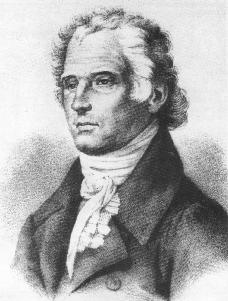
Dmytro Bortniansky
Dmitry Stepanovich Bortniansky was a Russian composer of Ukrainian origin; his father however had been born in thePolish village of Bartne, and was of Lemkos stock.....
(1751–1825), a pupil of Hermann Raupach
Hermann Raupach
Hermann Friedrich Raupach was a German composer.-Biography:Hermann Raupach was born at Stralsund in Germany, the son and pupil of composer and organist Christoph Raupach and the nephew of Lutheran church historian Bernhard Raupach...
and Baldassare Galuppi, went to Italy following his teacher Galuppi. In Italy, Bortniansky gained considerable success composing operas: Creonte (1776) and Alcide (1778) in Venice
Venice
Venice is a city in northern Italy which is renowned for the beauty of its setting, its architecture and its artworks. It is the capital of the Veneto region...
, and Quinto Fabio (1779) at Modena
Modena
Modena is a city and comune on the south side of the Po Valley, in the Province of Modena in the Emilia-Romagna region of Italy....
.
Bortniansky returned to the court at Saint Petersburg in 1779 where composed four more operas (all in French
French language
French is a Romance language spoken as a first language in France, the Romandy region in Switzerland, Wallonia and Brussels in Belgium, Monaco, the regions of Quebec and Acadia in Canada, and by various communities elsewhere. Second-language speakers of French are distributed throughout many parts...
, with libretti by Franz-Hermann Lafermière): Le Faucon (1786), Le Fete du Seigneur (1786), Don Carlos (1786), and Le Fils-Rival ou La Moderne Stratonice (1787).
At the same time in Russia, a successful one-act opera Anyuta
Anyuta
Anyuta is a one-act comic opera to a libretto by Mikhail Popov. First performed in 1772, it was one of the first operas written in the Russian language ....
(Chinese Theatre, September 6 [OS August 26] 1772) was created to the text by Mikhail Vasilyevich Popov
Mikhail Vasilyevich Popov
Mikhail Ivanovich Popov was a Russian writer, poet, dramatist and opera librettist of the 18th century.-Biography:Born into a merchant family, he was a pupil of Fyodor Volkov. After 1757 he was an actor at the Court Theatre in St Petersburg. He entered Moscow University in 1765, and began to...
. Music was a selection of popular songs specified in the libretto. It is a story about a girl called Anyuta, brought up in a peasants’ household, who in fact turned out to be of noble birth, and the story of her love for a nobleman, Victor, eventually ending happily, with wedding bells ringing. The score doesn’t survived and the composer of it is unknown, however, sometimes it was attributed to Vasily Pashkevich
Vasily Pashkevich
Vasily Alexeyevich Pashkevich also Paskevich was a Russian composer, singer, violinist and teacher who lived during the time of Catherine the Great.-Biography:...
or even to Yevstigney Fomin
Yevstigney Fomin
Yevstigney Ipat'yevich Fomin was a Russian opera composer of the 18th century.-Biography:...
who that time was just 11 year old.
The music of another successful Russian opera Melnik – koldun, obmanshchik i svat (The Miller who was a Wizard, a Cheat and a Match-maker, text by Alexander Ablesimov
Alexander Ablesimov
Aleksander Onisimovich Ablesimov, was a Russian opera librettist, poet, dramatist, satirist and journalist.-Biography:Worked as copyist for Alexander Sumarokov. Published his fables and satirical poems...
, Moscow, 1779), on a subject resembling Rousseau’s Le Devin du village
Le Devin du Village
Le devin du village is an interméde, a one-act opera by Jean-Jacques Rousseau, who also wrote the libretto.It was first performed before the court at Fontainebleau on 18 October 1752 and at the Paris Opéra on 1 March 1753. King Louis XV loved the work so much that he offered Rousseau the great...
, is attributed to a theatre violin player and conductor Mikhail Sokolovsky (c. 1756–?). Later the music was revised by Yevstigney Fomin
Yevstigney Fomin
Yevstigney Ipat'yevich Fomin was a Russian opera composer of the 18th century.-Biography:...
.
Vasily Pashkevich
Vasily Pashkevich
Vasily Alexeyevich Pashkevich also Paskevich was a Russian composer, singer, violinist and teacher who lived during the time of Catherine the Great.-Biography:...
(1742–1797), a Russian composer of Polish
Poles
thumb|right|180px|The state flag of [[Poland]] as used by Polish government and diplomatic authoritiesThe Polish people, or Poles , are a nation indigenous to Poland. They are united by the Polish language, which belongs to the historical Lechitic subgroup of West Slavic languages of Central Europe...
extraction was famous for his comic opera The Miser. Its roles are: Scriagin, Liubima’s guardian; Liubima, his niece; Milovid, her beloved; Marfa, the servant girl that Scriagin is in love with; Prolaz, Milovid’s manservant who is in Scriagin’s service. Accordingly the speech and the names of the characters of Molière
Molière
Jean-Baptiste Poquelin, known by his stage name Molière, was a French playwright and actor who is considered to be one of the greatest masters of comedy in Western literature...
's comedy were turned into Russian as well as the music that combines some features of European form with typically Russian melodies. Another his opera Fevey
Fevey
Fevey is an opera by Vasily Pashkevich to a Russian libretto by Catherine II of Russia.Empress Catherine II had literary ambitions and wrote nine opera librettos. This one, an allegorical fairy tale, was called The Story of Tsarevich Fevey...
was written to the libretto by Catherine II. Other operas are: The Carriage Accident (Neschastye ot karety, 1779 Saint Petersburg, Karl Kniper Theatre, St Petersburg Bazaar (Sankt Peterburgskiy Gostinyi Dvor, 1782 Saint Petersburg), Kniper Theatre, The Burden Is Not Heavy if It Is Yours (Svoya nosha ne tyanet, 1794), The Early Reign of Oleg (Nachal'noye upravleniye Olega, libretto by Catherine II, 1790 Saint Petersburg)– together with Giuseppe Sarti
Giuseppe Sarti
Giuseppe Sarti was an Italian opera composer.-Biography:He was born at Faenza. His date of birth is not known, but he was baptised on 1 December 1729. Some earlier sources say he was born on 28 December, but his baptism certificate proves the later date impossible...
and C. Cannobio), Fedul and His Children (Fedul s det'mi, libretto by Catherine II, 1791 Saint Petersburg) – together with Martin y Soler
Vicente Martín y Soler
Vicente Martín y Soler was a Spanish composer of opera and ballet. Although relatively obscure today, in his own day he was compared favorably with his contemporary, Wolfgang Amadeus Mozart, as a composer of opera buffa. He has been called the Valencian Mozart.He was born in Valencia and studied...
), The Pasha of Tunis (Pasha tunisskiy, 1782 libretto by Mikhail Matinsky
Mikhail Matinsky
Mikhail Alexeyevich Matinsky was a Russian scientist, dramatist, librettist and opera composer.-Biography:Matinsky originated from the serfs of Count S. P. Yaguzhinsky. He studied in the gymnasium for the "raznochintsy" at Moscow University and also in Italy. Later he taught mathematics at the...
) and You Shall Be Judged As You Lived (Kak pozhivyosh', tak i proslyvyosh 1792St. Petersburg) — rev. of St Petersburg Bazaar.
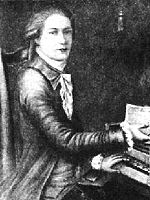
Yevstigney Fomin
Yevstigney Ipat'yevich Fomin was a Russian opera composer of the 18th century.-Biography:...
(1761–1800) composed about 30 operas including the most successful opera-melodrama Orfey i Evridika to the text by Yakov Knyazhnin
Yakov Knyazhnin
Yakov Borisovich Knyazhnin was Russia's foremost tragic author during the reign of Catherine the Great. Knyazhnin's contemporaries hailed him as the true successor to his father-in-law Alexander Sumarokov, but posterity, in the words of Vladimir Nabokov, tended to view his tragedies and comedies...
. Among his other operas are: The Novgorod Hero Boyeslayevich (Novgorodskiy bogatyr’ Boyeslayevich, text by Catherine II, 1786 Saint Petersburg), The Coachmen at the Relay Station (Yamshchiki na podstave 1787 Saint Petersburg), Soirées (Vecherinki, ili Gaday, gaday devitsa, 1788 Saint Petersburg), Magician, Fortune-teller and Match-maker (Koldun, vorozheya i svakha 1789 Saint Petersburg), The Miller who was a Wizard, a Cheat and a Match-maker (Melnik - koldun, obmanshchik i svat, 1779 Moscow, originally: Mikhail Sokolovsky), The Americans (Amerikantsy, comic opera, 1800 Saint Petersburg), Chloris and Milo (Klorida i Milon, 1800 Saint Petersburg), and The Golden Apple (Zolotoye yabloko, 1803 Saint Petersburg).
19th century
The 19th century was the golden ageGolden Age (metaphor)
A golden age is a period in a field of endeavour when great tasks were accomplished. The term originated from early Greek and Roman poets who used to refer to a time when mankind lived in a better time and was pure .-Golden Age in society:...
of Russian opera. It began with a success of a massive and slowly developing operatic project: the opera Lesta, dneprovskaya rusalka and its three sequels (1803–1807, first in Saint Petersburg) based on the German
German language
German is a West Germanic language, related to and classified alongside English and Dutch. With an estimated 90 – 98 million native speakers, German is one of the world's major languages and is the most widely-spoken first language in the European Union....
romantic-comic piece Das Donauweibchen by Ferdinand Kauer
Ferdinand Kauer
Ferdinand August Kauer , was an Austrian composer and pianist.-Biography:Kauer was born in Klein-Thaya near Znaim in South Moravia. He studied in Znaim, Tyrnau, and Vienna, and later settled in Vienna around 1777. In 1781 he joined Karl von Marinelli's newly formed company at Vienna as leader and...
(1751–1831) with the Russian text and additional music by Russianized Venetian immigrant Catterino Cavos
Catterino Cavos
Catterino Albertovich Cavos , born Catarino Camillo Cavos, was an Italian composer, organist and conductor settled in Russia...
(1775–1840) and Stepan Davydov
Stepan Davydov
-Biography:When the principal choirboy of the Imperial Court Capella, he drew the attention of the Empress Catherine II, who consigned him to the care of the Italian composer Giuseppe Sarti ....
(1777–1825).
The next success was a patriotic opera Ivan Susanin (1815) by Cavos
Catterino Cavos
Catterino Albertovich Cavos , born Catarino Camillo Cavos, was an Italian composer, organist and conductor settled in Russia...
based on an episode from Russian history.
This success was continued with the brilliant operatic career of Alexey Verstovsky
Alexey Verstovsky
Alexey Nikolayevich Verstovsky was a Russian composer, musical bureaucrat and rival of Mikhail Glinka.-Biography:...
(1799–1862), who composed more 30 opera-vaudevilles and 6 grand-operas including Askold's Grave
Askold's Grave
Askold’s Grave is an opera in 4 acts by Alexey Verstovsky to a libretto by Mikhail Zagoskin ....
(Askoldova mogila, first performed in 1835) that received about 200 performances in Saint Petersburg and 400 in Moscow only for the first 25 years.
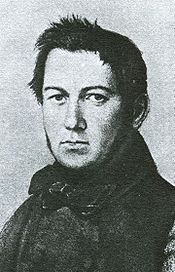
Mikhail Glinka
Mikhail Ivanovich Glinka , was the first Russian composer to gain wide recognition within his own country, and is often regarded as the father of Russian classical music...
(1804–1857) A Life for the Tsar
A Life for the Tsar
A Life for the Tsar , as it is known in English, although its original name was Ivan Susanin is a "patriotic-heroic tragic opera" in four acts with an epilogue by Mikhail Glinka. The original Russian libretto, based on historical events, was written by Nestor Kukolnik, Georgy Fyodorovich Rozen,...
, (Zhizn za tzarya, originally entitled Ivan Susanin 1836) and Ruslan and Lyudmila
Ruslan and Lyudmila
Ruslan and Lyudmila is an opera in five acts composed by Mikhail Glinka between 1837 and 1842. The opera is based on the 1820 poem of the same name by Alexander Pushkin. The Russian libretto was written by Valerian Shirkov, Nestor Kukolnik and N. A. Markevich, among others...
(based on the tale by Alexander Pushkin, 1842. These two works inaugurated a new era in Russian music and upraise or Russian national opera.
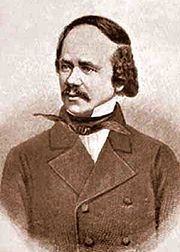
Alexander Dargomyzhsky
Alexander Sergeyevich Dargomyzhsky was a 19th century Russian composer. He bridged the gap in Russian opera composition between Mikhail Glinka and the later generation of The Five and Tchaikovsky....
(1813–1869) with his Rusalka
Rusalka (Dargomyzhsky)
Rusalka is an opera in four acts, six tableaux, by Alexander Dargomyzhsky, composed during 1848-1855. The Russian libretto was adapted by the composer from Pushkin's incomplete dramatic poem of the same name...
(1856) and revolutionary The Stone Guest
The Stone Guest
The Stone Guest is a poetic drama by Alexander Pushkin based on the Spanish legend of Don Juan. The Stone Guest was written in 1830 as part of his four short plays known as The Little Tragedies...
(Kamenny gost, completed by Rimsky-Korsakov
Nikolai Rimsky-Korsakov
Nikolai Andreyevich Rimsky-Korsakov was a Russian composer, and a member of the group of composers known as The Five.The Five, also known as The Mighty Handful or The Mighty Coterie, refers to a circle of composers who met in Saint Petersburg, Russia, in the years 1856–1870: Mily Balakirev , César...
and premiered in 1872).
Other composers were:
- Semen Hulak-ArtemovskySemen Hulak-ArtemovskySemen Stepanovych Hulak-Artemovsky , was a Ukrainian opera composer, singer , actor, and dramatist who lived and worked in Imperial Russia....
(1813–1873) with his 3 operas including Zaporozhets za DunayemZaporozhets za DunayemZaporozhets za Dunayem Beyond the Danube, also referred to as Cossacks in Exile) is a Ukrainian comic opera with spoken dialogue in three acts with music and libretto by the composer Semen Hulak-Artemovsky . The orchestration has subsequently been rewritten by composers such as Reinhold Glière and...
(1863); - Alexander SerovAlexander SerovAlexander Nikolayevich Serov – was a Russian composer and music critic. He and his wife Valentina were the parents of painter Valentin Serov...
(1820–1871) with his JudithJudith (Serov)Judith , is an opera in five acts, composed by Alexander Serov during 1861-1863. Derived from renditions of the story of Judith from the Old Testament Apocrypha, the Russian libretto, though credited to the composer, has a complicated history . The premiere took place in 1863 in Saint Petersburg...
(1863) RognedaRogneda (opera)Rogneda is an opera in five acts, composed by Alexander Serov during 1863–1865. The scenario, by the composer, was based on the novel Askold's Grave by Mikhail Zagoskin and the poem Rogneda by Kondraty Ryleyev...
(1865) The Power of the FiendThe Power of the FiendThe Power of the Fiend is an opera in five acts by Alexander Serov, composed during 1867-1871. The libretto is derived from a comedy by Alexander Ostrovsky from 1854 entitled Live Not As You Would Like To, But As God Commands. The opera was premiered posthumously on 19 April 1871 at the...
(Vrazhya sila, 1871); - Anton RubinsteinAnton RubinsteinAnton Grigorevich Rubinstein was a Russian-Jewish pianist, composer and conductor. As a pianist he was regarded as a rival of Franz Liszt, and he ranks amongst the great keyboard virtuosos...
(1829–1894) with his 19 operas including The DemonThe Demon (opera)The Demon is an opera in three acts by Russian composer Anton Rubinstein. The work was composed in 1871. The libretto was by Pavel Viskovatov, based on the poem of the same name by Mikhail Lermontov.-Background:...
(1875 Saint Petersburg); - César CuiCésar CuiCésar Antonovich Cui was a Russian of French and Lithuanian descent. His profession was as an army officer and a teacher of fortifications; his avocational life has particular significance in the history of music, in that he was a composer and music critic; in this sideline he is known as a...
(1835–1918), with his 14 operas including William RatcliffWilliam Ratcliff (Cui)William Ratcliff is an opera in three acts, composed by César Cui during 1861-1868; it was premiered on 14 February 1869 at the Mariinsky Theatre in Saint Petersburg under the conductorship of Eduard Nápravník...
(1861–1868); - Eduard NápravníkEduard NápravníkEduard Francevič Nápravník was a Czech conductor and composer, who settled in Russia and is best known for his leading role in Russian musical life as the principal conductor of the Imperial Mariinsky Theatre in Saint Petersburg for many decades...
(1839–1916), with his 4 operas including DubrovskyDubrovsky (opera)Dubrovsky is an opera in four acts Op. 58, by Eduard Nápravník, to a Russian libretto by Modest Ilyich Tchaikovsky after the novel of the same title by Alexander Pushkin.-Creation and performance history:...
(1895); - Sergei TaneyevSergei TaneyevSergei Ivanovich Taneyev , was a Russian composer, pianist, teacher of composition, music theorist and author.-Life:...
(1856–1915), with OresteiaOresteia (opera)Oresteia is an opera in three parts, eight tableaux, with music by Sergei Taneyev, composed during 1887-1894. The composer titled this work, his only opera, a "musical trilogy." The Russian libretto was adapted by A.A. Wenkstern from the The Oresteia of Aeschylus. The opera was premiered on at...
, (1895, Saint Petersburg); - Anton ArenskyAnton ArenskyAnton Stepanovich Arensky -Biography:Arensky was born in Novgorod, Russia. He was musically precocious and had composed a number of songs and piano pieces by the age of nine...
(1861–1906), with his 3 operas including A Dream on the Volga (1880).
Russian opera reached its apogee with the works by Modest Mussorgsky
Modest Mussorgsky
Modest Petrovich Mussorgsky was a Russian composer, one of the group known as 'The Five'. He was an innovator of Russian music in the romantic period...
and his antipode Pyotr Tchaikovsky
Pyotr Ilyich Tchaikovsky
Pyotr Ilyich Tchaikovsky Pyotr Ilyich Tchaikovsky Pyotr Ilyich Tchaikovsky (Russian: Пётр Ильи́ч Чайко́вский ; often "Peter Ilich Tchaikovsky" in English. His names are also transliterated "Piotr" or "Petr"; "Ilitsch", "Il'ich" or "Illyich"; and "Tschaikowski", "Tschaikowsky", "Chajkovskij"...
.
Modest Mussorgsky
Modest Mussorgsky
Modest Petrovich Mussorgsky was a Russian composer, one of the group known as 'The Five'. He was an innovator of Russian music in the romantic period...
's (1839–1881) Boris Godunov
Boris Godunov (opera)
Boris Godunov is an opera by Modest Mussorgsky . The work was composed between 1868 and 1873 in Saint Petersburg, Russia. It is Mussorgsky's only completed opera and is considered his masterpiece. Its subjects are the Russian ruler Boris Godunov, who reigned as Tsar during the Time of Troubles,...
remains the greatest masterpiece of Russian opera, despite what many consider to be serious technical faults and a bewildering array of versions (Original Version of 1869, Revised Version of 1872, Rimsky-Korsakov Edition of 1908, Shostakovich Edition of 1940, etc.). His other operas were left unfinished:
- SalammbôSalammbô (Mussorgsky)Salammbô [alternative title: The Libyan ] is an unfinished opera in 4 acts by Modest Mussorgsky. The fragmentary Russian language libretto was written by the composer, and is based on the novel Salammbô by Gustave Flaubert , but includes verses taken from poems by Vasily Zhukovsky, Apollon Maykov,...
(1866) - Zhenit'ba (The Marriage, 1868)
- KhovanshchinaKhovanshchinaKhovanshchina is an opera in five acts by Modest Mussorgsky. The work was written between 1872 and 1880 in St. Petersburg, Russia. The composer wrote the libretto based on historical sources...
(1872–1880) - The Fair at Sorochyntsi (1874–1880)
Pyotr Tchaikovsky
Pyotr Ilyich Tchaikovsky
Pyotr Ilyich Tchaikovsky Pyotr Ilyich Tchaikovsky Pyotr Ilyich Tchaikovsky (Russian: Пётр Ильи́ч Чайко́вский ; often "Peter Ilich Tchaikovsky" in English. His names are also transliterated "Piotr" or "Petr"; "Ilitsch", "Il'ich" or "Illyich"; and "Tschaikowski", "Tschaikowsky", "Chajkovskij"...
(1840–1893) completed ten operas including the most famous Eugene Onegin
Eugene Onegin (opera)
Eugene Onegin, Op. 24, is an opera in 3 acts , by Pyotr Ilyich Tchaikovsky. The libretto was written by Konstantin Shilovsky and the composer and his brother Modest, and is based on the novel in verse by Alexander Pushkin....
(Yevgeny Onegin), 1877–1878, 1879 Moscow and The Queen of Spades
The Queen of Spades (opera)
The Queen of Spades, Op. 68 is an opera in 3 acts by Pyotr Ilyich Tchaikovsky to a Russian libretto by the composer's brother Modest Tchaikovsky, based on a short story of the same name by Alexander Pushkin. The premiere took place in 1890 in St...
(Pikovaya dama), 1890, 1890 Saint Petersburg, which now belong to the world's standard repertoire. His other operas are:
- Voyevoda (The Voivode), 1867–1868, destroyed by the composer, but posthumously reconstructed
- UndinaUndina (Tchaikovsky)Undina is an opera in 3 acts by Pyotr Ilyich Tchaikovsky. The work was composed in 1869. The libretto was written by Vladimir Sollogub, and is based on Vasily Zhukovsky's translation of Friedrich de la Motte Fouqué's Ondine.The opera was composed during the months of January to July, 1869, but...
(or Undine), 1869, not completed, partly destroyed by the composer - The OprichnikThe Oprichnik (opera)The Oprichnik or The Guardsman is an opera in 4 acts, 5 scenes, by Pyotr Ilyich Tchaikovsky to his own libretto after the tragedy The Oprichniks by Ivan Lazhechnikov . The subject of the opera is the oprichniks...
, 1870–1872, 1874 Saint Petersburg - Vakula the SmithVakula the SmithVakula the Smith , is an opera in 3 acts, 8 scenes, by Pyotr Tchaikovsky, his Opus 14. The libretto was written by Yakov Polonsky and is based on Nikolai Gogol's story Christmas Eve . It was written for composer Alexander Serov, who died in 1871 leaving only fragments of an opera on the subject...
(Kuznets Vakula), 1874, 1876 Saint Petersburg - The Maid of Orleans (Orleanskaya deva), 1878–1879, 1881 Saint Petersburg
- MazepaMazeppa (opera)Mazeppa, properly Mazepa , is an opera in 3 acts by Pyotr Ilyich Tchaikovsky. The libretto was written by Victor Burenin and is based on Pushkin's poem Poltava....
1881–1883, 1884 Moscow - CherevichkiCherevichkiCherevichki [alternative renderings are The Little Shoes, The Tsarina's Slippers, Les caprices d'Oxane, and Gli stivaletti] is a comic-fantastic opera in 4 acts, 8 scenes, by Pyotr Ilyich Tchaikovsky. It was composed in 1885 in Maidanovo, Russia...
(rev. of Vakula the Smith) 1885, 1887 Moscow - The Enchantress (also The Sorceress or Charodeyka), 1885–1887, 1887 Saint Petersburg
- Iolanta (Iolanthe), 1891, 1892 Saint Petersburg
Not less important was Aleksandr Borodin
Alexander Borodin
Alexander Porfiryevich Borodin was a Russian Romantic composer and chemist of Georgian–Russian parentage. He was a member of the group of composers called The Five , who were dedicated to producing a specifically Russian kind of art music...
’s (1833–1887) Prince Igor
Prince Igor
Prince Igor is an opera in four acts with a prologue. It was composed by Alexander Borodin. The composer adapted the libretto from the East Slavic epic The Lay of Igor's Host, which recounts the campaign of Russian prince Igor Svyatoslavich against the invading Polovtsian tribes in 1185...
– (Knyaz Igor, completed by Rimsky-Korsakov
Nikolai Rimsky-Korsakov
Nikolai Andreyevich Rimsky-Korsakov was a Russian composer, and a member of the group of composers known as The Five.The Five, also known as The Mighty Handful or The Mighty Coterie, refers to a circle of composers who met in Saint Petersburg, Russia, in the years 1856–1870: Mily Balakirev , César...
and Alexander Glazunov
Alexander Glazunov
Alexander Konstantinovich Glazunov was a Russian composer of the late Russian Romantic period, music teacher and conductor...
, 1890).
Prolific Nikolai Rimsky-Korsakov
Nikolai Rimsky-Korsakov
Nikolai Andreyevich Rimsky-Korsakov was a Russian composer, and a member of the group of composers known as The Five.The Five, also known as The Mighty Handful or The Mighty Coterie, refers to a circle of composers who met in Saint Petersburg, Russia, in the years 1856–1870: Mily Balakirev , César...
(1844–1908) completed fifteen operas, the most significant achievements of the art of opera in Russia at the end of the century. The most notable of them are:
- May NightMay NightMay Night is an opera in three acts, four scenes, by Nikolai Rimsky-Korsakov from a libretto by the composer and is based on Nikolai Gogol's story May Night, or the Drowned Maiden, from his collection Evenings on a Farm Near Dikanka....
(Majskaja noch) 1878–1879 - The Snow MaidenThe Snow MaidenThe Snow Maiden: A Spring Fairy Tale is an opera in four acts with a prologue by Nikolai Rimsky-Korsakov, composed during 1880–1881. The Russian libretto, by the composer, is based on the like-named play by Alexander Ostrovsky .The first performance of Rimsky-Korsakov's opera took place at the...
(Snegurochka 1881 1st version, premiered 1882, Saint Petersburg; c. 1895 2nd version) - SadkoSadko (opera)Sadko is an opera in seven scenes by Nikolai Rimsky-Korsakov. The libretto was written by the composer, with assistance from Vladimir Belsky, Vladimir Stasov, and others. Rimsky-Korsakov was first inspired by the bylina of Sadko in 1867, when he completed a tone poem on the subject, his Op. 5...
(1896, premiered 1898, Moscow) - The Tsar's BrideThe Tsar's Bride (opera)The Tsar's Bride is an opera in four acts by Nikolai Rimsky-Korsakov, the composer's tenth opera. The libretto, by Il’ya Tyumenev, is based on the drama of the same name by Lev Mey. Mey's play was first suggested to the composer as an opera subject in 1868 by Mily Balakirev...
(Tsarskaya nevesta1898, premiered 1899, Moscow) - The Tale of Tsar SaltanThe Tale of Tsar Saltan (Rimsky-Korsakov)The Tale of Tsar Saltan is an opera in four acts with a prologue, seven scenes, by Nikolai Rimsky-Korsakov. The libretto was written by Vladimir Belsky, and is based on the poem of the same name by Aleksandr Pushkin...
(Skazka o tsare Saltane, premiered 1900, Moscow) - Kashchey the ImmortalKashchey the Immortal (opera)Kashchey the Deathless , aka Kashchey the Immortal, is a one-act opera in three scenes by Nikolai Rimsky-Korsakov. The libretto was written by the composer, and is based on a Russian fairy tale about Koschei the Deathless, an evil, ugly old wizard, who menaced principally young women...
(Kashchey bessmertny, 1902) - The Legend of the Invisible City of Kitezh and the Maiden FevroniyaThe Legend of the Invisible City of Kitezh and the Maiden FevroniyaThe Legend of the Invisible City of Kitezh and the Maiden Fevroniya is an opera in four acts by Nikolai Rimsky-Korsakov. The libretto was written by Vladimir Belsky, and is based on a combination of two Russian legends: that of St. Fevroniya of Murom, and the city of Kitezh, which became invisible...
(Skazanie o nevidimom grade Kitezhe i deve Fevronii, 1904) - The Golden CockerelThe Golden CockerelThe Golden Cockerel is an opera in three acts, with short prologue and even shorter epilogue, by Nikolai Rimsky-Korsakov. Its libretto, by Vladimir Belsky, derives from Alexander Pushkin's 1834 poem The Tale of the Golden Cockerel, which in turn is based on two chapters of Tales of the Alhambra by...
(Zolotoy petushok, 1907)
The last three of them already belong to the 20th century Russian opera.
There were built a lot of new opera theatres including Bolshoi Theatre
Bolshoi Theatre
The Bolshoi Theatre is a historic theatre in Moscow, Russia, designed by architect Joseph Bové, which holds performances of ballet and opera. The Bolshoi Ballet and Bolshoi Opera are amongst the oldest and most renowned ballet and opera companies in the world...
(opened since 1825 Moscow), and Mariinsky Theatre
Mariinsky Theatre
The Mariinsky Theatre is a historic theatre of opera and ballet in Saint Petersburg, Russia. Opened in 1860, it became the preeminent music theatre of late 19th century Russia, where many of the stage masterpieces of Tchaikovsky, Mussorgsky, and Rimsky-Korsakov received their premieres. The...
, opened since 1860 Saint Petersburg).
The history of 19th century Russian opera could be observed in the selected list of premieres at the Saint Petersburg theatres:
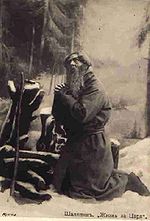
Bolshoi Kamenny Theatre
The Saint Petersburg Imperial Bolshoi Kamenny Theatre was a theatre in Saint Petersburg.- History :It was built in 1783 to Antonio Rinaldi's Neoclassical design as the Kamenny Theatre. It was rebuilt in 1802 and renamed the Bolshoi, but burned down in 1811. The building was restored in 1818, and...
- 1835 – Askold's GraveAskold's GraveAskold’s Grave is an opera in 4 acts by Alexey Verstovsky to a libretto by Mikhail Zagoskin ....
- 1836 – A Life for the TsarA Life for the TsarA Life for the Tsar , as it is known in English, although its original name was Ivan Susanin is a "patriotic-heroic tragic opera" in four acts with an epilogue by Mikhail Glinka. The original Russian libretto, based on historical events, was written by Nestor Kukolnik, Georgy Fyodorovich Rozen,...
- 1842 – Ruslan and LyudmilaRuslan and LyudmilaRuslan and Lyudmila is an opera in five acts composed by Mikhail Glinka between 1837 and 1842. The opera is based on the 1820 poem of the same name by Alexander Pushkin. The Russian libretto was written by Valerian Shirkov, Nestor Kukolnik and N. A. Markevich, among others...
- 1856 – RusalkaRusalka (Dargomyzhsky)Rusalka is an opera in four acts, six tableaux, by Alexander Dargomyzhsky, composed during 1848-1855. The Russian libretto was adapted by the composer from Pushkin's incomplete dramatic poem of the same name...
Mariinsky Theatre
Mariinsky Theatre
The Mariinsky Theatre is a historic theatre of opera and ballet in Saint Petersburg, Russia. Opened in 1860, it became the preeminent music theatre of late 19th century Russia, where many of the stage masterpieces of Tchaikovsky, Mussorgsky, and Rimsky-Korsakov received their premieres. The...
(since 1860)
- 1863 – Judith
- 1865 – Rogneda
- 1871 – The Power of the FiendThe Power of the FiendThe Power of the Fiend is an opera in five acts by Alexander Serov, composed during 1867-1871. The libretto is derived from a comedy by Alexander Ostrovsky from 1854 entitled Live Not As You Would Like To, But As God Commands. The opera was premiered posthumously on 19 April 1871 at the...
(Vrazya sila) - 1872 – The Stone GuestThe Stone GuestThe Stone Guest is a poetic drama by Alexander Pushkin based on the Spanish legend of Don Juan. The Stone Guest was written in 1830 as part of his four short plays known as The Little Tragedies...
- 1874 – Boris GodunovBoris Godunov (opera)Boris Godunov is an opera by Modest Mussorgsky . The work was composed between 1868 and 1873 in Saint Petersburg, Russia. It is Mussorgsky's only completed opera and is considered his masterpiece. Its subjects are the Russian ruler Boris Godunov, who reigned as Tsar during the Time of Troubles,...
- 1874 – The OprichnikThe Oprichnik (opera)The Oprichnik or The Guardsman is an opera in 4 acts, 5 scenes, by Pyotr Ilyich Tchaikovsky to his own libretto after the tragedy The Oprichniks by Ivan Lazhechnikov . The subject of the opera is the oprichniks...
- 1875 – The DemonThe Demon (opera)The Demon is an opera in three acts by Russian composer Anton Rubinstein. The work was composed in 1871. The libretto was by Pavel Viskovatov, based on the poem of the same name by Mikhail Lermontov.-Background:...
- 1876 – Vakula the SmithVakula the SmithVakula the Smith , is an opera in 3 acts, 8 scenes, by Pyotr Tchaikovsky, his Opus 14. The libretto was written by Yakov Polonsky and is based on Nikolai Gogol's story Christmas Eve . It was written for composer Alexander Serov, who died in 1871 leaving only fragments of an opera on the subject...
- 1881 – The Maid of Orleans
- 1882 – The Snow MaidenThe Snow MaidenThe Snow Maiden: A Spring Fairy Tale is an opera in four acts with a prologue by Nikolai Rimsky-Korsakov, composed during 1880–1881. The Russian libretto, by the composer, is based on the like-named play by Alexander Ostrovsky .The first performance of Rimsky-Korsakov's opera took place at the...
- 1886 – KhovanshchinaKhovanshchinaKhovanshchina is an opera in five acts by Modest Mussorgsky. The work was written between 1872 and 1880 in St. Petersburg, Russia. The composer wrote the libretto based on historical sources...
- 1886 – Prince IgorPrince IgorPrince Igor is an opera in four acts with a prologue. It was composed by Alexander Borodin. The composer adapted the libretto from the East Slavic epic The Lay of Igor's Host, which recounts the campaign of Russian prince Igor Svyatoslavich against the invading Polovtsian tribes in 1185...
- 1887 – The Enchantress (Charodeyka)
- 1890 – The Queen of SpadesThe Queen of Spades (opera)The Queen of Spades, Op. 68 is an opera in 3 acts by Pyotr Ilyich Tchaikovsky to a Russian libretto by the composer's brother Modest Tchaikovsky, based on a short story of the same name by Alexander Pushkin. The premiere took place in 1890 in St...
Mamontov's Private Russian Opera
Private Opera
The Private Opera , also known as:*The Russian Private Opera ;*Moscow Private Russian Opera, ;*Mamontov's Private Russian Opera in Moscow ;*Korotkov's Theatre ;*Vinter's Theatre ;*Private Opera Society ; and...
established in 1885. Savva Mamontov
Savva Mamontov
Savva Ivanovich Mamontov was a famous Russian industrialist, merchant, entrepreneur, and patron of the arts.-Biography:He was a son of the wealthy merchant and industrialist Ivan Feodorovich Mamontov and Maria Tikhonovna . In 1841 the family moved to Moscow. From 1852 he studied in St...
discovered talent of Chaliapin, commissioned designs from Mikhail Vrubel
Mikhail Vrubel
Mikhail Aleksandrovich Vrubel is usually regarded amongst the Russian painters of the Symbolist movement. In reality, he deliberately stood aloof from contemporary art trends, so that the origin of his unusual manner should be sought in Late Byzantine and Early Renaissance painting.-Early...
, Konstantin Korovin
Konstantin Korovin
Konstantin Alekseyevich Korovin was a leading Russian Impressionist painter.-Biography:Konstantin was born in Moscow to a merchant family officially registered as "peasants of Vladimir Gubernia". His father, Aleksey Mikhailovich Korovin, earned a university degree and was more interested in arts...
, Natalia Goncharova
Natalia Goncharova
Natalia Sergeevna Goncharova was a Russian avant-garde artist , painter, costume designer, writer, illustrator, and set designer. Her great-aunt was Natalia Pushkina, wife of the poet Alexander Pushkin.-Life and work:...
and Ivan Bilibin
Ivan Bilibin
Ivan Yakovlevich Bilibin was a 20th-century illustrator and stage designer who took part in the Mir iskusstva and contributed to the Ballets Russes. Throughout his career, he was inspired by Slavic folklore....
, staged the late operas by Rimsky Korsakov
Nikolai Rimsky-Korsakov
Nikolai Andreyevich Rimsky-Korsakov was a Russian composer, and a member of the group of composers known as The Five.The Five, also known as The Mighty Handful or The Mighty Coterie, refers to a circle of composers who met in Saint Petersburg, Russia, in the years 1856–1870: Mily Balakirev , César...
.
Opera spread to the provincial centres of Kiev
Kiev
Kiev or Kyiv is the capital and the largest city of Ukraine, located in the north central part of the country on the Dnieper River. The population as of the 2001 census was 2,611,300. However, higher numbers have been cited in the press....
(1867), Odessa (1887) and Kharkiv
Kharkiv
Kharkiv or Kharkov is the second-largest city in Ukraine.The city was founded in 1654 and was a major centre of Ukrainian culture in the Russian Empire. Kharkiv became the first city in Ukraine where the Ukrainian Soviet Socialist Republic was proclaimed in December 1917 and Soviet government was...
(1880).
20th century
The political collisions of 20th century divided Russian opera composers into those who managed to escape to the West, successfully or not, and those who continued to live in not particular friendly atmosphere of the Soviet and Post-Soviet regimes. And nevertheless, the process of producing of new operas was not diminished, but just opposite, it was immensely grown.Zimin Opera
Zimin Opera
The Zimin Opera was founded by the Russian entrepreneur Sergei Zimin in Moscow, Russia in 1903.The company staged the premieres of such operas as Rimsky-Korsakov's Golden Cockerel, Gretchaninoff's Beatris Sister and Ippolitov-Ivanov's Izmena...
established in 1904, Sergei Diaghilev
Sergei Diaghilev
Sergei Pavlovich Diaghilev , usually referred to outside of Russia as Serge, was a Russian art critic, patron, ballet impresario and founder of the Ballets Russes, from which many famous dancers and choreographers would arise.-Early life and career:...
's Saisons Russes
Ballets Russes
The Ballets Russes was an itinerant ballet company from Russia which performed between 1909 and 1929 in many countries. Directed by Sergei Diaghilev, it is regarded as the greatest ballet company of the 20th century. Many of its dancers originated from the Imperial Ballet of Saint Petersburg...
began in Paris in 1913.
Vladimir Rebikov
Vladimir Rebikov
Vladimir Ivanovich Rebikov was a late romantic 20th century Russian composer and pianist.-Biography:Rebikov began studying the piano with his mother. His sisters also were pianists. He graduated from the Moscow University faculty of philology. He studied at the Moscow Conservatory with N....
(1866–1920) composer of more than 10 operas is best of all known for his opera The Christmas Tree (Yolka, 1894–1902) in which he presented his ideas of “melo-mimics” and “rhythm-declamation” (see melodeclamation
Melodeclamation
Melodeclamation was a chiefly 19th century practice of reciting poetry while accompanied by concert music...
).
Sergei Rachmaninov
Sergei Rachmaninoff
Sergei Vasilievich Rachmaninoff was a Russian composer, pianist, and conductor. Rachmaninoff is widely considered one of the finest pianists of his day and, as a composer, one of the last great representatives of Romanticism in Russian classical music...
(1873–1943) completed three operas:
- AlekoAleko (opera)Aleko is the first of three completed operas by Sergei Rachmaninoff. The Russian libretto was written by Vladimir Nemirovich-Danchenko and is an adaptation of the poem The Gypsies by Alexander Pushkin. The opera was written in 1892 as a graduation work at the Moscow Conservatory, and it won the...
(1892, staged 1893) - The Miserly KnightThe Miserly KnightThe Miserly Knight, also The Covetous Knight, is a Russian opera in one act with music by Sergei Rachmaninoff, with the libretto based on the drama of Alexander Pushkin. The composer decided essentially to set the Pushkin text as written, and had Feodor Chaliapin in mind for the role of the Baron...
(Skupoy Rytsar Op. 24, 1904) - Franchesca da Rimini (Op. 25, 1904, staged 1906).
All three operas were staged at the Bolshoi Theatre He began and never finished the fourth Monna Vanna
Monna Vanna (opera)
Monna Vanna is an unfinished opera by Sergei Rachmaninoff after a play by Maurice Maeterlinck. Rachmaninoff had completed Act I in short vocal score, with piano accompaniment, and then he went to ask for permission to set the text in a full three-act treatment. However, another composer, Henry...
(1907, 1st act in a vocal score) after Maurice Maeterlinck
Maurice Maeterlinck
Maurice Polydore Marie Bernard Maeterlinck, also called Comte Maeterlinck from 1932, was a Belgian playwright, poet, and essayist who wrote in French. He was awarded the Nobel Prize in Literature in 1911. The main themes in his work are death and the meaning of life...
who refused to give permission to the composer for using of his text. These operas, written on the border between two centuries, rather belong to the world of the romantic opera of the past. Escaping Russia
Russia
Russia or , officially known as both Russia and the Russian Federation , is a country in northern Eurasia. It is a federal semi-presidential republic, comprising 83 federal subjects...
in 1917 Rachmaninov had never returned to the operatic projects again.
Unlike him, Igor Stravinsky
Igor Stravinsky
Igor Fyodorovich Stravinsky ; 6 April 1971) was a Russian, later naturalized French, and then naturalized American composer, pianist, and conductor....
(1882–1971) had been returning to this genre again and again, full of fresh and innovative ideas. Sometimes it is difficult to qualify these works as pure operas but rather "opera-ballets", "opera-cantatas", or "music theatre". Here is the list:
- Le rossignolThe Nightingale (opera)The Nightingale is a Russian conte lyrique in three acts by Igor Stravinsky. It is generally known by its French name...
(The Nightingale) (1914) - RenardRenard (Stravinsky)Renard, Histoire burlesque chantée et jouée is a one-act chamber opera-ballet by Igor Stravinsky, written in 1916. The Russian text by the composer was based on Russian folk tales from the collection by Alexander Afanasyev.The full Russian name of the piece is: Ба́йка про лису́, петуха́, кота́, да...
, burlesqueBurlesqueBurlesque is a literary, dramatic or musical work intended to cause laughter by caricaturing the manner or spirit of serious works, or by ludicrous treatment of their subjects...
for 4 pantomimePantomimePantomime — not to be confused with a mime artist, a theatrical performer of mime—is a musical-comedy theatrical production traditionally found in the United Kingdom, Australia, New Zealand, Canada, Jamaica, South Africa, India, Ireland, Gibraltar and Malta, and is mostly performed during the...
s and Chamber Orchestra (1916) opera-ballet - Histoire du SoldatHistoire du soldatHistoire du soldat , composed by Igor Stravinsky, is a 1918 theatrical work "to be read, played, and danced" . The libretto, which is based on a Russian folk tale, was written in French by the Swiss universalist writer C.F. Ramuz...
for chamber group and three speakers (1918), narration with music - MavraMavraMavra is a one-act opera buffa composed by Igor Stravinsky, and one of the earliest works of Stravinsky's 'neo-classical' period. The libretto of the opera, by Boris Kochno, is based on Aleksandr Pushkin's The Little House in Kolomna. Mavra is about 25 minutes long, and features two arias, a...
(1922) - Oedipus rexOedipus rex (opera)Oedipus rex is an "Opera-oratorio after Sophocles" by Igor Stravinsky, scored for orchestra, speaker, soloists, and male chorus. The libretto, based on Sophocles's tragedy, was written by Jean Cocteau in French and then translated by Abbé Jean Daniélou into Latin...
(1927) - PerséphonePerséphone (Stravinsky)Perséphone is a musical work for speaker, solo singers, chorus, dancers and orchestra with music by Igor Stravinsky and a libretto by André Gide....
for speaker, soloists, chorus and orchestra (1934) - BabelBabelBabel is the name used in the Hebrew Bible for the city of Babylon.Babel may also refer to:-People:*Isaak Babel, Soviet journalist, playwright, and short story writer*Ryan Babel, Dutch footballer*Markus Babbel, German footballer-Places:...
(1944) - The Rake's ProgressThe Rake's ProgressThe Rake's Progress is an opera in three acts and an epilogue by Igor Stravinsky. The libretto, written by W. H. Auden and Chester Kallman, is based loosely on the eight paintings and engravings A Rake's Progress of William Hogarth, which Stravinsky had seen on May 2, 1947, in a Chicago...
(1951) - The FloodThe Flood (Stravinsky)The Flood: A musical play is a short biblical drama by Igor Stravinsky on the allegory of Noah, originally written as an opera for television. CBS Television executive Alan Wagner commissioned the work...
(1962)
Sergei Prokofiev
Sergei Prokofiev
Sergei Sergeyevich Prokofiev was a Russian composer, pianist and conductor who mastered numerous musical genres and is regarded as one of the major composers of the 20th century...
’s (1891–1953) operas are full of humour, smartness, and novelty. Here is the list of his completed operas:
- Maddalena, (1911–1913)
- The GamblerThe Gambler (Prokofiev)The Gambler is an opera in four acts by Sergei Prokofiev to a Russian libretto by the composer, based on the story of the same name by Fyodor Dostoyevsky....
(1915–1916, rev. 1927) - The Love for Three OrangesThe Love for Three Oranges (Prokofiev)The Love for Three Oranges, Op. 33, also known by its French language title L'amour des trois oranges , is a 1919 satirical opera by Sergei Prokofiev...
(1919) - The Fiery Angel(1919–1927)
- Semyon KotkoSemyon Kotko (Prokofiev)Semyon Kotko , Op. 81, is an opera in five acts by Sergei Prokofiev to a libretto by Sergei Prokofiev and Valentin Katayev based on Katayev's 1937 novel I Am the Son of Working People .-Composition history:...
(1939) - Betrothal in a MonasteryBetrothal in a Monastery (Prokofiev)Betrothal in a Monastery is an opera by Sergei Prokofiev, his sixth with an opus number. The libretto, in Russian, was by the composer and Mira Mendelson , after Richard Brinsley Sheridan's ballad opera libretto for Thomas Linley the younger's The Duenna.Prokofiev began the work in 1940, and it was...
(1940–1941) - War and PeaceWar and Peace (Prokofiev)War and Peace is an opera in two parts , sometimes arranged as five acts, by Sergei Prokofiev to a Russian libretto by the composer and Mira Mendelson, based on the novel War and Peace by Leo Tolstoy...
(1941–1952) - The Story of a Real ManThe Story of a Real ManThe Story of a Real Man is an opera in four acts by the Russian composer Sergei Prokofiev, his opus 117. It was written from 1947 to 1948, and was his last opera....
, Op. 117 (1947–1948)
Dmitri Shostakovich
Dmitri Shostakovich
Dmitri Dmitriyevich Shostakovich was a Soviet Russian composer and one of the most celebrated composers of the 20th century....
(1906–1975) was another great opera composer struggling all his life in the clutch of the communist ideology. His satirical
Satire
Satire is primarily a literary genre or form, although in practice it can also be found in the graphic and performing arts. In satire, vices, follies, abuses, and shortcomings are held up to ridicule, ideally with the intent of shaming individuals, and society itself, into improvement...
opera
Opera
Opera is an art form in which singers and musicians perform a dramatic work combining text and musical score, usually in a theatrical setting. Opera incorporates many of the elements of spoken theatre, such as acting, scenery, and costumes and sometimes includes dance...
The Nose
The Nose (opera)
The Nose is a satirical opera composed by Dmitri Shostakovich. The libretto by Shostakovich, Yevgeny Zamyatin, Georgy Ionin, and Alexander Preis is based on the story The Nose by Nikolai Gogol. The plot concerns a St. Petersburg official whose nose leaves his face and develops a life of its own...
, after the completely absurd story by Gogol
Nikolai Gogol
Nikolai Vasilievich Gogol was a Ukrainian-born Russian dramatist and novelist.Considered by his contemporaries one of the preeminent figures of the natural school of Russian literary realism, later critics have found in Gogol's work a fundamentally romantic sensibility, with strains of Surrealism...
was criticized in 1929 by RAPM as "formalist
Russian formalism
Russian formalism was an influential school of literary criticism in Russia from the 1910s to the 1930s. It includes the work of a number of highly influential Russian and Soviet scholars such as Viktor Shklovsky, Yuri Tynianov, Vladimir Propp, Boris Eichenbaum, Roman Jakobson, Grigory Vinokur who...
". His second opera Lady Macbeth of the Mtsensk District
Lady Macbeth of the Mtsensk District (opera)
Lady Macbeth of the Mtsensk District is an opera in four acts by Dmitri Shostakovich, his Op.29. The libretto was written by Alexander Preis and the composer, and is based on the story Lady Macbeth of Mtsensk District by Nikolai Leskov. The opera is sometimes referred to informally as Lady Macbeth...
performed in 1934 with an enormous success was condemned by the authorities even more harshly. This forced him to recompose it much later, in 1962, as Katerina Izmailova in a style more simplified and conventional to meet the requirements of the new rulers of the regime.
Shostakovich was involved in many more operatic projects.
There were a lot more of the composers about the same generation, who had managed to create hundreds of operas. Some of them shared the same problems with Shostakovich and Prokofiev who returned to live to the Soviet Russia, and was deadly embraced by its suffocative regime. Others were at the opposite side, serving the suffocating roles. A serious condemnation and persecution of the Soviet Union
Soviet Union
The Soviet Union , officially the Union of Soviet Socialist Republics , was a constitutionally socialist state that existed in Eurasia between 1922 and 1991....
's foremost composers, such as Prokofiev, Shostakovich and many others, had emerged in 1948 in connection to the opera by Vano Muradeli
Vano Muradeli
Vano Muradeli was a Soviet Georgian composer.Born in Gori, Georgia, then part of Imperial Russia, he graduated from Tbilisi State Conservatory in 1931. From 1934 to 1938, he worked at the Moscow Conservatory. From 1942 to 1944, he served as a principal and artistic director of the Central Ensemble...
(1908–1970), Velikaya druzhba (The Great Friendship); see Zhdanov Doctrine
Zhdanov Doctrine
The Zhdanov Doctrine was a Soviet cultural doctrine developed by the Central Committee secretary Andrei Zhdanov in 1946. It proposed that the world was divided into two camps: the imperialistic, headed by the United States; and democratic, headed by the Soviet Union...
.
Here is just a short list of the opera composers of that times:
- Yuri Shaporin (1887–1966), opera The DecembristsDecembrist revoltThe Decembrist revolt or the Decembrist uprising took place in Imperial Russia on 14 December , 1825. Russian army officers led about 3,000 soldiers in a protest against Nicholas I's assumption of the throne after his elder brother Constantine removed himself from the line of succession...
(written during a period of 33 years 1930–1953, staged 1953) - Isaak DunayevskyIsaak DunayevskyIsaak Osipovich Dunayevsky was the biggest Soviet film composer and conductor of the 1930s and 1940s, who achieved huge success in music for operetta and film comedies, frequently working with the film director Grigori Aleksandrov...
(1900–1955), 14 operettas including White Acacia (1955) - Alexander Mossolov (1900–1973), 4 operas including. The Barrage (1929–1930)
- Vissarion ShebalinVissarion ShebalinVissarion Yakovlevich Shebalin was a Soviet composer.-Biography:Shebalin was born in Omsk, where his parents were school teachers. He studied in the musical college in Omsk. He was 20 years old when, following the advice of his professor, he went to Moscow to show his first compositions to...
(1902–1936), 3 operas including The Taming of the Shrew (1957) - Dmitri KabalevskyDmitri KabalevskyDmitry Borisovich Kabalevsky was a Russian composer.He helped to set up the Union of Soviet Composers in Moscow and remained one of its leading figures. He was a prolific composer of piano music and chamber music; many of his piano works have been performed by Vladimir Horowitz. He is probably...
(1904–1987), 7 operas including Colas Breugnon (1936–1976) - Veniamin FleishmanVeniamin FleishmanVeniamin Iosifovich Fleishman, was a Soviet composer.While studying under Dmitri Shostakovich at the Leningrad Conservatory , he began a one-act opera Rothschild's Violin based on Anton Chekhov’s short story about Bronza, a Russian country coffin-maker and violinist, and his combative relationship...
(1913–1941), opera Rothschild's ViolinRothschild's ViolinRothschild's Violin is a one-act opera by Russian composer Veniamin Fleishman set to the Russian libretto by the composer after the short story Rothschild's Fiddle by Anton Chekhov....
(1941) completed and orchestrated by Dmitri ShostakovichDmitri ShostakovichDmitri Dmitriyevich Shostakovich was a Soviet Russian composer and one of the most celebrated composers of the 20th century.... - Tikhon KhrennikovTikhon KhrennikovTikhon Nikolayevich Khrennikov was a Russian and Soviet composer, pianist, leader of the Union of Soviet Composers, who was also known for his political activities...
(born 1913), 5 operas including "Into the Storm" (1936–1939) - Grigory FridGrigory FridGrigory Samuilovich Frid also Grigori Fried is a Russian composer of music written in many different genres, including chamber opera.Born in Petrograd, now St. Petersburg, Frid studied in the Moscow Conservatory with Heinrich Litinsky and Vissarion Shebalin. He was a soldier in the Second World War...
(born 1915), 2 chamber mono-operas including The Diary of Anne FrankThe Diary of Anne Frank (opera)The Diary of Anne Frank is a monodrama in 21 scenes for soprano and chamber orchestra. The music and libretto are by Grigory Frid, after the eponymous diary....
(1968) - Mieczysław Weinberg (1919–1996), 7 operas including The PortraitThe Portrait (opera)The Portrait is an opera in eight scenes composed by Mieczysław Weinberg to a libretto by Alexander Medvedev based on Nikolai Gogol's short story The Portrait....
(1980) and The Idiot (1985)
Also: Vladimir Shcherbachev, Sergei Vasilenko
Sergey Nikiforovich Vasilenko
Sergei Nikiforovich Vasilenko was a Russian and Soviet composer and music teacher whose compositions showed a strong tendency towards mysticism....
, Vladimir Fere
Vladimir Fere
Vladimir Georgievich Fere was a Russian composer. He studied at the Moscow Conservatory in 1925 and later taught there.He was a member of a Kirghiz Republic collective assigned by the Soviet government under a plan to integrate national cultures into the arts...
, Vladimir Vlasov
Vladimir Vlasov
Vladimir Vlasov was a Russian composer and conductor. He studied at the Moscow Conservatory from 1924 to 1931 under such teachers as Georgy Catoire, Abram Yampol′sky, and Nikolai Zhilyayev. In 1936 he founded the Music and Drama Theatre in Frunze, working as the company's artistic director until...
, Kirill Molchanov
Kirill Molchanov
Kirill Vladimirovich Molchanov was a Russian and Soviet composer.He was appointed director of the Bolshoi, at the time political disfavour had fallen on the lead soprano Galina Vishnevskaya.His works are in the Social Realist romantic tradition and were not warmly received when performed...
, Alexander Kholminov, etc. (see: Russian opera articles#20th century).
The next generations who found themselves already in the Post-Stalin epoch had own specific problems. The ideological and stylistic control and limitation of creative freedom by the authorities and older colleagues-composers in the hierarchical structures of the Union of Composers made almost impossible the innovation and experiment in any field of musical art. It was a feeling that old bad times returned again, when in 1979 at the Sixth Congress of the Composers' Union, its leader Tikhon Khrennikov
Tikhon Khrennikov
Tikhon Nikolayevich Khrennikov was a Russian and Soviet composer, pianist, leader of the Union of Soviet Composers, who was also known for his political activities...
denounced seven composers (thereafter known as the "Khrennikov Seven"), who for some reason or other had been played in the West – there were at least four opera composers among them.
As a result even quite new phenomena appeared: a "samizdat
Samizdat
Samizdat was a key form of dissident activity across the Soviet bloc in which individuals reproduced censored publications by hand and passed the documents from reader to reader...
(underground) opera" (see Nikolai Karetnikov
Nikolai Karetnikov
Nikolai Nikolayevich Karetnikov , was a Russian composer of the so-called Underground – alternative or nonconformist group in Soviet music.-Biography:...
). Some of these operas still never been performed, others luckily received their premieres in the West, and only a few found their place at the operatic stages of the homeland. The collapse of the Soviet Union did not improve this hopeless situation much.
The list of the composers who contributed to the development of Russian opera nearer to the end of the 20th century:
- Edison DenisovEdison DenisovEdison Vasilievich Denisov was a Russian composer of so called "Underground" — "Anti-Collectivist", "alternative" or "nonconformist" division in the Soviet music.-Biography:...
(1929–1996), 3 Operas including L'écume des joursL'écume des jours (opera)L'écume des jours is an opera in three acts by the Russian composer Edison Denisov. The French text is by the composer based on the novel of the same title by Boris Vian...
( The Foam of Days, completed 1981) - Nikolai KaretnikovNikolai KaretnikovNikolai Nikolayevich Karetnikov , was a Russian composer of the so-called Underground – alternative or nonconformist group in Soviet music.-Biography:...
(1930–1994), 2 operas including Till Eulenspiegel, opera in two acts (1965–1985) - Sergei SlonimskySergei SlonimskySergei Mikhailovich Slonimsky is a Russian and Soviet composer, pianist and musicologist.-Biography:He is a son of Soviet writer Mikhail Slonimsky and a nephew of the Russian-American composer Nicolas Slonimsky. He studied at the Musical College in Moscow from 1943 until 1950. From 1950 Slonimsky...
(born 1932), 3 operas including Mary Stewart (1978–1980) - Rodion ShchedrinRodion ShchedrinRodion Konstantinovich Shchedrin is a Russian composer. He was one оf the leading Soviet composers, and was the chairman of the Union of Russian Composers from 1973 until 1990.-Life and Works:...
(born 1932), 3 operas including Myortvye dushi (Dead Souls 1976) - Alfred SchnittkeAlfred SchnittkeAlfred Schnittke ; November 24, 1934 – August 3, 1998) was a Russian and Soviet composer. Schnittke's early music shows the strong influence of Dmitri Shostakovich. He developed a polystylistic technique in works such as the epic First Symphony and First Concerto Grosso...
(1934–1998), 3 operas including Zhizn’ s idiotom (Life with an IdiotLife with an IdiotLife with an Idiot is an opera by the Russian composer Alfred Schnittke. The libretto is by Viktor Erofeyev. It was first performed at Het Muziektheater, Amsterdam on 13 April 1992. The opera is an allegory of Soviet oppression.-Roles:-Act One:...
, 1990–1991) - Boris TishchenkoBoris TishchenkoBoris Ivanovich Tishchenko was a Russian and Soviet composer and pianist.-Life:...
(b. 1939 ) 2 operas including Kradenoe solntse (The Stolen Sun (1968) - Alexander Knaifel (born 1943) 2 operas including Kentervilskoye prividenie (The Canterville Ghost, 1965–1966)
- Nikolai KorndorfNikolai KorndorfNikolai Sergeevich Korndorf was a Russian and Canadian composer and conductor. He was prolific both in Moscow, Russia and in Vancouver, Canada.-Biography:...
(1947–2001), chamber opera MR (Marina and Rainer)MR (Marina and Rainer)MR is a chamber opera in one act by the Russian composer Nikolai Korndorf . The libretto by Yuri Lourié is in Russian, German, Ancient Greek and Japanese)...
(1989) - Elena FirsovaElena FirsovaElena Olegovna Firsova is a Russian composer.-Life:She was born in Leningrad into the family of physicists Oleg Firsov and Viktoria Lichko. She studied music in Moscow with Alexander Pirumov, Yuri Kholopov, Edison Denisov and Philip Herschkowitz...
(born 1950), 2 chamber operas including The Nightingale and the Rose
Also: Nikolai Sidelnikov
Nikolai Sidelnikov
Nikolai Nikolayevich Sidelnikov was a Russian Soviet composer.Sidelnikov studied with E. O. Messner and Yuri Shaporin at the Moscow Conservatory. He taught at the Moscow Conservatory where he was a professor from 1981...
, Andrei Petrov
Andrei Petrov
Andrey Pavlovich Petrov was a Russian and Soviet composer. Andrey Petrov is known for his music for films such as I Step Through Moscow, Beware of the Car, and Office Romance.-Life:...
, Sandor Kallosh, Leonid Hrabovsky, Alexander Vustin
Alexander Vustin
Alexander Kuzmich Vustin, also Voustin or Wustin is a Russian composer.-Biography:He studied composition first with Grigory Frid at a regional music college, and later with Vladimir Ferè at the Moscow Conservatory, graduating in 1969. Between 1969 and 1974, Vustin worked as a music editor at USSR...
, Gleb Sedelnikov, Merab Gagnidze, Alexander Tchaikovsky, Vasily Lobanov
Vasily Lobanov
Vasily Pavlovich Lobanov also Vassily Lobanov is a Russian composer and pianist.Lobanov studied at the Moscow Conservatory from 1963 to 1971: piano with Lev Naumov and composition with Sergey Balasanyan. He also studied with Yuri Kholopov and Alfred Schnittke...
, Dmitri N. Smirnov, Leonid Bobylev
Leonid Bobylev
Leonid Borisovich Bobylev, also Bobylyov is a Russian composer.Bobylev graduated from the Moscow Conservatory, where he studied composition with Mikhail Chulaki, a professor at the Moscow Conservatory.-Works:Bobylev has composed 5 operas, 8 concertos, a symphony, a symphonic poem "De profundis", 2...
, Vladimir Tarnopolsky
Vladimir Tarnopolsky
Vladimir Grigoryevich Tarnopolsky is a Russian composer.-Biography:Tarnopolsky studied composition at the Moscow Conservatory with Nikolai Sidelnikov and Edison Denisov and music theory with Yuri Kholopov. He graduated from the conservatory in 1978, and completed post-graduate studies in 1980...
, and so on (see: Russian opera articles#20th century).
21st century
The Russian opera is continuing its development in the 21st century. It began with the noisy premieres of two comic operas, whose genre could be explained as "opera-farce":The first was Tsar Demyan – a frightful opera performance (a collective project of the five participants: composers Leonid Desyatnikov
Leonid Desyatnikov
Leonid Arkadievich Desyatnikov is a Russian composer.Leonid Desyatnikov was born in 1955 in Kharkiv, Ukraine. He is a graduate of the Leningrad Conservatory, where he studied composition and instrumentation. Desyatnikov has penned four operas, several cantatas and numerous vocal and instrumental...
and Vyacheslav Gaivoronsky from Saint Petersburg
Saint Petersburg
Saint Petersburg is a city and a federal subject of Russia located on the Neva River at the head of the Gulf of Finland on the Baltic Sea...
, Iraida Yusupova
Iraida Yusupova
Iraida Yusupova is a Turkmenistani composer of half Russian-half Tatar ethnicity who currently lives in Moscow, Russia....
and Vladimir Nikolayev
Vladimir Nikolayev
Vladimir Nikolayev is a Russian politician accused of membership in the Russian Mafia. He was a member of former Russian president Vladimir Putin's governing party United Russia; the mayor of Vladivostok; and the owner of seafood, meat, and timber-processing companies...
from Moscow
Moscow
Moscow is the capital, the most populous city, and the most populous federal subject of Russia. The city is a major political, economic, cultural, scientific, religious, financial, educational, and transportation centre of Russia and the continent...
, and the creative collective "Kompozitor," (a pseudonym for the well-known music critic Pyotr Pospelov) to the libretto by Elena Polenova after a folk-drama Tsar Maksimilyan, premiere June 20, 2001 Mariinski Theatre, Saint Petersburg. Prize "Gold Mask, 2002" and "Gold Soffit, 2002".
Another opera Rosenthal's Children by Leonid Desyatnikov
Leonid Desyatnikov
Leonid Arkadievich Desyatnikov is a Russian composer.Leonid Desyatnikov was born in 1955 in Kharkiv, Ukraine. He is a graduate of the Leningrad Conservatory, where he studied composition and instrumentation. Desyatnikov has penned four operas, several cantatas and numerous vocal and instrumental...
to the libretto by Vladimir Sorokin
Vladimir Sorokin
Vladimir Georgievich Sorokin is a contemporary postmodern Russian writer and dramatist, one of the most popular in modern Russian literature.-Biography:...
, was commissioned by the Bolshoi Theatre
Bolshoi Theatre
The Bolshoi Theatre is a historic theatre in Moscow, Russia, designed by architect Joseph Bové, which holds performances of ballet and opera. The Bolshoi Ballet and Bolshoi Opera are amongst the oldest and most renowned ballet and opera companies in the world...
and premiered on March 23, 2005. The staging of the opera was accompanied by juicy scandal, however made an enormous success.
List of Russian opera theatres
- "Comedie et opere", (small hall in a wing of Zimniy Dvorets—(The Winter Palace, From 1735 St Petersburg)
- Theatre of Letniy Sad — (Summer GardenSummer GardenThe Summer Garden occupies an island between the Fontanka, Moika, and the Swan Canal in Saint Petersburg and shares its name with the adjacent Summer Palace of Peter the Great.-Original:...
), from 1735 St Petersburg) - Opera House (with 1000 seats, at Zimniy Dvorets — (The Winter Palace, from 1743, St Petersburg)
- Moscow Theatre (built 1742 for the coronation of Elizaveta Petrovna, MoscowMoscowMoscow is the capital, the most populous city, and the most populous federal subject of Russia. The city is a major political, economic, cultural, scientific, religious, financial, educational, and transportation centre of Russia and the continent...
) - Kuskovo Summer TheatreKuskovoKuskovo was the summer country house and estate of the Sheremetev family. Built in the mid-18th century, it was originally situated several miles to the east of Moscow but now is part of the East District of the city. It was one of the first great summer country estates of the Russian nobility,...
(from 1755, KuskovoKuskovoKuskovo was the summer country house and estate of the Sheremetev family. Built in the mid-18th century, it was originally situated several miles to the east of Moscow but now is part of the East District of the city. It was one of the first great summer country estates of the Russian nobility,...
near MoscowMoscowMoscow is the capital, the most populous city, and the most populous federal subject of Russia. The city is a major political, economic, cultural, scientific, religious, financial, educational, and transportation centre of Russia and the continent...
) - Karl Kniper Theatre (1777–1797 St Petersburg)
- Chinese Opera TheatreChinese Village (Tsarskoe Selo)The Chinese Village in the Alexander Park of Tsarskoye Selo, Russia was Catherine the Great's attempt to follow the 18th-century fashion for the Chinoiserie....
(From 1779, Tsarskoe Selo near St Petersburg) - Petrovsky TheatreBolshoi TheatreThe Bolshoi Theatre is a historic theatre in Moscow, Russia, designed by architect Joseph Bové, which holds performances of ballet and opera. The Bolshoi Ballet and Bolshoi Opera are amongst the oldest and most renowned ballet and opera companies in the world...
(with 1000 seats, from 1780–1805, MoscowMoscowMoscow is the capital, the most populous city, and the most populous federal subject of Russia. The city is a major political, economic, cultural, scientific, religious, financial, educational, and transportation centre of Russia and the continent...
) - Bolshoi Kamenny TheatreBolshoi Kamenny TheatreThe Saint Petersburg Imperial Bolshoi Kamenny Theatre was a theatre in Saint Petersburg.- History :It was built in 1783 to Antonio Rinaldi's Neoclassical design as the Kamenny Theatre. It was rebuilt in 1802 and renamed the Bolshoi, but burned down in 1811. The building was restored in 1818, and...
(1783–1811, St Petersburg) - Hermitage TheatreHermitage TheatreThe Hermitage Theatre in Saint Petersburg, Russia is one of five Hermitage buildings lining the Palace Embankment of the Neva River.The palatial theatre was built between 1783 and 1787 at the behest of Catherine the Great to a Palladian design by Giacomo Quarenghi...
(from 1785 St Petersburg) - Ostankino TheatreNikolai SheremetevNikolai Petrovich Sheremetev was a Russian count, the son of Petr Borisovich Sheremetev, notable grandee of the epoch of empresses Anna Ivanovna, Elizabeth Petrovna, and Catherine II. He was also the grandson of Boris Petrovich Sheremetev.His father P. B...
(from July 22, 1795, Ostankino near MoscowMoscowMoscow is the capital, the most populous city, and the most populous federal subject of Russia. The city is a major political, economic, cultural, scientific, religious, financial, educational, and transportation centre of Russia and the continent...
) - Imperial Kamenny Theatre or the Bolshoi Theatre of Saint Petersburg, (St Petersburg)
- Petrovka Theatre (from 1786–1805 MoscowMoscowMoscow is the capital, the most populous city, and the most populous federal subject of Russia. The city is a major political, economic, cultural, scientific, religious, financial, educational, and transportation centre of Russia and the continent...
) - Bolshoi TheatreBolshoi TheatreThe Bolshoi Theatre is a historic theatre in Moscow, Russia, designed by architect Joseph Bové, which holds performances of ballet and opera. The Bolshoi Ballet and Bolshoi Opera are amongst the oldest and most renowned ballet and opera companies in the world...
(from 1825 MoscowMoscowMoscow is the capital, the most populous city, and the most populous federal subject of Russia. The city is a major political, economic, cultural, scientific, religious, financial, educational, and transportation centre of Russia and the continent...
) - Kamenny Island TheatreKamenny Island TheatreThe Kamenny Island Theatre is a wooden summer theatre on the grounds of the Kamennoostrovsky Palace, Kamenny Island, Saint Petersburg, Russia.-Before the Theatre:...
(from 1826 St Petersburg) - Mariinsky TheatreMariinsky TheatreThe Mariinsky Theatre is a historic theatre of opera and ballet in Saint Petersburg, Russia. Opened in 1860, it became the preeminent music theatre of late 19th century Russia, where many of the stage masterpieces of Tchaikovsky, Mussorgsky, and Rimsky-Korsakov received their premieres. The...
, (from 1860 St Petersburg)
See also
- List of Russian opera composers
- List of Russian opera singers
- Music of Russia#Classical, opera and ballet
- Russian culture#Opera
- Opera#Russian opera
- Comic opera#Russian comic opera