


Hermitage Theatre

Encyclopedia
The Hermitage Theatre in Saint Petersburg
, Russia
is one of five Hermitage
buildings lining the Palace Embankment of the Neva River
.
The palatial theatre was built between 1783 and 1787 at the behest of Catherine the Great to a Palladian
design by Giacomo Quarenghi
. The crumbling Third Winter Palace of Peter the Great
was demolished to make room for the new structure, although its old foundations are still visible in the ground floor. Quarenghi's designs for the theatre were engraved and published in 1787, earning him a European reputation.
The semicircular auditorium
is decorated with color marble and surrounded with ten niches for statues of Apollo
and the muse
s. As the interior has never been overhauled, the original stage machinery remains in situ
, but the elaborate sets, an acclaimed work of the Italian
artist Pietro Gonzaga
(1751-1831), were lost during the years of Soviet neglect.
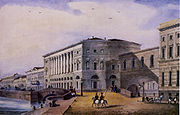 The ceremonial opening of the theatre took place on 22 November 1785. Though the auditorium could seat no more than 250 spectators, it was seldom overcrowded. Usually, the performance would be attended by several dozen aristocratic spectators, all invited by the monarch herself. As a sign of gratitude, a separate loge was reserved for the architect Quarenghi and his family. In the 19th century, selected members of the diplomatic corps were admitted to the theatre as well.
Although the building was used to entertain the imperial family until the Russian Revolution
, it came to be viewed as a rare monument to Catherine's personal tastes and affections. The empress brought out several comedies specifically to be staged in this theatre, which also saw the premieres of Domenico Cimarosa
's operas composed to her own libretto
s. As for the costumes, they were chosen from a 15,000-dress personal garderobe
of the late Empress Elizabeth.
Mathilde Kschessinska
, Anna Pavlova, and Fyodor Chaliapin were among the great artists who performed at the Hermitage Theatre for the last Russian tsar
. Among the ballets performed there was the premiere of Marius Petipa
's Harlequinade, in 1900. The Bolsheviks closed the theatre and utilised the building for administrative purposes. It was not until 1991 that performances were resumed on this stage, with the likes of Svyatoslav Richter, Mstislav Rostropovich
and Yelena Obraztsova appearing as guest stars.
Saint Petersburg
Saint Petersburg is a city and a federal subject of Russia located on the Neva River at the head of the Gulf of Finland on the Baltic Sea...
, Russia
Russia
Russia or , officially known as both Russia and the Russian Federation , is a country in northern Eurasia. It is a federal semi-presidential republic, comprising 83 federal subjects...
is one of five Hermitage
Hermitage Museum
The State Hermitage is a museum of art and culture in Saint Petersburg, Russia. One of the largest and oldest museums of the world, it was founded in 1764 by Catherine the Great and has been opened to the public since 1852. Its collections, of which only a small part is on permanent display,...
buildings lining the Palace Embankment of the Neva River
Neva River
The Neva is a river in northwestern Russia flowing from Lake Ladoga through the western part of Leningrad Oblast to the Neva Bay of the Gulf of Finland. Despite its modest length , it is the third largest river in Europe in terms of average discharge .The Neva is the only river flowing from Lake...
.
The palatial theatre was built between 1783 and 1787 at the behest of Catherine the Great to a Palladian
Palladian architecture
Palladian architecture is a European style of architecture derived from the designs of the Venetian architect Andrea Palladio . The term "Palladian" normally refers to buildings in a style inspired by Palladio's own work; that which is recognised as Palladian architecture today is an evolution of...
design by Giacomo Quarenghi
Giacomo Quarenghi
Giacomo Quarenghi was the foremost and most prolific practitioner of Palladian architecture in Imperial Russia, particularly in Saint Petersburg.- Career in Italy :...
. The crumbling Third Winter Palace of Peter the Great
Peter I of Russia
Peter the Great, Peter I or Pyotr Alexeyevich Romanov Dates indicated by the letters "O.S." are Old Style. All other dates in this article are New Style. ruled the Tsardom of Russia and later the Russian Empire from until his death, jointly ruling before 1696 with his half-brother, Ivan V...
was demolished to make room for the new structure, although its old foundations are still visible in the ground floor. Quarenghi's designs for the theatre were engraved and published in 1787, earning him a European reputation.
The semicircular auditorium
Auditorium
An auditorium is a room built to enable an audience to hear and watch performances at venues such as theatres. For movie theaters, the number of auditoriums is expressed as the number of screens.- Etymology :...
is decorated with color marble and surrounded with ten niches for statues of Apollo
Apollo
Apollo is one of the most important and complex of the Olympian deities in Greek and Roman mythology...
and the muse
Muse
The Muses in Greek mythology, poetry, and literature, are the goddesses who inspire the creation of literature and the arts. They were considered the source of the knowledge, related orally for centuries in the ancient culture, that was contained in poetic lyrics and myths...
s. As the interior has never been overhauled, the original stage machinery remains in situ
In situ
In situ is a Latin phrase which translated literally as 'In position'. It is used in many different contexts.-Aerospace:In the aerospace industry, equipment on board aircraft must be tested in situ, or in place, to confirm everything functions properly as a system. Individually, each piece may...
, but the elaborate sets, an acclaimed work of the Italian
Italy
Italy , officially the Italian Republic languages]] under the European Charter for Regional or Minority Languages. In each of these, Italy's official name is as follows:;;;;;;;;), is a unitary parliamentary republic in South-Central Europe. To the north it borders France, Switzerland, Austria and...
artist Pietro Gonzaga
Pietro Gonzaga
Pietro di Gottardo Gonzaga was an Italian theatre set designer who worked in Italy and, since 1792, in the Russian Empire....
(1751-1831), were lost during the years of Soviet neglect.
Although the building was used to entertain the imperial family until the Russian Revolution
Russian Revolution of 1917
The Russian Revolution is the collective term for a series of revolutions in Russia in 1917, which destroyed the Tsarist autocracy and led to the creation of the Soviet Union. The Tsar was deposed and replaced by a provisional government in the first revolution of February 1917...
, it came to be viewed as a rare monument to Catherine's personal tastes and affections. The empress brought out several comedies specifically to be staged in this theatre, which also saw the premieres of Domenico Cimarosa
Domenico Cimarosa
Domenico Cimarosa was an Italian opera composer of the Neapolitan school...
's operas composed to her own libretto
Libretto
A libretto is the text used in an extended musical work such as an opera, operetta, masque, oratorio, cantata, or musical. The term "libretto" is also sometimes used to refer to the text of major liturgical works, such as mass, requiem, and sacred cantata, or even the story line of a...
s. As for the costumes, they were chosen from a 15,000-dress personal garderobe
Garderobe
The term garderobe describes a place where clothes and other items are stored, and also a medieval toilet. In European public places, a garderobe denotes the cloakroom, wardrobe, alcove or an armoire. In Danish, Dutch, German and Spanish garderobe can mean a cloakroom. In Latvian it means checkroom...
of the late Empress Elizabeth.
Mathilde Kschessinska
Mathilde Kschessinska
Mathilda-Marie Feliksovna Kschessinskaya She was known in the West as Mathilde Kschessinska or Matilda Kshesinskaya.- Life :Kschessinska was born at Ligovo, near Peterhof. Like all her Polish family, to whom she was known as Matylda Krzesińska, Mathilde performed at the Imperial Mariinsky Theatre...
, Anna Pavlova, and Fyodor Chaliapin were among the great artists who performed at the Hermitage Theatre for the last Russian tsar
Nicholas II of Russia
Nicholas II was the last Emperor of Russia, Grand Prince of Finland, and titular King of Poland. His official short title was Nicholas II, Emperor and Autocrat of All the Russias and he is known as Saint Nicholas the Passion-Bearer by the Russian Orthodox Church.Nicholas II ruled from 1894 until...
. Among the ballets performed there was the premiere of Marius Petipa
Marius Petipa
Victor Marius Alphonse Petipa was a French ballet dancer, teacher and choreographer. Petipa is considered to be the most influential ballet master and choreographer of ballet that has ever lived....
's Harlequinade, in 1900. The Bolsheviks closed the theatre and utilised the building for administrative purposes. It was not until 1991 that performances were resumed on this stage, with the likes of Svyatoslav Richter, Mstislav Rostropovich
Mstislav Rostropovich
Mstislav Leopoldovich Rostropovich, KBE , known to close friends as Slava, was a Soviet and Russian cellist and conductor. He was married to the soprano Galina Vishnevskaya. He is widely considered to have been the greatest cellist of the second half of the 20th century, and one of the greatest of...
and Yelena Obraztsova appearing as guest stars.