


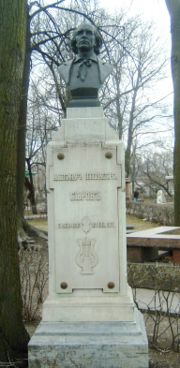
Alexander Serov

Encyclopedia

Cyrillic alphabet
The Cyrillic script or azbuka is an alphabetic writing system developed in the First Bulgarian Empire during the 10th century AD at the Preslav Literary School...
; Aleksandr Nikolaevič Serov in transliteration) – was a Russia
Russia
Russia or , officially known as both Russia and the Russian Federation , is a country in northern Eurasia. It is a federal semi-presidential republic, comprising 83 federal subjects...
n composer
Composer
A composer is a person who creates music, either by musical notation or oral tradition, for interpretation and performance, or through direct manipulation of sonic material through electronic media...
and music critic
Music journalism
Music journalism is criticism and reportage about music. It began in the eighteenth century as comment on what is now thought of as 'classical music'. This aspect of music journalism, today often referred to as music criticism , comprises the study, discussion, evaluation, and interpretation of...
. He and his wife Valentina
Valentina Serova (composer)
Valentina Semyonova Serova was a Russian composer of German-Jewish decent. She studied briefly at the St. Petersburg Conservatory, but left due to a conflict with Anton Rubinstein. She began to study with Alexander Serov who at that time was only known for his writings...
were the parents of painter Valentin Serov
Valentin Serov
Valentin Alexandrovich Serov was a Russian painter, and one of the premier portrait artists of his era.-Youth and education:...
. He was not only one of the most important music critics in Russia during the 1850s and 1860s, but also the most significant Russian composer of opera
Opera
Opera is an art form in which singers and musicians perform a dramatic work combining text and musical score, usually in a theatrical setting. Opera incorporates many of the elements of spoken theatre, such as acting, scenery, and costumes and sometimes includes dance...
in the years between Dargomyzhsky's
Alexander Dargomyzhsky
Alexander Sergeyevich Dargomyzhsky was a 19th century Russian composer. He bridged the gap in Russian opera composition between Mikhail Glinka and the later generation of The Five and Tchaikovsky....
Rusalka
Rusalka (Dargomyzhsky)
Rusalka is an opera in four acts, six tableaux, by Alexander Dargomyzhsky, composed during 1848-1855. The Russian libretto was adapted by the composer from Pushkin's incomplete dramatic poem of the same name...
and the early operas by Cui
César Cui
César Antonovich Cui was a Russian of French and Lithuanian descent. His profession was as an army officer and a teacher of fortifications; his avocational life has particular significance in the history of music, in that he was a composer and music critic; in this sideline he is known as a...
, Rimsky-Korsakov
Nikolai Rimsky-Korsakov
Nikolai Andreyevich Rimsky-Korsakov was a Russian composer, and a member of the group of composers known as The Five.The Five, also known as The Mighty Handful or The Mighty Coterie, refers to a circle of composers who met in Saint Petersburg, Russia, in the years 1856–1870: Mily Balakirev , César...
, Mussorgsky
Modest Mussorgsky
Modest Petrovich Mussorgsky was a Russian composer, one of the group known as 'The Five'. He was an innovator of Russian music in the romantic period...
, and Tchaikovsky.
Vladimir Vasilievich Stasov
Vladimir Vasilievich Stasov , son of Russian architect Vasily Petrovich Stasov , was probably the most respected Russian critic during his lifetime...
, but later the two became enemies over the relative values of Glinka's
Mikhail Glinka
Mikhail Ivanovich Glinka , was the first Russian composer to gain wide recognition within his own country, and is often regarded as the father of Russian classical music...
two operas. Serov's admiration for Richard Wagner
Richard Wagner
Wilhelm Richard Wagner was a German composer, conductor, theatre director, philosopher, music theorist, poet, essayist and writer primarily known for his operas...
likewise did not endear him to The Mighty Handful, especially the younger competing critic César Cui
César Cui
César Antonovich Cui was a Russian of French and Lithuanian descent. His profession was as an army officer and a teacher of fortifications; his avocational life has particular significance in the history of music, in that he was a composer and music critic; in this sideline he is known as a...
, who, like Stasov, had been on better terms with Serov earlier.
Although Serov's operas Judith
Judith (Serov)
Judith , is an opera in five acts, composed by Alexander Serov during 1861-1863. Derived from renditions of the story of Judith from the Old Testament Apocrypha, the Russian libretto, though credited to the composer, has a complicated history . The premiere took place in 1863 in Saint Petersburg...
and Rogneda
Rogneda (opera)
Rogneda is an opera in five acts, composed by Alexander Serov during 1863–1865. The scenario, by the composer, was based on the novel Askold's Grave by Mikhail Zagoskin and the poem Rogneda by Kondraty Ryleyev...
were quite successful in their day, none of his operas are frequently performed today. A CD recording of Judith (with some cuts) was made in 1991 by the forces of the Bolshoi Theatre
Bolshoi Theatre
The Bolshoi Theatre is a historic theatre in Moscow, Russia, designed by architect Joseph Bové, which holds performances of ballet and opera. The Bolshoi Ballet and Bolshoi Opera are amongst the oldest and most renowned ballet and opera companies in the world...
under conductor
Conducting
Conducting is the art of directing a musical performance by way of visible gestures. The primary duties of the conductor are to unify performers, set the tempo, execute clear preparations and beats, and to listen critically and shape the sound of the ensemble...
Andrey Chistiakov.
Operas
- JudithJudith (Serov)Judith , is an opera in five acts, composed by Alexander Serov during 1861-1863. Derived from renditions of the story of Judith from the Old Testament Apocrypha, the Russian libretto, though credited to the composer, has a complicated history . The premiere took place in 1863 in Saint Petersburg...
(Юдифь, 1861-1863) - RognedaRogneda (opera)Rogneda is an opera in five acts, composed by Alexander Serov during 1863–1865. The scenario, by the composer, was based on the novel Askold's Grave by Mikhail Zagoskin and the poem Rogneda by Kondraty Ryleyev...
(Рогнеда, 1863-1865) - The Power of the FiendThe Power of the FiendThe Power of the Fiend is an opera in five acts by Alexander Serov, composed during 1867-1871. The libretto is derived from a comedy by Alexander Ostrovsky from 1854 entitled Live Not As You Would Like To, But As God Commands. The opera was premiered posthumously on 19 April 1871 at the...
(Вражья сила, 1867-1871)