

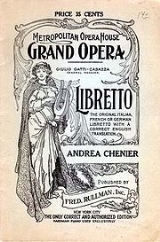
Libretto

Encyclopedia
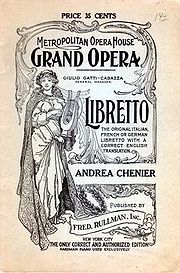
Opera
Opera is an art form in which singers and musicians perform a dramatic work combining text and musical score, usually in a theatrical setting. Opera incorporates many of the elements of spoken theatre, such as acting, scenery, and costumes and sometimes includes dance...
, operetta
Operetta
Operetta is a genre of light opera, light in terms both of music and subject matter. It is also closely related, in English-language works, to forms of musical theatre.-Origins:...
, masque
Masque
The masque was a form of festive courtly entertainment which flourished in 16th and early 17th century Europe, though it was developed earlier in Italy, in forms including the intermedio...
, oratorio
Oratorio
An oratorio is a large musical composition including an orchestra, a choir, and soloists. Like an opera, an oratorio includes the use of a choir, soloists, an ensemble, various distinguishable characters, and arias...
, cantata
Cantata
A cantata is a vocal composition with an instrumental accompaniment, typically in several movements, often involving a choir....
, or musical. The term "libretto" is also sometimes used to refer to the text of major liturgical works, such as mass
Mass (liturgy)
"Mass" is one of the names by which the sacrament of the Eucharist is called in the Roman Catholic Church: others are "Eucharist", the "Lord's Supper", the "Breaking of Bread", the "Eucharistic assembly ", the "memorial of the Lord's Passion and Resurrection", the "Holy Sacrifice", the "Holy and...
, requiem
Requiem
A Requiem or Requiem Mass, also known as Mass for the dead or Mass of the dead , is a Mass celebrated for the repose of the soul or souls of one or more deceased persons, using a particular form of the Roman Missal...
, and sacred cantata, or even the story line of a ballet
Ballet
Ballet is a type of performance dance, that originated in the Italian Renaissance courts of the 15th century, and which was further developed in France and Russia as a concert dance form. The early portions preceded the invention of the proscenium stage and were presented in large chambers with...
.
Libretto (pl. libretti), from Italian
Italian language
Italian is a Romance language spoken mainly in Europe: Italy, Switzerland, San Marino, Vatican City, by minorities in Malta, Monaco, Croatia, Slovenia, France, Libya, Eritrea, and Somalia, and by immigrant communities in the Americas and Australia...
, is the diminutive of the word "libro" (book). A libretto is distinct from a synopsis or scenario
Scenario
A scenario is a synoptical collage of an event or series of actions and events. In the Commedia dell'arte it was an outline of entrances, exits, and action describing the plot of a play that was literally pinned to the back of the scenery...
of the plot, in that the libretto contains all the words and stage directions, while a synopsis summarizes the plot. However, some ballet
Ballet
Ballet is a type of performance dance, that originated in the Italian Renaissance courts of the 15th century, and which was further developed in France and Russia as a concert dance form. The early portions preceded the invention of the proscenium stage and were presented in large chambers with...
historians use the word libretto to refer to the 15–40 page books which were on sale to 19th century ballet audiences in Paris and contained a very detailed description of the ballet's story, scene by scene.
The relationship of the librettist (that is, the writer of a libretto) to the composer
Composer
A composer is a person who creates music, either by musical notation or oral tradition, for interpretation and performance, or through direct manipulation of sonic material through electronic media...
in the creation of a musical work has varied over the centuries, as have the sources and the writing techniques employed.
Relationship of composer and librettist
Libretti for operas, oratorios, and cantatas in the 17th and 18th centuries generally were written by someone other than the composer, often a well-known poet. MetastasioMetastasio
Pietro Antonio Domenico Trapassi, better known by his pseudonym of Metastasio, was an Italian poet and librettist, considered the most important writer of opera seria libretti.-Early life:...
(1698–1782) (real name Pietro Trapassi) was one of the most highly regarded librettists in Europe. His libretti were set many times by many different composers. Another noted 18th century librettist was Lorenzo da Ponte
Lorenzo Da Ponte
Lorenzo Da Ponte was a Venetian opera librettist and poet. He wrote the librettos for 28 operas by 11 composers, including three of Mozart's greatest operas, Don Giovanni, The Marriage of Figaro and Così fan tutte....
, who wrote the libretti for three of Mozart's
Wolfgang Amadeus Mozart
Wolfgang Amadeus Mozart , baptismal name Johannes Chrysostomus Wolfgangus Theophilus Mozart , was a prolific and influential composer of the Classical era. He composed over 600 works, many acknowledged as pinnacles of symphonic, concertante, chamber, piano, operatic, and choral music...
greatest operas, as well as for many other composers. Eugène Scribe
Eugène Scribe
Augustin Eugène Scribe , was a French dramatist and librettist. He is best known for the perfection of the so-called "well-made play" . This dramatic formula was a mainstay of popular theater for over 100 years.-Biography:...
was one of the most prolific librettists of the 19th century, providing the words for works by Meyerbeer
Giacomo Meyerbeer
Giacomo Meyerbeer was a noted German opera composer, and the first great exponent of "grand opera." At his peak in the 1830s and 1840s, he was the most famous and successful composer of opera in Europe, yet he is rarely performed today.-Early years:He was born to a Jewish family in Tasdorf , near...
(with whom he had a lasting collaboration), Auber
Daniel Auber
Daniel François Esprit Auber was a French composer.-Biography:The son of a Paris print-seller, Auber was born in Caen in Normandy. Though his father expected him to continue in the print-selling business, he also allowed his son to learn how to play several musical instruments...
, Bellini
Vincenzo Bellini
Vincenzo Salvatore Carmelo Francesco Bellini was an Italian opera composer. His greatest works are I Capuleti ed i Montecchi , La sonnambula , Norma , Beatrice di Tenda , and I puritani...
, Donizetti
Gaetano Donizetti
Domenico Gaetano Maria Donizetti was an Italian composer from Bergamo, Lombardy. His best-known works are the operas L'elisir d'amore , Lucia di Lammermoor , and Don Pasquale , all in Italian, and the French operas La favorite and La fille du régiment...
, Rossini and Verdi
Giuseppe Verdi
Giuseppe Fortunino Francesco Verdi was an Italian Romantic composer, mainly of opera. He was one of the most influential composers of the 19th century...
. The French writers' duo Henri Meilhac
Henri Meilhac
Henri Meilhac , was a French dramatist and opera librettist.-Biography:Meilhac was born in Paris in 1831. As a young man, he began writing fanciful articles for Parisian newspapers and vaudevilles, in a vivacious boulevardier spirit which brought him to the forefront...
and Ludovic Halévy
Ludovic Halévy
Ludovic Halévy was a French author and playwright. He was half Jewish : his Jewish father had converted to Christianity prior to his birth, to marry his mother, née Alexandrine Lebas.-Biography:Ludovic Halévy was born in Paris...
wrote a large number of opera
Opera
Opera is an art form in which singers and musicians perform a dramatic work combining text and musical score, usually in a theatrical setting. Opera incorporates many of the elements of spoken theatre, such as acting, scenery, and costumes and sometimes includes dance...
and operetta
Operetta
Operetta is a genre of light opera, light in terms both of music and subject matter. It is also closely related, in English-language works, to forms of musical theatre.-Origins:...
libretti for the likes of Jacques Offenbach
Jacques Offenbach
Jacques Offenbach was a Prussian-born French composer, cellist and impresario. He is remembered for his nearly 100 operettas of the 1850s–1870s and his uncompleted opera The Tales of Hoffmann. He was a powerful influence on later composers of the operetta genre, particularly Johann Strauss, Jr....
, Jules Massenet
Jules Massenet
Jules Émile Frédéric Massenet was a French composer best known for his operas. His compositions were very popular in the late 19th and early 20th centuries, and he ranks as one of the greatest melodists of his era. Soon after his death, Massenet's style went out of fashion, and many of his operas...
and Georges Bizet
Georges Bizet
Georges Bizet formally Alexandre César Léopold Bizet, was a French composer, mainly of operas. In a career cut short by his early death, he achieved few successes before his final work, Carmen, became one of the most popular and frequently performed works in the entire opera repertory.During a...
. Arrigo Boito
Arrigo Boito
Arrigo Boito , aka Enrico Giuseppe Giovanni Boito, pseudonym Tobia Gorrio, was an Italian poet, journalist, novelist and composer, best known today for his libretti, especially those for Giuseppe Verdi's operas Otello and Falstaff, and his own opera Mefistofele...
, who wrote libretti for, among others, Giuseppe Verdi
Giuseppe Verdi
Giuseppe Fortunino Francesco Verdi was an Italian Romantic composer, mainly of opera. He was one of the most influential composers of the 19th century...
and Amilcare Ponchielli
Amilcare Ponchielli
Amilcare Ponchielli was an Italian composer, largely of operas.-Biography:Born in Paderno Fasolaro, now Paderno Ponchielli, near Cremona, Ponchielli won a scholarship at the age of nine to study music at the Milan Conservatory, writing his first symphony by the time he was ten years old.Two years...
, also composed two operas of his own.
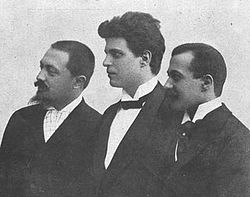
Mikhail Glinka
Mikhail Ivanovich Glinka , was the first Russian composer to gain wide recognition within his own country, and is often regarded as the father of Russian classical music...
, Alexander Serov
Alexander Serov
Alexander Nikolayevich Serov – was a Russian composer and music critic. He and his wife Valentina were the parents of painter Valentin Serov...
, Rimsky-Korsakov
Nikolai Rimsky-Korsakov
Nikolai Andreyevich Rimsky-Korsakov was a Russian composer, and a member of the group of composers known as The Five.The Five, also known as The Mighty Handful or The Mighty Coterie, refers to a circle of composers who met in Saint Petersburg, Russia, in the years 1856–1870: Mily Balakirev , César...
, Puccini
Giacomo Puccini
Giacomo Antonio Domenico Michele Secondo Maria Puccini was an Italian composer whose operas, including La bohème, Tosca, Madama Butterfly, and Turandot, are among the most frequently performed in the standard repertoire...
, and Mascagni
Pietro Mascagni
Pietro Antonio Stefano Mascagni was an Italian composer most noted for his operas. His 1890 masterpiece Cavalleria rusticana caused one of the greatest sensations in opera history and single-handedly ushered in the Verismo movement in Italian dramatic music...
wrote passages of music without text and subsequently had the librettist add words to the vocal melody lines. (This has often been the case with American popular song and musicals in the 20th century, as with Richard Rodgers
Richard Rodgers
Richard Charles Rodgers was an American composer of music for more than 900 songs and for 43 Broadway musicals. He also composed music for films and television. He is best known for his songwriting partnerships with the lyricists Lorenz Hart and Oscar Hammerstein II...
and Lorenz Hart
Lorenz Hart
Lorenz "Larry" Milton Hart was the lyricist half of the famed Broadway songwriting team Rodgers and Hart...
's collaboration, although with the later team of Rodgers and Hammerstein
Rodgers and Hammerstein
Richard Rodgers and Oscar Hammerstein II were a well-known American songwriting duo, usually referred to as Rodgers and Hammerstein. They created a string of popular Broadway musicals in the 1940s and 1950s during what is considered the golden age of the medium...
the lyrics were generally written first.)
Some composers wrote their own libretti. Richard Wagner
Richard Wagner
Wilhelm Richard Wagner was a German composer, conductor, theatre director, philosopher, music theorist, poet, essayist and writer primarily known for his operas...
is perhaps most famous in this regard, with his transformations of Germanic legends and events into epic subjects for his operas and music dramas. Hector Berlioz
Hector Berlioz
Hector Berlioz was a French Romantic composer, best known for his compositions Symphonie fantastique and Grande messe des morts . Berlioz made significant contributions to the modern orchestra with his Treatise on Instrumentation. He specified huge orchestral forces for some of his works; as a...
, too, wrote the libretti for two of his best-known works, La Damnation de Faust and Les Troyens
Les Troyens
Les Troyens is a French opera in five acts by Hector Berlioz. The libretto was written by Berlioz himself, based on Virgil's epic poem The Aeneid...
. Alban Berg
Alban Berg
Alban Maria Johannes Berg was an Austrian composer. He was a member of the Second Viennese School with Arnold Schoenberg and Anton Webern, and produced compositions that combined Mahlerian Romanticism with a personal adaptation of Schoenberg's twelve-tone technique.-Early life:Berg was born in...
adapted Georg Büchner
Georg Büchner
Karl Georg Büchner was a German dramatist and writer of poetry and prose. He was the brother of physician and philosopher Ludwig Büchner. Büchner's talent is generally held in great esteem in Germany...
's play Woyzeck
Woyzeck
Woyzeck is a stage play written by Georg Büchner. He left the work incomplete at his death, but it has been variously and posthumously "finished" by a variety of authors, editors and translators. Woyzeck has become one of the most performed and influential plays in the German theatre...
for the libretto of Wozzeck
Wozzeck
Wozzeck is the first opera by the Austrian composer Alban Berg. It was composed between 1914 and 1922 and first performed in 1925. The opera is based on the drama Woyzeck left incomplete by the German playwright Georg Büchner at his death. Berg attended the first production in Vienna of Büchner's...
.
Sometimes the libretto is written in close collaboration with the composer; this can involve adaptation, as was the case with Rimsky-Korsakov
Nikolai Rimsky-Korsakov
Nikolai Andreyevich Rimsky-Korsakov was a Russian composer, and a member of the group of composers known as The Five.The Five, also known as The Mighty Handful or The Mighty Coterie, refers to a circle of composers who met in Saint Petersburg, Russia, in the years 1856–1870: Mily Balakirev , César...
and his librettist Bel'sky, or an entirely original work. In the case of musicals, the music, the lyrics, and the "book" (i.e., the spoken dialogue and the stage directions) may each have their own author. Thus, a musical such as Fiddler on the Roof
Fiddler on the Roof
Fiddler on the Roof is a musical with music by Jerry Bock, lyrics by Sheldon Harnick, and book by Joseph Stein, set in Tsarist Russia in 1905. It is based on Tevye and his Daughters by Sholem Aleichem...
has a composer (Jerry Bock
Jerry Bock
Jerrold Lewis "Jerry" Bock was an American musical theater composer. He received the Tony Award for Best Musical and the Pulitzer Prize for Drama with Sheldon Harnick for their 1959 musical Fiorello! and the Tony Award for Best Composer and Lyricist for the 1964 musical Fiddler on the Roof with...
), a lyricist (Sheldon Harnick
Sheldon Harnick
Sheldon Harnick is an American lyricist best known for his collaborations with composer Jerry Bock on hit musicals such as Fiddler on the Roof....
), and the writer of the "book" (Joseph Stein
Joseph Stein
Joseph Stein was an American playwright best known for writing the books for such musicals as Fiddler on the Roof and Zorba.-Biography:...
). In rare cases, the composer writes everything except the dance arrangements - music, lyrics, and libretto, as Lionel Bart
Lionel Bart
Lionel Bart was a writer and composer of British pop music and musicals, best known for creating the book, music and lyrics for Oliver!-Early life:...
did for Oliver!
Oliver!
Oliver! is a British musical, with script, music and lyrics by Lionel Bart. The musical is based upon the novel Oliver Twist by Charles Dickens....
.
Other matters in the process of developing a libretto parallel those of spoken drama
Drama
Drama is the specific mode of fiction represented in performance. The term comes from a Greek word meaning "action" , which is derived from "to do","to act" . The enactment of drama in theatre, performed by actors on a stage before an audience, presupposes collaborative modes of production and a...
s for stage or screen. There are the preliminary steps of selecting or suggesting a subject and developing a sketch of the action in the form of a scenario
Scenario
A scenario is a synoptical collage of an event or series of actions and events. In the Commedia dell'arte it was an outline of entrances, exits, and action describing the plot of a play that was literally pinned to the back of the scenery...
, as well as revisions that might come about when the work is in production, as with out-of-town tryouts for Broadway musicals, or changes made for a specific local audience. A famous case of the latter is Wagner's 1861 revision of the original 1845 Dresden
Dresden
Dresden is the capital city of the Free State of Saxony in Germany. It is situated in a valley on the River Elbe, near the Czech border. The Dresden conurbation is part of the Saxon Triangle metropolitan area....
version of his opera Tannhäuser for Paris.
Literary characteristics
The opera libretto from its inception (ca. 1600) was written in verse, and this continued well into the 19th century, although genres of musical theater with spoken dialogue have typically alternated verse in the musical numbers with spoken prose. Since the late 19th century some opera composers have written music to prose or free verse libretti. Much of the recitativeRecitative
Recitative , also known by its Italian name "recitativo" , is a style of delivery in which a singer is allowed to adopt the rhythms of ordinary speech...
of George Gershwin
George Gershwin
George Gershwin was an American composer and pianist. Gershwin's compositions spanned both popular and classical genres, and his most popular melodies are widely known...
's opera Porgy and Bess
Porgy and Bess
Porgy and Bess is an opera, first performed in 1935, with music by George Gershwin, libretto by DuBose Heyward, and lyrics by Ira Gershwin and DuBose Heyward. It was based on DuBose Heyward's novel Porgy and subsequent play of the same title, which he co-wrote with his wife Dorothy Heyward...
, for instance, is merely DuBose
DuBose Heyward
Edwin DuBose Heyward was a white American author best known for his 1925 novel Porgy. This novel was the basis for the play by the same name and, in turn, the opera Porgy and Bess with music by George Gershwin.-Life and career:Heyward was born in 1885 in Charleston, South Carolina and was a...
and Dorothy Heyward
Dorothy Heyward
Dorothy Heyward Dorothy Heyward Dorothy Heyward (née Kuhns, (June 6, 1890 – November 19, 1961) was an American playwright.Born in Wooster, Ohio, she was married to the author DuBose Heyward, and adapted several of his scripts for the stage, including Porgy.-External links:...
's play Porgy
Porgy
Porgy is a novel written by American author DuBose Heyward in 1925, as well as a play Dorothy Heyward helped him to write which debuted in 1927....
set to music as written - in prose - with the lyrics of the aria
Aria
An aria in music was originally any expressive melody, usually, but not always, performed by a singer. The term is now used almost exclusively to describe a self-contained piece for one voice usually with orchestral accompaniment...
s, duets, trio
Trio (music)
Trio is generally used in any of the following ways:* A group of three musicians playing the same or different musical instrument.* The performance of a piece of music by three people.* The contrasting section of a piece in ternary form...
s and choruses
Refrain
A refrain is the line or lines that are repeated in music or in verse; the "chorus" of a song...
written in verse.
The libretto of a musical, on the other hand, is almost always written in prose (except for the song lyrics). The libretto of a musical, if the musical is adapted from a play (or even a novel), may even borrow their source's original dialogue liberally - much as Oklahoma!
Oklahoma!
Oklahoma! is the first musical written by composer Richard Rodgers and librettist Oscar Hammerstein II. The musical is based on Lynn Riggs' 1931 play, Green Grow the Lilacs. Set in Oklahoma Territory outside the town of Claremore in 1906, it tells the story of cowboy Curly McLain and his romance...
used dialogue from Lynn Riggs
Lynn Riggs
Rollie Lynn Riggs was an author, poet and playwright born on a farm near Claremore, Oklahoma. His mother was 1/8 Cherokee, and when he was two years old, his mother secured his Cherokee allotment for him. He was able to draw on his allotment to help support his writing...
's Green Grow the Lilacs
Green Grow the Lilacs (play)
Green Grow the Lilacs is a 1930 play by Lynn Riggs named for the popular folk song of the same name. It was performed 64 times on Broadway, opening on January 26, 1931 and closing March 21, 1931. It also played January 19, 1931 through January 24, 1931 at the National Theatre in Washington, D.C. It...
, Carousel
Carousel (musical)
Carousel is the second stage musical by the team of Richard Rodgers and Oscar Hammerstein II . The work premiered in 1945 and was adapted from Ferenc Molnár's 1909 play Liliom, transplanting its Budapest setting to the Maine coastline...
used dialogue from Ferenc Molnár
Ferenc Molnár
LanguageFerenc Molnár was a Hungarian dramatist and novelist. His Americanized name was Franz Molnar...
's Liliom
Liliom
Liliom is a 1909 play by the Hungarian playwright Ferenc Molnár. It was very famous in its own right during the early to mid-20th century, but is best known today as the basis for the Rodgers and Hammerstein musical Carousel.- Plot :...
, My Fair Lady
My Fair Lady
My Fair Lady is a musical based upon George Bernard Shaw's Pygmalion and with book and lyrics by Alan Jay Lerner and music by Frederick Loewe...
took most of its dialogue word-for-word from George Bernard Shaw
George Bernard Shaw
George Bernard Shaw was an Irish playwright and a co-founder of the London School of Economics. Although his first profitable writing was music and literary criticism, in which capacity he wrote many highly articulate pieces of journalism, his main talent was for drama, and he wrote more than 60...
's Pygmalion
Pygmalion (play)
Pygmalion: A Romance in Five Acts is a play by Irish playwright George Bernard Shaw. Professor of phonetics Henry Higgins makes a bet that he can train a bedraggled Cockney flower girl, Eliza Doolittle, to pass for a duchess at an ambassador's garden party by teaching her to assume a veneer of...
, Man of La Mancha
Man of La Mancha
Man of La Mancha is a musical with a book by Dale Wasserman, lyrics by Joe Darion and music by Mitch Leigh. It is adapted from Wasserman's non-musical 1959 teleplay I, Don Quixote, which was in turn inspired by Miguel de Cervantes's seventeenth century masterpiece Don Quixote...
took most of its dialogue from the 1959 television play I, Don Quixote
I, Don Quixote
I, Don Quixote is a non-musical play written for television, and broadcast on the CBS anthology series DuPont Show of the Month on the evening of November 9, 1959. Written by Dale Wasserman, the play was converted by him ca. 1964 into the libretto for the stage musical Man of La Mancha, with songs...
(from which it was adapted), and the 1954 musical version of Peter Pan
Peter Pan
Peter Pan is a character created by Scottish novelist and playwright J. M. Barrie . A mischievous boy who can fly and magically refuses to grow up, Peter Pan spends his never-ending childhood adventuring on the small island of Neverland as the leader of his gang the Lost Boys, interacting with...
used J.M. Barrie's dialogue. Even the musical Show Boat
Show Boat
Show Boat is a musical in two acts with music by Jerome Kern and book and lyrics by Oscar Hammerstein II. It was originally produced in New York in 1927 and in London in 1928, and was based on the 1926 novel of the same name by Edna Ferber. The plot chronicles the lives of those living and working...
, which is greatly different from the Edna Ferber novel from which it was adapted
Show Boat (novel)
Show Boat is a 1926 novel by American author and dramatist Edna Ferber. It chronicles the lives of three generations of performers on the Cotton Blossom, a floating theater that travels between small towns on the banks of the Mississippi, from the 1880s to the 1920s...
uses some of Ferber's original dialogue, notably during the miscegenation
Miscegenation
Miscegenation is the mixing of different racial groups through marriage, cohabitation, sexual relations, and procreation....
scene. And Lionel Bart's Oliver! uses chunks of dialogue from Charles Dickens
Charles Dickens
Charles John Huffam Dickens was an English novelist, generally considered the greatest of the Victorian period. Dickens enjoyed a wider popularity and fame than had any previous author during his lifetime, and he remains popular, having been responsible for some of English literature's most iconic...
's novel Oliver Twist, although it bills itself as a "free adaptation" of the novel.
Language and translation

Saint Petersburg
Saint Petersburg is a city and a federal subject of Russia located on the Neva River at the head of the Gulf of Finland on the Baltic Sea...
was challenged by the emerging native Russian repertory. Significant exceptions before 1800 can be found in Purcell
Henry Purcell
Henry Purcell – 21 November 1695), was an English organist and Baroque composer of secular and sacred music. Although Purcell incorporated Italian and French stylistic elements into his compositions, his legacy was a uniquely English form of Baroque music...
's works, German opera of Hamburg
Hamburg
-History:The first historic name for the city was, according to Claudius Ptolemy's reports, Treva.But the city takes its modern name, Hamburg, from the first permanent building on the site, a castle whose construction was ordered by the Emperor Charlemagne in AD 808...
during the Baroque, ballad opera
Ballad opera
The term ballad opera is used to refer to a genre of English stage entertainment originating in the 18th century and continuing to develop in the following century and later. There are many types of ballad opera...
and Singspiel
Singspiel
A Singspiel is a form of German-language music drama, now regarded as a genre of opera...
of the 18th century, etc.
Just as with literature and song, the libretto has its share of problems and challenges with translation
Translation
Translation is the communication of the meaning of a source-language text by means of an equivalent target-language text. Whereas interpreting undoubtedly antedates writing, translation began only after the appearance of written literature; there exist partial translations of the Sumerian Epic of...
. In the past (and even today), foreign musical stage works with spoken dialogue, especially comedies, were sometimes performed with the sung portions in the original language and the spoken dialogue in the vernacular. The effects of leaving lyrics untranslated depend on the piece. Many musicals, such as the old Betty Grable
Betty Grable
Elizabeth Ruth "Betty" Grable was an American actress, dancer and singer.Her iconic bathing suit photo made her the number-one pin-up girl of the World War II era. It was later included in the LIFE magazine project "100 Photos that Changed the World"...
- Don Ameche
Don Ameche
Don Ameche was an Academy Award winning American actor with a career spanning almost sixty years.-Personal life:...
- Carmen Miranda
Carmen Miranda
Carmen Miranda, GCIH was a Portuguese-born Brazilian samba singer, Broadway actress and Hollywood film star popular in the 1940s and 1950s. She was, by some accounts, the highest-earning woman in the United States and noted for her signature fruit hat outfit she wore in the 1943 movie The Gang's...
vehicles, are largely unaffected, but this practice is especially misleading in translations of musicals like Show Boat
Show Boat
Show Boat is a musical in two acts with music by Jerome Kern and book and lyrics by Oscar Hammerstein II. It was originally produced in New York in 1927 and in London in 1928, and was based on the 1926 novel of the same name by Edna Ferber. The plot chronicles the lives of those living and working...
, The Wizard of Oz
The Wizard of Oz (1902 stage play)
The Wizard of Oz was a 1902 musical extravaganza based on The Wonderful Wizard of Oz by L. Frank Baum, which was originally published in 1900...
, My Fair Lady or Carousel, in which the lyrics to the songs and the spoken text are often or always closely integrated, and the lyrics serve to further the plot. Availability of printed or projected translations today makes singing in the original language more practical, although one cannot discount the desire to hear a sung drama in one's own language.
The Spanish words libretista (playwright, script writer or screen writer) and libreto (script or screen play), which are used in the Hispanic TV and cinema industry, derived their meanings from the original operatic sense.
Status of librettists and the libretto
,_la_figlia_di_iorio_(1914).jpg)
these records often survive better than music left in manuscript. But even in late 18th-century London, reviews rarely mentioned the name of the librettist,
as Lorenzo da Ponte
Lorenzo Da Ponte
Lorenzo Da Ponte was a Venetian opera librettist and poet. He wrote the librettos for 28 operas by 11 composers, including three of Mozart's greatest operas, Don Giovanni, The Marriage of Figaro and Così fan tutte....
lamented in his Memoirs.
By the 20th century some librettists became recognized as part of famous collaborations, as with Gilbert and Sullivan
Gilbert and Sullivan
Gilbert and Sullivan refers to the Victorian-era theatrical partnership of the librettist W. S. Gilbert and the composer Arthur Sullivan . The two men collaborated on fourteen comic operas between 1871 and 1896, of which H.M.S...
or Rodgers and Hammerstein. Today the composer (past or present) of the musical score to an opera or operetta is usually given top billing for the completed work, and the writer of the lyrics relegated to second place or a mere footnote, a notable exception being Gertrude Stein
Gertrude Stein
Gertrude Stein was an American writer, poet and art collector who spent most of her life in France.-Early life:...
, who received top billing for Four Saints in Three Acts
Four Saints in Three Acts
Four Saints in Three Acts is an opera by American composer Virgil Thomson with a libretto by Gertrude Stein. Written in 1927-8, it contains about 20 saints, and is in at least four acts...
. Another exception was Alberto Franchetti
Alberto Franchetti
Alberto Franchetti was an Italian opera composer.-Biography:Alberto Franchetti was born in Turin, a Jewish nobleman of independent means. He studied first in Venice, then in Dresden under Felix Draeseke, and finally at the Munich Conservatory under Josef Rheinberger. His first major success...
's 1906 opera La figlia di Iorio
La figlia di Iorio
La figlia di Iorio , sometimes written as La figlia di Jorio, is an opera in three acts by Alberto Franchetti to a libretto by Gabriele D'Annunzio. The libretto is a very close rendering of D'Annunzio's play of the same name. La figlia di Iorio premiered at La Scala on March 29, 1906, conducted by...
which was a close rendering of a highly successful play by its librettist, Gabriele D'Annunzio
Gabriele D'Annunzio
Gabriele D'Annunzio or d'Annunzio was an Italian poet, journalist, novelist, and dramatist...
, a celebrated Italian poet, novelist, and dramatist of the day. In some cases, the operatic adaptation has become more famous than the literary text on which it was based, as with Claude Debussy
Claude Debussy
Claude-Achille Debussy was a French composer. Along with Maurice Ravel, he was one of the most prominent figures working within the field of impressionist music, though he himself intensely disliked the term when applied to his compositions...
's Pelléas et Mélisande
Pelléas et Mélisande (opera)
Pelléas et Mélisande is an opera in five acts with music by Claude Debussy. The French libretto was adapted from Maurice Maeterlinck's Symbolist play Pelléas et Mélisande...
after a play by Maurice Maeterlinck
Maurice Maeterlinck
Maurice Polydore Marie Bernard Maeterlinck, also called Comte Maeterlinck from 1932, was a Belgian playwright, poet, and essayist who wrote in French. He was awarded the Nobel Prize in Literature in 1911. The main themes in his work are death and the meaning of life...
.
On the other hand, the affiliation of a poor libretto to great music has sometimes given the libretto's author a kind of accidental immortality. Certainly it is common for works of classical music to be admired in spite of, rather than because of, their libretti. An example is Mozart's inept librettist Varesco
Varesco
Father Varesco was a chaplain, musician, poet and librettist to Wolfgang Amadeus Mozart. His given name variously appears as Giambattista, Gianbattista, Giovanni Battista and Girolamo Giovanni Battista...
.
The question of which is more important in opera — the music or the words — has been debated over time, and forms the basis of at least two operas, Richard Strauss
Richard Strauss
Richard Georg Strauss was a leading German composer of the late Romantic and early modern eras. He is known for his operas, which include Der Rosenkavalier and Salome; his Lieder, especially his Four Last Songs; and his tone poems and orchestral works, such as Death and Transfiguration, Till...
's Capriccio
Capriccio (opera)
Capriccio is the final opera by German composer Richard Strauss, subtitled "A Conversation Piece for Music". The opera received its premiere performance at the Nationaltheater München on October 28, 1942. Clemens Krauss and Strauss himself wrote the German libretto...
, and Antonio Salieri
Antonio Salieri
Antonio Salieri was a Venetian classical composer, conductor and teacher born in Legnago, south of Verona, in the Republic of Venice, but who spent his adult life and career as a faithful subject of the Habsburg monarchy....
's Prima la musica, poi le parole.
Publication of libretti
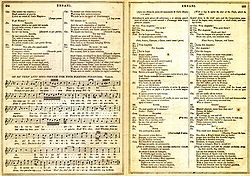
Opera
Opera is an art form in which singers and musicians perform a dramatic work combining text and musical score, usually in a theatrical setting. Opera incorporates many of the elements of spoken theatre, such as acting, scenery, and costumes and sometimes includes dance...
s in the public domain
Public domain
Works are in the public domain if the intellectual property rights have expired, if the intellectual property rights are forfeited, or if they are not covered by intellectual property rights at all...
) this format is supplemented with melodic excerpts of musical notation
Sheet music
Sheet music is a hand-written or printed form of music notation that uses modern musical symbols; like its analogs—books, pamphlets, etc.—the medium of sheet music typically is paper , although the access to musical notation in recent years includes also presentation on computer screens...
for important numbers
Number (music)
A number in music is a self-contained piece that is combined with other such pieces in a performance. In a concert of popular music, for example, the individual songs or pieces performed are often referred to as "numbers." The term is applied also to sections of large vocal works when the...
.
Printed scores
Sheet music
Sheet music is a hand-written or printed form of music notation that uses modern musical symbols; like its analogs—books, pamphlets, etc.—the medium of sheet music typically is paper , although the access to musical notation in recent years includes also presentation on computer screens...
for operas naturally contain the entire libretto, although there can exist significant differences between the score and the separately printed text. More often than not, this involves the extra repetition of words or phrases from the libretto in the actual score. For example, in the aria
Aria
An aria in music was originally any expressive melody, usually, but not always, performed by a singer. The term is now used almost exclusively to describe a self-contained piece for one voice usually with orchestral accompaniment...
'Nessun dorma
Nessun dorma
Nessun dorma is an aria from the final act of Giacomo Puccini's opera Turandot, and is one of the best-known tenor arias in all opera. It is sung by Calaf, il principe ignoto , who falls in love at first sight with the beautiful but cold Princess Turandot...
' from Puccini's Turandot
Turandot
Turandot is an opera in three acts by Giacomo Puccini, set to a libretto in Italian by Giuseppe Adami and Renato Simoni.Though Puccini's first interest in the subject was based on his reading of Friedrich Schiller's adaptation of the play, his work is most nearly based on the earlier text Turandot...
, the final lines in the libretto are "Tramontate, stelle!
All'alba, vincerò!" (Fade, you stars! At dawn, I will win!). However, in the score they are sung as "Tramontate, stelle! Tramontate, stelle! All'alba, vincerò! Vincerò! Vincerò!"
Because the modern musical tends to be published in two separate but intersecting formats (i.e., the book and lyrics, with all the words, and the piano-vocal score, with all the musical material, including some spoken cues), both are needed in order to make a thorough reading of an entire show.
External links
- Selected Opera Libretti at NaxosNaxos RecordsNaxos Records is a record label specializing in classical music. Through a number of imprints, Naxos also releases genres including Chinese music, jazz, world music, and early rock & roll. The company was founded in 1987 by Klaus Heymann, a German-born resident of Hong Kong.Naxos is the largest...
- Public-Domain Opera Libretti and Other Vocal Texts
- 400 Librettos of the most famous Operas
- Либретто во сне и наяву (Libretto in dream and in reality), holding Russian and some Western libretti (in the Russian language, as Microsoft Word files), notably: Libretti of classic Russian operas (in Russian)
- Index of over 900 opera libretti