

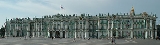
Winter Palace

Encyclopedia
Saint Petersburg
Saint Petersburg is a city and a federal subject of Russia located on the Neva River at the head of the Gulf of Finland on the Baltic Sea...
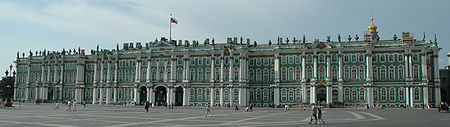
, Russia, was, from 1732 to 1917, the official residence of the Russian monarchs. Situated between the Palace Embankment
Palace Embankment
The Palace Embankment or Palace Quay is a street along the Neva River in Central Saint Petersburg which contains the complex of the Hermitage Museum buildings , the Hermitage Theatre, the Marble Palace, the Vladimir Palace, the New Michael Palace and the Summer Garden.The street was laid out...
and the Palace Square
Palace Square
Palace Square , connecting Nevsky Prospekt with Palace Bridge leading to Vasilievsky Island, is the central city square of St Petersburg and of the former Russian Empire...
, adjacent to the site of Peter the Great's original Winter Palace, the present and fourth Winter Palace was built and altered almost continuously between the late 1730s and 1837, when it was severely damaged by fire and immediately rebuilt. The storming of the palace in 1917 became an iconic symbol of the Russian Revolution.
The palace was constructed on a monumental scale that was intended to reflect the might and power of Imperial Russia. From the palace, the Tsar
Tsar
Tsar is a title used to designate certain European Slavic monarchs or supreme rulers. As a system of government in the Tsardom of Russia and Russian Empire, it is known as Tsarist autocracy, or Tsarism...
ruled over 22400000 square kilometres (8,648,688.4 sq mi) (almost 1/6 of the Earth's landmass) and over 125 million subjects by the end of the 19th century. It was designed by many architects, most notably Bartolomeo Rastrelli
Bartolomeo Rastrelli
Francesco Bartolomeo Rastrelli was an Italian architect naturalized Russian. He developed an easily recognizable style of Late Baroque, both sumptuous and majestic...
, in what came to be known as the Elizabethan Baroque style. The green-and-white palace has the shape of an elongated rectangle, and its principal façade is 250 m long and 100 ft (30.5 m) high. The Winter Palace has been calculated to contain 1,786 doors, 1,945 windows, 1,500 rooms and 117 staircases. The rebuilding of 1837 left the exterior unchanged, but large parts of the interior were redesigned in a variety of tastes and styles, leading the palace to be described as a "19th-century palace inspired by a model in Rococo
Rococo
Rococo , also referred to as "Late Baroque", is an 18th-century style which developed as Baroque artists gave up their symmetry and became increasingly ornate, florid, and playful...
style."
In 1905, the Bloody Sunday
Bloody Sunday (1905)
Bloody Sunday was a massacre on in St. Petersburg, Russia, where unarmed, peaceful demonstrators marching to present a petition to Tsar Nicholas II were gunned down by the Imperial Guard while approaching the city center and the Winter Palace from several gathering points. The shooting did not...
massacre occurred when demonstrators marched toward the Winter Palace, but by this time the Imperial Family had chosen to live in the more secure and secluded Alexander Palace
Alexander Palace
The Alexander Palace is a former imperial residence at Tsarskoye Selo, on a plateau around 30 minutes by train from St Petersburg. It is known as the favourite residence of the last Russian Emperor, Nicholas II, and his family and their initial place of imprisonment after the revolution that...
at Tsarskoe Selo, and returned to the Winter Palace only for the most formal and rarest state occasions. Following the February Revolution of 1917, the palace was for a short time the seat of the Russian Provisional Government
Russian Provisional Government
The Russian Provisional Government was the short-lived administrative body which sought to govern Russia immediately following the abdication of Tsar Nicholas II . On September 14, the State Duma of the Russian Empire was officially dissolved by the newly created Directorate, and the country was...
, led by Alexander Kerensky
Alexander Kerensky
Alexander Fyodorovich Kerensky was a major political leader before and during the Russian Revolutions of 1917.Kerensky served as the second Prime Minister of the Russian Provisional Government until Vladimir Lenin was elected by the All-Russian Congress of Soviets following the October Revolution...
. Later that same year, the palace was stormed by a detachment of Red Army
Red Army
The Workers' and Peasants' Red Army started out as the Soviet Union's revolutionary communist combat groups during the Russian Civil War of 1918-1922. It grew into the national army of the Soviet Union. By the 1930s the Red Army was among the largest armies in history.The "Red Army" name refers to...
soldiers and sailors—a defining moment in the birth of the Soviet state. On a less glorious note, the month-long looting of the palace's wine cellars during this troubled period led to what has been described as "the greatest hangover in history". Today, the restored palace forms part of the complex of buildings housing the Hermitage Museum
Hermitage Museum
The State Hermitage is a museum of art and culture in Saint Petersburg, Russia. One of the largest and oldest museums of the world, it was founded in 1764 by Catherine the Great and has been opened to the public since 1852. Its collections, of which only a small part is on permanent display,...
.
Peter the Great's Winter Palace (1711–1753)
Grand Embassy of Peter I
The Grand Embassy was a Russian diplomatic mission, sent to Western Europe in 1697-1698 by Peter the Great....
in 1698, Peter I of Russia
Peter I of Russia
Peter the Great, Peter I or Pyotr Alexeyevich Romanov Dates indicated by the letters "O.S." are Old Style. All other dates in this article are New Style. ruled the Tsardom of Russia and later the Russian Empire from until his death, jointly ruling before 1696 with his half-brother, Ivan V...
embarked on a policy of Westernization
Westernization
Westernization or Westernisation , also occidentalization or occidentalisation , is a process whereby societies come under or adopt Western culture in such matters as industry, technology, law, politics, economics, lifestyle, diet, language, alphabet,...
and expansion that was to transform the Tsardom of Russia
Tsardom of Russia
The Tsardom of Russia was the name of the centralized Russian state from Ivan IV's assumption of the title of Tsar in 1547 till Peter the Great's foundation of the Russian Empire in 1721.From 1550 to 1700, Russia grew 35,000 km2 a year...
into the Russian Empire
Russian Empire
The Russian Empire was a state that existed from 1721 until the Russian Revolution of 1917. It was the successor to the Tsardom of Russia and the predecessor of the Soviet Union...
and a major European power. This policy was manifested in bricks and mortar by the creation of a new city, Saint Petersburg, in 1703. The culture and design of the new city was intended as a conscious rejection of traditional Byzantine
Byzantine
Byzantine usually refers to the Roman Empire during the Middle Ages.Byzantine may also refer to:* A citizen of the Byzantine Empire, or native Greek during the Middle Ages...
-influenced Russian architecture
Russian architecture
Russian architecture follows a tradition whose roots were established in the Eastern Slavic state of Kievan Rus'. After the fall of Kiev, Russian architectural history continued in the principalities of Vladimir-Suzdal, Novgorod, the succeeding states of the Tsardom of Russia, the Russian Empire,...
, such as the then-fashionable Naryshkin Baroque
Naryshkin Baroque
Naryshkin Baroque, also called Moscow Baroque, or Muscovite Baroque, is the name given to a particular style of Baroque architecture and decoration which was fashionable in Moscow from the turn of the 17th into the early 18th centuries.-Style:...
, in favour of the classically inspired architecture prevailing in the great cities of Europe. The Tsar intended that his new city would be designed in a Flemish renaissance style, later known as Petrine Baroque
Petrine Baroque
Petrine Baroque is a name applied by art historians to a style of Baroque architecture and decoration favoured by Peter the Great and employed to design buildings in the newly-founded Russian capital, Saint Petersburg, under this monarch and his immediate successors.Unlike contemporaneous Naryshkin...
, and this was the style he selected for his new palace in the city. The first Royal residence on the site had been a humble log cabin then known as the Domik Petra I
Cabin of Peter the Great
The cabin of Peter the Great is a small wooden house which was the first St Petersburg "palace" of Tsar Peter the Great....
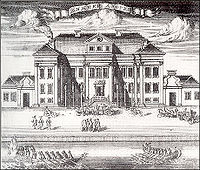
, built in 1704, which faced the River Neva. In 1711 it was transported to the Petrovskaya Embankment, where it still stands. With the site cleared, the Tsar then embarked on the building of a larger house between 1711 and 1712. This house, today referred to as the first Winter Palace, was designed by Domenico Trezzini
Domenico Trezzini
Domenico Trezzini was a Swiss Italian architect who elaborated the Petrine Baroque style of Russian architecture.Domenico was born in Astano, near Lugano, in the Italian-speaking Ticino . He probably studied in Rome...
.
The 18th century was a period of great development in European royal architecture, as the need for a fortified residence gradually lessened. This process, which had begun in the late 16th century, accelerated and great classical palaces quickly replaced fortified castles throughout the more powerful European countries. One of the earliest and most notable examples was Louis XIV
Louis XIV of France
Louis XIV , known as Louis the Great or the Sun King , was a Bourbon monarch who ruled as King of France and Navarre. His reign, from 1643 to his death in 1715, began at the age of four and lasted seventy-two years, three months, and eighteen days...
's Versailles
Palace of Versailles
The Palace of Versailles , or simply Versailles, is a royal château in Versailles in the Île-de-France region of France. In French it is the Château de Versailles....
. Largely completed by 1710, Versailles—with its size and splendour—heightened rivalry amongst the sovereigns of Europe. Peter the Great of Russia, keen to promote all western concepts, wished to have a modern palace like his fellow sovereigns. However, unlike some of his successors, Peter I never aspired to rival Versailles.
Georg Johann Mattarnovy
Georg Johann Mattarnovi was a German Baroque architect and sculptor, notable for his work in Saint Petersburg.The birthplace of Mattarnovi is unknown, but most probably it was Prussia. His year of birth is also unknown. He was a sculptor, and a disciple and assistant of German architect Andreas...
. Mattarnovy's palace, though still very modest compared to royal palaces in other European capitals, was on two floors above a rusticated ground floor, with a central projection underneath a pediment
Pediment
A pediment is a classical architectural element consisting of the triangular section found above the horizontal structure , typically supported by columns. The gable end of the pediment is surrounded by the cornice moulding...
supported by columns. It was here that Peter the Great died in 1725.
The Winter Palace was not the only palace in the unfinished city, or even the most splendid, as Peter had ordered his nobles to construct residences and to spend half the year there. This was an unpopular command; Saint Petersburg was founded upon a swamp, with little sunlight, and it was said only cabbages and turnips would grow there. It was forbidden to fell trees for fuel, so hot water was permitted just once a week. Only Peter's second wife, Tsaritsa
Tsaritsa
Tsaritsa , formerly spelled czaritsa , is the title of a female autocratic ruler of Bulgaria or Russia, or the title of a tsar's wife....
Catherine
Catherine I of Russia
Catherine I , the second wife of Peter the Great, reigned as Empress of Russia from 1725 until her death.-Life as a peasant woman:The life of Catherine I was said by Voltaire to be nearly as extraordinary as that of Peter the Great himself. There are no documents that confirm her origins. Born on...
, pretended to enjoy life in the new city.
As a result of pressed slave labour from all over the Empire, work on the city progressed quickly. It has been estimated that 200,000 people died in twenty years while building the city. A diplomat of the time, who described the city as "a heap of villages linked together, like some plantation in the West Indies", just a few years later called it "a wonder of the world, considering its magnificent palaces". Some of these new palaces in Peter's beloved Flemish Baroque style, such as the Kikin Hall and the Menshikov Palace
Menshikov Palace
The Menshikov Palace is a Petrine Baroque edifice in Saint Petersburg, situated on Universitetskaya Embankment of the Bolshaya Neva on Vasilyevsky Island. It was the first stone building in the city...
, still stand.
The palace 1725–1855

SERF
A spin exchange relaxation-free magnetometer is a type of magnetometer developed at Princeton University in the early 2000s. SERF magnetometers measure magnetic fields by using lasers to detect the interaction between alkali metal atoms in a vapor and the magnetic field.The name for the technique...
s, imported to build the Tsar's new city and Baltic fleet
Baltic Fleet
The Twice Red Banner Baltic Fleet - is the Russian Navy's presence in the Baltic Sea. In previous historical periods, it has been part of the navy of Imperial Russia and later the Soviet Union. The Fleet gained the 'Twice Red Banner' appellation during the Soviet period, indicating two awards of...
, frequently rebelled.
Peter I was succeeded by his widow, Catherine I, who reigned until her death in 1727. She in turn was succeeded by Peter I's grandson Peter II
Peter II of Russia
Pyotr II Alekseyevich was Emperor of Russia from 1727 until his death. He was the only son of Tsarevich Alexei Petrovich, son of Peter I of Russia by his first wife Eudoxia Lopukhina, and Princess Charlotte, daughter of Duke Louis Rudolph of Brunswick-Lüneburg and sister-in-law of Charles VI,...
, who in 1727 had Mattarnovy's palace greatly enlarged by the architect Domenico Trezzini
Domenico Trezzini
Domenico Trezzini was a Swiss Italian architect who elaborated the Petrine Baroque style of Russian architecture.Domenico was born in Astano, near Lugano, in the Italian-speaking Ticino . He probably studied in Rome...
. Trezzini, who had designed the Summer Palace in 1711, was one of the greatest exponents of the Petrine Baroque
Petrine Baroque
Petrine Baroque is a name applied by art historians to a style of Baroque architecture and decoration favoured by Peter the Great and employed to design buildings in the newly-founded Russian capital, Saint Petersburg, under this monarch and his immediate successors.Unlike contemporaneous Naryshkin...
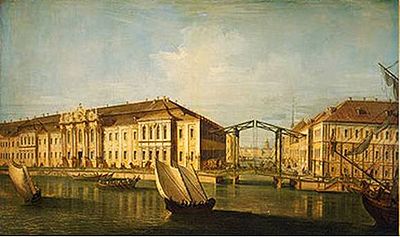
style, now completely redesigned and expanded Mattarnovy's existing Winter Palace to such an extent that Mattarnovy's entire palace became merely one of the two terminating pavilions of the new, and third, Winter Palace. The third palace, like the second, was in the Petrine Baroque style.
In 1728, shortly after the third palace was completed, the Imperial Court left Saint Petersburg for Moscow, and the Winter Palace lost its status as the principal imperial residence. Moscow had once again been designated the capital city, a status which had been granted to Saint Petersburg in 1713. Following the death of Peter II in 1730, the throne passed to a niece of Peter I, Anna Ivanovna, Duchess of Courland
Anna of Russia
Anna of Russia or Anna Ivanovna reigned as Duchess of Courland from 1711 to 1730 and as Empress of Russia from 1730 to 1740.-Accession to the throne:Anna was the daughter of Ivan V of Russia, as well as the niece of Peter the Great...
.
Anna (1730–1740)
The new Tsaritsa cared more for Saint Petersburg than her immediate predecessors; she re-established the Imperial court at the Winter Palace and, in 1732, Saint Petersburg again officially replaced Moscow as Russia's capital, a position it was to hold until 1918.Ignoring the third Winter Palace, the Tsaritsa on her return to Saint Petersburg took up residence at the neighbouring Apraksin Palace. In 1732, the Tsaritsa commissioned the architect Francesco Bartolomeo Rastrelli
Francesco Bartolomeo Rastrelli
Francesco Bartolomeo Rastrelli was an Italian architect naturalized Russian. He developed an easily recognizable style of Late Baroque, both sumptuous and majestic...
to completely rebuild and extend the Apraksin Palace, incorporating other neighbouring houses. Thus, the core of fourth and final Winter Palace is not the palace of Peter the Great, but the palace of Admiral General Fyodor Matveyevich Apraksin
Fyodor Matveyevich Apraksin
Count Fyodor Matveyevich Apraksin was one of the first Russian admirals who governed Estonia and Karelia from 1712 to 1723, general admiral , presided over the Russian Admiralty since 1718 and commanded the Baltic Fleet since 1723.-Early shipbuilding activities:The Apraksin brothers were...
.
The Tsaritsa Anna, though unpopular and considered "dull, coarse, fat, harsh and spiteful", was keen to introduce a more civilized and cultured air to her court. She designed new liveries for her servants and, on her orders, mead and vodka were replaced with champagne and Burgundy. She instructed the Boyars to replace their plain furniture with that of mahogany and ebony, while her own tastes in interior decoration ran to a dressing table of solid gold and an "easing stool" of silver, studded with rubies. It was against such a backdrop of magnificence and extravagance that she gave her first ball in the newly completed gallery at the Winter Palace, which, in the middle of the Russian winter, resembled an orange grove. This, the fourth version of the Winter Palace, was to be an ongoing project for the architect Rastrelli throughout the reign of the Empress Anna.
Elizabeth (1741–1762)
The baby Tsar Ivan VIIvan VI of Russia
Ivan VI Antonovich of Russia , was proclaimed Emperor of Russia in 1740, as an infant, although he never actually reigned. Within less than a year, he was overthrown by the Empress Elizabeth of Russia, Peter the Great's daughter...
, succeeding Anna in 1740, was soon deposed in a bloodless coup d'état by Grand Duchess Elizabeth, a daughter of Peter the Great. Delegating almost all powers to her favourites, the new Empress Elizabeth assumed a life of pleasure which led the court at the Winter Palace to be described later by the Russian historian Vasily Klyuchevsky
Vasily Klyuchevsky
Vasily Osipovich Klyuchevsky dominated Russian historiography at the turn of the 19th and 20th centuries. He is still regarded as one of three most reputable Russian historians, alongside Nikolay Karamzin and Sergey Solovyov.-Early life:...
as a place of "gilded squalor".
During the reign of Elizabeth, Rastrelli, still working to his original plan, devised an entirely new scheme in 1753, on a colossal scale—the present Winter Palace. The expedited completion of the palace became a matter of honour to the Empress, who regarded the palace as a symbol of national prestige. Work on the building continued throughout the year, even in the severest months of the winter. The deprivation to both the Russian people and the army caused by the ongoing Seven Years War were not permitted to hinder the progress. 859,555 rubles
Russian ruble
The ruble or rouble is the currency of the Russian Federation and the two partially recognized republics of Abkhazia and South Ossetia. Formerly, the ruble was also the currency of the Russian Empire and the Soviet Union prior to their breakups. Belarus and Transnistria also use currencies with...
had been allocated to the project, a sum raised by a tax on state-owned taverns. Though the labourers earned a monthly wage of just one ruble, the cost of the project exceeded the budget, so much so that work ceased due to lack of resources despite the Empress' obsessive desire for rapid completion. Ultimately, taxes were increased on salt and alcohol to fund the extra costs, although the Russian people were already burdened by taxes to pay for the war. The final cost was 2,500,000 rubles. By 1759, shortly before Elizabeth's death, a Winter Palace truly worthy of the name was nearing completion.
Catherine II (1762–1796)
It was Tsaritsa Elizabeth who selected the German princess, Sophie of Anhalt-Zerbst, as a bride for her nephew and successor, Peter IIIPeter III of Russia
Peter III was Emperor of Russia for six months in 1762. He was very pro-Prussian, which made him an unpopular leader. He was supposedly assassinated as a result of a conspiracy led by his wife, who succeeded him to the throne as Catherine II.-Early life and character:Peter was born in Kiel, in...
. The marriage was not a success, but it was this princess who, as Catherine the Great, came to be chiefly associated with the Winter Palace. In 1762, following a coup d'état, in which her husband was murdered, Catherine paraded her seven-year-old son, Paul
Paul I of Russia
Paul I was the Emperor of Russia between 1796 and 1801. He also was the 72nd Prince and Grand Master of the Order of Malta .-Childhood:...
, on the Winter Palace's balcony to an excited crowd below. She was not presenting her son as the new and rightful ruler of Russia, however, that honour she was usurping herself.
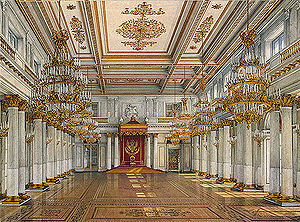
Ivan Starov
Ivan Yegorovich Starov was a Russian architect from St. Petersburg who devised the master plans for Yaroslavl, Voronezh, Pskov, Dnipropetrovsk, Mykolaiv, and many other towns in Russia and Ukraine...
and Giacomo Quarenghi
Giacomo Quarenghi
Giacomo Quarenghi was the foremost and most prolific practitioner of Palladian architecture in Imperial Russia, particularly in Saint Petersburg.- Career in Italy :...
saw the palace further enlarged and transformed. At this time an opera house which had existed in the southwestern wing of the palace was swept away to provide apartments for members of Catherine's family. In 1790, Quarenghi redesigned five of Rastrelli's state rooms to create the three vast halls of the Neva enfilade
Neva Enfilade of the Winter Palace
The Neva Enfilade of the Winter Palace, St Petersburg is a series of three large halls arranged in an enfilade along the palace's massive facade facing the River Neva....
. Catherine was responsible for the three large adjoining palaces, known collectively as the Hermitage—the name by which the entire complex, including the Winter Palace, was to become known 150 years later.
Catherine had been impressed by the French architect Jean-Baptiste Vallin de la Mothe
Jean-Baptiste Vallin de la Mothe
thumb|St. Petersburg's [[Imperial Academy of Arts]]Jean-Baptiste Michel Vallin de la Mothe was a French architect whose major career was spent in St...
, who designed the Imperial Academy of Arts
Imperial Academy of Arts
The Russian Academy of Arts, informally known as the St. Petersburg Academy of Arts, was founded in 1757 by Ivan Shuvalov under the name Academy of the Three Noblest Arts. Catherine the Great renamed it the Imperial Academy of Arts and commissioned a new building, completed 25 years later in 1789...
(also in Saint Petersburg) and commissioned him to add a new wing to the Winter Palace. This was intended as a place of retreat from the formalities and ceremonies of the court. Catherine christened it the Hermitage (14), a name used by her predecessor Tsaritsa Elizabeth to describe her private rooms within the palace.
The interior of the Hermitage wing was intended to be a simple contrast to that of the Winter Palace. Indeed, it is said that the concept of the Hermitage as a retreat was suggested to Catherine by that advocate of the simple life, Jean Jacques Rousseau. In reality, it was another large palace in itself, connected to the main palace by a series of covered walkways and heated courtyards in which flew rare exotic birds. Noted for its fine portico and attention to details of a delicate nature, it was richly furnished with an ever-growing art collection.
In this way, between 1764 and 1781 Catherine the Great acquired six major collections: those of Johann Ernst Gotzkowsky
Johann Ernst Gotzkowsky
Johann Ernst Gotzkowsky was a Prussian merchant with a successful trade in trinkets, silk, taft and porcelain. A relief on Meissen porcelain introduced in 1740s was named after him. Moreover he acted as a diplomat and art dealer...
; Heinrich von Brühl
Heinrich von Brühl
Heinrich, count von Brühl , was a German statesman at the court of Saxony and the Polish–Lithuanian Commonwealth...
; Pierre Crozat
Pierre Crozat
thumb|265px|[[Rembrandt]]'s painting [[Danaë |Danae]] from Crozat's collection.Pierre Crozat was a French art collector at the center of a broad circle of cognoscenti; he was the brother of Antoine Crozat....
; Horace Walpole; Sylvestre-Raphael Baudouin; and finally in 1787, the John Lyde-Brown collection. These large assemblies of art included works by such masters as Rembrandt, Rubens
Rubens
Rubens is often used to refer to Peter Paul Rubens , the Flemish artist.Rubens may also refer to:- People :Family name* Paul Rubens Rubens is often used to refer to Peter Paul Rubens (1577-1640), the Flemish artist.Rubens may also refer to:- People :Family name* Paul Rubens (composer) Rubens is...
, Titian
Titian
Tiziano Vecelli or Tiziano Vecellio Tiziano Vecelli or Tiziano Vecellio Tiziano Vecelli or Tiziano Vecellio (c. 1488/1490 – 27 August 1576 better known as Titian was an Italian painter, the most important member of the 16th-century Venetian school. He was born in Pieve di Cadore, near...
, Raphael
Raphael
Raffaello Sanzio da Urbino , better known simply as Raphael, was an Italian painter and architect of the High Renaissance. His work is admired for its clarity of form and ease of composition and for its visual achievement of the Neoplatonic ideal of human grandeur...
, Tiepolo
Giovanni Battista Tiepolo
Giovanni Battista Tiepolo , also known as Gianbattista or Giambattista Tiepolo, was an Italian painter and printmaker from the Republic of Venice...
, van Dyck
Anthony van Dyck
Sir Anthony van Dyck was a Flemish Baroque artist who became the leading court painter in England. He is most famous for his portraits of Charles I of England and his family and court, painted with a relaxed elegance that was to be the dominant influence on English portrait-painting for the next...
and Reni
Guido Reni
Guido Reni was an Italian painter of high-Baroque style.-Biography:Born in Bologna into a family of musicians, Guido Reni was the son of Daniele Reni and Ginevra de’ Pozzi. As a child of nine, he was apprenticed under the Bolognese studio of Denis Calvaert. Soon after, he was joined in that...
. The acquisition of 225 paintings forming the Gotzkowsky collection were a source of personal pride to Catherine. It had been put together by Gotzkowsky for Catherine's adversary, Frederick the Great of Prussia
Frederick II of Prussia
Frederick II was a King in Prussia and a King of Prussia from the Hohenzollern dynasty. In his role as a prince-elector of the Holy Roman Empire, he was also Elector of Brandenburg. He was in personal union the sovereign prince of the Principality of Neuchâtel...
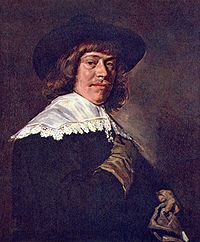
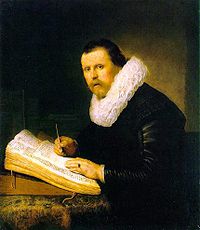
who, as a result of his wars with Russia, could not afford to pay for it. This collection included some great Flemish and Dutch works, most notably Frans Hals' "Portrait of a Young Man with a Glove." In 1769, the Bruhl collection brought to the Winter Palace two further works by Rembrandt, Portrait of a Scholar and Portrait of an Old Man in Red.
While some aspects of this manic collecting could have been a manifestation of Catherine's desire for a recognition of her intellectual concepts, there was also a more fundamental motivation: necessity. Just twenty years earlier, so scarce were the furnishings of the Imperial palaces that bedsteads, mirrors, tables and chairs had to be conveyed between Moscow and Saint Petersburg each time the court moved.
As the palace filled with art, it overflowed into the Hermitage. So large did Catherine's art collection eventually become that it became necessary to commission the German-trained architect Yury Velten to build a second and larger extension to the palace, which eventually became known as the Old Hermitage (15). Later, Catherine commissioned a third extension, the Hermitage Theatre
Hermitage Theatre
The Hermitage Theatre in Saint Petersburg, Russia is one of five Hermitage buildings lining the Palace Embankment of the Neva River.The palatial theatre was built between 1783 and 1787 at the behest of Catherine the Great to a Palladian design by Giacomo Quarenghi...
, designed by Giacomo Quarenghi
Giacomo Quarenghi
Giacomo Quarenghi was the foremost and most prolific practitioner of Palladian architecture in Imperial Russia, particularly in Saint Petersburg.- Career in Italy :...
. This construction necessitated the demolition of Peter the Great's by now crumbling third Winter palace.
Catherine was also responsible for introducing the lasting affection for all things French to the Russian court. While she personally disliked France, her distaste did not extend to its culture and manners. French became the language of the court; Russian was relegated for use only when speaking to servants and inferiors. The Russian aristocracy was encouraged to embrace the philosophies of Molière
Molière
Jean-Baptiste Poquelin, known by his stage name Molière, was a French playwright and actor who is considered to be one of the greatest masters of comedy in Western literature...
, Racine
Jean Racine
Jean Racine , baptismal name Jean-Baptiste Racine , was a French dramatist, one of the "Big Three" of 17th-century France , and one of the most important literary figures in the Western tradition...
and Corneille
Pierre Corneille
Pierre Corneille was a French tragedian who was one of the three great seventeenth-century French dramatists, along with Molière and Racine...
. The Winter Palace was to serve as a model for numerous Russian palaces belonging to Catherine's aristocracy, all of them, like the Winter Palace itself, built by the slave labour of Russian serfs. The sophistication and manners observed inside the Winter Palace were greatly at odds with the grim reality of life outside its externally gilded walls. In 1767, as the Winter Palace grew in richness and splendour, the Empress published an edict extending Russian serfdom
Russian serfdom
The origins of serfdom in Russia are traced to Kievan Rus in the 11th century. Legal documents of the epoch, such as Russkaya Pravda, distinguished several degrees of feudal dependency of peasants, the term for an unfree peasant in the Russian Empire, krepostnoi krestyanin , is translated as serf.-...
. During her reign she further enslaved over a million peasants. Work continued on the Winter Palace right up until the time of the Empress' death in 1796.
Paul I, Alexander I, and Nicholas I (1796–1855)
Paul I of Russia
Paul I was the Emperor of Russia between 1796 and 1801. He also was the 72nd Prince and Grand Master of the Order of Malta .-Childhood:...
. In the first days of his reign, the new Tsar (reported by the British Ambassador to be "not in his senses") augmented the number of troops stationed at the Winter Palace, positioning sentry boxes every few metres around the building. Eventually, paranoid for his security and disliking anything connected with his mother, he spurned the Winter Palace completely and built Saint Michael's Castle
Saint Michael's Castle
St. Michael's Castle , also called the Mikhailovsky Castle or the Engineers Castle , is a former royal residence in the historic centre of Saint Petersburg, Russia. St. Michael's Castle was built as a residence for Emperor Paul I by architects Vincenzo Brenna and Vasili Bazhenov in 1797-1801...
as his Saint Petersburg residence, on the site of his birthplace. The Tsar announced that he wished to die on the spot he was born. He was murdered there three weeks after taking up residence in 1801. Paul I was succeeded by his 24 year-old son, Alexander I
Alexander I of Russia
Alexander I of Russia , served as Emperor of Russia from 23 March 1801 to 1 December 1825 and the first Russian King of Poland from 1815 to 1825. He was also the first Russian Grand Duke of Finland and Lithuania....
, who ruled Russia during the chaotic period of the Napoleonic Wars
Napoleonic Wars
The Napoleonic Wars were a series of wars declared against Napoleon's French Empire by opposing coalitions that ran from 1803 to 1815. As a continuation of the wars sparked by the French Revolution of 1789, they revolutionised European armies and played out on an unprecedented scale, mainly due to...
. Following Napoleon's defeat in 1815, the contents of the Winter Palace were further enhanced when Alexander I purchased the art collection of the former French Empress, Joséphine
Joséphine de Beauharnais
Joséphine de Beauharnais was the first wife of Napoléon Bonaparte, and thus the first Empress of the French. Her first husband Alexandre de Beauharnais had been guillotined during the Reign of Terror, and she had been imprisoned in the Carmes prison until her release five days after Alexandre's...
. This collection, some of it plundered loot given to her by her ex-husband Napoleon
Napoleon I
Napoleon Bonaparte was a French military and political leader during the latter stages of the French Revolution.As Napoleon I, he was Emperor of the French from 1804 to 1815...
, contained amongst its many old masters Rembrandt's "The Descent from the Cross" and four sculptures by Antonio Canova
Antonio Canova
Antonio Canova was an Italian sculptor from the Republic of Venice who became famous for his marble sculptures that delicately rendered nude flesh...
.
Alexander I was succeeded in 1825 by his brother Nicholas I
Nicholas I of Russia
Nicholas I , was the Emperor of Russia from 1825 until 1855, known as one of the most reactionary of the Russian monarchs. On the eve of his death, the Russian Empire reached its historical zenith spanning over 20 million square kilometers...
. Tsar Nicholas was to be responsible for the palace's present appearance and layout. He not only effected many changes to the interior of the palace, but was responsible for its complete rebuilding following the fire of 1837.
Architecture
As completed, the overriding exterior form of the Winter Palace's architecture, with its decoration in the form of statuary and opulent stucco work on the pediments above façades and windows, is Baroque. The exterior has remained as finished during the reign of Tsaritsa Elizabeth. The principal façades, those facing the Palace Square and the Neva river, have always been accessible and visible to the public. Only the lateral façades are hidden behind graniteGranite
Granite is a common and widely occurring type of intrusive, felsic, igneous rock. Granite usually has a medium- to coarse-grained texture. Occasionally some individual crystals are larger than the groundmass, in which case the texture is known as porphyritic. A granitic rock with a porphyritic...
walls, concealing a garden created during the reign of Nicholas II. The building was conceived as a town palace, rather than a private palace within a park, such as that of the French kings at Versailles
Palace of Versailles
The Palace of Versailles , or simply Versailles, is a royal château in Versailles in the Île-de-France region of France. In French it is the Château de Versailles....
.
.jpg)
Piano nobile
The piano nobile is the principal floor of a large house, usually built in one of the styles of classical renaissance architecture...
, is distinguished by windows taller than those of the floors above and below. Each window is divided from its neighbour by a pilaster
Pilaster
A pilaster is a slightly-projecting column built into or applied to the face of a wall. Most commonly flattened or rectangular in form, pilasters can also take a half-round form or the shape of any type of column, including tortile....
. The repetitive monotony of the long elevations is broken only by symmetrically placed slightly projecting bays, many with their own small portico
Portico
A portico is a porch leading to the entrance of a building, or extended as a colonnade, with a roof structure over a walkway, supported by columns or enclosed by walls...
. This theme has been constant during all subsequent rebuilding and alterations to the palace. The only external changes have been in colour: at various times in its history the palace has been painted different shades. Following the restoration work after World War II, it was painted green with the ornament depicted in white. From 1837 to 1946, it was painted a dull red.
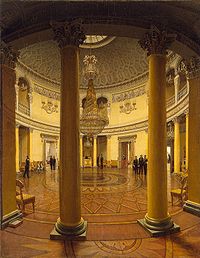
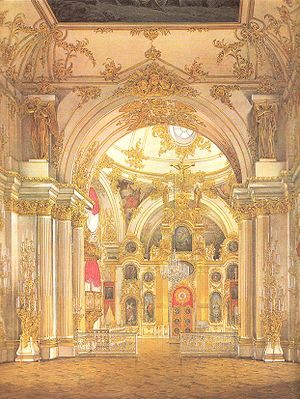
Internally, the palace appears as a combination of the Baroque and the Neoclassical. Little of Rastrelli's rococo interior design has survived; only the Jordan Staircase and the Grand Church remain in their original style. The changes to the interior were largely due to the influences of the architects employed by Catherine the Great in the last years of her life, Starov
Ivan Starov
Ivan Yegorovich Starov was a Russian architect from St. Petersburg who devised the master plans for Yaroslavl, Voronezh, Pskov, Dnipropetrovsk, Mykolaiv, and many other towns in Russia and Ukraine...
and Quarenghi
Giacomo Quarenghi
Giacomo Quarenghi was the foremost and most prolific practitioner of Palladian architecture in Imperial Russia, particularly in Saint Petersburg.- Career in Italy :...
, who began to alter much of the interior of the palace as designed by Rastrelli. Catherine always wanted the latest fashions, and during her reign the more severe neoclassical
Neoclassical architecture
Neoclassical architecture was an architectural style produced by the neoclassical movement that began in the mid-18th century, manifested both in its details as a reaction against the Rococo style of naturalistic ornament, and in its architectural formulas as an outgrowth of some classicizing...
architectural influences, fashionable in Western Europe from the late 1760s, slowly crept towards Saint Petersburg. The neoclassical interiors were further emphasised and extended during the reign of Catherine's grandson, Nicholas I.
Quarenghi is credited with introducing the Neoclassical style to Saint Petersburg. His work, together with that of Karl Ivanovich Rossi and Auguste de Montferrand
Auguste de Montferrand
Auguste de Montferrand was a French Neoclassical architect who worked primarily in Russia. His two best known works are the Saint Isaac's Cathedral and the Alexander Column in St. Petersburg.-Family:...
, gradually transformed Saint Petersburg into an "Empire Town". Montferrand not only created some of the palace's greatest neoclassical interiors, but also was responsible for the erection of the Column of Alexander during the reign of Nicholas I in Rossi's newly designed Palace Square
Palace Square
Palace Square , connecting Nevsky Prospekt with Palace Bridge leading to Vasilievsky Island, is the central city square of St Petersburg and of the former Russian Empire...
.
Interior
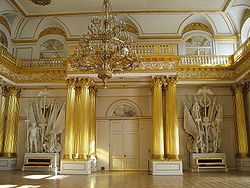
Enfilade (architecture)
In architecture, an enfilade is a suite of rooms formally aligned with each other. This was a common feature in grand European architecture from the Baroque period onwards, although there are earlier examples, such as the Vatican stanze...
s, from the top of the Jordan Staircase. The original Baroque suite of the Tsaritsa Elizabeth running west, fronting the Neva, was completely redesigned in 1790–93 by Giacomo Quarenghi. He transformed the original enfilade of five state rooms into a suite of three vast halls, decorated with faux marble columns, bas-reliefs and statuary.
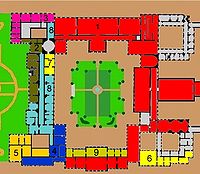
Military Gallery
The Military Gallery is a gallery of the Winter Palace in Saint Petersburg, Russia. The gallery is a setting for 332 portraits of generals who took part in the Patriotic War of 1812...
(11) was created from a series of small rooms, to celebrate the defeat of Napoleon. This gallery, which had been conceived by Alexander I, was designed by Carlo Rossi
Carlo Rossi (architect)
Carlo di Giovanni Rossi, was an Italian architect, who worked the major portion of his life in Russia. He was the author of many classical buildings and architectural ensembles in Saint Petersburg and its environments...
and was built between June and November 1826 under Nicolas I, inaugurated on 25 October 1826. For the 1812 Gallery, the Tsar commissioned 332 portraits of the generals instrumental in the defeat of France. The artist was the Briton George Dawe
George Dawe
George Dawe was an English portraitist who painted 329 portraits of Russian generals active during Napoleon's invasion of Russia for the Military Gallery of the Winter Palace...
, who received assistance from Alexander Polyakov and Wilhelm Golike.
Nicholas I was also responsible for the creation of the Battle Galleries (19), which occupy the central portion of the Palace Square façade. They were redesigned by Alexander Briullov to commemorate the Russian victories prior to 1812. Interestingly, immediately adjacent to these galleries celebrating the French defeat, were rooms (18) where Maximilian, Duke of Leuchtenberg
Maximilian, Duke of Leuchtenberg
Maximilian Joseph Eugene Auguste Napoleon de Beauharnais , 3rd Duke of Leuchtenberg, 3rd Prince of Venice Prince des Français and Hereditary Prince of the Kingdom of Italy and claimant to the Grand Duchy of Frankfurt was the husband of Grand Duchess Maria Nikolayevna of...
, Napoleon's stepson and the Tsar's son-in-law, lived during the early days of his marriage.
The fire of 1837
In 1833, de Montferrand was hired to redesign the eastern state rooms and create the Field Marshal's Hall and the Small Throne Room (9 & 10). In 1837, a fire broke out. Its cause is unknown, but its spread is blamed on de Montferrand. The architect was being hurried by the Tsar for an early completion, so he used wooden materials where stone would have been better. Additionally, between the hurriedly built wooden partition walls disused fireplaces were concealed; their chimneys, coupled with the narrow ventilation shafts, acted as flues for the fire, allowing it to spread undetected between the walls from room to room until it was too late to extinguish.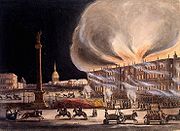
Vasily Zhukovsky
Vasily Andreyevich Zhukovsky was the foremost Russian poet of the 1810s and a leading figure in Russian literature in the first half of the 19th century...
witnessed the conflagration—"a vast bonfire with flames reaching the sky." The fire burned for several days, and destroyed most of the Winter Palace's interior.
Seeming to ignore the size of the palace, the Tsar ordered that the rebuilding be completed within a year. The Marquis de Custine
Marquis de Custine
Astolphe-Louis-Léonor, Marquis de Custine was a French aristocrat and writer who is best known for his travel writing, in particular his account of his visit to Russia in 1839 Empire of the Czar: A Journey Through Eternal Russia...
described the "unheard of efforts" that were necessary to facilitate this. "During the great frosts 6000 workmen were continually employed; of these a considerable number died daily, but the victims were instantly replaced by other champions brought forward to perish."
The rebuilding of the palace took advantage of the latest construction techniques of the industrial age. The roof was supported by a metal framework, while the spans of ceilings in the great halls were supported by iron girders. Following the fire, the exterior, most of the principal state suites, the Jordan staircase and the Grand Church were restored to their original design and decoration by the architect Vasily Stasov
Vasily Stasov
Vasily Petrovich Stasov was a Russian architect.-Biography:Stasov was born in Moscow....
. Some of the rooms, such as the second largest room in the Winter Palace, the Armorial Hall, became far more ornate, however, with a heavy use of gilt
Gilding
The term gilding covers a number of decorative techniques for applying fine gold leaf or powder to solid surfaces such as wood, stone, or metal to give a thin coating of gold. A gilded object is described as "gilt"...
. The smaller and more private rooms of the palace were altered and decorated in various 19th-century contemporary styles by Alexander Briullov according to whims and fashion of their intended occupants, ranging from Gothic to rococo. The Tsarevna's crimson boudoir (23), in the private Imperial apartments, was a faithful reproduction of the rococo style, which Catherine II and her architects started to eliminate from the palace less than 50 years earlier. One of the palace's most notable rooms was created as a result of the fire when the Jasper Room, which had been destroyed, was rebuilt as the Malachite Drawing Room
Malachite Room of the Winter Palace
The Malachite Room of the Winter Palace, St Petersburg, was designed in the late 1830s by the architect Alexander Briullov for use a formal reception room for the Empress Alexandra Fyodorovna, wife of Nicholas I. It replaced the Jasper Room, which was destroyed in the fire of 1837. The room obtains...
, the principal reception room of the Tsaritsa's suite. The Tsar himself, for all the grandeur he created in his palaces, loved the greatest simplicity. His bedroom at the Winter Palace was spartan, with no ornaments save for some maps and an icon
Icon
An icon is a religious work of art, most commonly a painting, from Eastern Christianity and in certain Eastern Catholic churches...
, and he slept on a camp bed with a straw mattress.
Usage of the palace
Tsarevna
Tsarevna or czarevna is the daughter of a Tsar or Tsaritsa, similar to a princess being the daughter of a King or Queen. A Tsarevna could also be the wife to a Tsar's son....
, the arrangement of the rooms makes more sense. Similarly the vast White Hall, so far from the other grand halls, was in fact the principal hall of the Tsarevich's and Tsarevna's apartments. Thus the Winter Palace can be viewed as a series of small palaces within one large palace, with the largest and grandest rooms being public while the residents lived in suites of varying sizes, allocated according to rank.
As the formal home of the Russian Tsars, the palace was the setting for profuse, frequent and lavish entertaining. The dining table could seat 1000 guests, while the state rooms could contain up to 10,000 people—all standing, as no chairs were provided. These rooms, halls and galleries were heated to such a temperature that while it was sub-zero outside, exotic plants bloomed within, while the brilliant lighting gave the ambiance of a summer's day.
Colonnade
In classical architecture, a colonnade denotes a long sequence of columns joined by their entablature, often free-standing, or part of a building....
d Jordan Hall before mounting the gilded Imperial staircase
Imperial staircase
An Imperial staircase is the name given to a staircase with divided flights. Usually the first flight rises to a half-landing and then divides into two symmetrical flights both rising with an equal number of steps and turns to the next floor. The feature is reputed to have first been used at El...
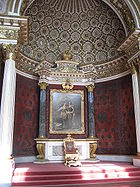
(8), from where the two enfilades of state rooms spread out. The principal or Jordan Staircase, so-called because on the Feast of the Epiphany, the Tsar descended in state for the ceremony of the Blessing of the Waters, is one of the few parts of the palace to retain the original 18th century rococo style, although the massive grey granite columns were added in the mid-19th century.
One of the most important rooms was the Palace's Grand Church
Grand Church of the Winter Palace
The Grand Church of the Winter Palace in Saint Petersburg, sometimes referred to as the Winter Palace's cathedral, was consecrated in 1763. It is located on the piano nobile in the eastern wing of the Winter Palace, and is the larger, and principal, of two churches within the Palace...
(16). Granted cathedral status, it was of greater religious significance than the chapels of most European royal palaces. It was here that Romanov weddings were usually celebrated with a rigid and unchanging tradition and protocol. Even the bride's dress, and the manner of donning it, was dictated by tradition. Dressed by the Tsaritsa, the bride and her procession would pass from the Malachite Drawing Room to the church through the state rooms.
The Imperial Family were not the only residents of the palace; below the metal framework in the attics lived an army of servants. So vast were the servants' quarters
Servants' quarters
Servants' quarters are those parts of a building, traditionally in a private house, which contain the domestic offices and staff accommodation. From the late 17th century until the early 20th century they were a common feature in all large houses...
that a former servant and his family, unbeknownst to the palace authorities, moved into the roof of the palace. They were only discovered by the smell of the manure from the cow that they had also smuggled into the building with them to provide fresh milk. It seems this cow was not the only bovine in the attics; other cows were kept next to the room occupied by the Maids of Honour, in order to provide fresh milk for the kitchens. This practice was discontinued after the 1837 fire.
Imperial Hermitage Museum
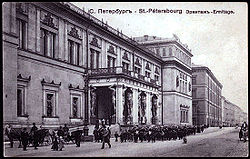
Nicholas I, conscious of the great art galleries in other European capitals, saw that Catherine the Great's Large Hermitage (15) was vastly expanded and transformed into a purpose-built public art gallery. In 1839, German architect Leo von Klenze
Leo von Klenze
Leo von Klenze was a German neoclassicist architect, painter and writer...
drew up the plans and their execution was overseen by Vasily Stasov
Vasily Stasov
Vasily Petrovich Stasov was a Russian architect.-Biography:Stasov was born in Moscow....
, assisted by Alexander Briullov and Nikolai Yefimov. With so many architects involved there were inevitably many conflicts over the design and its execution throughout the 1840s, with the Tsar having frequently to act as moderator. Eventually, after eleven years of building and architectural conflict, the first art museum in Russia, the Imperial Hermitage Museum, opened on 5 February 1852. The trebeated facades of the building were inspired by Schinkelesque architecture
Karl Friedrich Schinkel
Karl Friedrich Schinkel was a Prussian architect, city planner, and painter who also designed furniture and stage sets. Schinkel was one of the most prominent architects of Germany and designed both neoclassical and neogothic buildings.-Biography:Schinkel was born in Neuruppin, Margraviate of...
. It was erected in grey marble round three courtyards and the complex is noted for the asymmetrical planning of its wings and floors. By order of the Tsar, visitors to the museum were required to wear evening dress
Formal wear
Formal wear and formal dress are the general terms for clothing suitable for formal social events, such as a wedding, formal garden party or dinner, débutante cotillion, dance, or race...
even in the morning. The Tsar also decreed that grey top hats were "Jewish", and dress coats "revolutionary." Having negotiated the dress code, what the public saw was a huge array of art, but only a fraction of the Imperial collection, as the Winter Palace and other Imperial palaces, remained closed to the viewing public.
The last Tsars (1855–1905)
The Winter Palace was an official residence of the Russian sovereign from the 1732 until 1917; however, it was their home for little more than 140 of those years. The last Tsar to truly reside in the palace was Alexander IIAlexander II of Russia
Alexander II , also known as Alexander the Liberator was the Emperor of the Russian Empire from 3 March 1855 until his assassination in 1881...
, who ruled from 1855 to 1881, when he was assassinated. During his reign there were more additions to the contents; acquisitions included the ancient and archaeological collection of the unfortunate Marchese di Cavelli
Giampietro Campana
Giampietro Campana , created marchese di Cavelli , was an Italian art collector who assembled one of the nineteenth century's greatest collection of Greek and Roman sculpture and antiquities. The part of his collection of Hellenistic and Roman gold jewellery conserved in the Musée du Louvre...
in 1861 and Leonardo da Vinci
Leonardo da Vinci
Leonardo di ser Piero da Vinci was an Italian Renaissance polymath: painter, sculptor, architect, musician, scientist, mathematician, engineer, inventor, anatomist, geologist, cartographer, botanist and writer whose genius, perhaps more than that of any other figure, epitomized the Renaissance...
's "Madonna and Child" in 1865; da Vinci's second work of that same name, the so-called "Benois Madonna", was later acquired in 1914.
Alexander II was a constant target for assassination attempts, one of which occurred inside the Winter Palace itself. This attempt on the Tsar's life was organized by a group known as Narodnaya Volya (Will of the People) and led by an "unsmiling fanatic", Andrei Zhelyabov
Andrei Zhelyabov
Andrey Ivanovich Zhelyabov , Russian revolutionary, member of the Executive Committee of Narodnaya Volya....
, and his mistress
Mistress (lover)
A mistress is a long-term female lover and companion who is not married to her partner; the term is used especially when her partner is married. The relationship generally is stable and at least semi-permanent; however, the couple does not live together openly. Also the relationship is usually,...
Sophia Perovskaya, who later became his wife. Perovskaya, the daughter of a former Governor of Saint Petersburg, was well placed to learn information concerning happenings within the palace and through her connections learnt of repairs being carried out in the palace's basement. One of the group, a trained carpenter, was subsequently enrolled as one of the workmen. Every day he carried dynamite charges concealed amongst his tools, placing them beneath the private dining room. So great was the quantity of dynamite that the fact there was an intervening floor between the dining room and the basement was of no significance. Plans were made to detonate the bomb on the evening of , assassinating the Tsar and Imperial family as they dined. Fortunately for the Romanovs, a guest arriving from Berlin was delayed, and for the first time in years dinner was delayed. As the family left the drawing room for the dining room the bomb exploded. So great was the explosion that it could be heard all over Saint Petersburg. The dining room was completely demolished and 11 members of the Finnish Guard in the Guard Room below were killed and a further 30 wounded.

Alexander III of Russia
Alexander Alexandrovich Romanov , historically remembered as Alexander III or Alexander the Peacemaker reigned as Emperor of Russia from until his death on .-Disposition:...
was informed by his security advisers that it was impossible to make the Winter Palace secure. The Imperial Family then moved to the seclusion of the Palace of Gatchina, some 40 miles (64.4 km) from Saint Petersburg. By comparison with the Winter Palace, the 600 room, moated Gatchina Palace, set within forests, was a cosy family home. When in Saint Petersburg, the Imperial Family resided at the Anichkov Palace
Anichkov Palace
Anichkov Palace is a former imperial palace in Saint Petersburg, at the intersection of Nevsky Avenue and the Fontanka.-History:The palace, situated on the plot formerly owned by Antonio de Vieira, takes its name from the nearby Anichkov Bridge across the Fontanka...
, while the Winter Palace was used for official functions. Large economies were made in food and wine. The Tsar was highly interested in the running costs of the Palace, insisting that table linen was not to be changed daily, and that candles and soap were not replaced until completely spent. Even the number of eggs used in an omelette was reduced. While the Tsar economised on household expenses, he added to the Imperial art collection of both the palace and the Hermitage. Officially, the Hermitage Museum had an annual buying allowance of 5,000 rubles, but when this proved insufficient the Tsar would himself purchase items for the museum.
Empress Maria Feodorovna (Dagmar of Denmark), the wife of Alexander III, saw that a garden was laid out in the centre of the main courtyard in 1885, an area previously cobbled and lacking vegetation. Court architect Nikolai Gornostayev designed a garden surrounded by a granite plinth and a fountain, and planted trees in the courtyard, laying limestone pavements along the walls of the palace.
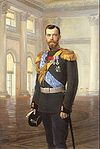
In 1894, Alexander III was succeeded by his son Nicholas II. The last Tsar suspended court mourning for his father to marry his wife Alix of Hesse in a lavish ceremony at the Winter palace. However, after the ceremony the newlywed couple retired to the Anichkov Palace, along with the Dowager Empress. There they began their married life in six small rooms.
In 1895, Nicholas and Alexandra established themselves at the Alexander Palace
Alexander Palace
The Alexander Palace is a former imperial residence at Tsarskoye Selo, on a plateau around 30 minutes by train from St Petersburg. It is known as the favourite residence of the last Russian Emperor, Nicholas II, and his family and their initial place of imprisonment after the revolution that...
at Tsarskoe Selo. This was to be their favoured home for the remainder of the reign. However, from December 1895 they did reside for periods during the winter at the Winter Palace. Architect Alexander Krasovsky was commissioned to redecorate a suite of rooms in the north-west corner of the palace, including the Gothic library.
In 1896, the wife of Nicholas II was credited for the creation of another garden (35) on the former parade ground, beneath the windows of the Imperial Family's private apartments. She had found it disconcerting that the public could stare into her windows. The garden was created by landscape architect
Landscape architect
A landscape architect is a person involved in the planning, design and sometimes direction of a landscape, garden, or distinct space. The professional practice is known as landscape architecture....
Georg Kuphaldt
Georg Kuphaldt
Georg Friedrich Ferdinand Kuphaldt was an influential German landscape architect, gardener and dendrologist of the Russian Empire....
, the director of the Riga
Riga
Riga is the capital and largest city of Latvia. With 702,891 inhabitants Riga is the largest city of the Baltic states, one of the largest cities in Northern Europe and home to more than one third of Latvia's population. The city is an important seaport and a major industrial, commercial,...
city gardens and parks. This is only one of two gardens
Gardens of the Winter Palace
The gardens of the Winter Palace, St Petersburg, are little known, as the great imperial palace of the Romanovs was never intended to have gardens...
which remain today at the palace.
During the reign of Nicholas II, court life was quieter than it had ever been, due to the Tsaritsa's retiring nature and mistrust of Saint Petersburg's high society. In the Tsaritsa's opinion: "Saint Petersburg is a rotten town, and not one atom Russian." Under her influence, gradually the great court receptions and balls at the Winter Palace, which humoured and cultivated the powerful nobility, came to an end. They were briefly replaced by theatricals held in the Hermitage which "no one enjoyed", then even the theatricals ceased.
The final great Imperial gathering at the Winter Palace was a themed fancy dress ball celebrating the reign of Alexei I
Alexis I of Russia
Aleksey Mikhailovich Romanov was the Tsar of Russia during some of the most eventful decades of the mid-17th century...
, which took place on 11 and 13 February 1903 (1903 Ball in the Winter Palace
1903 Ball in the Winter Palace
1903 Ball in the Winter Palace — the famous luxurious ball during the reign of the emperor Nicholas II of Russia in the Winter Palace, St.-Petersburg...
). Grand Duke Alexander Mikhailovitch
Grand Duke Alexander Mikhailovich of Russia
Grand Duke Alexander Mihailovich of Russia, Александр Михайлович Aleksandr Mihailovits was a dynast of the Russian Empire, a naval officer, an author, explorer, the brother-in-law of Emperor Nicholas II, and an advisor of the said Emperor.-Biography: Alexander was born the son of Grand Duke...
recalled the occasion as "the last spectacular ball in the history of the empire...[but] a new and hostile Russia glared through the large windows of the palace...while we danced, the workers were striking and the clouds in the Far East were hanging dangerously low." The entire Imperial family, the Tsar as Alexei I, the Tsaritsa as Maria Miloslavskaya
Maria Miloslavskaya
Maria Ilyinichna Miloslavskaya was the first wife of tsar Alexis of Russia and mother of the tsars Feodor III of Russia and Ivan V of Russia, as well as regent princess Sophia Alekseyevna.-Biography:...
, all dressed in rich 17th century attire, posed in the Hermitage's theatre, many wearing priceless original items brought specially from the Kremlin
Kremlin
A kremlin , same root as in kremen is a major fortified central complex found in historic Russian cities. This word is often used to refer to the best-known one, the Moscow Kremlin, or metonymically to the government that is based there...
, for what was to be their final photograph together.
In 1904, Russia was at war with Japan
Russo-Japanese War
The Russo-Japanese War was "the first great war of the 20th century." It grew out of rival imperial ambitions of the Russian Empire and Japanese Empire over Manchuria and Korea...
, and the newborn Tsarevich was secretly ill; the Tsar and Tsaritsa permanently abandoned Saint Petersburg, the Winter Palace, and high society (considered by the Tsaritsa to be decadent and immoral) for the greater comfort, security and privacy of Tsarskoe Selo. Thus it was that the Winter Palace, designed and intended to impress, reflect and reinforce the Romanov's power, lost its raison d'être over a decade before the fall of the dynasty it was intended to house and glorify.
Fall of the House of Romanov (1905–1918)
Livadia Palace
Livadia Palace was a summer retreat of the last Russian tsar, Nicholas II, and his family in Livadiya, Crimea in southern Ukraine. The Yalta Conference was held there in 1945, when the palace housed the apartments of Franklin Delano Roosevelt and other members of the American delegation...
; in May to Peterhof
Peterhof Palace
The Peterhof Palace in Russian, so German is transliterated as "Петергoф" Petergof into Russian) for "Peter's Court") is actually a series of palaces and gardens located in Saint Petersburg, Russia, laid out on the orders of Peter the Great. These Palaces and gardens are sometimes referred as the...
(not the great palace, but a 19th century villa in its grounds); in June, they cruised upon the Imperial Yacht, Standart; August was spent in Poland, at Spala
Spala
Spała is a village in the administrative district of Gmina Inowłódz, within Tomaszów Mazowiecki County, Łódź Voivodeship, in central Poland. It lies on the Pilica River, approximately west of Inowłódz, east of Tomaszów Mazowiecki, and south-east of the regional capital Łódź. The village has a...
, September was spent back at Livadia, before a return to Tsarskoe Selo for the Winter.
The Tsar betrayed his private views of Saint Petersburg in 1912, while addressing a farewell party of dignitaries and family bidding him farewell, as the family left for warmer climes: "I am only sorry for you who have to remain in this bog." However, to the Tsar's ordinary subjects, the Winter Palace was seen not only as the home of the Tsars, but a symbol of Imperial power. In this role, it was to be at the centre of some of the most momentous happenings in Russia's early 20th century history. Three of these events stand out in Russia's history: The Bloody Sunday massacre of 1905; the opening of the first State Duma in 1906, which opened in St George's Hall (13); and finally the taking of the palace by revolutionaries in 1917.
The Bloody Sunday massacre was a result of the public ignorance of the Tsar's place of residence. It occurred on during a demonstration march by workers toward the Winter Palace. The closest shootings of demonstrators occurred near St. Isaac's Cathderal at the entrance to the Aleksandr Gardens leading to the Palace Square in front of the Winter Palace. The massacre was sparked when a Russian Orthodox priest and popular working class leader, Father Gapon
George Gapon
Georgiy Apollonovich Gapon was a Russian Orthodox priest and a popular working class leader before the Russian Revolution of 1905.-Early life:...
, announced his intention to lead a peaceful protest of 100,000 unarmed striking workers to present a petition to the Tsar, to call for fundamental reforms and the founding of a constituent parliament. The protesters were unaware that the palace was little more than an uninhabited icon of Imperial power, and that the Tsar no longer resided there. The Tsar was not informed of the planned protest until the evening before, while no suggestion was made that the Tsar should meet a deputation or send representative to accept the petition. Instead, the Minister for the Interior drafted additional troops. As the strikers neared the palace bearing religious icons and singing the Imperial anthem, the Tsar's troops opened fire. While the number of casualties is disputed, moderate estimates average around 1,000 men, women and children killed or injured. The massacre, which came to be known as Bloody Sunday, was a serious blunder on the part of the Okhrana and was to have grave consequences for the Tsarist regime. It was also to be the catalyst for the 1905 Revolution.
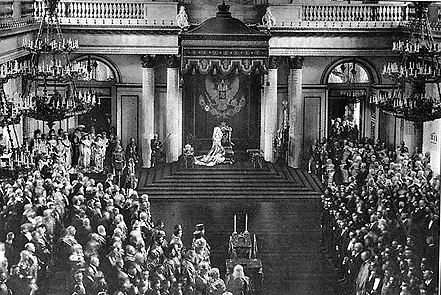
World War I
World War I , which was predominantly called the World War or the Great War from its occurrence until 1939, and the First World War or World War I thereafter, was a major war centred in Europe that began on 28 July 1914 and lasted until 11 November 1918...
as a result of the Triple Entente Alliance
Triple Entente
The Triple Entente was the name given to the alliance among Britain, France and Russia after the signing of the Anglo-Russian Entente in 1907....
. The Tsar and Tsaritsa briefly returned to the Winter Palace to stand on their balcony to accept salutes and homage from the departing troops. Ironically, unlike the monarchs of Europe who stood on balconies adorned with velvet, flanked by their families, the Tsar and Tsaritsa stood, alone, in one corner of an unadorned balcony, appearing almost lost next to an oversized Imperial emblem, soon to be torn down by their own subjects. As the departing troops saluted their monarch in front of the palace, plans were being drawn up to store the palace's contents and convert the state rooms into a hospital to receive returning troops.
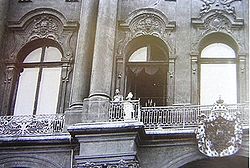
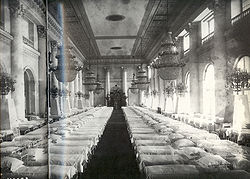
Forced to accept the hopelessness of both the war and the situation at home, on 15 March 1917, Nicholas II abdicated in favour of his brother, Grand Duke Mikhail Alexandrovich
Grand Duke Michael Alexandrovich of Russia
Grand Duke Michael Alexandrovich of Russia was the youngest son of Emperor Alexander III of Russia.At the time of his birth, his paternal grandfather was still the reigning Emperor of All the Russias. Michael was fourth-in-line to the throne following his father and elder brothers Nicholas and...
. The Grand Duke promptly refused to accept the throne without the support of the army and his people. A provisional Government
Russian Provisional Government
The Russian Provisional Government was the short-lived administrative body which sought to govern Russia immediately following the abdication of Tsar Nicholas II . On September 14, the State Duma of the Russian Empire was officially dissolved by the newly created Directorate, and the country was...
was appointed and many members of the former Imperial family were arrested, including the former Tsar, Tsaritsa and their children. No member of the Romanov family has since lived in the Winter Palace. Nicholas II, his wife and children were all held in captivity until they were shot at Yekaterinburg
Yekaterinburg
Yekaterinburg is a major city in the central part of Russia, the administrative center of Sverdlovsk Oblast. Situated on the eastern side of the Ural mountain range, it is the main industrial and cultural center of the Urals Federal District with a population of 1,350,136 , making it Russia's...
in 1918. Other members of the former Imperial Family either met similar fates or escaped into exile.
The Seat of the Provisional Government (1917)
.jpg)
February Revolution
The February Revolution of 1917 was the first of two revolutions in Russia in 1917. Centered around the then capital Petrograd in March . Its immediate result was the abdication of Tsar Nicholas II, the end of the Romanov dynasty, and the end of the Russian Empire...
, which for a brief time saw the Winter Palace re-established as a seat of government and focal point of the former Russian Empire. In February 1917, the Russian Provisional Government
Russian Provisional Government
The Russian Provisional Government was the short-lived administrative body which sought to govern Russia immediately following the abdication of Tsar Nicholas II . On September 14, the State Duma of the Russian Empire was officially dissolved by the newly created Directorate, and the country was...
, led by Alexander Kerensky
Alexander Kerensky
Alexander Fyodorovich Kerensky was a major political leader before and during the Russian Revolutions of 1917.Kerensky served as the second Prime Minister of the Russian Provisional Government until Vladimir Lenin was elected by the All-Russian Congress of Soviets following the October Revolution...
, based itself in the north west corner of the palace with the Malachite Room
Malachite Room of the Winter Palace
The Malachite Room of the Winter Palace, St Petersburg, was designed in the late 1830s by the architect Alexander Briullov for use a formal reception room for the Empress Alexandra Fyodorovna, wife of Nicholas I. It replaced the Jasper Room, which was destroyed in the fire of 1837. The room obtains...
(4) being the chief council chamber. Most of the state rooms were, however, still occupied by the military hospital.
It was to be a short occupation of both palace and power. By 25 October 1917, the Provisional Government was failing and, realising the palace was a target for the more militant Bolshevik
Bolshevik
The Bolsheviks, originally also Bolshevists , derived from bol'shinstvo, "majority") were a faction of the Marxist Russian Social Democratic Labour Party which split apart from the Menshevik faction at the Second Party Congress in 1903....
s, ordered its defence. All military personnel in the city pledged support to the Bolsheviks, who accused Kerensky's Government of wishing to "surrender Petrograd to the Germans so as to enable them to exterminate the revolutionary garrison."
Thus the provisional government, assisted by a few remaining loyal servants, who had formerly served the Tsar, barricaded themselves in the palace. Many of the administrative staff fled, leaving the palace severely under-defended by some Cossack
Cossack
Cossacks are a group of predominantly East Slavic people who originally were members of democratic, semi-military communities in what is today Ukraine and Southern Russia inhabiting sparsely populated areas and islands in the lower Dnieper and Don basins and who played an important role in the...
s, cadet
Cadet
A cadet is a trainee to become an officer in the military, often a person who is a junior trainee. The term comes from the term "cadet" for younger sons of a noble family.- Military context :...
s, and 137 female soldiers from the Women's Battalion
Women's Battalion
Women's Battalions were segregated all-female combat units formed after the February Revolution by the Russian Provisional Government in a last ditch effort to inspire the mass of war-weary soldiers to continue fighting in World War I until victory could be achieved...
. Food ordered by the occupants of the palace was commandeered by the Bolsheviks, and, in a state of siege, the Winter Palace entered the most turbulent period in its history. Five thousand sailors newly arrived from Kronstadt
Kronstadt
Kronstadt , also spelled Kronshtadt, Cronstadt |crown]]" and Stadt for "city"); is a municipal town in Kronshtadtsky District of the federal city of St. Petersburg, Russia, located on Kotlin Island, west of Saint Petersburg proper near the head of the Gulf of Finland. Population: It is also...
were deployed to attack the palace, while the cruiser Aurora positioned itself on the Neva, all its guns trained towards the Palace. Across the water, the Bolsheviks captured the Peter and Paul Fortress
Peter and Paul Fortress
The Peter and Paul Fortress is the original citadel of St. Petersburg, Russia, founded by Peter the Great in 1703 and built to Domenico Trezzini's designs from 1706-1740.-History:...
and turned its artillery
Artillery
Originally applied to any group of infantry primarily armed with projectile weapons, artillery has over time become limited in meaning to refer only to those engines of war that operate by projection of munitions far beyond the range of effect of personal weapons...
towards the besieged building. As the provisional Government, now impotent, hid in the private rooms of the former Imperial Family, nervously surveying the scenes outside, one by one the Government buildings in Palace Square surrendered to the Bolsheviks, leaving the palace seemingly only hours from destruction.
At 7:00 pm, the Government held its last meeting in the Malachite Room, with the telephone and all contact with the outside world disconnected. A short debate determined that they would not leave the palace to attempt dialogue with the hostile crowds outside. With the palace completely surrounded and sealed, the Aurora began her bombardment of the great Neva façade as the Government refused an ultimatum to surrender. Further machine gun
Machine gun
A machine gun is a fully automatic mounted or portable firearm, usually designed to fire rounds in quick succession from an ammunition belt or large-capacity magazine, typically at a rate of several hundred rounds per minute....
and light artillery fire were directed at the palace as the Bolsheviks gained entry via His Majesty's own Staircase (36). In the ensuing battle there were casualties on both sides until the Bolsheviks finally, by 2:00 am, had control of the palace. Leaving a trail of destruction, they searched room after room before arresting the Provisional Government in the Small Dining Room of the private apartment (28), from where they were taken to imprisonment in the Fortress across the river. Kerensky managed to evade arrest and escape to Pskov
Pskov
Pskov is an ancient city and the administrative center of Pskov Oblast, Russia, located in the northwest of Russia about east from the Estonian border, on the Velikaya River. Population: -Early history:...
, where he rallied some loyal troops for an attempt to retake the capital. His troops managed to capture Tsarskoe Selo, but were beaten the next day at Pulkovo.

"The Palace was pillaged and devastated from top to bottom by the Bolshevik[s]...Priceless pictures were ripped from their frames by bayonets. Packed boxes of rare plate and china...were broken open and the contents smashed or carried off. The library....was forced open and ransacked.....the Tsaritsa's salon, like all other rooms, was thrown into chaos. The colossal crystal lustre, with its artfully concealed music, was smashed to atoms. Desks, pictures, ornaments—everything was destroyed."
The Winter Palace's wine cellars literally fuelled the weeks of looting and unrest in the city which followed. Arguably the largest and best stocked wine cellar in history, it contained the world's finest vintages, including the Tsar's favourite, and priceless, Chateau de Calme 1847. So keen were the mob to obtain the alcohol, that the Bolsheviks explored radical solutions to the problem, one of which involved piping the wine straight out into the Neva. This led to crowds clustering around the palace drains. Another proposal, deemed too risky, was exploding the cellars. Eventually, the problem was solved by the declaration of martial law. It has been said that Petrograd, "perhaps with the biggest hangover in history, finally woke up and got back to some order."
The Winter Palace was now a redundant and damaged building symbolic of a despised regime, facing an uncertain future. The Storming of the Winter Palace
The Storming of the Winter Palace
The Storming of the Winter Palace was a 1920 mass spectacle, based on historical events that took place in Petrograd during the 1917 October Revolution....
was a historical reenactment
Historical reenactment
Historical reenactment is an educational activity in which participants attempt torecreate some aspects of a historical event or period. This may be as narrow as a specific moment from a battle, such as the reenactment of Pickett's Charge at the Great Reunion of 1913, or as broad as an entire...
organised by the Bolsheviks on the 3rd anniversary in 1920. With thousands of Red Guards led by Lenin, and witnessed by 100,000 spectators, the reenactment has become one of the "best known" events of the Russian Revolution. Ironically the Red Guard actually broke into the palace through a back door that was left open, guarded by wounded and disabled reserves. This gave rise to the occasion being described as the birth of the Soviet state. Nikolai Podvoisky
Nikolai Podvoisky
Nikolai Ilyich Podvoisky was a Russian revolutionary. He played a large role in the Russian Revolution of 1917 and wrote many articles for the Soviet newspaper Krasnaya Gazeta...
, one of the original troika
Troika (triumvirate)
Troika is a committee consisting of three members. The origin of "troika" comes from the term in Russian used to describe three-horse harnessed carriage, or more often, horse-drawn sledge.- Communist states :...
, which led the original storming, was so impressed by the re-enactment that he commissioned Sergei Eisenstein
Sergei Eisenstein
Sergei Mikhailovich Eisenstein , né Eizenshtein, was a pioneering Soviet Russian film director and film theorist, often considered to be the "Father of Montage"...
to make his film October. Certain features, such as the banks of floodlights which appear in Eisenstein's film indicate that Eisenstein was more influenced by the re-enactment than the original event.
New regime
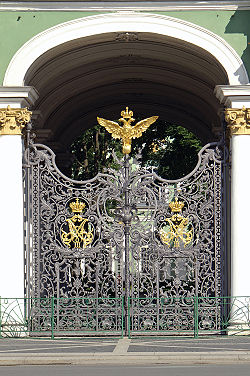
Following the Revolution, there was a policy of removing all Imperial emblems from the palace, including those on the stonework, plaster-work and iron work. During the Soviet era, many of the palace's remaining treasures were dispersed around the museums and galleries of the Soviet Union. Some were sold for hard currency while others were given away to visiting dignitaries. As the original contents disappeared and other items from sequestered collections began to be displayed in the palace, the distinctions between the rooms' original and later use have become blurred. While some rooms have retained their original names, and some even the trappings of Imperial Russia, such as the furnishings of the Small and Large Throne Rooms, many other rooms are known by the names of their new contents, such as The Room of German Art.
Following the 1941–1943 Siege of Leningrad
Siege of Leningrad
The Siege of Leningrad, also known as the Leningrad Blockade was a prolonged military operation resulting from the failure of the German Army Group North to capture Leningrad, now known as Saint Petersburg, in the Eastern Front theatre of World War II. It started on 8 September 1941, when the last...
, when the palace was damaged, a restoration policy was enacted, which has fully restored the palace. Furthermore, as the Russian Government has become more tolerant, the palace has had the emblems of the Romanovs restored. The gilded and crowned double headed eagles once more adorn the walls, balconies and gates. The Winter Palace is no longer the hub of a great empire, and the Romanovs no longer reside there, but the crowned Russian eagle serves as a reminder of the palace's Imperial history.
Today, as part one of the world's most famous museums, the palace attracts an annual 3.5 million visitors.