

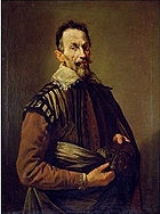
Italian opera

Encyclopedia
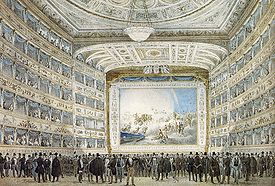
Opera
Opera is an art form in which singers and musicians perform a dramatic work combining text and musical score, usually in a theatrical setting. Opera incorporates many of the elements of spoken theatre, such as acting, scenery, and costumes and sometimes includes dance...
in Italy
Italy
Italy , officially the Italian Republic languages]] under the European Charter for Regional or Minority Languages. In each of these, Italy's official name is as follows:;;;;;;;;), is a unitary parliamentary republic in South-Central Europe. To the north it borders France, Switzerland, Austria and...
and opera in the Italian language
Italian language
Italian is a Romance language spoken mainly in Europe: Italy, Switzerland, San Marino, Vatican City, by minorities in Malta, Monaco, Croatia, Slovenia, France, Libya, Eritrea, and Somalia, and by immigrant communities in the Americas and Australia...
. Opera was born in Italy around the year 1600 and Italian opera has continued to play a dominant role in the history of the form until the present day. Many famous operas in Italian were written by foreign composers, including Handel
HANDEL
HANDEL was the code-name for the UK's National Attack Warning System in the Cold War. It consisted of a small console consisting of two microphones, lights and gauges. The reason behind this was to provide a back-up if anything failed....
, Gluck and Mozart. Works by native Italian composers of the 19th and early 20th centuries, such as Rossini, Bellini
Vincenzo Bellini
Vincenzo Salvatore Carmelo Francesco Bellini was an Italian opera composer. His greatest works are I Capuleti ed i Montecchi , La sonnambula , Norma , Beatrice di Tenda , and I puritani...
, Donizetti, Verdi and Puccini, are amongst the most famous operas ever written and today are performed in opera houses across the world.
Origins
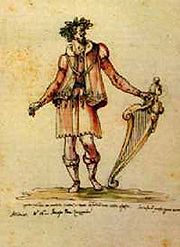
"Dafne
Dafne
Dafne is the earliest known work that, by modern standards, could be considered an opera. It was composed by Jacopo Peri in 1597, with a libretto by Ottavio Rinuccini.-History:...
" by Jacopo Peri
Jacopo Peri
Jacopo Peri was an Italian composer and singer of the transitional period between the Renaissance and Baroque styles, and is often called the inventor of opera...
was the earliest composition considered opera, as understood today. Peri's works, however, did not arise out of a creative vacuum in the area of sung drama. An underlying prerequisite for the creation of opera proper was the practice of monody
Monody
In poetry, the term monody has become specialized to refer to a poem in which one person laments another's death....
. Monody is the solo singing/setting of a dramatically conceived melody, designed to express the emotional content of the text it carries, which is accompanied by a relatively simple sequence of chords rather than other polyphonic
Polyphony
In music, polyphony is a texture consisting of two or more independent melodic voices, as opposed to music with just one voice or music with one dominant melodic voice accompanied by chords ....
parts. Italian composers began composing in this style late in the 16th century, and it grew in part from the long-standing practise of performing polyphonic madrigals
Madrigal (music)
A madrigal is a secular vocal music composition, usually a partsong, of the Renaissance and early Baroque eras. Traditionally, polyphonic madrigals are unaccompanied; the number of voices varies from two to eight, and most frequently from three to six....
with one singer accompanied by an instrumental rendition of the other parts, as well as the rising popularity of more popular, more homophonic vocal genres such as the frottola
Frottola
The frottola was the predominant type of Italian popular, secular song of the late fifteenth and early sixteenth century. It was the most important and widespread predecessor to the madrigal...
and the villanella
Villanella
In music, a villanella is a form of light Italian secular vocal music which originated in Italy just before the middle of the 16th century...
. In these latter two genres, the increasing tendency was toward a more homophonic
Homophony
In music, homophony is a texture in which two or more parts move together in harmony, the relationship between them creating chords. This is distinct from polyphony, in which parts move with rhythmic independence, and monophony, in which all parts move in parallel rhythm and pitch. A homophonic...
texture, with the top part featuring an elaborate, active melody, and the lower ones (usually these were three-part compositions, as opposed to the four-or-more-part madrigal) a less active supporting structure. From this, it was only a small step to fully-fledged monody. All such works tended to set humanist poetry of a type that attempted to imitate Petrarch
Petrarch
Francesco Petrarca , known in English as Petrarch, was an Italian scholar, poet and one of the earliest humanists. Petrarch is often called the "Father of Humanism"...
and his Trecento
Trecento
The Trecento refers to the 14th century in Italian cultural history.Commonly the Trecento is considered to be the beginning of the Renaissance in art history...
followers, another element of the period's tendency toward a desire for restoration of principles it associated with a mixed-up notion of antiquity.
The solo madrigal, frottola, villanella and their kin featured prominently in the intermedio
Intermedio
The intermedio, or intermezzo, in the Italian Renaissance, was a theatrical performance or spectacle with music and often dance which was performed between the acts of a play to celebrate special occasions in Italian courts. It was one of the important predecessors to opera, and an influence on...
or intermezzo, theatrical spectacles with music that were funded in the last seventy years of the 16th century by the opulent and increasingly secular courts of Italy's city-states. Such spectacles, were usually staged to commemorate significant state events: weddings, military victories, and the like, and alternated in performance with the acts of plays. Like the later opera, an intermedi featured the aforementioned solo singing, but also madrigals performed in their typical multi-voice texture, and dancing accompanied by the present instrumentalists. They were lavishly staged, and led the scenography of the second half of the 16th century. The intermedi tended not to tell a story as such, although they occasionally did, but nearly always focused on some particular element of human emotion or experience, expressed through mythological allegory.
The staging in 1600 of Peri's opera Euridice as part of the celebrations for a Medici wedding, the occasions for the most spectacular and internationally famous intermedi of the previous century, was probably a crucial development for the new form, putting it in the mainstream of lavish courtly entertainment.
Another popular court entertainment at this time was the "madrigal comedy
Madrigal comedy
Madrigal comedy is a term for a kind of entertainment music of the late 16th century in Italy, in which groups of related, generally a cappella madrigals were sung consecutively, generally telling a story, and sometimes having a loose dramatic plot. It is an important element in the origins of opera...
," later also called "madrigal opera" by musicologists familiar with the later genre. This consisted of a series of madrigals strung together to suggest a dramatic narrative, but not staged. There were also two staged musical "pastoral"s, Il Satiro and La Disperazione di Fileno, both produced in 1590 and written by Emilio de' Cavalieri
Emilio de' Cavalieri
Emilio de' Cavalieri was an Italian composer, producer, organist, diplomat, choreographer and dancer at the end of the Renaissance era. His work, along with that of other composers active in Rome, Florence and Venice, was critical in defining the beginning of the musical Baroque era...
. Although these lost works seem only to have included aria
Aria
An aria in music was originally any expressive melody, usually, but not always, performed by a singer. The term is now used almost exclusively to describe a self-contained piece for one voice usually with orchestral accompaniment...
s, with no recitative
Recitative
Recitative , also known by its Italian name "recitativo" , is a style of delivery in which a singer is allowed to adopt the rhythms of ordinary speech...
, they were apparently what Peri was referring to, in his preface to the published edition of his Euridice, when he wrote: "Signor Emilio del Cavalieri, before any other of whom I know, enabled us to hear our kind of music upon the stage". Other pastoral plays had long included some musical numbers; one of the earliest, La fabula d'Orfeo (1480) by Poliziano
Poliziano
Angelo Ambrogini, commonly known by his nickname, anglicized as Politian, Italian Poliziano, Latin Politianus was an Italian Renaissance classical scholar and poet, one of the revivers of Humanist Latin...
had at least three solo songs and one chorus.
Florence and Mantua
Henry IV of France
Henry IV , Henri-Quatre, was King of France from 1589 to 1610 and King of Navarre from 1572 to 1610. He was the first monarch of the Bourbon branch of the Capetian dynasty in France....
and Marie de Medici at the Pitti Palace in Florence
Florence
Florence is the capital city of the Italian region of Tuscany and of the province of Florence. It is the most populous city in Tuscany, with approximately 370,000 inhabitants, expanding to over 1.5 million in the metropolitan area....
. The opera, Euridice, with a libretto
Libretto
A libretto is the text used in an extended musical work such as an opera, operetta, masque, oratorio, cantata, or musical. The term "libretto" is also sometimes used to refer to the text of major liturgical works, such as mass, requiem, and sacred cantata, or even the story line of a...
by Rinuccini, set to music by Peri and Giulio Caccini
Giulio Caccini
Giulio Caccini , also known as Giulio Romano, was an Italian composer, teacher, singer, instrumentalist and writer of the very late Renaissance and early Baroque eras. He was one of the founders of the genre of opera, and one of the single most influential creators of the new Baroque style...
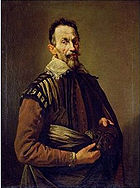
, recounted the story of Orpheus and Eurydice. The style of singing favored by Peri and Caccini was a heightened form of natural speech, dramatic recitative supported by instrumental string music. Recitative thus preceded the development of arias, though it soon became the custom to include separate songs and instrumental interludes during periods when voices were silent. Both Dafne and Euridice also included choruses commenting on the action at the end of each act in the manner of Greek tragedy. The theme of Orpheus, the demi-god of music, was understandably popular and attracted Claudio Monteverdi
Claudio Monteverdi
Claudio Giovanni Antonio Monteverdi – 29 November 1643) was an Italian composer, gambist, and singer.Monteverdi's work, often regarded as revolutionary, marked the transition from the Renaissance style of music to that of the Baroque period. He developed two individual styles of composition – the...
(1567–1643) who wrote his first opera, La Favola d'Orfeo
Orfeo
L'Orfeo , sometimes called L'Orfeo, favola in musica, is an early Baroque opera by Claudio Monteverdi, with a libretto by Alessandro Striggio. It is based on the Greek legend of Orpheus, and tells the story of his descent to Hades and his fruitless attempt to bring his dead bride Eurydice back to...
(The Fable of Orpheus), in 1607 for the court of Mantua
Mantua
Mantua is a city and comune in Lombardy, Italy and capital of the province of the same name. Mantua's historic power and influence under the Gonzaga family, made it one of the main artistic, cultural and notably musical hubs of Northern Italy and the country as a whole...
.
Monteverdi insisted on a strong relationship between the words and music. When Orfeo was performed in Mantua
Mantua
Mantua is a city and comune in Lombardy, Italy and capital of the province of the same name. Mantua's historic power and influence under the Gonzaga family, made it one of the main artistic, cultural and notably musical hubs of Northern Italy and the country as a whole...
, an orchestra of 38 instruments, numerous choruses and recitatives were used to make a lively drama. It was a far more ambitious version than those previously performed — more opulent, more varied in recitatives, more exotic in scenery — with stronger musical climaxes which allowed the full scope for the virtuosity of the singers. Opera had revealed its first stage of maturity in the hands of Monteverdi.
Opera in Rome
Within a few decades opera had spread throughout Italy. In RomeRome
Rome is the capital of Italy and the country's largest and most populated city and comune, with over 2.7 million residents in . The city is located in the central-western portion of the Italian Peninsula, on the Tiber River within the Lazio region of Italy.Rome's history spans two and a half...
, it found an advocate in the prelate and librettist Giulio Rospigliosi (later Pope Clement IX). Rospigliosi's patrons were the Barberini.
Among the composers who worked in this period one may mention: Luigi Rossi, Michelangelo Rossi
Michelangelo Rossi
Michelangelo Rossi was an important Italian composer, violinist and organist of the Baroque era....
, Marco Marazzoli
Marco Marazzoli
Marco Marazzoli was an Italian priest and composer.-Early life:Born at Parma, Marazzoli received early training as a priest, and was ordained around 1625. He moved to Rome in 1626, and entered the service of Cardinal Antonio Barberini...
, Virgilio Mazzocchi
Virgilio Mazzocchi
Virgilio Mazzocchi was an Italian baroque composer.He was born in Civita Castellana, the younger brother of Domenico Mazzocchi. Like his brother, who shared some features of his career, he was largely a composer of sacred vocal music.Mazzocchi is associated with providing music for the papal chapels...
, Stefano Landi
Stefano Landi
Stefano Landi was an Italian composer and teacher of the early Baroque Roman School. He was an influential early composer of opera, and wrote the earliest opera on a historical subject: Sant'Alessio .-Biography:Landi was born in Rome, the capital of the Papal States.In 1595 he joined the Collegio...
.
Since the 1730s, the subject of the works changed greatly: those of the pastoral tradition and Arcadia, it is preferable that the poems of chivalry, usually Ludovico Ariosto
Ludovico Ariosto
Ludovico Ariosto was an Italian poet. He is best known as the author of the romance epic Orlando Furioso . The poem, a continuation of Matteo Maria Boiardo's Orlando Innamorato, describes the adventures of Charlemagne, Orlando, and the Franks as they battle against the Saracens with diversions...
and Torquato Tasso
Torquato Tasso
Torquato Tasso was an Italian poet of the 16th century, best known for his poem La Gerusalemme liberata , in which he depicts a highly imaginative version of the combats between Christians and Muslims at the end of the First Crusade, during the siege of Jerusalem...
, or those taken from hagiography
Hagiography
Hagiography is the study of saints.From the Greek and , it refers literally to writings on the subject of such holy people, and specifically to the biographies of saints and ecclesiastical leaders. The term hagiology, the study of hagiography, is also current in English, though less common...
and Christian commedia dell'arte
Commedia dell'arte
Commedia dell'arte is a form of theatre characterized by masked "types" which began in Italy in the 16th century, and was responsible for the advent of the actress and improvised performances based on sketches or scenarios. The closest translation of the name is "comedy of craft"; it is shortened...
.
With the increased number of characters, the Roman operas became very dramatic, and has several twists. With these came along a new method of fixing the lines of the recitative, better suited to the various situations that arose from the rich storyline and that was closer to speech, full of parenthetical
Bracket
Brackets are tall punctuation marks used in matched pairs within text, to set apart or interject other text. In the United States, "bracket" usually refers specifically to the "square" or "box" type.-List of types:...
at the expense of the paratactic style
Parataxis
Parataxis is a literary technique, in writing or speaking, that favors short, simple sentences, with the use of coordinating rather than subordinating conjunctions...
that had so characterized the first Florentine works.
Venice: commercial opera
Opera took an important new direction when it reached the republic of VeniceVenice
Venice is a city in northern Italy which is renowned for the beauty of its setting, its architecture and its artworks. It is the capital of the Veneto region...
. It was here that the first public opera house, the Teatro di San Cassiano, was opened in 1637 by Benedetto Ferrari and Francesco Manelli. Its success moved opera away from aristocratic patronage and into the commercial world. In Venice, musical drama was no longer aimed at an elite of aristocrats and intellectuals and acquired the character of entertainment. Soon many other opera houses had sprung up in the city, performing works for a paying public during the Carnival
Carnival of Venice
The Carnival of Venice is an annual festival, held in Venice, Italy. The Carnival starts 40 days before easter and ends on Shrove Tuesday , the day before Ash Wednesday.-History:...
season. The opera houses employed a very small orchestra to save money. A large part of their budget was spent on attracting the star singers of the day; this was the beginning of the reign of the castrato
Castrato
A castrato is a man with a singing voice equivalent to that of a soprano, mezzo-soprano, or contralto voice produced either by castration of the singer before puberty or one who, because of an endocrinological condition, never reaches sexual maturity.Castration before puberty prevents a boy's...
and the prima donna
Prima donna
Originally used in opera or Commedia dell'arte companies, "prima donna" is Italian for "first lady." The term was used to designate the leading female singer in the opera company, the person to whom the prime roles would be given. The prima donna was normally, but not necessarily, a soprano...
(leading lady).
The chief composer of Venetian opera was Monteverdi, who had moved to the republic from Mantua in 1613, with other important composers including Pier Francesco Cavalli
Francesco Cavalli
Francesco Cavalli was an Italian composer of the early Baroque period. His real name was Pietro Francesco Caletti-Bruni, but he is better known by that of Cavalli, the name of his patron Federico Cavalli, a Venetian nobleman.-Life:Cavalli was born at Crema, Lombardy...
, Antonio Sartorio
Antonio Sartorio
Antonio Sartorio was an Italian composer active mainly in Italy and in Hamburg, Germany. He was a leading composer of operas in his native Venice in the 1660s and 1670s and was also known for composing in other genres of vocal music...
, and Giovanni Legrenzi
Giovanni Legrenzi
Giovanni Legrenzi was an Italian composer of opera, vocal and instrumental music, and organist, of the Baroque era...
. Monteverdi wrote three works for the public theatres: Il ritorno d'Ulisse in patria
Il ritorno d'Ulisse in patria
Il ritorno d'Ulisse in patria is an opera in a prologue and five acts , set by Claudio Monteverdi to a libretto by Giacomo Badoaro. The opera was first performed at the Teatro Santi Giovanni e Paolo in Venice during the 1639–1640 carnival season...
(1640), Le nozze d'Enea con Lavinia (1641, now lost) and, most famously, L'incoronazione di Poppea
L'incoronazione di Poppea
L'incoronazione di Poppea is an Italian baroque opera comprising a prologue and three acts, first performed in Venice during the 1642–43 carnival season. The music, attributed to Claudio Monteverdi, is a setting of a libretto by Giovanni Francesco Busenello...
(1642). The subjects of the new operas by Monteverdi and others were generally drawn from Roman history or legends about Troy, in order to celebrate the heroic ideals and noble genealogy of the Venetian state. However they did not lack for love interest or comedy. Most of the operas consisted of three acts, unlike the earlier operas which normally had five. The bulk of the versification was still recitative, however at moments of great dramatic tension there were often arioso
Arioso
In classical music, arioso is a style of solo opera singing between recitative and aria. Literally, arioso means airy. The term arose in the 16th century along with the aforementioned styles and monody. It is commonly confused with recitativo accompagnato....
passages known as arie cavate. Under Monteverdi's followers, the distinction between the recitative and the aria became more marked and conventionalised. This is evident in the style of the two most successful composers of the next generation: Francesco Cavalli
Francesco Cavalli
Francesco Cavalli was an Italian composer of the early Baroque period. His real name was Pietro Francesco Caletti-Bruni, but he is better known by that of Cavalli, the name of his patron Federico Cavalli, a Venetian nobleman.-Life:Cavalli was born at Crema, Lombardy...
and Antonio Cesti
Antonio Cesti
Antonio Cesti , known today primarily as an Italian composer of the Baroque era, he was also a singer , and organist. He was "the most celebrated Italian musician of his generation".- Biography :...
.
The spread of opera abroad
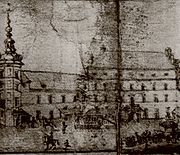
Warsaw
Warsaw is the capital and largest city of Poland. It is located on the Vistula River, roughly from the Baltic Sea and from the Carpathian Mountains. Its population in 2010 was estimated at 1,716,855 residents with a greater metropolitan area of 2,631,902 residents, making Warsaw the 10th most...
in 1628, with a performance of Galatea (composer uncertain), the first Italian opera produced outside Italy. Shortly after this performance, the court produced Francesca Caccini
Francesca Caccini
Francesca Caccini was an Italian composer, singer, lutenist, poet, and music teacher of the early Baroque era. She was the daughter of Giulio Caccini, and was one of the best-known and most influential female European composers between Hildegard of Bingen in the 12th century and the 19th century...
's opera La liberazione di Ruggiero dall'isola d’Alcina
La liberazione di Ruggiero
La liberazione di Ruggiero dall'isola d'Alcina is a comic opera in four scenes by Francesca Caccini, first performed February 3, 1625 at the Villa di Poggio Imperiale in Florence, with a libretto by Ferdinando Saracinelli, based on Ludovico Ariosto's Orlando Furioso...
, which she had written for Prince Władysław Vasa
Władysław IV Vasa
Władysław IV Vasa was a Polish and Swedish prince from the House of Vasa. He reigned as King of the Polish–Lithuanian Commonwealth from 8 November 1632 to his death in 1648....
three years earlier when he was in Italy. Another first, this is the earliest surviving opera written by a woman. Gli amori di Aci e Galatea by Santi Orlandi was also performed in 1628. When Władysław was king (as Władysław IV) he oversaw the production of at least ten operas during the late 1630s and 1640s, making Warsaw a center of the art. The composers of these operas are not known: they may have been Poles working under Marco Scacchi in the royal chapel, or they may have been among the Italians imported by Władysław. A dramma per musica
Dramma per musica
Dramma per musica is a term which was used by dramatists in Italy and elsewhere between the late-17th and mid-19th centuries...
(as serous Italian opera was known at the time) entitled Giuditta, based on the Biblical story of Judith, was performed in 1635. The composer was probably Virgilio Puccitelli.
Cavalli's operas were performed throughout Italy by touring companies with tremendous success. In fact, his Giasone
Giasone
Giasone is an opera in three acts and a prologue with music by Francesco Cavalli and a libretto by Giacinto Andrea Cicognini. It was premiered at the Teatro San Cassiano, Venice on 5 January 1649, during carnival. Giasone was "the single most popular opera of the 17th century"...
was the most popular opera of the 17th century, though some critics were appalled at its mixture of tragedy and farce. Cavalli's fame spread throughout Europe. One of his specialties was giving his heroines "ground bass laments
Lament bass
In music, the lament bass is a ground bass, built from a descending perfect fourth from tonic to dominant, with each step harmonized. The diatonic version is the upper tetrachord from the natural minor scale, known as the Phrygian tetrachord, while the chromatic version, the chromatic fourth, has...
". These were mournful arias sung over a descending bass line and they had a great influence on Henry Purcell
Henry Purcell
Henry Purcell – 21 November 1695), was an English organist and Baroque composer of secular and sacred music. Although Purcell incorporated Italian and French stylistic elements into his compositions, his legacy was a uniquely English form of Baroque music...
, whose "When I am laid in earth" from Dido and Aeneas
Dido and Aeneas
Dido and Aeneas is an opera in a prologue and three acts by the English Baroque composer Henry Purcell to a libretto by Nahum Tate. The first known performance was at Josias Priest's girls' school in London no later than the summer of 1688. The story is based on Book IV of Virgil's Aeneid...
is probably the most celebrated example of the form. Cavalli's reputation caused Cardinal Mazarin to invite him to France in 1660 to compose an opera for King Louis XIV's wedding to Maria Teresa of Spain. Italian opera had already been performed in France in the 1640s to a mixed reception and Cavalli's foreign expedition ended in disaster. French audiences did not respond well to the revival of Xerse (1660) and the specially composed Ercole amante
Ercole amante
Ercole amante is an opera in a prologue and five acts by Francesco Cavalli. The Italian libretto was by Francesco Buti, based on Sophocles' The Trachiniae and on the ninth book of Ovid's Metamorphoses....
(1662), preferring the ballets that had been inserted between the acts by a Florentine composer, Jean-Baptiste Lully
Jean-Baptiste Lully
Jean-Baptiste de Lully was an Italian-born French composer who spent most of his life working in the court of Louis XIV of France. He is considered the chief master of the French Baroque style. Lully disavowed any Italian influence in French music of the period. He became a French subject in...
, and Cavalli swore never to compose another opera.
Cesti was more fortunate when he was asked to write an opera for the Habsburg
Habsburg
The House of Habsburg , also found as Hapsburg, and also known as House of Austria is one of the most important royal houses of Europe and is best known for being an origin of all of the formally elected Holy Roman Emperors between 1438 and 1740, as well as rulers of the Austrian Empire and...
court in Vienna
Vienna
Vienna is the capital and largest city of the Republic of Austria and one of the nine states of Austria. Vienna is Austria's primary city, with a population of about 1.723 million , and is by far the largest city in Austria, as well as its cultural, economic, and political centre...
in 1668. Il pomo d'oro
Il pomo d'oro
Il pomo d'oro is an opera in a prologue and five acts by the Italian composer Antonio Cesti with a libretto by Francesco Sbarra . It was first performed before the imperial court in a specially constructed open-air theatre Vienna in 1668...
was so grandiose that the performance had to be spread over two days. It was a tremendous success and marked the beginning of Italian operatic dominance north of the Alps. In the late 17th century, German and English composers tried to establish their own native traditions but by the early 18th century they had given ground to imported Italian opera, which became the international style in the hands of composers such as Handel
HANDEL
HANDEL was the code-name for the UK's National Attack Warning System in the Cold War. It consisted of a small console consisting of two microphones, lights and gauges. The reason behind this was to provide a back-up if anything failed....
. Only France resisted (and her operatic tradition had been founded by the Italian Lully). This set the pattern until well into the 19th century: the Italian tradition was the international one and its leading exponents (e.g. Handel, Gluck and Mozart) were often not natives of Italy. Composers who wanted to develop their own national forms of opera generally had to fight against Italian opera. Thus, in the early 19th century, both Carl Maria von Weber
Carl Maria von Weber
Carl Maria Friedrich Ernst von Weber was a German composer, conductor, pianist, guitarist and critic, one of the first significant composers of the Romantic school....
in Germany and Hector Berlioz
Hector Berlioz
Hector Berlioz was a French Romantic composer, best known for his compositions Symphonie fantastique and Grande messe des morts . Berlioz made significant contributions to the modern orchestra with his Treatise on Instrumentation. He specified huge orchestral forces for some of his works; as a...
in France felt they had to challenge the enormous influence of the Italian Rossini.
Opera seria
By the end of the 17th century some critics believed that a new, more elevated form of opera was necessary. Their ideas would give birth to a genre, opera seriaOpera seria
Opera seria is an Italian musical term which refers to the noble and "serious" style of Italian opera that predominated in Europe from the 1710s to c. 1770...
(literally "serious opera"), which would become dominant in Italy and much of the rest of Europe until the late 18th century. The influence of this new attitude can be seen in the works of the composers Carlo Francesco Pollarolo
Carlo Francesco Pollarolo
Carlo Francesco Pollarolo was an Italian composer, chiefly of operas. Born into a musical family, he became the cathedral organist of his home town of Brescia. In the 1680s he began composing operas for performance in nearby Venice. He wrote a total of 85 of them as well as 13 oratorios...
and the enormously prolific Alessandro Scarlatti
Alessandro Scarlatti
Alessandro Scarlatti was an Italian Baroque composer especially famous for his operas and chamber cantatas. He is considered the founder of the Neapolitan school of opera. He was the father of two other composers, Domenico Scarlatti and Pietro Filippo Scarlatti.-Life:Scarlatti was born in...
.
During the 18th century artistic and cultural life in Italy was heavily influenced by the aesthetic and poetic ideals of the members of the Accademia dell'Arcadia. The Arcadian poets introduced many changes to serious music drama in Italian, including:
- the simplification of the plot
- the removal of comic elements
- the reduction of the number of arias
- a predilection for plots drawn from ancient Classical or modern French tragedy, in which the values of loyalty, friendship and virtue were extolled and the absolute power of the sovereign was celebrated
By far the most successful librettist of the era was Pietro Metastasio and he maintained his prestige well into the 19th century. He belonged to the Arcadian Academy and was firmly in line with its theories. A libretto by Metastasio was often set by twenty or thirty different composers and audiences came to know the words of his dramas by heart.
Comic opera
In the 17th century comic operas were produced only occasionally and no stable tradition was established. Only in the early years of the 18th century was the comic genre of opera buffaOpera buffa
Opera buffa is a genre of opera. It was first used as an informal description of Italian comic operas variously classified by their authors as ‘commedia in musica’, ‘commedia per musica’, ‘dramma bernesco’, ‘dramma comico’, ‘divertimento giocoso' etc...
born in Naples
Naples
Naples is a city in Southern Italy, situated on the country's west coast by the Gulf of Naples. Lying between two notable volcanic regions, Mount Vesuvius and the Phlegraean Fields, it is the capital of the region of Campania and of the province of Naples...
and it began to spread throughout Italy after 1730.
Opera buffa was distinguished from opera seria by numerous characteristics:
- the importance given to stage action and the consequent need for the music to follow the changes of the drama, emphasising the expressiveness of the words
- the choice of singers who were also excellent actors able to perform the drama convincingly
- a reduction in the use of scenery and stage machinery and in the number of orchestral players
- the use of a small cast of characters (at least in the short form of comic opera known as the intermezzoIntermezzoIn music, an intermezzo , in the most general sense, is a composition which fits between other musical or dramatic entities, such as acts of a play or movements of a larger musical work...
) and simple plots, a good example being PergolesiGiovanni Battista PergolesiGiovanni Battista Pergolesi was an Italian composer, violinist and organist.-Biography:Born at Iesi, Pergolesi studied music there under a local musician, Francesco Santini, before going to Naples in 1725, where he studied under Gaetano Greco and Francesco Feo among others...
's La serva padronaLa serva padronaLa serva padrona is an opera buffa by Giovanni Battista Pergolesi to a libretto by Gennaro Antonio Federico, after the play by Jacopo Angello Nelli. The opera is only 45 minutes long and was originally performed as an intermezzo between the acts of a larger serious opera... - libretti inspired by commedia dell'arteCommedia dell'arteCommedia dell'arte is a form of theatre characterized by masked "types" which began in Italy in the 16th century, and was responsible for the advent of the actress and improvised performances based on sketches or scenarios. The closest translation of the name is "comedy of craft"; it is shortened...
, with realistic subjects, colloquial language and slang expressions - as far as singing was concerned: the complete rejection of vocal virtuosity; a tendency to an incorrect pronunciation of the words; the frequent presence of rhythmic and melodic tics; the use of onomatopoiea and interjections.
In the second half of the 18th century comic opera owed its success to the collaboration between the playwright Carlo Goldoni
Carlo Goldoni
Carlo Osvaldo Goldoni was an Italian playwright and librettist from the Republic of Venice. His works include some of Italy's most famous and best-loved plays. Audiences have admired the plays of Goldoni for their ingenious mix of wit and honesty...
and the composer Baldassare Galuppi. Thanks to Galuppi, comic opera acquired much more dignity than it had during the days of the intermezzo. Operas were now divided into two or three acts, creating libretti for works of a substantially greater length, which differed significantly from those of the early 18th century in the complexity of their plots and the psychology of their characters. These now included some serious figures instead of exaggerated caricatures and the operas had plots which focussed on the conflict between the social classes as well as including self-referential ideas. Goldoni and Galuppi's most famous work together is probably Il filosofo di campagna
Il filosofo di campagna
Il filosofo di campagna is a dramma giocoso per musica in 3 acts by composer Baldassare Galuppi. The opera uses an Italian language libretto by Carlo Goldoni. The work premiered at the Teatro San Samuele in Venice on 26 October 1754.-Roles:-External links:*...
(1754).
The collaboration between Goldoni and another famous composer Niccolò Piccinni
Niccolò Piccinni
Niccolò Piccinni was an Italian composer of symphonies, sacred music, chamber music, and opera. Although he is somewhat obscure, even to music lovers today, Piccinni was one of the most popular composers of opera—particularly the Neapolitan opera buffa—of his day...
produced another new genre: opera semiseria
Opera semiseria
Opera semiseria is an Italian genre of opera, popular in the early and middle 19th century.Related to the opera buffa, opera semiseria contains elements of comedy but also of pathos, sometimes with a pastoral setting. It can usually be distinguished from tragic operas or melodramas by the presence...
. This had two buffo characters, two nobles and two "in between" characters.
The one-act farsa
Farsa
Farsa is a genre of opera, associated with Venice in the late 18th and early 19th centuries. It is also sometimes called farsetta....
had a significant influence on the development of comic opera. This was a type of musical drama initially considered as a condensed version of a longer comic opera, but over time it became a genre in its own right. It was characterised by: vocal virtuosity; a more refined use of the orchestra; the great importance given to the production; the presence of misunderstandings and surprises in the course of the drama.
Gluck's reforms
Opera seriaOpera seria
Opera seria is an Italian musical term which refers to the noble and "serious" style of Italian opera that predominated in Europe from the 1710s to c. 1770...
had its weaknesses and critics; a taste for embellishment on behalf of the superbly trained singers, and the use of spectacle as a replacement for dramatic purity and unity drew attacks. Francesco Algarotti
Francesco Algarotti
Count Francesco Algarotti was an Italian philosopher and art critic.He also completed engravings.He was born in Venice to a rich merchant. He studied at Rome for a year, and then Bologna, he studied natural sciences and mathematics...
's Essay on the Opera (1755) proved to be an inspiration for Christoph Willibald Gluck
Christoph Willibald Gluck
Christoph Willibald Ritter von Gluck was an opera composer of the early classical period. After many years at the Habsburg court at Vienna, Gluck brought about the practical reform of opera's dramaturgical practices that many intellectuals had been campaigning for over the years...
's reforms. He advocated that opera seria had to return to basics and that all the various elements—music (both instrumental and vocal), ballet, and staging—must be subservient to the overriding drama. Several composers of the period, including Niccolò Jommelli
Niccolò Jommelli
Niccolò Jommelli was an Italian composer. He was born in Aversa and died in Naples. Along with other composers mainly in the Holy Roman Empire and France, he made important changes to opera and reduced the importance of star singers.-Early life:Jommelli was born to Francesco Antonio Jommelli and...
and Tommaso Traetta
Tommaso Traetta
Tommaso Michele Francesco Saverio Traetta was an Italian composer.-Biography:Traetta was born in Bitonto, a town near Bari, near the top of the heel of the boot of Italy. He eventually became a pupil of the composer, singer and teacher Nicola Porpora in Naples, and scored a first success with his...
, attempted to put these ideals into practice. The first to really succeed and to leave a permanent imprint upon the history of opera, however, was Gluck. Gluck tried to achieve a "beautiful simplicity". This is illustrated in the first of his "reform" operas, Orfeo ed Euridice
Orfeo ed Euridice
Orfeo ed Euridice is an opera composed by Christoph Willibald Gluck based on the myth of Orpheus, set to a libretto by Ranieri de' Calzabigi. It belongs to the genre of the azione teatrale, meaning an opera on a mythological subject with choruses and dancing...
, where vocal lines lacking in the virtuosity of (say) Handel's works are supported by simple harmonies and a notably richer-than-usual orchestral presence throughout.
Gluck's reforms have had resonance throughout operatic history. Weber, Mozart and Wagner, in particular, were influenced by his ideals. Mozart, in many ways Gluck's successor, combined a superb sense of drama, harmony, melody, and counterpoint to write a series of comedies, notably Così fan tutte
Così fan tutte
Così fan tutte, ossia La scuola degli amanti K. 588, is an opera buffa by Wolfgang Amadeus Mozart first performed in 1790. The libretto was written by Lorenzo Da Ponte....
, The Marriage of Figaro
The Marriage of Figaro
Le nozze di Figaro, ossia la folle giornata , K. 492, is an opera buffa composed in 1786 in four acts by Wolfgang Amadeus Mozart, with Italian libretto by Lorenzo Da Ponte, based on a stage comedy by Pierre Beaumarchais, La folle journée, ou le Mariage de Figaro .Although the play by...
, and Don Giovanni
Don Giovanni
Don Giovanni is an opera in two acts with music by Wolfgang Amadeus Mozart and with an Italian libretto by Lorenzo Da Ponte. It was premiered by the Prague Italian opera at the Teatro di Praga on October 29, 1787...
(in collaboration with Lorenzo Da Ponte
Lorenzo Da Ponte
Lorenzo Da Ponte was a Venetian opera librettist and poet. He wrote the librettos for 28 operas by 11 composers, including three of Mozart's greatest operas, Don Giovanni, The Marriage of Figaro and Così fan tutte....
) which remain among the most-loved, popular and well-known operas today. But Mozart's contribution to opera seria was more mixed; by his time it was dying away, and in spite of such fine works as Idomeneo
Idomeneo
Idomeneo, re di Creta ossia Ilia e Idamante is an Italian language opera by Wolfgang Amadeus Mozart. The libretto was adapted by Giambattista Varesco from a French text by Antoine Danchet, which had been set to music by André Campra as Idoménée in 1712...
and La Clemenza di Tito
La clemenza di Tito
La clemenza di Tito , K. 621, is an opera seria in two acts composed by Wolfgang Amadeus Mozart to an Italian libretto by Caterino Mazzolà, after Metastasio...
, he would not succeed in bringing the art form back to life again.
Romantic period
Romantic opera, which placed emphasis on the imagination and the emotions began to appear in the early 19th century, and because of its arias and music, gave more dimension to the extreme emotions which typified the theater of that era. In addition, it is said that fine music often excused glaring faults in character drawing and plot lines. Gioacchino RossiniGioacchino Rossini
Gioachino Antonio Rossini was an Italian composer who wrote 39 operas as well as sacred music, chamber music, songs, and some instrumental and piano pieces...
(1792–1868) initiated the Romantic period. His first success was an "opera buffa" (comic opera), La Cambiale di Matrimonio (1810). His reputation still survives today through his Barber of Seville, and La Cenerentola. But he also wrote serious opera, Otello (1816) and Guilliame Tell (1829).
Rossini's successors in the Italian bel canto were Vincenzo Bellini
Vincenzo Bellini
Vincenzo Salvatore Carmelo Francesco Bellini was an Italian opera composer. His greatest works are I Capuleti ed i Montecchi , La sonnambula , Norma , Beatrice di Tenda , and I puritani...
(1801–35), Gaetano Donizetti
Gaetano Donizetti
Domenico Gaetano Maria Donizetti was an Italian composer from Bergamo, Lombardy. His best-known works are the operas L'elisir d'amore , Lucia di Lammermoor , and Don Pasquale , all in Italian, and the French operas La favorite and La fille du régiment...
(1797–1848) and Giuseppe Verdi
Giuseppe Verdi
Giuseppe Fortunino Francesco Verdi was an Italian Romantic composer, mainly of opera. He was one of the most influential composers of the 19th century...
(1813–1901). It was Verdi who transformed the whole nature of operatic writing during the course of his long career. His first great successful opera, Nabucco (1842), caught the public fancy because of the driving vigour of its music and its great choruses. Va, pensiero, one of the chorus renditions, was interpreted and gave advantageous meaning to the struggle for Italian independence and to unify Italy.
After Nabucco, Verdi based his operas on patriotic themes and many of the standard romantic sources: Victor Hugo
Victor Hugo
Victor-Marie Hugo was a Frenchpoet, playwright, novelist, essayist, visual artist, statesman, human rights activist and exponent of the Romantic movement in France....
(Ernani, 1844); Byron
George Gordon Byron, 6th Baron Byron
George Gordon Byron, 6th Baron Byron, later George Gordon Noel, 6th Baron Byron, FRS , commonly known simply as Lord Byron, was a British poet and a leading figure in the Romantic movement...
(Il Duo Foscari, 1844); and Shakespeare (Macbeth, 1847). Verdi was experimenting with musical and dramatic forms, attempting to discover things which only opera could do. In 1877, he created Otello which completely replaced Rossini's opera, and which is described by critics as the finest of Italian romantic operas with the traditional components: the solo arias, the duets and the choruses fully integrated into the melodic and dramatic flow.
Verdi's last opera, Falstaff (1893), broke free of conventional form altogether and finds music which follows quick flowing simple words and because of its respect for the pattern of ordinary speech, it created a threshold for a new operatic era in which speech patterns are paramount.
Opera had become a marriage of the arts, a musical drama, full of glorious song, costume, orchestral music and pageantry; sometimes, without the aid of a plausible story. From its conception during the baroque period to the maturity of the romantic period, it was the medium through which tales and myths were revisited, history was retold and imagination was stimulated. The strength of it fell into a more violent era for opera: verismo
Verismo
Verismo was an Italian literary movement which peaked between approximately 1875 and the early 1900s....
.
Contemporary period
Some of the greatest Italian operas of the 20th century were written by Giacomo PucciniGiacomo Puccini
Giacomo Antonio Domenico Michele Secondo Maria Puccini was an Italian composer whose operas, including La bohème, Tosca, Madama Butterfly, and Turandot, are among the most frequently performed in the standard repertoire...
(1858 – 1924). These include Manon Lescaut
Manon Lescaut (Puccini)
Manon Lescaut is an opera in four acts by Giacomo Puccini. The story is based on the 1731 novel L’histoire du chevalier des Grieux et de Manon Lescaut by the Abbé Prévost....
, La bohème
La bohème
La bohème is an opera in four acts,Puccini called the divisions quadro, a tableau or "image", rather than atto . by Giacomo Puccini to an Italian libretto by Luigi Illica and Giuseppe Giacosa, based on Scènes de la vie de bohème by Henri Murger...
, Tosca
Tosca
Tosca is an opera in three acts by Giacomo Puccini to an Italian libretto by Luigi Illica and Giuseppe Giacosa. It premiered at the Teatro Costanzi in Rome on 14 January 1900...
, and Madama Butterfly
Madama Butterfly
Madama Butterfly is an opera in three acts by Giacomo Puccini, with an Italian libretto by Luigi Illica and Giuseppe Giacosa. Puccini based his opera in part on the short story "Madame Butterfly" by John Luther Long, which was dramatized by David Belasco...
, Turandot
Turandot
Turandot is an opera in three acts by Giacomo Puccini, set to a libretto in Italian by Giuseppe Adami and Renato Simoni.Though Puccini's first interest in the subject was based on his reading of Friedrich Schiller's adaptation of the play, his work is most nearly based on the earlier text Turandot...
and La rondine
La rondine
La rondine is an opera in three acts by Giacomo Puccini to an Italian libretto by Giuseppe Adami, based on a libretto by Alfred Maria Willner and Heinz Reichert...
, the last two being left unfinished. In 2002 Luciano Berio
Luciano Berio
Luciano Berio, Cavaliere di Gran Croce OMRI was an Italian composer. He is noted for his experimental work and also for his pioneering work in electronic music.-Biography:Berio was born at Oneglia Luciano Berio, Cavaliere di Gran Croce OMRI (October 24, 1925 – May 27, 2003) was an Italian...
attempted a completion of Turandot
Turandot
Turandot is an opera in three acts by Giacomo Puccini, set to a libretto in Italian by Giuseppe Adami and Renato Simoni.Though Puccini's first interest in the subject was based on his reading of Friedrich Schiller's adaptation of the play, his work is most nearly based on the earlier text Turandot...
, and in 1994 Lorenzo Ferrero
Lorenzo Ferrero
Lorenzo Ferrero is a contemporary Italian composer with a predilection for opera, a librettist, author, and book editor. He started composing at an early age and wrote over a hundred compositions thus far, including twelve operas, three ballets, and numerous orchestral, chamber music, solo...
completed the orchestration of the third version of La rondine
La rondine
La rondine is an opera in three acts by Giacomo Puccini to an Italian libretto by Giuseppe Adami, based on a libretto by Alfred Maria Willner and Heinz Reichert...
. Berio himself wrote two operas, Un re in ascolto
Un re in ascolto
Un re in ascolto is an opera by Luciano Berio, who also wrote the libretto. The libretto is based on an idea by Italo Calvino, incorporating excerpts from Friedrich Einsiedel and Friedrich Wilhelm Gotter's eighteenth century libretto on Shakespeare's The Tempest as well as W. H. Auden's The Sea...
and Opera. Ferrero likewise has composed several operas including Rimbaud, ou le fils du soleil, La conquista, and his 2010 Risorgimento! Other 20th century Italian opera composers are:
- Gian Francesco MalipieroGian Francesco MalipieroGian Francesco Malipiero was an Italian composer, musicologist, music teacher and editor.-Early years:Born in Venice into an aristocratic family, the grandson of the opera composer Francesco Malipiero, Gian Francesco Malipiero was prevented by family troubles from pursuing his musical education in...
(1882 – 1973) whose 19 operas include L'OrfeideL'OrfeideL'Orfeide is an opera composed by Gian Francesco Malipiero who also wrote the Italian libretto, partly based on the myth of Orpheus and incorporating texts by Italian Renaissance poets. The work consists of three parts – La morte delle maschere , Sette canzoni , and Orfeo, ovvero L'ottava canzone...
and Torneo notturnoTorneo notturnoTorneo notturno is an opera by the Italian composer Gian Francesco Malipiero. It was first performed at the Nationaltheater, Munich on 15 May 1931. The libretto, by the composer, is based on works by Serafino Aquilano, Francesco Sacchetti and Tuscan folk songs.The work is made up of seven scenes... - Luigi DallapiccolaLuigi DallapiccolaLuigi Dallapiccola was an Italian composer known for his lyrical twelve-tone compositions.-Biography:Dallapiccola was born at Pisino d'Istria , to Italian parents....
(1904 – 1975) whose operas include Ulisse, Volo di notteVolo di NotteVolo di notte is a one-act opera composed by Luigi Dallapiccola to an Italian libretto he wrote based on the novel Vol de nuit by Antoine de Saint-Exupéry...
and Il prigionieroIl prigionieroIl prigioniero is an opera in a prologue and one act, with music and libretto by Luigi Dallapiccola. The opera was first broadcast by the Italian radio station RAI on 1 December 1949... - Luigi NonoLuigi NonoLuigi Nono was an Italian avant-garde composer of classical music and remains one of the most prominent composers of the 20th century.- Early years :Born in Venice, he was a member of a wealthy artistic family, and his grandfather was a notable painter...
(1924–1990) who wrote Al gran sole carico d'amoreAl gran sole carico d'amoreAl gran sole carico d'amore is an opera with music by Luigi Nono, based mainly on plays by Bertolt Brecht, but also incorporating texts of Fidel Castro, Che Guevara, Karl Marx, and Vladimir Lenin. Nono himself and Yury Lyubimov wrote the libretto. It premiered at the Teatro alla Scala on April...
, Intolleranza 1960, and PrometeoPrometeoPrometeo is a 150-minute opera by Luigi Nono, written between 1981 and 1984 and revised in 1985. Here the word "opera" carries the generic Italian meaning of "work," as in work of art, and not its usual worldly meaning. Indeed, Nono scornfully labels "Prometeo" a "tragedia dell'ascolto," a tragedy... - Sylvano BussottiSylvano BussottiSylvano Bussotti is an Italian composer of contemporary music whose work is unusually notated and often creates special problems of interpretation.Born in Florence, Bussotti learned to play the violin as a child, becoming a prodigy...
(b. 1931- ) whose prolific compositional output includes La Racine, pianobar pour Phèdre, Nympheo, Bozzetto siciliano, and La passion selon Sade - Salvatore SciarrinoSalvatore SciarrinoSalvatore Sciarrino is an Italian composer of contemporary classical music.-Biography:In his youth, Sciarrino was attracted to the visual arts, but began experimenting with music when he was twelve. Though he had some lessons from Antonino Titone and Turi Belfiore, he is primarily self-taught as a...
(b. 1947- ) who wrote several operas including Luci mie traditrici
See also
- List of Italian opera houses
Italian-language operas (category)
Sources
- The New Grove Dictionary of OperaNew Grove Dictionary of OperaThe New Grove Dictionary of Opera is an encyclopedia of opera, considered to be one of the best general reference sources on the subject. It is the largest work on opera in English, and in its printed form, amounts to 5,448 pages in four volumes....
, edited by Stanley Sadie (1992), 5448 pages, ISBN 0-333-73432-7 and ISBN 1-56159-228-5
- The New Penguin Opera Guide, ed. Amanda Holden (2001), 1142 pages, ISBN 0-140-51475-9
- The Viking Opera Guide (1994), 1,328 pages, ISBN 0-670-81292-7
- The Oxford Illustrated History of Opera, ed. Roger Parker (1994)
- The Oxford Dictionary of Opera, by John Warrack and Ewan West (1992), 782 pages, ISBN 0-19-869164-5
- Opera, the Rough Guide, by Matthew Boyden et al. (1997), 672 pages, ISBN 1-85828-138-5
- Opera: A Concise History, by Leslie Orrey and Rodney Milne, World of Art, Thames & Hudson
- Dr. Anthony A. Abruzzese of the PIRANDELLO LYCEUM Institute of Italian American Studies, Research and Cultural Dissemination.